This is a repository copy of
The effect of the dynamical state of clusters on gas expulsion
and infant mortality
.
White Rose Research Online URL for this paper:
http://eprints.whiterose.ac.uk/127511/
Version: Accepted Version
Article:
Goodwin, S.P. (2009) The effect of the dynamical state of clusters on gas expulsion and
infant mortality. Astrophysics and Space Science, 324 (2-4). pp. 259-263. ISSN 0004-640X
https://doi.org/10.1007/s10509-009-0116-5
[email protected] https://eprints.whiterose.ac.uk/
Reuse
Unless indicated otherwise, fulltext items are protected by copyright with all rights reserved. The copyright exception in section 29 of the Copyright, Designs and Patents Act 1988 allows the making of a single copy solely for the purpose of non-commercial research or private study within the limits of fair dealing. The publisher or other rights-holder may allow further reproduction and re-use of this version - refer to the White Rose Research Online record for this item. Where records identify the publisher as the copyright holder, users can verify any specific terms of use on the publisher’s website.
Takedown
If you consider content in White Rose Research Online to be in breach of UK law, please notify us by
arXiv:0802.2207v2 [astro-ph] 13 Mar 2008
DOI 10.1007/s•••••-•••-••••-•
The effect of the dynamical state of clusters on gas
expulsion and infant mortality
Simon P. Goodwin
c
Springer-Verlag••••
Abstract The star formation efficiency (SFE) of a star cluster is thought to be the critical factor in
determin-ing if the cluster can survive for a significant (>50 Myr)
time. There is an often quoted critical SFE of ∼ 30
per cent for a cluster to survive gas expulsion. I
re-iterate that the SFE is not the critical factor, rather
it is the dynamical state of the stars (as measured by their virial ratio) immediately before gas expulsion that is the critical factor. If the stars in a star cluster are born in a (even slightly) cold dynamical state then the survivability of a cluster can be greatly increased.
Keywords open clusters and associations: general – galaxies: star clusters
1 Introduction
The vast majority of stars form in star clusters (e.g. Lada & Lada 2003). These clusters remain embedded in their parental molecular clouds until feedback from the most massive stars removes the remaining gas on
a timescale of <a few Myr. The effects of this
‘resid-ual gas expulsion’ on star clusters has been studied by many authors, both analytically (e.g. Hills 1980; Math-ieu 1983; Elmegreen 1983; Elmegreen & Clemens 1985; Pinto 1987; Verschueren & David 1989; Boily & Kroupa 2003a), and increasingly numerically (e.g. Lada et al. 1984; Goodwin 1997a,b; Gyer & Burkert 2001; Boily & Kroupa 2003b; Goodwin & Bastian 2006; Baumgardt & Kroupa 2007).
The subject is of renewed interest as gas expulsion has been cited as the most likely cause of the ‘infant mortality’ of star clusters, where some 50 – 90 per cent
Simon P. Goodwin
Department of Physics & Astronomy, University of Sheffield, Hicks Building, Hounsfield Road, Sheffield, S3 7RH, UK
of young clusters appear to be destroyed within 10 – 50 Myr of their formation (e.g. Lada & Lada 2003; Goodwin & Bastian 2006; see also many contributions to this volume). Interest has been further stimulated by the observations of the signature of gas expulsion (ie. an excess of light at large radii) in a number of young clusters (Bastian & Goodwin 2006).
In this contribution I revisit some of the underlying assumptions in our theoretical treatment of gas expul-sion, and how it is generally interpreted.
2 The virial ratio of the stellar component
A critical star formation efficiency (SFE) of∼ 1/3 for
star clusters to survive instantaneous gas expulsion has
been determined from N-body simulations (e.g. Lada
et al. 1984; Goodwin 1997a,b; Boily & Kroupa 2003b; Goodwin & Bastian 2006; Baumgardt & Kroupa 2007), and analytically (e.g. Mathieu 1983; Boily & Kroupa 2003a). These studies generally assume that the stars
and gas in a cluster are in virial equilibriumimmediately
before the onset of gas expulsion. In this situation the
total (stars plus gas) initial virial ratioQ0 is
Q0=
T0
Ω0
= 0.5
whereT0 is the total initial kinetic energy, and−Ω0is
the total initial potential energy.
For an SFE of ǫ, the virial ratio of the stars after
instantaneous gas expulsion, Q⋆, is therefore
Q⋆=
ǫT0
ǫ2
Ω0
=1
ǫQ0=
1
2ǫ (1)
as the mass present after gas expulsion is M⋆ = ǫM0
2
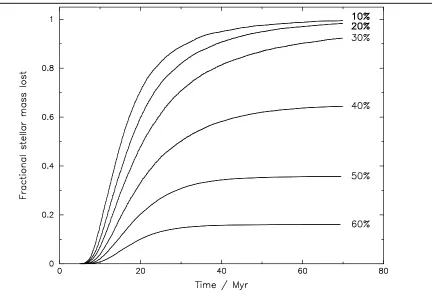
Figure 1 shows the mass loss with time for clusters
with ǫ = 0.1 to 0.6 from Goodwin & Bastian (2006).
In agreement with other simulations these show that
clusters withǫ <0.33≡Q⋆>1.5 are destroyed, whilst
clusters with ǫ >0.33≡Q⋆ <1.5 are able to survive.
Also note that clusters that survive may undergo signif-icant mass-loss and their final mass may be signifsignif-icantly less than their initial mass (‘infant weightloss’, see e.g. Kroupa & Boily 2002; Goodwin & Bastian 2006; Baum-gardt & Kroupa 2007).
When gas expulsion is slow (adiabatic), the effect of gas loss is less dramatic (as clusters are able to adjust to the changing potential somewhat), with a critical
SFE of ∼ 20 per cent (e.g. Mathieu 1983; Lada et
al. 1984; Goodwin 1997a; Baumgardt & Kroupa 2007). However, the assumption that the stars and gas are ini-tially in virial equilibrium still underlies the derivation of this critical SFE in the adiabatic case.
2.1 The initial virial ratio
The dependence of survival (or mass loss) on the SFE
is not, in fact, a dependence on the SFE:it is a
depen-dence on the virial ratio of the stars immediately before the onset of gas expulsion. The models on which this is based assume that the stars and gas are initially in virial equilibrium and therefore translate this into an SFE. Note that gas expulsion in situations where the system (in particular the stars) are not in virial equi-librium has been considered previously (see e.g. Lada et al. 1984; Verschueren 1990).
The effective SFE (eSFE, or ǫe) is the SFE derived
from the virial ratio of the stars (Verschueren 1990; Goodwin & Bastian 2006) is given by
eSFE≡ǫe=
1
2Q⋆
clearly from eqn. 1, the eSFE is equivalent to the true SFE when the stars and gas are initially virialised.
If the stars and gas are not initially in virial equilib-rium (we shall discuss if this is a reasonable expectation in the next section), the survivability of clusters can be significantly altered as the eSFE is no longer equal to the true SFE.
If the stars and gas have the same (spacial) distribu-tion then the total potential energy of the initial cluster and the potential energy of the stars will be related by the true SFE
Ω⋆=ǫ
2
Ω0
However, if we relax the assumption that the dynam-ical state of the stars and gas are well coupled, then we do not know the initial kinetic energy of the gas or
the stars. We can define a new total kinetic energyTvir
which is the kinetic energy the initial (gas and stars)
cluster would haveif it were in virial equilibrium. This
is not to say that the stars and gasarein virial
equilib-rium with each-other – in particular, the kinetic energy of the gas is irrelevant, as it is only the gas potential which the stars feel that is of importance to this dis-cussion. Therefore, the true total initial kinetic energy could be anything (even sufficient to make the cluster
unbound),Tvir is merely a mathematical tool.
If the stars have a velocity which is some fractionfof
the velocity required for them to be in virial equilibrium with the potential of the gas, then the kinetic energy
of the stars will be some fraction f2
ǫofTvir. It seems
reasonable to assume that the fraction will depend on
the SFE, and if it does not this is accounted for by f
which is a completely free parameter. By definition
Tvir
Ω0
= 0.5
The virial ratio of the stars is
Q⋆=
T⋆
Ω⋆
= f
2
ǫ Q0= f2
2ǫ (2)
Comparing eqns. 1 and 2 shows that the only
dif-ference is the factor f which parameterises the initial
dynamical state of the stars. If f < 1, the stars are
dynamically ’cold’, if f >1 they are ’hot’.
A cluster with a true SFE of ǫ = 0.33 is
usu-ally considered to be at the critical point for sur-vival/destruction.
For a cold cluster with f = 0.8 and a critical true
SFE of ǫ = 0.33, then Q⋆ = 0.96. Therefore the
ef-fective SFE (ie. how the cluster will respond to gas
expulsion) isǫe= 0.51 – well into the regime of
surviv-ing gas expulsion (see fig. 1).
Conversely, for a hot cluster withf = 1.2 and a true
SFE of ǫ= 0.5 (which would be expected to survive),
the eSFE is onlyǫe= 0.35 – right at the border-line of
survivability.
3 Are star clusters in virial equilibrium?
More correctly this section should be titled ‘Are the stars in star clusters in virial equilibrium with the resid-ual gas potential?’. For brevity the phrase ‘virial equi-librium’ as used here and below refers to the virial state of the stellar component with respect to the residual gas potential.
Fig. 1 The fractional stellar mass loss with time from a 20pc radius sphere around a cluster with an initial virial ratio 1/2ǫ, whereǫcorresponds to an SFE of 10, 20, 30, 40, 50 and 60%. From Goodwin & Bastian (2006)
Firstly, do the stars in clusters form in virial equilib-rium? Secondly, and most importantly for this discus-sion, are the stars in virial equilibrium at the onset of gas expulsion?
3.1 Do star clusters form in virial equilibrium?
Probably the most popular model of star formation at the moment is that of ‘star formation in a crossing time’ (Elmegreen 2000; see also many articles in ‘Protostars and Planets V’). In this scenario star formation is vi-olent and short-lived, and the GMCs from which stars form are highly turbulent, and possibly globally un-bound, structures. Stars form in dense knots and fila-ments created by the turbulent structure of the gas (see e.g. Padoan & Nordlund 2002,2004; Klessen & Burkert 2000; Klessen 2001; Li et al. 2003; Jappsen et al. 2005). In such a scenario there is no reason to expect stars to form in virial equilibrium. It is plausible to imagine situations where the stellar content is hot (e.g. different star forming knots form in regions with large relative velocities), or cold (e.g. despite the supersonic veloc-ities of much of the gas, stars form in almost station-ary converging flows). Indeed, depending on the details of the turbulence in any one GMC it is quite reason-able to think that either possibility may occur. It is also reasonable to imagine a situation where the initial
virial equilibrium depends on the true SFE (e.g. higher SFEs imply more dense converging regions with high or low relative velocity dispersions). Without a fuller understanding of GMC formation and subsequent star formation it is quite impossible to draw any reasonable conclusions about what we should expect.
Indeed, in such a scenario there is no reason to as-sume that the initial spacial distribution of the stars and gas should be very similar. Stars will form in dense knots which may not match the large scale mass (po-tential) distribution of the gas. Therefore the
assump-tion underlying eqn. 2 that Ω⋆ = ǫ
2
Ω0 may well be
incorrect. In such a situation the problem becomes in-tractable and will depend on the exact details of the turbulent velocity and density structure of the GMC. However, it is still possible to connect the eSFE to the
true SFE through thef-parameter, even if we have no
feel for its expected value(s).
3.2 Are star clusters in virial equilibrium at the onset of gas expulsion?
[image:4.612.94.526.72.362.2]oppor-4
tunity for a cluster to relax into virial equilibrium (e.g. Verschueren 1990).
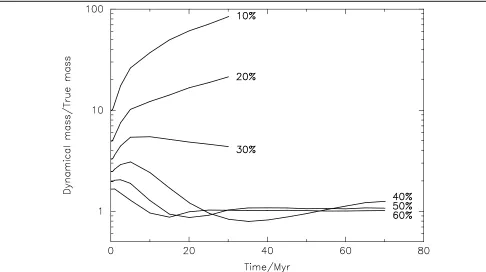
In only a few crossing times a cluster that is far from virial equilibrium can relax to close to virial equilibrium (see fig. 2). This would suggest that clusters that last for a few crossing times before the onset of gas expulsion should be roughly in virial equilibrium. If we assume a constant cluster radius then the crossing time scales
as M−1. Therefore high-mass clusters are more likely
to be close to f = 1 (ie. their eSFE is close to their
true SFE) than low-mass clusters as they have more crossing times to reach virial equilibrium. This means that if clusters are generally born hot then high-mass clusters will be more likely to survive than low-mass clusters, conversely, if clusters are generally born cold then high-mass clusters will be less likely to survive.
However, there are two important considerations to add to this discussion.
Firstly, if clusters are born in a highly non-equilibrium state, with stars forming in knots and filaments in a background of a highly turbulent gas potential, then relaxation into virial equilibrium is presumably not a simple process. In particular in the background gas po-tential is highly variable it may strongly influence the evolution of the dynamical state of the stars.
Secondly, during relaxation into an equilibrium state, a cluster will oscillate around exact virial equi-librium before finally settling as illustrated in fig. 2 for the post-gas expulsion clusters with eSFEs of 40, 50 and 60%. In the case of the 40% eSFE cluster the size of the oscillation can be quite extreme, corresponding
to anf factor of between 0.9 and 1.1. These examples
are for initially hot (ie. post gas expulsion) clusters, but initially cold systems would do exactly the same thing whilst collapsing.
This raises the interesting possibility that an ini-tially hot system could expand during the embedded phase and be caught at the start of gas expulsion in
the cold phase of its relaxation and so havef <1,
in-creasing the chance that it will survive. This possibility
re-emphasises the point that it is the virial state
imme-diately beforegas expulsion that is the critical state, not the virial state at birth.
4 The effect on infant mortality and cluster mass functions
As we have seen, even small departures from virial equi-librium at the onset of gas expulsion can cause signif-icant changes in the eSFE when compared to the true SFE. Cold clusters with a low true SFE can survive, whilst hot clusters with a high true SFE may still be destroyed.
Kroupa & Boily (2002) suggested that the shape of cluster mass functions may change due to the different impact of gas expulsion on clusters of different masses - in particular, that high-mass clusters may loose their gas adiabatically and so be far more robust (see also Parmentier et al. 2008a,b). However, depending on the
value of thef-factor, these conclusions may change. In
particular, as noted above, if clusters have a constant radius, then high-mass clusters should be closer to virial equilibrium than low-mass clusters due to having had more crossing times to relax. Therefore, high-mass clus-ters are more likely to survive if all clusclus-ters are born hot, and less likely to survive if all clusters are born cold.
That it appears that gas expulsion is the best mecha-nism for converting a birth power-law cluster mass tion into a bell-shaped old globular cluster mass func-tion through the preferential destrucfunc-tion of low-mass clusters (see Kroupa & Boily 2002; Parmentier et al. 2008a,b) may suggest that clusters are generally born hot.
It may be that the environment plays an important role in setting the initial dynamical state of clusters and so determining their robustness to gas expulsion. Gieles et al. (2007) and de Grijs & Goodwin (2008) find very little evidence for infant mortality in the SMC (but see Chandar et al. 2006 for a contrary view), and Goodwin et al. (in prep) find similar low-levels of in-fant mortality in the LMC. This is in sharp contrast to the high-levels of infant mortality seen in the Solar Neighbourhood (Lada & Lada 2003), or in the Anten-nae (e.g. Whitmore et al. 2007 and references therein) or M51 (e.g. Bastian et al. 2005). Could this be due to different initial dynamical states of clusters in different galaxies?
Interestingly, the mass regimes probed in different studies are very different. High-levels of infant mortal-ity are seen for low-mass clusters locally, and high-mass clusters in the Antennae and M51. However, the low-levels of infant mortality are seen for intermediate-mass clusters in the SMC and LMC. If cluster formation is universal, then this may suggest that low- and high-mass clusters are hot, whilst intermediate-high-mass clusters are cold.
Fig. 2 The ratio of the dynamical mass to the true mass of a star cluster with time after gas expulsion for clusters with initial virial ratios 1/2ǫ, whereǫcorresponds to an SFE of 10,20,30,40,50 and 60%. The difference between the dynamical and true masses is due to the stars being out of virial equilibrium. Note that forǫ = 0.4 – 0.6 (some of) the clusters re-virialise, but oscillate around a virial ratio of 0.5. From Goodwin & Bastian (2006)
5 Conclusions
The crucical factor in determining if a cluster will sur-vive gas expulsion is the virial state of the stars imme-diately before the conset of gas expulsion. If the stellar component of clusters is born dynamically ‘cold’, then clusters are far more likely to survive the destructive effects of gas expulsion.
[image:6.612.52.538.74.346.2]6
References
Baumgardt, H. & Kroupa, P. 2007, MNRAS, 380, 1589 Bastian, N., Gieles, M., Lamers, H. J. G. L. M.,
Scheep-maker, R. A. & de Grijs, R. 2005, A&A, 431, 905 Bastian, N. & Goodwin, S. P. 2006, MNRAS, 369, L9 Boily, C. M. & Kroupa, P. 2003a, MNRAS, 338, 643 Boily, C. M. & Kroupa, P. 2003a, MNRAS, 338, 673 Chandar, R., Fall S. M. & Whitmore, B. C. 2006, ApJ, 650,
L111
Elmegreen, B. G. 1983, MNRAS, 203, 1011
Elmegreen, B. G. & Clemens, C. 1985, ApJ, 294, 523 Elmegreen, B. G. 2000, ApJ, 530, 277
de Grijs, R. & Goodwin, S. P. 2008, MNRAS, in press Gieles, M., Lamers, H. J. G. L. M., Portegies Zwart, S. F.
2007, ApJ, 668, 268
Goodwin, S. P. 1997a, MNRAS, 284, 785 Goodwin, S. P. 1997b, MNRAS, 286, 669
Goodwin, S. P. & Bastian, N. 2006, MNRAS, 373, 752 Gyer, M. P. & Burkert, A. 2001, MNRAS, 323, 988 Hills, J. G. 1980, ApJ, 235, 986
Jappsen, A.-K., Klessen, R. S., Larson, R. B., Li, Y. & Mac Low M.-M. 2005, A&A, 435, 611
Klessen, R. S. & Burkert, A. 2000, ApJS, 128, 287 Klessen, R. S. 2001, ApJ, 556, 837
Kroupa, P. & Boily, C. M. 2002, MNRAS. 336, 1188 Lada, C. J., Margulis, M. & Dearborn, D. 1984, ApJ, 285,
141
Lada, C. J. & Lada E. A. 2003, ARAA, 41, 57
Li, Y., Klessen, R. S. & Mac Low, M.-M. 2003, ApJ, 592, 975
Mathieu, R. D. 1983, ApJ, 267, 97
Padoan, P. & Nordlund, ˚A 2002, ApJ, 576, 870 Padoan, P. & Nordlund, ˚A 2004, ApJ, 617, 559
Parmentier, G., Baumgardt, H. & Kroupa P. 2008a, MN-RAS, in press
Parmentier, G., Goodwin, S. P., Kroupa, P. & Baumgardt, H. 2008b, ApJ, submitted
Pinto, F. 1987, PASP, 99, 1161
Verschueren, W. & David, M. 1989, A&A, 219, 105 Verschueren, W. 1990, A&A, 234, 156
Whitmore, B. C., Chandar, R., & Fall, S. M. 2007, AJ, 133, 1067