Version: Accepted Version
Article:
Benone, C.L., Leite, L.C.S., Crispino, L.C.B. et al. (1 more author) (2018) On-axis scalar
absorption cross section of Kerr–Newman black holes: Geodesic analysis, sinc and
low-frequency approximations. International Journal of Modern Physics D, 27 (11).
1843012. ISSN 0218-2718
https://doi.org/10.1142/S0218271818430125
Electronic version of an article published as International Journal of Modern Physics D,
Vol. 27, No. 11, 1843012 (2018) https://doi.org/10.1142/S0218271818430125 © [copyright
World Scientific Publishing Company] https://www.worldscientific.com/worldscinet/ijmpd
[email protected] https://eprints.whiterose.ac.uk/
Reuse
Items deposited in White Rose Research Online are protected by copyright, with all rights reserved unless indicated otherwise. They may be downloaded and/or printed for private study, or other acts as permitted by national copyright laws. The publisher or other rights holders may allow further reproduction and re-use of the full text version. This is indicated by the licence information on the White Rose Research Online record for the item.
Takedown
If you consider content in White Rose Research Online to be in breach of UK law, please notify us by
c
World Scientific Publishing Company
On-Axis scalar absorption cross section of Kerr-Newman black holes: Geodesic analysis, sinc and low-frequency approximations
CAROLINA L. BENONE, LUIZ C. S. LEITE AND LU´IS C. B. CRISPINO
Faculdade de F´ısica, Universidade Federal do Par´a 66075-110, Bel´em, Par´a, Brazil
[email protected], [email protected], [email protected]
SAM R. DOLAN
Consortium for Fundamental Physics, School of Mathematics and Statistics, University of Sheffield, Hicks Building, Hounsfield Road, Sheffield S3 7RH, United Kingdom
Received Day Month Year Revised Day Month Year
We investigate null geodesics impinging parallel to the rotation axis of a Kerr-Newman black hole, and show that the absorption cross section for a massless scalar field in the eikonal limit can be described in terms of the photon orbit parameters. We compare our sinc and low-frequency approximations with numerical results, showing that they are in excellent agreement.
Keywords: Kerr-Newman black holes; null geodesics; scalar absorption.
PACS numbers: 04.50.-h, 04.50.Kd, 04.20.Jb
1. Introduction
Geodesics are a major issue of study in general relativity, since they give us the path followed by free particles in a spacetime. They help us to understand the structure of the spacetime, revealing new features. For geometries with rotation, the study of geodesics shows the presence of an ergoregion,i. e.a region where the particle has to rotate in the same sense as the central object. One can also study the formation of black holes by following the horizon generators, which follow null geodesics.
The curvature of the spacetime can act as a lens, making the path of light deviate from a straight line. This effect is related to the first experimental test of general relativity, and to the measurements of the deflection of light by the sun during the eclipse of 29th May 1919.1 This gravitational lensing makes it possible to see multiple images from a single source (e.g Einstein cross). For some cases the light of the source can be even lensed in a ring, in which case we have an Einstein ring.2 By studying null geodesics one can also determine the shadow of a black hole. This shadow is expected to be seen in the near future with the Event Horizon
Telescope.3, 4 Depending on the form of the shadow, we can differentiate between various kinds of black holes, which can also be used to test the no-hair theorem.5
The importance of studying geodesics extrapolates the limit of classical physics, being important also to understand the behavior of quantum fields around black holes. For instance, one can show that the total absorption cross section of quantum fields by black holes presents regular oscillations around the capture cross section, which is given byσgeo =πb2
c, where bc is the critical impact parameter. Sanchez first noticed this feature when she studied the absorption spectrum of a massless scalar field around a Schwarzschild black hole.6 From this result she proposed a model involving a sinc(x) = sin(x)/xfunction, matching the parameters in order to fit the numerical curves.
In Ref. 7, Sanchez’s result was generalized for static black holes with any dimen-sion. The authors used Regge pole techniques to show that the oscillatory pattern of the absorption cross section can be matched through a sinc(x) function, where the parameters involved are related to the light ring. Recently, Macedo and collab-orators showed that this result can be extended for the case of absorption by a Kerr black hole.8 The Regge pole techniques used in Ref. 7 were also applied to charged black holes, whose absorption properties have been extensively investigated in the literature.9–12
In a recent paper the absorption cross section for a massless scalar field im-pinging upon a charged rotating black hole for different incidence angles has been investigated.13 It has been shown that, for the on-axis case, the total absorption cross section oscillates around the classical limit, but the sinc approximation for this case was still lacking.
Besides the sinc approximation, in the present paper we investigate on-axis null geodesics in a Kerr-Newman black hole to find the high-frequency limit of the scalar absorption cross section. We organize the rest of this paper as follows: In section 2 we consider null geodesics, finding analytical expressions for the on-axis case. In section 3 we use the Regge pole technique to find an expression for the high-frequency limit of the absorption cross section. In section 4 we present the equations for a massless scalar field impinging upon a Kerr-Newman black hole, describing the numerical procedure we used to find the solution, which we compare with the results for the sinc approximation. In section 5 we reobtain the result for the low frequency limit, showing that it goes to the area of the black hole event horizon. In section 6 we present our final remarks.
2. Null orbit equations
The Kerr-Newman black hole can be described by the following line element
ds2=
1−2M r−Q
2
ρ2
dt2−ρ
2
∆dr 2
−ρ2dθ2
+ 4M arsin 2θ
−2aQ2sin2θ
ρ2 dtdφ−
ξsin2θ ρ2 dφ
where ρ2≡r2+a2cos2θ, ∆≡r2−2M r+a2+Q2, andξ≡(r2+a2)2−∆a2sin2θ. This line element corresponds to a black hole with massM, charge Qand angular momentum J =aM, provided that a2+Q2 ≤M2. This black hole has an event horizon located at r+ = M +p
M2−(a2+Q2) and a Cauchy horizon at r − = M−p
M2−(a2+Q2).
For this case, the equations of motion for a light ray are given by14
ρ2t˙=(r2+a2)2−aLz(r2+a2)
∆ −sin
2θ
a2− Lza
sin2θ
, (2)
ρ4r˙2= [(r2+a2)
−aLz]2−∆[(Lz−a)2+K]≡R(r), (3)
ρ2φ˙= a(r2+a2)−a2Lz
∆ −
asin2θ− Lz
sin2θ , (4)
ρ4θ˙2= [
K+ (Lz−a)2]−
(asin2θ− Lz)2
sin2θ , (5)
where Lz = Lz/E is the azimuthal angular momentum per unit energy and K = KC/E2is the Carter’s constant (KC) per unit energy (E) squared.
We will focus on the case of incidence along the black hole rotation axis, which impliesLz= 0. For this case, the impact parameterbis given by15
b=pK+a2. (6)
To find the circular null orbit we must solve R(rc) = 0 and R′(rc) = 0, in order to find the critical impact parameterbc and the critical radius rc. For the critical impact parameter, we find
b2c =
2rc(r2c+a2) rc−M
. (7)
As for the critical radius, we obtain
rc=M+ 2 p
M2−(a2+ 2Q2)/3 cos
1 3arccos
M3−(a2+Q2)M (M2−(a2+ 2Q2)/3)3/2
. (8)
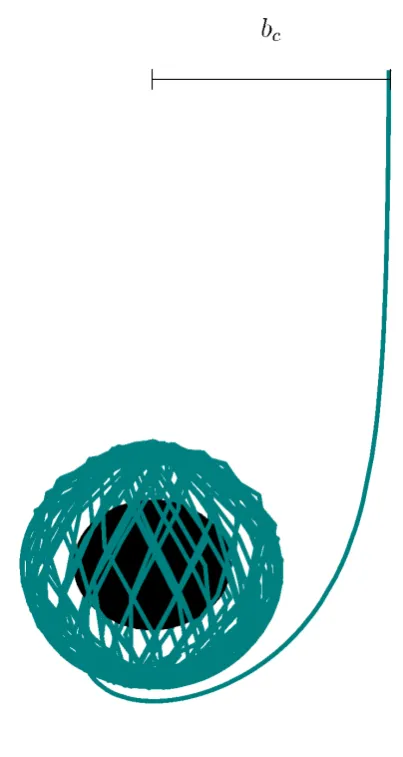
In Fig. 1 we display a geodesic with critical impact parameter for a black hole with a= 0.9M and Q= 0.3M. The total angular momentum is not conserved for the rotating case, which implies that the geodesic does not stay in the same plane.
The time for a light ray to leave and return to the same pole, that is to undertake a latitudinal angle of 2π, is called latitudinal period and can be found through
T0= 2 Z 1
−1 ˙ t ˙
zdz, (9)
wherez= cosθ. From Eqs. (2) and (5) we find
˙ t=ρ−2
(r2+a2)2
∆ −(1−z 2)a2
r=rc
, (10)
and
˙
z=hρ−2p
(K+a2z2)(1−z2)i r=r
c
which gives us
T0= 4
K KE −a 2 K +
(r2+a2)2
∆ −(a 2+ K) K −a 2 K , (12)
where K(k) and E(k) are the complete elliptic integrals of the first and second kind, respectively.
The Lyapunov coefficient is given by
Λ = 1˙ t
r 1 2
d2V
dr2, (13)
whereV = ˙r2. We can take an orbital average of this coefficient,15 given by
Λ0= 2 T0
Z 1
−1 ¯ λt˙
˙
zdz, (14)
such that we obtain
Λ0=4
√
6r2+ 2a2−b2
T0√K K
−a 2 K . (15)
3. Sinc Approximation
The total massless scalar absorption cross section for a charged rotating black hole is given by13
σ= ∞ X l=0 l X
m=−l 4π2
ω2|Sωlm| 2Γ
ωlm, (16)
whereSωlm are the oblate spheroidal harmonics16and Γωlm are the greybody fac-tors. By using the complex angular momentum technique we are able to find an an-alytic formula for the absorption cross section in the high-frequency limit in terms of the properties of the photon orbit. We make the transformationl=λ−1/2 in Eq. (16), whereλ is a complex number. Manipulating this equation, following closely Ref. 7, we find
σ=σgeo−4π
2
ω2 Re "∞
X
n=1
eiπ(λn−1/2)λ
nγn|Sωl0|2 sin[π(λn−1/2)]
#
, (17)
whereσgeo=πb2
c , andγnare the residues for the Regge polesλn. For the spheroidal harmonics we consider the approximation used in Ref. 8, given by
|Sωl0|2≈ 1
2π2. (18)
A good approximation for the greybody factors in the high-frequency regime is given by7
Γωlm≈
1
Fig. 1. Critical null geodesic with critical impact parameter (bc) impinging parallel to the
rota-tional axis of a Kerr-Newman black hole witha= 0.9MandQ= 0.3M.
where Ω0 = 2π/T0 is the orbital frequency for the critical orbit andL ≡l+ 1/2. By finding the poles of Eq. (19), which are given by
λn= ω Ω0
+i
n+1 2
β+O(1/ω), (20)
we may obtain the corresponding residues, namely
γn=− β
where
β≡Λ0/Ω0. (22)
Substituting Eqs. (18)–(21) in Eq. (17), and using also
∞ X
p=1
ei2pπ(z−a)= ieiπ(z −a)
2 sin[π(z−a)] (23)
forp= 1, we find, from the first Regge pole,7
σ≈σgeo
1−8πβe
−πβ
Ω2 0b2c
sinc 2πω
Ω0
. (24)
4. Numerical results
A massless scalar field obeys the Klein-Gordon equation, given byΨ = 0. To solve this equation we make a separation of variables and write the solution as
Ψ = +∞ X l=0 +l X
m=−l
Uωlm(r)
√
r2+a2Sωlm(θ)e
imφ−iωt, (25)
whereSωlm(θ) are the oblate spheroidal harmonics figuring in Eqs. (16)–(18). We need to solve the radial equation, given by13
d2U ωlm(r⋆) dr2
⋆ +
(
ω−m a r2+a2
2 +
2M r−2r2−∆ + 3r 2
r2+a2∆
∆
(r2+a2)3
− a2ω2+λlm−2maω ∆ (r2+a2)2
)
Uωlm(r⋆) = 0, (26)
wherer⋆is the tortoise coordinate, defined as
r⋆≡ Z
dr
r2+a2 ∆
. (27)
In order to solve Eq. (26) we need to impose boundary conditions, which we fix as
Uωlm(r⋆)∼
IωlmUI+RωlmUI∗(r⋆/M →+∞),
TωlmUT (r⋆/M → −∞),
(28)
in which
UI =e −iωr⋆
N X
j=0 hj
rj, (29)
UT =e
−i(ω−mΩH)r⋆ N X
j=0
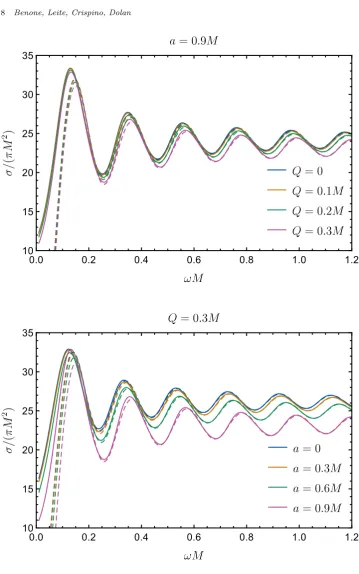
These are the appropriate boundary conditions to describe a scattering problem, since we have an incoming and a reflected wave at infinity and a transmitted wave at the horizon.gj andhjare constants to be determined by substituting the boundary conditions in the radial equation for the corresponding limits. In order to simplify the equations we chooseh0 =g0 = 1. Once we have found the radial solution, we manipulateUωlmanddUωlm/dr, and find the reflection coefficient, which we use to compute the total absorption cross section, knowing that Γωlm= 1−|Rωlm/Iωlm|2. In Fig. 2 we compare the results for the sinc approximation, given by Eq. (24), with numerical results for different choices of Q and a. The solid lines are the numerical results, while the dashed lines are the corresponding analytical ones. We see that the sinc approximation presents a good fit to the numerical results, even for relatively small values of the frequency (ωM &0.15).
5. Low-frequency approximation
The low-frequency limit of the absorption cross section for massless scalar fields is a well known result in the literature, having been found for stationary spacetimes with any dimension.17 In particular, for the Kerr-Newman spacetime it was first obtained by Maldacena and Strominger.18 Here we obtain analytically this low-frequency approximation in a slightly different way.19, 20 We will consider three solutions: One for zero frequency (U0), one forr → ∞ (UI), and one for r →r+ (UH). We will then consider the overlapping between these solutions in order to find the reflection coefficient and, hence, the absorption cross section.
We first consider the case for zero frequency. The eigenvalues of the spheroidal harmonics obey the expansion16
λlm =l(l+ 1) + ∞ X
k=1
c2k(aω)2k. (31)
Since we are considering the low-frequency limit, we can takeλlm ≈l(l+ 1). We now solve Eq. (26) makingω= 0, for which case we obtain
U0=pr2+a2APm¯ l (y) +
p
r2+a2BQm¯
l (y), (32)
where Pm¯
l (y) and Qml¯(y) are the associated Legendre functions of the first and second kind, respectively,AandB are constants and
¯
m=−p iam
M2−(a2+Q2), (33)
y= (r−M)ǫ, (34)
ǫ= p 1
M2−(a2+Q2). (35)
In the limitr→r+,y→1. Since,Qm
0.0 0.2 0.4 0.6 0.8 1.0 1.2 10
15 20 25 30 35
0.0 0.2 0.4 0.6 0.8 1.0 1.2
[image:9.595.113.473.143.718.2]10 15 20 25 30 35
Now we consider the solution forr→ ∞. In this case Eq. (26) reduces to
d2U ωlm(r⋆) dr2
⋆ +
ω2−l(lr+ 1)2
Uωlm(r⋆) = 0, (36)
where we neglected terms ofω2/r2andO(1/r3) in Eq. (26). The solution of Eq. (36) is given by
UI =ωr⋆[(−i)l+1Iωlmh∗l(ωr⋆) +il+1Rωlmhl(ωr⋆)]. (37)
The coefficients of Eq. (37) were chosen such that Eq. (37) reduces to Eqs. (28)-(30) with only thej= 0 term retained. Indeed, in the limitωr⋆≫l(l+ 1), we have
hl(ωr⋆) = (−i)l+1e iωr⋆
ωr⋆
. (38)
Substituting Eq. (38) in Eq. (37), we obtain
UI =Iωlme −iωr⋆
+Rωlmeiωr⋆. (39)
We will now consider the overlapping between Eqs. (32) and (37). In order to do that, we first consider the limitr→ ∞, for which case the associated Legendre functions reduce to
Plm(x) =
(2l)! 2liml!(l−m)!x
l, (40)
such that Eq. (32) reduces to
U0=A (2l)! 2lim¯l!(l−m¯)!ǫ
lrl+1, (41)
where (l−m¯)! = Γ(l−m¯ + 1).
Considering now the limit of Eq. (37) forωr⋆≪1, we obtain
UI = [(−i)l+1Iωlm+il+1Rωlm] 2ll!
(2l+ 1)!(ωr⋆) l+1
+i[(−i)l+1Iωlm−il+1Rωlm] (2l)!
2ll!(ωr⋆)
−l, (42)
where we used thathl(x) =jl(x) +inl(x), with
jl(x) = 2 ll!
(2l+ 1)!x
l, (43)
nl(x) =− (2l)!
2ll! x
−(l+1). (44)
In order to guarantee that the solution is not divergent in the low-frequency limit, we assumeRωlm≈(−1)l+1Iωlm, such that Eq. (42) gives us
UI = (−i)l+1Iωlm 2l+1l! (2l+ 1)!(ωr⋆)
Comparing Eq. (41) and Eq. (45), we find that
A= (−i)
l+12l+1+ ¯m(l!)2(l−m¯)!ωl+1
(2l)!(2l+ 1)!ǫl Iωlm, (46)
such that Eq. (32) is given by
U0=(−i)
l+12l+1+ ¯m(l!)2(l−m¯)!ωl+1
(2l)!(2l+ 1)!ǫl Iωlm p
r2+a2Pm¯
l (−M ǫ+ǫr). (47)
Let us now consider the case forr→r+. Takingj= 0 in Eq. (30), we obtain
UH =T
ωlme−i(ω−mΩH)r⋆. (48)
Considering the case forω≪1, we find
UH =Tωlm. (49)
We now consider the limitr→r+ in Eq. (47). In order to simplify our calcula-tions we consider only the casem= 0, for which we havePl0(1) = 1. Substituting this result in Eq. (47), we have
U0= (−i)
l+12l+1(l!)2l!ωl+1
(2l)!(2l+ 1)!ǫl Iωl0 q
r2
++a2. (50)
Comparing Eqs. (49) and (50), we find
Tωl0
Iωl0
=(−i)
l+12l+1(l!)2l!ωl+1
(2l)!(2l+ 1)!ǫl . (51)
Takingl=m= 0, we find
Tω00
Iω00
=−i2ωqr2
++a2. (52)
Now we have to substitute Eq. (52) in Eq. (16). However, as it can be also inferred from Eq. (31), the difference between the spheroidal harmonics and the spheri-cal harmonics comes from terms which depend on aω. Thus, in the limit ω → 0, Sωlm(θ) → Ylm(θ), with Ylm being the scalar spherical harmonics, which can be written as
Ylm(θ) = s
(2l+ 1) 4π
(l−m)! (l+m)!P
m
l (cosθ). (53)
Substituting Eq. (52) and Eq. (53) withl=m= 0 in Eq. (16), we obtain
σ= 4π(r+2 +a2), (54)
6. Final remarks
We considered null geodesics with incidence along the rotation axis of a charged rotating black hole. We solved the equations for the critical geodesic, finding an-alytical expressions for the geodesic parameters, such as the Lyapunov coefficient. We used the Regge pole technique to find a closed form for the high-frequency limit of the total scalar absorption cross section for the on-axis case, the so-called sinc approximation. We presented a selection of numerical results, obtaining excellent agreement with the corresponding analytical approximations, even in the case of relatively small frequencies. We also obtained an analytical approximation for the total absorption cross section in the low-frequency limit.
Acknowledgments
The authors would like to acknowledge Conselho Nacional de Desenvolvimento Cient´ıfico e Tecnol´ogico (CNPq) and Coordena¸c˜ao de Aperfei¸coamento de Pessoal de N´ıvel Superior (CAPES) for partial financial support. S.D. acknowledges finan-cial support from the Engineering and Physical Sciences Research Council (EPSRC) under Grant No. EP/M025802/1 and from the Science and Technology Facilities Council (STFC) under Grant No. ST/L000520/1.
References
1. F. W. Dyson, A. S. Eddington and C. Davidson, Phil. Trans. Roy. Soc. Lond. A220, 291 (1920).
2. J. N. Hewitt, E. L. Turner, D. P. Schneider, B. F. Burke, G. I. Langston and C. R. Lawrence, Nature333(1988) 537.
3. H. Falcke, F. Melia and E. Agol, Astrophys. J.528(2000) L13.
4. R. S. Lu, A. E. Broderick, F. Baron, J. D. Monnier, V. L. Fish, S. S. Doeleman and V. Pankratius, Astrophys. J.788, (2014) 120.
5. P. V. P. Cunha, C. A. R. Herdeiro, E. Radu and H. F. Runarsson, Phys. Rev. Lett. 115(2015) 211102.
6. N. G. Sanchez, Phys. Rev. D18(1978) 1030.
7. Y. Decanini, G. Esposito-Farese and A. Folacci, Phys. Rev. D83, (2011) 044032. 8. C. F. B. Macedo, L. C. S. Leite, E. S. Oliveira, S. R. Dolan and L. C. B. Crispino,
Phys. Rev. D 88(2013) 064033; L. C. S. Leite, L. C. B. Crispino, E. S. de Oliveira, C. F. B. Macedo and S. R. Dolan, Int. J. Mod. Phys. D25(2016) 1641024.
9. L. C. B. Crispino and E. S. de Oliveira, Phys. Rev. D 78 (2008) 024011; L. C. B. Crispino, A. Higuchi, and E. S. de Oliveira, Phys. Rev. D80(2009) 104026. 10. L. C. B. Crispino, A. Higuchi, and G. E. A. Matsas, Phys. Rev. D82(2010) 124038. 11. E. S. de Oliveira, L. C. B. Crispino, and A. Higuchi, Phys. Rev. D84, (2011) 084048. 12. C. L. Benone, E. S. de Oliveira, S. R. Dolan and L. C. B. Crispino, Phys. Rev. D89
(2014) 104053; Addendum: [Phys. Rev. D95(2017) 044035].
13. L. C. S. Leite, C. L. Benone and L. C. B. Crispino, Phys. Rev. D96(2017) 044043. 14. B. Carter, Phys. Rev.174(1968) 1559.
15. S. R. Dolan, Phys. Rev. D82(2010) 104003.
16. C. Flammer,Spheroidal Wave Functions(Stanford University Press, Stanford, 1957). 17. A. Higuchi, Class. Quant. Grav.18(2001) L139; Addendum: [Class. Quant. Grav.19
18. J. M. Maldacena and A. Strominger, Phys. Rev. D56(1997) 4975. 19. W. G. Unruh, Phys. Rev. D14(1976) 3251.