Abstract: Fine total is one of the significant material in the planning of cement. Concrete is most generally utilized in development materials Major segments of cement are totals which are typically accessible in regular structure. The interest for waterway sand in the development business has therefore expanded because of the broad utilization of cement. The huge scale exhaustion of common sand makes ecological issues, for example, soil disintegration, disappointment of waterway banks, bringing down of stream bed, saline water interruption into the land. To evade these sort of issues and to save common assets fine total utilized in concrete is supplanted by stone residue. Utilization of stone residue in concrete improve the nature of concrete as well as go about as reasonable elective material for common stream sand for who and what is to come. In the present examination a trial program was done to consider the quality and properties of regular solid utilizing stone residue concrete in M45 grade. In view of the test examinations led, it is presumed that the stone residue is best option for the fine total since fine total and stone residue has comparable physical and mechanical properties. It is discovered that 40% supplanting of fine total with stone residue invigorates conspicuous than customary cement.
Keywords – Stone dust, Conplast SP430, Compressive strength &Split tensile strength
I.
INTRODUCTION
The Ordinarily Concrete is a composite material made of
bond, fine total, coarse total and water. At present
development industry is becoming exponentially because of a
few other factor other than expanding formative exercises.
This outcomes in colossal interest of development materials.
Significant segments of cement are totals which are generally
accessible in characteristic structure. Fine Aggregate utilized
in concrete is normally waterway sand accessible locally or at
close by area[1]. The interest for waterway sand in the
development business has thusly expanded because of the
broad utilization of cement bringing about the decrease of
sand sources and increment in price.Going for elective and
advantageous material which can be utilized as fractional or
full substitution of ordinary material can assume a crucial job
in preservation of common assets. Because of quick
development of development movement, the accessible
Revised Manuscript Received on October 22, 2019.
A. Arunya, Department of Civil Engineering, Bharath Institute of Higher Education and Research, Chennai , India. Email: [email protected]
R. Chitra, Department of Civil Engineering, Bharath Institute of Higher
Education and Research, Chennai, India.
Email: [email protected]
Thendral S, Department of Civil Engineering, Bharath Institute of
Higher Education and Research, Chennai , India.
Email: [email protected]
wellsprings of common sand are getting depleted.
Consequently preservation of regular assets is extraordinary
test for structural designers since development exercises can't
be reduced as it is personal capable. The main route is to look
through choices material which can completely or halfway
supplanted normally accessible material in development.
Stone dust is such an elective material which can be
successfully being utilized in development as incomplete
substitution of normal sand[2]. Thus an examination is
completed to recognize reasonable substitute that is
eco-accommodating, cheap and better for quality execution
II.
MATERIALS
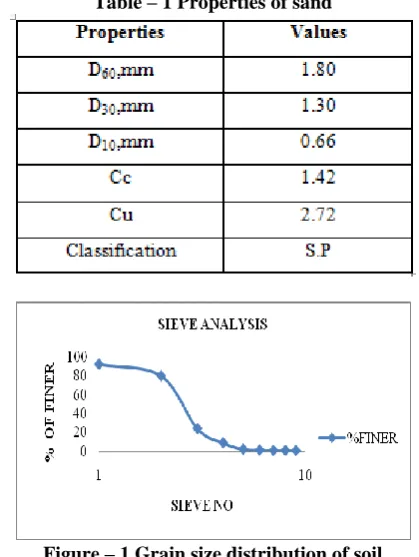
A) Fine Aggregate
[image:1.595.325.535.428.707.2]Locally accessible stream sand going totally through
4.75mm opening size strainer and adjusting to zone-II
according to IS:383-1970 particular is used in this
investigation . The fundamental test was completed and the
test outcomes are classified in Table 1.
Table – 1 Properties of sand
Figure – 1 Grain size distribution of soil
B. Coarse Aggregate
Locally accessible waterway sand going totally through
4.75mm opening size sifter and
adjusting to zone-II according to
Strength Properties of Concrete using Stone
Dust as a Replacement Material for Fine
IS:383-1970 determination is used in this examination[3]-[5].
The primer test was done and the test outcomes are arranged
in Table 2.
Table – 2 Properties of coarse aggregate
C. Cement
[image:2.595.329.530.129.240.2]In this examination Ordinary Portland Cement (OPC) 43
evaluation of single cluster was utilized adjusting to IS
8112:1989 details. Properties of OPC are recorded beneath in
Table.3
Table – 3 Properties of Cement
D. Stone dust
Stone dust got from the devastating plant at kasbapuram local
zone of kanchipuram District in Tamilnadu[6]-[10]. It was
dark in shading, dry in condition,used as a thoroughlyretained
on 150 micron sifter for whole investigation.The properties of
the material are classified in Table.4
Table – 4 Properties of stone dust
E. Conplast SP430
In this investigation conplast SP430 is utilized to give
magnificent speeding up of solidarity gain at early ages and
significant increments in quality at all ages by altogether
diminishing water request in a solid blend and furthermore to
[image:2.595.61.274.351.477.2]proportion which permit the generation of high quality cement
without inordinate concrete substance. According to May be:
9103-1999 detail. It is in fluid structure which is dark colored
in shading which has a decent consolidating property with
water. The properties of Sp430 are classified in Table.6
Table.6 Properties of Conplast (SP430)
III. METHODOLOGY
A. Fresh concrete Workability
To decide consistency of solid, Slump test was led.
Usefulness as droop test for consistency of each bunch of
solid blend complies with IS:1199-1959 details was done.
Droop estimated was recorded regarding millimeter of
subsidence of the example during test.The aftereffects of
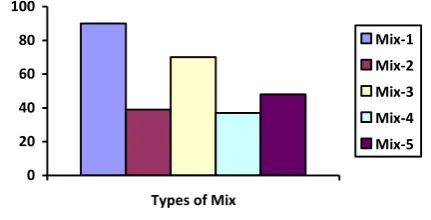
droop esteem are organized in Table.7[26]-[29]
Table.7 Slump Test Values
Figure – 2 Graphical representation of Slump Value
0 20 40 60 80 100
Types of Mix
Mix-1 Mix-2 Mix-3 Mix-4 Mix-5
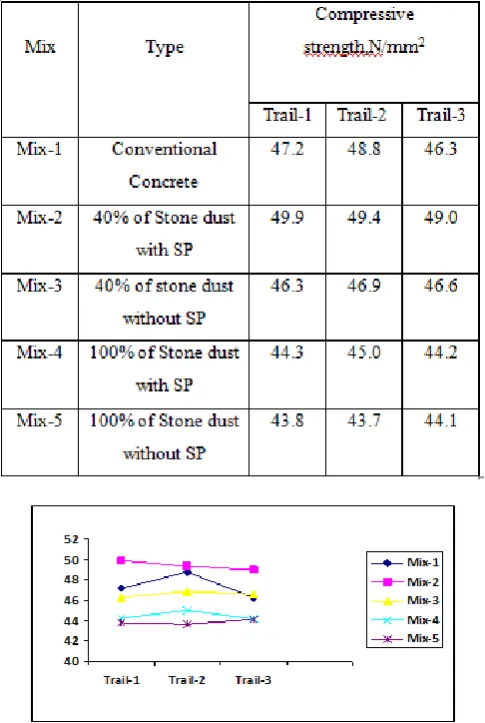
B. Compressive Test
The
shape
specimens(150*150mm)
were
tried
for
compressive quality toward the finish of 7 days and 28 days.
The examples were tried after
[image:2.595.305.550.373.506.2] [image:2.595.321.537.567.677.2] [image:2.595.56.280.569.705.2]applied on the smooth sides without stun and expanded
constantly until the disappointment of the example. The most
extreme burden withstand by the examples is noted, mean
compressive quality is resolved and introduced in Table.8 and
Table.9
[image:3.595.47.291.128.496.2]Table.8 Compressive strength test results @ 7 days
Figure - 2 Graphical representation of Compressive
Strength @ 7 days
Table.9 Compressive strength test results @ 28 days
Figure – 3 Graphical representation of Compressive
Strength @ 28 days
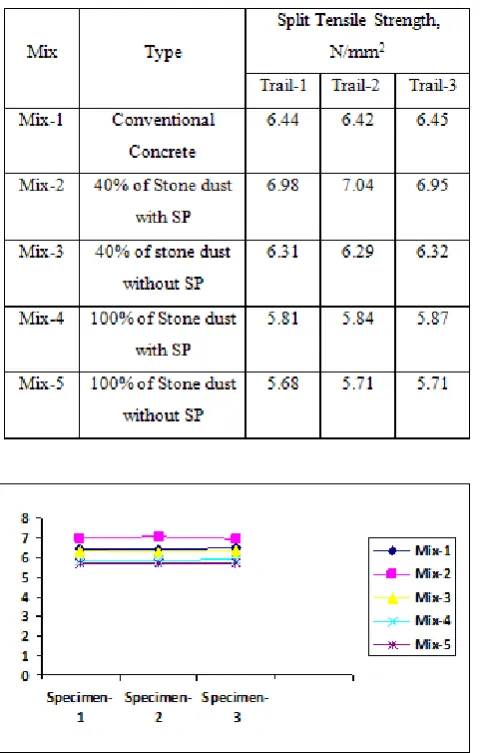
C. Split Tensile strength Test
[image:3.595.48.291.131.493.2]A chamber of example 100mm dia and 200mm length were
tried for split rigidity toward the finish of 7 days and 28
days[30]-[34]. Parting rigidity test on solid chamber is a
strategy to decide the elasticity of cement. The solid is
extremely frail in strain because of its fragile nature and isn't
relied upon to oppose the immediate pressure[15]-17]. The
solid creates breaks when exposed to ductile powers. In this
way, it is important to decide the rigidity of cement to decide
the heap at which the solid individuals may split. The
aftereffects of the split elasticity are arranged in Table.10 and
Table.11
[image:3.595.304.548.407.728.2]Fig.4 Graphical representation of Split Tensile Strength
@ 7days
Table - 11 Split Tensile strength test results @ 28 days
Figure - 5 Graphical representation of Split Tensile
Strength @ 28 days
IV.
RESULTS
AND
DISCUSSION
Compressive quality and Split Tensile quality of the solid
3D square and Cylinder examples was determined by
separating the most extreme burden applied to the example
during the test by the cross-sectional area[18]-[22].The
normal of three estimations of compressive quality was taken
machine in such way that the heap applied to the contrary
sides of the examples as cast that isn't to the top and base
according to IS;516;1959 particulars.
[image:4.595.52.293.262.639.2]An absolute number of 60 solid 3D shape and chamber
examples as a gathering of 12 3D squares (3 3D squares and 3
chambers for 7 days and 3 blocks and 3 chambers for 28 days
test )were thrown with 5 diverse blends in with the expansion
of superplasticizer.40% and 100 % supplanting of common
stream sand with stone dust with and without superplasticizer
and drenched completely in consumable water for restoring
and tried for 7 days and 28 days compressive and split pliable
strength[23]-[25].The normal results for compressive and
split rigidity for 7 and 28 days are organized in Table 12 and
Table 13.
Table - 11 Compressive strength test results @7 & 28 days
Table - 12 Split Tensile strength test results @7 & 28 days
Figure – 7 Graphical representation of Split tensile
strength @ 7 & 28 days
V.
CONCLUSION
Based on the results and discussions, the following points are
concluded,
i.
Slump of cement made utilizing stone residue
diminishes with increment in substitution level
ii.
There is a critical increment in both compressive and
split malleable test at 40% substitution of stone residue.
iii.
Stone residue can be utilized as one of the substitute
for Fine total if there should be an occurrence of
non-accessibility of normal waterway sand at a sensible
expense.
REFERENCES
1. Iyappan L., Dayakar P., Identification of landslide prone zone for
coonoortalukusing spatial technology, International Journal of Applied Engineering Research,V-9,I-22,PP-5724-5732,Y-2014.
2. Kumar J., Sathish Kumar K., Dayakar P.,Effect of microsilica on high
strength concrete, International Journal of Applied Engineering Research,V-9,I-22,PP-5427-5432,Y-2014.
3. Dayakar P., Vijay Ruthrapathi G., Prakesh J., Management of
bio-medical waste, International Journal of Applied Engineering Research,V-9,I-22,PP-5518-5526,Y-2014.
4. Swaminathan N., Dayakar P., Resource optimization in construction
project, International Journal of Applied Engineering
Research,V-9,I-22,PP-5546-5551,Y-2014.
5. Venkat Raman K., Dayakar P., Raju K.V.B.,An experimental study
on effect of cone diameters in penetration test on sandy soil,
International Journal of Civil Engineering and
Technology,V-8,I-8,PP-1581-1588,Y-2017.
6. Saritha B., Chockalingam M.P.,Photodradation of malachite green
DYE using TIO2/activated carbon composite,International Journal of Civil Engineering and Technology,V-8,I-8,PP-156-163,Y-2017
7. Shendge R.B., Chockalingam M.P., Saritha B., Ambica A.,Swat
modelling for sediment yield: A case study of Ujjani reservoir in Maharashtra, India,International Journal of Civil Engineering and Technology,V-9,I-1,PP-245-252,Y-2018
8. Chockalingam M.P., Balamurgan V.,Modernisation of an existing
urban road-sector in Chennai, a case study report,International
Journal of Civil Engineering and
Technology,V-8,I-8,PP-1457-1467,Y-2017
9. Saritha B., Chockalingam M.P.,Adsorption study on removal of basic
dye by modified coconut shell adsorbent, International Journal of Civil Engineering and Technology,V-8,I-8,PP-1370-1374,Y-2017
10. Saritha B., Chockalingam M.P.,Adsorptive removal of heavy metal
chromium from aqueous medium using modified natural
adsorbent,International Journal of Civil Engineering and
Technology,V-8,I-8,PP-1382-1387,Y-2017
11. Chockalingam M.P., Palanivelraja S.,Retrospective analysis of a
theoretical model used for forecasting future air quality near the north Chennai thermal power plant,International Journal of Civil Engineering and Technology,V-8,I-8,PP-1457-1467,Y-2017
12. Saritha B., Chockalingam M.P.,Photodegradation of methylene blue
dye in aqueous medium by Fe-AC/TiO2 Composite,Nature
Environment and Pollution
Technology,V-17,I-4,PP-1259-1265,Y-2018
13. Shendge R.B., Chockalingam M.P., Kaviya B., Ambica A.,Estimates
of potential evapotranspiration rates by three methods in upper Bhima Basin, In Maharashtra, India,International Journal of Civil Engineering and Technology,V-9,I-2,PP-475-480,Y-2018
14. Shendge R.B., Chockalingam M.P.,The soil and water assessment
tool for Ujjani Reservoir,International Journal of Mechanical Engineering and Technology,V-9,I-2,PP-354-359,Y-2018
15. Shendge R.B., Chockalingam M.P.,A review on soil and water
assessment tool,International Journal of Mechanical Engineering and Technology,V-9,I-2,PP-347-353,Y-2018
16. Sachithanandam P., Meikandaan T.P., Srividya T.,Steel framed multi
storey residential building analysis and design,International Journal of Applied Engineering Research,V-9,I-22,PP-5527-5529,Y-2014
17. Meikandaan T.P., Ramachandra Murthy A.,Study of damaged RC
beams repaired by bonding of CFRP laminates,International Journal of Civil Engineering and Technology,V-8,I-2,PP-470-486,Y-2017
18. Meikandaan T.P., Ramachandra Murthy A.,Retrofittng of reinforced
concrete beams using GFRP overlays,International Journal of Civil Engineering and Technology,V-8,I-2,PP-423-439,Y-2017
19. Meikandaan T.P., Ramachandra Murthy A.,Flexural behaviour of RC
beam wrapped with GFRP sheets,International Journal of Civil Engineering and Technology,V-8,I-2,PP-452-469,Y-2017
20. Meikandaan T.P., Murthy A.R.,Experimental study on strengthening
of rc beams using glass Fiber,International Journal of Civil Engineering and Technology,V-9,I-11,PP-959-965,Y-2018
21. Meikandaan T.P., Hemapriya M.,Use of glass FRP sheets as external
flexural reinforcement in RCC Beam,International Journal of Civil Engineering and Technology,V-8,I-8,PP-1485-1501,Y-2017
22. Saraswathy R., Saritha B.,Planning of integrated satellite township at
Research,V-9,I-22,PP-5558-5560,Y-2014
23. Saritha B., Ilayaraja K., Eqyaabal Z.,Geo textiles and geo synthetics
for soil reinforcement,International Journal of Applied Engineering Research,V-9,I-22,PP-5533-5536,Y-2014
24. Ambica A., Saritha B., Changring G., Singh N B., Rajen M., Salman
Md.,Analysis of groundwater quality in and around Tambaram taluk, Kancheepuram district,International Journal of Civil Engineering and Technology,V-8,I-8,PP-1362-1369,Y-2017
25. Arunya A., Sarayu K., Ramachandra Murthy A., Iyer
N.R.,Enhancement of durability properties of bioconcrete
incorporated with nano silica,International Journal of Civil Engineering and Technology,V-8,I-8,PP-1388-1394,Y-2017
26. Ilayaraja K., Krishnamurthy R.R., Jayaprakash M., Velmurugan
P.M., Muthuraj S.,Characterization of the 26 December 2004 tsunami deposits in Andaman Islands (Bay of Bengal, India),Environmental Earth Sciences,V-66,I-8,PP-2459-2476,Y-2012
27. Ilayaraja K.,Morphometric parameters of micro watershed in
Paravanar sub-basin, Cuddalore District,International Journal of Civil Engineering and Technology,V-8,I-8,PP-1444-1449,Y-2017
28. Ilayaraja K., Singh R.K., Rana N., Chauhan R., Sutradhar N.,Site
suitability assessment for residential areas in south Chennai region using remote sensing and GIS techniques,International Journal of Civil Engineering and Technology,V-8,I-8,PP-1468-1475,Y-2017
29. Ilayaraja K., Reza W., Kumar V., Paul S., Chowdhary R.,Estimation
of land surface temperature of Chennai metropolitan area using Landsat images,International Journal of Civil Engineering and Technology,V-8,I-8,PP-1450-1456,Y-2017
30. Chitra R.,Experimental study on beam using steel fiber and
latex,International Journal of Civil Engineering and
Technology,V-8,I-8,PP-1395-1403,Y-2017
31. Chitra R.,Analysis of traffic and management at Kovilambakkam
intersection,International Journal of Civil Engineering and Technology,V-8,I-8,PP-1433-1443,Y-2017
32. Aswathy M.,Experimental study on light weight foamed
concrete,International Journal of Civil Engineering and
Technology,V-8,I-8,PP-1404-1412,Y-2017
33. Aswathy M.,Wastewater treatment using constructed wetland with
water lettuce (Eichornia Crasipies),International Journal of Civil Engineering and Technology,V-8,I-8,PP-1413-1421,Y-2017
34. Kiruthiga K., Anandh K.S., Gunasekaran K, Assessment of
influencing factors on improving effectiveness and productivity of construction engineers, 2015, International Journal of Applied Engineering Research, V - 10,I -17,p -13849-13854.
AUTHORS
PROFILE
A. Arunya Assistant Professor, Department of Civil Engineering, Bharath Institute of Higher Education and Research, Chennai , India.
R. Chitra, Assistant Professor, Department of Civil Engineering, Bharath Institute of Higher Education and Research, Chennai , India.