International Journal of Innovative Technology and Exploring Engineering (IJITEE) ISSN: 2278-3075, Volume-8 Issue-9, July 2019
Abstract: An optimal receiver recovering transmitted signals across a noisy communication channel employs an efficient impact as Sphere Decoding (SD) benchmark to reduce the probability of error. This system can employ a coding strategy for information security where the data symbol space forms a scant lattice. The sparsity structure is resolved through channel code. In this article, motivated by this idea, we present novel efficient detection-decoding combinational techniques using Reed-Solomon (RS) decoding followed by the single tree search (STS) algorithm in SD detection. The simulation results determine that the proposed method of improving the performance of 1.6 dB at the bit error rate (BER) of has a significant impact.
Keywords: Sphere Decoding (SD), Reed-Solomon (RS), Single Tree Search (STS), Bit Error Rate (BER).
I. INTRODUCTION
The recent focus on multiple inputs, multiple outputs (MIMO) technology especially in mobile communications has aroused the impressive interest of research work because it provides diversity and multiplexing gains within the bounded power and bandwidth resources. An optimal receiver recovers signals across the noisy environment with the help of maximum likelihood receiver and it provides fallen the probability of error. Yet, it increases exponentially the computational complexity with number of antennas and modulation order which makes it infeasible for practical system [1]. Hence, the main challenge is to design a low complexity algorithm for detection of an elevated traditional MIMO system. A key requirement of the downlink (Access Point link to user terminal) in a MIMO system is to reduce computational complexity at the user terminal to enable hardware implementation, while maintaining good performance [2]. Consequently, tree-searching algorithm in Sphere Decoding(SD) has appeared as a strong candidate [3] and the K-best which can be embraced for the reason, that it has a near optimal performance and low complexity [4]. Research work has been focusing on these theories and Schnorr-Euchner enumeration targets to reduce the overall complexity [5].
An investigation of a MIMO system with applying error detection and correction codes [6], further examining such as turbo code in [7] and low-density parity-check (LDPC) codes in [8] have performed. The information bits are encodethrough channel codes and mapped with the help of complex constellation - Quadrature Amplitude Modulation
Revised Manuscript Received on July 09, 2019
Mitesh S Solanki, Electronics Engineering Department, Sardar Vallabhbhai National Institute of Technology, Surat, India
Shilpi Gupta, Electronics Engineering Department, Sardar Vallabhbhai National institute of Technology, Surat, India
Vinaykumar Singh, Electronics Engineering Department, Sardar Vallabhbhai National institute of Technology, Surat, India.
(QAM) at the transmission side. The transmitted symbol is recover through MIMO detector and the decoder fetches the information bits from estimated symbols at the receiver side. In this approach, better performance is obtained but subject to computation complexity. In the detection and decoder, the joint functions have performed well as two distinct block in [9]. The results of this approach are often swapped iteratively [10]. Access to the connection between detection and decoder strategies in the chain is suggested in [11], where channel code is functional as the convolution code and turbo code respectively. Theemerging Reed-Solomon (RS) code is the most efficient error-correction code, which is a dominant code to transmitted [12]-[13] or to ensure the integrity of the storage data system. The trade-off between the optimal performance and complexity of RS code [13] is to find out the approach that is the main prevailing problem. Thus, MIMO detection and RS codes are essential to investigate for this joint approach.
In the ML detection using Reed-Solomon code, has an NP-hard problem because of the increased length of codeword, leading to an exponential increase in the decoding complexity [12]. Because of such problems, it becomes difficult to realize these systems physically. Research work also has received much attention in the direction of soft decision decoding techniques for RS code and making efforts to have low complexity and near optimal performance. In [13]it has been reported that the performance has been improved in comparison to hard decision decoding with polynomial complexity. Therefore, one possibility is that it can be equipped with more number of antennas at the base stations. It provides attractive features like that of the large MIMO system where one can put together to transmit a bulk of data on the same resources. The motivation behind this work is to achieve near optimal performance and low complexity by using this approach. In this article, we present the sphere decoder as melodic MIMO detector. Adapting of this detector is achieved through log-likelihood ratio (LLRs) of the sphere decoder [12]. It provides a revision of the tree pruning defined in a superior approach of the single tree-search algorithm (STS) [3]. A methodically describing complexity and performance trade-off as classical approach soft output sphere decoder are formulate. Here, we describe RS codes using soft decision sphere decoder.
The memories of this article are form as follows: preliminaries of background motivation and the system model incorporating coded system are present in section II. Section III discusses about soft-output Sphere decoding algorithm schemes, where soft decision are conduct through simplified
A Novel Efficient Sphere Decoding with
Reed-Solomon Code in MIMO Detection
Schnorr-Euchner enumerations. Tree traversal strategy has given in Section IV. The simulation results have introduced in section V and ultimately section VI concludes this article.
II. BACKGROUNDANDMOTIVATION
These coded MIMO induce the making of the conceptual
emerging wireless communication concept for
communication. On this concept, the MIMO system has established itself as beneficial for the family’s data protection. In addition, enough research has conducted to implement it in the testbed. This article aims to provide a detailed statewide survey to provide a critical evaluation of its potential benefits on RS codes based MIMO research.
A. System Model
Flat fast fading is taken into consideration with an transmit antenna for MIMO system transmission and receive antennas for reception. All the information bits k are encode through Reed-Solomon codes and produce coded bit streams. Subsequently, the bit stream is mapped to symbol vectors , where denotes the complex constellation points. Each symbol is associated with vector bit-level label vector , which has the corresponding binary values in the set of The resembling bits are represented by entries, where and represent the bit label of constellation point corresponding to the entry of
[14]. The input-output relationship
mathematically modelled is
where indicates channel matrix and all entries are assume to be i.i.d. Additionally, let denote the received
signal from receive antennas.
introduces an i.i.d. complex
Gaussian noise vector with each
Specifically, we also note that both and are
known at the receiver. Our main objective at the receiver is to obtain all transmitted codewords, which is closest to receiver signal vector for given
III. SOFT-DECISIONSPHEREDECODER Considering a multiple antenna system with channel codes, a calculation of reliability information (means soft decisions) in terms of log likelihood ratio, is represented as which correlates all bits with the label vector . The error rate performance is compared with the hard decision for each transmitted bit .
A. Calculation of Maximum-Log Likelihood Ratio Fig. 1 represents the conceptual diagram of the proposed MIMO detection process. Soft-output Sphere Decoder proceeds to calculate LLR value for each transmitted bit
in compliance with [2], [3]
Genuine calculation of equation (2) leads to the prohibitive computational complexity. First of all, the
QR-decomposition employed to channel matrix
Equation (1) on the left hand side is leading to a
changed mathematical representation
Here the term has the same statistics as n. We utilize the max log approximation [2]
where and are the set of the symbols vector which has the same bit of indices and and is equal to +1 and -1, respectively. We do not consider the priori information. If we considerit to be related to a corresponding performance loss to use the definite LLR, then it requires the max log approximation.
Fig.1. MIMO detection at receiver
Additionally, there is also emphasis on the LLR in equation (4) to normalize the noise variance . To use the factor on the right hand side of equation (4) [5]. One of the two minima in equation (4) is evaluated by the metric
related with the maximum-likelihood
detection problem
The other minimum of equation (2) is represented as
where
is compatible to the set of The bit is equal to the counter-hypothesis indicating bth bit complement in the ith entry of [2]. As per the above equation (5) and (6) the max-log LLRs are represented as
In the dissent (7) of the equation, it can be compiled that representative max log degrades to appreciate the best soft output MIMO detection and
for efficient association of and [2].
IV. THREE-TRAVERSALSTRATEGY:SINGLE
TREESEARCH
Calculating the log likelihood ratio values in equation (7) which needs to verify the metric
, for known of and Soft-
Output SD
LLR Calculator
RS Decoder y
H,
Symbol list
LLR
[image:2.595.319.554.270.320.2]International Journal of Innovative Technology and Exploring Engineering (IJITEE) ISSN: 2278-3075, Volume-8 Issue-9, July 2019
the
is only found by reference to those parts of the tree which contain the leaves in
. After this, the calculation
has to be applied to the whole bit, it is directly prominent that LLR value calculation results in terms ofincreasing computational complexity compared to the hard decision. The single tree search algorithm is proposed due to its reduced computational complexity [2], [3].
A. Single Tree Search
It is the most powerful tree traversal strategy where a secure pass to every node at least once is made. This strategy can be achieved through the searching process in the ML criterion and all counter-hypothesis simultaneously. This kind of approach is proposed in [5]. We define and revise rules and pruning approach on a list carrying metric , with the comparable , and the metric
. The finding sub-trees from the arising nodes is the most significant idea if the result list i.e. at least one matrix can be repeated in or
. In the initial discussion, the prevailing ML’s hypothesis and equivalent metric are determined by and . The sphere decoding with a single tree search algorithm in soft decisioninvolves two main functions: (i) list administration (ii) tree pruning [2].
i. List Administration: The initial phase of this algorithm starts with
Whosoever a leaf with accordingly bit label is reached, the algorithm differentiates between two cases:
1. Though an update ML hypothesis is detected, i.e., , consequently every for which
in conjunction to imitated by the current and
this guarantees that every bit
in the ML hypothesis that is modified in the process of the update, the metric of the prior ML hypothesis befalls the metric of the new counter-hypothesis, intimated by a current of the ML hypothesis [2].
2. In this process , only the counter-hypothesis needs to be checked. Here, the decoder current
for every and satisfies
and
ii. Tree pruning: The tree pruning criterion is the second view of the STS algorithm. Consideration of allotted node (on level ) and the resembling speculation label including the bits . Suppose that the sub-tree source from the node under amends and compatible to the bits
has not been extensive yet, then the
pruning criterion for along with its subtree is accumulated from two states. In the first case, the fractional bit-label related to is the relatively improved ML hypothesis, with similar bits in the label of . All metrics with
detected in this comparison may be affected when searching the sub-tree of . In the second case, the metics
)similar to the counter-hypothesizes in the subtree of may be aversed as well [2], [3]. The matrix that can be disrupted through the search of a sub-tree strategy from node is presented by the following set
The node along with its sub-tree is pruned if its partial Euclidian distance satisfies
The single tree-search algorithm confirms that the given node and the initial form of all the sub-trees that the nodes are viewed only when they can verify the correction of or
[2].
Finally, the tree pruning strategy detects all information bits decoded through the RS decoder.
V. SIMULATIONRESULTS
Table 1 shows the simulation parameters. In this section, we look at the proposed approach and traditional SD’s bit error rate (BER) performance. Here, we have consistently kept channel matrix during the transmission of every codeword. We have employed RS(15, 13) and BCH(15, 11) with sphere decoding MIMO detector.
TABLE I. SIMULATION PARAMETERS
Sr
No. Parameter Description
1 Number of bits 8192
2 Antenna Configurations
3 Fading Distribution Rayleigh
4 SNR range 0 to 18 dB
5 Modulation Scheme 4-QAM & 16-QAM
6 Channel Coding RS(15,13),
BCH(15,11) 7 MIMO Signal Processing Sphere Decoder
Fig. 2.BER vs. SNR with a MIMO system for 4-QAM mapping
Fig. 3. The BER vs. SNR with a MIMO system for 4-QAM mapping
[image:4.595.51.285.279.480.2]Fig. 4. The BER vs. SNR with a MIMO system for 16-QAM mapping
Fig. 5. The BER vs. SNR with a MIMO system for 16-QAM mapping
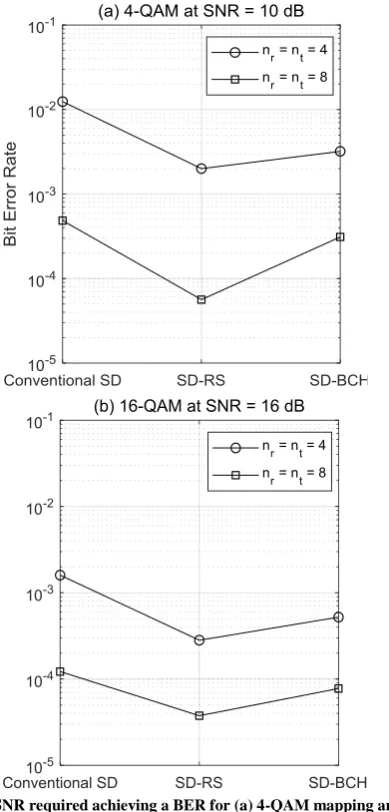
Fig. 6. SNR required achieving a BER for (a) 4-QAM mapping and (b) 16-QAM mapping
[image:4.595.334.529.288.695.2] [image:4.595.52.284.514.719.2]International Journal of Innovative Technology and Exploring Engineering (IJITEE) ISSN: 2278-3075, Volume-8 Issue-9, July 2019
modulation schemes. No iteration has been taken into account for this approach between detection and channel decoding
Figure 2 and 3 show the BER performance of the introduced approach SD-RS, SD-BCH and conventional SD. The transmission is over a and MIMO channel with 4-QAM modulation. It can be seen that our proposed approach SD-RS and SD-BCH have about 2 dB and 1.2 dB performance gain compare to conventional SD with 4-QAM modulation.
Figure 4 and 5 show the BER performance of the proposed approach SD-RS, SD-BCH and conventional SD.The simulations are under and MIMO with 16-QAM modulation. It can be seen from figure 4 and 5 that the gain proposed approach has about 1.8 dB and 1 dB performance gain compare to conventional SD with 16-QAM modulation. However, the improved RS performance is better than BCH over the rich scattering environment, since the RS codes are correcting burst errors.Finally, we note that theRS-coded system gives better performance compared to BCH coding
Further, we examine the relative performance of SD-RS, SD-BCH and conventional SD for rising constellation size. The results have been shown in figure 6. From the figure 6, one can observe that for and MIMO system at 10 dB and 16 dB provides significant improvement as compared to conventional SD, SD-RS and SD-BCH, 4-QAM and 16-QAM constellations.Furthermore, it is found that performance depends on LLRs values through channel state information and achieves good performance in coded MIMO system. Our results imply that the proposed approach can be an attractive solution for 5G communication due to its ability to support near-optimal performance and low complexity.
VI. CONCLUSION
In this article, we have showed how to represent the soft output sphere decoder with RS code. This construction establishes a new separate relation between detection and decoding in MIMO systems. Naturally, this construction allows coded links employing RS code with soft output detection the output LLRs values and can be scaled through noise variance. In addition, the RS code added in this approach is suitable for hardware realization. Through our paper focused on the RS codes, the principle is more general. With RS encoding it provides an alternative method to improve reliability information under MIMO channel and this information utilizes soft output sphere decoder. Our results gives 1.6 dB SNR improvement in performance with various antenna configurations in RS codes as compared to the other schemes.
ACKNOWLEDGMENT
This work has endorsed by the Department of Electronics, under the project funded by Sardar Vallabhbhai National Institute of Technology (SVNIT).
REFERENCES
1. H. Hai, X.-Q. Jiang, P. Selvaprabhu, S. Chinnadurai, J. Hou, and M. H. Lee, “LDMC design for low complexity MIMO detection and efficient decoding”,EURASIP J. Wirel. Commun. Netw., vol. 2018, no. 1, pp. 1-8, Dec 2018.
2. C. Studer, A. Burg, and H. Bolcskei, “Soft-output sphere decoding: algorithms and VLSI implementation”,IEEE J. Sel. Areas Commun., vol. 26, no. 2, pp. 290–300, Feb. 2008.
3. C. Studer and H. Bolcskei, “Soft–Input Soft–Output Single Tree-Search Sphere Decoding”,IEEE Trans. Inf. Theory, vol. 56, no. 10, pp. 4827–4842, Oct. 2010.
4. N. Moezzi-Madani, T. Thorolfsson, P. Chiang, and W. R. Davis, “Area-Efficient Antenna-Scalable MIMO Detector for K-best Sphere Decoding”,J. Signal Process. Syst., vol. 68, no. 2, pp. 171–182, Aug. 2012.
5. H.-W. Liang, W.-H. Chung, H. Zhang, and S.-Y. Kuo, “A parallel processing algorithm for Schnorr-Euchner sphere decoder”,IEEE Wireless Communications and Networking Conference, Paris, France, 2012, pp. 613–617.
6. M. El-Khamy, H. Vikalo, B. Hassibi, and R. McEliece, “On the Performance of Sphere Decoding of Block Codes”,IEEE International Symposium on Information Theory, Seattle, WA, 2006, pp. 1964–1968. 7. R. Sapra and A. K. Jagannatham, “EXIT Chart Based BER Expressions for Turbo Decoding in Fading MIMO Wireless Systems”,IEEE Commun. Lett., vol. 19, no. 1, pp. 10–13, Jan. 2015.
8. A. Sanderovich, M. Peleg, and S. Shamai, “LDPC Coded MIMO Multiple Access With Iterative Joint Decoding”,IEEE Trans. Inf. Theory, vol. 51, no. 4, pp. 1437–1450, Apr. 2005.
9. C. P. Sukumar, C.-A. Shen, and A. M. Eltawil, “Joint Detection and Decoding for MIMO Systems Using Convolutional Codes: Algorithm and VLSI Architecture”,IEEE Trans. Circuits Syst. Regul. Pap., vol. 59, no. 9, pp. 1919–1931, Sep. 2012.
10. A. G. D. Uchoa, C. T. Healy, and R. C. de Lamare, “Iterative Detection and Decoding Algorithms for MIMO Systems in Block-Fading Channels Using LDPC Codes”,IEEE Trans. Veh. Technol., vol. 65, no. 4, pp. 2735–2741, Apr. 2016
11. N. Kim, J. Kim, S.-C. Lim, and H. Park, “BER of MIMO-BICM System at Current Detection/Decoding Cycle”,IEEE Wirel. Commun. Lett., vol. 6, pp. 78–81, 2017.
12. F. Shayegh and M. R. Soleymani, “Soft decision decoding of Reed-Solomon codes using sphere decoding”, ICC’08. IEEE International Conference, Beijing, China, 2008, pp. 4489–4495. 13. F. Shayegh and M. R. Soleymani, “Efficient soft decoding of
Reed–Solomon codes based on sphere decoding”,IET Commun., vol. 5, no. 2, pp. 141–153, Jan. 2011
14. A. Haroun, C. A. Nour, M. Arzel, and C. Jego, “Low-Complexity Soft Detection of QAM Demapper for a MIMO System”,IEEE Commun. Lett., vol. 20, no. 4, pp. 732–735, Apr. 2016.
15. O. P. Babalola and D. J. J. Versfeld, “Analysis of Bounded Distance Decoding for Reed-Solomon Codes”,SAIEE Africa Research Journal, pp. 154-158, 2018.
AUTHORSPROFILE
Mitesh S Solanki received the B.Tech degree in Electronics and Communication Engineering from Saurashtra University, Gujarat, India, in 2011 and the M.Tech degree from Gujarat Technological University, Gujarat, India, in 2013. He is currently pursuing the Ph.D. degree with the department of Electronics Engineering, Sardar Vallabhbhai National Institute of Technology, Surat, India. His current research interests are in wireless communication and large MIMO detection algorithms.
![Fig. 1 represents the conceptual diagram of the proposed MIMO detection process. Soft-output Sphere Decoder proceeds to calculate LLR value for each transmitted bit in compliance with [2], [3]](https://thumb-us.123doks.com/thumbv2/123dok_us/8196039.259410/2.595.319.554.270.320/represents-conceptual-proposed-detection-decoder-calculate-transmitted-compliance.webp)