Rochester Institute of Technology
RIT Scholar Works
Theses
Thesis/Dissertation Collections
1989
A Simulated shape recognition system using feature
extraction
Wendy Pan
Follow this and additional works at:
http://scholarworks.rit.edu/theses
This Thesis is brought to you for free and open access by the Thesis/Dissertation Collections at RIT Scholar Works. It has been accepted for inclusion
Recommended Citation
Rochester Institute of Technology
School of Computer Science and Technology
A Simulated Shape Recognition System
Using Feature Extraction
by
Wendy Pan
A thesis, submitted to
The Faculty of the School of Computer Science and Technology
in partial fulfillment of the requirements for the degree of
Master of Science in Computer Sciences
Approved by:
John A. Biles
Edward R.
Salem
Peter G. Anderson
Permission to Reproduce
Title of Thesis:
A Simulated Shape Recognition System
Using Feature Extraction
I,
Wendy Pan,
prefer to be contacted each time a request for
reproduction is made.
I can be reached at the following
address:
19 Locke Drive
Pittsford,
NY 14534
ACKNOWLEDGEMENTS
I would especially like to thank Prof. John Biles for
his encouragement, guidance, inspiration, and many helpful
comments. He also helped me greatly on improving my thesis
writing, I am sincerely grateful. I would also like to thank
Prof. Edward Salem who reviewed the manuscript and kept me
ABSTRACT
A simulated shape recognition system using feature
extraction was built as an aid for
designing
robot visionsystems. The simulation allows the user to study the effects
of image resolution and feature selection on the performance
of a vision system that tries to
identify
unknown 2-Dobjects. Performance issues that can be studied include
identification accuracy and recognition speed as functions
of resolution and the size and makeup of the feature set. Two approaches to feature selection were studied as was a
nearest neighbor classification algorithm based on Mahalanobis distances.
Using
a pool of ten objects andtwelve features, the system was tested
by
performing studies of hypothetical visual recognition tasks.Key
Words: robot vision, feature extraction, simulation,TABLE OF CONTENTS
1. INTRODUCTION 1
2. BACKGROUND 5
2.1. Overview 6
2.2. Data Acquisition 6
2.2. 1. Visual Input Devices 6
2.2.2. Other Hardware 7
2.3. Data
Processing
72.3. 1. Segmentation 7
2.3.2. Edge Extraction 8
2.4. Classification 9
2.4. 1. Template Matching 9
2.4.2. Feature Extraction 10
2.4.3. Selection of a Feature Subset 15
2.4.4. Nearest Neighbor Classification Algorithm 16
2.5. Simulation
by
Shape Generation 19IMPLEMENTATION 23
3.1. System Overview 23
3.2. Simulated Digitization 25
3.2. 1. Shape Generation 25
3.2.2. Effect of Grid Size 26
3.2.3.
Translation,
Rotation andScaling
293.2.4. Controlled Distortion 29
3.3. Classification
by
Feature Extraction 303.3.1. Feature Pool 31
3.3.2. Feature Selection 35
3.3.3. Classification 43
3.4. Flow Charts of Implementation 44
3.4. 1. System Data Flow Diagram 44
3.4.2. Hierarchical Process Diagram 44
3.4.3. Create and Store Objects 47 3.4.4. Select Reference Objects 47
3.4.5. Select a Feature Subset 47
3.4.6.
Identify
Unknown Objects 503.5. System Hardware and Software 52
4. RESULTS AND DISCUSSION 54
4.1. Graphic Representation of Edge-Extracted Objects 55
4. 1. 1. Objects in the Object Pool 55
4.1.2. Digitized Images without Distortion .... 61
4.1.3. Types of Distortion 61
4.1.4. Digitized Images with Distortion 62
4.2. Properties of the Objects in the Object Pool ... 63
4.2.1. Average Feature Values and Their Standard
Deviations 63
4.2.2. Mahalanobis Distances between Object
Classes with All Features 66
4.3. Selection of Reference Objects from the Object
Pool 68
4. 4. Effect of Resolution 69
4.5. Selection of a Feature Subset 75
4.5. 1. Elimination of Redundant Features 75
4.5.2. Selection of Features
by
DiscrminationAbility
794.5.3. Mahalanobis Distances between Object
4. 6. Classification of Unknown Objects 84
4.6.1. Generation of an Unknown Object
at a
Randomly
Distorted State 844.6.2. Confidence Level on Identification 85
5. CONCLUSION, FUTURE WORK AND OTHER APPLICATIONS 93
5.1. Future Work 93
5.2. Other Applications 95
BIBLIOGRAPHY 96
CHAPTER 1
INTRODUCTION
The patterns we encounter fall into two categories:
abstract and concrete. Examples of abstract items include
ideas and arguments, and the recognition of such patterns is
beyond the scope of this study. Examples of concrete items
include characters, symbols, pictures, biomedical
images,
three-dimensional physical objects, speech waveforms and
electrocardiograms CB0W84]. In the last couple of
decades,
extensive interest has focused on two types of concrete
pattern recognition problems: optical character recognition
and robot vision [BERT86]. This thesis focuses on the robot
vision area.
Many
robot vision (digital image processing) systemsalso have been developed. Overviews of these systems are
presented in numerous papers CSUET863 [ZIMM833 CVANG86]. Robot
vision systems consist of a computer, an image memory bank
that is different from the computer RAM and connected to the
computer
bus,
an interface that connects the camera with theimage memory
bank,
and a sensor controller, which providesthe camera with the necessary synchronization signals.
In recent years, the power of digital image processing
also has been brought to the IBM PC and compatible
computers.
Imaging
Technology's PCVISION Frame GrabberFrame Grabber that enables the user to perform low level
digital image processing functions.
Among
them are imageaveraging, image subtraction, convolution and edge enhancing algorithms.
For a robot vision system to be capable of complex
automated assembly and inspection operations, it must be
able to perform in real time. The system's aim is to sort
randomly oriented objects on production lines at speeds of
about 10 objects/sec. As a result, some of the
functions,
such as edge detection and feature calculations, are
performed
by
dedicated hardware [CAGN863.Although robot vision systems are
being
appliedincreasingly
to manufacturing tasks, the installation of acomplete vision system is still expensive. Companies are
often reluctant to make such a major investment unless they
are sure that the system can do the job.
This thesis describes a simulated shape recognition
system that can be used to do
feasibility
studies of thesuitability of robot vision systems. There is no need to go
through all the steps in
building
a vision system just for afeasibility study because a simulated system can provide
useful data for
determining
whether to invest in an actualvision system.
For instance, if one wants to differentiate a
bolt,
athe
following
steps can be simulatedby directly feeding
thedigitized and edge extracted objects into a computer.
Using
a real robot vision system, one often needs toimage objects at random orientations and locations for a
teaching set. This can become tedious and time consuming,
but on a simulated system, the
"picture"
in computer memory
can be easily rotated, translated and scaled in a matter of
seconds.
By doing
simulation, thefollowing
questions can beanswered before one seriously considers the installation of
a real vision system:
(a) What is the minimum required camera resolution,
64x64,
128x128 or . . . ? It is easy to digitize an objectmathematically at various grid sizes. The results will provide data to
help
in selecting the right kind ofelectronic camera.
(b) What is the minimum number of features that need to
be examined to recognize a set of objects and what are those
features?
(c) What features take a
long
time to calculate? Canthese features be implemented in hardware?
Our objective was to provide a simple but complete
simulated shape recognition system to
help
decide onappropriate resolution requirements and useful feature sets
for a robot vision system in a given domain. We have tested
This system has a simulated shape
digitizer,
proceduresto select and calculate feature values, and algorithms to
perform classification. Reference objects will undergo
controlled distortions to provide a range of feature values.
The average value and its standard deviation for each
feature of each type of object are then stored for future
comparison.
Chapter 2 of this thesis gives an overview of the
concepts and various components of a robot vision system.
Prior work also is reviewed.
Chapter 3 discusses the ways we have implemented our
simulated system. Some of our own ideas are presented here
and several flow charts are included to show the details of
our system.
Chapter 4 discusses the results of our work. Digitized
images with and without distortions are plotted. Feature
values and their standard deviations for various objects are tabulated. Mahalanobis distances between object pairs are
shown. The algorithms for selecting an effective feature
subset are also presented.
Finally,
identification andconfidence levels are examined on several unknown objects.
Chapter 5 concludes our work and also suggests how to
CHAPTER 2
BACKGROUND
2.1. Overview
In robot vision, one can divide an entire task into
three phases: data acquisition, data processing and decision
classification, as shown in Figure 2.1 [B0W84]. In the data
acquisition phase, light
intensity
is measured by a sensorand converted to a digital format suitable for computer
processing. The measured data then are used as the input to the data processing phase and are grouped into a set of
characteristic features as output. The classification phase
is implemented in the form of a set of decision functions.
In the
following
sections, we will discuss each phase ingreat detail.
PHASE 1 > PHASE 2 > PHASE 3
DATA ACQUISITION
sensor detection digitization
DATA PROCESSING
segmentation
edge extraction
CLASSIFICATION
nearest neighbor
feature-extraction
2.2. Data Acquisition
An automatic visual inspection or robot vision system
consists of the
following
subsystems: the parthandling
system, the optics and the sensor, the
illumination,
and thecomputer system. Each of them is
briefly
described below.2.2.1. Visual Input Devices
A variety of devices have been used for visual input to
robot vision systems. The most popular ones are solid-state
array cameras, linear arrays and laser scanners
CRAPA883 CMUND833 [AGIN803 .
Solid-state array cameras include CCD (charge-coupled
device) and CID (charge-injection device) cameras which
contain area arrays of photosensitive elements.
Uniformity
of response between elements of the array was a problem in
earlier devices, but high quality cameras available today have much improved uniformity.
Linear arrays are used where the scene to be scanned is
in continuous linear motion, as for example on a constantly
moving conveyor. The camera scans a line across the
conveyor, and the motion of the part produces the orthogonal direction of the scan. Cost reduction can be achieved
by
using a linear array instead of an area array.
Laser scanners generally use an arrangement of rotating
transmitted light from various angles. These systems are
capable of extremely fast operation, but there are quite
expensive.
2.2.2. Other Hardware
In addition to visual input
devices,
there is otherrequired hardware
[SUET863,
depending
on the task. Forinstance,
whendealing
with partsinspection,
there shouldbe a part
handling
system, which consists of afeeding
system for the transportation of the parts to the sensor and
a separation system for sorting the inspected objects. Proper illumination is also important. The goal is to
provide high contrast images to allow the objects of interest to be isolated from the background
by
simplethresholding.
Also,
a computer is needed for data acquisition andfurther processing.
2.3. Data Processing
When data acqusition is completed, some processing of
data is needed. First of all, the object of interest should
be isolated. This step is called segmentation.
Secondly,
theedges of the object are detected to simplify data
processing. This step is called edge extraction.
2.3.1. Segmentation
methods exist for segmenting an image CSUET863. The easiest
way is called global
thresholding,
in which the objects areseparated from the background
by
means of a fixed gray levelor threshold value. This thesis is restricted to examine
only
binary
images. If the gray level exceeds a threshold value, then that pixel is "on", otherwise it is "off".If a frame contains more than one objects, connectivity
analysis [ROSE663 CAGIN803 is needed to break an image into
its connected components. For
instance,
if a wrench and anut are in an
image,
this analysis will indicate that thereare two separate objects so that each can be analyzed. This
analysis also detects any holes in an object. For this thesis, segmentation was not necessary because the images that were processed were already segmented.
2.3.2. Edge Detection
Edge extraction CSHI0863CBOIE873 CCAEL873 CPAVI753 is
probably the most important step in image pattern
recognition. The purpose is to reduce the amount of data
points for the classification phase.
Edges are regions in which abrupt changes of brightness
occur. The edges in an image, then, can be extracted
by
detecting these changes. A gradient operator
[CHEN863,
whichthe edge extraction is
by-passed,
since our mathematicallygenerated shapes constitute only the edges.
2.4. Classification
Two major pattern recognition approaches, template
matching and feature extraction, are discussed in this
section, although only the latter was implemented in our
system. Also two techniques for selecting a proper feature
subset, and algorithms for
doing
nearest neighbor patternclassification CAGIN803 CCASH863 CGLEN873 are discussed.
2.4.1. Template
Matching
Direct image-matching,
frequently
called "mask matching"or "template
matching" [AGIN803, is a
pixel-by-pixel comparison of one image (usually a
"live"
image) with
another (a stored image to be used as a reference or model). A fundamental limitation of template-matching systems
is that the two images to be compared must be in perfect
alignment for the comparison to be meaningful. If the
position of the object to be inspected is not precisely
known beforehand, some adjustments must be made. A brute-force technique to accomplish this is to compare images many
times, shifting one image with respect to the other between
comparisons, to find the amount of shift that maximizes the
correlation (minimizes the difference) between the images. This technique is widely used in recognizing printed
recognition (OCR) machines CTECH863 often require that "skew"
is within 2
degrees,
where skew is the angulardeviation from the proper orientation of a character.
Faster methods for template matching exist [HUTT873.
One method is to search only a single row or column of the
image before shifting and scaling, selecting the translation
that yields the smallest difference in the single row or
column, and then calculating the difference between the two
entire images.
If one image is rotated with respect to the other, it
is possible to perform a rotation in software before
matching.
However,
rotation is much more time consuming thanshifting.
To increase speed, one also can match an image with
multiple templates [LI863, provided that each template has its own processor and the matching can be done in parallel.
2.4.2. Feature Extraction
Along
with template matching, there is another majorpattern recognition approach, called feature extraction
[BOW843CSHET863. The objective of feature extraction is to
reduce the dimensionality of the measurement space (pixels in a raw image) to a feature space suitable for the
application of pattern classification algorithms.
During
theclassification can be implemented on a vastly reduced feature space.
In an N-feature space, an object is represented as an
N-dimensional vector, the vector components
being
thedifferent feature values. Examples of features commonly used
in current commercial vision systems are area, perimeter,
centroid (the center of gravity), length of the minimum and
maximum radius (Rmin, Rmax) from the centroid to the
perimeter, the angles of the minimum and maximum radius,
first and second invariant moments, and the length and width
of the
bounding box,
which is the smallest rectangle thatcompletely encloses the object.
Two dimensional moments have been used with success for
a number of image processing tasks. In the robotics
field,
moments are used for motion tracking and for object
orientation calculations
[GOSH833,
scene matching [WONG783and character recognition [CASH873 CHU623.
For a 2-D pattern, the moment of order (p+q) is defined
as
M =
ff
*xP
y<3 f(x,y) dx dy (2.1)where p, q =
0,
1,2, ....For a discrete
image,
the moments can be approximatedby
MPq
"X
I
x?where m and n are the horizontal and vertical
dimensions,
respectively, of the
image,
and f(x,y) is theintensity
(gray level) at a point (x,y) in the image. f(x,y) can be
either 1 or 0 for a
binary
image. f(x,y) also may have 0 to2"
gray
levels,
where n is the number of bits per pixel.These "raw'
moments are information preserving; the
original image can be reconstructed acceptably using a
finite,
but sufficientlylarge,
set of moments computed fromthe image [TEAG803.
The central moments of an image can be computed using
m n
f*pq
= 1 I (x-x)p (y-y")qf(x,y) (2.3)
where
mio
_moi
x =
, y =
moo
moo
are the coordinates of the centroid of the image. The
central moments are invariant with respect to translation of
an image.
Another set of moments may be derived from the central
moments, which are also invariant with respect to the scale
of an image. Denoted
by
i , these normalized centralmoments are given
by
Mpq
"pq
"(Rav/R0)p+q
^
f(x,y)where Rav is the average distance from the centroid to all
"on"
pixels. Ro is a constant used to scale the magnitude of
''pq's
to a suitable level. Ro was set to 2 in the currentstudy. Note that 17 is also invariant with respect to the
pq
value of f(x,y).
Hu [HU623 went one step further and developed a set of
seven moments that were invariant to translation, scale
change and rotation. These moments are usually called
"moment invariants"
[ZAKA873CCAGN863 .
Moment invariants were chosen as part of the features
for this thesis, since the calculations are straightforward.
In addition, dedicated hardware has already been developed
for computing moment invariants [WU863. Table 2.1 lists the
Index
1
Formula
lT^20+\2)
(T,20"r'02)2 +
4T)2H
(tl30+T)l2)2 +
(T>21
+,'03)2
(,|30-3?"l2,(,'30
+,Il2n(,l30
+ " 3^2
l +%
3> ']
+
(3T'l2-Tl03)(Tl21
+Tl03)[3(T,30+Tll2)2 " (^2
l +%
3> ']
(T'2O-Tl02)[(Tl30
+Tll2)2-(Tl21+T'o3)2]+4T)ll(Tl30+r'l2)(n21+T)03)(3Tl2ri03)(T30+1l2)t(T'30
+T'l2)2-3(Tl21
+Tl03)21+ (3t1l2-Tl30)
(121+Tl0
3)[3(n30
+,12)2-(T>21+Tl03)2]Table 2.1. Formulas for the 7 Lowest Order
2.4.3. Selection of a Feature Subset
The only guaranteed technique for choosing the best
subset of N features from a set of M features is to try all
possible combinations. This is computationally impractical
for large numbers of
features,
so heuristic techniques arerequired. Mucciardi and Gose [MUCC713 compared several
techniques on feature selection. Two of those techniques,
which are easy to
implement,
are described here.The first technique is to arbitrarily choose the first
feature and to determine which two classes are most often
confused in a multi-class problem. The feature that (when
used alone) is the best discriminator between these two
classes is the next addition to the set. The procedure is
iterative.
The second technique is based on the idea that a
feature that is very similar to another already in use adds
very little additional
discriminatory
information.According
to this technique, the second feature selected is the one
least correlated with the
first,
which is arbitrarilyselected. Subsequent features are those that have the
minimum average correlation coefficients with those already
chosen.
The above techniques, with slight modifications, were
2.4.4. Nearest Neighbor Classification Algorithm
Given several reference object classes and an unknown
object, the problem is to determine to which object class
the unknown belongs. Objects may be thought of as points in
an N-dimensional feature space, where N is the number of
features. The nearest neighbor technique computes the
distance from the unknown point to each of the reference
points and chooses the object class closest to the unknown.
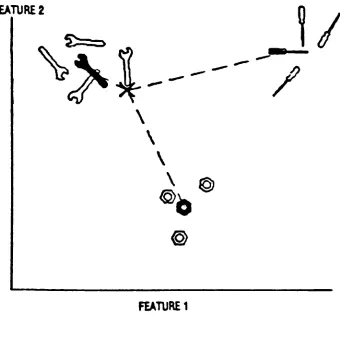
Figure 2.2 illustrates a hypothetical case where the
number of features available for recognition has been
reduced to two. The open shapes indicate feature
measurements made on each of several reference objects. The
solid shapes mark the centroids computed for each object
class. The unknown, designated
by
the"X"
in Figure 2.2, is
identified
by
choosing the class whose centroid is theclosest.
Intuitively, the feature that has a smaller variance
(standard deviation) should contribute more to the decision
process. Therefore, a Mahalanobis distance is suggested, in
which each feature is weighted and the weight is the
reciprocal of standard deviation.
The Mahalanobis distance [CASH863 between an unknown
object and the i-th reference object class is defined as
Vn
/
U(k)-R. (k) \
z
FEATURE
2
W
/
\
\
FUTURE
1 [image:26.540.105.445.148.488.2]where N is the number of
features,
U(k) is the k-th featurevalue of the unknown object, Ri(k) is the average k-th
feature value for the i-th reference object class and <r. (k)
is the standard deviation of that class. Note that the U(k)
and Ri(k) values are normalized
by
the variance. In thepresent work, a.
(k) is set to 0.01 if it is less than 0.01.
We further extend the definition of Mahalanobis
distance to include the distance between two object classes
i and j,
/n
/ Rj_ (k)-R. (k) \:
' k=l
\
o
(k) + o. (k)/
\
=\"I
1
(2.6)Note that
during
the calculation of Mahalanobisdistance,
only the average feature values and theirvariances are needed. This leads to less stored data and a
much simplified computation.
Cash and Hatamian [CASH863 studied various
clssification techniques.
They
recommended the use ofMahalanobis distance for its adequate recognition rate and
easy implementation. This study will use Mahalanobis
distance along with the nearest neighbor algorithm for
classification.
Other approaches, such as the
binary
decision tree[AGIN803,
has been used for classification.However,
we use2.5. Simulation
by
Shape GenerationThis study tried to bypass image acquisition,
segmentation and edge detection.
Instead,
the digitizededges of a shape were generated mathematically and then
processed directly.
Hooper and Klinger proposed a similar idea [HOOP863
when
they
advocated that artificial pattern generation was auseful technique for providing large banks of data that
could be used as test data for pattern recognition
experiments. The generated patterns were distorted under
control in this thesis to yield a wide variety of samples
that were different
from,
but similar to, the originalpattern.
The distortions included linear stretching in either a
horizontal or vertical
direction,
rotation and relocation,blurring
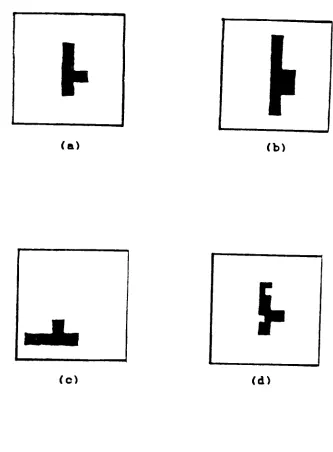
and random noise. Figures 2.3 and 2.4 present someof the examples. Figure 2.3 gives an original image and its
stretched, relocated and noisy-added images. Figure 2.4
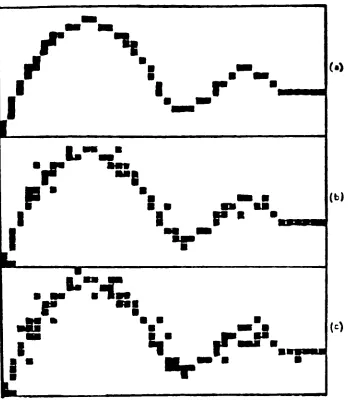
shows a curve before and after blurring.
2.6.
Summary
In this chapter, we have reviewed the hardware for the
actual robot vision systems. We also have reviewed how to
achieve edge extraction. However; edge extraction was
simulated in our system
by
mathematically generating(a) (b)
5-(c) (d)
Figure 2.3. Examples of various distortion schemes.
(a) original
(b) vertical stretching
(c) rotation and relocation
[image:29.540.121.454.97.549.2]BB BB
f
"V
1* BB
B
1
1
r
1
1
B^B
!"
V
av"6
P' B
B
B B as BB
B
1
jr
-1
L
B 1
T
B
B MB B BBB
r
BB B B
V
B
8"
B
J-r
(>
(b)
(0
Figure 2.4. (a) the original digitized curve,
(b) the same curve after
blurring by
adding 10% of the cells adjacent to the curve,(c) the result of
blurring
by
adding 20% of the [image:30.540.102.451.76.486.2]Two major pattern recognition approaches, template
matching and feature extraction were
discussed,
but only thelatter was considered suitable for our purpose. Invariant
moments are useful and were chosen as part of the features
in the pool.
Reduction the number of features can improve
recognition speed. We thus have studied two techniques to
automatically select useful features. One technique is to
eliminate redundant features and the other technique is to
pick a
feature,
for a pair of object classes, with highdiscrimination ability.
Identification was achieved
by
using the nearestneighbor classification algorithm. A Mahalanobis distance
was introduced and discussed. This distance can be
calculated between two object classes or between an unknown
CHAPTER 3
IMPLEMENTATION
3.1. System Overview
In this chapter, we describe the implementation of
image simulation and
digitization,
feature extraction, andunknown identification in our system.
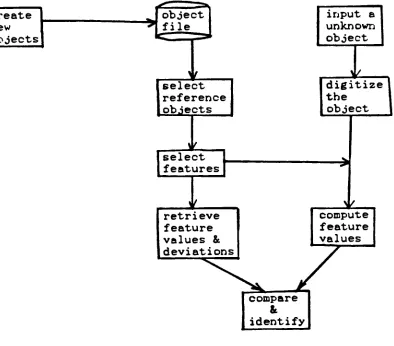
Figure 3.1 shows an overall system data flow diagram.
A new object and many variations can be created any time and
stored in the object file. The digitized image of an unknown
is generated mathematically. The stored feature values and
the standard deviations of objects of interest can be
retrieved when needed.
The task of recognition is restricted to associating an
unknown with one of the selected reference objects. The
unknown is classified
by
comparing feature values of theunknown to those of references. Classification is achieved
by
the nearest neighbor algorithm.There are 12 features currently stored in our feature
pool. We have derived two rules for selecting an effective
feature subset. The system automatically does the selection.
Many
other flow charts are provided to show the detailsof our implementation. Our system hardware and software are
Create
new
objects
select
reference
objects
select
features
retrieve
feature
values &
deviations
input a
unknown
object
digitize the
object
_*: compute
feature
values
[image:33.540.85.479.145.491.2]3.2. Simulated Digitization
Digitization and edge extraction are two important
processes in robot vision. This thesis describes a system
that simulates the results from these processes and
mathematically generates the digitized edges of a shape. The
shape undergoes a series of translations, rotations,
scaling, and controlled distortions to form a class of
similar images.
In this study, we have limited the system to
binary
images.
3.2.1. Shape generation
Here,
we discuss how to generate an edgeextracted"
image.
The user first needs to decide the size of an object
and then plot the object on graph paper. The coordinates of
key
points of that object then can be obtained. We believethat any digitized curve can be represented
by
a series ofline segments, although some line segments may be short.
For instance, a triangle is represented
by
thecoordinates of its three vertices. A line segment is defined
by
two points. Then a linear equation y=ax+b can bedetermined, and the projections of this line segment on a
given grid can be calculated. The projections often will not
fall precisely on individual pixels, but the nearest pixels
to the projections will be turned "on". The mathematics here
perform this
digitization
task. An example is shown inFigure 3.2.
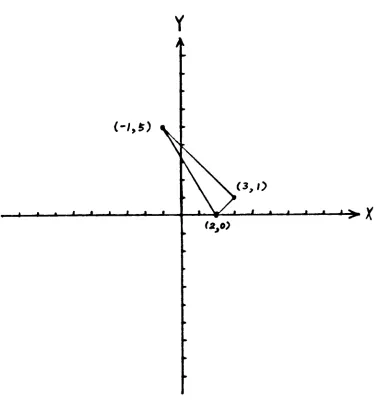
As shown in Figure
3.3,
for a triangle with threevertices
(2,0),
(3,1) and (-1,5). four points need to bespecified,
(2,0),
(3,1),
(-1,5) and(2,0),
to indicate thatit is a closed curve. Note that the first and the last
points are the same.
Our system was designed in such a way that it
automatically digitizes three line segments, (2,0) to (3,1),
(3,1) to (-1,5) and (-1,5) to (2,0).
We also wrote a procedure for generating a digitized
circle, which is defined
by
a center coordinate and aradius, based on Bresenham's circle algorithm [BRES773.
The
following
shapes will be examinedby
our system:?,
?,
A,
^3,
O,
,
Jo], O,
<2>,
<&,
in which,(q\
simulates a washer,[OJ
andSq\
representnuts, and others are simple geometrical shapes.
3.2.2. Effect of Grid Size
One typical goal for a user of our system would be to
study the effect of camera resolution. This can be simulated
by
changing the grid size. This system was designed suchthat digitization can be performed at three grid sizes,
Y
Figure 3.2. Digitization of a line segment.
(-!>*)
i . . i i i j
(3,l>
\s i 11 i i >. Y
(2,0)
[image:37.540.92.474.131.535.2]system will scale up (or down) the coordinates of those
key
points accordingly and then perform digitization.
Objects are often easy to classify at a higher
resolution.
However,
this benefit may diminish rapidlybeyond a certain limit. This simulation can
help
the user todetermine a proper cost-effective resolution
by
allowing himto experiment with different resolutions and object sizes.
3.2.3.
Translation,
Rotation andScaling
When the pictures of an object are taken at various
locations,
orientations and camera-to-objectdistances,
theresults of digitization are all different.
Therefore,
thissystem provides translation, rotation and scaling operations
to perform these simulation tasks.
By
performing varioustransformations, a series of similar feature values will be
generated, which, along with those from original and other
controlled distortions, are considered to
belong
to thesame class. An average value and standard deviation for that
class then can be determined.
3.2.4. Controlled Distortion
Distortion operations are used to simulate device
inaccuracy. For instance, a circle may be distorted slightly
to become an ellipse, and the edges may be noisy. In this
system, an object can be shortened along the x direction
before it is digitized.
Blurring
is simulatedby
using a random numberbetween a shape and a grid, a small
(e.g.,
-2 to 2 for agrid size of 64x64) random number is added to the calculated
coordinates so that an
"on"
pixel may be shifted a few
positions in the x and/or y directions.
The extent of x-axis compression (or elongation) and
pixel relocation in our system are controlled
by
twoparameters that are
temporarily
set at 5% andi2/64,
respectively, in our controlled distortion. Comparisons
between the feature values of undistorted and distorted
shapes also give us some idea of the effect of distortion on
various feature values. For instance, if feature values
change a lot with single axis compression, we may have to
select an acquisition device that has a smaller
compression/elongation distortion.
This system is aimed at simulating a real robot vision
system. For a real vision system, the extent of distortions
can be determined experimentally. The parameters used
by
oursystem for controlling distortions then can be re-set
easily.
3.3. Classification
by
Feature ExtractionWe intend to identify randomly oriented but well
separated objects on a conveyor belt. Based on the arguments
given in Section 2.4.1 and 2.4.2, the feature extraction
method of feature extraction is used in this study for
classification.
There are twelve features in our current feature pool.
In this section, we show how these feature values are
computed. Two rules to select an effective subset of
features are also discussed.
3.3.1. Feature Pool
Our system is limited to simulating robotic visual
inspection and classification tasks. It is assumed that the
objects to be inspected are isolated and randomly oriented.
In addition, the object may not be at an exact position
under the camera. As a result, the selected features should
be independent of position, orientation, and size.
As an aside, we understand that size-dependent
features can be useful.
By
using thesefeatures,
forexample, printed upper case characters can be differentiated
easily from lower case ones. Our intent in using
size-independent features is that someday we hope this system
can be used to examine hand written characters of which the
sizes often vary. As a result, the size independent features
are especially useful for hand written characters.
Orientation dependent features are also useful in the
assembly of machine parts, since parts often need to be
properly aligned. The reason not to use orientation
dependent features is to avoid time consuming rotation
This system can be modified easily to include size
and/or orintation dependent features
by
simply adding suchfeatures to the feature pool. The
following
are the featuresused in our system. This list could be expanded easily if
desired.
F^a.ur._JL
(Rmax/Rav),
where Rmax is the longest distance ("radius") from
centroid to any
"on"
pixel and Rav is the average
distance from centroid to all
"on"
pixels. Note that
Rmax may be off
by
a lot if there is random noise.This problem can be lessened
by
taking the averagedistance for the 5% most remote
"on"
pixels, instead of
a single most remote
"on"
pixel, as Rmax.
Fjejanr_!5L_2.
(Rmin/Rav),where Rmin is the shortest distance from centroid to
any
"on"
pixel. To lessen the effects of noise, one may
also take Rmin as the average distance for the nearest
5% "on" pixels from centroid.
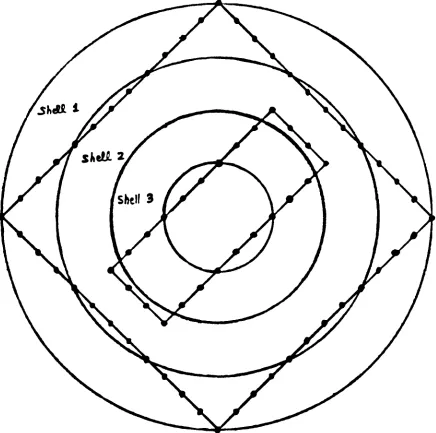
Feature 3 fraction of
"on"
pixels in cicular shell 1 as
shown in Figure 3.4. The radius for the outermost
circle is Rmax. A
"shell"
is defined as the area
between two neighboring circles.
Feature 4 fraction of
"on"
pixels in shell 2.
Feature 5 fraction of
"on"
pixels in shell 3.
Figure 3.4. Example for the computation of features
[image:42.540.55.491.118.551.2]the radii. The total number of
"on"
pixels for both
rectangles is 72. The fraction of
"on"
pixels in shell 1 is
0.39 (28/72), which is the value of feature 3.
Similarly,
the values of feature 4 and 5 are 0.39 (28/72) and 0.11
(8/72), respectively. Note that the fraction of
"on"
pixels
in the innermost shell is not
included,
since it isredundant to the other 3 shells.
Features 3 to 5 are proposed because it is obvious that
their values are independent of orientation, size and
position.
They
can be considered as discretedensity
funtions,
where the digitized image is divided here intofour disjoint circular shells. It is reasonable to assume
that the number of shells can be increased if a grid size
greater than 64x64 is used.
Features 6 to 12 the 7 invariant moments derived
by
Hu[HU623 are the choices and the formulas for computing
invariant moments are shown in Table 2.1.
Currently, there are a total of twelve features in our
Feature
numberFormula
forcomputing feature value
1 Rmax / Rav
2 Rmin / Rav
3
Fraction
of "on"pixels in shell 1 (Fig. 3. 4)
4
Fraction
of "on"pixels in shell 2 (Fig. 3. 4)
5 Fraction of "on"
pixels in shell 3 (Fig. 3. 4)
6 1st invariant moment (Table
2.1)
7 2nd invariant moment (Table 2.1)
8 3rd invariant moment (Table 2.1)
9 4th invariant moment (Table 2.1)
10 5th invariant moment (Table 2.1)
11 6th invariant moment (Table 2.1)
12 7th invariant moment (Table 2.1)
Table 3.1. Features in our feature pool.
3.3.2. Feature Selection
For the recognition of some given objects, one may not
need all the features in the feature pool. The problem is to
develop
a systematic way to select an optimum subset offeatures that can achieve both adequate
discrimination
andhigh speed recognition. We have derived two selection rules
from the algorithms described in section
2.4.3,
and bothBy.le_JL.
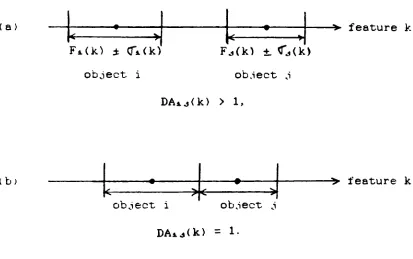
Choose the feature with good discrimination ability when the feature is used alone.As shown in Figure
3.5a,
the discrimination ability offeature k for object classes i and j is defined as
('i
(k)-F . (k)l
DA (k) =
_\_I
I
L-
(3.1)J
o. (k) + a . (k)
i 1
where F*(k) is the k-th feature value for object class i, and ^(k) is the corresponding standard deviation. In the
present study, a. (k) or a. (k) is set to 0.01 if it is less
than 0. 01.
Comparing
with Equation (2.6), the above definition is, infact,
a one-feature Mahalanobis distance. For a givenfeature,
when the ranges of feature values of two object classes touch each other as shown in Figure3.5b,
the discrimination ability for that feature will be unity.Conceptually, one may say that a feature is statistically
"likely"
to differentiate two objects if its corresponding
discrimination ability is greater than unity.
In order to be more specific, let us assume that the distribution of feature values of an object in various states is a bell shaped normal function CDUDA73] . One then
can calculate the probability of occurences of a feature
(a)
<b>
F.(k) 0\<k) object i
Fj(k) +
Cj(k>
object j
DAj(k) > 1,
object i object
DA*.<k) =
1--v feature k
-> feature k
Figure 3.5. Discrimination abilities of feature k for
[image:46.540.66.479.232.491.2]Range
Probability
mean feature value +/- 1 o 68.27%
mean feature value
+/-2 a 95.45%
mean feature value +/- 3
o 99.73%
Table 3.2.
Probability
of occurence for a feature valueto be within a range.
Armed with the information in Table
3.2,
one canfurther calculate the probability of successful
discrimination
by
feature k for object classes i and j atgiven Dtj(k) values. The results are shown in the table
below.
DtJ(k) value Successful discrimination
1 70.79%*
2 95.50%
3 99.73%
*
70.79% = (0.6827 + 0. 5*( 1-0. 6827)
)2,
where probability ofobject i occurs inside one standard deviation from its mean
=
0.6827,
and probabilty of object i occurs outside onestandard deviation from its mean but away from object j
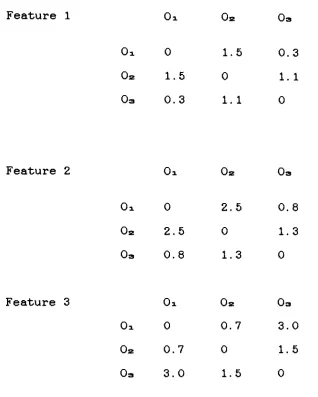
In order to better explain our method, a hypothetical
example is given in Table 3.4 which includes 3 objects and 3
features.
Feature 1 Oi Oa Oa
d 0 1.5 0.3
0* 1.5 0 1. 1
Oa 0.3 1. 1 0
Feature 2 0i 0s
Ox 0 2.5 0.8
Oa 2.5 0 1.3
Oa 0.8 1.3 0
Feature 3 Ox Oa Oa
Ox 0 0.7 3.0
0* 0.7 0 1.5
Oa 3.0 1.5 0
Table 3.4. Discrimination abilities
by
each featureamong 3 object classes.
Based on Table
3.4,
fordifferentiating
Oa. fromOa,
feature 2 is the best choice; for Ox and
Oa,
feature 3 is [image:48.540.88.406.151.548.2]result, features 2 and 3 should be chosen as a subset for
classification. Note that the user can always include
additional features to the selected feature sub-set for
improved accuracy, but with a compromise in speed.
In our current study, if the best feature provides a
discrimination ability less than
2,
then the next best onealso will be selected. For the object pair 2 and 3 in Table
3.4,
both features 3 and 2 are selected since neither of thefeatures has a discrimination ability greater than 2.
What
if,
for a pair of objects, no feature withdiscrimination ability greater than unity can be found? In
such a case, it is always difficult to discriminate between
the object pair. It is thus advised to look for a better
feature outside the current feature pool.
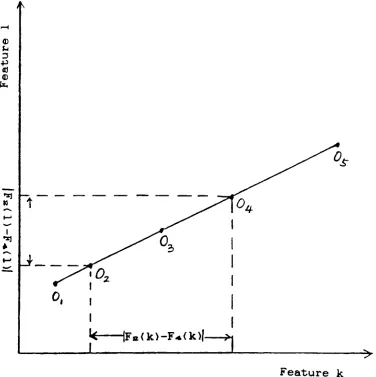
Rule 2 If two features are redundant for given reference
objects, one of them is deleted.
An example is illustrated in Figure
3.6,
where 5objects are plotted in a 2-dimensional feature space and all
objects fall onto a straight line. This means that
F(k)-Fj(k) is proportional to F*.( 1)-Fj( 1) for any object
pair,ij. This also means that if an object pair can be
discriminated
by
featurek,
it also can be discriminatedby
feature 1. As a result, one of these features can be
i-i
P
a)
a) fx,
i
k
|F(k)-F*(k)|
>J
>Feature k
[image:50.540.77.453.130.507.2]n n n. n
abilities,^
Dj(k)
andtLD*.j(l),
which represent the' V(j<i) * 3<j<i)
overall
discrimination
abilitiesby
feature k and1,
respectively. The feature with a smaller sum will be
deleted.
As a summary,
Overall discrimination ability
by
feature k= DA(k)
n
= I
i
n
I
j (j
<
i)D.j(k) (3.2)
We have explained the fact that 2 features are
considered redundant if the objects fall on a straight line
in the 2-dimensional feature space.
But,
how can a computertell if the objects are on the same line? This can be easily
achieved
by
the method of linear regression. All the pointsare fitted to a straight line and the correlation
coefficient, r , are computed
by
thefollowing
equation[FREU843:
r =
n ( Ixy) ( x) ( s y)
yjn ( XX2)
-( X x)2
->Jn( XV2) - (y)2
(3.3)
where n is the number of points (or objects) and x is the
sum of all x coordinates. The definitions for xy, Sxy, ix2
ry2are obvious.
points fall exactly onto a straight line. At r =
0,
thepoints can not be approximated at all
by
a straight line.In this section, we first defined the discrimination
ability
by
a feature for any object pair. With thisdefinition,
it became easier to explain the redundancy offeature pairs.
However,
in the implementation of our system, we firstexamine all feature pairs for redundancy and one feature is
deleted in a redundant feature pair.
Presently,
one featureis deleted if r > 0.95. As a rule,
delete feature k if r > 0. 95 & DA( 1) > DA(k),
delete feature 1 if r > 0.95 & DA(k) > DA(1). (3.4)
After redundancy is removed, we then use the
discrimination ability to select the most discriminating
feature for each object pair.
The system deals with one feature or one feature pair
at a time. It avoids handling a large number of features
simultaneously. Our approach saves time, and the results are
good.
3.3.3. Classification
With the selected feature subset, the Mahalanobis
distance between an unknown and each chosen reference object
along with the Mahalanobis distances are used for
classification.
3.4. Flow Charts of Implementation
In the
beginning
of this chapter, we presented a flowchart to show the overall picture of our system. The chart
is shown in Figure 3.1.
Here,
we present five additionalflow charts to describe the details of our system
implementation.
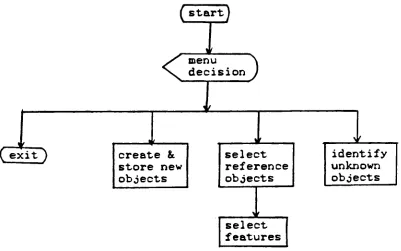
3.4.1. Hierarchical Process Diagram
Our system was designed to be menu driven. One of three
main paths can be selected
by
the user at one time.They
are(1) create and store objects, (2) select reference objects
to be compared and then select a feature subset, and (3)
identify
unknown objects.A flow chart of the main menu is shown in Figure 3.7.
The details of each path are discussed in the succeeding
sections.
3.4.2. Create and Store Objects
This is an interactive system, in which the coordinates
of
key
points for an object are providedby
the userwhenever the system prompts for them. The coordinates come
(
start)
<oenu
\
decision
J
exi
D
create &store new
objects
select
reference
objects
identify
unknownobjects
select
features
[image:54.540.72.473.141.392.2](start
)
N>0
prompt for Cx,y)
positions of
centers and radii
prompt for positions
of
key
pointsJ
prompt for grid
size
1
|digitize
the objectJ.
|
plot the object~\
{save to object pool
"1
examine the condition
for distortion
-><menuy.
scale up Cdown) input coordinates
save to feature
pool
compute mean feature
values & deviations
calculate feature
value
{digitize
jtheobJect|
re-compute the Input
feature values and their standard
deviations,
and saving theinformation in a disk file. The user only needs to provide
coordinates at one grid size, and the system will examine
the object at several different grid sizes to study the
effects of camera resolution.
3.4.3. Select Reference Objects
Figure 3.9 gives the sequence in the selection of
reference objects for comparison with the unknown. First of
all, the user opens the object file on a disk and retrieves
the information about all saved objects. The system first
displays a list of object names from which the user can
select. It then displays the image of the object selected
for the user to confirm. After all the reference objects are
chosen, only their feature values and standard deviations
are used in the next step, which is to select an effective
feature subset.
3.4.4. Select a Feature Subset
The subset of features is automatically selected
by
thesystem according to the rules explained in Section 3.3.2.
As shown in Figure
3.10,
the system provides information on(a) the correlation coefficient of all feature pairs, and
(b) discrimination ability of every feature for all object
pairs.
Later,
only the selected features are used for(start)
jopen
object pooT*ften,Q
display
objecttable
I
enter object
index
1
digitize object 1|
plot object|
correct.
Yes
(Jo
save
key
points ofobject to reference
object file
1
save feature values & deviation to
(
start"")
compute
correlation coefficient
delete
redundant
features
compute
discrimination
ability
select
effective
features
establish
feature
subset
^
menu)
3.4.5.
Identify
Unknown ObjectsFigure 3.11 shows the path for
identifying
unknownobjects. The information to plot the unknown object will be
prompted
by
the system. The system then displays an image ofthe unknown object on the monitor for the user's
confirmation.
The system then computes the values of selected
features for the unknown object. These values are used to
calculate the Mahalanobis distance to each reference object
class in the selected feature space. The unknown then can be
identified based on the nearest neighbor classification
algorithm.
Along
with each identification, it is helpful to definea confidence
level,
which is shownbelow;
Confidence level is high if Da > 3 and Dx < 2,
Confidence level is low if Da < 1 or Dx >
3,
Condidence level is average otherwise. (3.4)
where Dx is the Mahalanobis distance from unknown to the
nearest reference object class and Da is the distance from
unknown to the next nearest reference object class. In
addition, if an unknown is identified with a reference
object class that has a short Mahalanobis distance ( < 1 )
to another reference object class, then the confidence level
(
start")prompt for the
information of unknown object
periorm a
random
distortion
digitize &
display
objectNo
compute
feature values
I
compute Mahanalobis distance to each
reference object
identify
unknowngive confidence level & a second guess
<
menu)
Without
involving
rigorous mathematical derivations andbased on the probabilities shown in Table
3.2,
one sees thatthe probability of mistakenly
finding
the unknown to be thesecond nearest object is no more than 0.27% when Da > 3. The
additional condition for a high confidence
level,
Dx <2,
assures that the unknown is in the neighborhood of the
nearest reference object.
One also sees that the probability of mistakenly
finding
the unknown to be the second nearest referenceobject can be as high as 68.27% when Da < 1 and that the
probability of correctly
finding
the unknown to be itsnearest neighbor is less than 0.27% when Dx > 3.
Now,
we arefully
prepared toidentify
unknown objects.In some cases, the system can
identify
an unknown with highconfidence. In other cases, the system makes identification
by
its best judgement, but also informs user that theconfidence level is low or average.
3.5. System Hardware and Software
The system runs on a super Turbo (10 MHz) IBM-XT
compatible computer with 640K
RAM,
a 30 MBSeagate,
hard diskand a 360K floppy drive. Our simulated shape recognition
program and related data files were installed on the hard
disk for fast access. A Seikosha dot matrix printer is used
language. The Turbo PASCAL compiler, version
4,
was used,and the line compile option was chosen.
A large memory, ~110K, was needed to edit our program,
which could not be handled
by
the Turbo PASCAL editor. As aresult, a word processing program, Microsoft WORD version
3.0,
was selected to do editing. WORD was also used toproduce this thesis manuscript.
3.6.
Summary
In this chapter, the discussion includes mathematcally
generating images and also ways of
implementing
controlleddistortions.
There are currently 12 features used
by
the system. Fora given object domain, the system can automatically choose
an effective feature subset for improved recognition speed.
Classification was done
by
the nearest neighboralgorithm and the Mahalanobis distance was adopted.
Five flow charts were presented to show the
architecture of the system and the details of the
imp
1ementation.The system hardware was described. The operating
CHAPTER 4
RESULTS AND DISCUSSION
In this chapter, we will discuss the variables
manipulated in
testing
our system and also the system'sperformance. We have included 12 features, 10 different
objects, 4 types of
distortion,
and 3 grid sizes todemonstrate various aspects of our work.
The objects, both with and without
distortions,
weredigitized mathematically. This was done to simulate image
sensing,
digitization,
and edge extraction processes in anactual robot vision system.
Feature values and their standard deviations were
computed for all 12 features and 10 object classes.
Mahalanobis distances in the 12-dimensional feature space
between 10 object classes also were computed.
The effect of resolution is discussed
by
showingresults at 3 different grid sizes. Results also are shown to
explain the algorithms for selecting an effective feature
subset in a given object space. Our method avoids
handling
many features simutaneously.
First,
features were examined pairwise to determinetheir redundancy, which was measured
by
the correspondingredundancy and then selecting the most
discriminating
features from the remaining ones.
Finally,
an unknown at its randomly distorted state wasidentified with one of the reference objects based on the
nearest neighbor classification algorithm.
4.1. Graphic Representation of Edge-Extracted Objects
Image sensing, digitization and edge-extraction
processes usully are done
by
hardware in an actual robotvision system. In this study, we tried to simulate the end
results of these processes
by
mathematically generating theedge-extracted images.
Ten geometric objects were included for demonstration.
Plots of some digitized objects with and without distortions
are shown in Figures 4.1 to 4.4. Four types of controlled
distortion and also the magnitude of distortions are
tabulated below.
4.1.1. Objects in the Object Pool
We have stored 10 simple geometric objects in our
object pool. These objects are listed in Table 4.1 and their
i o
'? C'
y o
'-'
o
; 2 o
:u z<
*. <^i
. . .'_>. .
5,
. .o,
o
< o
r '. '. 1 1 1 6. i
*9
I '. '. '.
6'. '. '. '. '. '.
o
V . .o
'-o. . . . .
-. . .
"
o
000000000600606000606000000600600
Figure 4.1. A isosceles triangle.
> . .000000000. . ,
.000 000.
.00...001
. .00 00
.0 c
. .0 o,
.0 o,
.0,
.0 o
. . .0 o...
. . .0. . o...
. .0 o. .
. .0 o. .
.0 o. .0 o. .0 o. o o o o o o o o o o o o
o . . o
o o
o o
.c>. ... ...o.
.0 o.
.0 o.
. .o c.
. .0. * o. .
...o o...
...o o...
. . . .O .u. . . .
,o o,
.0 o,
.0 .0
,0 o
,00... .oo.
[image:65.540.135.373.34.325.2].o,
.o. .oo... ...o.o
O...O. ... . .O . . . .C'O.oo. . . .
O.O. ..o.o. . . .o. . ....O...-.O..O.. . . . . I"l ^ ....>">. . . .o". . o.oo.
,...o.oo
ooo
:<o oo.o. . . . .C *. .O.OOOO . i ..0...0.oo .
oo... ..o.o.
.0.0. >o. .o
. .O ...O...O.
>o. ... ...00.o. . .
,0.0 ...O.O....
[image:66.540.150.411.163.437.2]I. .0.. ... ..OO... .c ..0..0...
...u...o.. iO. ...OOOi t.0....*...*..0.>~<* , . . . .O o. .o. , 1 ..O O O...O.... 1
...o....oc.'Z"'... ...
... ...o... .00...
0.0
... ...0.0.0... . .O.aOO... ...
Figure 4.3. A distorted isosceles triangle.
blurring
by
pixel relocation: +2 to -2x-axis compression: none
rotation angle:
O,
>...o o...o.o..,
oc oo o,
'. ....O. ... ...r>..
.O. .O '. . .o. , .O
,-.O. .o . ,
o
-'
OO, .*_<
I-.o o
o o.o
..o.o... ...
...OO OO
O O. . .
.o,
.i_'. o
.O.O.... . . .o
o...
o.o. ... ...o. .00 .o...
,O1
o... ,o. . . o... ,
.O..O.
1 .o. 00... .0.0.0. o...
'~i...O..O.O....O...i
o . .o.o
GO. .C , 00. .o. . . .o
o .,
Figure 4.4. A distorted circle.
blurring by
pixel relocation: ?2 to -2x-axis compression: 5%
rotation angle: 51
[image:67.540.123.449.97.439.2]Index
Object Name1 Square
?
2
Rectangle
?
3 Isosceles Triangle
A
4 Right Triangle
^3
5 Circle
O
6 Washer (Ring)
7 Nut (Circle in Square)
0
8 Hexagon
o
9 Nut (Circle in Hexagon)
<o>
10 Asymmetric Shape
*33
Table 4.1. Objects in the Object Pool.
The coordinates of
key
points for these 10 objects in a64x64 frame are shown in Table 4.2. Note that the objects do
not
fully
occupy the whole field of view. The systemautomatically calculated the coordinates for 32x32 and 16x16
frames
by
multiplying all coordinates with factors 0.5 and0.25,
respectively. The resulted numbers from multiplicaton [image:68.540.92.392.48.328.2]Key
points CenterObject of lines of a circle & radius
1 (-20,20X20, 20X20,-20)
(-20,-20)(-20,20)
2 (-24, 12)(24, 12X24,-12)
(-24,-12X-24, 12)
3 (-16,-20X0,
20X16,
-20)(-16,-20)
4 (-24,-4X24,10X24,-4)
(-24,-4)
5
6
(0,0), r = 20
(0,0), rx = 20
(0,0), ra = 15
(0,0), r = 15 7 (-20,20X20,20X20,-20)
(-20, -20X-20,20)
8 (-10, 17X10, 17X20,0X10,-17)
(-10,-17X-20,0X-10,17)
9 (-10,17X10,17X20,0X10,-17) (0,0). r = 12
(-10,-17X-20,0X-10,17)
10 (-24,10X26,22X26,-12) (16,0), r = 8
(-16,-12)(-24, 10)
As described in Section
3.4.3,
the object pool can beexpanded easily
by
accessing the "Create and Store Objects"menu, which guides the user step
by
step through the processof creating a new object. Once a new object is created, it
will remain in the object pool until it is deleted and can
be retrieved whenever it is needed.
4.1.2. Digitized Images without Distortion
Figures 4.1 and 4.2 show the undistorted digitized
images of an isosceles triangle and a circle in the current
object pool. All images have a field of view of 64x64.
In the images, series of
"o"
characters represent edges
and the dots "." indicate pixels that are not part of an
edge. Since we chose to use text mode for printing the
objects, the line spacing has been re-set to be almost the
same as the spacing between characters on the same line. As
a result, a square looks like a square on paper.
4.1.3. Types of Distortion
The magnitude and number of each type of distortion,
for the current study, are listed in Table 4.3. There are a
total of 24 states(variations) for each object class. These
Magnitude Number*
of variations
+ 10% 3
5% 2
51
2
>n ~ 5% 2
Type of Distortion
Change of size
x-axis compression
Rotation
Blurring by
pixel relocation ~ 5%*
includes the undistorted state.
Table 4.3. Our controlled distortions.
With our system, the user can ask "what if"
questions.
For
instance,
what is the ability to separate a rectanglefrom a square if the x-axis compression is 20% instead of
5%,
or what will happen if theblurring
effect becomes twiceas severe?
Each type of distortion is controlled
by
a singleparameter, which can be re-set easily for the system. For a
real application, the distortion parameters should be
determined experimentally in order to closely simulate a
given robot vision system. These parameters can be
determined
by
repeatedly taking pictures of the same object.4.1.4. Digitized Images with Distortions
Figures 4.3 and 4.4 show a distorted isosceles triangle
compression, which simulates the quality of images an actual
vision system might produce.
In Figure
4.4,
note that the number of x-axis pixels is46 and the number of y-axis pixels is
49,
since the circleis compressed along its x-axis.
4.2. Properties of the Objects in the Object Pool
Since our system recognizes objects
by
using the methodof feature extraction, the first task is to compute various
feature values for each object, and the second task is to
compute Mahalanobis distances among object classes in a
given feature space.
4.2.1. Average Feature Values and their Standard Deviations
Currently, there are 12 features employed in our
system. These features were defined in Section 3.3.1 and
stored in the feature pool. Feature values were computed for
24 variations of each object class. The average feature
values and their standard deviations, for 10 objects with a
grid size of 64x64, are shown in Table 4.4. The name of the
objects are shown in T