Enterprises’ communication system diagnostics
I. Penkova1,*, A. Bodnar2, and M. Rebezov3 1
Institute of Economy and Management Crimean Federal University by V.I. Vernadsky, Simferopol, Russia 2
Automobile Road Institute, Donetsk National Technical University, Gorlovka, Ukraine 3
South Ural State University, Chelyabinsk, Russia
Abstract. The article is devoted to the issues assessing the development of information and communication technologies. There have been analyzed the level of innovative technologies application in enterprises, as well as their impact on improving the efficiency of organizations’ productivity and management. The analysis allowed us to estimate the level of use of innovative technologies in enterprises in developed, developing and transition economies. The use of information and communication technologies is at a low level. This is evidenced by the interest obtained in the paper and numerical characteristics on such indicators as the average level of use of fixed telephone lines, the average number of Internet users, and the use of broadband Internet lines and mobile phones. The article shows the effect of the level of use of information and communication technologies to improve the efficiency of production and management of enterprises. There was a relationship between the number of companies using different types of information and communication technologies on their size. The analysis of indicators for micro and small enterprises. The dependence between the amount of use in its activities by domestic enterprises Web site and e-mail on their size. A parallel with similar enterprises in developing countries , using in the various activities of information and communication technology and having an overall yield 5.1% higher as opposed to those who do not use them.
1 Introduction
In order to identify the advantages of enterprises’ communication system operating it is advisable to examine the main trends in the development of information and communication technologies in the Russian Federation, to assess the value and the dynamics of its application on different types of enterprises, to identify the main operations results and the level of spending on implementation of information and communication technology, and to analyze the dynamics of every components of the communications system within the country's businesses not specified by kind as well.
2 Theoretical and practical framework.
results of investigation
At the end of 2014 year there were registered 486 000 enterprises and organizations of various types of ownership in the Russian Federation of which 332700 enterprises were of state and municipal property, 4212200 companies were private and 34300 had mixed Russian ownership type (Fig. 1) [19].
Aiming at the fining out the main point of management advantages on the enterprises dealing with the different economic activity we will analyze in
progress every informational and communicational component of the communication system such as namely technical, informative, organizational, administrative and social one.
The technical component of the communications system is one of the most quickly and dynamically developing, and significantly influencing the speed of the communication system and the enterprise as a whole. It is necessary to involve into this component the facilities applied by enterprises namely PCs, local and global networks, software, and personal sites.
Investigating the results of information and communication technologies use by the end of 2014 it should be noted that the company preferred to employ PCs in their activity, that is 93.8%, as opposed to the other kind of computer techniques - 26.6%. This evolution can be traced in the whole range of research.
To function and transfer the information 89.8% of companies draw on in their work the global information network, this greatly increases the speed of information transmission and accelerates its swapping, both within the enterprise and with the external environment (Fig.1).
protection from breaking due to the large volume of confidential information.
At the same time every fourth company using computers has Web-site functioning in the Internet and Wi-Fi access to its internal computer network [4].
[image:2.595.312.538.170.281.2]A significant impact on the of the enterprise communications system operation has software installed that can perform various functions from transferring information to being helpful in decision-making.
Fig. 1. The dynamics of the total number of enterprises and
organizations in the Russian Federation (end of the year).
[image:2.595.62.284.186.300.2]At the end of 2014 more than 86% of enterprises used various kinds of specialized software tools ranging from email to a system that allowed access to databases for solving managerial and economic tasks, sales and purchases monitoring, which indicated an increase in the influence of the technical component of the communication system on the effectiveness of business management and decision-making rate (Fig.2).
Fig. 2. Personal computers in enterprises.
Number of enterprises using the Internet to interact with suppliers, goods and services consumers increased from 2005 to 2014 by 15.5%. Simultaneously, the number of companies, which desired to obtain information about products, services and works, increased by 29%. The percentage of companies that provided information about their products increased by 22% within the same period of time (Fig. 2) [20].
At the end of 2014 the expenditures on the technical component of communication systems formed 72.8% while purchasing the computer equipment costs did not increase, as far as there were no need to replace personal computers annually, there was enough to make their modernization and repairing (Fig. 3) [9].
[image:2.595.307.540.449.733.2]Thus, nowadays enterprise actively involve information and communication technologies in the activity, in self-learning how to work with clients through the Internet and personal sites. They do not reduce the technical component costs of the communications system, introducing new information support to improve the quality and the work rate that will eventually affects the enterprises performance as a whole.
Fig. 3. The enterprises’ expenditures on technical component
of the communications system (percentage of total).
Information component of enterprise communications systems can be characterized by a degree of incoming information automatic receipt, workflow, and data loss level during its transmission.
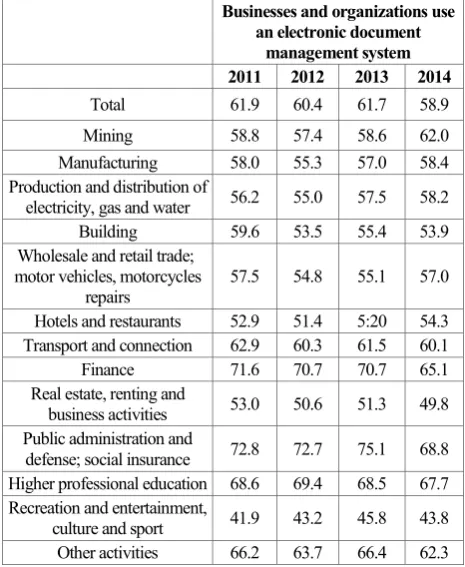
More than a half of the enterprises surveyed in various economic activities apply electronic document management system during the period estimated (Table 1.) [16-20].
Table 1. The electronic document management use in enterprises
by economic activity (as a percentage of the total number of enterprises surveyed within the corresponding activity).
Businesses and organizations use an electronic document
management system
2011 2012 2013 2014
Total 61.9 60.4 61.7 58.9
Mining 58.8 57.4 58.6 62.0
Manufacturing 58.0 55.3 57.0 58.4
Production and distribution of
electricity, gas and water 56.2 55.0 57.5 58.2
Building 59.6 53.5 55.4 53.9
Wholesale and retail trade; motor vehicles, motorcycles
repairs
57.5 54.8 55.1 57.0
Hotels and restaurants 52.9 51.4 5:20 54.3 Transport and connection 62.9 60.3 61.5 60.1
Finance 71.6 70.7 70.7 65.1
Real estate, renting and
business activities 53.0 50.6 51.3 49.8
Public administration and
defense; social insurance 72.8 72.7 75.1 68.8 Higher professional education 68.6 69.4 68.5 67.7 Recreation and entertainment,
culture and sport 41.9 43.2 45.8 43.8
Other activities 66.2 63.7 66.4 62.3
[image:2.595.61.283.452.574.2]automation rate in the enterprises activities is within recreation, culture and sports (43.8%).
Regardless of the economic activity type more than a half of the companies enlarged the data automatic exchange up to 52.7%. from 2013 to 2014. Having analyzed the data on the automatic exchange of information between internal and external information systems there were found out the incontestable leaders such as the organizations of higher education, that is 64.3% of the information circulated within these organizations in electronic form at the end of 2014 (Fig. 4).
[image:3.595.317.528.209.327.2]The adoption of electronic document management and automatic data exchange between internal and external information systems requires enterprises’ related costs which are shown in Figure 4 [16-20].
Fig. 4. Electronic documents circuit building-up costs
(Percentage of total).
Thereby, the information component of communication system has become increasingly important in providing high-quality and timely information in the business management process.
The employment of personal computers, special software, electronic document circulating imposes on the enterprise the relevant requirements for staff training.
The social component of the communications system is advisable to be estimated with such indicators as the number of employees who need advanced training, the staff turnover, the conflict frequency.
The total labor force in the Russian Federation at the end of 2014 amounted up to 75 428 000 people of which 71 539 000 dealt with the economy and 3 889 000 people were unemployed (not taking into account the information on the Crimean Federal District) [20].
Level of training, namely, the level of education has significant impact on the development of the social component of the communication system.
Analyzing the distribution of population by type of employment by economic activity and the education level we should note that the vast majority of workers employed in the economy have higher education - 32.2%, while in the sphere of research and development corresponding level reaches 73.2%, within financing - 69.4%.
In spite of this, training and skills improvement is an important direction to develop any enterprises implementing in the activities information and communication management tools, as communication management include the use of innovative technologies
and data exchange tools, personal computers and its software.
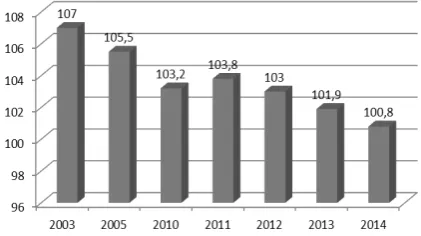
It is also significant to point out a slowdown in labor productivity among enterprise employees by 6.2% during the period estimated. This leads to the idea of the necessity to improve the staff skills despite the enterprises’ activity [4-5].
Consequently, the companies, increasing personnel costs, enrich the staff skills, provide training and retraining of staff, thus ensuring an efficient work organization.
Fig. 5. The productivity growth (decline) rate (comparing to
the previous year).
The organizational component of the communications system can be characterized by the feedback occurrence, the standard of the long-term goals achievement and the current assignments fulfillment.
Among the existing organizational structure of enterprise administration communication system is expediently to be managed within a mixed structure, as it is very flexible and one of the most progressive. It is composite because it includes features of organizational structures types which are widespread all over the world: 1) horizontal (planar) covers three management level which perform different functions:
- The 1st level (higher) - Head-office;
- The 2nd level (Intermediate) - Middle-office (main regional establishments, local administrations, independent branches);
- The 3rd level (lower) - Front-office (the departments like A, B, C, D.).
2) The Staff Line-functionally structure includes the Chairman of the Board headquarters - Head-office (HO), and the Directorate of the head-office and branches - Middle-office, and in addition linear functional vertical connections are commonly used.
3) Divisional customer and functionally oriented structure includes:
3.1) profitable business streamline;
3.2) Business managing (consumables) pointing; 3.3) supporting direction.
In addition, the management structures are distinguished as a divisional-product, a divisional-regional, a network an a design matrix.
[image:3.595.71.278.266.387.2]and managers directly involved into communication management. As a rule, these types of activity are worked over by the outside experts who are engaged in setting up automated systems, workflow automation [17,11,12].
This approach does not allow communication system to be wholly under control, and it affects only some of its components.
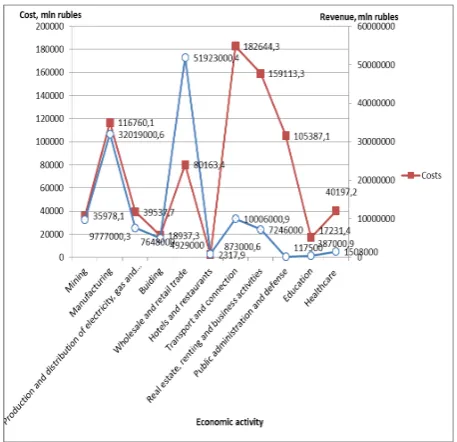
[image:4.595.57.286.261.482.2]The research done for companies and organizations of different economic activity has correlated costs for information and communication technology with a company turnover as their operational results at the end of 2014. It is concluded that the information and communication technologies costs make up an average of 2% of the enterprises turnover, excepting public administration and military security, but it can influence the enterprise revenue value (Fig. 6) [19,11].
Fig. 6. Comparison of the of information and communication
technology costs with the enterprise revenue value of economic activities (million rubles).
Therefore, enterprises currently make aware of the need for communications management. However there is no up-to-date approach or method developed to investigate communications management system as a whole. There is quite uncoordinated management of its separate elements.
Based on an analysis of actual approaches to the formation of criteria for a communication system evaluation, from the standpoint of the qualitative and quantitative assessment regarding information as a communication facility, here is the measuring indicators combination for every component of the communications system. To assess communication system development statues it is proposed the method comprising 15 indicators characterizing the components of the communications system [6,9,10]:
Information INF (X1 - automated receipt of incoming information, X2 - workflow automation, X3 - data loss).
Technical TEX (X4 - the software adequacy, X5 - hardware sufficiency, X6 - communication channels loading);
Social SOC (X7 - the need for training, X8 - turnover, X9 - the level of conflict);
Organization ORG (X10 - feedback, X11 - long-term goal accomplishment, X12 - current task implementation);
Management UPR (X13 - communications centralization, X14 - detailed information, X15 - communication dynamics).
The appropriate management decisions are found out for the trade and service companies investigated such as "Aleko-Service", "Alfa-Bank", Gorlovka electromechanical plant. And the following results were obtained, that allows them to identify prior areas to advance (Table 2) [1-3].
Table 2. Acceptance of administrative decisions in the building
management system sales and service enterprises "Aleko-service" pjsc "Alfa-bank", Gorlovka electromechanical plant.
Level Communication
System Development
The standard of the communications
system components development
Events
Manage rial impact essence
Alfa-Bank
SYS_KOM = 0.251
The communication
system is not sufficiently
developed
INF = 0.749> 0.5
- -
TEX = 0.605> 0.5
SOC = 0.273 <0.5 The social component is not
sufficiently developed
Labour Systems Improving
1. To mprove the
labor motivation
system. 2. To Introduce
feedback channels. ORG = 0.749>
0.5 - -
UPR = 0.61> 0,5 Trade and service
company Aleko-Service
SYS_KOM = 0.273
The communication
system is not sufficiently
developed
INF = 0.626> 0.5 - -
TEX = 0.26 <0.5 The technical component is not
sufficiently developed
New communication
technologies introducing, the technical platform improving
1. To introduce a
new information
system to respond to
client requests by
one program.
2. To invest in technical equipment SOC = 0.5> 0.5
- -
[image:4.595.310.538.271.784.2]electromechanical plant
SYS_KOM = 0.259
The communication
system is not sufficiently
developed
INF = 0.564> 0.5
- -
TEX = 0.71> 0.5 SOC = 0.749>
0.5 ORG = 0.584>
0.5
UPR = 0.251 <0.5 The management component of the underdeveloped
Administrative and control
system improving
1. To increase
the efficiency
of the information
received.
and service companies "Aleko-service" there has been revealed that the communication system is not sufficiently developed, as evidenced by the low rate of the outcome indicator SYS_KOM = 0,251. This is due to the fact that the technical component requires the decision-making to enhance the efficiency of the enterprise as a whole. At the final stage of a functional algorithm there have been formed the means to improve communications systems for the enterprise tested, i.e., a list of the administrative decisions is worked out to improve the technical equipment of the system, to introduce new information technology, to invest in technical equipment [7,8,10].
3 Conclusion
It has been grounded that the communication system includes the technical, informational, social, managerial and organizational components, which provide processes of information exchange within the enterprise and with the external environment to achieve its objectives. Having analyzed the enterprises’ communication system dynamics there was estimated the current development level of its elements. Investigated companies increase the expenditures on the technical component of communication systems, personnel, improving the staff skills, staff training and retraining. The management components analysis shows that no mechanism is able to manage any entire information and communication system, and therefore, the necessity of its development has been specified.
The work was supported by Act 211 Government of the .
References
1. Yu. Lysenko, P. Egorov, Economics of Ukraine, 1, 86-87 (1997)
2. ! #$& +? J&& Q &Z\ ^\ Q`{3, 44-49 (2012)
3. A.V. Leonenkov, Fuzzy modeling in MATLAB environment and fuzzyTECH (BHV-Petersburg, St. Petersburg, 2005)
4. M.R. Ryan, M.R. Frater, Communications and information systems (Argos Press, P/L, 2002)
5. N.O. Shpak, Fundamentals of communication management industry (Publishing Lviv Polytechnic National University, Lviv, 2011)
6. N.O. Shpak, Management and Entrepreneurship in Ukraine: stages of formation and development problems, 145-149 (2010)
7. E.S. Surovtseva, G.Ya. Rubin, Production Organizer: theoretical and scientific journal, 2, 54-56 (2008) 8. E.S. Surovtseva, Proc. Management of economic
systems: theory, methodology, practice, 61-64 (2007) 9. A.A. Shubin, I.V. Simenko, Science and studio
Premysl, 3(15), 83-92 (2009)
10. N.O. Shpak, A.M. Ulyanov, Management and Entrepreneurship in Ukraine: etipy formation and development problems. Bulletin of the National University Lviv Polytechnic, 575, 39-45 (2006)
11. Information economy report 2014 ICTs, economics of cloud technologies and developing countries (United nations conference on trade and development UNCTAD, New York and Geneva, 2015)
12. Information economy report 2012 ICTs, production software and developing countries (United nations conference on trade and development UNCTAD, New York and Geneva, 2012)
13. Information economy report 2011 ICTs as an Enabler for Private Sector Development (United nations conference on trade and development UNCTAD. New York and Geneva, 2011)
14. Information economy report 2010 ICTs, Enterprises and Poverty Alleviation (United nations conference on trade and development UNCTAD, New York and Geneva, 2010)
15. Information economy report 2009 Trends and Outlook in Turbulent Times (United nations conference on trade and development UNCTAD, New York and Geneva, 2009)
16. Russian Statistical Yearbook (2011). http://www.gks.ru/bgd/regl/b11_13/Main.htm.
17. Russian Statistical Yearbook (2012). http://www.gks.ru/bgd/regl/b12_13/Main.htm.
18. Russian Statistical Yearbook (2013). http://www.gks.ru/bgd/regl/b13_13/Main.htm.
19. Russian Statistical Yearbook (2014). http://www.gks.ru/bgd/regl/b14_13/Main.htm.
20. Statistical Yearbook (2015).