EFFECT OF FABRIC COVERS ON IMPROVING SOUND ABSORPTION
MOHAMAD HAFIZ BIN JAMIL
ii
EFFECT OF FABRIC COVERS ON IMPROVING SOUND ABSORPTION
MOHAMAD HAFIZ BIN JAMIL
This report is submitted
in fulfillment of the requirement for the degree of Bachelor of Mechanical Engineering (Structure & Materials)
Faculty of Mechanical Engineering
UNIVERSITI TEKNIKAL MALAYSIA MELAKA
iii
DECLARATION
I declare that this project report entitled “Effect of fabric covers on improving sound absorption” is the result of my own work except as cited in the references
iv APPROVAL
I hereby declare that I have read this project report and in my opinion this report is sufficient in terms of scope and quality for the award of the degree of Bachelor of Mechanical Engineering (Structure & Materials).
v
DEDICATION
vi ABSTRACT
vii ABSTRAK
viii
ACKNOWLEDGEMENT
First and foremost, I would like to express my gratitude to my supervisor, Associate Professor Dr. Azma Putra whose expertise, understanding and patience in helping me to do the final year project with him. Thanks also to him because never give up on giving me guidance and advices during the process of completing my final year project. Without the guidance, this report may not complete on the time given.
I would like to thank to a few master student, Or Khai Hee, Lim Kah Hei, Nur Fazlin, and Lim Zhi Ying for spending some their time to helping me especially to conduct the experiment. They would like to share the knowledge about my project research about the acoustics. I also want to thank to laboratory assistant, En. Johardi for helping me use the acoustics laboratory.
ix CONTENT
CHAPTER CONTENT PAGE
DECLARATION iii
APPROVAL iv
DEDICATION v
ABSTRACT vi
ABSTRAK vii
ACKNOWLEDGEMENT viii
TABLE OF CONTENT ix LIST OF FIGURES xi LIST OF ABBREVIATIONS xiii LIST OF TABLE xiv
LIST OF APPENDIX xv
CHAPTER 1 INTRODUCTION 1
1.1Background 1
1.2Problem Statement 2
1.3Objective 3
1.4Scope of Project 3
CHAPTER 2 LITERATURE REVIEW 4
2.1 Sound Absorption Materials 4
2.2 Sound Acoustics of Textile 5
2.3 Sound Absorbing in Woven Fabrics 7 2.4 Sound Absorbing in Nonwoven Fabrics 9 2.5 Factors of Fibre Size Affecting Sound Absorption 11 2.6 Application of Fabric Covers on Natural Fibers 12
x
CHAPTER 3 METHODOLOGY 15
3.1 Introduction 15
3.2 Materials for panel absorber 16
3.2.1 Fabric covers 17
3.2.2 Micro perforated panel (MPP) 17
3.2.3 Natural fibers 18
3.3 Measurement of Sound Absorption Coefficient 19
3.2.1 Impedance Tube 19
3.4 Experiment Setup 21
3.4.1 Experiment Setup for Impedance Tube 21
CHAPTER 4 RESULTS AND DISCUSSION 23
4.1 Introduction 23
4.2 Measurement of sound absorption on fabrics and
micro-perforated panel (MPP) 23 4.3 The effect of distance between the sample 25 4.3.1 The distance between the sample is 10 mm 26 4.4 Effect of fabric covers on micro perforated panel (MPP) 27 4.4.1 Fabric covers at front of MPP 28 4.4.2 Fabric covers at back of MPP 29 4.5 Effect of fabric covers on natural fibers 31
4.5.1 Kenaf fiber 31
4.5.2 Oil palm fiber 33
4.5.3 Coir fiber 34
4.5.3.1 20 mm thickness 34 4.5.3.2 30 mm thickness 36
CHAPTER 5 CONCLUSION AND RECOMMENDATION 37
5.1 Conclusion 37
5.2 Recommendation 38
REFERENCE 39
xi
LIST OF FIGURES
FIGURE TITLE PAGE
1.1 The example of natural fibers (Berardi and Iannace, 2017) 2 2.1 The example of the phenomenon of sound absorption
material (Kumar, 2011) 4
2.2 The example of multilayer made up of a downstream
porous media and resistive layer (Chevillotte, 2011) 5 2.3 Types of textile fibres (Sinclair, 2015) 6 2.4 Example of woven fabrics (Raaz, 2014) 7 2.5 The detailed view of the different samples of textiles under
Investigation (Alonso and Martellotta, 2015) 9 2.6 The enlarged image of the nonwoven fabric (Shimizu and
Koizumi, 2015) 10
2.7 The image of Typha fibre (Moghaddam et al., 2015) 11 2.8 Sound absorption of tea leaf fiber with cotton cloth for with and
without backing (Ersoy and Kucuk, 2009) 12 2.9 Paddy fiber attached with polyester fabric (Putra et al., 2013) 13 2.10 Luffa fiber with a perforated linen (Koruk and Genc, 2015) 13 2.11 The test sample (a) porous layer, (b) perforated panel, (c) coir fiber
(Zulkifli et al., 2010) 14
3.1 Flow chart of the methodology 16
xii
3.6 (a) The position of the fabric covers, (b) The sample inside the
tube holder 19
3.7 Impedance Tube 20
3.8 Diagram of the measurement setup in impedance tube
(Putra et al., 2013) 22
4.1 The position of the sample inside the impedance tube 24 4.2 Sound absorption coefficient for (a) 10 mm air gap, (b) 20 mm
air gap, (c) 30 mm air gap 25
4.3 The position of sample for 10 mm distance 26 4.4 The sound absorption coefficient for D = 10 mm for (a) 10 mm
air gap, (b) 20 mm air gap, (c) 30 mm air gap 27 4.5 (a) The fabric cover at the front of MPP, (b) The fabric cover at
the back of MPP 28
4.6 Sound absorption coefficient of fabric covers at the front of the
MPP for (a) 10 mm air gap, (b) 20 mm air gap, (c) 30 mm air gap 29 4.7 Sound absorption coefficient of fabric covers at the back of the
MPP for (a) 10 mm air gap, (b) 20 mm air gap, (c) 30 mm air gap 30 4.8 The position of the sample inside the impedance tube for (a) rigid
backing, (b) air gap 31
4.9 Sound absorption coefficient of kenaf fiber for (a) Rigid backing, (b) 10 mm air gap, (c) 20 mm air gap, (d) 30 mm air gap 32 4.10 Sound absorption coefficient of oil palm fiber for (a) Rigid backing,
(b) 10 mm air gap, (c) 20 mm air gap, (d) 30 mm air gap 34 4.11 Sound absorption coefficient of coir fiber with 20 mm thickness
for (a) Rigid backing, (b) 10 mm air gap, (c) 20 mm air gap,
(d) 30 mm air gap 35
4.12 Sound absorption coefficient of coir fiber with 30 mm thickness for (a) Rigid backing, (b) 10 mm air gap, (c) 20 mm air gap,
xiii
LIST OF ABBREVIATIONS
xiv
LIST OF TABLES
TABLE TITLE PAGE
xv
LIST OF APPENDIX
APPENDIX TITLE PAGE
A Experimental setup 44
B Material used 46
1 CHAPTER 1
INTRODUCTION
1.1 Background
Materials that reduce the energy of sound wave by the phenomenon of absorption are called sound absorptive materials. These materials are commonly used to reduce the amplitude of the reflected waves of sound. Nowadays, the increasing request for quietness in building and auditoriums has inspired the use and development of the quality of sound absorption material (Shahani et al., 2014). Among the acoustic absorptive materials, porous material is widely used and numerous achievements have been made in recent years (Xiang et al., 2013).
There are many types of porous materials which can usually classify as porous foam and fibrous medium (Ayub et al., 2011). These materials generally composed of porous synthetic materials such as glass wool, rock wool, polyester or polyurethane. Textile material such as nonwoven, woven and knitted fabrics also one of the porous materials and it has great ability for sound absorption application. Three categories can be can characterized in the acoustic properties of textiles which is absorption , propagation, and scattering and the properties can be expressed by flow resistance, transmission loss, absorption coefficient and scattering coefficient (Nayak, 2016).
2
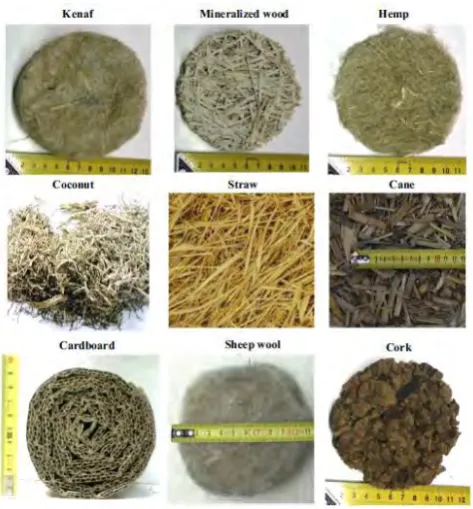
Figure 1.1: The example of natural fibers (Berardi and Iannace, 2017).
This research discusses about the effect of the fabrics cover on the natural fibers in order to improve the sound absorption. Different type of fabrics is used to identify the best fabric material that can be used to apply on the fiber as well as can improve the sound absorption. The fabrics are placed at the front and the back of the natural fibers and then compared it with the fiber that not attached with fabrics. This experiment is conducted by using impedance tube with the proper standard ISO 10534-2:2001.
1.2 Problem Statement
3
The acoustic textiles are not often used in the industry because of the lack of the research about the acoustic textiles characteristics. Usually, the acoustic textile is used in the building such as hall or sound studio and can be used as a fabric wrapped panel. The fabrics also can be used as a cover for acoustical panels such as fiber panel because it has higher ability of sound absorption. The usage of the fabric also important to give a better quality of sounds absorption and also can be a decoration purposes. The type of the fabrics that can be used to cover the fiber panel is still lack in research. It is because each type of fabric has its own sound absorption characteristics that can affect the quality of sound in the building. For this research, three types of fabrics are choosing to expand the research about the acoustic textile to reduce noise in the building.
1.3 Objective
For this project, a few objectives can be determined as follows:
1. To measure the sound absorption coefficient by using different types of fabric covers on micro perforated panel (MPP).
2. To measure the sound absorption coefficient on three types of natural fibers by applying different types of fabric cover.
1.4 Scope of Project
4 CHAPTER 2
LITERATURE REVIEW
2.1 Sound Absorption Materials
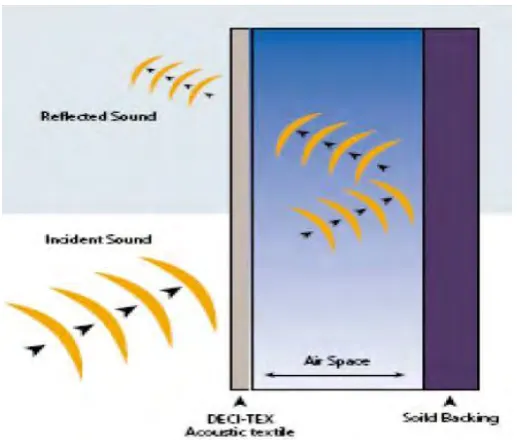
[image:19.595.194.453.523.743.2]Materials that reduce the energy of sound wave by the phenomenon of absorption are called sound absorptive materials (Kumar, 2011). Figure 2.1 shows the example of the phenomenon of sound absorption material. They are often used to moderate the acoustic environment of a closed volume by way of decreasing the amplitude of the reflected waves. Absorbing materials are usually resistive in nature, either porous, fibrous or reactive resonator (Bell et al., 1994). Mineral wools, fibrous glass and foams are the sample of resistive materials while the example of the resonator is such as sintered metal and hollow core blocks. A resonator is a passive standard for noise reduction by converting into a vibration. The resonator absorbs sound by making the vibration to produce heat loss due to the sound pressure differences (Liu and Hu, 2010). Most of the product material is provide some degree of absorption at the same frequencies and when the material thickness is increase, the performance at low frequencies also increase.
5
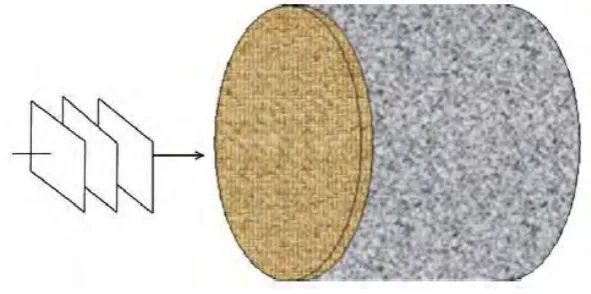
[image:20.595.162.458.290.437.2]Porous materials usually used as sound absorbers and it application are often assembled with a resistive layer. Chevillotte (2011) has stated that, the resistive layer can be used to increase acoustic properties of the porous material and usually it used for the protection or decoration. From this research, there are three type of numerical simulations that carried out which is influence of perforation diameter, influence of perforation rate and influence of downstream layer. Two multilayer textile + air and textile + glass wool are carried out in this experiment by using impedance tube. The results can be shows that the sound absorption selectivity is increasing when the perforation rate decreases. This is because the considered multilayer tends to act as a Helmholtz resonator. Figure 2.2 shows the example of multilayer made up of a downstream porous media and resistive layer.
Figure 2.2: The example of multilayer made up of a downstream porous media and resistive layer (Chevillotte, 2011).
2.2 Sound Acoustics of Textile
Textiles are used in many application including the acoustics such as in automotive insulation, panels for workstations and halls. The used of textiles for noise reduction is based on two categorise which is low costs production and small specific gravity. Textiles materials have their own acoustics properties. Generally, acoustic materials are separated in two categories of porous sound absorbers which are (Kumar, 2011):
6
filaments are combined and twisted to produce yarns while the staple fibres are rolled to create yarns. Yarns are usually woven or knitted into fabrics. A piece of fabric contains a huge number of fibres. Morton & Hearle (2008) stated that a small piece of fabric contain over 100 million fibres.
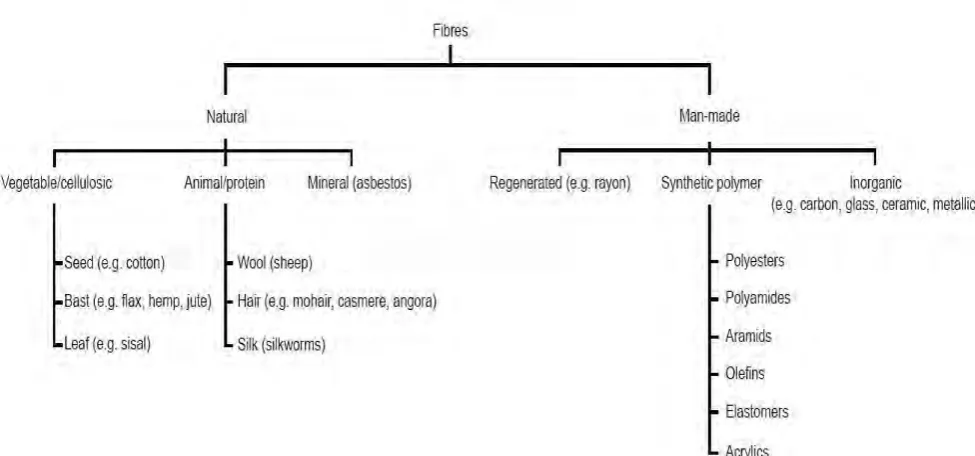
[image:21.595.85.573.331.559.2]Fabric is the processed and assembled of the yarns. There are many ways by processing yarns to make a fabric such as woven, nonwoven and knitting. The fabrics processing in different way produces a variation in texture, appearance, drape as well as it performance characteristics such as strength and durability (Sinclair, 2015). In textile fibres, there are three types of fibre groups which are natural fibres, regenerated fibres and synthetic fibres. Regenerated and synthetic fibres are known as man-made (manufactured) fibres. Figure 2.3 shows that the variety type of textile fibres.
Figure 2.3: Types of textile fibres (Sinclair, 2015)
7 2.3 Sound Absorbing in Woven Fabrics
[image:22.595.124.458.327.520.2]Woven fabrics can be used as a component of noise reduction assemblies made of textile materials and also as decorative cover of noise absorber that made of rock wool. Shoshani and Rosenhouse (1990) conduct the investigated about the relationship between the noise absorption coefficients of a cover made of woven fabric and its intrinsic parameters. The parameters considered were fibre content, yarn count, cover factor, air gap behind the fabric and the frequency of the impinging sound wave. There are 28 woven fabrics that conducted in the experiment varying with the parameters and the results shows that the intrinsic parameters of the woven fabric have a very little effect on absorption coefficient in the low frequency but has major impact at the highest frequency. Figure 2.4 shows the example of woven fabrics.
Figure 2.4: Example of woven fabrics (Raaz, 2014)
8
[image:23.595.77.534.192.468.2]Table 2.1 shows the description of the analysed sample of carpet. The results show that the absorption coefficient is increase with the frequency with 0.1 at 400 Hz up to 0.5 to 0.8 at 4200 Hz. The best sample among the six samples is the sample with made of 100% wool and having the highest thickness of 12 mm.
Table 2.1: The description of the analysed sample of carpet (Ricciardi and Lenti, 2010)
Test
Sample Composition
Total Thickness
(mm)
Mass per unit area (g/ of Fibre +
Support
Colour
A 100% Wool 12 3934 Brown
B 100% Wool 8 2925 Dark Blue Plain
C 80% Wool
20% Polymide 14 2752 Brown & Green
D 80% Wool
20% Polymide 12 3809 Purple Veined
E 80% Wool
20% Polymide 10 3296 Ochre Plain
F 100% Polymide 12 2548 Electric Blue with
Yellow Picture
9
Figure 2.5: The detailed view of the different samples of textiles under investigation (Alonso and Martellotta, 2015).
2.4 Sound Absorbing in Nonwoven Fabrics
Porous materials such as nonwoven fibre are widely used as sound absorptive materials. By using nonwoven fabric as porous absorber, it is technically and economically one of the most extensive means among the variation techniques that used for the sound absorption (Moghaddam et al., 2015). According to Wang and Torng (2001), the sound absorption materials are widely used because of their fibrous structures due to the porosity, cost and low mass are capable of sound absorption. Compare to the woven and knitted fabric, nonwoven fabrics do not have an organized geometrical structure. Nonwoven fabrics are not easily recognized because they are commonly hidden even though it is used in various areas (Yilmaz and Deniz, 2009). There are some example of nonwoven application area such as in automotive, clothing, construction, home and healthcare.