EINETICS OF THE FORMATION OF SUBSTITUTED DIAMIDES OF CARBONIC ACID.
By
Lloyd Earle SMYTHE.
Being a thesis submitted for the degree of DOCTOR OF PHILOSOPHY
in the Faculty of Science * •
University of Tasmania.
MEMORANDUM,
This project came into being as a result of earlier work carried out in the Department of Chemistry, University of Sydney, in l9,46. The original project at Sydney was a kinetic study
of the urea-formaldehyde reaction and the results were
incorporated in a thesis for the degree of Master of Science (Syd,), later published in 3. Phys. Colloid Chem.
In 3,9144-45 the author was associated with a newly •established factory for the production of phenoplastics
and aminoplasties. As Research Chemist ; Beetle-Elliott Plastics Pty. Ltd., he was given the task of carrying out the developmental work necessary for the establishment of the first plant for the stanafacturs of urea-formaldehyde condensation products in Australia.
Early in this work it was realised that notwithstanding formulae and manufacturing data supplied by the parent
•Beetle Company in England, the tu3e of Australian raw materials introduced many difficulties which were not easily reconciled with existing knowledge of the reaction.
Despit3 a history of over sixty years and intensive research by many workers there was and still is, incomplete •understanding of the complex condensation between urea and
formaldehyde which is the basis for the production of many important technical plastics exemplified by Beetle, Plaskon, 3arab, Uformite and others.
rather vague nature contained in patents.
Prior to 1946 no work had been published on the kinetics ' of the urea-formaldehyde reaction and the Sydney project was
undertaken with a view to examining the initial condensation and reaction mechanism. Owing to other employment during the period 1946,48 it was not found possible to continue with this project even though some interesting points had been raised which required further examination.
In 3.948 workers in the United states and. Sweden published several papers on the kinetics of this reaction and at present the work still continues mainly in the United States, Australia, Sweden and telgium.
When the opportunity arose in 1949 for further work on this subject and due to the interesting papers which had appeared in the intervening years, the author sought approval of this project as work for the Ph.D. degree.
This thesis is composed essentially of four papers published (or in press) lathe Journal of the American Chemical Society. The work was published as results came to hand since as similar projects had been commenced in other countries, any great delay in publication might have resulted in some duplication of work. In the case of the author,
the delay in publication would have been some four years as the project was undertaken on a half-time basis owing
to teaching duties in the Department of Chemistry, University of Tasmania. The normal time spent on research by Ph.D.
iv.
V.
ACKNOWLEDGEMENTS.
/ wish to express my appreciation for the advice and assistance of the following:
Professor LE. Kurth, Professor of Chemistry, UniVersity of Tasmania; Dr. T. 'radial., Reader in Physical Chemistry, University of Sydney; Dr, J.B. Poin t Senior Lecturer in Organic Chemistry, University of Tasmania; Dr. G.A. Crowe, Bakelite Company, Union Carbide and Carbon Corp., Bound Brook,
New Jersey', U.S.A.; Dr. X.fl. /lick, Lecturer in Organic Chemistry, University of Tasmania; Dr, 3.8. Pitzgerald, Division. of
vi.
CONTENTS.
TITLE PAGE . 0041 000 000 000 000
MEMORANDUM 000 000 •00 ••0 ii - iv
AOHNOWLEDGEME1T8 00* 000 000 040 v
CONTENTS vi
INTRODUCTION ... •00 000 01111 0041 1 - 11.1.
UREA-FORMALDEHYDE KINETIC STUDIES 15 Part I Variation in Urea Solutions 16 Part II Factors Influencing Initial Reaction 19 Part III Polarographic Studies in Dilute Solution 22 !?art /V Reactions of Methylenebisureas
38
SUMMARY and CONCLUSION:3 ... 000
43
VITA 58
1,
INTRODUCTION.
A serious drawback which hindered the elucidation of many reaction mechanisms in. organic chemistry, was the lack of
accurate quantitative data. The classical investigation by Lapworth of the halogenation of ketones initiateda new kinetic era in organic chemistry promoting the search for more exact knowledge' of reaction mechanisms and the
energy
considerations involved. •The reaction between urea and formaldehyde first occupied the attention of chemists some sixty years ago with the
studies of Hazer, Lady, Heimtelmayr, Goldschmidt, Einhorn, Hamburger and others. The greater portion of the work
published ulnae then related to the preparative aspects of the
reaction and it was not until 1928 that the first serious attempt to suggest a reaction mechanism was made.
'
Holzer2 isolated a compound having the empirical formula
02 H4 0 N2 and assigned it the structure: NH2CON =CH2
monomethyleneurea
2.
Monomethyleneurea is a dehydration product of
monomethylolurea $02.130.HH.CHell and lia.dy 3 suggested that its
insolubility might be due to the occurrence of .a cyclic structure: NH
\
0=0 0H2NH
Hemme1mays
■4
later prepared a compound which was the same as that obtained by H8lzer and later by 1.44y, by reacting together urea and chloromethil alcohol.Important progress in the study of the reaction was made at the turn of the century. However, before reviewing this work it is important to record the factors which influence the urea—formaldehyde reaction. These arias
(1) the urea to formaldehyde molecular ratio; (ii)the' solution concentration;
(iii)temperature; (iv)the solution pH;
(v)catalysts, if present.
These criteria are critical and are responsible for the diversity of products obtained by various workers.
3. Lindy, L. J.C.S., Xi, 1059 (1889)
3
.
Under mild conditions - low temperatures (e.g. 5-.30 00) and neutral or slightly, alkaline conditions - important
51 compounds isolated were the crystalline mono- anddimethylolureas ,6, 'tinhorn and Hamburger6 prepared monomethylolurea lill2CONINE2011,
by reacting urea and formaldehyde in equimolecular proportions in the presence of a small quantity' of barium hydroxide at 5 60. Dimethylolurea 01i20HNHC0NI10112011, was prepared by the same
workers using two molecUlar proportions of formaldehyde to one of urea in the presence of a small quantity ot barium hydroxide at 25 3000. The later stages of the condensation were not investigated by these workers* although it was shown
that in acid or alkaline solution the methylolureas yielded ill-defined amorphous compounds of varying composition.
Dixon8 varied the proportions of urea and formaldehyde and effected the condensation in acid solution. Using a urea-formaldehyde molecular ratio of 1:0.75 he obtained a product which* as a result of nitrogen analysis * was believed
to be pure methyleneurea.
van Latr9 suggested that at ordinary temperatures
the formation of methyleneurea proceeds by the condensation of both the urea amino groups giving a cyclic form
5. Goldschmidt* C. Chem. Ztg. Lk* 460 (1897); .1.0. S.
7,6178
(1898),6. Iginhornt. A. and Hamburger* A. Ber. Us- 24 (1908). 7. 'tinhorn* A. ann., al, 207 (1905); al. 113 (1908).
8. Dixon* A.E. J.C.S., MI 238 (1918).
which then tautamerizes to the asymmetric form:
NH NH
/2 / -., /
NCH
=
2
Cr.C) i- (:-C H ----> CAC) CH ---"" C=C) \
N H
2 \ / z __ \
(+ Hp)
N Hz
2 N H
Scheibler and co-workers10 were of the opinion that a trace of HC1 converted the methylolurea first formed into a polymer consisting of methyleneurea units, each containing one firmly bound molecule of water.
[
A .H.01
4. C:7:H
I 2 I
NH
h
Degradation of the polymers by the same workers led them to believe that they consisted of chains of dimethyleneurea or methylolmethylene units joined together, the free ends
of the chains being attached to water molecules, Such chains, they suggested, might be associated by secondary valencies
into micelles and colloid particles which confer on the polymerized material its characteristic high molecular physical properties. Seheibler and co-workers also observed that when symmetrical dimethylurea CO(NH.0H3) 2 , was reacted with formaldehydel methylol derivatives were formed but no further condensation to methylene compounds took place. It was concluded that the mechanism
for the formation of methyleneurea suggested by van Laer was impossible.
10. Sch*ibler, H. Trostler, F. and Scholz, E. Z.Angew.Chem.,
5.
Walter and Gewing4 made an analytical study of the water and formaldehyde lost during the condensation process and early recognised the need for quantitative data. According
to Dixon , dimethylolurea loses water and formaldehyde when
heated above its melting point to yield a compound which appears to be identical with Goldschmidt's compound/2:
NH-CH — N-CH OH
. NH.CHOH I 2 I 2
/
co ----> (›C C400 ÷
CH 0 1-2H2 20\NH.CH
2 OH NH—CH2
---NH
(Goldschmidt's compound)
If the formaldehyde split out were taken up again in
the formation of a ramified chain the net change of formaldellyeke would be zero. Walter and Gewing found that this agreed rainy well with the experimental values; which suggested a chain
of the type:. CH
2 OH 1
N - CH-NH 2 I C=0 • GTO
I 2
CH2OH N-CH-NH
I 2. 1
Cx0 1
N-CH-N-C H
2 etc.
Moreover, as a result of their computations,,they decided that the following structures could not be present in the
final hardened resin:
6,
(i) optn chain structures of the type:-
.01i2 . [C0.1111. Cli2:N(CH20q ri COMLOH2OH (ii) alien ring chain structures of the
type:-NH-CH-
-71
-
CH2- -C HaOHC=0 C=0 C----0
NH-CH- -N-CH- -N-CH2.0H 2
Very close chemical control would be needed to obtain a homogeneous polymer under the conditions employed by Walter and Gewing. .Their findings are inconclusive since with the relatively drastic conditions employed and lack of close control, it is likely that their analytical data represent mean values for mixed structures or structural units,
de Ghesne13 examined the ureampformaldehyde condensation by both chemical and physical methods, He suggested that
the resins formed when the pH of the reaction mixture is' greater than.
7,
involve the initial condensation ofmethylolureas and consist of micellar aggregates af linear thread-like moleeuleo of varying degrees of polymerization. It was suggested also that highly solvated hydrophillic
colloids are formed which possess the property of irreversible gelation. de Chasm's findings musts's° receive little
support since the reaction was not strictly controlled. 14
Redfern commented on the need for strict control of the reaction and suggested that the reason earlier
, 7.
investigators were at variance, was because of the lack of careful buffering of reaction solutions. He suggested that in acid solution two molecules of water are eliminated from dimethylolurea to yield dimethyleneurea:
NHCHOH 7=CH2
c=c) -->
c=c> HE 2
. NHCH2OH N=CH2
heating then results in the formation of a polymer with a saturated chain structure:
—CH
CH—CHCH CH
CH —-
2
12
1
2
2
. I I I 2
— N • N
fq N N N —
. C=0 C*0 co
This theory is unsatisfactory since there is no provision for cross-linking and for formaldehyde liberated during the later condensations Moreover, owing to the strain iiklosed„
the
formation of a large number of four-meMbered rings isunlikely.
There is also no mention of the isolationor
pure dimethyleneupea itself.E11is15 suggested' that two molecules of urea and three of formaldehyde lead to the initial formation of .
NH — CH
CO
\ 2
/N.CO.NH.CHIOH +2 H20
NH —CH
2
1
condensation 8,methylol carbamyl 4-keto hexahydrotriazine, followed by condensation:
2
NRCO.NH +3
CH20
2
NH2 NHCH2 OH C= 0 ÷ G= 0
\ \ •
NH.0 1-110H N HCH2OH
if
CO NH -N
\ / 1.
CH — N 2.
'CO-NH-CH
.OH
,
Assuming the above to be correct, gelation can only occur when the ratio of formaldehyde to urea is greater than
lit Is since with smaller quantities insufficient formaldehyde is present to permit necessary cross-linking between
secondary amino nitrOgens.
Walter26 studied the condensation further and reported that at high hydrogen ion concentration (pH ft 1.0) there occurred rid deposition of a highly insoluble monomeric
9.
methyleneurea. This compound did net polymerize and he suggested that it had a stable ring structure:
\ •
H N-C CH / . 2
0
Under less acid conditions (pH = 3.0) the reaction proceeded more slowly giving a methyleneurea which showed a greater tendency to polymerize, and a dtmeric and trimerie form. These were suggested to have the following structures:
• 3112.CO.N = CH2 reactive structure. • HH2.00.HH.CH2.HH.00.H = 0H2 dimer•
Int•C0.HH.CH2.11H.00.M.CH2•NH.00.1fr = CH2 trimer.
The formation of these plymeric substances were supposed to take place through the initial formation of methylol
compounds as follows:
2 NH2..CO.NH.CH2OH ---o 1012.CO.N1.CH2.NR.00.NH.CH20K
HH2.00.M.CH2.1;14.00.'H = CH2 H20. The evidence is somewhat inconclusive, since molecular weights of products were determined by the cryoscapic method using formic acid as the solvent. short chain methylol and - methylene compounds are very sensitive to formic acid being rapidly converted to polymeric compounds even at low
temperatures. In addition; since the number of free -Na 2
10.
A similar, effect has been observed with condensation, products of urea and formaldehyde and the hydrochloric acid set free from hydroxylamine hydrochloride which was used as an
analytical reagent. 17
Kadowaki" reacted urea and formaldehyde in the molecular ratio 8:1 in the presence of hydrochloric acid and obtained methylenebisurea, m.p. 218°C, which was also obtained by
Vass: 19
VH2.00.thi.CH2.1111.00.N112 methySenebisurea. Kadowaki found that aqueous solutions of mothyleneurea when acidified gave insoluble polymethyleneureas such as
pentamethylenehexaureas
3112.00.1111(0112.1111.CO.N11) 5 H
On the basis of these reactions Kadowaki suggested that with one molecule of urea and one or less of
formaldehyde, a chain condensation occurs:
.
( xNH.CONH.CH OH ----> CH 0+ [-N H.CO.NH.CH-]
2 2 2 x
ENH.CO.NH.CHrII-NH.CO.NH --> NH.0 0.N H INH.0 0.NH.CHilH
2 1. x
17. Smythe, L*3. 341 Phys. Colloid Chem., 11.J 369 (1947).
18. Sadowski, H. Bull. Chem. Soc. Japan, 11, 248 (1936.) Vass, F. British Plastics, 100 115 (1938).
U.
With one molecule of urea and more than one molecule of formaldehyde the condensation proceeds in a similar manner giving linear chains with attached lateral methylol groups:
NH.CO.NHICH.NH.C.O.N.]
Ix CH20H
•
The methYlol groups would then be in a position to react with adjacent secondary amino groups in other chains to give methylene cross linkages.
Kadowaki also succeeded in isolating both mono and dimethylol derivatives of methylenebisurea and these
could be converted by heating to a hard transparent resin. With one molecule of urea to four of formaldehyde at ordinary temperatures in the presence of Ba(0102 and subsequent addition of methanol and excess of 1107,, Kadowaki isolated 315 dimethoxymethylurons
C 0
/
c H30 . C ItC Hi0C H3
CH CH / 2 0
This compound may be regarded as being derived from a tetramethylurea in which two methylol groups have been methylated and the other two have undergone intra—molecular condensation with the formation of an. ether group.
12.
particularly when strong condensing agents are employed2° leads to the formation of ill-defined compounds.
Haigins and liovey21 applied Kienlels theory of
functionality22 to the formation of urea...formaldehyde condensation products. in the case of monomethylolurea it *Is suggested
that only long.-chain or branched polymers are permissible and no cross-linkage takes place. For dimethylolurea
there is an equal number of hydrogen and hydroxyl reactive pointsend three-dimensional polymers with crosa.ainkagea can be formed. Experiments suggested that in the case of mixtures of monomethylol and dimethylol ureas, the cross linking tendency increased with increasing Proportion of dimethy1o3.ures.. In this case the effective functionalities of the two methylolureas depend, on the relative proportions of each component present. This view of the condensation is valuable when considering the Initial condensation and fate of the methylolureas, once formed.
Vogel25 carried out viscosity and osmotic pressure measurements which suggested that for condensations of urea and formaldehyde in 1:1 molecular ratio the
macromolecules are approximately spherical in shape with three dimensimal branched chain formations present.
20. tamythe, L. B. J.A.0.8.
rv
Reactions of liethylenebieureas.2,1,
1953 (in press)21. liodgins, T.S. and Hovey, A.G. Ind. Eng. Ohm
• 673
(1939)• 22„ Xiertle, R.H. Ind, Eng. Chem., 22. 590 (1930).13.
Marve1214' and co.workers regard urea as containing an amino and an amido group and suggest that resirsificktion proceeds as follows
(I) the initial reaction is between the primary amine part of the molecule and the formaldehyde to give
methylen.e.imine derivative which immediately trimerizess
NCH + H2. NHCO.NH
2 + CH20 ----> NH.2CO. = 0
2 2
CO.NH 1. 2
/N\ 3 NHCO.N=CH 2 2..
CH2 C H2.
•
I I
N N
NH2CO cH
z CO.NH 2
(ii) the amide. groups then react with more formaldehyde to form methylene cross linkages between the rings. Marvel supports his theory with rather inconclusive
evidence since the trimer postulated has never been 'isolated. In addition it must be emphasised that figures for the
nitrogen content of the resins ranging from 33 36% mean
little unless the conditions of condensation be subject to very close control, It is possible that the highly condensed systems investigated by various workers contain shorter open chain structures together with the more abundant branched and oross.linked structures already discussed, Hydration of formaldehyde, urea and the lower molecular weight methylol and *ethylene compounds should not be overlooked and this
may well lead to the variation in analytical determinations of water and formaldehyde by Walte.r.16
At this stage it is not proposed to consider further the few theories advanced during the past four years and relating to the resinification process ; since it is the kinetic and
•quantitative aspects
or
the Initial condensation which .concerns this investigation. • What has been said will be sufficientto serve both as an introduction to the kinetic studies •and provide a broad view of the field into which these
studies fit. In addition no significant advance has been made during the past four years and recent studies .
significantly concern the kinetics of the initial condensation. Because of the number of factors mentioned earlier which
influence the reaction; progress must necessarily be slow until the overall picture is completed. With careful
15.
KINETICS OF THE .PORMATION OP SUBSTITUTED DIANCIDES OF CARBONIC ACID
presented as
Ureac-Pormaldehyde Kinetic Studies
Part Z. Variation in Urea Solutions.
Th
e
s
e
a
r
t
icl
e
s
ha
ve
been
removed for
copyright or
proprietary reasons.
Smythe, L.E., 1951, Urea—formaldehyde kinetic
studies. I. Variations in urea solutions,
J
ournal of the
American Chemical Society, 73(6), 2735-2738
10.1021/ja01150a089
Smythe, L.E., 1952, Urea—formaldehyde kinetic
studies. II. Factors influencing initial reaction,
22,
CONTRIBUTION FROM THE DEPARTMENT OF CHEMISTRY UNIVERSITY OF TASMANIA.
UREA. FORMALDEHYDE KINETIC STUDIES.
III. POLAROGRAPHIC STUD/ES IN DILUTE SOLUTION. By Lloyd E. SMYTHE.
Abstract:
The reaction between (a) urea, (b) N-methylurea,
(c) N-ethylurea and formaldehyde has been studied in dilute solution at pH 7.15 using the polarographic method for following the
concentration of unreacted formaldehyde. The reactions were found to be second order and rate constants and energies of activation have been evaluated. Differences have been observed in the reaction of urea with formaldehyde as compared with the simple N-alkyl ureas and formaldehyde. It is suggested that in the case of alkyl ureas some effective resonance stabilization is lost and the effect
becomes more pronounced in dilute solution resulting in increased reactivity. Hydration of both the urea and formaldehyde is
appreciable in the region of pH
7;
the reactions reaching a certain stage and being unable to proceed further. The effect of acid or alkaline condensing agents in dilute solution would be initially to break down forces of hydration and in the case of alkaline solutions the reaction is reversible. The initial rapid reaction previously observed becomes less important with increasing dilution and the significance of this is discussed. The23, -2-
Part II of this series1 indicated that dilution of reactants exerted a considerable influence on the nature of the initial reaction between urea and formaldehyde. It was also evident that the analytical method for the estimation of formaldehyde2 was
subject to some errors when working with dilute solutions.
A study of the reaction in dilute solutionassing urea and N-alkyl ureas was commenced. The polarogmphionmethod appeared
to be the most suitable in this case and Crowe and Lynch, had successfully used it employing 0.05N lithium hydroxide and buffers giving supporting electrolyte pH values from 8.6 — 12.7. In all cases the reaction was shown to be reversible and equilibrium constants were evaluated. Earlier observations 4 had indicated that while most alkaline condensing agents are efinective for the formation of methylol compounds there Was evidence of some
hydrolysis of the condensation product, equilibrium evidently being attained, particularly at pH values greater than 9.0. In this study it was desirable that the pH
or
the supporting electrolyte be maintained as close as possible to 7, so as not to influence materially the forward or reverse reactions. The effect of phosphate buffers on the reaction has been studiedl and preliminary studies using different supporting electrolytes indicated that SOrensen buffer of seven parts by 'volume bf15Na2 HPO4 and three parts by volume of HA2 PO4 giving
a pH of 7.15 at25 0C, provided a suitable stwortimag electrolyte. 1. Smythe, L.E.
2. Smythe, L.E. 3. Crowe, G.A.
This Journal, /271:3(1952). J. PhYs. and Cialoid
and Lynch, C.C. This Journal.
1, 2596 (1947).
0 37911941;
2 3622 1950 .
3731 1949 ;
24. -3.
It is well known5 that polarographic limiting currents on
buffered solutions of formaldehyde show an exceptional dependence on pH. At neutrality the limiting current is less than
1 100
and at pH 13.5 less than - of the diffusion current as calculated by the Ilkovic equation. Nevertheless the diffusion current
in the selected buffer, although reduced, was aftuate giving smooth polarographic steps with mostly no maxima and thus avoiding the use of maximum suppressors.
EXPERIMENTAL.
The polarographic measurements were made with a Tinsley ink recording polarograph (V722/1) employing D. C. amplification
of the current passing through the solution in the polarographic cell. The recorder unit was a moving coil D.C. pen type
milliameter, the standard speed being 1 inch per minute
corresponding to a voltage change of 0.5 volts. The "capillary constant" K was 23.82 using 0.1 M CH20 in Sitfrensen buffer
containing dissolved air; applied voltage -1.65 v., head of mercury 501 m.m., drop time 2.52 sec., temperature 25.0.
The radius of the capillary orifice610 determined in 0.1 M KC1 at 25 .0 using an open circuit was 25 microns.
With BfiSrensen buffer supporting electrolyte containing dissolved air, the half-wave potential vs. the mercury pool electrode was -1.65 volts and -1.73 volts vs. the saturated calomel electrode. Concentration of formaldehyde within the range 0.01 - 0.10 M exhibited this half wave potential but concentrations of 0.10 - 0.50 M resulted in a shift to a
5. Veseley, K. and Brdicka, R., Czech.Chem6Commums. 12, 313 (1947). 6. Miller, 0.1!. The polarographic Method of Analysis.pp.182-190,
IwZ
. slightly more negative potential. Figure 1 shows the relation between the diffusion current in microamperes and concentration
•■■••
(44
(l)
L tztl)
Sensitivities corresponding to full scale deflection on the recording chart were selected to give the largest possible step. Accuracy of measurement was + 0.05pA over the range 0.01 —
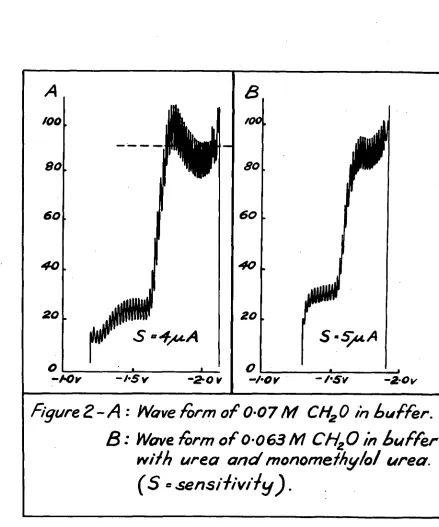
0.10 M C120. Slight maxima were exhibited with formaldehyde alone in the buffer and it was not found necessary to eliminate these as step heights were reliably determined by drawing a
[image:28.557.24.546.41.713.2]line representing the limiting current as shown in Polarogram A, Figure 2.
In
this case other means for estimating the diffusion current did not prove as reliable as the method employed. It is interesting to note that in the studies of the reaction mixture of urea and formaldehyde, the urea in each case acted as a28.
A
90.
/00I
80
60 60
40
20 20
S -A
o . . 0
[image:29.539.79.518.62.589.2]-boy --/-5 v -2-0 v -boy - 1•5v -2-0v
Figure 2- A : Wave form of
007M C1120 in&offer.
B:
Wave form of
0.063 MCH2 0 in 6uffer
29.
A
too
80 .
,
B
mo
80
60. 60
40. 40
20 20 .
S. /944 A
o . o 1 I
-40 v -I-5 v -2-0 v -/-0 v -PS v -2-0
v
Figurea-A:Woveformof
0445 M
CH20 in buffer.
8: Wave form of0.1/0 M Ck0 in buffer
Some studies carried out with 0.10 - 0.50 M formaldehyde solutions revealed that the maxima exhibited offered some
difficulty in measurement of diffusion current (Polarogram A,
Figure 3). Although these maxima were also effectively suppressed in the presence of urea and substituted ureas, (Ptlarogram B,
Figure 3) the accuracy was only of the order + 0.211.A. The maxima in all cases appeared to be 2.5pA greater than the line drawn through the step and used for measuring the diffusion current.
As dissolved oxygen was not removed from any of the solutions, zero suppression was used in the range 0.01 - 0.10 M CH20, the
recorder zero adjustment being used to depress the oxygen step. Zero suppression was not found necessary in the range 0.10 - 0.50
m me,
using lower sensitivities. The polarograph cell used was a modification of the simple Heyrovsky cell, holding4
ml. of solution. Temperature control was by means of athermostat bath to within+ 0.05 .0. The height of mercury above •the capillary orifices maintained constant by a levelling
device.
The polarographic procedure outlined above has been used to follow the progress of urea - formaldehyde condensations on the industrial scale. The dilution of the sample taken with buffer, effectively retards the reaction rate and prevents
elimination of formaldehyde already combined, as maybe the case with other supporting electrolytes. The progress of a typical condensation employing 500 parts by weight 40 per cent --formalin, 185 parts by weight urea, one part by weight
•
NA2HPO4. 2H20 was followed by withdrawing 1 ml. samples and
31. .9.
using 4m1, of this solution, the concentration of free formaldehyde being estimated from Figure 1.
Chemicals used were of analytical reagent grade or specially purified in the case of urea7. N-methyl and N-ethyl ureas were prepared by the method of Davis and Blanchard8.
Table I.
DATA FOR THE REACTION BETWEEN EQUIMOLAR (0.1M) AMOUNTS OF FORMALDEHYDE AND UREAS.
Nmgp No.of oc experi- frS405 ments
k 104 a 20 End of 10
Urea Mi.t.zoo mitecaoction 4ga (approx.) see. 4.
25 7 iH2CONH2 1.7 (14,000) 1.0 0.035
15,300 35 5 NH20ONH2 3.8 (12,000) 1.0 0.032
25 8 MeNHOONH2 8.3 (8i000) 7.5 0.050
14,100 35 6 MeNHCONH2 18.0 (6000) 8.0 o.047
25 6 EtNHCONH2 7.0 (10,000)
7.0
o.054
14,000
35
4
EtNRCONH215.5 (Moo)
7.4
0.051
ca, k equals average for number of seconds in parenthesis
minus 300.
b In calories. Evaluated for two temperatures only owing to loss of CH20 at temperatures greater than 35 0C.
•0
Smythe, L.E. This Journal,
21,
2735 (1951).32. -10--
The reactions were second order. Important effects were:- Effect of Dilution- For urea and formaldehyde in equimolar proportions at 25 °0„ previous results1,2,7 together with those
given in Table Ishow that for pH. values close, to
7,
Tateconstants increase with increasing dilution of reactants attaining maximum values with 0,5 M solutions and falling off as dilution increases further, Anion formation of urea may increase with
dilution attaining limiting values in the re gion of 0.5 M solutions. Thereafter competition for the nucleophilic nitrogen of urea
•
involves increasingly stronger forces of hydration of the urea molecule. Formaldehyde would be fully hydrated2 under these conditions of pH and dilation and depolymerization would not be involved. For 0.1 M solutions the percentage of formaldehyde
reacted in the first 300 seconds now reduces to less than 1 per cent as compared with much higher percentages for stronger solutions2 The reaction is now of the slow bimolecular variety from zero time. Crowe and Lynch3 have shown that increasing hydroxyl ion
concentration results in higher rate constants. This would increase dehydration of both the methylene glycol and urea thus resulting in relatively higher rates as compared with those in Table I. In the same table it is shown that the reaction does not go to completion under the conditions stated. At pH
7
the reaction is not reversible but is second order from zero time until33.
-.11-
no further reaction took place.. In addition monomethylolurea, methylenebisurea, methylenebismethylurea and monomethylolmethylent-bisethylurea showed no signs of hydrolysid in the buffer over periods of up to three weeks at 25 O. At pH greater than 8.6
Crowe and Lynch3 have shown the reaction to be reversible and thue while increased hydroxyl ion concentration increases the reaction rate in dilute solution it also promotes hydrolysis of the reaction product possibly preceded by dehydration.
For N-methylurea the rate constant relationship between urea and N-methylurea which was approximately 6 to 1 in the case of 8 M solutions becomes reversed and the reaction with N-methylurea is now five times more rapid. This feature of
the reaction which also holds for N-ethylurea is discussed under the heading reaction mechanism.
Column
5,
Table I shows that a higher percentage offormaldehyde is utilised in the first 300 seconds in the case of both N-methylurea and N-ethylurea, as compared with urea. This fits in with the fact that the alkyl ureas lose resonance stabilization as compared with urea and the rate of anion
formation is increased. The effect becomes more pronounced with Increasing dilution since both urea and the alkyl ureas are very weak bases. The relative effect in the case of the alkyl ureas
Is greater even though Anion formation may.reach limiting values in the region of 0.5 M solutions. In the case of the alkyl ureas examined, only approximately 50 per cent of the formaldehyde
34.
-12?
products, involving the utilization of all the urea and half of the formaldehyde. When formed, no further reaction of the methylenebisureas with the formaldehyde takes place owing to both hydration and the greater difficulty of the reaction between formaldehyde and the nitrogen with the attached alkyl group. The reaction is not reversible and will not proceed further even after periods of days.
It will be appreciated that the above considerations apply to mono- and disubstituted ureas and the fact that dimethylureas Will not give dimethylol derivatives and triethylurea will not react with formaldehyde at all l° is additional evidence that structure of urea plays an important part in. determining the reactivity of these derivatives.
For N-ethylurea the rate constant for
8 M
solutions and not recorded in Part II, was found to be 1.6 x 10 -5 Lmole-1 sietr 1 .(300: with 42 per cent of the formaldehyde utilised in the first300 seconds and tala 15,900 calories, This may be compared with data for urea and N-methylurea given in Table I and previously. 1,297.
Effect of Buffer.- It has been shown previously that the addition of an acid phosphate buffer increases the reaction rate. However, since the relative increase is known and results are compared using the one medium in the case of dilute solutions,
the presence of the buffer should not materially affect the conclusions to be drawn.
-35. -13.-
energies of activation are only accurate to approx. + 1000 calories per mole it is interesting to note that the values are somewhat lower for the alkyl ureas.
Reaction Mechanism and Substitution in the Urea Molecule.
The naeleophilic nitrogen of urea must attack the electrophilic carbon centre of formaldehyde to afford N-methylolureas,
methylenebisureas etc.1P2P3'7* Tautomeric and/or mesomerie forms enhancing the nucleophilic nature of the reactive
nitrogen are more likely to be involved in the reaction than others. A similar attack by nucleophilic oxygen is less important since this would lead to the formation of unstable compounds and an equilibrium strongly displaced in favour of the original reactants.
For unionized urea one may wriPire the canonic forms:
0 Or"' 0-
0 +1 +
H2N C - NH2<> H2N = C If% <—> NN.- 0 = NH2 ( 5 ) derived from the amide form or:
OH OR
+ I
I 4.
•
0H2N = c
gR ‹...>
Hit c = RH ‹...> 112N . en(ii)
from the imadol form. The amide structure is seen to be moreimportant partly owing to the possibility of equivalent canonic
forms, partly owing to a more probable type of charge distribution. In this form however, the nitrogen is deactivated as a nucleophilic centre. For anionic urea the following canonic forms may be written
? 0"1
pro* (i) or (ii) H2N C
gR <.--> H2N - C
=NH (iii) OH36. -14-
(iv) has more resonance stabilization than (iii) owing to equivalent canonic forms; it also appears to have nitrogen
activated for nucleophilic reactions. On these considerations (i) is predominating over (ii) under static, i.e. non-reacting
conditions. The anionic forms necessary for the initial
'condensation are evidently obtained mainly through the ionization of (ii). In other words, (ii) is a stronger acid than (1),
since the former gains resonance energy on ionization to the anionic forms (iii) and (iv), mainly to (iv). Under acidic conditions therefore, the distinction between (i) and (ii)
disappears and the N-methylol type of condensation is no longer favoured.
The tautomeric forms of a simple alkyl urea such as N-methylurea may be written:
0 OH OH
a
I 1
R - Nff C NI12 R N = C RNH - 0 = NH
(v) (vi) (vii)
With R = Me or Et, the inductive effect is towards the adjacent nitrogen and (vi) is less likely than (vii). The principalanionicforms .a.re thus:
sb: 0
0 w R - NH - C = R - C
E4
It
is seen that both the unionized and ionized forms of the alkyl ureas lose resonance stabilization in comparison withcorresponding forms of urea and this maybe responsible for the increased reactivity since there is less resonance energy
37.
-15-
for AE st against urea. The results tend to confirm this view. • It would be expected that substitution of Et for Me would
increase this effect so that N-ethylurea should show slightly higher values for k than N-methylurea. Table I however, does not indicate any significant difference between the
behaviour of N-methyl and N-ethylurea. An examination of the
behaviour of a larger series of alkyl ureas might illustrate
this trend more clearly.
38.
CONTRIBUTION FROM THE DEPARTMENT OF CHEMISTRY. UNIVERSITY OF TASMANIA.
UREA-FORMALDEHYDE KINETIC STUDIES. IV. REACTIONS OF METHYLENEBISUREAS.
By Lloyd E. SMYTHE.
Abstract:
The stability and reactions of methylenebisureas with formaldehyde in dilute neutral and alkaline solutions has been
investigated. Hydrolysis of methylenebisureas proceeds in
alkaline solution (pH = 12.7) but not in neutral solution = 7.15) where the molecule is hydrated. The effect of alkali is to
break down. the forces of hydration. It was found that methylol groups are more easily hydrolysed than methylene linkage.
In neutral solution methylenebisureas do not react with
formaldehyde owing to both hydration of the molecule and lack of strongly nucleophilic nitrogen centres.
In the course of studies of the reaction of dilute solutions of urea and simple N-alkylureas with formaldehyde at pH 7,15
it was observed that certain methylenebisureas once formed, showed no sign of hydrolysis, further condensation or
polymerization.1 Methylene compounds have been postulated as important units in urea-formaldehyde plastics and it
was desirable that the reactions of methylenebisureas be studied further. It was found that the polarographic method of analysis used previously. more suitable for this study than
titration methods. The use of titration methods for the
39.
estimation of formaldehyde when working with more concentrated solutions must. receive careful consideration, since condensation products have been shown to influence the estimationF.
Preliminary studies have indicated that methylol compounds 2, methylenebisureas and more highly condensed systems each have
separately different effeots on the usual titration nothoda.
Consequently the study of later stages of condensation in.more concentrated solution, must await reliable analytical methods. Borzee and Smets3 have recently used titration methods in t% study of condensation reactions of urea and formaldehyde in
concentrated solution but do not state whether errors were introduced by the condensation products.
EXPERIMENTAL.
The apparatus and general technique used in this study have been described1 . Compounds prepared were:—
monomethylolurea 1IH200E110%011, in. p. 111 °C, Rinhorn and Rambarger4; methylenebisurea 0112CONH0H2NHC0NH2, Dup. 2180 decomp., Kadowaki5i
methylenebismethylurea OH3NHCONHafyliCONHCaty m. p. 184°0, Xmlowak15 ; methylenebisethAurea 02115/e1CONHOH2NRCONEC2115 ,06p. 117°0, ginhorn6;
monomethYlolmethylenebisethylurea C2H 5NHCON(CH201)080HC0NEWK5 , m.p. 171PC, EinhorA It was found necessary to modify several
2. smyths, L.E. J.Phys.Colloid Chem., tt, 396
(1.947).
3. Borzeo, A. and smsts, G. J.Poly.Sci.ill ,; 371 (1952).4..
'tinhorn, A,. and Hamburger, A. Ber., 424 (1908).L.O.
of the above methods of preparation where hydrochlgric acid was used as condensing agent. Where the solutions were allowed ' to develop excessive heat during the initial reaction, ill-defined
products of indefinite melting point were obtained. These would . not respond to purificatitm.
The stability i of methylenebisureas in dilute solution . • (Orensen buffer) was tested as follOws: 04,M solutions Of
the COmpounds listed above were prepared with the buffer.
The solutions were allowed to stand in sealed tubes at temperatures of 250C and 35 9C. No free formaldehyde was detected by
polarographic analysis at any time up to three weeks.
• The reaction of methylenebisureas with formaldehyde was :also studied. 0.2 M solutions Of the compounds listed above,
.prepared with Bjerensenhuffer,-were allowed to react with . • equal voluMes of 0.2 M.solutions of formaldehyde in the same
buffer at temperatures of 259C and 350C• For periods of up to three weeks the concentration of free formaldehyde remained unaltered at 0.1 M
Methylenebisureas were found to be unstable in the presence ofa strong base:. In this case, lithium hydroxide was selected as the base, since it would provide for comparison of the
results with those of Crowe and Lynch7. Equal volumes of 0.2 M solutions of the compounds listed above and 0.1 'MUCH were reacted together at 25 9C with the results given in Table I. The decompositions were first order from zero time.
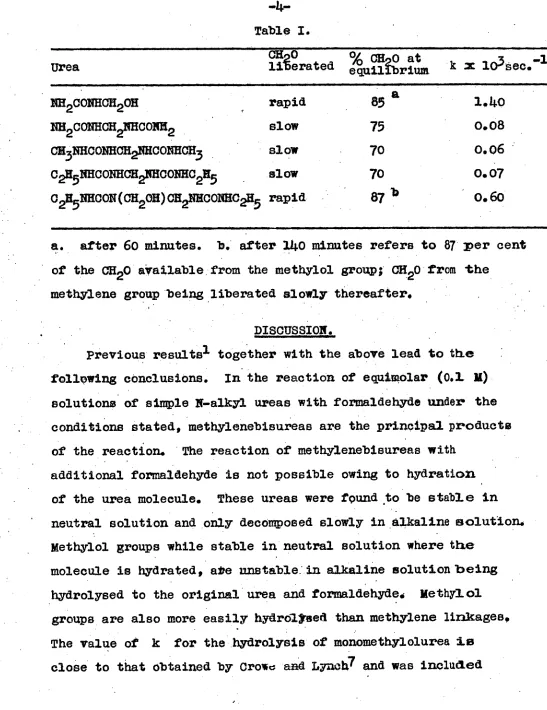
Table I. Urea
CH20
ok
CH20 at ,liberated 1 equilibrium 2C 108eC. wl
NH200NHCH2OH rapid , BH2COVHCH2NHCONH2 slow CH3NHC0NIICH2NHC0NHCH3 slow C2H5NHCOBECH2NHC0NHC2H5 slow 02H5NHCON(CH2OH)CH2NHCONHC2H5 rapid
85 a
1.40
75 0.08
70 0.06
70 0.07
87 1) 0.60
a. after 60 minutes. b. after 140 minutes refers to
87
per cent of the CH20 aVailable from the methylol group; ag2o ft.om themethylene group being liberated slowly thereafter. DISCUSSION.
previous resultsl together with the above lead to the ' following conclusions. In the reaction of equimolar (0.1 M) solutions of simple N-alkyl ureas with formaldehyde under the conditions stated, methylenebisureas are the principal products of the reaction. The reaction of methylenebisureas with
additional formaldehyde is not possible owing to hydration of the urea molecule. These ureas were found to be stable in neutral solution and only decomposed slowly in alkaline solution. Methylol groups while stable in neutral solution where the
L.2.
-5-
for purposes of comparison. In neutral solution it is seen that formaldehyde will not react with methylenebisethylurea to form monomethylolmethylenebisethylurea owing to hydration of the urea and lack of a strongly nucleophilic nitrogen centre. However, if the monomethylolmethylenebisethylurea be formed separately under more drastic conditions 6 the methy1o1 group is seen to be easily hydrolysed under alkaline conditions, the remaining methylene link being then alowly attacked.
Borzee and Smets3 have observed that with equimolar concentrated neutral solutions of monomethylolurea and
formaldehyde, beyond an initial slow reaction, the course and rate of the readtion is essentially the same as for urea and formaldehyde. This was explained on the basis that the
condensation of monomethylolurea itself with formaldehyde comprises the initial slow reaction and that the overall velocity is
increased by a more rapid reaction between monomethylolurea and one of the hydrolysis products of this, urea itself. Studies
• in dilute neutral solution however suggest that hydrolysis of
monomethylolurea is negligible and under such conditions it is unlikely that the nucleophilic nitrogen of urea would attack any but an electrophilic centre of monomethylolurea, if such a centre existed. This latter point awaits clarification by further studies of the reactions of methylolureas.
43.
SUMMARY AND CONCLUSIONS.
In an earlier paper' the author drew attention to the diversity of products obtained in the urea-formaldehyde reaction and listed factors which influence this reaction. Prior to this, Redfarn2 had consent4d on the need for strict control of the reacticin,
particularly as regards the careful buffering of reaction solutions. Without attempting to stumnarize all the papers which have
appeared on urea-forma3.dehyde kinetics, and in this respect it would be more convenient to consult the summaries which accompany the majority of papers, the author intends to outline the !more Important findings wider eonvenient headings. Where possible the author's work will be treated in greater detail although other related work must necessarily be mentioned in order to obtain a broad view of this field. It should be noted that the greater portion of the kinetic work relates to the initial condensa.tion and only when this is thoroughly understood, will theories of the • overall reaction be placed on a secure basis. In view of the
number of factors which influence the reaction it is doubtrul it recent kinetic studies of the overall rcaction3 '11' °Luba regarded with confidence. The accuracy of kinetic data is limited by the accuracy of analytical methods, even in cases
where the reaction is capable of very close control. in addition, • analytical methods which may be suitable for following the
1. Smythe, L.E. J. Phys. Colloid chem., 51, 369 (19147)•
2. Redfarn C.A. British Plastics, 23:U(1933).
L4.
initial condensation under certain carefully controlled conditions,
mar prove inaccurate when applied to the overall reaction.
EXPERIVETAL METHODS:-
The initial condensation of urea and formaldehyde in la mole ratio to form mon moethylolurea„ has been itudie4using hydroxylamine hydrochloride to follow the decrease of free formaldehyde with time. It was shown that monomethylolurea, and other condensation products affected the estimation and a correction factor was employed.
The accuracy of the method varied from for.hlgher
concentrations of formaldehyde, to 4. 5% in the region of molar ' solutions. The hYdrexylamine hydrochloride method was employed
in Parts I and of this investigation but was not suitable for work with dilate solutions.
BettelheMn and CedWall, employed the Lemme6 sodimm sulphite method, liberated NaOR being determlned by titration. It was found that while pare aqueous formaldehyde solutions reacted
almost instantaneously with the sulphite, methYlolureas influenced the estimation• At a result of experiment it was decided to
normalise the sulphite additions and titrations to one minute. It is likely that the accuracy of this method is of the same
order as the hydroxylamine hydrochloride method, when applied to reaction solutions conta 4 ning mono- and dimethylolureas as the principal reaction products.
L5.
Crowe and Lynch7 successfully employed the polarographio method for estimating formaldehyde in urea-formaldehyde and • general amide.formaldehyde renctions. These authors considered
that the general polarographic error was 4. 3% of the value determined. Possibly the accuracy was often higher in the ease of supporting electrolytes of pH 10.1 — 12.7, since the limiting current is greatly influenced by pH, being greater for alkaline solutions. Later polarographie studies by Smythe 8 in neutral solution where the limiting current is much smaller, indicated an accuracy of 596 for the estimation of 0.01 . 0.10 It 0#20 solutions.
De Jondhas published a note onthe urea.formaldehyde reaction but no details are given of the method used for estimation, of
formaldehyde.
Takahashi3 has studied kinetic and other aspects of the
urea.formaldehyde reaction but it has not been possible to Obtani a full translation of the papers concerned.
4-
Borzee and Smets employed a variety of analytical methods in their urea-formaldehyde studies. While hydroxylamine
hydrochloride was used for the estimation of formaldehyde, it was not stated if condensation products interfered. It is therefore not possible to comment on the accuracy of their
analytical methods, except in more general terms. It, is stated that in the studies, total formaldehyde (uncombined formaldehyde plus methylolie formaldehyde) was determined bysa iodometrio 7. Crowe, G A. and Lynch,
8. smythe, L.E. Sea parts 9. De Jong, 3.1. Recuell,
0.C. 3 .A.C.S.
lg.
3795 (1948); 11_, 37:51 (1949)1 7gT3622 (1950).46.
method or alternatively, by a method using sodium sulphite. •The difference between the results of the iogemetric and
hydroxylamine hydrochloride methods then gave “the variation in coneeatration,of the methyloleroup." It seems likely that considerable errors have beenintredueed by employing such
methods in kinetic studies. Condensation products, particularly 'those obtained under acid conditions, would affect the accuracy
of both the hydroxylamine hydrochloride and iodometric methods, For example in the iodometric method, it is necesaary to dilute the sample to be analysed to a formaldehyde content of 0.2%. Comparatively large volumes of decinormal iodine and 2N NaOH are then added to a 25 ml. aliquot and a tea minute reaction period allowed. It is likely that urea or other condensed produets present would affect the accuracy of the method.
10
Investigations have oilcan that the iodometric method gives
accurate results only when applied to gars :ormaldehyde solutions • free from organic compounds (with the exception of methanol and • formic- acid). The tables of Berzee and Smets record total
formaldehyde to four significant figures, the accuracy of estimation Of formaldehyde evidently being of the order of
0.1% of values recorded. It is extremely doubtful IT such a high degree of accuracy is possible in view of what has been said concerning the accuracy of other methods.
It is seen that methods for following the urea formaldehyde reaction kinetically, have been balsed mainly on the decrease in concentration, of formaldehyde during the reaction period.
L1.7.
Other determinations such as melting point and nitrogen content of reaction products, may prove helpful in some cases. Nitrogen content of reaction products however, may not always be
representative of pure structural units.
In view of the difficulties mentioned, the author believed that until suitable analytical methods were developed for the estimation of urea, particularly uncombined urea in the presence of reaction products, studies of the reaction employing ratios • of reactants other than 1:1, would not prove completely reliable.
Usual methods for the estimation of urea are not applicable in •this reaction. The soluble and reactive methylolureas introduce
difficulties and reagents such as xanthydrol, which require the use of such drastic condensing agents as glacial acetic acid, a.re entirely unsuitable. Bettelheim and Cedwall5 are said to be
investigating methods for the estimation of free urea in
urea-formaldehyde reaction mixtures but no information is yet available and there are many difficulties to be overcome.
PURITY OP COMPOUNDS: •
48.
which indicates that there is an equilibrium between urea, ammonium cyanate and ammonium carbonate in aqueous solution at room temperature, no data are-available for similar equilibria in the case of substituted ureas.
De Jong9 has suggested that ammonium salt impurities in the urea, may be responsible tor the initial rapid reaction observed in the case of concentrated solutions. No evidence of this has been detected (see Part I/ this thesis) but rather has the effect been mainly attributed to the concentration of the reactants in
solution. It is suggested that the initial rapid reaction involves anion formation of urea, and dehydration and depolymerization
phenomena.
Of the impurities in commercial formalin only two affect the ureso-forma.Idehyde reaction to an apprhciable extent. _ These are formic acid (usually 0.01 - 0.03%) and methanol
(usually
5 15% ).
Formic acid does not favour the formation of methylol compoundsalthough the
rate of condensation isincreased. The fond° acid in formalin should be neutralised prior to the kinetic studies, except where suitable buffers are used. The effect of methanol on the reaction rate for 1:1
ratio of reactants has been mentioned in Part II. The
author
has
used methanol free formaldehyde solutions in all other studies. It is well known that methylol derivatives of urea may form ethers ilwith methanol, particularly in the presence of hydrochloric acid, In addition it is probable that hendacetals are present in
alcoholic formaldehyde and even though relatively
unstable, their
U.
Ritchie, P.D.
A Chemistry of Plastics and High Polymers. p.121.L1.9.
existence should be recognised in kinetic studies, unless special precautions are taken to use methanol free solutions.
Criteria of purity of reaction, products offer some difficulty. In the case of simple methylolureas and methylenebisureas, mating point and nitrogen determinations are important in the identification of products. Higher temperatures and the use of acid condensing
agents lead to ill.defined compounds of indefinite salting point
and variable nitrogen content. As mentioned previously, it is also possible that shorter chain hydrated products are present
in such mixtures, thereby affecting analytical data.
CATALYSTS AND OTRER COMPOUNDS PRESENT IN REACTION MIXTURE: Fr= the kinetic viewpoint, information is now available in respect or various acids, bases, buffers, ammonium salts,
methanol, glycine etc. in both concentrated and dilute solutions. The information is incomplete and further work is required.
In acidic medium Borsee and Smets4 Observed a pure acid catalytic
effect and dral an analogy with the Mrrnich12 reaction, In the eiperience of the author, no pure acid catalytic effect has been .
•
observed and studies have concerned more particularly neutral solutions. In addition, Takshash13 Observed that the uniformity of the calculated values of k was best in neutral medium,
where the pH of the system did not change through the reaction.
50.
SOLUT/ON pH..
Crowe and Lynch' have related the urea-formaldehyde reaction rate and the polarographic wave height of formaldehyde to changes of pH and temperature. They consider that with changing pH,
• both urea and formaldehyde activation equilibria are shifted • and the amount of anion of urea is affected more by pH charge
than by temperature charge. The author had examined changes in the pH of unbuffered reaction solutions and suggested that the initial rapid reaction was related to the ionization of urea, in turn dependent upon the hydrogen-ion eoncentrationl.
suffering of solutions in the pH range 7.0 - 8.6 showed that
for L - 8 X solutions, while the initial rapid reaction remained • substantially unaltered, dilution increased, anion formation of
13 , urea in this limited range, more than changing pH. This
anion. formation of urea involves both dilution (with associated .hydration) and changing pH. It was suggested in Part I that
hydration of urea does not appear to play an important role in the reaction at concentrations of 0.003 • 8 M. While this was found to be the case for more concentrated neutral solutions and for dilute alkaline solutions, studies in dilute neutral solutions indicated hydration of'urea. Temperature change is also seen to be less important than the dilution and pH of solutions.
Por more concentrated solutions of pH > 5 the effect of depolymerization phenomena is discussed . in Part II, where
51.
it is suggested that depolymerization of formaldehyde hydrated polymers, results in the production of cations available for
reaction with nneleophilic nitrogen.
On the basis of available evidence it appears that the reaction is capable of close control in neutral and alkaline
3,7,8:13 '
media In the case of urea, methylol compounds are formed under such conditions. Pox' dilute solutions of simple N-alkylureas, methylenebisareas are formed in preference to methylol compounds. The effect of pH on the stability of methylenebisureas in dilute solution is diseussed in Part IV.
Pox' the urea-formaldehyde reaction* acid conditions appear to favour the formation of methylene compounds and associated cross-linking relatively, early in the reaction, although the
evidence is somewhat conflicting on this point. The kinetic scheme suggested by Borzee and Smeti4 involves the formation of methylol compounds under acid conditions, in the early-as well as the later stages of the reactions The conflicting
laims regarding the nature of products isolated under acid conditions suggest that if methylol compounds are formed, mythylene and more highly condensed eross-Iinked structures
• are formed very soon thereafter and at, the expense of the
methylol compounds.
BorZee and 8inets4 only consider the diamide form of urea as taking part in the reaction whereas in this form the nitrogen is deactivated as a nucleophilic centre. /n addition the author has pointed out that under acid conditions the distinction