A semiotic polyocular framework for multidisciplinary research in relation to multifunctional farming and rural development
Egon Noe
Danish Institute of Agricultural Sciences, Department of Agroecology PO Box 50, DK-8830 Tjele, Tel.: + 45 8999 1207, Fax: + 45 8999 1200 E-mail: Egon.Noe (AT) agrsci.dk
Hugo Fjelsted Alrøe
Danish Research Centre for Organic Food &Farming (DARCOF) PO Box 50, DK-8830 Tjele, Tel: +45 8999 1679, Fax: +45 8999 1673 http://alroe.dk/hugo
Anne Mette Sørensen Langvad
Danish Institute of Agricultural Sciences, Department of Agroecology PO Box 50, DK-8830 Tjele, Tel.: + 45 8999 1251, Fax: + 45 8999 1200 E-mail: Anne Mette.Langvad (AT) agrsci.dk
Abstract
The concept of multifunctional farming rises out of a problematization of the role of agriculture in society and, in particular, in relation to rural development. Hitherto multifunctional farming has primarily been used as a notion on the relationship between agriculture and society concerning the range of commodity and non-commodity goods that farms provide for society. But the agro-economic achievements together with societal development have led to a point where praxis is questioned and discourse potentially reopened. In an indirect way, the notion of multifunctionality reflects, that aspects not captured by the distinction between commodity and non-commodity need to be reintroduced.
This paper offers a new framework (theoretical and methodical) suggesting a poly-ocular multidisciplinary approach and constructivist semiotic understanding of multifunctionality, which supports dialogue and interactions between the approaches, involved. Each research perspective has its own construction of the object of ‘farming’ and the ‘environment’ of farming; and thereby also its own perception of the functions and problems of farming. It therefore comes as no surprise that problems of communication are experienced between different perspectives, or that confusion on shared notions can cause frustrations and difficulties for multidisciplinary studies of multifunctionality. The present framework introduces a notion of multifunctionality, which enables the explicit handling of different perspectives by way of a distinction between the ‘immediate object’, as it appears to the observer, and the ‘dynamical object’, which represents the potentiality of the object in itself. From such semiotic point of view, the notion of multifunctionality becomes genuinely multidisciplinary. Multifunctionality cannot be reduced and included in one perspective, but has to be observed as a second order observation that involves reflexive communication between different perspectives and disciplines.
Archived
at
1. The evolvement of a societal discourse on multifunctionality
A century ago, all farms were multifunctional in their way of organising, not for romantic reasons or because of certain values, but because of the purposefulness of multidimensionality seen from a farmer’s biological, social and economic point of view. At the time, the majority of people were farmers and the farm was the limit of their mental universe. Therefore multifunctionality was simply a non-conceptualized way of agricultural practice. But in a European context, for a 50-year period in time there has been a contradiction between the rationality of multifunctionality and the modernisation process of agricultural production, leading also to alternative conceptualisations.
The history of modernisation of agriculture is the story of exclusive attention to technological efficiency in food production. A major driving force in bringing about agricultural modernisation has been the need to secure food supplies and to increase productivity per capita in order to supply labour to the growing industrial sector. This particular process following World War II is often called the Green Revolution (see e.g. Norgaard, 1994).
As Manuel Moreira (2004) describes it, the Keynesian hegemony during the 30 post-war years of continuous growth, known as the “glorious thirty”, was an era of “social contract”. Thus, the period was characterised by the economic and regulative securing of a framework for agriculture in which to specialise and to continually make production more efficient. In recent decades – and parallel with the emergence of both globalisation and neo-liberalism - we have seen an even stronger specialisation into monocultural farms, the major rationale and driving force now being the changing conditions in terms of technical features and the globalisation of markets. At a societal level agricultural specialisation has led to such a tremendous increase in productivity, that political importance given to area of productivity gradually decreases, and other farm produced benefits, demanded by society, gain focus. The first signs of breaches to this productivity discourse occurred in the ‘70ies.
The ‘70ies raised a debate on sustainability, mainly focusing on the environmental aspect. From then on farming’s many unintended side effects on the environment, landscape, and the possibility of livelihoods in rural areas have further led to a focus on the viability of smaller farms, of employment in connection with local diversified production, and of rural social life on a whole. Farm based rural development covers many aspects related to the farm character and its contribution to the local area. From a farming perspective, this may be farm activities, which result in more value added per unit of product, diversifying activities to new non-agricultural activities such as agro-tourism, nature and landscape management, and household resource mobilization through e.g. farming economically or off-farm incomes (Ploeg and Renting, 2004). The potential of farm based rural development for raising the income level on farms as well as in the wider rural economy has been demonstrated (Ploeg and Renting 2000 and 2004, Gorman et al. 2001, Ventura and Milone 2000, Roest and Menghi, 2000, Knickel 2001, Mielgo et al. 2001).
It is in this context that the term of multifunctionality gains meaning as a tool for focusing not only on the negative side effects of farming, but also on the positive effects that we want farming to have for the rural areas (OECD, 2001).
multifunctionality and the historical processes assigning increasing importance of the ideas, values and policies guiding the agrarian change in Europe and Denmark. Real problems attached to the interrelation of farming and society and especially to the role played by farming, have had as a consequence that we now stand at the end of a social contract; the current political-economic regulation being about to collapse, without any new interlocking of thoughts with practise yet able to replace the old contract with a new one (Moreira 2004).
We find that at this point in time the discourse on multifunctionality has gained such power, that multifunctionality might be the point of departure for forming a new societal contract. In this atmosphere we might turn to the role of various disciplines in challenging and folding out the new roles of agriculture with respect to society and to rural districts.
2. An interdisciplinary discursive battle on multifunctionality?
It is important to stress that, in the present void, economy is still a dominating discursive force, maybe due to its former hegemonic position. Within a strict economical frame, multifunctionality is viewed in the optics of the market, by the logic of ‘demand’ and ‘supply’. Consequentially, any output from farming is constructed as a distinction between ‘commodity’ and ‘non-commodity’, non-commodities being limited resources that cannot directly or naturally be subjected to market regulations. As in any dichotomic operation of distinction, the negative side of non-commodity is later transformed into its positive counterpart. Thus, by way of contingent evaluation methods economy expresses its basic value orientation, and turns aspects of agricultural viability, legitimacy and culture into commodities of a second order (Luhmann 1995, Jönhill 1997).
To exemplify, in the dynamic interplay between agriculture and settlement in rural areas, economy would focus on the agricultural costs and potential earnings. Viability, legitimacy or culture would be seen as potential means for settlement and priced accordingly. Obviously such a view is valuable within this purpose, but it hinders radical questioning of settlement by viability, as well as non-economic reasons for or against settlement. In other words, synergy, consequences, complications, and conflicts connected with multifunctionality cannot meaningfully be reduced to the economic perspective, which as a single operative procedure, simply turns out too one-dimensional.
The fact, that rural sociology has only very hesitantly accepted the concept of multifunctionality, might has to do with the strong economic discursive embedding of the notion. Besides, rural sociology has been very critically positioned towards the policy use of multifunctionality, as an argument for continuous subsidy to the European agricultural production. In such a context it is tempting to choose an alternative system of concepts, and sociology has made attempts with the core notion of multidimensionality1. Nevertheless, an introduction of just another conceptual frame of reference would only add to the incompatibility of view points and probably even prolong the era of economic hegemony and its’ consequences on both policy and research.
Instead of being reductive, analytical observers of multifunctionality sociologists should play an active part in constituting a new multidisciplinary framework able to confront the complexity of real problems. Because multifunctionality is always also about geography, biology, technique/logistics, etc., we should act as theoretical and practical facilitators of cross-disciplinary communication and development. We should not allow ourselves to a conceptual socio centrism and the effects attached to it.
1
One might object, that concepts are formed in an internal disciplinary operation bound up with a certain perspective of observation and that multidisciplinary conceptualisation processes are contradictions in terms. We concede to the fact that there is no way in which all perspectives can be contained within one and that such an attempt of holism wouldn’t constitute a solution. Still, we argue that because sociology is really about dealing with paradoxes - our main question being “how is society possible?” - we have a long tradition of loosening up such paradoxes by observing, describing and explaining various forms and possibilities of interrelationships on various levels of abstraction. In other words, it is not the content of multifunctionality formed by a sociological perspective that is invaluable to the progressing of multifunctional farming but the sociological
insights to formation in spite of contradictions per se, or in other words the insight in navigating and mediating in situations of conflicting values, interests, worldviews etc.
By adhering to the concept of multifunctionality, even if, at the moment, the concept connotes to both economy and a specific policy-making practise, and by accepting the discursive challenge, sociology has an important, qualifying role to play.
To sum up, a framework for dealing with multifunctionality in a multidisciplinary way must relate to the following core problematic:
Multifunctional agriculture cannot be meaningfully reduced to a single perspective.
Different perspectives have different ways of constructing the object, e.g. “the farm”. They have different perceptions of the function of the object.
Multifunctionality constitutes a disciplinary battlefield with respect to its definition and to the establishing of schemes for research in multifunctionality
Difficulties with communication arise from these facts, though they may not be insurmountable
In this paper we argue that no one discipline is able to observe multiple types of functions and that multifunctionality therefore can only be observed in a multidisciplinary process. From a constructivist, semiotic theoretical standpoint, we construct a poly-ocular framework to interrelate the various disciplinary perspectives. The theoretical construction leads to a methodical outline of how multidisciplinary observations of multifunctionality can be taken into practise, and how, at the same time, multifunctional agriculture retains its dynamical character.
3. A theoretical development of multifunctionality in a multidisciplinary framework
The present theoretical framework is primarily inspired by Peircean semiotics, Luhmannian Systems Theory and the tradition of Actor-Network-Theory (ANT). In order to ensure coherency and transparency to the developmental process, our presentation is organised around ontological and epistemological reflections, beginning with a short outline of the object-subject relationship. Whereas this relationship is typically seen as epistemological of character, we want to point also to its ontological bearing.
3.1 The object-subject relationship – a constructivist realist foundation of functions
By the introduction of an observer a hermeneutic perspective on the character of functions is co-introduced. Within such frame of reference functions do not exist with delimited reference to the object; they are always in need of an observer. Nevertheless, if sole attention were given to the observer, the hermeneutic perspective would result in a subjectivist position as reductive as the objectivist, mentioned before.
By claiming that functions arise in a dynamic interplay of objects and observers, none of the elements being the determining party, we take a realist, constructivist2 point of departure. In this view an observer from a perspective by which to observe the object, and the function subsequently ascribed to the object will depend on, but not be determined by the perspective formed.
Expressed in a Peircean semiotic terminology an observation will always be an observation of the ‘immediate object’, that is the object framed in a perspective due to a reduction and construction made by the observer and affected by the interests and qualifications of the observer. According to Peirce:
"A sign, is something which stands to somebody for something in some respect or capacity. (Peirce, 1897, CP: 2.228)
”… it is necessary to distinguish the Immediate Object, or the Object as the Sign represents it, from the Dynamical Object, or really efficient but not immediately present object (Peirce, 1908, CP: 8.343) 3
The semiotic relation between the reality of the object and the immediate object, that represents the ‘dynamical object’ is graphically illustrated below.
Interpretation
Description Immediate
Object (IO)
Dynamical Object (DO)
Sign
Figure1: The relationship between ‘dynamical object’, imidiate object, interpreter, and sign based on Peirce’s semiotic
2
We make it realist, constructivist to clearly separate it from a constructionist point of view.
3
An example to illustrate the elements of signification and the semiotic relation between the immediate and the ‘dynamical object’ could be the sign: Dairy cattle. Dairy cattle is the description
of the immediate object of a cow in respect of its “ability of producing milk”, referring the ‘dynamical object’ of a cow as an “animal with a surplus of possible functions” e.g. meat, skin colour, ability to eat grass, that could be object of other signs. Finally the interpretation of the sign
could be “a cow producing milk for an income”.
If we take another example of a signification in relation to ‘a cow’ as ‘dynamical object’, the
description “grazing cattle”, would refer to the ‘dynamical object’ of ‘cow’ in respect of its quality of “living from eating grass, and other vegetations” as immediate object, for the interpretation of “an animal keeping meadows and fringes, in a high conservational condition, free of seedlings and high vegetations”.
According to Peirce, within the signification process three analytically distinctive operations4 are performed, one is the selection of immediate object in the redundancy of possibilities pertaining to the ‘dynamical object’, the other is the assigning of a description, and the third assigning a logic linking the quality of the immediate object with its function or use, the interpretation. Peirce uses the notion of habits of signs that assign a shared linguistic meaning.
It is important to stress that, in Peirce’s sense, there is no position from where we can observe the ‘dynamical object’ as such; every perspective only adds to the number of immediate objects that refer to the ‘dynamical object’. This semiotic understanding thereby also becomes the foundation of Peirce’s theory of science.
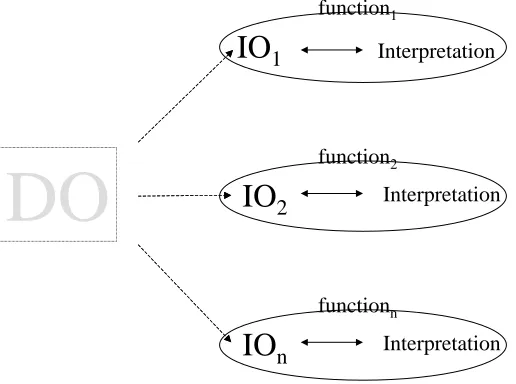
By the above examples the concept of function is introduced as a relationship between the immediate object and the observer. The ascription and existence of a functionality necessarily involves a signification process, but as it has just been pointed out, there is more to signification than the mere ascription of a function (figure 2).
DO
IO
1 Interpretationfunction1
IO
2 Interpretationfunction2
IO
n Interpretation [image:6.595.171.429.490.682.2]functionn
Figure 2: A semiotic understanding of functions and multifunctionality in relation to the (dynamic) object.
4
3.2 The constructivist-realist ontology of multifunctionality pertaining to a multidisciplinary study of multifunctionality
Above we have evolved an understanding of function as a relation between object and interpretation. Before we can elaborate on an empirical framework dealing with multifunctionality as a ‘dynamical object’ we need to go one step further in developing the ontology of this reality of functions and of how to deal with it in a theoretical way.
The Peircean notion of the ‘dynamical object’ may also be understood as an ontological abstraction of the object ”en soi”5 prior to any observation or labelling and with no possibility of relating to other objects. It is stressed by Pierce, that signs belong to observers but are dependent on the potentiality of the ‘dynamical object’, the object strikes back so to speak.
In search for a theoretical platform to develop multifunctionality as an independent reality we turn to the heirs of semiotics in Actor-Network-Theory (ANT).
ANT unfolds to us the dynamics of “l’être pour soi,” that is the relatively independent reality of immediate objects, and by doing so they point to the co-evolving of ‘dynamical objects’ with immediate objects. Thus, by including ANT in our theoretical framework we have the opportunity of elaborating upon our realist-constructivist ontology and to consider the consequences of its existence to research in multifunctionality.
Digging deeper into the exact lines of dynamic interrelations between the dynamic and immediate objects requires a short introduction to ANT notions of actor and network.
“An ‘actor’ in ANT is a semiotic definition – an actant – that is, something that acts or to which activity is granted by others” (Latour, 1997:6).
In accordance with this definition we will use the term 'actant' for the actors of ANT. The notion of an actant is not linked to the quality of the entity as such, but to the quality of the entity in the frame of the network into which the entity is mobilised:
“ …For the semiotic approach tells us that entities achieve their form as a consequence of the relations in which they are located. But this means that it also tells us that they are performed in, by, and through those relations” (Law, 1999:4).
When Peirce is translated into ANT terminology, the immediate object is equivalent to the actant
within actor-networks. The sign is equivalent to the network, that is the context in which the ‘dynamical object’ is actualised in some respect or capacity to the network. Likewise, the immediate object only exists within the triadic sign in the presence of an interpretant; the actants are performed within actor networks, only. Actor-networks
“… are neither objective nor social, nor are they effects of discourse even though they are real, and collective, and discursive … … the networks are simultaneously real, like nature, narrated, like discourse and collective, like society” (Latour 1993:6)
5
As already mentioned, networks constitute part of our constructivist-realist ontology. In ANT there is no hierarchy of interaction. Heterogeneous actors in actor-networks like knowledge, machines, livestock and chemical products are all at the same level of interaction in the network; each element is able to influence strongly the interpretation of another and each element links to other elements accordingly. Therefore, within the network, there is no subject-object hierarchy, just internal functionality. This is exactly why new reality potentially arise from these networks and the above citation becomes exact.
According to ANT, at a certain point the actor-network obtains such complexity, that the introduction of more elements would simply make it disintegrate. Combining this understanding with a Luhmannian theoretical position, we claim that in such case either networks disintegrate as ANT has it, or, alternatively, they will differentiate into/generate new networks and thereby ‘dynamical objects’ seen from the perspective of the existing networks. Networks will become social-objects with real effects or functionally real objects6.
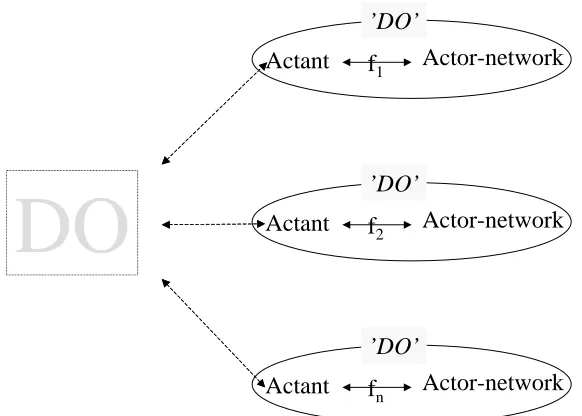
ANT helps us to grasp the evolutionary dynamic interaction between the ‘dynamical object’ and the immediate object, which as a co-evolutionary process contributes to the potentiality of the ‘dynamical object’; in other words, the fact that our interactions with the world influence the potentiality of the world. New ‘dynamical objects’ or new aspects of the ‘dynamical objects’ are continually generated by way of the interplay between dynamic and immediate objects – and as a consequence reality evolves and augments.
DO
Actor-network Actant f1
’DO’
Actor-network Actant f2
’DO’
Actor-network Actant fn
[image:8.595.153.444.429.637.2]’DO’
Figure 3: Multifunctionality of a ‘dynamical object’ understood as the mobilisation of the object as an actant into different actor-networks.
6
From a Luhmannian point of view new objects can only be generated by way of selection of possibilities. Noe and Alrøe (2003, 2005a 2005b) have described the autopoiesis of actor-networks trough selection by the example of a farm enterprise: Seen from an autopoietic point of view, food-production may be organised in numerous ways according to different goals and purposes. The farm enterprise as a heterogeneous social system is not only forced to select in the contingency of the potential ‘dynamical object’s that can be mobilised into the farming processes as ‘immediate objects’ like pigs or cows, but also in the contingency of the potentiality related to each ‘dynamical object’ behind the immediate object that is enrolled; e.g. a computer can be enrolled as devise for the yearly accounting or as part of a daily steering system. Like a cell creates its own operational closure in terms of is cell membrane, open for material diffusion but closed in terms of its own operation of production and reproduction, a farm enterprise creates itself through the selection of possibilities open for internal operation. As with the cell membrane it is because selection is made, that new, socially and objectively real ‘dynamical objects’ come into existence.
Multifunctionality arises only as a consequence of the differentiation of perspectives; it exists due to the unfolding of different actor-networks. Each perspective attaches different values, understandings and interests to the ’dynamical object’. In terms of functionality and potential reality there is a lot of difference as to whether a landscape is seen in light of agricultural production, nature quality, environmental protection, the richness of hunting, with respect to rural development or with reference to the aesthetical experiences that may be attached to it.
When multifunctionality is described as an object that gains ontological reality due to the differentiation of perspectives it becomes evident why more disciplines need to continuously set and reset their perspectives. Not so obvious is it, that it is only by the communicative and collective setting of perspectives that the disciplines are continuously creating and recreating non-redundant, complex reality to the object of multifunctionality.
In the following part we explain why communication of a certain type is needed for multifunctionality to prosper. By doing this we simultaneously elaborate upon a realist-constructivist epistemological framework for studying multifunctionality that corresponds with the above presented ontology.
3.3 The epistemology behind multidisciplinary communication
As it has been explicated in part 3.1 and 3.2. a function is a relation between the immediate object and the observer that can potentially be generalised to and captured by a broader collective when actor-network relationships result in a differentiation enabled by momentary selection. A precondition to the ontological existence of multifunctionality is the performing of multiple observations made publicly and communicatively available by way of selection.
for Rural Research and Development a fourth. The differentiation into applied scientific fields happens as an integrated part of the ontological processes of differentiation, and once new applied disciplines have been institutionalised, they strongly promote further differentiation.
In a Luhmannian perspective, in fact, each scientific discipline operates as a function system and Luhmann points to the fact that functional, action-oriented perception or precognition is a precondition to specialized disciplinary knowledge.
By generating a habit for seeing yield in the perspective of food production, commodity in the perspective of the market and social interactions in the perspective of culture and society, the disciplines pre-cognise certain functions. It is exactly because of this precognition, that it is possible to further differentiate between various forms of yields, commodities or relationships. To perceive by the ascription of a function simply releases the amounts of mental capacity pre-requisite to the performance of deeply specialised science (Luhmann 1995).
As a negative but logically following byproduct of disciplinary, functional differentiation the disciplines generate blind spots as to the values and interests attached to other disciplines. These values and interests are considered largely irrelevant as long as they are not translated into the logic of the specific discipline in question. In other words, the way that agronomy attaches to biology is by posing the question of how biodiversity would be of influence to the yield - food production relationship. Another unintended consequence of the differentiated ‘immediate objects’ being used as representations of ‘dynamical objects’ is that communication becomes troublesome, if not directly improbable.
In conclusion, we are confronted with the following paradoxical fact: Highly specialized functionalities of agriculture only arise because of functional observations and functionally motivated perceptions performed by disciplines. At the same time multifunctionality as a way to mediate between conflicts interests and synergies, can only be a fact when different functions and observations of functions combine. Furthermore there is no way back to an undifferentiated world and science; differentiation is an irreversible process due to the relative increase of non-redundant complexity, created by these differentiation processes. The only way leads forward.
To loosen up this apparent Gordian knot, we need to turn to a qualitatively different type of cognition. We do that by introducing the Japanese theoretician, Magoroh Maruyama.
that can be contained within one immediate object, the more comprehensive the perception the ‘dynamical object’ becomes.
Translating Luhmann’s theory of disciplinary differentiation into Maruyama’s vocabulary, we could say that in contrast to individual cognition scientific cognition is mono-ocular, due to the logic of differentiation. Disciplines have a one-dimensional way of cognition, in order to be able to specialise. Consequentially, if the sciences are to reach a multifunctional understanding, they have to mobilize their observations as actants in multidisciplinary communication.
Nevertheless, multifunctionality by multidisciplinary communication, in terms of communications between disciplinary discourses, is not taking the complexity of the matter far enough. To make further progress into the possibilities of poly-ocular cognition we need to further focus upon the differences between an individual and the scientific disciplines in a Luhmannian conception. Luhmann uses the distinction between human individuals belonging to the environment of social systems and ‘persons’ interacting in social systems (this distinction can be seen as a parallel to the universal distinction between the ‘dynamic’ and ‘immediate’ object).
As scientists/researchers we are persons trained in certain skills and theories, we are differentiated, but as human individuals we are always undifferentiated. We are capable in a surplus of ways to sense and relate to our environment, although some more trained than others. In that sense we are capable of poly-ocularity if we communicate interactively with one another by way of physical individual co-presence.
Poly-ocularity through multidisciplinary communication does not only have to draw on mobilising the ‘dynamical object’ produced by the disciplines in the network of communication process, but also to draw on the poly-ocular potentiality of the human individuals involved as persons in these communications.
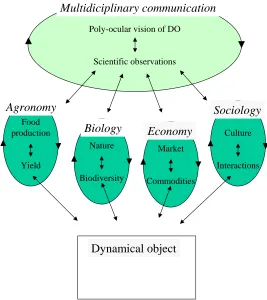
The epistemologically inspired figure below may act as a concretization. This figure illustrates how different disciplines ascribe/observe different functions to the very same dynamical object. The disciplinary communication is not enlarged or extended to multidisciplinary communication. But the multidisciplinary communication is dependent on the mobilisations of facts and insights produced by the disciplines. Multidisciplinary and disciplinary communications need to be separated and thereby to be environments to each other, because the two types of communications operate on different logics, interests and values. The figure additionally describes how – as an essential part of multidisciplinary communication – the disciplines are stimulated to reflect upon their own cognition.
Poly-ocular vision of DO
Scientific observations
Multidiciplinary communication
Dynamical object Food
production
Yield
Agronomy
Nature
Biodiversity
Biology Culture
Interactions
Sociology
Market
Commodities
[image:12.595.163.430.87.387.2]Economy
Figure 4: The relationship between disciplines and multidisciplinary communication.
By the present elucidation, we have substantiated our claim that multifunctionality can only be studied in a multidisciplinary way, but that the very specialized perspectives complicate matters of communication. Furthermore we have argued why a multifunctional understanding is not possible as a mere collocation of disciplinary perspectives, but only become possible in terms of the poly-ocular base of multidisciplinary communication. Simultaneously, we have shown the unfruitfulness of the idea of holism, i.e. the idea of developing a new one research-perspective that can grasp the observation of the complexity of multifunctionality. Every such attempt will only add a new perspective to the ‘dynamical object’. We now, finally to a discussion of how such multidisciplinary communication can be organised in praxis.
4. Methodical devices for multidisciplinary communication and creation of multifunctionality We have now presented a theoretical framework for multidisciplinary communication as an imperative for studying multifunctionality. One of the primary motivations for the development of this framework has been to establish a theoretical embeddings of the experiences obtained in a series of projects, that we have been involved in.
* Researchers from the involved disciplines must be enrolled in the multidisciplinary communication
Theoretically we have argued that it is necessary to involve of the abilities of human individuals to poly-ocular cognition, as mediator between disciplinary communication and multidisciplinary communication.
Influenced by EU-project standards, most research projects are organised in work packages and deliverables, with a Perth-diagram describing the logic of how output from one WP become input to the next for further synthesis. However this is not enough to obtain multidisciplinary communication, synthesis or multidisciplinary communication must not be left to one discipline and partner. Furthermore if the researchers are not enrolled in the multidisciplinary communication there will be a lack of feedback to the disciplinary communications. We therefore recommend that sufficient time is dedicated to shared presentations and discussions of the findings of each disciplinary perspective involved. From Danish as well as EU projects our experiences is that at least two yearly workshops running over several days are necessary to support multidisciplinary communication. A critical point is to convince the founding bodies of the necessity of these communicative activities of the project.
* Skills and motivations
Multidisciplinary communications takes other skills than disciplinary communication. Disciplinary communication is dealing with defending truth and borders of the discipline, e.g. what methods and theories are acceptable. A necessary process in disciplinary communication is continually keeping the ocular in focus, to stay with the metaphors of this paper. And the education and training programme of researchers is based on developing these skills; we become professionals in defending our research discipline.
Multidisciplinary communication is not about truth but about abstraction and about adapting other perspectives. Multifunctional communication demands that you as a researcher are able to oscillate between a communication of truth and of abstraction. Since we are trained in the first and not in the second, our experiences are that many researchers feel uncomfortable leaving the safe ground of truth. It is therefore important that the involved researchers recognises the value of multidisciplinary communication and are motivated. The worst-case scenario of multidisciplinary research projects is projects where unmotivated project partners are forced together in one project, spending thir time on defending own positions and interests.
* Shared ‘dynamical object’
The above insights lead us to conclude, that we can only perform multidisciplinary communication, if we take as a starting point a concrete object and it’s relation to the external environment in a certain perspective. It is only when we agree upon a certain objectification of multifunctionality that we will really commit ourselves to collective evolvement of the concept.
The ‘dynamical object’ is not necessarily a physical object it can also be an object of 2.order, like a problematic complex of multitude entities. And it must be recognised that the selection of ‘dynamical object’, of which the multifunctionality is to be researched, always belongs to the multidisciplinary communication.
While e.g. a farm-enterprise constructs and reconstructs it self through its oven selection and operations and as such it becomes a self-organising ‘dynamical object’. Farms in this way are social objects, they dispose of will to contingently realize their potentiality, and therefore of borderlines of their own. A landscape has no limitation in and by itself and no internal meaning attached to it. A
landscape is a certain perspective attached to a multitude of elements by a certain (research) perspective. Referring to our ontological discussion a landscape does not have an ontological reality, only the entities or ‘dynamical object’ merged into this perspective (seen from a realist-constructivist perspective). When constituting the object of research, solely the collective of researcher-observers makes demarcation of the landscape. To use this kind selection of mere constructions complicates the multidisciplinary communication, while it easily becomes a communication about the function a mere construction of one discipline, and without an ontological reality it cannot be observed by other disciplines.
* Shared experiences improves the platform for communication
Multidisciplinary communication demands the mediation of ability of poly-ocular cognition based on poly-ocularity of experiences with the ‘dynamical object’. Working with multidisciplinary perceptions in practice, Højring et al. (2005) let communication take their starting point in a sensory
awareness of the dynamical object. A dynamical object send out impulses sensed by individuals and seized according to values, experience, knowledge and qualifications particular to the individual in question. Communication on this so called ‘aesthetical experiential basis’ make individuals assure and reassure, that they refer to the same ‘dynamical object’, hereby enhancing probability of linking more disciplinary observations and functions into one actor-network. Consequentially the production of redundancy within the actor-network is diminished and communication likely to continue.
It is important to stress, that this procedure does not lead to the neglect of disciplines. Rather an aesthetical experiential base of reflexive communicative interaction prolong the indirect, non redundant linkages among actants so that complexity can be retained, and new multidimensional understanding of the ‘dynamical objects’ be formed as a consequence of continued shifts of perspectives.
* Avoid disciplinary hegemony
It is therefore an important task of the facilitator to avoid disciplinary hegemony of multidisciplinary communication. This could be supported both by establishing a clear rationale of the multidisciplinary communication and to develop tools and rules to avoid this e.g. rules of what kind of arguments that is legal in multidisciplinary communication.
* Reflexive objectivity
Finally multidisciplinary communicating must pay especially attention to the immanent and mostly implicit values and interests linked to each discipline involved (Noe et al., 2005; Hansen et al. 2005). Differentiation into functions is a differentiation into interest and values too. A
differentiation processes that emphasis on the pursuing of the goals of the functions and leave the integration between interests out of sight. Multifunctionality depends on mediation between conflicts of interests, perspectives, and values of the different functions.
5. Further on
This is far from meant to be a complete recipe on multidisciplinary research, but it is our hope that this theoretical framework can be an inspiration to others, as well as we hope that it can stimulate them to contribute to the theoretical and practical development of the framework either by critique or suggestions. It is out of the scope of this paper to discus the framework in relation to other main theoretical regimes within this area. Subjects that we find particular relevant to discuss in later papers are how this framework communicates with some of the theoretical schools that have been a source of inspiration to our theory development, among others the Wageningen school of farming styles (Ploeg, 1994; Renting and Ploeg, 2001; Roep et al. 2003), the European LEARN-group (Cerf et al. 2000) and The Hawkesbury school (Bawden, 1991; Sriskandarajah et al., 1989).
In relation to the sociology of knowledge and theory of science it would be interesting to discuss the common notions of multi-, inter- and trans-disciplinary research. Jan Schakel concludes in a monograph on multifunctional agriculture (Huylenbroeck and Durand 2003) “The crisis of agriculture implies not only a development of a multi-functional answers, but also multifunctional knowledge” (Schakel 2003:233). The solution given to this problem is trans-disciplinary research; building on agro system-theory, but the ideas of how to practise it is weak. Most of these research regimes tend to skip the existing research regimes and either turns to involvement of stakeholders as co-researches or to alternative research paradigms. However if our initial analysis of the crisis of faming and rural development is coherent, the crisis is produced by the differentiation of disciplines. Neglecting these disciplines and there related institutions by creating new transdisciplinary cells will therefore not be a fruitful solution, we need to go one step further and strive to reintegrate these perspectives in poly-ocular visions.
Referencer:
Alrøe, H.F. 2000. Science as Systems Learning: Some reflections on the cognitive and communicational aspects of science. Cybernetics & Human Knowing, 7(4): 57-78
Alrøe, H. F. & Kristensen, E. S. 2002. Towards a systemic research methodology in agriculture: Rethinking the role of values in science. Agriculture and Human Values 19(1):3-23.
Cerf, M.; D. Gibbon, B. Hubert, R. Ison, J. Jiggins, M. Paine, J. Proost, N. Röling (Eds.). Cow up a tree – Knowing
and Learning for Change in Agriculture - Case studies from Industrialised Countries, INRA editions Paris.
Bateson, G. 1979. Mind and Nature : A Necessary Unity. Bantam Books.
Bawden, R.J. 1991. Towards Action Researching Systems. In O. Zuber-Skerritt (Ed). Action Research for Change
and Development: 21-51. Brisbane, Centre for the Advancement of Learning and Teaching, Griffith University,
1991.
Brandt, J. & H. Vejre (ed.) (2003): “Multifunctional Landscapes – Monitoring, Diversity and Mangagement”. Vol. II, Southampton: WIT Press
Brandt, J. & H. Vejre (ed.) (2004): “Multifunctional Landscapes – Theory, Values and History”. Vol. I,
Southampton: WIT Press
Gorman, M., Mannion, J., Kinsella, J.: & Bogue, P. 2001. Connecting Environmental management and farm Household livelihoods: The Rural Environment Protection Scheme in Ireland. Journal of Environmental Policy and Planning 3, 137-147.
Hansen, L.; Noe, E & Højring, K. 2005. Nature and nature values in organic agriculture. An analysis of contested concepts and values among different actors in organic farming. Journal of Agricultural and Environmental Ethics. Accepted
Højring, K. (2004). Æstetisk sansning og naturvidenskabelig naturforståelse - et eksplorativt eksperiment. Arbejdsraooprt Skov & Landskab nr.4 2004
Højring K. and Noe, E. 2004. Communicative Approaches to Involving Farmers in Protecting Aesthetic and Biological Landscape Quality. Proceeding at IRSA XI World Congress of Rural Sociology in Trondheim, Norway. Højring, K., Noe, E., Busck, A.G. and Erichsen, E.H. 2005. Landbrugslandet - skabelse og iagttagelse. Syddansk
Universitetsforlag.
Jönhill, J.I.(1997): ”Samhället som system och dess ekologiska omvärld – En studie i Niklas Luhmanns sociologiska systemteori” Lund Dissertations in Sociology 17
Knickel, K. 2001. The marketing of Rhöngold Milk: An Example of the Reconfiguration of Natural Relations with Agricultural Production and Consumption. Journal of Environmental Policy and Planning 3, 123-136. Knickel, K. and Peter, S. 2004. Rural Areas are shaping the Future: Some experiences with the Regional Action
Programme in Germany. Proceeding from the 6th European IFSA symposium: European Farming and Society in a Search of a New Social Contract – Learning to Manage Change. Vila Real, 2004. Portugal.
Knickel, K., Renting, H. and van der Ploeg, J.D. 2004. Multifunctionality in European agriculture. In: Brouwer, F. (ed.) Sustaining Agriculture and the Rural Development. Governance, policy and Multifunctionality. Advances
in Ecological Economics, Edward Elgar, Cheltenham, UK, 81-103
Latour, B. 1997. Om aktør - netværksteori. Nogle få afklaringer og mere end nogle få forviklinger. Philosophia 25 (3-4): 47-64. [English version (1996) On Actor-Network Theory: A few clarifications. Soziale Welt 47((3-4): 369-381. Available online at <http://amsterdam.nettime.org/Lists-Archives/nettime-l-9801/msg00019.html>]
Latour, Bruno (1993): “We have never been modern”. Harvester Wheatsheaf, London
Law, J. 1999. After ANT: complexity, naming and topology. In Law, J. & Hassard, J. (Eds.), Actor-Network Theory and after. England. Oxford: Blackwell Publisher.
Luhmann, N. 1995. Social systems. Stanford University Press.
Maruyama, M. 1978. Endogenous Research and Polyocular Anthropology in Perspectives on Ethnicity. Ed. R. Holloman & S. Arutiunov, The Hague: Mouton Publisher.
Maruyama, M. 1985. Mindscapes: How to understand specific situations in Multicultural Management. Asia pacific
journal of Management 2(3)125-149
Maruyama, M. 1995. Individual Epistemological Heterogeneity across cultures and its use in organisations.
Cybernetica, 37(3):215-249.
Moreira M.B. 2004. Globalization: The end of the social contract in agriculture. Manuscript of the keynote speech of
the Sixth IFSA European Symposium. Vila Real, Portugal April 4th 2004.
Mielgo, A. M. A., Guzmán, E. S., Romera, M.J. and Casado, G. G. 2001. Rural Development and Ecological
management of Endogenous resources: The case of Mountain Olive Groves in Los Pedroches comarca (Spain).
Journal of Environmental Policy and Planning 3, 163-175.
Noe, E. & Alrøe, H.F. 2003. Farm enterprises as self-organizing systems: A new transdisciplinary framework for studying farm Enterprises? International Journal of Sociology of Agriculture and Food 11(1) 3-14. Noe, E. & Alrøe, H.F. 2005. Combining Luhmann and Actor-Network Theory to see Farm Enterprises as
Self-organizing Systems. Cybernetics and Human Knowing. (Accepted)
Noe, E. & H.F. Alrøe 2005. The challenge of management of multidimensional enterprises analysed from a logo-poietic perspective. Submitted
Noe, E., Halberg, N. and Reddersen, J. 2004. Indicators of biodiversity and conservational wildlife quality on organic farms for use in farm management. Journal of agricultural and environmental Ethics (Accepted)
Norgaard. R.B. 1994. Development betrayed – the end of progress and a coevolutionary revision of the future. London and New York, Routledge.
OECD 2001. Multifunctionality Towards an Analytical Framework. [http://pinguet.free.fr/4.pdf]
Peirce C.S. 1897, 1908. Charles Sanders Peirce, Collected papers. Edited by Charles Hartshorne and Paul Weiss. Cambridge: Belknap Press of Harvard University Press, 1958-1966.
Ploeg, J.D.v.d. 1994. Styles of Farming: An Introductory Note on the Concepts and Methodology. In J.D.v.d. Ploeg & A. Long (Eds.), Born from Within - Practice and Perspectives of Endogenous Rural Development: 7-30. Holland. Van Gorcum
Ploeg, J. D.v.d. and Renting, H. 2000. Impact and potential: A comparative review of European rural development practices. Sociologia Ruralis 40(4), 529-543.
Ploeg, J. D.v.d. and Renting, H. 2004. Behind the "redox": A rejoinder to David Goodman. Sociologia Ruralis 44(2), 233-242.
Renting H. and van der Ploeg, J.D. 2001. Reconnecting Nature, Farming and Society: Environmental Cooperatives in the Netherlands as Institutional Arrangements for creating Coherence. Journal of Environmental Policy and Planning, 3, 85-101.
Roep D., van der Ploeg, J.D. and Wiskerke, J.S.C 2003. Managing technical-institutional design processes: some strategic lessons from environmental co-operatives in the Netherlands. NJAS 51-1/2
Roest, K. de and Menghi, A. 2000. Reconsidering 'Traditional' Food: The case of Parmigiano Reggiano cheese. Sociologia Ruralis 40, 439-451
Sartre, J.P. 1943. L’Être et le Néant. Paris: Gallimaud.
Scheer, H. 2002. En Solar verdensøkonomi – Strategi for den økologiske modernitet [Solare Weltwirtschaft] Hovedland Højbjerg.
Sriskandarajah, N., Bawden, R.J. & Packham, R.G. 1989. Systems Agriculture – A Paradigm for Sustainability. Paper presented at the Ninth Annual Farming Systems Research/Extension Symposium, University of Arkansas, Fayetteville, USA, October 9-11. AFSRE Newsletter 2(3):1-5. 1991