Copyright © 2004, American Society for Microbiology. All Rights Reserved.
Effect of Interaction between Hepatitis C Virus NS5A and NS5B on
Hepatitis C Virus RNA Replication with the Hepatitis C
Virus Replicon
Tetsuro Shimakami,
1,2Makoto Hijikata,
3Hong Luo,
1,4Yuan Yuan Ma,
1Shuichi Kaneko,
2Kunitada Shimotohno,
3and Seishi Murakami
1*
Department of Molecular Oncology, Cancer Research Institute, Kanazawa University,1and Department of Gastroenterology,
Kanazawa University Graduate School of Medicine,2Takara-Machi, Kanazawa, Ishikawa 920-0934, and Department of Viral
Oncology, Institute for Virus Research, Kyoto University, Sakyo-Ku, Kyoto 606-8507,3Japan, and The Institute of
Infectious Diseases, West China Hospital, Sichuan University, Chengdu, Sichuan 610041, China4
Received 3 September 2003/Accepted 10 November 2003
Hepatitis C virus (HCV) NS5A has been reported to be important for the establishment of replication by adaptive mutations or localization, although its role in viral replication remains unclear. It was previously reported that NS5A interacts with NS5B via two regions of NS5A in the isolate JK-1 and modulates the activity of NS5B RdRp (Y. Shirota et al., J. Biol. Chem., 277:11149–11155, 2002), but the biological significance of this interaction has not been determined. In this study, we addressed the effect of this interaction on HCV RNA replication with an HCV replicon system derived from the isolate M1LE (H. Kishine et al., Biochem. Biophys. Res. Commun., 293:993–999, 2002). We constructed three internal deletion mutants, M1LE/5Adel-1 and M1LE/5Adel-2, each encoding NS5A which cannot bind NS5B, and M1LE/5Adel-3, encoding NS5A that can bind NS5B. After transfection into Huh-7 cells, M1LE/5Adel-3 was replication competent, but both M1LE/ 5Adel-1 and M1LE/5Adel-2 were not. Next we prepared 20 alanine-substituted clustered mutants within both NS5B-binding regions and examined the effect of these mutants on HCV RNA replication. Only 5 of the 20 mutants were replication competent. Subsequently, we introduced a point mutation, S225P, a deletion of S229, or S232I into NS5A and prepared cured Huh-7 cells that were cured of RNA replication by alpha interferon. Finally, with these point mutations and cured cells, we established a highly improved replicon system. In this system, only the same five mutants were replication competent. These results strongly suggest that the interaction between NS5A and NS5B is critical for HCV RNA replication in the HCV replicon system.
The hepatitis C virus (HCV) is a major cause of chronic hepatitis around the world (1, 9). Chronic infection with HCV results in liver cirrhosis and often hepatocellular carcinoma (50, 53). HCV is an enveloped positive-strand RNA virus be-longing to the genusHepacivirusin the familyFlaviviridae(44). The HCV RNA genome is⬃9.6 kb in length and consists of a 5⬘nontranslated region (5⬘NTR), a large open reading frame, and a 3⬘NTR. The 5⬘NTR contains an internal ribosome entry site (IRES) mediating translation of a single polyprotein of
⬃3,000 amino acid (aa) residues (57, 59). The polyprotein is cleaved by host and viral protease into at least 10 different products (2, 21, 22, 25, 26). The structural proteins core, E1, and E2 are located in the amino terminus of the polyprotein, followed by p7, a hydrophobic peptide with unknown function, and the nonstructural (NS) proteins NS2, NS3, NS4A, NS4B, NS5A, and NS5B (41). The 3⬘NTR consists of a short variable sequence, a poly(U)-poly(UC) tract, and a highly conserved X region, and it is critical for HCV RNA replication and HCV infection (17, 34, 65, 66).
HCV is unique among positive-strand RNA viruses in caus-ing persistent infections, and a high mutation rate in E2 allows
it to escape host immune surveillance. These phenomena are tightly associated with chronic inflammation of the liver (27, 32, 61, 62). Therefore, HCV RNA replication has been a target for treatment of HCV. NS5B is an RNA-dependent RNA polymerase (RdRp), the central catalytic enzyme in HCV RNA replication. Several recombinant forms of NS5B ex-pressed and purified from insect cells andEscherichia coliare available and catalytically active, and studies with purified NS5B proteins provide insight into the biochemical and cata-lytic properties of NS5B (3, 16, 39, 64). However, the result that NS5B can initiate de novo RNA replication in vitro with both a non-HCV RNA template and an HCV RNA template may reflect the catalytic property of NS5B but not the tight regulation of HCV RNA replication initiation. Studies of HCV RNA replication in vitro have to overcome several difficulties, since replication requires all or most NS proteins and occurs at the membrane where all of the HCV NS proteins are recruited. A second system used to study HCV RNA replication is the study of HCV RNA replicons in vivo, which utilizes autono-mously replicating HCV-derived RNAs. These replicon RNAs have the authentic HCV 5⬘ and 3⬘ NTRs. The HCV IRES drives the translation of a selectable marker such as neomycin resistance, and an internal encephalomyocarditis virus IRES directs translation of NS3 to NS5B (38). In vitro-transcribed replicon RNAs are transfected into the human hepatoma cell line Huh-7 by electroporation and placed under selection. The emergence of neomycin-resistant cell colonies is indicative of
* Corresponding author. Mailing address: Department of Molecular Oncology, Cancer Research Institute, Kanazawa University, 13-1 Takara-Machi, Kanazawa, 920-0934 Ishikawa, Japan. Phone: 81-76-265-2731. Fax: 81-76-234-4501. E-mail: [email protected] .ac.jp.
2738
on November 8, 2019 by guest
http://jvi.asm.org/
RNA replication. Recently, adaptive mutations that dramati-cally enhance the ability of HCV RNA to replicate have been identified in NS3, NS4B, NS5A, and NS5B (4, 24, 35, 37, 40). Initially, only the replicon derived from a genotype 1b isolate, HCV-Con1, was replication competent in Huh-7 cells, and adaptive mutations were required for efficient replication (4, 35, 37, 40). Then, several replicon systems derived from a genotype 1b isolate, N, and a genotype 1a isolate, HCV-H77, were reported to replicate in Huh-7 cells (6, 23, 24, 29). Recently, a replicon system was established which uses an HCV sequence derived from the human T-cell line MT-2C infected with HCV (a genotype 1b isolate, M1LE) in vitro and isolated 50-1 cells replicating subgenomic RNAs with some amino acid mutations (31, 33, 43, 55).
It was previously reported that NS5A and NS5B interact in vitro and in vivo through two independent regions of NS5A and that NS5A modulates the activity of NS5B RdRp through this interaction in vitro in the isolate JK-1 (54). This ability of NS5A to modulate the RdRp activity in vitro may be consistent with the high frequency of adaptive mutations in NS5A which result in a much more efficient RNA replication in Huh-7 cells; however, the biological meaning of the interaction between NS5A and NS5B remains to be addressed in vivo. Here we report a modified HCV RNA replicon system derived from the isolate M1LE by introducing point mutations (S225P, a dele-tion of S229, and S232I), and curing 50-1 cells of HCV sub-genomic RNA replication by interferon (IFN) treatment. By introducing internal deletion and substitution mutations into NS5A, we demonstrate that the regions essential for the inter-action between NS5A and NS5B are also critical for HCV RNA replication in using the HCV replicon system.
MATERIALS AND METHODS
Construction of plasmids.pNNRZ2RU (33) harbors a subgenomic replicon derived from MT-2C cells infected with HCV (a genotype 1b isolate, M1LE; GenBank accession no. AB080299), and this plasmid contains cDNA of wild-type
M1LE. For convenience, pNNRZ2RU was digested withMluI andBglII, and the
obtained fragment was inserted into theMluI andBglII sites of the vector
pGL3Basic (Promega) to create pGL3-MluI-BglII. pGL3-MluI-BglII was used as
an intermediate vector. All mutations were introduced into pGL3-MluI-BglII,
and then the fragments of pGL3-MluI-BglII digested byMluI andBglII
contain-ing each mutation were reintroduced into the MluI and BglII sites of
pNNRZ2RU to create each mutant.
M1LE/5Adel-1 was generated by PCR with the primers 5Adel-1 For
(contain-ing aMluI site) and 5A Rev-3 and then inserted into theMluI andNheI sites of
pGL3-MluI-BglII to create pGL3-MluI-BglII-5Adel-1. M1LE/5Adel-2 was
gen-erated by PCR with overlap extension with the primers 5Adel-2 For, 5A Rev-2,
5Adel-2 Rev, and 5A For-3 and then inserted into theNheI andSacI sites of
pGL3-MluI-BglII to create pGL3-MluI-BglII-5Adel-2. M1LE/5Adel-3 was
gen-erated by PCR with the primers 5A del-3 For (containing aNheI site) and 5A
Rev-2 and then inserted into theNheI andSacI sites of pGL3-MluI-BglII to
create pGL3-MluI-BglII-5Adel-3.
An alanine scanning method was used to construct NS5A alanine-substituted mutants to minimize the effects of substituted amino acid residues (7). The positions of alanine-substituted clustered mutations (cm) of NS5A are shown in Fig. 2B. To generate MlLE/cm 94, 100, 105, 110, 113, 120, 127, 134, 141, 148, and
155, each mutation was introduced into theMluI andNheI sites of pGL3-Mlu
I-BglII by site-directed mutagenesis with primers carrying the necessary nucleotide
changes to create pGL3-MluI-BglII-cm94, -100, -105, -110, -113, -120, -127, -134,
-141, -148, and -155, respectively. To generate M1LE/cm 252, 277, 283, 290, 297,
304, 311, 316, 321, and 328, each mutation was introduced into theNheI andSacI
sites of pGL3-MluI-BglII by site-directed mutagenesis with primers carrying the
necessary nucleotide changes to create pGL3-MluI-BglII-cm252, -277, -283, -290,
-297, -304, -311, -316, -321, and -328, respectively.
To generate M1LE/S225P and a deletion of S229 (delS229), the point
muta-tions S225P and delS229 were introduced into theMluI andNheI sites of
pGL3-MluI-BglII by site-directed mutagenesis with primers carrying the necessary
nu-cleotide changes to create pGL3-MluI-BglII-S225P and -delS229. The point
mutation S232I was introduced into theMluI andSacI sites of pGL3-MluI-BglII
by site-directed mutagenesis with primers carrying the necessary nucleotide
changes to create pGL3-MluI-BglII-S232I. To generate the double mutants
con-taining both the point mutation S232I plus an internal deletion mutation or cm,
theEcoRI fragments of pGL3-MluI-BglII-cm94, -100, -105, -110, -113, -120, -127,
-134, and -141 were inserted into theEcoRI sites of pGL3-MluI-BglII-S232I.
Because there were no optimal enzyme sites in the others, the point mutation
S232I was introduced into theMluI andSacI sites of pGL3-MluI-BglII-5Ade1-1,
-del-2, -del-3, and -cm148, -155, -252, -277, -283, -290, -297, -304, -311, -316, -321, and -328 by site-directed mutagenesis with primers carrying the necessary nu-cleotide changes.
To create double mutants containing both the point mutation S225P plus an internal deletion mutation or cm (cm 252, 277, 283, 290, 297, 304, 311, 316, 321,
and 328), theNheI andSacI fragments of pGL3-MluI-BglII-5Adel-2, -5Adel-3,
-cm252, -277, -283, -290, -297, -304, -311, -316, -321, and -328 were introduced
into theNheI andSacI sites of pGL3-MluI-BglII-S225P.
To generate M1LE/5B-VDD, a point mutation changing the GDD motif of
NS5B to VDD was introduced at theNdeI andSmaI sites of pGL3-MluI-BglII by
site-directed mutagenesis with primers carrying the necessary nucleotide changes
to create pGL3-MluI-BglII-5B-VDD.
All of the mammalian expression vectors were derived from pSG5UTPL (36). The vector pNKFLAG (49) was used to express amino-terminally FLAG-tagged
proteins. The vector pNKGST (49) was used to express glutathioneS-transferase
(GST)-fused proteins.
pNNRZ2RU was subcloned by PCR with the primers NS5A For, NS5A Rev, NS5B For, and NS5B Rev. NS5A For contains an artificial initiation codon
downstream of theMunI site, and NS5B For contains one artificial initiation
codon downstream of theSacI site. NS5A Rev contains aBglII site, and NS5B
Rev contains aBamHI site. Full-length NS5A was subcloned into theEcoRI and
BamHI sites of pNKFLAG to create pNKFLAG-5A/wild, and full-length NS5B
was subcloned into theSacI andBamHI sites of pNKGST to create
pNKGST-5B/wild.
To create NKFLAG-5A/de1-1, and -cm94, -100, -105, -113, -120, -127, -134,
-141, -148, and -155, theMluI andNheI fragments of pGL3-MluI-BglII mutants
were introduced at theMluI andNheI sites of pNKFLAG-5A/wild. To create
NKFLAG-5A/del-2, /del-3, -cm252, -277, -283, -290, -297, -304, -311, -316, -321,
and -328, theNheI andSacI fragments of pGL3-MluI-BglII mutants were
in-serted into theNheI andSacI sites of pNKFLAG-5A/wild.
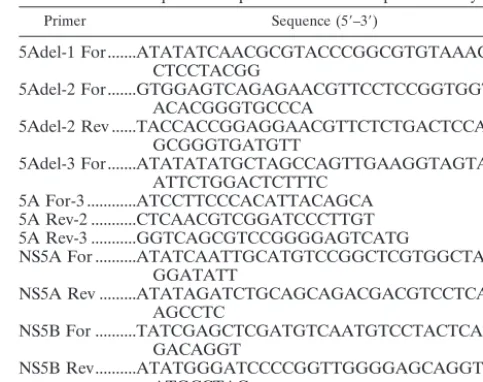
The sequences of all of the constructs were confirmed by the dideoxy sequence method. The main primers used for plasmid construction are shown in Table 1.
In vitro transcription and purification of RNA.Plasmids were linearized with
XbaI and purified by passage through a column (PCR purification kit; Qiagen)
[image:2.603.301.543.78.269.2]prior to transcription. RNA was synthesized with T7 MEGAScript reagents (Ambion) by following the manufacturer’s directions, and the reaction was stopped by digestion with RNase-free DNase. The synthesized RNA was passed
TABLE 1. Sequences of primers used in the present study
Primer Sequence (5⬘–3⬘)
5Adel-1 For...ATATATCAACGCGTACCCGGCGTGTAAACCT CTCCTACGG
5Adel-2 For...GTGGAGTCAGAGAACGTTCCTCCGGTGGT ACACGGGTGCCCA
5Adel-2 Rev ...TACCACCGGAGGAACGTTCTCTGACTCCAC GCGGGTGATGTT
5Adel-3 For...ATATATATGCTAGCCAGTTGAAGGTAGTA ATTCTGGACTCTTTC
5A For-3 ...ATCCTTCCCACATTACAGCA 5A Rev-2 ...CTCAACGTCGGATCCCTTGT 5A Rev-3 ...GGTCAGCGTCCGGGGAGTCATG
NS5A For ...ATATCAATTGCATGTCCGGCTCGTGGCTAAG GGATATT
NS5A Rev ...ATATAGATCTGCAGCAGACGACGTCCTCACT AGCCTC
NS5B For ...TATCGAGCTCGATGTCAATGTCCTACTCATG GACAGGT
NS5B Rev...ATATGGGATCCCCGGTTGGGGAGCAGGTAG ATGCCTAC
on November 8, 2019 by guest
http://jvi.asm.org/
through a column (RNeasy mini kit; Qiagen) and dissolved in RNase-free water. The concentration was determined by measuring the optical density at 260 nm, and RNA integrity was checked by nondenaturing agarose gel electrophoresis.
RNA transfection and selection of G418-resistant cells.Subconfluent Huh-7
cells were trypsinized, washed once with phosphate-buffered saline (PBS) (⫺),
and resuspended at 107cells/ml in OPTI-MEM (Gibco-BRL, Invitrogen Life
Technologies). Then, 10 to 1,000 ng of transcript was adjusted with total RNA
from naive Huh-7 cells to a final amount of 10g, which was mixed with 400l
of the cell suspension in a cuvette with a gap width of 0.4 cm (Bio-Rad). The mixture was immediately transfected into Huh-7 cells by electroporation with
GenePulser II system (Bio-Rad) set to 270 V and 975F. Following 10 min of
incubation at room temperature, the cells were transferred into 10 ml of growth medium and then seeded into a 10- or 15-cm-diameter cell culture dish. For the selection of G418-resistant cells, the medium was replaced with fresh medium containing 0.5 to 1 mg of G418 (Geneticin; Gibco-BRL, Invitrogen Life Tech-nologies)/ml after 24 to 48 h and the medium was changed twice a week. Four weeks after transfection, colonies were stained with Coomassie brilliant blue (0.6 g/liter in 50% methanol–10% acetic acid).
IFN treatment.To stop the replication of HCV subgenomic RNA, 50-1 cells
were treated with 10,000 U of IFN-␣2b (kindly provided by Schering-Plough)/ml
in the absence of G418. After 2 weeks of IFN treatment, the absence of HCV RNA was determined from the results of Northern hybridization, reverse tran-scription-PCR, and sensitivity to G418.
Cell culture.We used two kinds of Huh-7 cells, one derived from our own laboratory’s original Huh-7 cell line, designated Huh-7-DMB, and the cured clone of 50-1 cells, designated Huh-7-KV-C. Both types of Huh-7 cells were grown in Dulbecco’s modified Eagle’s medium (Gibco-BRL, Invitrogen Life
Technologies) supplemented with 10% fetal bovine serum, 2 mML-glutamine,
nonessential amino acids, 100 U of penicillin, and 100g of streptomycin.
Preparation of cell extracts, coprecipitation with glutathione resin, and West-ern blot analysis.The transient transfection of COS1 cells was carried out by using the calcium-phosphate method. The cells were harvested, washed with PBS
(⫺), and sonicated in PBS lysis buffer [PBS (⫺) containing 250 mM NaCl, 1.0%
Triton X-100, 1 mM EDTA, and 1 mM dithiothreitol] with 10 mg (each) of aprotinin and leupeptin per ml. Total cell lysate was diluted 10-fold with PBS
lysis buffer, mixed with 40l of glutathione-Sepharose 4B beads (glutathione
resin) (Amersham Biosciences), and then incubated for 3 h on a rotator in a cold
room. After an extensive wash with PBS (⫺) containing 1.0% Triton X-100, the
bound proteins were eluted, fractionated by sodium dodecyl sulfate (SDS)–10% polyacrylamide gel electrophoresis (PAGE), transferred onto nitrocellulose membranes, and subjected to Western blot analysis with anti-FLAG monoclonal antibody. The proteins were visualized by enhanced chemiluminescence accord-ing to the manufacturer’s instructions (Amersham Biosciences). The nitrocellu-lose membranes used for Western blot analysis with anti-FLAG monoclonal antibody were reprobed with anti-GST monoclonal antibody (Zymed Laborato-ries) according to the manufacturer’s instructions (Amersham Biosciences).
RESULTS
Interaction between NS5A and NS5B.It was previously
re-ported that NS5A and NS5B associate through two discontin-uous regions of NS5A (aa 105 to 162 and 277 to 334) and that NS5A weakly stimulates the activity of NS5B RdRp in vitro initially (at a molar ratio to NS5B of less than 0.1) and then inhibits the activity in a dose-dependent manner (54). To ex-amine the effect of this interaction on HCV RNA replication, we used an HCV RNA replicon system derived from the iso-late M1LE and 50-1 cells (33). We prepared a hybrid replicon of JK-1 and M1LE which harbors the JK-1 sequence from aa 92 (MluI site) of NS5A to the end of NS5B. However, the hybrid replicon did not produce any G418-resistant colony with the Huh-7 cell line (data not shown), so we constructed various mutated versions of NS5A of the RNA replicon derived from M1LE.
First, we confirmed whether the association between NS5A and NS5B through the two discontinuous regions of NS5A occurs with the sequence derived from M1LE. COS1 cells were transiently cotransfected with mammalian expression vectors,
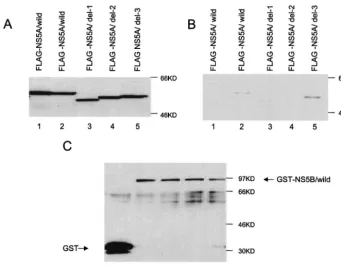
pNKFLAG-5A/wild, /del-1, /del-2, and /del-3; pNKGST or pNKGST-5B/wild; and the cell lysates were subjected to a GST pull-down assay. pNKFLAG-5A/wild encodes the full-length and wild-type NS5A proteins of M1LE. pNKFLAG-5A/del-1 encodes the internally deleted NS5A protein missing aa 94 to 162, a deletion 11 aa longer than that reported for JK-1 for the convenience of mutagenesis (aa 105 to 162). pNKFLAG-5A/ del-2 encodes the internally deleted NS5A protein missing aa 277 to 334, the same region reported for JK-1. pNKFLAG-5A/ del-3 encodes the internally deleted NS5A protein missing aa 235 to 276, a region nonessential for the interaction with NS5B in JK-1. pNKGST-5B/wild encodes the full-length and wild-type NS5B proteins of M1LE, and pNKGST encodes only a GST protein. Under conditions in which the expression levels of FLAG-NS5A proteins (input) were similar and the recovery of the GST-NS5B proteins was almost the same (Fig. 1A, lanes 1 to 5, and C, lanes 2 to 5), coprecipitated NS5A proteins (output) were examined (Fig. 1B, lanes 1 to 5). FLAG-NS5A/ wild bound to GST-NS5B (Fig. 1B, lane 2) but not to GST alone (Fig. 1B, lane 1). This result demonstrates that NS5A and NS5B also interact not only in JK-1 but also in M1LE in vivo. Very little FLAG-NS5A/del-1 or /del-2 was recovered (Fig. 1B, lane 3 and 4); however, FLAG-NS5A/del-3 was effi-ciently pulled down (Fig. 1B, lane 5). When larger amounts of proteins were used for this assay, both FLAG-NS5A/del-1 and /del-2 were weakly detected in the fraction pulled down with GST-NS5B but much significantly weaker than FLAG-5A/wild and /del-3. These results demonstrate that aa 94 to 162 (de-fined as region 1) and aa 277 to 334 (region 2), but not aa 235 to 276 (region 3), of NS5A seem to be essential for binding NS5B in M1LE as observed in JK-1.
Effect of binding NS5B on HCV RNA replication.To
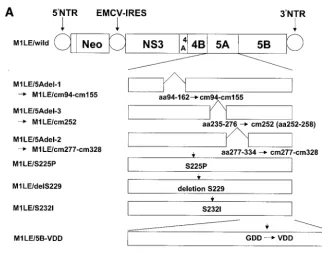
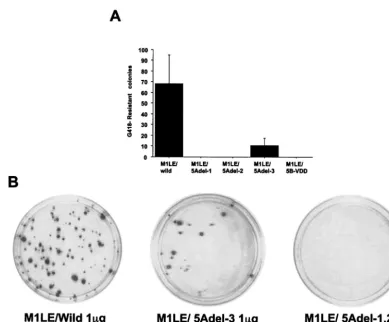
exam-ine the effect of the interaction between NS5A and NS5B on HCV RNA replication in the replicon system, we prepared three kinds of internal deletion mutants, M1LE/5Adel-1, M1LE/5Adel-2, and M1LE/5Adel-3, missing regions 1, 2, and 3 of NS5A, respectively (Fig. 2). M1LE/5Adel-1 and M1LE/ 5Adel-2 are impaired in their binding to NS5B, but M1LE/ 5Adel-3 is not. As a negative control, we prepared M1LE/5B-VDD, in which the GDD motif of NS5B was mutated to VDD. FLAG-tagged wild-type and internally deleted NS5A pro-teins were efficiently expressed in transiently transfected COS1 cells (Fig. 3). When wild-type M1LE and M1LE/5Adel-3 were transfected by electroporation into our laboratory’s Huh-7 cell line, Huh-7-DMB, G418-resistant colonies emerged after se-lection at a concentration of 1 mg/ml. In the case of M1LE/ 5Adel-3, the number of G418-resistant colonies was about seven times fewer than in wild-type M1LE. In contrast, no colonies emerged when M1LE/5Adel-1, M1LE/5Adel-2, and M1LE/5B-VDD were transfected into Huh-7-DMB cells, indi-cating that both of the NS5B-interacting regions of NS5A are critical for HCV RNA replication (Fig. 4). The fact that M1LE/5Adel-3 was replication competent but less efficient than the wild type in Huh-7-DMB cells may reflect some roles of region 3 in HCV RNA replication or a conformational change introduced by the internal deletion (see Discussion).
To minimize the effect of the internal deletion and further delineate the sequence(s) critical for HCV RNA replication, we used the alanine-scanning method (7). All residues of the two regions were scanned by introducing alanine substitution
on November 8, 2019 by guest
http://jvi.asm.org/
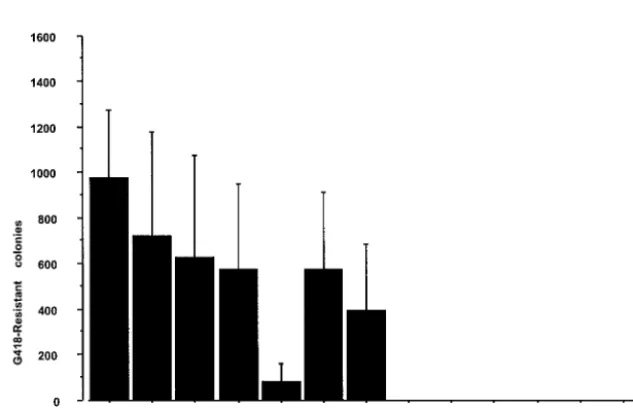
cm in addition to one cm mutant within region 3 as a control (Fig. 2). All of these cm mutants in FLAG-tagged forms, 10 in region 1, 9 in region 2, and 1 in region 3, were similarly expressed in transiently transfected COS1 cells (Fig. 3). When these 20 mutants were transfected by electroporation into Huh-7-DMB cells, only M1LE/cm 252, 277, 283, 290, 297, and 304 were found to be replication competent, although less so than wild-type M1LE. All other mutants were replication in-competent (Fig. 5). The regions of cm 252, 277, 283, 290, 297, and 304 are predicted to form a helical structure by DNASIS-Mac, version 3.2 (Hitachi Software Engineering Co.). The competence of replication may be due to this original structure (see Discussion). To rule out this possibility, we constructed another cm mutant, M1LE/cm 110. In this mutant, the region from aa 110 to 117 of NS5A is predicted to form a helical structure, were all changed to alanines, and after the transfec-tion into Huh-7-DMB cells, no colonies emerged (data not shown). These results support the notion that the inability of the internal deletion mutants, M1LE/5Adel-1 and M1LE/ 5Adel-2, to replicate is due not to conformational change in-duced by the deletions but to the absence of interaction be-tween NS5A and NS5B. It is also unlikely that these results are due to an increased cytotoxicity associated with the mutant NS5As, because we observed no decrease in transfection effi-ciency or ability to establish colonies by using the plasmid
encoding a drug resistance marker along with the wild or the mutant NS5A protein (data not shown).
Improvement in the HCV replicon system. The results
clearly showed that two discontinuous regions of NS5A are essential for HCV RNA replication by using the HCV replicon system with Huh-7-DMB cells; however, the number of G418-resistant colonies per microgram of transfected RNA was much smaller than previously reported (24, 29, 35, 37). It remains unclear whether some mutants were replication com-petent but too inefficient to be detected in the system we applied. Therefore, we tried to improve the assay system in two ways, by the introduction of point mutations to NS5A and by the selection of Huh-7 cells cured of HCV RNA replication by IFN treatment.
[image:4.603.121.462.73.341.2]We constructed three mutants, M1LE/S225P, M1LE/ delS229, and M1LE/S232I, harboring the point mutation S225P (35), a deletion of S229 (delS229) (24), and S232I (4), respectively, all defined as adaptive mutations in other HCV replicon systems (Fig. 2). Next, the 50-1 cells, an HCV subge-nome-replicating subclone, were cured of HCV RNA by treat-ment with IFN for 2 weeks (as described in Materials and Methods), and then the absence of HCV RNA was determined from the results of Northern hybridization, reverse transcrip-tion-PCR, and sensitivity to G418 (data not shown). The 50-1 cells cured of HCV RNA by treatment with IFN, designated
FIG. 1. Interaction between NS5A and NS5B of the isolate HCV M1LE and the regions essential for this interaction. COS1 cells were transiently cotransfected with mammalian expression vectors expressing FLAG-NS5A proteins (lanes: 1 and 2, wild type; 3, internal deletion mutant 1; 4, internal deletion mutant 2; 5, internal deletion mutant 3) and GST protein alone (lane 1) or GST-NS5B proteins (lanes 2, 3, 4, and 5). (A) Input of FLAG-NS5A proteins. Total lysates were fractionated by SDS–10% PAGE and subjected to Western blot analysis with anti-FLAG monoclonal antibody. (B) Output of FLAG-NS5A proteins. Coprecipitants by glutathione resin were washed with PBS (⫺) containing 1.0% Triton X-100, fractionated by SDS–10% PAGE, and subjected to Western blot analysis with anti-FLAG monoclonal antibody. (C) Recovery of GST or GST-NS5B proteins. The nitrocellulose membrane used for Western blot analysis of coprecipitants with anti-FLAG antibody was reprobed with anti-GST antibody. Molecular masses (in kilodaltons) are indicated to the right of each panel.
on November 8, 2019 by guest
http://jvi.asm.org/
FIG. 2. (A) Schematic presentation of HCV mutant replicons used in this study. Wild-type M1LE contains the HCV M1LE wild-type sequence. M1LE/5Adel-1, M1LE/5Adel-2, and M1LE/5Adel-3 encode internal deletions of NS5A missing aa 94 to 162 (region 1), aa 277 to 334 (region 2), and aa 235 to 276 (region 3), respectively. All amino acids within region 1 were replaced with alanines, and 11 cm mutants were prepared. All amino acids within region 2 were replaced, and 9 cm mutants were prepared. The aa 252 to 258 within region 3 were replaced, and M1LE/cm 252 was prepared. The point mutation S225P, a deletion of S229, and S232I were introduced into wild-type M1LE, and then M1LE/S225P, M1LE/delS229, and M1LE/S232I were prepared. M1LE/5B-VDD encodes NS5B in which the GDD motif was mutated to VDD. (B) Summary of the NS5A mutations. This figure shows the entire amino acid sequence of NS5A of M1LE and the positions of mutations. Numbering starts from the beginning of NS5A. Internal deletions 1, 2, and 3, and point mutations S225P, delS229, and S232I, and cm 252 were introduced as described for panel A. All amino acids within region 1 were replaced with alanines, and then M1LE/cm 94, 100, 105, 110, 113, 120, 127, 134, 141, 148, and 155 were prepared. All amino acids within region 2 were replaced with alanines, and M1LE/cm 277, 283, 290, 297, 304, 311, 316, 321, and 328 were prepared. The positions of the substituted amino acids in each cm mutant are shown in panel B.
on November 8, 2019 by guest
http://jvi.asm.org/
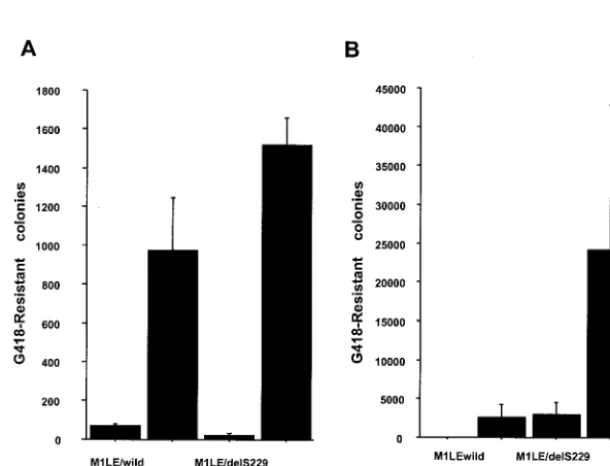
[image:5.603.131.454.88.361.2]Huh-7-KV-C, were evaluated. Wild-type and these mutant HCV replicons were transfected into 7-DMB and Huh-7-KV-C cells. In Huh-7-DMB cells, M1LE/S225P and MlLE/ S232I actually increased the efficiency of transduction to some extent, but M1LE/delS229 did not (Fig. 6A). M1LE/S232I was the most effective. In Huh-7-KV-C cells, interestingly, no col-onies emerged after selection with G418 when wild-type M1LE was transfected, whereas in the case of M1LE/S225P, delS229, and S232I, 2,500, 3,000, and 25,000 colonies/g of RNA emerged, respectively (Fig. 6B). These results indicate that two point mutations, S225P and S232I, can be categorized as the adaptive mutations in the isolate M1LE and that the cells cured of HCV RNA by treatment with IFN, Huh-7-KV-C, show higher permissiveness for M1LE/S225P, delS229, and S232I than Huh-7-DMB cells. In this way, we established highly improved replicon systems.
Delineation of important sequences of NS5A for HCV RNA
replication. To examine the effect of internal deletions and
alanine substitutions on HCV RNA replication with this im-proved replicon system, double mutants with S232I plus inter-nal deletion mutations or alanine-substituted cm’s in M1LE were constructed and transfected into 7-DMB and 7-KV-C cells by electroporation. After G418 selection, in Huh-7-DMB cells, some 400 to 1,000 colonies/g of RNA emerged with the double mutants of M1LE/S232I plus cm 252, 277, 283, 297, and 304, but only about 100 colonies/g of RNA emerged with the double mutant M1LE/S232I plus cm 290. No colonies
emerged with the double mutant M1LE/S232I plus other cm’s, del-1, del-2, and del-3 (Fig. 7; data not shown for Huh-7-KV-C cells). The double mutant M1LE/S232I plus cm 110 was also replication incompetent in Huh-7-DMB cells. To further ex-amine the replication competence of these mutants, double mutants of M1LE/S225P plus an internal deletion mutation or cm were constructed and then transfected into Huh-7-DMB cells. The results were almost the same as those with the double mutants with S232I, although the efficiencies of these mutants were around one-half of those with S232I (Fig. 8). The similar results in the double mutants with S225P were obtained with Huh-7 KV-C cells (data not shown). The replication-defective property of the mutants with deletions of regions 1 and 2, the cm mutants within region 1, and the cm mutants in the C-terminal part of region 2 was also observed with both Huh-7-DMB and Huh-7-KV-C cells, indicating that the repli-cation incompetence of these mutants is not due to the low efficiency of the original assay system. The cm mutants at the N-terminal part of region 2, cm 277, 283, 290, 297, and 304, were replication competent in the absence of the adaptive mutation in Huh-7-DMB cells and also in the presence of the adaptive mutation in Huh-7-DMB and Huh-7-KV-C cells to some extent. Taken together, these results suggest that the interaction with NS5B through regions 1 and 2, probably through its C-terminal part, is also essential for HCV RNA replication. We examined the interaction between cm mutants of FLAG-NS5A and GST-NS5B, but the difference among wild-type and cm mutants was weak in the pull-down assay. Differential binding would be possible if the two partner pro-teins were lower in concentration or together with other NS proteins, as those occur in vivo in HCV-RNA-replicating cells. Interestingly, two quantitative differences were observed with M1LE/5Adel-3, cm 252, and 290 with and without the adaptive mutations. M1LE/5Adel-3 was weakly replication competent in DMB cells but incompetent in Huh-7-DMB and Huh-7-KV-C cells when the adaptive mutations were introduced. In contrast, M1LE/cm 252 was weakly repli-cation competent in Huh-7-DMB cells but as high as that of the other replication-competent cm mutants in the presence of the adaptive mutations in Huh-7-DMB and Huh-7-KV-C cells (data not shown for Huh-7-KV-C cells; see Discussion).
DISCUSSION
HCV NS5A is a viral regulatory protein that modulates viral RNA replication and host processes by interacting directly and indirectly with a variety of host regulatory factors (10, 19, 42, 56, 58, 67). The important role of NS5A in HCV RNA repli-cation has been clearly demonstrated by high or clustered incidence of adaptive mutations in NS5A detected in HCV RNA replicon systems, although the molecular mechanism involved remains unknown (4, 24, 35, 37, 40). Shirota et al. previously reported direct interaction between NS5A and NS5B through two binding regions of NS5A expressed in mam-malian cells and in vitro with a purified recombinant and that NS5A could modulate the activity of NS5B RdRp in vitro through this direct interaction (54). Here we demonstrated the critical role of regions essential for the NS5A-NS5B interac-tion in HCV RNA replicainterac-tion with an HCV subgenomic rep-licon by introducing several internal deletion mutations into
FIG. 3. Efficient translation of mutant FLAG-NS5As. COS1 cells were transiently transfected with mammalian expression vectors ex-pressing FLAG-NS5A proteins that were prepared as described in Materials and Methods. Lanes: 4, 16, and 26, wild type; 1, internal deletion 1; 2, internal deletion 2; 3, internal deletion 3; 5, cm 252; 6, cm 94; 7, cm 100; 8, cm 105; 9, cm 113; 10, cm 120; 11, cm 127; 12, cm 134; 13, cm 141; 14, cm 148; 15, cm 155; 17, cm 277; 18, cm 283; 19, cm 290; 20, cm 297; 21, cm 304; 22, cm 311; 23, cm 315; 24, cm 321; 25, cm 328. Total lysates were fractionated by SDS–10% PAGE and subjected to Western blot analysis with anti-FLAG monoclonal antibody.
Molecu-lar masses (in kilodaltons) are indicated to the left of the panels.
on November 8, 2019 by guest
http://jvi.asm.org/
[image:6.603.60.264.70.300.2]NS5A. Our results provide clear evidence that NS5A is indis-pensable for HCV RNA replication probably through its interaction with NS5B, since the mutants missing the NS5B-binding regions, regions 1 and 2, could not produce G418-resistant colonies, but the mutants missing region 3, which is not essential for this interaction, could. The critical role of NS5A in HCV RNA replication in this report is consistent with the previous one that an amino-terminal amphipathic␣-helix of NS5A is essential for HCV RNA replication in the replicon system, localizing NS5A to a membrane (13). The use of cm mutants strongly suggests that all of region 1 and the C-termi-nal part of region 2 are critical for HCV RNA replication. However, it is difficult to exclude the possibility that the sub-stitution of eight amino acids in a row may induce structural change. Then the critical regions defined by cm mutants may simply reflect the structural integrity necessary for the func-tion, although a structural evaluation is difficult at present, since no crystal model of NS5A is available. Further muta-tional analysis is necessary to test these possibilities.
HCV RNA replication would take place in a distinctly al-tered membrane structure of the endoplasmic reticulum, a membranous web (12), as recently reported by Gosert et al. (20). All NS proteins might be recruited to the membrane
[image:7.603.94.483.65.387.2]structure via their own membrane association domains or by the help of NS4A in the case of NS3 (8, 13, 20, 28, 30, 51, 52, 63). Recently, Dimitrova et al. (11) reported that all six NS proteins interact with each other through their multiple inter-acting surfaces. NS5B is HCV RdRp and has been reported to interact with NS proteins and some host proteins. Such inter-action(s) may modulate the activity of NS5B RdRp in various ways. The critical role of the homomeric interaction of NS5B in RdRp activity was demonstrated by us and another group (48, 60). Piccininni et al. (47) reported that NS5B interacts with NS3 and NS4B as positive and negative regulators in the replication complex. Previously, it was reported that the direct binding of NS5A and NS5B in the isolate JK-1 weakly stimu-lated the activity of NS5B RdRp in vitro at first (at a molar ratio to NS5B of less than 0.1) and then inhibited the activity in a dose-dependent manner (54). In the present study, we showed that the two regions of NS5A are important for binding NS5B and are essential for HCV RNA replication in the iso-late M1LE by HCV replicon assays. The weak stimulation by NS5A of RdRp activity through the binding of NS5B observed in vitro may reflect the essential role of NS5A in HCV RNA replication, or the interaction between NS5A and NS5B is important for the dynamic assembly of NS proteins in the HCV
FIG. 4. Effect of internal deletion mutation on HCV RNA replication. Huh-7-DMB cells were transfected with 1g of in vitro-transcribed wild-type MILE, 5Adel-1, 5Adel-2, 5Adel-3, and 5B-VDD RNA by electroporation, and G418-resistant cells were selected with a G418 concentration of 1 mg/ml. G418-resistant cell colonies were stained 4 weeks after transfection. (A) This figure shows the mean number of G418-resistant cell colonies isolated per 10-cm-diameter cell culture dish per 1g of RNA. Error bars indicate the standard deviations of the results from at least three independent experiments. (B) G418-resistant colonies were visualized by staining cells as described in Materials and Methods.
on November 8, 2019 by guest
http://jvi.asm.org/
FIG. 5. Effect of clustered alanine-substitution mutations on HCV RNA replication. Huh-7-DMB cells were transfected with 1 g of in vitro-transcribed wild-type MILE, 5Adel-1, 5Adel-2, and cm 94, 100, 105, 113, 120, 127, 134, 141, 148, 155, 252, 277, 283, 290, 297, 304, 311, 316, 321, and 328 RNA, and G418-resistant cells were selected with a G418 concentration of 0.5 mg/ml. G418-resistant cell colonies were stained 4 weeks after transfection. This figure shows the mean number of G418-resistant cell colonies isolated per 15-cm-diameter cell culture dish per 1g of RNA. Error bars indicate the standard deviations of the results from at least three independent experiments.
FIG. 6. Effects of three kinds of point mutation, S225P, deletion S229, and S232I, on HCV RNA replication in the Huh-7-DMB and KV-C sublines. 50-1 cells were cured of self-replicating subgenomic RNAs by IFN-␣treatment, and then cured 50-1 cells, Huh-7-KV-C, were prepared. Huh-7-DMB and KV-C cells were transfected with 10 ng to 1 g of in vitro-transcribed wild-type M1LE, M1LE/S225P, M1LE/delS229, and M1LE/S232I RNA. G418-resistant cells were selected with a G418 concentration of 1 mg/ml. G418-resistant cell colonies were stained 4 weeks after transfection. (A) This figure shows the mean number of G418-resistant cell colonies isolated per 10-cm-diameter cell culture dish per 1g of RNA when each in vitro-transcribed mutant RNA was transfected into Huh-7-DMB cells. Error bars indicate the standard deviations of the results from at least three independent experiments. (B) This figure shows the mean number of G418-resistant cell colonies isolated per 10-cm-diameter cell culture dish per 1g of RNA when each in vitro-transcribed mutant RNA was transfected into Huh-7-KV-C cells. Error bars indicate the standard deviations of the results from at least three independent experiments.
on November 8, 2019 by guest
http://jvi.asm.org/
replication complex. Alternatively, it cannot be excluded that the internal deletion and cm mutants may be defective in other unknown function(s) essential for HCV RNA replication.
Adaptive mutations that increase the efficiency of HCV RNA replication have been accumulated in different HCV replicon systems (4, 24, 35, 37, 40). We introduced several point mutations into NS5A of M1LE and found that two, S232I and S225P, positively affected colony formation as adaptive mutations in two different Huh-7 sublines. Interestingly, a de-letion of S229 had an effect distinct from those of the other two
mutations, since it was only effective in the cured cells, the KV-C subline. Also, it is noteworthy that wild-type M1LE could not replicate in the Huh-7-KV-C subline. The effect of the deletion of S229 and the replication incompetence of wild-type M1LE may be of interest for the elucidation of the phe-notypic or genetic change(s) in the cured cells. In combination with the adaptive mutation, the deletion and cm mutants ex-hibited distinct phenotypes in HCV RNA replication.
[image:9.603.127.455.70.263.2]First, the mutant missing region 3 was replication incompe-tent in the presence of S232I or S225P, which was in contrast
FIG. 7. Effect of M1LE/S232I plus internal deletion mutations or alanine-substitution mutations. Huh-7-DMB cells were transfected with 1g of in vitro-transcribed M1LE/S232I plus 5Adel-1, 5Adel-2, 5Adel-3, and cm 94, 100, 105, 113, 120, 127, 134, 141, 148, 155, 252, 277, 283, 290, 297, 304, 311, 316, 321, and 328 RNA. G418-resistant cells were selected with a G418 concentration of 1 mg/ml and stained 4 weeks after transfection. This figure shows the mean number of G418-resistant cell colonies isolated per 10-cm-diameter cell culture dish per 1g of RNA. Error bars indicate the standard deviations of the results from at least three independent experiments. The number of G418-resistant cell colonies in M1LE/S232I is derived from the results shown in Fig. 6A.
FIG. 8. Effect of M1LE/S225P plus internal deletion mutations or alanine-substitution mutations. Huh-7-DMB cells were transfected with 1g of in vitro-transcribed M1LE/S225P plus 5Adel-2, 5Adel-3, and cm 252, 277, 283, 290, 297, 304, 311, 316, 321, and 328 RNA. G418-resistant cells were selected with a G418 concentration of 1 mg/ml and stained 4 weeks after transfection. This figure shows the mean number of G418-resistant cell colonies isolated per 10-cm-diameter cell culture dish per 1g of RNA. Error bars indicate the standard deviations of the results from at least three independent experiments. The number of G418-resistant cell colonies in M1LE/S225P is derived from the results shown in Fig. 6A.
on November 8, 2019 by guest
http://jvi.asm.org/
[image:9.603.137.454.473.677.2]to the dramatic increase in HCV RNA replication efficiency obtained by introducing the adaptive mutation alone. A similar but more moderate phenotype was observed with cm 252 when the adaptive mutation was present. Our result is different from the reported enhancement of G418-resistant colony formation caused by a large 47-aa deletion in HCV-Con1 (4) and by a natural 4-aa insertion in HCV-N (29). Region 3 contains the IFN sensitivity-determining region, within which mutations have been reported to be associated with sensitivity to IFN therapy in patients with chronic HCV infection in Japan (14, 15). Region 3 is almost the same as a protein kinase R (PKR)-binding domain (18). It has been reported that NS5A can disrupt the dimerization of PKR through binding, resulting in the repression of PKR function, and efficient HCV RNA rep-lication may involve a block in PKR-dependent signaling (18, 46). In this context, the adaptive mutations can greatly aug-ment HCV RNA replication and thus may induce PKR, which could be inactivated via interaction with the PKR-binding re-gion of NS5A, rere-gion 3, but not with those mutants defective in PKR-binding, such as del-3 and cm 252.
Second, cm 290 was less replication competent than the other cm mutants in region 2 when the adaptive mutation, S232I or S225P, was present. The highly charged sequence mutated in cm 290 may be critical for HCV RNA replication in the presence of the adaptive mutation. To address this point, four different combinations of three to four alanine substitu-tions in 7 aa residues were introduced into the M1LE/S232I construct. All of these mutants were more efficient in HCV RNA replication than M1LE/S232I plus cm 290 but still less so than the other replication-competent mutants in region 2 (data not shown), suggesting that all or most amino acids in the sequence contribute to its critical role in HCV RNA replica-tion in the presence of the adaptive mutareplica-tions. This result may suggest a functional linkage of the sequence mutated in cm 290 to the adaptive mutations.
In HCV subgenomic replicons, some groups have found that cured cell clones showed a high permissiveness for HCV RNA replication (5, 45) while another has not (40). Between the recipient sublines we used, the cured cells (Huh-7-KV-C) shared the nonpermissive property for wild-type M1LE; however, the DMB subline was permissive for wild-type M1LE and/or adaptive mutations with lower efficiency than the KV-C subline. These results suggest that several different genetic or phenotypic alter-ations in recipient cells emerge under IFN treatment or multiple ways for cells to be permissive to HCV RNA replication.
In summary, we established a highly efficient HCV replicon system derived from the isolate M1LE and demonstrated that the two regions critical for the interaction between NS5A and NS5B are also indispensable for HCV RNA replication in an HCV replicon system. Our results strongly suggest that NS5A is involved in the HCV replication complex and acts as a positive modulator of HCV RNA replication through its inter-action with NS5B. The molecular mechanism of this positive effect by NS5A remains to be elucidated and may lead to the design of new drugs that inhibit HCV RNA replication.
ACKNOWLEDGMENTS
We are grateful to N. Hayashi and T. Nomura for encouraging discussion. We also thank M. Yasukawa and K. Kuwabara for technical assistance.
This work was supported in part by the Program for Promotion of Fundamental Studies in Health Sciences of the Organization for Phar-maceutical Safety and Research, Grants-in-aid for scientific research (B) and development, and Grants-in-aid for scientific research on priority areas (C) in oncogenesis from the Ministry of Education, Sports, Culture, and Technology.
REFERENCES
1. Alter, H. J., R. H. Purcell, J. W. Shih, J. C. Melpolder, M. Houghton, Q. L. Choo, and G. Kuo.1989. Detection of antibody to hepatitis C virus in prospectively followed transfusion recipients with acute and chronic non-A,
non-B hepatitis. N. Engl. J. Med.321:1494–1500.
2. Bartenschlager, R., L. Ahlborn-Laake, J. Mous, and H. Jacobsen.1993. Nonstructural protein 3 of the hepatitis C virus encodes a serine-type pro-teinase required for cleavage at the NS3/4 and NS4/5 junctions. J. Virol.
67:3835–3844.
3. Behrens, S. E., L. Tomei, and R. De Francesco.1996. Identification and properties of the RNA-dependent RNA polymerase of hepatitis C virus.
EMBO J.15:12–22.
4. Blight, K. J., A. A. Kolykhalov, and C. M. Rice.2000. Efficient initiation of
HCV RNA replication in cell culture. Science290:1972–1974.
5. Blight, K. J., J. A. McKeating, and C. M. Rice.2002. Highly permissive cell lines for subgenomic and genomic hepatitis C virus RNA replication. J.
Vi-rol.76:13001–13014.
6. Blight, K. J., J. A. McKeating, J. Marcotrigiano, and C. M. Rice.2003. Efficient replication of hepatitis C virus genotype 1a RNAs in cell culture.
J. Virol.77:3181–3190.
7. Bordo, D., and P. Argos.1991. Suggestion for safe residue substitutions in
site-directed mutagenesis. J. Mol. Biol.217:721–729.
8. Brass, V., E. Bieck, R. Montserret, B. Wo¨lk, J. A. Hellings, H. E. Blum, F. Penin, and D. Moradpour.2002. An amino-terminal amphipathic␣-helix mediates membrane association of the hepatitis C virus nonstructural
pro-tein 5A. J. Biol. Chem.277:8130–8139.
9. Choo, Q. L., G. Kuo, A. J. Weiner, L. R. Overby, D. W. Bradley, and M. Houghton.1989. Isolation of a cDNA clone derived from a blood-borne
non-A, non-B viral hepatitis genome. Science244:359–362.
10. Chung, K. M., J. Lee, J. E. Kim, O. K. Song, S. Cho, J. Lim, M. Seedorf, B. Hahm, and S. K. Jang.2000. Nonstructural protein 5A of hepatitis C virus
inhibits the function of karyopherin3. J. Virol.74:5233–5241.
11. Dimitrova, M., I. Imbert, M. P. Kieney, and C. Schuster.2003. Protein-protein interactions between hepatitis C virus nonstructural Protein-proteins. J.
Vi-rol.77:5401–5414.
12. Egger, D., B. Wo¨lk, R. Gosert, L. Bianchi, H. E. Blum, D. Moradpour, and K. Bienz.2002. Expression of hepatitis C virus proteins induces distinct membrane alterations including a candidate viral replication complex. J.
Vi-rol.76:5974–5984.
13. Elazar, M., K. H. Cheong, P. Liu, H. B. Greenberg, C. M. Rice, and J. S. Glenn.2003. Amphipathic helix-dependent localization of NS5A mediates
hepatitis C virus RNA replication. J. Virol.77:6055–6061.
14. Enomoto, N., I. Sakuma, Y. Asahina, M. Kurosaki, T. Murakami, C. Yamamoto, N. Izumi, F. Marumo, and C. Sato.1995. Comparison of full-length sequence of interferon-sensitive and resistant hepatitis C virus 1b. Sensitivity to interferon is conferred by amino acid substitutions in the NS5A
region. J. Clin. Investig.96:224–230.
15. Enomoto, N., I. Sakuma, Y. Asahina, M. Kurosaki, T. Murakami, C. Yamamoto, Y. Ogura, N. Izumi, F. Marumo, and C. Sato.1996. Mutations in the nonstructural protein 5A gene and response to interferon in patients with
chronic hepatitis C virus 1b infection. N. Engl. J. Med.334:77–82.
16. Ferrari, E., J. Wright-Minogue, J. W. S. Fang, B. M. Baroudy, J. Y. N. Lau, and Z. Hong.1999. Characterization of soluble hepatitis C virus RNA-dependent
RNA polymerase expressed inEscherichia coli.J. Virol.73:1649–1654.
17. Friebe, P., and R. Bartenschlager.2002. Genetic analysis of sequence in the
3⬘nontranslated region of hepatitis C virus that are important for RNA
replication. J. Virol.76:5326–5338.
18. Gale, M., Jr., C. M. Blakely, B. Kwieciszewski, S. L. Tan, M. Dossett, N. M. Tang, M. J. Korth, S. J. Polyak, D. R. Gretch, and M. G. Katze.1998. Control of PKR protein kinase by hepatitis C virus nonstructural 5A protein:
molecular mechanisms of kinase regulation. Mol. Cell. Biol.18:5208–5218.
19. Ghosh, A. K., M. Majumder, R. Steele, P. Yaciuk, J. Chrivia, R. Ray, and R. B. Ray.2000. Hepatitis C virus NS5A protein modulates transcription
through a novel cellular transcription factor SRCAP. J. Biol. Chem.275:
7184–7188.
20. Gosert, R., D. Egger, V. Lohmann, R. Bartenschlager, H. E. Blum, K. Bienz, and D. Moradpour.2003. Identification of the hepatitis C virus RNA repli-cation complex in Huh-7 cells harboring subgenomic replicons. J. Virol.
77:5487–5492.
21. Grakoui, A., D. W. McCourt, C. Wychowski, S. M. Feinstone, and C. M. Rice.
1993. Characterization of the hepatitis C virus-encoded serine protease: determination of proteinase-dependent polyprotein cleavage sites. J. Virol.
67:2832–2843.
22. Grakoui, A., C. Wychowski, C. Lin, S. M. Feinstone, and C. M. Rice.1993.
on November 8, 2019 by guest
http://jvi.asm.org/
Expression and identification of hepatitis C virus polyprotein cleavage
prod-ucts. J. Virol.67:1385–1395.
23. Gu, B., A. T. Gates, O. Isken, S. E. Behrens, and R. T. Sarisky.2003. Replication studies using genotype 1a subgenomic hepatitis C virus
repli-cons. J. Virol.77:5352–5359.
24. Guo, J. T., V. V. Bichko, and C. Seeger.2001. Effect of alpha interferon on
the hepatitis C virus replicon. J. Virol.75:8516–8523.
25. Hijikata, M., H. Mizushima, Y. Tanji, Y. Komoda, Y. Hirowatari, T. Akagi, N.Kato, K. Kimura, and K. Shimotohno.1993. Proteolytic processing and membrane association of putative nonstructural proteins of hepatitis C virus.
Proc. Natl. Acad. Sci. USA90:10773–10777.
26. Hijikata, M., N. Kato, Y. Ootsuyama, M. Nakagawa, and K. Shimotohno.
1991. Gene mapping of the putative structural region of the hepatitis C virus
genome byin vitroprocessing analysis. Proc. Natl. Acad. Sci. USA88:5547–
5551.
27. Hijikata, M., N. Kato, Y. Ootsuyama, M. Nakagawa, S. Ohkoshi, and K. Shimotohno.1991. Hypervariable regions in the putative glycoprotein of
hepatitis C virus. Biochem. Biophys. Res. Commun.175:220–228.
28. Hu¨gle, T., F. Fehrmann, E. Bieck, M. Kohara, H. G. Kra¨usslich, C. M. Rice, H. E. Blum, and D. Moradpour.2001. The hepatitis C virus nonstructural protein 4B is an integral endoplasmic reticulum membrane protein. Virology
284:70–81.
29. Ikeda, M., M. Yi, K. Li, and S. M. Lemon.2002. Selectable subgenomic and genome-length dicistronic RNAs derived from an infectious molecular clone of the HCV-N strain of hepatitis C virus replicate efficiently in cultured
Huh7 cells. J. Virol.76:2997–3006.
30. Ivashkina, N., B. Wo¨lk, V. Lohmann, R. Bartenschlager, H. E. Blum, F. Penin, and D. Moradpour.2002. The hepatitis C virus RNA-dependent RNA polymerase membrane insertion sequence is a transmembrane
seg-ment. J. Virol.76:13088–13093.
31. Kato, N., T. Nakazawa, T. Mizutani, and K. Shimotohno.1995. Susceptibility of human T-lymphotropic virus type I-infected cell line MT-2 to hepatitis C
virus infection. Biochem. Biophys. Res. Commun.206:863–869.
32. Kato, N., Y. Ootsuyama, H. Sekiya, S. Ohkoshi, T. Nakazawa, M. Hijikata, and K. Shimotohno.1994. Genetic drift in hypervariable region 1 of the viral
genome in persistent hepatitis C virus infection. J. Virol.68:4776–4784.
33. Kishine, H., K. Sugiyama, M. Hijikata, N. Kato, H. Takahashi, T. Noshi, Y. Nio, M. Hosaka, Y. Miyanari, and K. Shimotohno.2002. Subgenomic rep-licon derived from a cell line infected with the hepatitis C virus. Biochem.
Biophys. Res. Commun.293:993–999.
34. Kolykhalov, A. A., K. Mihalik, S. M. Feinstone, and C. M. Rice.2000. Hepatitis C virus-encoded enzymatic activities and conserved RNA elements
in the 3⬘nontranslated region are essential for virus replication in vivo.
J. Virol.74:2046–2051.
35. Krieger, N., V. Lohmann., and R. Bartenschlager.2001. Enhancement of hepatitis C virus RNA replication by cell culture-adaptive mutations. J.
Vi-rol.75:4614–4624.
36. Lin, Y., H. Tang, T. Nomura, D. Dorjsuren, N. Hayashi, W. Wei, T. Ohta, R. Roeder, and S. Murakami.1998. The hepatitis B virus X protein is a co-activator of activated transcription that modulates the transcription
machin-ery and distal binding activators. J. Biol. Chem.273:27097–27103.
37. Lohmann, V., F. Ko¨rner, A. Dobierzewska, and R. Bartenschlager.2001. Mutations in hepatitis C virus RNAs conferring cell culture adaptation.
J. Virol.75:1437–1449.
38. Lohmann, V., F. Ko¨rner, J. O. Koch, U. Herian, L. Theilmann, and R. Bartenschlager.1999. Replication of subgenomic hepatitis C virus RNAs in
a hepatoma cell line. Science285:110–113.
39. Lohmann, V., F. Ko¨rner, U. Herian, and R. Bartenschlager.1997. Biochem-ical properties of hepatitis C virus NS5B RNA-dependent RNA polymerase and identification of amino acid sequence motifs essential for enzymatic
activity. J. Virol.71:8416–8428.
40. Lohmann, V., S. Hoffmann, U. Herian, F. Penin, and R. Bartenschlager.
2003. Viral and cellular determinants of hepatitis C virus RNA replication in
cell culture. J. Virol.77:3007–3019.
41. Major, M. E., and S. M. Feinstone.1997. The molecular virology of hepatitis
C. Hepatology25:1527–1538.
42. Majumder, M., A. K. Ghosh, R. Steele, R. Ray, and R. B. Ray.2001. Hep-atitis C virus NS5A physically associates with p53 and regulates p21/waf1
gene expression in a p53-dependent manner. J. Virol.75:1401–1407.
43. Mizutani, T., N. Kato, S. Saito, M. Ikeda, K. Sugiyama, and K. Shimotohno.
1996. Characterization of hepatitis C virus replication in cloned cells ob-tained from a human T-cell leukemia virus type 1-infected cell line, MT-2.
J. Virol.70:7219–7223.
44. Murphy, F. A., C. M. Fauquet, D. H. L. Bishop, S. A. Ghabrial, A. W. Jarvis, G. P. Martelli, M. A. Mayo, and M. D. Summers.1995. Classification and nomenclature of viruses: sixth report of the internal committee on taxonomy of viruses, p. 424–426. Springer-Verlag, Vienna, Austria.
45. Murray, E. M., J. A. Grobler, E. J. Markel, M. F. Pagnoni, G. Paonessa, A. J. Simon, and O. A. Flores.2003. Persistent replication of hepatitis C virus
replicons expressing the-lactamase reporter in subpopulations of highly
permissive Huh7 cells. J. Virol.77:2928–2935.
46. Pflugheber, J., B. Fredericksen, R. Sumpter, Jr., C. Wang, F. Ware, D. L. Sodora, and M. Gale, Jr.2002. Regulation of PKR and IRF-1 during
hep-atitis C virus RNA replication. Proc. Natl. Acad. Sci. USA99:4650–4655.
47. Piccininni, S., A. Varaklioti, M. Nardelli, B. Dave, K. D. Raney, and J. E. G. McCarthy.2002. Modulation of the hepatitis C virus RNA-dependent RNA polymerase activity by the non-structural (NS) 3 helicase and the NS4B
membrane protein. J. Biol. Chem.277:45670–45679.
48. Qin, W., H. Luo, T. Nomura, N. Hayashi, T. Yamashita, and S. Murakami.
2002. Oligomeric interaction of hepatitis C virus NS5B is critical for catalytic
activity of RNA-dependent RNA polymerase. J. Biol. Chem.277:2132–2137.
49. Qin, W., T. Yamashita, Y. Shirota, Y. Lin, W. Wei, and S. Murakami.2001. Mutational analysis of the structure and functions of hepatitis C virus
RNA-dependent RNA polymerase. Hepatology33:728–737.
50. Saito, I., T. Miyamura, A. Ohbayashi, H. Harada, T. Katayama, S. Kikuchi, Y. Watanabe, S. Koi, M. Onji, Y. Ohta, Q. Choo, M. Houghton, and G. Kuo.
1990. Hepatitis C virus infection is associated with the development of
hepatocellular carcinoma. Proc. Natl. Acad. Sci. USA87:6547–6549.
51. Santolini, E., L. Pacini, C. Fipaldini, G. Migliaccio, and N. Monica.1995. The NS2 protein of hepatitis C virus is a transmembrane polypeptide. J.
Vi-rol.69:7461–7471.
52. Schmidt-Mende, J., E. Bieck, T. Hu¨gle, F. Penin, C. M. Rice, H. E. Blum, and D. Moradpour.2001. Determinants for membrane association of the hepatitis C
virus RNA-dependent RNA polymerase. J. Biol. Chem.276:44052–44063.
53. Seeff, L. B.1997. Natural history of hepatitis C. Hepatology26:21S–28S. 54. Shirota, Y., H. Luo, W. Qin, S. Kaneko, T. Yamashita, K. Kobayashi, and S.
Murakami.2002. Hepatitis C virus (HCV) NS5A binds RNA-dependent RNA polymerase (RdRp) NS5B and modulates RNA-dependent RNA
poly-merase activity. J. Biol. Chem.277:11149–11155.
55. Sugiyama, K., N. Kato, T. Mizutani, M. Ikeda, T. Tanaka, and K. Shimo-tohno.1997. Genetic analysis of the hepatitis C virus (HCV) genome from
HCV-infected human T cells. J. Gen. Virol.78:329–336.
56. Tan, S. L., H. Nakao, Y. He, S. Vijaysri, P. Neddermann, B. L. Jacobs, B. J. Mayer, and M. G. Katze.1999. NS5A, a nonstructural protein of hepatitis C virus, binds growth factor receptor-bound protein 2 adaptor protein in a Src homology 3 domain/ligand-dependent manner and perturbs mitogenic
sig-naling. Proc. Natl. Acad. Sci. USA96:5533–5538.
57. Tsukiyama-Kohara, K., N. Iizuka, M. Kohara, and A. Nomoto.1992.
Inter-nal ribosome entry site within hepatitis C virus RNA. J. Virol.66:1476–1483.
58. Tu, H., L. Gao, S. T. Shi, D. R. Taylor, T. Yang, A. K. Mircheff, Y. Wen, A. E. Gorbalenya, S. B. Hwang, and M. M. C. Lai.1999. Hepatitis C virus RNA
polymerase and NS5A Complex with a SNARE-like protein. Virology263:30–
41.
59. Wang, C., P. Sarnow, and A. Siddiqui.1993. Translation of human hepatitis C virus RNA in cultured cells is mediated by internal ribosome-binding
mechanism. J. Virol.67:3338–3344.
60. Wang, Q. M., M. A. Hockman, K. Staschke, R. B. Johnson, K. A. Case, J. Lu, S. Parsons, F. Zhang, R. Rathnachalam, K. Kirkegaard, and J. M. Colacino.
2002. Oligomerization and cooperative RNA synthesis activity of hepatitis C
virus RNA-dependent RNA polymerase. J. Virol.76:3865–3872.
61. Weiner, A. J., H. M. Geysen, C. Christopherson, J. E. Hall, T. J. Mason, G. Saracco, F. Bonino, K. Crawford, C. D. Marion, K. A. Crawford, M. Bru-netto, P. J. Barr, T. Miyamura, J. McHutchinson, and M. Houghton.1992. Evidence for immune selection of hepatitis C virus (HCV) putative envelope glycoprotein variants: potential role in chronic HCV infections. Proc. Natl.
Acad. Sci. USA89:3468–3472.
62. Weiner, A. J., M. J. Brauer, J. Rosenblatt, K. H. Richman, J. Tung, K. Crawford, F. Bonino, G. Saracco, Q. L. Choo, M. Houghton, and J. H. Han.
1991. Variable and hypervariable domains are found in the regions of HCV corresponding to the flavivirus envelope and NS1 proteins and the pestivirus
envelope glycoproteins. Virology180:842–848.
63. Wo¨lk, B., D. Sansonno, H. G. Kra¨usslich, F. Dammacco, C. M. Rice, H. E. Blum, and D. Moradpour.2000. Subcellular localization, stability, and trans-cleavage competence of the hepatitis C virus NS3-NS4A complex expressed
in tetracycline-regulated cell lines. J. Virol.74:2293–2304.
64. Yamashita, T., S. Kaneko, Y. Shirota, W. Qin, T. Nomura, K. Kobayashi, and S. Murakami.1998. RNA-dependent RNA polymerase activity of the soluble recombinant hepatitis C virus NS5B protein truncated at the
C-terminal region. J. Biol. Chem.273:15479–15486.
65. Yanagi, M., M. St. Claire, S. U. Emerson, R. H. Purcell, and J. Bukh.1999.
In vivoanalysis of the 3⬘untranslated region of the hepatitis C virus afterin vitromutagenesis of an infectious cDNA clone. Proc. Natl. Acad. Sci. USA
96:2291–2295.
66. Yi, M., and S. M. Lemon.2003. 3⬘Nontranslated RNA signals required for
replication of hepatitis C virus RNA. J. Virol.77:3557–3568.
67. Zech, B., A. Kurtenbach, N. Krieger, D. Strand, S. Blencke, M. Morbitzer, K. Salassidis, M. Cotten, J. Wissing, S. Obert, R. Bartenschlager, T. Herget, and H. Daub.2003. Identification and characterization of amphiphysin II as a novel cellular interaction partner of the hepatitis C virus NS5A protein.
J. Gen. Virol.84:555–560.