Logic in Classical and Evolutionary Games
MSc Thesis
(Afstudeerscriptie)
written by Stefanie Kooistra
(born April 24th, 1986 in Drachten, The Netherlands)
under the supervision of Prof. dr. Johan van Benthem, and submitted to the Board of Examiners in partial fulfillment of the requirements for the
degree of
MSc in Logic
at theUniversiteit van Amsterdam.
Date of the public defense: Members of the Thesis Committee:
September 5th, 2012 Prof. dr. Johan van Benthem
Contents
1 Introduction 4
2 Classical Game Theory 9
2.1 Strategic Form Games . . . 10
2.1.1 Terminology . . . 10
2.1.2 Game Matrix . . . 12
2.1.3 Solution Concepts . . . 14
2.1.4 Iterated Elimination of Dominated Strategies . . . 16
2.1.5 Conclusion . . . 17
2.2 Extensive Form Games . . . 18
2.2.1 Terminology . . . 18
2.2.2 Game Tree . . . 19
2.2.3 Equilibria . . . 20
2.2.4 Normalisation . . . 21
2.2.5 Backward Induction . . . 23
2.2.6 Imperfect Information . . . 23
2.3 Conclusion . . . 24
3 Evolutionary Game Theory 26 3.1 Background . . . 27
3.1.1 Evolutionary Interpretation of Game Theoretic Terms . . 28
3.2 Evolutionary Stability . . . 29
3.2.1 A Note on the Relationship Between ESS, NE and SNE . 30 3.3 The Replicator Dynamics . . . 31
3.3.1 Graphing Replicator Dynamics . . . 32
3.4 Conclusion . . . 33
4 Logic in Classical Game Theory 35 4.1 Logic for Strategic Form Games . . . 36
4.1.1 Games in Static Modal Logic . . . 37
4.1.2 Games in Dynamic Modal Logic . . . 39
4.1.3 Relations in Strategic Games . . . 41
4.1.4 Games in Hybrid Logic . . . 47
4.2 Logic for Extensive Form Games . . . 52
4.2.1 Bonanno’s Account of Backward Induction . . . 53
4.2.2 The Theory of Play and Extensive Form Games . . . 53
4.2.3 Freedom in Extensive Form Games . . . 56
4.2.4 Freedom, Forcing and the Process Model . . . 61
4.3 Conclusion . . . 64
5 Logic in Evolutionary Game Theory 66 5.1 The Problem of Choice and Rationality . . . 67
5.1.1 Alternative Views of Rationality . . . 68
5.1.2 Rationality in Game Theoretic Pragmatics . . . 70
5.1.3 An Acceptable Way to Abandon Rationality . . . 72
5.2 Logic . . . 73
5.2.1 A Hybrid Logic for Evolutionary Stable Strategies . . . . 73
5.2.2 Logical Reinterpretation of Classical Terms . . . 76
5.3 Conclusion . . . 78
Acknowledgements
I would like to express my immense gratitude to my supervisor, Johan van Ben-them, whose patient but persistent guidance gave me the motivation, support and ‘know-how’ I needed to learn how to write a thesis. The competences I have gained from writing my thesis with Johan are invaluable and will certainly stick with me. I would also like to thank the members of the thesis committee, Alexandru Baltag and Benedikt L¨owe, for taking the time to read and evaluate my thesis. Last, I am grateful to Davide Grossi for his technical lessons, which were vital to the results in this thesis, my mentor Dick de Jongh, who in many ways guided and encouraged me throughout the process of the MoL programme, and Henk Zeevat for his time when I started my thesis.
This thesis is dedicated to my parents, Henk and Sieneke Kooistra, who in every way made it possible for me to complete this work. Thank you for your tremendous support, friendship, patience and love. Also thank you to my sister, Lydia, for being an always supportive, loving and helpful friend, never afraid to be honest and always reminding me to just “deal with it.”
Bart J. Buter, I can’t imagine having gone through this process without you; we took classes together, we wrote our theses in each other’s company, and we faced all the related challenges and successes together. Thank you for your support, your faith in my ambitions, and patience for my sometimes eccentric style of working.
Rob Uhlhorn, thank you for always relativising everything good and bad with brilliant absurdity. Our regular debauchery kept me on track, totally straight-edge. And also thanks to Bill Mikesell, for your support, good advice, good cake, and for joining and helping us all keep things fun.
Many many thanks to my friends, family and fellow students for the many forms of support; having coffees and dinners, ranting over skype, proof–reading my thesis and more; so,thank you to Danielle, Maaike, Pietro, Ines, Robbert-Jan, Tjerk, Patrick, Sara, Hendrike, Silvia, Piet, Nynke, Kasper, Abel and Jelle (“finished” first, after all).
Chapter 1
Introduction
Game theory is the study of a fundamental and persistent aspect of human behaviour: the strategic interaction of agents. It is a “characteristic ingredient of human culture” [4]; it can be demonstrated in many kinds of social scenarios such as bartering over the price of a squash, figuring out what film to watch when all your friends have different tastes and choosing the best word a tourist who is looking for the bathroom is most likely to understand.
Despite its application to what seems like a familiar everyday occurrence, game theory is a formal mathematical framework for social interaction; that is, “game theory uses mathematics to express its ideas formally ... however, [they] are not inherently mathematical” [35]. Mathematics simply gives us a formal and reliable way to define key elements of strategic interaction in game-like scenarios. In game theory, a “game” is not always a game in the recreational sense1, but every strategic scenario is considered to have their key elements in
common with “fun” games: players, actions, outcomes and the value of the outcomes for each player.
Because game theory delivers a formal and elegant model describing a very basic feature about human behaviour, game theory is deeply rooted in many social sciences. Game theory is prominent in economics, for instance. The emergence of game theory is often attributed to the 1944 publication ofTheory of Games and Economic Behaviour by John von Neumann and Oskar Morgen-stern [34], in which they represent economic and other social behaviour with many of the formal concepts game theorists use today. Other fields that use game theory are political science, linguistics, logic, artificial intelligence and psychology among others. This thesis is devoted to the study oflogic and game theory.
The connection between logic and game theory is itself intricate. Economics and other fields are generally considered to be applications of game theory2but
1Chess, checkers, poker, Candyland ...
2Osborne and Rubinstein observe that“the boundary between pure and applied game
logic can be seen as something to apply to game theory or as a way to describe game theory.
Van Benthem, in his upcoming bookLogic in Games, points out that “logic in games” is an ambiguous phrase; it seems to reflect the difference between logic as an application and logic as a description. Van Benthem claims that we have “ ‘game logics’ [which] capture essential aspects of reasoning about, or inside, games” and we have “ ‘logic games’ capturing basic reasoning activities and suggesting new ways of understanding what logic is” [4]. The former uses logic todescribegame theory, and the latterapplies game theory to logic. Put simply, the aim of Logic in Games is to describe both perspectives and the intricate connections between them. For this thesis, in general, one point van Benthem makes is salient: “Some students ... [prefer] one direction while ignoring the other” [4]. To some degree, this preference likely occurs for some students by taste or inclination, and, accordingly, this thesis adheres to the preference for game logics.
The goal of this thesis is to take initial but key steps towards the inclusion ofevolutionary game theory in that game logic debate. That is, it explores how we can describe evolutionary game theory by means of logic. Evolutionary game theory is an expansion of game theory into biology, where it is fitted to observe the stability of behaviour of populations of players in the animal kingdom over time. Moreover, it can also be used to understand the dynamics of our human behaviour where classical game theory would otherwise fall short.
Although the step from classical to evolutionary game theory looks small (it is “simply” thinking of games in terms of populations instead of individuals, and it is still mathematically described by all the same components), it revolves around a dramatic change of perspective on the traditional mathematical com-ponents of game theory. But given that the study of classical game logics is already firmly grounded3, one may conclude that game logics should be easily
extended to evolutionary game theory since the theories seem so closely related. John Maynard Smith, one of the earliest authorities on evolutionary game theory, claimed the following in his article “Evolutionary Game Theory” [41]:
applications. Nevertheless, we believe that such a line can be drawn ... [This book] ... stay[s] almost entirely in the territory of ‘pure’ theory” [35]
3The Institute for Logic, Language, and Computation (ILLC) at the Universiteit van
There are two main differences between classical and evolutionary game theory.
1. The replacement of “utility” by “fitness”...
2. The replacement of rationality by natural selection.
This thesis will address and elaborate upon Maynard Smith’s points. The following two issues will therefore be major themes throughout this thesis, and will be the main obstacles to overcome in establishing an evolutionary game logic.
1. Many established game logics are not sufficient to simply extend to evolu-tionary game theory. Whereas classical game theory is elegantly described by modal logics with modalities for knowledge and preference, evolution-ary game theory raises two classes of issues. First, what the logic expresses and what evolutionary concepts mean do not always coincide. Second, evo-lutionary game theoretic concepts are formally different to such a degree that it implies finding a more expressive language.
In order to figure out how to remedy these issues, we take a close look at the essential differences between classical game theory and evolutionary game theory, how those differences influence the logical structure of clas-sical and evolutionary game theory, and then search in our logical toolbox for a solution.
2. Rationality, which underpins the enterprise of game theory, is radically questioned in the evolutionary game setting. The nature of evolutionary game theory is such that the players are programmed to play strategies instead of burdened to rationalize and deliberate over what they should choose. It is therefore prudent to ask, what is game theory without ratio-nality and choice?
This thesis will accomplish the above goals by describing the basic background and details of classical and evolutionary game theory, exploring some appealing logics for classical game theory and then exploring how those fit with evolution-ary game theory.
assumptions that are foundational to the solution concepts.
Chapter 3 introduces evolutionary game theory. I will motivate the evolution-ary perspective by explaining its unique background with its historical origins in Darwin’s expedition on the Beagle. Understanding the origins of evolutionary game theory will foreshadow not only why it is very interesting to look at in logic, but also the challenges we will face given what it stands for. This chapter will describe two basic formal approaches to evolutionary game theory: evolu-tionary stability and replicator dynamics. It will also take the opportunity to comment on the role that rationality plays in evolutionary game theory.
The crucial chapter 4 takes a detailed look at how classical game theory in strategic and extensive form has been and can be described by existing logics. An in–depth analysis of classical game logic isparamountto motivating the evo-lutionary game logic in the following chapter. Game theory and logic are akin, for they share many formal components such as possible worlds or states and reasoning agents with preferences. This chapter will focus primarily on exam-ples of static and dynamic modal logics as evidence showing how game theory resembles logic. A result of this analysis is a set of relational modalitiesfreedom, knowledge, and preference, which express key relationships between the states in a strategic form game. In combination withhybrid logic, a logic that “brings to modal logic the classical concepts of identity and reference” [12], it is possible to elegantly redefine some notions in the above modal logic for both strategic and extensive form games; this new perspective on those notions consequently sheds some light on their meaning.
Chapter 5 finally approaches the question of whether the logic–game theory interface of chapter 4 is applicable given what we know about evolutionary game theory from chapter 3. I will argue that the difference in interpretation of classical game theoretic terms in evolutionary game theory is responsible for the issues arising in inventing a logic for evolutionary games. My approach to this investigation is two–fold: the reinterpretation of terms has effected the role that rationality plays in evolutionary games, and the reinterpretation of terms has also effected how we must think of the logical components of game theory such as players, strategies and preferences:
First, there is a significant disparity between what rationality means for classical game theory and evolutionary game theory, and that has consequences for the logic of classical and evolutionary game theory. I consider three ways we can “think of” rationality that may fit evolutionary game theory and logic of evolutionary game theory without compromising the evolutionary perspective.
theoretic terms in the latter logic will prove to be the most intuitive alternative, for it best expresses what evolutionary game theory stands for.
Chapter 2
Classical Game Theory
Classical game theory establishes the framework for studying and analysing strategic interaction. Strategic interaction incorporates the decision-making be-haviour of rational intelligent agents with preferences over the possible out-comes, which are determined by the joint actions of all agents. In general, the study of classical game theory specifies terminology, the solution concepts and the reasoning behind the processes of strategic interaction. Classical game the-ory provides the theoretical background and structure on which many practical studies of strategic interactions base their investigations. Classical game theory is very popular and informative to researchers in various fields in which strategy is involved.
There are two forms of classical games: the strategic form game and the ex-tensive form game. The former describes games in which players act once and simultaneously. This form is straightforward; players can only deliberate before-hand, act, and then accept what follows from his and his opponents’ actions. An instance of a game that takes this form is rocks, paper, scissors. Neither player is to observe his opponents action before taking his own. Therefore, a player could only choose what to play based on what he thinks his opponentmightplay.
The latter, the extensive form game, is more complex. It describe strategic interaction that takes a sequential, or turn taking, form. A game such as chess is an instance of an extensive form game. The players take turns one after the other, until one player reaches a last move which concludes the game at an out-come in which he wins or loses. This chapter will describe the terminology and results of both forms.
classical game theory that will, in chapter 3, be adapted under the development on classical game theory, evolutionary game theory. Evolutionary game theory has the same basic machinery as classical game theory, but the meaning of the terminology is changed. Because these new meanings imply that, among other things, rationality is no longer a factor, I will describe the influence that ratio-nality has on classical game theory. By being aware of that influence, we will be able to evaluate the consequences of abandoning rationality in theories based on classical game theory, such as evolutionary game theory.
2.1
Strategic Form Games
A strategic form game is the framework by which game theorists express one-shot strategic interaction. The main factors that compose this framework are players, actions, and preferences over the outcomes that result from the joint actions of the players. This section will first describe the basic terminology, a tool that visualizes the main idea of the theory and some crucial solution concepts and results in classical game theory.
2.1.1
Terminology
A player is a decision–maker who is to choose an action in a game. Agent is a more specific term referring to a player who we assume to be intelligent and rational. A strategic form game is defined1 as:
Definition 2.1.1. Astrategic form gameΓis a tuple!N,(Ai)i∈N,("i)i∈N# where:
N is the set of players.
(Ai)i∈N is a non-empty set of actions for each player i∈N
("i)i∈N is the preference relation for player i ∈ N on the set of action profilesA=×j∈NAj
This is the basic definition of a strategic form game. An action profilea∈A
represents the list of actions (a1, ..., an) played by each playeri∈N, whereai is thei–th projection. Ana∈A is also anoutcome of the game, for it denotes the unique situation resulting from each player’s action.
The preference component of a strategic form game can be further specified by the strict and weak variety:
• a"ia" ifi prefersamore than or equally to a" • a&ia" ifa"ia" anda" '"ia
• a(ia" ifa"ia" anda" "ia
Preference over outcomes can also be expressed in terms of utility. Utility expresses that an outcome has a particular value to a player, which is determined by a numerical consequence of that outcome. Preference and utility achieve the same goal, but by different means. The choice to express a game by utility or preference is usually a question of convenience, i.e. sometimes it is just more appropriate to talk about preference than utility or vice versa. So, in this discussion, as well as others, both concepts will be used where appropriate. The formal guide to connecting utility with preference is2:
Definition 2.1.2. Ui:A→Rdefines a preference relation"i by the condition thata"ia" if and only ifUi(a)≥Ui(a").
A strategic form game may also represent scenarios where players take mixed actions. For instance, playeri chooses to play actionai ppercent of the time and a"
i p" percent of the time3, where !ai∈Aip(ai) = 1 and for all ai ∈ Ai,
p(ai)≥0. An alternative possible interpretation of a mixed strategy is as the probability by which a playeri may play an action inAi. The definition of a strategic form game that accounts for mixed actions is:
Definition 2.1.3. The mixed extension of the strategic form game Γ is a tuple!N,∆(Ai)i∈N,(Ui)i∈N#where:
∆(Ai)i∈N is the set of probability distributions over Ai.
(Ui)i∈N is a function from mixed action profiles to real numbers,(Ui)i∈N : ×j∈N∆(Aj)→R.
Strategy is the default term that describes actions of players, in general, whether they are playing a pure action or mixed set of actions. From now on, actions of a playeri will be denoted as strategies σi even though it is usually a pure strategy whereai would be sufficient4. We thus identify outcomes with the setS=×i∈NAi ofstrategy profiles [10].
Definition 2.1.4. Astrategy profileσ∈S denotes the list of pure or mixed actions played by each player i∈N,σ= (a1, ..., an), where σi denotes theith projection, i.e. σi = ai and σ−i denotes the choices of all players except i,
σ−i= (a1, ..., ai−1, ai+1, ..., an). [10]
This concludes the basic terms that compose strategic form games. In the following section, concepts such as the game matrix, solution concepts and pro-cedures will be introduced.
2Based on [35].
3This interpretation of a mixed strategy alludes to multiple plays of a game.
4Strategic form games do not exhibit the complexity seen in other game forms, and
2.1.2
Game Matrix
A game matrix is a visual tool that lists one player’s actions in a row and the other’s in a column, which results in a grid or table. The box where a column and row converge represents a strategy profile and is labelled by the utilities for each player assigned to that strategy profile. Although a game matrix is limited to representing only games with two players, it is a useful tool that can efficiently describe and visualize many fundamental concepts. The following figure is an arbitrary example of a game matrix, where playeri’s actionsaiand
bi are listed in the left column, player j’s actions aj and bj are listed in the top row, and the cells represents the four possible combinations ofi’s and j’s strategies:
aj bj
ai ui(ai, aj),uj(ai, aj) ui(ai, bj),uj(ai, bj)
bi ui(bi, aj),uj(bi, aj) ui(bi, bj),uj(bi, bj)
Each cell in the game matrix represents the outcome of the game from the strategy profile of the players’ strategies at the cell’s respective row and column. It is prudent to note that “one often identifies the outcomes with the set of strategy profiles ...” [4], and in the chapters about game theory and logic, we will see that “it seems natural to use the strategy profiles themselves as possible worlds” [4].
1
2
1
2
σ1 σ2
[image:13.595.193.419.268.307.2]σ3 σ4
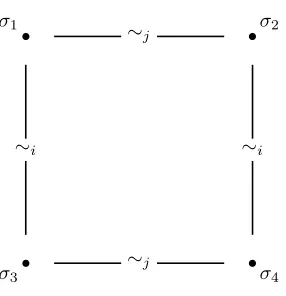
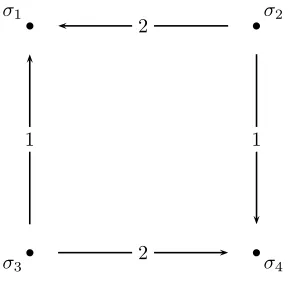
Figure 2.1: This picture represents the four states and a few preference relations.
[image:13.595.234.379.405.547.2]Types of Games
By observing relationships between the outcomes of a game, we can also make specific claims about properties of a game; that is, we can distinguish between types of games. These include symmetric, zero-sum, and coordination games.
Symmetric Game
A symmetric game implies that in the game matrix, the payoffs and correspond-ing utilities of one player are the transpose of the pay-offs/utilities of the other, and each player has the same strategies available to him.
a−i a"−i
ai (n, n) (k, l)
a"i (l, k) (m, m)
Notice that the rule holds that a 2-player game Γ is symmetric if∀ab:u1(a, b) = u2(b, a) =u(a, b). Because it does not matter which player is at the row or
col-umn position, it is sufficient to talk about utility in terms of just the row player
u(a, b).
Coordination Game
A coordination game is a type of game where it is the best for both players to choose the same strategy. In general, a coordination game has the following game matrix composition:
A B
A N, n L, l
B M, m K, k
whereN > M,K > L, andn > l,k > m.
Thus, either case of choosing the same strategy has a higher utility than ei-ther case of choosing differing strategies.
Zero-Sum Game
A zero-sum game is strictly competitive; the gain of one player is the loss of another. An example of a zero-sum game is the Matching Pennies game: each player flips a coin, and the row player wants the pennies to match (both heads of both tails), and the column player wants the pennies to be opposites (one heads, one tails). The matrix is composed as:
Head Tail Head 1, -1 -1, 1 Tail - 1, 1 1, -1
The interaction between players in a strategic scenario is described by the def-inition and visualised by game matrix, but it does not yet address the process involved between the player and his action; that is, what motivates players to choose certain actions? Essentially, a player will choose an action that is in his best interest.
Analyses of how players may reason towards his most preferred outcome given his opponents’ moves have resulted in concepts such as the Nash equilib-rium (NE), which is one out of many possible solution concepts in game theory. The following section describes the some of most central results and solution concepts to classical game theory.
2.1.3
Solution Concepts
A game theorist can reason about a game and decide which strategies rational and intelligent players in a game will play. The resulting strategy profiles can be given names and defined on the basis of the reasoning for why a game will result in that strategy profile.
John Nash’s Ph.D. thesis published in 1950 [33], which followed von Neumann and Morgenstern’sThe Theory of Games and Economic Behaviour [34] by only six years, introduced what is arguably the most important solution concept in game theory, the Nash Equilibrium.
Definition 2.1.5. A strategy profile σ∗ is aNash Equilibrium if for every
player i∈N
(σi∗, σ∗−i)"i(σi, σ−∗i)for allσi ∈Si
Nash equilibrium is also measurable by another means; the best response function. This function determines which action is the best response to an opponent’s strategy, and is defined [35] as:
Definition 2.1.6. A strategyσi is abest response to−i’s strategy,Bi(σ−i),
if
(σi, σ−i)"i(σi", σ−i) for allσi" ∈Si
Definition 2.1.7. A strategy profile σ∗ is aNash Equilibrium if for every
player i∈N.
Bi(σ∗−i) =σi∗
Nash proves in [33] that “every finite game has an equilibrium point.” He demonstrates that if a game does not have a pure strategy Nash equilibrium, then there exists a Nash equilibrium in mixed strategies5.
The following game is a famous and authoritative example of a strategic game and demonstrates the Nash equilibrium solution concept.
Example: The Prisoner’s Dilemma
This game describes a scenario where two individuals are arrested as suspects to a crime. Because they have insufficient evidence to convict either suspect, the arresting policemen offer the suspects the same deal: if the suspect cooperates and thus tattles on the other and the other defects and remains silent, the suspect who tattled goes free. If they both tattle on each other, both go to jail for 5 years. If they both remain silent, they each get jailed for 1 year. They must each therefore choose to cooperate or defect. This is represented in the following matrix:
Cooperate Defect
Cooperate 3, 3 0, 6
Defect 6, 0 1, 1
In the Prisoner’s dilemma the outcome (Defect, Defect) is a Nash equilibrium. If the row player changes his action, he will receive a lesser utility of 0, and if the column player changes his strategy, he will also receive a lesser utility of 0.
Nash equilibrium, as well as other solution concepts, have refinements. The Nash equilibrium described in definition 2.1.5, also referred to as a weak Nash equilibrium, has a refinement where the players strictly prefer one outcome over the other. This is called the strict Nash equilibrium:
Definition 2.1.8. An outcome σ∗ is a Strict Nash Equilibrium if for all
σi∈Si,
(σi∗, σ−∗i)"i(σi, σ−∗i) and(σ∗i, σ−∗i)'(i (σi, σ−∗i)
The following example demonstrates some additional refinements of Nash equilibrium.
5To prove this, Nash relies on Brouwer’s fixed point theorem. The proof consists of a
Example: Stag Hunt Game
There are many more refinements of the Nash equilibrium that reveal interesting additional information about a game when there are multiple Nash equilibria. Consider the following example of the Stag Hunt game, which has multiple Nash equilibria6:
Stag Hare Stag 2,2 0,1
Hare 1,0 1,1
(Stag, Stag) and and (Hare, Hare) are the Nash equilibria in this coordination game. Two refinements of Nash equilibrium are exemplified in this game: pay– off dominant and risk–dominant equilibria. (Stag, Stag) is the pay–off dominant equilibrium, because it yields the highest utilities, and (Hare, Hare) is the risk– dominant equilibrium, because it has the lowest risk of a low utility should one player deviate for some reason.
2.1.4
Iterated Elimination of Dominated Strategies
A special procedure of reasoning about a game is by means of iterated elim-ination of dominated strategies (IEDS), which is the repeated application of the notion dominated strategy to a game. With each application of IEDS a dominated strategy is removed from the game.
It operates under the assumption that a rational player will never choose to play strategies that give him unilaterally (forany strategy the opponent plays) strictly lower utilities than at least one other strategy. Following this reasoning, one may repeat this until a smaller game or only one outcome remains. This procedure depends on the solution concept dominated strategy:
Definition 2.1.9. A strategyσi is adominated strategyfor player iif ∃σ"i∀σ−i(σi", σ−i)"i(σi, σ−i)
In other words, if there is a better strategyσ" than the one in questionσfor
every possible move ofi’s opponent, thenσis a dominated strategy. A rational playerj will reason that his opponentiwill never choose to play a dominated strategy, so j may rule out the outcomes where i plays a dominated strategy. Playeriwill reason that because playerjhas ruled out one of his own dominated strategies, one of j’s strategies becomes dominated, and can be eliminated as well. This is repeated as many times as it takes for no more strategies to be deleted. The process will result in a strategy profile (one or more) that survive after the sequence of deletions.
Consider the game in the following example and the single outcome, (D, A) that the IEDS procedure selects.
6The story of the Stag Hunt game is as follows: two hunters can choose each to hunt for
A B C
D 2,3 2,2 1,1
E 0,2 4,0 1,0
[image:18.595.256.351.119.177.2]F 0,1 1,4 2,0
Figure 2.2: Matrix 1 borrowed from [2]
The IEDS procedure in this example is described in the following figure 2.3:
⇒
A B
D 2,3 2,2
E 0,2 4,0
F 0,1 1,4
⇒
A B
D 2,3 2,2
E 0,2 4,0
⇒
A
D 2,3
E 0,2
⇒ D" 2,3A
Figure 2.3: Matrices (2), (3), (4), (") respectively
In matrix(1), the initial game, the strategy C for the column player is dom-inated resulting in matrix (2). Here we can see that the strategy F is now dominated for the row player, which, after deletion, results in matrix(3). Fol-lowing this procedure, we can delete strategyBresulting in matrix(4)and then
E resulting in the solution matrix" where (D, A) is the solution that survives the process of IEDS.
2.1.5
Conclusion
It is prudent to note that we are bound to strict assumptions of rationality and reasoning ability in order to make solution concepts like Nash equilibrium, best response and IEDS realistic. If we did not assume that the players consistently reasoned towards and chose the strategies that would result in the most pre-ferred outcome possible, then Nash equilibrium, IEDS and best response would be hard to justify. These solution concepts all require rationality in some form7.
The strategic form is nevertheless an intuitive and robust way to describe strate-gic scenarios, but this form only partly composes classical game theory. The extensive form game is, similarly to the strategic form game, a model by which we can understand the strategic interaction and adheres to the stringent ratio-nality requirements as well.
An initial definition of an extensive form game by von Neumann in 1928 was further developed in 1953 by Harold Kuhn, a long-time colleague and friend of Nash, into what is now the default definition of an extensive form game. As we will see in the next section, the extensive form game is expressive like the
7See [37] for an in-depth account of the rational requirements for rationality in (extensive)
[image:18.595.185.431.240.319.2]strategic form game, but it models features of games that the strategic form is not equipped to handle, namely sequential turn-taking games.
2.2
Extensive Form Games
Whereas a strategic form game expresses a unique one-time, one-move scenario, an extensive form game can express a game that involves sequences of actions and turn taking. As with strategic form games, an extensive form game is de-fined by players, actions and utilities of outcomes, but there are some differences that clearly sets it apart from a strategic form game. For instance, an extensive form game is represented not by a matrix but by a game tree, it introduces a new notionhistory, and it uses an alternative perspective on the notionstrategy. With these concepts, an extensive form game represents all possible sequences of the players’ choices, which lead to unique outcomes that are associated with one particular sequence. Those outcomes are also assigned utilities for each player in the game.
In this section, I will first describe the basic terms and definitions of extensive form games. Second, I will describe the game tree. Also, I describe solution concepts for extensive form games. This includes the Nash equilibria which exist for extensive form games, but because they ignore the sequential nature of the game, another solution concept, subgame perfect equilibrium is used to more accurately describe a solution intuitive to the game.
Generally, extensive form games operate under the assumption that the play-ers observe each other’s moves and know what state they are in; under these circumstances the game is aperfect informationextensive form game. However, there are extensive form games with imperfect information meaning that the players are not always aware of the other player’s move. I will describe these games as well.
2.2.1
Terminology
The following terms and definitions are used to describe extensive form games8.
We formally define an extensive form game as
Definition 2.2.1. Anextensive form gameis a tuple
G=!N, H, P,("i)i∈N#where:
Players As with strategic form games, there is a set of playersN, withi∈N
as some individual player.
Histories A set of historiesH describes all possible sequences of actions taken by the players, whereh=∅is the start of the game (i.e. the empty sequence). If a member ofH (a sequence of actions) ishK = (a
1, ..., aK), then for everyL <
K, it holds thathL= (a
1, ..., aL) is a member ofH. A historyhK = (a1, ..., aK)
is a member of the set of terminal histories9 Z
⊂H if there is no aK+1 such
that hK+1 = (a
1, ..., aK+1) is in H. The game ends at the terminal history,
but after a non-terminal historyh, the set of actions available are denoted by
A(h) ={a: (h, a)∈H}.
Turns Each non-terminal history h∈ H\Z is assigned to a player in N by the player functionP. ThusP(h) =iindicates that afterh, it is playeri’ turn.
Preferences For each playerithere is a preference relation ("i) over the set of terminal histories Z. We denote (z, z")∈ ("i) as meaning that i prefers z
overz" or prefers them equally.
In an extensive form game, a strategy has a more involved notion of strategy than in strategic form games:
A strategy, so far, has been understood to be the action or probability dis-tribution of actions that a player can take in a game. In extensive form games, however, players take multiple actions progressing through the game, so we take an alternative approach to account for this. A strategy in extensive form games specifies for each history which action will be taken by the player whose turn it is. That is, a player has a planned response to every action that his opponents may take. Formally, a strategy foriassociates with eachhfor whichP(h) =i
an actiona∈A(h).
Because a strategy is a sequence of actions, an outcome cannot be described directly by strategy profiles. Instead we can define an outcome for every strategy profileσas O(σ) “is the terminal history that results when each playeri∈N
follows the precepts ofσi” [35]. This only holds for perfect information games.
2.2.2
Game Tree
A game tree is a non-cyclical pointed graph that is a visual tool representing extensive form games as described above. Like the matrix for strategic form games, the game tree is useful to understand the concepts described by the formal terms. The extensive form game, and thus the game tree, differs from the game matrix, because the game matrix “...describes only a situation where each player makes a single choice, in ignorance of the choices made by the other players, and the game is then over. The tree thus appears to be a more general description, allowing players to move more than once and also to observe what other players do” [14].
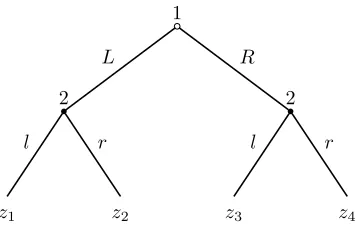
The game tree is composed of nodes, which represent histories, and edges which represent possible actions a player can take given the preceding node. The terminal nodes are also labelled by utilities, which correspond to the preference ordering over outcomes for each player10 These concepts are illustrated by the
tree in figure 2.4.
R L
1
r
z2
l
z1
2
r
z4
l
z3
[image:21.595.217.395.123.244.2]2
Figure 2.4: This is an extensive form game with the terminal nodes marked by
zs.
2.2.3
Equilibria
Extensive form games have as a solution concept Nash equilibrium, but it also introduces the solution concept subgame perfect equilibrium. Nash equilibrium [35] in extensive form games essentially claims the same thing as in strategic form games. No player can do better by defecting from his current strategy. Definition 2.2.2.ANash equilibrium of an extensive game with perfect information!N, H, P("i)# is a strategy profile σ∗ such that for every player
i∈N we have
O(σi∗, σ−∗i)"iO(σi, σ−∗i)for every strategyσi of playeri
However, Nash equilibrium does not reflect the sequential nature of extensive form games, and the following example, borrowed from [35], verifies this and consequentially motivates a solution concept reflecting the sequential nature of extensive form games, the subgame perfect equilibrium.
The following extensive form game, borrowed from [35], exhibits how the solution concept Nash equilibrium can lead to unintended conclusions.
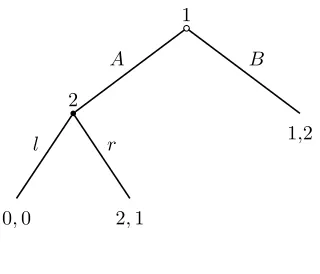
The game in figure 2.5 has two Nash equilibria: (A, r) and (B, l) . However, the equilibrium (B, l) is motivated by the explanation that player 1 will play
B because of player 2’s “threat” of playing l. Playing l still amounts to the same payoff, after all. But at player 2’s choice node it would never be optimal to playl because playing r affords a greater payoff, so the threat of playing l
B
1,2
A
1
r
2,1
l
[image:22.595.214.374.122.259.2]0,0 2
Figure 2.5
Definition 2.2.3. A subgame of the extensive game with perfect
informa-tion Γ = !N, H, P,("i)# that follows history h is the extensive game Γ(h) =
!N, H|h, P|h,("i|h)#where H|h is the set of sequences h" of actions for which (h, h")∈H,Ph is defined byP|h(h") =P(h, h")for eachh"∈H|h, and"i|h is defined by h""i|h h"" if and only if (h, h")"i(h, h"").
The subgame perfect equilibrium is a solution where after each history h, each player’s strategy is the optimal one given his opponent’s move. By basing an equilibrium concept on subgames, we preserve the sequential nature of the scenario. Thus, a subgame perfect equilibrium is based on the concept of a subgame:
Definition 2.2.4. Asubgame perfect equilibrium of an extensive game with perfect information Γ = !N, H, P,("i)# is a strategy profile σ∗ such
that for every player i∈N and every non-terminal history h∈H\Z for which
P(h) =iwe have:
Oh(σ∗|h, σ∗−i|h)"i |hOh(σi, σ−∗i|h)for every strategyσiof playeriin the subgameΓ(h) WhereOh is the outcome function ofΓ(h).
It is also possible to view extensive form games as a strategic form game by means of normalisation, and subsequently we can examine solutions in strategic form.
2.2.4
Normalisation
Definition 2.2.5. Thestrategic form of the extensive game with perfect informationΓ =!N, H, P,("i)#is the strategic game!N,(Si),(""
i)#in which for each playeri∈N
• Si is the set of strategies of playeriin Γ • ""
iis defined byσ""iσ" if and only ifO(σ)"iO(σ")for everyσ∈ ×i∈NSi.
R L
1
r
1,3
l
4,1 2
r
2,4
l
3,2 2
(a) Extensive form game tree.
L R
ll (4,1) (3,2)
lr (4,1) (2,4)
rl (1,3) (3,2)
rr (1,3) (2,4)
[image:23.595.210.402.219.455.2](b) Strategic form game matrix.
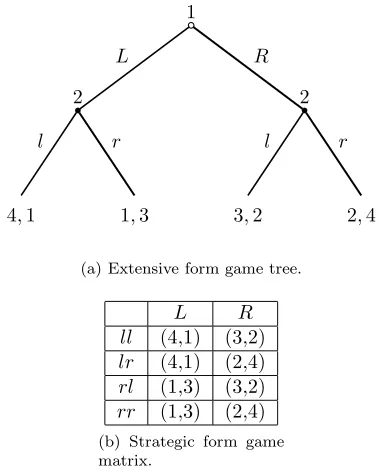
Figure 2.6: (b) is the strategic form game matrix that results from the extensive form game tree in (a)
Notice in figure 2.6 that expressing an extensive form games in this manner is inefficient, for the conversion can lead to very large matrices. This process leads to redundantly listing outcomes. Notice in the matrix above that the outcome with utilities (4,1) is listed twice (as are all the outcomes) for the strategy profiles (L, ll) and (L, lr) are the same.
Given player 1 playsL, both of the strategiesllandlrexpress that he plays
l when 1 plays Land l when 1 plays R . Because the strategy profile already specifies that 1 playsL, the fact that 2 may playl or 1 after 1 playsR has no bearing on the outcome. Therefore, expressing extensive form games in matrices leads to inefficient redundancies. The comparison does reflect an interesting fact about matrices:
not as single moves, but rather as complete plans of action for the tree. [14]
The fact that this is possible will be of interest in the upcoming discussion on logic in classical game theory.
2.2.5
Backward Induction
The procedure of backward induction is the process that proves Kuhn’s Theorem that “every finite extensive game with perfect information has a subgame perfect equilibrium” [35]. The idea is that there is a best terminal node branching from a nodehfor the player whose turn it is. If that player is rational, he will choose the action corresponding to that terminal node. For this reason, we can back that value up the tree to that nodeh. If the player whose turn it is at the node leading to this newly valued node h, and that value is preferred to his other actions, then he will take that action, allowing us to move that value further up the tree. Continuing in this fashion, we can determine a path in the tree that selects an outcome called the backwards induction solution. For an in-depth discussion of backwards induction see sources such as [5], [9] and [26].
R L
1
r
1,3
l
4,1 2
r
2,4
l
[image:24.595.214.403.359.507.2]3,2 2
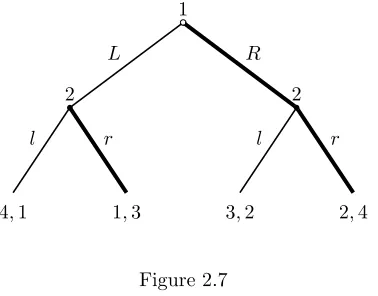
Figure 2.7
The bold lines in the game in 2.7 represent the path in the game that results in a backward induction solution. Every game has a unique backward induction solution if the preference over terminal histories is strict for each player. Other-wise, the backward induction path would split at any pointhwhere the values of the possible actions are the same. Both outcomes resulting fromhwould be backwards induction solution.
2.2.6
Imperfect Information
to him, or if moves are made by chance. These games have added structure that represent what knowledge the acting players have about the state of the game. Furthermore, the special player chance is added. The definition accounts for these factors with two additional concepts in the tuple:
Definition 2.2.6. An imperfect information extensive form game is a tupleG=!N, H, P, fc,(Ii)i∈N("i)#, where:
N, H, P, and "i These are as described in definition 2.2.1 above.
Probability Distribution The actions of player chance are determined by the probability distributionfc(·|h) onA(h). That is, the probability that player chance playsa at historyhis fc(a|h). Because of the chance component, the utility function is defined as lotteries over terminal histories, since chance in-duces a non-deterministic component over terminal histories.
Information Partition The structures that represent the knowledge of the acting players are information sets. Information sets partition the set of all histories where a player acts i.e. Ii is a partition on {h∈H :P(h) = i}, and an information set is aIi ∈ Ii. These structures are interpreted as follows, the acting playericannot distinguish betweenhandh" whenh, h"∈ Ii.
Because players cannot distinguish between histories in the same information set, they have the same set of actions to choose from if the histories are members of the same information set. HenceA(h) =A(h") whenever h, h" ∈ Ii. For if
A(h) '= A(h") players could deduce in what history they are by the actions
available to them.
Furthermore, because players cannot distinguish between histories in the same information set, they can only decide upon one (stochastic) action per information set. Therefore, histories are no longer the primitive of the game over which is reasoned, but rather information sets take its place.
In general, backward induction is not possible under imperfect information [26], because in imperfect information games a player chooses an action per informa-tion set. In backward inducinforma-tion, you assign a value to every history. Moreover, a player takes an action per history. However, in imperfect information games, a player chooses an action per information set. Therefore, it is unclear how to assign values to actions in the information set. Backward induction is generally not possible for imperfect information games11.
2.3
Conclusion
With these basic concepts that compose classical game theory, we can move on to describe evolutionary game theory. There are multiple ways one can choose
11Some new literature suggests that for specific imperfect information games backward
to think about evolutionary game theory in relation to classical game theory. Because evolutionary game theory takes terms and solution concepts and applies it to patterns in biology, one could argue that it is simply an application of game theory. Evolutionary game theory also reveals patterns about the behaviour of collections of individuals and invents new solution concepts, so it can also be considered to build on classical game theory as a development or extension.
Classical game theory is a firmly rooted theory with many well-known and revered results, but it is not perfect. Importantly, it has stringent rationality requirements as was described in section 2.1.6, which is a limiting factor for the theory; despite its enticing pliability in describing human interaction, an application with a doubtful rationality role will be more difficult to describe in classical game theoretic terms.
Chapter 3
Evolutionary Game Theory
Classical game theory is centred on the idea that the agents or players of a game reason intelligently and rationally. Humans, being the the exceptionally gifted species on earth capable (we assume) of reasoning intelligently and ratio-nally, are ideal agents around which to build classical game theory. However, there is a manner in which we can include the less “gifted” members of the animal kingdom in game theory. By means of evolutionary game theory. This involves considering games where the players are members of a population; the population is divided by the amount n of strategies occurring in the popula-tion. Evolutionary game theory measures the circumstances under which the frequencies of a strategy in a populations are stable, and if they are not stable then it measures the dynamic behaviour of the strategies in relation to the other strategies in the population.
Like classical game theory, evolutionary game theory describes concepts by means of the components we saw in the previous chapter: players, strategies, outcomes and preference. The pivotal difference separating the concepts of evolutionary game theory apart from those in classical game theory is their in-terpretation. This difference is the foundation of the arguments in this thesis. In the following chapter 4, we will see how classical game theory has been described with modal logics, but introducing evolutionary game theory to logic is subject to a deep understanding of the consequences of the difference in interpretation. Simply “throwing” the logic we have for classical game theory at evolutionary game theory is inadequate to properly define evolutionary concepts.
The other approach, replicator dynamics, describes the dynamic scenario that arises when a population is not robust against invasion and therefore is not or cannot remain homogeneous. The replicator dynamics are based on the differential equations approach to dynamical systems [23]. These dynamical systems represent populations that are in flux; with strategies that sometimes never reach equilibrium and therefore are always approaching or orbiting equilib-rium. Such a heterogeneous environment is, by definition, constantly changing over time. For our purposes a brief study of basic calculus is sufficient to de-scribe the rate of change of the frequency over time of a strategy in a population.
Replicator dynamics reflect the intrinsic dynamic factors of evolutionary games, but this thesis’ main focus is the static concept of evolutionary stability. The static notion of evolutionary stable strategy “is particularly useful because it says something about the dynamic properties of a system without being com-mitted to any particular dynamic model” [23]. In fact, it is more comcom-mitted to the static model of a strategic form game; the evolutionary stable strategy is defined similarly to other solution concepts in strategic form games and it can be described by a game matrix. The reason this thesis focuses on strategic form games and the static evolutionary stable strategy is because the logic for strate-gic form games is the most salient initial doorway to lostrate-gic for an evolutionary concept.
The main terminology and results in evolutionary game theory that we will see in this chapter is informed by or based on the insightful and thorough sources [42], [28], [23], and [27]. Moreover, altough this chapter thoroughly presents evolutionary stable strategies,s a rigorous discussion of replicator dynamics and dynamical systems is excluded for they are far more involved and complex than is germane to the conclusions of this thesis. For a more in-depth understanding of these topics, [23], [27], and [43] are recommended.
3.1
Background
Evolutionary game theory essentially has its origins in Charles Darwin’s theory of natural selection [18], which claims that the fittest genetic (or behavioral) traits are more likely to survive through replication. Survival of the fittesteasily reflects the game theoretic idea that the interaction1 of players with certain
traits (this is often strictly competitive in natural biology, for animals often compete for limited resources) results in winners and losers. Therefore, the involvement of game theoretic concepts in the process of evolution was a salient direction of study.
The introduction of the paper “The Logic of Animal Conflict” by John May-nard Smith and George Price [42] in 1973 significantly progress in the field of evolutionary game theory. This paper introduced the idea and definition of
evo-1After all, “the fitness of an individual cant be measure in isolation; rather it has to be
lutionary stability which described why one behaviour rather than another was adopted by a certain proportion of a population at a given time; an idea based on the basic concepts of evolution. Following this, the field became popular among researchers in fields such as economics, language and mathematics, because its new dynamic perspective saliently describe trends in economics, culture, and language.
3.1.1
Evolutionary Interpretation of Game Theoretic Terms
Evolutionary game theory is based on a reinterpretation of the classical game theoretic terminology. In classical game theory, a game Γ is a triple Γ = !N,(Ai)i∈N,(ui)i∈N# where N is the set of players, (Ai)i∈N is the set of ac-tions available toi(we defer to the more general notion of strategy as described in Chapter 2), and (ui)i∈N is the utility function fori,ui:A→R. evolutionary game theory reinterprets each of these components in the following way:N
The setN is the set of players that compose a population. (Ai)i∈N
Instead of choosing an action in a game, players are programmed for cer-tain strategies. This can be interpreted as the expression of a gene or an instinct; namely “parents pass on their strategy [asexually] to their offspring basically unchanged” [28]. This is calledreplication. When two players play a game, each “plays” or enacts its programmed strategy. (ui)i∈N
Utility is interpreted asfitness. A player who play a game and wins has a higher fitness than his opponent and vice versa. If they “tie” they have the same fitness. A player with higher tness produces more offspring (with the same strategy) than the opponent who has a lower fitness and therefore produces less offspring.
Given this interpretation of game theoretical terms, the following facts and assumptions also hold:
• If a population is heterogeneous with respect to strategies played, we rea-son about the proportions of each strategy in the population where the sum of the proportion of each strategy is 1.
• Sometimes replication is unfaithful, which results in a mutant who plays a different strategy than his parents. Depending on the utility of his strategy as opposed to the strategy of the incumbent, he will either infiltrate the population or die off.
The way in which the classical game theoretic terms have been interpreted allows the game theorist to define evolutionary notions elegantly. This is evident in the following section, which characterises one of the central notions of evolutionary game theory, the evolutionary stable strategy.
3.2
Evolutionary Stability
Whereas the Nash Equilibrium was the principal solution concept in classical game theory, the evolutionary stable strategy is the principal solution concept of evolutionary game theory. Nash equilibrium expresses that no player has an incentive to to choose a different strategy than the current one. An evolution-ary stable strategy (ESS), on the other hand, is a strategy that persists in a homogeneous2population and cannot be “invaded” by a group of mutants who
play a different strategy. Those mutants “will eventually die off over mutliple generations” [19].
Given the radical reinterpretation of classical game theoretic concepts, Nash equilibrium and ESS describe seemingly separate concepts, but they are, in fact, closely related. An ESS concerns a population of players who each encounter other players in that population and create constantly occurring scenarios of standard 2-player strategic games. Although ESS speaks to the strategies played in a population of players, its definition is entirely based on the utilities for each individual player in simple pairwise, one-shot strategic form games. The definition of an ESS is as follows:
Definition 3.2.1. A strategy,σ∗ ∈S, is anevolutionary stable strategy if for allτ'=σ,
1. u(σ, σ)≥u(τ, σ), and
2. If u(σ, σ) =u(τ, σ), thenu(σ, τ)> u(τ, τ)
This definition3,4 expresses that in order for a strategyσto be an ESS, it
must satisfy two conditions. The first condition states that it must be a Nash equilibrium. That is, the utility of playingσ againstσis better than or equal to playing τ against σ. The second condition expresses that “if a τ-mutation can survive in anσ-population, σ must be able to successfully invade any τ -population...” [28]. That is, if the utility for playingσagainstσis the same for playingτagainstσ, then the utility of playingσagainstτmust be higher than playingτagainstτ. This ensures that when encountering a mutant playingτ,σ
will prevail, making it impossible forτto infiltrate the population ofσplayers.
2With respect to what strategy the members of the population play 3Recall that in a symmetric game,u(A, B) =u
i(A, B) =uj(B, A) fori, j ∈N; i.e. the
utility of strategy profileSfor all players in the game.
4The following is a trivial variation of the definition of ESS.
1. u(σ, σ)> u(τ, σ), or
3.2.1
A Note on the Relationship Between ESS, NE and
SNE
The evolutionary stable strategy is related to Nash equilibrium in a number of ways. Technically, an ESS is also a refinement of a NE; the first condition requires that the ESS is a NE, so naturally that implies that every ESS in a game is also a NE. Thus, ESS⊂NE. Moreover, if a NE is a strict NE (SNE), then the requirement for ESS is automatically satisfied. Therefore, we can conclude that [28]:
Strict NE⊂ESS⊂NE
It is crucial to point out that this claim is superficial for it boldly claims that ESS is a subset of a NE and a superset of a SNE despite the fact that NE and SNE arestrategy profiles and an ESS is a strategy. One must already assume that because ESS holds only for symmetric games, that implies a strategy profile where each player is playing the ESS (say (σ, σ)). This is also astutely noted in [17]:
... an ESS must correspond to a symmetric Nash equilibrium in that game ... I say ‘correspond’ rather than ‘is’ because an ESS is defined as a single strategy, with the understanding that it is played by all members of a monomorphic population, but a Nash equilibrium is defined as a combination of strategies, one for each player.
Given that the strategy profile corresponding to an ESS must therefore always be symmetric, the above claim fails to specify that not all strict Nash equilibria can be ESSs, but only all symmetric strict Nash equilibria are ESSs. The following game demonstrates that it is possible for a symmetric game to have a strict Nash equilibrium that is not symmetric.
A B
A 0,0 3,2
B 2,3 0,0
We must specify that an ESS is, in fact, the superset of asymmetric SNE and the subset of asymmetric NE. It is also pointed out in [17] that “it can also be shown ... that in this model any strict, symmetric Nash equilibrium corresponds to an ESS in a large population.” Therefore, the following is more accurate than the claim above:
Symmetric Strict NE⊂ESS⊂NE
In any case, we can not simply claim that every SNE is an ESS5. Under most
circumstances the fact that NE and SNE are strategy profiles, whereas ESS is a single strategy, is relatively trivial but in a logic of evolutionary game theory, it will be crucial to acknowledge the distinction.
5We saw that Nash proved that every game has a Nash equilibrium: if not pure, then
An evolutionary stable strategy is a special concept in evolutionary game theory. It is the one static concept on which the real dynamic character of evolution-ary game theory is built. The following section describes replicator dynamics, which demonstrates the behaviour of strategies when they are not at a stable state. The dynamics are represented by coordinate systems that visualize the changing frequency of strategies over time.
3.3
The Replicator Dynamics
Strategies are considered to bereplicators and therefore, the dynamics of strat-egy frequency can be measured over time. If a population has an evolutionary stable strategy, but is for some reason at a heterogeneous state, the replica-tion of strategies over multiple generareplica-tions will always eventually result in a homogeneous population. However, a population at a homogeneous or hetero-geneous state that does not have an ESS also changes over many generations of replication. This results in a scenario where the population never stabilizes and remains in constant flux. In both cases, elementary calculus is sufficient to measure the changing frequency of strategies. This section will introduce the basic mathematics and results that compose the replicator dynamics.
The function N(t) expresses the population size at a time t. N(t) “can be thought of as the actual (discrete) population size divided by some normaliza-tion constant for the borderline case where both approach infinity” [28]. Given that there arenstrategiesσ1, ..., σn,xi =Ni/N of some strategyσi. The sum of xj for all σj ∈ S is 1; i.e. it is a probability distribution. We also assume that death is a constantd.
Supposetis continuous. Assuming ∆tgoes to 0, the limit equation is:
dNi
dt =Ni(
n
"
j=1
xju(i, j)−d)
“We abbreviate the expected utility of strategyσi,!nj=1xj(i, j), asui, and the population average of the expected utility!ni=1xiui, asu” [28]. Therefore, the corresponding differential equations are:
dNi
dt =Ni(ui−d)
dN
dt =N(u−d)
Becausexi =N/Ni (and following from the definition rule for the first deriva-tive), the equation called thereplicator dynamics:
dxi
If the differential utilitydxi
dt = 0 for alli, the frequency of the strategy is question
σ remains constant over time. On the other hand, if it does not equal 0, the strategy will either increase or decrease in frequency. When it is 0, however, the strategy is considered to be static, which reflects the first condition of ESS. The second condition, that the strategy is robust against mutations or invasions of other strategies holds if the trajectories are drawn to thex value resulting in the differential utility of 0. Thenxis called anattractor.
3.3.1
Graphing Replicator Dynamics
[image:33.595.193.418.305.470.2]We can visualise the replicator dynamics of a game in a coordinate system where time is mapped to thex–axis and the relative frequency of the strategy in question is mapped to they–axis. This can be seen in 3.1. figure
Figure 3.1: This is an example from [28] of a graph representing the replicator dynamics of a game where the frequency of 1 is clearly an attractor for the strategy, meaning that it is an ESS. Each line stands for its behaviour in its trajectory towards a frequency of 1 given some examples of the frequency at which it may “start.”
Figure 3.2: This example, also borrowed from [28], is a game of three strategies, where the frequency of the strategies are constantly evolving. At some point on a trajectory, the next generation has on average evolved to play less of the previous generation’s strategy.
3.4
Conclusion
This chapter introduced evolutionary game theory with an intentional focus on its relationship with classical game theory. Classical game theory provides the framework and machinery for evolutionary game theory. We saw in this chapter that players, strategies, strategy profiles and utilities formally operate in the same way.
The main difference is that evolutionary game theory takes this machinery a step further by reinterpreting the meaning of the terms and the machinery it has adopted from classical game theory. In particular, because it measures utility as fitness, evolutionary game theory inherits a future-oriented picture of game theory. Fitness implies something about how the same game may be played in future encounters between members of a population, where the population changes after every occurrence of the game.
game logic. This will show that classical game logics establish a reliable core for evolutionary game logics, but the change in meaning demands the same from an appropriate logic.
This chapter also introduced the notion of dynamical systems and replicator dy-namics in evolutionary game theory. Although replicator dydy-namics demonstrate a central point of evolutionary game theory, i.e. change in strategy frequency over time, it will not be a widely discussed factor in this thesis. This is certainly a topic of future work for logicians, where a logical study of dynamical systems would require a way to describe infinite games 6, Chapter 5 for an overview), and a way to express continuous functions. Kremer and Mints [30] do suggest a logic to this end, in terms of “dynamic topological logic.” They base the logic on topological spaces in place of Kripke frames.
The primary directive of this thesis, however, is on the more static concepts in evolutionary game theory such as evolutionary stable strategy. ESS raises many interesting questions as a static concept alluding to a dynamic environ-ment. The fact that we can (and will) define ESS in modal logic (which seems extraordinarily simple compared to logics that express the replicator dynamics). Nevertheless, logical applications alluding to the temporal nature of replicator dynamics is not ignored.
Chapter 4
Logic in Classical Game
Theory
Logic and classical game theory have many things in common; they both aim to model complex interactive scenarios composed of concerns rooted in both classical game theory and logic, such as agents, choices, actions, preference, and knowledge (or lack thereof). For some time now, logicians have been exploring the enticing possibilities as well as the challenges posed within the interface of classical game theory and logic.
Van Benthem’s distinction between logic games and game logics [4] outlined in the introduction draws a line between topics within the interface. On one side, logic games consider classical game theory as a tool used to describe logic, where, in short, players are burdened to “prove” the truth of logical formulas. The player with the winning strategy determines whether a formula is true or false. Jaakko Hintikka and Gabriel Sandu have published a seminal and elabo-rate work, “Game Theoretic Semantics” [25], on this topic.
On the other hand, game logics aim to model a game as a framework of ra-tionality and interaction by means of logic. This section will take this latter perspective by analysing a selection of approaches to modelling classical game theory in both strategic and extensive forms. In particular, this chapter fo-cuses on modal logic with epistemic modalities; one static modal logic approach and one dynamic modal logic approach. We see that the procedure of IEDS is an ideal illustration of the kind of rational interaction that modal logic can describe.
portion of this chapter.
In accordance with the trend of creative approaches to logic and games, this chapter will also build on Seligman’s [40] and van Benthem’s [10] [4] work by demonstrating how hybrid logic can describe many more interesting concepts in classical game theory such as the salient example, IEDS.
In the next chapter, the techniques investigated in this chapter will see yet another advance underevolutionary game theory. Evolutionary game theory is not as intuitive to logic as classical game theory is, but this thesis nevertheless takes the hybrid logic development described here to be an attractive way to introduce logic to evolutionary game theory.
4.1
Logic for Strategic Form Games
This section will explore several contributions that offer compelling logics for strategic games. One particular challenge for logicians arises from the exclu-sion of epistemic factors in the traditional definitions of strategic games. Nash equilibrium, best response and the process of iterated elimination of dominated strategies (IEDS)1, for instance, have stringent requirements for the knowledge
and rationality of the players. In order for them to make sense realistically, one must assume common knowledge of rationality for the players. Often game the-orists, at best, give informal arguments for the epistemic foundations of these solution concepts. For instance, Osbourne and Rubenstein, in their influential introduction to game theory, describe that a player “is aware of his alternatives, forms expectations about any unknowns, has clear preferences and chooses his action deliberately after some process of optimization” [35]. Others have made similar descriptions:
Game theory has originally been conceived as a theory of strategic interaction among fully rational agents ... Rationality here means, among other things, full awareness of ones own beliefs and pref-erences and logical omniscience. Even stronger, for classical game theory to be applicable, every agent has to ascribe full rationality to each other agent. [29]
The articles surveyed in this section are Giacomo Bonanno’s “Modal Logic and Game Theory: Two Approaches”[13], van Benthem’s “Rational Dynamics and Epistemic Logic in Games” [2], van Benthem et al.’s “Towards a Theory of Play” [10] and Seligman’s “Hybrid Logic for Analysing Games” [40], describe strategic games using modal logic. Each article does this in a unique way. With this selection, we describe strategic games in static logic, strategic games in dynamic logic and strategic games in a hybrid logic.
In section 6.1.1, I outline how Giacomo Bonanno describes games in static modal
![Figure 2.2: Matrix 1 borrowed from [2]](https://thumb-us.123doks.com/thumbv2/123dok_us/8384944.321613/18.595.185.431.240.319/figure-matrix-borrowed-from.webp)
![Figure 3.1: This is an example from [28] of a graph representing the replicatordynamics of a game where the frequency of 1 is clearly an attractor for thestrategy, meaning that it is an ESS](https://thumb-us.123doks.com/thumbv2/123dok_us/8384944.321613/33.595.193.418.305.470/figure-example-representing-replicatordynamics-frequency-clearly-attractor-thestrategy.webp)
![Figure 3.2: This example, also borrowed from [28], is a game of three strategies,where the frequency of the strategies are constantly evolving](https://thumb-us.123doks.com/thumbv2/123dok_us/8384944.321613/34.595.209.391.133.331/figure-example-borrowed-strategies-frequency-strategies-constantly-evolving.webp)