An ES Process Framework for Understanding the Strategic Decision
Making Process of ES Implementations
Maha Shakir
I.I.M.S., Massey University, Albany Campus, Auckland, New Zealand
[email protected]
Abstract
Enterprise systems (ES) implementations are regarded costly, time and resource consuming and have a great impact on the organization in terms of the risks they involve and the opportunities they provide. The steering committee (SC) represents the group of individuals who is responsible for making strategic decisions throughout the ES implementation lifecycle. It is evident from recent studies that there is a relationship between the decision making process and ES implementation success. One of the key elements that contribute to the success of ES implementations is a quick decision making process (Brown and Vessey, 1999; Gupta, 2000; Parr, et al., 1999). This study addresses the strategic decision-making process by SC through its focus on four research questions (1) How can the strategic decision-making process in the implementation of ES be better understood, during each phase of the ES implementation lifecycle? (2) What is the process by which the SC makes strategic decisions? (3) How are fast decisions made? and (4) How does decision speed link to the success of ES implementation? Process models of ES implementation will provide a framework to investigate the strategic decision making process during each phases of the ES implementation lifecycle. Patterns in the decision making process will be explored using strategic choice models. This study develops a research model that focuses on the decision making process by steering committee to explore research questions. It concludes with identifying contributions to both IS research and business practitioners.
Key words:
Enterprise systems, strategic decision-making, steering committee, implementation lifecycle, implementation success
Introduction
Enterprise systems (ES) are software applications that manage and integrate business processes across and between organizational functions and locations. The three alternatives to enterprise integration (EI) identified from a review of the literature are packaged software applications, data warehousing and best-of-breed systems (Davenport, 2000; Markus, 2000; Pender, 2000). The focus of this study is on packaged software applications. A comparison between the three alternatives is out of the scope of this paper. The reader is directed to the above references for a detailed review. For the purpose of this study, ES are defined as enterprise-wide, mainly packaged software applications, which support EI and the business best practice.
reformulated with the pace of implementation. As a result, the understanding of these decision cannot be separated from the understanding of the decision-making process of ES implementation.
The decision-making process in ES implementation involves different stakeholders from inside as well as outside the organization. The SC, which has a high level of senior management representation, manages ES implementation through the stages of ES implementation lifecycle. One of the key elements that contribute to the success of ES implementations is a quick decision making process (Brown and Vessey, 1999; Gupta, 2000, p. 116; Parr, et al., 1999, pp. 111-112). This is usually realized through the SC which is responsible for both, making high level decisions in the implementation of ES and establishing and publishing a decision making process to facilitate quick decisions to empowered ES project teams.
At present, there is a lack of research that looks at the decision making process of ES implementation through the lifecycle of initiation, acquisition, implementation and post implementation (Sarkis and Sundarraj, 2000). The aim of this study is to explore the strategic decision making process of ES implementation in New Zealand organizations using a multiple case study design approach. Furthermore, it intends to compare New Zealand findings with international findings to provide a synthesis of the similarities and differences within a global context. Comparisons will be made to draw international experiences and judge the applicability of New Zealand findings from an international perspective. The next part will introduce the theoretical framework of the study and provides for a description for the proposed research model.
The theoretical framework for the study
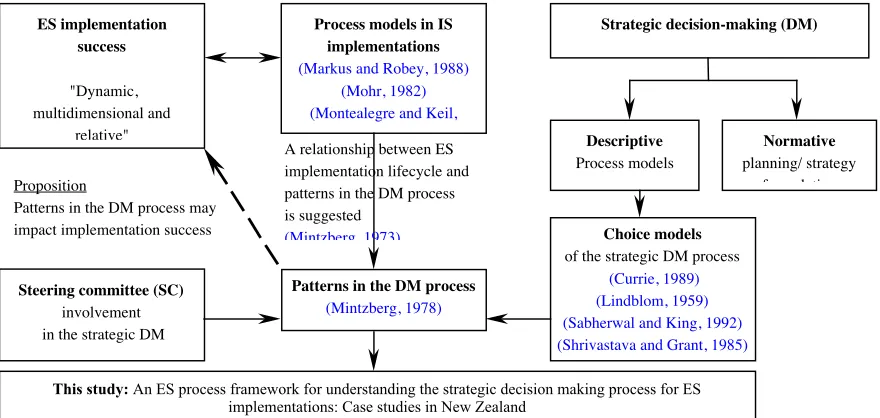
[image:2.595.51.491.445.654.2]Process models of ES implementation will provide a framework to investigate the strategic decision making process during each phase of the ES implementation lifecycle. Patterns in the decision making process will be explored using strategic choice models. This study develops a research model that focuses on the decision making process by steering committee to explore research questions. Figure 1, shows the theoretical framework for the study and the relationships between research constructs. The next sub-sections will provide a brief discussion of these constructs.
Figure 1: The theoretical framework for the study of the strategic decision making process for ES implementations
Process models in IS implementations
(Markus and Robey, 1988) (Mohr, 1982) (Montealegre and Keil,
ES implementation success
"Dynamic, multidimensional and
relative"
Patterns in the DM process
(Mintzberg, 1978)
Steering committee (SC)
involvement in the strategic DM
Strategic decision-making (DM)
Normative
planning/ strategy f l ti
Descriptive
Process models
Choice models
of the strategic DM process (Currie, 1989) (Lindblom, 1959) (Sabherwal and King, 1992) (Shrivastava and Grant, 1985)
This study: An ES process framework for understanding the strategic decision making process for ES implementations: Case studies in New Zealand
Proposition
Patterns in the DM process may impact implementation success
A relationship between ES implementation lifecycle and patterns in the DM process is suggested
Process models in IS research
Two types of research has targeted IS implementation, variance research and process research (Markus and Robey, 1988; Newman and Robey, 1992). Due to the space limitation for this paper, an extensive comparison between the two is not provided. The reader is directed to the above references for a detailed review. Process research is concerned with explaining outcomes in relation to the existence of a set of necessary, but not always sufficient conditions for outcomes to occur. As a result process theories provide for a different way of generalizing research finding to that of variance theories, which is called analytical generalization (Yin, 1994, pp. 10). The aim of analytical generalization is to explain the pattern of regularities over time. Process theories are useful in answering the "how" and "why" research question and for generating new theories (Newman and Robey, 1992). They are also more useful than variance theories in dealing with complex relationships through explaining the sequence of events (Crowston, 2000; Shaw and Jarvenpaa, 1997). Practitioners value findings of process research because they are easier to understand; and are of high level of relevance (Shaw and Jarvenpaa, 1997, pp. 86). Furthermore, and because IS is considered an applied discipline, research that scores highly on relevance is much regarded (Applegate and King, 1999; Benbasat and Zmud, 1999; Davenport and Markus, 1999; Lee, 1999; Lyytinen, 1999).
In considering the study research questions, process research is found more suitable to investigate decision making through the phases of ES implementation for the purpose of providing an understanding of this dynamic process. A recent study acknowledged that although process theories complement variance theories, they are less commonly found in the literature (Montealegre and Keil, 2000). The aim of this study is to fill this gap in relation to decision making in the implementation of ES by focusing on the sequence of activities in order to explain how and why observed outcomes evolve over time. A process theory of ES implementation includes identifying both phases and the triggering activities, which drive the movement from one phase to the next (Markus and Tanis, 2000; Montealegre and Keil, 2000). Since the strategic decisions in ES implementation are performed the by SC, SC involvement in ES implementation will be the next research construct discussed.
Steering committee involvement in ES implementation
It is observed that the cost of ES implementation is approximately two thirds people and one-third hardware and software (Martin and Cheung, 2000). As a result people management is regarded of key importance to ensure that money invested is well spent. Except for case studies that identify team structures, which include steering committee, project teams, study teams, venture teams etc., the literature in the implementation of ES provide no rich description of the decision-making process (Martin and Cheung, 2000; Sarkis and Sundarraj, 2000). This research tries to fill this gap by focusing on the role of the steering committee to explore the strategic decision-making process in the implementation of ES. A definition the SC is first provided. Next the proposition of extending two research models to understand SC involvement is elaborated on.
The review of the IS literature provides for a definition of the steering committee (SC) as a formal organizational body that includes members from several functional units of the organization whose main responsibility is the high level management of IS project (Doll and Torkzadeh, 1987; Drury, 1984; McFarlan, 1981; McKeen and Guimaraes, 1985; Nolan, 1982a; Nolan, 1982b; Schwartz, 1969; Willoughby, 1975). The SC can be considered a realization of the organization buying center concept, which was defined to include all members of the organization involved in the buying process (Johnston and Bonoma, 1981a; Johnston and Bonoma, 1981b). However the two definitions are incomplete because they define membership as internal to the organization while ES implementation case studies often indicate that consultants, who are external to the organization often join or are part of the decision making process by SC.
the era of ES was focused on managing the selection process of IS projects, its role has evolved to include the overseeing and management of large IS projects throughout the implementation lifecycle.
Drury identified several structural and operating alternatives for the SC depending on leadership, users representation, regularity of meetings, degree of formalization and decisions authority. (Drury, 1984). Study findings revealed that advantages couldn't be achieved using the same structural alternatives. As a result, the structure of the SC needed to change over time to suit the changing needs of the organization. This calls for a process research to help the understanding of the changing relationships between the operating alternatives over time, which is what this study aims for, through the use of the exploratory case studies strategy. Johnston (1981b) in an exploration of the dynamics of organizational purchase processes developed a decision network model that shows the relationships and their frequencies between decision-making stakeholders. The five dimensions of model are: vertical involvement, lateral involvement, total number of people involved (extensivity), connectedness of people involved, and the centrality of the purchasing manager in the purchase process communication networks. This study proposes to extend the previous two models to understand the SC operating alternatives over time. Expected finding are believed to provide a context for decision making by SC. Furthermore, it can show patterns in the decision making process that are particular to the implementation of ES or to the specific cases studied. The next section justifies decisions by SC as strategic decisions, postulates a relationship between decision speed and ES implementation success and suggests the use of choice model to investigate the strategic decision making process of ES implementation.
Fast strategic decision-making in the implementation of ES
Strategic decisions are these, which are important in terms of the actions taken, the resources committed or the precedents set (Mintzberg, et al., 1976). They are important because they are fundamental decisions, which shape the course of an organization (Eisenhardt and Zbaracki, 1992). Decisions by SC to invest and implement an ES are regarded as strategic decisions because the system is one of the major investments an organization commits to and system implementation is of high impact on the organization. The previous section highlighted the role of the SC in the decision making process of ES implementation. This section proposes to use the choice models of decision making to explore this process. And since recent studies suggested that a quick decision making process would positively contribute to the success of ES implementations (Brown and Vessey, 1999; Gupta, 2000, pp. 116; Parr, et al., 1999, pp. 111-112), the relationship between patterns of the decision making process and decision making speed will also be investigated.
Choice models of the strategic decision making process include the rationality, bounded rationality, incremental, adaptive, garbage-can and political models (Eisenhardt and Zbaracki, 1992; Fredrickson and Mitchell, 1984; Hoy and Tarter, 1995; Mintzberg, 1973; Nutt, 1976; Ranganathan and Sethi, 2000; Sabherwal and King, 1992; Sabherwal and King, 1995; Shrivastava and Grant, 1985). A review of choice models for the strategic decision making process in organizations in the Eisenhardt (1992) study showed that choice models, that prevailed were a mix of bounded rationality and politics, while the garbage-can model was less relevant for strategic decision making. A preliminary case study on ES evaluation, selection and implementation produced similar findings (Shakir, 2000), however the link between decision making speed and the success of decision outcome is still to be investigated.
by SC and whether a fast decision process will be positively associated with ES implementation success. A definition of the ES implementation success construct is the subject of the next section.
ES implementation success
While budget, schedule and quality are acknowledged as the traditional IS project outcome metrics for success (Abdel-Hamid, et al., 1999), it is believed that they are not inclusive. Success is a difficult construct to identify because it is multidimensional, dynamic and relative. This study concurs with Markus and Tanis (2000) in using these same features they describe as "optimal success" to operationlize this construct. Success is "dynamic" because the meaning of success is constantly changing during the lifecycle of ES implementation. It is "relative" because its assessment depends on the specific organization, organizational goals and on the time during ES implementation. Finally success is "multidimensional" because it is judged by several outcomes which are a combination of ES project outcomes, operational outcomes and strategic outcomes (Sarkis and Sundarraj, 2000). The proposed definition suggests that not all success outcomes are expected to be observed during every phase of the of the ES implementation lifecycle, because outcomes will be relative to the organization, its goals and the phase of implementation for which success will be examined. The decision making process by steering committee, as discussed in the previous section and its impact on ES implementation success will be explored within the above definition.
Conclusions and future directions
The study will explore the decision-making process for ES implementation practice in New Zealand. International experiences will also be presented for comparison, similarities and differences. The expected contribution of the study is two folds, theoretical and practical. The theoretical contribution includes a synthesis of existing literature on IS implementation process models, organizational buying process models and ES implementation case studies, the result of which is the development of a normative ES implementation lifecycle model. The normative model is used to investigate group decision-making processes; at the level of the steering committee; and during the different phases of ES implementation. The relationship of observed patterns in the decision making process and both decision speed and ES implementation success will also be explored. The descriptive model of ES implementation in New Zealand, which will be developed, of case study findings will be compared to the normative model for better understanding of the decision-making process. As for practical contribution, the outcome of this research will be of interest to organizations planning large IS/ IT investments, especially in the area of ES. It will help many organization stakeholders involved in the IS implementation lifecycle visualize the decision-making process and it's implications on decision making speed and the success of ES implementation. The next phase of this research will use the research theoretical framework to collect data from four organizations that have or are in the course of implementing an ES system. Case study research is deemed suitable because the proposed research addresses the contemporary phenomenon of ES implementation, which the researcher has no control over; it is largely exploratory; and addresses the "how" question (Darke, et al., 1998; Yin, 1994). Multiple cases are suggested to enable the successful generation of theory.
References
Abdel-Hamid, K., T., Sengupta, K. and Swett, C. "The impact of goals on software project management: An experimental investigation," MIS Quarterly (2:4), 1999, pp. 531-555.
Applegate, L.M. and King, J.L. "Rigor and Relevance: Careers on the Line," MIS Quarterly (23:1), 1999, pp. 17-18.
Ballantine, J.A. and Stray, S. "Information Systems and other Capital Investments: Evaluation Practice Compared," Logistics Information Management (12:1/2), 1999, pp. 78-93.
Benbasat, I. and Zmud, R.W. "Empirical Research in Information Systems: The Practice of Relevance," MIS Quarterly (23:1), 1999, pp. 3-16.
Crowston, K. "Process As Theory In Information Systems Research," Proceedings of the IFIP TC8 WG8.2 International Working Conference on the Social and Organizational Perspective on Research and Practice in Information Technology, Aalborg, Denmark, 2000, pp. 149-163.
Currie, W.L. "The Art Of Justifying New Technology To Top Management," OMEGA (17:5), 1989, pp. 409-18.
Darke, P., Shanks, G. and Broadbent, M. "Successfuly Completing Case Study Research - Combining Rigour, Relevance And Pragmatism," Information Systems Journal (8:4), 1998, pp. 273-289.
Davenport, T.H. and Markus, M.L. "Rigor Vs. Relevance Revisited: Response to Benbasat and Zmud," MIS Quarterly (23:1), 1999, pp. 19-23.
Davenport, T.H. Mission Critical: Realizing the Promiseof Enterprise Systems, Harvard Business School Press, Boston, Massachusetts, 2000.
Doll, W.J. and Torkzadeh, G. "The Relationship of MIS Steering Committees to Size of Firm and Formalization of MIS Planning," Communications of the ACM (30:11), 1987, pp. 972-978.
Drury, D.H. "An evaluation of data processing steering committees," MIS Quarterly (8:4), 1984, pp. 257-266.
Eisenhardt, K.M. and Zbaracki, M.J. "Strategic Decision Making," Strategic Management JournaL (13), 1992, pp. 17-37.
Fredrickson, J.W. and Mitchell, T.R. "Strategic Decision Processes: Comprehensiveness and Performance in an Industry with an Unstable Environment," Academy of Management Journal), 1984, pp. 399-423.
Gupta, A. "Enterprise Resource Planning: The Emerging Organisational Value Systems," Industrial Management And Data Systems (100:3), 2000, pp. 114-118.
Hoy, W.K. and Tarter, C.J. Administrators Solving the Problems of Practice: Decision-Making Concepts, Cases, and Consequences, Allyn and Bacon, Boston, Boston, 1995.
Johnston, W.J. and Bonoma, T.V. "Purchase Process for Capital Equipment and Services," Industrial Marketing Management (10:4), 1981b, pp. 253-264.
Johnston, W.J. and Bonoma, T.V. "The Buying Center: Structure and Interaction Patterns," Journal of Marketing, New York (45:3), 1981a, pp. 143-156.
Lee, A.S. "Rigor and Relevance in MIS Research: Beyond the Approach of Positivism Alone," MIS Quarterly (23:1), 1999, pp. 29-33.
Lyytinen, K. "Empirical Research In Information Systems: On the Relevance of Practice in Thinking of IS Research," MIS Quarterly (23:1), 1999, pp. 25-27.
Markus, M.L. "Paradigm Shifts - E-Business and Business/Systems Integration," Communications of the AIS (4:10), 2000, pp. 1-45.
Markus, M.L. and Robey, D. "Information Technology and Organizational Change: Causal Structure in Theory and Research," Management Science (34:5), 1988, pp. 583-589.
Markus, M.L. and Tanis, C. "Framing the Domains of IT Research: Glimpsing the Future Through the Past.," In Framing the Domains of IT Research: Glimpsing the Future Through the Past, R. W. Zmud (Ed.), Pinnaflex Educational Resources, Inc, Cincinnati, OH, 2000, pp. 173-207.
Martin, I. and Cheung, Y. "SAP and Business Process Reengineering," Business Process Management (6:2), 2000, pp. 131-121.
McFarlan, F.W. "Portfolio Approach to Information Systems," Harvard Business Review (59:5), 1981, pp. 142-150.
Mintzberg, H.D. "Strategy-Making In Three Modes," California Management Review (16:2), 1973, pp. 44-53.
Mintzberg, H.D., Raisinghani, D. and Theoret, A. "The Structure Of Unstructured Decision Process," Administrative Science Quarterly (21:2), 1976, pp. 246-275.
Montealegre, R. and Keil, M. "De-escalating Information Technology Projects: Lessons from the Denver International Airport," (24:3), 2000, pp. 417-447.
Newman, M. and Robey, D. "A Social Process Model of User-Analyst Relationships," MIS Quarterly (16:2), 1992, pp. 249-266.
Nolan, R.L. "Managing Information Systems by Committee," Harvard Business Review (60:4), 1982a, pp. 72-79.
Nolan, R.L. "Steering DP Through a Recession," Harvard Business Review (60:5), 1982b, pp. 24-51.
Nutt, P.C. "Models For Decision-Making In Organizations And Some Contextual Variables Which Stipulate Optimal Use," Academy of Management Review (1:2), 1976, pp. 414-450.
Parr, A., Shanks, G. and Darke, P. "The Identification of Necessary Factors for Successful Implementation of ERP Systems," Proceedings of the IFIP Working Group 8.2 Conference on New Information Technologies in Organisational Process: Field Studies and Theoretical Reflections on the Future of Work, 1999, pp. 99-120.
Pender, L. "Damned If You Do: Will Integration Tools Patch The Holes Left By An Unsatisfactory ERP Implementation?," CIO Magazine, Sunday, 17 September 2000.
Ranganathan, C. and Sethi, V. "Assessing the Impact of Decision Process on the Effectiveness of Strategic IT Decisions A Triangulation Approach Combining Qualitative & Quantitative Methods," Proceedings of the International Conference on Information Systems (ICIS), 2000, pp. 455-456.
Sabherwal, R. and King, W.R. "An Empirical Taxonomy of the Decision Making Processes Concerning Strategic Applications of Information Systems," Journal of Management Information Systems (11:4), 1995, pp. 177-214.
Sabherwal, R. and King, W.R. "Decision Processes for Developing Strategic Applications of Information Technology: A Contingency Approach," Decision Sciences (23), 1992, pp. 917-943.
Sarkis, J. and Sundarraj, R.P. "Factors for Strategic Evaluation of Enterprise Information Technologies," International Journal of Physical Distribution & Logistics Management (30:3/4), 2000, pp. 196-220.
Schwartz, M.H. "Project Selection In The Business Enterprise," Journal Of Accountancy (127:4), 1969, pp. 35-43.
Shakir, M. "Decision Making in the Evaluation, Selection and Implementation of ERP Systems," Proceedings of the Americas Conference on Information Systems, Long Beach, California, 2000, pp. 1033-1038.
Shaw, T. and Jarvenpaa, S. "Process Models in Information Systems," Proceedings of the Information Systems and Qualitative Research- proceeding of IFIP 8.2, Philadelphia, Pennsylvania, 1997, pp. 70-100.
Shrivastava, P. and Grant, J.H. "Empirically Derived Models of Strategic Decision-Making Processes," Strategic Management Journal.), 1985, pp. 97-113.
Willoughby, T.C. "Origins Of Systems Project," Journal Of Systems Management, Cleveland (26:10), 1975, pp. 19-26.