Algorithms Bridging Quantum
Computation and Chemistry
The Harvard community has made this
article openly available.
Please share
how
this access benefits you. Your story matters
Citation
McClean, Jarrod Ryan. 2015. Algorithms Bridging Quantum
Computation and Chemistry. Doctoral dissertation, Harvard
University, Graduate School of Arts & Sciences.
Citable link
http://nrs.harvard.edu/urn-3:HUL.InstRepos:17467376
Terms of Use
This article was downloaded from Harvard University’s DASH
repository, and is made available under the terms and conditions
applicable to Other Posted Material, as set forth at
http://
Algorithms Bridging Quantum
Computation and Chemistry
a dissertation presented by
Jarrod Ryan McClean to
the Committee in Chemical Physics
in partial fulfillment of the requirements for the degree of
Doctor of Philosophy in the subject of Chemical Physics
Harvard University Cambridge, Massachusetts
c
Dissertation advisor:
Professor Al´an Aspuru-Guzik
Author:
Jarrod Ryan McClean
Algorithms Bridging Quantum Computation and
Chemistry
Abstract
The design of new materials and chemicals derived entirely from computation has
long been a goal of computational chemistry, and the governing equation whose
so-lution would permit this dream is known. Unfortunately, the exact soso-lution to this
equation has been far too expensive and clever approximations fail in critical
situa-tions. Quantum computers offer a novel solution to this problem. In this work, we
develop not only new algorithms to use quantum computers to study hard problems
in chemistry, but also explore how such algorithms can help us to better understand
and improve our traditional approaches.
In particular, we first introduce a new method, the variational quantum
eigen-solver, which is designed to maximally utilize the quantum resources available in a
device to solve chemical problems. We apply this method in a real quantum photonic
device in the lab to study the dissociation of the helium hydride (HeH+) molecule.
We also enhance this methodology with architecture specific optimizations on ion trap
computers and show how linear-scaling techniques from traditional quantum
chem-istry can be used to improve the outlook of similar algorithms on quantum computers.
We then show how studying quantum algorithms such as these can be used to
un-derstand and enhance the development of classical algorithms. In particular we use
a tool from adiabatic quantum computation, Feynman’s Clock, to develop a new
Dissertation advisor:
Professor Al´an Aspuru-Guzik
Author:
Jarrod Ryan McClean
quantum dynamics and ground state eigenvalue problems. We use these tools to
de-velop two novel parallel-in-time quantum algorithms that outperform competitive
al-gorithms as well as offer new insights into the connection between the fermion sign
problem of ground states and the dynamical sign problem of quantum dynamics.
Finally we use insights gained in the study of quantum circuits to explore a general
notion of sparsity in many-body quantum systems. In particular we use developments
from the field of compressed sensing to find compact representations of ground states.
As an application we study electronic systems and find solutions dramatically more
compact than traditional configuration interaction expansions, offering hope to extend
Contents
1 Introduction 1
1.1 Background and motivation . . . 1
1.2 Technical background and notation . . . 5
1.3 Chapter outline and summaries . . . 21
2 A variational eigenvalue solver on a photonic quantum pro-cessor 29 2.1 Introduction . . . 30
2.2 Results . . . 32
2.3 Discussion . . . 41
2.4 Methods . . . 44
2.5 Supplemental Information . . . 48
3 From transistor to trapped-ion computers for quantum chem-istry 55 3.1 Introduction . . . 56
3.2 Trapped ions for quantum chemistry . . . 59
3.3 Quantum-assisted optimization . . . 62
3.4 Unitary coupled-cluster (UCC) ansatz . . . 64
3.5 Measurement of arbitrarily-nonlocal spin operators . . . 67
3.6 Probing potential energy surfaces . . . 68
3.7 Numerical investigation . . . 69
3.8 Conclusions . . . 71
3.9 Methods . . . 72
3.10 Supplementary Material . . . 73
4 Exploiting Locality in Quantum Computation for Quantum Chem-istry 84 4.1 Introduction . . . 85
4.2 Electronic structure problem . . . 87
4.3 Quantum energy estimation . . . 101
4.4 Using imperfect oracles . . . 111
4.5 Adiabatic computation . . . 117
5 Feynman’s clock, a new variational principle, and
parallel-in-time quantum dynamics 124
5.1 Introduction . . . 125
5.2 Many-Body application of the TEDVP . . . 135
5.3 Parallel-in-time quantum dynamics . . . 141
5.4 Norm Loss as a measure of truncation error . . . 148
5.5 Conclusions . . . 153
5.6 Supplemental Information . . . 154
6 Clock Quantum Monte Carlo: an imaginary-time method for real-time quantum dynamics 158 6.1 Introduction . . . 159
6.2 Dynamics as a ground state problem . . . 161
6.3 FCIQMC for the Clock Hamiltonian . . . 164
6.4 Manifestation of the sign problem . . . 171
6.5 Mitigating the sign problem . . . 176
6.6 Parallel-in-time scaling . . . 180
6.7 Conclusions . . . 183
7 Compact wavefunctions from compressed imaginary time evo-lution 185 7.1 Introduction . . . 186
7.2 Compressed imaginary time evolution . . . 188
7.3 Application to chemical systems . . . 193
7.4 Conclusions . . . 198
7.5 Supplemental Information . . . 199
8 Conclusions 211
Citations to previously published work
At the time of writing, the work in Chapter 7 is submitted for publication, and the work in Chapters 2-6 has appeared, apart from minor alterations, in previous pub-lications. The publication citations are highlighted at the beginning of the relevant chapters as title footnotes and additionally listed for reference here
Alberto Peruzzo†, Jarrod R. McClean†, Peter Shadbolt, Man-Hong Yung, Xiao-Qi Zhou, Peter J Love, Al´an Aspuru-Guzik, and Jeremy L O’Brien. A new variational eigenvalue solver on a photonic quantum processor.
Nature Communications, 5(4213):1-7, (2014). † These authors contributed equally to this work.
Man-Hong Yung, Jorge Casanova, Antonio Mezzacapo, Jarrod R. Mc-Clean, Lucas Lamata, Al´an Aspuru-Guzik, and Enrique Solano. From transistor to trapped-ion computers for quantum chemistry. Scientific Reports, 4(3589):1-7, (2014).
Jarrod R. McClean, Ryan Babbush, Peter J. Love, and Al´an Aspuru-Guzik. Exploiting locality in quantum computation for quantum chem-istry. The Journal of Physical Chemistry Letters, 5(24):4368-4380, (2014).
Jarrod R. McClean, John A Parkhill, and Al´an Aspuru-Guzik. Feynman’s clock, a new variational principle, and parallel-in-time quantum dynam-ics. Proceedings of the National Academy of Sciences USA, 110(41):E3901-E3909, (2013).
Acknowledgments
It would be impossible for me to acknowledge all the people in my life to whom I am indebted, but I would like to begin by thanking my parents for their unwavering support. Their encouragement, love, and sacrifices are the reason I am who I am to-day. My amazing wife Anh has been a beacon of love and hope that lit up each day and broke through the storm clouds so often over Cambridge.
I also must thank my advisor Al´an Aspuru-Guzik, who helped prove to me that imagination and hard work are the foundations that science is built on. I will always be grateful for the opportunities and wisdom he gave to me. My committee members, Eric Heller and Efthimios Kaxiras helped guide me and always had valuable insights.
1
Introduction
1.1 Background and motivation
To frame the themes and goals of this work, it is appropriate to begin with a famous
quote by the renown physicist Paul Dirac [60],
The underlying physical laws necessary for the mathematical theory of a large part of physics and the whole of chemistry are thus completely known, and the difficulty is only that the exact application of these laws leads to equations much too complicated to be soluble.
The physical law being referred to here is, of course, the Schr¨odinger equation, which
computational power, one could predict the whole of chemistry, ranging from small
molecule synthesis to enzymatic catalysis and photosynthetic light harvesting. An
efficient solution to this equation would revolutionize the computational design of
drugs and materials and change the tools we have available to understand the
physi-cal world. Unfortunately, as alluded to by Dirac, the exact solution of these equations
has remained practically untenable. Dirac finished his quote by saying,
It therefore becomes desirable that approximate practical methods of ap-plying quantum mechanics should be developed, which can lead to an explanation of the main features of complex atomic systems without too much computation.
And indeed, much progress has been made in approximate solutions of the Schr¨odinger
equation. Many classes of systematically improvable wavefunction methods such as
complete active space methods, configuration interaction, perturbation theory,
cou-pled cluster, and density matrix renormalization group methods have been developed
and used with great success [13,17,45,84,102,107,173,192,217,249].
Simultane-ously methods based entirely on the density, namely density functional theory, have
continued to develop and progress to new heights of accuracy and cost effectiveness,
in spite of the lack of obvious routes towards systematic improvement [62,126,194].
Despite these advances in approximation methods, there are still some cases where
the accuracy that is feasibly attainable remains lacking.
Even today, the difficulty of accurately calculating the interactions of atoms in the
simple exchange reaction O2+O → O+O2, has led to great confusion in
interpret-ing its dynamics [203,235,258,259]. The inaccuracies of this potential surface have
led to a decade long debate including attempts to identify features such as “Reef-like”
qual-ity of the surface. Moreover, such interpretations have led to erroneous conclusions of
the basic physics, independent of the accuracy of quantitative assessment. This
high-lights the crucial need to make additional advances in this area. Without accurate
determination of such surfaces, gaining a deeper understanding of the physical
phe-nomena can be extremely challenging if not impossible.
It was Feynman who first suggested [70] that the difficulty arising in solving such
equations might stem from the fact that we are trying to represent fundamentally
quantum systems with classical ones. Consequently, a more natural solution might be
to use quantum systems to represent quantum systems. This modest suggestion
rep-resents the foundation of what we know today as quantum computation, simulation,
and information. The development of this field has led to many fundamental insights
into the nature of quantum mechanics as well as new algorithms for problems
seem-ingly unrelated to quantum mechanics, such as factoring large numbers [215].
Among the many developments in the general field of quantum computation, it
was discovered that instances of the molecular Schr¨odinger might be solvable exactly
(within a basis and to a fixed energetic precision), in a time that is exponentially
faster than current classical algorithms as a function of the system size [6]. Since
the initial proposal of the idea, there have been numerous proof of principle
quan-tum experiments demonstrating its feasibility as well as many algorithmic extensions
and variations [8,111,136,166,196,209,242,261]. In fact, at present it is believed
that the solution of the molecular Schr¨odinger equation may represent one of the
first practical uses of a quantum computer that exceeds the computational capacity
of modern classical supercomputers [82].
The work of this thesis began at this foundation in understanding how one might
fundamen-tal level. From this cornerstone, we developed a new quantum algorithm capable of
utilizing any quantum device to its maximum capability in studying quantum
eigen-value problems [196]. We then helped to extend this algorithm to new architectures
as well as import ideas from traditional quantum chemistry to further enhance its
ef-ficacy [166, 261]. In the study of quantum algorithms, we gained new insight into the
traditional methods of simulating quantum chemistry. From these insights, we were
inspired to write down a new quantum variational principle connecting time
dynam-ics to ground state eigenvalue problems [167]. This formulation facilitated not only
the development of time-parallel algorithms, but a new way to stochastically
sam-ple space-time paths with a discrete form of quantum Monte Carlo [165]. In
study-ing the performance of this algorithm, we were inspired to consider a different
ap-proach to the traditional simulation of electronic structure problems. This method
uses compressed sensing techniques to find simple representations of electronic
wave-functions [164]. The continuous cross-pollination between quantum computation and
classical computation has offered numerous insights into both fields, and this is not
a phenomenon likely to stop soon. We have learned much in navigating this bridge
between two fields, and believe there is much yet to be learned.
In this dissertation, we begin with a short introduction of the problems of
quan-tum mechanics as well as the notation and background required for understanding
this work. We then give a brief outline of each of the subsequent chapters, putting
each into the context of the greater theme. This is followed by the detailed research
chapters, representing the publications on these topics we have made throughout the
duration of this thesis research. Finally we conclude by tying the works together and
discussing the outlook for the bridge between quantum computation and quantum
1.2 Technical background and notation
1.2.1 Quantum states and the enormity of Hilbert space
In non-relativistic quantum mechanics, the state of a physical system is represented
by a vector in a complete vector spaceV equipped with an inner product, or Hilbert
space [53]. This vector is also called the wavefunction of the physical system, and
con-tains all possible information about that physical system. Throughout this work we
will make use of the Bra-Ket notation of Dirac, where state vectors are denoted|Ψi,
and the inner product with another state vector|Φi is denotedhΦ|Ψi. Observable
quantities are given by Hermitian operators ˆO, and the expectation value of an
oper-ator a state vector|Ψi, or average value expected upon repeated measurement of the
observable, is given byhΨ|Oˆ|Ψi.
After choosing an orthonormal basis B = {|φii}i, i.e. hφi|φji = δij, for the vector
space of the physical systemV, one can express any state of the physical system|Ψi
in terms of this basis as
|Ψi=X
i
ci|φii (1.1)
whereci ∈
Cand one may write the matrix representation of a linear operator ˆO as
O=
hφ1|Oˆ|φ1i hφ1|Oˆ|φ2i hφ1|Oˆ|φ1i ...
hφ2|Oˆ|φ1i hφ2|Oˆ|φ2i hφ2|Oˆ|φ3i
hφ3|Oˆ|φ1i hφ3|Oˆ|φ2i hφ3|Oˆ|φ3i ..
. . ..
or more succinctly [O]ij =hφi|Oˆ|φji.
Suppose that we have a quantum system that belongs to a spaceV with basis B =
{|φii}i and another that belongs to a space V0 with basis B0 ={|φ0ii}i. This situation
is common when considering many-particle quantum systems, where each particle
has a well defined Hilbert space such asV. The composite system lives in the tensor
product spaceV ⊗V0, and is spanned by the basisB⊗B0 ={|φ
ii ⊗ |φ0ji=|φii |φ0ji=
|φiφ0ji}ij. As such, any state of the composite system can be written in terms of this
basis as
|Ψi=X
ij
cij|φiφ0ji (1.3)
wherecij = c is a complex two-index tensor completely defining the quantum state.
We will sometimes call this the defining or coefficient tensor of the state. Note that
cij is typically subject to the constraint of normalization and all physical observables
are independent of the global phase. As such, if V has dimensionM and V0 has
di-mensionM0, the tensorcij contains 2M M0−2 real degrees of freedom.
Before generalizing to N particles, we consider an example of two qubits, which
are simply two-level quantum systems. Equivalently these may be thought of as 2
spin-1
2 particles or 2 qubits. Each qubit has a standard basis, sometimes called the computational basis, given by
|0i=
1
0
(1.4)
|1i=
0
1
In this case,V =V0, and any state of the two qubit system may be written as
|Ψi=c00|00i+c10|10i+c01|01i+c11|11i=X
ij
cij|iji (1.6)
As in the more general case, the state|Ψi is, of course, defined completely by the
ten-sorc. A property of tensors such as cthat will be important throughout this work,
is the concept of canonical- or separation-rank [66,88,92,125,127]. The
separation-rank is the minimalr such that we may express the tensor as a sum of products of 1
index tensors. For the two-qubit example given here, this is denoted
c=
r X
k
akvk1⊗vk2 (1.7)
wherevji ∈ CM and ak ∈ C. In the case of two subsystems (or indices inc), the
separation rank is exactly equivalent to the more familiar matrix rank, however this
concept will generalize naturally to an arbitrary number of indices. To make this
de-composition more concrete, consider the following two states of our two-qubit system
|Ψsi=
1
2(|00i+|01i+|10i+|11i) =
X
ij
cijs |iji (1.8)
|Ψei=
1 √
2(|00i+|11i) =
X
ij
cije |iji. (1.9)
In this case, we may write the defining tensor of|Ψsi, orcs as
cs=
1 2
1 1
⊗
1 1
(1.10)
tensor is the hallmark of what is more typically referred to as a separable state in
quantum computation and quantum information, and has the physical property that
projective measurement on any subsystem (such as a single qubit) will not affect the
probability of measurement outcomes on the other subsystem [183]. A quantum
sys-tem that is not separable is called entangled, and is equivalently defined as a tensor
with separation rankr > 1. Consider for example the decomposition of the defining
tensor of |Ψei,ce,
ce =
1 √ 2
1 0
⊗
1 0
+ √1 2
0 1
⊗
0 1
(1.11)
which has separation rankr= 2, and is entangled. A defining physical property of
en-tangled states is that projective measurement on one subsystem may affect the
mea-surement outcome probabilities for other subsystems.
Moving now to a more general system of N qubits, one finds that the quantum
state lives in the vector spaceNNi=1Vi and any state may be written as
|Ψi= X
i1,i2,...,iN
ci1,i2,...,iN|i
1i2...iNi (1.12)
where the defining tensor of the statecnow has N indices, and for a simple 2-qubit
system has on the order of 2N complex entries. This brings us to the central problem
in the simulation and study of many-body quantum systems, the enormous size ofc
for anN particle system. Consider a simple collection of 256 qubits. The size of the
tensorcin this case is roughly 2256 ≈ 1080 which is on the order of the number of
particles in the known universe. Even if one could enumerate 1 quadrillion entries per
(which is estimated to be≈1017 seconds) to write down an arbitrary state, much less
perform meaningful computation on it.
The central goals of this work will be concerned with making progress in the study
of many body quantum systems, despite the daunting size ofc. A central guiding
phi-losophy and strategy for such work, is that the universe may not prepare arbitrary
quantum states, and instead the subspace of physical states (sometimes called the
physical corner of Hilbert space), may be small enough to be tractable [65,79,199].
In classical simulation methods, one attempts to find efficient approximations to the
tensorc, such as the low rank decomposition described before. In quantum
simula-tion, one takes a novel approach, which is to forfeit detailed knowledge of the tensor c
and allow a different quantum system (perhaps a quantum computer) to naturally
ex-plore this gargantuan space. It is likely that both approaches will have some strengths
and some weaknesses, and only by further study will we come to understand them.
Despite the strong promises of quantum computers, it is perhaps prudent to keep in
mind the wisdom of renowned mathematician John von Neumann,
Truth [...] is much too complicated to allow anything but approximations.
1.2.2 The Schr¨odinger Equation and (Imaginary) Time Evolution
The central equation governing the dynamics of quantum systems is the time-dependent
Schr¨odinger equation, which in atomic units (~= 1) is written
i∂t|Ψ(t)i=H(t)|Ψ(t)i (1.13)
whereH(t) is a Hermitian operator called the Hamiltonian and is the generator of
can be separated from the equation to yield the time-independent Schr¨odinger
equa-tion,
H|χki=Ek|χki (1.14)
which is an eigenvalue equation for the operatorH, where|χki are the eigenvectors
(or eigenstates) andEk are the eigenvalues (or eigenenergies). One often orders the
eigenvalues by their value, such thatE0 < E1 ≤...Ek. The eigenvectors corresponding
to the few lowest eigenenergies are frequently of primary interest, as physical systems
at thermal equilibrium tend to predominantly occupy the lowest state and those
rea-sonably accessible at thermal energy scales, i.e. Ek−E0 < kbT, which is roughly 0.59
kcal/mol at room temperature.
One can use the knowledge that we are often only interested in the lowest few
eigenstates to design specialized algorithms for finding and describing them. One
such algorithm is imaginary time evolution [29,52,94,139,208,238]. Consider the
time-dependent Sch¨odinger equation with a time-independent Hamiltonian after a
transformationt → iτ. This transformation is sometimes called a Wick rotation into
imaginary time, and the new equation is given by
∂τ|Ψ(τ)i=−H|Ψ(τ)i (1.15)
and has a formal solution
|Ψ(τ)i=e−Hτ|Ψ(0)i (1.16)
an arbitrary initial wave function|Ψ(0)i. Any state of the system may be formally
decomposed into the eigenstates of the Hamiltonian, such that
|Ψ(0)i=X
i
ai|χii (1.17)
and by using the property that for an analytic functionf of an operatorH with
eigenstate and eigenenergy|χki,Ek,f(H)|χki = f(Ek)|χki, we see that evolution
of this state in imaginary time is given by
ψ(τ) =e−Hτ|Ψ(0)i
=e−Hτ X i
ai|χii
!
=X
i
aie−Eiτ|χii (1.18)
such that in the limit τ → ∞, we find |Ψ(τ)i → |χ0i. Thus if one can find a method
to evolve a state in imaginary time, eventually it will converge to the ground state,
assuming the initial state was not strictly orthogonal to it. A number of methods
have been developed to achieve this in practice, and for discrete quantum systems a
popular approach is the repeated use of the linearized short-time propagator [269].
That is, one makes the identification
e−Hτ =
N Y
i=1
e−HNτ ≈
N Y
i=1
I−Hτ
N
(1.19)
and then finds a prescription for application of the linearized short time propagator
I−Hτ
N
. This formulation is convenient in that it only requires knowledge of how
that is totally unbiased from the linearization under some loose conditions on the
time step Nτ relative to the spectrum of the system. This prescription is the basis for
the imaginary time evolution used in both the Clock Quantum Monte Carlo [165] and
NOMAGIC [164] algorithms described later in this dissertation.
1.2.3 Canonical Decompositions and Matrix Product States
In the previous section, we showed briefly for two-qubits a form of the canonical rank
decomposition, sometimes called the CANDE-PARFAC or CP decomposition [66,88,
92,125,127]. We will now consider the generalization toN particles, and instead of
focusing on the coefficient tensor, we can write this decomposition in a more
famil-iar way with bra-ket notation of tensor products of single particle states. Consider a
quantum system withM possible single particle states, andN copies of that system.
Suppose that we have a basis for the single particle system denoted by{|χii}i, and we
fashion single particle states of the form
|φkii=X
j
bjik|χji. (1.20)
We can write the canonical decomposition of anN particle state|Ψiof rank r as
|ΨCPi= r X
k=1
ak|φk1φk2...φkNi (1.21)
As before, we call a state separable ifr = 1 and entangled if r > 1. We will use this
form of the CP decomposition in the construction of the NOMAGIC method, and also
later specify it to the case of indistinguishable systems.
ex-pansions or tensor-network decompositions in general quantum physics. For that
rea-son, we quickly highlight the connection between the CP decomposition and matrix
product states, which are the implicit ansatz of the density matrix renormalization
group method [45,249]. The connection is quite straightforward and noted abstractly
in tensor references [92] but does not seem to be well recognized in physics or
chem-istry literature. Consider the expansion of|ΨCPiinto its canonical tensor
representa-tion, and for simplicity of notation absorb the coefficients ak into the state such that
|ΨCPi= r X
k=1
|φk1φk2...φkNi (1.22)
= r X k=1 M X
j1,j2,...,jN
bj1
1kb j2
2k...b
jN
N k|χj1χj2...χjNi (1.23)
Define a trivial diagonal matrixBi
j as
Bji =
bi
j1 0 0 ...
0 bi
j2 0
0 0 bi
j3 .. . . .. bi jr (1.24)
which is a square matrix of dimensionr. We may rewrite the above state using these
matrices as
|ΨCPi= X
j1j2...jM
TrhBj1
1 B j2 2 ...B jN N i
|χj1χj2...χjNi (1.25)
di-mensionr. Recall that matrix product states are invariant under a transformation by
an invertible matrixX, such asBi
jBjk+1 → BjiXX−1Bjk+1. Thus, states which can be decomposed with separation rankr are equivalent to matrix product states with
bond dimensionr that can be made totally diagonal by invertible transformationsX.
Moreover, this form helps to highlight the lack of geometric dependence in the CP
de-composition, as although diagonal matrices that are not multiples of the identity do
not commute with all matrices, they do commute with eachother.
1.2.4 Antisymmetric Systems
Until this point, we have considered the most general quantum systems possible. Now
it is prudent to spend some time specializing to the case of a set ofN
indistinguish-able, antisymmetric particles. This is, of course, crucial to the study of electrons in
molecules.
The wavefunction of N electrons must be totally antisymmetric with respect to
the exchange of particles. We will consider the state of the electron to be represented
by single particle functions{|φii}i expressed in a basis of M single particle functions
{|χi
ji}ij. A number of approaches can be used to enforce the desired antisymmetry in
the wavefunction. For example, we may write the state with a standard tensor
expan-sion
|ΨAi= X
i1,i2,...,iN
ci1i2...iN|χ1
i1χ
2
i2...χ
N
iNi (1.26)
under the constraint thatci1i2...iN is totally antisymmetric under exchange of indices.
This approach has the advantage that makes clear the relation between the space of
antisym-metric particle is a subspace of the space of distinguishable particles. However,
work-ing with this construction in practical calculations can be somewhat cumbersome.
One alternative to this approach is to work in a basis of antisymmetric component
functions. That is, much like the CP decomposition before, we have an antisymmetric
CP decomposition
|ΨCPA i=
r X
k=1
akA|φk1φk2...φkNi (1.27)
whereAis the antisymmetrization operator. These antisymmetrized tensor products
are taken to be so-called Slater Determinants, and the manipulation of such objects
is well studied in quantum chemistry. We will use these antisymmetric component
functions in the implementation of the NOMAGIC algorithm for electronic systems
later in this work.
1.2.5 Quantum computation in brief
First conceptualized by Richard Feynman [70], quantum computation is the idea of
encoding and processing information with a quantum system. The number of
pos-sible physical systems one could use to encode and process this information is
enor-mous [183], ranging from entangled photons [8] and ions [95] to superconducting
cir-cuits [58]. As such, to make progress algorithmically, it is beneficial to abstract away
the physical implementation and speak in the language of qubits, the quantum
coun-terpart of bits.
and|1i. A convenient vector representation for these states is given by
|0i=
1 0 (1.28)
|1i=
0 1
. (1.29)
Ideal, reversible actions on qubits are called gates, and transformations of the qubits
are unitary as dictated by evolution under the time-dependent Schr¨odinger equation.
Unitary operators are generated by the algebra of antihermitian operators, and as
such any single qubit gate can be parametrized by
U = exp −iX i
αiσi
!
(1.30)
whereαi are real numbers andσi are the standard Pauli matrices that constitute a
basis for 2×2 Hermitian matrices.
σ0 =I =
1 0
0 1
(1.31)
σ1 =X =
0 1
1 0
(1.32)
σ2 =Y =
0 −i
i 0
(1.33)
σ3 =Z =
1 0
0 −1
where in defining the Pauli matrices, we have also given their common designations
when used as single qubit gatesX,Y, and Z. A few other useful single qubit gates
that play a prominent role in the construction of circuits are the Hadamard gate H,
the T-gate, and rotation gateR(θ),
H= √1
2
1 1
1 −1
(1.35) T =
1 0
0 eiπ/4
(1.36)
R(θ) =
cosθ sinθ
−sinθ cosθ
(1.37)
In order to perform useful computations, it is also necessary to perform conditional
actions on qubits based on the states of other qubits. The simplest of such gates
(con-ceptually), is the controlled-NOT or CNOT gate. This gate performs a NOT (or X)
gate on a target qubit based on the state of the control qubit. It has operator and
matrix representations given by
CNOT =|0i h0| ⊗I+|1i h1| ⊗X =
1 0 0 0
0 1 0 0
0 0 0 1
0 0 1 0
(1.38)
A gate set is called universal, if by successive application of the gates in the set on
different qubits an arbitrary unitary on nqubits can be performed to a specified
|
0
i
R
(
θ
)
•
|
0
i
R
(
θ
)
•
|
0
i
R
(
θ
)
•
|
0
i
R
(
θ
)
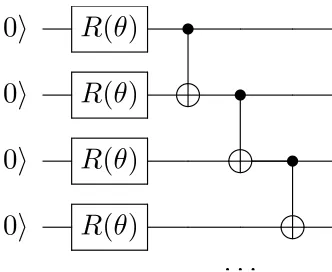
[image:28.612.212.378.92.228.2]· · ·
Figure 1.1: An example quantum circuit diagram. These diagrams are read from left to right, where horizontal lines denote a particular qubit, boxes represent a quantum gate, and lines shows the control relationship for multi-qubit gates. Shown here is a series of one-qubit rotations
pa-rameterized by an angle theta, R(θ), followed by CNOT gates, where the solid dot represents the
control bit and the cross represents the target bit.
that can be used to express algorithms are quantum circuit diagrams, an example of
which is depicted in Fig. 1.1.
1.2.6 Electronic Hamiltonians
While the aim of almost all the methods in this work is to be generally applicable
to all quantum systems, electronic and chemical Hamiltonians are an application of
special interest. A non-relativistic system composed ofNn nuclei and Ne electrons
neglecting weak spin-spin interactions is defined by a Hamiltonian composed of the
the kinetic energy and Coulomb interactions of the charged particles. In atomic units
we write this Hamiltonian as
H = Ne X i=1 −∇2 ri 2 + Nn X i=1 −∇2 Ri
2Mi
+
Nn
X
i,j<i
ZiZj
|Ri−Rj|−
NXn,Ne
ij
Zi
|Ri−rj|
+
Ne
X
i,j<i
1 |ri−rj|
(1.39)
whereRi, Mi, Zi are nuclear positions, masses, and charges respectively, and the
be-tween the electrons and nuclei, this Hamiltonian can be well-approximated (in
non-dynamical problems) by assuming that the nuclei are fixed classical point charges.
This approximation is known as the Born-Oppenheimer approximation, and yields a
purely electronic Hamiltonian that depends only parametrically on the position of the
nuclei as
H=
Nn
X
i,j<i
ZiZj
|Ri−Rj|
+
Ne
X
i=1
−∇2
ri
2 −
NXn,Ne
ij
Zi
|Ri−rj|
+
Ne
X
i,j<i
1 |ri−rj|
. (1.40)
It is also known, both from experimental inference and later the spin-statistics
the-orem of quantum field theory, that electrons must be antisymmetric with respect to
exchange. One way of dealing with the antisymmetry is through explicit constraints
on wavefunctions, as in previous sections where we references antisymmetric
coef-ficient tensor constraints or antisymmetric components. Another way is to include
antisymmetry in the Hamiltonian through the use of second quantization. In second
quantization one makes use of the operator algebra of fermion creation and
annihila-tion operators,a†i andaj, to account for antisymmetry. Defining the anti-commutator
{A, B}:=AB+BA, these satisfy the fermion anti-commutation relations
n
a†i, a†jo= 0 (1.41)
{ai, aj}= 0 (1.42)
n a†i, aj
o
=δij (1.43)
{|ϕii}i. The Hamiltonian in this basis, now including antisymmetry, may be written
H =X
ij
hija†iaj +
1 2
X
ijkl
hijkla
†
ia
†
jakal (1.44)
where the coefficients of the operators are defined as integrals of the interaction terms
over this single particle basis. More explicitly,
hpq =
Z
dσ ϕ∗p(σ) −∇
2 r 2 − X i Zi
|Ri−r| !
ϕq(σ) (1.45)
hpqrs =
Z
dσ1 dσ2
ϕ∗p(σ1)ϕ∗q(σ2)ϕs(σ1)ϕr(σ2)
|r1−r2|
(1.46)
whereσi now contains the spatial and spin components of the electron,σi = (ri, si).
This form of the electronic Hamiltonian has been particularly useful in the
devel-opment of correlated electronic structure calculations. In this work, we will use it to
help formulate the electronic structure problem on quantum computers. In order to
do this, we first need to map this problem, which is in the language of
indistinguish-able fermions, to the language of qubits, or distinguishindistinguish-able two-level systems. There
are now at least 3 known isomorphisms that may be used to accomplish this task, the
Jordan-Wigner, Parity, and Bravyi-Kitaev mappings [35,112,209]. In this
disserta-tion, we primarily utilize the Jordan-Wigner transformation that is defined by
a†p = (Y
m<pσ
z
m)σp+ (1.47)
ap = (
Y
m<pσ
z
m)σp− (1.48)
σ± ≡(σx±iσy)/2 (1.49)
operators{σx, σy, σz} in the distinguishable qubit basis. However, an important
as-pect of this transformation that will be used later, is that despite this non-locality,
the number of terms in the Hamiltonian is conserved up to a constant factor. Thus if
there areO(M4) terms in the original fermionic Hamiltonian, whereM is the number
of single particle basis functions used to discretize the Hamiltonian, then there will be
O(M4) terms in distinguishable qubit representation of the Hamiltonian.
1.3 Chapter outline and summaries
1.3.1 Chapters 2, 3, and 4
In the first chapters of this thesis, we will describe, and subsequently improve upon, a
new quantum algorithm for the study of quantum chemistry with minimal
experimen-tal requirements. This method is called the Variational Quantum Eigensolver [196],
and can be applied to general eigenvalue problems on a quantum computer, but our
specific application goals at the time were focused on quantum chemistry.
Almost all quantum algorithms to date have been developed agnostic to the
avail-able hardware. That is, the approach is write down the best possible algorithm with
regards to cost for attaining the result one desires, assuming that one day a quantum
device will be capable of running that algorithm. However, many of the algorithms
that perform optimally in the asymptotic limit of size require extraordinary resources
for systems of interest.
For this reason, we proceeded with a different, co-design approach to quantum
com-putation. We consider both the problem and the available architecture
simultane-ously, to achieve an optimal solution for the given hardware. This is done by
and components that can be trivially performed on a classical computer, so as not to
waste expensive quantum resources.
To describe how we formulate this approach, we return to the variational principle
of quantum mechanics. This principle states that for a Hermitian operatorH with
eigenvectors and eigenvalues|Ψii, Ei ordered by value, that any approximate
wave-function|ΨTi (obeying necessary symmetries) satisfies
hΨT|H|ΨTi
hΨT|ΨTi ≥
E0 (1.50)
Thus if we can create some state|ΨTibased on a set of parameters {θi}, we can
im-prove the quality of the approximation to the ground state by choosing parameters
that minimize the expectation value of the energy.
The preparation of complex quantum states based on some set of parameters is an
area where quantum computers excel. Indeed any parametrizable sequence of gates
or repeatable sequence of quantum operations can be considered as a valid trial state
preparation. We call this general idea, the “quantum hardware ansatz”, and it allows
one to use the available hardware to define the limits of the simulation. On a
theoret-ical side, we have investigated the preparation of parameterizable ansatz states that
we believe to be both high-quality and not efficiently prepared or sampled from on a
classical computer. We believe multi-reference unitary coupled cluster [225] to be a
strong candidate in this regard.
Once a state is prepared, one needs a way to evaluate the energy in order to
im-prove the parameterization. One potential solution is to use quantum phase
estima-tion, but this returns us to techniques which are, at the time of writing,
the expectation value of the electronic Hamiltonian as
hΨT|H|ΨTi ≡ hHi= X
ij
hijha†iaji+
X
ijkl
hijklha
†
ia
†
jakali (1.51)
=X
iα
giαhσαii+X
ijαβ
gαβij hσαiσβji+... (1.52)
where the first line shows that the energy is explicitly obtainable through the
two-electron reduced density matrix, weighted by the precomputed values of the two-electronic
integrals. The second line is obtained through any of the aforementioned
transfor-mations(e.g. Jordan-Wigner or Bravyi-Kitaev) from fermions to qubits and
demon-strates that the energy may be efficiently evaluated through a weighted sum of Pauli
measurements on the system. Here the Greek indices denote the type of Pauli
ma-trix (I, X, Y, Z) and the Roman index runs over the number of qubits. Recall that the
number of terms in sum on the second line scales the same as the number of terms in
the first with respect to the number of spin orbitals, and only a partial tomography of
the quantum system is ever required.
Based on the value of the energy, a new set of parameters for the state preparation
can be determined through some non-linear minimization scheme, such as
Nelder-Mead simplex method or simulated annealing [73,180]. Classical computers are well
optimized to perform tasks like adding together the measurements and deciding on
new parameters in a non-linear optimization, suggesting a hybrid approach.
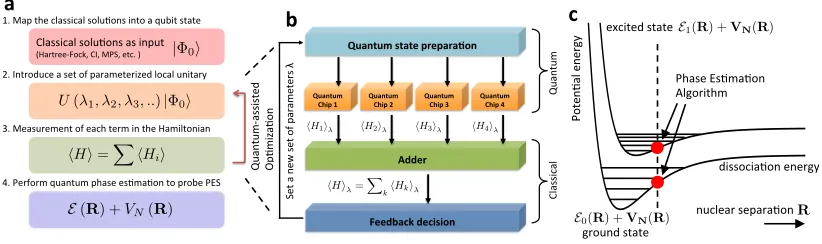
The approach can be qualitatively outlined as
1. Prepare a quantum state on a quantum device based on an established protocol
that depends on a set of parameters{θi}i.
weighted summation on a classical computer.
3. Use a classical computer to decide a new set of parameters{θi}i that lowers the
energy, and repeat until convergence.
This procedure takes advantage of a quantum computer’s ability to prepare and
efficiently sample select elements from complex quantum states, while offloading
mun-dane tasks such as addition and multiplication of scalars to a classical computer. In
doing so, we conserve precious quantum resources for what they do best. We call
this technique the variational quantum eigensolver and this is the subject of
Chap-ter 2, which includes an experimental implementation on a photonic quantum chip.
Since its initial formulation, we have done some work in optimizations for ion traps
in Chapter 3. Finally, we imported technology from classical quantum chemistry in
Chapter 4, and showed how the use of the appropriate basis could offer dramatic
sav-ings, not only in this method, but all those currently being considered for quantum
chemistry on quantum computers.
1.3.2 Chapters 5 and 6
The potential of quantum computers to help accelerate our simulations and
under-standing of chemistry are great, however this eventual promise is not the only reason
to study quantum computation and quantum information in chemistry. The
knowl-edge gained in this field has now helped to bolster both our understanding and
method-ology in both general physics and chemistry. In these Chapters we introduce another
such knowledge transfer from quantum computation to classical simulation of
The gate model of quantum computation, built from qubits and sequences of
uni-tary gates is only one model of quantum computation currently under consideration.
Another model of interest is that of adiabatic quantum computation [68]. In this
model, one encodes the solution to a problem in the ground state of some
Hamilto-nianHp, and prepares the ground state to this problem Hamiltonian through a slow
adiabatic evolution from a simple starting Hamiltonian HD, whose ground state is
easy to prepare. By the adiabatic theorem, if the evolution of the Hamiltonian from
HD toHp is slow enough, one remains in the ground state and the solution to the
problem is found. This is often written as a simple linear schedule between the two
Hamiltonians parameterized by a real numbers∈[0,1] as
H(s) = (1−s)HD +sHp. (1.53)
In order to unify this approach with the gate model, Kitaev, building off the work
of Feynman, developed the clock Hamiltonian, which encodes the result of a gate
model computation into the problem HamiltonianHp.
To perform this mapping, one attaches an ancilla quantum register that keeps
track of time, called the clock register. If one only has access to qubits then some
effort must be made to keep the clock states valid, however for classical computing
purposes, it suffices to use ad−dimensional qudit, with orthonormal basis states
hi|ji = δij. Given an initial state|Ψ0i and an ordered sequence of quantum gates
these operations as its ground state is
Hc= X
t
1 2
I⊗ |ti ht| −Ut⊗ |t+ 1i ht| −Ut†⊗ |ti ht+ 1|+I⊗ |t+ 1i ht+ 1|
+ (1− |Ψ0i hΨ0|)⊗ |0i h0|. (1.54)
where the final projector is penalty term that breaks the degeneracy of the ground
state to the unique evolution desired. The properties of this Hamiltonian have been
studied extensively, and it is known that it is frustration-free and has a spectral gap
that decreases as 1/T2 whereT is the total number of discrete time steps under
con-sideration [33,34,49]. The ground state of this Hamiltonian is the history state,
|ΦHi, which contains the entire quantum trajectory as
|ΦHi=
1 √
T X
t
|Ψti |ti (1.55)
where|Ψti is the state of the quantum system after the application of the first t−1
gates. The eigenvalue of this state is 0 by construction, though it may be adjusted
through a constant shift factor if desired.
In Chapter 5, we show that this can be derived from a more general discrete time
variational principle, and that recasting a dynamics problem as an eigenvalue problem
in this manner can have practical computational benefits on a classical computer. In
particular, we show that it makes parallel-in-time dynamics possible through use of
a proper preconditioner. Moreover the proposed algorithm demonstrates an
advan-tage over the current standard Parareal algorithm [14,143] for the quantum dynamics
problems studied.
corre-lated many-body systems, namely the Full Configuration Interaction Quantum Monte
Carlo (FCIQMC) [26,27, 29,128,213,220], technique can be applied to time
dy-namics problems with this connection. It suggests a close link between the fermion
sign problem experienced in the simulation of electronic ground states and the
dy-namical sign problem arising in the simulation of quantum dynamics. We introduced
a rotating basis methodology capable of mitigating the sign problem through
approxi-mate pre-computation and demonstrated the method’s capabilities in parallel
compu-tation of quantum circuits.
1.3.3 Chapter 7
The simulation of explicit wavefunctions has pushed forward by exploiting expert
knowledge of physics to identify structure and reduce the complexity of the
prob-lem to be solved. For example, the use of symmetry or knowledge that an
interac-tion is relatively weak with regards to another in perturbainterac-tion theory facilitates fast,
accurate approximations. Recently a technique has emerged in the field of signal
pro-cessing that attempts to exploit a different kind of structure, namely sparsity. These
techniques are generally referred to as compressed sensing methodologies [193,232].
A Hamiltonian governing many non-interacting particles may be written as the sum
of the non-interacting pieces
H =X
i
Hi (1.56)
given by a rank 1 quantum state
|Φi=|φ1i |φ2i...|φNi (1.57)
whereHi|φii = Ei|φiiand as a result H|Φi = (PiEi)|Φi. If one introduces some
weak coupling between the subsystems, we conjecture that one does not expect the
rank of the state to change dramatically and as such the state may be well described
by a CP-decomposition with rank r << D = MN. If this conjecture is true, the
practical question is how to obtain this type of sparse representation without first
knowing the full state. Moreover, once the technique is developed, one would like to
examine what kind of systems exhibit such a decomposition.
In Chapter 7 we discuss the application of a method from the field of compressed
sensing, namely orthogonal matching pursuit combined with imaginary time evolution
to find exactly these types of compressed wavefunctions. The methodology we build
is general in the sense that it does not require that one use a specific type of ansatz
or apply it to a particular type of quantum system. As an example application we
consider the electronic structure of molecules, using an antisymmetric low rank
de-composition. We find solutions that are dramatically more compact than traditional
If you find that you’re spending almost all your time on
theory, start turning some attention to practical things;
it will improve your theories. If you find that you’re
spending almost all your time on practice, start turning
some attention to theoretical things; it will improve your
practice.
Donald Knuth
2
A variational eigenvalue solver on a photonic
quantum processor
∗
Abstract
Quantum computers promise to efficiently solve important problems that are intractable
on a conventional computer. For quantum systems, where the physical dimension
grows exponentially, finding the eigenvalues of certain operators is one such intractable
∗Alberto Peruzzo†,Jarrod R McClean†, Peter Shadbolt, Man-Hong Yung, Xiao-Qi Zhou, Peter J Love, Al´an Aspuru-Guzik, and Jeremy L O’Brien. A new variational eigenvalue solver on a photonic quantum processor. Nature Communications, 5(4213):1-7, 2014.
problem and remains a fundamental challenge. The quantum phase estimation
algo-rithm efficiently finds the eigenvalue of a given eigenvector but requires fully coherent
evolution. We present an alternative approach that greatly reduces the requirements
for coherent evolution and we combine this method with a new approach to state
preparation based on ans¨atze and classical optimization. We implement the algorithm
by combining a highly reconfigurable photonic quantum processor with a conventional
computer. We experimentally demonstrate the feasibility of this approach with an
ex-ample from quantum chemistry—calculating the ground state molecular energy for
He–H+. The proposed approach drastically reduces the coherence time requirements,
enhancing the potential of quantum resources available today and in the near future.
2.1 Introduction
In chemistry, the properties of atoms and molecules can be determined by solving the
Schr¨odinger equation. However, because the dimension of the problem grows
expo-nentially with the size of the physical system under consideration, exact treatment
of these problems remains classically infeasible for compounds with more than 2–3
atoms [229]. Many approximate methods [102] have been developed to treat these
sys-tems, but efficient exact methods for large chemical problems remain out of reach for
classical computers. Beyond chemistry, the solution of large eigenvalue problems [206]
would have applications ranging from determining the results of internet search
en-gines [191] to designing new materials and drugs [86].
Recent developments in the field of quantum computation offer a way forward for
efficient solutions of many instances of large eigenvalue problems which are
eigen-values have previously relied on the quantum phase estimation (QPE) algorithm.
The QPE algorithm offers an exponential speedup over classical methods and
re-quires a number of quantum operationsO(p−1) to obtain an estimate with precision
p [1,2,6,8,136,251]. In the standard formulation of QPE, one assumes the
eigenvec-tor |ψi of a Hermitian operatorHis given as input and the problem is to determine
the corresponding eigenvalue λ. The time the quantum computer must remain
coher-ent is determined by the necessity of O(p−1) successive applications ofe−iHt, each of
which can require on the order of millions or billions of quantum gates for practical
applications [111,251], as compared to the tens to hundreds of gates achievable in the
short term.
Here we introduce an alternative to QPE that significantly reduces the
require-ments for coherent evolution. We have developed a reconfigurable quantum processing
unit (QPU), which efficiently calculates the expectation value of a Hamiltonian (H),
providing an exponential speedup over exact diagonalization, the only known exact
solution to the problem on a traditional computer. The QPU has been experimentally
implemented using integrated photonics technology with a spontaneous parametric
downconversion single photon source and combined with an optimization algorithm
run on a classical processing unit (CPU), which variationally computes the
eigenval-ues and eigenvectors of H. By using a variational algorithm, this approach reduces
the requirement for coherent evolution of the quantum state, making more efficient
use of quantum resources, and may offer an alternative route to practical
QPU
Algorithm 1
Algorithm 2
CPU
quantum module 1
quantum state preparation
classical adder
classical feedback decision
quantum module 2 quantum module 3
quantum module n
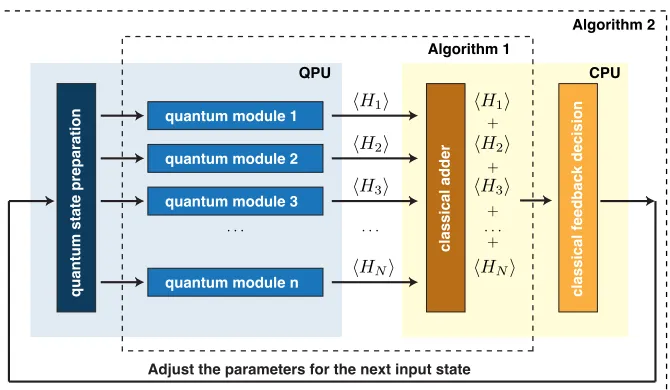
[image:42.612.140.475.93.288.2]Adjust the parameters for the next input state
Figure 2.1: Architecture of the quantum-variational eigensolver. (Algorithm 1): Quantum states
that have been previously prepared, are fed into the quantum modules which compute hHii, where
Hi is any given term in the sum defining H. The results are passed to the CPU which computes
hHi. (Algorithm 2): The classical minimization algorithm, run on the CPU, takeshHi and
deter-mines the new state parameters, which are then fed back to the QPU.
2.2 Results
2.2.1 Algorithm 1: Quantum expectation estimation
This algorithm computes the expectation value of a given HamiltonianHfor an input
state|ψi. Any Hamiltonian may be written as
H=X
iα
hi
ασαi +
X
ijαβ
hijαβσi
ασ
j
β+... (2.1)
for realh where Roman indices identify the subsystem on which the operator acts,
and Greek indices identify the Pauli operator, e.g. α = x. Note that no
assump-tion about the dimension or structure of the hermitian Hamiltonian is needed for this
that
hHi=X
iα
hiαhσαii+X
ijαβ
hijαβhσiασβji+... (2.2)
We consider Hamiltonians that can be written as a number of terms which is
polyno-mial in the size of the system. This class of Hamiltonians encompasses a wide range
of physical systems, including the electronic structure Hamiltonian of quantum
chem-istry, the quantum Ising Model, the Heisenberg Model [147,153], matrices that are
well approximated as a sum of n-fold tensor products [188,189], and more
gener-ally any k−sparse Hamiltonian without evident tensor product structure (see
Sup-plementary Information for details). Thus the evaluation of hHireduces to the sum
of a polynomial number of expectation values of simple Pauli operators for a
quan-tum state |ψi, multiplied by some real constants. A quantum device can efficiently
evaluate the expectation value of a tensor product of an arbitrary number of simple
Pauli operators [188]. Therefore, with ann-qubit state we can efficiently evaluate the
expectation value of this 2n×2n Hamiltonian.
One might attempt this using a classical computer by separately optimizing all
re-duced states corresponding to the desired terms in the Hamiltonian, but this would
suffer from the N-representability problem, which is known to be intractable for both
classical and quantum computers (it is in the quantum complexity class QMA-Hard [145]).
The power of our approach derives from the fact that quantum hardware can store a
global quantum state with exponentially fewer resources than required by classical
hardware, and as a result the N-representability problem does not arise.
As the expectation value of a tensor product of an arbitrary number of Pauli
oper-ators can be measured in constant time and the spectrum of each of these operoper-ators is
coeffi-cienth, which is an arbitrary element from the set of constants {hij...αβ...}, our approach
incurs a cost ofO(|h|2 p−2) repetitions. Thus the total cost of computing the
expecta-tion value of a state |ψiis bounded byO(|hmax|2 M p−2), where M is the number of
terms in the decomposition of the Hamiltonian andhmax is the coefficient with
maxi-mum norm in the decomposition of the Hamiltonian. The advantage of this approach
is that the coherence time to make a single measurement after preparing the state is
O(1). Conversely, the disadvantage of this approach with respect to QPE is the
scal-ing in the total number of operations as a function of the desired precision is
quadrat-ically worse (O(p−2) vsO(p−1)). Moreover, this scaling will also reflect the number of
state preparation repetitions required, whereas in QPE, the number of state
prepara-tion steps is constant. In essence, we dramatically reduce the coherence time
require-ment while maintaining an exponential advantage over the classical case, by adding a
polynomial number of repetitions with respect to QPE.
2.2.2 Algorithm 2: Quantum variational eigensolver
The procedure outlined above replaces the long coherent evolution required by QPE
by many short coherent evolutions. In both QPE and Algorithm 1 we require a good
approximation to the ground state wavefunction to compute the ground state
eigen-value and we now consider this problem. Previous approaches have proposed to
pre-pare ground states by adiabatic evolution [6], or by the quantum Metropolis
algo-rithm [226,262]. Unfortunately both of these require long coherent evolution.
rithm 2 is a variational method to prepare the eigenstate and, by exploiting
Algo-rithm 1, requires short coherent evolution. AlgoAlgo-rithms 1 and 2 and their relationship
are shown in Figure 2.1 and detailed in the Supplementary Information.
D1
D2
D3
D4
CPU Optimization
algorithm
dc1 dc2
dc3
dc9 dc6
dc7
dc8
dc10
dc11 dc12 dc13 dc4 dc5
QPU
(a)
(b)
from SPDC source
from CPU
QPU to detectors
from SPDC source
from CPU
QPU to detectors
[image:45.612.133.474.93.344.2]1 cm
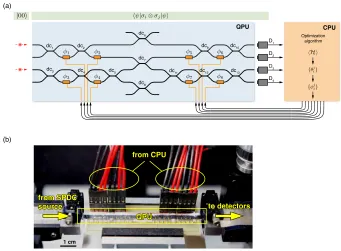
Figure 2.2: Experimental implementation of our scheme.(a) Quantum state preparation and
measurement of the expectation valueshψ|σi⊗σj|ψiare performed using a quantum photonic
chip. Photon pairs, generated using spontaneous parametric down-conversion are injected into the
waveguides encoding the |00istate. The state|ψiis prepared using thermal phase shiftersφ1−8
(orange rectangles) and one CNOT gate and measured using photon detectors. Coincidence count
rates from the detectors D1−4are passed to the CPU running the optimization algorithm. This
computes the set of parameters for the next state and writes them to the quantum device. (b) A photograph of the QPU.
operatorH can be restated as a variational problem on the Rayleigh-Ritz quotient [204,
205], such that the eigenvector|ψi corresponding to the lowest eigenvalue is the|ψi
that minimizes
hψ| H |ψi
hψ|ψi . (2.3)
By varying the experimental parameters in the preparation of |ψi and computing the
Rayleigh-Ritz quotient using Algorithm 1 as a subroutine in a classical minimization,
sim-ple prescription for the reconstruction of the eigenvector is stored in the final set of
experimental parameters that define|ψi.
0 1
0 20 40 60 80 100
−3 −2.5 −2 −1.5 −1 −0.5
Optimization step j
Energy (MJ mol
−1)
Energy levels Theoretical Experimental
Tangle
0 20 40 60 80 100
0
0.2 0.4 0.6 0.8
1
Optimization step j
State overlap
(a)
[image:46.612.186.422.148.422.2](b)
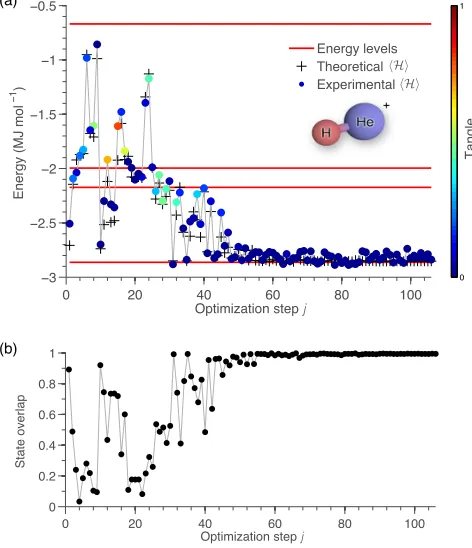
Figure 2.3: Finding the ground state of He-H+ for a specific molecular separationR = 90pm.
(a) Experimentally computed energyhHi(colored dots) as a function of the optimization stepj.
The color represents the tangle (degree of entanglement) of the physical state, estimated directly
from the state parameters{φji}. The red lines indicate the energy levels ofH(R). The
optimiza-tion algorithm clearly converges to the ground state of the molecule, which has small but non zero tangle. The crosses show the energy calculated at each experimental step, assuming an ideal
quan-tum device. (b) Overlap| hψj
|ψG
i | between the experimentally computed state|ψj
iat each the
optimization stepj and the theoretical ground state ofH,|ψG
i. Error bars are smaller that the
data points. Further details are provided in the Methods section and in the Supplementary Infor-mation.
If a quantum state is characterized by an exponentially large number of
parame-ters, it cannot be prepared with a polynomial number of operations. The set of
effi-ciently preparable states are therefore characterized by polynomially many
condi-tions, a classical search algorithm on the experimental parameters which define|ψi,
needs only explore a polynomial number of dimensions—a requirement for the search
to be efficient.
One example of a quantum state parametrized by a polynomial number of
parame-ters for which there is no known efficient classical implementation is the unitary
cou-pled cluster ansatz [225]
|Ψi=eT−T†|Φiref (2.4)
where |Φiref is some reference state, usually the Hartree Fock ground state, and T is
the cluster operator for anN electron system defined by
T =T1+T2+T3+...+TN (2.5)
with
T1 =
X
pr
trpaˆ†pˆar (2.6)
T2 =
X
pqrs
trspqaˆ†pˆa†qˆarˆas (2.7)
and higher order terms follow logically. It is clear that by construction the operator
(T −T†) is anti-hermitian, and exponentiation maps it to a unitary operatorU =
e(T−T†)
. For any fixed excitation level k, the reduced cluster operator is written as
T(k)=
k X
i=1
Ti (2.8)
In general no efficient implementation of this ansatz has yet been developed for a
BCH series [225]. However this state may be prepared efficiently on a quantum
de-vice. The reduced anti-hermitian cluster operator (T(k)−T(k)†) is the sum of a
poly-nomial number of terms, namely it contains a number of termsO(Nk(M−N)k) where
M is the number of single particle orbitals. By defining an effective Hermitian
Hamil-tonianH = i(T(k) −T(k)†) and performing the Jordan-Wigner transformation to
reach a Hamiltonian that acts on the space of qubits, ˜H, we are left with a
Hamilto-nian which is a sum of polynomially many products of Pauli operators. The problem
then reduces to the quantum simulation of this effective Hamiltonian, ˜H, which can
be done in polynomial time using the procedure outlined by Ortiz et al. [188]. We
note that while this state preparation procedure utilizes tools from quantum
simu-lation, the total effective time of evolution is fixed by the expansion coefficients trs
pq.
This is in contrast to normal difficulties encountered in quantum phase estimation,
where simulations must be carried out for times that are exponential in the desired
final precision.
While there is currently no known efficient classical algorithm based on these ansatz
states, non-unitary coupled cluster ansatz is sometimes referred to as the “gold
stan-dard of quantum chemistry” as it is the stanstan-dard of accuracy to which other
meth-ods in quantum chemistry are often compared. The unitary version of this ansatz is
thought to yield superior results to even this “gold standard” [225].
2.2.3 Prototype demonstration
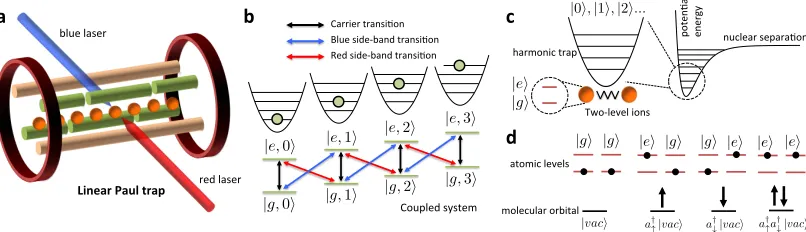
We have implemented the QPU using integrated quantum photonics technology [186].
Our device, shown schematically in Figure 2.2 is a reconfigurable waveguide chip that
can prepare and measure arbitrary two-bit pure states using several single qubit
of possible configurations with mean statistical fidelityF > 99% [210]. The state is
path-encoded using photon pairs generated via a spontaneous parametric
downcon-version process. State preparation and measurement in the Pauli basis is achieved by
setting 8 voltage driven phase shifters and counting photon detection events with
sili-con single photon detectors.
The ability to prepare an arbitrary two-qubit separable or entangled state enables
us to investigate 4×4 Hamiltonians. For the experimental demonstration of our
al-gorithm we choose a problem from quantum chemistry, namely determining the bond
dissociation curve of the molecule He-H+ in a minimal basis. The full configuration
50 100 150 200 250 300
−2.9 −2.8 −2.7 −2.6 −2.5 −2.4
Atomic separation R (pm)
Energy (MJ mol
−1 )
0 100 200 300 400
−10
0 10 20
Atomic separation R (pm)
Energy (MJ mol
−1 ) Theoretical
Experimental
[image:49.612.186.428.312.557.2]Corrected Exp.
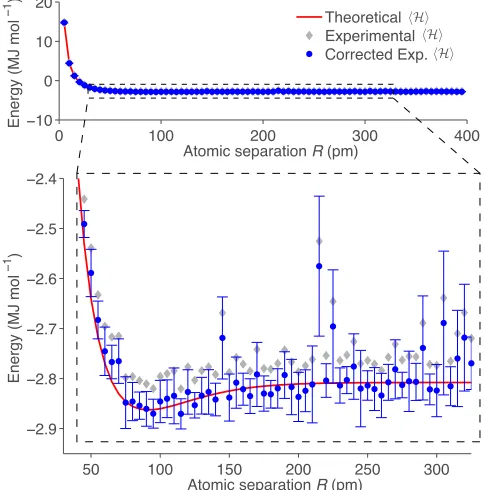
Figure 2.4: Bond dissociation curve of the He-H+ molecule. This curve is obtained by repeated
computation of the ground state energy (as shown in Figure 2.3) for severalH(R). The