
Advance Access publication 2013 November 19
A deep
WISE
search for very late type objects and the discovery of two
halo/thick-disc T dwarfs: WISE 0013
+
0634 and WISE 0833
+
0052
D. J. Pinfield,
1‹J. Gomes,
1A. C. Day-Jones,
1,2S. K. Leggett,
3M. Gromadzki,
4B. Burningham,
1M. T. Ruiz,
2R. Kurtev,
4T. Cattermole,
1C. Cardoso,
5N. Lodieu,
6,7J. Faherty,
2,8S. Littlefair,
9R. Smart,
5M. Irwin,
10J. R. A. Clarke,
1L. Smith,
1P. W. Lucas,
1M. C. G´alvez-Ortiz,
11J. S. Jenkins,
2H. R. A. Jones,
1R. Rebolo,
6,7V. J. S. B´ejar
6,7and B. Gauza
6,71Centre for Astrophysics Research, Science and Technology Research Institute, University of Hertfordshire, Hatfield AL10 9AB, UK 2Universidad de Chile, Santiago, Casilla 36-D, Chile
3Gemini Observatory, Northern Operations Center, 670 N. A’ohoku Place, Hilo, HI 96720, USA
4Departamento de F´ısica y Astronom´ıa Universidad de Valpara´ıso, Av. Gran Breta˜na 1111, Playa Ancha, Casilla 5030, Chile 5Istituto Nazionale di Astrofisica, Osservatorio Astronomico di Torino, Strada Osservatrio 20, I-10025 Pino Torinese, Italy 6Instituto de Astrof´ısica de Canarias, E-38200 La Laguna, Spain
7Dept. Astrof´ısica, Universidad de La Laguna, E-38206 La Laguna, Tenerife, Spain
8Department of Astrophysics, American Museum of Natural History, Central Park West at 79th Street, New York, NY 10034, USA 9Department of Physics and Astronomy, University of Sheffield, Sheffield S3 7RH, UK
10Institute of Astronomy, Madingley Road, Cambridge CB3 0HA, UK
11Centro de Astrobiolog´ıa (CSIC-INTA), Ctra. Ajalvir km 4, E-28850 Torrej´on de Ardoz, Madrid, Spain
Accepted 2013 August 1. Received 2013 July 31; in original form 2012 October 27
A B S T R A C T
A method is defined for identifying late-T and Y dwarfs inWISEdown to low values of signal-to-noise. This requires aWISEdetection only in theW2-band and uses the statistical properties of the WISE multiframe measurements and profile fit photometry to reject contamination resulting from non-point-like objects, variables and moving sources. To trace our desired parameter space, we use a control sample of isolated non-moving non-variable point sources from the Sloan Digital Sky Survey (SDSS), and identify a sample of 158WISE W2-only candidates down to a signal-to-noise limit of eight. For signal-to-noise ranges>10 and 8–10, respectively,∼45 and∼90 per cent of our sample fall outside the selection criteria published by theWISEteam, mainly due to the type of constraints placed on the number of individualW2 detections. We present follow-up of eight candidates and identify WISE 0013+0634 and WISE 0833+0052, T8 and T9 dwarfs with high proper motion (∼1.3 and∼1.8 arcsec yr−1). Both
objects show a mid-infrared/near-infrared excess of∼1–1.5 mag and areKband suppressed. Distance estimates lead to space motion constraints that suggest halo (or at least thick disc) kinematics. We then assess the reduced proper motion diagram ofWISE ultracool dwarfs, which suggests that late-T and Y dwarfs may have a higher thick-disc/halo population fraction than earlier objects.
Key words: surveys – brown dwarfs – stars: low-mass.
1 I N T R O D U C T I O N
Population studies of brown dwarfs (mass<0.075 M; Baraffe et al. 2003) can provide crucial constraints on the low-mass ex-treme of the star formation process (e.g. Reipurth & Clarke 2001; Bate, Bonnell & Bromm 2002; Goodwin & Whitworth 2007;
E-mail: [email protected]
Bonnell, Clark & Bate 2008; Machida, Inutsuka & Matsumoto 2009; Stamatellos & Whitworth 2009), through measurements of the luminosity and mass functions (e.g. Cruz et al. 2007; Metchev et al. 2008; Pinfield et al. 2008; Bastian, Covey & Meyer 2010; Burningham et al. 2010b, 2013; Reyl´e et al. 2010; Kirkpatrick et al. 2012; Lodieu, Deacon & Hambly 2012a), and sampling of the for-mation history (e.g. Day-Jones et al. 2013). Also, the cooling of brown dwarfs leads to a Teff range that encompasses the lowest
C
mass stars and giant planets. As such, brown dwarfs make excellent test beds to improve our understanding of sub-stellar atmospheres (e.g. Pinfield et al. 2006, 2012; Burningham et al. 2009; King et al. 2010; Zhang et al. 2010; Day-Jones et al. 2011; Faherty et al. 2013; Gomes et al. 2013).
Brown dwarf discovery began in 1995 (Nakajima et al. 1995; Rebolo, Zapatero Osorio & Mart´ın 1995), and has expanded, mainly through the use of large-scale surveys, into several new spectral classes. The 2MASS (Skrutskie et al. 2006), DENIS (Epchtein et al. 1999) and Sloan Digital Sky Survey (SDSS; York et al. 2000) surveys revealed the dusty L dwarfs (with Teff = 2300–1400 K; e.g. Kirkpatrick et al. 1999), the methane-dominated T dwarfs (withTeff<1400 K; e.g. Strauss et al. 1999; Geballe et al. 2002; Burgasser et al. 2006) and the LT transition objects that join together these two spectral types (e.g. Leggett et al. 2000). More recently, the UKIDSS surveys and the Canada France Brown Dwarf Survey (CFBDS) have identified the coolest examples of the T dwarf class in the 500–700 K range (e.g. Warren et al. 2007; Burningham et al. 2008, 2010a; Delorme et al. 2008; Lucas et al. 2010), with large-scale deep near-infrared coverage. However, it took the mid-IR sensitivity of theWISEobservatory (Wright et al. 2010) to break through into the<500 K regime for free-floating field objects. Al-thoughWISEhas a similar sensitivity to L dwarfs as 2MASS (thus providing good scope for infrared proper motion surveys; Castro, Gizis & Gagn´e 2011; Gizis et al. 2011a; Gizis, Troup & Bur-gasser 2011b; Castro & Gizis 2012), the relative dominance of mid-infrared emission for<500 K objects (particularly around 4.5µm; Burrows, Sudarsky & Lunine 2003; Mainzer et al. 2011; Allard, Homeier & Freytag 2012) leads to a greatly increased sensitivity at thisTeff.
Such objects are known as Y dwarfs. Like late-T dwarfs, Y dwarf spectra exhibit deep H2O and CH4absorption bands which dominate their spectral morphology. However, the Y dwarf WISE 1828+2650 (Cushing et al. 2011, presented as the archetype) has notably extreme colours (J− W2=9.3) and a spectrum that is markedly different to the latest T dwarfs (e.g. UGPS 0722−0540; Lucas et al. 2010). TheJ−Hcolour of WISE 1828+2650 is much redder than those of the late Ts showing that a reversal of the previ-ously known colour trend has occurred, indicative of a collapse in the near-infrared flux relative to that at∼5µm (Cushing et al. 2011). Furthermore, the [3.6]−[4.5]Spitzercolour shows a turn to the blue that may be indicative of a shift in position of the∼5µm flux peak (Kirkpatrick et al. 2012, K12 hereafter). WISE 1828+2650 would thus seem to fulfil at least one of the five criteria put forward by Burrows et al. (2003) for the establishment of the Y class. Despite the marked difference between the late-T dwarfs and the archetypal Y dwarf, the actual transition follows a gradual change (as per the norm) which is predominantly quantified by the narrowness of the J-band flux peak (see also Mace et al. 2013).
In comparison toWISE, the UKIDSS Large Area Survey and Galactic Survey cover ∼7000 square degrees of sky down to J∼19.5 (Lawrence et al. 2007), with VISTA now expanding into the southern sky (e.g. Gauza et al. 2012; Lodieu et al. 2012b). How-ever, Y dwarfs generally haveJ−W2≥5, and the firstWISEY dwarfs were found in about half the sky in theW2=14–14.5 range (Cushing et al. 2011; Kirkpatrick et al. 2011, K11 hereafter). From a Y dwarf perspective, the WISE W2coverage and sensitivity in the first incremental release was equivalent to a near-infrared sur-vey reachingJ>19.5 over half the sky. Indeed, when considering the reddest Y dwarfs currently known (e.g.J−W2∼9)WISEis sensitive out to∼10 times the distance of the deepest near-infrared surveys.
The collaboration led by Kirkpatrick of theWISEScience team is implementing an ongoing search for late-T and Y dwarfs inWISE (K11; K12). Though maintaining a variety of candidate lists, their general search method has been characterized in K12. As well as a set of colour, magnitude and coordinate constraints, and allowances for non-detection in some bands, they placed constraints on a set of criteria parametrizing source detection and character. Thresholds were used for the number of detections in individual frames (to remove spurious aligned artefacts), blending with other sources was avoided (since it can result in poorly determined photometry) and the point-like nature of a source was assessed. This programme discovered the first Y dwarfs (Cushing et al. 2011), and has to-date identified a population of 14 objects in this new class (K12; Tinney et al. 2012).
In anotherWISEsearch, Pinfield et al. (2012) searched for wide companion late-T and Y dwarfs around Hipparcos and Gliese stars. This search had similar colour constraints and allowances for non-detection in various bands, but did not place any further constraints on source detection and character. This was a practical approach in this case because only candidate widely separated companions were taken forward for closer inspection, and the sky coverage was severely limited by the requirement for proximity to Hipparcos and Gliese stars. The distances of the possible primary stars also con-tributed to the assessment (since companions would be essentially at the same distance as their primary) and visual inspection could proceed for a few tens of candidates after an automated selection process. This search identified a new metal poor T8p companion, and recovered three other previously known objects (T6p, T8 and T8.5).
In this paper, we describe a new search method designed to ef-fectively identify late-T and Y dwarf candidates in the fullWISE sky down to a faint detection limit inW2. Sections 2.1–2.4 present our selection and rejection method, making use of a control sample to assessW2 source characteristics. We initially search down toW2 signal-to-noise of 10, and Section 2.5 extends our search down to a signal-to-noise of 8. We discuss our visual inspection process in Section 2.6, and the new candidate sample itself in Section 2.7. Section 3 describes a classification system that allows us to prior-itize candidates for further follow-up, and Section 4 describes our current photometric follow-up measurements. Our analysis of the recently identified WISE 1639−6847 is presented in Section 6.1. And the two newly discovered objects WISE 0013+0634 and WISE 0833+0052 are discussed in Section 6.2. We plot and assess these new objects, and also other L T and Y dwarfs with measured proper motion, in reduced proper motion diagrams in Section 7. Future work is considered in Section 8.
2 C A N D I DAT E S E L E C T I O N
2.1 The initial selection
was no 2MASS source within 3 arcsec of theWISEsource, and at least eight individual exposures in each bands (w*m≥8). Wright et al. (2010) explain how the WISEmission design provides at least eight exposures over more than 99 per cent of the sky during a 6 month mission.
To minimize contamination from reddened objects, we removed sources towards reddened regions of sky. To estimate reddening, we used the online Galactic Dust Reddening and Extinction Calculator at the NASA/IPAC Infrared Science Archive, which computes line-of-sight interstellar extinction using the technique pioneered by Schlegel, Finkbeiner & Davis (1998). To reject stars with reddened W1−W2>2.0, we aimed to exclude regions withE(W1−W2)≥ 1.4 (since normal stars haveW1−W2=0.0–0.4 and will scatter somewhat in colour due to photometric uncertainty). This constraint was transformed into anAv limit using the extinction curves of Mathis (1990) leading to a rejection criterion where the average line-of-sight visual extinctionAv>0.45. We also allowed for extinction variation of 0.35 mag (due to dense structures) across the∼5 arcmin on-sky resolution of the extinction maps (this range of variations is exceeded in only∼1 per cent of the sky). We thus rejected sources towards regions of sky with average line-of-sight extinctionAv>0.8 (21.7 per cent of the sky).
We experimented with theccflagparameter to remove sources flagged as possible spurious detections of diffraction spikes, persis-tence, haloes or optical ghosts in theW2 band. However, there was no such contamination in our initial selection, which consisted of 6067 sources withw2snr≥10.
2.2 Refining the selection
We devised a set of additional selection criteria to remove contami-nation in the form of (i) resolved (or partially resolved) sources such as galaxies and sources associated with nebulosity or artefacts, (ii) variable sources and (iii) sources that move significantly over the time-scale of the multiframe images (i.e. Solar system objects).
2.3 The control sample
As a means to differentiate between the desired data base properties of quality sources and those of contamination that we wish to reject, we defined a control sample of isolated point-like variable non-moving sources, extending all the way down to the faint survey limits. To define this control sample, we combined the SDSS with WISE. We selected sources spectroscopically classed by SDSS as stars, and to avoid field crowding (and thus prefer isolated sources) we limited our search to a galactic latitude|b|>70◦(also removing giant stars that could be variable). We used photometric limits of g<20.0 andg−r<0.3 to select stars with reasonably blue colour andWISEmagnitudes down toW2=18. We selected point-like Sloan sources (that were un-blended inWISE) with proper motions >20 mas yr−1which we cross-matched withWISEusing a 1 arcsec cross-match radius to avoid mismatches. We thus exclude non-moving galaxies and high proper motion objects, with the control sample thus consisting of stellar point sources that are stationary across theWISEmultiframe measurements.
2.4 Rejection methods
In Fig. 1, the plots on the left-hand side show the control sample (small black points), as well as sources from the All-Sky late-T and Y dwarf census of K12 as blue symbols, except for Y dwarfs which are green. We plot our final selection of new candidates with
w2snr>8 in red (see Section 2.5 for thew2snr=8–10 selection).
The plots on the right-hand side of Fig. 1 show how contamination is rejected from the 6067W2-only initial selection withw2snr>10. The rejection criteria that we employed are indicated with solid lines, and discussed below.
The top plots show our ‘profile fit photometry rejection method’ which assesses how point-like each source is. Thew2rchi2 parame-ter is plotted against log(w2snr), wherew2snris the signal-to-noise of theW2 measurements.w2rchi2is the reducedχ2of theW2 pro-file fit photometry, and is a direct indicator of how well the source is represented by the optimized point spread function (PSF) fit. It can be seen from the control sample plot (top left) that in all but a small number of outlier cases (∼1 per cent),w2rchi2lies in a band between 0.7 and 1.2 forw2snrfrom 2 to 50 (log(w2snr)=0.3– 1.7). Seven of the K12 census (∼4 per cent) havew2rchi2>1.2, and visual inspection showed that the majority were very close to or slightly overlapping with neighbouring sources in theWISEimages (although they are listed as unblended in theWISEdata base). In these cases, this effect has led to an increasedw2rchi2value for the profile fit photometry. We also note that in a few cases there was no clear explanation for the increasedw2rchi2values, and these sources could warrant further study for unresolved multiplicity (e.g. Gelino et al. 2011; Liu et al. 2011). This rejection method should thus be effective at retaining isolated point sources, but will reject a small fraction where field crowding and blending are an issue.
The middle plots show our ‘photometric uncertainty rejection method’. We plot log(w2sigp1−w2sigmpro) against log(w2snr), wherew2sigmprois the integrated flux uncertainty andw2sigp1is the standard deviation of the population ofW2 fluxes measured on the individual frames (both in magnitude units). For isolated non-variable non-moving objects,w2sigp1provides a direct measure of the uncertainty on individual frames, which should relate to the integrated flux uncertainty. Indeed, the control sample (middle-left plot) traces out a well-defined sequence over the full signal-to-noise range, though there are two K12 sources (∼1 per cent of the census) slightly above this sequence. However, visual inspection once again showed that these two sources slightly overlapped with neighbouring sources in the WISEimages, which has led to an increase in thew2sigp1values. Guided by the control sample we rejected all sources that lie above the upper limit line in the plot,
log(w2sigp1−w2sigmpro)=1.3–1.38 log(w2snr).
The bottom plots show the ‘detection number rejection method’ that we used when there were a limited number (<8) of detections in the individual frames. The plots show the fraction of individual W2 frames in which the source was detected with a signal-to-noise greater than 3 (i.e.w2nm/w2m), against log(w2snr). The control sam-ple traces out a sequence in this parameter-space (bottom-left plot), ranging from detection in all frames down to no individual detec-tions (above a signal-to-noise of 3). We thus define a minimum frac-tion of frames in which theW2 source must be detected, shown by the solid line where its sloping portion is defined byw2nm/w2m<1.8
log(w2snr)−1.7. Although 11 of the K12 census (6 per cent) lie
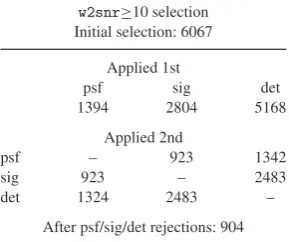
Table 1. Summary of how the three main re-jection methods incrementally reduce the ini-tialw2snr≥10 selection. psf refers to the pro-file fit photometry rejection method, sig to the photometric uncertainty rejection method and det to the detection number rejection method.
w2snr≥10 selection Initial selection: 6067
Applied 1st
psf sig det
1394 2804 5168
Applied 2nd
psf – 923 1342
sig 923 – 2483
det 1324 2483 –
After psf/sig/det rejections: 904
Table 1 summarizes the number ofw2snr>10 candidates that remain after rejection using our three different methods. Results are shown for different orders of applying the methods, to indicate their effectiveness and highlight common ground amongst the rejection methods. It can be seen that the profile fit photometry method rejects the most objects, followed by the photometric uncertainty rejection method. It is also clear that the profile fit photometry method rejects most of the sources rejected by the detection number method. So the overall approach might be simplified without substantially reducing the number of rejected sources, by omitting the detection number method. However, we chose to apply all three methods here, re-jecting 5163 sources and leaving 904w2snr>10 sources for visual inspection.
2.5 Extending the search to the 8σW2 limit
We built on ourw2snr>10 selection by extending our analysis into
thew2snr=8–10 range. We made an initial selection of 18 112
sources, and our three rejection methods (from Section 2.4) left 3252 sources. A visual inspection of∼100 of these revealed that many were found close to bright stars, and resulted from spurious or poor quality detections within the extended bright star haloes. We therefore implemented an additional rejection method for this
w2snrrange, to remove such contamination prior to visual
inspec-tion. The contamination and confusion flag (cc_flags) parameter in the All-Sky Database assesses such contamination, though we chose to establish our own halo criterion so as to optimize this rejection method for our sample.
Fig. 2 shows a zoomed in plot of the separations between our 3252 sources and their nearest bright 2MASS neighbour (whereJ2MASSis the 2MASSJ-band magnitude of the bright object). The full range of separation extends out to∼10 000 arcsec, but it can be seen that a large number of candidates are found within about 600 arcsec of a bright star if its magnitude isJ2MASS≤3.5. This overdensity (1590 sources) clearly identifies the separation–brightness region where halo contamination is common amongst ourW2-onlyw2snr=8– 10 sources. For comparison we overplot (in orange) the 946 sources that are flagged as halo associations in theWISEdata base, and it is clear that theWISEdata base does not account for all of the W2-only contamination around bright stars. We therefore removed
anyw2snr=8–10 sources that are close to a bright 2MASS star
[image:5.595.94.239.125.246.2]withJ2MASS≤3.5 if their separation (s) from this star fulfils the criterions≤(−157.14×J2MASS)+850 (shown by the solid line
Figure 2. The separation betweenW2-only sources and their nearest bright 2MASS neighbour. Overplotted in orange are sources flagged as halo asso-ciations in theWISEAll-Sky release data base. The solid line delineates our own halo rejection region.
in Fig. 2). This criterion removed about half of the 3252W2-only sources, which were found in only 193 square degrees (0.5 per cent) of sky around bright stars.
2.6 Visual inspection
We used theWISEImage Service at the NASA/IPAC Infrared Sci-ence Archive to examine candidate W2-only sources that came through both our selections (w2snr>10 andw2snr=8–10). We visually examined 600 arcsec Atlas images in all fourWISEbands, but made use of the zoom and background image stretch settings in some cases. We assessed the quality of sources in several ways. We rejected sources that were associated with artefacts, including diffraction spikes, optical ghosts, glints, spurious halo associations and some sources in regions with a poorly fit sky (which can result from latents). Next we compared theW2 sources with noise features in the local sky, and visually assessed their shape for point source consistency. We thus rejected many sources that were part of re-solved extended structure such as nebulosity and galaxies. We also rejected visually blended sources if the blending precluded reason-able quality assessment in other respects. And we rejected sources with visual counterparts in theW1,W3 orW4 bands. In some cases the presence of such counterparts was unambiguous, though in oth-ers we had to assess significance relative to noise features in the local sky.
width-half-maximum (FWHM) is 6.4 arcsec, andWISEAtlas Im-ages have 1.375 arcsec per pixel] nearby objects with proper motion of 2.5–3 arcsec per year could move by∼a pixel between the two epochs, and may thus be identified through visual inspection. We rejected nine sources which looked spurious in the extra epoch image.
2.7 The new sample
In all we have identified 158W2-only sources, 52 withw2snr≥10 and 106 withw2snr =8–10. 28 of these sources are previously identified T5-Y dwarfs from the literature (24w2snr≥10 and 4
withw2snr=8–10; K12; Burningham et al. 2010b; Lodieu et al.
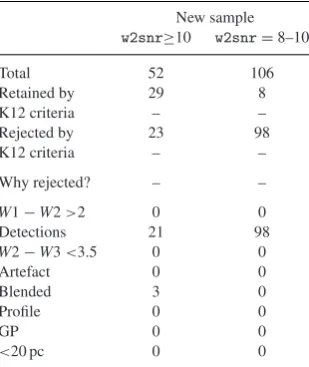
2012b). 24 of the re-identified objects are previousWISEdiscoveries from theWISEcensus summarized by K12, so to provide a more in-depth comparison with this work we filtered our sample using the K12 selection criteria. In total 37 of our sample pass the K12 selection criteria and 121 do not. For those that do not, Table 2 summarizes the reasons.
None of our sample are rejected by the K12W1−W2>2 or W2−W3<3.5 criteria, unsurprising since we are considering W2-only sources. None of our sources are flagged as artefacts, and the K12 Galactic plane (‘GP’) exclusion region covers significantly less sky (240 square degrees) than ourAv<0.8 criterion (8952 square degrees). Our constraints on the reducedχ2of theW2 profile fit photometry are substantially tighter than those of K12 (see Sec-tion 2.4), so none of our sources are rejected by this K12 criterion. And the K12 ‘<20 pc’ criterion does not affect our sample because our sources only have lower limitW1−W2 colours.
[image:6.595.86.241.547.731.2]A small fraction of our sources fail the K12 blending requirement. However, the K12 criterion that affects our sample the most is the ‘detection’ criterion – K12 required that a source must have at least eight detections (≥3σ) in the individualW2 frames, or where there
Table 2. Summary of how the new sample se-lection criteria map on to the K12 criteria. ‘De-tections’ refers to the required number of de-tections in individual frames. ‘Blended’ refers to the requirement that a source is not blended with another source. ‘Profile’ is the constraint placed on the quality of the profile fit photometry. ‘GP’ refers to the Galactic plane exclusion re-gion and ‘<20 pc’ refers to the colour–magnitude constraints designed to remove objects beyond a distance of 20 pc.
New sample w2snr≥10 w2snr=8–10
Total 52 106
Retained by 29 8
K12 criteria – –
Rejected by 23 98
K12 criteria – –
Why rejected? – –
W1−W2>2 0 0
Detections 21 98
W2−W3<3.5 0 0
Artefact 0 0
Blended 3 0
Profile 0 0
GP 0 0
<20 pc 0 0
are 5–7 detections it must be detected in at least 40 per cent of theW2 frames. 87 per cent of ourw2snr>10 sources (and all the
w2snr=8–10 sources) that are rejected by the K12 criteria failed
to meet the K12 detection criterion.
Fig. 3 plots the new sample (red symbols) inW2 versusW1−W2 andW2−W3 colour–magnitude diagrams. Y dwarfs (from K12 and Tinney et al. 2012) are green, with other K12 sources blue. Triangles indicate lower and upper limit colours, pointing to the right and left, respectively. The dotted lines indicate the 5σand 2σ W1 andW3 limits (assuming 20 frames) in the left and right-hand plots, respectively. The limit colours become common in the 2–5σ region, and dominate at fainter magnitudes.
Where our search has re-identified K12 objects the red symbols can be seen nested within the blue/green symbols. We re-identify 25 of the 33W2-only detected K12 objects, with 5 being inAv>0.8 directions, 1 each being rejected by our profile fit photometry and photometric uncertainty rejection methods (see Section 2.4 and Fig. 1), and 1 havingw2snr<8. Of the 14 Y dwarfs 1 has a measured W1 magnitude in the All-Sky data base due to an erroneous de-blending procedure as noted by K12, and 8 are detected inW3. Most of theseW3 detections lie around the indicatedW3 detection limit (shown in the right-hand plot), and indeed theirW3 photometric uncertainties range from 0.2 to 0.5. However, three of these W3-detections are markedly below these lines because there are>30 frames of coverage for these objects (the faintest one being covered by 84 frames). Four of the fiveW2-only Y dwarfs are re-identified by our search method, with the fifth one being in anAv > 0.8 direction.
The brightest object in our new sample is WISE 1639–6847, a blended source withW2= 13.64. This is the brightest (inW2) Y dwarf known, and was recently discovered by Tinney et al. (2012) just prior to the submission of this paper. We discuss our own analysis of this object in Section 6.1. In theW2=14–15 range we identify 16 sources, 15 of which are previously known late-T and Y dwarfs and 2 of which are rejected by the K12 selection method. The dominant magnitude range for the new sample isW2=15– 16, where we find 116 sources. 13 of these are previously reported objects, with 95 being rejected by the K12 selection method. Our sample also contains 25 sources fainter thanW2=16, 14 of which are rejected by the K12 method.
3 C A N D I DAT E C L A S S I F I C AT I O N
Figure 3. WISE W2 againstW1−W2 andW2 againstW2−W3 colour–magnitude diagrams. Our new sample is shown with red symbols (triangles point away from the lower limit colours). Objects from the K12 census are also shown (blue, except for Y dwarfs which are green). Dotted lines show the 5σ and 2σW1 andW3 limits (assuming 20 frames).
Table 3. Candidate classification using near-infrared colour and proper motion.
Category J−W2 μtot Interpretation
(arcsec yr−1)
1 2–4 <0.7 Mid–late T (disc)
2 2–4 >0.7 Mid–late T (thick-disc/halo)
3 4–6 <0.3 Late T (disc)
4 4–6 0.3–0.7 Late T or Y (disc)
5 4–6 >0.7 Late T (thick-disc/halo) or Y
6 >6 <0.7 LowμY
7 >6 >0.7 Clear Y
motions of<0.7 arcsec yr−1. With distances<20 pc Y dwarfs will general have proper motion>0.3 arcsec yr−1, though in some rare cases e.g. where their velocity is mostly along the line of sight, their proper motion could be smaller. Bringing this information together we defined some representative candidate classification categories to help us prioritize based on follow-up measurements of detected J-band counterparts. These categories are summarized in Table 3.
To assess the credence of possibleJ-band counterparts of our WISEcandidates, we considered on-sky densities ofJ-band sources. A search of VISTA Hemisphere Survey (VHS) reveals ∼0.01 sources withJ=17.5–20.2 per 7 arcsec2(equivalent to a circular sky area of radius 1.5 arcsec) in directions away from the Galactic plane. It is therefore very unlikely to find mismatched counterparts in this separation and magnitude range, and we thus assume any such counterparts to be genuine.WISEastrometric accuracy ranges from 0.28 to 0.44 arcsec forW2-only sources withw2snr = 8– 15 (using Zacharias et al. 2010; Wright et al. 2010), so sources within 1.5 arcsec of theWISEposition will have moved no more than 2 arcsec between theWISEand near-infrared epochs, and with typical baselines of a few years such sources will generally be in categories 1, 3, 4 or 6 (see Table 3).
At larger offsets mismatched near-infrared counterparts become more likely, e.g. we find∼0.6 VHS sources withJ=17.5–20.2 per 314 sq arcsec (equivalent to a 10 arcsec circle of sky). We rou-tinely check SuperCOSMOS and SDSS (where available) to assess possible offset counterparts. However, such faint sources are
gen-erally non-detections in these surveys. It is therefore important to verify widely offset counterparts through additional epoch images (showing the proper motion) or multiband photometry giving near-infrared colour criteria, before assigning them to category 2, 5 or 7. If no near-infrared counterpart is detected, the candidate cannot be classified using Table 3, and additional mid-infrared follow-up will then be required.
4 A D D I T I O N A L P H OT O M E T RY A N D P R O P E R M OT I O N S
Four Star observations were obtained on 2012 August 10. Images were taken with theJ-band filter (MKO system), using individual integrations of 20 s, with six co-adds and a random 11-point jitter pattern, leading to total exposure times of 22 min. The target was centred on detector 2 as it has the most uniform pixel sensitivity, providing a 5.4 arcmin field of view (FOV). The data were reduced using standardIRAFroutines.
NICS (Baffa et al. 2001) observations were made on the nights of 2012 August 2, 3 and 5. Image mosaics were produced by com-bining individual exposures of 30 s, with two or four co-adds, and five different pointings giving a total exposure time of 5 or 10 min. The mosaics were produced using the reduction Speedy Near-infrared data Automatic Pipeline (SNAP) provided by TNG. The TNGJ-band filter is somewhat different to MKOJ, so to de-termine a correction we derived synthetic photometry on the two systems. For standard stars (from the Pickles spectral library; Pick-les 1998), we found essentially no difference between the different J-band magnitudes at a level of<0.4 per cent, and could thus use the transforms of Carpenter (2001) to convert 2MASSJinto TNG J. For mid–late T dwarfs, however, we found a significant differ-ence. We derived synthetic photometry using spectra of mid–late T spectral standards from Burgasser et al. (2006), and determined that (JTNG−JMKO)=0.55±0.08.
HAWK-I observations were obtained on the nights of 2012 Oc-tober 18 and 19 on the UT4 telescope on Paranal, Chile. HAWK-I is equipped with four Hawaii 2RG 2048×2048 pixel detectors and an MKO filter set which matches the VISTA filter set precisely (Kissler-Patig et al. 2008). In theJ-band, five 60 s exposures were taken, with a random offset of up to 20 arcsec between them. The H-band data consisted of nine 100 s exposures, randomly offset from each other by up to 20 arcsec. Data reduction was carried out using the HAWK-I pipeline (V1.8.9) provided by ESO.
SofI observations were obtained on 2012 December 31 under photometric conditions, seeing∼0.8 arcsec, and dark conditions. SofI is equipped with a 1024×1024 Hawaii HgCdTe offering an FOV of 4.9×4.9 arcmin and a pixel size of 0.292 arcsec in its ‘Large-field’ configuration. J-band images were measured using integrations of 10 s repeated six times with a 10-point dither pattern yielding a total exposure of 10 min. Dome flats were obtained during the afternoon preceding the observations. The images were reduced with the ESO packageGASGANO.
Warm-Spitzer IRAC photometry was obtained for two of the dwarfs presented in this work via Cycle 8 GO programme 80077 (PI: Leggett). The observations were carried out in both the [3.6] and [4.5] bands, with a 30 s frame time, repeated one to four times per pointing, and dither patterns consisting of 12, 16 or 36 posi-tions. Post-basic-calibrated-data mosaics generated by theSpitzer pipeline version S19.1.0 were used to obtain aperture photometry
using a 7.2 arcsec diameter aperture, and the sky levels were deter-mined from annular regions. Aperture corrections were taken from the IRAC handbook, and a 3 per cent uncertainty (due to system-atics) contributes in quadrature to overall uncertainty. TheSpitzer observations and photometry are summarized in Table 6.
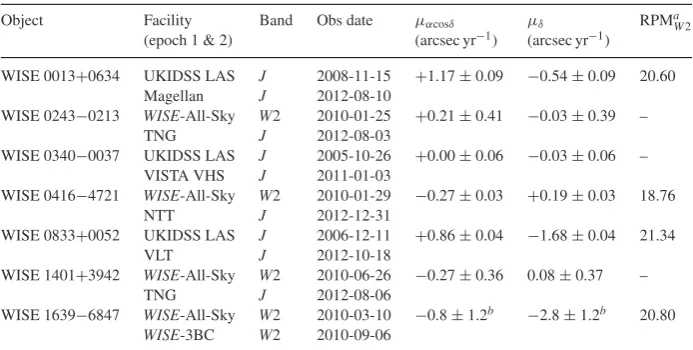
We derived proper motions using a combination of near-infrared follow-up andWISEimages, using multi-epoch near-infrared im-ages where available. When we used aWISEepoch, we required near-infrared counterparts within ∼1.5 arcsec of theWISE posi-tion, and that theWISEsource was isolated and visually unblended to ensure reliable measurements. We typically selected 12–20 ref-erence stars to define our interepoch positional transforms, which had root-mean-square residuals of∼0.03–0.07 arcsec.J-band coun-terpart centroiding uncertainties were estimated as a function of signal-to-noise, from the scatter in centroid measurements of a sim-ulated population of sources with Gaussian PSF and added Poisson noise. Fit residuals and centroiding uncertainties were combined in quadrature to give full proper motion uncertainties.
To date we have been able to assign categories to eight new candidates using ourJ-band follow-up classification method. Six haveJ-band counterparts within 1.5 arcsec of theWISEsource cen-tre, and two have high proper motion near-infrared counterparts. Spitzerphotometry was obtained for the two high proper motion objects. The follow-up photometry, assigned categories and proper motion measurements are presented in Tables 4–6. Near-infrared measurements of the other followed up candidates cannot be pre-sented at this stage because in general we have identified possible counterparts and we need an additional measurement to confirm of reject them.
5 S P E C T R O S C O P Y
Low-resolution near-infrared spectroscopy of WISE J001354.39+063448.2 (WISE 0013+0634 hereafter) and WISE J083337.83+005214.2 (WISE 0833+0052 hereafter) were obtained using the Gemini Near Infrared Spectrograph (GNIRS; Elias et al. 2006) on the Gemini North Telescope on Mauna Kea, Hawaii, and the Folded port InfraRed Echellette (FIRE) spectro-graph (Simcoe et al. 2008, 2010) mounted on the Baade 6.5 m Magellan telescope at Las Campanas Observatory, respectively. The FIRE and GNIRS observations were made on the nights of 2013 February 14 and June 25 in clear conditions.
[image:8.595.56.536.619.724.2]GNIRS observations were made via queue programme GN-2013B-Q-65. A 0.68 arcsec slit was used in cross-dispersed mode providing a 0.9–2.5µm spectrum with a resolving power ofR∼750. Eight 300 s integrations were obtained using an ABBA jitter pat-tern giving a total integration of 40 min. Comparison argon arc frames were obtained to provide dispersion solutions. For telluric
Table 4. Photometry of new late object discoveries. Mid-infrared limit colours are also given where one band has only a 95 per cent confidence upper limit magnitude. The object category is listed in the last column based on colour and proper motion (see Table 3).
Object W2 W1−W2 W2−W3 J−W2 H−W2 J−H Y−J Category
WISE J001354.39+063448.2 15.04±0.11 >3.27 <2.44 4.71±0.12 4.98±0.12 −0.28±0.07 5
WISE J024345.58−021326.5 15.21±0.10 >2.85 <2.25 2.50±0.16 1
WISE J034019.34−003702.4 15.26±0.12 >2.67 <2.65 3.68±0.15 0.97±0.21 1
WISE J041657.61−472115.0 16.17±0.13 >2.60 <2.53 2.41±0.14 1
WISE J083337.83+005214.2 14.96±0.10 >3.39 <2.40 5.32±0.14 5.67±0.14 −0.35±0.14 0.15±0.24 5 WISE J132116.09−100512.3 15.72±0.14 >3.00 <2.50 3.73±0.19 1.34±0.33 1 or 2a
WISE J140143.50+394235.2 15.44±0.10 >3.33 <2.22 2.90±0.16 1
Table 5. Proper motion and reduced proper motion for late-type objects discussed in this paper.
Object Facility Band Obs date μαcosδ μδ RPMaW2
(epoch 1 & 2) (arcsec yr−1) (arcsec yr−1)
WISE 0013+0634 UKIDSS LAS J 2008-11-15 +1.17±0.09 −0.54±0.09 20.60
Magellan J 2012-08-10
WISE 0243−0213 WISE-All-Sky W2 2010-01-25 +0.21±0.41 −0.03±0.39 –
TNG J 2012-08-03
WISE 0340−0037 UKIDSS LAS J 2005-10-26 +0.00±0.06 −0.03±0.06 – VISTA VHS J 2011-01-03
WISE 0416−4721 WISE-All-Sky W2 2010-01-29 −0.27±0.03 +0.19±0.03 18.76
NTT J 2012-12-31
WISE 0833+0052 UKIDSS LAS J 2006-12-11 +0.86±0.04 −1.68±0.04 21.34
VLT J 2012-10-18
WISE 1401+3942 WISE-All-Sky W2 2010-06-26 −0.27±0.36 0.08±0.37 –
TNG J 2012-08-06
WISE 1639−6847 WISE-All-Sky W2 2010-03-10 −0.8±1.2b −2.8±1.2b 20.80
WISE-3BC W2 2010-09-06
aRPM is presented where proper motion is inconsistent with zero. bSee Tinney et al. (2012) for more accurate proper motions.
Table 6. SpitzerIRAC Photometry of new late object discoveries.
Object Date Integration [3.6] [4.5] [3.6]−[4.5]
observed time (s)
WISE 0013+0634 2013-02-12 1440 17.15±0.03 15.16±0.03 1.99±0.04 WISE 0833+0052 2013-01-03 1440 17.02±0.03 14.80±0.03 2.22±0.04
correction, the F5V star HD 5892 was observed after the target and at a similar airmass. Data reduction was carried out using standard IRAF GEMINIpackages (Cooke & Rodgers 2005). Hydrogen lines were removed from the F5V stellar spectrum using linear interpolation, and the true continuum determined using the IRTF Spex library spectrum of HD 27524 (Rayner, Cushing & Vacca 2009).
The FIRE instrument was used in prism mode with a 0.6 arcsec slit giving a resolving power ofR∼200 at 1.6µm. Thirty 120 s integrations were obtained using an ABBA jitter pattern, giving a total integration of 1 h. Ne–Ar arc lamps were observed at the configuration and pointing for both the target and the standard to allow for good dispersion correction. Due to some saturation with the on-night standard calibration star, we made use of calibrators from 2012 October 5 and June 3. These nights had similar conditions to that of our target observation, and the standards were observed at a similar airmass. To verify the effectiveness of this approach, we generated four output spectra of WISE 0833+0052 using the four measured standards in order to compare the results and assess consistency. We found≤10 per cent variation in flux calibration over the full wavelength range using the different standard stars, and significantly less variation over the wavelength width of the flux peaks that we measure in Section 6.2.
The FIRE spectrum was extracted using the low-dispersion ver-sion of theFIREHOSEpipeline, which is based on theMASEpipeline (Bochanski et al. 2009; Simcoe et al. 2010). The pipeline uses a flat-field constructed from two quartz lamp images taken with the lamp at high (2.5 V) and low (1.5 V) voltage settings. The data were divided by this pixel flat before being wavelength calibrated. The pipeline performs sky subtraction following the method outlined in Bochanski et al. (2011), adapted for the low-dispersion config-uration of the spectrograph. The spectra were optimally extracted before being combined using a weighted mean, using an adapta-tion of the XCOMBSPEC routine fromSPEXTOOL(Cushing, Vacca & Rayner 2004). The T dwarf spectra were then corrected for
tel-luric absorption and flux calibrated using a FIRE specific version of the XTELLCOR routine (Vacca, Cushing & Rayner 2003). Finally, residual outlying points due to cosmic rays and bad pixels were removed using a simple 3σclipping algorithm.
6 O B J E C T S O F S P E C I A L N OT E
6.1 WISE 1639−6847
The brightest (inW2) source in our sample is WISE 1639−6847, which we analysed while assessing sample candidates. This object was recently presented by Tinney et al. (2012), who used differ-ential imaging to separate theJ-band counterpart from a nearby blended star ∼6 arcsec to the south of the object (measuring a colour ofJ3−W2=6.98). These authors also measured the ob-ject’s spectrum during a period of good (∼0.6 arcsec) seeing, and determined a spectral type of Y0. They also combined theWISE All-Sky and 3-Band Cryo images with theirJ-band data to mea-sure proper motion and parallax constraints, determining a proper motion of 3.07±0.04 arcsec yr−1and an approximate distance of
∼5 pc. We did not measure the near-infrared counterpart, but we used theWISEdata by itself to assess source motion and determine proper motion constraints. It is interesting to compare our results to those obtained with more data.
Examination of the blended source in 2MASS, SuperCOSMOS and W1 revealed that it was a non-moving point source with
[image:9.595.140.456.295.350.2]Figure 4. W2 images of WISE 1639−6847. The top two images show theWISEAll-Sky and 3-Band Cryo images on the left and right, respec-tively, which are separated in epoch by∼6 months. The PSF of the non-moving blend star has been subtracted in the middle two images, with WISE 1639−6847 now seen to be a point source that moves∼1 pixel southwards between these epochs. This motion is also shown by the difference images in the bottom two plots (see the text).
normalized shifted PSF-subtraction source was then subtracted off theW2 image to effectively remove the PSF of the blended source. In Fig. 4, the top-left and rightW2 images are from the WISE-All-Sky and 3-Band Cryo releases, respectively (∼6 months apart). The middle two plots show our blend-subtracted images where WISE 1639−6847 now appears as a circular point-like source. The proper motion was measured using these blend-subtracted images. We used theIRAF,GEOMAPandGEOXYTRANpackages to derive po-sitional transforms between the two epoch images. As reference stars we selected sources that had good signal-to-noise (>20), were unsaturated and point-like in both epoch images, and were within 5 arcmin of the candidate. We selected 20 reference stars, opti-mized a fit geometry of second-order polynomials inxandy, and rejected outlier reference stars. The root-mean-square residuals of our fitted transform were 0.05 pixels (∼70 mas). To estimate cen-troiding uncertainties forWISEsources, we used the astrometric relation described in Wright et al. (2010) with a correction fac-tor of FWHMW2/FWHMW1 since our sources are W2-only (σ = 0.18+6.4/(2SNR)). In this way, we determined proper motion constraints for WISE 1639−6847 ofμα= −0.8±1.2 arcsec yr−1 andμδ=2.8±1.2 arcsec yr−1. These have much larger
uncertain-ties than the Tinney et al. results but are consistent, and significant at the level of∼2.5σ.
We also studied the signature of motion in theWISEdata by assessing the difference image (epoch 1 minus epoch 2) which is shown at the bottom of Fig. 4. The left-hand image shows the dif-ference between the originalWISEepoch images while the other image was made using the blend-subtracted versions. These two images are very similar as expected, since the subtraction of the stationary blend star should not significantly affect the difference image. The motion of the source between the epochs results in a positive–negative undulation following the direction of motion. We note other features in the difference images associated with bright sources, whose profiles are not stable between the epochs, and also some that result from faint non-point-like features. However, the difference signature of WISE 1639−6847 is clear, and it seems likely that the depth and symmetry properties of such difference image undulations could be combined with source brightness in-formation to provide a general means of assessing the credence of moving object candidates inWISEmulti-epoch data.
6.2 WISE 0013+0634 and WISE 0833+0052
Fig. 5 shows images of WISE 0013+0634 in various bands. TheW2 andW1WISEimages are shown upper-left and -right respectively (epoch 2010.5), with two epochs of J-band imaging below with the near-infrared counterpart indicated by a red arrow. The bottom-right zoomed in image shows a low signal-to-noise (∼5) counterpart from the UKIDSS LAS (epoch 2008.9). This counterpart is offset by∼2 arcsec from theWISEsource centre, and no detections were discernible in theY-, H- or K-band LAS images. We were able to confirm the near-infrared counterpart in a deeperJ-band image (using Four Star on Magellan; epoch 2012.6) in which we detected the counterpart with signal-to-noise∼20 on the other side of the
[image:10.595.308.546.432.666.2]Figure 6. Multiband images of WISE 0833+0052. Each image is 1 arcmin on the side. The top two plots areWISE W2- andW1-band images on the left and right, respectively, with WISE 0833+0052 in the centre. The middle two plots show the UKIDSSY- andJ-band images from 2006.95. The bottom two plots show the VLT Hawk-IJimage from 2012.8 and theSpitzer[4.5] image from 2013.0. The high proper motion near-infrared counterpart is indicated in each image by a red arrow, and has moved by 10.4 arcsec across the near-infrared epochs.
WISEsource centre. The three epoch positions (UKIDSS,WISEand Magellan) are all consistent with our measured proper motion (to within astrometric uncertainties), though our final proper motion of 1.3 arcsec yr−1was derived using the UKIDSS and Magellan data (with a 3.7 yr baseline).
[image:11.595.47.283.58.400.2]WISE 0833+0052 is the brightest (W2=14.96) new object in our sample. Fig. 6 shows theWISEimages at the top (epoch 2010.32) with theWISEcounterpart slightly blended with a star∼10 arcsec to the west. The middle two plots show the UKIDSS LASY- and J-band images from 2007.0 (the counterpart was undetected in the LASH- andK-band images), and the bottom two plots show the J-band Hawk-I image from 2012.8 and theSpitzer[4.5] image from 2013.0. A faint UKIDSSY- andJ-band counterpart is visible at low signal-to-noise about 6 arcsec to the north-west of theWISEsource centre. And in the more recent VLT andSpitzerepochs, the source is strongly detected about 4 arcsec to the south-east of theWISE position. We measured the proper motion of WISE 0833+0052 using the UKIDSS and HAWK-IJ-band images. We also verified that the positions in UKIDSS,WISEandSpitzerwere consistent with this. Our centroiding on theWISEsource was not affected by the modest level of blending evident in theW2 image, so our
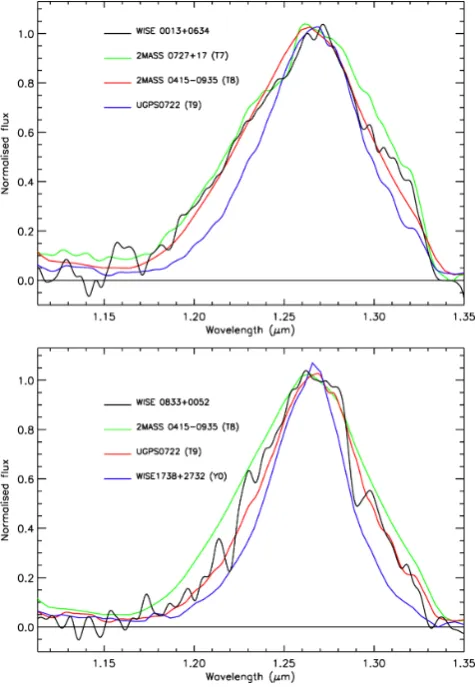
Figure 7. TheJ-band spectra of WISE 0013+0634 and WISE 0833+0052. Late-T standard spectra are overplotted for comparison and to facilitate spectral typing.
consistency check was able to verify the relative location of the object in all the epochs. WISE 0833+0052 has a high proper motion of 1.89±0.04 arcsec yr−1.
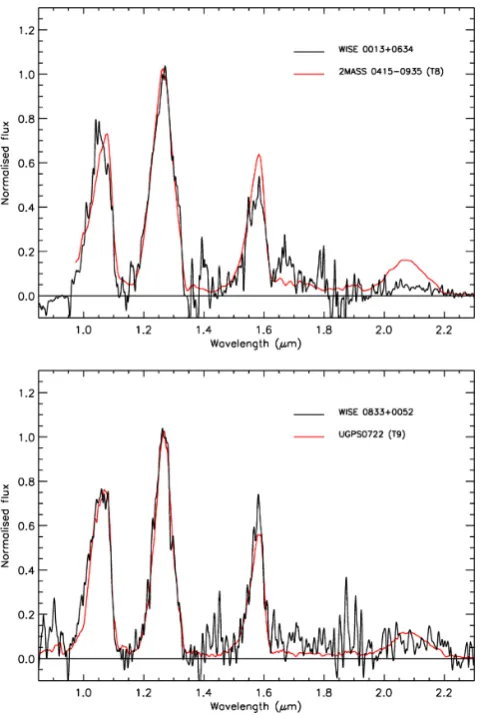
Figure 8. The full near-infrared spectrum of WISE 0013+0634 and WISE 0833+0052. A known T8 and T9 dwarf are overplotted in red for compari-son.
To compare the overall spectral morphology and colours of WISE 0013+0634 and WISE 0833+0052 with those of other field ob-jects, we show their full near-infrared spectra and measured colours in Figs 8 and 9. When plotting the spectra we also show (in red) comparison T8 and T9 spectra for WISE 0013+0634 and WISE 0833+0052, respectively. In the colour plots, WISE 0013+0634 and WISE 0833+0052 are represented by red symbols, with a com-parison sample of late-T and Y dwarfs from Leggett et al. (2013) plotted in blue.
We note that theY-band flux peak of WISE 0833+0052 is not markedly different from that of UGPS 0722−0540, which seems surprising since the measuredY−Jcolour of WISE 0833+0052 is bluer than all the late-T dwarfs in Fig. 9. While the Y-band peak of WISE 0833+0052 is slightly broader (extending to the blue), this can only account for a small∼7 per centY-band excess (relative toJ), which is insufficient to explain the measuredY−J colour. However, the Y-band photometric uncertainties are large due to low signal-to-noise (±0.2), and the measuredY−Jcolour is only ∼2σ away from a more typical value for late-T dwarfs. So while this potential anomaly may offer tentative evidence of variability, further photometric studies (at higher signal-to-noise) will be needed to investigate this possibility.
WISE 0013+0634 is significantlyKband suppressed by compar-ison with 2MASS 0415−0935, and despite a rather noisierK-band spectrum WISE 0833+0052 appears to beKband suppressed also.
Theory and observation suggest this is due to strong collisionally induced absorption by H2 in higher pressure atmospheres with low-metallicity and/or high-gravity (e.g. Saumon et al. 1994; Pinfield et al. 2008).
The H-band flux peak of WISE 0013+0634 appears slightly suppressed relative to 2MASS 0415−0935, and that of WISE 0833+0052 seems slightly enhanced compared to UGPS 0722−0540. However, there is no evidence that they are outliers inJ−Hcolour, and we note that the broad-band spectroscopic flux calibration for WISE 0833+0052 is no better than∼10 per cent.
The range of plots shown in Fig. 9 clearly demonstrate that WISE 0013+0634 and WISE 0833+0052 have relatively enhanced mid-infrared emission compared to their near-mid-infrared brightness. This excess is seen in the H− W2 versus spectral type plot, where both objects lie significantly above the locus of other T dwarfs (∼1–1.5 mag redder than the average T dwarf colour). However, in J−Hand mid-infrared colours they do not appear unusual. The only comparison object with a similar excess is the T7.5p dwarf ULAS 1416+13B, which is believed to be a low-metallicity/high-gravity object (Burningham et al. 2010a). Theory (Saumon & Marley 2008; Allard, Homeier & Freytag 2011) predicts a change inH−W2 of
+0.2 to+0.3 for a decrease in metallicity of[M/H]= −0.3 (at Teff∼700 K), while studies of metal poor benchmarks (e.g. Pinfield et al. 2012) suggest even larger effects (H−W2= +0.6; Burn-ingham et al. 2013). Overall, current theory and observation would suggest thatH− W2=1–1.5 could suggest a low-metallicity object with [M/H] between−0.5 and−1.5.
We have estimated the distances of WISE 0013+0634 and WISE 0833+0052 using absolute magnitude against spectral type rela-tions from Dupuy & Liu (2012), in all available bands (and al-lowing for a spectral type uncertainty of±0.5 types). The results are shown in Table 7 for both the single object case and that of an unresolved binary with equal brightness components. For both objects, these distance constraints fall into two groupings. Distance estimates made in theJandHbands are the largest, with those made in the mid-infrared (and theYband for WISE 0833+0052) being smaller by a factor of∼2. As previously discussed, theY-band mag-nitude has large uncertainty, but the factor of∼2 difference between theJHand mid-infrared distance estimates is clear, and in itself is representative of an∼1.5 magnitude relative mid-infrared/JH ex-cess (compared to typical T8–9 field dwarfs). The actual distances of WISE 0013+0634 and WISE 0833+0052 may be intermediate between the near- and mid-infrared estimates, and will be greater if the object is an unresolved multiple.
Figure 9. Plots of various colours as a function of spectral type. WISE 0013+0634 (T8) and WISE 0833+0052 (T9) are red, and the comparison sample of late-T and Y dwarfs from Leggett et al. (2013) is in blue.
Table 7. Distance estimates for WISE 0013+0634 and WISE 0833+0052 using absolute magnitude versus spec-tral type relations in theY,J,H, [3.6], [4.5] and W2 bands (where available), and spectral types of T8±0.5 and T9±0.5, respectively. Absolute magnitudes have been estimated assuming single objects and also equal bright-ness unresolved binarity.
WISE 0013+0634 Distance range (pc) (T8±0.5)
Band Single object Unresolved binary
J 46 (39–55) 65 (55–78)
H 43 (36–51) 61 (51–73)
[3.6] 26 (23–30) 37 (33–42)
[4.5] 22 (20–25) 31 (28–35)
W2 21 (18–25) 30 (25–35)
WISE 0833+0052 Distance range (pc) (T9±0.5)
Band Single object Unresolved binary
Y 22 (18–26) 31 (26–37)
J 31 (26–37) 44 (37–52)
H 32 (27–38) 45 (37–53)
[3.6] 17 (15–19) 24 (21–27)
[4.5] 15 (14–17) 22 (20–24)
W2 17 (15–20) 24 (21–29)
to+250 km s−1when calculating space motions, with the resulting constraints being shown as grey regions in the plots. As a guide we overplot the mid-value space motion in red, with blue and green symbols indicating how the uncertainty in distance and RV broadens the constrained region. We also overplot the old disc and halo
veloc-ity dispersions (1 and 2σas dashed/dotted and solid lines, respec-tively) from Chiba & Beers (2000). In Table 8, we present tangential velocity estimates for WISE 0013+0634 and WISE 0833+0052 (with ranges reflecting proper motion and distance uncertainties), as well as minimum possible value estimates for total space motion ((U2+V2+W2)
minin the LSR frame). These minimum space motions result from aUVWparameter-space search (i.e. within the grey regions in Fig. 10) for each object. The solar-centric RV that would produce the minimum space motions are indicated in paren-theses in the table, with all other RV values leading to larger space motions.
It is clear that when theJHdistances are used, WISE 0013+0634 and WISE 0833+0052 occupy the halo region in Fig. 10. This is also evident in Table 8, where the minimum possible space motions (if we assumeDJH) are above the range defined for the thick disc (85–180 km s−1; Fuhrmann 2000; Feltzing, Bensby & Lundstr¨om 2003; Nissen 2004). However, if we instead use the mid-infrared distance estimates the space motions could be lower, touching or overlapping with the 2σ old disc velocity dispersion in Fig. 10. In this case, the total space motion would also be consistent with thick disc membership.
[image:13.595.74.259.462.652.2]Figure 10. UV space motion plots for WISE 0013+0634 and WISE 0833+0052. Uncertainties in measured proper motion and estimated distance have been accounted for, as well as a possible range in RV from−250 to+250 km s−1. In the left-hand plots distances were estimated usingJHbrightness, while in the right-hand plots they were estimated using (relatively overluminous) mid-infrared brightness. Old disc and halo velocity dispersions (1 and 2σas dashed/dotted and solid lines, respectively) are also shown from Chiba & Beers (2000).
Table 8. Tangential velocities and minimum values of the total space motion ((U2+V2+W2)
min) for WISE 0013+0634 and WISE 0833+0052. The solar-centric radial
velocity (RV in km s−1) required to produce the minimum space motion is also listed.
Object Vtan(km s−1) Minimum space motion (km s−1) =(U2+V2+W2)
min
UsingDJH UsingDMIR UsingDJH UsingDMIR
WISE 0013+0634 278 (213–349) 147 (107–190) 183 (RV= −1) 83 (RV= −1) WISE 0833+0052 286 (235–337) 179 (126–231) 222 (RV=12) 118 (RV=12)
7 R E D U C E D P R O P E R M OT I O N D I AG R A M
In Fig. 11, we plot reduced proper motion (HW2=W2+5 logμ+5) against W1 − W2 and spectral type (left- and right-hand plots, respectively). In the top two plots, WISE 0013+0634 and WISE 0833+0052 are shown as a red symbols. We also plot (as blue
sym-bols) a sample that includes theWISEcensus (with proper motions from K11) and all additional L and T dwarfs from DwarfArchives (if they are detected inWISEand have proper motion accuracy
[image:14.595.144.446.589.658.2]Figure 11. Diagrams showing reduced proper motion against colour (left) and spectral type (right). In the top two plots, the DwarfArchive and K12 census are plotted in blue using proper motions from K11. Y dwarfs are green and ultracool sub-dwarfs as open symbols. WISE 0013+0634 and WISE 0833+0052 are red. In the bottom two plots, the colour coding shows the survey used to identify each object (WISE, 2MASS, SDSS and others).
indicative tracks to show characteristic kinematics, for L0-T9.5 and L0-Y2 dwarfs in the left- and right-hand plots, respectively. These tracks were constructed using the K12MW2relationship (the fit ex-cluding WISE 1828+2650) for T7-Y2 dwarfs, combined with esti-mates ofMW2for the L0-T6.5 dwarfs (which were derived using an H−W2 colour-correctedMHrelation from Marocco et al. (2010)). For the left-hand plot, we made use of aW1−W2 colour–spectral type relationship constructed using data from K12.
In the bottom two plots, we show the same objects but with differ-ent colours represdiffer-enting the surveys in which they were iddiffer-entified. TheWISEcensus is shown in blue, 2MASS in red and SDSS in green. Other objects (grey) mainly come from DENIS, with the UKIDSS and CFBDS surveys only yielding nine and one object, respectively (that were detected inWISEand with <25 per cent proper motion uncertainties).
The left-hand plots suffer from a bunching-up of the tracks for blue objects due to the relative insensitivity of theW1−W2 colour
for earlier objects. Indeed, the start of this trend may be evident in fig. 6 of Faherty et al. (2009).
The situation is slightly more ambiguous for the Y dwarfs, since the tracks only extend out to T9.5 colours in the left-hand plot, and in the right-hand plot they steepen rapidly into the Y dwarf regime. However, parallax distance estimates are available for five of the Y dwarfs in the diagram, and are suggestive. WISE 1828+2650 and WISE 1738+2732 haveVtanin the range 25–95 km s−1, while WISE 0410+1502 and WISE 1405+5534 haveVtan>100 km s−1, and WISE 1639−6847 hasVtan=73±8 km s−1(see also Tinney et al. 2012).
The bottom two plots show that the larger scatter in mid–late T reduced proper motion is evident amongst the samples from both WISEand 2MASS, though there are insufficient SDSS objects plot-ted to assess this survey sample. We considered possible selection biases for these survey samples that might contribute to the scatter. Leggett et al. (2010) examines the mid-infrared properties of late-T dwarfs, and highlights the late-T6–6.5 dwarfs 2MASS 0937+2931 and 2MASS 1237+6526. These T dwarfs (Teff=800–975K) are believed to be metal poor ([M/H] −0.3 and−0.2, respectively) from spectroscopic fitting (Liebert & Burgasser 2007; Geballe et al. 2009), and show M[4.5] excess (at a level of∼0.5 mag) with re-spect to the solar/rich metallicity T7.5 dwarfs Gl 570D and HD 3651B (Teff=780–840 K). If metal-poor mid–late T dwarfs can be detected out to distances≥25 per cent further than their solar/rich analogues, we might expect a factor≥2 increase in their number in aW2-limitedWISEsample. Metal poor T dwarfs could constitute a kinematically older population with larger velocity dispersion. Also standard 2MASS T dwarf selection techniques require blueH−K colours which will introduce a bias towards older lower metallicity objects, which could affect their kinematics in a similar sense. To address these possible biases it would be interesting to compare the reduced proper motions of a large sample of mid–late T dwarfs from the UKIDSS and VISTA surveys (e.g. building on Lodieu et al. 2012b; Burningham et al. 2013), since those selection techniques should not lead to an older metal poor bias. And for the Y dwarfs, the kinematic constraints are determined by parallax distances that need to be improved.
If the large scatter in reduced proper motion for late-T and Y dwarfs genuinely results from an increased fraction of objects withVtan=50–100 km s−1, this may provide useful constraints on the mass function and evolution of brown dwarfs. A 10 Gyr-old early- to mid-T dwarf withTeff=1000–1400 K will have a mass of about 70–80MJupiter, while a 10 Gyr-old late-T to early-Y dwarf withTeff=400–800 K will have a mass of 25–65MJupiter(Burrows et al. 2001). For a flat or slightly declining mass function, we would therefore expect to see more late-T/Y than early–mid T thick disc brown dwarfs.
8 S U M M A RY A N D F U T U R E W O R K
We have presented a new method for identifying late-T and Y dwarf candidates in theWISEdata base. After an initial selection of sources with at least eight individual frames measured per band, detections inW2-only were selected avoiding directions where ex-tinctionAv>0.8. We then developed rejection methods to assess the nature of the W2 sources, using the information relating to the multiple measurements and the source profile-fitting. These methods were designed to reject non-point-like, variable and mov-ing (Solar system) objects, and were based on measures of the profile fit photometry, the scatter in the individualW2 measure-ments, and the fraction of individual detections in the full W2
frame set. To effectively trace the desired parameter-space, we made use of a control sample of isolated non-moving non-variable point sources from the SDSS. These methods led to a manageable sam-ple size for visual inspection down tow2snr=10, and with the additional removal of sources near bright 2MASS stars, down to
w2snr=8.
We identify 158 candidate late objects. For
w2snr>10 ∼ 45 per cent are not identified by the previously
published method of K12, and for the lowerw2snr=8–10 sources
∼90 per cent fall outside the K12 criteria. The main reason for this is the differing approaches used to place constraints on the number of individualW2 detections. The main source of incompleteness in our sample is source blending, which can affect the statistical properties that we assess, although we do not directly reject blends in our search method.
Our analysis of WISE 1639–6847 shows that the∼6 month base-line offered by the fullWISEdata set can yield reasonably accurate proper motions for high proper motion objects, and that difference images may be a useful tool.
We have identified two high proper motion late-T dwarfs, a T8 WISE 0013+0634 and a T9 WISE 0833+0052. These objects both show mid-infrared/near-infrared excess and K-band suppression consistent with high gravity and/or low metallicity. Distance es-timates lead to kinematics that are consistent with thick disc or halo membership, and current constraints suggest that WISE 0833+0052 may have unambiguous halo kinematics.
Examination of reduced proper motion diagrams suggests that late-T and Y dwarfs may consist of a larger fraction of thick-disc/halo members than is the case for earlier objects.
Parallax and RV measurements for WISE 0013+0634 and WISE 0833+0052 are vital to properly determine the space motion of these objects. And additional near-infrared follow-up will allow us to categorise candidates in our full sample (according to Table 3), and build up the known number of very late T and Y dwarfs across the range of kinematic populations.
AC K N OW L E D G E M E N T S
ADJ is supported by a Fondecyt Postdoctorado under project number 3100098. SKL is supported by the Gemini Observa-tory, which is operated by AURA, on behalf of the interna-tional Gemini partnership of Argentina, Australia, Brazil, Canada, Chile, the United Kingdom and the United States of Amer-ica. MG is financed by the GEMINI-CONICYT Fund, allo-cated to the project 32110014. MTR is partially funded by PB06, CATA. RK acknowledges partial support from FONDE-CYT through grant number 1130140. NL is funded by the na-tional program AYA2010-19136 funded by the Spanish ministry of science and innovation. VJSB has been supported by the Span-ish Ministry of Economics and Competitiveness under the project AYA2010-20535. This research has made use of the SIMBAD data base, operated at CDS, Strasbourg, France. This research has benefited from the SpeX Prism Spectral Libraries, maintained by Adam Burgasser at http://pono.ucsd.edu/∼adam/browndwarfs/ spexprism.
R E F E R E N C E S
Allard F., Homeier D., Freytag B., 2011, in Johns-Krull C., Browning M. K., West A. A., eds, ASP Conf. Ser. Vol. 448, Model Atmospheres From Very Low Mass Stars to Brown Dwarfs. Astron. Soc. Pac., San Francisco, p. 91
Allard F., Homeier D., Freytag B., 2012, Phil. Trans. R. Soc. A, 370, 2765 Baffa C. et al., 2001, A&A, 378, 722
Baraffe I., Chabrier G., Barman T. S., Allard F., Hauschildt P. H., 2003, A&A, 402, 701
Bastian N., Covey K. R., Meyer M. R., 2010, ARA&A, 48, 339 Bate M. R., Bonnell I. A., Bromm V., 2002, MNRAS, 332, L65 Bochanski J. J. et al., 2009, PASP, 121, 1409
Bochanski J. J., Burgasser A. J., Simcoe R. A., West A. A., 2011, AJ, 142, 169
Bonnell I. A., Clark P., Bate M. R., 2008, MNRAS, 389, 1556
Burgasser A. J., Geballe T. R., Leggett S. K., Kirkpatrick J. D., Golimowski D. A., 2006, ApJ, 637, 1067
Burningham B. et al., 2008, MNRAS, 391, 320 Burningham B. et al., 2009, MNRAS, 395, 1237 Burningham B. et al., 2010a, MNRAS, 404, 1952 Burningham B. et al., 2010b, MNRAS, 406, 1885 Burningham B. et al., 2013, MNRAS, 433, 457
Burrows A., Hubbard W. B., Lunine J. I., Liebert J., 2001, Rev. Mod. Phys., 73, 719
Burrows A., Sudarsky D., Lunine J. I., 2003, ApJ, 596, 587 Carpenter J. M., 2001, AJ, 121, 2851
Casali M. et al., 2007, A&A, 467, 777 Castro P. J., Gizis J. E., 2012, ApJ, 746, 3
Castro P. J., Gizis J. E., Gagn´e M., 2011, ApJ, 736, 67 Chiba M., Beers T. C., 2000, AJ, 119, 2843
Cooke A., Rodgers B., 2005, in Shopbell P., Britton M., Ebert R., eds, ASP Conf. Ser., Vol. 347, IRAF Package for GNIRS Data Reduction – A Product of the Gemini/NOAO Collaboration. Astron. Soc. Pac., San Francisco, p. 514
Cos¸kunoˇglu B. et al., 2011, MNRAS, 412, 1237 Cruz K. L. et al., 2007, AJ, 133, 439
Cushing M. C., Vacca W. D., Rayner J. T., 2004, PASP, 116, 362 Cushing M. C. et al., 2011, ApJ, 743, 50
Day-Jones A. C. et al., 2011, MNRAS, 410, 705 Day-Jones A. C. et al., 2013, MNRAS, 430, 1171 Delorme P. et al., 2008, A&A, 482, 961 Dupuy T. J., Liu M. C., 2012, ApJS, 201, 19
Elias J. H., Rodgers B., Joyce R. R., Lazo M., Doppmann G., Winge C., Rodr´ıguez-Ardila A., 2006, in McLean I. S., Iye M., eds, Proc. SPIE Conf. Ser. Vol. 6269, Performance of the Gemini near-infrared spectro-graph. SPIE, Bellingham, p. 626914
Epchtein N. et al., 1999, A&A, 349, 236
Faherty J. K., Burgasser A. J., Cruz K. L., Shara M. M., Walter F. M., Gelino C. R., 2009, AJ, 137, 1
Faherty J. K., Rice E. L., Cruz K. L., Mamajek E. E., N´u˜nez A., 2013, AJ, 145, 2
Feltzing S., Bensby T., Lundstr¨om I., 2003, A&A, 397, L1 Findlay J. R. et al., 2012, MNRAS, 419, 3354
Fuhrmann K., 2000, in Bergeron J., Renzini A., eds, Proc. VLT Opening Symposium, From Extrasolar Planets to Cosmology. Springer, Berlin, p. 351
Gauza B. et al., 2012, MNRAS, 427, 2457 Geballe T. R. et al., 2002, ApJ, 564, 466
Geballe T. R., Saumon D., Golimowski D. A., Leggett S. K., Marley M. S., Noll K. S., 2009, ApJ, 695, 844
Gelino C. R. et al., 2011, AJ, 142, 57
Gizis J. E., Burgasser A. J., Faherty J. K., Castro P. J., Shara M. M., 2011a, AJ, 142, 171
Gizis J. E., Troup N. W., Burgasser A. J., 2011b, ApJ, 736, L34 Gomes J. I. et al., 2013, MNRAS, 431, 2745
Goodwin S. P., Whitworth A., 2007, A&A, 466, 943 Griv E., Gedalin M., Eichler D., 2009, AJ, 137, 3520 Hambly N. C. et al., 2008, MNRAS, 384, 637
Hewett P. C., Warren S. J., Leggett S. K., Hodgkin S. T., 2006, MNRAS, 367, 454
Irwin M. J. et al., 2004, Proc. SPIE, 5493, 411
King R. R., McCaughrean M. J., Homeier D., Allard F., Scholz R.-D., Lodieu N., 2010, A&A, 510, A99
Kirkpatrick J. D. et al., 1999, ApJ, 519, 802 Kirkpatrick J. D. et al., 2011, ApJS, 197, 19 ( K11) Kirkpatrick J. D. et al., 2012, ApJ, 753, 156 ( K12) Kissler-Patig M. et al., 2008, A&A, 491, 941 Lawrence A. et al., 2007, MNRAS, 379, 1599 Leggett S. K. et al., 2000, ApJ, 536, L35 Leggett S. K. et al., 2010, ApJ, 710, 1627
Leggett S. K., Morley C. V., Marley M. S., Saumon D., Fortney J. J., Visscher C., 2013, ApJ, 763, 130
Liebert J., Burgasser A. J., 2007, ApJ, 655, 522 Liu M. C. et al., 2011, ApJ, 740, 108
Lodieu N., Deacon N. R., Hambly N. C., 2012a, MNRAS, 422, 1495 Lodieu N. et al., 2012b, A&A, 548, A53
Lucas P. W. et al., 2010, MNRAS, 408, L56 Mace G. N. et al., 2013, ApJS, 205, 6
Machida M. N., Inutsuka S.-i., Matsumoto T., 2009, ApJ, 699, L157 Mainzer A. et al., 2011, ApJ, 726, 30
Marocco F. et al., 2010, A&A, 524, A38 Mathis J. S., 1990, ARA&A, 28, 37
Metchev S. A., Kirkpatrick J. D., Berriman G. B., Looper D., 2008, ApJ, 676, 1281
Nakajima T., Oppenheimer B. R., Kulkarni S. R., Golimowski D. A., Matthews K., Durrance S. T., 1995, Nat, 378, 463
Nissen P. E., 2004, Origin and Evolution of the Elements. Cambridge Univ. Press, Cambridge, p. 154
Pickles A. J., 1998, PASP, 110, 863
Pinfield D. J., Jones H. R. A., Lucas P. W., Kendall T. R., Folkes S. L., Day-Jones A. C., Chappelle R. J., Steele I. A., 2006, MNRAS, 368, 1281
Pinfield D. J. et al., 2008, MNRAS, 390, 304 Pinfield D. J. et al., 2012, MNRAS, 422, 1922
Rayner J. T., Cushing M. C., Vacca W. D., 2009, ApJS, 185, 289 Rebolo R., Zapatero Osorio M. R., Mart´ın E. L., 1995, Nat, 377, 129 Reipurth B., Clarke C., 2001, AJ, 122, 432
Reyl´e C. et al., 2010, A&A, 522, A112 Saumon D., Marley M. S., 2008, ApJ, 689, 1327
Saumon D., Bergeron P., Lunine J. I., Hubbard W. B., Burrows A., 1994, ApJ, 424, 333
Schlegel D. J., Finkbeiner D. P., Davis M., 1998, ApJ, 500, 525
Echellette Spectrometer for the Magellan Telescopes. SPIE, Belling-ham, p. 70140U
Simcoe R. A. et al., 2010, in McLean I. S., Ramsay S. K., Takami H., eds, Proc. SPIE Conf. Ser. Vol. 7735, The FIRE Infrared Spectrome-ter at Magellan: Construction and Commissioning. SPIE, Bellingham, p. 773514
Skrutskie M. F. et al., 2006, AJ, 131, 1163
Stamatellos D., Whitworth A. P., 2009, MNRAS, 392, 413 Strauss M. A. et al., 1999, ApJ, 522, L61
Tinney C. G., Faherty J. K., Kirkpatrick J. D., Wright E. L., Gelino C. R., Cushing M. C., Griffith R. L., Salter G., 2012, ApJ, 759, 60
Vacca W. D., Cushing M. C., Rayner J. T., 2003, PASP, 115, 389 Warren S. J. et al., 2007, MNRAS, 381, 1400
Wright E. L. et al., 2010, AJ, 140, 1868 York D. G. et al., 2000, AJ, 120, 1579 Zacharias N. et al., 2010, AJ, 139, 2184 Zhang Z. H. et al., 2010, MNRAS, 404, 1817




![Table 7. Distance estimates for WISE 0013estimated assuming single objects and also equal bright-(where available), and spectral types of T8T9+0634 andWISE 0833+0052 using absolute magnitude versus spec-tral type relations in the Y, J, H, [3.6], [4.5] and](https://thumb-us.123doks.com/thumbv2/123dok_us/7956471.198014/13.595.89.509.55.330/distance-estimates-estimated-assuming-available-absolute-magnitude-relations.webp)
