R E S E A R C H A R T I C L E
Open Access
The characteristics and experience of community
food program users in arctic Canada: a case study
from Iqaluit, Nunavut
James Ford
*†, Marie-Pierre Lardeau
†and Will Vanderbilt
†Abstract
Background:Community food programs (CFPs), including soup kitchens and food banks, are a recent
development in larger settlements in the Canadian Arctic. Our understanding of utilization of these programs is limited as food systems research has not studied the marginalised and transient populations using CFPs, constraining service planning for some of the most vulnerable community members. This paper reports on a baseline study conducted with users of CFPs in Iqaluit, Nunavut, to identify and characterize utilization and document their food security experience.
Methods:Open ended interviews and a fixed-choice survey on a census (n = 94) were conducted with of users of the food bank, soup kitchen, and friendship centre over a 1 month period, along with key informant interviews.
Results:Users of CFPs are more likely to be Inuit, be unemployed, and have not completed high school compared to the general Iqaluit population, while also reporting high dependence on social assistance, low household income, and an absence of hunters in the household. The majority report using CFPs for over a year and on a regular basis.
Conclusions:The inability of users to obtain sufficient food must be understood in the context of socio-economic transformations that have affected Inuit society over the last half century as former semi-nomadic hunting groups were resettled into permanent settlements. The resulting livelihood changes profoundly affected how food is produced, processed, distributed, and consumed, and the socio-cultural relationships surrounding such activities. Consequences have included the rising importance of material resources for food access, the weakening of social safety mechanisms through which more vulnerable community members would have traditionally been supported, and acculturative stress. Addressing these broader challenges is essential for food policy, yet CFPs also have an essential role in providing for those who would otherwise have limited food access.
Background
Food insecurity is a chronic problem affecting Inuit set-tlements in Canada. In Nunavut Territory, for instance, 56% of the Inuit population is estimated to be food-insecure [1], with community studies indicating preva-lence ranging from 50 to 80% [2-5]. This significantly exceeds the Canadian average and includes high preva-lence among children [6]. Food insecurity is reflective of, and in turn contributes to, the poor health status of Inuit, and has been identified as one of the major policy challenges facing northern governments [7-15].
The last two decades have witnessed a proliferation of research examining Inuit food systems, proving insight on food (in)security. Inuit food systems combine inter-dependence on traditional components based on subsist-ence hunting and fishing activities – which remain a major source of food [16] – and market based or store foods. Early food research in Arctic Canada focused on sharing in contemporary Inuit society, examining cus-tomary rules governing how traditional foods are pro-duced, processed, distributed, prepared and consumed [17-20]. More recently, this work has examined how traditional food systems are changing and what this means for food security at a community level [21-27]. In the early 1990s research also began to examine
* Correspondence:[email protected] †Equal contributors
Department of Geography, McGill University, Montreal, Canada
contaminants in traditional foods and associated health implications, as it became clear that Arctic regions were accumulating contaminants emitted in the south; this remains an important focus of study [28-30]. Concern over contaminants, along with broader interest in dietary change, in turn provided impetus for research docu-menting dietary consumption patterns, examining change in dietary habits over time, and assessing the ad-equacy of nutrient intakes [5,6,31-44]. Some of these studies have utilized modified versions of the Radimer/ Cornell and USDA household food questionnaire to quantify prevalence of food insecurity [1-5].
The literature develops an understanding of the magni-tude of the food security challenge facing Inuit communi-ties and the roles played by various factors. A preference for working in small, remote, and more traditional com-munities (population <1500) is discernible along with a focus on the traditional food component of the food sys-tem. Vulnerable groups including children and females have been the focus of a few recent studies [4,6,45]. The experience and determinants of food insecurity in the lar-ger regional Inuit centers (RICs) (e.g. Iqaluit, Inuvik), how-ever, have been largely unexamined. These regional centers differ significantly from the smaller communities that have been the focus of research, with their adminis-trative functions, rapidly developing economies, transport links, and rapid in-migration, with livelihoods combining a strong dependence on the waged economy alongside continued importance on subsistence-based harvesting activities [46-48].
Employment opportunities in RICs and lower retail prices for store food relative to what is found in smaller communities which are more remote from larger food distribution routes are likely, on the one hand, to moder-ate food insecurity compared to smaller communities, where poverty and unemployment are major constraints on the ability to access food. Equally, research has indi-cated that social networks through which traditional foods are shared between and within households are often weaker in RICs, a function of demographics, pre-dominance of livelihoods based on the waged economy, in-migration and transiency in habitation [47-49]. More-over, the larger settlements, while increasingly prosper-ous, have significant pockets of inequality, characterized by high and persistent unemployment, poverty, and house overcrowding [50,51]. For this ‘underclass,’ food insecurity is typically chronic and manifest in an inability to access traditional or store foods [48]. In response, community food programs (CFPs) have been initiated in some RICs, including the development of food banks and soup kitchens. Such support mechanisms are a recent development in the Canadian Arctic and reflect the challenges faced in the context of modernization, acculturation, and population growth.
While there is a well developed literature on CFPs in urban areas of southern Canada, very little is known in a Canadian Arctic context, or indeed the Arctic more gener-ally. Who is using CFPs? How often? Why? Is use chan-ging over time? How are food programs perceived? These are important questions, particularly in-light of stressors such as climate change, the rising cost of living, changing sharing networks, and population growth, all of which have the potential to increase demand for formalized food services. Policy makers and program coordinators have identified this knowledge gap as challenging service plan-ning for this segment of the population, who have histor-ically been neglected in food system initiatives [48]. This gap partly reflects the challenging nature of researching marginalised and transient populations using CFPs who are sometimes homeless and living in shelters or in tem-porary housing. These individuals are unlikely to be cap-tured in research recruiting study participants randomly based upon housing lists and maps (e.g. Inuit Health Sur-vey) or in qualitative studies using convenience or snow-ball sampling. Rather, they need to be explicitly targeted as a vulnerable sub-population. This paper is situated within this context, and employs a mixed methods re-search approach to document and examine utilization and the food security experience of users of CFPs drawing upon a case study from Iqaluit, Nunavut. In developing a baseline understanding of utilization and determining fac-tors, we close by examining policy interventions to strengthen current food programming targeted at vulner-able community members.
Methods
Case study: Iqaluit, Nunavut
Inuktitut)–was established in 2003, with traditional foods are available on a daily basis.
The challenges facing Iqaluit residents are characteris-tic of those facing RICs in the Canadian north more broadly. While increasingly prosperous as the capital of one of Canada’s fastest growing regions, inequality in in-come, employment opportunities, and health outcomes are pronounced [47,49]. In particular, for those without a formal education, who suffer from mental health or
addiction-related problems, or have a criminal record, finding a stable job is difficult. Hidden homelessness or house insecurity is also an increasing problem, charac-terized by an inability of individuals or families to find stable housing [49,51].
Data collection
A community based participatory research (CBPR) ap-proach guided the study, with research questions identi-fied during consultation with territorial level policy makers, local leaders, community members, and north-ern science bodies. This was followed with a one week photovoice workshop with 8 regular users of the food bank to assist with project development and identify re-search needs and questions [48]. This work informed the creation of a mixed-methods approach to data collection involving a fixed-choice survey and open ended ques-tions with the aim of documenting and examining CFP utilization and food security experience. Mixed methods enabled the collection of standardized data and quantita-tive analysis while also allowing users to describe in their own words their experiences. The research team – con-sisting of university-based researchers, community health professionals, and two local research assistants who were users of food programs–evaluated the results with participants. The research followed ethical norms for working with communities in northern Canada, in-cluding obtaining university research ethics board con-sent from McGill University (REB#: 65–0710), a research license from the Nunavut Research Institute (#0104810 NA), eliciting informed consent from all study participants, and ensuring confidentiality of participants.
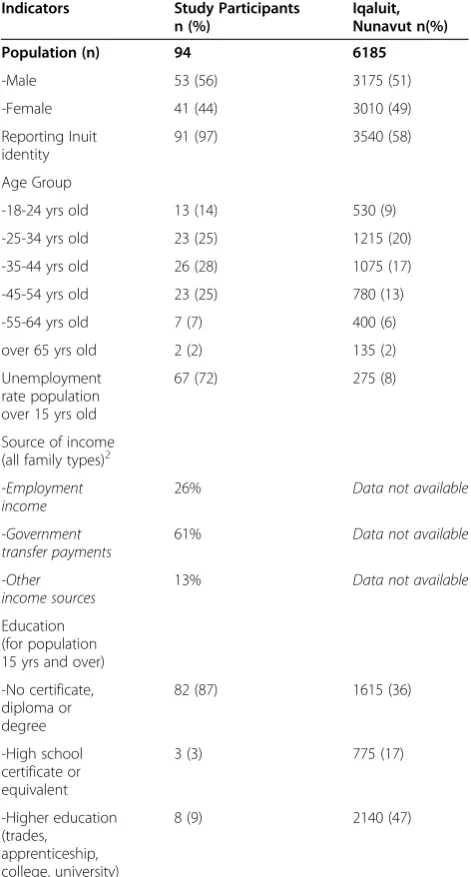
[image:3.595.56.292.114.553.2]A census of clientele using CFPs during May 2010 (n = 94) was conducted. This involved the research team visiting the food programs during hours of operation, at which time users were randomly asked to participate. Sampling continued over a 4 week period until theoret-ical saturation was reached, at which no new users were identified. Each participant was first asked a series of fixed-choice close-ended survey questions covering socio-demographic-livelihood characteristics, food ac-cess, and frequency of use of CFPs (Table 2). A locally adapted version of the U.S. Department of Agriculture Food Security Module (FFSM) was then administered. Due to the fact that the target population consisted of regular users of CFPs, it was assumed that they already experienced food insecurity and the survey therefore used only 4 locally adapted questions of the standard 6 item subset of the 12 month FFSM, which are also part of the core domains of the food insecurity experience shared across cultures [52]. These questions focus on the experience of not having enough food in the house-hold, reducing food portions and switching to cheaper Table 1 Socio-economic demographic data for Iqaluit,
based on the 2006 Census1
Indicators Study Participants
n (%)
Iqaluit, Nunavut n(%)
Population (n) 94 6185
-Male 53 (56) 3175 (51)
-Female 41 (44) 3010 (49)
Reporting Inuit identity
91 (97) 3540 (58)
Age Group
-18-24 yrs old 13 (14) 530 (9)
-25-34 yrs old 23 (25) 1215 (20)
-35-44 yrs old 26 (28) 1075 (17)
-45-54 yrs old 23 (25) 780 (13)
-55-64 yrs old 7 (7) 400 (6)
over 65 yrs old 2 (2) 135 (2)
Unemployment rate population over 15 yrs old
67 (72) 275 (8)
Source of income (all family types)2
-Employment income
26% Data not available
-Government transfer payments
61% Data not available
-Other income sources
13% Data not available
Education (for population 15 yrs and over)
-No certificate, diploma or degree
82 (87) 1615 (36)
-High school certificate or equivalent
3 (3) 775 (17)
-Higher education (trades,
apprenticeship, college, university)
8 (9) 2140 (47)
1
Nunavut Bureau of Statistics.Census Data 2006.www.eia.gov.nu.ca/stats/ census.html.
Accessed 12 September 2010.
2
foods. Questions on coping strategies were adapted from the coping strategies index developed by Maxwell et al. [53]. Following the survey, open-ended questions were asked in order to examine and document, in the user’s own words, perceptions of the services offered, why they were using the food programs, and the nature of food insecurity experienced.
Participants received a $40 CAN gift card for the local supermarket for their time and all questions were asked in the language of choice (English or Inuktitut). Recruitment and interviewing took place during hours of operation of the respective programs and in a private setting to ensure confidentiality. The questions were pre-tested and evalu-ated by the team to ensure appropriateness and effective-ness. Additional data was obtained from handwritten records on utilization kept by the food bank (for 2007– 2009), soup kitchen (for 2005–2009), and Tukisigiarvik (for 2003–2009), which were entered into excel for ana-lysis. Key informant interviews were also conducted with the territorial nutritionist, personnel at the CFPs, and the Quajigiartiit Health Research Network, the Nunavut Re-search Institute and the Inuit Institute for ReRe-search and Planning to obtain multiple perspectives on utilization, and complimented by participant observation in which researchers volunteered at the various CFPs.
Analysis
Data were analyzed in SPSS 15.0. Basic descriptive statis-tics were used to describe the sample population, responses to each question, and to ascertain the distribu-tion of responses by age, sex, occupadistribu-tion, and hunting be-haviour. Chi-squared (x2) analysis and Fischer exact tests were performed to test for significant differences between participant characteristics and response to questions, and to compare the sample population with that of Iqaluit (where community-level data was available). Significance was set at p<0.05. Open-ended questions were used to explore participant’s experiences and perceptions of CFPs in Iqaluit. Coding was used to sort qualitative answers in content related categories by using non-automated fre-quency counts and through latent content analysis.
Results
Ninety four interviews were conducted. Socio-demographic characteristics of the sample population are provided in Table 1.
Community food programs in Iqaluit are widely used and valued
[image:4.595.57.540.90.222.2] [image:4.595.59.538.627.729.2]In 2008–2009, the food bank distributed food to 365 households (18.1% of total number of households in Figure 1Number of household units visiting the food bank per month from 2007 to 2009.Note: Household unit refers to any type of family: single individual, homeless, family living on their own. In 2007, the food bank operated over 7 months and had 18 delivery days. In 2008, the food bank operated over 12 months and had 28 delivery days. In 2009, the food bank operated over 9 months and had 13 delivery days. In 2007 and 2009, the Food Bank was closed during the summer months.
Table 2 Key areas explored in the surveys and open-ended questions
Survey–Key areas Open-ended questions
- Socio-demographic information:birth town, sex, age group, education level, number of people in household, income level, etc.
- Perception of services:Are they helping your situation? How so? How do you feel when you use the services?
- Access to country foods: hunter in the household, access to sharing, main source of country foods, etc.
- Challenges to be food secure:What are the main obstacles to be food secure?
- Food security and coping strategies:not enough food in the past 12 months, reducing portions for oneself or others in the household, skipping meals, selling belongings, etc.
- What are the most difficult times during the month, during the year? What makes those times more difficult to have enough food?
Iqaluit based on 2006 census). Peaks in attendance occur in early winter (November, December), while fewer cli-ents used their services in the fall and summer (Figure 1). The soup kitchen had an average of 275 days of oper-ation per year between 2005 and 2009, and serves an average of 9984 meals annually, primarily to adults (Figure 2). The soup kitchen had its peak attendance in 2005, receiving an average of 43 people per operation day during its first year of operation when it was open seven days per week for lunch and dinner, and every month of the year. In recent years the soup kitchen’s operation has been curtailed with a reduction of service from two meals per day seven days a week, to one meal per day five days a week. In 2009, it served meals to an average of 36 people per day. Tukisigiarvik received 3828 drop-ins in 2008– 2009, an increase from the 3690 drop-ins that were made in 2004–2005. These drop-ins include stopping for coun-selling, sharing traditional foods, doing laundry and participating in cultural activities.
"When I come [to the soup kitchen], it reduces the number of people to feed in my house" (female, 35– 44 yrs old, full time worker)
"We don’t have a choice, we don’t have money to buy food" (male, 45–54 yrs old, unemployed)
"The food bank is very helpful, especially having 2 small kids who don’t understand there is no food"(female, 45–54 yrs old, unemployed)
"We can’t find people to help. If it weren’t for these services, we would go hungry" (female, 45–54 yrs old, unemployed)
CFPs were highly valued among users, with 82% report-ing that they regularly help alleviate hunger, while the
absence of other options for accessing food during times of need was widely noted. Participants explained that these programs provide more than a source of food, increasing a sense of well-being by decreasing anxiety about not being able to afford food and reducing feelings of helplessness:
"I feel really bad when children are hungry, and I like knowing that these organizations can help them" (female, 18–24 yrs old, unemployed)
"Makes it easier, because I have no money or work" (female,35-44 yrs old, unemployed)
"When I get very depressed from hunger, they lift me up" (female, 45–54 yrs old, part time worker)
"It would be really stressful if [the food programs] didn’t exist" (male, 25–34 yrs old, unemployed)
"There would be a lot more social problems without these organisations" (male, 25–34 yrs old, unemployed)
Repeat use is common
employment status (employment defined as a wage earn-ing activity and includearn-ing part time work), nor place of birth and frequency of use of CFP’s. However, a small sample size, particularly for those employed and not using CFP’s, is likely to have reduced statistical power to detect an association between employment and CFP use. A larger sample size would be required to detect an association.
Users are primarily Inuit, born in Iqaluit, unemployed and did not complete high school
Comparing the prolife of CFP users with socio-economic indicators of Iqaluit obtained from the 2006 census indi-cates that users are significantly more likely to be Inuit (p<0.01 Fisher’s Exact test), with 97% self identifying as Inuit compared to 58% for the community as a whole. Users were also more likely to be unemployed (p<0.01 Chi-squared test), with 72% reporting to be unemployed at the time of the survey: eight times greater than the community as a whole. Twelve percent reported working full time, 7% worked part time, 4% were full-time hunters or fishers and 2% were involved in traditional craft pro-duction (i.e. carving). Significantly fewer users reported completing high school (13%) (p<0.01 Chi-squared test) compared to the general population, where 66% com-pleted high school. Twelve percent reported having some post secondary education, primarily involving learning a trade. No statistical relationships were documented be-tween users and the general population for gender, where 56% of respondents were male and 46% female, or age.
The majority of users (76%) were born in Iqaluit and of those born elsewhere, over three quarters were from other Nunavut communities and two thirds had lived for more than five years in Iqaluit. Social assistance was the main source of income for 61% of respondents, whereas employment was the main source of income for 26% of participants, with another 13% reporting other benefits or non waged work, such as carving, as their main source of income (Table 1). While the majority of employed participants said that the main source of in-come in their household was from employment, some said that although they were employed, the main source of income in their household was from income support. In some cases, participants lived in households where they were the only employed member of the household and their salary could not support all members in the household. In such cases, they considered that the main source of income at the household level was from in-come support.
When asked if income was enough for their needs, 57% of respondents answered rarely or never. Lack of adequate shelter was a concern for many users, with 16% of respondents either homeless or living in shelters at the time of the interview. Others reported living alone
(23%), in households with 2 people (16%), 3–4 people (31%), 5 to 8 people (21%), and 9 or more (9%). Of those participants (46%) who said that there where times dur-ing the year when they had more people in their house, 30% said that the reason for this was because they had to help out family members and friends who had no-where else to stay. Lack of shelter was identified as a major constrant to accessing food. As one partcipant said,"It is hard to have food in the house when there is no house." (male, 25–34 yrs old, homeless)
The majority of users live in households without hunters
Three quarters of respondents reported living in a household without a hunter, which was described as making it difficult to obtain traditional food on a regular and predictable basis. While most (72%) reported that they could access traditional foods through sharing, this is dependent on the hunting success of family members and friends and on their willingness to share. Close to one third (28%) of the respondents said that they did not have anyone who could share country food with them, and there was no difference between men or women. Tukisigiarvik provides an important source of traditional foods herein and represented the main source of trad-itional foods for 33% of respondents. Equally, living in a household with a hunter did not protect against running out of food in the house and being unable to acquire more, as there was no statistically significant difference in the number of households with or without a hunter reporting running out of food in the past year. Also, there was no statistically different level of use of any of the three community food programs between house-holds with a hunter and househouse-holds without a hunter.
Users are regularly not able to access food and CFP use is one of a number of coping mechanisms
food in the household included: lack of money (36%), unemployment (27%), having to help others (12%), addictions (8%) and food being too expensive (6%).
Early winter is the most difficult time to access food
Over half of the respondents (54%) said that early winter (November, December) was the most difficult time of the year to access food, with fewer reporting fall or spring (9%) or the summer (7%), to be difficult times. One fifth (21%) of respondents said that they saw no dif-ference in difficulties accessing food between seasons. Utilization data indicates that these are generally the times of greatest usage of CFPs, although the records are temporally limited. One fifth of respondents reported that there were no differences between seasons when accessing food. Reasons given to explain why certain times were more difficult than others during the year were because there was less hunting in the community (31%), bad weather (14%), because expenses go up during that time (15%) and due to unemployment or lack or stable employment (10%). Also, 17% of respondents mentioned that the most difficult time of the year was when services providing food where closed. Services sometimes close during bad weather events, holidays, the summer or when their own staff or volunteers are in insufficient numbers to operate the facilities. When asked about difficult times of the month, the majority (45%) said it was when they had insufficient money in the household, mostly due to income support being too low, and while they were between cheques (36%).
"In the winter, there are less country foods. Foods at the store are more expensive, there are more things to pay for"
"Between income support cheques, I am broke"
Limited access to financial means reported as the main challenge to achieving food security
Finally, when asked about the main challenge to achiev-ing a sense of food security at the household level, 35% of participants answered unemployment. Closely follow-ing unemployment was income support befollow-ing too low or not having enough money (26%) and the need to sup-port other members of the family or household crowd-ing (14%). The high cost of food was the main difficulty for 12% of respondents, dealing with addictions was the main challenge for 8% of participants and 6% of answers had various other reasons.
Discussion
To our knowledge, this is the first study to document and examine utilization of CFPs in the Canadian Arctic, and the Arctic more generally. The data provide a
snapshot of utilization at a specific point in time (May 2010), and while we interviewed all users over a 4-week period, we recognize that we will have missed those who use the programs at other times of the year. The study describes users of CFPs who typically have a low level of formal education, are unemployed, rely on social assist-ance, and have a low household income. This is not sur-prising, with utilization profiles similar to those in southern urban centres [54,55]. Contrary to our expect-ation that new arrivals to Iqaluit would be overrepre-sented in utilization of CFPs reflecting the breadth and quality of their social ties, the majority of users were born in Iqaluit, and of those from elsewhere, the major-ity had been living in Iqaluit for more than five years. Lack of shelter is a challenge facing many CFP users, es-pecially‘hidden homelessness’characterized by a lack of a secure and permanent dwelling, involving individuals and families moving from one temporary housing situ-ation to another [51,56]. These situsitu-ations are typical for users of CFPs, and compound challenges of finding a job, getting an education, recovering from previous trauma, and achieving food security. Housing is a broader problem in Nunavut, where overcrowding in substandard houses is widespread [47,51,57]. While ad-dictive behaviour was reported by 9% of participants as a reason why they had difficulties obtaining food, this likely reflects the nature of the research approach (i.e. formal survey/interview), with key informants and some users noting that addiction is major problem facing those using CFPs. We did not detect an association be-tween employment status, place of birth, gender, age, presence of hunter in the household and utilization of CFPs. This is likely due to both low sample size, as well as low variation in the data.
communities in the eastern Arctic, beginning with the building of a US Air Force base in 1942 [47,62,64]. This was accompanied by rapid socio-cultural change with the associated development of the formal education system, relative decline in hunting, expansion of the wage-based economy, and rapid population growth [17,65-69], with implications for how food is produced, processed, distribu-ted, and consumed, and hence food security.
The nutrition transition is one consequence of these broader influences, with the rising consumption of store foods at the expense of traditional foods widely docu-mented across Inuit communities [4,33], access to which is determined by monetary resources in contrast to the moral economy of reciprocity and exchange that gov-erned access to traditional food [17,18,70,71]. There was historically little need for formalized food programs, as household sharing networks would ensure food access (except during periods when wildlife resources were scarce). Sharing networks continue to be important for Inuit–differentiating the northern CFP experience from that in the south – and the majority of respondents reported that they could access traditional foods through such networks, which is important given the limited number of participants who reported having hunters in the household. Nevertheless, as documented here and elsewhere, in a contemporary context in which hunting is expensive, harvest success is being affected by climate change, and fewer people are engaging in harvesting activities, increasing demands are being placed on diminishing supply of traditional foods [21,61,72-78]. Sharing outside of the household – the primary means of traditional food access for CFP users – is therefore often unpredictable and infrequent, especially for those with less to offer in terms of reciprocity (e.g. material resources). For the more vulnerable members of the community who do not have access to financial resources or have stable housing, this diminished social safety net leaves few alternatives but to use CFPs. The vulnerability of sharing networks is particularly apparent in enhanced CFP usage in November and December, times of the year when traditional foods are hard to ac-cess due to ice freeze-up and uncertain snow conditions on inland trails which limit the ability to hunt [73,79]. At these times, sharing concentrates among those in the immediate household and for elders.
Another consequence of these broader changes has been significantacculturative stressamong northern populations, linked to the rapid changes in livelihoods and culture, and experience of residential schools [10,12,80-83]. Many of the older respondents were born and raised in small hunting camps, resettled in Iqaluit, spent time at tuberculosis sana-toria in southern Canada in the 1950s and 60s, and now live in a modern community. The significant associated acculturative stress and intergenerational trauma provides
the context for many of the social and health challenges fa-cing Inuit communities including Iqaluit [13,74]. Thus the financial constraints faced by many CFP users reflect more than the cost of food and unemployment; they are exacer-bated by household financial management skills, problems of addiction, and poor living conditions associated with ac-culturation and recent development of the monetary econ-omy [63,82,84]. Similarly, problems of addiction need to be situated in the context of past abuse and also changing rela-tionships with the environment. The land is a fundamental component of Inuit culture and central to health and well-being–both through the act of hunting and being on the land, and also the act of sharing and consuming traditional foods– yet for CFP users this link was often lacking: few were able to afford to hunt, instead relying on sharing for traditional food access. This directly affects food availability, but also has broader ramifications for well-being [85].
In-light of the magnitude of food insecurity in the Canadian north, food policy is increasingly recognized as a central component of anti-poverty/community develop-ment strategies. Addressing the broader determinants of food insecurity is essential for such policy interventions, yet the pervasiveness and persistence of these causes despite recognition at a policy level is indicative of the challenging nature of intervention required. Moreover, at a community level, such ultimate causes are often beyond the scope of what can be achieved, necessitating broad-scale territorial and federal involvement [14]. In this context, while CFPs do not address root causes, they provide a valuable service for a community undergoing rapid change. While it has been argued in the general scholarship and among some northern commentators that CFPs can create dependency and thereby increase food insecurity in the long-term, users in Iqaluit have few alternative sources of food, and numer-ous barriers make it difficult for users to obtain waged em-ployment necessary for food access. CFPs also provide much more than food. They offer a safe place to go, and in the case of Tukisigiarvik, provide access to culturally im-portant traditional foods which many otherwise would not have access to. Herein, this work suggests a number of priorities for food policy in Iqaluit:
than just food for those in need including
counselling, cultural activities, advice on life skills, and structure.
Promotion of traditional foods at the food bank and soup kitchen. Many participants expressed their gratitude towards the foods offered at the food bank and soup kitchen. However, many also expressed desire to see traditional foods being incorporated in the menus of the soup kitchen, or being offered at the food bank because of the difficulty they have obtaining them otherwise, and more diversity of foods offered. Currently however, the food bank can not serve traditional foods harvested locally because of food safety regulations.
Education on how to make the best of store foods offered at the food bank.Items offered through the food bank are through local donations, and users often reported not knowing how to make use of the food received. The development of cooking classes, pamphlets with recipes, and workshops that teach users how to get the most nutritional value out of the distributed foods were identified as important, and could be undertaken at little cost.
In addition, a number of broader initiatives are needed to strengthen the traditional food
component of the food system. Maintaining access to traditional foods is widely recognized as essential for secure food systems in Inuit communities, providing culturally valued nutritious food [14,59].
Enhanced support mechanisms to ensure that CFP users can access hunting equipment.Many participants reported having to sell hunting
equipment to access money to buy food, resulting in short term access to material resources but loss of the means of harvesting in the long term, with associated food security implications. Many also reported having hunting skills but no equipment, or could not go hunting because of the cost associated with hunting. A number of hunter support
mechanisms are available in Nunavut, and were reviewed by Ford et al. [73,86]. The challenge for CFP users is that many would not meet the
requirements for such support mechanisms, while in a community the size of Iqaluit demand for
assistance significantly exceeds the resources available. An alternative intervention to the individual focused grants aimed at full time hunters would be a co-op system to allow community members without equipment to access hunting gear. This would provide access for those who want to harvest part-time, prevent people from feeling the need to sell hunting equipment, and spread limited resources around the community. As one
participant said:"I used to be able to hunt before
moving here, but not anymore, because I don’t have gear"(male, 25–34 years old, unemployed.
Sharing networks to distribute country foods need to be preserved and facilitated:Sharing of traditional foods remains important in Iqaluit and for CFP users, although the long-term sustainability of such practices has been questioned in light of socio-economic transformations. Initiatives that facilitate the sharing of traditional foods are needed, with community freezers, reduced cargo cost for shipping of traditional foods between communities, support for the new traditional food market in Iqaluit, subsidies on traditional foods sold at stores, and subsidies to hunters to allow them to go hunting, all offering potential entry points.
Conclusions
Community food programs (CFPs) provide an important service to chronically food insecure households in Iqaluit, Nunavut. Users are among the most vulnerable community members, and typically have low level of education, are un-employed, have limited access to material resources, and have insecure housing. These challenges reflect a complex socio-cultural-political context reflecting rapid transform-ation in Inuit livelihoods over the past half century, com-bined with the high cost of living in the north. The baseline study identifies a number of community level priorities for intervention including continuing support for CFPs, pro-motion of traditional foods at the food bank and soup kit-chen, education of using foods offered through CFPs, alongside broader policies to support the harvesting sector. Future research will examine policy interventions in greater depth, with the territorial and federal government increas-ingly cognizant of the challenges faced by the most vulner-able of Arctic residents.
Competing interests
The authors declare that they have no competing interests.
Authors' contributions
JF and MPL conceived the study and participated in its design and coordination. MPL and WV conducted the field work in Iqaluit. MPL conducted statistical data analysis. JF and MPL wrote the manuscript. All authors read and approved the final manuscript.
Acknowledgements
Received: 14 February 2012 Accepted: 5 June 2012 Published: 21 June 2012
References
1. Ledrou I, Gervais J:Food Insecurity. Health Reports cat no 82–003-XIE. Ottawa: Statistics Canada; 2005:11–22.
2. Ford JD, Berrang-Ford L:Food security in Igloolik, Nunavut: an exploratory study.Polar Rec2009,45:225–236.
3. Lawn J, Harvey D:Nutrition and food security in Kugaaruk, Nunavut: Baseline survey for the food mail pilot project. Ottawa: Department of Indian and Northern Affairs; 2003.
4. Egeland GM, Pacey A, Cao Z, Sobol I:Food insecurity among Inuit preschoolers: Nunavut Inuit Child Health Survey, 2007–2008.Can Med Assoc J2010,182:243–248.
5. Egeland GM, Johnson-Down L, Cao ZR, Sheikh N, Weiler H:Food insecurity and nutrition transition combine to affect nutrient intakes in canadian arctic communities.J Nutr2011,141:1746–1753.
6. Johnson-Down L, Egeland GM:Adequate nutrient intakes are associated with traditional food consumption in Nunavut Inuit children aged 3–5 years.J Nutr2010,140:1311–1316.
7. Willows ND:Determinants of healthy eating in aboriginal peoples in Canada - The current state of knowledge and research gaps.Can J Public Health2005,96(Suppl 3):32–36.
8. Abnizova A, Young KL:Hillslope hydrological linkages: Importance to ponds within a polar desert High Arctic wetland.Hydrol Res2008, 39:309–321.
9. Wilson K, Young TK:An overview of Aboriginal health research in the social sciences: Current trends and future directions.Int J Circumpol Heal 2008,67:179–189.
10. Young KL, Bjerregaard PB:Inuit. InHealth Transitions in Arctic Populations. Edited by Young KL, Bjerregaard PB. Toronto: University of Toronto Press; 2008:119–133.
11. Power EM:Conceptualizing food security for Aborginal people in Canada.Can J Public Health2008,99:95–97.
12. Richmond CAM, Ross NA:The determinants of First Nation and Inuit health: A critical population health approach.Health Place2009,15:403–411. 13. Richmond CAM:The social determinants of Inuit health: A focus on social
support in the Canadian Arctic.Int J Circumpol Heal2009,68:471–487. 14. Damman S, Eide WB, Kuhnein HV:Indigenous peoples' nutrition transition
in a right to food perspective.Food Policy2008,33:135–155. 15. Nancarrow TL, Chan HM:Observations of environmental changes and
potential dietary impacts in two communities in Nunavut, Canada.Rural Remote Heal2010,10:1370.
16. Poppel B, Kruse J, Duhaime G, Abryutina L:SLiCA Results. In Institute of Social and Economic Research, Anchorage: University of Alaska Anchorage; 2007.
17. Wenzel G:Animal Rights, Human Rights: Ecology, Economy, and Ideology in the Canadian Arctic. Toronto: University of Toronto Press; 1991. 18. Wenzel G:Ningiqtuq: Resource sharing and generalized reciprocity in
Clyde River, Nunavut.Arct Anthropol1995,32:43–60.
19. Collings P:Subsistence hunting and wildlife management in the central Canadian Arctic.Arctic Anthropol1997,34:41–56.
20. Collings P, Wenzel G, Condon RG:Modern food sharing networks and community integration in the Central Canadian Arctic.Arctic1998, 51:301–314.
21. Wenzel G:Canadian Inuit subsistence and ecological instability- if the climate changes, must the Inuit?Polar Res2009,28:88–89.
22. Chabot M:Economic changes, household strategies, and social relations in contemporary Nunavik Inuit.Polar Rec2003,39:19–34.
23. Duhaime G, Chabot M, Gaudreault M:Food consumption patterns and socio-economic factors among the Inuit of Nunavik.Ecol Food Nutr2002, 41:91–118.
24. Duhaime G, Chabot M, Frechette P, Robichaud V, Proulx S:The impact of dietary changes among the Inuit of Nunavik (Canada): A socioeconomic assessment of possible public health recommendations dealing with food contamination.Risk Anal2004,24:1007–1018.
25. Collings P:Economic strategfies, community, and food networks in Ulukhaktok, Northwest Territories, Canada.Arctic2011,64:207–219. 26. Gombay N:The commoditization of country foods in Nunavik: A
comparative assessment of its development, applications, and significance.Arctic2005,58:115–128.
27. Gombay N:From subsistence to commercial fishing in Northern Canada -The experience of an Inuk entrepreneur.Brit Food J2006,108:502–521. 28. Dewailly É, Ayotte P, Blanchet C, Grondin J, Bruneau S, Holub B, Carrier G: Weighing contaminant risks and nutrient benefits of country food in Nunavik.Arctic Med Res1996,55:13–19.
29. Donaldson SG, Van Oostdam J, Tikhonov C, Feeley M, Armstrong B, Ayotte P, Boucher O, Bowers W, Chan L, Dallaire F,et al:Environmental contaminants and human health in the Canadian Arctic.Sci Total Environ 2010,408:5165–5234.
30. Furgal C, Bernier S, Godinf G, Gingras S, Grondin J, Dewailly E:Decision making and diet in the North: Balancing the physical, economic and social components. InSynopsis of research conducted under the 2000–2001 Northern Contaminants Program. Edited by Kalhok S. Ottawa: Department of Indian Affairs and Northern Development; 2001:42–43.
31. Kuhnlein HV, Receveur O:Dietary change and traditional food systems of indigenous peoples.Annual Rev Nutr1996,16:417–442.
32. Kuhnlein H, Soueida R, Receveur O:Dietary nutrient profiles of Canadian Baffin Island Inuit by food source, season, and age.J Am Diet Assoc1996, 96:155–162.
33. Kuhnlein HV, Receveur O, Soueida R, Egeland GM:Arctic indigenous peoples experience the nutrition transition with changing dietary patterns and obesity.J Nutr2004,134:1447–1453.
34. Receveur O, Boulay M, Kuhnlein H:Decreasing traditional food use affects diet quality for adult Dene/Métis in 16 communities of the Canadian Northwest Territories.J Nutr1997,127:2179–2186.
35. Kuhnlein HV, Receveur O, Chan HM:Traditional food systems research with Canadian indigenous peoples.Int J Circumpol Heal2001,60:112–122. 36. Galloway T, Young TK, Egeland GM:Emerging obesity among
preschool-aged Canadian Inuit children: results from the Nunavut Inuit Child Health Survey.Int J Circumpol Heal2010,69:151–157.
37. Sharma S, Cao X, Roache C, Buchan A, Reid R, Gittelsohn J:Assessing dietary intake in a population undergoing a rapid transition in diet and lifestyle: the Arctic Inuit in Nunavut, Canada.Brit J Nutr2010,103: 749–759.
38. Hopping BN, Mead E, Erber E, Sheehy C, Roache C, Sharma S:Dietary adequacy of Inuit in the Canadian Arctic.J Hum Nutr Diet2010, 23(Suppl 1):27–34.
39. Hopping BN, Erber E, Mead E, Roache C, Sharma S:High levels of physical activity and obesity co-exist amongst Inuit adults in Arctic Canada. J Hum Nutr Diet2010,23(Suppl 1):110–114.
40. Hopping BN, Erber E, Mead E, Sheehy T, Roache C, Sharma S:
Socioeconomic indicators and frequency of traditional food, junk food, and fruit and vegetable consumption amongst Inuit adults in the Canadian Arctic.J Hum Nutr Diet2010,23(Suppl 1):51–58.
41. Acosta-Michlik L, Kelkar U, Sharma U:A critical overview: Local evidence on vulnerabilities and adaptations to global environmental change in developing countries.Global Environ Change2008,18:539–542. 42. Sharma S:Assessing diet and lifestyle in the Canadian Arctic Inuit and
Inuvialuit to inform a nutrition and physical activity intervention programme.J Hum Nutr Diet2010,23(Suppl 1):5–17.
43. Sharma S:Development and use of FFQ among adults in diverse settings across the globe.Proc Nutr Soc2011,70:232–251.
44. Egeland GM, Faraj N, Osborne G:Cultural, socioeconomic, and health indicators among Inuit preschoolers: Nunavut Inuit Child Health Survey, 2007–2008.Rural Remote Heal2010,10:1365. online.
45. Beaumier M, Ford J:Food insecurity among Inuit females exacerbated by socio-economic stresses and climate change.Can J Public Health2010, 101:196–201.
46. Searles E:Inuit identity in the Canadian Arctic.Ethnology2008,47: 239–255.
47. Searles E:Placing Identity: Town, Land, and Authenticity in Nunavut, Canada.Acta Boreal2010,27:151–166.
48. Lardeau MP, Healey G, Ford J:The use of Photovoice to document and characterize the food security of users of community food programs in Iqaluit, Nunavut.Rural Remote Heal2011,11:1680. online.
49. Morin A, Edouard R, Duhaime G:Beyond the harsh. Objective and subjective living conditions in Nunavut.Polar Rec2010,46:97–112. 50. Gross domestic product by industry, millions of chained (2002) dollars.
52. Coates JC, Webb P, Houser RF, Rogers BL, Wilde P:"He said, she said": who should speak for households about experiences of food insecurity in Bangladesh?Food Secur2010,2:81–95.
53. Maxwell DG:Measuring food insecurity: The frequency and severity of ''coping strategies''.Food Policy1996,21:291–303.
54. Hamelin A-M, Mercier C, Bedard A:Needs for food security from the standpoint of Canadian households participating and not participating in community food programmes.Int J Consum Stud2011,35:58–68. 55. Rose D:Economic determinants and dietary consequences of food insecurity in the United States.J Nutr1999,129(Suppl 2S):517–520. 56. Qulliit Nunavut Status of Women Council:A Study of Women's Homelessness
North of 60: Territorial Report. Iqaluit:; 2007.
57. Statistics Canada for the Nunavut Housing Corporation:An analysis of the housing needs in Nunavut: Nunavut housing needs survey 2009/2010. Iqaluit; 2010.
58. Coates J, Frongillo EA, Rogers BL, Webb P, Wilde PE, Houser R: Commonalities in the experience of household food insecurity across cultures: What are measures missing?J Nutr2006,136:1438–1448. 59. Theriault S:The food security of the Inuit in times of change" alleviating
the tension between conserving biodiversity and access to food.J Hum Rights Environ2011,2(2):136–156.
60. Sharma S, Gittelsohn J, Rosol R, Beck L:Addressing the public health burden caused by the nutrition transition through the Healthy Foods North nutrition and lifestyle intervention programme.J Hum Nutr Diet 2010,23(Suppl 1):120–128.
61. Ford JD, Beaumier M:Feeding the family during times of stress: experience and determinants of food insecurity in an Inuit community. Geogr J2011,177:44–61.
62. Damas D:Arctic Migrants/Arctic Villagers. Montreal and Kingston: McGill-Queens University Press; 2002.
63. Tester FJ, Irniq P:Inuit Qaujimajatuqangit: Social History, Politics and the Practice of Resistance.Arctic2008,61(Suppl 1):48–61.
64. Meldrum SM:Frobisher Bay: An Area Economic Survey 1966–1969. Ottawa: Indian Affairs and Northern Development; 1975.
65. Brody H:Inuit land use in northern Baffin Island and northern Foxe Basin. InInuit Land Use and Occupancy Project. 1st edition. Edited by Freeman MR. Ottawa: Department of Indian Affairs and Northern Development; 1976: 153–172.
66. Brody H:Inummariit: The real Eskimos. InInuit land use in northern Baffin Island and northern Foxe Basin. 2nd edition. Edited by Freeman MR. Ottawa: Thorn Press Limited; 1976:223–226.
67. MacBain S:The evolution of Frobisher Bay as a major settlement in the Canadian Eastern Arctic. Montreal: McGill University; 1970. 68. Carpenter W:Canada’s Own Eskimo Dog. . .on the brink of extinction.
February: In North/Nord; 1976.
69. Katsualik G:Good Times and Bad Times. InRecollections of Inuit elders: in the days of the whalers, and other stories. Eskimo Point: Inuit Cultural Institute; 1986.
70. Kishigami N:Contemporary Inuit food sharing and the hunter support program of Nunavik, Canada. InThe Social Economy of Sharing: Resource Allocation and Modern Hunter-Gatherers. Edited by Wenzel G, Hovelsrud-Broda G, Kishigami N. Osaka: Senri Ethnological Studies; 2000:171–192. 71. Kishigami N:A new typology of food sharing practices among hunter
gatherers, with a special focus on Inuit examples.J Anthropol Res2004, 60:341–358.
72. Ford JD:Vulnerability of Inuit food systems to food insecurity as a consequence of climate change: a case study from Igloolik, Nunavut.Reg Environ Change2009,9:83–100.
73. Ford JD, Ford J, Pearce T, Duerden F, Furgal C, Smit B:Climate change policy responses for Canada’s Inuit population: The importance of and opportunities for adaptation.Global Environl Change2010,20:177–191. 74. Ford JD, Berrang-Ford L, King M, Furgal C:Vulnerability of Aboriginal
health systems in Canada to climate change.Global Environ Change2010, 20:668–680.
75. Pearce T, Smit B, Duerden F, Ford J,et al:Inuit vulnerability and adaptive capacity to climate change in Ulukhaktok, Northwest Territories, Canada. Polar Rec2010,24:1–21.
76. Wesche SD, Chan HM:Adapting to the Impacts of Climate Change on Food Security among Inuit in the Western Canadian Arctic.EcoHealth 2010,7:361–373.
77. Lambden J, Receveur O, Marshall J, Kuhnlein HV:Traditional and market food access in Arctic Canada is affected by economic factors.Int J Circumpol Heal2006,65:331–340.
78. Guyot M, Dickson C, Paci C, Furgal C, Chan H:Local observations of climate change and impacts of traditional food security in two northern aboriginal communities.Int J Circumpol Heal2006,65:403–415. 79. Ford J, McDowell G, Shirley J,et al:Capturing the dynamic multi-scale
nature of climate change vulnerability using a longitudinal community-based monitoring approach: An Inuit harvesting example.Ann Assoc Am Geogr. In review.
80. Kvernmo S, Heyerdahl S:Acculturation strategies and ethnic identity as predictors of behavior problems in arctic minority adolescents.J Am Acad Child Psy2003,42:57–65.
81. Segal B, Saylor B:Social transition in the north: comparisons of drug-taking behavior among Alaska and Russian natives.Int J Circumpol Heal 2007,66:71–76.
82. Lehti V, Niemela S, Hoven C, Mandell D, Sourander A:Mental health, substance use and suicidal behaviour among young indigenous people in the Arctic: A systematic review.Soc Sci Med2009,69:1194–1203. 83. Richmond CAM, Ross NA:Social support, material circumstance and
health behaviour: Influences on health in First Nation and Inuit Communities of Canada.Soc Sci Med2008,67:1423–1433. 84. Kral M:Unikkaartuit: Meanings of well-being, sadness, suicide, and
change in two Inuit communities. InFinal Report to the National Health Research and Development Programs, Health Canada; 2003:43.
85. Cunsolo-Willox A, Harper S, Landman K, Houle K, Ford J, The Rigolet Inuit Community Government:'The Land Enriches Our Soul’: On Environmental Change, Affect, and Emotional Health and Well-Being in Nunatsiavut, Canada.Emotion, Space & Society, in press.
86. Ford JD, Pearce T, Smit B, Wandel J, Allurut M, Shappa K, Ittusujurat H, Qrunnut K:Reducing vulnerability to climate change in the Arctic: The case of Nunavut, Canada.Arctic2007,60:150–166.
doi:10.1186/1471-2458-12-464
Cite this article as:Fordet al.:The characteristics and experience of community food program users in arctic Canada: a case study from Iqaluit, Nunavut.BMC Public Health201212:464.
Submit your next manuscript to BioMed Central and take full advantage of:
• Convenient online submission
• Thorough peer review
• No space constraints or color figure charges
• Immediate publication on acceptance
• Inclusion in PubMed, CAS, Scopus and Google Scholar
• Research which is freely available for redistribution