IN SEARCH OF THE RIGHT TROUSER PATTERN
- COMPARISON OF FOUR DIFFERENT PATTEN MAKING MATTHODS IN AFFORDANCE WITH DIFFERENT BODY SHAPES
Hye-Won Lim1*, Tracy Cassidy2, Simeon Gill³
1PhD Student, School of Design, University of Leeds, Leeds, UK, 2Lecturer, School of Design, University of Leeds, Leeds, UK,
3Lecturer, Clothing Design and Technology, Manchester Metropolitan University, Manchester, UK
Abstract: Clothing comfort is one of the major concerns in the clothing industry. Various pattern making methods have been introduced to the industry with consideration to clothing comfort. This study evaluates four pattern making methods known as the ESMOD, Bunka, Aldrich, and Armstrong methods. The work focuses on trouser patterns and uses two subjects who have similar height, weight and BMI but have different body shapes and body sizes. The body measurement data of the two subjects were collected using a three-dimensional body scanner and patterns of the four different methods were developed accordingly. The fit of experimental garments were examined by two subjects and experts using questionnaires and were analysed.
Keywords: Clothing comfort, Clothing fit, Fit preference, Fit evaluation
*Corresponding author: [email protected]
1. INTRODUCTION
One of the aspects of competitiveness in the clothing industry is to have professional pattern making skills, combined with fit proper suitability for customers and a speedy clothing manufacturing system. The popularity of female choosing to wear trousers has been on the rise in comparison with that of wearing skirts, especially in our modern society. Increasing demands for trousers include not merely their functional aspects but also aesthetic aspects, physical suitability and movement adaptability, as well as for a variety of designs. In this sense, it is necessary to understand body shapes and to develop enhanced trouser pattern blocks which reflect the specific characteristics of different pattern making methods.
The aim of this study is to compare four different trouser pattern making methods with a focus on fit for different body shapes and to examine the characteristics of each pattern making method by producing, analysing and evaluating both real garments and three-dimensional virtual simulated garments. Experiments for fit evaluations were designed to achieve the study aim and the key questions to answers are as follows.
Q1. Which method is most suitable for each subject?
Q2. Do the results of the fit evaluation show the same satisfaction between subject A and B / real garments and three-dimensional simulated garments?
2. METHODS
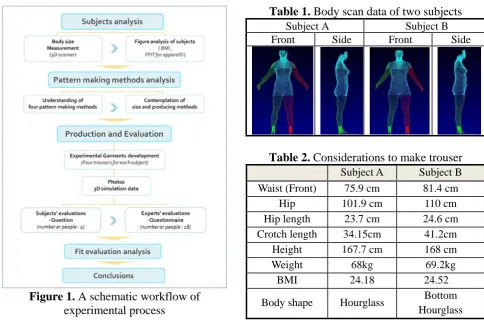
Figure 1. shows the methodology used for this study. The process as it occurred is follows:
Figure 1. A schematic workflow of experimental process
Table 1. Body scan data of two subjects
Subject A Subject B
Front Side Front Side
Table 2. Considerations to make trouser Subject A Subject B
Waist (Front) 75.9 cm 81.4 cm
Hip 101.9 cm 110 cm
Hip length 23.7 cm 24.6 cm
Crotch length 34.15cm 41.2cm
Height 167.7 cm 168 cm
Weight 68kg 69.2kg
BMI 24.18 24.52
Body shape Hourglass Bottom
Hourglass
statistics program SPSS 11.0 were used to calculate the mean and standard deviation; these were conducted to verify significant differences in each part. ■ Sixth, the results of the fit evaluations were analysed.
3. RESULTS AND FINDINGS
3.1. Findings of Subjects
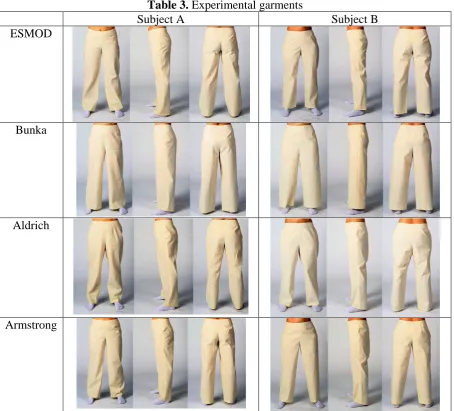
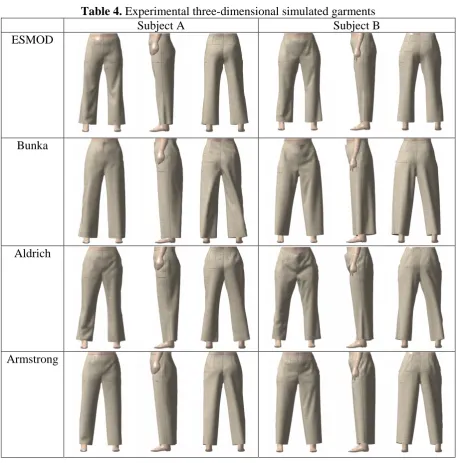
[image:3.595.72.527.359.770.2]Table 1. shows each subject’s three-dimensional body scanned data. Fundamental body sizes of each subject to make the trousers and division based on BMI and FFIT© are represented in Table 2. The two subjects who were chosen in this study have similar height, weight and BMI. However, they have predominant differences in hip size (8cm) which is almost a two size grading interval. In addition, their body shapes are different are being an Hourglass shape and the second a Bottom Hourglass shape. A total of eight experimental garments were produced. For the two subjects, four pattern methods for making trousers (ESMOD, Bunka, Aldrich, and Armstrong) were used to manufacture the garments (Table 3). The three-dimensional simulation results of the subjects were processed in order and represented in Table 4.
Table 3. Experimental garments
Subject A Subject B
ESMOD
Bunka
Aldrich
Table 4. Experimental three-dimensional simulated garments
Subject A Subject B
ESMOD
Bunka
Aldrich
Armstrong
3.2. Results of Fit Evaluation
Experts’ examinations: The appearance examinations were conducted by 18 experts who have background knowledge of pattern making. The experts examined the photos of the trouser fronts, sides, and backs respectively. The results of fit examinations on real garments and three-dimensional simulated garments were evaluated (Table 5).
4. ANALYSIS AND SUGGESTION
4.1. Analysis of fit evaluation results
(12.33) between Subjects A and B and it can be inferred that the overall satisfaction of Subject A was rated higher than Subject B (Table 6).
Table 5. Results of the appearance examinations
Real garments three-dimensional simulated garments
ESMOD Bunka Aldrich Armstrong ESMOD Bunka Aldrich Armstrong
A B A B A B A B A B A B A B A B
F mean 3.18 3.08 3.47 2.96 3.70 3.29 3.72 3.12 3.78 3.05 3.24 2.34 3.99 2.59 3.64 2.86
S.D. 0.34 0.21 0.31 0.27 0.26 0.19 0.23 0.28 0.19 0.14 0.31 0.31 0.07 0.46 0.11 0.19
S mean 3.49 3.46 3.85 3.42 3.83 3.39 3.92 3.36 3.78 3.29 3.29 2.92 3.65 2.51 3.65 3.08
S.D. 0.22 0.19 0.23 0.22 0.39 0.12 0.38 0.26 0.17 0.28 0.30 0.37 0.05 0.11 0.14 0.28
B mean 3.12 3.39 3.62 2.78 3.86 3.00 3.70 3.39 3.83 3.28 3.22 3.16 3.79 3.21 3.74 3.19
S.D. 0.44 0.11 0.18 0.23 0.22 0.28 0.17 0.24 0.20 0.09 0.21 0.18 0.17 0.19 0.24 0.15
O mean 2.94 3.17 3.61 2.67 3.44 2.67 3.78 3.17 3.56 2.61 2.83 2.06 3.61 2.17 3.78 2.67
Table 6. Result of the t-test: Real garments Real
garments
Subject A Subject B
N t-value p-value mean S.D. M.D. N t-value p-value mean S.D. M.D.
ESMOD 18 20.62 .000 83.05 17.08 4.02 18 35.57 .000 83.77 9.99 2.35
Bunka 18 35.44 .000 93.16 11.15 2.62 18 19.95 .000 81.33 17.29 4.07
Aldrich 18 32.64 .000 97.94 12.73 3.00 18 20.40 .000 85.61 17.8 4.19
Armstrong 18 42.13 .000 97.44 9.8 2.31 18 29.23 .000 84.05 12.19 2.87
Table 7. Result of the t-test: three-dimensional simulated garments three-
dimensional simulation
Subject A Subject B
N t-value p-value mean S.D. M.D. N t-value p-value mean S.D. M.D.
ESMOD 18 33.27 .000 98.44 12.55 2.95 18 25.74 .000 82.00 13.51 3.18
Bunka 18 26.65 .000 83.50 13.28 3.13 18 20.05 .000 70.83 14.98 3.53
Aldrich 18 27.84 .000 101.44 15.45 3.64 18 19.66 .000 73.16 15.78 3.72
Armstrong 18 36.47 .000 96 11.16 2.63 18 26.55 .000 78.61 12.56 2.96
Overall, the results of three-dimensional simulated garment examinations indicated that Aldrich method suited Subject A better but the ESMOD's method was deemed the most appropriate for Subject B (Table 7). As a consequence of an analytical t-test conducted in SPSS, the results of this experiment are said to be statistically significant in Subject A and B due to the p-value being less than 0.001.
5. CONCLUSIONS
Through this study, the suitability data of each subject was collected resulting in feedback from the fit evaluation. Even though this study was challenging, it has possibilities for improving the appropriate fit of trousers and for developing a better understanding of body shape and size.
Subject A and the ESMOD's method suited better for Subject B in the three-dimensional virtual simulated garment examination.
Through conducting the experiment and analysing the fit evaluations, the significant results were found and are described as follows.
Q1. Which method is suitable for each subject?:
As previously stated in the analysis of the fit evaluation results, it was suggested that the Aldrich method was the most suitable for Subjects A and B in the real garment examination. Furthermore, it was evaluated in the three-dimensional virtual simulated garment examination that Aldrich method better suited Subject A and the ESMOD's method better suited Subject B.
Q2. Do the results of the fit evaluation show the same satisfaction between Subjects A and B / real garments and three-dimensional simulated garments?:
Through the results from a t-test, it is shown that there is the minimum difference in the Bunka’s method in the evaluation of the real garments and three-dimensional virtual simulated garments. In addition, there is a considerable difference between the real garments and the three-dimensional simulated garments in the fit evaluation’s satisfaction rates (11.19 in mean difference).
During the research, there were some limitations which have influenced the overall results of the research and are listed as follows.
■ First, there are numerous variations to define clothing comfort and fit preference individually, which may be affected by ethnic group, culture, climate, age, etc. These may have affected the results in the fit evaluations. ■ Second, there were only two subjects in this research, and they were inadequate to represent prototypes of all body shapes. In addition, the number of experts who participated in the fit evaluation was also insufficient to form a generalisation. ■ Third, precise considerations about body shape were needed to develop the researcher’s suggested pattern. For example, there might be distinctive difference between wide hip and protruding hip even though each subject has the same hip circumference size.
It is suggested that, when choosing and analysing subjects for comparison, significant consideration should be given to body shapes and sizes. In order to increase the reliability of the results of questionnaires, it is recommended that more participants are used in the survey. In addition, it is expected that three-dimensional virtual simulation programs can provide precise images, equivalent to real photos.
References
[1] Devarajan P and Istook CL, Validation of ‘female figure identification technique (FFIT)’ for apparel software, Journal of Textile and Apparel, Technology and Management, 4 (1), (2004), pp.1-16.
[2] i-designer, Available from http://www.i-designer.co.kr/Accessed: 2013-07-08
[3] ESMOD Fashion School, Became a pattern drafter 2 – Women’s garment, ESMOD EDITIONS, The UK (2009)
[4] Bunka Fashion College, Bunka fashion series garment design textbook 3 – Skirts and Pants, Bunka Fashion College, South Korea (2010)