E u r o p e a n I n v e s t m e n t B a n k
~ \ r i ' ^ f ^ y ^ { ~ i ^ r i o ^ ^ / ' ' ^ f \ ^ ^ - ^ r i ^ ^
/ ^ ^ * ^ ^ ^
Den europaeiske Investeringsbarik
J D U LJ ® U U l H ( â U D ® U Û / J 4 ^ C ^ ^ ^ ' ^ ^ ^ ' ' ' ^ ^ mvestltiorìsbank
Banque Européenne d'Investissement
^ H B • • • M ^^^ \ · ^ ^ Banca Europea per gli Investimenti
B E I * E I B ^•*>>^<*^^ Europese Investeringsbank
No 21 · May 1980
ISSN 0250-3891Greece and the European Investment Bank
The treaty on Greece's accession to the European Community ('), signed In Athens on 28 May 1979, Is due to come Into force on 1 January 1981. As the Treaty of Rome establishing the European Economic Community specifies that the Member Countries are automatically members also of the European Investment Bank, Greece becomes on the same date the ElB's 10th Member Country, joining Belgium, Germany, France, Italy, Luxembourg and the Netherlands (members since 1 January 1958, with the creation of the EEC) and Denmark, Ireland and the United Kingdom (members
since the first enlargement of the Community, on 1 January 1973).
Protocol no. 1 (') to the Act of the Treaty of Accession lays down the dispositions on Greece's participation In the Bank's decision-making bodies and on its contri-butions to the capital and reserves.
From next year onwards, therefore, borrowers for investment in Greece should have access to EIB finance on the same basis as for investment in the present "Nine".
There is one important difference, however, compared with the last enlargement: Greece is not a "new" country to the European Investment Bank as were Denmark, Ireland and the United Kingdom. Under two financial protocols to the Association Agreement signed between Greece and the Community on 9 July 1961 the EIB has already lent a total of more than 270 million units of account (at end-April 1980) for investment in this country.
The broad aim of both financial protocols has been to pave the way to accession by helping to build up the Greek economy to a level more approaching that of the Community as a whole.
In this issue
Greece and the EIB
— Greece due to become member of the Bank on 1 January 1981
— lending operations to date under financial protocols to the Greece—EEC Association Agree-ment p. 1—4 Global loans: new developments
p. 4—5 EIB support for improved telecomunlcatlons p. 6—8
This article looks at the framework for future lending in Greece and the
Bank's experience to date, covering investment in industry, agriculture, energy and infrastructure. It also outlines institutional aspects of Greek membership of the EIB.
The three tasks given to the EIB under the Treaty of Rome, and which are the basis for all its action within the Community, i.e. to assist investment
— helping balanced regional development;
— serving the common Interest of several Member Countries or the Community as a whole; or
— supporting modernisation and conversion of enterprises, each have a direct relevance where Greece is concerned. The regional aspect is the dominant one.
Greece has a per capita GDP about half that of the Community average; there are substantial regional variations, which means that some areas approach more like 30 %.
Industrial development is heavily concentrated on one area, the Athens-Piraeus conurbation, where Va of the country's 9 million popu-lation live, with a preponderance of relatively small enterprises, focusing on traditional products such as foodstuffs, textiles, clothing and leather goods.
Agriculture is characterised by low productivity (output per person less than half the Community of "Nine" average), exacerbated by difficult soil and rainfall conditions. It employs over a third of the working popu-lation, against less than 10% in the present Community.
Although considerable progress has been accomplished in recent years, infrastructure (e.g. roads, railways, telecommunications, water supply and sewerage provision) needs to be strengthened to assist development in a number of areas.
"The country's regional disparities, though in individual respects comparable to those of Italy and Ireland, may prove as a whole to be even harder to correct, particularly as a result of geographical handi-caps" ('). Greece is 70% moun-tainous and embraces 200 inhabited
islands.
As far as "common interest" is concerned, the Community's most pressing problem calling for substan-tial investment in the years ahead is that of ensuring energy supplies at a cost which the economy can stand.
(') Text published in the Official Journal of the European Communities L 291, 19 No-vember 1979.
The "Nine" are approximately 55 % (') dependent on energy imports whereas Greece is about 75 % dependent. These imports weigh heavily on the country's balance of payments (approx. US$ 1-2 billion in 1978), but potential exists for tapping more hydropower and there are lignite and peat reserves, which together with recent oil discoveries, could substantially Improve the situation. The other main area of "common interest", clear from Greece's peripheral position in Europe, is that of improving transport links with other Community countries. Finally, the problems of some indus-trial sectors In Greece, with the need for modernisation and higher productivity, may be expected to have some impact on operations carried out by the EIB under its third role.
Financial protocols
As mentioned earlier, the EIB has been active in Greece for the best part of 20 years under two financial protocols to the Greece-Community Association Agreement and so the problems outlined above are by no means new to the Bank.
The first protocol came Into effect on 1 November 1962. It provided for the Bank to grant loans from its own resources (i.e. essentially funds which the Bank raises on capital markets) up to a maximum of US$ 125 million. An important aspect of this lending was that the six Community founder States paid from their own budgets 3 % interest subsidies on ^h of the loans, which were made for transport, energy and land improvement projects.
The Bank's operations under this protocol were interrupted in 1967 by the coup d'état in Greece which led to a standstill In relations with the Community until restoration of a democratic system. It was possible to
recommence lending only towards the end of 1974 when the ElB's Board of Governors, following the Council of Ministers' decision to reactivate the Association Agreement, auth-orised the Bank to commit the remainder of the amount originally foreseen In the protocol. This lending was completed by end-1975 (the protocol was expressed in US$: at exchange rates ruling at contract signatures the US$ 125 million equalled 116-4 million u.a.).
The Board of Governors of the European Investment Bank is composed of one minister from each Member Country (Article 9 of the EIB statute), usually the minister responsible for finance. The entry of Greece means an increase from 9 to 10 members.
Upon accession, the Governors are to appoint one director nominated by Greece (Articles 4 and 10 of Protocol No. 1 to the Act of Accession), increasing the Board of Directors from 18 to 19 members.
In addition, they will appoint one Alternate nominated jointly by Denmark, Greece and Ireland, increasing the number of Alternates from 10 to 11 (Alternates vote in place of absent Directors).
Each Member Country subscribes to the ElB's capital and pays in a proportion. Article 2 of Protocol No. 1 to the Act of Accession lays down that Greece is to subscribe 112-5 million u.a. of the European Investment Bank's capital, raising the total from 7 087-5 million to 7 200 million u.a.
Greece is scheduled to pay 14-46 million u.a. (in stages, last instalment 31 October 1983), increasing the amount of capital to be paid in by Member Countries from the present 911-25 million u.a. to 925-71 million u.a.
These modifications would change the ElB's capital structure to the following (in million u.a.):
Subscribed capital
Total paid in and to be paid in
%
Germany France
United Kingdom Italy
Belgium Netherlands Denmark Greece Ireland Luxembourg
Total
1575 1575 1 575 1 260 414 414 210 112 52 10 7 200
00 00 00 00 75 75 00 50 50 50
202 202 202 162 53 53 27 14 6 1
925 50 50 50 00 325 325 00 46 75 35 71
21 21 21 17 5 5 2 1 0 0 100
875 875 875 50 76 76 925 563 729 146
Greece is due also to contribute In Instalments towards the Bank's statutory reserve, the supplementary reserve and those provisions equivalent to reserves, and to the sum still to be appropriated to reserves and provisions corresponding to the balance of the profit and loss account at 31 December 1980. This should equal in total 1 -56 % of these reserves and provisions as stated in the Bank's approved balance sheet.
The second protocol, signed on 28 February 1977, came into effect on 1 August 1978, providing for a "package" of Community finance totalling up to 280 million u.a., as follows:
— 225 million u.a. In the form of loans from the ElB's own resources; — 55 million u.a. from the Com-munity budget, of which 45 million u.a. In grant aid and 10 million u.a. In loans on special conditions.
Part of the grant aid is for use in
paying 3 % interest subsidies on loans from the ElB's own resources totalling up to 150 million u.a. Priority for these subsidised loans has been given to economic infrastructure and agricultural development projects.
The interest subsidies are managed by the Bank under mandate from the Community, as are the funds for lending on special conditions (term 30 years, grace period 8 years, interest rate 2-5%), which are reserved for agricultural moderni sation.
The part of the grant aid not used for interest subsidies is managed by the Commission of the European Communities to finance technical cooperation, basically in the form of pre-investment and other studies.
By end-April loans had been made for a total of 154 million u.a. of which 144 million from the ElB's own resources (79 million with 3% interest subsidies) and the full 10 million u.a. on special conditions from budgetary funds. A number of other loans are at advanced stages of examination and negotiation.
Under both protocols, particular emphasis has been placed on improving agricultural productivity in a number of areas through irrigation schemes, large and small (loans totalling 111-3 million u.a. by end-April for projects covering over 130 000 hectares). In addition the Bank has lent for development of forestry resources (10 million).
Another main area of activity has been the granting of global loans to the National Investment Bank for Industrial Development (NIBID), the Hellenic Industrial Development Bank (ETBA) and the Agricultural Bank of Greece (ABG) for financing small and medium-scale industrial, agro-indus trial and tourism ventures plus a loan for the construction of small factory units (total 78-7 million). These operations have been aimed at diversifying industrial production, improving productivity and also at spreading the development of small and medium-scale ventures to more regions.
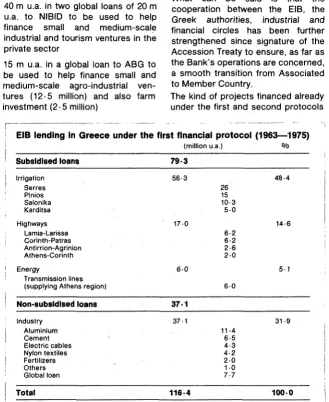
[image:3.589.214.543.353.755.2]Other loans have been made for a number of larger-scale industrial schemes (e.g. cement, aluminium and fertilizer production), for electricity generation and trans mission and road construction. Details of projects financed under the first protocol were published in EIB-Information No. 3 (November 1975) and EIB-Information No. 4 (February 1976). A recapitulation is given in the table alongside.
A list follows of the projects (as at end-April) for which the EIB has
signed loans under the second pro tocol, since it came into effect on 1 August 1978:
Loans with 3 % interest subsidies 25 million (m u.a.) to the State for irri gation of 7 500 hectares of coastal land in N.W. Crete
20 m u.a. to the State for irrigation of 37 760 hectares in the Evros area, Thrace
18 m u.a. to the Public Power Cor poration for construction of two hydro-electric power stations (total capacity 423 MW) on the Aliakmon river, Southern Macedonia
10 m u.a. to the State for forestry development (mainly construction of access roads) in Eastern Macedonia and Thrace
6 m u.a. to ETBA for construction of standardised factory units for small and medium-scale ventures In the Salonika and Herakiion industrial zones.
Ordinary loans
40 m u.a. in two global loans of 20 m u.a. to NIBID to be used to help finance small and medium-scale industrial and tourism ventures in the private sector
15 m u.a. in a global loan to ABG to be used to help finance small and medium-scale agro-industrial ven tures (12-5 million) and also farm investment (2-5 million)
10 m u.a. in a global loan to ETBA for financing small and medium-scale industrial ventures.
Special loan
10 m u.a. in a global loan to ABG for financing small scale irrigation schemes.
Greater scope
The financial protocols specified maximum amounts for EIB lending In Greece, whereas there are no national quotas for EIB lending in the Community.
The Bank lends the most in those areas of the Community where regional problems are greatest and according to levels of Investment in energy and other sectors of "common interest": to this extent the scope for lending in Greece, once a Member of the Community, will be greater than in the past, although it is impossible to put a figure on future operations.
What can be said is that the cooperation between the EIB, the Greek authorities, industrial and financial circles has been further strengthened since signature of the Accession Treaty to ensure, as far as the Bank's operations are concerned, a smooth transition from Associated to Member Country.
The kind of projects financed already under the first and second protocols
EIB lending In Greece under the first financial protocol (1963—1975)
(million u.a.) "/o
Subsidised loans 79-3
Irrigation Serres Pinios Salonika Karditsa
Higtiways Lamia-Larissa Corinth-Patras Antirrion-Agrinion Athens-Corinth
Energy
Transmission lines (supplying Athens region)
56-3
17-0
6-0
26 15 10-3
5-0
6-2 6 2 2-6 2-0
6-0
48-4
14-6
5-1
Non-subsidised loans 37-1
Industry Aluminium Cement Electric cables Nylon textiles Fertilizers Others Global loan
37-1 31-9
11-4 6-5 4-3 4-2 2-0 1-0 7-7
would continue to be eligible in the future — irrigation schemes, water supplies, road improvements, indus-trial development, including small and
medium-scale ventures financed via global loans. The development of hydro and other energy resources, and the financing of investment in energy-saving are expected to be important areas of activity. Other fields are currently being examined, such as telecommunications and projects which might embrace a combination of different activities (e.g. tourism, agriculture, fishing, road construction, water supply schemes) all in the same area.
Finally it should be noted that with membership of the European Community, access is opened to other Community sources of finance, e.g. the European Regional Development Fund and Social Fund, Agricultural Guidance Fund, European Coal and Steel Community and Euratom finance, and to the New Community Instrument for Borrowing
The EIB has lent 25 million u.a. for construction of parts of the Trans-Yugoslavian Highway, which will run 1 160 km from the Italian and Austrian frontiers in the north to the Greek border In the south. Among sections financed is the connection between Gevgelija and the Greek border.
The loan was granted following a decision from the ElB's Governors authorising the Bank to make available up to 50 million u.a. in loans for projects of common interest to Yugoslavia and the Community; this decision was taken to further the Community—Yugoslavia cooperation policy spelled out in the Belgrade Statement of December 1976.
The EIB lent the other 25 million u.a. to help finance construction of a 380 kV electricity transmission network in Yugoslavia, interconnecting with the Greek and Italian networks, enablihg swap arrangements and mutual assistance In case of failure in large generating units.
Up to a further 200 million u.a. (over a period of 5 years) is foreseen for financing other projects in Yugoslavia of common interest to that country and the Community under the Financial Protocol to the Cooperation Agreement signed in Belgrade on 2 April 1980 and due to come Into force on 1 July 1980.
and Lending — "Ortoli Facility" — for which the EIB is responsible for the lending operations under mandate from the Community (').
(') See articles on New Community Instrument published in EIB-Information No, 19 (October 1979), No. 17 (June 1979) and No. 15 (December 1978).
Financing small and medium-scale investment...
New developments in EIB global loans
The European investment Bank's global loan formula, designed over 10 years ago to give support to the development of small and medium-scale industrial ventures in regionai development areas, has been widened to extend the scope for this form of finance.
The Bank is now making global loans to finance small and medium-scale infrastructure works which assist regionai development and it Is considering global loans specifically to finance equipment to reduce energy consumption or make better use of energy in industry.
To recap on the principle of global loans ('), the Bank opens a line of credit to a finance Institution or bank at regional or national level which, acting as intermediary, then splits the sum into smaller sub-loans for investments chosen from amongst those submitted by its own clients. The intermediary is responsible for most of the detailed negotiations and appraisals, although the EIB must give its agreement to each sub-loan. In this way, by harnessing its financial resources as an international body with access to the world's capital markets to the operational resources (in terms of manpower, local offices, direct contacts etc.) of the various institutions with which it works, the EIB can provide finance in quite modest amounts which it would not be a practical, economic proposition for it to handle directly.
Last year alone the EIB made global loans totalling 137-3 million u.a. (against 99-9 million in 1978) for industrial development in the
Community's less-favoured regions; credits provided from these global loans and others granted previously totalled 131-4 million and helped to finance 415 ventures (72-2 million, 155 ventures in 1978).
Global loans have been reserved for assisting ventures where the pro-moter's net fixed assets do not exceed 30 million u.a. and where the new fixed investment costs will not exceed 12 million u.a.
Within these parameters, the Bank gives permanent priority to firms employing less than 500 people and legally and financially Independent, with no more than one-third of their capital held by a larger company. In 1979 the Bank reduced the minimum for a sub-loan from 50 000 to 25 000 u.a., so as to render eligible many investment projects which, despite their modest scale, often play a valuable role in regional development, notably In job-creation. The maximum amount for a sub-loan is currently 4 million u.a.
Although most global loans will continue to be made for Industry in regional development areas, the EIB recently broke new ground by making two global loans — the first for 12 million u.a. (Ffrs 70 million) in December 1979, the second for 14-4 million u.a. (Ffrs 83-7 million) in March this year — for financing small and medium-scale infrastructure works in less developed or conversion regions in France.
The funds were lent to the Caisse d'Aide à l'Équipement des Collectivités Locales (CAECL), a public financing institution set up in
1966 and managed by the Caisse des Dépôts et Consignations (CDC). The CAECL makes long and medium-term loans, complementing those of the CDC, to finance the capital requirements of local authorities and public bodies of various kinds.
The first global loan has been fully utilised to help finance a total of 27 infrastructure schemes carried out mainly by Chambers of Commerce and Commune syndicates. The works included rural electrification in Corrèze, Cher, Haute Loire and Cantal, road improvements in Gard, and harbour works at La Rochelle, Bastia, Ile Rousse, Boulogne, Calais, Bayonne and Cherbourg.
Institutions in other Member Coun-tries may be able to carry out a similar intermediary function in financing small and medium-scale infrastructure works in development regions.
Another area where global loans could prove to be a useful instrument is in helping to meet the Community's objective of reducing its oil import dependence.
A substantial proportion of total EIB lending each year goes to the energy sector (45%, or 1146-5 million u.a. (') in 1979 alone), the majority for a range of investment aimed at development of European energy resources and diversifying imports away from oil, to natural gas for example.
The Bank is now looking at how to use global loans as a means for financing new equipment to reduce energy consumption or make more efficient use of energy in existing factories.
Outside the Community
As part of its development finance operations in countries which have signed association or cooperation agreements with the Community, the EIB has been giving increasing importance to working through local development banks.
It does this in a number of ways. In most cases the EIB uses its own resources (i.e. essentially funds which it borrows on capital markets) to make global loans similar to those inside the Community, but usually with 2 or 3 % interest subsidies paid from the Community budget or the European Development Fund to reinforce the character of development aid. In addition, and depending upon the country concerned, the Bank makes available various forms of finance on specially soft conditions using budgetary funds which it manages under mandate from the Community.
The conditions laid down for the use of this finance (e.g. the size, nature
and location of ventures to be assisted) are fixed case-by-case in negotiating each operation.
Last year finance to development banks in Mediterranean and Lomé Convention countries totalled 111-3 million u.a. (100-5 million from the Bank's own resources, 10-8 million from budgetary resources), against totals of 64-5 million in 1978 and 23-5 million in 1977.
Not only the volume of operations has been increasing, but also the variety. While most finance has gone towards small and medium-scale industrial ventures, a number of operations on budgetary funds have enabled development banks to finance pre-investment studies, handi-craft activities and small agricultural investments. In certain cases, funds are used by development banks as venture capital to purchase stakes in new enterprises.
Another form of support is for the EIB to use budgetary funds to take a participation in the share capital of a development bank, strengthening its financial base. In these cases the intention is always to transfer such interests, preferably to nationals or
institutions of the country concer-ned, as soon as this Is deemed appropriate.
An important additional benefit from all these operations Is that In providing funds this way the EIB helps the development of the financial/banking sectors in the countries concerned, essential for their economic progress.
The countries in which the EIB has worked in support of development banks through global loans or other forms of financing are (as at
end-April 1980):
— the Mediterranean region:
Greece, Turkey, Portugal, Egypt, Jordan and Tunisia
— Lomé Convention:
Barbados, Burundi, Kenya, Lesotho, Liberia, Malawi, Mauritius, Nigeria, Seychelles, Tanzania, Trinidad & Tobago, Zaire, Zambia; regional development banks^ operating throughout the Caribbean and in West Africa.
(') 997 million u.a. from the ElB's own resources plus 149-5 million u.a. from the resources of the New Community Instru-ment for Borrowing and Lending.
In the United Kingdom an agency agreement exists between the EIB and the Government which, in effect, works in the same way as a global loan.
The Department of Industry in England, through its regional offices, the Scottish Economic Planning Department, the Welsh Office Industry Department and the Northern Ireland Department of Commerce act on behalf of the Bank In making loans for small and medium-scale private sector ventures which help to create or safeguard employment in assisted areas. The EIB finance is disbursed in foreign currencies but the Government shields borrowers from exchange risks.
This exchange risk cover scheme, originally adopted for the period 1978-79, has been renewed for a further two years (1980-81). Announcing the decision. Lord Trenchard, Minister of State for Industry, said, "Small companies have impressed on us the value of the scheme and their appreciation has been endorsed by Industry generally, the Confederation of British Industry and the clearing and merchant banks".
Loans are currently being made available under the agency arrangement for terms of 7 years at a fixed interest rate of 11 %. The Government's charge for the exchange risk cover, and also for a guarantee which it gives to the EIB on each loan, is 1 % in Special Development Areas and Northern Ireland and 2 % in Development and Intermediate Areas.
Over 1 750 million u.a. lent in five countries . . .
EIB support for Improved telecommunications
Since i t s first loan in the s e c t o r , in 1965, t h e European Investment Bank has made available 1 762-9 million u.a. (') f o r t e l e c o m m u n i c a t i o n s d e v e l o p m e n t in t h e European C o m m u n i t y (figure as at end-April 1980). Over t h e last five years lending has been running at an annual average of c l o s e t o 250 million u.a.
The Bank has helped t o finance t e l e c o m m u n i c a t i o n s p r o j e c t s in five Member Countries — italy (733-9 million u.a./664-2 billion lire), France (651 million u.a./Ffrs 3 640-6 miiiion), United K i n g d o m (210-3 million u.a./£ 131 -9 million), Ireland (158-5 million u.a./IR£ 9 7 - 5 miiiion) and Denmark, or m o r e precisely Greenland ( 9 - 2 miiiion u . a . / D k r 6 6 million) (').
The vast majority of this finance (95%) has been provided in pursuit of the ElB's main role under the Treaty of Rome, i.e. to help promote a more balanced regional development. The Bank has also lent to support projects aimed at improving communications between Member Countries, which correspond to the Bank's second main task under the Treaty, that of helping to finance investment of " c o m m o n interest" t o several Member Countries or the Community as a whole.
In total, the telecommunications sector has accounted for roughly 15 % of the Bank's lending within the European Community to date.
Out of an estimated worid figure of 445 million telephones in service at end-1978, 100 million were in the Community, giving an average density of approximately 38 tele-phones per 100 population {').
In the USA the figure was 77 per 100 population, in Canada approx. 65, in Japan about 44. Some European countries which are not members of
the Community — Sweden (74) and Switzerland (68) — also showed higher figures.
The Community average covers sub-stantial variations between the
(') 1 745-0 million u.a. from the European Investment Bank's own resources plus 17-9 million u.a. (IRE 12 million) in Ireland from the resources of the New Community Instrument for Borrowing and Lending.
(') Unit of account/national currency equivalents at the exchange rates ruling at the time of contract signatures.
(') Source: International Telecommuni-cation Union (figures for the United Kingdom at end-March
1979).-Member Countries and between regions, e.g. the telephone density in Luxembourg is three times higher than in Ireland, the least-well equipped Member Country, and almost four times more than in parts of Southern Italy.
Broadly speaking these figures are linked to the levels of economic development and living standards in the countries, although a number of other factors may have an influence, such as differences in consumer habits.
R e g i o n s in w h i c h t h e EIB has h e l p e d t o f i n a n c e t e l e c o m m u n i c a -t i o n s d e v e l o p m e n -t
Italy
Puglia:' :;;;i Sardegna: Sicilia: Campaüiä: Cafabria:":
Projects covering more than Mezzogiorno:
Abruzzi-Molise:
(million u.a.) (billion Lire)
151-2 152-5
114-4 105·0
54-2 49-0 49-4 34-85 29-8 22-0
(four loans: 1970, -74,-76, -80) (four loans: 1965, -73, -78) (two loans: 1975, -77) (two loans: 1972, -74) (1973)
one region
. 55)7 64-0 (two loans: 1979, -80) for long distance teleptione links plus improved telex services throughout the South.
86-5 80-25 (guarantee on a loan provided from a German bank, 1970: two loans: 1975, -78)
Veneto-Trentino-Alto Adige: Calabria-Basilicala: Sioilla-Calabria: Friuli-Venezia Giulia: Campania-Basilicata:
France
Nord Pas-de-Calais: Lorraine:
Pays de la Loire: Midi-Pyrénées; Aquitaine: Auvergne: Bretagne; Poltou-Cliarentesi Limousin:
54-8 54-1 36-0 20-2 20-0
(million u.a.) 100-0
99-2 92-3 60-2
m-0
53-8 47-2 ;::.: 25-0
15-0
40-125 53-0 22-5 20-0 12-5
(two loans: (two loans: (two loans: (1977) (1966)
(million Ffrs) 570-0 580-0 516-4 335-1 323-2 296-7 252-5 138-8 83-4
(1978) (1979) (two loans : (two loans; (two loans; (two loans:
1969, 1976, 1967,
1971, 1973, 1972, 1972, (three loans: 197 (1973)
(1971)
-75) -77) -71)
-78) -77) -76) -76)
,-75 -76)
Project covering more than one region . Sud-Ouest (Midi-FVrènéeà;
Aquitaine, Poitou-Charentes); 8-1 40-0 (1967)
United Kingdom Wales & t h e Marches: Scotland;::; :,: Norfh-East England; Northern Ireland:
Ireland
(million u.a.) 122-4
;: ao-o
30-0 27-9 (million u.a.) Projects covering the whole country
Denmark yf; Greenland;
:
(million £)
77-5 (two loans;1975,-79) 17-3 (1976)
18-6 {two loans: 1976, -78) 18-5 (1977)
(million IR Z)
:: 140-6 85-5 {six loans: 1973,-74,-75,-76 -77, -79)
from the ElB's own resources .. 17 :S 12-0 (1979)
froni the resources of the New Community Instrument for Borrowing and Lending (million u.a.)
9-2
(million Dkr)
The European Investment Bank is not concerned with national tele-communications programmes as such, but basically with the role telecommunications play in spurring on regional development.
The EIB intervenes in areas which are eligible for financial assistance under regional aid schemes. The key cri-terion applied is that telecommuni-cations be appropriate to the level of economic development in the region. The Bank helps to finance projects where the lack of adequate equipment Is already proving an obstacle to economic growth, or where telecommunications may be adequate at present but Insufficient to cope with further development.
Telecommunications provision in a region — quality as well as quantity, e.g. access to efficient automatic trunk and international dialling facilities — is one of the factors taken into account by firms when deciding where to locate their operations. Regions which do not offer the service required are handicapped.
The creation and expansion of the European Community, placing industry and services increasingly on an international rather than national market, has in itself helped to fuel demand for telephones, telex and data transmission facilities.
The Bank lends for telecommuni-cations both in less-developed regions and In industrial areas In difficulty which are eligible for assistance to restructure activities e.g. where coalmining and steel, both industries with a relatively low telephone usage, are being replaced by light industries, often export-oriented, with a high telephone usage.
Apart from industry and services, modern agriculture has also made its own demand, with the particular problem that long rural lines in sparsely populated areas are costly to install.
Services for the household sub-scriber are not directly the ElB's concern, but some aspects are very closely linked to regional development. The authorities In a number of Member Countries give a high priority to improving tele-communications in rural areas as part of their policy to stem the drift away from the land.
Apart from loans for improving regional telecommunications infra-structure, the EIB has provided 90-2 million u.a. (Ffrs 504-5 million) in 1975 and 1977 for the extension and modernisation of the French inter-national network, substantially Increasing the number of European links via land and submarine cables, ultra-high frequency radio beams and satellites. The investment also covered improved telex communications. In Italy, the EIB lent 7-5 million u.a. (Lit 8 500 million) last year for extension of a satellite telecommunications earth station in Abruzzi, part of a system which uses satellites also for meteorological purposes and earth resources management. The Bank helped to finance the investment primarily because of the contribution to developing advanced technology In the Community offering benefits to all Member Countries, but also because the project supports efforts to attract high technology research and academic activities to the Mezzogiorno. Again in Italy, the EIB lent 2-5 million u.a. (Lit 2 500 million) in 1977 for construction of a training centre in Abruzzi to help engineers keep pace with the continual Improvements in telecommunications technology. This came within similar initiatives aimed at furthering professional training In the Mezzogiorno.
As part of its lending for regional development, the European Investment Bank has provided 27-2 million u.a. to help a number of companies involved in manufacturing telecommunications equipment to set up or expand operations In areas of high unemployment.
The Bank has lent 13 million u.a. in Italy for construction of two factories manufacturing cables and switchboards, both in Campania, and for two factories producing handsets and other equipment in Sicily. A loan for 2-5 million u.a. was made for a new telecommunications cable factory in Lancashire, England.
Many smaller scale ventures have benefited from finance provided through global loans which the EIB has made to credit institutions in Italy (11-1 million u.a. for 12 ventures in the Mezzogiorno) and in France (0-6 million u.a. for one venture In Finistère).
These figures are counted as part of the Bank's lending for industry and are not included in the totals given in this article for telecommunications development as such.
The table on page 6 gives a list of the regions which have benefited from EIB loans for telecommunications Infrastructure up to end-April 1980; it will be noted that a number of loans have been for projects covering more than one region.
Three-quarters of the total has gone to regions in Italy, mainly in the Mezzogiorno, and in France, but it has to be borne in mind that the Bank began lending in the United Kingdom, Ireland and Denmark (Greenland) only from 1973 onwards, following the accession of these countries to the European Community.
In relation to the country's population it is the Irish telephone system which has benefited most from EIB financing, reflecting difficult devel-opment problems (Ireland is the only Community country whose entire national territory Is eligible for
regional aid) and the high priority which is given to improving telecommunications.
In the first four months of this year the EIB has already made loans totalling more than 107 million u.a. for telecommunications development. This aspect of the ElB's work is perhaps less in the public eye than others. It doesn't appear to have the same "urgency" as financing development of European energy
In Greenland — a vast territory, four times the size of France, and over 2 000 km distant at the nearest point from mainland Denmark — telecommunica-tions are a basic condition for an acceptable way of life in the face of con-ditions harsher, in many respects, than anywhere else in the European Com-munity.
Isolation Is one of the biggest handicaps for the 50 000 islanders in their economic development. Towns and villages are scattered along a coastline deeply indented by fjords, no overland transport system exists, there are only a few ports which are ice-free all the year round and air travel (mainly by helicopter within Greenland) Is expensive and subject to rigorous weather conditions.
The EIB has lent a total of 9-2 million u.a. (Dkr 66 million) for two telecommunications projects.
The first loan — 5-4 million u.a. (Dkr 38 million) granted in 1974 — went towards development of a UHF (Ultra-High Frequency) trunk communications network along 2 000 km of the south-west coast.
Conventional telecommunications by cable are impossible because of the mountainous terrain and distances between townships. The original radio equipment was suitable only for local calls or short-wave telegraphy between main centres, the latter being frequently disturbed by the Aurora Borealis.
Apart from telephone and telegraph communications, the UHF equipment enables telex links and carries radio broadcasts from Godthaab, the chief town, to local relay transmitters. The system also permits ships to communi-cate with any subscriber on land.
The second loan — 3-8 million u. a. (Dkr 28 million) granted in December last year — went towards Installations using satellites to extend telephone and telex links to communities in the far northern and eastern parts of Greenland and to increase by some 160% the capacity of the links between Greenland and mainland Denmark.
Unit of Account
Below are the values In national currencies of the Unit of Account used by the Bank, as at 31 March 1980; these rates are applied the present quarter in preparing finan-cial statements and operational statistics of the Bank:
DM £ Ffrs Lit Fl
2-53283 0-600552 5-84024 1 170-65
2-77061
Bfrs 40-6081 Lfrs 40-6081 Dkr 7-85778 IR£ 0-672290 US-$ 1-30290
Statistics summarising Bank activi-ties in terms of Units of Account have been based on several diffe-rent conversion rates applied sin-ce 1958. This, coupled with the ef-fects of price trends, would sug-gest prudence in Interpreting the significance of figures which relate to operations extending over many years.
The composition and hence value of the unit of account used by the EIB is the same as that of the Euro-pean Unit of Account (EUA) and the European Currency Unit (ECU).
New p u b l i c a t i o n
A fold-out key facts and figures leaf-let on the EIB Is now available in all the official Community languages. Copies available free on request.
Personalia
The Board of Governors of the European Investment Bank has appointed two new Members to the Board of Directors and one new Alternate.
Mr. David HANCOCK, Deputy Secretary (Overseas Finance A), H. M. Trea-sury, United Kingdom, replaces Mr. Norman Jordan-Moss, his predecessor at the Treasury, who has retired. Mr. Jordan-Moss had been a Director of the EIB since January 1976.
Mr. Waldemar MÜLLER-ENDERS, Ministerialdirigent, Federal Ministry of Finance, Germany, succeeds Mr. Hans-Herbert Weber, a Director since September 1970. Mr. Weber has resigned as Ministerialdirektor at the Federal Ministry of Finance and as Director of the EIB to become President of the Management Committee of the Westfalenbank A.G.
Since June 1970 Mr. Müller-Enders had served as an Alternate Member of the ElB's Board of Directors; to replace him in this position the Board of Governors has appointed Mr. Winfried HECK, Ministerialdirigent at the Fed-eral Ministry of Finance.
Mr. Nicolaas van den HOUTEN, Manager of the ElB's Legal Directorate from January 1962 to April 1979, after which he served as Special Adviser to the Bank's Management Committee, has retired. In appreciation of his long and valued service the Management Committee has conferred upon him the title of Honorary Manager.
EIB-INFORMATION Is published perio-dically by the European Investment Bank In six different languages (Da-nish, Dutch, English, French, German and Italian.)
Material which appears in EIB-INFOR-MATION may be freely reproduced; an acknowledgement would be apprecia-ted and also a clipping of any article pu-blished
2. Place de Metz — Boîte postale 2005 Luxembourg
tel. 4350 11 — telex 3530 bankeu lu Facsimile 20 422
Department for Italy: 38, Via Sardegna, 00187 Rome tel· 483651 — telex 611130 bankeu i
Facsimile 47 458 77 Representative Office in Brussels:
227, Rue de la Loi B-1040 Brussels
tel· 73521 38—telex21721 bankeub Liaison Office forthe United Kingdom:
23, Queen Anne's Gate, Westminster. London SW1H 9BU
tel· 2222933—telex 919159 bankeu g
Printed in Germany by Saarbrücker Zeitung Druckerei und Verlag GmbH, Gulenbergslraße 11—23,6600 Saar-brücken