This is a repository copy of Identifying components in consent information needed to support informed decision making about trial participation: an interview study with women managing cancer.
White Rose Research Online URL for this paper: http://eprints.whiterose.ac.uk/100449/
Version: Accepted Version
Article:
Abhyankar, P, Velikova, G, Summers, B et al. (1 more author) (2016) Identifying
components in consent information needed to support informed decision making about trial participation: an interview study with women managing cancer. Social science & medicine, 161. pp. 83-91. ISSN 0277-9536
https://doi.org/10.1016/j.socscimed.2016.05.040
© 2016. This manuscript version is made available under the CC-BY-NC-ND 4.0 license http://creativecommons.org/licenses/by-nc-nd/4.0/
[email protected] https://eprints.whiterose.ac.uk/
Reuse
Unless indicated otherwise, fulltext items are protected by copyright with all rights reserved. The copyright exception in section 29 of the Copyright, Designs and Patents Act 1988 allows the making of a single copy solely for the purpose of non-commercial research or private study within the limits of fair dealing. The publisher or other rights-holder may allow further reproduction and re-use of this version - refer to the White Rose Research Online record for this item. Where records identify the publisher as the copyright holder, users can verify any specific terms of use on the publisher’s website.
Takedown
If you consider content in White Rose Research Online to be in breach of UK law, please notify us by
Journal: Social Science and Medicine
Revision Submitted: 29/04/2016
Manuscript ID: SSM-D-15-02401R1
Date accepted: 26/05/2016
Title: Identifying components in consent information needed to support informed decision
making about trial participation: an interview study with women managing cancer
Authors:
Purva Abhyankar*, PhD, Leeds Institute of Health Sciences, University of Leeds, UK
Galina Velikova, MD, PhD, Leeds Institute for Molecular Medicine, St James’s Institute of
Oncology, University of Leeds, UK
Barbara Summers, PhD, Centre for Decision Research, Leeds University Business School,
UK
Hilary L Bekker, PhD, Leeds Institute of Health Sciences, University of Leeds, UK
Funding: The study was funded by an Overseas Research Scholarship, supporting PA’s
doctoral project.
*Contact details
Purva Abhyankar
School of Health Sciences
University of Stirling
4T12 RG Bomont Bulding
Stirling
FK9 4LA
Email: [email protected]
Authors’ contributions
PA made substantial contributions to conception and design, acquisition of data, analysis and interpretation of data, drafting the manuscript and revising it critically for important
intellectual content and gave final approval of the version to be published.
GV made substantial contribution as a clinical supervisor to conception and design,
interpretation of data, and revising the manuscript critically for important intellectual content and gave final approval of the version to be published.
BS made substantial contribution as an academic supervisor to interpretation of data, and revising the manuscript critically for important intellectual content and gave final approval of the version to be published.
HLB made substantial contribution as lead supervisor to conception and design, analysis and interpretation of data, drafting the manuscript and revising it critically for important
intellectual content and gave final approval of the version to be published.
Acknowledgements
We would like to acknowledge the research nurses at the oncology outpatient clinic who helped in patient recruitment and all patients who took part in the study. We would also like to thank Dr Fiona Harris for advice on qualitative aspects of this paper and helpful comments from the anonymous peer reviewers, both of which have significantly improved the
Identifying components in consent information needed to support informed decision making about trial participation: an interview study with women managing cancer
Abstract
Background: Research governance requires patients give informed consent to participate in
clinical trials. However, there are concerns that consent information may not support patient
participation decisions. This study investigates the utility of consent information in supporting
women’s trial participation decisions when receiving treatment for cancer.
Design: An interview study with women receiving cancer treatments at a medical oncology
outpatient clinic in Yorkshire (UK). All women over 18 years, not admitted to a hospital ward
and who had currently or previously been invited to take part in a trial were invited to take part
in the study over a three month period. Interviews were audio-tape recorded, transcribed and
analysed using thematic analysis.
Results: 21/41 eligible women with breast (n=11), ovarian (n=8) and endometrial (n=2) cancer
participated; mean age 57 years. Eighteen had made at least one trial decision and three were
considering taking part in a trial. Findings are synthesised under two analytical themes: 1)
Influence of the cancer and cancer treatment context on decision making for trial participation
and 2) Experiences of the consenting process and their influence on decision making.
Conclusions: Designing trial information to represent explicitly the trial participation decision
as being between standard care and study-related care options is more likely to effectively
support patients in making informed decisions between standard care treatments and taking
part in a trial.
Keywords: shared decision making, informed consent, trial participation, cancer treatment,
Introduction
Obtaining consent from patients to take part in a clinical trial is guided by the principles of
good clinical practice, the Declaration of Helsinki (World Medical Association, 2013) and
health service research governance (International Conference on Harmonisation, Good Clinical
Practice [ICH GCP], 1996). Consent refers to the ethical-legal principle of patients giving their
permission to practitioners for a treatment or procedure to be carried out, either by gesture,
verbally or in writing. To be valid, this consent must be voluntary and informed, and the person
consenting must have the capacity to make the decision (NHS Choices, 2014). Information
provided to support patients’ trial participation choices is required to include details of the
study team, sources of funding, conflicts of interest, aims and methods, procedures, anticipated
risks and benefits of procedures, available alternatives, confidentiality, and the right to
withdraw from the trial. Its purpose is to ensure patients are informed about the study, and their
trial choices are made voluntarily, when they give their consent to participate (World Medical
Association, 2013). An outstanding question is whether this information is sufficient to support
informed consent.
Patients and professionals have described informed consent for a trial as an empty ritual in
which patients are provided with complex information that is difficult to understand and has
little impact on their decision making (Armstrong et al., 2012; Lidz et al., 2004). Although the
information provided during elicitation of informed consent has improved (Bjorn et al., 1999;
Flory & Emanuel, 2004; Synnot et al., 2014), patients’ understanding of consent remains
suboptimal, leaving unmet patient needs (Bell & Balneaves, 2015; Brehaut et al., 2012a; Gillies
et al., 2014; Moynihan et al., 2012). Previous studies show that patients possess poor
knowledge and understanding about key aspects of trial processes and treatments
information with their values and goals (Baker et al., 2013). Patients often draw on their prior
knowledge or use rule-of-thumb decision strategies when making a choice, rather than evaluate
the trial details (Moynihan et al., 2012). These strategies tend to be influenced by contextual
and emotional factors that encourage patients to make choices based on cues in the context
such as the way the trial was communicated or their relationship with trial recruiters (McCann
et al., 2013). Patients report trial consent information is sufficient to raise their awareness of
the study and inform them of associated procedures, but not sufficient to help their reasoning
about (non) participation (Gillies et al., 2014).
Consent processes may not fully support patients’ decisions, in part, because their focus is
solely on clinical trial participation. The details they include, and the way information is
presented, provide facts key to understanding evidence-based care for an illness,
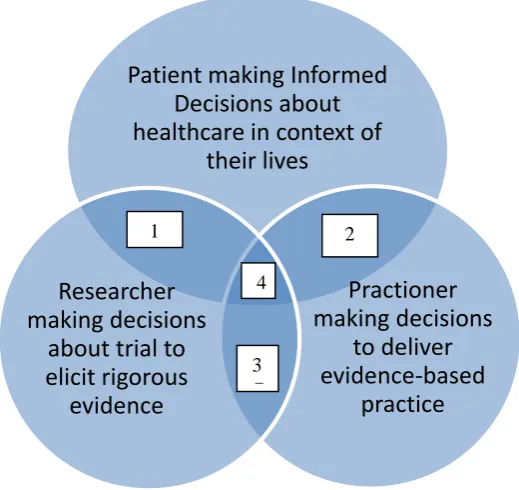
ethically-based research about new and/or different procedures, and engagement with the study (Figure
1 – sections 1, 2, 3). What this approach does not address explicitly is that patients are actively
making decisions about their health and/or management of illness in the context of their lives,
when offered trial participation opportunities (Figure 1 – section 4). Little is known about how
people perceive the clinical trial options in relation to standard care treatment options, how
they reason about the trial and standard care options in relation to each other, and what helps
or hinders their ability to make a reasoned decision about trial participation or not (Bell &
Balneaves, 2015)
An informed or reasoned decision is one based on accurate information about all options and
their consequences, people’s evaluations of these options in accordance with their values, and
a choice made based on trade-offs between these evaluations (Bekker et al., 1999) There is
patients in making informed decisions about participation, what aspects discourage patients
from evaluating the trial facts, and what information is missing which is of relevance to
patients’ values towards their care and trial participation (Jacobson et al., 2013) This study
investigates the role of trial information in enabling women managing cancer to make trial
choices and their support needs when making trial and treatment decisions at the same time.
This evidence is needed to inform the structure and content of patient information so that it can
be designed to support patients’ active thinking between healthcare options and trial
participation (Cox, 2002a).
<<Figure 1 about here>>
Methods Design
The study used a cross-sectional survey design with face-to-face semi-structured interviews
eliciting women’s reasoning about, and experiences of making, treatment and trial participation
choices. All interviews were audio-recorded and transcribed verbatim.
Sampling and participant recruitment
Potential participants were identified from those attending a medical oncology outpatient clinic
at a large University hospital in the north of England, offering non-surgical oncology services
and actively engaged in clinical trials. Majority of the trials offered to patients were phase III
trials comparing new chemo/hormone therapy with standard treatment. Criteria for potential
participants were females 18 years or older, with breast and/or ovarian cancer, who were
invited to take part in at least one clinical trial since their cancer diagnosis, attending the clinic
between June and December 2005. Those admitted to wards were excluded due to the difficulty
of conducting interviews in the busy ward setting and the possibility of their accounts of
A purposive sampling strategy with predetermined inclusion criteria was used to ensure a broad
range of experiences and views about trial participation choices (Ritchie et al., 2003). Women
representing different age groups, cancer stages, times since diagnosis, and trial participation
choices were invited to take part in the study. In qualitative research, a-priori estimation of the
sample size is not possible, nor advised, and final sample size is guided by findings from
preliminary analyses taking place simultaneously with data collection, with data collection
ending when interviews no longer give rise to new themes (data saturation). In this case, no
new themes seemed to emerge from the data after about 18 interviews; further three interviews
were conducted and analysed showing no new themes before concluding data saturation had
been reached in relation to the study’s objectives. Hence, data collection was ended after 21
interviews.
Materials
The study information sheet, consent form and an interview topic guide were developed in
accordance with National Research Ethics guidance (approval granted by Harrogate Local
Research Ethics Committee on 19/05/2005). The questions in the topic guide were derived
from the literature on decision making about treatment choices (Pierce, 1993; Reynolds &
Nelson, 2007) and patients’ experiences of trial participation (Cox, 2002b; Snowdon et al.,
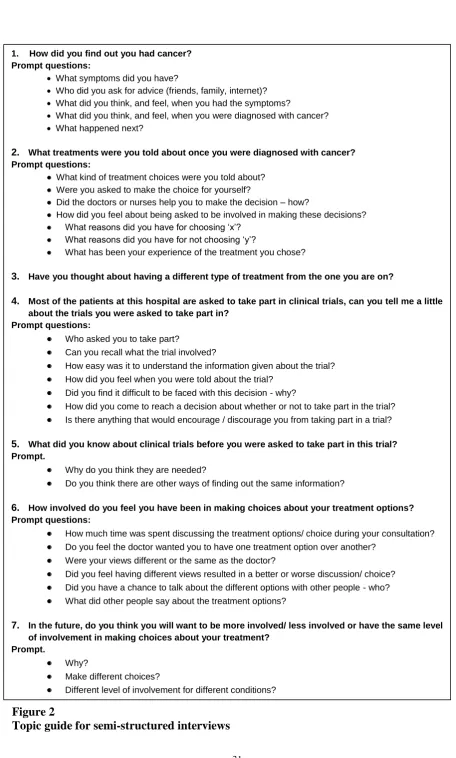
2006). Three key topics were addressed: experiences of being diagnosed with cancer and being
offered trial and treatment choices; process of making decisions about trial participation;
experiences of recruitment. Each question was followed by probe questions exploring in more
detail their views, reactions, experiences, feelings, reasons and preferences. The interview
schedule was piloted by reviewing the responses of the first four participants to assess whether
the questions helped address the study’s objectives (Figure 2).
Procedure
A list of women with breast, endometrial, and ovarian cancer who met the study’s inclusion
criteria was obtained from the clinical team using the clinic’s patient records database. Women
were identified using demographic information from patient records such as age, type and stage
of cancer, date of diagnosis, trials offered and patient’s choice about trial participation. Women
were approached by the research nurses on the day of their visit to the outpatient clinic and
were introduced to the researcher. The researcher briefed the women about the research, handed
the study information to them along with a reply slip, and asked if they could be contacted by
telephone in case they did not return the reply slip. It was emphasised that agreeing to the phone
call did not mean they were agreeing to the study. Those who responded agreeing to participate
were contacted to arrange a date, time and venue for the interview. Written informed consent
was obtained on the day of the interview. Interviews were conducted by the first author (PA),
a female doctoral candidate at the time of the study with training in psychological approaches
to health. Interviews were conducted either in a quiet room at the clinic or at the woman’s home
and lasted an average of 35 to 45 minutes; a patient’s partner was present in one of the
interviews.
Analysis
Data were analysed using thematic analysis (Ritchie & Spencer, 2002) which allows systematic
classification and organisation of the data in terms of key themes and emergent patterns. An
initial coding frame was developed based on data from three transcripts selected to ensure a
fair representation of experiences and the areas covered in the topic guide. This coding frame
was applied systematically by the first author (PA) to all the transcripts using the software
package QSR NVivo v8, adding new themes/categories as they emerged from the data. Once
all the text had been coded, the categories were refined by revisiting the text in each category.
a more comprehensive and higher-order theme. To ensure reliability and trustworthiness of the
analytical process, each stage of the analysis were discussed with the supervisors (HB) and
(GV), to ensure interpretation was informed by the clinical context and science explaining
people’s decision making. Data were categorised under ten themes resulting in a descriptive
coding framework (Table 1) (Abhyankar, 2008) Data from the descriptive themes are
synthesised under the following analytical themes, using quotes typical of the theme to
illustrate the interpretation and synthesis:
Influence of the cancer and cancer treatment context on decision making for trial
participation
Experiences of the consenting process and their influence on decision making
<<Table 1 about here>>
Results
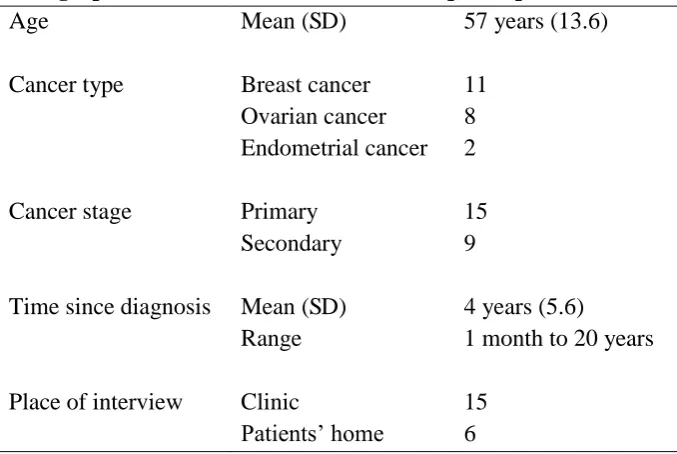
In total, 21/41 women informed of the study participated; their mean age was 57 years (range
29-81 years). Most were interviewed in the clinic (Table 2). Eighteen had made a trial
participation decision in the past, and three were considering one at the time of study. Of those
who had made a decision in the past: nine had been offered one trial, and eight agreed to take
part in the trial offered; seven were invited to take part in two trials, and three took part in both
and four took part in only one trial; two were invited to take part in three trials, and both
declined to take part in at least one of them.
<<Table 2 about here>>
Influence of the cancer and cancer treatment context on decision making for trial participation
Women’s accounts suggested that all treatment options raised within the clinic were judged
seemed to influence the way in which the options were perceived and/or evaluated and
women’s experience of making the decision. There was a tendency to perceive the active
pursuit of treatment as the only option available and there was ‘no real choice’ to make.
Women tended to simplify the choices by dichotomising the options in terms of life versus
death. Having some kind of treatment was judged to be obviously superior to ‘doing
nothing’ in light of their goal of fighting cancer. Choosing not to have the offered treatment
was rarely considered as a meaningful option or immediately dismissed as irrational.
‘Listen love…when you get to my age and you have a choice of living or dying, you
pick to live. Believe me or not..!’ (SN3, ovarian)
‘The treatment? I’ve got to have the treatment I’ve got no choice. Well I have, but that
would be silly.’ (SN13, ovarian)
This perception of ‘no choice’ is also reported by other authors studying treatment decision
making, particularly among patients with cancer (Charles et al., 1998; Elit et al., 2003;
Jansen et al., 2006) and has been attributed to patients’ preference for a passive role in
decision making, beliefs about the nature of cancer, and the need to maintain a positive
attitude through reassurance of having done everything possible.
The perception of ‘no choice’ prevailed even when one of the options for cancer care was
to take part in a clinical trial. The trial participation option was also evaluated against the
goal of abating cancer with a tendency to perceive this as the only active option to be
involved in making a decision about. Standard care was viewed as a more passive process
to be engaged with as adhering to a practitioner-led pathway of care.When offered a clinical
trial, the choice often exists between ‘taking part in the trial’ and ‘receiving the standard
treatment/s’. To make an informed decision about trial participation, patients must evaluate
where they receive either the standard treatment/s or a newer but less evaluated treatment.
However, there was little evidence that participants discriminated between care delivered
as part of a trial and, therefore, optional and care offered as part of usual treatment and
standard procedure. Women’s reports suggested that it was the ‘treatment’ within the trial
that was evaluated more against their goal of cancer care than the other trial aspects such
as random allocation to treatments, uncertainty of side effects etc. The ‘trial’ aspects were
not seen as important to consider when making the decision. As the quote below reflects, it
did not matter much whether or not the offered treatment was on trial; the decision would
not have been any different if the treatment was not on trial.
‘Yeah, well I’ve got lots of information on it and I know it is a treatment for curing breast
cancer, but they think because the two (breast and ovarian cancer) are linked, it could
help people like me and erm, I just think that if it is something that you take maybe daily,
erm and it will keep it at bay then you know, I think that would be a good thing’ (SN14,
Ovarian)
‘No. No, it didn’t matter to me whether it was a trial or not, maybe it should have
mattered more, but it didn’t... It [being offered a trial] didn’t make much difference to
me really. I would still have gone for it if it wouldn’t have been a trial... If it wouldn’t
have been a trial, the chemotherapy, I don’t think I would have made my decision any
quicker than with it being a trial, that’s all.’ (SN17, breast)
When a treatment or trial was seen as the only option meeting their goal of cancer treatment,
the choices were often made quickly and intuitively, with minimal consideration of the trial
information. There was little evidence women reasoned explicitly between the advantages
and disadvantages of trial participation and standard cancer care options when deciding
already made their mind up’, ‘seeing trial as just a natural thing to do’, ‘going with their
gut feelings’ and ‘putting it to fate’. The following quote reflects participant’s quick
decision making based on selective consideration of advantages of trial participation.
‘I was offered Herceptin (trial) at the same time as my chemotherapy so that they all
started together […] Well Dr P explained what Herceptin was, that it acts as similar to
one of your own antibodies and stops the cancer cells latching on to your own cells and
multiplying and growing, and he explained to me that the different people, you know
different women who had these trials and you know, well basically they hadn’t got a full
set of results but you know, things were looking good and I just thought well I may as
well try, if it doesn’t help me it could help somebody else or something that they find out
from me could help somebody else so, I just made the decision there and then, I never
discussed it with anybody or, just decided. (SN15, Breast)’
Others reported feelings of disquiet and conflict around making a decision to consent or not
in research, especially when incongruity was sensed between the altruistic and personal
goals. Carrying out research to find evidence of better treatments was valued. There was
also an appreciation of others’ research participation that had benefitted them, and an
understanding of their participation benefitting others. Although women were aware of the
uncertainty of achieving personal benefit through the trial, they were concerned about
making the “right”or “correct” decision.
‘`cos you do sometimes think you know you are helping other people by doing this, but
then sometimes you think I don’t want to help anybody else, I want to look after myself’.
‘I mean you could only…..you can only make one decision at each time. And you can
only review it in retrospect whether you think that was the right one, but you never can
be quite sure, can you?’ (SN2, breast)
These findings resonate with the concept of ‘conditional altruism’ reported by McCann et
al. (2010) which represents a decision that is motivated by consideration of the collective
general good but is conditional upon the prospect of some personal benefit or lack of harm.
Women’s reports of how they deliberated about pros and cons clearly reflected this tension
between seeking personal benefit versus wanting to help others (Locock & Smith, 2011a).
However, their reasoning was informed more by their beliefs about the consequences of
(not) taking part for them or future patients than a systematic weighing up of all
information.
‘like I say my thought process generally is, is it going to do me any harm, no. Is it
going to help other people, possibly. So you know that’s about it really.’ (SN19,
breast)
Experiences of the consenting process and their influence on decision making
All women were invited to take part in trials when attending the service for diagnosis and/or
treatment of cancer. There was variation in the way the trial was offered within the clinic
appointment, sometimes it was delivered and/or mentioned in consultations when discussing
diagnosis and treatments with women’s practitioners, and sometimes it was presented on its
own ‘outside’ the consultation by research staff.
‘When I was diagnosed with my lung secondaries, I was...I don’t know what the
alternative was,…any way… various chemos were run past me, like “we could do this or
we could do the other……..and by the way, there is a trial on Taxol. Mm and that was
In this cancer outpatient service, women were at different points in their identification,
adjustment and management of illness. Receiving new information about a diagnosis and/or
options about cancer treatment left women to assimilate this information and their reactions to
the details, while trying to participate effectively in care planning decisions. They felt baffled
with the amount of information and found it difficult to concentrate during the consultation,
picking up on only some bits of the information.
‘…to tell you the truth I don’t know that day to this what the doctor, consultant I should
call him, said to me because the only thing I picked up on was chemotherapy. “What
you telling me?” and that was it. So...’ (SN8, ovarian)
Receiving an opportunity to take part in a trial at this point added to the complexity of this
process, especially when the new treatments offered in the trial and standard treatments
appeared similar, and impacted on how they reasoned about the different options. Women
found it difficult to differentiate between treatments offered as standard and within the trial.
‘`cos there didn’t seem a great deal of difference in a lot of them it’s just different
drugs. That’s another thing with a lot of these trials and things, you don’t see a great
deal of difference and they, it’s just something they want to test with, whether it would
be any better’. (SN16, breast)
Given women’s perceived difficulty in assimilating all the information and to make choices, it
is not surprising that many made decisions after asking for another’s opinion and/or using
another’s experiences of treatment. Using opinions from health professionals seemed to be a
way of tapping into expertise the participant did not have themselves.
‘We talked about it, we went back the following week and agreed to do the trial. But I
actually went to my own doctor and asked him what he thought. Because I’ve more faith
The experiences of other patients provided an additional viewpoint on particular treatment
options, including the experience of side effects. As this participant explains, her decision
to take part in the trial was influenced by her beliefs about the ill-effects of chemotherapy,
which were informed by other people’s experiences.
‘Well, as I say, you know, they were talking about chemotherapy and I said “No, I
wouldn’t, I’m not having chemotherapy”. I was adamant that I wouldn’t have it because
of what I’d seen and how ill it made people […] As far as I was concerned it (Herceptin
trial) was the only option that I had because I didn’t want chemotherapy.’ (SN9, Breast)
Most participants regarded the consent information as easy to understand and the trial well
explained, yet lacking in detail about the trial treatment options and their consequences.
Information about the options and their consequences was seen as necessary to make an
informed decision. For instance, details about the dose of the drug, the nature and likelihood
of experiencing side effects and personal relevance of the trial tended not to be described.
‘It is easy to sort of understand what they were trying to achieve but as I said it doesn’t
give you any information as to whether what they feel would be adequate for you, if it
was on a banding system, whether it would actually be higher or lower than the toxins
that you are getting now. That we don’t know,’ (SN 20, breast).
Sometimes, it was felt that further details about the trial were only provided post consent. As
one participant stated, she was told that the details about the trial will be explained if she
decides to take part in the trial.
‘They just asked me and whenI said no, they didn’t bother anymore. Well they didn’t tell
me anything about the trial, what it would do. They just asked me if I would do it….I said
So….well..it’s a trial that you go through, but if you decide to have it will be explained
to you. And as I say I made the decision that I wouldn’t have it’ (SN 4, ovarian)
Women knew the choice to participate in a trial was theirs to make. Staff explicitly reinforced
this message, although some portrayed trial participation favourably. Some women felt
persuaded by this possible framing, whilst others thought it was probably their perception that
staff held a positive view rather than an explicit statement.
“I also, in July last year, on my birthday, which was really bad timing, is mm…I was
suddenly offered, not by the doctor, but by somebody else in the team, “wow we have got
two new trials and this is the answer…this is the answer for your care”(SN2, breast)
‘When they talk about one thing more than the other one. I can’t think of any example I’m
afraid. When they’ve got two lots of tablets and they are sort of saying something about it,
I don’t know. It’s a state of mind I think at the time, I think could be misinterpreted when
you are not feeling great,’ (SN 16, breast)
Discussion
This qualitative study analysed women’s decision making about trial participation when
they were informed of trial participation being an option during their attendance at a cancer
outpatient clinic. It adds to the qualitative evidence on the process and experiences of
decision making about clinical trial participation (Bell & Balneaves, 2015; Cox, 2002b;
Locock & Smith, 2011a; Locock & Smith, 2011b; Pierce, 1993; Reynolds & Nelson, 2007;
Snowdon et al., 2006; Thomas & Menon, 2013), and provides novel insight into the
complexities of making trial decisions in the context of active illness management. The
findings indicate women made trial participation choices within the context of treating and
Though aware of the research context and altruistic benefits, there was little evidence they
made choices by thinking systematically about the advantages and disadvantages of both
participation and non-participation in accordance with their values. While the consent
information was perceived to be easy and sufficient to understand the trial, these details
were not sufficient to support women’s reasoning about trial participation in the context of
their illness, and/or make informed trade-offs between the trial participation and standard
cancer care treatment options. Within a service delivery context, presenting the trial in a
way such that the choice between trial participation and standard care options is not made
explicit may hinder women’s reasoning by influencing their evaluation of the trial
information and/or judgments (Abhyankar et al., 2014).
Until recently, patient participation in clinical trials has been conceptualised and studied
either as a type of behaviour (Mills et al., 2006) or as an act or process of consent (Lidz et
al., 2004), with a focus on increasing recruitment rates and/or improving consent
information. The trial is usually presented as an ‘opportunity’ to participate or not and any
written information provided to patients focuses mainly on the trial. This study
conceptualises trial participation as a ‘decision’ in the wider context of disease
management/treatment. The current findings highlight that when a trial is integrated within
a patient’s care pathway, patients are evaluating trial options at the same time as managing
their illness and making treatment decisions. This suggests that trials need to be framed as
an active decision between healthcare options, i.e. between standard care and trial
participation. This conceptualisation as a deliberate decision between healthcare options
helps place the decision in the context of patients’ illness management and lifestyle. Our
illness management (Abhyankar et al., 2014; Brown et al., 2004; Entwistle, 2008; Gillies
et al., 2014; Juraskova et al., 2008; Juraskova et al., 2014).
Trial participation represents a complex decision problem, with nested options and
uncertain consequences. For instance, compared to standard treatment, the treatments
offered in the trial may be novel or familiar, possess similar or different attributes, involve
unknown and/or serious risks, and, in the end, may not be received by the patient on
consenting to participate if they are allocated to the control group. While vital for the benefit
of future patients, taking part in a trial may or may not be personally beneficial to the
patient, but it should not be worse than standard care. Patients thus have to evaluate
treatments offered within their standard care pathway and those in the trial, and make
consent judgements about standard and study procedures. However, women in this study
found it difficult to separate the trial decision from the treatment decision and evaluated the
treatment, rather than trial, consequences. Despite meeting the ethical and legal
requirements of informed consent, our data show that the consent information may not be
sufficient to support explicit reasoning between trial participation and standard care options.
The insufficiency of the consent information may be explained by the complexity of
competing patient, professional and trial staff goals at play, when a trial is located in clinical
practice. Staff delivering the trial are focussed on eliciting rigorous evidence while meeting
the clinical and research governance best practice requirements and thus provide
information explaining the trial, its benefits and risks. Patients are making informed
decisions about their care, not just the trial, in the context of their lives and need explicit
and balanced information on all available options and their consequences. Practitioners
involved in patient care are focussed on delivering best possible, evidence-based and patient
and information to enable effective healthcare practice. Practitioners often find it
challenging to balance their ‘clinical’ and ‘recruiter’ roles which inadvertently affects their
recruitment practices (Brown et al., 2004; Donovan et al., 2014). The extent to which
patients are enabled to make informed decisions between trial participation and standard
care options depends on the goal with which the information is delivered. Consent
documents, which are primarily designed to provide accurate and factual information about
trial/research, are unlikely to enable deliberation and comparison of different options in
light of personal values and illness behaviours (Brehaut et al., 2012b).
The context of trial information delivery such as how and when options and information
are presented, by whom and with what purpose has a significant influence on patients’
evaluation of information, decision making strategies and ultimately their decisions
(McCann et al., 2013; Moynihan et al., 2012). From the science behind people’s decision
making, we know that context affects the extent to which patients are enabled to use cues
from the context (use heuristic strategies) or be reasoned (use systematic strategies) in their
decision making (Chaiken, 1980; Tversky & Kahneman, 1981). Our data show that women
used mainly heuristic rather than systematic strategies to make decisions such as making
intuitive judgements about options, referring to other people’s choices, and outcomes,
immediately accepting doctor’s advice, dichotomising choices as life versus death, feeling
that there was only one option and selectively focussing on options/attributes. It is likely
that the consent information was impoverished (Gillies et al., 2014) as it does not present
all alternatives explicitly and does not allow comparative evaluation of other options in
relation to the trial. The impoverished nature of consent information may have encouraged
women to use contextual cues to guide their decisions, such as: a) attributes of staff and/or
strategy (e.g. trial offered by a patient’s treating doctor in the consultation may be evaluated
differently to when offered by a research nurse before or after the consultation) (McCann
et al., 2013) b) framing of the trial offer and information (e.g. depending on who is
providing information, it may be framed positively or negatively, which then impacts on
patients’ evaluation of that information and choices)(Moynihan et al., 2012). Evidence
suggests personal views of health professionals about clinical equipoise, need for trial,
patient’s eligibility etc. have a significant impact on trial recruitment and create systematic
variations in the way patients are consented and how options are presented (Donovan et al.,
2014) c) the trial participation option, and consent information, is presented as an
opportunity or choice rather than a decision between options, which affects people’s
representation of the decision problem and judgements about the options (Abhyankar et al.,
2014).
Strengths And Limitations
The study’s strengths include use of thorough and rigorous methods to collect, analyse and
interpret data. The purposive sample meant experiences of women with different
characteristics, cancer type, stage and treatment, and trial participation experience were
captured. The study methods and results are informed by the understanding of purpose of
informed consent and research governance, the evidence on how people make sense of
illness and reason about treatment options, and the goal of delivering evidence-based and
good quality information to support people’s decision making. The study helps people think
differently about the needs of the patients, health practitioners and research community to
ensure clinical trials are more effectively integrated in the clinical context. Nevertheless,
there are some limitations. First, our findings draw from experiences of women deciding
making trial choices in other cancers and clinical contexts as well as in men. Future research
would benefit from exploring differences by gender and clinical contexts. Second, all trials
in this study were phase III comparisons of new vs standard chemo/hormone therapy.
Decision making about participation in such trials may be different to decision making
about trials comparing two or more standardly available treatments and/or surgical options.
Third, women’s experiences of decision making were elicited in semi-structured interviews
with no observational data on how choices were presented and discussed with health
professionals. Studies of patient-professional interactions about trial participation in real
time would provide further evidence of the associations between trial presentation and
patients’ reasoning about participation.
Implications For Practice
The findings have pragmatic implications for ensuring informed consent and/or informed
choice as well as for supporting women to make informed decisions between trial and
treatment options. To enable informed consent, efforts must be made to reduce framing and
bias in the presentation of trial participation options in service delivery context (Abhyankar
et al., 2013; Winterbottom et al., 2015). This could be achieved by 1) improving
information in consent to help patients’ active decision making between consequences of
other treatment options and consequences of taking part in trial (Abhyankar et al., 2011). A
decision aid (DA) developed by Juraskova et al. (2008; 2014) to assist women’s decision
making about participation in a cancer prevention trial has shown promising results in
improving understanding, reducing decisional regret and enhancing decision quality over
and above the usual consent information. The DA presents an explicit choice between the
trial participation and standard care options, which is a more balanced and complete
Abhyankar et al., 2014) 2) collaborative working between care staff and trial staff to ensure
trial is embedded appropriately in care pathway and 3) training to non-trial staff in how to
provide information about the trial in the context of delivering care (Mills et al., 2014). To
enable individuals to make informed decisions between trial participation and standard care
treatment options, the clinical trial needs to be presented as a decision with all available
options made explicit, detailed information provided on all their attributes and
consequences, and patients’ preferences elicited and addressed (Abhyankar et al., 2013;
Abhyankar et al., 2014; Mills et al., 2014).
Conclusion
This study reports on the experiences of using trial information and making decisions about
trial participation among women with breast, endometrial or ovarian cancer. Findings highlight
that information used in eliciting informed consent may not be sufficient for helping people
make informed decisions between the trial and other available treatment options. Clinical trial
information must be presented in a way that enables unbiased evaluation of all available
options, not just the trial.
References
Abhyankar, P. (2008). Decision making about cancer treatment and clinical trial
participation (Unpiblished doctoral thesis). University of Leeds, UK.
Abhyankar, P., Bekker, H. L., Summers, B. A., & Velikova, G. (2011). Why values
elicitation techniques enable people to make informed decisions about cancer trial
participation. Health Expectations, 14, 20-32.
Abhyankar, P., Volk, R. J., Blumenthal-Barby, J., Bravo, P., Buchholz, A., Ozanne, E.
et al. (2013). Balancing the presentation of information and options in patient decision aids:
an updated review. BMC Medical Informatics and Decision Making, 13, S6.
Abhyankar, P., Summers, B. A., Velikova, G., & Bekker, H. L. (2014). Framing
Options as Choice or Opportunity: Does the Frame Influence Decisions? Medical Decision
Making, 34, 567-582.
Armstrong, N., xon-Woods, M., Thomas, A., Rusk, G., & Tarrant, C. (2012). Do
informed consent documents for cancer trials do what they should? A study of manifest and
latent functions. Sociology of Health & Illness, 34, 1230-1245.
Baker, J. N., Leek, A. C., Salas, H. S., Drotar, D., Noll, R., Rheingold, S. R. et al.
(2013). Suggestions from adolescents, young adults, and parents for improving informed
consent in phase 1 pediatric oncology trials. Cancer, 119, 4154-4161.
Bekker, H. L., Thornton, J., Airey, C., Connelly, J., Hewison, J., Robinson, M. et al.
(1999). Informed decision making: an annotated bibliography and systematic review. Health
Bell, J. & Balneaves, L. (2015). Cancer patient decision making related to clinical
trial participation: an integrative review with implications for patients' relational autonomy.
Support Care Cancer, 23, 1169-1196.
Bjorn, E., Rossel, P., & Holm, S. (1999). Can the written information to research
subjects be improved?--an empirical study. Journal of Medical Ethics, 25, 263-267.
Brehaut, J. C., Carroll, K., Elwyn, G., Saginur, R., Kimmelman, J., Shojania, K. et al.
(2012a). Informed consent documents do not encourage good-quality decision making.
Journal of Clinical Epidemiology, 65, 708-724.
Brehaut, J. C., Carroll, K., Elwyn, G., Saginur, R., Kimmelman, J., Shojania, K. et al.
(2012b). Informed consent documents do not encourage good-quality decision making.
Journal of Clinical Epidemiology, 65, 708-724.
Brown, R. F., Butow, P. N., Butt, D. G., Moore, A. R., & Tattersall, M. H. N. (2004).
Developing ethical strategies to assist oncologists in seeking informed consent to cancer
clinical trials. Social Science & Medicine, 58, 379-390.
Chaiken, S. (1980). Heuristic versus systematic information processing and the use of
source versus message cues in persuasion. Journal of Personality and Social Psychology, 39,
752-766.
Charles, C., Whelan, T., Gafni, A., Reyno, L., & Redko, C. (1998). Doing Nothing is
No Choice: Lay Constructions of Treatment Decision-making Among Women with
Cox, K. (2002a). Informed consent and decision-making: patients' experiences of the
process of recruitment to phases I and II anti-cancer drug trials. Patient Education and
Counseling, 46, 31-38.
Cox, K. (2002b). Informed consent and decision-making: patients' experiences of the
process of recruitment to phases I and II anti-cancer drug trials. Patient Education and
Counseling, 46, 31-38.
Dixon-Woods, M., Ashcroft, R. E., Jackson, C. J., Tobin, M. D., Kivits, J., Burton, P.
R. et al. (2007). Beyond misunderstanding: Written information and decisions about taking
part in a genetic epidemiology study. Social Science & Medicine, 65, 2212-2222.
Donovan, J. L., Paramasivan, S., de Salis, I., & Toerien, M. (2014). Clear obstacles
and hidden challenges: understanding recruiter perspectives in six pragmatic randomised
controlled trials. Trials, 15, 1-12.
Elit, L., Charles, C., Gold, I., Gafni, A., Farrell, S., Tedford, S. et al. (2003).
WomenÇÖs perceptions about treatment decision making for ovarian cancer. Gynecologic
Oncology, 88, 89-95.
Entwistle, V. (2008). Supporting participation in clinical research: decision aids for
trial recruitment? Health Expectations, 11, 205-207.
Flory, J. & Emanuel, E. (2004). Interventions to improve research participants'
understanding in informed consent for research: A systematic review. JAMA, 292,
1593-1601.
Gillies, K., Huang, W. F., Skea, Z. F., Brehaut, J. F., & Cotton, S. (2014). Patient
whether they contain information to support decision making about trial participation. Trials,
15, 62.
ICH GCP (1996). International Conference on Harmonisation, Guideline for Good
Clinical Practice. Retrieved from
http://www.ich.org/fileadmin/Public_Web_Site/ICH_Products/Guidelines/Efficacy/E6/E6_R
1_Guideline.pdf [On-line].
Jacobson, M., O'Connor, A., & Stacey, D. (2013). Decisional Needs Assessment in
Populations. Retrieved from www.ohri.ca/decisionaid. [On-line].
Jansen, S. J. T., Otten, W., & Stiggelbout, A. M. (2006). Factors affecting patients'
perceptions of choice regarding adjuvant chemotherapy for breast cancer. Breast Cancer
Research and Treatment, 99, 35-45.
Juraskova, I., Butow, P., Bonner, C., Bell, M. L., Smith, A. B., Seccombe, M. et al.
(2014). Improving decision making about clinical trial participation - a randomised controlled
trial of a decision aid for women considering participation in the IBIS-II breast cancer
prevention trial. British Journal of Cancer, 111, 1-7.
Juraskova, I., Butow, P., Lopez, A., Seccombe, M., Coates, A., Boyle, F. et al. (2008).
Improving informed consent: pilot of a decision aid for women invited to participate in a
breast cancer prevention trial (IBIS-II DCIS). Health Expectations, 11, 252-262.
Lidz, C. W., Appelbaum, P. S., Grisso, T., & Renaud, M. (2004). Therapeutic
misconception and the appreciation of risks in clinical trials. Social Science & Medicine, 58,
Locock, L. & Smith, L. (2011a). Personal benefit, or benefiting others? Deciding
whether to take part in clinical trials. Clinical Trials, 8, 85-93.
Locock, L. & Smith, L. (2011b). Personal experiences of taking part in clinical trials
Çô A qualitative study. Patient Education and Counseling, 84, 303-309.
McCann, S., Campbell, M., & Entwistle, V. (2013). Recruitment to clinical trials: a
meta-ethnographic synthesis of studies of reasons for participation. Journal of Health
Services Research & Policy, 18, 233-241.
McCann, S. K., Campbell, M. K., & Entwistle, V. A. (2010). Reasons for
participating in randomised controlled trials: conditional altruism and considerations for self.
Trials, 11, 31.
Mills, E. J., Seely, D., Rachlis, B., Griffith, L., Wu, P., Wilson, K. et al. (2006).
Barriers to participation in clinical trials of cancer: a meta-analysis and systematic review of
patient-reported factors. The Lancet Oncology, 7, 141-148.
Mills, N., Blazeby, J. M., Hamdy, F. C., Neal, D. E., Campbell, B., Wilson, C. et al.
(2014). Training recruiters to randomized trials to facilitate recruitment and informed consent
by exploring patients' treatment preferences. Trials, 15, 1-13.
Moynihan, C., Lewis, R., Hall, E., Jones, E., Birtle, A., & Huddart, R. (2012). The
Patient Deficit Model Overturned: a qualitative study of patients' perceptions of invitation to
participate in a randomized controlled trial comparing selective bladder preservation against
surgery in muscle invasive bladder cancer (SPARE, CRUK/07/011). Trials, 13, 1-13.
NHS Choices (2014). Consent to treatment. Retrieved from
Pierce, P. F. (1993). Deciding on breast cancer treatment: a description of decision
behavior. Nursing research, 42, 22-28.
Pope, J. E., Tingey, D. P., Arnold, J. M., Hong, P., Ouimet, J. M., & Krizova, A.
(2003). Are subjects satisfied with the informed consent process? A survey of research
participants. The Journal of Rheumatology, 30, 815-824.
Reynolds, W. W. & Nelson, R. M. (2007). Risk perception and decision processes
underlying informed consent to research participation. Social Science & Medicine, 65,
2105-2115.
Ritchie, J., Lewis, J., & Elam, G. (2003). Designing and selecting samples.
Qualitative research practice: A guide for social science students and researchers, 2,
111-145.
Ritchie, J. & Spencer, L. (2002). Qualitative data analysis for applied policy research.
The qualitative researcher's companion, 305-329.
Snowdon, C., Elbourne, D., & Garcia, J. (2006). It was a snap decision: parental and
professional perspectives on the speed of decisions about participation in perinatal
randomised controlled trials. Social Science & Medicine, 62, 2279-2290.
Synnot, A., Ryan, R., Prictor, M., Fetherstonhaugh, D., & Parker, B. (2014).
Audio-visual presentation of information for informed consent for participation in clinical trials.
Cochrane.Database.of Systematic.Reviews..
Thomas, M. & Menon, K. (2013). Consenting to pediatric critical care research:
Tversky, A. & Kahneman, D. (1981). The framing of decisions and the psychology of
choice. Science, 211, 453-458.
Winterbottom, A., Gavaruzzi, T., Mooney, A., Wilkie, M., Davies, S., Crane, D. et al.
(2015). Patient acceptability of the Yorkshire Dialysis Decision Aid (YoDDA) Booklet: a
prospective non-randomised comparison study. Peritoneal Dialysis International.
World Medical Association (2013). World medical association declaration of helsinki:
Figure 1
Representation of informational needs by people involved in trial participation.
Patient making Informed Decisions about healthcare in context of
their lives
Practioner making decisions
to deliver evidence-based
practice Researcher
making decisions about trial to elicit rigorous
evidence
1= informed consent trial 2= informed choice treatment 3= clinical trial information
4= informed decision making between standard care and trial participation options
1 2
Figure 2
Topic guide for semi-structured interviews 1. How did you find out you had cancer?
Prompt questions:
What symptoms did you have?
Who did you ask for advice (friends, family, internet)?
What did you think, and feel, when you had the symptoms?
What did you think, and feel, when you were diagnosed with cancer?
What happened next?
2. What treatments were you told about once you were diagnosed with cancer? Prompt questions:
What kind of treatment choices were you told about?
Were you asked to make the choice for yourself?
Did the doctors or nurses help you to make the decision – how?
How did you feel about being asked to be involved in making these decisions?
What reasons did you have for choosing ‘x’?
What reasons did you have for not choosing ‘y’?
What has been your experience of the treatment you chose?
3. Have you thought about having a different type of treatment from the one you are on?
4. Most of the patients at this hospital are asked to take part in clinical trials, can you tell me a little about the trials you were asked to take part in?
Prompt questions:
Who asked you to take part?
Can you recall what the trial involved?
How easy was it to understand the information given about the trial? How did you feel when you were told about the trial?
Did you find it difficult to be faced with this decision - why?
How did you come to reach a decision about whether or not to take part in the trial? Is there anything that would encourage / discourage you from taking part in a trial?
5. What did you know about clinical trials before you were asked to take part in this trial? Prompt.
Why do you think they are needed?
Do you think there are other ways of finding out the same information?
6. How involved do you feel you have been in making choices about your treatment options? Prompt questions:
How much time was spent discussing the treatment options/ choice during your consultation? Do you feel the doctor wanted you to have one treatment option over another?
Were your views different or the same as the doctor?
Did you feel having different views resulted in a better or worse discussion/ choice? Did you have a chance to talk about the different options with other people - who? What did other people say about the treatment options?
7. In the future, do you think you will want to be more involved/ less involved or have the same level of involvement in making choices about your treatment?
Prompt.
Why?
Make different choices?
Table 1
Descriptive coding frame developed to classify women’s utterances.
Theme Sub-theme
Diagnosis of cancer Diagnosis, Affect surrounding diagnosis, Coping with cancer,
Reasons for treatment Cancer beliefs, Treatment beliefs, Pros and cons, Trade- offs, Anticipation of regret
Treatment experience Positive experience, Negative experience
Managing treatment effects, Post decisional affect
Decision process Self-reports of decision process, Seeking information, Use of heuristics, Treatment preferences, Decisional affect
Clinical trial participation Timing of offer, Offering personnel, Recall of participation, Decision about trial, Time for decision, Prior trial knowledge, Quality of written information,
Trial beliefs, experience and reasons
Positive and negative beliefs about trial, Positive and negative experience of trial, Reasons for trial participation and non-participation
Experience of health service
Diagnostic and referral pathway, Routine treatment delivery, Trial treatment delivery, practitioner communication,
Expectation from practitioner
Directiveness in practitioner communication
Perceived directiveness in practitioner communication, practitioner/medical reasons for treatments
Decisional role Perceived decisional role, Desired decisional role Affect about perceived role, Trust
Table 2
Demographic and clinical characteristics of participants
Age Mean (SD) 57 years (13.6)
Cancer type Breast cancer 11
Ovarian cancer 8 Endometrial cancer 2
Cancer stage Primary 15
Secondary 9
Time since diagnosis Mean (SD) 4 years (5.6)
Range 1 month to 20 years
Place of interview Clinic 15