R E S E A R C H A R T I C L E
Open Access
Barriers to the implementation of preconception
care guidelines as perceived by general
practitioners: a qualitative study
Danielle Mazza
1*, Anna Chapman
1and Susan Michie
2Abstract
Background:Despite strong evidence of the benefits of preconception interventions for improving pregnancy outcomes, the delivery and uptake of preconception care and periconceptional folate supplementation remain low. General practitioners play a central role in the delivery of preconception care. Understanding general practitioners’ perceptions of the barriers and enablers to implementing preconception care allows for more appropriate targeting of quality improvement interventions. Consequently, the aim of this study was to examine the barriers and enablers to the delivery and uptake of preconception care guidelines from general practitioners’perspective using
theoretical domains related to behaviour change.
Methods:We conducted a qualitative study using focus groups consisting of 22 general practitioners who were recruited from three regional general practice support organisations. Questions were based on the theoretical domain framework, which describes 12 domains related to behaviour change. General practitioners’responses were classified into predefined themes using a deductive process of thematic analysis.
Results:Beliefs about capabilities, motivations and goals, environmental context and resources, and memory, attention and decision making were the key domains identified in the barrier analysis. Some of the perceived barriers identified by general practitioners were time constraints, the lack of women presenting at the preconception stage, the numerous competing preventive priorities within the general practice setting, issues relating to the cost of and access to preconception care, and the lack of resources for assisting in the delivery of preconception care guidelines. Perceived enablers identified by general practitioners included the availability of preconception care checklists and patient brochures, handouts, and waiting room posters outlining the benefits and availability of preconception care consultations.
Conclusions:Our study has identified some of the barriers and enablers to the delivery and uptake of
preconception care guidelines, as perceived by general practitioners. Relating these barriers to a theoretical domain framework provides a clearer understanding of some of the psychological aspects that are involved in the
behaviour of general practitioners towards the delivery and uptake of preconception care. Further research prioritising these barriers and the theoretical domains to which they relate to is necessary before a methodologically rigorous intervention can be designed, implemented, and evaluated.
Keywords:Preconception care, Focus groups, Family practice, Practice guideline, Barrier analysis
* Correspondence:Danielle. [email protected]
1
Department of General Practice, Monash University, Building 1, 270 Ferntree Gully Road, Notting Hill, VIC 3168, Australia
Full list of author information is available at the end of the article
Background
Pregnancy is ‘a window of opportunity’ for promoting positive health behaviours because it is a time when women are more inclined to give up unhealthy habits [1]. While women realise the importance of optimising their health before pregnancy [2], many studies have shown that women of reproductive age demonstrate low levels of knowledge and behaviour related to preconcep-tion care (PCC) [2-6]. In one study, it was reported that less than 50% of women supplement their diet with fol-ate during the periconception period [3] even though there is strong evidence that folate supplementation reduces the risk of neural tube defects (NTDs) [7].
National and international guidelines outlining evidence-based recommendations for the delivery and uptake of PCC have been published [8-11]. These recommendations focus on medical risk factors such as infection, immunisa-tion status, previous adverse pregnancy outcomes, and pa-tient lifestyle (eg, smoking, nutrition, alcohol, and physical activity). The delivery of PCC is generally achieved in a pri-mary health care setting, but many women find that gen-eral practitioners (GPs) rarely discuss the availability of and need for PCC [12]. This assertion is further supported by a study which reported that only 53% of women who had heard of folate reported doing so from a GP or obstetrician [3]. Therefore, there is a need to understand why there is inadequate delivery of PCC guidelines by GPs.
Implementation researchers have emphasised that the identification of theoretical domains that are causally related to behaviour allows for the appropriate targeting of interventions for increasing guideline implementation [13-18]. A consensus of experts has identified a set of theoretical domains that may be considered when designing strategies to improve the implementation of evidence-based practice [19]. This set of domains has been used previously to understand implementation dif-ficulties in different health care settings such as mental health care [20], primary health care [21], intensive care [22], and chiropractic care [23]. Theoretical domains have also been used to identify the barriers and enablers to careful hand hygiene as perceived by nurses and hos-pital administrators [24]. Therefore, theoretical domains can potentially be used to identify aspects of GPs’ behav-iour which can be targeted for intervention to improve the delivery and uptake of PCC guidelines.
Our previous study examined women’s views on the barriers and enablers to the delivery and uptake of PCC [12], but there is little information on the views of GPs on the barriers and enablers to the delivery and uptake of PCC guidelines. Consequently, the aim of this study was to examine GPs’views on the barriers and enablers to the delivery and uptake of PCC guidelines issued by the Royal Australian College of General Practitioners (RACGP) [25] using theoretical domains related to behaviour change.
Methods Study participants
This study was approved by the Monash University Standing Committee on Ethics in Research Involving Humans and informed written consent was obtained from all participants. All participant details were de-identified to maintain confidentiality. To obtain a range of opinions that reflected diverse practice settings, pur-posive sampling using letters of invitation, advertise-ments in member newsletters, and faxes was used to recruit GPs through three regional general practice sup-port organisations (two metropolitan and one rural). The Index of Relative Socio-Economic Disadvantage [26] was used to categorise practice postcodes from urban areas as either high or low socioeconomic status (SES). A total of 22 GPs (13 female and 9 male) participated in our study, with 10 GPs from low SES practices, 7 GPs from high SES practices, and 5 GPs from rural practices.
Data collection
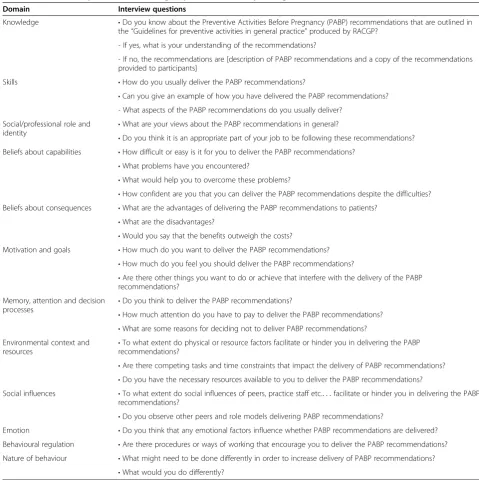
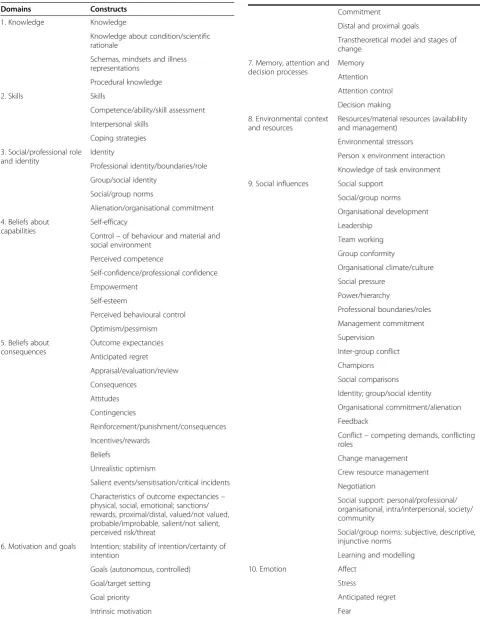
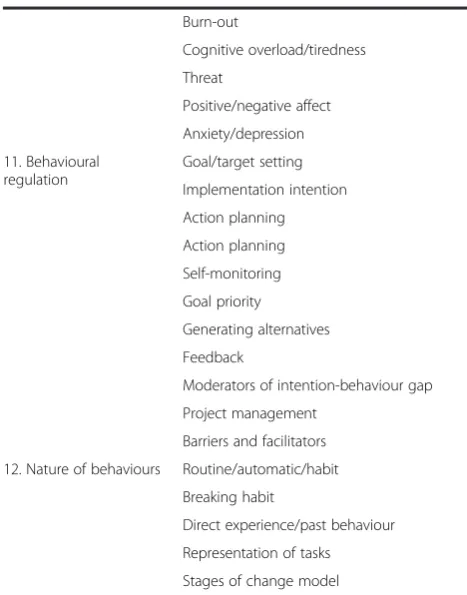
A total of three focus group interviews (one for each re-gional general practice support organisation) were con-ducted between October and November 2007. Focus group interviews were conducted because these were deemed to be most effective for engaging with busy GPs. To maintain consistency, all focus groups were con-ducted by the same facilitator (DM) and each session was 90 minutes in duration. The schedule of questions for the focus group (Table 1) was based on the theoret-ical domain framework developed by Michie et al. [19]. This framework outlines 12 key theoretical domains related to behaviour change (Table 2) and can be used to identify which domains are likely to be the best explana-tions of implementation problems. In this study, each domain was linked to a set of questions which were used to explore the delivery and uptake of PCC guidelines by GPs, as outlined in the RACGP Guidelines for Prevent-ive Activities in General Practice [25]. The facilitator chose which set of questions to ask and the line of ques-tioning was modified according to whether barriers and enablers were elicited for each domain.
Data analysis
differed, an agreement of interpretation was reached through meetings with the project advisory group, which included content and methodological experts.
Results
We found that the barriers and enablers to the delivery and uptake of PCC guidelines, as perceived by GPs, were primarily related to four theoretical domains: (1) beliefs about capabilities; (2) motivations and goals; (3) environ-mental context and resources; and (4) memory, attention,
and decision making. Statements which accurately depicted the theme for each theoretical domain were chosen ac-cordingly. Theoretical domains that were found to not be relevant included emotion, social/professional role and identity, and skills.
Beliefs about capabilities
[image:3.595.54.534.98.579.2]GPs felt that they did not have the opportunity to de-liver the PCC guidelines as women often did not present at the preconception stage. GPs also stated that
Table 1 Schedule of questions for focus groups and the corresponding theoretical domains
Domain Interview questions
Knowledge •Do you know about the Preventive Activities Before Pregnancy (PABP) recommendations that are outlined in the“Guidelines for preventive activities in general practice”produced by RACGP?
- If yes, what is your understanding of the recommendations?
- If no, the recommendations are [description of PABP recommendations and a copy of the recommendations provided to participants]
Skills •How do you usually deliver the PABP recommendations?
•Can you give an example of how you have delivered the PABP recommendations? - What aspects of the PABP recommendations do you usually deliver?
Social/professional role and
identity •
What are your views about the PABP recommendations in general?
•Do you think it is an appropriate part of your job to be following these recommendations? Beliefs about capabilities •How difficult or easy is it for you to deliver the PABP recommendations?
•What problems have you encountered?
•What would help you to overcome these problems?
•How confident are you that you can deliver the PABP recommendations despite the difficulties? Beliefs about consequences •What are the advantages of delivering the PABP recommendations to patients?
•What are the disadvantages?
•Would you say that the benefits outweigh the costs?
Motivation and goals •How much do you want to deliver the PABP recommendations?
•How much do you feel you should deliver the PABP recommendations?
•Are there other things you want to do or achieve that interfere with the delivery of the PABP recommendations?
Memory, attention and decision processes
•Do you think to deliver the PABP recommendations?
•How much attention do you have to pay to deliver the PABP recommendations?
•What are some reasons for deciding not to deliver PABP recommendations? Environmental context and
resources
•To what extent do physical or resource factors facilitate or hinder you in delivering the PABP recommendations?
•Are there competing tasks and time constraints that impact the delivery of PABP recommendations?
•Do you have the necessary resources available to you to deliver the PABP recommendations?
Social influences •To what extent do social influences of peers, practice staff etc.. . .facilitate or hinder you in delivering the PABP recommendations?
•Do you observe other peers and role models delivering PABP recommendations?
Emotion •Do you think that any emotional factors influence whether PABP recommendations are delivered?
Behavioural regulation •Are there procedures or ways of working that encourage you to deliver the PABP recommendations? Nature of behaviour •What might need to be done differently in order to increase delivery of PABP recommendations?
Table 2 Theoretical domains and their component constructs
Domains Constructs
1. Knowledge Knowledge
Knowledge about condition/scientific rationale
Schemas, mindsets and illness representations
Procedural knowledge
2. Skills Skills
Competence/ability/skill assessment
Interpersonal skills
Coping strategies
3. Social/professional role and identity
Identity
Professional identity/boundaries/role
Group/social identity
Social/group norms
Alienation/organisational commitment
4. Beliefs about capabilities
Self-efficacy
Control–of behaviour and material and social environment
Perceived competence
Self-confidence/professional confidence
Empowerment
Self-esteem
Perceived behavioural control
Optimism/pessimism
5. Beliefs about consequences
Outcome expectancies
Anticipated regret
Appraisal/evaluation/review
Consequences
Attitudes
Contingencies
Reinforcement/punishment/consequences
Incentives/rewards
Beliefs
Unrealistic optimism
Salient events/sensitisation/critical incidents
Characteristics of outcome expectancies– physical, social, emotional; sanctions/ rewards, proximal/distal, valued/not valued, probable/improbable, salient/not salient, perceived risk/threat
6. Motivation and goals Intention; stability of intention/certainty of intention
Goals (autonomous, controlled)
Goal/target setting
Goal priority
Intrinsic motivation
Table 2 Theoretical domains and their component constructs(Continued)
Commitment
Distal and proximal goals
Transtheoretical model and stages of change
7. Memory, attention and decision processes
Memory
Attention
Attention control
Decision making
8. Environmental context and resources
Resources/material resources (availability and management)
Environmental stressors
Person x environment interaction
Knowledge of task environment
9. Social influences Social support
Social/group norms
Organisational development
Leadership
Team working
Group conformity
Organisational climate/culture
Social pressure
Power/hierarchy
Professional boundaries/roles
Management commitment
Supervision
Inter-group conflict
Champions
Social comparisons
Identity; group/social identity
Organisational commitment/alienation
Feedback
Conflict–competing demands, conflicting roles
Change management
Crew resource management
Negotiation
Social support: personal/professional/ organisational, intra/interpersonal, society/ community
Social/group norms: subjective, descriptive, injunctive norms
Learning and modelling
10. Emotion Affect
Stress
Anticipated regret
they were often unaware of a woman’s intention to con-ceive, or that women only presented when they were already pregnant.
“You’ve got to motivate them to actually come in; my main barrier is that they don’t come.”(Female GP, High SES)
“It’s very rare for people to come in and say that they’re planning to have a baby. Most of them come when they are already pregnant.” (Male GP, High SES)
GPs also stated that increased awareness in women of both the availability and the importance of PCC would facilitate the delivery of PCC guidelines.
Motivation and goals
A number of GPs stated that spina bifida and NTDs were too rare to warrant specific action. This view was reflected by the fact that few of the GPs had ever seen a case of NTD. They were also of the opinion that folate isn’t 100% effective in preventing NTDs, and that even if they did discuss the use folic acid during early
pregnancy, their efforts may not be worthwhile because NTDs were still a possibility.
“. . .even if everyone did take folate, there will still be neural tube defects, it will never be eradicated.” (Female GP, Low SES)
GPs also frequently stated that they did not raise PCC with women of reproductive age because of other com-peting preventive care priorities. Examples of other pre-ventive care priorities included chlamydia screening, pap smears, and cervical cancer vaccination. Some GPs pre-ferred to spend more time addressing issues such as al-cohol and smoking as they could see more potential benefits.
“It’s a big consultation and there is a lot of competing preventive health at the moment.”(Female GP, Low SES)
Environmental context and resources
Overall, the biggest barrier to the delivery of PCC as per-ceived by GPs was the time limits on consultations. GPs pointed out that the delivery of PCC guidelines would take longer than a standard consultation, and that trying to cover all of the issues related to PCC was a real chal-lenge. They found it particularly problematic when PCC issues were raised at the end of a consultation for an-other issue.
“There is a problem with adding in more preventive type consultations in practices that are stretched to the limit. I don’t know if we can physically do it. . ..”(Male GP, Rural)
“The main commodity is time, and all of us are stretched at the moment so by taking on this additional work, we don’t know where to fit it in.” (Male GP, High SES)
More importantly, both rural and low SES groups of GPs felt that patients were not willing to spend more time and money on attending multiple consultations dedicated to PCC.
“There is also the cost as well, because they won’t want to pay for that.”(Female GP, Rural)
[image:5.595.55.289.110.408.2]Another major barrier identified by GPs was the lack of both GP and patient resources (eg, patient information sheets, evidence-based websites) for PCC. The majority of resources utilised by GPs were patient information sheets produced by pharmaceutical companies. Consequently, Table 2 Theoretical domains and their component
constructs(Continued)
Burn-out
Cognitive overload/tiredness
Threat
Positive/negative affect
Anxiety/depression
11. Behavioural regulation
Goal/target setting
Implementation intention
Action planning
Action planning
Self-monitoring
Goal priority
Generating alternatives
Feedback
Moderators of intention-behaviour gap
Project management
Barriers and facilitators
12. Nature of behaviours Routine/automatic/habit
Breaking habit
Direct experience/past behaviour
Representation of tasks
GPs expressed a need for resources to be produced by more credible, unbiased organisations.
Another barrier that was mentioned by GPs was the limited access to individual GPs, particularly for rural patients. There was some concern that not all GPs were willing to deliver PCC, and, consequently, there could be considerable delay to see those that do.
“A problem is that in our practice, there is a lot of doctors who don’t do prenatal care and, if they want to see me, it’s a long wait.”(Female GP, Rural)
“Another problem is that I’m not always there, which makes it more difficult if they want to see me.” (Female GP, Low SES)
One final barrier that was identified was the potential increase in burden on clinics if the number of PCC con-sultations was increased. GPs commonly believed that this may result in sick patients getting limited access to clinics. GPs stated that they often pushed themselves to make additional time for patients who were unwell, but they were not necessarily willing to keep adding more time to consultations for opportunistic or preventive issues.
“If I book for half hour to talk about this, I’ve got other patients who are actually sick and are coming with hepatitis, influenzasetc.. . .and I have to make time for them, so I’m not going to allow more time for something that is preventive or an opportunistic thing.” (Male GP, Low SES)
Memory, attention and decision making
A perceived enabler identified by GPs was the availability of PCC checklists to ensure that the entire PCC guide-line is discussed. Patient brochures, handouts, and wait-ing room posters outlinwait-ing the benefits and availability of PCC consultations were also viewed as beneficial.
“I like the idea of having a checklist of things so when people come in you can go over everything.”(Male GP, Low SES)
Discussion
Using the theoretical domain framework, our study has identified some of the barriers and enablers to the deliv-ery and uptake of PCC guidelines, as perceived by GPs. The biggest barrier we identified was the time con-straints faced by GPs – they simply felt that there was not enough time to deliver PCC in a standard consult-ation. Other barriers to the delivery of PCC guidelines were the lack of women presenting at the preconception stage, other competing preventive care issues, the
availability of and access to GPs who deliver PCC, the cost associated with extending consultations to include PCC, and the lack of resources for assisting in the deliv-ery of preconception care guidelines. Perceived enablers to the delivery and uptake of PCC guidelines included the availability of PCC checklists as well as patient bro-chures, handouts, and waiting room posters outlining the benefits and availability of PCC consultations.
The results of our study highlight the need for devel-oping interventions that respond to concerns from GPs about their capability to deliver PCC when faced with time constraints. The availability of a checklist may prove useful for GPs as it will ensure that all aspects of the PCC guidelines are discussed with patients, even when time is limited. There is also the potential for PCC to be delivered by a practice nurse or for a risk screen to be undertaken online by patients prior to a consultation. Both options could potentially remove some of the bur-den on GPs without compromising the delivery of PCC to patients.
The lack of women presenting at the preconception stage also contributes to the difficulty in delivering PCC guidelines. Interventions should focus on increasing pa-tient awareness of the need for and availability of PCC. The lack of women presenting specifically for PCC results in GPs being deprived of the opportunity to de-vote a consultation to this purpose. As a consequence, PCC issues are often raised at the end of the consult-ation where they may compete with other preventive care issues. Dealing with PCC in an“opportunistic”way is problematic because non-attendees and those who are most in need may inadvertently be denied access to PCC. A shift in emphasis is required that extends women’s awareness to attend for antenatal care at the preconception stage. Some have even suggested extend-ing PCC to the family plannextend-ing settextend-ing whilst acknow-ledging the difficulty of talking to a predominantly young clientele about preparing for pregnancy at a time when they are presenting for contraceptive services [30].
Both the cost of and access to preventive services in low SES and rural areas were viewed by GPs in our study as problematic to the delivery of PCC guidelines. These issues are often discussed in literature from the US, where insurance coverage for women of reproduct-ive age living in low SES and rural areas is a problem [31]. Inadequate access to PCC may be overcome by work-role substitution, where practice nurses undertake the delivery of PCC. Also, the availability of a financial incentive specifically for PCC would overcome the cost of accessing PCC, which is especially relevant for women living in low SES areas.
In our study, GPs also mentioned the need for GP and patient resources to facilitate the delivery of PCC guide-lines. Specifically, GPs thought that the availability of checklists would ensure that the entire guideline is dis-cussed during a consultation. Guidelines often have a multitude of recommendations and, therefore, GPs need assistance with resources and time management strat-egies to enable them to deliver the recommendations in a more holistic way. Our findings are consistent with a previous study that examined the barriers to counselling women of childbearing age on the potential risks of birth defects when using certain medications during preg-nancy. In this study, primary care providers expressed a desire for resources such as patient information materi-als, electronic decision support tools, and clinical care systems that routinely assess patients' pregnancy risk, which they believed would help counsel patients about the teratogenic risks associated with certain medications [32]. Another study also highlighted the need for patient information leaflets to support GPs in the delivery of PCC to women with diabetes, especially when there are time constraints [33]. Consequently, potential interven-tions for improving the delivery of PCC guidelines should also focus on providing tools and resources to as-sist GPs in delivering the content and evidence base of the guidelines.
Our study is limited by the relatively small number of GPs involved and the fact that they were recruited from only one state in Australia. Despite this, the barriers and enablers (and, therefore, the corresponding theoretical domains) identified by GPs were consistent across the three regional general practice support organisations. Al-though GPs in low SES and rural groups already consult ethnically diverse populations, our study could have been further strengthened by recruiting GPs who work in locations with high indigenous populations. Indigen-ous populations have proportionately higher rates of perinatal morbidity and mortality relative to the rest of the Australian population. Therefore, the views of those GPs on the barriers and enablers to the delivery and up-take of PCC would have provided an interesting com-parison with our data.
The results of our study are also limited by the qualita-tive design. While focus groups are suitable for exploring common experiences, they may increase the conformity of responses. Because the GPs in our study volunteered to participate, they may also represent a subgroup of GPs who have a higher degree of interest in PCC compared with other GPs, thus limiting the generalisability of our findings. The barriers reported by GPs may also be differ-ent to those observed in real practice. For example, a lack of time to deliver PCC may, in reality, reflect a lack of mo-tivation. Conducting a similar study on a larger scale or incorporating quantitative methodologies may provide a greater understanding of the issues raised in our study.
Conclusion
Our study has identified some of the barriers and enablers to the delivery and uptake of PCC, as perceived by GPs. Further research is necessary to determine which of these should be targeted or prioritised for intervention. Consideration must also be given to the views of women on the barriers and enablers to the de-livery and uptake of PCC [12]. Understanding the views of both women and GPs as well as the theoretical basis for changing their behaviour will be essential when designing effective implementation strategies for im-proving the delivery and uptake of PCC. These strategies may also need to consider the role practice nurses and other health professionals may have in facilitating better uptake of PCC, especially among high-risk patients who should be actively targeted. Promotional materials and letters of invitations from GPs advising patients of the availability of and the need for preconception care could also be used to increase the uptake of PCC. Given the potential for evidence-based PCC to reduce maternal and neonatal morbidity and mortality, it is essential that effective strategies are put in place to deliver evidence-based PCC guidelines. Therefore, the information gath-ered by our study provides a foundational step for designing a methodologically rigorous intervention [34] for improving the implementation of PCC guidelines.
Abbreviations
GP: General practitioner; NTD: Neural tube defect; PCC: Preconception care; RACGP: Royal Australian college of general practitioners; SES: Socioeconomic status.
Competing interests
The authors declare that they have no financial or non-financial competing interest.
Authors’contributions
DM conceived the study, DM and AC drafted the paper, and SM contributed to the writing and review of the manuscript. All authors read and approved the final manuscript.
Acknowledgements
Dr Bronwyn Harvey. We would also like to thank Ms Elizabeth Logan and Ms Danielle Rigoni for their advice. We would also like to thank Dr Maria de Leon-Santiago for her assistance in preparing this manuscript. Finally, we would like to thank the Bayside GP Network, Dandenong Division of GP and South Gippsland GP Network for their assistance in recruitment, and the participating GPs.
Funding
DM undertook this work with the support of a National Institute of Clinical Studies (NICS) - HCF Foundation Fellowship. NICS is an institute of the National Health and Medical Research Council (NHMRC), Australia’s peak body for supporting health and medical research. AC was supported by funding from the Shepherd Foundation. Both funding bodies had no involvement in the research process.
Author details 1
Department of General Practice, Monash University, Building 1, 270 Ferntree Gully Road, Notting Hill, VIC 3168, Australia.2Research Department of Clinical, Education and Health Psychology, University College London, London, UK.
Received: 13 September 2012 Accepted: 17 January 2013 Published: 31 January 2013
References
1. Bille C, Andersen A-MN:Preconception care.British Med J2009,338:b22. 2. Frey KA, Files JA:Preconception healthcare: what women know and
believe.Mat Child Health J2006,10(5 Suppl):S73–S77.
3. Watson LF, Brown SJ, Davey M-A:Use of periconceptional folic acid supplements in Victoria and New South Wales, Australia.Aust N Z J Public Health2006,30(1):42–49.
4. Marsack CR, Alsop CL, Kurinczuk JJ, Bower C:Pre-pregnancy counselling for the primary prevention of birth defects: rubella vaccination and folate intake.Med J Aust1995,162(8):403–406.
5. Conlin ML, MacLennan AH, Broadbent JL, Conlin ML, MacLennan AH, Broadbent JL:Inadequate compliance with periconceptional folic acid supplementation in South Australia.Aust N Z J Obstet Gynaecol2006, 46(6):528–533.
6. Inskip HM, Crozier SR, Godfrey KM, Borland SE, Cooper C, Robinson SM, for the Southampton Women’s Survey Study Group:Women’s compliance with nutrition and lifestyle recommendations before pregnancy: general population cohort study.British Med J2009,338:b481.
7. Lumley J, Watson L, Watson M, Bower C:Periconceptional
supplementation with folate and/or multivitamins for preventing neural tube defects.Cochrane Database Systematic Rev2001, (3):CD001056. 8. Johnson K, Posner SF, Biermann J, Cordero JF, Atrash HK, Parker CS, Boulet
S, Curtis MG:Recommendations to improve preconception health and health care - United States. A report of the CDC/ATSDR preconception care work group and the select panel on preconception care.MMWR Recommend Report2006,55(RR-6):1–23.
9. Royal Australian College of General Practitioners:RACGP redbook: guidelines for preventive activities in general practice. 7th edition. Melbourne: Royal Australian College of General Practitioners; 2009.
10. Lu MC:Recommendations for preconception care.Am Fam Physician 2007,76(3):397–400.
11. Health Council of the Netherlands:Preconception care: a good beginning: The Hague: Health Council of the Netherlands; 2007. Publication no. 2007/19E. 12. Mazza D, Chapman A:Improving the uptake of preconception care and
periconceptional folate supplementation: what do women think?BMC Publ Health2010,10(786):1–6.
13. Michie S, Hendy J, Smith J, Adshead F:Evidence into practice: a theory based study of achieving national health targets in primary care.J Eval Clin Pract2004,10(3):447–456.
14. The Improved Clinical Effectiveness through Behavioural Research Group (ICEBeRG):Designing theoretically-informed implementation interventions.Implement Sci2006,1(4):1–8.
15. Grol RP, Bosch M, Hulscher M, Eccles M, Wensing M:Planning and studying improvement in patient care: the use of theoretical perspectives.Milbank Quarter2007,85:93–138.
16. Michie S, Fixsen D, Grimshaw J, Eccles M:Specifying and reporting complex behaviour change interventions: the need for a scientific method.Implement Sci2009,4(40):1–6.
17. Eccles M, Grimshaw J, Walker A, Johnston M, Pitts N:Changing the behavior of healthcare professionals: the use of theory in promoting the uptake of research findings.J Clin Epidemiol2005,58(2):107–112. 18. Beenstock J, Sniehotta FF, White M, Bell R, Milne EM, Araujo-Soares V:What
helps and hinders midwives in engaging with pregnant women about stopping smoking? A cross-sectional survey of perceived
implementation difficulties among midwives in the northeast of England.Implement Sci2012,7(36):1–10.
19. Michie S, Johnston M, Abraham C, Lawton R, Parker D, Walker A, on behalf of the Psychological Theory Group:Making psychological theory useful for implementing evidence based practice: a consensus approach.Qual Saf Health Care2005,14(1):26–33.
20. Michie S, Pilling S, Garety P, Whitty P, Eccles MP, Johnston M, Simmons J: Difficulties implementing a mental health guideline: an exploratory investigation using psychological theory.Implement Sci2007,2(8):1–8. 21. Laws R, Kirby S, Davies G, Williams A, Jayasinghe U, Amoroso C, Harris M:
“Should I and Can I?”: A mixed methods study of clinician beliefs and attitudes in the management of lifestyle risk factors in primary health care.BMC Heal Serv Res2008,8(44):1–10.
22. McKenzie J, French S, O’Connor D, Grimshaw J, Mortimer D, Michie S, Francis J, Spike N, Schattner P, Kent P,et al:IMPLEmenting a clinical practice guideline for acute low back pain evidence-based manageMENT in general practice (IMPLEMENT): Cluster randomised controlled trial study protocol.Implement Sci2008,3(11):1–12. 23. Bussieres AE, Patey AM, Francis JJ, Sales AE, Grimshaw JM, Brouwers M,
Godin G, Hux J, Johnston M, Lemyre L,et al:Identifying factors likely to influence compliance with diagnostic imaging guideline
recommendations for spine disorders among chiropractors in north America: a focus group study using the theoretical domains framework. Implement Sci2012,7(82):1–11.
24. Boscart VM, Fernie GR, Lee JH, Jaglal SB:Using psychological theory to inform methods to optimize the implementation of a hand hygiene intervention.Implement Sci2012,7(77):1–12.
25. Royal Australian College of General Practitioners:RACGP redbook: guidelines for preventive activities in general practice. 6th edition. Melbourne: Australian College of General Practitioners; 2007.
26. Australian Bureau of Statistics:Information paper: an introduction to Socio-Economic Indexes for Areas (SEIFA) 2006: ABS Catalogue No. 2039.0; 2006; 2008. 27. QSR International Pty Ltd:NVivo qualitative data analysis software. Version 7; 2006. 28. Boyatzis R:Transforming qualitative information: thematic analysis and code
development. London, UK: Sage Publications; 1998.
29. Hayes N:Theory-led thematic analysis: social identification in small companies. InDoing qualitative analysis in psychology. Edited by Hayes N. Hove: Psychology Press; 1997:93–114.
30. Gold RB, Alrich C:Role of medicaid family planning waivers and title X in enhancing access to preconception care.Womens Health Issues2008, 18(6):S47–S51.
31. Rosenbaum S:Women and health insurance: implications for financing preconception health.Womens Health Issues2008,18(6, Supplement 1):S26–S35. 32. Schwarz EB, Santucci A, Borrero S, Akers AY, Nikolajski C, Gold MA:
Perspectives of primary care clinicians on teratogenic risk counseling. Birth Defects Res Part A Clin Mol Teratol2009,85(10):858–863.
33. Mortagy I, Kielmann K, Baldeweg SE, Modder J, Pierce MB:Integrating preconception care for women with diabetes into primary care: a qualitative study.Br J Gen Pract2010,60(580):815–821.
34. van Bokhoven MA, Kok G, van der Weijden T:Designing a quality improvement intervention: a systematic approach.Quality Safety Health Care2003,12(3):215–220.
doi:10.1186/1472-6963-13-36
Cite this article as:Mazzaet al.:Barriers to the implementation of