Int. J. Electrochem. Sci., 12 (2017) 6465 – 6476, doi: 10.20964/2017.07.27
International Journal of
ELECTROCHEMICAL
SCIENCE
www.electrochemsci.org
Detection of H
2S at Room Temperature Using ZnO Sensors
Based on Hall Effect
J. Y. Lin, Z. X. Chen, X. L. He*, W. M. Xie
School of Information science and Engineering, Fujian University of Technology, Fuzhou, Fujian, 350108, China
*
E-mail: [email protected]
Received: 6 March 2017 / Accepted: 29 April 2017 / Published: 12 June 2017
In this paper, a novel selective gas sensor for detection of H2S gas is proposed based on Hall Effect.
ZnO sensors based on Hall Effect were fabricated from ZnO nanonails prepared by a hydrothermal method and their gas-sensing properties were investigated. The sensor was placed in a magnetic field perpendicular to the current which is moving through the sensor. At room temperature (RT), it was observed that the sensor can be used as selective hydrogen sulfide gas sensor because output voltage decreases in the presence of H2S gas. Furthermore, the change in output voltage was found to be
reversible and a drift in recovery from the original value of voltage was also observed on the removal of H2S gas environment. A Typical room temperature response of 70.4 was achieved at 100 ppm of
NO2 with a response and recovery times of 35 and 82 s respectively. Along with the investigation of
the performance of the sensors, the mechanisms of H2S gas sensing of the Hall Effect sensor are also
discussed in this study. The low cost and low power consumption of the sensor makes it a promising hydrogen sulfide gas sensor.
Keywords: Gas sensor; Room temperature H2S sensor; ZnO; Hall Effect
1. INTRODUCTION
As a flammable and poisonous gas, hydrogen sulfide is usually generated during the mining process, crude oil or manufacturing of natural gases. The threshold limit value (TLV) of hydrogen sulfide is stipulated to be 10 ppm. If 500–1000 ppm of H2S is inhaled for 30 min, it will be hazardous
to people and even lead to death. Therefore, it is essential for industries like mining, gas, food packing and oil to consume a low amount of hydrogen sulfide safely [2].
A large number of studies were conducted to improve the sensitivity, selectivity, reproducibility, temperature operation and stability of gas sensors for H2S. Different base materials for
oxide semiconductors including SnO2 [3], ZnO [4], In2O3 [5], CuO [6], TiO2 [7], WO3 [8], α-Fe2O3
[9], have been reported as H2S sensor in the literature [10]. However most of these sensors are
supposed to work under higher temperatures, which is inconvenient in practice and occasionally even dangerous for measuring the concentration of combustible gases [11]. Moreover, under high operation temperature, the long-term stability of the metal gas sensors drifts due to oxygen vacancies diffuse in the metal oxides [12,13]. Under some circumstances, disadvantages could be resulted from keeping high operation temperature, particularly under the condition that higher sensor power consumption is unsatisfactory, such as when photovoltaics are the ideal power source. A proper example is to monitor outdoor gas emission where main power is unavailable by remote control. Under such circumstance, highly responsive, low power and thus room temperature gas sensors would be desirable [14].
Z.S. Hosseini et al. fabricated H2S gas sensor on the basis of vertical ZnO nanorods which were
sensitized by Au and had a flower-like construction. Au was used to modify the construction in order to improve the selectivity and sensitivity of sensing H2S under ambient temperature [15]. Jianfeng
Deng et al. introduced a sensitive films based on ZnO quantum dots (QDs) of 3.8 nm with operating at room temperature to sense H2S. In that study, the films were produced through a spin-coating process
and processed in low temperature [16]. In these researches, various methods such as incorporating dopants [17, 18], sensitizing the sensing layer with noble metals (Au) [19] as well as 1D metal oxides nanostructures (ZnO,CuO) [20, 21] , have all been employed to reduce the operating temperature of detecting H2S to ambient temperature. But the sensors on the basis of Hall Effect which could operate
under ambient temperature were still rarely reported [22]. To the best of our knowledge, there are no reports on their H2S sensing properties under ambient temperature.
In this study a gas sensor was developed on the basis of Hall Effect and ZnO which was used as the gas sensitive coating, to detect low level (10 to 140 ppm) H2S gas under ambient temperature.
ZnO thin-films were prepared through thermal evaporation on Si substrates coated with Au. Not only the property of device, but also the reversibility and sensibility to the electron donor H2S under
ambient temperature were all proposed and discussed. Moreover, the sensing mechanisms of the device on the basis of Hall Effect were deeply studied.
2. EXPERIMENT
2.1. Preparation of pure ZnO nanonails
ZnO nanonails were produced on Si substrates coated with Au by simple thermal evaporation. Firstly, the temperature of furnace elevated to 850 °C with 500 sccm N2 flow and the heating speed
powder (99.99%) were mixed under the Zn/C weight ratio of 2/1 to make the source material and then transferred into a quartz boat while Au-coated Si substrates was put downstream from the source material. Subsequently the quartz boat was inserted into tube and placed in the center of tube in a horizontal-type furnace. After being heated for 60 seconds, the reaction system was added with 3 sccm O2gas and the temperature was maintained for fifteen seconds. In the end, the quartz boat was drawn
out of the tube furnace gradually and cooled down to ambient temperature. White products of mass yield were observed on the substrate.
2.2. Fabrication and measurement of sensors
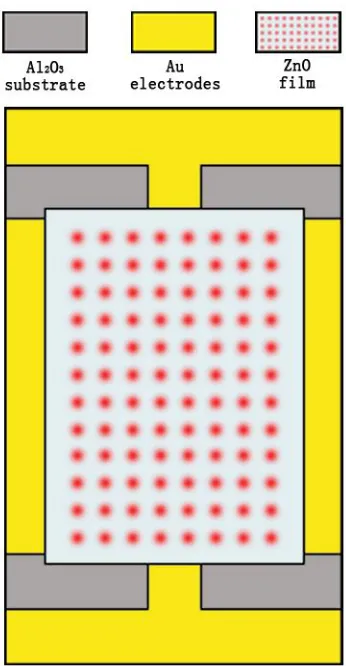
[image:3.596.214.387.393.726.2]An alumina substrate was equipped with two pairs of Au electrodes (line width; 2 mm; distance between lines: 10 mm ;) which were manufactured through screen printing with a commercial Au paste and then calcined at 900◦C for 15 minutes. Organics were used to mix with the ZnO nanonails in order to prepare the paste which was then deposited on an alumina substrate using dip coating method in order to prepare a thin film, whose thickness is about 300 μm [23]. Four gold electrodes were attached with four wires on silver paste whose diameter is 0.25 mm and subsequently fired under the temperature of 500◦C for two hours in dry air flow. Fig. 1 shows the schematic diagram of the sensor.
[image:4.596.100.484.255.421.2]
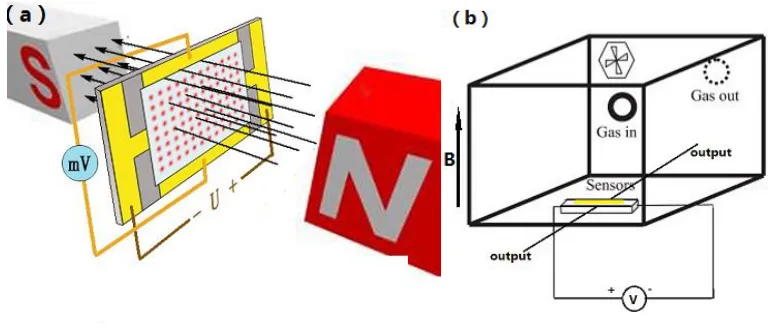
The electrical and sensing characteristics of the sensors were detected through bench system under ambient temperature which is presented in Fig.2. Sensors were placed between magnetic field and a fixed 5 V was continuously supplied to the sensor circuit from a power supply. The Hall voltage of the sensor was measured using different concentrations of gas. Standard gas with known volume was diluted with dry air to obtain specified concentration of gas dilutions which were subsequently injected into the chamber with magnetic field of 0.245×10⁻³ T and volume of 24 L. A fan was used to distribute the gas of the chamber evenly. Over a period of time, air was inflated into the chamber for purging and the experiment was conducted for other cycles. The experimental condition of this study was normal atmosphere and the temperature of 24~28◦C as well as the relative humidity of 20~45%.
Figure 2. Measurement system for testing gas sensors.
2.3. Microstructural and elemental analysis of films
A Philips X'pert instrument operated with CuKα radiation (λ = 1.54056 Ǻ) at 40 kV/40 mA was used to record the analyzing result of Xray powder diffraction (XRD). The SEM diagrams were obtained by a A Philips XL3 ESEM-TMP Scanning electron microscope (SEM).
2.4. Measurement of sensitivity, selectivity, response and recovery time
This equation was used to calculate the response(S) of the sensor: g a
o
a
V V
S
V
3. RESULT AND DISCUSSION
[image:5.596.177.424.129.346.2]3.1. Microstructure and morphology
Figure 3. X-ray diffraction patterns of sample.
Figure 4. SEM image of ZnO sample.
[image:5.596.131.465.405.653.2]
nm, which was corresponding to the values of ZnO powders provided by JCPDS document (Powder Diffraction File Compiled by the Joint Committee on Powder Diffraction, 1985, Card No. 36-1451). The overall profile of the sample produced on the Au-coated Si substrate is shown in Fig.4. The well-organized nanostructure of ZnO nails grew on the Si substrate coated with Au. The length of high-density ZnO nanonails with high high-density reached micron-size, and the diameter of the caps and shafts of nanonails were 2-4 μm and 50-300 nm, respectively.
3.2. Gas sensing result
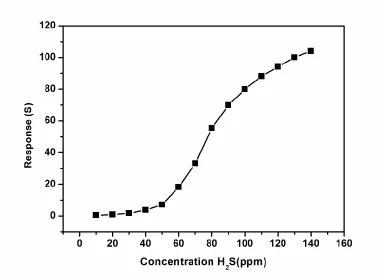
It has drawn much attention to develop gas sensors which could work under room temperature and measure gas concentrations of a wider range. Fig.5 shows that the response of a sensor was the function of H2S concentration ranged from 10 ppm to 140 ppm. The sensor on the basis of Hall Effect
had satisfactory response, even if the concentration was as low as 10 ppm, which is higher than Au modified ZnO nanowires sensor [19]. The response of sensor rose exponentially along with the increasing gas concentration. The threshold limit values for H2S are 10 ppm, so there are various
strategies such as reducing the area of device, surface modification and the doping metal lons like Au, Pd, Pt will be study to enhance response of sensor.
Figure 5. Response of Hall Effect sensor to H2S with varied concentration of 10–140 ppm at room
temperature.
Table 1 shows the performance indices of H2S gas sensor based on our samples and various
[image:6.596.106.491.380.656.2][image:7.596.128.466.484.715.2]
than 50. These results show that gas sensor based on Hall Effect can be expected to have great potential development in H2S gas detection.
Table 1. Comparison of H2S gas sensor based on various ZnO nanostructure
Sensing element Gas
con.(ppm)
Operation temperature
(◦C)
Response Ref.
ZnO dendrites 100 30 17.3 [24]
Pillar shaped ZnO nanorods 100 50 61.7 [23]
Pure ZnO nanorods 100 100 50 [25]
ZnO nanowires 100 RT <10 [26]
In2O3/ ZnO nanowires 100 RT <10 [26]
The response exaggerated tremendously with the concentration of is increasing. The decrease in the absolute value of Hall voltage with increasing H2S concentration could be explained by the
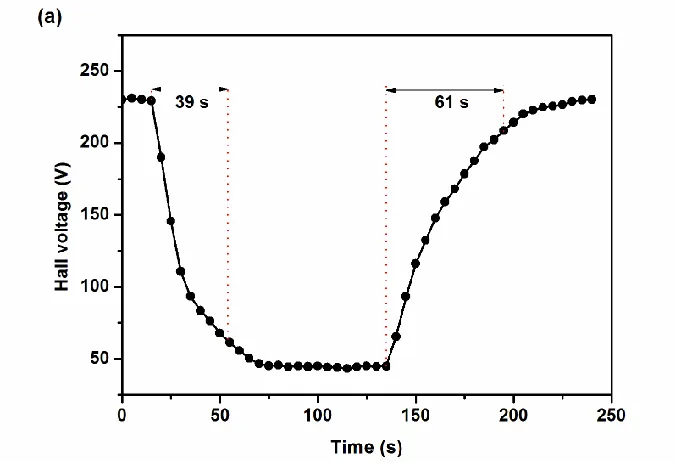
Figure 6. (a) Dynamic response–recovery curve to 40 ppm H2S and (b) the response and recovery time
of the Hall Effect sensor to various concentration H2S at room temperature.
The responding as well as recovering time were critical parameters for a gas sensor. As shown in Fig.6 (a), responding as well as recovering time of the sensor were 39 s and 61 s to the 40 ppm H2S
at room temperature. The recovering and responding time of 100 ppm H2S were 82 s and 35 s
[image:8.596.131.464.73.300.2]separately. It is indicated in Fig. 6 (b) that the responding time was shorter and the recovering time was longer while the gas concentration was higher.
Figure 7. Response of Hall Effect sensor to various gases.
Selectivity was evaluated as the major parameter of a gas sensor. The selectivity of the gas sensor on the basis of Hall Effect to H2S and other probable interfering gases including ammonia
[image:8.596.154.443.462.676.2]
Fig.7. It was clearly observed that Hall Effect sensor displayed the negligible response to CH3COCH3 and C₂H₅OH. And it showed higher response to 60 ppm H2Sthan that at 200 ppm NH3 and 60 ppm
NO2, but the absolute value of output voltage increased for oxidizing gas such as NO2 while decreased
for reducing gas such as NH3 and H2S. Obviously the sensor exhibited high selectivity for H2S.
[image:9.596.153.444.206.422.2]Stability is one of the important properties of gas sensors. As shown in Fig. 8, Stabilitywas also observed even after more than 60 days storage in air. The response shows a rather high stability and the fluctuation of response is lower than 8%.
Figure 8. Variation in the sensor response to 100 ppm H2S at RT for different days.
3.3. Sensing Mechanism
In a magnetic field, the charge carriers of a semiconductor which carries current experience force from the direction which is perpendicular to the current as well as the magnetic field. While equilibrium has established, a voltage arise at the margin of the semiconductor which is named as the Hall effect [27], According to the following equation the voltage could be calculated.
X Z H H
I B
V R
d
Eq. (1)
Where RH represents the Hall coefficient, Bz represents the magnetic flux density, Ix represents
the current passing between both edges, d represents the width of the active region. It is obvious that Hall voltage proportionated to Hall coefficient in the present of invariable width, current as well as magnetic flux density.
2 2 2 1 ( ) p n H p n p n R
e p n
Eq. (2)
or equivalently 2 2 1 ( ) H p nb R
e p nb
Eq. (3)
with n
p
b
Eq. (4)
Where n represents the electron concentration, e the elementary charge, p the hole mobility,n the electron mobility, p the hole concentration,
Substituting the mass action law 2 i n p
n
into Eq. (3) while utilizing a standardized electron concentration
i n x
n
then we obtain, 2 2 2 2 2 2 1 1 ( ) ( ) i H i i n nb xb n x R n en xb e nb x n Eq. (5) i
n represents hole concentration and electron concentration in pure semi-conductor substrate [28].
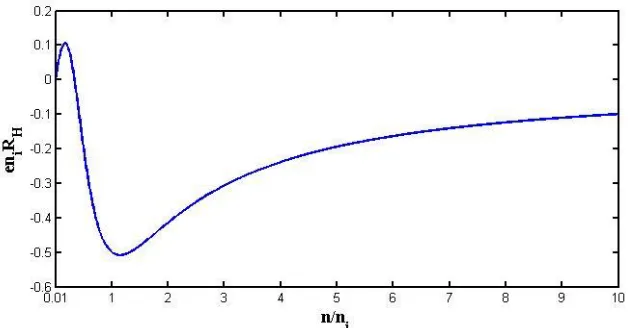
[image:10.596.136.452.445.609.2]RH vs. n which is shown in Fig.9 for b = 3.
Figure 9. Normalized Hall coefficient vs. normalized electron concentration.
Simulation with Matlab revealed that the Hall coefficient was a function of electron concentration for ZnO semi-conductor, as shown in Fig.8. As is well-know, since ZnO is an n-type semiconductor (nni), O2 molecules were absorbed by ZnO surface thus O2
−
and O22− ions were
the surface reaction of H2S has been explained using Esq. (6) [29], (7) and (8) [29, 30], which
describes surface reaction with adsorbed oxygen species:
2 2
2H S gas( ) e2H S ads( ) (6) 2 ( ) 2 ( ) 2 ( ) 2( )
H S gas O ad H S ads O gas e (7)
2 2 2 2
2H S ads( ) 3 O(ad)2H O g( ) 2 SO g( ) 3 e (8)
In exposure to H2S gas, oxygen species react with gas. The reaction decreases oxygen partial
pressure which then causes the electrons trapped on surface to be released and back to the conducting band of ZnO. Consequently, the absolute value of Hall coefficient or Hall voltage decreased.
The electron concentration rooting in this reaction could decide the sensibility of sensor since which increased due to the elevation of H2S concentration. The surface-to-volume ratio related to 1D
nanostructure was remarkably high which possibly resulted in the drastic decrease of the voltage of sensor made from ZnO nanonail materials [23].
4. CONCLUSION
To sum up, a Hydrogen sulfide sensor based on Hall Effect has been made that is suitable for usage under ambient temperature. The Hall voltage of sensors on the basis of Hall Effect is decreased when exposed to ppm level Hydrogen sulfide. The behavior of sensor on the basis of Hall Effect to Hydrogen sulfide is related with change of electron concentration. The response behaviors of as-prepared our sensors based on Hall Effect suggest that such sensors based on Hall Effect have potential applications in actively detecting toxic gas without using any electricity power.
ACKNOWLEDGEMENTS
This work was supported by the National Natural Science Foundation of China (Grant No.61306071),the Natural Science Foundation of Fujian Province, China (Grant No. 2015J05117)and Fujian Young and Middle-aged Teacher Education and Scientific Research Projects(NO:JA15347) .
References
1. G. Chaudhari, D. Bambole, A. Bodade and P. Padole, J.Mat.S., 41(2006) 4860.
2. J. Sarfraz, P. Ihalainen, A. Määttänen, T. Gulin, J. Koskela, C. E. Wilén, A. Kilpelä and J. Peltonen, Sensors Actuators B: Chem., 191(2014) 821.
3. E. Y. Sevast’yanov, N. K. Maksimova, Е. V. Chernikov and А. А. Firsov, Ru.Ph.J., 55(2012) 602. 4. Z. S. Hosseini, A. I. zad and A. Mortezaali, Sensors Actuators B: Chem., 207(2015) 865.
5. R. H. Bari, P. P. Patil, S. B. Patil and A. R. Bari, Bull Mater Sci., 36(2013) 967.
6. F. Zhang, A. Zhu, Y. Luo, Y. Tian, J. Yang and Y. Qin, J. Phys. Chem. C., 114(2010) 19214. 7. K. Garadkar, B. Shirke, P. Hankare and D. Patil, Sensor Lett., 9(2011) 526.
8. C. S. Rout, M. Hegde and C. Rao, Sensors Actuators B: Chem., 128(2008) 488.
9. J. Deng, J. Ma, L. Mei, Y. Tang, Y. Chen, T. Lv, Z. Xu and T. Wang, J. Mater. Chem. A., 1(2013) 12400.
11. H. C. Wang, Y. Li and M. J. Yang, Sensors Actuators B: Chem., 119(2006) 380. 12. P. Clifford and D. Tuma, SeAc., 3(1983) 255.
13. P.-G. Su and Y.-T. Peng, Sensors Actuators B: Chem., 193(2014) 637.
14. E. R. Waclawik, J. Chang, A. Ponzoni, I. Concina, D. Zappa, E. Comini, N. Motta, G. Faglia and G. Sberveglieri, Beilstein J Nanotechnol., 3(2012) 368.
15. Z. S. Hosseini, A. Mortezaali, A. Iraji zad and S. Fardindoost, J Alloys Compd., 628(2015) 222. 16. J. Deng, Q. Fu, W. Luo, X. Tong, J. Xiong, Y. Hu and Z. Zheng, Sensors Actuators B: Chem.,
224(2016) 153.
17. E. Mohammadi-Manesh, M. Vaezzadeh and M. Saeidi, Surf Sci., 636(2015) 36.
18. M. Asad, M. H. Sheikhi, M. Pourfath and M. Moradi, Sensors Actuators B: Chem., 210(2015) 1. 19. N. S. Ramgir, P. K. Sharma, N. Datta, M. Kaur, A. K. Debnath, D. K. Aswal and S. K. Gupta,
Sensors Actuators B: Chem., 186(2013) 718.
20. C. Wang, X. Chu and M. Wu, Sensors Actuators B: Chem., 113(2006) 320. 21. T. Fu, Electrochim Acta., 112(2013) 230.
22. J. Lin, W. Xie, X. He and H. Wang, Appl Phys A., 122(2016) 801.
23. S. Shinde, G. Patil, D. Kajale, V. Gaikwad and G. Jain, J Alloys Compd., 528(2012) 109. 24. N. Zhang, K. Yu, Q. Li, Z. Zhu and Q. Wan, J Appl Phys., 103(2008) 104305.
25. Y. Cao, D. Jia, R. Wang and J. Luo, Solid·State Electron., 82(2013) 67.
26. W. Zang, Y. Nie, D. Zhu, P. Deng, L. Xing and X. Xue, J. Phys. Chem. C., 118(2014) 9209. 27. E. H. Hall, AmJM., 2(1879) 287.
28. S.O. Kasap, Hall effect in semiconductors: an e-booklet, 1 (2001)1.
29. C. M. Ghimbeu, J. Schoonman, M. Lumbreras and M. Siadat, Appl Surf Sci., 253(2007) 7483. 30. J. Kim and K. Yong, The Journal of Physical Chemistry C., 115(2011) 7218.