R E S E A R C H
Open Access
IRF5
gene polymorphisms in melanoma
Lorenzo Uccellini
1,2*, Valeria De Giorgi
1, Yingdong Zhao
3, Barbara Tumaini
4, Narnygerel Erdenebileg
1,
Mark E Dudley
6, Sara Tomei
1, Davide Bedognetti
1,5, Maria Libera Ascierto
1,5, Qiuzhen Liu
1, Richard Simon
3,
Leah Kottyan
6, Kenneth M Kaufman
6,7, John B Harley
6,7, Ena Wang
1, Steven A Rosenberg
1and
Francesco M Marincola
8*Abstract
Background:Interferon regulatory factor (IRF)-5is a transcription factor involved in type I interferon signaling whose germ line variants have been associated with autoimmune pathogenesis. Since relationships have been observed between development of autoimmunity and responsiveness of melanoma to several types of
immunotherapy, we tested whether polymorphisms ofIRF5are associated with responsiveness of melanoma to adoptive therapy with tumor infiltrating lymphocytes (TILs).
Methods:140 TILs were genotyped for four single nucleotide polymorphisms (rs10954213, rs11770589, rs6953165,
rs2004640) and one insertion-deletion in theIRF5gene by sequencing. Gene-expression profile of the TILs, 112 parental melanoma metastases (MM) and 9 cell lines derived from some metastases were assessed by Affymetrix Human Gene ST 1.0 array.
Results:Lack of A allele in rs10954213 (G > A) was associated with non-response (p < 0.005). Other polymorphisms in strong linkage disequilibrium with rs10954213 demonstrated similar trends. Genes differentially expressedin vitro between cell lines carrying or not the A allele could be applied to the transcriptional profile of 112 melanoma metastases to predict their responsiveness to therapy, suggesting thatIRF5genotype may influence immune responsiveness by affecting the intrinsic biology of melanoma.
Conclusions:This study is the first to analyze associations between melanoma immune responsiveness andIRF5 polymorphism. The results support a common genetic basis which may underline the development of
autoimmunity and melanoma immune responsiveness.
Introduction
The development of autoimmunity in patient with ma-lignant melanoma has been linked to tumor regression following immunotherapy with interleukin (IL)-2, inter-feron (IFN)α or anti-Cytotoxic T-Lymphocyte Antigen (CTLA)-4. Examples include hypothyroidism [1,2],
vitiligo [3], anti-phospholipids syndrome [4] and auto-immune retinopathy [5]. In particular, the fact that effective immune responses against melanoma are associated with the development of vitiligo [3], which results from auto-immune destruction of normal melanocytes, reinforces
the pathogenic commonality between autoimmunity and cancer rejection.
Several studies support the hypothesis that distinct immune-mediated tissue-specific destruction (TSD) pro-cesses such as autoimmunity, cancer rejection, allograft rejection, graft versus host disease, or acute infection resulting in clearance of pathogens share convergent final mechanisms [6-9]; we have previously defined this phenomenon as the immunological constant of rejection (ICR) [6]. The ICR includes the coordinate expression of genes controlling antigen presentation, interferon-stimulated genes (ISGs) and immune effectors functions (IEFs). The suggestion that the phenomena of immune-mediated cancer rejection and autoimmunity represent different faces of TSD, leads to the conjecture that fac-tors responsible for autoimmunity might also be relevant to the immunotherapy of cancer.
* Correspondence:[email protected];[email protected] 1Infectious Disease and Immunogenetics Section (IDIS), Department of Transfusion Medicine, Clinical Center and trans-NIH Center for Human Immunology, National Institutes of Health, Bethesda, MD 20892, USA 8
Surgery Branch, National Cancer Institute, National Institutes of Health, Bethesda, MD, USA
Full list of author information is available at the end of the article
Systemic Lupus Erythematosus (SLE) is the prototype for systemic autoimmune disease. An important step to understand the pathogenesis of SLE was the appreciation for the dominant role played by type I IFNs [10,11]. Var-iants of genes within the IFN pathway like interferon regulatory factor (IRF)-5 have been associated with SLE by multiple studies [12,13] and have been repeatedly implicated in susceptibility to several other autoimmune diseases including rheumatoid arthritis [14], multiple sclerosis [15,16], inflammatory bowel disease [17] and Sjogren’s syndrome [12,18]. IRF5 is involved in host defense against pathogens by inducing transcription of IFNα[19] and the expression of genes involved in apop-tosis [20,21]. Three functional variants of IRF5 that are associated with SLE risk have been touted to define the risk to develop SLE: including a splice site, a 30 base pair in-frame insertion/deletion, and an alternative polyade-nylation site in the 3’UTR region [22]; however, no fine mapping study has been reported to establish whether these, over the many other variants, including an inter-esting promoter variant [23] are preferred as explana-tions for SLE risk.
The prominent role played by IRF5 variants in deter-mining the risk to develop autoimmunity suggests a possible role for IRF5 as modulator of immune respon-siveness of melanoma. However, to our knowledge,IRF5 polymorphisms have never been studied in the context of melanoma. Therefore, we investigated whether poly-morphisms inIRF5associated to SLE are also associated with melanoma responsiveness to immunotherapy. Con-cordant to results obtained in SLE, the lack of the A allele in rs10954213 (G > A) that is protective against the development of SLE was associated to non-responsiveness to treatment among 140 patients with metastatic melanoma who received the adoptive transfer of tumor infiltrating lymphocytes (TILs). Remarkably, transcriptional changes observed between melanoma cell lines carrying or not the A allele could be used to predict responsiveness of 112 melanoma metastases (MM), suggesting that the IRF5 -dependent immune responsiveness is at least partly related to the intrinsic biology of melanoma.
Materials and methods Patient samples
TILs were expandedin vitrofrom 140 excised melanoma metastases for reinfusion into patients following lympho-depletion of the host. An aliquot from each TIL prepar-ation were cryo preserved on the day of infusion. Samples were collected during 5 consecutive trials at the Surgery Branch, National Cancer Institute (NCI) [24,25]. Before TIL administration, patients received nonmyeloa-blative lymphodepletion consisting of cyclophosphamide at 60 mg/Kg/d for 2 days and fludarabine at 25 mg/m2/d for 5 days [24]. Two Gy or 12 Gy total body irradiation
(TBI) was administered in conjunction with chemother-apy in T200 and T1200 trials, respectively. Within 1 day of completion of lymphodepletion, TILs were infused and high-dose IL-2 therapy was started (720,000 IU/Kg intravenously every 8 hours to tolerance). Two days after TIL infusion, patients treated with TBI also received au-tologous purified CD34+ hematopoietic stem cells from a granulocyte colony-stimulating factor ± plerixafor.
Different protocols were employed to generate TILs [24-26]. A‘classic’ method employing an extended dur-ation of multiple microcultures and an individualized assay to identify tumor recognition was used for TNMA, T200, T1200 trials [24,26]. A simplified method using short-term cultured‘young’TILs unscreened for tumor-reactivity were used in TYT and TCD8 trials [25]. TILs were depleted from CD4+ cells in TCD8 trial [25].
Inclusion criteria for the trials were: age≥18, measur-able disease, good clinical performance and a life expect-ancy above 3 months. All patients signed an informed consent approved by the NCI Institutional Review Board. Data for this analysis are updated as of January 11th, 2012. Response (complete response CR, partial re-sponse PR or no rere-sponse NR) was assessed using the Response Evaluation Criteria in Solid Tumors (RECIST) guidelines starting approximately 4 weeks after TIL ad-ministration and at regular intervals thereafter. A CR or PR was considered an overall response (R).
TIL samples from 142 melanoma patients under adop-tive transfer therapy were available: RNA and DNA were isolated from the same 140 TIL with 2 additional TIL for RNA only. 112 pre-treatment snap-frozen tumor bi-opsies used for the TIL generation were used for RNA extraction. RNA and DNA were also isolated from 15 melanoma cell lines derived from the 112 melanoma lesions.
Genotyping
Four single nucleotide polymorphisms (SNPs) rs10954213, rs11770589, rs6953165, rs2004640 and one insertion-deletion in exon 6 of IRF5 were genotyped by sequen-cing 140 TILs. PCR was carried out in a reaction mixture containing 40 ng of DNA, 10 μl of HotStar Taq Master Mix (Qiagen, Germantown, MD) and 100 pmol of each of the following primers: for rs10954213/ rs11770589, forward 5-CCCTGATTTCCCTGGTTTG-3 and reverse 5’-AGCCAGCCAGGTGAGTGTT-3’; for rs6953165/rs2004640 forward 5’-CACCGCAGACAGG TGGG-3’, reverse 5’-GGGAGGCGCTTTGGAAGT-3’; for insertion-deletion in exon 6 forward 5’-CCCCACATGAC ACCCTATTC-3’ and reverse 5’-GGCTGGGGTCTGG AGCAG-3’. The reaction mixture was denatured at 95°C for 15 minutes and cycled 35 times at 94°C for 45 seconds, Tafor 45 seconds (Ta= 55°C for rs10954213 / rs11770589;
insertion-deletion), 72°C for 60 seconds, with final exten-sion at 72°C for 10 minutes. PCR product was treated with Exosap-IT (USB Corporation, Cleveland, OH) to removed excess primers. 3.5μl out of 20 of purified DNA product was combined with 2.0μl of Big Dye terminator (ABI Prism Big Dye Terminator cycle sequencing ready reaction kit v3.1, Applied Biosystems, Foster City, CA) and 100 pmol of forward primer. The sequencing reaction was carried out for 30 cycles of denaturation (96°C/1 m), annealing (50°C/30 s) and extension (60°C/ 4 m). Excess dye terminators were removed using DyeEx 96 Kit columns as per Manufacturer’s instructions (Qiagen Inc. Germantown, MD). Electrophoresis was performed on ABI Prism 3730 XL instrument (Applied Biosystems, Foster City, CA).
Statistical analysis
In this explorative analysis, no stratification of patients was done according to distinct TIL protocols with the as-sumption that the genetic background of the patient would have an independent effect on responsiveness to the conceptually similar therapeutic protocols studied here. Association analyses were conducted by chi-square test using 2 × 2 and 2 × 3 contingency tables. When 1 or more variables in the contingency table were≤5, Fisher’s exact test was used. Two side probability values (p2-value) < 0.05 were considered to be statistically
signifi-cant. In gene expression data analysis, the variance of the log-intensity for each gene was compared to the median of all the variances. Those genes not significantly more variable than the median gene were filtered out (p > 0.01). For class comparison in cell lines with replicates, a linear mixed-effects model was used for each gene (implemented in BRB-ArrayTools). Cell line was specified as random ef-fect and IFNαand genotype were specified as fixed factors. Genes that were differentially expressed between genotype “A” and “G” groups were identified after accounting for the differences in expression in IFNα+ and IFNα- groups. A list of genes whose expression changes due to IFNα were also identified by adjusting for any imbalances in the “A”to“G”ratio in the IFNα+ and IFNα- groups. To con-firm the segregation of two distinct groups in class com-parison analysis data, a K-means clustering algorithm was performed that chooses a pre-specified number of cluster centers to minimize the within class sum of squares from those centers [27].
Calculation of linkage disequilibrium (LD) para-meters (r2 and D’) based on genotype data from 140 patients was performed using LDPlotter tool from https://pharmgat.org/Tools.
Gene expression profiling
We generated 3 independent gene expression data sets from 140 TIL samples, 112 melanoma metastases and 9
cell lines out of 15 that were homozygous for a given
IRF5 haplotype and had been expanded from some of the metastases. Total RNA was extracted using miRNeasy minikit (Qiagen, Germantown, MD). The cell lines were treated with 1000 U/mL IFNα2b and RNA was isolated after 9 hours. RNA quality and quantity was estimated using Nanodrop (Thermo Scientific, Wilmington, DE) and Agilent 2100 Bioanalyzer (Agilent Technologies, Palo Alto, CA). RNA was amplified from 300 ng of total RNA (Ambion WT Expression Kit). cDNA was reverse transcribed with biotinilation and hybridized to the GeneChip Human Gene 1.0 ST Arrays (Affymetrix WT Terminal Labeling Kit,) after fragmentation. The arrays were washed and stained on a GeneChip Fluidics Station 450 (Affymetrix, Santa Clara, CA); scanning was carried out with the GeneChip Scanner 3000 and image analysis with the Affymetrix GeneChip Command Console Scan Control. Expression data were normalized using the RMA algorithm, http://www.partek.com (Partek Inc., St. Louis, MO and log-transformed (base 2) for parametric analysis and cluster analysis was based on Partek soft-ware. Functional interpretations were based on Ingenuity Pathways Analysis software (http://www.ingenuity.com (Ingenuity Systems, Inc., Redwood City, CA).
Results
Genotyping results
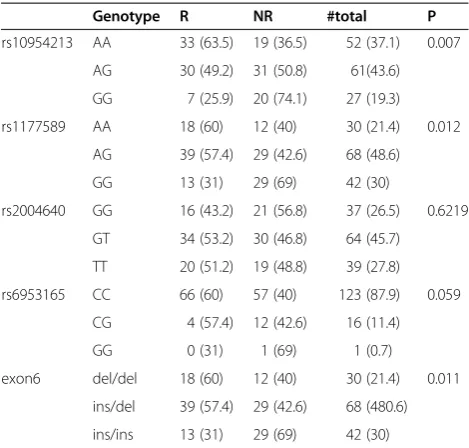
Genotyping of TILs–Sequencing germline DNA extracted from 140 TILs for IRF5 rs10954213, rs11770589 and rs6953165, rs2004640 and one insertion-deletion in exon 6 demonstrated that genotype frequency distribution was significantly different between responders and non-responders (Table 1). AllIRF5variants but rs2004640 were associated with immune responsiveness. The lack of the A allele in rs10954213 was predominant in non-responders (rs10954213: AA + AG: 63R vs. 50NR, GG: 7R vs. 20NR, P = 0.005), (Table 2). All investigated polymorphisms but rs2004640 are in LD with each other in both responders and non-responders (r2= 1, D’= 1, Figure 1). Because of the strong linkage disequilibrium among the different var-iants, we selected one (rs10954213) that provided the high-est predictive value for subsequent class comparison analyses as representative of theIRF5extended haplotype. Moreover, because the presence of the A allele in this SNP was associated with immune responsiveness independent of homo/hetorozygosity, we split samples into an“A”allele carrier (AA + AG) and an“A”allele missing (GG) group.
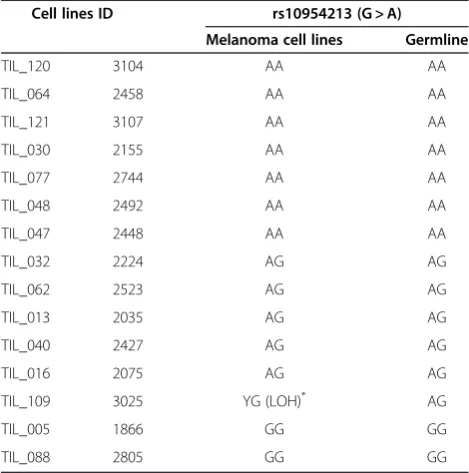
the A allele; AG > G genotype) (Table 3). This loss was significant because it leads to the absence of the domin-ant “A” allele determining immune responsiveness. For this reason, although the patient bore a mixed genotype, the hemi-zygotic “G” cell line was considered together with the“G”homozygous cell lines for class comparison. However, the patient and corresponding tumor were considered still heterozygous because there is no clear evidence that the cell line genotype was representative of the cancer cellsin vivo, nor it was known whether the transcriptional profile of tumors containing a mixed population of cancer and normal cells would be predom-inantly affected by one or the other. In addition, it is not known whether theIRF5genotype of the tumor or some other cell type, such as an immune cell, is where the genotype is relevant to the immune-responsiveness phenotype. Certainly, if there an elevated proportion of patients have metastases showing loss of heterozygosity the “A” allele at IRF5, then this would imply that the
IRF5 genotype of the tumor itself is important. In any case, the frequency of LOH was < 10%. Thus, we esti-mated, for the purpose of further analysis, that the geno-type of cancer cells in tumor tissues was conserved in approximately 90% of cases and conducted further class
comparisons classifying metastases according to the gen-etic background of the corresponding patient.
Gene expression profiling Cell lines
Nine of the 15 cell lines generated from the melanoma metastases were analyzed for functional differences according to their IRF5 genotype; the genetic profile of these cell lines and its relationship with the parental tumors has been extensively described elsewhere [28]. To test whether differences between IRF5genotype bear any effects on the intrinsic biology of cancer cells without the influence of the microenvironment, we cultured the 9 cell lines with or without IFNαand compared transcriptional patterns according to their IRF5 rs10954213 genotype. Seven cell lines out of the 15 bore the more frequent“AA” genotype but one of them stopped growing in culture, re-ducing to 6 the number of cell line analyzed; whereas three (including the “G” hemizygous cell line) bore only the GG allele. Principal Component Analysis (PCA) (Figure 2) demonstrated that identical cell lines distribu-ted closely in three-dimensional spaces independently of the treatment with IFNα with the three G only carrying cell lines clustering close together. IFNα predicatively affected the expression of 1,411 genes (p < 0.01), mostly related to IFN signaling (see Additional file 1: Table S1). We identified 106 differentially expressed genes between “A” and “G” groups using a linear mixed-effects model (p < 0.01). Gene enrichment analysis suggested that the predominantly affected pathways were related to antigen presentation, immune response, allograft rejection, auto-immunity and metabolism.
Re-clustering of melanoma metastases based on transcripts differentiating melanoma cell lines with distinct IRF5 genotype
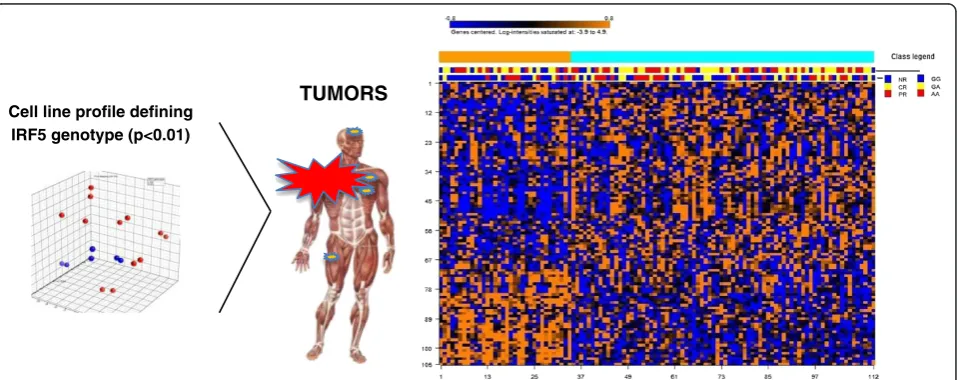
The 106 gene signature differentiating melanoma cell linesin vitrowas applied to produce a heat map of mel-anoma metastases based on K mean clustering method (Figure 3). This experiment identified a subset of metas-tases significantly enriched in non-responders. Interest-ingly, while this signature appeared to strongly predict lack of immune responsiveness, it was less predictive of theIRF5genotype of the patient, suggesting that the re-lationship between the two parameters is complex and multifactorial. K-means clustering algorithm, performed on the class comparison of metastases based on tran-scripts differentiating melanoma cell lines with distinct
[image:4.595.56.291.99.323.2]IRF5 genotype, segregated two groups of patients. The group 2 includes 46 responders and 32 non-responders, while the group 1 includes 12 responders and 22 non-responders, with in this case inclusion of a large majority of GG genotypes (Fisher test: p2-value = 0.025).
Table 1 IRF5 genotype frequencies
Genotype R NR #total P
rs10954213 AA 33 (63.5) 19 (36.5) 52 (37.1) 0.007
AG 30 (49.2) 31 (50.8) 61(43.6)
GG 7 (25.9) 20 (74.1) 27 (19.3)
rs1177589 AA 18 (60) 12 (40) 30 (21.4) 0.012
AG 39 (57.4) 29 (42.6) 68 (48.6)
GG 13 (31) 29 (69) 42 (30)
rs2004640 GG 16 (43.2) 21 (56.8) 37 (26.5) 0.6219
GT 34 (53.2) 30 (46.8) 64 (45.7)
TT 20 (51.2) 19 (48.8) 39 (27.8)
rs6953165 CC 66 (60) 57 (40) 123 (87.9) 0.059
CG 4 (57.4) 12 (42.6) 16 (11.4)
GG 0 (31) 1 (69) 1 (0.7)
exon6 del/del 18 (60) 12 (40) 30 (21.4) 0.011
ins/del 39 (57.4) 29 (42.6) 68 (480.6)
ins/ins 13 (31) 29 (69) 42 (30)
Table 2 IRF5 rs10954213-TILs association
Genotype R NR Total P
AA + AG 63 (55.8) 50 (44.2) 113 (81.0) 0.005
GG 7 (25.9) 20 (74.1) 27 (19.0)
[image:4.595.57.291.676.733.2]Discussion
Several studies support a link between autoimmunity and cancer immune responsiveness, suggesting that the two phenomena share a common determinism. Thus, we hypothesized that factors relevant to autoimmunity might also be relevant to cancer immunotherapy. The
IRF5gene has been associated with SLE in multiple eth-nic groups and repeatedly implicated in susceptibility to
many autoimmune diseases, becoming a rationale for the focus of our study. Consistent with the concept that autoimmunity and cancer rejection might represent dif-ferent facets of the same phenomenon, we observed that polymorphisms protecting against the susceptibility to develop SLE [12,13], such as the IRF5 rs10954213 GG genotype, were significantly more prevalent among patients who did not respond to adoptive TIL therapy.
We analyzed cell lines grown from 9 metastases to test the weight of the IRF5genotype on the intrinsic biology of cancer cells independent of microenvironment influ-ences. This allowed us to test the ability of the IRF5 genotype to predict immune responsiveness in vivo. We applied the signatures of genes differentiating the 2 cell line genotypes in vitro to the melanoma metastases
in vivoand observed a significant segregation of respon-ders from non-responrespon-ders, leading to the conclusion that immune responsiveness is at least in part dependent upon the genetic background of the host, which affects the biology of cancer cells primarily, and secondarily the immune responsiveness of tumors.
It is interesting to observe that the IRF5 genotype appeared to segregate 2 different cases. When genes dif-ferentiating melanoma cell lines in vitro according to genotype were applied for class prediction, a segregation of responding and non responding cases was observed and it was only partially predictive of theIRF5genotype
in vivo. The resulting segregation of cases according to genotype was associated with likelihood of responsive-ness. However, there were cases lacking the genetic background predictive of susceptibility to therapy that still did not respond to the treatment. This is a classic
IL-2
TILs
RPMI
CELL LINES
IL-2 +MYELOABLATION ± TOTAL BODY IRRADIATION
IN-DEL
rs10954213
rs11770589
rs2004640
rs6953165
IN-DEL
rs10954213 rs11770589 rs2004640 rs6953165
0.55
0.55 0.40
0.24 0.24 0.78
Non Responders
Responders
1
1 1
1
1
1
1
1 1
1
1 1 1
[image:5.595.60.538.90.298.2]1
Figure 1(Left) Pairwise linkage disequilibrium betweenIRF5polymorphisms in tumor infiltrating lymphocytes (TILs).D’and r2were calculated using LDPlotter tool. D’values for linkage disequilibrium among the major alleles of each ofIRF5are shown. IN-DEL = insertion/ deletion. (Right) Samples studied: 140 TILs, 112 parental melanoma metastases and 9 cell lines derived from some metastases.
Table 3 Fifteen melanoma cell lines genotype compared with the germline
Cell lines ID rs10954213 (G > A)
Melanoma cell lines Germline
TIL_120 3104 AA AA
TIL_064 2458 AA AA
TIL_121 3107 AA AA
TIL_030 2155 AA AA
TIL_077 2744 AA AA
TIL_048 2492 AA AA
TIL_047 2448 AA AA
TIL_032 2224 AG AG
TIL_062 2523 AG AG
TIL_013 2035 AG AG
TIL_040 2427 AG AG
TIL_016 2075 AG AG
TIL_109 3025 YG (LOH)* AG
TIL_005 1866 GG GG
TIL_088 2805 GG GG
[image:5.595.56.291.488.725.2]example of the multifactorial road to immune respon-siveness [29] underlining that multiple factors may be necessary to allow response to therapy, among which the host genetic background is one. Thus, it is possible that this separate set of genes has distinct yet comple-mentary influences on immune responsiveness.
Fine mapping studies now underway suggest that there are two independent associations withIRF5defining risk for lupus (L. Kottyan, J. Harley, K.M. Kaufman, unpub-lished data). The markers identified as being associated with the responses to TILs in this study are more asso-ciated with the association located in the promoter of
IRF5. In addition, in lupus there are suggestive data that sub-phenotypes also have variable associations withIRF5 alleles [30], suggesting rich variation in theIRF5control of immune responsiveness.
As a theoretical limitation of this study, we refrained from genotyping the melanoma metastases with the as-sumption that polymorphisms of the germline were suf-ficiently representative. Due to the genetic instability of the tumor genome, genotyping the tumor DNA instead of the germline DNA would be ideal for association studies. However, tumor tissue samples are composed of heterogeneous cell types and it is not clear which one mostly contributes to immune responsiveness. Thus, this study was aimed only at the predictive effects of the gen-etic background of the host. On the other hand, com-parison of 15 cell lines with their parental tumors suggested that in the large majority of cases the IRF5 gene was conserved. The frequency of LOH was < 10%, which is close to other estimates of LOH prevalence for genes not directly related to oncogenesis such as the linear mixed-effects model Interferon AA vs. GG
p<0.01 1411 106
IFN-αtreatment IRF5 genotype Sample ID
• AA • GG
• IFN • No IFN
•1866 •2155 •2458 • 2492 • 2744 •2805
•3025 •3104
[image:6.595.57.540.90.214.2]• 3107
Figure 2(Top panel) Principal Component Analysis (PCA) based on the gene expression profile of 9 out of 15 melanoma cell lines.The 3D displays of the PCA are color coded by sample ID, IFNαtreatment, andIRF5genotype, respectively. (Bottom panel) Gene expression analysis of cell lines using linear mixed-effects model shows 106 genes were found significant (p < 0.01) for testing the genotype effect and 1411 genes were found significant (p < 0.01) for testing the interferon effect.
TUMORS
Cell line profile defining IRF5 genotype (p<0.01)
Figure 3Cell lines predict tumor behavior, comparing AA vs GG.K mean clustering method organize heat map of melanoma metastases re-clustered based on 106 genes differentiating melanoma cell lines with distinctIRF5genotype. On the right side of the panel, a subset of metastases significantly enriched in non-responders; on the left side of the panel, a set of cases that enriched in responders (Fisher test: p2
[image:6.595.60.540.495.685.2]human leukocyte antigen class I genes [31-33]. Thus, we are confident that this analysis approximates the results that could be obtained if the analysis could have been adjusted according to potential somatic changes in the
IRF5gene.
In conclusion, polymorphism ofIRF-5appears to be a predictor of immune responsiveness of melanoma me-tastases to adoptive therapy with TILs. Comparison of melanoma cell lines classified according to the AA vs. GG rs10954213 (G > A) suggested significant differences in global transcription enriched in genes related to im-mune regulation. The signatures differentiating the 2 cell line genotypes in vitro are predictive of the responsive-ness of melanoma metastases in vivo. Thus, it appears that immune responsiveness is at least in part dependent on the genetic background of the host, which affects the biology of cancer cells primarily and secondarily the im-mune responsiveness of tumors. This is the first study analyzing the role ofIRF5 gene polymorphism in deter-mining immune responsiveness of melanoma. The results provide a link between the determinism of auto-immunity and immune responsiveness and suggest a po-tential genetic marker that could be evaluated prospectively and eventually considered for future pa-tient stratification.
Additional file
Additional file 1:Table S1.Table of significant genes for testing 'genotype' effect (106 genes were found significant at level 0.01).
Competing interests
The authors declare that they have no competing interests.
Authors’contribution
FMM LU conceived the study, LU performed the experiments. LU YZ VDG FM analyzed the data. LU and FM drafted the manuscript, JHB KMK LK revised data and manuscript. BT NE MED ST DB QL MLA RS WE SAR revised critically the manuscript for important intellectual content and for the language. All the authors read and approved the final manuscript.
Acknowledgments
DB's fellowship was supported by the Conquer Cancer Foundation of the American Society of Clinical Oncology.
Author details
1
Infectious Disease and Immunogenetics Section (IDIS), Department of Transfusion Medicine, Clinical Center and trans-NIH Center for Human Immunology, National Institutes of Health, Bethesda, MD 20892, USA. 2Institutes of Infectious and Tropical Diseases, University of Milan, L Sacco Hospital, Milan, Italy.3Biometric Research Branch, Division of Cancer Treatment and Diagnosis, National Cancer Institute, National Institutes of Health, Bethesda, MD 20892, USA.4Cell Processing Section, Department of Transfusion Medicine, Clinical Center, National Institutes of Health, Bethesda, MD 20892, USA.5Department of Internal Medicine (DiMI), University of Genoa, Genoa 16132, Italy.6Center for Autoimmune Genomics and Etiology (CAGE), Cincinnati Children’s Hospital Medical Center, Cincinnati, OH 45229, USA.7U S Department of Veterans Affairs Medical Center, Cincinnati, OH 45229, USA.8Surgery Branch, National Cancer Institute, National Institutes of Health, Bethesda, MD, USA.
Received: 30 July 2012 Accepted: 1 August 2012 Published: 21 August 2012
References
1. Gogas H, Ioannovich J, Dafni U, Stavropoulou-Giokas C, Frangia K, Tsoutsos D, Panagiotou P, Polyzos A, Papadopoulos O, Stratigos A,et al:Prognostic significance of autoimmunity during treatment of melanoma with interferon.N Engl J Med2006,354:709–718.
2. Atkins MB, Mier JW, Parkinson DR, Gould JA, Berkman EM, Kaplan MM: Hypothyroidism after treatment with interleukin-2 and lymphokine-activated killer cells.N Engl J Med1988,318:1557–1563.
3. Phan GQ, Attia P, Steinberg SM, White DE, Rosenberg SA:Factors associated with response to high-dose interleukin-2 in patients with metastatic melanoma.J Clin Oncol2001,19:3477–3482.
4. Naldi L, Locati F, Finazzi G, Barbui T, Cainelli T:Antiphospholipid syndrome associated with immunotherapy for patients with melanoma.Cancer
1995,75:2784–2785.
5. Chan C, O'Day J:Melanoma-associated retinopathy: does autoimmunity prolong survival?Clin Experiment Ophthalmol2001,29:235–238. 6. Wang E, Worschech A, Marincola FM:The immunologic constant of
rejection.Trends Immunol2008,29:256–262.
7. Wang E:Marincola FM: Immunologic signatures of rejection. New York, NY: Springer; 2010.
8. Ascierto ML, De Giorgi V, Liu Q, Bedognetti D, Murtas D, Chouchane L, Wang E, Marincola FM:An immunologic portrait of cancer.J Transl Med
2011,9:146.
9. Spivey TL, Uccellini L, Ascierto ML, Zoppoli G, De G V, Delogu LG, Engle AM, Thomas JM, Wang E, Marincola FM,et al:Gene expression profiling in acute allograft rejection: challenging the immunologic constant of rejection hypothesis.J Transl Med2011,9:174.
10. Blanco P, Palucka AK, Gill M, Pascual V, Banchereau J:Induction of dendritic cell differentiation by IFN-alpha in systemic lupus erythematosus.Science
2001,294:1540–1543.
11. Pascual V, Farkas L, Banchereau J:Systemic lupus erythematosus: all roads lead to type I interferons.Curr Opin Immunol2006,18:676–682. 12. Ronnblom L:The type I interferon system in the etiopathogenesis of
autoimmune diseases.Ups J Med Sci2011,116:227–237.
13. Graham RR, Kozyrev SV, Baechler EC, Reddy MV, Plenge RM, Bauer JW, Ortmann WA, Koeuth T, Gonzalez Escribano MF, Pons-Estel B,et al:A common haplotype of interferon regulatory factor 5 (IRF5) regulates splicing and expression and is associated with increased risk of systemic lupus erythematosus.Nat Genet2006,38:550–555.
14. Dawidowicz K, Allanore Y, Guedj M, Pierlot C, Bombardieri S, Balsa A, Westhovens R, Barrera P, Alves H, Teixeira VH,et al:The interferon regulatory factor 5 gene confers susceptibility to rheumatoid arthritis and influences its erosive phenotype.Ann Rheum Dis2011,70:117–121. 15. Vandenbroeck K, Alloza I, Swaminathan B, Antiguedad A, Otaegui D,
Olascoaga J, Barcina MG, de lH V, Fernandez-Arquero M,et al:Validation of IRF5 as multiple sclerosis risk gene: putative role in interferon beta therapy and human herpes virus-6 infection.Genes Immun2011,12:40–45. 16. Kristjansdottir G, Sandling JK, Bonetti A, Roos IM, Milani L, Wang C,
Gustafsdottir SM, Sigurdsson S, Lundmark A, Tienari PJ,et al:Interferon regulatory factor 5 (IRF5) gene variants are associated with multiple sclerosis in three distinct populations.J Med Genet2008,45:362–369. 17. Dideberg V, Kristjansdottir G, Milani L, Libioulle C, Sigurdsson S, Louis E,
Wiman AC, Vermeire S, Rutgeerts P, Belaiche J,et al:An insertion-deletion polymorphism in the interferon regulatory Factor 5 (IRF5) gene confers risk of inflammatory bowel diseases.Hum Mol Genet2007,16:3008–3016. 18. Nordmark G:Eloranta ML. Ronnblom L: Primary Sjogren's syndrome and the
type I interferon system. Curr Pharm Biotechnol; 2012.
19. Barnes BJ, Moore PA, Pitha PM:Virus-specific activation of a novel interferon regulatory factor, IRF-5, results in the induction of distinct interferon alpha genes.J Biol Chem2001,276:23382–23390. 20. Barnes BJ, Kellum MJ, Pinder KE, Frisancho JA, Pitha PM:Interferon
regulatory factor 5, a novel mediator of cell cycle arrest and cell death.
Cancer Res2003,63:6424–6431.
22. Graham RR, Kyogoku C, Sigurdsson S, Vlasova IA, Davies LR, Baechler EC, Plenge RM, Koeuth T, Ortmann WA, Hom G,et al:Three functional variants of IFN regulatory factor 5 (IRF5) define risk and protective haplotypes for human lupus.Proc Natl Acad Sci U S A2007,104:6758–6763.
23. Sigurdsson S, Goring HH, Kristjansdottir G, Milani L, Nordmark G, Sandling JK, Eloranta ML, Feng D, Sangster-Guity N, Gunnarsson I,et al:
Comprehensive evaluation of the genetic variants of interferon regulatory factor 5 (IRF5) reveals a novel 5 bp length polymorphism as strong risk factor for systemic lupus erythematosus.Hum Mol Genet2008, 17:872–881.
24. Dudley ME, Yang JC, Sherry R, Hughes MS, Royal R, Kammula U, Robbins PF, Huang J, Citrin DE, Leitman SF,et al:Adoptive cell therapy for patients with metastatic melanoma: evaluation of intensive myeloablative chemoradiation preparative regimens.J Clin Oncol2008,26:5233–5239. 25. Dudley ME, Gross CA, Langhan MM, Garcia MR, Sherry RM, Yang JC, Phan GQ, Kammula US, Hughes MS, Citrin DE,et al:CD8+ enriched "young" tumor infiltrating lymphocytes can mediate regression of metastatic melanoma.Clin Cancer Res2010,16:6122–6131.
26. Dudley ME, Wunderlich JR, Shelton TE, Even J, Rosenberg SA:Generation of tumor-infiltrating lymphocyte cultures for use in adoptive transfer therapy for melanoma patients.J Immunother2003,26:332–342. 27. MacQueen J:Some methods for classification and analysis of multivariate
observations. Inproceedings of the Fifth Berkeley Symposium on Mathematical Statistics and Probability. Edited by LeCam LM, Neyman J. Berkeley, CA, USA: University of California Press; 1967:281–297.
28. Spivey TL, De Giorgi V, Zhao Y, Bedognetti D, Pos Z, Liu Q, Tomei S, Ascierto ML, Uccellini L, Chouchane L,et al:The stable traits of melanoma genetics: an alternative approach to target discovery.BMC Genomics
2012,13:156.
29. Wang E, Uccellini L, Marincola FM:A genetic inference on cancer immune responsiveness.Oncoimmunology2012,1(4):520–525.
30. Niewold TB, Kelly JA, Kariuki SN, Franek BS, Kumar AA, Kaufman KM, Thomas K, Walker D, Kamp S, Frost JM,et al:IRF5 haplotypes demonstrate diverse serological associations which predict serum interferon alpha activity and explain the majority of the genetic association with systemic lupus erythematosus.Ann Rheum Dis2012,71:463–468.
31. Mendez R, Rodriguez T, Del CA, Monge E, Maleno I, Aptsiauri N, Jimenez P, Pedrinaci S, Pawelec G, Ruiz-Cabello F,et al:Characterization of HLA class I altered phenotypes in a panel of human melanoma cell lines.Cancer Immunol Immunother2008,57:719–729.
32. Marincola FM, Shamamian P, Alexander RB, Gnarra JR, Turetskaya RL, Nedospasov SA, Simonis TB, Taubenberger JK, Yannelli J, Mixon A,et al: Loss of HLA haplotype and B locus down-regulation in melanoma cell lines.J Immunol1994,153:1225–1237.
33. Marincola FM:Mechanisms of immune escape and immune tolerance. In
Principles and practice of the biologic therapy of cancer. Third editionth edition. Edited by Rosenberg SA. Philadelphia: Lippincott Williams & Wilkins; 2000:601–617.
doi:10.1186/1479-5876-10-170
Cite this article as:Uccelliniet al.:IRF5gene polymorphisms in
melanoma.Journal of Translational Medicine201210:170.
Submit your next manuscript to BioMed Central and take full advantage of:
• Convenient online submission
• Thorough peer review
• No space constraints or color figure charges
• Immediate publication on acceptance
• Inclusion in PubMed, CAS, Scopus and Google Scholar
• Research which is freely available for redistribution