R E S E A R C H
Open Access
Comparative effectiveness of malaria
prevention measures: a systematic review
and network meta-analysis
Kinley Wangdi
1*, Luis Furuya-Kanamori
1,2, Justin Clark
3, Jan J. Barendregt
4,5ˆ, Michelle L. Gatton
6, Cathy Banwell
1,
Gerard C. Kelly
1, Suhail A. R. Doi
1,2†and Archie C. A. Clements
1†Abstract
Background:
Malaria causes significant morbidity and mortality worldwide. There are several preventive measures
that are currently employed, including insecticide-treated nets (ITNs, including long-lasting insecticidal nets and
insecticidal-treated bed nets), indoor residual spraying (IRS), prophylactic drugs (PD), and untreated nets (UN).
However, it is unclear which measure is the most effective for malaria prevention. We therefore undertook a
network meta-analysis to compare the efficacy of different preventive measures on incidence of malaria infection.
Methods:
A systematic literature review was undertaken across four medical and life sciences databases (PubMed,
Cochrane Central, Embase, and Web of Science) from their inception to July 2016 to compare the effectiveness of
different preventive measures on malaria incidence. Data from the included studies were analysed for the
effectiveness of several measures against no intervention (NI). This was carried out using an automated generalized
pairwise modeling (GPM) framework for network meta-analysis to generate mixed treatment effects against a
common comparator of no intervention (NI).
Results:
There were 30 studies that met the inclusion criteria from 1998
–
2016. The GPM framework led to a final
ranking of effectiveness of measures in the following order from best to worst: PD, ITN, IRS and UN, in comparison
with NI. However, only ITN (RR: 0.49, 95% CI: 0.32
–
0.74) showed precision while other methods [PD (RR: 0.24,
95% CI: 0.004
–
15.43), IRS (RR: 0.55, 95% CI: 0.20
–
1.56) and UN (RR: 0.73, 95% CI: 0.28
–
1.90)] demonstrating
considerable uncertainty associated with their point estimates.
Conclusion:
Current evidence is strong for the protective effect of ITN interventions in malaria prevention.
Even though ITNs were found to be the only preventive measure with statistical support for their
effectiveness, the role of other malaria control measures may be important adjuncts in the global drive to
eliminate malaria.
Keywords:
Malaria, Preventive measures, Meta-analysis, Efficacy
Background
Malaria imposes a great health and socio-economic
bur-den on humanity, with an estimated 3.2 billion people at
risk of being infected with malaria [
1
]. In 2016, there
were approximately 216 million cases with 445,000
deaths, most of which were in children aged under 5
years in Africa [
1
]. Between 2000 and 2015, it has been
estimated that there was a 37% global reduction in
mal-aria incidence [
2
]. This improvement was likely made
possible by economic development and urbanization in
many endemic countries [
3
] as well as a substantial
in-crease in investment in tackling malaria [
4
], leading to
an increase in preventative activities, and improved
diag-nostics and treatment. The Global Technical Strategy for
Malaria 2016
–
2030 (GTS) has a target to eliminate
mal-aria in at least ten countries by 2020, 20 countries by
2025, and 30 countries by 2030 [
2
,
5
].
* Correspondence:[email protected]
†Equal contributors
ˆDeceased
1Research School of Population Health, College of Health and Medicine, The
Australian National University, ACT, Canberra, Australia
Full list of author information is available at the end of the article
© The Author(s). 2018Open AccessThis article is distributed under the terms of the Creative Commons Attribution 4.0 International License (http://creativecommons.org/licenses/by/4.0/), which permits unrestricted use, distribution, and reproduction in any medium, provided you give appropriate credit to the original author(s) and the source, provide a link to the Creative Commons license, and indicate if changes were made. The Creative Commons Public Domain Dedication waiver
Vector control remains an essential component of
malaria control and elimination. The capacity of vectors
to transmit parasites and their vulnerability to vector
control measures vary by mosquito species and are
influ-enced by local environmental factors. Personal
prevent-ive measures that prevent contact between the adult
mosquitoes and human beings are the main methods of
prevention
currently
in
practice.
These
include
insecticide-treated nets (ITNs), and indoor residual
spraying (IRS) [
6
]. ITNs are of two types: long-lasting
in-secticidal nets (LLINs) that have the insecticide
incorpo-rated into fibers during the manufacturing process,
which leads to a longer duration of effectiveness and
insecticide-treated nets (ITNs) which are impregnated
with insecticides every six months. Indoor residual
spraying (IRS) involves spraying insecticides on the walls
of the houses. Additionally, antimalarial
chemoprophy-laxis is used for prevention of malaria in children and
pregnant women. The commonly used prophylactic
drugs (PD) are sulphadoxine-pyrimethamine (SP),
meflo-quine (MQ), amodiameflo-quine (AQ),
dihydroartemisinin-peperaquine (DP) and artesunate (AS). The main
advan-tage of using PD is that they only require a single dose
to achieve a full prophylactic effect [
7
,
8
]. However, the
most common PD is SP and it is becoming less effective
due to resistance [
9
–
13
]. As a result, other drugs such as
MQ and AQ are increasingly being used as a substitute
for or in combination with SP [
12
,
14
]. MQ provides a
longer period of prophylaxis but side effects
(agranulo-cytosis in 1 per 2000 patients) [
15
] are the main problem
[
16
,
17
]. Similarly, AQ has been used in combination
with SP but AQ is not well tolerated [
14
]. Many other
less commonly utilized measures include
treated curtains (ITC), mosquito coils,
insecticide-treated hammocks, and insecticide-insecticide-treated tarpaulins.
There has been a decrease in malaria incidence
world-wide, but what remains unclear is which of the common
preventive interventions is the most effective for
preven-tion of malaria infecpreven-tion. This knowledge may help
pri-oritise resourcing of these interventions. There has been
one comparative study of preventive efficacy that
com-pares mortality across ITN, IRS and PD and this study
demonstrated that the impact of IRS is equal to that of
ITN on reducing malaria-attributable mortality in
chil-dren [
18
]. There have also been several systematic
re-views and meta-analyses focusing on single preventive
measures. These reviews of existing data suggest that PD
[
19
–
22
], is effective in preventing malaria infection in
children when treated on a monthly basis with no
pro-tection when given three-monthly. The reviews of both
ITN [
23
–
25
] and IRS [
26
,
27
] provide support for their
effectiveness as malaria preventive measures, but there is
no data on the effectiveness of one measure over
another.
Therefore, this study aims to present an up-to-date
comparison of the effectiveness of the four common
malaria preventive measures (ITNs, UNs, IRS and PDs)
for which data are readily available and compare these
against no intervention [NI, defined as no intervention
or placebo or a study group with standard care (any
intervention given to all participants)]. A network
meta-analysis methodology was chosen to pool the data as it
allows comparisons of multiple preventive measures
simultaneously and allows comparisons across
prevent-ive measures not directly tested in the included trials
(indirect comparisons across a pair of studies that share
a common comparator). In addition, this method allows
ranking of the effectiveness of these measures for
deci-sion making.
Methods
Search strategy and eligibility criteria
A systematic literature review was undertaken using four
medical and life sciences databases (PubMed, Cochrane
Central, Embase and Web of Science). They were
searched from their inception to March 2016 for trials
that compared the effectiveness of malaria preventive
measures. Search terms included were
“
malaria
”
,
“
Plas-modium falciparum
”
,
“
Plasmodium vivax
”
,
“
bed net
”
,
“
mosquito control
”
,
“
antimalarial
”
, and
“
insecticides
”
; the
specific keywords and connectors for each database are
listed in the Additional file
1
: Table S1.
The inclusion of studies were restricted to (i)
interven-tional studies; (ii) conducted in humans (with no
restric-tion of age or sex); (iii) that compared two or more of
the following malaria preventive measures: ITN, UN,
IRS, PD or NI; and (iv) reported the number of new
malaria cases diagnosed through microscopy or rapid
diagnostic tests (RDT) after each intervention compared
amongst a population at risk over time. Exclusion
cri-teria included: (i) non-intervention studies; (ii)
confer-ence abstracts; and (iii) other less commonly utilized
malaria preventive measures including ITC, mosquito
coils, treated hammocks and
insecticide-treated tarpaulins. No language restrictions were
im-posed. Since we used a generalized pairwise modeling
approach (see below), odd numbers of treatments (e.g.
three treatment arms) required selection of a pair for
in-clusion in this study and we therefore excluded the arm
that had the most available data in this synthesis [(i)
arms that we excluded do not make a difference, (ii)
concurrent interventions and no effect modification].
Study selection and data extraction
potentially relevant studies. Data from the included
studies were then independently extracted in a
spread-sheet by the same two researchers. The extracted data
included: (i) the country of study; (ii) year(s) when the
study was conducted; (iii) study design; (iv) study
popu-lation characteristics; (v) preventive measures employed
in the trial; and (vi) the number of new cases of malaria
and person-months at risk. The extracted data were then
cross-checked by the two researchers and any
discrepan-cies during the selection of studies or data extraction
were resolved through discussion and consensus
follow-ing independent evaluation by another author (SARD).
Statistical analysis
The outcome of interest was the rate ratio (RR) of new
malaria cases in intervention-A
vs
intervention-B
follow-ing the implementation of different preventative
mea-sures. An automated generalized pairwise modeling
(GPM) framework [
28
] was used to generate mixed
treatment effects against a common comparator (NI).
This framework is an extension of the Bucher method
[
29
] that automates the single three-treatment loop
method. This analysis starts by pooling effect sizes based
on direct comparisons between any two interventions
using meta-analytic methods. The indirect comparison
was then performed by automated generation of all
pos-sible closed loops of three-treatments such that one of
them was common to the two studies and formed the
node where the loop began and ended but where the
common node was never NI, while one of the other
nodes was always NI. Finally, the mixed effects (multiple
direct/indirect effects) were pooled using the same
meta-analysis model as used for pooling direct effects.
The analysis therefore led to a final mixed treatment
ef-fect estimate for different interventions versus NI.
Esti-mates of preventive effectiveness were then ranked by
their point estimates. It should be pointed out that it is
common for network plots based on Bayesian methods
to rank treatments by the surface under the cumulative
ranking curve (SUCRA). From our frequentist
perspec-tive, treatment effects are thought of as fixed parameters
and thus, strictly speaking SUCRA does not apply. A
fre-quentist alternative called the P-score has been proposed
but SUCRA or P-scores have no major advantage
com-pared to what we have done, i.e. ranking treatments by
their point estimates [
30
].
All direct estimates were pooled using the inverse
vari-ance heterogeneity (IVhet) model [
31
] as were all mixed
estimates, but this synthesis process was also repeated
using the random effects model for comparison (the
ran-dom effects analysis was undertaken under the GPM
framework as well as under the frequentist multivariate
meta-analysis framework for comparison (see Additional
file
1
: Tables S2 and S3 for details).
Cluster randomized controlled trials (RCT) were
com-bined with other study types after accounting for
cluster-ing uscluster-ing the design effect (DEFF). The DEFF was
calculated as follows:
DEFF
¼
1
þ
ρ
ð
c
−
1
Þ
where
ρ
is the intra-class correlation for the statistic in
question and
c
is the average size of the cluster. We then
divided the numbers in each 2 × 2 table of the study by
the DEFF to calculate a corrected sample size, which
was then utilized in the meta-analysis. Different units of
clusters such as villages and households were used in
different studies. The intra-class correlation coefficient
(
ρ
) was provided only in one study [
32
], and this (
ρ
=
0.048) was used for calculation of the DEFF for other
cluster RCT studies.
Statistical heterogeneity across direct effects pooled in
the meta-analysis were assessed by the Cochran
’
s
Q
and
the
H
index which is the square root of
H
2, the
esti-mated residual variance from the regression of the
stan-dardized treatment effect estimates against the inverse
standard error in each direct meta-analysis.
H
was
com-puted as follows:
H
¼
ffiffiffiffiffiffiffiffiffiffiffiffiffiffiffiffiffiffiffiffiffiffiffiffiffiffiffiffiffiffiffiffiffiffiffiffiffiffiffiffiffiffiffiffiffiffi
max max 1
½
ð
;
n
−
1
Þ
;
Q
max 1
ð
;
n
−
1
Þ
s
where
n
is the number of study estimates pooled and Q
represents the Chi squared from Cochran
’
s
Q
.
Transitivity was assessed statistically by looking at
in-consistency across the network as a whole using the
weighted pooled
H
index (
H
) which was computed as
follows from the Cochran
’
s
Q
statistic for the
k
final
comparisons:
H
¼
ffiffiffiffiffiffiffiffiffiffiffiffiffiffiffiffiffiffiffiffiffiffiffiffiffiffiffiffiffiffiffiffiffiffiffiffiffiffiffiffiffiffiffiffiffiffiffiffiffiffiffiffiffiffiffiffiffi
P
kj¼1
max max 1
½
ð
;
n
−
1
Þ
;
Q
P
kj¼1
n
−
k
þ
s
v
u
u
u
t
where
n
is the number of estimates pooled across each
comparison and
s
is the number comparisons (out of
k
)
were
n
= 1. The minimum value
H
or
H
can take is 1, it
is not influenced by
n
, and
H
<
3 was taken to be
min-imal inconsistency based on our simulations of
H
in
homogenous direct meta-analyses [
28
].
Sensitivity analyses were undertaken through limiting
the network to (i) studies conducted in children or (ii)
studies including only
Plasmodium falciparum
infection
and then re-running the GPM analysis.
small-study effects, we expect the studies to form an
inverted funnel centred at zero [
33
]. All the analyses
in-volved in the generalised pairwise modelling (GPM)
framework for multiple indirect and mixed effects were
conducted using MetaXL v5.2 (EpiGear International,
Sunrise Beach, Australia) [
28
]. Funnel and network plots
were produced using Stata version 13 (Stata
Corpor-ation, College StCorpor-ation, TX, USA).
Quality assessment
The quality of the included studies was assessed using a
modification of a quality checklist used in another study
by one of the authors [
34
]. The studies were assessed on
inclusion of safeguards relating to study design,
selec-tion, informaselec-tion, blinding of study assessors, and
ana-lytical biases. There were 12 questions with a possible
maximum count of 17 safe-guards (Additional file
1
:
Table S4).
Results
Data extraction
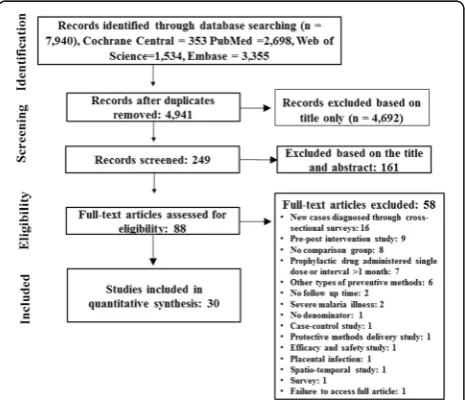
The search strategy identified 7940 citations (Cochrane
Central = 353, PubMed = 2698, Web of Science = 1534
and Embase = 3355). After deleting duplicate citations, a
total of 4941 citations were retrieved for the initial
screening. Of these, 4692 citations were excluded based
on title only. Records of 249 citations were screened and
161 citations were excluded based on the title and
ab-stract. Eighty eight articles were assessed for eligibility,
of which 58 articles were excluded (Additional file
1
:
Table S5). Thirty citations fulfilled eligibility criteria and
were included in the meta-analysis (Fig.
1
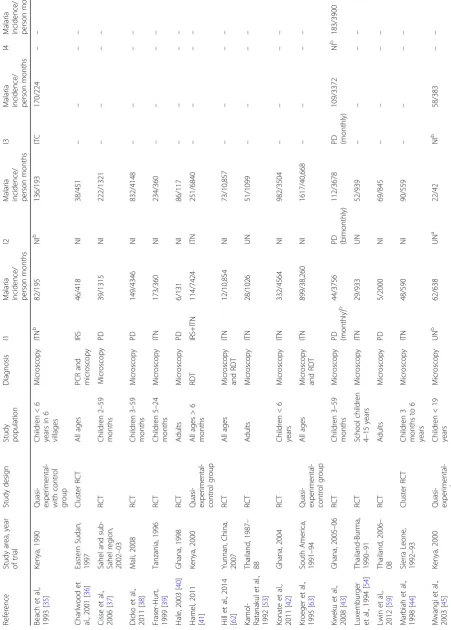
). Data from
the included studies were extracted and summarized in
a spreadsheet (Table
1
).
Characteristics of included studies
The literature search on malaria control and preventive
measures led to the identification of the five treatment
groups across the studies (ITN, UN, PD, IRS and NI). A
total of 30 studies were included in the current
meta-analysis. These studies were conducted from 1988 to
2015. Eighteen studies were conducted in Africa [
35
–
52
],
11 studies were from Asia [
32
,
53
–
62
] and one study from
South America [
63
]. Ten studies did not restrict study
participants to any age [
36
,
41
,
51
,
55
,
57
,
58
,
60
–
63
], four
studies only included adults as study participants
[
40
,
53
,
56
,
59
], and the rest of the studies (16) were
conducted in children and adolescents (0
–
19 years)
[
32
,
35
,
37
–
39
,
42
–
50
,
52
,
54
]. There were 21
stud-ies that reported
P. falciparum
infection rates separately
[
32
,
35
,
37
–
43
,
45
–
48
,
50
–
52
,
54
,
55
,
58
,
60
,
62
]. The
lat-ter two groups were used in a sensitivity analysis (see
below). The most common study design was the RCT
with 16 studies [
37
–
40
,
42
,
43
,
46
–
48
,
50
,
51
,
53
,
54
,
56
,
59
,
62
], eight studies were cluster RCT [
32
,
36
,
44
,
49
,
52
,
57
,
58
,
60
], and the rest (6) were quasi-experimental
stud-ies with a control group [
35
,
41
,
45
,
55
,
61
,
63
]. Twenty
one studies had two arms [
32
,
36
–
42
,
44
,
49
,
50
,
52
–
55
,
57
,
59
–
63
], eight studies had three arms, [
35
,
45
–
48
,
51
,
56
,
58
] and one had four arms [
43
]. Of those with three
arms we dropped the curtain arm in two studies [
31
,
51
]
(not part of this review) and one of the PD arms in four
other studies [
43
,
46
,
48
,
56
] that reported PD
compari-sons at different dosages or intervals. Microscopy was
used for detection of
Plasmodium
parasites in 25 studies
[
32
,
35
,
37
–
40
,
42
–
48
,
50
–
61
], three studies used both
mi-croscopy and RDTs [
49
,
62
,
63
], and one study each used
RDT [
41
] and polymerase chain reaction (PCR) and
mi-croscopy [
36
] for diagnosis (Table
1
).
Interventions utilized across studies
Twenty five studies had a NI arm [
32
,
35
–
46
,
48
–
52
,
55
–
57
,
59
,
61
–
63
], and seven studies had a UN arm [
45
,
47
,
52
–
54
,
58
,
60
]. Of the eleven studies that used a PD arms
[
37
,
38
,
40
,
42
,
43
,
46
–
48
,
50
,
56
,
59
], the regimens were
all different (Additional file
1
: Table S6). Fourteen studies
reported the use of ITN in one arm [
32
,
35
,
39
,
44
,
51
,
53
–
55
,
57
,
58
,
60
–
63
]. In these studies, different types of
nets and insecticides for treating such nets were used
(Additional file
1
: Table S7). The insecticides used for IRS
in the three studies of this intervention were also different
and are listed in (Additional file
1
: Table S8) [
36
,
41
,
49
].
Quality assessment
The quality of the studies including types of study,
randomization and other characteristics was assessed
through 17 safeguards against bias as outlined in the
supplementary material. They were combined into a
uni-variate overall quality score consisting of counts of
Fig. 1Search flowchart.Note: details of excluded studies in Additional
[image:4.595.58.291.503.703.2]Table
1
Characteristics
of
included
studies
Refere nce Study area , year of trial Study de sign Study populat ion Diagnosis I1 Malaria inciden ce/ person mont hs I2 Malaria incide nce/ person mon ths I3 Malaria inciden ce/ person mont hs I4 Malaria inciden ce/ person mont hs Beac h et al. , 1993 [ 35 ] Kenya, 1990 Quasi- exper imental-with contro l group Childre n < 6 years in 6 villages Microscopy ITN b 82/195 NI b 136/19 3 ITC 170/224 –– Charl wood et al., 20 01 [ 36 ] Eastern Sudan, 1997 Cluster RCT All ages PCR an d microscopy IRS 46/418 NI 38/451 –– – – Cisse et al., 2006 [ 37 ] Sahel an d sub-Sahel reg ion, 2002 – 03 RCT Childre n 2 – 59 mont hs Mi croscopy PD 39/131 5 NI 222/13 21 –– – – Dick o et al. , 2011 [ 38 ] Mali, 2008 RCT Childre n 3 – 59 mont hs Microscopy PD 149/43 46 NI 832/41 48 –– – – Frase r-Hurt, 1999 [ 39 ] Tanzani a, 1996 RCT Childre n 5 – 24 mont hs Microscopy ITN 173/36 0 NI 234/36 0 –– – – Hale, 20 03 [ 40 ] Ghana, 1998 RCT Adult s Microscopy PD 6/131 NI 86/117 –– – – Ham el, 2011 [ 41 ] Kenya, 2000 Quasi- exper imental-control group All ages > 6 mont hs RDT IRS+IT N 114/74 24 IT N 251/68 40 –– – – Hill et al., 2014 [ 62 ] Yunnan , China, 2007 RCT All ages Microscopy and RDT ITN 12/10,8 54 NI 73/10, 857 –– – – Kamol -Ratanak ul et al., 1992 [ 53 ] Thailand, 1987 – 88 RCT Adult s Microscopy ITN 28/102 6 U N 51/109 9 –– – – Kon ate et al., 2011 [ 42 ] Ghana, 2004 RCT Childre n < 6 years Microscopy ITN 332/45 64 NI 982/35 04 –– – – Kroeg er et al., 1995 [ 63 ] South America, 1991 – 94 Quasi- exper imental-control group All ages Microscopy and RDT ITN 899/38 ,260 NI 1617/4 0,668 –– – – Kwe ku et al., 2008 [ 43 ] Ghana, 2005 – 06 RCT Childre n 3 – 59 mont hs Microscopy PD (mon thly) b 44/375 6PD (bimonthly)
[image:5.595.68.520.105.736.2]safeguards ranging between 7 and 17 out of a maximum
possible of 17. The ranges of the scores were 10
–
17, 7
–
14, 9
–
16, 10
–
16, and 8
–
11 in PD
vs
NI, ITN
vs
NI, IRS
vs
NI, ITN
vs
UN, and UN
vs
NI studies, respectively.
The most common safeguards missing were
consider-ation of confounders such as socio-economic status,
owning LLINs, malaria prevalence and blinding of
asses-sors in between 46.7
–
93.3% of studies (Additional file
1
:
Table S9).
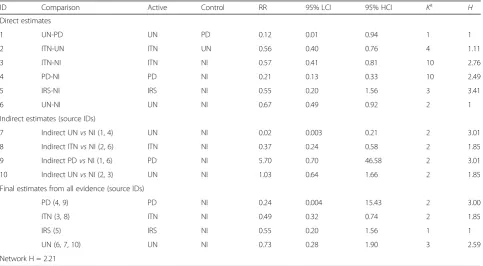
Quantitative synthesis
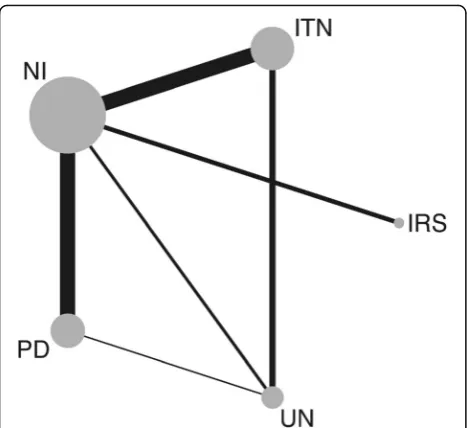
Seven direct estimates based on head-to-head
compari-son within 30 studies, which included 60 treatment
groups, were available (Table
2
and Fig.
2
). In these
dir-ect comparisons, PD (RR: 0.21, 95% confidence interval
[CI] 0.13
–
0.33), ITN (RR: 0.57, 95% CI: 0.41
–
0.81), and
UN (RR: 0.67, 95% CI: 0.49
–
0.92) were significantly
bet-ter than NI. Similarly, UN (0.12, 95% CI: 0.01
–
0.94) was
better as compared to PD, and IRS (RR: 0.55, 95% CI:
0.20
–
1.56) was not significantly different from NI.
The indirect estimate for ITN (RR: 0.37, 95% CI: 0.24
–
0.58) was consistent with the direct estimate, while that
for PD (RR: 5.70, 95% CI: 0.70
–
46.58) demonstrated an
inconsistent and very uncertain effect as opposed to the
direct estimate. UN had two indirect estimates possible
and both were inconsistent with the direct effect but in
opposite directions with either a grossly positive effect
(RR: 0.02, 95% CI: 0.003
–
0.21) or a negative effect (RR:
1.03, 95% CI: 0.64
–
1.66) (Table
2
).
The final estimates were based on all evidence for
these interventions in comparison with NI and results
showed that, PD (RR: 0.24, 95% CI: 0.004
–
15.43), ITN
(RR: 0.49, 95% CI: 0.32
–
0.74), IRS (RR: 0.55, 95% CI:
0.20
–
1.56), and UN (RR: 0.73, 95% CI: 0.28
–
1.90) were
all less likely to be associated with incident infection as
compared to participants using no preventive measure
(NI). However, only ITN demonstrated a statistically
sig-nificant effect (Table
2
and Fig.
3
).
There was overall minimal statistical network
incon-sistency (
H
¼
2
:
21
Þ
over comparisons despite the
incon-sistent direct and indirect effects, because of the huge
uncertainty associated with indirect effects possibly
reflecting heterogeneity in terms of the geographical
lo-cations and population characteristics of studies. One
final effect (PD-NI) demonstrated modest inconsistency
(
H
= 3.0) while the rest demonstrated minimal to no
in-consistency (H < 3, see Table
2
), again because of
uncer-tainty around the individual mixed effects.
Sensitivity analysis and publication bias
Heterogeneity was evident when selection criteria were
modified to include only children or only
P. falciparum
[image:7.595.57.541.440.706.2]infections respectively (with
H
at 2.35 and 2.29,
Table 2
Direct, indirect and final results from comparison of different preventive measures
ID Comparison Active Control RR 95% LCI 95% HCI Ka H
Direct estimates
1 UN-PD UN PD 0.12 0.01 0.94 1 1
2 ITN-UN ITN UN 0.56 0.40 0.76 4 1.11
3 ITN-NI ITN NI 0.57 0.41 0.81 10 2.76
4 PD-NI PD NI 0.21 0.13 0.33 10 2.49
5 IRS-NI IRS NI 0.55 0.20 1.56 3 3.41
6 UN-NI UN NI 0.67 0.49 0.92 2 1
Indirect estimates (source IDs)
7 Indirect UNvsNI (1, 4) UN NI 0.02 0.003 0.21 2 3.01
8 Indirect ITNvsNI (2, 6) ITN NI 0.37 0.24 0.58 2 1.85
9 Indirect PDvsNI (1, 6) PD NI 5.70 0.70 46.58 2 3.01
10 Indirect UNvsNI (2, 3) UN NI 1.03 0.64 1.66 2 1.85
Final estimates from all evidence (source IDs)
PD (4, 9) PD NI 0.24 0.004 15.43 2 3.00
ITN (3, 8) ITN NI 0.49 0.32 0.74 2 1.85
IRS (5) IRS NI 0.55 0.20 1.56 1 1
UN (6, 7, 10) UN NI 0.73 0.28 1.90 3 2.59
Network H = 2.21
Abbreviations:ITCinsecticide-treated curtain,ITNinsecticide-treated net,PDprophylactic drug,NIno intervention,IRSindoor residual spraying,UNuntreated nets,
RRrate ratio,LCIlower confidence interval,HCIhigher confidence interval
a
respectively (Additional file
2
: Figure S1; Additional file
3
: Figure S2). However, the rank of effectiveness of
dif-ferent preventive measures remained unchanged in both
analyses except that ITN was less effective than IRS in
only
P. falciparum
and effects were now less precise
be-cause numbers of studies were lower.
The comparison-adjusted funnel plot demonstrated
lit-tle evidence of asymmetry except for the PD-NI
com-parison, which was in keeping with the fact that there
was both considerable heterogeneity and inconsistency
across this comparison (Additional file
4
: Figure S3).
Discussion
This meta-analysis showed that only ITNs had a
signifi-cant effect in protection against malaria infection. While
the effect size for PD was larger, the uncertainty was
high, thus making the impact of this intervention
uncer-tain. These findings confirm that impregnated
insecti-cides on ITNs offers better protection than UNs in
preventing mosquitoes from taking a blood meal from
the host through its excito-repellency effect [
23
,
64
–
70
].
The insecticides on ITNs may also inhibit mosquitoes
from entering a house similar to the effect of IRS.
Mor-tality of mosquitoes in the range of 25
–
75% has been
observed after they enter huts in search of blood meals
irrespective of the various different pyrethroids used in
ITNs [
67
]. Individual studies on efficacy of this
interven-tion have shown that the risk of malaria infecinterven-tion due to
ITN use can reduce by up to 39
–
62% and child
mortal-ity by 14
–
29% [
24
,
71
]. Interestingly, the impact of ITNs
on child mortality and morbidity have been reported to
extend out from areas with the actual ITN use to
neigh-bouring areas because of the impact of the insecticidal
nets on the entomological inoculation rate (EIR) of the
local vector population [
72
–
74
]. Similarly, mathematical
modelling has shown that ITNs can even protect against
mosquitoes that feed outdoors [
75
]. ITNs have also been
reported to protect women in pregnancy and in reducing
placental malaria, anaemia, stillbirths and abortions [
65
].
Of note, the combination of IRS and ITN has been
shown to offer better protection as compared to ITNs
alone [
27
,
41
,
76
–
79
]. Only one of the latter studies was
included in our synthesis which compared IRS
vs
NI
where both arms were also given ITNs and the RR was
0.42 (95% CI: 0.34
–
0.52) suggesting that the effects are
independent and additive on malaria prevention [
41
].
The other studies did not meet our inclusion criteria
be-cause these studies were cross-sectional and pre-post
interventional studies but evidence from them was also
supportive of this conclusion.
Despite reports of pyrethroid resistance in parts of the
world including Africa [
80
–
85
], ITNs treated with
pyre-throids continue to provide significant protection against
malaria [
69
,
71
,
86
,
87
]. ITNs of the LLIN type have
in-secticides impregnated in the fibres of nets, which are
wash resistant for the four- to five-year lifespan of the
ITNs. ITBN types of ITNs require insecticides to be
im-pregnated every six months. Due to reduced costs and
ease of implementation, the LLINs have gained huge
popularity in recent years and given their superiority to
IRS in this analysis as well as in previous studies [
27
,
88
],
this would represent a strong choice in terms of malaria
prevention.
The biggest effect size was for PD. This intervention
prevents or reduces the incidence of malaria primarily
through clearing existing parasitaemia (or reducing it to
a level below the fever threshold) and preventing new
infections [
8
,
89
,
90
]. In our analysis however, we found
the least precision for the effect estimate and the most
Fig. 3Results of network meta-analysis of 30 studies comparing
listed interventions against NI. Only the PD-NI mixed effects showed modest inconsistency and this is reflected in the marked uncertainty (wide 95% confidence intervals) of the effect estimate
Fig. 2Network plot showing the comparison groups. The circle size is
proportional to the number of studies including that intervention while line width is proportional to the number of comparisons.
[image:8.595.57.291.86.300.2] [image:8.595.57.290.571.683.2]inconsistency, suggesting that the effects varied widely
across studies. Whilst the effectiveness of prophylactic
drugs has been documented in children and pregnant
women in sub-Saharan Africa, it has not been
substanti-ated in other parts of the world [
38
,
42
,
91
,
92
], possibly
because of the limited ability of drugs to prevent relapse
in
P. vivax
infection [
8
,
93
,
94
]. Nevertheless, in our
ana-lysis restricted to
P
.
falciparum,
the same uncertainty
was observed for PDs as in the full dataset. There are
other concerns apart from preventive efficacy with the
use of drugs as they can also result in impairment of
natural immunity, and rebound infections of the
chil-dren who received chemo-prophylaxis for 1
–
5 years
[
95
–
98
]. The widespread use of chemoprophylaxis in
children and pregnant women could possibly increase
the rate of spread of drug resistance [
99
].
The preventive measure with the next highest effect
estimate was IRS, a critical component of the WHO
’
s
Global Malaria Eradication Program from 1955
–
1969
and the main intervention attributed to the elimination
or dramatic reduction of malaria in parts of Europe, Asia
and Latin America [
27
]. The basic principle of IRS in
vector control is that IRS protects inhabitants against
mosquito bites by killing the blood-fed females who rest
on the walls after feeding and also protect inhabitants
against mosquito bites by diverting the vector from
en-tering a sprayed house an effect known as
excito-repellency [
100
,
101
]. If the mosquito does enter the
house, after biting, the female mosquito eventually rests
on sprayed surfaces, where it picks up a lethal dose of
insecticide, thus preventing transmission of the parasite
to others. In a village with a high percentage coverage of
houses with IRS, the mean age of the village mosquito
population is expected to be reduced and very few
mos-quitoes will survive the approximately 12 days required
for sporozoite maturation to be able to transmit the
par-asites [
71
]. Thus, IRS reduces malaria transmission at
the community level by reducing mosquito longevity
and abundance, but it has also been reported to
pro-vide household-level protection [
27
]. Studies have
shown that IRS was more effective with high initial
prevalence, multiple rounds of spraying and in
re-gions with a combination of
P. falciparum
and
P.
vivax
[
26
]. Despite all the advantages of IRS, our
ana-lysis suggested a consistently better (or at worst
equivalent) efficacy for ITNs compared to IRS.
Mos-quito mortality has been shown to decline after the
third month following IRS and by the fifth month,
ef-fectiveness reduces by 12% [
102
]. Efficacy might wane
if walls are replastered or painted following
implant-ation of IRS, and mosquito resistance to insecticides
can emerge. In addition, there is a need for trained
personnel for application of insecticides, which means
IRS might not always be done effectively.
Untreated nets were the least effective in preventing
malaria infection as compared to other preventive
mea-sures. UNs can offer a barrier against the bite of
mosqui-toes; however, mosquitoes can rest on the UNs while
seeking opportunities to feed on the hosts sleeping
under the nets, which can be presented when any part
of a host
’
s body comes in contact with the nets. This
happens often when hosts are in a deep sleep, especially
under inadequately spaced or small nets. Untreated nets
can even offer resting places to mosquitoes in an
IRS-sprayed house and thus cannot be recommended given
the other alternatives that exist. Finally, torn untreated
nets have been shown to offer no additional protection
as compared to not using nets [
45
,
103
].
A key strength of this analysis is the use of the GPM
framework which avoids approximations and
assump-tions that are not stated explicitly or verified when the
method is applied. On the contrary, the multivariate
fre-quentist framework assumes that if there is no common
comparator in the network, this then has to be handled
by augmenting the dataset with fictional arms with high
variance. This is not very objective and requires a
deci-sion as to what constitutes a sufficiently high variance
[
104
]. Another alternative, the Bayesian framework, also
has its problems such as requiring prior distributions to
be specified for a number of unknown parameters and
choices regarding over-dispersed starting values for a
number of independent chains so that convergence can
be assessed. While we have several choices for the
meta-analytic framework, this choice may be less important
than other choices regarding the modelling of effects
[
105
]. Indeed, we were able to use the inverse variance
heterogeneity model for direct estimates which has
cor-rect error estimation when compared with the random
effects model [
31
]. Results from a random effects model
(using both the multivariate meta-analysis framework as
well as the GPM framework) differ slightly from our
main results, especially regarding PD, which has
spuri-ously precise estimates using this approach (Additional
file
1
: Tables S2, S3).
the effectiveness of ITNs in preventing malaria. Thirdly,
the methods of diagnosis of incident malaria were
differ-ent in the studies. Since most of these studies were
con-ducted in intense malaria transmission areas, this effect
is however likely to be minimal. Fourthly, the vectors
were different depending on the region of the study; for
instance, the commonest malaria vectors in the Asian
region including
Anopheles dirus
,
An. baimaii
and
An.
minimus
[
111
,
112
], are able to avoid indoor sprayed
surfaces because of their exophilic and exophagic
char-acteristics [
113
–
115
] rendering most domicile-based
in-terventions, like ITNs and IRS less effective [
114
,
116
].
Of the three main vectors in the African region:
An.
ara-biensis
,
An. funestus
and
An. gambiae
[
113
,
117
], only
An. arabiensis
shows feeding preferences for both
in-doors and outin-doors while the other two are
indoor-feeders [
117
]. Other challenges include insecticide
resist-ance [
118
]. Finally, the drug types and regimens varied
between studies. All of these limitations have the
poten-tial to increase heterogeneity between the included
stud-ies and make it more difficult to estimate the effects of
the different interventions more precisely than what we
have reported.
Conclusions
Even though ITNs were found to be the only preventive
measure with statistical support for its effectiveness in
this study, the role of all malaria control measures are
important in the global drive to eliminate malaria.
How-ever, when a choice needs to be made for resource
allo-cation, the results reported here tend to favour the use
of ITNs.
Additional files
Additional file 1:Table S1.Search Strategy.Table S2.Meta-analysis of different control measures against NI using the random effects model under the generalized pairwise modeling (GPM) framework in MetaXL. Table S3.Meta-analysis of different control measures against NI using the random effects model under the frequentist multivariate meta-analysis framework (mvmeta) in Stata.Table S4.Quality scale.Table S5. Summary of the excluded studies.Table S6.Drugs used in the included studies.Table S7.Description of ITN’s used across the studies.Table S8. Description of IRS treatments used across the included studies.Table S9. Quality assessment scores of included studies. (DOCX 56 kb)
Additional file 2:Figure S1.Results of network meta-analysis of 21 studies with children as a study population. (TIFF 624 kb)
Additional file 3:Figure S2.Results of network meta-analysis of 28 studies with incidence ofPlasmodium falciparum. (TIFF 631 kb)
Additional file 4:Figure S3.Funnel plot depicting asymmetry for the PD-NI comparison. (TIFF 1482 kb)
Abbreviations
AQ:Amodiaquine; AS: Artesunate; CI: Confidence interval; DEFF: Design effect; DP: Dihydroartemisinin-peperaquine; EIR: Entomological inoculation rate; GPM: Generalized pairwise modelling; GTS: Global Technical Strategy for Malaria 2016–2030; HCI: Higher confidence interval; IRS: Indoor residual spraying; ITC: Insecticide-treated curtain; ITN: Insecticide-treated net;
IVhet: Inverse variance heterogeneity; LCI: Lower confidence interval; LLIN: Long-lasting insecticidal nets; MI: Malaria infection; MQ: Mefloquine; NI: No intervention; PD: Prophylactic drugs; RCT: Randomized controlled trials; RDT: Rapid diagnostic tests; RR: Rate ratio; SP: Sulphadoxine-pyrimethamine; SUCRA: Surface under the cumulative ranking curve; UN: Untreated nets; WHO: World Health Organization
Acknowledgements
The authors pay tribute to the late Jan Barendregt of Epigear International Pty Ltd, who passed away during preparation of this work.
Funding
LFK is funded by an Endeavour Postgraduate Scholarship (#3781_2014), an Australian National University Higher Degree Scholarship, and a Fondo para la Innovación, Ciencia y Tecnología Scholarship (#095-FINCyT-BDE-2014).
Availability of data and materials
The datasets for the current study are available from the corresponding author upon request.
Authors’contributions
KW, LFK, SARD and ACAC conceived the idea. JC developed citation search and executed it. KW and LFK carried out the data extraction. KW, LFK, SARD and JB carried out data analysis. KW drafted the manuscript. SARD and ACAC helped in the interpretation of the findings and critical revision of
manuscript. LFK, JC, JB, MLG, CB and GK were involved in revision of the manuscript. All authors read and approved the final manuscript.
Ethics approval and consent to participate Not applicable.
Consent for publication Not applicable.
Competing interests
Authors declare that they have no competing interests.
Publisher
’
s Note
Springer Nature remains neutral with regard to jurisdictional claims in published maps and institutional affiliations.
Author details
1Research School of Population Health, College of Health and Medicine, The
Australian National University, ACT, Canberra, Australia.2Department of Population Medicine, College of Medicine, Qatar University, Doha, Qatar. 3Centre for Research in Evidence-Based Practice (CREBP), Faculty of Health
Sciences and Medicine, Bond University, Gold Coast, Queensland, Australia. 4
School of Public Health, The University of Queensland, Brisbane, Queensland, Australia.5Epigear International Pty Ltd, Sunrise Beach, Queensland, Australia.6School of Public Health & Social Work, Queensland University of Technology, Brisbane, Queensland, Australia.
Received: 4 December 2017 Accepted: 6 March 2018
References
1. WHO. World Malaria Report, vol. 2017. Switzerland: World Health Organization, Geneva; 2017.
2. WHO. World Malaria Report, vol. 2015. Switzerland: World Health Organization, Geneva; 2015.
3. Cotter C, Sturrock HJ, Hsiang MS, Liu J, Phillips AA, Hwang J, et al. The changing epidemiology of malaria elimination: new strategies for new challenges. Lancet. 2013;382(9895):900–11.
4. Murray CJ, Rosenfeld LC, Lim SS, Andrews KG, Foreman KJ, Haring D, et al. Global malaria mortality between 1980 and 2010: a systematic analysis. Lancet. 2012;379(9814):413–31.
6. WHO. WHO recommendations for achieving universal coverage with long-lasting insecticidal nets in malaria control. World Health Organization. Switzerland: Geneva; 2014.
7. Greenwood B. Anti-malarial drugs and the prevention of malaria in the population of malaria endemic areas. Malar J. 2010;9(Suppl. 3):S2. 8. White NJ. Intermittent presumptive treatment for malaria. PLoS Med. 2005;
2(1):e3.
9. Ronn AM, Msangeni HA, Mhina J, Wernsdorfer WH, Bygbjerg IC. High level of resistance ofPlasmodium falciparumto sulfadoxine-pyrimethamine in children in Tanzania. Trans R Soc Trop Med Hyg. 1996;90(2):179–81. 10. Mugittu K, Abdulla S, Falk N, Masanja H, Felger I, Mshinda H, et al. Efficacy of
sulfadoxine-pyrimethamine in Tanzania after two years as first-line drug for uncomplicated malaria: assessment protocol and implication for treatment policy strategies. Malar J. 2005;4:55.
11. Roper C, Pearce R, Nair S, Sharp B, Nosten F, Anderson T. Intercontinental spread of pyrimethamine-resistant malaria. Science. 2004;305(5687):1124. 12. Gosling RD, Gesase S, Mosha JF, Carneiro I, Hashim R, Lemnge M, et al.
Protective efficacy and safety of three antimalarial regimens for intermittent preventive treatment for malaria in infants: a randomised, double-blind, placebo-controlled trial. Lancet. 2009;374(9700):1521–32.
13. Tan KR, Katalenich BL, Mace KE, Nambozi M, Taylor SM, Meshnick SR, et al. Efficacy of sulphadoxine-pyrimethamine for intermittent preventive treatment of malaria in pregnancy, Mansa, Zambia. Malar J. 2014;13:227. 14. Clerk CA, Bruce J, Affipunguh PK, Mensah N, Hodgson A, Greenwood B,
Chandramohan D. A randomized, controlled trial of intermittent preventive treatment with sulfadoxine-pyrimethamine, amodiaquine, or the combination in pregnant women in Ghana. J Infect Dis. 2008;198(8):1202–11.
15. Taylor WR, White NJ. Antimalarial drug toxicity: a review. Drug Saf. 2004; 27(1):25–61.
16. Steketee RW, Wirima JJ, Hightower AW, Slutsker L, Heymann DL, Breman JG. The effect of malaria and malaria prevention in pregnancy on offspring birthweight, prematurity, and intrauterine growth retardation in rural Malawi. Am J Trop Med Hyg. 1996;55(Suppl. 1):33–41.
17. Briand V, Bottero J, Noel H, Masse V, Cordel H, Guerra J, et al. Intermittent treatment for the prevention of malaria during pregnancy in Benin: a randomized, open-label equivalence trial comparing sulfadoxine-pyrimethamine with mefloquine. J Infect Dis. 2009;200(6):991–1001. 18. Eisele TP, Larsen D, Steketee RW. Protective efficacy of interventions for
preventing malaria mortality in children inPlasmodium falciparumendemic areas. Int J Epidemiol. 2010;39(Suppl. 1):i88–101.
19. Wilson AL. A systematic review and meta-analysis of the efficacy and safety of intermittent preventive treatment of malaria in children (IPTc). PLoS One. 2011;6(2):e16976.
20. Meremikwu MM, Donegan S, Sinclair D, Esu E, Oringanje C. Intermittent preventive treatment for malaria in children living in areas with seasonal transmission. Cochrane Database Syst Rev. 2012;2:Cd003756.
21. Meremikwu MM, Donegan S, Esu E. Chemoprophylaxis and intermittent treatment for preventing malaria in children. Cochrane Database Syst Rev. 2008;2:Cd003756.
22. Matangila JR, Mitashi P, Inocencio da Luz RA, Lutumba PT, Van Geertruyden JP. Efficacy and safety of intermittent preventive treatment for malaria in schoolchildren: a systematic review. Malar J. 2015;14:450.
23. Choi HW, Breman JG, Teutsch SM, Liu S, Hightower AW, Sexton JD. The effectiveness of insecticide-impregnated bed nets in reducing cases of malaria infection: a meta-analysis of published results. Am J Trop Med Hyg. 1995;52(5):377–82.
24. Lengeler C. Insecticide-treated bed nets and curtains for preventing malaria. Cochrane Database Syst Rev. 2004;2:Cd000363.
25. Van Remoortel H, De Buck E, Singhal M, Vandekerckhove P, Agarwal SP. Effectiveness of insecticide-treated and untreated nets to prevent malaria in India. Trop Med Int Health. 2015;20(8):972–82.
26. Kim D, Fedak K, Kramer R. Reduction of malaria prevalence by indoor residual spraying: A meta-regression analysis. Am J Trop Med Hyg. 2012; 87(1):117–24.
27. Pluess B, Tanser FC, Lengeler C, Sharp BL. Indoor residual spraying for preventing malaria. Cochrane Database Syst Rev. 2010;4:Cd006657. 28. Doi SA, Barendregt JJ. A generalized pairwise modelling framework for
network meta-analysis. Int J Evid Based Healthc. 2018;27 [Epub ahead of print] 29. Bucher HC, Guyatt GH, Griffith LE, Walter SD. The results of direct and
indirect treatment comparisons in meta-analysis of randomized controlled trials. J Clin Epidemiol. 1997;50(6):683–91.
30. Rucker G, Schwarzer G. Ranking treatments in frequentist network meta-analysis works without resampling methods. BMC Med Res Methodol. 2015;15:58.
31. Doi SA, Barendregt JJ, Khan S, Thalib L, Williams GM. Advances in the meta-analysis of heterogeneous clinical trials I: The inverse variance heterogeneity model. Contemp Clin Trials. 2015;45(Pt A):130–8.
32. Smithuis FM, Kyaw MK, Phe UO, van der Broek I, Katterman N, Rogers C, et al. The effect of insecticide-treated bed nets on the incidence and prevalence of malaria in children in an area of unstable seasonal transmission in western Myanmar. Malar J. 2013;12:363.
33. Chaimani A, Salanti G. Using network meta-analysis to evaluate the existence of small-study effects in a network of interventions. Res Synth Methods. 2012;3(2):161–76.
34. Liu X, Clark J, Siskind D, Williams GM, Byrne G, Yang JL. SA. A systematic review and meta-analysis of the effects of Qigong and Tai Chi for depressive symptoms. Complement Ther Med. 2015;23(4):516–34. 35. Beach RF, Ruebush TK 2nd, Sexton JD, Bright PL, Hightower AW, Breman JG,
et al. Effectiveness of permethrin-impregnated bed nets and curtains for malaria control in a holoendemic area of western Kenya. Am J Trop Med Hyg. 1993;49(3):290–300.
36. Charlwood JD, Qassim M, Elnsur EI, Donnelly M, Petrarca V, Billingsley PF, et al. The impact of indoor residual spraying with malathion on malaria in refugee camps in eastern Sudan. Acta Trop. 2001;80(1):1–8.
37. Cisse B, Sokhna C, Boulanger D, Milet J, Ba el H, Richardson K, et al. Seasonal intermittent preventive treatment with artesunate and sulfadoxine-pyrimethamine for prevention of malaria in Senegalese children: a randomised, placebo-controlled, double-blind trial. Lancet. 2006;367(9511): 659–67.
38. Dicko A, Diallo AI, Tembine I, Dicko Y, Dara N, Sidibe Y, et al. Intermittent preventive treatment of malaria provides substantial protection against malaria in children already protected by an insecticide-treated bednet in Mali: a randomised, double-blind, placebo-controlled trial. PLoS Med. 2011; 8(2):e1000407.
39. Fraser-Hurt N, Felger I, Edoh D, Steiger S, Mashaka M, Masanja H, et al. Effect of insecticide-treated bed nets on haemoglobin values, prevalence and multiplicity of infection withPlasmodium falciparumin a randomized controlled trial in Tanzania. Trans R Soc Trop Med Hyg. 1999;93(Suppl. 1):47–51. 40. Hale BR, Owusu-Agyei S, Fryauff DJ, Koram KA, Adjuik M, Oduro AR, et al. A
randomized, double-blind, placebo-controlled, dose-ranging trial of tafenoquine for weekly prophylaxis againstPlasmodium falciparum. Clin Infect Dis. 2003;36(5):541–9.
41. Hamel MJ, Otieno P, Bayoh N, Kariuki S, Were V, Marwanga D, et al. The combination of indoor residual spraying and insecticide-treated nets provides added protection against malaria compared with insecticide-treated nets alone. Am J Trop Med Hyg. 2011;85(6):1080–6.
42. Konate AT, Yaro JB, Ouedraogo AZ, Diarra A, Gansane A, Soulama I, et al. Intermittent preventive treatment of malaria provides substantial protection against malaria in children already protected by an insecticide-treated bednet in Burkina Faso: a randomised, double-blind, placebo-controlled trial. PLoS Med. 2011;8(2):e1000408.
43. Kweku M, Liu D, Adjuik M, Binka F, Seidu M, Greenwood B, Chandramohan D. Seasonal intermittent preventive treatment for the prevention of anaemia and malaria in Ghanaian children: a randomized, placebo controlled trial. PLoS One. 2008;3(12):e4000.
44. Marbiah NT, Petersen E, David K, Magbity E, Lines J, Bradley DJ. A controlled trial of lambda-cyhalothrin-impregnated bed nets and/or dapsone/pyrimethamine for malaria control in Sierra Leone. Am J Trop Med Hyg. 1998;58(1):1–6.
45. Mwangi TW, Ross A, Marsh K, Snow RW. The effects of untreated bednets on malaria infection and morbidity on the Kenyan coast. Trans R Soc Trop Med Hyg. 2003;97(4):369–72.
46. Nankabirwa JI, Wandera B, Amuge P, Kiwanuka N, Dorsey G, Rosenthal PJ, et al. Impact of intermittent preventive treatment with dihydroartemisinin-piperaquine on malaria in Ugandan schoolchildren: a randomized, placebo-controlled trial. Clin Infect Dis. 2014;58(10):1404–12.
47. Nevill CG, Watkins WM, Carter JY, Munafu CG. Comparison of mosquito nets, proguanil hydrochloride, and placebo to prevent malaria. BMJ. 1988; 297(6645):401–3.
49. Pinder M, Jawara M, Jarju LB, Salami K, Jeffries D, Adiamoh M, et al. Efficacy of indoor residual spraying with dichlorodiphenyltrichloroethane against malaria in Gambian communities with high usage of long-lasting insecticidal mosquito nets: a cluster-randomised controlled trial. Lancet. 2015;385(9976):1436–46.
50. Sesay S, Milligan P, Touray E, Sowe M, Webb EL, Greenwood BM, Bojang KA. A trial of intermittent preventive treatment and home-based management of malaria in a rural area of The Gambia. Malar J. 2011;10:2.
51. Sexton JD, Ruebush TK 2nd, Brandling-Bennett AD, Breman JG, Roberts JM, Odera JS, Were JB. Permethrin-impregnated curtains and bed-nets prevent malaria in western Kenya. Am J Trop Med Hyg. 1990;43(1):11–8. 52. Snow RW, Rowan KM, Lindsay SW, Greenwood BM. A trial of bed nets
(mosquito nets) as a malaria control strategy in a rural area of The Gambia, West Africa. Trans R Soc Trop Med Hyg. 1988;82(2):212–5.
53. Kamol-Ratanakul P, Prasittisuk C. The effectiveness of permethrin-impregnated bed nets against malaria for migrant workers in eastern Thailand. Am J Trop Med Hyg. 1992;47(3):305–9.
54. Luxemburger C, Perea WA, Delmas G, Pruja C, Pecoul B, Moren A. Permethrin-impregnated bed nets for the prevention of malaria in schoolchildren on the Thai-Burmese border. Trans R Soc Trop Med Hyg. 1994;88(2):155–9.
55. Rowland M, Bouma M, Ducornez D, Durrani N, Rozendaal J, Schapira A, Sondorp E. Pyrethroid-impregnated bed nets for personal protection against malaria for Afghan refugees. Trans R Soc Trop Med Hyg. 1996;90(4): 357–61.
56. Taylor WR, Richie TL, Fryauff DJ, Picarima H, Ohrt C, Tang D, et al. Malaria prophylaxis using azithromycin: a double-blind, placebo-controlled trial in Irian Jaya, Indonesia. Clin Infect Dis. 1999;28(1):74–81.
57. Sahu SS, Jambulingam P, Vijayakumar T, Subramanian S, Kalyanasundaram M. Impact of alphacypermethrin treated bed nets on malaria in villages of Malkangiri District, Orissa, India. Acta Trop. 2003;89(1):55–66.
58. Sharma SK, Tyagi PK, Upadhyay AK, Haque MA, Mohanty SS, Raghavendra K, Dash AP. Efficacy of permethrin treated long-lasting insecticidal nets on malaria transmission and observations on the perceived side effects, collateral benefits and human safety in a hyperendemic tribal area of Orissa, India. Acta Trop. 2009;112(2):181–7.
59. Lwin KM, Phyo AP, Tarning J, Hanpithakpong W, Ashley EA, Lee SJ, et al. Randomized, double-blind, placebo-controlled trial of monthlyversus
bimonthly dihydroartemisinin-piperaquine chemoprevention in adults at high risk of malaria. Antimicrob Agents Chemother. 2012;56(3):1571–7. 60. Soleimani-Ahmadi M, Vatandoost H, Shaeghi M, Raeisi A, Abedi F,
Eshraghian MR, et al. Field evaluation of permethrin long-lasting insecticide treated nets (Olyset(R)) for malaria control in an endemic area, southeast of Iran. Acta Trop. 2012;123(3):146–53.
61. Shah NK, Tyagi P, Sharma SK. The impact of artemisinin combination therapy and long-lasting insecticidal nets on forest malaria incidence in tribal villages of India, 2006–2011. PLoS One. 2013;8(2):e56740. 62. Hill N, Zhou HN, Wang P, Guo X, Carneiro I, Moore SJ. A household
randomized, controlled trial of the efficacy of 0.03% transfluthrin coils alone and in combination with long-lasting insecticidal nets on the incidence of
Plasmodium falciparumandPlasmodium vivaxmalaria in Western Yunnan Province, China. Malar J. 2014;13:208.
63. Kroeger A, Mancheno M, Alarcon J, Pesse K. Insecticide-impregnated bed nets for malaria control: varying experiences from Ecuador, Colombia, and Peru concerning acceptability and effectiveness. Am J Trop Med Hyg. 1995; 53(4):313–23.
64. Maxwell CA, Rwegoshora RT, Magesa SM, Curtis CF. Comparison of coverage with insecticide-treated nets in a Tanzanian town and villages where nets and insecticide are either marketed or provided free of charge. Malar J. 2006;5:44.
65. Gamble C, Ekwaru JP, ter Kuile FO. Insecticide-treated nets for preventing malaria in pregnancy. Cochrane Database Syst Rev. 2006;2:Cd003755. 66. Sutanto I, Freisleben HJ, Pribadi W, Atmosoedjono S, Bandi A. Purnomo.
Efficacy of permethrin-impregnated bed nets on malaria control in a hyperendemic area in Irian Java, Indonesia: influence of seasonal rainfall fluctuations. Southeast Asian J Trop Med Pub Hlth. 1999;30(3):432–9. 67. Maxwell CA, Myamba J, Njunwa KJ, Greenwood BM, Curtis CF. Comparison
of bednets impregnated with different pyrethroids for their impact on mosquitoes and on re-infection with malaria after clearance of pre-existing infections with chlorproguanil-dapsone. Trans R Soc Trop Med Hyg. 1999; 93(1):4–11.
68. Sharma SK, Upadhyay AK, Haque MA, Tyagi PK, Mohanty SS, Raghavendra K, Dash AP. Field evaluation of Olyset nets: a long-lasting insecticidal net against malaria vectorsAnopheles culicifaciesandAnopheles fluviatilisin a hyperendemic tribal area of Orissa, India. J Med Entomol. 2009;46(2):342–50. 69. Curtis CF, Jana-Kara B, Maxwell CA. Insecticide-treated nets: impact on
vector populations and relevance of initial intensity of transmission and pyrethroid resistance. J Vector Borne Dis. 2003;40(1–2):1–8.
70. Wangdi K, Gatton ML, Kelly GC, Clements AC. Prevalence of asymptomatic malaria and bed net ownership and use in Bhutan, 2013: a country earmarked for malaria elimination. Malar J. 2014;13:352.
71. Curtis CF, Maxwell CA, Magesa SM, Rwegoshora RT, Wilkes TJ. Insecticide-treated bed-nets for malaria mosquito control. J Am Mosq Control Assoc. 2006;22(3):501–6.
72. Gimnig JE, Vulule JM, Lo TQ, Kamau L, Kolczak MS, Phillips-Howard PA, et al. Impact of permethrin-treated bed nets on entomologic indices in an area of intense year-round malaria transmission. Am J Trop Med Hyg. 2003; 68(Suppl. 4):16–22.
73. Hawley WA, Phillips-Howard PA, ter Kuile FO, Terlouw DJ, Vulule JM, Ombok M, et al. Community-wide effects of permethrin-treated bed nets on child mortality and malaria morbidity in western Kenya. Am J Trop Med Hyg. 2003;68(Suppl. 4):121–7.
74. Larsen DA, Hutchinson P, Bennett A, Yukich J, Anglewicz P, Keating J, Eisele TP. Community coverage with insecticide-treated mosquito nets and observed associations with all-cause child mortality and malaria parasite infections. Am J Trop Med Hyg. 2014;91(5):950–8.
75. Govella NJ, Okumu FO, Killeen GF. Insecticide-treated nets can reduce malaria transmission by mosquitoes which feed outdoors. Am J Trop Med Hyg. 2010;82(3):415–9.
76. West PA, Protopopoff N, Wright A, Kivaju Z, Tigererwa R, Mosha FW, et al. Indoor residual spraying in combination with insecticide-treated nets compared to insecticide-treated nets alone for protection against malaria: a cluster randomised trial in Tanzania. PLoS Med. 2014;11(4):e1001630. 77. West PA, Protopopoff N, Wright A, Kivaju Z, Tigererwa R, Mosha FW, et al.
Enhanced protection against malaria by indoor residual spraying in addition to insecticide treated nets: is it dependent on transmission intensity or net usage? PLoS One. 2015;10(3):e0115661.
78. Fullman N, Burstein R, Lim SS, Medlin C, Gakidou E. Nets, spray or both? The effectiveness of insecticide-treated nets and indoor residual spraying in reducing malaria morbidity and child mortality in sub-Saharan Africa. Malar J. 2013;12:62.
79. Kleinschmidt I, Schwabe C, Shiva M, Segura JL, Sima V, Mabunda SJ, Coleman M. Combining indoor residual spraying and insecticide-treated net interventions. Am J Trop Med Hyg. 2009;81(3):519–24.
80. Glunt KD, Abilio AP, Bassat Q, Bulo H, Gilbert AE, Huijben S, et al. Long-lasting insecticidal nets no longer effectively kill the highly resistant
Anopheles funestusof southern Mozambique. Malar J. 2015;14:298. 81. Chandre F, Manguin S, Brengues C, Dossou Yovo J, Darriet F, Diabate A,
et al. Current distribution of a pyrethroid resistance gene (kdr) inAnopheles gambiaecomplex from west Africa and further evidence for reproductive isolation of the Mopti form. Parassitologia. 1999;41(1–3):319–22. 82. Etang J, Fondjo E, Chandre F, Morlais I, Brengues C, Nwane P, et al. First
report of knockdown mutations in the malaria vectorAnopheles gambiae
from Cameroon. Am J Trop Med Hyg. 2006;74(5):795–7.
83. Stump AD, Atieli FK, Vulule JM, Besansky NJ. Dynamics of the pyrethroid knockdown resistance allele in western Kenyan populations ofAnopheles gambiaein response to insecticide-treated bed net trials. Am J Trop Med Hyg. 2004;70(6):591–6.
84. Hargreaves K, Koekemoer LL, Brooke BD, Hunt RH, Mthembu J, Coetzee M.
Anopheles funestusresistant to pyrethroid insecticides in South Africa. Med Vet Entomol. 2000;14(2):181–9.
85. Hargreaves K, Hunt RH, Brooke BD, Mthembu J, Weeto MM, Awolola TS, Coetzee M.Anopheles arabiensisandAn. quadriannulatusresistance to DDT in South Africa. Med Vet Entomol. 2003;17(4):417–22.
86. Wangdi K, Banwell C, Gatton ML, Kelly GC, Namgay R, Clements AC. Malaria burden and costs of intensified control in Bhutan, 2006–14: an
observational study and situation analysis. Lancet Glob Health. 2016;4(5): e336–43.