Number of cycles in the graph of 312-avoiding permutations
Richard Ehrenborg, Sergey Kitaev∗ and Einar Steingr´ımsson
Abstract
The graph of overlapping permutations is defined in a way analogous to the De Bruijn graph on strings of symbols. That is, for every permutation π = π1π2· · ·πn+1 there is a directed edge from the standardization of π1π2· · ·πn to the standardization of π2π3· · ·πn+1. We give
a formula for the number of cycles of length d in the subgraph of overlapping 312-avoiding permutations. Using this we also give a refinement of the enumeration of 312-avoiding affine permutations and point out some open problems on this graph, which so far has been little studied.
1
Introduction and preliminaries
One of the classical objects in combinatorics is the De Bruijn graph. This is the directed graph
on vertex set {0,1, . . . , q−1}n, the set of all strings of length nover an alphabet of size q, whose
directed edges go from each vertexx1· · ·xn to each vertexx2· · ·xn+1. That is, there is a directed
edge from the string xto the string y if and only if the lastn−1 coordinates of xagree with the first n−1 coordinates ofy.
The De Bruijn graph has been much studied, especially in connection with combinatorics on words, and one of its well known properties (see for instance [10, page 126]) is the fact that its number of directed cycles of length d, ford≤n, is given by
1
d
X
e|d
µ(d/e)qe, (1.1)
where the sum is over all divisorseof lengthd, and whereµdenotes the number theoretic M¨obius function. Recall thatµ(n) is (−1)k ifn is a product ofkdistinct primes and is zero otherwise.
A natural variation on the De Bruijn graphs is obtained by replacing words over an alphabet by permutations of the set of integers {1,2, . . . , n}, where the overlapping condition determining directed edges in De Bruijn graphs is replaced by the condition that the head and tail of two per-mutations have the samestandardization, that is, that their letters appear in the same order of size. This graph of overlapping permutations, denoted G(n), has a directed edge for each permutation
π ∈ Sn+1 from the standardization of π1π2· · ·πn to the standardization of π2π3· · ·πn+1. As an
example, there is a directed edge from 2341 to 3412 in G(4) labeled 24513, since the
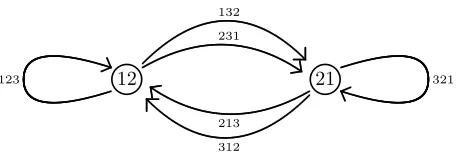
standardiza-tions of 2451 and 4513 are 2341 and 3412, respectively. In fact, between these two vertices there is another directed edge labeled 34512. The simple case ofn= 2 is illustrated in Figure 1. Note that, apart from the path and cycle graphs mentioned in Section 3, all graphs in this paper are directed, although we do not explicitly refer to them as directed graphs.
∗
n n
12 21
132
231
213
312
[image:2.612.193.424.72.154.2]123 321
Figure 1: The graphG(2) of overlapping permutations.
The graphG(n) appeared in [4] in connection withuniversal cycles on permutations. It has also appeared in [7], where it was used as a tool in determining the asymptotic behavior of consecutive
pattern avoidance, and in [2], where it is called the graph of overlapping patterns (see also [11,
Section 5.6]).
What is the number of directed cycles in this graphG(n), that is, the analogue to the question for which Equation (1.1) is the answer. This is a natural question which does not seem to have
been studied so far. We have not been able to solve that problem (and we do not recognize
the associated number sequences). We do here, however, solve that problem when the graph is
restricted to permutations of length n avoiding the pattern 312, that is, permutations containing
no three letters the first of which is the largest and the second of which is the smallest. We prove
in Theorem 5.2 that the number of directed cycles of length din the restriction of the graph is
1
d
X
e|d
µ(d/e)
2e e
, (1.2)
ford not exceedingn. Note the similarity between this and the expression in Equation (1.1): the
power qe in (1.1) is replaced here by the central binomial coefficient 2ee.
It is easy to see, due to straightforward symmetries, that permutations avoiding a particular one of the patterns 132, 213 and 231 yield a graph isomorphic to the one for 312, which is the representative we have chosen. It is also easy to see that permutations avoiding 123 (or, equivalently, 321) give rise to a nonisomorphic graph. For this latter case we have no solution for the number of cycles, and we do not recognize the number sequences counting the cycles in that graph.
Using similar techniques, we prove that the number of 312-avoiding affine permutations in Sed
with k cut points is given by the binomial coefficient 2dd−−1k−1
. This refines a result of Crites [6] who showed that the number of 312-avoiding affine permutations is 2dd−1−1
. As a corollary to our results we show that each affine permutation has a cut point or is, in other words, decomposable.
The connection between cycles in the graph of overlapping permutations and affine permutations goes through bi-infinite sequences. A bi-infinite sequence (. . . , f(−1), f(0), f(1), f(2), . . .) of distinct
real numbers yields a bi-infinite walk where the ith edge is given by the standardization of f =
(f(i), f(i+1), . . . , f(i+n)), that is, the unique permutation of{1,2, . . . , n+1}whose letters appear in the same order of size as the numbers inf . This walk is a closed walk of lengthdif the sequence is periodic, in the sense thatf(i)< f(j) if and only iff(i+d)< f(j+d). Thus, infinited-periodic sequences correspond to d-cycles.
The paper is organized as follows. In Section 2 we introduce some definitions related to pattern
avoidance, affine permutations and bi-infinite sequences. The last of these play an important
are introduced in Section 3. In Section 4 we give results on the number of affine 312-avoiding permutations with a given number of cut points and show that every such permutation does have
a cut point. In Section 5 we present the main result, about the number of d-cycles in G(n,312)
and subsequently give a bijection that proves this, in Sections 6 and 7. Finally, in Section 8, we list several open problems in this area.
2
Pattern-avoiding permutations, affine permutations and bi-infinite
sequences
We first introduce some formal definitions that are needed later on.
For a permutation x= x1· · ·xn consisting of distinct real numbers, let Π(x) denote the
stan-dardization ofx, also known as thereduced form ofx, that is, the unique permutationπ=π1· · ·πn
in the symmetric group Sn whose elements have the same relative order as those in x. In other
words, xi < xj if and only if πi < πj for all 1≤i < j ≤ nand π is built on the set{1,2, . . . , n}.
For example, Π(3(−2)02) = 4123.
The graph of overlapping permutations G(n) has the elements of the symmetric group Sn as
its vertex set and for every permutation σ = σ1· · ·σn+1 in Sn+1 there is a directed edge from
Π(σ1· · ·σn) to Π(σ2· · ·σn+1).
A permutation π = π1π2· · ·πn ∈ Sn avoids a permutation τ ∈ Sk if there are no integers
1≤i1< i2 <· · ·< ik≤nsuch that Π(πi1πi2· · ·πin) =τ. In this context,τ is called apattern and
we say that π avoids the pattern τ. Let Sn(τ) denote the set of τ-avoiding permutations inSn.
Especially, we are interested in 312-avoiding permutations, which are those that have no indices
i < j < k such thatπj < πk < πi. It is well known that the number of 312-avoiding permutations
inSn is given by thenth Catalan number Cn= n+11 2nn
.
A cut point of a permutation π ∈ Sn is an index j with 1 ≤ j ≤ n−1 such that for all i
and k satisfying 1 ≤ i ≤ j < k ≤ n we have that πi < πk. The cut points split a permutation
into components, each ending at a cut point. A permutation without cut points is said to be
indecomposable (or, sometimes, irreducible). As an example, the permutation 31246758 has three cut points, namely 3, 4, and 7, and components 312, 4, 675 and 8, wheres 2413 is indecomposable. The following proposition is well known (see, for instance, [5]), and it is easy to prove, e.g. using the
following argument. Every 312-avoiding permutation is of the form A1B, where each element of B
is larger than every element ofA, which implies that a 312-avoiding permutation is indecomposable
precisely whenB is empty. Such permutations withB empty directly correspond bijectively to the
312-avoiding permutationsA of length n−1, which leads to the following result.
Proposition 2.1. The number of 312-avoiding indecomposable permutations inSn is given by the
Catalan number Cn−1.
One extension of the notion of a permutation is the notion of an affine permutations. While
the symmetric group Sd is the Weyl group Ad−1, the group of affine permutations Sed is the
affine Weyl group Aed−1. However, the combinatorial description of affine permutations is due to
permutationπ ∈Sed is a bijection π:Z−→Z such that
π(i+d) =π(i) +d, (2.1)
d−1 X
i=0
(π(i)−i) = 0. (2.2)
Note that the first condition implies that the values π(0) through π(d−1) determine the whole
affine permutation.
We now extend the notion of an affine permutation to bi-infinite sequences. A bi-infinite
se-quenceis defined to be an injective functionf :Z−→R. Alternatively, one can think of a bi-infinite sequence as a bi-infinite list (. . . , f(−1), f(0), f(1), f(2), . . .) of distinct real numbers. We say that two bi-infinite sequencesf and gare equivalent if there is a strictly increasing continuous function
T :R−→ R such that g(i) =T(f(i)). Equivalently, it is enough to assume that T is strictly in-creasing and bijective. It is straightforward that this relation is an equivalence relation. We think about the equivalence classes as bi-infinite permutations. Hence, it is natural to extend notions from permutation patterns theory to bi-infinite sequences.
A cut pointfor a bi-infinite sequencef is an indexj such that for all integersi≤j < kwe have thatf(i)< f(k). Theinversion set for a bi-infinite sequencef is the set
Inv(f) ={(i, j)∈Z2 : i < j, f(i)> f(j)}.
A bi-infinite sequence isperiodicwith periodd, if for all integersiandj, the inequalityf(i)< f(j) is equivalent to the inequality f(i+d)< f(j+d). Equivalently, a bi-infinite sequence is periodic with perioddif the inversion set satisfies the condition (i, j)∈Inv(f) is equivalent to (i+d, j+d)∈
Inv(f). Extending the notion of pattern avoidance, we say that a bi-infinite sequencef avoids the patternσ ∈Sn if there are no integersi1< i2 <· · ·< in such that Π(f(i1)f(i2)· · ·f(in)) =σ.
3
Compositions and cyclic compositions
A composition of a non-negative integerdintokparts is a list ofkpositive integers (a1, a2, . . . , ak)
such that their sum is d. Let α1, α2, . . . be a sequence of numbers and f(t) = Pi≥1αiti be the
associated generating function. Form a new sequence (βd,k)d≥1 by the relation
βd,k =
X
(a1,a2,...,ak)
αa1αa2· · ·αak
where the sum is over all compositions of d into k parts. Additionally, we set β0,k to be the
Kronecker deltaδ0,k, which is equal to 1 ifk= 0 and 0 otherwise. Also, let the sequence (βd)d≥0 be
defined by the sum βd=Pk≥0βd,k. The following relations are classical generatingfunctionology:
X
d≥0
βd,ktd= (f(t))k and
X
d≥0
βdtd=
1
1−f(t). (3.1)
For a family of sets Si, where αi is the cardinality of a set Si, we can give a combinatorial
interpretation to the numberβd,k, hence also βd. Anenriched compositionis a pair (a,s) where a
such that the elementsi belongs to the set Sai. Nowβd,k is the number of enriched compositions
of dintokparts, and βd is the number of enriched compositions ofd.
Note that each connected subgraph of a path is also a path. Hence a composition (a1, a2, . . . , ak)
ofdcan be thought of as a subgraph of the path ondvertices, whereaiis the size of theith connected
component. The number of connected components of the subgraph is the number of parts of the
composition. With this analogue in mind we define a cyclic composition to be a subgraph of the
labeled cycle ondvertices where each component is a path. Note that we rule out the case of the
cycle being a subgraph of itself. Yet again, the number of paths is the number of components k.
Observe that k is also the number of edges removed to obtain the subgraph. Since there are d
edges in a cycle, we have dkcyclic compositions ofdintokparts fork≥1. For instance, there are
4 2
= 6 cyclic compositions of 4 into two parts, namely, two consisting of two 2s and four consisting of 1 and 3 (see Figure 2).
s s s s
1 2
3
4 s s
s s
1 2
3
4 s s
s s
1 2
3
4 s s
s s
1 2
3
4 s s
s s
1 2
3
4 s s
s s
1 2
[image:5.612.156.459.247.291.2]3 4
Figure 2: The 6 cyclic compositions of 4 into two parts.
To be more formal, let Zd denote both the integers modulo dand the cycle of length d, where
we connectiandi+ 1 modulod. A cyclic composition is a set partitionP ={B1,B2, . . . ,Bk}where each blockBiis a path in the cycleZd. Equivalently, each blockBiis the image of an interval [pi, qi]
of integers under the quotient map Z−→Zd with the restriction 0≤qi−pi ≤d−1. Also, letai
beqi−pi+ 1, that is, the cardinality of the interval [pi, qi] and its associated path.
Similar to compositions, we construct new sequences (γd,k)d≥1 and (γd)d≥1 as follows:
γd,k =
X
P
αa1αa2· · ·αak
where the sum is over all cyclic compositionsP of dintok parts andai is the size of the ith part.
Also, letγddenote the sum γd=
P
k≥1γd,k.
Proposition 3.1. The generating functions for γd,k and γd are given by
X
d≥k
γd,ktd=tf0(t)(f(t))k−1=
t kD
(f(t))k
and (3.2)
X
d≥1
γdtd=
tf0(t)
1−f(t), (3.3)
where D is the differential operator with respect to t.
Proof. To observe the first relation, consider the component containing the vertex 1 of the cycle.
Also, assume that this component has size i. Then there are i possibilities how to choose this
component. This is encoded by the generating function P
i≥1iαiti = tf0(t). Next we have to
As a brief example of Equation (3.3), note that setting αi = 1 enumerates the number of cyclic
compositions. We havef(t) = 1/(1−t)−1 and obtainP
d≥1γdtd= 1/(1−2t)−1/(1−t), yielding
the answer of 2d−1 for the number of cyclic compositions ofd.
Combining generating functions in Equations (3.1) and (3.2) we have the following result.
Corollary 3.2. The two quantities βd,k and γd,k are related by
γd,k =
d
kβd,k. (3.4)
An enriched cyclic compositionis a pair (P,s) whereP is a cyclic composition{B1,B2, . . . ,Bk}
of d into k parts and s = (s1, s2, . . . , sk) is a list of length k such that the element si belongs
to the set S|Bi|. Now γd,k has the combinatorial interpretation as the number of enriched cyclic
compositions of dintokparts, and βdis the number of enriched cyclic compositions of d.
Let C(t) and CB(t) denote the generating functions for the Catalan numbers and the central binomial coefficients, that is,
C(t) =X
d≥0
Cdtd=
1−√1−4t
2t ,
CB(t) =X
d≥0
2d d
td= √ 1
1−4t.
Lemma 3.3. Letαi =Ci−1+δi,1 where δi,1 denotes the Kronecker delta. Then the central binomial
coefficient is given by the sum
2d d
=X
P
αa1αa2· · ·αak,
where the sum is over all cyclic compositionsP of d andd≥1.
Proof. First, observe that P
i≥1αiti =t+tC(t). The result now follows from Equation (3.3) and
the identity
CB(t)−1 = t(t+tC(t))
0
1−t−tC(t).
The following two well-known identities involving the Catalan numbers are worth keeping in mind in the next section, where we prove similar results regarding affine 312-avoiding permutations. We have
X
(a1,a2,...,ak)
Ca1−1Ca2−1· · ·Cak−1 =
k d
2d−k−1
d−1
, (3.5)
where the sum is over all compositions of d into k parts. The numbers in the right hand side
give Catalan’s triangle, sequence A009766 in [12]. One of many things they enumerate is the set
of 312-avoiding permutations of length d that split into (at most) k components. Namely, such
letter ofAj fori < j. Since each component is an indecomposable 312-avoiding permutation, these
permutations withkcomponents are counted by the left hand side. By a similar argument we have
X
(a1,a2,...,ak)
Ca1−1Ca2−1· · ·Cak−1 =Cd,
where the sum is over all compositions of d.
By combining Corollary 3.2 and Equation (3.5) we have:
Lemma 3.4. The following identity holds
X
P
Ca1−1Ca2−1· · ·Cak−1 =
2d−k−1
d−1
, (3.6)
where the sum is over all cyclic compositionsP of d intok parts.
4
312
-avoiding affine permutations
Before we continue, we take a detour to study 312-avoiding affine permutations. Recall that an affine permutationπ∈Sedis 312-avoiding if there are no integersi < j < k such thatπ(j)< π(k)< π(i).
Crites [6] proved the following result for affine permutations.
Theorem 4.1 (Theorem 6 in [6]). The number of312-avoiding affine permutations in Sed is given
by 2dd−1.
We give a refinement of this result. Recall that a cut point for an affine permutation π is an
indexjsuch that fori≤j < k the inequalityπ(i)< π(k) holds. Note that, ifj is a cut point, then
so is any index congruent toj modulod. Hence, we count the number of equivalence classes of cut
points.
Theorem 4.2. Let kbe a positive integer and k≤d. The number of 312-avoiding affine permuta-tions in Sed that have k cut points modulo d is given by
2d−k−1
d−1
.
Proof. Consider a cyclic composition {B1,B2, . . . ,Bk}into kparts of the cycleZd and enrich each
block with an indecomposable 312-avoiding permutation. By Proposition 2.1 there are Ca−1
in-decomposable 312-avoiding permutations in Sa, hence the total number of enriched cyclic
com-positions is given by Lemma 3.4, that is, 2dd−−1k−1
. Let the ith block Bi be the image of the
interval [pi, qi]. View the permutation πi enriching Bi as a bijection on this interval. That is, we
have the bijection πi : [pi, qi]−→[pi, qi]. Now concatenate thesek bijections, that is, define
π : [
1≤i≤k
[pi, qi] = [p1, qk]−→[p1, qk]
byπ(j) =πi(j) ifj ∈[pi, qi]. Finally, extendπ to all integers by Condition (2.1). By construction,
it is clear that π is a 312-avoiding affine permutation with k cut points and that all 312-avoiding
n n n
n
n
213 321
132
123
231
2134 3214
3241
2314 1324
2143
1243
3421 1432 2431
1342 2341
[image:8.612.150.463.61.285.2]1234 4321
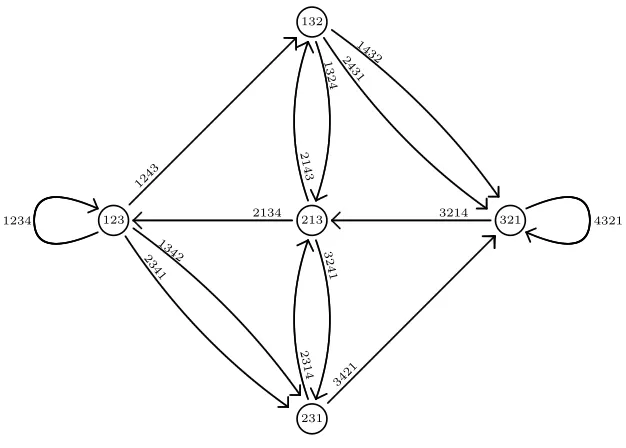
Figure 3: The graph G(3,312), which has two 1-cycles, two 2-cycles and six 3-cycles.
Corollary 4.3. Every 312-avoiding affine permutation in Sed has a cut point.
Proof. Since the sum of 2dd−−1k−1forkfrom 1 todis 2dd−1, and by Theorem 4.1, all the 312-avoiding affine permutations have been accounted for.
A more direct proof is as follows.
A second proof of Corollary 4.3. Letπ be an affine 312-avoiding permutation inSed. LetP be the
set {(i, π(i)) : i∈Z}. Define a poset structure on the set P by (i, π(i))<P (j, π(j)) if i > j and
π(i)< π(j). Note, for instance, that the set {(i, π(i)) : i≡j modd} forms an infinite antichain. Now if an element (i, π(i)) is greater than both of the elements (j, π(j)) and (k, π(k)), and
these two elements are incomparable, then this triple forms a 312-pattern. Since we assumedπ is
312-avoiding we have that the lower order ideal generated by a single element is a chain. In other words, the poset is a forest with the minimal elements as roots.
Pick a minimal element (i, π(i)) in the poset. We claim that i is a cut point. Among the
maximal elements above (i, π(i)) in the poset pick an element (j, π(j)) with the largest second coordinate. We claim that if k ≤ i then π(k) ≤ π(j). There is nothing to prove if π(k) ≤ π(i). If π(k) ≥π(i) then we have (k, π(k))≥P (i, π(i)). But we picked (j, π(j)) to be the element with
largest second coordinate, which proves the claim. Next we claim that if k > ithen π(k)> π(j). Assume thatπ(k)< π(j). Since (i, π(i)) is a minimal element we know thatπ(i)< π(j). However, this yields a contradiction since Π(π(j), π(i), π(k)) = 312, the prohibited pattern. Hence,iis a cut point.
5
The graph of
312
-avoiding permutations
to Π(σ2· · ·σn+1) labelledσ. Furthermore, let G(n, τ) be the graph of overlappingτ-avoiding
per-mutations, that is, it is the subgraph ofG(n) having the vertex setSn(τ) and the edge setSn+1(τ). For an example, see Figure 3 where the graphG(3,312) is presented.
A closed walk of length d in a graph is a list of d edges (e1, e2, . . . , ed) such that head(ei) =
tail(ei+1) for 1≤i≤d−1 and head(ed) = tail(e1), where for a directed edgee, head(e) is the node
the edge points to, while tail(e) is the other node incident to e. Thus, (1342,2314,2134) and its cyclic shift (2134,1342,2314) are two different closed walks.
Define an equivalence on the set of closed walks by cyclic shifting, that is, two closed walks (e1, e2, . . . , ed) and (ei, ei+1, . . . , ed, e1, e2, . . . , ei−1) are equivalent. Then a d-cycleis defined to be
an equivalence class of sized. For instance, the graphG(3,312) in Figure 3 has six closed walks of length 2, namely,
(1234,1234),(4321,4321),(1324,2143),(2143,1324),(2314,3241) and (3241,2314).
However, the graph G(3,312) has only two 2-cycles, since the first two closed walks yield 1-cycles while the fourth (respectively, sixth) walk is equivalent to the third (respectively, fifth) walk.
The number of closed walks of a fixed length is given by the following result.
Theorem 5.1. The number of closed walks of lengthd in G(n,312), for d≤n, is given by 2dd.
A bijective proof of Theorem 5.1 will be given in the following two sections.
Theorem 5.2. The number of d-cycles in G(n,312), for d≤n, is given by
1
d
X
e|d
µ(d/e)
2e e
.
Proof. Let h(d) denote the number of d-cycles. A closed walk of length d can be obtained by choosing a divisoreofd, ane-cycle and a starting point on the cycle. By repeating thee-cycle d/e
times we obtain a closed walk of lengthd. Hence, we have
2d d
=X
e|d
e·h(e).
The result now follows by classical M¨obius inversion.
6
The bijection
It remains to show that the number of closed walks of lengthdinG(n,312) is given by 2dd. We do this by constructing a bijection between closed walks and enriched cyclic compositions. The proof of this bijection involves bi-infinite sequences. LetWddenote the set of all closed walks of lengthd
in the graph G(n,312).
Given a cyclic composition P on Zd, we enrich each part of size a either with a 312-avoiding
indecomposable permutation from the symmetric groupSa, or, if a= 1, with the symbolD. The
symbol D stands for “Down” and it will be used for the part of the bi-infinite sequence that is
or the symbol D. Let Ed denote the set of all these enriched cyclic compositions. Note that the
number of enrichments of a part of sizeais the Catalan numberCa−1 plus the Kronecker deltaδa,1.
Hence, by Lemma 3.3, we know that the total number of these structures is the central binomial coefficient 2dd
.
We now describe a bijection Φ : Ed −→ Wd. Let P = (B1,B2, . . . ,Bk) be an enriched cyclic
composition inEd. Recall that theith blockBiis the image of the interval [pi, qi] under the quotient
map Z −→ Zd. If the enrichment on the part Bi is a permutation, we view it as a permutation
πi on the set [pi, qi]. Let Bi be the set Bi = Sj∈Z[pi +jd, qi +jd]. Note that B1,B2, . . . ,Bk is a partition of the integersZ. Furthermore, extendπi by the relation πi(j+d) =πi(j) +d. That is,
nowπi is a bijection on the setBi. Construct a bi-infinite sequencef by
f(j) =
(
exp(πi(j)) ifj∈ Bi and partBi is enriched with a permutation,
−exp(j) ifj∈ Bi and partBi is enriched with the symbolD.
By construction, the bi-infinite sequence f isd-periodic. It also is 312-avoiding.
Claim 6.1. The bi-infinite sequence f is 312-avoiding.
Assume not, that is, there are three integers x < y < z such that f(y)< f(z) < f(x). Assume thatf(y)<0< f(z). Then bothf(x) andf(z) are positive. Sincef(y) is negative,xandzbelong to different intervals of the form Bi+j·d. But between these types of intervals f is increasing,
yielding the contradictionf(x)< f(z). Hence if f(y) is negative then so is f(z). But the negative
values of f form a decreasing sequence, since this is a subsequence of −exp(j). This contradicts
f(y)< f(z). Now assume that f(y)>0. Since f(x) > f(y), x has to belong to the same interval
Bi+j·dasy. Similarly, sincef(x)> f(z),z has to belong to the same intervalBi+j·dasx. This
contradicts to the fact that the block Bi was enriched with a 312-avoiding permutation, proving
the claim.
Finally, we construct an infinite walk (. . . , σ−1, σ0, σ1, σ2, . . .) in the graphG(n,312) by letting
σi be the standardization Π(f(i), f(i+ 1), . . . , f(i+n)). Note that this permutation is 312-avoiding
and as an edge in the graph, it has the tail Π(f(i), f(i+ 1), . . . , f(i+n−1)) and the head Π(f(i+ 1), f(i+ 2), . . . , f(i+n)). Sincef isd-periodic the infinite walk has periodd. Restricting the walk to (σ1, σ2, . . . , σd) gives a closed walk in the set Wd. This completes the description of the map Φ.
Example 6.2. As an example of how the bijection Φ works, consider the cyclic composition of
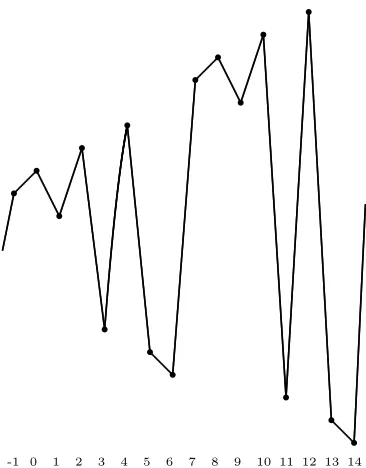
d = 8 consisting of the interval [−1,1] and the five singletons {2},{3},{4},{5},{6}. Enrich the singletons {2},{3} and {5} with the symbol D. Enrich the interval [−1,1] with the permutation 231 and the two remaining singletons with the permutation 1. Then a graphical representation
of the associated sequence f is in Figure 4. In the graph G(8,312) the sequence f describes the
8-cycle:
45362178,43521786,34216758,43267581,32564718,35647281,56473821,54637218.
r r r
r
r r
r r
r r r
r
r r
r r
[image:11.612.214.397.66.300.2]-1 0 1 2 3 4 5 6 7 8 9 10 11 12 13 14
Figure 4: A schematic representation of the sequence appearing in Example 6.2.
7
The inverse bijection
One can always lift an infinite walk in the graph to a bi-infinite sequence. However, as Remark 7.1 shows, an infinite walk could lift to several non-equivalent sequences, and they do not all have the desired properties. Thus, when lifting a walk to a sequence we have the additional requirements in Conditions (7.1) and (7.2). Their interpretation is that we do not introduce an inversion in the bi-infinite sequence, unless we are required to do so by a local condition.
Remark 7.1. Consider the two bi-infinite sequences
h1(n) =n+ (−1)n and h2(n) =n+ 2(−1)n.
Observe that they both encode the same 2-cycle inG(2,312). That is,
Π(h1(n), h1(n+ 1), h1(n+ 2)) = Π(h2(n), h2(n+ 1), h2(n+ 2)) = (
132 ifnis odd,
213 ifnis even.
However, note that h2 is not 312-avoiding, whereas h1 is. Furthermore, h2 does not have any cut
points, whereash1 does. Hence, when constructing the inverse map to Φ we have to be careful in
constructing a bi-infinite sequence which is 312-avoiding.
We now construct the inverse map of Φ. Given the closed walk (σ1, σ2, . . . , σd) inWdwe extend
it to an infinite walk by lettingσj+d=σj for all integersj.
We are going to find a sequence. . . , g(−1), g(0), g(1), g(2), . . .such that Π(g(i), g(i+1), . . . , g(i+
n)) =σifor all integersi. To find such a sequence, letg(k) =σ1(k) for 1≤k≤n+1. Now alternate
(+) Assume that we have picked the values g(i), g(i+ 1), . . . , g(j−1) of the sequence. We will now pick the value of g(j). That is, we are extending the sequence in the positive direction.
Letσ be the permutationσi−n. Letaand bbe the real numbers (including ±∞) given by
a=
(
g(σ−1(σ(n+ 1)−1) +s) ifσ(n+ 1)>1,
−∞ ifσ(n+ 1) = 1,
b=
(
g(σ−1(σ(n+ 1) + 1) +s) ifσ(n+ 1)< n+ 1,
∞ ifσ(n+ 1) =n+ 1,
wheresis the shifts=j−n−1. Then any real number xin the open interval (a, b) satisfies Π(g(j−n), . . . , g(j−1), x) =σ. However, we have one more requirement, we will pick x as large as possible with respect to the already picked valuesg(i), g(i+ 1), . . . , g(j−n−1). That is, we pick g(j) =x such that
max(a,{g(k) : g(k)< b, i≤k≤j−1})< x < b. (7.1)
Note that we are picking a real number g(j) = x in an open interval. If the interval is
bounded, it is fine to use the average of the two endpoints. However, any number in the open interval will do, since there are plenty (read infinite) of real numbers in the interval both less than and greater than our pick.
(–) Now we extend the sequence in the negative direction. Assume that we have picked the values
g(i+ 1), g(i+ 2), . . . , g(j) of the sequence. We will now pick the value of g(i). Let σ now
denote the permutation σi. Let the two boundsaand bbe given by
a=
(
g(σ−1(σ(1)−1) +s) ifσ(1)>1,
−∞ ifσ(1) = 1,
b=
(
g(σ−1(σ(1) + 1) +s) ifσ(1)< n+ 1,
∞ ifσ(1) =n+ 1,
wheres=i−1. Yet again, any real number x in the open interval (a, b) satisfies Π(x, g(i+ 1), . . . , g(i+n)) = σ. However, now we pickx as small as possible with the already picked values g(i+ 1), . . . , g(j). That is, we pick g(i) =xsuch that
a < x <min(b,{g(k) : g(k)> a, i+ 1≤k≤j}) (7.2)
The purpose of the two conditions in (7.1) and (7.2) is to avoid introducing any extra inversions in the sequenceg. These conditions will come into play at the end of this construction in the case
when the setD (to be defined soon) is empty.
Claim 7.2. The sequence g is locally 312-avoiding, that is, if i < j < k, where k−i ≤ n then
Π(g(i), g(j), g(k))6= 312.
This holds true since σi is 312-avoiding.
Since d≤nand Π(g(i), g(i+ 1), . . . , g(i+d), . . . , g(i+n)) is a permutation, g(i) and g(i+d) are distinct.
Claim 7.4. Fori < j andj−i < nthe inequality g(i)< g(j) is equivalent tog(i+d)< g(j+d).
Sinceσi=σi+dwe have the string of the equivalencesg(i)< g(j)⇐⇒σi(1)< σi(j−i+ 1)⇐⇒
σi+d(1)< σi+d(j−i+ 1)⇐⇒g(i+d)< g(j+d).
Hence, the bi-infinite sequence g decomposes intodsequences, each of which is monotone. We
now partition the integersZinto two setsD={i : g(i)> g(i+d)} andU ={i : g(i)< g(i+d)}.
Note that since d≤ n we have that i ∈D is equivalent to i+d ∈D. That is, D consists of the
sequences that are decreasing andU of the increasing sequences.
Claim 7.5. The subsequence {g(i)}i∈D is decreasing.
Assume that {g(i)}i∈D is not decreasing. Then there are two entriesi, j ∈D such that i < j,
j −i ≤ d−1, and g(i) < g(j). Also, we have that g(j −d) > g(j). Combining the last two inequalities gives an occurrence of 312 since Π(g(j−d), g(i), g(j)) = 312. This contradiction proves that{g(i)}i∈D is decreasing.
Claim 7.6. The values of the sequence {g(i)}i∈D are all smaller than the values of {g(j)}j∈U.
We begin when iand j are close to each other, that is, when i < j < i+d, i∈D and j∈U. Assume thatg(i)> g(j). Then we have the string of inequalities g(i−d)> g(i)> g(j)> g(j−d) implying that Π(g(i−d), g(j−d), g(i)) = 312, a contradiction. Hence, we conclude thatg(i)< g(j). Now pick i0 ∈ D and j0 ∈ U. If i0 < j0 let i = i0 and j = j0−d· b(j0 −i0)/dc. If i0 > j0 let
i=i0−d·d(i0−j0)/deandj =j0. (Hereb·candd·eare the usual floor and ceiling functions.) In both cases we havei∈D,j∈U andi < j < i+d. Furthermore, we have thatg(i0)≤g(i)< g(j)≤g(j0), proving the claim.
Now assume that D is non-empty. The case when D is empty requires an extra argument,
which we postpone to the end of this section. Pick p1 to be an element in the set D. Decompose
the interval [p1, p1+d−1] of cardinality dinto smaller intervals, according to the rules:
(d) Ifi∈D∩[p1, p1+d−1] then let the singleton{i}= [i, i] be an interval in the decomposition.
Moreover, enrich this singleton with the symbol D.
(u) If i ≤ j, i−1, j+ 1 ∈ D and [i, j] ⊆ U ∩[p1, p1+d−1] then we use the argument at the
end of Section 3 to decompose the interval [i, j] into smaller intervals, each enriched with an indecomposable 312-avoiding permutation. That is, we use the permutation Π(g(i), g(i+ 1), . . . , g(j)) to decompose the interval.
Let the decomposition of the interval [p1, p1 +d−1] be {[p1, q1],[p2, q2], . . . ,[pr, qr]}, where qi+
1 = pi+1. Extend this decomposition to a decomposition {[pi, qi]}i∈Z of the integers Z by letting
pi+r = pi+d and qi+r = qi+d. Note that under the quotient mapZ −→ Zd we obtain a cyclic
composition.
Claim 7.7. If the intervals[pi, qi]and[pk, qk]are not enriched with the symbolD,i < k,x∈[pi, qi]
First assume that z−x ≤ d. If there is no interval [pj, qj] between these two intervals (i <
j < k) that is enriched with the symbolD then the inequality follows by the decomposition into indecomposable permutations in part (u) above. If there is an interval [pj, qj] in between which
is enriched with the symbol D, then consider the pattern Π(g(x), g(pj), g(z)). Since [pj, qj] is
enriched by D we have that g(pj) < g(x) and g(pj) < g(z). Hence, if g(x) > g(z), we obtain the
pattern 312, a contradiction. Finally, ifz−x > d, we obtain the inequality by using thatU consists of the increasing sequences.
The last claim states that we do not lose information if we view the permutation enriching the interval [pi, qi] as a bijection on this interval. The resulting composition, viewed as a cyclic
composition with its enrichment, is the inverse image of the map Φ.
When the set D is empty, we need to be more careful to show that the sequence g has a cut
point. We will use an argument similar to that in the second proof of Corollary 4.3. However, there
is an added complication since all we know is thatg is locally 312-avoiding. By Condition (7.1) we
have the following lemma.
Lemma 7.8. Assume thatj < kandg(j)> g(k). Then there is a chainj =j0< j1 <· · ·< jL=k
such that g(j0)> g(j1)>· · ·> g(jL) and jh+1−jh≤nfor all indices 0≤h≤jL−1.
Proof. When we selected the value of g(jL), we picked this value in an interval (a, b) whereb was
one of the values from the listg(jL−n), . . . , g(jL−2), g(jL−1). Hence, letjL−1 be the index such
thatg(jL−1) =b.
Assume that g(j)< g(jL−1). Condition (7.1) states that we pickedg(jL) as large as possible in
the interval (a, b). Hence, the assumptiong(j)< g(jL−1) implies thatg(j)< g(jL), a contradiction.
We conclude that g(j)> g(jL−1). By iterating this argument we obtain the chain.
Now the argument is the same as in the second proof of Corollary 4.3, except in the case when we use the 312-avoidance. That is, we have picked (i, g(i)) as a minimal element in the poset P
and (j, g(j)) to be an element larger than or equal to the minimal element (i, g(i)) maximizing the
second coordinate. Observe that i−j ≤ d. The local 312-avoidance condition implies that the
poset order between (i, g(i)) and (j, g(j)) is a chain. That is, we have the string of inequalities
g(j)> g(j+ 1)>· · ·> g(i−1)> g(i).
The remaining case is to show that there is no index ksuch thati < k and g(i)< g(k)< g(j). First pickj0 in the interval [j, i−1] such thatg(j0+ 1)< g(k)< g(j0). Next use Lemma 7.8 to pick the first element of the chainj10 such thatj0< j10 ≤j0+n andg(j0+ 1)< g(j10)< g(j0). However, this is a 312-pattern, contradicting the assumption that there is such ak. Hence, we conclude that
the sequenceg has a cut point.
Let the cut point be p1−1. Consider the composition of the interval [p1, p1+d−1] consisting
of one part. That is, this part is the interval [p1, p1+d−1]. Now, in a way similar to part (u)
above, we decompose this interval into smaller intervals, each enriched with an indecomposable 312-avoiding permutations using the permutation Π(g(p1), g(p1+ 1), . . . , g(p1+d−1)). This completes
the inverse of Φ in the case when the set Dis empty.
8
Open problems
Question 8.1. The sequence 1dP
e|dµ(d/e) 2e
e
from Theorem 5.2 appears in the On-Line Ency-clopedia of Integer Sequences [12] as sequence A060165. It has been previously studied by Puri and
Ward [13, 14]. When q is a prime power, the number of monic irreducible polynomials of degreed
inGF(q)[x] is given by Equation (1.1). Is there a similar algebraic interpretation for the numbers occurring in Theorem 5.2?
Question 8.2. Can the number of d-cycles in the graph G(n,321) be determined? Equivalently,
what is the number of closed walks in G(n,321) of lengthd? Of course, the same question can be
asked for any set of patterns of length 3 or more, as well as for the entire graphG(n).
Question 8.3. One of the earliest results on De Bruijn graphs is that the number of complete cycles, also known as Eulerian cycles, is given by
(q!)qn−1
qn .
This result goes back to 1894 by Flye Sainte-Marie [9] in the case whenq = 2 and the general case
to van Aardenne-Ehrenfest and De Bruijn [1]. Is there an analogous result for the graph G(n) of
overlapping permutations? It seems, from the small examples we have studied, that the number of complete cycles in the graph of overlapping permutations has small prime factors, which gives hope that there is an explicit formula.
Question 8.4. Observe that G(n,312) does not have any complete cycles since there are vertices
with different out- and in-degrees. Hence, it is natural to ask: For which sets S of patterns do
all vertices in the graph G(n, S) have the same out- and in-degree? Also, what is the number of
complete cycles in these graphs?
Question 8.5. Lastly, it would be interesting to find bijective proofs of Lemmas 3.3 and 3.4.
Acknowledgments
The authors thank the two referees for their helpful comments. The first author was partially supported by National Science Foundation grant DMS 0902063 and National Security Agency grant H98230-13-1-0280. The last author was supported by grant no. 090038013 from the Icelandic Research Fund.
References
[1] T. van Aardenne-Ehrenfest and N. G. De Bruijn, Circuits and trees in oriented linear
graphs,Simon Stevin,28(1951), 203–217.
[2] S. Avgustinovich and S. Kitaev, On uniquelyk-determined permutations,Discrete Math.,
308(2008), 1500–1507.
[3] A. Bj¨orner and F. Brenti, Affine Permutations of TypeA,Electron. J. Combin.,3(1996), R18.
[5] A. Claesson and S. Kitaev, Classification of bijections between 321- and 132-avoiding
permutations,S´em. Lothar. Combin.,60 (2008/09), Art. B60d, 30pp.
[6] A. Crites, Enumerating pattern avoidance for affine permutations,Electron. J. Combin.,17 (2010), R127.
[7] R. Ehrenborg, S. Kitaev and P. Perry, A spectral approach to consecutive
pattern-avoiding permutations,J. Comb.,2 (2011), 305–353.
[8] R. Ehrenborg and M. Readdy, Juggling and applications toq-analogues, Discrete Math.,
157(1996), 107–125.
[9] C. Flye Saint-Marie, Solution to question 48,l’Interm´ediare des Math´ematiciens,1(1894), 107–110.
[10] S. W. Golomb,“Shift register sequences,” Holden-Day, Inc., San Francisco, 1967.
[11] S. Kitaev, “Patterns in Permutations and Words,” Monographs in Theoretical Computer Science. An EATCS Series, Springer, Heidelberg, 2011.
[12] OEIS Foundation Inc. (2011), The On-Line Encyclopedia of Integer Sequences,
http://oeis.org.
[13] Y. Puri and T. Ward, A dynamical property unique to the Lucas sequence, Fibonacci Quart.,39(2001), 398–402.