
Integration of database programming and query languages for distributed object bases : a dissertation presented in partial fulfilment of the requirements for the degree of Doctor of Philosophy in Information Systems at Massey University
273
0
0
Full text
(2) Integrat ion of Database Programming and Query Languages for D istributed Obj ect Bases. Markus Kirchberg. A dissertation presented in partial fulfilment of the requirements for the degree of Doctor of Philosophy in Information Systems. at Massey University.
(3) Supervisor: P rof. Dr. Klaus-Dieter Schewe. Co-S upervisor: Associate Prof. Dr. Ray Kemp. Internal Examiner: Dr. Alexei Tretiakov. Australasia Examiner: Prof. Dr. Xiaofang Zhou. International Examiner: Prof. Dr. Bernhard Thalheim. Date of Examination: July 13, 2007.
(4) Abstract. Object-oriented programming is considered advantageous to other programming paradigms. It is believed to provide more flexibility, simplify development and main tenance, better model real-world situations, and is widely popular in large-scale soft ware engineering. The idea behind object-oriented programming is that a program is composed of objects that act on each other. While programming languages mainly focus on processing, data storage and data sharing only play a minor role. Database management systems, on the contrary, have been built to support large bodies of ap plication programs that share data. In todays database marketplace, relational and object-relational database systems are dominant. Object-oriented database systems were originally deemed to replace relational systems because of their better fit with object-oriented programming. However, high switching costs, the inclusion of object oriented features in relational database systems, and the emergence of object-relational mappers have made relational systems successfully defend their dominance in the DB marketplace. Nevertheless, during the last few years, object-oriented database systems have established themselves as a complement to relational and object-relational sys tems. They have found their place as embeddable persistence solutions in devices, on clients, in packaged software, in real-time control systems etc. In order to utilise the combined power of programming languages and SQL-like data base query languages, research has focused on the embedded and integrated approaches. While embedded approaches are more popular, they suffer from the impedance mis match, which refers to an inadequate or excessive ability of one system to accommodate input from another. This situation worsens when considering the numerous conceptual and technical difficulties that are often encountered when a relational database system is being used by a program that is written in an object-oriented language. Research presented in this thesis addresses the integration of programming lan guages, database query languages, object-oriented programming and traditional data base concepts. We investigate the stack-based approach to database programming and querying. The major objectives of our research are to: - Develop a database architecture that is suitable to integrate database programming languages, object-oriented programming and more traditional database system fea tures; - Propose an intermediate-level database programming and querying language that combines the advantages of object-oriented programming and database querying languages. Before such a powerful language design can be achieved, a number of conceptual and technical challenges have to be investigated; - Define a suitable run-time environment, which permits an efficient and effective evaluation of such an integrated language in a distributed database environment; and - Provide proof of concept implementations..
(5)
(6) Acknowledgement. I would like to thank Klaus-Dieter Schewe for giving me the opportunity to pursue an academic career under his supervision. This thesis would not have been possible without his invaluable input, constant support and understanding. My thanks also goes to Ray Kemp who kindly agreed to act as eo-supervisor of this thesis. Thanks to Massey University and the Department of Information Systems for their financial support. Special thanks to Sebastian Link, Sven Hartmann and Faizal Riaz-ud-Din for their support, useful discussions and their friendship. I am grateful to my wife Gowri for her love, encouragement and understanding. It is her support that gave me the strength to complete this work. Finally, I would like to thank my parents Sigrid and Dieter Kirchberg, who have always been there for me and supported me in every way possible.. 111.
(7)
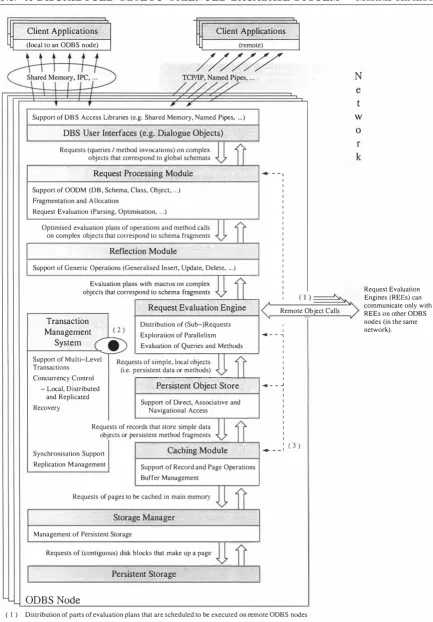
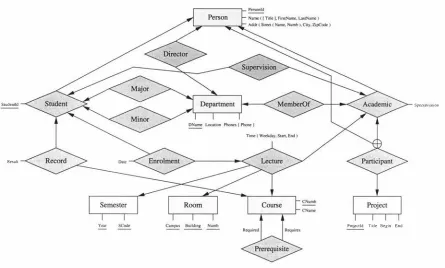
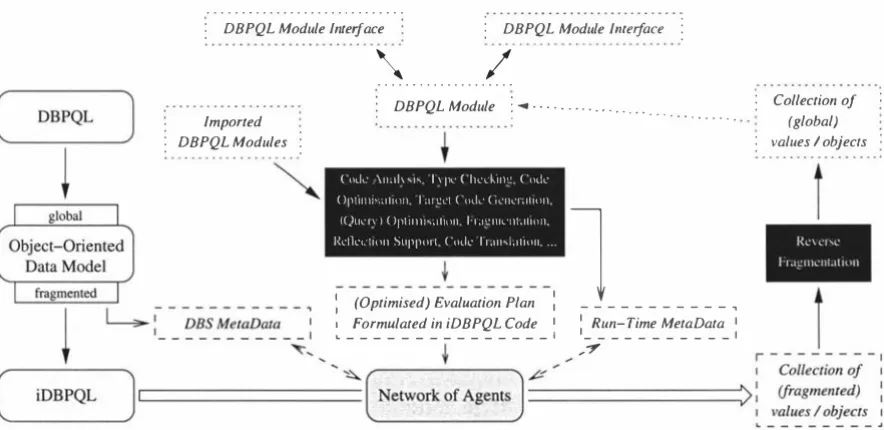
(8) Table of Content s 1. Introduction. 9. 1. 1 Database Systems and Programming Languages 1.1. 1 The Impedance Mismatch . . . . . . . . Objects and RDBMSs. . . . . . . . . . . Objects and Object-Relational Databases. Objects and Pure Object Databases. . . . 1.1.2 On the Integration of Programming and Query Languages 1.1.3 DBPL vs. Conventional Programming Languages 1.2 Contributions 1 . 3 Assumptions . 1.4 Outline . . . . 2. A Review of DBPLs and Related Concepts. 2. 1 The Stack-Based Approach . . . . . . . . . . . . . . . 2.2 Overview of D B Programming Environments . . . . . 2.2.1 The Database Programming Language DBPL 2.2.2 The 0 2 Object Database System . . . . . . . 2.2.3 The Object Base Management System TIGUKAT 2.2.4 The Parallel Database Programming Language FAD . 2.2.5 Additional Relevant Research Results on DBPLs . . 3. An Integrated Approach to DB Programming and Querying. 3. 1 A Distributed Obj ect-Oriented Database System . 3 . 1 .1 Architecture Overview . . . . . . . . . . 3.1.2 Properties of the OODM . . . . . . . . . Notes on the Choice of the Data Model. 3.1.3 Fragmentation . . . . . . . . . . . 3 . 1 .4 Linguistic Reflection . . . . . . . . . . 3.1.5 A Simple University Application . . . . The Global OODM Database Schema. Distributing the University Database. . 3.1.6 A Note on the Contribution of the Proposed ODBS 3.2 Processing User Requests . . . . . . . . . . . . . . . . . . .. 1. 10 14 15 15 15 16 18 19 21 22 23. 23 25 25 26 26 27 28 31. 31 32 36 37 37 38 39 39 43 50 50.
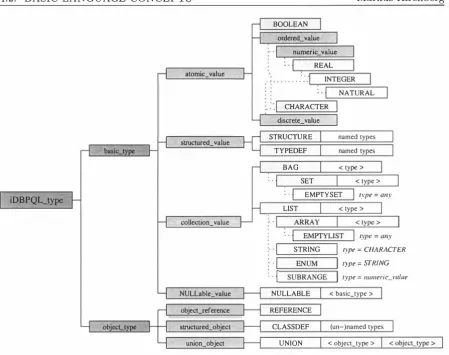
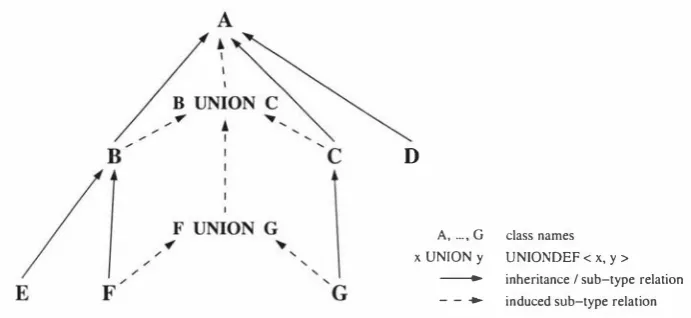
(9) Markus Kirchberg 4. The Database Programming and Query Language iDBPQL. 4.1 Language Overview . . . . 4.2 Basic Language Concepts . 4.2.1 Challenges . . . . . 4.2.2 Conventions . . . . 4.2.3 Literals, Names and Other Rudimentary Language Elements Literals. . . Identifiers. . Comments. Names. . . . 4 . 2.4 Types and Values Primitive Types. The Record Type. Type Definitions. Type Parameters. Collection Types. NULLable Types. . Value Initialisation and Default Values. Sub-typing and Type Conversion. Variables. . . . . . . . . . . . . . . . . Default Type Operations. . . . . . . . Type Definitions for the University Application. 4.2.5 Classes and Objects . . . . . . Structure of a Class. . . . . . . Variables and Reference-Types. Methods. . . . . . . . . . . . . (Multiple ) Inheritance. . . . . . Variables, Types, Objects, and Classes. The FINAL and the ABSTRACT Modifiers. The UNION-Type. . . . . . . Special Pre-Defined Classes. Class-Collections. . . . . . . Constraints. . . . . . . . . . Database Schemata and Classes. . Run-Time MetaData Catalogue Entries. Persistence. . . . . . . . . . . . . . . . . Class Definitions for the University Application. 4.3 Evaluation Plans . . . . . . . . . . . . . 4.3.1 Challenges . . . . . . . . . . . . . . . . . 4.3.2 Components of Evaluation Plans . . . . 4.3.3 Evaluation Blocks and Their Properties . 4.3.4 Statements . . . . . . . . Assignment Statements. . . . . . . . . . Control Flow Statements. . . . . . . . . Type Operation Invocation, Method Calls and Object Creation. 4 .3.5 Expressions . . . . . . . . . . . . . . . . . . . . . . . . . . . 2. 57. 57 58 59 60 61 61 61 61 61 62 62 63 67 68 69 71 72 73 74 74 75 78 78 80 81 82 88 88 89 91 93 94 95 96 97 98 100 100 101 102 104 104 105 107 108.
(10) Markus Kirchberg. Simple Expressions. . . . . Parenthesised Expressions. Assignment Expressions. . Type Operation Invocation, Method Calls and Object Creation. Renaming Expressions. Boolean Expressions. Query Expressions. . . Cast Expressions. . . . The SUPER Expression and Keywords THIS and SUPER. 4.4 Simultaneous Processing . . . . . . . . . . . . 4.4.1 Implicit Inter-Transaction Concurrency 4.4.2 Support for Explicit Concurrency 4.4.3 Implications 4.5 Examples . . . . . . . . . . . . . . 5 On the Implementation of iDBPQL. 5.1 MetaData Catalogues and Evaluation Plans . . . . . 5 . 1.1 Challenges . . . . . . . . . . . . . . . . . . . . 5 .1.2 MetaData Entries and Associated Information Representing Type Information. Representing Class Information. Representing Descriptors. Representing Other Attributes. Inheritance Relations. . . . . . 5.1.3 The Representation of Objects and Values 5.1.4 The Representation of Evaluation Plans 5.1.5 Overview of Annotations . . . . 5.2 DBS Component Interface Definitions . 5.2.1 A Persistent Object Store . An Object Model for POS . . Access Methods. . . . . . The Architecture of POS. . The Service Interface. . . . . POS as a Platform for iDBPQL. . 5.2.2 A Multi-Level Transaction Management System The Service Interface. . . . . . . . . . . . . . . . 5.2.3 The Remote Communication Module . . . . . . The Database Agent Communication Language (DBACL) . 5.3 The Execution of Evaluation Plans 5.3.1 Challenges . . . . . . . . . . 5.3.2 The Run-Time Environment The REE Stack Area. The Environment Stack (ES) . The Result Stack (RS). . . . . Operations on Stacks and Queues. . Initialising Result Queues. . 3. 108 108 108 108 108 109 110 114 114 117 120 120 124 125 131. 131 132 132 134 135 137 137 138 138 141 144 145 145 146 150 150 151 159 162 165 166 166 167 168 169 171 172 174 175 178.
(11) Markus Kirchberg. Binding Behaviour Names to Evaluation P lans. . . 5.3.3 The SYSTEMcall , POScall and TMScall Primitives The SYSTEMcall Primitive. The POScall Primitive. . . . . . . The TMScall Primitive. . . . . . . 5.3.4 Overview of the Evaluation Process Machine Instructions. . . . . . . Unnesting Objects and Values. The Main Evaluation Routine . . 5.3.5 Maintaining the Run-Time Environment 5.3.6 Evaluating Individual Statements and Expressions . Simple Expressions: Literals and Names. . . . . Object Identifiers and Stacks. . . . . . . . . . . Expressions with Unary and Binary Operators. Boolean Expressions. . . Renaming Expressions. . . . . . . . . . . . . . . Accessing Data Objects. . . . . . . . . . . . . Accessing Persistent Data: Beyond Direct Access. More Query Expressions. . . . . . . . . . . . . . Controlling the Flow of Serial Data Processing. I nvocation of Behaviours. . . . . . Object Creation and Assignments. . . . . . . . Cast Expressions, SUPER and THIS. . . . . . . . 5.3.7 Evaluating Statements and Blocks of Statements . Blocks of Statements. . . . Simple Transactions. . . . . Atomic Statement Blocks. . 5.3.8 Processing Evaluation Plans 5.3.9 Simultaneous Evaluation of Statements and Expressions 5.3.10 Distributed Processing of Evaluation Plans . . . Migrating Objects. . . . . . . . . . . . . . . . . Processing Evaluation Plans on a Remote Node. Distributed Transactions. 5.4 Optimisation of the Evaluation Process .. 6. Proof of Concept. 179 179 179 180 180 180 180 181 183 186 187 187 187 188 190 194 195 199 201 209 213 214 215 216 216 217 221 222 222 223 223 224 224 226 229. 6.1 Simultaneous Stack-Based Abstract Machines 6.2 The iDBPQL Prototype System . . . . . . . . 7 Summary. 229 231 239. 7.1 Main Contribution . . . . . . . . 7.2 Future Plans and Open Problems Bibliography. 239 241 245. 4.
(12) Markus Kirchberg. A The Syntax. of. iDBPQL. 255. A.l The Lexical Syntax of iDBPQL . . . . . . . A.2 The Syntax of MetaData Catalogue Entries A.2.1 Syntax of DBS MetaData Units . . . A.2.2 Syntax of Run-Time MetaData Units A.2.3 Common Syntax of Type-System-Related Definitions A.2.4 Common Syntax of iDBPQL Types A.3 The Remaining Syntax of iDBPQL A.3.1 Syntax of Evaluation Units . A.3.2 Syntax of Evaluation Blocks A.3.3 Syntax of Statements . . . . A.3.4 Syntax of Expressions . . . A.3.5 Identifiers, Labels, Values and More . B The Parentage Database Example. 5. 255 256 256 256 256 257 258 258 258 258 259 259 261.
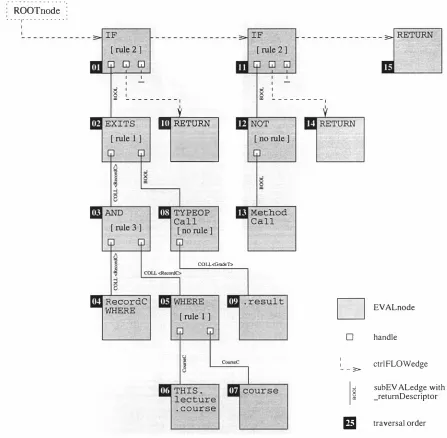
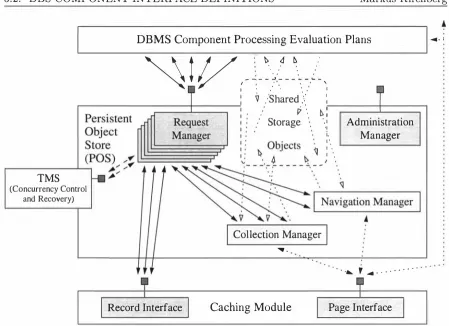
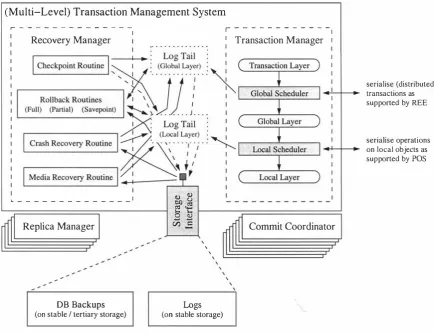
(13) List of Figures 2.1 Relationship Between Data Models and SBQL's Abstract Storage Model ( [131 , F igure 1]) . . . . . . . . . . . . . . . . . . . . . . . . . . . . .. 23. 3. 1 Architecture of the Distributed Object-Oriented Database System. . 3.2 HERM Diagram of the University Database. . . . . . . . . . . . . 3.3 Relationship between User Requests, Data Models and iDBPQL. .. 33 40 51. 4.1 The Type System of iDBPQL. . . . . . . . . . . . . . . . . 4.2 Union Types, Sub-typing and Inheritance ( [53, Figure 1 ] ) .. 71 91. 5 . 1 Sample Evaluation Graph for the verifyEnrolment Method. 5 . 2 Overview of Embedded References Between Instances of Classes of the Uni vers i tycc Schema Fragment as Considered in Example 5.3. 5.3 Architecture of the Persistent Object Store. . . . . . . . . . . . . . 5 . 4 Architecture of the Transaction Management System . . . . . . . . . 5.5 Local Heap with Embedded POS and RCM Shared Memory Areas. 5.6 Logical View of the Environment and Result Stacks. . . . . . . . . . 5.7 Logical View of the Effects of evalMult iES ( ) Evaluation Procedures on ES. . . . . . . . . . . . . . . . . . . . . . . . . . . . . . . . . . . . . 5.8 Overview of the Evaluation Process of the verifyEnrolment Method from Figure 5 . 1 . . . . . . . . . . . . . . . . . . . . . . . . . . . . . . . . 6. 1 Overview of a Stack-Based Abstract Machine with Distribution Capabilities. . . . . . . . . . . . . . . . . . . . . . . . . . 6.2 Overview of a Local Stack-Based Abstract Machine. 6.3 Usage Diagram for the iDBPQL Prototype. 6.4 Evaluation of the Hello World Example. . . . . . . . 6.5 iDBPQL and Internal Representations of the Parentage Database. 6.6 Executing Requests on the Parentage Database. . . . . . . . . . .. 6. 143 149 151 163 170 173 184 186 230 231 234 235 236 237.
(14) List. of Tables. 4 . 1 The Primitive Types of iDBPQL. . . . . . . . . . 4.2 Primitive Types and Their Supported Operations. 5 . 1 Modifier Flags and Their Interpretation. . . . . . 5.2 Internal Object Structure of Instances of Classes Presented in Example 4.12. . . . . . . . . . . . . . . . . . . . . . . . . . . . 5 .3 (Binary) Path-Operators that are Supported by POS. . . . . . . . . . . 5.4 Type Information Mapping to Machine Instructions. . . . . . . . . . . . 5.5 Overview o f Machine Instructions for Binary Expressions without Side Effects. . . . . . . . . . . . . . . . . . . . . . . . . . . . . . . . . . . . . 5.6 Overview of Machine Instructions for Assignment Expressions with Side Effects. . . . . . . . . . . . . . . . . . . . . . . . . . . . . . . . . . . . . 5 . 7 Overview of Additional Boo lean Expressions and their Machine Instructions. . . . . . . . . . . . . . . . . . . . . . . . . . . . . . . . . . . . . .. 7. 62 64 135 140 1 52 181 1 89 1 90 191.
(15) List of Tables. Markus Kirchberg. 8.
(16) Chapter. 1. Int roduction Programming paradigms and, thus, programming languages (PLs) advocating single or multiple paradigms have been at the centre of research for many decades. C++ [ 1 28] is one of the prime examples of the object-oriented (00) programming paradigm. It is often mentioned as the object-oriented programming language (OOPL) that resulted in programmers and organisations adopting this class of PLs. While C++ is referred to as an OOPL, it is designed to support elements of the procedural programming paradigm, the object-based programming paradigm, the object-oriented programming paradigm, and the generic programming paradigm. It is then up to designers and programmers to decide how to build a C++ program using those paradigm elements. In contrast, OOPLs such as Java [46] only support one paradigm, i.e. the object-oriented programming paradigm. It is claimed by many people that object-oriented programming (OOP) is advantageous to other programming paradigms in various ways. OOP is believed to provide more flexibility, simplify development and maintenance, better model real world situations, and is widely popular in large-scale software engineering. The idea behind OOP is that a program is composed of a collection of objects that act on each other. Each object is capable of receiving messages (i.e. methods), processing data and sending messages to other objects. Programming languages traditionally focus on processing. Apparently, data storage and data sharing only play a minor role. Long-term data is 'exported' to a file system or database system (DBS) . DBSs, on the contrary, have been built to support large bodies of application programs that share data. The emergence of OOPLs have brought those two concepts closer together, i .e. data is at the centre of attention. evertheless, in OOPLs, the messages that objects accept are most important while DBSs (in particular object-relational and object-oriented DBSs) largely evolve around object persistence and data sharing. This, of course, results in a number of common (i.e. object-related) concepts being dealt with differently. Such concepts include the degree of encapsulation (OOPLs adhere to it rigidly while DBSs demand a more relaxed approach to support ad-hoc querying) , treatment of transient and persistent data, incorporation of types and classes, inheritance, concurrency, NULL values etc. In today's database (DB) marketplace, relational DBSs (RDBSs) and object relational DBSs (ORDBSs) are dominant. Object-oriented DBSs (ODBSs) were orig inally deemed to replace RDBSs because of their better fit with OOP. However, high switching costs, the inclusion of object-oriented features in RDBSs, and the emergence 9.
(17) 1 . 1 . DATABASE SYSTEMS AND PROGRAMMING LANGUAGES. Markus Kirchberg. of object-relational mappers (ORMs) have made RDBSs successfully defend their dom inance in the DB marketplace. ODBSs are now established as a complement, not a replacement for (object-) relational DBSs. They have found their place as embeddable persistence solutions in devices, on clients, in packaged software, in real-time control sys tems etc. Especially the open source community has created a new wave of enthusiasm that is fuelling the rapid growth of ODBS installations. Christof Wittig ( db4objects, Inc.) summarises the aim of developing ODBSs in [29]: ' Our mission is to give 00. developers a choice) when it comes to persistence: Relational databases do a great job in server-centric environments) where the database is "above )) the application and 0/R mappers take care of the mapping. However) in resource- constrained environments[. . .}) persistence strategies [. . .} have to look different. There )s no value in mapping objects to tables - only cost. '.. Traditionally, database management systems (DBMSs) provide support for query languages (QLs) , most commonly SQU-like languages. It has been common practice for decades to link both domains (i.e. PLs and DBSs) by embedding QLs into PLs. Popular examples include programming interfaces such as ODBC 2 and JDBC3, which are both based on SQL. However, this embedded approach suffers from problems col lectively known as impedance mismatch (refer to Section 1 . 1 . 1 ) . Alternative integrated approaches circumvent these problems. However, the majority of them either represent a PL with added query constructs (e.g. DBPL [10, 11]) or a QL with added programming abstractions (e.g. SQL-99 [36] , Oracle PL/SQL [40] , Microsoft SQL Server Transact SQL [47] ) . Only a few research projects (e.g. LOQIS [129] with its stack-based language SBQL [131] and TIGUKAT [100] ) have attempted a seamless integration of program ming and querying languages. In this thesis, we follow this line of research, in particular we adopt ideas of the stack-based approach (SBA) as proposed in [129, 130, 131] . The SBA approach has been used successfully to integrate querying constructs and program ming abstractions into a uniform database programming language. Unfortunately, there are a number of issues, which are yet to be addressed by the SBA approach. Not only does it neglect transactions, concurrent and distributed processing, but it also rejects any type checking mechanism that originates from type theory. Among other things, we intend to rectify these shortcomings. We will propose an integrated, object-oriented DBPL that combines the advantages of OOP and DBS programming. Before considering the contribution of the research work presented in this thesis in explicit detail, we will elaborate on our motivation and challenges that have to be faced. 1.1. O bj ect- Orient ed D atabase Systems and P rogramming. L anguages. Object-oriented database systems (ODBSs) first appeared in the 1980s, as both pro totype systems and commercial products. Prototype systems developed in the 1980s 1. SQL (i.e. Structured Query Language) is the most popular database language used to create, retrieve and manipulate data from relational database management systems (RDBMSs). 2 ODBC (i.e. Open Database Connectivity) provides a standard software application programming interface (API) method for using RDBMSs. 3 JDBC (i.e. Java Database Connectivity) is an API (similar to ODBC) for the Java programming language. It provides methods for querying and updating data in RDBMSs. 10.
(18) 1 . 1 . DATABASE SYSTEMS AND PROGRAMMING LANGUAGES. Markus Kirchberg. and early 1990s include Avance [18] , ENCORE/ObServer [121] , IRIS [42] , ORlON [62] , and Starburst [84] . Commercial products released in that period include GemStone [24] , 02 [14] , ObjectStore [76] , ONTOS [99] , ORION-2 [63] , and VERSANT [139] . Ini tially, ODBSs have been regarded as the solution to the discovery of the limitations of RDBMSs and the need to manage a large volume of objects with object semantics. However, most of those systems disappeared again within a few years. Among others, Kim [60] investigated the reasons for their disappearance and also outlined research directions to be addressed before being able to build a sophisticated and successful ODBS. Four major concerns that have contributed to the disappearance of most of those early developments are: 1 . ' There is no standard object semantics. ' [60, page 6] . Though various (complete) object-oriented data models have been introduced, the problem, however, was and still is that there is no consensus on a single model. 2 . ' Object-oriented database systems today are 'pot-boilers '. ' [60, page 6] . Meaning that the push for object-oriented concepts and the push for solutions to a long list of deficiencies in conventional DBSs have been translated into object-oriented database systems. However, most of those issues are orthogonal to object-oriented concepts. 3. ' The vendors of early systems offered systems which seriously lack in database fea tures. ' [60, page 8] . Common database features, such as transaction management and query optimisation, have not been incorporated. 4 . ' There is apparently no formal foundation for object-oriented database systems. ' [60, page 8] . A solid theoretical framework only exists in a fragmentary way. Driven by the demand to research and develop better ODBSs and the failure of those early developments, a large number of discussion papers emerged. Main discussion ob jectives included the definition of characteristics of ODBSs and a recommendation of the future path of ODBS research. The three most important discussion papers are the three manifestos. The first manifesto [8] aimed at providing a basis for further discus sions. To do so, main features and characteristics of ODBSs have been proposed. These characteristics are separated in three groups, namely mandatory features, optional fea tures, and open choices. Authors of the first manifesto strongly support the opinion that ODBSs are intended to replace relational technologies. In contrast, authors of the second manifesto [134] strongly oppose this view. Instead, they revive the relational model, but still agree with the need for support of object-oriented concepts. They take the stand that accomplishments gained through the relational model should not be dis carded that easily. Instead an extension of relational technologies is what they desire the database community to focus on. The third manifesto [34] strongly agrees to carry forward accomplishments gained via the relational model. However, they highlight that the relational model is more powerful than its current implementations. Thus, some re thinking and re-development of existing approaches and implementations is demanded. The third manifesto can be seen as a push for object-relational database systems. Considering today's ORDBSs, none of them comes close to the desired character istics as outlined in the third manifesto. RDBMS vendors have realised the shortcom ings of their products with respect to certain advanced applications. This has led to an extension of their systems with features adding support for some object-oriented 11.
(19) 1 . 1 . DATABASE SYSTEMS AND PROGRAMMING LANGUAGES. Markus Kirchberg. concepts. However, current systems do not use a consistent data model and different object-oriented features are supported with little standardisation. In April 1 989, the Object Management Group (OMG) , an international not-for profit corporation, was founded. This group has been formed to establish industry guidelines and detailed object management specifications to provide a common frame work for application development. Being frustrated with the lack of progress towards ODBS standards, ODBS vendors have implemented another consortium, the Object Data(base) Management Group (ODMG) , in 1991 4 . The ODMG group has 'completed' its work on object data management standards in 2001 and was disbanded. In 2000, the final release of the ODMG standard, ODMG 3.0 [28] , was published. The ODMG standard mainly consists of an object model, the object definition language ODL, the object query language OQL and various object language bindings. Even though the ODMG standard was developed by the major vendors of ODBSs, it has not been ac cepted as a standard for ODBSs. Reasons for this include the fact that ODMG's object model does not have the mathematical rigour associated with the relational data model and its relational algebra. Similarly, Java Data Objects (JDO) [55] , another attempt to standardise data access, has not seen adoption by the mainstream. Instead, recent research (e.g. [32] ) suggests to use the PL itself to query objects and thus make a separate 00 query standard redundant. While ORDBSs dominate the present database marketplace, a new wave of enthusi asm is fuelling the rapid growth of second-generation, native ODBSs. However, ODBSs are no longer seen as a replacement of existing RDBSs and ORDBSs. Instead, they are considered as a complement to such (object-) relational systems. In accordance with [98] , applications in which ODBSs tend to provide a better solution than current RDBSs include: - Embedded DBMS Applications. Such applications demand super-fast response times. which translates into the requirement of a self-contained, non-intrusive, and easy-to deploy persistence solution for objects. Storing objects 'just as they are in memory' is always the leanest and least intrusive way to implement a persistence solution. Us ing a relational or object-relational DBMS requires the overhead of object-relational mapping, resulting in an increased demand on resources. - Complex Object Relationships. In such applications, classes define multiple cross references among themselves. Considering (object-) relational DBMSs, relationships among objects are often modelled using foreign keys. Thus, retrieving an object to gether with objects it references and also those objects they reference etc. can result in complicated and difficult-to-maintain code. On the contrary, ODBMSs implement reachability persistence. That means that any object referenced by a persistent ob ject is also persistent. Thus, storing or retrieving objects can be achieved with a single call. The ODBMS engine handles the details of maintaining the references when objects are stored, and satisfying them when objects are retrieved. - 'Deep ' Object Structures. Not all data is easily organised into the tabular form associated with RDBMSs. Some data is best organised in tree or graph structures 4. Note: Neither OMG nor ODMG are recognised standards groups. Their aim is - or was, in the case of ODMG - to develop de facto standards that will eventually be acceptable to recognised standards groups such as ISO/ ANSI. 12.
(20) 1 . 1. DATABASE SYSTEMS AND PROGRAMMING LANGUAGES. Markus Kirchberg. that can be tricky to support in an RDBMS. ODBMSs, however, require no con version of the original structure into a DB model and the structure's integrity is preserved by the DB engine itself. - Changing Object Structures. Most applications evolve as they age. Hence, the data structures they support must evolve as well. An ODBMS will typically weather data structure changes more easily than a RDBMS. - Developments Including Agile Techniques. ODBMSs fit more flawlessly into agile development environments than RDBMSs. - 00. Programs. - Objects Include Collections. A collection within an object often represents a one-. to-many relationship. Such relationships, modelled by an RDBMS, require an in termediate table that serves as the link between the parent object and the objects in the collection. Meanwhile, ODBMSs treat a collection as just another object. - Data is Accessed by Navigation Rather Than Query. Considering RDB MSs, naviga tion through a tree translates into a sequence of SELECT statements. In an ODBMS, navigation through the tree is expressed naturally using the constructs of the native language. The ODBMS.ORG Panel of Experts [98] reason that this new interest in ODBS technologies results from the facts that: 1 . ' Object databases [. . . ] have long been recognised as a solution to one of the biggest dilemmas in modern object-oriented programming { . . ] the object-relational { . . ] impedance mismatch.' and 2. ' Now that OOP languages like Java and . NET are finally becoming mainstream, this problem [i.e. the object-relational impedance mismatch] rests at the heart of information technology. ' .. Current ODBSs include Cache, db4o, FastObjects, Gemstone/S, GOODS, JADE, Jasmine, JYD Object Database, Matisse, ObjectDB, Objectivity /DB, ObjectStore, ozone, TITANIUM, Versant Developer Suite, and VOSS. These systems address many of the shortcomings of early ODBS developments (e.g. support of core object oriented concepts and traditional database features) but they are still not based on sound the oretical foundations. This brings us back to the three manifestos mentioned above. These papers, as well as a large body of corresponding discussion papers, identify desirable characteristics a system should have in order to be referred to as an ODBS. These characteristics can be summarised as follows: - Mandatory object-oriented concepts: Complex objects, object identity, encapsula. tion, types and classes, class and/or type hierarchies, inheritance, and polymor phism (overriding and late binding) ; - Traditional DB features: Persistence, secondary storage management, transaction support, concurrency control, recovery, ad-hoc query facility, and schema evolution; and - Optional features: Multiple inheritance, type checking or type inferencing, distribu t ion, replication, generic update operations, and version management. 13.
(21) 1 . 1 . DATABASE SYSTEMS AND PROGRAMMING LANGUAGES. Markus Kirchberg. Considering these characteristics, they all relate (directly or indirectly) to the lan guage(s) an ODBS makes available to their (high- and I or low-level) users. Bringing our attention back to the early 1980s, the emergence of ODBSs has been. ' { . .} due to the simultaneous coming of age of object-oriented programming and the push for post-relational database technology. The discovery of the limi tations of the relational database systems and the need to manage a large volume of objects with object semantics found in object-oriented programming languages led to the introduction of commercial object-oriented database systems in the mid- to late- 1 980s. ' [60, page 2] . Object-oriented programming languages are mainly based on two concepts, encap sulation and extensibility. Encapsulation leads to the distinction between the state of an object (i.e. its associated data) and the behaviour of an object (i.e. the associated code that operates on the data) . Extensibility corresponds to the ability to re-use and extend an existing system without modifying it. Extensibility is provided in two ways: Behavioural extension (i.e. add-on of new programs) and inheritance (i.e. specialisation of existing objects) . Those object-oriented concepts have evolved over time. They first appeared in programming languages (e.g. Simula-67 [97] and Smalltalk [45] ) , then in ar tificial intelligence, and finally in databases. Focusing on DBSs, research into semantic data models has led to data modelling concepts similar to those embedded in object oriented programming and knowledge representation languages. Examples include the ERM and the HERM [133] . Kim concludes that. [. . } object-oriented concepts are the common thread linking frame-based knowledge representation and reasoning systems, object-oriented programming (application development) environments, and object-oriented advanced human interface systems. Therefore, they may be the key to building one type of intelli gent high-performance programming system of the foreseeable future.' [60, page '. .. 2] . Before considering differences in the interpretation of object-oriented concepts in the DBS community and the OOPL community, we first explain the previously mentioned term impedance mismatch and also address common approaches to link programming languages and database languages in greater detail. 1.1.1. The Impedance Mismatch. The term impedance mismatch refers to an inadequate or excessive ability of one sys tem to accommodate input from another. Considering DBMSs, the object-relational impedance mismatch is often named as one of the central problems of research. It refers to a set of conceptual and technical difficulties which are often encountered when a RDBMS is being used by a program written in an OOPL. Robert Greene (Versant Corp.) highlights in [29] that ' Objects in the language and Relations in the database have always been at odds, as articulated in the classic problem known as "impedance mismatch". ' He continues to identify the two fundamental ways in which this mismatch. materialises, i .e. as developer burden and in slower performance and I or resource con sumption. While standardisation of mapping has brought relief to the former, the latter 14.
(22) 1 . 1 . DATABASE SYSTEMS AND PROGRAMMING LANGUAGES. Markus Kirchberg. still poses a significant burden . Thus, Robert Greene concludes that ' Object databases, which don't suffer from the "impedance mismatch" problem, have proven to be a better solution for certain kinds of applications and have a renewed opportunity to expand , their scope of use. . Let us consider those impedance related issues in more detail (also. refer to [48] ) . Objects and RDBMSs.. -. Managing objects in RDBMSs requires to:. 'Map' the object structure (OOPL) to a table structure (SQL) ; Create the table using SQL; Write SQL code 'inside' OOPL code to create, read, update, and delete objects; Explicitly instantiate objects when reading them from the DB; and Explicitly control the translation between SQL data types and OOPL data types.. While these steps are necessary for simple objects, the list of conversion tasks grows much longer when dealing with complex objects, e.g. involving numerous object refer ences. Since RDBMSs do not support references (apart from simple foreign key rela tionships) , one has to model object references, e.g. by maintaining them in additional tables. Object-relational DBMSs (ORDBMSs) can ease some of the conversion tasks required for RDBMSs. They manage the trans lation between objects and relational tables transparently. However, programmers still have to specify which objects are to be made persistent, and how their contents are mapped to the table. How this is done depends on the particular ORDBMS. Common tasks include: Objects and Object-Relational Databases.. - Derivation of those application classes that are to be stored in the DB from a base persistent class. - Creation of a descriptor file, which includes mappings of classes to tables and in stance variables to columns. - Creation of a deployment descriptor file, which includes a DB driver class, DB aliases, DB authentication information etc. Objects and Pure Object Databases. An ODBMS stores and retrieves objects. The structure of an object is commonly defined by its class. Relationships between objects which would be handled by J O I N operations in RDBMSs- are modelled via references. This results in a number of distinguishing features of ODBMSs: On one hand, the class structure is the schema , i.e. associations and relationships are built into the class archi tecture. On the other hand, there is the treatment of persistence. ODBMSs provide two general persistence techniques, which are explicit persistence (e.g. db4objects [102]) and transparent persistence (e.g. JDO [55] ) . With explicit persistence, DB operations (e.g. storing, retrieving and deleting objects) appear in code. With transparent persistence, on the contrary, objects are moved to and from the DB invisibly.. 15.
(23) 1 . 1 . DATABASE SYSTEMS AND PROGRAMMING LANGUAGES 1 . 1 .2. Markus Kirchberg. On the Integration of Programming and Query Languages. The relationship between query languages and general-purpose programming languages has been studied for decades. As we have already mentioned, the popular classification distinguishes between the embedded approach and the integrated approach. While em bedded approaches suffer from the impedance mismatch, integrated approaches circum vent these problems. The majority of current integrated approaches either represent a programming language with added QL constructs or a query language with added P L abstractions. The former approach provides full computational and pragmatic univer sality, and clean semantics whereas the latter, commercially more popular one, provides user friendliness, macroscopic programming, declaritiveness, and data independence. There are a number of reviews of existing (integrated) database programming lan guages (DBI?Ls) . For instance, [79] contains an elaborate analysis of requirements on the type system underlying object-oriented DBPLs together with a review of existing DBPLs. The review was written as part of the TIGUKAT project [100] , which aimed at developing a novel ODBS. TIGUKAT researchers proposed a novel object model whose identifying characteristics include a purely behavioural semantics and a uniform approach to objects. Research results of interest to this thesis include a type system for object-oriented DBPLs [78] and a draft TIGUKAT user (query) language [81 ] . However, research has been terminated (in 1999, to the best of our knowledge) without address ing problems arising when including data creation and manipulation statements, and programming language constructs into a behavioural database language. Another, from a practitioners point of view, more interesting approach is presented in [131] . The seamless integration of a query language with a programming language is investigated. Thus, a foundation of a QL-centralised programming language according to the traditional paradigms of the programming languages domain is built. Researchers follow an extended approach to stack-based machines as known from classical PLs such as Pascal. This Stack-Based Approach (SEA) includes the SBQL language which is an untyped, query-centralised language. A number of extensions have been proposed more recently, introducing types [77] , object roles [54] and views [74] . While the TIGUKAT project is based upon a powerful type system (resulting in implementation challenges and performance problems as acknowledged in [78, pages 207-208]) , the SBA approach rejects any type checking mechanisms that originate from type theory. Instead, a type system consisting of a metabase, static stacks and type inference rules is proposed. In addition, SBA lacks of any efforts that aim towards efficient evaluation. Concepts such as concurrent processing, transactions and distribution are neglected by both approaches altogether. Considering SBA, on one hand, we can summarise its main contributions: - It demonstrates the potential of combining the advantages of programming ab stractions and database programming to yield a powerful and universal language design. - An abstract machine model originating from the PL-domain has been extended to suit the evaluation of both, QL constructs and PL abstractions. - A stack-based query-centralised language SBQL is proposed. Operational semantics are defined for atomic queries, compound queries, selection, projection, navigation, 16.
(24) 1 . 1 . DATABASE SYSTEMS AND PROGRAMMING LANGUAGES. Markus Kirchberg. path expressions, natural join, quantifiers, bounded variables, transitive closure, ordering, null values and variants, assignments, and for each statements. On the other hand, there are a number of shortcomings that must be addressed be fore incorporating this SBA approach into a full-fledged database management system. These shortcomings include: - It tightly couples SBQL to the persistent object store. A more modular approach. enabling a stack-based language to be used with a variety of object stores is desired. - It does not aim towards efficiency. Operational semantics of SBQL language con. -. -. -. structs are only based on basic algorithms. It is desirable to have a number of dif ferent implementations for each language construct available from which the most suitable (e.g. efficient) one can be selected for execution on grounds such as the objects involved, the configuration of the affected ODBS node(s) , and the current system load (s) . It does not support simultaneous processing. Only a single stack-based machine, which evaluates all SBQL statements in a serial manner, is defined. It is desirable to have a collection of these machines that cooperatively execute requests that are passed down from higher ODBS layers. It does not support the concept of transactions. It is desirable to execute operations in a way that data consistency can be ensured. Thus, transaction support must be taken into consideration. It does not support distribution. It is vital for the success of most systems nowadays to operate in distributed computing environments, in particular for DBSs. For in stance, data should be stored at (or close to) the location it is used most frequently. Thus, it is desirable to have a network of stack-based machines that cooperatively (over many locations if necessary) execute DB operations. It is not suitable for large databases, as the stacks are main memory based. This limits the size of objects and also restricts scalability of the ODBS. It is desirable to support objects of any size. Most importantly, database systems and applications have to be scalable to adapt 'easily' to changes in business structures, business demands, customer demands etc.. In addition to the above, we consider the following decision, adopted more recently in the SBA approach, as unfortunate: - Widely accepted results originating from type theory are dismissed. In [52, page 1 1 J it is stated that ' The notion that a type is a (possibly infinite) set of values and that a variable of that type is constrained to assume values of that type is a misconception and should be rejected' . In our opinion, it is desirable to have a sound type system. from which values and (complex) objects are built. A lack of (strong) typing is likely to result in low reliability and affects the productivity of programmers. The necessity of typing together with discussions of related issues are underlined by a large number of researchers, including [11, 25, 79] . Research results presented in this thesis will address these issues. In addition, a number of more conceptual (and resulting implementational) challenges have to be taken into consideration. These are discussed next. 17.
(25) 1 . 1 . DATABASE SYSTEMS AND PROGRAMMING LANGUAGES. Markus Kirchberg. 1 . 1 . 3 Database Programming Languages vs. Conventional Programming Languages. In order to support the majority of desired features and characteristics a system should have to be referred to as an ODBS (as outlined earlier) , a number of issues have to be considered that are dealt with differently when considering conventional OOPLs and languages for ODBSs. These issues include the degree of encapsulation, treatment of transient and persistent data, the interpretation of the notions of type, class and inheritance, support of NULL values etc. Among others, [8, 19, 31 , 58, 61] contributed to the discussion of these issues affecting the design and implementation of object oriented DBPLs. We will summarise the main issues next. Database systems have mainly been built to support large bodies of application pro grams that share data. Thus, the main focus was on data. On the contrary, traditional programming languages have focused on processing. Data storage and sharing only played a minor role. As mentioned before, the latter has changed with the appearance of OOPLs. However, differences still remain. While OOPLs evolve around the messages an object accepts, DBMSs focus on persistence and data sharing (i.e. exposing both structure and behaviour of objects) . Hence, encapsulation is interpreted differently. Without relaxing the encapsulation property, support for ad-hoc querying, as known from relational DBSs, cannot be carried over into an integrated object-oriented data base programming language. Atkinson et al. [8] suggests that supporting encapsulation is essential but that it may be violated under certain conditions. Another issue to consider is the interpretation of the term class . In fact, we also have to include the notions of type and inheritance in this discussion. Considering OOPLs, there is no common approach. While some languages support types, others support classes or even both with various degrees of closeness (or separation if you prefer) . There is a large body of research papers that discuss these different approaches. We will not consider such OOPL issues in detail but rather refer the interested reader to [25, 26, 30, 91] . Instead, we focus on differences between the ODBS domain and the OOPL domain with respect to these notions. While types and / or classes serve as data structuring primitive in both domains, they also serve as means of access to all objects of a particular type or class in DBMSs. For instance, a user querying a DBMS expects the ability to access all objects of type or class Person. In particular, ad-hoc querying makes frequent use of this type of access. Such types or classes can be regarded as (preferably system-maintained) collections of objects. This is not the case in OOPLs. In fact, such a property is not desired in OOPLs. Not only does this make garbage collection almost impossible5 it also has the potential to violate data abstraction. The latter is true since objects become accessible through the type or class even though they were meant to be hidden from the user (i.e. only accessible through an abstract layer) . In addition, a type or class as collection approach does not make sense for all type or class definitions. Imagine a type or class definition used in numerous application domains. There might be no meaningful relationship between the respective objects. Thus, a collection of these objects is not desired. 5. Garbage collection revolves around references. If there are no more references to an object, it can no longer be accessed. Thus, it is garbage-collected. Having a type or class as collection approach always provides a means of access to objects without using object references. Thus, we cannot collect garbage in the usual sense. · 18.
(26) Markus Kirchberg. 1 .2. CONTRIBUTIONS. Support of inheritance is an essential feature in both communities. However, there is no agreement on which types of inheritance are to be supported. While modern OOPLs commonly support multiple interface inheritance (e.g. Java and C#) , there are numer ous discussions on whether multiple implementation inheritance has its advantages. Most OOPLs (e.g. Java and C#) only support single implementation inheritance. Con sidering ODBSs, in particular, schema design, structural properties of multiple super types or -classes should be inheritable. Thus, multiple inheritance becomes a necessary language feature. However, this introduces a number of (mainly) implementational chal lenges. Multiple implementation inheritance causes several semantic ambiguities. These ambiguities (caused by the same class, say A, being inherited over two different paths) fall into two classes: Replicated inheritance (i.e. two different copies of A's members are inherited) and shared inheritance (i.e. A is shared between at least two classes, one from each path) . The former ambiguity can be resolved more easily (i.e. through renaming) than the latter. Another issue concerns the life-time of objects. Persistence was always at the core of DBSs in contrast to the PL-domain. Programming languages tended to rely on file systems or DBSs to maintain long-term data. This, of course, resulted in a non-uniform treatment of transient and persistent data. It is commonly accepted that persistence should be orthogonal (i.e. each object, independent of its type or class, is allowed to become persistent without explicit translation) [10, 1 1 , 145] . Further issues encompass the inclusion of NULL values and the different focus of concurrency support. The former has only recently found its way into OOPLs, i.e. into the second release of C#. The latter is commonly centred around transactions in DBMSs (i.e. competition for resources) and around multi-threading in PLs (i.e. cooperation) . 1.2. Cont ributions. Research presented in this thesis is closely related to the development of a distributed object-oriented database system [72] . The core of the physical system, that is the eval uation engine, of this ODBS is of particular interest. We will propose the language iDBPQL that is used to program the evaluation engine and the corresponding run-time environment that makes up the evaluation engine and executes iDBPQL programs. In addition, we will briefly describe two prototype implementations accomplished during the process of our research as proof of concept. The fact that presented research results are linked to a bigger research project leads to our first objective. We must achieve a sufficient degree of independence to ensure that results are applicable to ODBSs other than our own. The proposed distributed ODBS makes provisions for this undertaking by following a strictly modular approach. We have enforced this objective in our approach. Among other things, the proposed iDBPQL language is not tied to a particular conceptual data model nor is it tied to a particular persistent object store. However, it cannot be denied that certain design decisions made for the distributed ODBS have also found their way into the physical system composed to effectively and efficiently drive this database system. The first major contribution of this thesis is the proposal of the integrated database programming and querying language iDBPQL. Driven by the desire to address concep tual and implementational challenges faced when integrating object-oriented program19.
(27) Markus. 1 .2. CONTRIBUTIONS. Kirchberg. ming principles and database environments, we have designed a language that includes the following properties: - It distinguishes between values and objects; - It supports types (with user-defined type operations) that structure values and classes (exposing both data and behaviour) grouping objects; - It contains pre-defined collection types such as BAG, SET, L IST as well as the possibility to add user-defined (collection) types; - It introduces the ability to add the NULL value to any other existing type; - It supports structural sub-typing; - It provides a means of name-based access to all objects of (system-maintained) class-collections; - It supports (name-based) multiple inheritance; - It allows for the definition of (static) domain and entity constraints; - It adds a UNI ON-type that supports the unification of identical or similar objects; - It supports database schemata as collections of class and type definitions with their corresponding objects and values; - It allows any language entity to persist; - It provides a mechanism to model blocks of atomic statements and (local and distributed) transactions; - It enables the implementation of all types of behaviour through single concepts, evaluation plans; - It contains the usual assignment and control flow statements together with state ments supporting collections; - It supports common query expressions such as selection, projection, navigation, ordering and various joins; - It includes additional expressions such as two types of renaming expressions, quan tifier expressions etc . ; and - It provides a means of specifying simultaneous processing explicitly. The second major contribution addresses (operational) semantics and the implemen tation of the iDBPQL language. We propose its internal representation, a corresponding run-time environment and interfaces of related ODBS components such as the persistent object store, the transaction management system and remote communication facilities. The run-time environment, together with iDBPQL metadata catalogues and ODBS system interfaces, is then used to specify the evaluation of iDBPQL expressions, state ments, blocks, evaluation plans, and entire user requests. This specification is done in terms of operational semantics. While outlining operational semantics of the iDBPQL language, implementational challenges that stem from the integration of OOPLs and DBPLs are addressed. Our final contribution corresponds to proof of concept implementations. The fea sibility and practicality of the presented approach is demonstrated in terms of two prototype implementations. An initial prototype that extends the SBA approach with capabilities to process many transactions concurrently and function in a (virtual) par allel computing environment is introduced. The second, more sophisticated prototype implements the proposed run-time environment and processes iDBPQL evaluation plans in a single-node or distributed database environment. 20.
(28) Markus Kirchberg. 1 .3. ASSUMPTIONS. 1 .3. Assumpt ions. Throughout the 1980s and early 1990s, object bases have been advocated as the su perior database technology that will supersede relational database technologies. While various object base implementations emerged during that time, these systems did not 'live up to their expectations' . Among others, this failure can be explained by developers grounding their implementations on ideas that originated from relational technologies. Apparently, the latter is not a suitable technology for the processing of large sets of highly structured complex objects. In this thesis, we break with that school of thought in order to avoid the repetition of the mistakes made in the 1 980s and 1990s. Instead, we have been looking for alternative (including previously neglected) ways to approach the integration of object-oriented programming and database technologies. In particu lar, research advances in the areas of programming languages, database programming languages and compiler construction have been beneficial to this research. The proposal of a new and novel approach for the development of a complete dis tributed object-oriented database system is a research problem large enough for a dozen or more PhD theses. In order to achieve our particular research objectives, we have made a number of assumptions. These include: - User requests arrive in a form that is suitable for processing by the underlying object base engine. That is, concepts such as user interaction, code compilation, fragmentation and allocation, code optimisation, code rewriting, execution plan generation etc. are beyond the scope of this thesis. Instead, we adopt a black box approach and assume that user requests are 'magically' transformed into a suitable form for request evaluation . - Restricting our considerations t o the level of request evaluation implies that typical high-level programming language concepts such as packages or modules, interfaces, type and class definitions, classes (as code structuring primitives) etc. are left aside. Those concepts, however, have to be considered when defining suitable high-level language interfaces. In order to assist with the readability and understanding of the language part of this thesis, various syntactically rich language constructs have been introduced in the proposed language. While it is not common to have a syntactically rich, intermediate-level language, the final version of the proposed integrated language will be less rich. But this does not mean that our efforts are wasted. Instead, most of those richer concepts will find their way into a corresponding high-level language once the envisioned ODBS environment has been finalised. - The run-time environment that processes evaluation plans replies on the support by other database components such as a persistent object store, a multi-level transac tion management system, caching mechanisms, and remote communication mecha nisms. While we describe the general functionality and service interfaces of corre sponding DBS components, it has to be acknowledged that there are still a number of open research problems, which need to be addressed before those components reach the necessary degree of maturity. Assumptions are discussed in greater detail in the respective chapters. An overview of open research problems can be found at the end of this thesis. 21.
(29) 1 .4. OUTLINE. 1 .4. Markus Kirchberg. Outline. The remainder of this thesis is organised in six chapters. Chapter 2 provides an overview of selected (database) programming and evaluation environments, and related research contributions that had a significant impact on the ODBS and DBPL research commu nities. Subsequently, in Chapter 3, we present our approach to develop a distributed ODBS that is based on a sound theoretical framework . The main focus is on how an in tegrated object-oriented DBPL fits into the envisioned ODBS. To assist this objective, an overview of how user requests are processed is presented. Chapter 4 proposes the intermediate-level, integrated database programming and querying language iDBPQL. The main focus is on the language's design and characteristics. In a nutshell, iDBPQL consists of metadata catalogues (holding transient and persistent entity definitions) , evaluation plans that represent behaviour implementations (such as the user request, a type operation implementation or a method implementation) , and the iDBPQL library (containing pre-defined language entities and their implementations) . The internal rep resentation of metadata catalogues and evaluation plans is presented in Chapter 5 . In addition, service interfaces of ODBS components are outlined. These components are used subsequently when the operational syntax of iDBPQL's language constructs is presented. In Chapter 6, we discuss two prototype implementations that have been created to verify the feasibility of the chosen approach and that serve as proof of con cept. Finally, Chapter 7 summarises this thesis and also provides an outlook for future research.. 22.
(30) Chapter. 2. A Review of Database Programming Languages and Related Concepts As previously mentioned, the Stack Based Approach has been used successfully to seamlessly integrate querying constructs and programming abstractions into a uniform database programming language. F irst, we introduce this approach in greater detail. Subsequently, we will address other integrated languages and object-oriented ( database ) environments that have made significant contributions to the respective research areas. 2.1. The Stack-Based Approach. Subieta et al. [131] investigates the 'seamless' integration of a query language with a programming language. Thus, a foundation of a QL-centralised programming language according to the traditional paradigms of the programming language domain is built. An extended approach to two-stack abstract machines - known from classical programming languages such as Pascal - is presented. This proposal includes definitions of an abstract storage model, an abstract machine model, and semantics of query and programming language operators that are defined through operations on these stacks. F igure 2 . 1 shows the relationship between data models and the abstract storage model.. [. Data Model. j. SBQL's Abstract Storage Model. Fig. 2 . 1 .. J. : :. I 1 1. Query in the Data Model. :. .. Query Adressmg the Abstract Storage Model. L - - - - - - - - - - - -. �. r-L__. : Interpretation of rile Result : in the Data Model. :. Machine Program. I 1. I 1. I. Relationship Between Data Models and SBQL's Abstract Storage Model ([131, Figure 1]) .. 23.
(31) 2 . 1 . THE STACK-BASED APPROACH. Markus ·Kirchberg. In the abstract storage model, objects are defined as triples < id, name, v alue > , where i d i s a n internal object identifier, name represents its external identifier, . ancl' v alue is either an atomic value, an identifier of another object or a �et of ·objects. ·A database instance is viewed as a set of objects that satisfy the referential integrity . constraint. The abstract machine model introduces two stacks. These are the environment stack ES and the query result stack QRES. The environment stack deteri:nimis scoping and binding 1 . ES never stores objects directly, instead it only holds (collections of) references to objects. The query result stack is a storage for i ntermediate results, used either for the evaluation of query operators or for the evaluation of arithmetic-style expressions. Results are represented as tables, which are bags of atomic values and internal object identifiers. Semantics of operations are part of the proposed language SBQL (Stack-Based Query Language) . It is an untyped, query-centralised programming language in the 4GL style. Evaluation of SBQL operations is performed by a single machine. The state of this machine is defined by the current database instance, ES and QRES. Seman tics of SBQL operations are defined using top-down recursion in accordance with the respective query tree. In particular, semantics are defined for the following operations: Atomic queries, compound queries (using both algebraic and non-algebraic operators), selection, projection, navigation, path expressions, natural join, quantifiers, bounded variables, transitive closure, ordering, null values, variants, assignments, and f or each statements. In addition, remarks are provided on how to deal with procedures, classes, class inheritance, methods, and encapsulation. As an example, let us consider oper ational SBQL semantics for the navigational join [131 , pages 33 and 34] in greater detail. E XAMPLE 2 . 1 . SBQL supports only a single join operator, which is the navigational join. Its operational semantics are defined as follows: 01 procedure evaL ( query : string ) ; 11 the ma�n eval procedure 02 begin 03 if query is recognised as q1 t><l Q2 then 04 begin 05 11 commence evaLua t i on of a navigat ionaL join 06 var RESUL T : Table ; 11 define resu L t variab L e as a tab L e 07 11 ini t i a L is e resu L t v ariab L e RESULT : = 0 ; eva L ( q1 ) ; 08 I I eva Lua t e Ql expression 09 f or each r E t op ( QRES ) do I I for each row of the resu L t of Ql do 10 begin 11 push ( ES , nes t ed ( r ) ) ; I I open a new scop e on ES 12 eva L ( q2 ) ; I I eva Luate q2 express ion RESULT : = RESULT U ( r. 181 t op ( QRES ) ) ; 13 I I join and add t o resu L t 14 p op ( QRES ) ; I I c anc e L the resu L t of Q2 res t ore the previ ous s t a t e of ES pop ( ES ) ; 15 II 16 end ; 1. Binding refers to the association between two things, such as the association of values with identifiers. Binding is closely related to scoping. In fact, scopes decide when binding occurs. In most modern PLs, the scope of a binding is determined at compile-time ( i.e. static scoping) . Alternatively, binding may be dependent on the flow of execution ( i.e. dynamic scoping) . 24.
(32) 2.2. OVERVIEW OF DB P ROGRAMMING ENVIRONMENTS 17 18 19 20 21. pop C QRES ) ; push ( QRES , RESULT ) ; end ; else . . . end ( * eva L * ) ;. r.. Markus Kirchberg. 11 cance L the resu L t of ql 11 compose resu L t. denotes a single-row table from the row bags.. r.. 0. denotes the horizontal composition of D. The SBA approach has been implemented in the LOQIS system [1 29] . More recently, this SBA approach has been refined (refer [130] ) . In contrast to the earlier approach, it now supports a hierarchy of object store models ranging from a simple version (called MO) , which covers (nested-) relational and XML-oriented DBSs to higher-level object store models covering classes and static inheritance (in the model known as M 1 ) , object roles and dynamic inheritance (in the model known as M2) , and encapsulation (in the model known as M3) . In addition, a number of extensions have been proposed introducing types [52, 77] , object roles [54] and views [74] . However, the shortcomings outlined in Section 1 . 1.2 still apply. 2.2. Overview of E xisting D atabase Programming. E nvironments. While the SBA approach is of particular interest to our research, there are numerous research findings that have influenced the iDBPQL proposal. In this section, we intend to provide a brief overview of research results that are important to the DBPL research community and, in particular, to our research. In general, there are two approaches to develop ODBSs. On one hand, a type system from an existing OOPL can be adopted and then extended to include concepts vital for DBSs. On the other hand, research may start by proposing a new, purpose-built object model. For instance, the former approach has been adopted by the DBPL project (which is based on Modula-2) , ObjectStore (which is based on C++) and Gemstone (which is based upon Smalltalk) . The latter approach has been more popular among research prototypes such as 02, SBA, TIGUKAT, and iDBPQL. Persistence is a property not commonly supported by main stream programming languages. Thus, a large body of research has been devoted to address this shortcoming. Next, we will introduce selected DB programming environments and important re search contributions in more detail. 2.2.1. The Database Programming Language DBPL. The Database programming language DBPL [115] integrates programming abstrac tions and querying constructs by extending the Modula-2 [144] system programming language. Main extensions include the addition of bulk data management (through a bulk type constructor for ' keyed sets' or relations) , access expressions (for access ing relational variables) , persistent modules (by extending Modula-2's modularisation mechanism with a special DATABASE MODULE construct) , and transactions (as special procedures) . 25.
(33) 2 .2. OVERVIEW OF DB PRO G RAMMING ENVIRONMENTS. Markus Kirchberg. While DBPL is not an object-oriented language, it still had a major impact on the development of object-oriented database languages. It demonstrated the feasibility and practicality of a database programming language t hat has been designed to ad vocate simplicity and orthogonality. In addition, DBPL supported an implementation ( procedure) type, but without incorporating a notion of methods. 2.2.2. The 02 Object Database System. The 02 object database system [14] has been developed in the late 1980's and 1990's. Starting from various (research) prototype systems, 02 became one of the most suc cessful commercial object base systems by the end of the 1 990's. The main objective underlying the development of 02 was to build an environment for data intensive ap plications that integrates the functionality of a DBMS, a programming language, and a programming environment . 02 distinguishes between values and objects. Each value has a type, which describes its structure. Pre-defined primitives are associated with types that may be invoked upon corresponding values. Besides atomic values, sets, lists and records are supported. Ob j ects belong to classes, have an identity and encapsulate values and user-defined meth ods. A class has a name, a type and a set of methods. Classes and types are partially ordered according to an inheritance relation. Multiple inheritance is supported. Persis tence is user-controlled. An 02 schema consists of classes, types, named objects and named values. A query language that uses the distinction between objects and values and the existence of primitives to manipulate structured values has been designed. The 02 object base contains the 02 object manager [138] that is concerned with complex object access and manipulation, transaction management, persistence, disk management, and distribution in the adopted server j workstation environment. The object manager is divided into four layers: - A layer that supports the manipulation of objects and values as well as transaction control; - A memory management layer; - A communication layer executing object transfers, execution migration, and application downloading; and - A storage layer, on the server, provides persistence, disk management and transac tion support. Applications correspond to system processes. For every application there is one process on the workstation and one (mirror) process on the server. The lock table, the buffer and the object manager's memory are shared among all processes. 2 . 2.3. The Object Base Management System TIGUKAT. The TIG UKA T project [100] has been another attempt at developing a novel ODBMS that integrates object-oriented concepts with database systems. Characteristics of this approach include a purely behavioural object model (i.e. user interactions only happen t hrough behaviour invocations) , a uniform object model (i.e. everything is a first-class object; there is no separation between objects and val ues) , and the vision that this 26.
(34) 2.2. OVERVIEW OF DB PROGRAMMING ENVIRONMENTS. Markus Kirchberg. uniformity property is extended to other system entities such as queries, transactions etc. Research started by investigating requirements of OOPLs, DBPLs and ODBSs. The selection of requirements was mainly theory-driven. As a result, numerous desired properties that are not commonly found in practical systems even within the respective domain have been added. For instance, support of multi-methods and parametric poly morphism together with inclusion polymorphism is uncommon even in today's OOPLs due to their complexity and associated implementation challenges. Leontiev et al. [79] outlines all identified requirements in more detail and also proposes ten tests that may be used to verify whether or not an object-oriented type system satisfies some or all of the desired properties. Leontiev [78, page 206] already acknowledges the complexity and difficulty of meeting the outlined set of requirements: '[. . . ] the desired combination. of features remains elusive in that no type system, theoretical or practical, exists in a programming language or proposed, has all the features necessary for the consistent and uniform treatment of object-oriented database programming. ' . In the same article [78] ,. a corresponding type system is proposed that passes all ten tests. While theoretical correctness was proven, practical verification or prototyping remained unaccomplished. Among other things, the complexity of verification algorithms is assumed to be expo nential. The TIGUKAT research project was terminated (in 1 999, to the best of our knowl edge) without addressing problems that arise when data creation and manipulation statements, PL constructs, transactions and distribution are included into the pro posed behavioural DBS language. Nevertheless, this research project not only provides an extensive review of existing database and system programming languages, but it also influenced our research. In particular, the shape of parts of TIGUKAT's type sys tem hierarchy and the adopted approach to class-based object access has affected the respective concept in the proposed language iDBPQL. 2.2.4. The Parallel Database Programming Language FAD. The Franco-Armenian Data Model (FAD) has been designed for highly parallel da tabase systems. Besides query operations, the optimisation of programming language constructs, in terms of utilising parallelism, is considered to enhance system perfor mance. The language FAD is presented in [13] . FAD provides a rich set of built-in structural data types and operations. It operates on sets and tuples, which can be nested within each other to an unlimited degree. FAD operators mainly utilise pipelin ing and set-oriented parallelism. For instance, a f i lter operator is proposed targeting sets. In addition, a pump operator, which supports parallelism by a divide and conquer strategy, targets aggregate functions. Both operators have i nfluenced how iDBPQL supports simultaneous processing. FAD was later extended [51 ] with communication primitives, in particular with asynchronous message passing mechanisms. The resulting language is called PFA D , which i s restricted t o a shared-nothing, distributed model of execution.. 27.
(35) 2.2.. OVERVIEW OF DB PROGRAMMING ENVIRONMENTS. Markus Kirchberg. 2.2.5. Additional Relevant Research Results on Database Programming Languages. The Object Database and Environment (ODE) [2] is based on the C++ [128] object paradigm. C++ classes are used for both database and general purpose manipulation. ODE provides its own database programming language 0++ [1] , which allows the definition, querying and manipulation of ODE databases. Persistence is modelled on the 'heap'. In particular, memory is partitioned into volatile and persistent. Volatile objects are allocated in main memory (on the heap) . Persistent objects are allocated in the persistent store. An ODE database is a collection of persistent objects. Each object is identified by a unique object identifier, which is realised as (persistent) pointer to a persistent object. PS-Algol [9] is an experimental language, which demonstrates that persistence can be achieved regardless of type. It is considered to be the first programming language that supports this orthogonal persistence property. The support of orthogonal persistence is strongly advocated, especially for DBPLs. Among others, [10, 1 1] underline this importance. Three principles of persistence are outlined ' that should govern language design: - Persistence should be a property of arbitrary values and not limited to certain types. - All values should have the same rights to persistence. - While a value persists, so should its description (type). ' [ 1 1 , page 109]. In addition, [11] also advocates the support of type completeness (i.e. all data types should be of equal status) and adequate expressive power (i.e. computational power, database manipulation and database access) . This need for orthogonal persistence is reinforced in [10] . Technologies required to support orthogonal persistence are presented. These include a stable and reliable per sistent object store, implementing persistence by reachability and type-safe linguistic reflection as defined in [126] . Napier88 [93] is a persistent programming system that supports orthogonal per. sistence and type completeness. In contrast to its predecessor, PS-algol, the Napier88 system consists of its own, special-purpose built N apier88 language and a persistent environment. As such, it uses objects within the persistent store. In Napier88, the philosophy that types are sets of values from the value space is adopted. This is in accordance with research results obtained in type theory (e.g. refer to [27] ) . Concurrency is provided by threads and semaphores for co-operative and competi tive concurrency, and designer transactions. The Napier88 system is designed as a layered architecture consisting of a compiler, the Persistent Abstract Machine (PAM) and persistent storage architecture. Multiple incarnations of persistent stores and activations of the PAM are supported. However, only one PAM incarnation may work on one persistent store at any one time.. 28.
Figure
![Fig. 2 . 1 . I Relationship Between Data Models and SBQL's Abstract Storage Model ([131, Figure 1])](https://thumb-us.123doks.com/thumbv2/123dok_us/8461723.338415/30.552.125.410.574.699/relationship-data-models-sbql-abstract-storage-model-figure.webp)
+7
Related documents
To what extent these findings can be applied to those declin- ing participation in PA programmes outside a trial setting is not certain; while it seems logical that some of the
Although the information on cold-set gelation is limited as compared to that on heat-induced gelation, the results have showed that cold-set gels are different
In this paper we trace the early history of relativistic su- pertasks, as well as the subsequent discussions of Malament-Hogarth spacetimes as physically-reasonable models
The structure and magnitude of the oceanic heat fluxes throughout the N-ICE2015 campaign are sketched and quantified in Figure 4, summarizing our main findings: storms
Nitri fi cation and sedimentary denitri fi cation occurred near the river mouth, nitri fi cation prevailed further offshore under the plume, and fi nally, phytoplankton
2 Equity Market Contagion during the Global Financial Crisis: Evidence from the World’s Eight Largest Economies 10..
In 2008, the first pilot experiments were conducted in seven organic winter oilseed rape fields (total area: 4.2 ha) in North-western Switzerland.. One half of each field was
In alle drie de jaren was er een reactie van het gewas wat betreft opbrengst (venkel in 2008, prei in 2010) of productkwaliteit (andijvie in 2009) op de voor het gewas
