Supertasks and Spacetime
Their Role and Relevance
DAVIDO’CONNELL Supervised by Benedikt Löwe
December 1, 2018
Abstract
In recent years, discussions of supertasks involved a particular class of physical models known asMalament-Hogarthspacetimes. One might wonder – what is the role of physical models in the philosophi-cal discussion of supertasks? Why Malament-Hogarth spacetimes in particular? In this paper we trace the early history of relativistic su-pertasks, as well as the subsequent discussions of Malament-Hogarth spacetimes as physically-reasonable models of supertasks.
Contents
Supertasks 2
Conceptual Origins 3
Pitowsky Spacetimes . . . 4 Malament-Hogarth Spacetimes . . . 6
Further Analysis of Malament-Hogarth Spacetimes 8
Causal Structure . . . 9 Energetic Structure . . . 11 Supertasks as Physically Possible . . . 12
Relativistic Computation 14
In the first section, we will briefly introduce the concept of supertasks, with special emphasis on Thomson’s lamp and Weyl’s computer. After this, we will start to trace the conceptual origins of relativistic supertasks, namely Pitowsky spacetimes and the now-famous Malament-Hogarth spacetimes. Once we have introduced these, we will outline some interesting subse-quents works. These can be divided into two categories – further analysis of Malament-Hogarth spacetimes, and applications of relativistic supertasks to the theory of computation. Finally, we will summarise the literature introduced throughout the paper within a philosophical framework.
Supertasks
The idea of performing infinitely-many operations in a finite time has been a topic of philosophical interest since at least the Pre-socratic philsopher Zeno of Elea, who introduced a series of paradoxes, including the famous Achilles paradox. The termsupertask, however, was introduced much later when practical adaptations of Zeno’s idea were considered by Thomson in 1954 [1]. His example, known asThomson’s Lampcan be paraphrased as follows:
Suppose we have a lamp connected to a computer such that the lamp is switched off at timet= 0. The system is configured in such a way that the lamp toggles it’s state at an ever-increasing rate, i.e. att= 12 it switches on, att = 34 it switches off, att = 78, back on, and so on. The figure below depicts the state changes of the lamp.
0 Off
1 2
On
3 4
Off
7 8
On
· · · · · ·
[image:2.595.152.444.487.533.2]1 ?
Figure 1: State changes of Thomson’s Lamp
Thomson’s Lamp is configured similarly to Zeno’s paradox of Achilles and the Tortoise, and as such we can perform similar reasoning to obtain a paradox – after one second, an infinite number of states changes have occurred in a finite time, however it seems that we have no grounds to say whether the lamp is on or off att=1.
should be noted that there exist configurations in which the lamp is guar-anteed to be at a certain state by timet =1. Earman and Norton provide an example using a steel bouncing ball that leaves the lamp on after one second [3]. Interestingly, there also exist well-formed supertasks that retain the paradox in some form, e.g. [4].
In this paper we will also consider the special class of supertasks that involve computational processes rather than a lamp. This type of supertask has its conceptual origin with Weyl, who in hisPhilosophy of Mathematics and Natural Science, wrote the following:
“if the segment of length 1 really consists of infinitely many sub-segments of length 12,14,18, ..., as of “chopped-off" wholes, then it is incompatible with the character of the infinite as the “incom-pletable" that Achilles should have been able to traverse them all. If one admits this possibility, then there is no reason why a machine should not be capable of completing an infinite se-quence of distinct acts of decision within a finite amount of time; say, by supplying the first result after12 minute, the second after another14 minute, the third 18 minute later than the second, etc. In this way it would be possible, provided the receptive power of the brain would function similarly, to achieve a traversal of all natural numbers and thereby a sure yes-or-no decision regarding any existential question about natural numbers!" ([5], pg 42)
Weyl used this thought experiment in a broader discussion of the nature of the continuum, and had no practical applications in mind. Nevertheless, his idea generated a large amount of interest and laid the conceptual foundation for the field of relativistic computation.
Conceptual Origins
We briefly mentioned Paul Benacerraf in the previous section. His 1962 paper“Supertasks and Modern Eleatics"is a significant contribution to the philosophical discussion of supertasks. Despite criticising Thomson’s Lamp, Benacerraf held that supertasks were logically possible, but notphysically
possible, i.e. supertasks are not consistent with the laws of nature1. In the introduction to his 1983 book“Philosophy of Mathematics", he (and Putnam) write:
“... procedures that require us to perform infinitely many op-erations in a finite time are conceivable, though not physically
possible (owing mainly to the existence of a limit to the velocity with which physical operations can be performed)..." ([6], pg. 20)
This is an interesting argument: the speed of light provides a finite limit to the rate at which the mechanism of any supertask can operate.
In fact, given a few assumptions, this limit can be calculated. Suppose we have a Thomson’s lamp configuration, and for simplicity, the total length of wire of the system is equal to 1 metre. We will be generous and assume that the internal computation time of the toggling-program is instant.
From this, we can calculate2the minimum speed at which the informa-tion signal will need to be sent to the lamp in order to toggle before the next iteration. For the first iteration, this speed iss1 = 0.51 =2m/s. In general, for
thenthiteration, we will havesn=2n. At the 29thiteration, the information
signal will need to travel along the wire at a speed of 229 ≈5×10⁸, which is faster than the speed of light. As such, after 28 iterations the lamp will not be able to perform its function.
It seems as though the argument is settled – supertasks, although logi-cally possible, are not physilogi-cally possible. However, as we will see, this is not necessarily the case.
Pitowsky Spacetimes
In 1990, Itamar Pitowsky wrote “The Physical Church-Turing Thesis and Phys-ical Complexity" [7]. In this paper, Pitowsky considers a type of supertask machine which he calls a “Platonic computer". These are conceptually equiv-alent to the type of computer mentioned by Weyl3. As the title would sug-gest, Pitowsky’s paper focuses mainly on physical computation. However, early in the paper he also makes an explicit rebuttal of Benacerraf/Putnam’s argument. He writes:
“Conventional wisdom has it that Platonist computers are phys-ically impossible,"owing mainly to the existence of a limit to the velocity with which physical operations can be performed."Yet the same theory which maintains that the upper limit on the speed of information transmission is the velocity of light, also maintains that time is relative to the observer" ([7], pg. 82).
The crucial insight of Pitowsky is that the supertask machine and the observer need not be in the same place. He then argues that it possible to ex-ploit relativistic concepts (i.e. that time is relative to the observer) in order to
2Using the equations= d
t, which in our case is simplys=1t
avoid Benacerraf/Putnam’s argument. The idea is simple enough–provide a spacetime in which the proper time of the machine is infinite, whereas the proper time of the observer isfinite. If this is done in such a way that the speed of light is not exceeded when sending signals to the observer, then it would serve as a counterexample.
This is exactly what Pitowsky (in correspondence with Malament) man-aged to do. Let’s consider his example:
Suppose we have the 4-dimensional Minkowski spacetime in which there is an observer (whose proper time we will denote byt) orbiting Earth (whose proper time we will denote byτ) in a satellite whose velocity is given
byv(τ) = c
√
1−e−2τ. We would like to obtain an expression fort. This
is done by rearranging the expression forv(t), and using the formula for time dilation,4which yields the expressiondt=e−τdτ. To obtain the time
relative to the satellite (i.e. the proper time of the observer of the supertask machine), we integratedtwith respect to the interval on which the curve is defined. In particular, if we take an open-ended curveλ: [0,∞)→ R4,
we obtain the integralR0∞e−τdτ=1, and can thus conclude that it takes the observer one second for an infinite amount of time to pass on Earth.
Examples such as the above have since been referred to as Pitowsky spacetimes, which can be defined as follows.
Definition 1 A spacetime (M,g) is called a Pitowsky spacetime just in case there are a pair of curves γ0,γ1 such that Rγ0dτ = ∞ and Rγ1dτ < ∞ and
γ0⊂ I−(γ1).
Note that in the above definition we denote byI−(p)the causal history of the pointp, that is, an elementqis inI−(p)if there exists a future-directed timelike curve fromqto p, or equivalently, if pis reachable fromqat strictly subluminal speed.
So how can we model a supertask in a Pitowsky spacetime? Fortunately, Pitowsky provided an example of this, which we will now paraphrase.
Suppose we have a mathematicianBtraversing the curveγ1as in Def
1, and some immortal computerCtraversing the curveγ0. The computer
is programmed to check Goldbach’s conjecture5for every triple of natural
numbers(a,b,c). If Goldbach’s conjecture is false, a counterexample will be
4That is,
λ= ddtτ andλ =
q
1−vc22, where we break convention and denote byλthe
Lorentz factor.
found, andCcan send a signal toBtelling them that the conjecture is false. If the conjecture is true, then no signal will ever be sent, and after 1 second ofB’s time, they will know the theorem is true. It should be noted at this point that the velocity ofBwill be so great at timet=1 that the satellite will probably be disintegrated, killingB. However, this is a small price to pay.
Pitowsky thought that his model adequately avoids Benacerraf/Putnam’s claim. He writes:
"...as far as computation time is concerned, the existence of Platonist computers is compatible with general relativity(though it is probably incompatible with the conditions in the actual universe)." [7, Pg. 84]
There are two interesting components to this quote. First, Pitowsky is claiming that supertasks are in some sensephysically possible, that is, there exists a model of a supertask that is consistent with relativity theory. Second, that they are probably not realisable in the actual world. These are distinct claims, and clearly the second is stronger than physical possibility. We will refer to this second component asphysical reasonableness. This will be important in the next section.
It should be noted that although Pitowsky spacetimes are appealing, there are some fundamental flaws in the idea. The first is that the spacetimes have to possess some physically-dubious properties (but more on this later). The second flaw involves the epistemic limitations of our mathematicianB. Suppose for arguments sake that Goldbach’s conjecture is true. If this is the case,Bwill never receive the signal telling them that there is a counterexam-ple. However, at every pointt<1 on the curveγ1, there is no way forBto
distinguish between a lack of signal because Goldbach’s conjecture is true, or a lack of signal because Goldbach’s conjecture has a counterexample and the signal is yet to arrive. Put differently, the only time thatBwill ever know the truth-value of Goldbach’s conjecture will be att=1, when any potential signal will have definitely been received. However as previously noted, at
t= 1 the satellite carryingBwill be ever-converging to the speed of light, and will almost certainly be destroyed. But ifBdies att = 1, this means that at no point do they know the outcome of the supertask procedure.
Malament-Hogarth Spacetimes
idea is still promising, and as such Pitowsky’s class of spacetimes catalysed further development.
The next step in the development comes from David Malament6and Mark Hogarth [9], who independently introduced a class of spacetimes that have since been referred to asMalament-Hogarth spacetimes. They are defined as follows.
Definition 2 A spacetime (M,g) is a Malament-Hogarth spacetime (or, MH spacetime) just in case there is a timelike half-curveγ0and a point p ∈ M such
thatR
γ0dτ=∞andγ0⊂ I −(p).
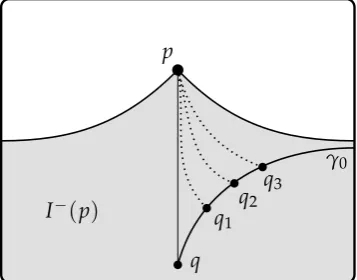
The geometric intuition for MH spacetimes is perhaps best represented in the case of the anti-De Sitter spacetime, which is pictured below.
p
γ0
I−(p)
q q1
q2
[image:7.595.208.387.321.461.2]q3
Figure 2: The Anti-De Sitter spacetime
The main difference between MH and Pitowsky spacetimes is the inclu-sion of the pointp, which we will call the MH point. By making reference to this point, MH spacetimes avoid the issue outlined previously. Indeed, ifq∈ I−(p), then by definition ofI−(p)there is a future-directed timelike curveγ1fromqto psuch thatRγ1(q,p)dτ<∞. Since the curveγ0is entirely
contained withinI−(p), that is, every pointqonγ0lies in the causal history
ofp, it follows that at any point onqonγ0we can create a future-directed
curve fromqtopoffinitelength. This means that if there were ever a definite counterexample to the supertask, a signal could be sent in finite time top, and thus our mathematicianBwould definitely know the outcome to the task by then. It is also not necessary thatBwill die atp, since we are now exploiting curvature of spacetime rather than speedingBup.
An important question to be asked is whether or not MH spacetimes actually exist. Fortunately, Hogarth [9] provides three concrete examples. These are:
1. 2D Minkowski spacetime “rolled up", see [9, Fig. 2],
2. Anti-De Sitter spacetime, as pictured in Figure 2 above, and
3. Reissner-Nordstrom spacetime, which models a charged, spherically-symmetric body of mass.
As well as this, another famous example of an MH spacetime is the Kerr-Newman spacetime, which models the region surrounding a charged, ro-tating mass (in the special case that the rotation is equal to zero, we obtain the Reissner-Nordstrom spacetime). This will be a particularly important example in the section on relativistic computation.
Further Analysis of Malament-Hogarth Spacetimes
We saw in the previous section that Malament-Hogarth spacetimes circum-vent the problem of Pitowsky spacetimes through the inclusion of a point
p at which the observer will definitely be able to access the information produced by the computer. However, it would be premature to conclude that MH spacetimes are physically possible (or, for that matter, physically reasonable), and as such a further analysis needs to be undertaken. In this section we will start by introducing (part of) the discussion of the physical reasonableness of MH spacetimes, before moving back to physical possibil-ity.
a solution to the Einstein field equations (EFE’s)7.
Although every physically-reasonable spacetime is a solution to the Einstein field equations, it is not the case that every solution is physically-reasonable. As such, extra conditions need to be imposed in order to separate the physically reasonable spacetimes from the unreasonable ones. We will consider two main categories of restrictions, namely:
1. restrictions on thecausal structure, and
2. restrictions onenergy/matter fields.
With this in mind, we will now survey some analyses of MH spacetimes. We will try our best to avoid technical definitions, and rely on intuitive formulations instead.
Causal Structure
Causality conditions are imposed on spacetimes in order to exclude models in which closed timelike curves8(CTC’s) or other oddities occur. The
con-ditions range in strength, and form a hierarchy known as theCausal ladder
orCausal Hierarchy9. We will now outline a minor analysis on the causal structure of MH spacetimes.
Our first result comes from Hogarth himself in his original 1991 paper. He shows that any MH spacetime cannot satisfy the strongest of all the causality conditions, namely global hyperbolicity:
Lemma 1 Malament-Hogarth spacetimes are not globally-hyperbolic
The exact definition of global hyperbolicity is not too important for the purposes of this paper, but it should be noted that it is equivalent to the existence of aCauchy surface10. The useful property of Cauchy surfaces is that they are entirely deterministic – from the initial conditions on the Cauchy surface one can determine the past and future of the whole space-time uniquely.
7The EFE’s are a system of 10 coupled partial differential equations admitting no unique solution.
8I.e. timelike curves that loop back on themselves. Anything traversing such a curve will eventually arrive back at it’s past.
9See Minguzzi/Sanchez’s“The Causal Hierarchy of Spacetime"[10], Section 3 for more information on this.
Lemma 1 shows that MH spacetimes are in some sense indeterministic. The nature of determinism in spacetime is a highly-debated topic, although it is generally deemed that a globally-hyperbolic spacetime is the most desirable. The next question to ask is – if MH spacetimes are necessarily indeterministic, how bad is the damage? We can begin to answer this question by considering the following result, found in [11].
Lemma 2 If a spacetime contains a closed timelike curveγthen it is Malament-Hogarth.
Interestingly, any pointpon the CTCγmay act as our MH point – traversing γinfinitely-many times will mean that there is an infinite-length half-curve γ0 contained entirely in the causal history of p. So spacetimes containing
CTC’s are MH spacetimes with infinitely-many possible MH points. Although interesting, MH spacetimes of this type are typically seen as physically unreasonable. A famous discussion of CTC’s in spacetime comes from Hawking [12], and culminates in his famousChronology Protection Con-jecture, which claims that there are no CTC’s in any physically-reasonable spacetime. Tactfully avoiding a debate on the reasonableness of CTC’s, we will ask a different question: are there any MH spacetimes that do not contain CTC’s, and moreover are there any MH spacetimes sufficiently far up the causal hierarchy to be considered physically reasonable?
To answer these questions, we need to first fix a suitable causality con-dition. Following [9] and [13], the required condition isstable causality. A spacetime(M,g)is said to be stably causal iff it contains no CTC’s, and no metrics near11gcontain CTC’s. A useful characterisation of stable causal-ity is the existence of a global time function– a smooth map f : M → R
such that f(q)< f(r)wheneverq∈ I−(r). Such spacetimes, despite being indeterministic in some sense, are generally seen as causally well-behaved. So are there any MH spacetimes that are stably causal? The answer is yes: it was shown by Hogarth [9] that both the anti De-Sitter and the Reissner-Nordstrom spacetimes are stably-causal.
To summarise, Malament-Hogarth spacetimes must display at leastsome
causal misbehaviour, however there exist MH spacetimes in which this misbehaviour is reasonably small.
11Technically, this notion of proximity of metrics comes from defining a topology (usually called theCk-fine topology) on the vector bundle of symmetric(0, 2)-tensors overM. For
Energetic Structure
Any physically-reasonable model of the universe should at least containsome
matter. However, there are some pathological types of matter that contradict our observations of reality. As such, energy conditions are imposed on the spacetime in order to exclude such pathological behaviour.
It is now in our benefit to introduce a formal statement of the EFE’s:
Rµν−
1
2Rgµν+Λgµν = 8πG
c4 Tµν (∗)
The meanings of most of these symbols are not too important for the purpose of this paper, so we will omit an explanation and just remark that these equations connect the geometry of the spacetime (i.e. the left hand side) to local energy conditions (i.e. the right hand side).
There is one element of(∗)that is particularly crucial for stating energy conditions. On the right-hand side of the equations is a(0, 2)-tensorTµν,
which is commonly called thestress-energy tensor12. The important feature ofTµνis that it contains all the information about energy and momentum
on a local scale, and can be seen as a generalisation of the stress tensor from Newtonian mechanics. The components of the tensor are given by:
Tµν =
T00 T01 T02 T03
T10 T11 T12 T13 T20 T21 T22 T23 T30 T31 T32 T33
where
T00is energy density
T0i =Ti0is momentum density
Tijform the usual stress tensor
Imposing energy conditions on spacetime amounts to applying restric-tions to the stress-energy tensor. These are local rules that are typically empirically-grounded, and are very useful when proving results of a large depth and scope. The benefit of energy conditions is best stated by Curiel:
“...it is no exaggeration to say that the great renaissance in the study of general relativity itself that started in the 1950s with the work of Synge, Wheeler, Misner, Sachs, Bondi, Pirani, et al., and the blossoming of the investigation of the global structure of relativistic spacetimes at the hands of Penrose, Hawking, Geroch, et al., could not have happened without the formulation and use of such energy conditions." ([15], pg. 45)
So what sort of energy conditions can an MH spacetime satisfy? We will focus on two conditions. The first is known as thestrong energy condition
(SEC). We will not state the mathematical formulation of the condition, but instead note that it’s physical interpretation is that under the SEC matter must gravitate toward matter. One important feature is that the SEC requires the cosmological constantΛappearing in(∗)to vanish.
Our next physically reasonable energy condition is known as the domi-nant energy condition(DEC). Informally speaking, we say that a spacetime satisfies the DEC whenever the local energy-density is positive (i.e.T00>0) and the vector describing the local energy flow is non-spacelike, that is, the local energy flow cannot exceed the speed of light. The name comes from the fact that the energy-density component ofTµνdominates the other
components, that is,T00≥ |Tij|for alli,j6=0.
So, are there are any Malament-Hogarth spacetimes that satisfy these conditions? The anti De-Sitter spacetime can be shown to have a strictly negative cosmological constant13. As such, the anti De-Sitter space cannot
satisfy the SEC. However, the anti De-Sitter spacetime can satisfy the DEC. As for the Reissner-Nordstrom spacetime, it is generally deemed to satisfy both the DEC and the SEC.
To summarise, there are MH spacetimes that satisfy at leastsome plausible-sounding energy condition.
Supertasks as Physically Possible
In the previous sections we outlined some potential problems for MH space-times from a purely relativistic perspective. However, we have yet to discuss the obvious question of whether MH spacetimes are genuine models of su-pertasks. There are a number of concerns to consider.
The first comes from Earman/Norton [13], who observe that the signals sent from the computer to the observer with ever-increasing frequency. They write:
“During her lifetime, [the sender] measures an infinite number of vibrations of her source, each vibration taking the same amount of her proper time. [The receiver] must agree that an infinite number of vibrations take place. But within a finite amount of his proper time, [the receiver] receives an infinite number of light signals from [the sender], each announcing the completion of a vibration. For this to happen, [the receiver] must receive the
signals in ever decreasing intervals of his proper time. Thus, [the receiver] will perceive the frequency of [the sender’s] source to increase without bound" ([13], pg. 30)14
In the same paper, a technical formulation of this idea is provided. This blueshifting of the signals has since been referred to as theblueshift problem, and has the following consequence:
“The fact that an MH spacetime gives an indefinitely large blueshift for the photon frequency implies that the spacetime structure acts as an abitrarily powerful energy amplifier." ([13], pg 34)
The problem with this is that realistically speaking, any information signal sent to the receiver will possess non-zero thermal energy. As such this ther-mal energy may amplify indefinitely, placing the receiver in the unenjoyable position of having to accept a series of arbitrarily-hot signals being sent their way. That being said, the authors do entertain the possibility of some mechanism for reducing this ever-increasing thermal energy, such as a de-vices for cooling-down the signal at its source, or progressively reducing the energy while the signal is in transit, though no concrete solution is provided.
In Section 6 of the same paper, Earman/Norton voice another concern about the suitability of MH spacetimes. Their criticism arises from the trustworthiness of information at the point p. We saw in Lemma 1 that any MH spacetime is not globally hyperbolic. In fact, the proof of this lemma revolves around the fact that globally-hyperbolic spacetimes can be equivalently characterised by the existence of a Cauchy surface, from which the stronger result that every point in the spacetime has a Cauchy surface passing through it follows15. It can be shown that the pointpin a MH spacetime cannot have a Cauchy surface. The problem with this, as Earman/Norton highlight is that “events atpor at points arbitrarily close topare subject to nondeterministic influences". As such, the information received atpcannot be trusted to have come from the computer.
These two concerns have been successfully avoided by Manchak in his 2010 paper “On the Possibility of Supertasks in General Relativity" [11]. In order to avoid the Blueshift problem, Manchak observed a loophole in Earman/Norton’s technical formulation of the problem. Armed with this knowledge, Manchak provides a reasonable criterion which he calls
14This quote is actually a paraphrased version, taken from Manchak [11].
thebounded blueshift condition. As well as this, Manchak provides another criterion for avoiding signal unreliability, which he calls thesignal reliability condition. This culminates in the final theorem of his paper, which we will paraphrase16as follows:
Theorem 1 There exists a Malament-Hogarth spacetime(M,g)such that:
1. (M,g)is stably causal
2. (M,g)satisfies the strong and dominant energy conditions 3. (M,g)avoids the blueshift problem
4. (M,g)satisfies the signal reliability condition
The example Manchak provides is entirely artificial, and even he admits that it is not intended as a physically reasonable spacetime. However, his point is that, as it stands, all of the criticisms mentioned thus-far in this paper are not strong enough to push through the conclusion that MH spacetimes are unphysical.
We finish this section by briefly mentioning one last paper. In 2013 Romero wrote the paper“ The Collapse of Supertasks "[17]. He argues that supertasks such as Thomson’s lamp form a divergence in the curvature of spacetime, and as such will eventually form a black hole. However, as we have already mentioned, certain MH spacetimes (e.g. the Kerr-Newman metric) are models of black holes to begin with, so perhaps his criticism could be avoided. As it stands, there is no widely accepted consensus on the physical possibility or physical reasonableness of MH spacetimes.
Relativistic Computation
The discussion of supertasks and their potential physical models catalysed the creation of a new field of study known as Relativistic Computation. In this section we will briefly outline the origins of the subject, as well as its contributions to the debate on the physicality of supertasks.
The discussion of computation within spacetime began with Pitowsky [7], where a large portion of his paper is devoted to the discussion of infinite Turing machines and the physical Church-Turing thesis. This was taken further by Hogarth, who produced a series of papers17 in the 1990’s that partially developed the theory of relativistic computation. These papers
16In fact, Manchak proves more than this, but given the scope of this paper we have omitted some of his argument.
(as well as a few papers produced by the then-masters student Wischik under Hogarth’s supervision [20]) laid the formal foundations of Relativistic computation.
An explosion of interest occurred18in 2002 with the paperNon-Turing
Computations via Malament-Hogarth Spacetimesby Németi19and Etesi. This paper is highly influential in the field and marks a new chapter in the discus-sion of supertasks in spacetime. An interesting note is that the authors argue for MH spacetimes as physically reasonable from an original perspective. They write:
“...we are going to focus our attention to the Kerr space-time be-cause in light of the celebrated black hole uniqueness theorem... this space-time is the only candidate for the late-time evolu-tion of a collapsed rotating star. Hence existence of Kerr black holes in the Universe is physically very reasonable even in our neighbourhood. For instance, a candidate for such a black hole is the supermassive compact object in the center of the Milky Way; this question can be decided in the next few decades. In this context it is remarkable that this space-time possesses the Malament-Hogarth property." ([25], pg. 11)
This line of reasoning bypasses the contents of the previous sections. The claim is that there is probably an MH spacetime in the actual world, and that this warrants further studyjust in case. What is interesting is that this is the first time in which it is argued that MH spacetimes existwithin the actual world. Of course if this were true, MH spacetimes would have to be both physically reasonable and physically possible.
So how are supertasks phrased within charged, rotating black holes? Etesi and Nemeti answer this question by introducing a now-famous exam-ple, which we will now paraphrase.
Suppose our computerC orbits the black hole at some point outside of the event horizon,20whilst our daring mathematicianBdescends into
the black hole. The benefit of using a rotating black hole is that there are
18Since this paper the Budapest Group, presumably with Németi as the driving force, have produced a series of papers, e.g. [21], [22], [23], and [24].
19In the same paper it is also claimed that Németi independently discussed the concept of supertasks in spacetime as early as 1987. They cite: Iowa State University, Department of Mathematics. Ph. D. course during the academic year 1987/88. Subject: “On logic, relativity, and the limitations of human knowledge." Lecturer: I. Németi.
two event horizons, i.e. theinnerhorizon and theouterhorizon. The figure below, found in [25, Fig. 1], depicts the set-up.
Singularity
p
Trajectory ofB
Outer horizon
Orbit of computer
[image:16.595.161.434.163.302.2]MH point Inner horizon
Figure 3: Etesi/Nemeti’s MH set-up in a Kerr-Newman spacetime
The computer may send signals toBat all times, and by the time thatB
reaches the inner horizon of the black hole (i.e. at pointpin Figure 3),Bwill know the outcome of the computation.
In 2006, Nemeti and Dávid published a paper that further analyses this class of MH spacetimes [26]. Interestingly, in Section 5.1 of their paper they conclude that technically speaking, no supertask needs to be implemented. Following terminology found in Barrow [27], they conclude that such a set-up only implements apseudo-supertask.
It should also be noted that although both Hogarth and the Budapest group discuss the physical reasonableness of MH spacetimes, many authors in the field of Relativistic Computation make no such discussions. Authors in this category include Wiedermann/van Leeuwen [28], Pitowsky/Shagrir [29], and Welch [30]. In these cases, these authors emphasise the computa-tional aspects of models such as Etesi/Nemeti’s, but are interested in the purely computational aspects of such models.
Discussion
In this paper we have seen that spacetimes were involved in the discussion of thepossibilityof supertasks. We have seen that there are number of possible positions to take on the matter, which stem from a variety of notions of possibility. These notions are:
2. Physical possibility: supertasks are consistent with the theory of physics,
3. Physical reasonablity: supertasks are reasonable from a physical per-spective, i.e. there are models of supertasks that satisfy the criteria of a reasonable model of (part of) the universe, and
4. Actuality: supertasks can be produced in the real world.
These notions can be used to create some plausible-sounding philosoph-ical positions, which we list as follows.
Philosophical Position
A There are well-formed models of some form of supertask
B Convincing models of supertasks exist, however all such models violate some physical laws
C Convincing models of supertasks exist, and some are even com-patible with the basic assumptions of GR, but are probably incom-patible with more detailed physical models
D There are models of supertasks within the spacetimes of GR that are sufficiently compatible with any relevant physical laws E There are regions of the actual universe which are suitable
candi-dates for supertasks to be implemented
The positions above can be roughly summarised by their commitment to the various notions of possibility.
Logically Possible Phys. Possible Phys. Reasonable Actual
A No No No No
B Yes No No No
C Yes Probably not Undecided Undecided
D Yes Yes Undecided Undecided
E Yes Yes Yes Yes
These positions clearly vary in their philosophical scope. Positions A and B can be see as purely metaphysical claims, perhaps even as exercises in mathematical logic. Positions C and D begin to delve into more empirical territory, since they mostly revolve around the notions of physical possi-bility and reasonableness, which are grounded in empirical observation. Positions E and E’ are the most empirical of all, and are perhaps the task of a cosmologist to verify.
which is an argument for position B. Pitowsky took the first steps away from position B and into the realms of C and D. The subsequent discussions outlined in this paper, i.e. that of Pitowksy, Malament, Hogarth, Earman, Norton, Manchak and Romero, exist somewhere within the uncommitted middle-ground between positions C and D. The Budapest Group may be seen to hold something like position E, perhaps better stated as:
E’ There are regions of the actual universe in which pseudo-supertasks can be performed
Under this framework of philosophical positions, we can see that the Budapest group in some sense disrupted the prior discussions. Their claim of position E’ was far more committed, and circumvented any theoretical arguments by instead appealing to empirical data. Their contributions to relativistic computation are in some sense motivated by position E’, however a number of authors progressed the field of relativistic computation without making any philosophical commitments whatsoever.
To summarise: The involvement of spacetimes in the discussion of supertasks can be seen as an attempt to settle the dispute of the nature of the possibility of supertasks. This discussion has a number of possibilities which require a varying degree of philosophical commitment. Although there is still no consensus on the matter, the discussion has lead to the advent of interesting mathematics and as such, the field of Relativistic computation emerged. Although this field is distancing itself from the original debate, its interest to other academics warrants further study.
References
[1] J. F. Thomson, “Tasks and super-tasks,”Analysis, vol. 15, no. 1, pp. 1– 13, 1954.
[2] P. Benacerraf, “Tasks, super-tasks, and the modern eleatics,”The Jour-nal of Philosophy, vol. 59, no. 24, pp. 765–784, 1962.
[3] J. Earman and J. Norton, “Infinite pains: The trouble with supertasks,” inBenacerraf and His Critics, A. Morton and S. P. Stich, Eds., Blackwell, 1996, pp. 11–271.
[4] J. P. Laraudogoitia, “A beautiful supertask,”Mind, vol. 105, no. 417, pp. 81–83, 1996.
[6] P. Benacerraf and H. Putnam,Philosophy of mathematics: Selected read-ings. Cambridge University Press, 1983.
[7] I. Pitowsky, “The physical church thesis and physical computational complexity,”Iyyun: The Jerusalem Philosophical Quarterly, pp. 81–99, 1990.
[8] J. Earman, Bangs, crunches, whimpers, and shrieks: Singularities and acausalities in relativistic spacetimes. Oxford University Press, 1995.
[9] M. L. Hogarth, “Does general relativity allow an observer to view an eternity in a finite time?”Foundations of physics letters, vol. 5, no. 2, pp. 173–181, 1992.
[10] E. Minguzzi and M. Sánchez, “The causal hierarchy of spacetimes,”
Recent developments in pseudo-Riemannian geometry, ESI Lect. Math. Phys, pp. 299–358, 2008.
[11] J. B. Manchak, “On the possibility of supertasks in general relativity,”
Foundations of Physics, vol. 40, no. 3, pp. 276–288, 2010.
[12] S. W. Hawking, “Chronology protection conjecture,”Physical Review D, vol. 46, no. 2, p. 603, 1992.
[13] J. Earman and J. D. Norton, “Forever is a day: Supertasks in pitowsky and malament-hogarth spacetimes,”Philosophy of Science, vol. 60, no. 1, pp. 22–42, 1993.
[14] S. W. Hawking and G. F. R. Ellis,The large scale structure of space-time. Cambridge university press, 1973, vol. 1.
[15] E. Curiel, “A primer on energy conditions,” in Towards a theory of spacetime theories, Springer, 2017, pp. 43–104.
[16] R. Geroch, “Domain of dependence,”Journal of Mathematical Physics, vol. 11, no. 2, pp. 437–449, 1970.
[17] G. E. Romero, “The collapse of supertasks,” Foundations of Science, vol. 19, no. 2, pp. 209–216, 2014.
[18] M. Hogarth, “Non-turing computers and non-turing computability,” inPSA: Proceedings of the Biennial Meeting of the Philosophy of Science Association, Philosophy of Science Association, vol. 1994, 1994, pp. 126– 138.
[19] ——, “Predictability, computability, and spacetime,” PhD thesis, Uni-versity of Cambridge, 1996.
[21] H. Andréka, I. Németi, and C. Wüthrich, “A twist in the geometry of rotating black holes: Seeking the cause of acausality,”General Relativity and Gravitation, vol. 40, no. 9, pp. 1809–1823, 2008.
[22] H. Andréka, I. Németi, and P. Németi, “General relativistic hypercom-puting and foundation of mathematics,”Natural Computing, vol. 8, no. 3, pp. 499–516, 2009.
[23] I. Németi and H. Andréka, “Can new physics challenge “old" com-putational barriers?”Manuscript, accessed online at http://www. renyi. hu/pub/algebraic-logic/antcs06uj. pdf on the 3rd of December, 2016.
[24] G. Etesi, “Note on a reformulation of the strong cosmic censor con-jecture based on computability,” Physics Letters B, vol. 550, no. 1-2, pp. 1–7, 2002.
[25] G. Etesi and I. Németi, “Non-turing computations via malament– hogarth space-times,”International Journal of Theoretical Physics, vol. 41, no. 2, pp. 341–370, 2002.
[26] I. Németi and G. Dávid, “Relativistic computers and the turing bar-rier,”Applied Mathematics and Computation, vol. 178, no. 1, pp. 118–142, 2006.
[27] J. D. Barrow, “How to do an infinite number of things before break-fast.,”New Scientist, vol. 185, no. 2484, pp. 28–32, 2005.
[28] J. Wiedermann and J. van Leeuwen, “Relativistic computers and non-uniform complexity theory,” inUnconventional Models of Computation, Springer, 2002, pp. 287–299.
[29] O. Shagrir and I. Pitowsky, “Physical hypercomputation and the church–turing thesis,”Minds and machines, vol. 13, no. 1, pp. 87–101, 2003.