(ms. received 1.8.1975)
DISTURBED BEHAVIOUR AND MOON PHASES
by N. D. McGlashan, University of Tasmania and T.R. Hay, Westwinds Home (with two tables and two text-figures)
ABSTRACT
Data upon the behaviour of hyper-reactive male adolescents in care is reviewed against lunar phase to assess whether human bio-rhythmic patterns seem to be influenc-ed by this form of extra-terrestrial cyclic change. Statistical tests suggest some correlation between attitude or behaviour patterns and days with the moon in the full phase.
INTRODUCTION
The existence of a temporal relationship between the behaviour of mentally dis-turbed persons and the phases of spatial arrangements between the earth and moon has been commonly believed through history (01 i ver 1943) and gives rise to the etymology of the word "lunatic". Recent studies have tended to find contradictory evidence concerning the effect. In homicide a significant correlation has been demonstrated from one U.S. area (Lieber and Sherin 1972) but in psychiatric emergencies the effect has not been found (Bauer and Hornick 1968). I t has always been diffi cuI t to prove or to disprove the hypothesis because comparable data of sufficient cases over long periods are generally needed. Most commonly the scientific conclusion has been mere-ly that the figures have not supported any relationship of behaviour with moon phases. Conclusive denial of an effect is also lacking, and so the hypothesis lingers unproven in the limbo between superstition and old wives' tale.
The Tasmanian (State) Department of Social Welfare, assumes responsibility, as a resul t usually of court action for .an ever-changing number of boys whose homes are unable for a wide variety of reasons to care for them. These boys include children of single parents or of grossly inadequate parents; some have been in minor police trouble, many are slow-learners or come to the department emotionally disturbed to a greater or lesser extent. It should be stressed that these boys are not criminals nor are they necessarily educationally sub-normal, though a few have received brain-damage at birth. Their existence reflects upon us all for they are more socially sinned against than sinners. In common these boys have a need for love, orderliness and security that most of them have never known.
One residential home for these boys is "Westwinds" in southern Tasmania. The home is staffed by eight permanent full time adults, receives boys from allover the State (viz. up to about 300 km distant) in the age group 7 to 16 and accommodates up to 20 boys at anyone time. The regime deliberately sets out to provide a rel~xed atmosphere, free of tension in either staff or boys. The boys may attend the local school, wander in the grounds and local countryside and they have opportunity for visits, holidays and day-trips away. In spite of these intentions, the boys make up a naturally volatile, emotional and moody group particularly easily affected by out-side influences or changes in their life patterns. If lunar influence were felt in human affairs, these hyper-reactive boys would be expected to form a sui table test
150
Disturbed Behaviour and Moon Phases
si tuation for its recognl tlon. Furthermore, wi th an all-male test group, hormonal and menstrual rhythms of attitudinal response could be ignored. The boys at "West-winds" might thus provide evidence of external effects upon behaviour at a non-criminal level and of a less extreme kind than the serious violence of other studies. Formal-ised, the single tail null hypothesis would state that no significant behavioural wors-ening could be detected with periods of full moon.
DATA
Ranked information about the "behaviour" and the "attitude" of 18 boys resident at "Westwinds" was analysed for the period between March 1973 and .June 1974 providing data coverage for nearly 12,000 boy/days.
"Attitude" was defined as the ability to reach acceptance of instruction, and "behaviour" as an ability to live with and adapt to events external to oneself. Records were based upon the confidential judgement of the duty staff member for the day concerned in complete absence of any idea upon his part of future use to test a lunar hypothesis. Indeed the recording system was instituted originally for the guid-ance of visiting psychiatrists in prescribing medication and gauging its effectiveness. Lunar phase was not recorded on the boys' records and was added retrospectively. No possibility existed of lunar phase prejudicing the rank of behaviour or attitude awarded.
ANALYSES
For each method of testing, "full moon-days" were defined as the three day period straddling full-moon to include the day before and day after.
(i) Attitude and Behaviour against Moon Phases
1ne total boy/days recorded for attitude were 6230, of which 1702 (27%) were shown as rating one of the two attitude ranks below norm. These were 1279 days at -1 rank and 423 days at -2. Of these 6230 days 617 were full moon days of which 412 (67%) recorded normal behaviour, 156 (25%) full moon days were at -1 level and 49 days
(8%) at -2 level of attitude but these two ranks were combined for analysis. Chi-squared testing of these data shows a significant association in time (p< 0.0(1) be-tween rank scores for sub-normal attitude and full moon days (See Table I). That is the proportion of days rated subnormal for attitude is significantly hjgher when the moon is full.
TABLE I
Boys' Attitude Rankings and Lunar Phase
Full Moon days Other days
Normal
412 (66.8%) 4116 (73. 3~")
Sub-Normal
205 (33.2gb)
1497 (26.790)
TABLE II
Boys' Behaviour Rankings and Lunar Phase
Full Moon days Other days
389 3709 Normal (69.7%) (73.3%) Sub-Normal 169 1349 (30.3%) (26.7%)
x
2 with Yates' Correction=
3.15 at 1 d.f. 0.05 <: p< 0.10An exactly similar analysis of behaviour rankings against moon phases is summar-ised in Table II. Whilst this set of data just fails to reach the significance level of p
=
0.05 it is broadly corroborative of the finding in Table I.(ii) Correlation of Behaviour and Attitude
As would be expected, the order of agreement of ranks of the eighteen boys, by percentage of days below norm, is extremely high ( p< 0.01 on Spearman's Rho Test) between the two parameters of behaviour and attitude. The "good" boys are good on both parameters generally and the "bad" similarly. The point illustrates consistency
in rank awarding practice by varying staff and to varying boys during the period studied.
When the "better" half of the group of 18 boys was removed, as suggested by Bauer and Hornick (1968), no significant relationship was found amongst the 9 "worse" boys between attitude rank and full moon days or between behaviour rank and full moon days. The difference between the "worse" and the "better" halves of the boys is slight; for example, the worse had only 3% more days ranked as below normal for attitude. It is clear that the fuller tabulations including all the boys are necessary to detect these slight differences.
(iii) Monthly Cycles of Attitude and Behaviour
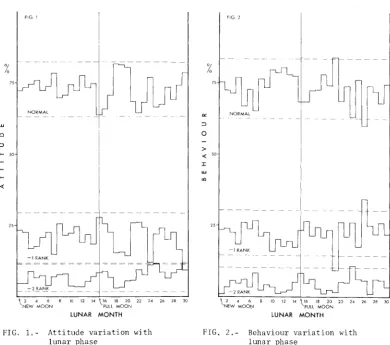
As an alternative method of approach figs. 1 and 2 show the full daily varia-tions of each parameter against the phase of the moon. The number of days recorded varied considerably (from 168 thirteenth days after new moon to 245 twenty-sixth days after new moon) because of irregular breaks in the record for holidays and other absences. All counts of days were therefore expressed in percentages to provide easy visual comparability.
For each graph, confidence limits at +2 and -2 standard deviations have been added, and in each case a trough in "normal" ranking must, of course, produce a peak in ranks less than normal, although not necessarily evenly in each of the sub-normal ranks.
Whilst normal attitude (top graph of fig. 1) is clearly achieved less often about the full moon, it is also less often reached about the twenty-second day. In neither case does the variation from the mean (72.8% of all days being normal) reach signifi-cant proportions. Conversely the apparent peaks of -1 rank of attitude and of -2 rank of attitude do not attain significance compared with their respective ±2 s.d. values depicted. Thus these daily variations could be the result of chance.
152
Disturbed Behaviour and Moon Phases
flG,l
:
% 1 - - e . : : : . : . .
-,
c:~~J'fl ~j VUU
I
50
25
LUNAR MONTH
FIG. 1.- Attitude variation with lunar phase
%
75
'"
::J 0
>
« 50 :c
<Xl
25 f1G.2
Lj
il1r
1ffL
1
J1Jlrlli··
~
NORMAL
I
--
-
j
-~~EW %O~I>I 8 10 12 14 \,~6Ul.L l~O~~ 22 24 26 28 30 LUNAR MONTH
FIG. 2.- Behaviour variation with lunar phase
CONCLUSION
Only the first of these tests suggests that these boys' attitudes or behaviour patterns are affected on days wi th the moon in the full phase. The initial null hypothesis is tentatively rejected in that case. This disagrees basically with the fail ure of Shapiro et al (1970) to confirm any effect of I unar phase. There is, however, no apparent difference in the way that different groups of boys, grouped respecti vely by attitude and by behaviour, react to phases of the moon. The total number of boy/days examined (11,846 in Tables I and II), even when divided into two halves, would be expected to suffice to show a tendency to differ if such existed. The question of whether this lunar effect upon human biorhythm i s induced by moon-light itself or alternatively by the moon's gravitational influence upon bodily tides (Oliver 1943) becomes relevant only once the effect itself is accepted.
ACKNOWLEDGEMENT
[image:4.475.43.434.80.425.2]REFERENCES
Bauer, S.F. and Hornick, E.J., 1968: Lunar effect on mental illness. Am. J. Psychiatry, ~, 696-697.
Lieber, A.L. and Sherin, C.R., 1972: Homicides and the lunar cycle: toward a theory of lunar influences on human emotional disturbances Am. J. Psychiatry, ~, 69-74.
Oliver, J.F., 1943: Moonlight and nervous disorders, a historical study
Am. J. Psychiatry, 99, 579-584