Painting a Visual Language that Interprets my Personal World
Alan Young
Bachelor of Fine Arts (Hons), University of Tasmania
Submitted in the fulfillment of the Requirement for the Degree of Master of Fine Art (Research)
Signed statement of originality
This thesis contains no material which has been accepted for a degree or diploma by the university or any other institution. To the best of my knowledge and belief, it incorporates no material previously published or written by another person, except where due acknowledgement is made in the text.
Signed statement of authority of access to copying.
This thesis may be made available for loan and limited copying in accordance with the copyright act 1968.
Signed
A
joU~
Thesis Title: "Painting a Visual Language that Interprets my Personal World" Abstract
This research project is based on the pursuit of a new personal visual language that interprets my immediate world. My paintings and drawings are grounded in my immediate environment and evolve directly out of personal experience. Central to my investigation is the development of a new set of symbols and an examination of how they have evolved. Recording these experiences in an autobiographical and diaristic way is a fundamental part of my process. Journal sketching and independent drawing is critical to the evolution of the paintings, particularly their combination of pictograms and text.
The work charts my navigation through space and also describes the characters that I come in contact with, communicate with or just "bump up against". The characters I describe fall into three categories; people I know well, people I hardly know and people I imagine and would like to meet. I have an unusual neurological condition, which involves problems with balance, weakness and tremor. These influence how I look and behave in a way that makes me appear "different" and makes my view of the world and my place in it unique. This element of beitig different results in me being involved in some situations which make me feel uncdtilfortable, uneasy, vulnerable, and at times frustrated. My physical limitations also determine my painting style.
Acknowledgements
Table of Contents
ABSTRACT 4
CHAPTER I 8
INTRODUCTION TO THE PROJECT 8
1. My View of the World/The Subject of the Pictures 8 ~
~
2. Evolution of the Images 9 r4!;
CJ:
Journal 9
00
...
...J 3. From Journal Images Through to Large Drawings and then Paintings JOen
12 ~ 1-2
4. What I am setting out to do
u...
CHAPTER2
13
0
CONTEXT 13
f:
13 M
a:
IntroductionPortraiture/Self-Portraiture 13
>
LU"""'
15
z
::J
Jean-Michael Basquiat (1963-1988)Gordon Bennett (1955 -) 20
Philip Guston (1913-1980) 22
Gareth Sansom (1939-) 23
CHAPTER3 25
How THE PROJECT EVOLVED/DEVELOPED 25
Stage 1 25
Finding the Project 25
Stage2 25
Going Out Drawings 25
Stage3 26
Going Out Paintings 26
Stage4 28
Stage 5
Disaster-Painting in oil on large canvas Stage 6
Frustration/Standstill Stage 7
Rave decor drawings Stage 8
Back On Track Stage 9
All positive andfan Stage JO
Concentrating on the more positive sides of things. Stage 11
Constructing my Paintings Differently
CHAPTER4 CONCLUSION
APPENDIXl:
LIST OF IMAGES AND ILLUSTRATIONS
APPENDIX2: BIBLIOGRAPHY
CURRICULUM VITAE
29 29 30 30 30 -30 31 31 31 31 34 34 35 35
37
37
40 40
42
42
Chapter 1
Introduction to the Project
1. My View of the World/The Subject of the Pictures
My immediate world has always been the subject of my work; where I live, who I come in contact with, communicate with or just "bump against." I came to Hobart aged seven, and since then suburban Hobart has always been my immediate world. As I have grown up and moved out of home, the detail has changed, but navigating my way through my immediate environs has remained my main concern. My work is about my individual view of this world. It is about what is happening to me personally, what is going on around me and my own individual slant on these things. Making what is around me the focus of my work was not a conscious, planned decision, but rather developed naturally. When I was at high school and college and had to travel by bus from the suburbs I felt uncomfortable and insecure. I channeled all those thoughts and feelings into my art practice. This continued throughout my years at art school. During my Honours year the focus was my urban environment and in particular the bus journeys to and from Art School. (fig I. On The Bus, 2002.) One feature of these journeys was my feelings of insecurity and discomfort as I struggled with aggressive "hoons". In some ways it became a story about "goodies versus baddies". My anxiety on the bus contrasted with the feelings of security which I felt within the safe enclosure of art school. During these years art school was my haven.
Beginning my research project coincided with me moving out of my parents' home in the suburbs and into my own flat in the middle of the city. It was therefore to a significant extent my reaching independence, gaining more confidence and growing up. Bus journeys were no longer a feature of my world, but the same emotions that I had felt on my bus journeys continued intermittently. Feelings of insecurity and vulnerability were still present at times. How my physical disability affects people's
fig 1. On The Bus, 2002 perceptions of me when I go out is also a source of frustration. My tremor is misinterpreted as nervousness and my sometimes-staggery movements are interpreted as drunkenness (even when I am sober). I had to get a medical certificate to put in my wallet because I was getting refused entry to places.
the people I met in those environments continued. In all this, there was still an underlying insecurity in how I felt. After a while I got used to going out and did feel more at ease socially, but I was still not entirely comfortable with myself and with drug users and drunk aggressive people.
Later on, I began to really enjoy going out to dance parties and raves. I have always been passionate about dance music and so I felt comfortable in this environment. This enjoyment triggered off a broader interest in club culture, which then became my primary subject matter. The Dj who spins records is an important part of club culture. Clubs get much larger crowds when they book a big name Dj who is commercially known and associated with a particular sound. Clubbers tend to dress up to go to clubs and they stay out later than they do in pubs because clubs stay open until 4-5am. Local Dj's perform at normal clubbing nights. Raves are when interstate or overseas Dj 's perform and they are larger scale commercial events which attract bigger crowds and last until. 6-7am. Club culture is commonly associated with "pill-poppers", that is people who take drugs such as ecstasy, and more recently GHB. I explored both the positive and negative aspects of this culture. Some of the positive aspects are the people who regularly go to raves and who are there for the music. There are also Dj's who support and encourage the local scene and are in it for the right reasons, from a genuine passion for dance music. Negative aspects include "posers", clubbers who are there to be seen and for the use of recreational drugs. Also, Dj 's who Dj for the wrong reasons, such as alcohol and money. So I was now concentrating more on the kind of people I know and see every week; also focussing on who the Dj was and what style of music he was playing, as opposed to looking at people I had only just met and didn't know very well.
Towards the end of my investigation, I began to concentrate on just dancing itself and the many physical and mental spaces in which my friends and I are dancing. My work became about the whole idea of movement within psychological, architectural and pictorial space.
2. Evolution of the Images Journal
My journal is the first stage in my painting process. I use the recordings in my journal as a basis for telling stories about my personal experiences. My journal is autobiographical and diaristic.
determines my sketching style. When I am experiencing intense emotion, the energy and excitement I feel makes it even more difficult to control my hands. It is as if my pen is dictating what to do and my hand runs ahead of my mind. I am not always on a positive emotional high, sometimes I feel agitated and frustrated.
When I come home I have a clear idea of what I want to write and sketch about in my journal. I focus on one aspect of my night out. This is quite different from my practice during my Honours year. Then, it was much more about general impressions, rather than the more restricted, deliberate focus that I currently employ. This focus can be one particular experience that happened that night such as being jostled by other people in the crowd as they walk past or it could be about the regular rave goers. Often it involves how I feel about the music that was played. Sometimes it is about people I meet and how they influence whether or not I have a good night.
[image:10.573.187.351.458.613.2]The sketch is normally writing and a figure incorporated together, and it expresses the mood I am feeling at that time. I always use a figure to record what I see. Sometimes the figure is me involved in a real experience. At other times, it is a mixture of real experience plus my particular response or attitudinal slant. In such cases I use the figure to express my 'voice". When I draw a figure, the figure's facial expression and posture are used to describe the general mood. When I use arms pointing up this shows a positive mood and the body slouching represents a negative mood. In my journal I use text to clarify the distinction between happiness and sadness. For example, in Happy and Active, 2003, (fig 2.) the placement of the text as well as what it says is significant. The next stage in my process is using the ideas from my journal so that I am clear about my subject matter when I start to do my large drawings.
fig 2. Happy and Active, 2003
3. From Journal Images Through to Large Drawings and then Paintings
Large Drawings
which are associated in my mind with particular objects and/or people. Then I let loose with colour crayons and fill the entire paper with colour and expressive marks in an instinctive uninhibited way. I do this quickly so my hands can translate and record visually what I am thinking at that precise moment. There is no pause in laying down these expressive marks. While I am doing these large drawings I am thinking about the subject matter. I don't keep an eye on what form it is taking; it is like I am having a conversation with the crayon and the paper. After I have finished the large drawing I look at it from a distance. By following this procedure, I already know what my stories are, what feelings I am trying to convey and what colours I am going to use to convey them before I start to paint. Therefore, I have some sort of idea of what visual form a painting is going to take. My paintings are a continuation of my large drawings even if the precise detail of the visual form isn't fully worked out before I paint. Of course, when I start painting I go with the flow of the pigment and that sometimes changes things. Also, it is a general feature of the way that I work that while I may repeat the one idea it doesn't take the same visual form each time.
Visual Language
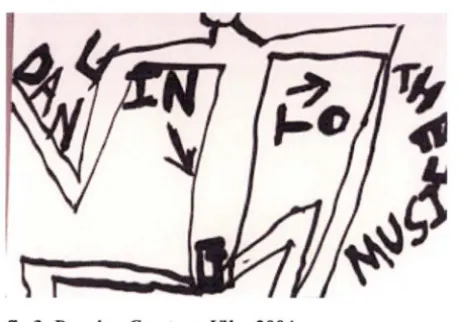
Mood is conveyed through the figures' facial expression as well as the body posture (arms and legs). This can also indicate the location, the place where the story takes place. Where I am affects how I feel, for example whether I am comfortable or uncomfortable. The meaning, placement and application of text(s) also play a part in telling my story, for example in the drawing Dancing Creates a Vibe, 2004, (fig 3.)
fig 3. Dancing Creates a Vibe, 2004
[image:11.574.62.292.424.585.2]4. What I am setting out to do
My main aim is to develop a new way of telling the who, what, and why about my life in Tasmania.
I am setting out to record and describe my world in a honest way which incorporates and develops a new kind of visual language. I want my narratives to involve the making process itself, the application of the mark as well as the look of the mark.
Finding new ways to tell my stories has involved the following aims: • Not having me physically in the painting all the time.
• Telling my stories through different angles and perspectives and so to constructing my paintings in ways which expand on my previous "boxed", left- to- right way. • Using my visual language to tell a specific story about a specific place.
• By using different colours and figure postures, indicating moods and telling stories about feeling uncomfortable and comfortable in different spaces.
• Maintaining a balance between working as a painting (object) as well as a visual language (story).
• Incorporating text at an equal value to other objects in the painting, and not just having the words stand out alone.
• Using different visual forms to keep an element of surprise in my paintings. If the viewer gets used to seeing the same objects used in the same way, he/she can not have the spontaneous reaction that I am seeking to inspire.
In pursuit of these aims I record my ideas to remind me contextually or visually through a journal (writing and sketching) as well as through drawing. My drawings and journal are essential elements in the process of my painting
Chapter2 Context Introduction
My work sits within the field of artists who in the 1980' s and 1990' s represented a return to the examination of personal experiences as a basis for their work. Outside my own enclosed world and its description there are the following influences and contexts: the (traditions) of twentieth century self-portraiture and portraiture and the changing view of portraiture, and the impact of cubism on portraiture. I will discuss the work of a small number of artists; Jean-Michel Basquiat, Gordon Bennett, Philip Guston, and Gareth Sansom. The key aspects of the influence of these artists on my work is the way in which they go about telling stories about their personal experiences and the technical devices they use to do so.
Portraiture/Self-Portraiture
By the twentieth century portraiture conventions were clearly established. What distinguishes twentieth century portraiture from what came before was the fact that the artist's individual style is emphasised. Until then what had mattered most was the likeness and status of the subject. By the 1930's, the Archibald Prize for portraiture was established as an important competition in Australia. Throughout its history the Archibald Prize has often been associated with controversy because opinions vary on the definition of a portrait. This is even more so when it comes to portraiture. The freedom of self-portraiture allows more opportunity for the artist to reveal himself and take risks in how much they lay themselves bare. What seems important in the artist's approach to self-portraiture is their underlying motive for doing it. Sometimes it is just done as part of an artistic exercise; sometimes it is about describing a relationship. It can also be used to construct an identity or to record the struggle to establish a clear identity.
In a recent catalogue essay for the exhibition To Look Within Self-Portraits in Australia, Andrew Sayer talks about the fascination of self-portraits for artists and their audiences. He thinks that the fascination stems from the fact that self-portraits combine the "common and unique." He explains that although self-portraits will always reflect the traditions of their genre and also conventions of self-representation, each self- portrait will be a one-off because the subject is unique; an "individual whose persona is shaped by specific circumstances, history, identity and aspiration."1 When Henry Hanke won the Archibald Prize with a self-portrait in 1934 it was a controversial decision, just because self-portraits weren't considered "proper portraiture" by some people. In Sidney Nolan's
1
Kelly and Moon Boy, 1945, (fig 4.) The simple use of line and the featureless face suggest a loser definition of self-portraiture.
Cubism was one of the most influential movements in the history of modern art because it introduced dramatically different approaches to portraying form and space. The Cubists tried to show the subject from several viewpoints at the same time by reorgamsmg and fig 4. Nolan, Kelly and Moon Boy, 1945 overlapping elements. John Berger explains that "Cubism changed the nature of the relationship between the painted image and reality and by doing so expressed a new relationship between man and reality". Berger talks about the changing view of man in the portrait. He describes how there was a change in how an identity can be portrayed. "We can no longer accept that the identity of man can be adequately established by preserving and fixing what he looks like from a single viewpoint in one place", He argues that we can still rely on "likeness to identify a person, but not to explain or place him. To focus too much on likeness is to isolate falsely" 2
Surrealism is another movement which influenced the development of self-portraiture in Australia. Surrealism allowed artists to create forms and images not just by reason but impulsively, without deliberation. This meant that images could be dream-like or fantasy. They could also shock. Examples of surrealist portraitists in Australia include James Gleeson, Bernard Boles, Ray Opie and James Cant. James Gleeson has made a major contribution to the field of the Surrealism. He endeavoured to show that there is an alternative reality that can be lived through dreams, hallucinations and different mental states which is distinct from obvious and everyday experience. His work encourages audiences to look at the world in a different way. He wants us to look below the surface and "beyond the screen of sight". By the late 1970's Gleeson had substituted his figures with technological gadgets. The human form in his paintings disappeared and he came to believe that it could be adequately represented by "an arm, a hand, and eye" 3
My own interpretation of self -portraiture is that it can be about a personal reaction at a particular time and a particular place. Place can mean where you are and also how close you are to what is going on. The self doesn't always have to be represented in bodily form. It can just be represented in a voice, which uses visual language such as text, in a direct way to communicate and express opinions. Relative distance and how comfortable you feel in an environment can influence viewpoint and reaction. The reaction to what is
2
Berger, John, The Moment of Cubism, and other essays, The Changing view of man in the portrait, p 46,
3
[image:14.570.65.263.109.249.2]going on can vary from being an instinctive, instant reaction to one which is influenced by previous knowledge or opinion which has been brought to the situation. The nature of personal experiences can be communicated through the application of the mark. For example, a strong energetic mark can suggest positives. Self-portraiture can be about visual recordings of your journey through life and navigating the inevitable emotional swings and roundabouts. It can also be about channeling personal frustrations into your work in a way that makes you feel better. In that way it can be about getting something positive out of a negative experience.
In my pursuit of a new visual language that evolves directly out of personal experience the ideas and practice of artists such as Jean-Michel Basquiat, Gordon Bennett Philip Guston and Gareth Sansom have impacted on my own practice.
Jean -Michel Basquiat (1963-1988)
When I was in New York in 1999, I was visiting a friend of my uncle who is an established artist. I was looking at her bookcase and a particular book immediately grabbed my attention. It was a book about the work of Jean-Michel Basquiat. My excitement at seeing the book must have been obvious, because my uncle then went and bought it for me. This book and the instant connection I felt with it influenced greatly the development of my art making from that point on. I felt an immediate connection with many aspects of his visual language such as his childlike use of strong colour, overlapping of layers, symbols and his use of text. His work made me realise that a thick but expressive mark was possible. I have physical limitations, which determine my painting style and influence my choice and use of materials. After looking at his work and noting his use of materials such as oilsticks, I thought I would try using them myself. Oilsticks are easy for me to use because their thickness gives me a wide surface to hold on to. Using oilsticks enabled me to make the application of my mark in a quick, fluid way and in one motion without having to stop and start. This made mark making easier for me and also made the mark easier to control. It also led me to the idea that I could do several layers of these marks. This discovery fundamentally changed my painting process. Basquiat's use of visual language really excited me. In particular, the skeletal figure was new to me and also the "straight- to- the- point" direct text. His use of these devices encouraged me to experiment with the use of similar ones in my own work. Basquiat's career only spanned nine years and can be divided into four phases. The first phase was a typical expression of street culture. He produced graffiti in subways, schools and old warehouses. At this stage he started using SAMO, which was his own tag for himself. He also used "Sameol thing". These are both used to refer to himself in an ironic way. In the second phase from 1980 to 1982 he used painterly gestures on canvas and portrayed mostly skeletal figures and mask-like faces. He also used urban street imagery such as cars and buildings. The middle period 1982-1985 focused more on issues related to his black and Hispanic identity. In the last phase from 1986 to his death he began to move out of his comfort zone and deal with new territory and developed a new kind of figurative depiction with different symbols, sources and subject matter.
4
Basquiat was influenced by artists such as Jean Dubuffet, Jackson Pollock, Pablo Picasso and Cy Twombly. In his earliest works the surfaces of Basquiat's paintings were scratched and graffitied in a way that has echoes of Dubuffet. Graphic devices which were a favourite of Pollock's such as overpainted and overlapping shapes and figures, cryptic writing and drawn outlines suited Basquiat's closely packed together, gestural image-making. Basquiat's use of bold, childish colour and anatomically graphic figures owe much to Picasso's late paintings. Like Twombly, Basquiat learned to draw, scribble, write, collage and paint all at the same time. As well as all these influences from individual artists, Greg Tate thinks that Basquiat is very much an heir to the surrealists,
"but his surrealism is descriptive of New York in the day rather than Europe at night".5
During the late l970's Basquiat chose to live on the streets. He didn't have a studio or home and lived in abandoned buildings with friends. Jn the early 1980's his subject matter was urban street life in New York and he used images from his street existence such as automobiles, buildings, police and children's sidewalk games.
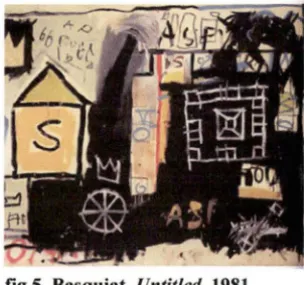
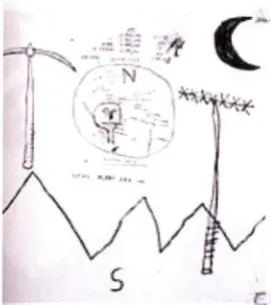
[image:16.570.299.469.429.582.2]In 198 l Basquiat did two untitled paintings, (figs 5. and 6.) which were done in a more frenetic way using abstract composition with a two dimensionality that allows no suggestion of depth, narrative, or relative size. One painting is full of black overpainted graphic areas. This painting draws from Basquiat's street imagery. It features a children's street game called Skelly which is played with markers such as bottle caps. The second untitled work deals with the same subject matter. The "skelly court" is superimposed over the entire work. The work suggests a spray-painted, overpainted, graffitted, and collaged city wall. Basquiat is now using canvas rather than walls of building to record his thoughts about city life experience. His earlier symbol for himself was the text SAMO, and arose from this street life and existence.
fig 5. Basquiat, Untitled, 1981 fig 6. Basquiat, Untitled, 1981
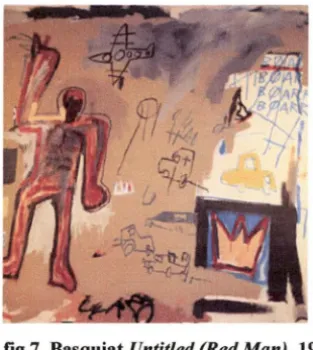
Untitled (Red Man), 198 l, (fig 7.) is autobiographical. It is about Basquiat being struck by a car when he was a child playing in a Brooklyn street. In this piece Basquiat shows internal organs by an outlined red spray painted figure and the ambulance suggests the accident. Pork, 1981, (fig 8.) was done on a thrown out apartment door which he found on the street. It is about his struggle dealing with racist taunts during his life on the street. I was struck by the way he used text, which related to where he was and also his personal experience. He uses the meaning of the text, not the appearance of it.
5
[image:16.570.63.215.436.579.2]While Basquiat was growing up and playing in the streets of New York, its society was changing. His father was Haitian and his mother was Puerto Rican. The influence of immigration patterns were beginning to show. African influences brought about by Afro-Cuban, Afro-Haitian, Afro-Jamaican and Afro-Puerto Rican communities were reflected in the growth of hip-hop music and break dancing. From this a new subculture emerged and it came to prominence in the early 1980's. This music was an important part of Basquiat's life. Robert Thompson
fig 7. Basquiat Untitled (Red Man), 1981 thinks that "Understanding the a~ of J~an-!'1ichel depends in part on understanding his lifelong involvement with music" and points out that he listened to music while he worked 6 Sound was an important part of his visuality.
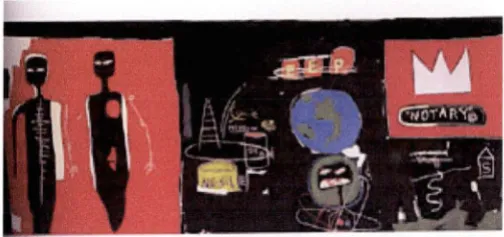
In Both Poles, 1982, (fig 9.) there is a strong visual rhythm. The use of ladders as railways in Leonardo de Vinci's Greatest
Hits, 1982, (fig 10.) also suggests rhythmic movement. Ian
McLean has suggested that Basquiat's love of jazz and its syncopated rhythms affected the way that he used pictorial space.7 It seems that the structure of jazz music influenced the structure of his paintings. One of his musical heroes was
fig 8. Basquiat, Pork, 1981 Charles Parker who revolutionised jazz by using
improvisation, frantic tempos and elided rhythms. These characteristics fit into Basquiat's painting and drawing style.
Basquiat's work is a good example of a combination of several influences that co-existed in the late l 970's and early l 980's. Imagistic painting, which tells stories, had made a comeback. Therefore the stage was set for Basquiat's painterly, figurative and political ideas to be well received in the art world. Basquiat was so well received that he became famous overnight. It was the sort of meteoric rise that is associated more with pop stars than artists.
6
Thompson, Robert, Royalty, Heroism and the Streets, in Marshall Richard, op.cit, p 32
7
[image:17.574.66.223.105.280.2]-~- .•
.
.:: -:-..
.
fig 9. Basquiat, Both Poles, 1982 fig 10. Basquiat, Leonardo de Vinci's Greatest Hits, 1982
It has been said that trying to "read" a Basquiat painting is like trying to listen to a melody on a radio with a faulty tuner. "The dominant signal is constantly under attack from static interference and unannounced intrusions from other stations."8 This is partly because of the sheer intensity and directness of Basquiat's work. Central to this is the fact that his work is line-driven, uses direct text, and integrates highly visible drawing into painting. Klauss Kertess thinks that "Improvisation grounded in sophistication is at the heart of Basquiat's art." 9 He also sees the improvisatory invention of art and self, the artist as seer and the incorporation of the vernacular into the vocabulary of art as characteristic of many of the avant-garde painters such as Jackson Pollock, Joseph Beuys and of course Basquiat. He sees this element of improvisation as being vital to Basquiat's work because it provided him with a "bridge between painting and music and drawing and writing."10
At the start of his middle phase in 1982 Basquiat's Self-Portrait as a Heel, Part Two, 1982, (fig 11.) Basquiat expresses his sense of self-alienation in visual terms. Dick Hebdidge identifies this as being typical of Basquiat's ability to " ... always look back at himself, as well as from the place of the
other .... "11 fig 11. Self-Portrait as a
Heel, Part Two, 1982
In Grillo, 1984, (fig 12.) Basquiat juxtaposes areas of emptiness with areas, which are full of overlapping and underlapping layers of painted objects. Basquiat uses a figure with no detail in the face, anatomical detail in the body and stick like arms and legs. Movement is conveyed by the hands. There are lots of segments that make up the painting, in each segment the objects are placed and
8
Hebdidge, Dick, in Marshall, Richard, op.cit, Welcome to the Terrordome, p 62 9
, Kertess Klaus, in Marshall Richard, op.cit, Brushes with Beatitude, p50 10
Ibid 11
[image:18.569.65.201.100.252.2] [image:18.569.318.444.100.278.2]positioned in columns. In some there are several different objects in each columns. Some objects are placed and positioned in the same way as each other, as a pair. In this painting Basquiat used the crown as his trademark. He also uses the crown as a symbol of respect and admiration. His earlier symbol for himself was the text SAMO. The type of panel he painted on in Nu-Nile, 1985, (fig 13.) was of interest to me because of the billboard shape of the panel and the childlike use of colour.
fig 13. Basquiat, Nu-Nile, 1985
[image:19.568.240.492.216.334.2]Gordon Bennett (1955 - )
During his short lived career that only lasted nine years Basquiat at times focused on issues related to his black and Hispanic identity. Australian artist Gordon Bennett is also associated with race issues and he was a great admirer of Basquiat. Bennett came across a book about Basquiat in 1994 and he has described how it made a huge impact on him. He did a series of paintings in a Basquiat-like style and wrote him a hypothetical letter. Gordon Bennett is commonly thought of as an urban Aboriginal artist although it is a title, which he greatly dislikes and has consciously fought against. His work is about telling stories of his own experiences and stems from his struggle with his own identity. He has suggested that every work he has done to date has been a self portrait, in that what inspires each work is his own everyday experiences living in Australia "from my own life experience through to the speaking position of text and orations about Australia and Australians in the past and present and their relationships and continuities."12 His upbringing was very European and when he discovered his Aboriginal background he felt a sense of shock. He has consciously kept changing his style so that he isn't labelled as an indigenous artist.
He has described himself as a shy and introverted, self-conscious child. He saw attending art school as a mature student as a way out. He found Art school a safe and comfortable place. He felt that he belonged there. However, he had difficulty in verbalising his intuitions and the comprehension of art theory. He explained later that "I found the language in which I was most articulate to be the visual language of painting and it was through painting that I found a voice."13
Bennett has channeled his frustrations about aspects of Australian society into his paintings. He has said that doing this has made him feel better and helped him deal with his frustrations. However, he also describes one of the potential problems with self-. portraiture, in that, in the desire to express how you feel, you can reveal things that you might later regret. Bennett describes how he works through things in his own mind and on canvas and it is only later that he thinks of an audience and then "I freak out with having exposed myself so much."14
Bennett tells stories, which explore the legacy of colonialism and the traumatic effects of racism. In his series of watercolors, Home Sweet Home, 1993-1994 (see fig 14.) Bennett describes the tension he came across when he moved to the suburbs. In the accompanying letters he explains that "at the backyard barbie with the neighbours, the subject of Aborigines always came up."15
12
Mclean, Ian, Bennett Gordon, The Art of Gordon Bennett, Craftsman House 1996, p 58 13
Ibid, p 8
14
Bennett has the ability to immerse himself in another artist's language to the extent that in Self-Portrait:lnterior/Exterior, 1993, (fig 15.) Bennett is dealing with collective rather than personal memory. In
Self Portrait (But I Always Wanted to be One of the Good
Guys), 1990, (fig 16.) He reveals his personal struggle with the fact that his Euro Australian upbringing affects his perceptions even when he knows his ancestral history. He doesn't see identity as a fixed thing, but thinks that identities are like ideas, they develop not from within the subject but from what is going on around him. In his letter to Basquiat, Bennett talks about being drawn to the
'semiotic and painterly fields of your work and
particularly to the layered lines of your drawing of the
Home, 1993-94 human figure."16 Bennett has done several series of
paintings as a tribute to Basquiat. In Notes To Basquiat
(Death of Irony), 2002, (fig 17.) Bennett uses some typical aspects of Basquiat's visual language. These include the shaky hand drawn grid, the pairing of objects, elongated arms, and skeletal figures.
He seems to be able to speak through them. Sometimes, it is as though he is allowing their voice to speak through him. In Home Decor: (Preston + de Stijl = Citizen),
Panorama, 1997, (fig 18.) there are references to ~argar~t fig 15. Bennett, In Self
-Preston. Thes Bock, Ben Dutersuas well as Basqmat. This Portrait: Interior/Exterior, 1993
work is also an example of how Bennett uses his paintings
as a performative space. Altered Body Print, 1994, (fig 19.) conveys mood through arm and body language. The body is also done with a simple use of line and not much detail.
fig 16. Bennett, Self Portrait (But I always wanted to be one of the Good Guys), 1990
16
fig 17. Bennett, Notes To Basquiat (Death of Irony), 2002
[image:21.566.274.482.513.649.2] [image:21.566.59.235.514.642.2]fig 18. Bennett, Home Decor: (Preston+ de Stijl =
Citizen), Panorama, 1997
[image:22.578.371.453.91.233.2]Philip Goston (1913-1980)
fig 19. Bennett, Altered
Body Print, 1994
Philip Guston was above all a storyteller. His work had three main phases and spanned
forty years. Even in his abstraction phase, the story telling element was there. Rothko
once said to Guston "You are the best story teller and I am the best organ player" Guston himself ended up rejecting abstraction because as he explained later "I got sick and tired
of all that purity! I wanted to tell stories" Even though his career had three phases Nicole
Krauss makes the point that if you review his entire life's work, the thing that stands out
is its overall unity. She describes his work as "a continuous journey towards the most
unflinching expression of the self'17
My interest in Guston lies in his ability to tell stories using a
complex and highly personalized iconography, and the
theatricality of the scenes he sets in his painting. His drawings related directly to the current paintings. "On a lucky day a surprising balance of forms and spaces will appear and I feel the drawing make itself, the image taking hold. This in tum moves me towards painting." 18 The Studio, 1969, (fig 20.)
contains much of the essential Guston. In typical theatrical
fashion, the central
[image:22.578.59.261.96.211.2]hooded character 1s
fig 20. Goston, The
Studio, 1969
surrounded by props
such as the can of paint, a one- handed clock
and the easel. The hoods represented the Ku Klux Clan and were an important part of his
personalised iconography. In, The Street, 1977,
(fig 21.) Guston uses imagery in a chaotic way.
The two small insects are watching the world
crumble. The multi racial legs show that it is fig 21. Goston, The Street, 1977
17
Krauss, Nicole, The first painter after the last, Modern Painters Winter, 2003, p 88 18
[image:22.578.308.474.515.618.2]worldwide. All the objects are warped. It seems that Guston's view of the world was an anxious one.
Throughout his career Guston experienced times of frustration when he felt that something was getting between him and the canvas. He explained that "the desire for direct expression finally became so strong that even the interval necessary to reach back to the palette beside me became too long."19 While painting in 1951 Guston made the decision to paint the whole work without stepping back to look at it. After that, he never again planned his painting moves in advance. He sees the most relevant question in process as "When are you finished." How he answers this is an insight into his approach to his painting. ' I think the only pressing question in painting is: when are you through? For my own part it is when I know I have come out the other side."20 As he works he is aware of contradictions and the tensions they produce. When these resolve, he knows that he is finished. ln my own art practice the issue of when is a painting is finished has been a recurring problem and I found Guston's approach to this helpful.
Gareth Sansom (1939-)
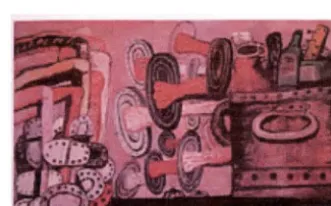
Another artist whose approach I found helpful is Gareth Sansom. His work has been described as "a struggle between abstraction and figuration."21 Sansom achieves a balance between abstraction and figuration in his story telling and it is this balance which is a central concern in my work. His fluid handling of line, which implies a sense of motion, thick gestural brushwork and his use of enamel paint were also aspects which interested me. Jn Glory Hole Road/Voodoo, 1985, (fig 22.) Sansom divides the space in the painting physically into clear areas. The two areas tell different stories. The silhouetted head and the small black bodies with no detailed features
[image:23.580.55.477.315.729.2]interested me. fig 22. Sansom, Glory Hole Road/Voodoo,
1985 He uses
repetition and placement of forms to convey movement. He uses the two poles to distinguish between the two areas; the poles also look like they are physically close to you.
ln Art Meets Mr God, 1987, (fig 23.) there is a
simple out lined face with not much attention to
fig 23. Sansom, Art Meets Mr God, 1987 detail; the eyes could also represent boxes. The
face is a combination between a face and a potato.
Fuzzy and sketchy (crayon line marks) behind the potato head are used. Sansom explains his unique picture construction by describing his painting process as being about "how
19
Krauss, Nicole, The First Painter after The Last, Modern Painters Winter, 2003, p 88
20
Ibid, p 89
21
Lindsay, Frances, He Sees Himself, Gareth Sansom Paintings 1956-1986, University of Melbourne,
ordered or chaotic the thing was going to be before it became anarchic." He sees this process as an exercise in "how close you can get to the edge without everything collapsing ... that's a bit like walking a tightrope"22 Terence Maloon identifies Sansom as a painter who has taken pictorial composition to the "brink of incoherence."23 Looking at how- artists such as Basquiat, -Bennett, Guston and Sansom record- their personal experiences and tell their stories has impacted on my art practice in particular ways. Bennett helped me realise that in some ways my work is about struggling to establish my identity. I can also relate to his discomfort with the way that such personal experiences expose the artists publically. The way that Guston talks about his process helped me to identify some of the -problems I have been having with mine and helped me solve them. For example, knowing when my painting is finished was a big problem, which caused me a great deal of frustration and confusion. Sansom influenced my picture construction. The most important influence was undoubtedly Basquiat. His use of visual language really excited me and I continually got stimulation and inspiration from just flicking through the book (the one my uncle bought), particular from his skeletal figures and use of direct text. I drew much reference from his skeletal figure and the use of direct text.
22
Maloon Terence, Gareth Sansom: Seventh Triennale, India, 1991 I curated by Maloon, [Melbourne] Australian Exhibitions Touring Agency, c1991, p 13
23
Chapter3
How the Project Evolved/Developed Stage 1
Finding the Project
Beginning this research project coincided with me physically moving out of my parents' home in the suburbs and into a flat in the city, just ten minutes walk from art school. This stage was about finding my new life as an independent person as well as finding and establishing my research project. I was unable to paint at first so I directed all my energy into recording my personal experiences in a journal. For the first time I began to combine text and image. This was a very significant change for me. In my honours year I had a separate journal each for text and image. Combining this into one journal simplified my whole process and helped my recording flow more naturally.
The subject matter at this stage was the immediate environment of the street where I live and also coping with the daily grind of laundry and cooking on my own. One of my earliest journal entries was prompted by my washing machine breaking down. Also, at this stage I was feeling uncomfortable and insecure because I was having to deal with so many new situations like landlords and house inspections.
Stage2
Going Out Drawings
Since I hadn't had a lock in my studio at this stage, I drew an extensive series of coloured drawings, on large sheets of paper. I didn't spend much time on them. I crammed the white paper from left to right with visual information, bodies. text, bottles etc. The main idea for these drawings was to keep on drawing non-stop, so that I could become familiar with my subject matter really quickly. This series of drawings mapped out clearly how I was going to tell my stories and also how my visual language was going to take shape.
used blue, red and yellow to convey positive feelings. At the same time the energy and quirkiness of the line echoed this positive feeling. Blue is used in text to say my name "Al". The blue incorporates reference to my favourite chair, the one I chose to sit in all the time when I was very young. However, sometimes red was used for anger. ln these instances I used the text to make that clear. Pink in the form of a breast is associated with femininity. Therefore, colour is sometimes a social marker/identifier, and sometimes an indicator of emotional temperature. Colour and text together are also used in reference to commercial brands/logos (for example, as Boags Draught.)
These drawings were very helpful in plotting out what I was going to paint. They were developed from pages in my journal. For example, I might draw a head in my journal then in my drawing add arms and legs to it. My large drawings are full of text originally developed in my journal. For example I might use the word angry in my journal then in the drawings I go into more detail. In these drawings I also map out what all the symbols mean. In this way my drawings were an extension of my journal, a half-way point towards paintings.
[image:26.582.58.245.405.544.2]Also through the drawings I realised that I could convey an idea of how far away I am from the focus or centre of a picture or story. The fact that I am far away indicates something particular about my mood and feeling. ln In a Pub, 2003, (fig 24.) I was navigating from a distance because I was uneasy about how other people were perceiving me. This distance is suggested by the aerial view of two people sitting at a table.
fig 24. In a Pub, 2003
Stage 3
Going Out Paintings
The main outcome of this stage was that I realised that drawing is crucial to the evolution of the combination of pictograms and text in my paintings. Also these drawings were vital to the development of my visual language because practically all the elements in them were carried on into my paintings in some shape or form.
how I felt in that particular situation. In this painting, I am viewing from a close-up perspective. This reflected the close-up confrontational aspect of what was happening. In this painting I tried to convey the negative tension both before and after the incident.
In this painting there was a shift in location in that I moved inside to the interior environment. However,
much of the painting was done in the same way as the street scapes of my Honours year. It was generally constructed in the same contained (left to right) grid-like way and also colour was used similarly. I did use oilsticks but in a very limited way and oilsticks were not used in the major story-telling parts. My literal,
[image:27.581.55.199.149.314.2]descriptive use of colour included using grey for the entrance to the pub and black for inside the pub. At the same time I used grey and black to convey the sense of frustration and anxiety about how I was being fig 25. Being Confronted, 2003 perceived. My anger and frustration was also shown by using black and grey in fragmented parts of my body. I indicated the part that is me by using glasses, my favourite colour blue and my nickname Ellen, as text.
Me Dancing Energetically, 2003, (fig 26.) was
about me trying to get confidence with myself and dealing with other people when I started to go out to a pub. Tables indicate that the location is a pub. Here I am dealing with mainly the more positive side of going out though there is also an element of sarcasm. The positive mood is conveyed through the use of full-on colours: light blue, dark blue and yellow. I even used enamel paint to strengthen the intensity of the colour. The text "more than 1" is about sexual politics, about starting to get to know females and being unsure
if they are playing games or not. This is where the fig 26. Me Dancing Energetically, 2003 sarcastic element comes in. The figure of the other
[image:27.581.314.477.365.543.2]women. They are sitting at a table, and it is as if I was observing from above. In this painting the text, AHY, means my name (Alan Henry Young). Again I have used a blue figure and blue glasses to indicate myself. For the tables tape was used to get a more exact line. I used acrylic paint rather than oilstick because all I needed here was a flat rather than textured surface. Blue enamel paint was applied loosely and vigorously to achieve movement in the text. In my body I use the text "full", to mean full of energy and enthusiasm for dancing. The light blue in the text "full" is to convey positiveness.
Apart from my face, my body is outlined with no detail. The mood I am describing is conveyed through the quirkiness of the lines and the posture of the arms and legs. The small blue and yellow boxed lines round the outside of the figure are other small tables. Brown was used for the large tables because that is the colour they are in real life.
I produced five paintings during this stage. I was doing a lot of experimenting and this meant that some of them just didn't work as paintings even though aspects of what I was trying to do did work. Being Questioned about Your Appearance, 2003, (fig 27.) which was about me being questioned about my tremor and movement because the security
fig 27. Being Questioned about Your Appearance 2003
Stage 4
Entrepot Drawings
guard thought I was on drugs, didn't work as a painting. It didn't work visually because it was very
one-dimensional and needed another layer. But tackling that story and that issue was important in terms of story-telling.
This was a stage when I didn't explore new ways of developing language in a thorough or systematic way.
It was more about dabbling with lots of technical aspects in an experimental, playful way.
[image:28.583.53.199.315.437.2] [image:28.583.61.462.623.739.2]There were some technical difficulties. I couldn't get the colour as bright as I wanted because I used water-soluble crayons and the wall was non-absorbent. Bold colour became blobby by accident and some areas were too wishy-washy. I really enjoyed doing this piece while people were reacting spontaneously around me. The first day I found that a bit nerve-wracking and felt very self-conscious but I got used to it.
I settled down on the second day and got into a working routine. Some of the work was very planned and some was spontaneous. For me this piece needed to sit somewhere between a drawing and a painting. I really enjoyed showing my versions of real events around me and telling stories about some things that make me feel uncomfortable. This whole exercise was different because I was doing it in an accessible space open to everybody.
In some areas I spent ages pressing and pressing. Some of this was to make the colour more intense. Some of this I would have liked to spend more time on. This was the longest I have ever spent on drawings. Normally, I spend a maximum of forty minutes. Some bits were quickly done and some bits are edited intensely and slightly painted over twice. A big difference in my painting process this year is that my drawings are more directly related to my paintings. This whole idea of being more aware of scale, space and composition is now in my mind when I am doing my drawings. Anything that I am going to try out in my paintings, I try out in my drawings first. Doing my drawings on such a large scale and doing them in a more careful way was a really good exercise for me. Doing this piece came at the right time. Probably, the most important thing that I learned from the Entrepot exercise was that I work in segments.
Stage 5
Disaster-Painting in oil on large canvas
push it out. This prevents my paintings from being uniform, single level screens, giving them the kind of colour dynamic practised and taught by Hans Hoffmann.
Stage 6
Frustration/Standstill
This period was characterised by frustration and a feeling of going round in circles.
After the disaster of the oil paint on large canvas, I went back to the same size of canvas I normally work with (138 x 118 cm). I ended up getting really frustrated; I was trying too hard and nothing was happening. Trying to be too analytical interfered with my natural flow. I just kept on painting myself into a comer, either painting out too much or adding too many objects. I need to be able to improvise. It was as though I had lost my
freedom to paint. This stage lasted for about four months. I ended up painting over all these canvases later so nothing positive was produced.
Stage 7
Rave decor drawings
After thinking about why my paintings weren't working, I looked at the drawings I had already done about raves and pubs. I decided that I wanted to concentrate specifically on going to raves in and in particular focus on the Oj and the type of music he was playing rather than on the other people there. Since my subject matter was now more specific I had to start using a wider range of objects. So I started to look on the Internet to find line drawings of items representing club culture from the 1960s to now. I looked in detail at lighting, rope, audio, fashion, decor, narcotics, drink, wings, ceilings, drums, keyboards and women and men in their various outfits (party gear). Many of the items were objects
I had not drawn previously so I have needed to experiment with new images derived from them. I used a black felt pen because it was the quickest way to get fluid marks. I wasn't thinking about colour at all, I was trying to produce simple outlines based on complex
shapes.
What I learned from this stage was that I could tell stories through objects and application of line rather than just colour. Microphone, and Sweater, 2004, (figs 31, 32.) are both examples of my rave drawings from this stage.
[image:30.583.58.169.573.692.2] [image:30.583.352.439.574.707.2]Stage 8
Back On Track
Doing these rave drawings changed my focus to the exploration of specific and personally significant subject matter. At the same time they were significantly broad in content in a way to allowed me a freedom to construct my paintings in different ways. This also coincided with me realising that to see my paintings clearly, I had to step back and look at my paintings from a distance. The long view made it easier to see when my paintings were unbalanced -if they were too full of symbols or if the colours were clashing. This is all about the constant struggle to achieve a balance between getting the visual language the way I want it but also getting it to work as a painting.
Stage 9
All positive and fun
This stage was about using different kinds of space to tell stories. One of the things that helped me get out of the frustration stage was using oilstick. I realised that using oilstick is really important in constructing my paintings in the best possible way. It was pointed out at one crit session (May 2004) that my paintings were lacking movement in the line, and so were flat. I could see what the critics were saying, but it was a little later before I realised that what was causing this was my choice of materials. Oilsticks allow me to do a thick, quick, fluid mark in one motion. They are also easier for me to hold. Looking at Basquiat's work started me off using oilsticks, so I had been using them for some time. However, because they are so expensive I thought I would try to use them less in my painting. I realised that this just doesn't work.
Using oilsticks isn't just about making things easier technically. Using them is fundamental to a painting process that works for me. Doing a mark with an oilstick allows me to think about what I will do next. As I am doing a mark I think of what object I am going to do next and then do it straight after the completed one. How I do one object affects how I do the next one, so having this flow really matters. This means that I can think and paint at the same time and the two processes can develop simultaneously. There is no gap between thinking and painting. I need to work on two different segments, that is, two different areas of the painting at one time. Each segment has to work on its own but it also has to fit in as a whole. My paintings are like jigsaw puzzles and each piece has to fit. Even though I figured out the best process to suit my work, some paintings took longer to finish than others.
Now that I was clear and confident about what the best painting process is for me I went back to rework the canvases from my frustration period. These paintings just didn't work as paintings. I wanted to see if I could modify and add elements in a way that resulted in a painting that worked. One really positive aspect of this was that because I was going on top of marks, I built up thick layers, which brought a new quality to my work. This gritty, dense crayon-like texture was accidental, but was important because from then on I managed to achieve a similar texture. It was good that even out of that long period of frustration positive things emerged. This new thick texture did present problems though. It was a difficult surface to paint on. The sheer thickness made it more difficult to control my mark. It did mean that I had to do my mark slower and in a different way because I was going over bumps. By now I had succeeded in working out what process suited my project.
I narrowed down my subject matter to going out to raves, not pub bands. I focussed more on the Dj and the style of music he played. I started using exact symbols for raves. As indicated above, the iconography includes such things as lighting (mirror ball), audio,
fashion, decor, narcotics, drink, ceilings, drums, keyboards, tables, passageways, and women in party gear such as pink dresses. Dancing Man,
2004 (fig 33.) is a good example of dancing at a rave. Other images I have used are a ghost-like figure with dollar signs,
frying pans, bong pipes and shoes. All these examples (apart from the shoes) are evident
in Frying Brain Cells, 2004, (fig 34.) Other examples of this rave stage are the paintings,
[image:32.581.60.274.268.422.2]Al Dancing, 2004, (fig 35.) and Al at a Rave, 2004, (fig 36.)
fig 34. Frying Brain Cells,
2004
[image:32.581.63.487.499.650.2]However, one of the main problems that remained was the ongoing battle of trying to avoid colour clashes in my painting. I was over the hurdle of the frustration stage and so some paintings were now relatively quick to do. l+l=Great Fun, 2004, (see fig 37.) was in this category. These paintings required less editing as well. However, some paintings still presented a problem in the sense of striking a balance between the various elements of my language. The symbols are not only for telling stories, but they also need to be combined so that the painting works spatially. Sometimes I want to use text in a direct way to tell my story but it makes the painting too crowded. I tried to overcome this by using short or abbreviated words.
For example, in one of my paintings I try to get across the idea that too much emphasis should not be put on fancy audio technology. Ultimately, the music played at clubs should be about dance, having fun and enjoyment. To explain this I used the words "100% Fun". (fig 38.) Another example of using text in this way is the use of the words "frying pan" to illustrate the idea of brain cells being fried through drug use. Frying Brain Cell, (fig 34.)
fig 37. J+J=Great Fun, 2004 One of my other
major themes is that Dj's should be there to Dj and not to massage their egos or indulge in drink. I prefer Dj's who Dj because of their enthusiasm to hear and play new music. Compressing that message into one (short) word I simply use the word "ego".
My shift in location from outside to inside caused
a change in the type of colour I used. I chose more fig 38.100% Fun, 2004
vibrant colours such as neon green, silver and gold to
reflect the garish artificial lighting of the nightclubs for example in 1+1 =Great Fun, (fig
37.) In order to get the movement and energy I need in my painting, I use oilstick instead of a brush. I begin my paintings by using acrylic paint to do simple shapes like tables and passageways. Then I use several layers of oilstick, which are overlapped and underlapped at the same time. I have discovered that when my paintings don't work and become flat, and there is no movement of line, it is because the shapes are not interconnected. My layers of the main symbols in the paintings need to be thin, Jong and sharp so that I am in control of my mark. When I use a brush for a bulky thing it becomes flat. I started to use tape to get a more precise line without using a brush. I do the text last so it is always on the top layers, and communicates clearly a direct word, as in Al Dancing, (fig 35.)
symbols or colours I can't give an example. Some of the things I talk about have been recorded visually but others have been painted out or modified)
Stage 10
Concentrating on the more positive sides of things.
In this series I started concentrating on the more positive sides of things. Sometimes it was about turning a negative into a positive experience or turning negative subject matter into positive. I was trying to channel my frustrations in a positive way and get a buzz out of making this public. For example, in l+J=Great Fun, (fig 37.) I used the text "GHB", a drug, and over it I did a big cross, meaning you don't need it. In the rest of the painting there is a dancing female to convey the idea you can have a great time by dancing drug free. In this painting there were two woman I see at raves all the time. Focusing on familiar people at clubs was a recurring feature of all my paintings at this stage. The location was inside a crowded club-as they say: "there was sweat dripping from the roof," which I indicated by the text "dripping inside roof'. At raves, it is always crowded, but the more you go out to raves the more you recognise people's faces. In this particular situation, even though it was very crowded and I could only see their backs, I could still tell who they were. So the two people in the painting were recorded in detail from a distance. I was distant from the people I painted about but I was still uncomfortable, but not because of them. I was comfortable and used to going out, but still not comfortable because the club was so crowded that movement was very restricted.
In l+l=Great Fun, (fig 37.), I had achieved my aim of getting out of the restrictive (left to right) system. I built up thick texture by accident, through building up thick layers of oilstick and repeatedly painting over it. I built up many layers of oilstick because I wanted to work the painting until I was happy with it both visually and in terms of its narrative symbolic content. This took a long time. This brought a new quality to my work, a different kind of rawness. I also decided to keep the rawness in my work by not painting the edges of my canvases anymore. I did another painting after this one, that
Stage 11
Constructing my Paintings Differently
This stage is characterised by a change in how I construct my paintings and use space. Also, it is different because in all the paintings produced during this stage I am comfortable in the location.
I started to focus exclusively on fun, good friends and dancing rather than on DJ's, decor and the type of music. While I was painting this developed into something slightly different. I began to explain more about the highs and lows in one night. I decided to have all my figures showing the movement of their dance through their arms and legs. [ tried to contrast the movement depending on mood and the extent of the influence of alcohol. That is, whether the dancers felt happy, slightly drunk and lively or tired and down and starting to get hung over.
The way I constructed these paintings was a breakthrough. In all five paintings in this stage I continually turned the canvas upside down and on its side each day. I did each segment on a different angle. I did this to try and pull the viewer round the painting.
[image:35.579.61.195.469.662.2]Hung Over 1, 2004, (fig 40.) is a good example of this. In these paintings the same people appear in each painting but they are constructed differently each time by using different shapes or various lengths and thickness of lines. In this series of paintings, I was using as many different colors as possible to make it much easier to get colour combinations that work as opposed to clashing. I also used particular colours to convey various states such as hungover, on a high, and exhaustion. These last paintings are constructed in different ways. Doing the figures in different shapes is important because each different shape creates a different kind of space around them.
fig 40. Hung Over 1, 2004 fig 41.Hung Over 2, 2004
In Hung Over 2, 2004, (see fig 41.) my friends are floating, they have no energy. Black
[image:35.579.200.468.470.673.2]The ongoing battle of not having colour clashes became even harder because there were even more segments in my painting. I also experimented with doing the text in different
ways. In Hungover 4, 2004, (see fig 42.) I was trying to get a mish mash of layers. I did
two layers of paint on top of each other then used oilstick to do text on top so that one of
the colours was still showing through in the outlined text. In general, where I am (the
real original location which I am thinking about when I record these experiences in my
journal) effects how I place the figures and what kind of facial expressions they have.
The subject matter is mainly told through these two things, supported by text, colour and
body posture. The original location described in my journal doesn't effect how I
physically construct the paintings as a whole, only what the objects look like. Location is
discovered through what I am feeling and seeing at the time in relation to who is around
me.
fig 42. Hung Over 4, 2004
..
,
t.
[image:36.578.55.226.276.493.2]