
A critical analysis of the intercultural communication training industry
187
0
0
Full text
(2) A Critical Analysis of the Intercultural Communication Training Industry. Thesis submitted by Rhian Morgan BA(Hons) UK In January 2010. For the degree of Master by Research (Anthropology) James Cook University, Townsville.
(3) II STATEMENT OF ACCESS. I, the undersigned author, understand that James Cook University will make this thesis available for use within the university library and via the Australian Digital Thesis network and elsewhere as appropriate.. I understand that as an unpublished work, a thesis has significant protection under the Copyright act and I do not wish to place any further restrictions on access to this work.. Rhian Morgan. 27.01.2010. …………………………………. ………………………….. Signature. Date.
(4) III STATEMENT OF SOURCES. Declaration: I declare that this thesis is my own work and has not been submitted in any form for another degree or diploma at any other university or tertiary education institution. Information derived from the work of others has been acknowledged in the text and a list of references is provided.. Rhian Morgan. 27.01.2010. …………………………………. ………………………….. Signature. Date.
(5) IV STATEMENT OF THE CONTRIBUTION OF OTHERS. This thesis has been made possible through the support of the following people:. Supervisors: Primary supervisor: Dr Robin Rodd, School of Arts & Social Sciences, James Cook University. Secondary Supervisors: Dr Rosita Henry, School of Arts & Social Sciences, James Cook University. Dr Marcus Barber, School of Arts & Social Sciences, James Cook University. Editorial Assistance: Dr Rosemary Dunn, Graduate Research School, James Cook University.
(6) V DECLARATION ON ETHICS. The research presented and reported in this thesis was conducted within the guidelines for research ethics outlined in the National Statement on Ethics Conduct in Research Involving Humans (1999), the Joint NHMRC/AVCC Statement and Guidelines on Research Practice (1997), the James Cook University Policy on Experimentation Ethics. Standard Practices and Guidelines (2001), and the James Cook University Statement and Guidelines on Research Practice (2001). The proposed research methodology received clearance from the James Cook University Experimentation Ethics Review Committee, approval number: 2799.. Rhian Morgan. 27.01.2010. …………………………………. ………………………….. Signature. Date.
(7) VI. Acknowledgements Firstly I would like to thank my supervisory team and the anthropology department at James Cook University, in particular Dr Robin Rodd for his support throughout the preparation and completion of this thesis. Secondly, I would thank the people that gave their time to participate in this study, those that completed interviews and the crosscultural training companies that provided training materials for analysis. Thirdly, I would like to thank the entire postgraduate community within the school of Arts and Social Sciences at James Cook University, for their friendly support throughout the research and writing processes. I would also like to thank Dr Rosemary Dunn for her support and editorial help during the preparation of this thesis. Finally, I would like to thank my husband and my son for putting up with me through the entire process..
(8) VII Abstract Cross-cultural training (CCT) is a form of people skills training aimed at facilitating the development of intercultural communicative competence and cultural sensitivity. Since the 1960s, cross-cultural training has developed into the product of a small, multinational, commercial industry. CCT is predominantly provided through day long training workshops and the primary consumers of CCT, within Australia, are public sector departments and service providers. CCT workshops attempt to provide trainees with an understanding of culture that will encourage cultural sensitivity and appropriate behaviours during intercultural encounters. However, ‘culture’ is a contested concept; there is no universally accepted definition, or theory, of culture. Over the past two hundred years the discipline of anthropology has produced multiple theories on the nature and workings of this elusive concept. In recent years, some postmodernist anthropologists have even begun to question the utility and descriptive force of ‘culture’, arguing that the concept promotes essentialist, deterministic and divisionary conceptions of alterity. The existence of a plethora of theories on the nature and influences of ‘culture’ raises questions as to which conceptions of culture CCT courses are adhering to and promoting. This thesis addresses these questions through an exploration and critical analysis of the contents and influences of crosscultural training courses.. The primary aims of this thesis are: firstly, to determine how CCT courses conceptualise culture; secondly, to determine the relationship between CCT conceptions of culture and anthropological culture theory and thirdly, to examine the influence of CCT on trainees’ orientations towards diversity. Literature reviews are used to explore the theories which inform CCT content and the relationships between CCT theory, CCT content and anthropological culture theory. Information on training content is obtained through participant observation and semi-structured interviews. Personal participation in an Indigenous cultural awareness training course and an online intercultural business communication course enable an analysis of the conceptions of culture presented within training programs. Further information on training content is provided through a series of six semi-structured interviews with CCT producers and consumers and an analysis of training materials provided by CCT companies and trainers. The interview findings are subjected to a qualitative comparison with CCT teachings and the stages of cultural competence outlined in Bennett’s (1986; 1993) “Developmental Model of Intercultural Sensitivity”. These comparisons reveal the relative influence of CCT on participants’ orientations towards diversity and understandings of culture. Training materials and CCT theories of culture are subjected to a.
(9) VIII critical discourse analysis. The discourse analysis investigates patterns of expression and rhetoric within training materials and CCT theory, in order to discern how the concepts of identity, values, agency and the ‘other’ are represented within CCT. The discourse analysis, in conjunction with the literature reviews, demonstrates how CCT courses conceptualise culture and shows the relative influences of different anthropological schools of thought on the content of cross-cultural training courses. The discourse analysis also reveals whether the criticisms of ‘culture’ raised by postmodernist anthropologists apply to the conceptions of culture promoted by the CCT industry.. The findings of this thesis reveal the susceptibility of CCT conceptions of culture to the postmodernist culture critique and how problematic conceptions of culture within training programs are reducing and negating the potentially positive influences of CCT. Current CCT practice is effective at increasing awareness of cultural differences. However, some culture general training is prompting prescriptive understandings of diversity which can lead trainees to view culture as an invariable determinant of behaviour. The final section of this thesis explores how these problems could be solved through the integration of cognitive anthropological theories into CCT training programs. The results of this thesis demonstrate a need for the reformation of CCT conceptions of culture and a possible direction which this reformation could take. The improvement and augmented accuracy of CCT teachings will increase the capacity of these training programs to promote intercultural understanding and positive intercultural relations..
(10) TABLE OF CONTENTS STATEMENT OF ACCESS ....................................................................................................II STATEMENT OF SOURCES .............................................................................................. III STATEMENT OF THE CONTRIBUTION OF OTHERS ...................................................IV DECLARATION ON ETHICS..............................................................................................V ACKNOWLEDGEMENTS ................................................................................................. VI ABSTRACT ........................................................................................................................ VII LIST OF TABLES ............................................................................................................... IX ABBREVIATIONS ................................................................................................................X. CHAPTER 1: THESIS INTRODUCTION ........................................................................... 1 Cross-cultural Training..................................................................................................... 1 Aims ................................................................................................................................ 3 Research Questions .......................................................................................................... 4 Methodology .................................................................................................................... 4 Anthropology and Cross-cultural Training........................................................................ 9 Chapter overview ............................................................................................................10. CHAPTER 2: THE CROSS-CULTURAL TRAINING INDUSTRY..................................13 Introduction.....................................................................................................................13 The Origins of the Cross-cultural Training Industry .........................................................13 Australian Cross-cultural Training: An Industry Profile ...................................................18 A Cross-cultural Training Workshop ...............................................................................23 Conclusion ......................................................................................................................25 CHAPTER 3: CROSS-CULTURAL TRAINING, MODELS OF CULTURE .............................................................................................26 Introduction.....................................................................................................................26 Hall’s Proxemic, Contextual Communication and Temporal Theories..............................26 Hofstede’s Five Dimensional Model of Culture ...............................................................31 Trompenaars & Hampden-Turner’s Seven Dimensional Model of culture ...............................................................................40.
(11) Conclusion ......................................................................................................................53. CHAPTER 4: A CRITICAL ANALYSIS OF CCT MODELS OF CULTURE .............................................................................................54 Introduction.....................................................................................................................54 Criticisms of the Five Dimensional Model.......................................................................54 Hofstede’s Responses to Criticisms of the Five Dimensional Model ................................60 The Implications of a Dimensional Approach to Cross-cultural Training....................................................................................................66 Conclusion ......................................................................................................................71 CHAPTER 5: ANTHROPOLOGICAL CULTURE THEORY ..........................................72 Introduction.....................................................................................................................72 The Origins of Culture.....................................................................................................72 Social Evolutionism ........................................................................................................74 European Social Anthropology ........................................................................................75 American Cultural Anthropology.....................................................................................81 Structuralism and Interpretivism......................................................................................87 Cognitive Anthropology ..................................................................................................89 The Post-modernist Culture Critique................................................................................98 Conclusion ....................................................................................................................104 CHAPTER 6: CROSS-CULTURAL TRAINING PRACTICE & CONTENT..........................................................................................106 Introduction...................................................................................................................106 Training Methods ..........................................................................................................108 Course Content..............................................................................................................111 Culture Shock................................................................................................................119 Cultural Misunderstandings ...........................................................................................124 Conclusion ....................................................................................................................128 CHAPTER 7: CCT CONCEPTIONS OF CULTURE & THE INFLUENCES OF TRAINING............................................................................................................131 Introduction...................................................................................................................131.
(12) CCT Theory and Anthropological Culture Theory .........................................................131 Conceptions of Culture within Training Materials..........................................................136 Participants’ Understandings of Culture.........................................................................146 Cognitive Anthropology and Cross-cultural Training.....................................................153 Conclusion ....................................................................................................................155 CHAPTER 8: THESIS CONCLUSIONS...........................................................................157 REFERENCES....................................................................................................................169.
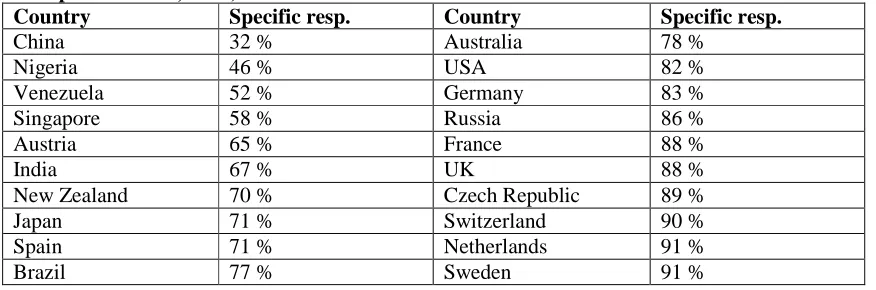
(13) IX. LIST OF TABLES TABLE 1: PDI scores for twenty countries/regions…………………………………34 TABLE 2: IDV scores for twenty countries/regions………………………………...35 TABLE 3: MAS scores for twenty countries/regions………………………………..36 TABLE 4: UAI scores for twenty countries/regions………………………………...37 TABLE 5: LTO scores for twenty countries/regions………………………………..39 TABLE 6: Hofstede’s eight culture areas…………………………………………...39 TABLE 7: Characteristics of Hofstede’s culture categories………………………...40 TABLE 8: Universalist responses to “The car and the pedestrian” dilemma……….43 TABLE 9: Individualist responses to “The quality of life” dilemma……………….46 TABLE 10: Neutral responses to the “Upset at work” dilemma……………………47 TABLE 11: Specific responses to the Paint the house” dilemma…………………...48 TABLE 12: Achievement orientated responses to the “Respect depends on family background” dilemma………………………………………………….49 TABLE 13: Inner-directed responses to “The captain of their fate dilemma”……....52.
(14) X Abbreviations AUD …………Australian dollars CCT …………Cross-cultural training CVS …………Chinese values survey DIMIA ………Department of Immigration, Multicultural and Indigenous Affairs DMIS ………..Developmental model of intercultural sensitivity FSI …………..Foreign Service Institute IDI …………..Intercultural development inventory IDV…………..Individualism index LD …………...Less-developed LTO…………Long-term orientation index MAS ………...Masculinity index MD.………….More-developed NGO ………...Non-governmental organisation Orig. …………Original PDI …………..Power-distance index Resp. ………...Response SIETAR ……..Society for intercultural education, training and research UAI ………….Uncertainty avoidance index.
(15) 1 Chapter 1: Thesis Introduction. Cross-cultural training Cross-cultural training (CCT) is a form of adult education aimed at developing “the awareness knowledge and skills needed to interact appropriately with culturally diverse customers and coworkers” (Bean, 2006, p.2). Since the 1960s, cross-cultural training has developed into the product of a small multinational commercial industry. Despite a growing body of research into intercultural communication and demographic surveys of the CCT industry, there has been little investigation into how cross-cultural training courses conceptualise ‘culture’ or the influence CCT has on consumers’ orientations towards diversity. CCT is simultaneously representative of discourses on diversity and a facet of a wider debate on the nature of culture. This study uses participant observation, semi-structured interviews and discourse analysis to provide a critical perspective on representations of these debates within the context of Australian cross-cultural training and cognitive anthropological theory to suggest directions for the refinement of the conceptions of culture presented in CCT courses.. The Australian cross-cultural training industry predominantly consists of small consultancies and individual trainers (Bean, 2006). However, training is also offered by larger multinational CCT companies, public sector departments, NGOs and educational institutions. The Australian organisations using cross-cultural training are approximately 2/3 public sector organisations and 1/3 private sector companies (Bean, 2006, p.3). The products of the CCT industry include books, seminars, consultations and internet training. However, the most common form of CCT delivery is through day long workshops (Bean, 2006). CCT workshops attempt to cultivate understandings of culture which will encourage cultural sensitivity. However, culture is a contested concept; there is no universally accepted definition or theory of culture. The absence of academic consensus on the exact nature and influences of culture raises questions as to which understandings of culture CCT courses are adhering to and promoting. This thesis attempts to answer these questions through an exploration of the origins, content and influences of crosscultural training courses.. Prior research into the CCT industry has documented the origins, demographics, content and methods of training courses. The origins of cross-cultural training have been traced to the work of.
(16) 2 the anthropologist Edward T Hall, for the American foreign service institute, during the early 1950s (Leeds Hurwitz, 1990; Moon, 1996). However, the relative influences of different anthropological schools of thought, on the conceptions of culture advocated by the CCT industry, have not yet been investigated. The most comprehensive investigation of the Australian CCT industry, to date, is a review commissioned by the Department of immigration, multicultural and indigenous affairs (DIMIA) entitled “The effectiveness of cross-cultural training in the Australian context” (Bean, 2006). The DIMIA review provides comprehensive demographic and organisational information on the Australian CCT industry. However, this review does not elaborate on the content of CCT courses. The content of CCT courses has been quantitatively investigated in a previous international study conducted by Fantini and Smith (1997). Fantini and Smith (1997) surveyed fifty CCT courses in eleven different countries and identified the most popular “models” for intercultural training (Fantini & Smith, 1997). These “models” are culture theories which inform the content of CCT workshops. Previous evaluative studies have identified several theoretical and methodological problems with the manner in which cultural values are represented by these models (McSweeney, 2002). However, no prior research has investigated the relationship between anthropological culture theory and the conceptions of culture presented in CCT training models, or the manner in which theoretical CCT models are translated into training materials. The methods and goals of CCT courses have been analysed in multi-disciplinary studies. Training methods, such as lectures and simulations, have been assessed as to their success in achieving particular training goals. (Bennett, 1986; Milhouse, 1996; Pruegger & Rogers, 1994). CCT researchers have also produced and evaluated assessment tools for the measurement of intercultural competence (Bennett, 1986; 1993; Hammer & Bennett, 1998; Bennett & Bennett 2001; Hammer, Bennett & Wiseman, 2003). However, there has been no investigation into the influences of CCT on trainees’ orientations towards diversity. Critiques of CCT’s representations of diversity demonstrate the need for such an investigation.. Critical literature on cross-cultural training is minimal, but severe. In 1999, G. Jack and A. Lorbiecki produced a damning critique of representations of cultural diversity within crosscultural training materials. The critique was launched from a post-modernist perspective, drawing heavily on the work of Edward Said (2003, orig. 1978). The criticisms raised against the industry were that it was promoting static, essentialist interpretations of cultural identity and encouraging divisionary processes of ‘othering’ (Jack & Lorbiecki, 1999). These criticisms are similar to the arguments post-modernist critics have raised against anthropological conceptions of culture (Abu-.
(17) 3 Lughod, 1991; Appadurai, 1996; Wikan, 1999). Jack and Lorbiecki (1999) began to apply the postmodernist critique to the cross cultural training industry. These criticisms press for further investigation if cross-cultural training is to be used as a tool for the promotion of intercultural understanding. It is also necessary to investigate whether CCT can be defended using the arguments anthropologists employed to defend ‘culture’ (Brumann, 1999).. A review of prior cross-cultural training research demonstrates some significant gaps in our knowledge of the theoretical orientations and influences of CCT. Prior investigation into CCT content has revealed the popularity of CCT models of culture as training tools, and evaluative studies have identified conceptual and methodological problems with some of these models. Yet, there has been no investigation into the theories of culture which these models adhere to, or analysis of representations of these models within training workshops. CCT researchers have developed assessment tools for the measurement of intercultural competence, but no one has examined the influence of CCT on trainees’ orientations towards diversity. CCT representations of diversity have been criticised for promoting essentialist notions of culture and encouraging processes of ‘othering’. However, further investigation is required in order to determine the applicability of this critique to CCT conceptions of culture and to explore potential avenues for the augmentation of CCT conceptions of culture using cognitive anthropological theories, such as schema theory and connectionism, as posited by Strauss and Quinn (1994). Potential defences and opportunities for the refinement of CCT teachings must also be explored. These gaps in our understandings of CCT content and influence place limitations on evaluations of CCT practice. The investigations into CCT theory, content and influence, conducted throughout the following chapters, will enable more comprehensive evaluations of the utility of CCT and identify the potential for using cognitive anthropology in the future development of this industry.. Aims The primary aims of this study are to determine how CCT courses conceptualise culture, the relative influence of the discipline of anthropology on CCT conceptions of culture, and the impact of CCT on participants’ orientations towards diversity. The following chapters provide an analysis of manifestations of discourses on culture and diversity within the CCT industry. This analysis enables an evaluation of the applicability of the post-modernist culture critique to crosscultural training practice. The following series of research questions have been devised in.
(18) 4 accordance with these aims, on the basis of preliminary reviews of training materials and culture theory. The methods used to answer these questions are explained in detail in the following section.. Research questions 1. How do CCT courses conceptualise culture? i.. How do CCT models conceptualise culture?. ii.. How do the conceptions of culture found in CCT models relate to the conceptions of culture found in training materials?. 2. How do understandings of culture found in CCT courses and models relate to anthropological understandings of culture? i.. Which anthropological schools of thought have been most influential in the emergence of the CCT industry and the development training models?. 3. How does CCT affect participants’ understandings of culture and diversity? i.. Can one detect the influence cross-cultural training in participants’ understandings of culture and their framing of intercultural encounters?. ii.. Do the differing conceptualisations of culture, presented in CCT courses, produce differing participant reactions to training?. 4. How do debates on the nature of culture and discourses on diversity manifest in cross-cultural training? i.. How does CCT discourse construct cultural identity, cultural values, individual agency and the ‘other’?. ii.. Does the postmodernist culture critique apply to the representations of culture promoted by CCT?. iii.. If so, can CCT be defended with the same arguments employed to defend anthropological conceptions of culture?. Methodology.
(19) 5 The primary methods used in this study are literature reviews, participant observation, semistructured interviews, reviews of training materials and discourse analysis. Literature on CCT theory, CCT analysis and culture theory is collated and reviewed. Personal participation in two CCT courses provides a subjective experience of cross-cultural training and information on CCT content. Information on training content is also obtained through semi-structured interviews with CCT producers and consumers. These interviews also provide information on participants’ understandings of culture and the influences of CCT. Additional training materials are obtained through internet searches and provided by training companies and participants. The data obtained is subjected to a critical discourse analysis. The discourse analysis examines patterns of expression and rhetoric within training materials, identifying the differing constructions of identity, agency and values, present within CCT discourse.. The review of CCT theory consists of an examination of the content of the CCT models of culture which inform the content of training materials. This examination reveals how the creators of the models define culture and the theories of culture which the models adhere to. The review of analytical CCT literature explores prior critiques of CCT models and enables the identification of conceptual problems inherent within the culture theories which these models present. The subsequent review of anthropological culture theory provides a theoretical basis for the evaluation of CCT models and training materials.. CCT training materials are obtained through participation in training, provided by participants, and gathered through library and internet searches. Personal participation, in a day-long crosscultural training workshop and a 3 month on-line training course, provides access to training materials in the forms in which they are presented to trainees. The training materials provided by participants are analysed in conjunction with the participants’ descriptions of the training programs they attended. Further information on training content is provided in the form of training videos, and booklets designed to accompany workshops. These videos and booklets are provided by training companies and obtained through library and internet searches. Training materials are examined as to their explicit and implicit conceptions of culture, identity, values and agency. The sources of training materials are not refereed to directly in order to protect the anonymity of training providers..
(20) 6. The analysis of training materials is conducted in conjunction with the information obtained through literature reviews. This conjunctive analysis enables the identification of CCT conceptions of culture. The examination of the explicit and implicit understandings of culture presented in training materials, combined with the reviews of CCT theory and anthropological culture theory, reveals the theoretical perspectives on which training programs are based. Comparisons between CCT content and CCT theory reveal the relative influence of CCT models on training programs and demonstrate how concepts from models are incorporated into training workshops. Comparisons, between CCT theory, training materials and anthropological culture theory, reveal the relative influences of different anthropological schools of thought on CCT content. The influence of CCT on participants’ understanding of culture is examined through a process of qualitative semi-structured interviews.. The interviews are designed to reveal the influence of CCT on participants’ orientations towards diversity. The interviews also provide information on CCT practice and content. The target groups for participation are adults, of any age, gender or ethnicity, with some form of intercultural experience, either through migration or interactions with culturally diverse clients and co-workers. Involvement in CCT is not an exclusive criterion for participation. Participant’s actual involvement in CCT ranges from none, over CCT consumers, to CCT trainers. Participants are recruited using a snowballing technique. E-mail and postal information sent to potential participants from a range of businesses, services and NGOs, contained requests that the information be forwarded to others who may be interested in participating. Details of the study and forwarding requests sent to 86 organisations, received 27 responses, resulting in six interviews. The six participants come, primarily from multi-cultural service providers and NGOs; they are predominantly female, 35-50 years old and have some experience of CCT. These characteristics reflect trends within the Australian cross-cultural training industry as identified by Bean (2006). During the interviews participants are invited to talk about their experiences of cultural diversity, culture identity and cross-cultural training. The interviews consist of broad questions, designed to prompt narrative accounts of participants intercultural and CCT experiences. In addition, participants are asked specific questions about their involvements with CCT, about the types, duration and content of courses attended or given..
(21) 7 The interview findings are subjected to a comparative analysis, in which participants’ narrative accounts of intercultural interactions and responses to questions on culture are compared to CCT teachings. It is assumed that greater levels of involvement with CCT will produce understandings of culture which exhibit similarities with the understandings of culture presented in CCT courses. Participants’ accounts and responses are also compared with each other, in order to see if responses from participants with greater experience of CCT exhibit more similarities with CCT teachings than those of participants with less CCT experience. Participants orientations towards diversity are assessed through the comparison of interview statements with statements corresponding to diversity orientations identified in the “Developmental Model of Intercultural Sensitivity” (DMIS) (Bennett, 1986; 1993).. The DMIS is a model for the categorisation of people’s orientations towards diversity according to six basic types; the first three types are classified as ethnocentric, the second three are classified as ethno-relative (Bennett, 1986; 1993). The first of the ethnocentric DMIS orientations is “Denial”. “Denial” is an attitude characterised by ignorance, or non-recognition, of cultural diversity (Bennett, 1986; 1993). The second ethnocentric orientation is “Defence” and entails recognition of the existence of cultural diversity, but diversity is seen as threatening. “Defence” is characterised by beliefs in the superiority of one’s own culture, and a critical, or derogatory, attitude towards other cultures (Bennett, 1986; 1993). The final ethnocentric orientation is “minimization”, a state in which diversity is recognised, but certain aspects of one’s own cultural value system are perceived to be universals (Bennett, 1986; 1993). The first ethno-relative orientation is “Acceptance”. People at “Acceptance” recognise the existence and validity of a multiplicity of cultural values (Bennett, 1986; 1993). The second ethno-relative orientation is “Adaptation”. “Adaptation” is when one’s experiences of another culture, results in the expansion of one’s worldview to include perceptions, attitudes and behaviours appropriate to the other culture (Bennett, 1986; 1993). The final ethno-relative orientation is “Integration” and is characterised by the incorporation of multiple cultural worldviews into ones understanding of oneself. (Bennett, 1986; 1993; Hammer & Bennett, 1998; Bennett & Bennett, 2001). Within CCT, DMIS orientations are measured using the intercultural development inventory (IDI). The IDI is a questionnaire used to assess where a person’s orientation towards diversity lies on the DMIS scale (Hammer, Bennett & Wiseman, 2003). Due to funding constraints the IDI was not directly accessible for use in this study. However, published literature surrounding the development of the IDI provides examples of statements which correspond to DMIS orientations.
(22) 8 (Hammer et al, 2003). These example statements form the basis of a comparison between the narrative accounts, of experiences of diversity, provided by participants and DMIS orientations. This comparison enables conclusions to be drawn about CCT’s potential to encourage ethnorelative attitudes.. The final research question, “how do debates on the nature of culture and discourses on diversity manifest in cross-cultural training?” is answered using critical discourse analysis. Patterns of expression, formulation and rhetoric within CCT theory and training materials are examined as to how they construct identities, values and agency. The public and persuasive natures of discourses on diversity within CCT are examined, in conjunction with an elucidation of the power relations implicit in CCT discourse. The critical analysis of these discourses enables the determination of whether post-modernist criticisms of ‘culture’ apply to representations of culture within CCT theory and training courses. The post-modernist criticisms of culture raised against anthropology and CCT centre around certain representations of ‘culture’ and ‘the other’ (Abu-Lughod, 1991; Brumann, 1999; Said, 2003; Wikan, 1999). In order to assess the validity of these criticisms, as they apply to CCT, it is first necessary to demonstrate how culture and diversity are represented by the industry; this is the purpose of the discourse analysis.. Critique of the concept of ‘culture’ reached prominence within anthropology in the 1990s. Criticisms centred around the idea that the concept of culture, “suggests boundedness, homogeneity, coherence, stability and structure, whereas social reality is characterised by variability, inconsistencies, conflict, change and individual agency” (Brumann, 1999, p.1) Some anthropologists began to question whether the concept of ‘culture’ had acquired essentialist connotations, like the concept of race (Wikan, 1999; Appadurai, 1996). Some advocated “writing against culture” and suggested an abandonment of the concept (Abu-Lughod, 1991; 1993), others defended the concept, arguing that criticisms of culture only apply to certain misuses of the concept, not the concept itself and that culture “should be retained as a convenient term for designating the clusters of common concepts emotions and practices that arise when people interact regularly” (Brumann, 1999; p.1). The contours of this debate are explored in full in the review of anthropological culture theory contained in chapter Five. It is suggested that cognitive anthropological theory may be used to negotiate the contradictions between the existence of cultural specificity and universal human traits, as raised by critics of the concept of culture. The.
(23) 9 subsequent critical analysis of CCT discourse enables, firstly, a demonstration of how culture is conceptualised by the industry and secondly, an assessment of whether criticisms surrounding the misuse of ‘culture’ apply to representations of culture within the CCT industry.. Anthropology and cross-cultural training CCT aims to influence trainees understanding of culture(s) in a manner that will produce ‘appropriate behaviours’ during intercultural interactions. The success of CCT is not only dependent on whether training influences trainees’ understandings of culture, but also how training influences trainees’ understandings of culture. Cross-cultural training has the potential to become usable a tool for the wide scale promotion of positive intercultural relations. However, whether these ends are achievable through cross-cultural training depends on what is being taught and how training is affecting participants’ orientations towards diversity. If the accusations of neo-imperialism raised by Jack and Lorbiecki (1999), or the arguments of the ‘culture critique’, apply to current CCT teachings then the aspiration, of using CCT to promote intercultural understanding, is not achievable without the reformulation of training programs. Cognitive anthropology provides a possible direction for the reformation of CCT conceptions of culture and the final chapter of this thesis will explore how and why this reformation should occur.. Many of the researchers that have produced and assessed CCT models have a large stake in the industry, often owning or selling their work to CCT companies. The most damning criticisms of the industry have accused CCT of promoting reductive, essentialist, notions of culture (Jack & Lorbiecki, 1999). If these criticisms are valid, and the CCT industry is characterised by a hegemonic discourse surrounding specific interpretations of culture, one must ask whether this discourse is perpetuated by the fact that the academic impetus and evaluation of CCT is dominated by those with stakes in the industry. At least, the interplay of research and corporate investment, should raises questions about whether subjectivities and vested interests are influencing trends within CCT evaluations..
(24) 10 Some anthropologists exhibit a slightly disparaging attitude to cross-cultural training describing it as a “packaged way to know ‘other’ cultures” (Peacock, 2001, p.76, orig. 1986). Others interpret CCT as an aspect of the commoditisation of a consumer concept of culture (Kahn, 1995). However, if criticisms of CCT’s representations of ‘culture’ and ‘the other’ apply, surely it is the responsibility of anthropologists to refine the understandings of culture promoted by this industry. As Wikan (1999) argues it is “our concept that is loose on the streets.” (p.62). The cross-cultural training industry developed out of the teachings of anthropology. It is therefore the responsibility of anthropologists to monitor, evaluate and if necessary refine CCT teachings; and aid the development of this industry in a direction that will promote positive intercultural relations and public wellbeing in multicultural societies, such as Australia.. This thesis uses anthropological culture theory as a framework for the analysis of CCT teachings and suggests that schema theory and connectionism, as posited by Strauss and Quinn (1994) could be used as a framework for refining CCT conceptions of culture in such a way as to avoid the accusations of neo-imperialism raised by Jack and Lorbiecki (1999). The processes of participation observation and semi-structured interviews provide qualitative data on the teachings and influences of cross-cultural training. A critical analysis of CCT discourses enables an assessment of the validity of criticisms raised against the CCT industry. The results of this thesis demonstrate how CCT courses conceptualise culture, the relative influences of anthropological culture theory within the CCT industry, and the influence of CCT on trainees’ orientations towards diversity. These results enable conclusions to be drawn about the utility of cross-cultural training and the identification of how CCT conceptions of culture could be refined through the integration of CCT and cognitive anthropological theory.. . Chapter overview Chapter two begins with an introduction to the CCT industry. This introduction provides a review of the historical origins and growth of the CCT industry. This historical review is followed by a profile of the contemporary Australian CCT Industry. The Industry profile is followed by a generic description of a CCT workshop. The purpose of this chapter is to familiarise the reader with the character and practices of the industry under investigation..
(25) 11 Chapter three introduces CCT models of culture. The chapter focuses on three of the most popular CCT models, as identified by Fantini and Smith (1997). The chapter begins with an explanation of Edward Hall’s (1959; 1969; 1977) theories on the influences of culture on peoples’ temporal, spatial, and communicative orientations. This explanation is followed by descriptions of Geert Hofstede’s (1980; 2005) five dimensional model of culture and Trompenaars’ and Hampden-Turner’s (1997) seven dimensional model of culture. The introduction to these models provides the reader with an understanding of the theories which inform CCT content.. Chapter four provides an evaluation of these training models based on critical literature produced by Brendan McSweeney (2002). The evaluation explores the merits and applicability of the criticisms raised against CCT models of culture, with a specific focus on Geert Hofstede’s (1980; 2005) five dimensional model. The evaluation also explores Hofstede’s (2002) replies to the criticisms raised by McSweeney (2002), and investigates whether these replies constitute a comprehensive defense of the five dimensional model. Chapter four concludes with an exploration of the impacts of dimensional models on training content and an introduction to alternative, developmental, approaches to CCT. This chapter explains some of the theoretical and conceptual problems inherent in the models introduced in chapter three and discuses the impacts of these problems on cross-cultural training programs.. Chapter five contains a review of anthropological culture theory. The purposes of this chapter are to demonstrate the contested nature of the concept of culture and introduce some diverse theoretical perspectives on the nature and influences of culture. The chapter begins with an exploration of the historical origins of the term ‘culture’ and continues with a discussion of early European social anthropology. This discussion covers Tylor’s (1958, orig. 1871) theory of social evolutionism, Durkheim’s (1964) theory of social solidarity, and the differing functionalist theories of Malinowski (1944), Radcliffe- Brown (1952) and Evans-Pritchard (1976; 1940). The chapter continues with an exploration of American cultural anthropology and the theories of Boa’s (1931, 1932), Benedict (1955, 1975), Kroeber (1944, 1952) and Sapir (1968). The review of early American cultural anthropology is followed by an introduction to Levi-Strauss’ (1963) theory of structuralism and Geertz’s (1973) interpretivist theory of culture. The chapter then explores developments in the field of cognitive anthropology and explanations of culture which utilise schema theory and connectionism (Strauss & Quinn, 1994). The introduction to cognitive.
(26) 12 anthropology is followed by an exploration of the arguments of the post-modernist culture critique, as raised by theorists such as Abu-Lughod (1991), Appadurai (1996) and Wikan (1999). The chapter concludes with the suggestion that conceptualisations of culture based on cognitive anthropological theory could be used to avoid the criticisms of the culture critique. This chapter demonstrates the intricacies and contested nature of the concept on which cross-cultural training is based and provides a basis for the evaluation of CCT conceptions of culture.. Chapter six provides an analysis of CCT content based on the findings of semi-structured interviews, processes of participant observation and collections of training materials. This chapter identifies themes within CCT content, demonstrates how CCT models of culture are integrated into training workshops and investigates participants’ responses to training. The analyses in this chapter demonstrate the positive and negative aspects of current CCT practice and show how content influences participants’ reactions towards training.. Chapter seven investigates CCT conceptions of culture by means of critical discourse analysis. The chapter begins by comparing the conceptions of culture presented in CCT models with the anthropological theories of culture outlined in chapter five. This comparison explores the applicability of the culture critique to representations of culture within dimensional CCT models. Patterns of expression and rhetoric within training materials are examined as to how they construct identities, values and the ‘other’. Participants’ conceptions of culture and orientations towards diversity are then examined and compared to the orientations outlined in the DMIS. The comparison of participant orientations towards diversity with DMIS orientations enables conclusions to be drawn about the relative influences of cross-cultural training on these participants’ understandings of culture. The final section of chapter seven suggests directions for future CCT research and the further development of the industry using cognitive anthropology, schema theory, and connectionism. In conjunction, the following chapters aim to contribute to an expansion of our evaluative knowledge of CCT content and influence..
(27) 13 Chapter 2: The Cross-cultural Training Industry. Introduction The following chapter provides an introduction to cross-cultural training (CCT). The origins of CCT, in the work of Edward T. Hall for the American Foreign Service Institute (FSI), are discussed, along with the paradigm that this early training set for future CCT. This discussion is followed by a historical overview outlining the circumstances that led to the development and expansion of the cross-cultural training industry. Following the historical overview is a contemporary profile of the Australian CCT industry, based on the findings of Robert Bean (2006), as outlined in the DIMIA report “The effectiveness of cross-cultural training in the Australian context”. The profile identifies norms among CCT producers and consumers, and introduces distinctions among types of training. The contemporary CCT profile is followed by a generic description of a cross-cultural training workshop. The workshop description is based personal experiences of CCT, in conjunction with information on training provided by participants, and the findings of the DIMIA report. The purpose of this chapter is to familiarise the reader with cross-cultural training and the CCT industry.. The origins of the cross-cultural training industry “The story of Intercultural communication starts at the foreign service institute” (Leeds-Hurwitz, 1990, cited in Rogers, Hart & Mike, 2002, p.8) The origins of modern cross-cultural training are often traced to the work of the anthropologist Edward T. Hall, for the American Foreign service institute (FSI), during the early 1950s. The FSI was developed in 1947, within the US department of state, in response to the underwhelming performance of American diplomats on overseas assignments (Moon, 1996). The institute provided language and foreign affairs training for state department employees, diplomats, Foreign Service and government agency workers, and military service branches (Rogers, et al, 2002). Hall was part of a team of linguists and anthropologists employed by the FSI to provide culture and language training for Foreign Service officials between 1950 and 1955 (Rogers, et al, 2002). Hall’s experiences of training at the FSI not only shaped his own subsequent studies of culture, but also created a paradigm for cross-cultural training which is still reflected in CCT courses today..
(28) 14 The FSI training originally consisted of introductory language training, mission orientation training, demographic studies of host countries and information on anthropological culture theory (Leeds-Hurwitz, 1990). Culture was taught about as a system of “shared information along with shared methods of coding, storing and retrieving that information” (Hall & Hall, 1989, cited in Moon, 1996, p.3). This original training used macro-level, mono-cultural analysis and focused on traditional anthropological topics of enquiry, such as kinship systems and sociocultural institutions (Rogers, et al, 2002). The FSI trainees responded negatively to the anthropological culture theory taught by Hall (Moon, 1996). Trainees reported finding the culture theory difficult to understand, lacking in specific, or concrete, information and irrelevant to their assignments (Moon, 1996). The training was generally perceived as unnecessary and unimportant (Moon, 1996). The training was further complicated by the ethnocentrism of the trainees, the political and bureaucratic objectives of the FSI, and a disregard for the practical value of anthropology (Hall, 1959, cited in Rogers, et al, 2002; Moon, 1996). These negative responses prompted Hall and his colleagues to modify the FSI curriculum. The FSI trainers abandoned the teaching of anthropological perspectives on culture in favour of a more “pragmatic and goal-orientated” approach (Moon, 1996, p.3).. The modified FSI curriculum focused on comparisons between ‘national’ cultures, rather than the study of single cultures (Moon, 1996). Trainees studied non-verbal communication and training focus changed to an emphasis on micro-cultural analysis and the provision of information on specific cultural traits such as orientations towards time, body language and tone of voice (Leeds-Hurwitz, 1990). The emphasis on traditional anthropological areas of enquiry, like kinship systems, was replaced by a dyadic approach which concentrated on the nature of interactions between individuals from different cultures (Moon, 1996). Anecdotal accounts of intercultural interactions were introduced as training tools and trainers began to utilise participatory training methods, such as simulations and role plays. Intensive day-long workshops became the main method of CCT delivery (Moon, 1996; Rogers, et al, 2002).The FSI trainees were far more receptive to the new curriculum; Hall used it to train approximately 2000 people during his five years of employment at the FSI (Rogers, et al, 2002).. The new training paradigm, set by the revised FSI curriculum, influenced both the methods and content of future training programs. The methods of training introduced by the FSI curriculum,.
(29) 15 such as intensive workshops, the use of anecdotes, role plays and simulations, have become standard CCT practices, albeit in refined forms. The dyadic focus of the FSI training, which compared practices from different cultures, is reflected in the ‘cultural contrast’ approaches utilised by many CCT trainers today. The equation of cultural identity with nationality, set up by the early FSI training, still occurs within some contemporary training courses. The under recognition of intra-national diversity, which can result from such equations, is an expressed concern of many contemporary CCT analysts (Moon, 1996; Jack & Lorbiecki, 1999). The extent to which the FSI paradigm has influenced training methods is demonstrated in the industry profile contained in the following section of this chapter.. The pragmatic, goal orientated approach of the FSI training heavily influenced the content of future CCT. The reform of the FSI training program shifted training focus from, ideational anthropological conceptions of culture, onto pragmatic “operationalised notions of cultural variation” (Moon, 1996, p.7). These “operationalised notions of cultural variation” focus on the micro level analysis of specific cultural traits, such as time orientation or societal tendencies towards individualism or collectivism (Moon, 1996). The apparent incompatibility of anthropological culture theory and the desires of CCT trainees is reflected in an account of training given by Tina, a CCT trainer, during her interview. During a conversation about the influence of trainers’ philosophical view points on training, Tina gave the following account of a young anthropologist employed as a trainer by her company: We’ve actually got a worker at the moment that has some of these issues. He’s from an anthropologist background, so he’s got some major issues. When you’re training you have to use the language of the audience and you have to link it. ..., it’s not simple English, but he can’t go on and talk about dialectics and things like this, because you’re just going to create a barrier ... The first session he did they all walked out and told their co-ordinator they felt dumb and stupid and they didn’t want [him] back. (Tina, Personal communication, 27.04.08). Tina’s account of the consequences of mixing anthropology with CCT mirrors Hall’s (1959) reports of teaching anthropological culture theory at the FSI. The anthropologist’s trainees found the culture theory incomprehensible and irrelevant, demonstrating there is still no place for traditional anthropological theory in cross-cultural training. Earlier during the interview Tina talked about trainees’ wants and expectations;.
(30) 16 They want to know “how can I improve my way of communicating with Mr Blogs, so that …” or “we’ve got a worker that slams down the phone anytime someone’s got an accent.” (Tina, personal communication, 27.04.08) Tina’s experiences of trainees’ desires for relevant, practical, goal-orientated training also reflect Hall’s experiences of trainee responses at the FSI. The FSI training recognised trainees desires and laid out norms for CCT. However, it was demographic change and globalisation that drove the growth of CCT, from its origins at the FSI, into the product of an international industry.. The growth of the cross-cultural training industry is primarily attributable to changes in population demographics and corporate internationalisation (Jack & Lorbiecki, 1999). During the 1960s, corporate internationalisation began to stimulate interest in questions about how companies should best respond to the challenges of international commerce, such as foreign finance, international marketing, and international human resources management (Jack & Lorbiecki, 1999). Demographic changes, caused by increased migration and international employment opportunities, in the period after world war two, had resulted in increasingly diverse workforces within many countries. During the 1970s, companies in so-called ‘developed’ countries were becoming progressively concerned with how best to recruit, manage and retain workers within culturally diverse societies (Jack & Lorbiecki, 1999). Debate surrounding diversity management emerged in the early 1980s, replacing discourses on the acultural nature of management, which had previously dominated the fields of management and business studies (Jack & Lorbiecki, 1999). During the 1980s, cultural differences were increasingly conceptualised, by both corporations and scholars, as potential sources of national and international corporate ineffectiveness (Jack & Lorbiecki, 1999). Nationally based companies and multi-nationals, in Europe, the US, Canada and Australia, were becoming increasingly concerned about the impact of cultural diversity on company efficiency and CCT appeared to be the solution to these concerns.. Globalisation and increasing competition on the global market, combined with diversifying workforces, presented companies with new challenges in the areas of recruitment, retention and management. Managers were concerned with how to recruit and retain employees in.
(31) 17 multicultural societies and executives were concerned about the internal conflicts which differing cultural interpretations of effective group membership could cause and the affects these internal conflicts could have productivity and competitiveness (Jack & Lorbiecki, 1999). Companies sought a competitive edge as they tried to break into foreign markets, negotiate international mergers and manage diverse workforces. Increasing staff’s intercultural competence was seen as a possible means by which companies could gain this competitive edge (Jack & Lorbiecki, 1999). Cultural differences were conceptualised as a potential source of corporate weakness and cultural awareness was perceived as a resource for negating this weakness. As a result, cultural differences were increasingly perceived as legitimate areas for management control (Jack & Lorbiecki, 1999). “The moral imperative of respect and tolerance at work ... [was] given commercial respectability through its connection with improved business performance and a better bottom-line” (Jack & Lorbiecki, 1999, p.7). By the mid 1980s, the business case for cross-cultural training was made. There was a perceived need for managers and staff to develop their knowledge of different cultural values and increase their intercultural communication skills. This need prompted corporate investment in academic research which led to the development of models of culture and frameworks for corporate cross-cultural training (Jack & Lorbiecki, 1999). This institutional response to the challenges of globalisation grew into the contemporary cross-cultural training industry.. The emergence of the cross-cultural training industry was fuelled and legitimised by the corporate drive for competitiveness on the global market, yet the character of this industry was still heavily influenced by the paradigm set by Hall’s FSI training program. The models of culture and training frameworks developed during the1980s and 1990s, in response to the corporate need for cultural awareness, retained many characteristics of the revised FSI curriculum. The models of culture created for training frequently utilised the dyadic approach to intercultural study introduced by Hall and simulations, role plays and anecdotes became common CCT training methods. Jack and Lorbiecki (1999) situate the impetus for the growth of the CCT industry in the world of international commerce. However, since its emergence in the mid 1980s the cross-cultural training industry has increasingly come to be utilised by public sector organisations, NGOs and governments..
(32) 18 Australian cross-cultural training: An industry profile The following industry profile describes the defining characteristics of the contemporary Australian CCT industry. The Australian CCT industry is currently dominated, in both provision and consumption, by public sector organisations and NGOs (Bean, 2006). Yet, the paradigm set by the FSI curriculum and the influences of international commerce are still apparent in modern Australian training methods. The following profile describes the multiple products of the CCT industry and the characteristics of CCT producers and consumers. The statistical data included in this profile are taken from the DIMIA report “Cross-cultural training in the Australian context” (Bean, 2006). This report constitutes the most comprehensive review of CCT in Australia, to date. The use of CCT has undoubtedly fluctuated slightly in the years since the DIMIA study. However, the general nature, parameters and distribution of CCT remain fairly consistent, so the information in the report can still be considered representative of the general character of the Australian CCT industry.. Australia is a multicultural society, approximately one quarter of Australia’s resident population was born overseas and Indigenous Australians make up an estimated 2.5% of the total population (Australian Bureau of Statistics, 2007). Cross-cultural communication, defined simply as a communicative act between people who identify themselves as coming from different cultural backgrounds, is an everyday occurrence for many Australians. Cultural competence is defined in the DIMIA report as “the ability of systems, organisations, professions and individuals to work effectively in culturally diverse environments and situations” (Bean, 2006, p.2). Australia’s cultural diversity makes cultural competence a necessity for successful business practice and service provision. Cross-cultural training is increasingly being recognised, by the Australian public sector, as a resource for aiding the development of cultural competence among employees. The increasing demand for CCT, within the Australian public sector, is being driven by both customer expectations and diversity orientated policy initiatives (Bean, 2006). However, public sector demand has not altered the corporate character of CCT.. The role of CCT, as a tool for increasing competitiveness, is still apparent in the terminology of the DIMIA report. The DIMIA report refers to the cultural competencies, which CCT aims to facilitate, as necessary for the development of the “social cohesion” which Australia needs in.
(33) 19 order to increase its chances of attracting skilled migrants on the international labour market (Bean, 2006, p.2). Situating CCT so firmly in the language of commerce demonstrates the continued role of CCT as a tool for increasing competitiveness. However, the DIMIA report also illustrates further developments in the story of this industry. The report found that two thirds of Australian CCT consumers are public sector organisations, whereas private sector companies only account for one third of Australian CCT consumption (Bean, 2006). The report also identified a diversification and specialisation of CCT products, which has occurred since the emergence of the industry in the mid 1980s.. Cross-cultural training has come to be used as a broad label for a number of specialised subcategories of culture and communication training. The DIMIA report identifies four broad types of cross-cultural training (Bean, 2006). These types are culture general training, culture or ethno specific training, training on working with interpreters and specialised, or industry specific, training (Bean, 2006, p.31). Culture general CCT is a broad form of training, focusing on the influences of culture on perceptions, values, behaviours and interactions (Bean, 2006). Culture general CCT provides trainees with information on cultural differences, often presenting strategies for successful intercultural interactions and using information on specific cultures as a means of illustrating the affects of culture on behaviour. Culture, or ethno, specific CCT also provides information on the nature and influences of culture. However, the focus is on the practices of a particular subject culture and often the nature of interactions between the subject culture and the trainee’s home culture (Bean, 2006). Indigenous cultural awareness training is a form of culture specific CCT particular to Australia. Indigenous cultural awareness training focuses on Indigenous culture, service provision for Indigenous Australians and relations between Indigenous and non-Indigenous Australians. Training on working with interpreters provides information on the utilisation of interpreting services and the cultural dynamics of translation (Bean, 2006). Specialised, or industry specific, CCT is culture and communication training tailored to the needs of people in specific professions, such as policing or health care. Specialised CCT is also used to address specific topics, such as international business or working with refuges (Bean, 2006). The most common form of training provided and utilised within Australia is culture general CCT (Bean, 2006)..
(34) 20 Demand for CCT is identified, by bean (2006), as being driven primarily by managers requesting training for staff and staff requesting training. Demand is also driven by customer or client recommendations for staff and recommendations by trainers and multi-cultural officers within organisations (Bean, 2006). The organisations surveyed in the DIMIA report stated that their primary motivation for commissioning training events was the improvement of customer service (Bean, 2006). Improving workplace or community relations was also a commonly stated reason for conducting cross-cultural training, as was improving compliance with antidiscrimination, or access and equity, policies (Bean, 2006). The majority of organisations surveyed by Bean (2006) predicted that customer service requirements, demographic changes and multi-cultural policy initiatives would result in increased future demand for CCT.. CCT consumption patterns are fairly uniform. Organisations using CCT hold, on average, five training events a year (Bean, 2006). The main participants are staff level employees and the most commonly used form of training is culture general workshops (Bean, 2006). Training tends to be specifically tailored to either the needs of particular companies, or the occupations of attendees (Bean, 2006). Bean’s (2006) current practice survey showed that 48.7% of organisations had all training tailored to their organisation, whereas 42.3% had most of their training tailored to their organisation. The majority of trainees in the DIMIA survey reported that their attendance at training was voluntary (Bean, 2006). However, compulsory training is also common. Tina, a CCT trainer, provided the following comment regarding voluntary training; Often it’s a case of “train these volunteers, you, you, you and you”. (Tina, Personal communication, 27.04.08). Vera, a second trainer interviewed, reported that attendance is compulsory for most of the specialised CCT she provides; It is compulsory. We’ve done a few that were on the voluntary side, we didn’t have a bad turn out but it wasn’t as good as I would have hoped. (Vera, Personal communication, 22.04.08). Vera’s comments demonstrate that the compulsory or voluntary nature of training may impact turn-out. Two out of the four other participants interviewed also reported that the training they had attended was compulsory. Given the limited number of case studies undertaken, this finding should not be considered representative of any significant change within the industry. However, Tina’s comment demonstrates that participation in training, which is reported as being voluntary, may not be as elective, on the part of staff, as the label voluntary can make it appear..
(35) 21. Training providers in Australia are, to 96.6%, nationally based companies or independent trainers, with numbers of providers dispersed across the country relative to population density (Bean, 2006). Overseas and multinational training companies only account for 3.4% of Australian CCT provision (Bean, 2006). Most training providers are small to medium sized companies, approximately 64% employing 3, or fewer, full-time trainers (Bean, 2006). Organisations commission trainers both internally and externally. Bean (2006) found that 44% of organisations using CCT sourced trainers internally, whilst 20.9% sourced trainers externally and 35.2% sourced trainers both internally and externally. Externally sourced training is provided by government departments (45.7%), community organisations (42.9%), individual training consultants (37.1%) and private training organisations (27.1%) (Bean, 2006). Trainers are also occasionally sourced from academic institutions (Bean, 2006). The average cost of a CCT workshop is between $1750AUD and $3000AUD, the price range is similar to other forms of ‘people skills training’ (Bean, 2006). The cost of workshops in larger cities tends to be higher and costs also vary in accordance with the expertise of trainers (Bean, 2006). Workshops provided by NGOs and community organisations tend to be cheaper, costing only a few hundred dollars a day (Bean 2006). Like consumption, provision of CCT on the Australian market is dominated by the public sector (Bean, 2006). Training providers are characteristically small to medium sized nationally, or locally, based public sector organisations.. CCT trainers tend to be Australian citizens, female, with extensive training experience and an average age of forty-eight (Bean, 2006). Bean (2006) found 90% of trainers to be Australian citizens and 77% to be female. Trainers present an average of twenty workshops a year and have an average of eleven years experience providing CCT (Bean, 2006). For many trainers, the provision of CCT is an additional aspect of their job, rather than their primary occupation (Bean, 2006). Most cross-cultural trainers have personal experience of immersion within a foreign culture and many have qualifications in areas related to CCT such as linguistics, the humanities, or psychology (Bean 2006). Currently, there is no national accreditation process for cross-cultural trainers. However, 64% of trainers surveyed in an international CCT study were found to have attended some form of professional development training (SIETAR, 2004, cited in Bean, 2006)..
(36) 22 Approaches to cross-cultural training can be represented as existing on a continuum, ranging from purely didactic training to purely experiential approaches (Bean, 2006, p.32). Didactic training is presentation based, using methods such as lectures, discussions and the presentation of country profiles (Bean, 2006). Experiential training is interactive and utilises exercises, such as role plays and simulations (Bean, 2006). Trainees responding to Bean’s (2006) longitudinal survey reported, to 80.7%, that their training used a combination of both didactic and experiential approaches, 12.4% reported training used mainly didactic methods and 6.2% reported training used mainly experiential methods (Bean, 2006).. Workshops are the most frequently utilised methods of CCT delivery (Bean, 2006). However, some trainers and companies also offer distance or e-learning courses, in-house training, consultancy, or project management (Bean, 2006). All of the trainers and training providers surveyed in the DIMIA study reported that they provide training workshops (Bean, 2006). Half of the trainers surveyed for the DIMIA report also provide some form of private consultancy, such as mentoring or project management (Bean, 2006). The average length of a cross-cultural training workshop is 5.2 hours (Bean, 2006). Over 90% of the workshops utilised by public sector departments, between 2000 and 2005, were up to five hours long (Bean, 2006). Over Sixty percent of trainees surveyed by Bean (2006) expressed a desire for more training. Forty-one percent of trainees recommended longer training programs (Bean, 2006). Vera also mentioned that she would prefer to give longer training sessions. I would love to do a really good workshop that goes for about three days, but we can’t afford it. The staff can’t be out for that long, and so four hours was my compromise. With three days I think I could give people more of an immersion. Then get them to operate before and after and see how confident they’re feeling, things like that. (Vera, Personal communication, 22.04.08). The short duration of training workshops is significant given the complexity of the materials being taught and the attitudinal changes that CCT is attempting to facilitate.. Methods of training include lecturing, the use of cultural assimilators and simulations, role plays, anecdotal accounts of intercultural interactions and cultural contrasts (Bean, 2006). Lectures are used to present models of culture and theories of intercultural interaction (Bean, 2006). Cultural assimilators and simulations are case studies of intercultural interactions used to.
Figure


+7


Related documents
This research employs participant observation and semi-structured interviews to analyze the lived mental health experiences of current/former Disney cast members as a direct result
By categorising the risks identified from the literature review, combined with the risks identified from semi- structured interviews, this study listed pertinent risk
By way of response, this study draws on data collected from over 1000 h of participant observation and 53 semi-structured interviews to explore how underlying political and
Employing participant observation, in-depth interviews, and discourse analysis, this dissertation uses a case study approach to consider the ways that modern Mormon identities
Data sources included participant observation, child and staff semi-structured interviews, and the DDMS-S. Bussert-Webb documented field notes as she interacted with elementary
The study employs multi-sited ethnographic methods using methods of triangulation (semi-structured interviews, participant observation and visual analysis). Field work was conducted
The strategy of inquiry that informs the procedures is the case study design and research methods include participant observation of a community meeting, semi-structured
By drawing on 42 semi-structured interviews with musicians and other key actors in Montreal's independent scene, this case study engages with debates on the social foundations
