1 Construction
2 Cultural and creative industries
5 Hospitality 6 Manufacturing 7 Public administration 3 Financial services 4Health and social care 0 Overview
W
orkf
or
ce
Development
Lift for action plan 8 Retail 9 Transport and logistics 10 Voluntary and community
Learning and Skills Council London East
Boardman House, 64 Broadway, Stratford, London E15 1NT Telephone: 0845 019 4151 e-mail: [email protected] www.lsc.gov.uk
This strategy was written by Trevor Carr and members of the LSC London East Workforce Development team. Trevor Carr McKerr Carr Ltd Telephone: 020 8349 2110 www.mckerrcarr.com Designed by Creative Leap Telephone: 020 7549 0700 www.creativeleap.com
Nordland Papier AG is committed to the tradition of sustainable forest management and minimisation of its impact on the local environment.
WFD/LSCLE/024/03
W
orkf
or
ce
Development
Our
and
• Basic Skills Agency • Business Link for London • Connexions • DTI • DfE S
• Education Business Partnerships • Engineering Employers’ Federation South • Further education colleges • Higher education institutions • Jobcentre Plus
• Local authorities • London Development Agency • Made in London
• Manufacturing Advisory Service for London
• Private-sector employers • Production Industries Commission • Regeneration partnerships • Sector Skills Council for Science,
Engineering and Manufacturing Technologies
• Thames Gateway London Partnership • Trade unions
• Work-based learning providers
We, the Learning and Skills Council London East, fund training and education for those over age 16 in Barking and Dagenham, Bexley, City of London, Greenwich, Hackney, Havering, Lewisham, Newham, Redbridge and Tower Hamlets.
Learning and Skills Council London East Boardman House, 64 Broadway, Stratford, London E15 1NT Telephone: 0845 019 4151 e-mail: [email protected] www.lsc.gov.uk
©LSC 2003. Published by the
Learning and Skills Council. You may copy extracts from this publication for non-commercial, educational or training purposes as long as you acknowledge the source and do not misrepresent the findings. Readers please note:
• in this publication where ‘we’ is used, it refers to the Learning and Skills Council London East, and • we have used footnotes in this
MANUF
ACTURING
C
ontents
Foreword
Introduction
Executive summary
Chapter 1
Chapter 2
Chapter 3
Chapter 4
Chapter 5
Chapter 6
Pull-out section inside the back cover
2
3
4
6 The main features of the sector
6 The scope of the manufacturing sector 8 London East
10 Manufacturing – demand levels
11 Economic drivers 12 Competition and change 14 Skills issues
14 Skills gaps 14 Skill shortages
15 Skills supply for the sector
16 Higher education 16 Further education 16 Apprenticeships 16 Staff turnover 18 Other training 18 New developments 18 Summary
19 Key issues
19 The strengths of the sector 19 The needs of the sector
20 Strategic recommendations
The action plan
We are in the middle of an
exciting period of change.
London East’s 2 million
residents have seen many
changes in the last 10 years.
The new developments
announced for the Thames
Gateway show that there
will be further investment
and increased opportunities
during the next 10 years.
Mary Conneely
Executive Director
In every sector there is potential for growth. The proposal for major housing development in the Thames Gateway by the Deputy Prime Minister, in February 2003, is a boost for the construction industry. The Strategic Rail Authority and Transport for London have ambitious plans to develop the transport infrastructure. Health and social care, and financial services have their own challenges to meet as legislative changes place new demands on the workforce. The cultural and creative industries are thriving, and the retail sector can continue to grow with future town-centre redevelopments planned.
Our task, with you, our partners, is to make sure that London East is ready to meet these challenges with a highly skilled workforce. The consultation paper,Success for All1,in June 2002 set out the role of
learning providers. It stated that “learning in an area must meet national and local skill needs… and be responsive to local employers and communities.” This view was reinforced in the formal publication of Success for Allwhich set out the joint plans of the DfES and the Learning and Skills Council, in November 2002, to reform the learning and skills sector and raise standards.
This series of workforce development strategies explains the issues affecting each industrial sector. Each strategy then suggests some realistic action to support the skills development of local people. The aims are to meet employers’ needs, and to give individuals positive learning and employment experiences.
By delivering the actions in these 10 sector strategies, we will be helping to:
• fulfil our corporate objectives which we outlined in the Local Strategic Plan 2002-2005
• meet the requirements of the Learning and Skills Council’s National Policy Frameworkfor workforce development
• support the objectives outlined in London’s Framework for Regional Employment and Skills Action (FRESA)published by the London Skills Commission, and
• meet the aims of the Skills Strategy White Paper (2003).
MANUF
ACTURING
Intr
oduction
Workforce Development Strategies for London East
1 Construction
2 Cultural and creative industries 3 Financial services
4 Health and social care 5 Hospitality
6 Manufacturing 7 Public administration 8 Retail
9 Transport and logistics 10 Voluntary and community
1DfES,Success for All – Reforming Further Education and Training,Discussion Document, June 2002;
DfES,Success for All – Reforming Further Education and Training – Our Vision for the Future, November 2002.
2This does not include higher education provision.
The Learning and Skills
Council is responsible
for funding and planning
education and training
for those over 16 years
old in England
2.
Workforce development is one of the most challenging and exciting parts of our work, and in November 2002, the national office published its Workforce Development Strategy – National Policy Framework to 2005.
The National Policy Frameworkwas published at the same time as the Government report,In Demand: Adult Skills in the 21st century – part 2, produced by the Strategy Unit. These two documents suggested action that would promote workforce development. They state that we should:
• “raise informed demand for employment-related skills among individuals and employers • support improvements to the
responsiveness and flexibility of the supply side, and
• contribute to the development of an underpinning framework of better skills and labour market intelligence, responsive vocational qualifications and improved links to the wider educational agenda.”
Each sector strategy has an action plan which shows how we, at LSC London East, will take practical steps to meet those three objectives. By carrying out the action proposed for each sector, with you, our partners, we will directly contribute to delivering of the LSC’s goals, which are to:
• “raise the participation and achievement of young people
• increase the demand for learning and equalise opportunities through better access to learning
• engage employers in improving skills for employability and competitiveness • raise the quality of education and
training delivery
• improve effectiveness and efficiency.” This workforce development strategy for the manufacturing sector is one of ten sector-based strategies. Each one describes the current issues in the sector nationally and locally. They give details of the current levels of employment and skills in the sector, and suggest where improvements in skills are necessary to meet the needs of the local and national economy.
Ex
ecutive
summary
Manufacturing is of major
importance to the UK
and the London economy.
It is estimated that
manufacturing companies
make up one fifth of the
economy and employ
four million people.
More recently, manufacturing has produced a declining proportion of GDP compared with other sectors. UK manufacturing output has dropped, and productivity lags behind our main international competitors.
In the strategy, we review 13 subsectors that employ a total of 73,000 people in London East. There are 5,300 business establishments, with approximately 4,500 of these businesses having fewer than 11 employees.
The top five manufacturing subsectors (by the number of employees) are: • paper, publishing, printing
• transport equipment • food, beverages and tobacco
• electrical and optical equipment • basic metals and fabricated products
The paper, publishing and printing subsector employs 24,500 people, and the food, beverages and tobacco subsector employs 7,700 people. These are growing industries, whereas transport equipment manufacturers and traditional engineering companies are now employing fewer people.
The key economic drivers which are changing the manufacturing sector include:
• new working practices • the need for innovation
• new technology • globalisation, and
• environmental concerns.
Manufacturing companies compete in world markets, and they have to change to survive. The future for London manufacturing is in the development of high value-added products, and maximising the use of research in new product design and development.
Although there is a forecast increase in the output of the manufacturing sector, this will be accomplished with up to 13,000 fewer people. In all the main employment subsectors, the numbers employed are expected to decrease.
National survey work by a variety of organisations identified the following skills gaps in employees in the manufacturing sector generally:
• the ability to deal with change • personal and generic skills
• team-working
• new and specific technical skills
• computer literacy and ICT skills • management and leadership skills
• customer service
MANUF
ACTURING
London East manufacturing employers interviewed for this strategy said that there was a lack of management skills among existing staff, and there were some gaps in specific technical expertise. Apart from these, the representatives of the larger companies interviewed generally said that there were few skills gaps at the present time. Where changing processes dictated that employees’ skills should be developed, many companies said they would deal with the issues in-house.
Some manufacturing subsectors were experiencing skills shortages. In food manufacture, managers, team leaders and bakers are all needed, and in
pharmaceuticals and chemicals, graduate scientists are needed.
The number of students entering further and higher education courses related to manufacturing has fallen, and the drop-out rates are high. Nevertheless, there has been some growth on courses based on newer technologies and electronics.
In spite of the weaknesses of the supply-side in developing high-calibre industry entrants at all occupational levels, local employers said that there were few immediate supply problems regarding the numbers of staff available. This is because the recent economic downturn had affected the sector. However, this equilibrium between supply and demand will not last long, and the need for staff, particularly with increased IT capability, will continue.
The need to support operatives, assembly workers and clerical workers in improving literacy, numeracy, IT and team-working skills is identified in the strategy. The action plan lists proposals to address these and other issues.
London East LSC has offered funding support of over £2 million for several initiatives which can assist workforce development in the manufacturing sector. These include:
• the development of NVQ delivery frameworks for small to medium-sized enterprises (SMEs) to increase the participation of the workforce in lifelong learning
• the provision of basic skills and ESOL support in the workplace, and
Chapter
The
main
featur
es
of
the
sector
The scope of the manufacturing sector
Manufacturing is of major importance to the UK and the London economy.
The Government’s
Manufacturing Strategy
sees the sector as critical
to the success of the UK
economy. It estimates that
manufacturing companies
make up one fifth of the
economy and employ four
million people.
In recent years, in all the developed economies of the world, manufacturing has produced a declining proportion of GDP compared with other sectors. In the UK, the decline has been from 32% in 1970 to 19% in 1999. This trend is not as severe as it seems at first, as nowadays manufacturing companies outsource more activities which are now classified as services. The more worrying trend for the UK is the recent decline in output from manufacturing industries. This dropped 6.7% in 2001 and resulted in 150,000 job losses in the UK. Moreover, the productivity gap of UK manufacturing compared with overseas competitors is of major concern.
Manufacturing productivity is 55% higher in the US than the UK, 32% higher in France, and 29% higher in Germany. There are opportunities to address this issue, and these will be identified in this strategy.
The new Sector Skills Council for Science, Engineering and Manufacturing Technologies3covers about half of UK
manufacturing activity. This includes the main engineering groups of:
• basic metal manufacture • metal products
• mechanical equipment • electrical equipment
• motor vehicles • aerospace, and
• other transport.
It also includes other specific subsectors:
• pharmacy, and parts of the pharmaceutical industries • forensic science
• meteorology • biotechnology
• genetics
• nanotechnology, and
• packaging.
3 The SSC received its 5 year licence in April 2003.
4EMTA (now Sector Skills Council for Science, Engineering and Manufacturing Technologies),
Market Assessment for Science, Engineering and Manufacturing Technologies, January 2003.
MANUF
ACTURING
London East
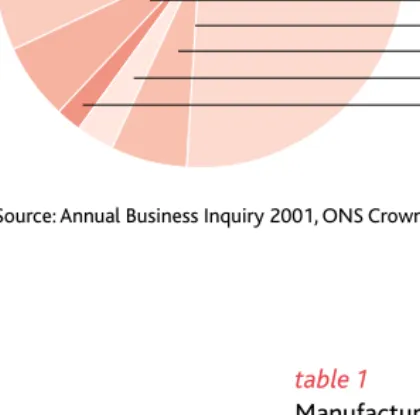
The analysis of the workforce in London East using Annual Business Inquiry data for 2001 uses a broader definition of manufacturing. We have covered 13 subsectors that employ between them 73,000 people. There are 5,300 business establishments, with approximately 4,500 of these businesses having fewer than 11 employees.
The largest manufacturing subsector is paper, publishing and printing. It employs 24,500 people, more than one third of the manufacturing employees in London East. Paper, printing and publishing businesses are concentrated in Tower Hamlets, Hackney and the City, although there are some businesses in Bexley and Greenwich as well.
Although, there was considerable change in the publishing industry 15 to 20 years ago with the introduction of new technology, the firms in the area have developed to become the main manufacturing presence in London East. The second highest number of employees (13,500) is in the transport equipment subsector. The two boroughs that dominate this subsector are Hackney and Barking and Dagenham. The latest subregional figures available for 2001 do not show the full effect of Ford’s decision to stop car production at its Dagenham plant. The factory is now used to develop and manufacture diesel engines, but with a reduced workforce.
19% Transport equipment 11% Food, beverages and tobacco 5% Textiles and textile products 0% Leather and leather products 1% Wood and wood products 34% Paper, publishing, printing 8% Electrical and optical equipment
[image:10.842.248.564.332.474.2]5% Manufacture of machinery and equipment 6% Basic metals and fabricated products 0% Coke, petroleum products and nuclear 6% Chemicals and man-made products 3% Rubber and plastic products 2% Other non-metal mineral products
figure 1
Percentage of employees by manufacturing subsector, London East, 2001
[image:10.842.356.566.589.796.2]Source: Annual Business Inquiry 2001, ONS Crown copyright (2003)
table 1
Manufacturing subsectors – rank order by numbers of employees
Paper, publishing, printing 1
Transport equipment 2
Food, beverages and tobacco 3
Electrical and optical equipment 4
Basic metals and fabricated products 5
Chemicals and man-made products 6
Textiles and textile products 7
Manufacture of machinery and equipment 8
Rubber and plastic products 9
Other non-metal mineral products 10
Wood and wood products 11
Leather and leather products 12
Coke, petroleum products and nuclear 13
MANUF
ACTURING
This change at Ford sums up the approach that global manufacturing companies will be taking to production in this country. For the UK, and London in particular, the creation of high-quality, high value-added products is essential for business survival.
The food, beverages and tobacco subsector ranks third in terms of employment (7,700 employees) and production is concentrated in four boroughs, Newham and Tower Hamlets on the north bank of the Thames, and Lewisham and Bexley on the south bank. The textiles and textile products subsector clusters in the area immediately to the east of the City of London, in Tower Hamlets, Hackney and Newham. The number of employees in this subsector has fallen to under 4,000 people, and it now ranks seventh out of 13 subsectors.
[image:11.842.298.568.209.479.2]By comparison, electrical and optical equipment manufacture now employs almost 6,000 people in Greenwich and the outer London boroughs of Bexley and Havering.
table 2
Manufacturing subsectors – boroughs where employment activity is concentrated
(the borough with most employees is mentioned first)
Paper, publishing, printing Tower Hamlets, Hackney, City, Bexley, Greenwich
Transport equipment Barking and Dagenham, Hackney
Food, beverages and tobacco Newham, Bexley, Tower Hamlets, Lewisham
Electrical and optical equipment Greenwich, Bexley, Havering
Basic metals and fabricated products Bexley, Barking and Dagenham
Chemicals and man-made products Barking and Dagenham, Newham
Textiles and textile products Tower Hamlets, Hackney, Newham
Manufacture of machinery and equipment Greenwich, Bexley
Rubber and plastic products Havering, Bexley
Other non-metal mineral products Havering, Newham
Wood and wood products Barking and Dagenham, Hackney, Havering
Leather and leather products Hackney
Coke, petroleum products and nuclear Havering
Source: Annual Business Inquiry 2001, ONS Crown copyright (2003)
0 2,000 4,000 6,000 8,000 10,000 18,000
16,000
14,000
12,000
Emplo
[image:11.842.214.569.592.795.2]yees
figure 2
Employees by borough, manufacturing subsector, London East, 2001 (thousands)
Barking and Dag enham Bexle
y
City o
f London Hac
kne
y
Gr
eenwic
h
Ha
v
e
ring
Lewisham Redbr
idg
e
T
ower Hamlets
New
ham
Chapter
Man
uf
actur
–
demand
levels
MANUF
ACTURING
Economic drivers
EMTA – the National Training Organisation for Engineering Manufacture – in its Sector Workforce Development Plan for
Engineering Manufacture 2001-2005 identified eight factors that are affecting the management and development of modern business. We think that these factors affect all manufacturing, not just those subsectors represented by EMTA. The factors are:
• new working practices
• outsourcing
• the need for innovation
• new technology
• information and communications technology
• globalisation
• flatter organisational structures, and
• environmental concerns.
New working practices include team working, ‘just in time’ manufacturing and contract working. Each of these changes tends to put greater responsibility on the individual worker. Employees are expected to show greater social skills, as well as technical skills.
Outsourcing – the process of one company asking another company to supply goods or services – is a growing trend. This has provided considerable benefits for smaller companies as larger ones devolve the responsibility for tasks such as design, manufacture and the distribution of products to third parties. This brings a need for a range of business skills as well as manufacturing expertise.
Innovation and new technology are essential when competing in world markets, and London East’s larger sectors have demonstrated they can work to these demands. The need for short product cycles and the introduction of new technologies have made new demands in terms of methods of working and the use of staff. For example, the paper, publishing and print subsector has adapted well to changing technology, and London East serves growing local, national and international markets.
The effect of globalisation on manufacturing has been mixed in its social and political consequences. In practice, ICT has allowed multi-national companies and their subsidiaries to share technologies between partners and innovate. On the other hand, it has given companies an opportunity to concentrate production strategically round the world. This can have advantages and disadvantages as some production declines locally and new work replaces it.
The move towards flatter management structures has affected most industrial sectors. The motivations behind such moves are cost-savings through a decrease in the number of managers, and possible increases in efficiency, as responsibilities are devolved. Again, this has skills implications. Vocational and technical expertise can be lost when managers are made redundant. Younger staff given broader remits may not have developed all the social skills needed to meet the challenges of managing change.
expected to continue, but competition is intense, and the industry is looking at the way it manages the new media aspect of its business, for it knows it must diversify from just ‘print on paper’.
Food manufacture and pharmaceuticals in very different ways are suffering intense competitive pressures and high levels of regulation in their work. Food manufacture particularly is having to respond to new consumer demands as lifestyles change. The future for manufacturing in London East has to be in developing expertise, and using that knowledge to create high value-added products. It is expected that local manufacturing will adopt these principles as the level of value-added in the
manufacturing sector is set to rise by 13% between 2002 and 2010. (Value-added is the difference between the cost of producing the goods and the income received from selling them.)
Although there is a forecast increase in the output of the manufacturing sector, this will be accomplished with fewer people. In all the main employment subsectors the numbers employed are expected to decrease. The largest reductions in percentage terms are going to be in clothing and leather goods, and motor vehicles over the period 2002 to 2010. At the time of writing this strategy, many of the motor vehicle job losses have already happened.
MANUF
ACTURING
66 69 72 75 78 81 87
84
Emplo
yees
London East, 2002-2010 (thousands)
2002 2004 2006 2008 2010
Source: CE/IER LEFM 2002
3100 3200 3300 3400 3500 3600 3800 3900
3700
(£million at 1995 pr
ices)
2002 2004 2006 2008 2010
[image:15.842.47.385.63.302.2]Source: CE/IER LEFM 2002
figure 5
Manufacturing – change in levels of employment by subsector, London East, 2002-2010
-3 -2.5 -2 -1.5 -1 -0.5 0 0.5
Food
Drink
Tobacco
Textiles
Clothing and leather
Wood and wood products
Paper, print and publishing
Manufacturing fuels
Pharmaceuticals
Chemicals not classified elsewhere
Rubber and plastics
Non-metal mineral products
Basic metals
Metal goods
Mechanical engineering
Electronics
Electrical engineering
Instruments
Motor vehicles
Aerospace
Other transport equipment
Manufacturing not classified elsewhere
Man
uf
actur
ing subsector
Percentage change
[image:15.842.214.375.85.299.2] [image:15.842.62.497.420.793.2]In writing this strategy, we interviewed representatives of companies in the London East area from various subsectors, including • food manufacture
• pharmaceuticals • chemicals
• scientific products, and • transport equipment
among others.
Skills gaps
• Local
A lack of management skills was mentioned, and there were some gaps in specific technical expertise. Apart from these, the representatives of the larger companies interviewed said that there were few skills gaps at the present time. Where changing processes dictated that employees’ skills should be developed, many companies said they would deal with the issues in-house.
• National
Survey work from a variety of organisations has identified the following skills gaps in employees in the manufacturing sector generally:
• the ability to deal with change • personal and generic skills
• team-working
• new and specific technical skills
• computer literacy and ICT skills • management and leadership skills
• customer service, and • an ability to continue learning.
There was an expectation that staff should be multi-skilled and demonstrate greater flexibility.
regulations require employees to read and record production information. Basic IT skills can also be needed to monitor production processes.
Both nationally and locally, the need for team leadership skills has been identified as production processes are dependent on group working to produce outputs.
The publishing industry employs one third of its UK workforce in the London area. The former National Training Organisation6
said that skill levels were rising in the industry with the advent of new media. However, employers said staff had the skills to carry out their jobs effectively. The concern was to find the right calibre candidates in the future as the labour market tightened in the media sector generally.
EMTA’s research suggested that staff at all levels lack technical engineering skills, while clerical and administrative staff are weak on IT skills. Finally, as in all the sector strategies, it was found that managers appear to lack leadership and management skills.
Skill shortages
• National
In equipment manufacture, general manufacturing and science-based industries, EMTA7identified skills
shortages at three levels:
Professional
• professional engineers • scientists
• technologists
• design and development engineers
• electrical engineers • mechanical engineers
• radio systems design engineers • systems engineers, and
• software engineers.
• CNC programmers, and • sales engineers.
Craft
• electrical maintenance
• sheet metal workers • pipefitters
• toolmakers
• vehicle body builders
• welders, and • tuners.
MANUF
ACTURING
Chapter
Skills
suppl
y
for
the
In the previous chapter, we noted that there would be a decline in the total numbers employed in London East manufacturing as a whole. Nevertheless, there will still be a replacement demand requirement, particularly in engineering where there is an ageing workforce, and younger people have not been attracted to the industry.
Two further factors that need to be considered are the changing strengths of the different subsectors, and a general rise in qualification levels expected of new entrants.
The recent growth in
pharmaceuticals, electronics
and electrical goods
manufacture is good news
for London. The downturn in
traditional heavy engineering
and transport equipment
manufacture is disappointing
in terms of the numbers
of jobs available.
Concerns were expressed by local
employers interviewed for this study about the lack of high-quality engineering and science graduates coming through. This was particularly important where research and development were essential to the development of the industry.
There needs to be improvements in the supply of:
• professional and managerial staff
• skilled operatives, and • assembly workers.
There are different routes into the various subsectors:
• higher education
• further education
• modern apprenticeships, and
• from other sectors / subsectors.
5DfEE,Employers Skill Survey: Case Study, Food Manufacturing Sector, 2000
6Publishing NTO,Workforce Development Plan
Higher education
High technology manufacturing, electronics, chemicals, pharmaceuticals, and publishing are all dependent on high quality entrants at levels 4 and 5. Employers see a need for an increased number of graduates in these areas. EMTA in its application for SSC status,
commented on the fall of 8% in the number of engineering and technology undergraduates in the five years until 2001, although electronics admissions went up. It was also disappointed in the drop-out rates on engineering and technology courses, and suggested that 50% of the original entrants did not complete. (A problem which affects further education as well – see table 3.)
Further education
A previous analysis8commissioned by
London’s LSCs showed a “radical decrease in the numbers of traditional engineering and production engineering related courses” delivered through further education colleges. It showed that engineering students only accounted for 2.7% of students enrolled in the London area. The positive sign for London East was that one third of the students enrolled were in our area.
The other noticeable feature of this analysis was the growth of new courses which had an IT basis, and would thus support local industry. There were more electronic / computer technology programmes as well as specific courses related to electronic publishing.
Disappointingly, research shows that for another larger local employer, the print industry, machine printing, pre-press and finishing staff were not coming through in sufficient numbers from further education. Moreover, the number of students in the manufacturing subprogramme area in London East’s colleges was quite low according to an analysis of the ISR (Individualised Student Records).
Apprenticeships
The new sector skills council (SEMTA) in its Market Assessment (January 2003) said that the engineering Modern Apprenticeship has the largest number of apprentices in training of all sectors in the economy. However, it continued by saying that its workforce development plan for the sector estimates that there is a need for an entry of 10,000 AMA/MAs per year, compared with the current level of around 6,000-7,000.
It is a pattern repeated in other subsectors.
Staff turnover
At operative level, there is some
MANUF
ACTURING
8London Skills Forecasting Unit,Production skills in the Digital Economy, 2001
table 3
Manufacturing subprogramme area, London East, 2001
Enrolments Completions Achievements
under 16 2 1
16 to18 122 58 37
19 to 20 29 14 2
21 to 24 29 20 5
25 to 59 159 112 28
60 and over 9 5 1
Total 350 210 73
Enrolments Completions Achievements
Full time full year 161 79 50
Full time part year 8 6
Part time 181 125 23
Other training
One common feature, evident across the subsectors, was the necessity, felt by employers, to give additional training to staff because those entering employment lack job-readiness. Thus, the increasing demand for graduates was matched in larger companies by the need to run training programmes for them so that they were competent to handle industry-specific issues.
Managers at the larger companies interviewed said that they only used public training provision to a limited extent to develop their workforces, and were more inclined to use in-house or private training. This was particularly so for lower-level occupations, where job-specific training was offered.
The other feature of training supply noted by the report,Production Skills in the Digital Economy, was the increase in privately provided training courses that offered customised solutions to industry-specific problems. It seems that short, intensive courses delivered by specialists were often the answer to companies’ needs.
The area where in-house training was not seen to be taking place was in small and microbusinesses. Given the continuing growth in outsourcing, there is a need to support staff training in small businesses.
New developments
Two important recent developments will support the manufacturing sector in London.
The Centre for Engineering and Manufacturing Excellence has been established on 18 acres of land at the Ford plant in Dagenham. This venture will support innovative small businesses, and promote leading-edge manufacturing and technological developments. It will support the “nation’s higher-education capacity in manufacturing and engineering.”
A second initiative is the launch of the Manufacturing Advisory Service for London. This is part of a nationwide programme under the auspices of the DTI. The service, which will provide support for small manufacturers, will be delivered by Business Link for London in conjunction with the Engineering Employers’ Federation South, who will provide a team of specialists to give advice. The Manufacturing Advisory Service will give access to training materials and provide workshops among a range of support activities.
Summary
In spite of the weaknesses of the supply-side in developing high-calibre industry entrants at all occupational levels, local employers said that there were few immediate supply problems regarding the numbers of staff available. This is because the recent economic downturn had affected the sector.
However, it was anticipated that the broader supply issues identified above would face the industry as the economy grew again, and more investment is made in the manufacturing sector. The equilibrium between supply and demand would not last long, and the need for staff, particularly with increased IT capability, would continue.
MANUF
ACTURING
The strengths of the sector
London East is well positioned when improvements in the general economy take place, as it has a strong presence in the new manufacturing industries: electronics, electrical and optical
equipment and publishing. Although it has suffered the loss of car production at Ford, Dagenham, the company’s decision to concentrate the production of high specification diesel engines at the plant is valuable.
London has seen some stability in its manufacturing industry after a period of decline, and investment is set to grow in this sector.
The needs of the sector
The issue for UK manufacturing is to improve output, and to close the productivity gap with other industrialised nations.
There are two skills issues. Firstly, the need to increase the supply of appropriately qualified applicants coming forward, and, secondly, to reduce the skills gaps among the existing workforce.
Although the total number of jobs in manufacturing will continue to fall, there will still be a strong demand. There is a requirement to replace an ageing workforce in traditional engineering subsectors. There is also a need to enthuse a new generation about the wide range of manufacturing jobs that use new
technology and new production methods. Finally, but perhaps most importantly, there is a need to support operatives, assembly workers and clerical workers in improving literacy, numeracy, IT and team- working skills.
MANUF
ACTURING
We will work with partners to:
• ensure that learning opportunities are relevant and focused, and take into account the developments that are taking place in a fast-moving sector • increase the range of learning
opportunities available that will enable people of all ages to gain employment in manufacturing locally
• support new initiatives such as the Centre for Engineering and Manufacturing Excellence (CEME), and the Business Innovation Centre based on the CEME campus
• support the work of the Manufacturing Advisory Service for London in providing assistance to small manufacturers
• raise the profile of manufacturing and support steps to improve the sector’s image
• improve leadership and management skills, and the technological capability of employees in the industry
• find ways of raising productivity by developing expertise, and maximising the outcomes of research and development • increase the number of female
employees in the sector (currently set to fall locally to below 20% of the workforce), and
• increase basic skills support for staff, where needed, in manufacturing employment to support career progression.
Chapter
St
rateg
ic
1 Construction
2 Cultural and creative industries
5 Hospitality 6 Manufacturing 7 Public administration 3 Financial services 4Health and social care 0 Overview
W
orkf
or
ce
Development
Lift for action plan 8 Retail 9 Transport and logistics 10 Voluntary and community
Learning and Skills Council London East
Boardman House, 64 Broadway, Stratford, London E15 1NT Telephone: 0845 019 4151 e-mail: [email protected] www.lsc.gov.uk
This strategy was written by Trevor Carr and members of the LSC London East Workforce Development team. Trevor Carr McKerr Carr Ltd Telephone: 020 8349 2110 www.mckerrcarr.com Designed by Creative Leap Telephone: 020 7549 0700 www.creativeleap.com
Nordland Papier AG is committed to the tradition of sustainable forest management and minimisation of its impact on the local environment.
WFD/LSCLE/024/03
W
orkf
or
ce