Advance Access publication 2013 October 16
Main-sequence progenitor configurations of the NN Ser candidate
circumbinary planetary system are dynamically unstable
Alexander J. Mustill,
1‹Jonathan P. Marshall,
1Eva Villaver,
1Dimitri Veras,
2Philip J. Davis,
3Jonathan Horner
4,5and Robert A. Wittenmyer
4,51Departamento de F´ısica Te´orica, Universidad Aut´onoma de Madrid, Cantoblanco, E-28049 Madrid, Spain 2Institute of Astronomy, University of Cambridge, Madingley Road, Cambridge CB3 0HA, UK
3Institut d’Astronomie et d’Astrophysique, Universit´e Libre de Bruxelles, Boulevard du Triomphe, B-1050 Brussels, Belgium 4School of Physics, University of New South Wales, Sydney 2052, Australia
5Australian Centre for Astrobiology, University of New South Wales, Sydney 2052, Australia
Accepted 2013 September 14. Received 2013 September 13; in original form 2013 May 17
A B S T R A C T
Recent observations of the NN Serpentis post-common envelope binary system have revealed eclipse timing variations that have been attributed to the presence of two Jovian-mass exo-planets. Under the assumption that these planets are real and survived from the binary’s main-sequence state, we reconstruct initial binaries that give rise to the present NN Ser con-figuration and test the dynamical stability of the original system. Under standard assumptions about binary evolution, we find that survival of the planets through the entire main-sequence lifetime is very unlikely. Hence, we conclude that the planets are not survivors from before the common envelope phase, implying that either they formed recently out of material ejected from the primary or that the observed signals are of non-planetary origin.
Key words: planets and satellites: dynamical evolution and stability – binaries: close – stars: individual: NN Ser – planetary systems.
1 I N T R O D U C T I O N
In recent years, eclipse timing variations have been observed in sev-eral post-common envelope binaries (PCEBs), including sub-dwarf B binaries such as HW Vir (Lee et al. 2009), pre-cataclysmic vari-ables (pre-CVs) such as NN Ser (Beuermann et al. 2010) and CVs such as HU Aqr (Qian et al. 2011). While such timing variations can be generated by angular momentum redistribution in the binary via the Applegate mechanism (Applegate 1992), this is ruled out in many cases due to the mass of the secondary star being insuffi-cient to generate the required magnetic field. It has been proposed that the variations are due to orbiting planets: a recent review by Zorotovic & Schreiber (2013) listed six single-planet and six two-planet candidate systems known amongst all PCEBs. Recently, Portegies Zwart (2013) used the current binary properties and two-planet solution to the HU Aqr CV system in order to attempt to constrain the full system evolution, and determine uncertain pa-rameters of binary evolution such as the common envelope (CE) ejection efficiency and time-scale.
However, while Keplerian fits can formally be made to the bina-ries’ eclipse timing variations, dynamical integrations of two-planet fits thus obtained often show that the systems are violently unstable,
E-mail: [email protected]
often on time-scales of mere centuries; examples studied include HU Aqr (Horner et al. 2011; Hinse et al. 2012; Wittenmyer et al. 2012), HW Vir (Horner et al. 2012b) and NSVS 14256825 (Wittenmyer, Horner & Marshall 2013). Even where stability on longer time-scales is found, it may only have been demonstrated for∼1 Myr, as in the case of UZ For (Potter et al. 2011). Such instability suggests that either the planetary parameters are radically different from the best-fitting values or that the signals are of non-planetary origin.
An exception is the pre-CV system NN Ser, with two planet candidates whose nominal orbits are stable on 100 Myr time-scales (Beuermann et al. 2010; Horner et al. 2012a; Beuermann, Dreizler & Hessman 2013). Although the present-day stability of the planet candidates is reasonably secure, how the system evolved into its present state poses a challenge. If the system evolved from a cir-cumbinary configuration on the main-sequence (MS), similar to the two-planet system Kepler-47 (Orosz et al. 2012), the initial plan-etary configuration would have been more compact, with a wider binary, raising questions about its survival to the present day.
In this paper, we seek to reconstruct the history of the NN Ser binary, and to test the stability of the original planetary system. In Section 2, we describe our reconstruction of the initial binary configuration. In Section 3, we use the reconstructed binaries to test the dynamical stability of the original planetary system. We address caveats in Section 4, discuss the implications of our results for NN Ser and similar systems in Section 5 and conclude in Section 6.
C
2013 The Authors
Published by Oxford University Press on behalf of the Royal Astronomical Society
at University of Southern Queensland on June 25, 2014
http://mnras.oxfordjournals.org/
Figure 1. Schematic evolution of the orbital radii of bodies in the NN Ser system. A and B are the primary and secondary star, c and d the planets. Italic labels state the algorithm used to study different sets of interactions at different times.
2 T H E B I N A RY ’ S E VO L U T I O N
The full evolution of the NN Ser system is complex and we must break it down into several sections (Fig. 1). On the MS, the binary orbit would have been wider and the planets’ orbits smaller. The secondary would have been too distant from the primary for its orbit to have shrunk due to tidal decay. The binary orbit may have decayed slightly due to tidal forces as the primary ascended the red giant branch (RGB) and increased in radius, before suffering stronger tidal decay and engulfment in the envelope on the asymptotic giant branch (AGB), which resulted in the ejection of the primary’s enve-lope and left the secondary on a very tight orbit. During the course of envelope ejection, the planets’ orbits would have expanded to their present positions as a reaction to the changing gravitational potential.
Previous works have usedN-body integrations to study the dy-namics of the present-day system (Beuermann et al. 2010, 2013; Horner et al. 2012a). In this paper, we evolve binary star models forwards in time to find those that give rise to systems similar to NN Ser. We then calculate the initial locations of the planets in the system before mass-loss, and finally study the stability of the original system on the MS.
2.1 The NN Ser binary today
NN Ser is a pre-CV binary comprising a C/O white dwarf (WD) of 0.535 Mand an M dwarf of 0.111 Mon a 0.13 d orbit (Parsons et al. 2010). NN Ser is one of the few PCEBs for which the WD properties have been determined with very high accuracy indepen-dent of any WD mass–radius relation. Furthermore, the WD mass in the NN Ser system is larger than the peak of the distribution of He-core WDs and consistent with that of C/O WDs (Rebassa-Mansergas et al. 2011). The system is currently at an early stage of its post-CE evolution, with a cooling age of∼1 Myr. The binary properties are summarized in Table 1.
[image:2.595.312.540.72.158.2]The eclipse timing variations reported for NN Ser suggest the presence of a planetary system. Beuermann et al. (2010) fit three qualitatively different solutions to the O−C variability of the bi-nary. The first, a single-planet fit, had an unacceptably large reduced
Table 1. Stellar parameters for the present-day NN Ser binary.
Parameter Value Reference
MA(M) 0.535±0.012 1
MB(M) 0.111±0.004 1
Period (d) 0.130 080 171 41±0.000 000 000 17 1
Separation (R) 0.934±0.009 1
WDTeff(K) 57 000±3000 1
Cooling age (yr) 106 2
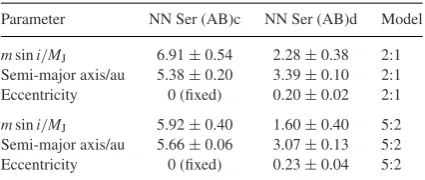
References: (1) Parsons et al. (2010); (2) Beuermann et al. (2010). Table 2. Planet candidate parameters for the NN Ser binary, from Beuermann et al. (2010), for the 2:1 and 5:2 resonance solutions. Note that NN Ser (AB)d is the inner planet and NN Ser (AB)c is the outer planet.
Parameter NN Ser (AB)c NN Ser (AB)d Model
msini/MJ 6.91±0.54 2.28±0.38 2:1
Semi-major axis/au 5.38±0.20 3.39±0.10 2:1 Eccentricity 0 (fixed) 0.20±0.02 2:1
msini/MJ 5.92±0.40 1.60±0.40 5:2
Semi-major axis/au 5.66±0.06 3.07±0.13 5:2 Eccentricity 0 (fixed) 0.23±0.04 5:2
chi-squared (χ2
ν =23.38), and so two two-planet solutions with
χ2
ν =0.78 and 0.80 were proposed. The first of these corresponds
to the planets being at a 2:1 period commensurability, while the second has the planets at the 5:2 commensurability. The planet pa-rameters for the two-planet solutions are listed in Table 2. Stability analysis of the present-day configuration by Horner et al. (2012a) showed that the 2:1 solution is stable for at least 108yr, while the 1σ
errors on the 5:2 solution straddle the boundary between long-term stable systems, stable for 108yr, and relatively unstable systems,
un-stable in∼105yr. While this paper was under review, Beuermann
et al. (2013) provided new eclipse timings. The data remain con-sistent with a 2:1 solution, which can be stable for 108yr, and the
5:2 solution is now ruled out. The revised parameters for the 2:1 fit are almost unchanged from Beuermann et al. (2010), although the
msiniof the inner planet is somewhat smaller, at 1.74±0.09MJ
compared to 2.28± 0.38MJ. In this paper, we take our system
parameters from the 2:1 solution of Beuermann et al. (2010). For completeness, we also briefly describe our results for the moribund 5:2 solution.
2.2 Reconstructing the original binary
To identify MS progenitor binaries to the current NN Ser binary, we use the Binary Star Evolution (BSE) code (Hurley, Tout & Pols 2002).BSEcouples evolutionary models of single stars, from Hurley,
Pols & Tout (2000), to routines governing binary interactions such as tidal forces,1mass transfer and CE evolution. The speed of the
underlying single stellar models allows the evolutionary progress of many binary systems with different parameters to be followed on computationally short time-scales. We therefore adopt an approach of modelling the evolution of large grids of models forwards in time, to identify the parameters of the progenitor binary that give rise to systems similar to NN Ser.
1We correct the bug in the tidal equations described by Zorotovic &
Schreiber (2013).
at University of Southern Queensland on June 25, 2014
http://mnras.oxfordjournals.org/
[image:2.595.320.533.225.315.2]In our modelling, we vary the following parameters governing the binary’s initial state and evolution: the initial mass of the primary
MA, the initial orbital period of the binaryP (which governs its
semi-major axisaB), and the parameters governing the CE binding
energyλand ejection efficiencyα. These are degenerate and only their productαλ is important. We initially fix the metallicity at
Z=0.02, and set the binary eccentricity at zero, as this will give the most stable progenitor systems. Since NN Ser is not yet at the CV stage, there has been no mass transfer from the secondary, and its initial mass is constrained to its current value of 0.111 M. The possibility that the secondary may accrete material during the CE phase is discussed in Section 4.
We aim to find systems that give pre-CVs similar to NN Ser after CE evolution. We require that the final masses of the stars must be within the 1σerrors given in Table 1, while the separation must be tighter than 0.004 65 au (1 R). Additionally, we place a constraint on the allowed initial binary separation. At this stage, we require simply that the initial binary can be no wider than the initial orbit of the inner planet. In Section 3, we shall test the stability of the reconstructed systems in detail, but here we note that a simple application of the results of Holman & Wiegert (1999) suggests that the inner planet has to have a semi-major axis at least 1.8 times greater than the binary semi-major axis to ensure stability on the MS.
Assuming adiabatic expansion of the planets’ orbits during mass-loss, the planets’ initial semi-major axes are given by
a(i) c,d= M
(f) A +MB
M(i) A +MB
a(f)
c,d, (1)
whereMA(i)andMA(f)are the primary’s initial and final masses,MB
is the secondary’s mass, andac(i),d anda (f)
c,dare the planets’ initial
and final semi-major axes. We neglect here the small contribution from the planets’ masses. We require that these criteria be satisfied within 10 Myr of the formation of the WD. Hence, our target space is somewhat broader than the NN Ser system proper.
2.3 Results of the binary reconstruction
We ran a grid ofBSEmodels to identify systems satisfying the above criteria. The initial mass of the primary ranged from 1 to 3 M, in steps of 0.025 M. The parameter governing CE ejection,αλ, ranged from 0.05 to 2 in steps of 0.05, and then up to 4.5 in steps of 0.5. The initial binary period ranged from 50 to 250 d in steps of 10 d. There were thus 76 545 binary systems in the grid calculated for binary reconstruction.
There were 369 initial binary configurations that met our criteria for the final system. These systems all had primary masses in the range 1.95–2.15 M. The upper limit is given by assuming that the growth of the C/O core is terminated by the CE phase. The lower mass limit requires that CE evolution occur when the primary is on the AGB phase, not the RGB, setting a lower mass limit of∼2 M. This is the lowest mass star that, at the assumed metallicity, does not undergo the He flash at the RGB tip. Stars undergoing this flash achieve larger radii on the RGB. The minimum initial binary separation is∼0.55 au, which avoids tidal engulfment on the RGB. The initial separations of the successful binaries then range from
∼0.55 to∼1 au, while the CE parameter productαλranges from 0.5 to 2.0. The inner planet’s orbit is at around 1 au, meaning that all but the tightest binaries are likely ruled out by the Holman & Wiegert (1999) stability estimate. Nevertheless, as this is only an approximation, and does not in any case apply to four-body
systems, we test the stability of all systems numerically in the next section.
We subsequently generated two further grids at metallicities
Z= 0.01 and 0.03. The youth of the NN Ser system means that very low metallicities (Z 0.01) are not likely. There was lit-tle difference compared to the nominalZ =0.02 case: the range of primary masses was 1.875–1.95 M for the low-metallicity case and 1.975–2.25 M for the high-metallicity case, while the initial binary orbits were, respectively, at 0.57–0.98 and 0.55– 1.05 au. We use only theZ=0.02 case as a basis for ourN-body integrations.
3 DY N A M I C A L M O D E L L I N G
We now set out to determine the stability of planetary systems around our reconstructed progenitor binaries, using the hybrid sym-plectic integrator from theN-body codeMERCURY(Chambers 1999), with a modification to the algorithm detecting collisions with the primary described in Veras et al. (2013). A time-step of 1/25 of the binary’s initial period is chosen, which gives maximum energy errors of∼10−5. We perform three sets of simulations. In the first,
we fix the planets’ semi-major axesacandadat a few values within
the 3σ range allowed by the 2:1 solution and study the stability of the different reconstructed binary systems over a short time-scale. In the second set, we choose the most promising binary system and vary the planets’ semi-major axes and masses on a finer grid consistent with the 2:1 solution, integrating these systems over the whole MS lifetime of the primary. In the third set, we again fix the binary properties but instead integrate planets consistent with the 5:2 solution.
To reconstruct the MS progenitor system, we reduce the planets’ semi-major axes as described by equation (1). For our successful binaries, the binary initial-to-final mass ratio is approximately 0.3. This moves the inner planet in from its current orbit of 3.39 au to an initial orbit of∼1 au.
The best prospects for stability assume that the planets were ini-tially on circular orbits, and that the observed eccentricity of the inner planet is a result of subsequent dynamical excitation. On the MS, we therefore set the planetary eccentricities to be initially zero. The systems are assumed to be coplanar. Our initial systems there-fore consist of the binary companion at 0.5–1 au and two planets at
∼1 and∼1.6 au, all on circular orbits.
The MS lifetime of the∼2 Mprimaries is in excess of 1 Gyr; hence, these systems must be stable on very long time-scales. How-ever, due to the short period of the binary and the large number of systems we test, we initially restrict ourselves to 10 Myr integrations to weed out the most unstable systems. For each successful progen-itor binary identified in Section 2, we generate 10 realizations of the system with randomized angles, giving 3690 separate integrations. Although the systems are close to the 2:1 commensurability, we make no effort to ensure that the resonant arguments are librating. We track when planets collide or are ejected; the ejection distance is set to 100 au.
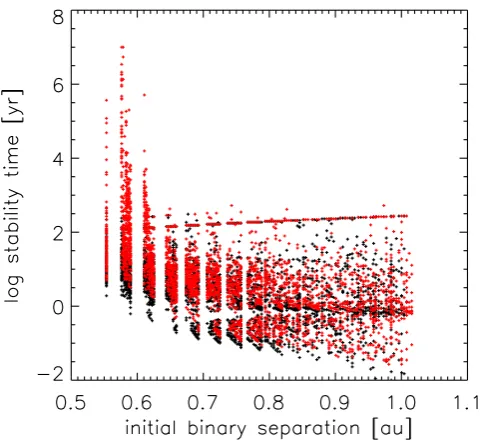
The stability lifetimes of these systems are shown as the black points in Fig. 2. All of these systems with the planets’ semi-major axes set to the adiabatically contracted nominal values were un-stable on very short time-scales of <400 yr. We therefore tried increasing the planets’ axes by 1σ, 2σand 3σin order to find more widely separated and therefore stable systems. The number of in-tegrations was around 3700 in each set, changing slightly with the inner planet’s semi-major axis (which determines the number of successful binary progenitors). The most stable configuration was
at University of Southern Queensland on June 25, 2014
http://mnras.oxfordjournals.org/
Figure 2. Time-scale to instability for progenitor systems of NN Ser, as a function of initial binary separation. Systems were integrated up to 107yr.
The black crosses show systems with the nominal planetary semi-major axes; red show systems withadincreased by 2σandacincreased by 3σ.
The line of points at∼100 yr is an artefact ofMERCURY’s ejection-tracking
algorithm.
with the inner planet’s orbit enlarged by 2σ and the outer planet’s by 3σ. The stability lifetimes of these systems are shown as the red points in Fig. 2. 16 of the 3740 systems integrated survived for the 10 Myr integration. These were all orbiting fairly close binaries, withaB<0.6 au.2Hence, although the number of stable systems
is small (0.4 per cent), we find the possibility that systems may sur-vive the entire pre-CE lifetime. We pursue this further in the next section.
3.1 Variation of planet parameters
To explore the 2:1 solution in more depth, we now consider one of the binary systems that showed promise of long-term stability in the previous section. This binary initially hadMA=2.0 M,P=110 d
andaB=0.57 au. We ran a grid of simulations varying the planets’
semi-major axes from their nominal values out to a 3σ increase,3
with 25 semi-major axis values for each planet and 10 systems with random initial angles for each combination of semi-major axes: a total of 6250 systems. These were integrated until they suffered a collision, close encounter or ejection, up to a maximum time of 1.164 Gyr, at which the primary leaves the MS.
The vast majority of these systems are unstable on very short time-scales. The maximum lifetime of the 10 systems at each grid point is shown in Fig. 3. In all, only 16 systems, 0.26 per cent, survived until the end of the MS. Long-lived systems, and particularly those that survive the whole MS, are concentrated withadbetween 1.08
2While in this grid all the stable systems satisfied the Holman & Wiegert
(1999) criterion, we did find instances (e.g. when increasing both planets’ semi-major axes by 3σ) where the stable systems’ inner planets orbited inside the stability boundary from Holman & Wiegert (1999). The boundary estimate fails by a few per cent, within the errors quoted in Holman & Wiegert (1999).
3We did not consider reducing the planets’ semi-major axes as compressing
the system will likely make it yet more unstable.
1.18e+00 9.07e+00
P
c=2P
d2P
d=5P
B2P
c=11P
BFigure 3. Stability map for the reconstructed NN Ser system. The semi-major axes of inner and outer planets are varied. The nominal values are those at the bottom-left corner of the plot, while the axes extend to the nominal value plus 3σ. Colour scale shows the maximum lifetime (in years, log scale) of systems at each combination of axes. Some important mean motion resonances are marked in red.
and 1.12 au andacbeyond 1.80 au. A second region of moderate
stability, with two survivors, lies withad<1.06 au. Nevertheless,
the low number of survivors, and the fact that these are found in a region of parameter space far from the nominal values, suggests that the evolution of the present NN Ser planetary system from a more compact configuration is rather unlikely.
We also ran a second grid, fixing the planets’ semi-major axes at their nominal values but reducing the masses by up to 3σ, again on a 25×25 grid with 10 realizations per point. We note that the new lower mass for the inner planet (Beuermann et al. 2013) is covered by this grid. None of these systems lasted longer than 1500 yr. The dominant effect of the binary, together with the relative insensitiv-ity of analytical stabilinsensitiv-ity criteria to small changes in mass, means that the planets’ semi-major axes exert the dominant influence on stability.
We performed the same analysis for the 5:2 solutions, finding them even more unstable: only 7 of 6250 systems survived for the primary’s MS lifetime when allowingac andadto vary, and the
longest lived system had a lifetime of only 500 yr when allowing
mcandmdto vary.
4 OT H E R E VO L U T I O N A RY PAT H S F O R T H E N N S E R S Y S T E M
The results of the stability analysis presented above suggest that a very small fraction of potential progenitor systems for NN Ser could have survived to the end of the primary’s MS lifetime, and that these require orbital elements that are rather removed from their nominal values. While the evolution of the present-day
at University of Southern Queensland on June 25, 2014
http://mnras.oxfordjournals.org/
[image:4.595.308.546.57.332.2]two-planet configuration from an MS system is therefore a possibil-ity, its likelihood seems rather low. Is there any way of mitigating these harsh conclusions, and finding some evolutionary path for the system?
4.1 Uncertain binary/CE physics
The most important objection is that binary evolution may permit binaries on tighter initial orbits than those we have considered. How-ever, tight orbits require high values ofαin order to achieve a given final outcome, and high values ofαare not favoured either by obser-vations of PCEBs or by theoretical considerations (see Zorotovic et al. 2010; De Marco et al. 2011; Davis, Kolb & Knigge 2012; Rebassa-Mansergas et al. 2012); in fact, these works suggestα val-ues at the lower end of the range considered in this paper, withλ typically in the range 0.1−0.4 andαwithin 0.2−0.3 and certainly <1.
Furthermore, attempts to seek closer initial binaries run up against the problem of engulfment on the RGB. This may be averted if the strength of tidal forces is much weaker than that included in the
BSEcode. While studies of tidal circularization in binaries suggest
that tidal dissipation should be stronger than the Zahn (1977) theory employed inBSE(Meibom & Mathieu 2005), numerical simulations
of tidal dissipation of the convective zones of solar-type MS stars suggest weaker tides (Penev et al. 2009). Reducing the strength of tidal forces by a factor of 10 reduces the orbit of the tightest binary that can survive the RGB to 0.34 au, and test integrations show that around half of the systems tested withaB<0.5 au are stable
for 10 Myr, although we have not followed their evolution on Gyr time-scales.
Alternatively, engulfment on the RGB may not be a problem if the WD is in fact an He-core WD, in which case engulfment would indeed have occurred on the RGB. This option does not however appear to be supported by detailed observations of the WD’s spectrum (Parsons et al. 2010).
Another possibility is that the initial mass of the companion was smaller than its current mass, and that it accreted material during the CE phase. However, such accretion would be limited because the secondary expands as a result of the accretion, causing mass ex-change to stabilize once the secondary fills its Roche lobe: Hjellming & Taam (1991) showed that, at least in the case of a 1.25 MMS secondary, the effects of the CE phase on the secondary mass are small. With such a low-mass secondary as in the NN Ser system, accretion will be even less significant. Indeed, Maxted et al. (2006) found that the post-CE brown dwarf companion to WD 0137−349 has a spectral type consistent with a brown dwarf that has seen little accretion during the CE.
4.2 Unpredictable dynamics
It may also be that our assumption of adiabatic expansion of the planets’ semi-major axes may be incorrect. We note that we require some form of excitation to raise the inner planet’s eccentricity to its observed value, the eccentricities of planets surviving our integra-tions did not exceed 0.07, and non-adiabatic orbit expansion due to the rapid loss of mass during the CE phase provides a natural source (Portegies Zwart 2013). In general, rapid mass-loss may cause the orbits to expand either faster or slower than the adiabatic rate (Ve-ras et al. 2011), and if the semi-major axis increase were lower, the planets would have initially been further from the binary and likely more stable. However, when starting from a circular orbit, rapid mass-loss causes the semi-major axis to expand faster than in
the adiabatic case. This is because angular momentum must still be conserved:
GM(f)
A +MB
a(f) c,d
1−e(f)2c,d
=
GM(i)
A +MB
a(i) c,d
1−e(i)2c,d
, (2)
where (i) and (f) label initial and final elements. To change a circular orbit to one at a finale(f)c,d=0 requires that
a(i) c,d=
M(f) A +MB
M(i) A +MB
a(f) c,d
1−e(f)2c,d
, (3)
a rate of semi-major axis expansion faster than that given in equation (1). Starting from an eccentric orbit would allow a smaller increase inabut the eccentricity would compromise the stability of the initial system.
We note that we have not attempted to ensure that the original system was in an exact resonant state, which can enhance stability in two-planet systems. However, we estimate that conjunctions of the inner planet with the secondary would cause large enough pertur-bations to swiftly remove the two planets from resonance (Murray & Dermott 1999, equation 9.93), and it is unlikely that the system could maintain a resonant configuration throughout its MS lifetime. It is possible that the present resonant or near-resonant configura-tion was attained recently. This would be possible if the planets migrated during the CE ejection, but we argue below that we expect drag forces to be negligible and little migration to occur. It is also possible that the system has been recently perturbed into its present state by an internal instability or a passing star. While attempting to reproduce the outcome of such an event could only be done statis-tically, it is likely that any possible progenitor configuration would also run into stability problems when on the MS.
4.3 CE ejecta and drag
It may be possible that the planets started further away from the binary than we have reconstructed. A slight reduction of the planets’ semi-major axes may also be possible through drag effects as the envelope is expelled. In order to estimate how the planets’ orbits will shrink as a consequence of the density increase in the circumstellar environment associated with the ejection of the envelope, we use the same formalism as in Villaver & Livio (2009), including both the gravitational drag forceFgand the frictional forceFfaccording
to the following expressions:
Fg=4π
(Gmpl)2
c2 s
ρI, (4)
with I 0.5, Gbeing the gravitational constant, ρ the density encountered by the planet,mplthe planet mass andcsthe sound
speed;
Ff=
1 2Cdρv
2πR2
pl, (5)
whereCd0.9 is the dimensionless drag coefficient for a sphere
andRplis the radius of the planet andvis its orbital velocity.
In order to estimate the density for the calculation of the drag terms, we consider the spherically symmetric density profile created by a wind launched from the primary’s surface at velocities of 10 and 15 km s−1 at a rate of 1.5 ×10⁻³M
yr−1. These outflow
velocities are typical of winds ejected at the sound speed of the envelope, while such high mass-loss rates, or still higher, must arise
at University of Southern Queensland on June 25, 2014
http://mnras.oxfordjournals.org/
from the brief duration of the CE phase. Having established the density profile, we then treat the envelope as static and unchanging during the ejection, which continues for 10 000 yr. This therefore significantly overestimates the total effect of the drag force, as the force is integrated over a longer time period than can be maintained at such high mass-loss rates, and also in reality the planets will only see the highest densities for a fraction of the period of envelope ejection. Even so, we find that the planets’ orbits decay by only a few hundredths of an au, insufficient to move the initial locations to the more stable regions identified in Fig. 3. We note that CE ejection in reality will not be isotropic and it is likely that the bulk of material is ejected in the orbital plain. Our calculations overestimate the total impulse on the planet by about a factor of 10, and so account for the expected mid-plane density enhancements (Ricker & Taam 2012).
We do acknowledge the possibility that a disc of material may remain bound to the binary after ejection of the envelope. Detailed numerical studies of CE evolution (e.g. Kashi & Soker 2011) typi-cally result in some fraction of the material of the primary’s enve-lope’s remaining bound to the binary after the rapid in-spiral phase. However, the quantity of such material, as well as its location after fallback, is not well constrained. If sufficient quantities remain at several au for sufficiently long time periods, it may trigger planet migration as in protoplanetary discs.
5 D I S C U S S I O N
Because survival of a two-planet system from the MS appears highly improbable, we must seek other explanations for the eclipse timing variations.
First, it could be the case that there is only one planet in the system. Although the one-planet fit of Beuermann et al. (2010) has a much greater reducedχ2than either of the two-planet fits, in its
original configuration the planet would have been at∼2 au, com-fortably distant from the binary companion to survive the primary’s MS evolution.
Secondly, perhaps the present planetary system did not evolve directly from any MS planetary system, instead representing the outcome of second-generation planet formation from debris from the ejected stellar envelope. We note that the short time-scale for envelope ejection may however leave little time for such planet formation. Furthermore, the large mass of the planets implies that the disc they formed from was rather massive.
Second-generation planet formation has received scant theoret-ical attention. As discussed above, models of CE ejection provide the possibility that discs may form. Very large (up to 1000s of au) circumbinary discs have been observed orbiting some post-AGB stars such as the Red Rectangle (Bujarrabal et al. 2005); these discs may arise from the effects of jets on material in the AGB wind (Akashi & Soker 2008). However, it is not known how the proper-ties of the disc scale with different binary parameters and mass-loss rates, nor is it known whether planets can actually be created in the disc should one form. Other scenarios for second-generation planet formation, such as AGB wind accretion in wide binaries (Perets & Kenyon 2013) and supernova fallback discs (Hansen, Shih & Currie 2009), are less relevant to a post-CE situation. Second-generation planet formation in the NN Ser system remains a speculation.
Lastly, the eclipse timing variations may not be of planetary ori-gin at all, but instead reflect some as yet unexplained phenomenon. When NN Ser is considered in the context of other post-CE binaries with planet candidates, which have often been shown to be
dynam-ically implausible, a non-planetary origin for the timing variations perhaps becomes the more likely explanation. If the variations can-not be planetary in other systems, it is only natural to suppose that the same process is at work in all systems, and that in this one case it so conspires that the timings can be interpreted as a stable plan-etary system. Proof of the planplan-etary origin of the period variations would come from detection of the planets’ mutual gravitational interactions, although these will take several decades to become apparent (Beuermann et al. 2013).
While the number of post-CE binaries with eclipse timing varia-tions attributed to planets is growing, the planetary origin of these is coming increasingly under attack. Horner et al. (2011, 2012b), Hinse et al. (2012), Wittenmyer et al. (2012) and Horner et al. (2013) show that many of the proposed two-planet systems are unstable on very short time-scales, convincingly showing that the origin of the variations cannot be attributed to planetary systems with the architectures suggested by Keplerian fitting. NN Ser, the system studied here, is the only two-planet system that has been proved to be long-term stable in its currently observed state.
Zorotovic & Schreiber (2013) used a statistical argument to re-fute the variations’ being attributable to planetary systems that have evolved from the MS: in nearly all systems where the eclipse timing precision is sufficient to detect the presence of planetary mass com-panions, such companions have been found, but the occurrence rate of giant planets orbiting the progenitor MS binaries is much lower. They conclude that either second-generation planet formation is highly efficient during the envelope ejection or the eclipse timings are of non-planetary origin. Our detailed investigation of the NN Ser system supports this conclusion: it is highly unlikely that the planetary system evolved from an MS state. If the planets are real, they must be of second-generation origin. Perhaps the more likely alternative, however, is that they do not exist.
6 C O N C L U S I O N
There are three explanations for the eclipse timing variations ob-served in NN Ser: they may be due to perturbations from first-generation planets that survived the whole evolution of the binary; they may be due to second-generation planets that formed from remnant material after ejection of the primary’s envelope; or they may be due to some process intrinsic to the binary. Based on the calculations in this work, the first possibility seems unlikely.
We have reconstructed possible MS progenitors of the NN Ser pre-CV binary, and shown that almost all initial configurations of the planetary system are unstable on very short time-scales. We acknowledge that a full exploration of all values of all parameters is not possible, and hence we may have missed some possible solution. However, perhaps the biggest uncertainty in modelling the evolution of close binaries, and that which has the greatest effect on the evolution, lies in the values of the CE parameters, with which we have dealt. Furthermore, we note that we have not dealt with several aspects of the transition from the MS to the pre-CV binary: notably, the effects of the in-spiral of the secondary during the RGB, AGB and CE phases, which may cause eccentricity excitation through mean motion resonance sweeping, and the eccentricity excitation due to non-adiabatic mass-loss. While some of the latter may be required to pump the eccentricity of the planet to its present value, too much would easily destabilize the system. Hence, the prospects for finding a consistent evolution from the MS through to the present day are even more dire than we have presented. We are left with three choices: either there is only a single planet, although the solution is a poor fit to the data; or there are two planets which
at University of Southern Queensland on June 25, 2014
http://mnras.oxfordjournals.org/
recently formed out of matter from the ejected envelope; or the eclipse timing variations are of non-planetary origin. Considering that in other similar systems a planetary origin has been shown to be highly unlikely, a non-planetary origin is also our preferred scenario for NN Ser.
AC K N OW L E D G E M E N T S
JPM is supported by Spanish grant AYA 2011/26202. AJM and EV are supported by Spanish grant AYA 2010/20630. EV also acknowledges the support of the Marie Curie grant FP7-People-RG268111. We thank two anonymous referees for helping us to improve and clarify the paper.
R E F E R E N C E S
Akashi M., Soker N., 2008, New Astron., 13, 157 Applegate J. H., 1992, ApJ, 385, 621
Beuermann K. et al., 2010, A&A, 521, L60
Beuermann K., Dreizler S., Hessman F. V., 2013, A&A, 555, A133 Bujarrabal V., Castro-Carrizo A., Alcolea J., Neri R., 2005, A&A, 441, 1031 Chambers J. E., 1999, MNRAS, 304, 793
Davis P. J., Kolb U., Knigge C., 2012, MNRAS, 419, 287
De Marco O., Passy J.-C., Moe M., Herwig F., Mac Low M.-M., Paxton B., 2011, MNRAS, 411, 2277
Hansen B. M. S., Shih H.-Y., Currie T., 2009, ApJ, 691, 382
Hinse T. C., Lee J. W., Go´zdziewski K., Haghighipour N., Lee C.-U., Scul-lion E. M., 2012, MNRAS, 420, 3609
Hjellming M. S., Taam R. E., 1991, ApJ, 370, 709 Holman M. J., Wiegert P. A., 1999, AJ, 117, 621
Horner J., Marshall J. P., Wittenmyer R. A., Tinney C. G., 2011, MNRAS, 416, L11
Horner J., Wittenmyer R. A., Hinse T. C., Tinney C. G., 2012a, MNRAS, 425, 749
Horner J., Hinse T. C., Wittenmyer R. A., Marshall J. P., Tinney C. G., 2012b, MNRAS, 427, 2812
Horner J., Wittenmyer R. A., Hinse T. C., Marshall J. P., Mustill A. J., Tinney C. G., 2013, MNRAS, 435, 2033
Hurley J. R., Pols O. R., Tout C. A., 2000, MNRAS, 315, 543 Hurley J. R., Tout C. A., Pols O. R., 2002, MNRAS, 329, 897 Kashi A., Soker N., 2011, MNRAS, 417, 1466
Lee J. W., Kim S.-L., Kim C.-H., Koch R. H., Lee C.-U., Kim H.-I., Park J.-H., 2009, AJ, 137, 3181
Maxted P. F. L., Napiwotzki R., Dobbie P. D., Burleigh M. R., 2006, Nat, 442, 543
Meibom S., Mathieu R. D., 2005, ApJ, 620, 970
Murray C. D., Dermott S. F., 1999, Solar System Dynamics. Cambridge Univ. Press, Cambridge
Orosz J. A. et al., 2012, Sci, 337, 1511
Parsons S. G., Marsh T. R., Copperwheat C. M., Dhillon V. S., Littlefair S. P., G¨ansicke B. T., Hickman R., 2010, MNRAS, 402, 2591 Penev K., Sasselov D., Robinson F., Demarque P., 2009, ApJ, 704, 930 Perets H. B., Kenyon S. J., 2013, ApJ, 764, 169
Portegies Zwart S., 2013, MNRAS, 429, L45 Potter S. B. et al., 2011, MNRAS, 416, 2202 Qian S.-B. et al., 2011, MNRAS, 414, L16
Rebassa-Mansergas A., Nebot G´omez-Mor´an A., Schreiber M. R., Girven J., G¨ansicke B. T., 2011, MNRAS, 413, 1121
Rebassa-Mansergas A. et al., 2012, MNRAS, 423, 320 Ricker P. M., Taam R. E., 2012, ApJ, 746, 74
Veras D., Wyatt M. C., Mustill A. J., Bonsor A., Eldridge J. J., 2011, MNRAS, 417, 2104
Veras D., Mustill A. J., Bonsor A., Wyatt M. C., 2013, MNRAS, 431, 1686 Villaver E., Livio M., 2009, ApJ, 705, L81
Wittenmyer R. A., Horner J., Marshall J. P., Butters O. W., Tinney C. G., 2012, MNRAS, 419, 3258
Wittenmyer R. A., Horner J., Marshall J. P., 2013, MNRAS, 431, 2150 Zahn J.-P., 1977, A&A, 57, 383
Zorotovic M., Schreiber M. R., 2013, A&A, 549, A95
Zorotovic M., Schreiber M. R., G¨ansicke B. T., Nebot G´omez-Mor´an A., 2010, A&A, 520, A86
This paper has been typeset from a TEX/LATEX file prepared by the author.
at University of Southern Queensland on June 25, 2014
http://mnras.oxfordjournals.org/