This is a repository copy of
Energy Efficient Resource Allocation in Vehicular Cloud based
Architecture
.
White Rose Research Online URL for this paper:
http://eprints.whiterose.ac.uk/148915/
Version: Accepted Version
Proceedings Paper:
Alahmadi, A, Musa, M, Elgorashi, T et al. (1 more author) (2019) Energy Efficient
Resource Allocation in Vehicular Cloud based Architecture. In: 21st International
Conference on Transparent Optical Networks. 21st International Conference on
Transparent Optical Networks (ICTON), 09-13 Jul 2019, Angers, France. IEEE . ISBN
978-1-7281-2779-8
https://doi.org/10.1109/ICTON.2019.8840547
© 2019 IEEE. Personal use of this material is permitted. Permission from IEEE must be
obtained for all other uses, in any current or future media, including reprinting/republishing
this material for advertising or promotional purposes, creating new collective works, for
resale or redistribution to servers or lists, or reuse of any copyrighted component of this
work in other works.
[email protected] https://eprints.whiterose.ac.uk/
Reuse
Items deposited in White Rose Research Online are protected by copyright, with all rights reserved unless indicated otherwise. They may be downloaded and/or printed for private study, or other acts as permitted by national copyright laws. The publisher or other rights holders may allow further reproduction and re-use of the full text version. This is indicated by the licence information on the White Rose Research Online record for the item.
Takedown
If you consider content in White Rose Research Online to be in breach of UK law, please notify us by
Energy Efficient Resource Allocation in
Vehicular Cloud based Architecture
Amal A. Alahmadi, Mohammed O. I. Musa, T. E. H. El-Gorashi, and Jaafar M. H. Elmirghani School of Electronic & Electrical Engineering, University of Leeds, LS2 9JT, United Kingdom
e-mail: {elaaal, m.musa, t.e.h.Elgorashi, j.m.h.elmirghani}@leeds.ac.uk
ABSTRACT
The increasing availability of on-board processing units in vehicles has led to a new promising mobile edge computing (MEC) concept which integrates desirable features of clouds and VANETs under the concept of vehicular clouds (VC). In this paper we propose an architecture that integrates VC with metro fog nodes and the central cloud to ensure service continuity. We tackle the problem of energy efficient resource allocation in this architecture by developing a Mixed Integer Linear Programming (MILP) model to minimize power consumption by optimizing the assignment of different tasks to the available resources in this architecture. We study service provisioning considering different assignment strategies under varying application demands and analyze the impact of these strategies on the utilization of the VC resources and therefore, the overall power consumption. The results show that traffic demands have a higher impact on the power consumption, compared to the impact of the processing demands. Integrating metro fog nodes and vehicle edge nodes in the cloud-based architecture can save power, with an average power saving up to 54%. The power savings can increase by 12% by distributing the task assignment among multiple vehicles in the VC level, compared to assigning the whole task to a single processing node.
Keywords: mobile edge computing (MEC); vehicular clouds; fog; resource assignment; resource allocation; service provisioning; power consumption.
1.INTRODUCTION
Providing energy-efficient and reliable network infrastructure has been the focus of attention in recent years. The huge growth in the Internet traffic and the growth of cloud-dependant applications have had a large impact on the network power consumption. This calls for more research to develop new architectures and solutions to provide robust and energy-efficient infrastructures. Previous research efforts contributed solutions to reduce the power consumption of cloud datacenters and core networks [1] - [5], considering many research approaches including virtualization [6], [7], network architecture design and optimization [8]-[12], content distribution [13], big data [14] - [16], network coding [17], [18] and renewable energy [19]. Decentralized architectures have also been proposed to integrate distributed edge servers to mitigate the traffic burden on central data centers [20], [21].
Vehicular clouds (VC) are one of the distributed computing paradigms that has been proposed recently. They exploit the powerful and underutilized on-board computation and storage resources in vehicles in a cloud computing fashion. Integrating VC with centralized cloud services can enhance the service provisioning by serving users locally. This integration can also offload the computational burden and reduce the power consumption in conventional data centers. Recent research efforts have been successful in adopting the vehicles in cloud computing paradigm as static vehicles in a parking lot [22], [23], moving vehicles [24], [25], or vehicles stopping at traffic lights [26]. However, the hybrid architecture and dynamic behavior of the VC make it a very interesting direction with many challenging areas, including heterogeneous resource management [27], service provisioning [28], quality of experience [29], and resource scheduling and allocation [30], [31]. The problem of resource allocation can be a major factor affecting the total network power consumption, especially in the presence of edge computing. Optimization approaches have been studied in vehicular cloud environments to achieve the optimal scheduling strategy in term of execution delay [32], continuous service [33], resource utilization [34], [35], and cost minimization [36] – [38].
In this paper, we extend our previous work in [26], (where the main focus was minimizing the conventional cloud power consumption), by introducing a vehicular cloud to the architecture. We tackle the problem of energy cost minimization by optimizing resource assignment in an architecture that is a composite of a cluster of vehicles’ on-board units referred to as a vehicular cloud, integrated with metro fog servers and a conventional cloud datacenter. We also study and compare different resource assignment strategies in terms of delivering the best overall network power savings. The remainder of this paper is organized as follows: In Section 2, the proposed VC architecture is presented and the energy-efficient resource allocation strategies are explained. The optimization results are presented and discussed in Section 3. Finally, Section 4 concludes the paper.
2.VEHICULAR CLOUD ARCHITECTURE AND ENERGY EFFIEICNT ASSIGNMENT STRATEGIES
by the roadside unit (RSU) which has sufficient computational capability to execute the assignment strategy. Based on the executed strategy, the RSU offloads each task either to the conventional cloud, fog nodes, or connected vehicles.
Figure 1. Integrated Vehicular Cloud Architecture
The tasks assignment is optimized using mixed integer linear programming to minimize the power consumption of the overall architecture. The model objective is to minimize the power consumption of the overall proposed architecture including the processing and networking power consumption of the cloud servers, fog nodes, VC OBUs, and the intermediate optical and wireless links.
Five different assignment strategies are considered. All strategies are evaluated under a varying traffic demand volume as well as a varying processing demand volume. These assignment strategies are defined as follows:
• Conventional Cloud-based assignment (Cloud): In this strategy, all tasks are assigned only to the conventional cloud. This represents the baseline approach to which assignment strategies considering the VC are compared. This is executed in the model by introducing a constraint that restrict the assignment only to the conventional cloud.
• Optimal Cloud/Fog based assignment (C/F-optimal): In this strategy, tasks are assigned to the conventional cloud, fog servers, or split between the cloud and fog. This assignment is optimized by the MILP model to guarantee the minimum power consumption of the architecture. This represents another baseline approach to which assignment strategies (considering the VC) are compared.
• Optimal Cloud/Fog/VC based single assignment (C/F/V-single): In this strategy, each task is assigned to one location: the Cloud, the Fog, or the VC based on the minimum overall power consumption. This assignment, however, uses single assignment where no splitting among servers takes place. This is enforced in the MILP by using a no splitting constraint among candidate processing nodes.
• Optimal Cloud/Fog/VC based distributed assignment (C/F/V-distributed): In this strategy, each task is assigned to one or more location in the Cloud, Fog, or VC based on the minimum power consumption objective. The model is free to split the tasks to achieve this objective. When distributing the processing tasks, the related traffic is split among processing destinations proportionally.
• Cloud/Fog/VC based random assignment (C/F/V-random): In this strategy, tasks are assigned to only one location randomly between Cloud, Fog, and VC. The RSU offloads the task to the randomly chosen location of the three processing locations. However, if tasks assigned to the VC exceed its capacity, these tasks will be offloaded to the fog node. Random assignment has been widely adopted to analyze network performance, and it can work as a baseline for other assignment strategies of the Cloud/Fog/VC architecture.
3.RESULTS AND DISCUSSION
In this section, we study the impact of increasing the traffic and processing demands on the energy efficiency of the overall architecture, considering the assignment strategies described in the previous section.
Table 1. Network components parameters
Network Components Capacity Power
consumption Network Components Capacity
Power consumption
Conventional server 4 GHz 300 W [39] OLT (Tellabs1134) 320 Gb/s 400 W [40]
Cloud switch (cisco 6509) 320 Gb/s 3.8 kW [39] ONU (Tellabs ONT140C) 2.488 Gb/s 5 W [41] Cloud router (Juniper MX-960) 660 Gb/s 5.1 kW [39] Access point (Extreme 3825i/e) 1.75 Gb/s 7.42 W [42] Core router (Cisco CRS 16-slots) 12.8 Tb/s 13.9 kW [43] RSU (Savari SW-1000) 27 Mb/s 7 W [44] Optical switch (Cisco SG220-50P) 100 Gb/s 63.2 kW [45] Low-end computer (Intel Atom) 1.6 GHz 18 W [46] Transponder (Cisco ONS 15454) 10 Gb/s 50 W [47] OBU processor (AMOS-825) 1 GHz 7 W [48] Edge router (Cisco 12816) 200 Gb/s 4.2 kW [49] Vehicle network Wi-Fi (CC3000 Module) 54 Mb/s 207mW [50] Aggregation switch (Cisco 6880) 160 Gb/s 3.8 kW [51] Fog server (Intel Core2-Q9400) 2.66 GHz 95 W [52]
A. The impact of traffic demands (data size) on the assignment decision and power consumption
The processing demand of tasks follows a normal distribution with mean value equal to 1GHz and standard deviation equal to 0.5GHz. The traffic of the task is normally distributed and vary the between mean values of 10-100Mb/s and standard deviation 5Mb/s.
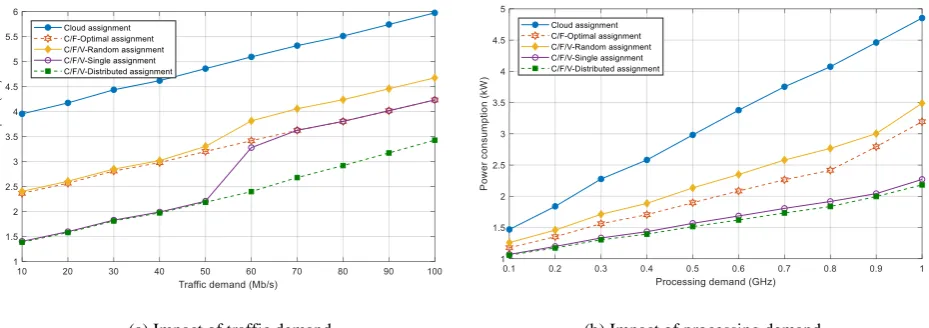
As shown in Fig. 2a, the total power consumption in the cloud based assignment follows a linear relationship with the traffic demands of tasks, and this applies to C/F and C/F/V distributed assignment strategies.
The random and single assignment strategies follow a non-linearly increasing trend in the power consumption. This is due to the limitation of wireless link capacity in the VC which leads to offloading tasks with traffic demands that exceed the link capacity to the fog node and conventional cloud. Fig.3 shows that the random assignment achieves 30% power savings compared to the cloud assignment, but results in 7% power loss compared to the optimal cloud/fog based assignment. This is because, the random assignment chooses randomly between the Cloud, Fog, and the VC. This makes the random assignment less efficient than the optimal cloud/Fog strategy which prioritizes the use of Fog nodes. On the other hand, the single assignment achieves an average power saving of 45% and 18% compared to the cloud based and F/C based assignment strategies, respectively.
Similar to the Cloud and C/F assignment strategies, the power consumed in the distributed assignment follows a linear relationship with the traffic demands of tasks. However, the distributed assignment achieves the highest power savings, with averages of 54%, 30%, and 12% compared to the cloud based, F/C based, and single assignment strategies, respectively. This is due to its ability to split the tasks and utilize the VC resources by
assigning more demands to the energy efficient VC’s OBUs.
Figure.3 shows the average power savings among the different strategies compared to the cloud based and C/F based strategies.
B. The impact of processing demands on the assignment decision and power consumption:
In this evaluation, the traffic demand of a task follows a normal distribution with mean value equal to 50 Mb/s and standard deviation equal to 5Mb/s.. The processing demand is normally distributed and vary the between mean values of 0.1GHz and1GHz and standard deviation 0.5GHz.
Fig.2b shows that the power consumption of the conventional cloud based assignment follows a linear relationship with the processing demand of tasks. Furthermore, in the Cloud/Fog based assignment, the power increases linearly with increase in the processing demands until the fog capacity is exhausted, and a step power increase occurs afterwards with a higher rate.
Integrating the VC to the architecture while considering the random assignment reduces the power consumption by an average of 30% compared to the conventional cloud based assignment. However, random assignment results in 11% power loss compared to the optimal cloud/fog assignment, as shown in Fig.4b. This is because, the random assignment chooses randomly between the Cloud, Fog, and the VC and therefore the less efficient cloud resources get used in many cases.
(a) Impact of traffic demand (b) Impact of processing demand
Figure 2. Impact of increasing the demand on the power consumption for different assignment strategies
4.CONCLUSIONS
This study proposed a distributed MEC architecture which is comprised of the a conventional cloud, metro fog nodes, and vehicles clustered by a traffic light. The proposed architecture was modelled using MILP to solve the problem of energy efficient resource assignment. Five assignment strategies were evaluated while varying the processing and traffic demands of the generated tasks. Our results showed that the traffic volume has higher impact on the power consumption compared to the impact of the processing demands. The results show an average saving between 30% and 54% when fog nodes and vehicles OBUs are integrated to the cloud based architecture. The results show a priority in terms of task allocation firstly in the VC, followed by metro fog nodes, and finally the conventional cloud. This is due to the fact that the energy needed for processing in on board units is 90% lower compared to the energy needed in cloud servers, followed by fog nodes, with 52% more energy efficiency compared to the cloud. Dividing the tasks to more than one server to be processed has a better power saving compared to the single task assignment.
ACKNOWLEDGEMENTS
The authors would like to acknowledge funding from the Engineering and Physical Sciences Research Council (EPSRC), through INTERNET (EP/H040536/1), STAR (EP/K016873/1) and TOWS (EP/S016570/1) projects. All data are provided in full in the results section of this paper.
(a) Power savings in C/F/V based assignment strategies, compared to Conventional cloud assignment
(b) Power savings in C/F/V based assignment strategies, compared to Cloud /Fog-Optimal assignment
Figure 3. The average power savings when increasing traffic demand
(a) Power savings in C/F/V based assignment strategies, compared to Conventional cloud assignment
(b) Power savings in C/F/V based assignment strategies, compared to Cloud/Fog-Optimal assignment
REFERENCES
1. J. M. H. Elmirghani, T. Klein, K. Hinton, L. Nonde, A. Q. Lawey, T. E. H. El-Gorashi, M. O. I. Musa, and X. Dong, ‘GreenTouch GreenMeter Core Network Energy-Efficiency Improvement Measures and Optimization’, J. Opt. Commun. Netw., vol. 10, no. 2, p. A250, 2018.
2. M. O. I Musa, T. E. H El-Gorashi, J. M. H Elmirghani, and S. Member, ‘Bounds on GreenTouch GreenMeter Network Energy Efficiency’, J. Light. Technol., vol. 36, no. 23, p. 5395, 2018.
3. N. I. Osman, T. El-gorashi, L. Krug, and J. M. H. Elmirghani, “Energy-Efficient Future High-Definition TV,” vol. 32, no. 13, pp. 2364–2381, 2014.
4. X. Dong, T. El-Gorashi, and J. M. H. Elmirghani, “Green IP over WDM networks with data centers,” J. Light. Tech., vol. 29, no. 12, pp. 1861–1880, 2011.
5. H. M. M. Ali, T. E. H. El-Gorashi, A. Q. Lawey, and J. M. H. Elmirghani, “Future Energy Efficient Data Centers with Disaggregated Servers,” J. Light. Technol., vol. 35, no. 24, pp. 5361–5380, 2017.
6. L. Nonde, T. E. H. El-Gorashi, and J. M. H. Elmirghani, ‘Energy Efficient Virtual Network Embedding for Cloud Networks’, J. Light. Technol., vol. 33, no. 9, pp. 1828–1849, 2015.
7. A. N. Al-Quzweeni, A. Q. Lawey, T. E. H. Elgorashi, and J. M. H. Elmirghani, ‘Optimized Energy Aware 5G Network Function Virtualization’, IEEE Access, vol. 7, p. 1, 2019.
8. X. Dong, T. E. H. El-Gorashi, and J. M. H. Elmirghani, ‘On the energy efficiency of physical topology design for IP over WDM networks’, J. Light. Technol., vol. 30, no. 12, pp. 1931–1942, 2012.
9. B. Bathula, M. Alresheedi, and J.M.H. Elmirghani, “Energy efficient architectures for optical networks,” Proc IEEE London Communications Symposium, London, Sept. 2009.
10. J. M. H. Elmirghani, L. Nonde, A. Q. Lawey, T. E. H. El-Gorashi, M. O. I. Musa, X. Dong, K. Hinton, and T. Klein, "Energy efficiency measures for future core networks," in 2017 Optical Fiber Communications Conference and Exhibition (OFC), March 2017, pp. 1-3.
11. B. Bathula, and J.M.H. Elmirghani, “Energy Efficient Optical Burst Switched (OBS) Networks,” IEEE
GLOBECOM’09, Honolulu, Hawaii, USA, November 30-December 04, 2009.
12. X. Dong, T.E.H. El-Gorashi and J.M.H. Elmirghani, “Green Optical OFDM Networks,” IET Optoelectronics, vol. 8, No. 3, pp. 137 – 148, 2014.
13. A. Q. Lawey, T. E. H. El-Gorashi, and J. M. H. Elmirghani, ‘BitTorrent content distribution in optical networks’, J. Light. Technol., vol. 32, no. 21, pp. 3607–3623, 2014.
14. A. M. Al-Salim, A. Q. Lawey, T. E. H. El-Gorashi, and J. M. H. Elmirghani, ‘Energy Efficient Big Data Networks: Impact of Volume and Variety’, IEEE Trans. Netw. Serv. Manag., no. 1, pp. 458–474, 2018.
15. M.S. Hadi, A. Lawey, T.E.H. El-Gorashi and J. M. H. Elmirghani, ‘Patient-Centric Cellular Networks Optimization using Big Data Analytics’, IEEE Access, vol. 7, 2019.
16. M.S. Hadi, A. Lawey, T.E.H. El-Gorashi, and J.M.H. Elmirghani, “Big Data Analytics for Wireless and Wired Network Design: A Survey, Elsevier Computer Networks, vol. 132, No. 2, pp. 180-199, 2018.
17. M. Musa, T. Elgorashi, and J. Elmirghani, ‘Bounds for Energy-Efficient Survivable IP Over WDM Networks With Network Coding’, J. Opt. Commun. Netw., vol. 10, no. 5, p. 471, 2018.
18. M. Musa, T. Elgorashi, and J. Elmirghani, “Energy Efficient Survivable IP-Over-WDM Networks With Network Coding,” J. Opt. Commun. Netw., vol. 9, no. 3, p. 207, 2017.
19. X. Dong, T. El-Gorashi, and J. M. H. Elmirghani, ‘IP over WDM networks employing renewable energy sources’, J. Light. Technol., vol. 29, no. 1, pp. 3–14, 2011.
20. F. Jalali, K. Hinton, R. Ayre, T. Alpcan, and R. S. Tucker, ‘Fog computing may help to save energy in cloud computing’, IEEE J. Sel. Areas Commun., vol. 34, no. 5, pp. 1728–1739, 2016.
21. F. Jalali, A. Vishwanath, J. De Hoog, and F. Suits, ‘Interconnecting Fog computing and microgrids for greening IoT’, in IEEE PES Innovative Smart Grid Technologies Conference Europe, 2016, pp. 693–698.
22. S. Arif, S. Olariu, J. Wang, G. Yan, W. Yang, and I. Khalil, ‘Datacenter at the airport: Reasoning about time-dependent parking lot occupancy’, IEEE Trans. Parallel Distrib. Syst., vol. 23, no. 11, pp. 2067–2080, 2012. 23. F. Hagenauer, C. Sommer, T. Higuchi, O. Altintas, and F. Dressler, ‘Parked Cars as Virtual Network Infrastructure’,
in Proceedings of the 2nd ACM International Workshop on Smart, Autonomous, and Connected Vehicular Systems and Services, 2017, pp. 57–64.
24. O. Altintas, F. Dressler, F. Hagenauer, M. Matsumoto, M. Sepulcre, and C. Sommery, ‘Making cars a main ICT resource in smart cities’, in IEEE Conference on Computer Communications Workshops, 2015, pp. 582–587. 25. R. Hussain, J. Son, H. Eun, S. Kim, and H. Oh, ‘Rethinking Vehicular Communications: Merging VANET with
cloud computing’, in CloudCom 2012 - Proceedings: 4th IEEE International Conference on Cloud Computing Technology and Science, 2012, pp. 606–609.
26. A. A. Alahmadi, A. Q. Lawey, T. E. H. El-gorashi, and J. M. H. Elmirghani, ‘Distributed Processing in Vehicular Cloud Networks’, in 8th International Conference on the Network of the Future (NOF), 2017, pp. 22–26.
27. M. Shojafar, N. Cordeschi, and E. Baccarelli, ‘Energy-efficient Adaptive Resource Management for Real-time Vehicular Cloud Services’, IEEE Trans. Cloud Comput., no. iv, pp. 1–1, 2016.
28. A. Odena, D. Lawson, and C. Olah, ‘Reinforcement learning for resource provisioning in the vehicular cloud’, IEEE Wirel. Commun., no. June, pp. 128–135, 2016.
29. M. Aloqaily, B. Kantarci, and H. T. Mouftah, ‘On the impact of quality of experience (QoE) in a vehicular cloud with various providers’, 2014 11th Annu. High Capacit. Opt. Networks Emerging/Enabling Technol. (Photonics Energy), HONET-PfE 2014, pp. 94–98, 2014.
31. C. C. Lin, D. J. Deng, and C. C. Yao, ‘Resource Allocation in Vehicular Cloud Computing Systems with Heterogeneous Vehicles and Roadside Units’, IEEE Internet Things J., vol. 5, no. 5, pp. 3692–3700, 2018.
32. S. Bitam and A. Mellouk, ‘ITS-cloud: Cloud computing for Intelligent transportation system’, in GLOBECOM - IEEE Global Telecommunications Conference, 2012, pp. 2054–2059.
33. P. Ghazizadeh, R. Mukkamala, and S. El-tawab, ‘Scheduling in Vehicular Cloud Using Mixed Integer Linear Programming’, Proc. first Int. Work. Mob. sensing, Comput. Commun. ACM, pp. 7–11, 2014.
34. L. Gu, D. Zeng, S. Guo, and B. Ye, ‘Leverage parking cars in a two-tier data center’, IEEE Wirel. Commun. Netw. Conf. WCNC, pp. 4665–4670, 2013.
35. I. Jang, S. Choo, M. Kim, S. Pack, and G. Dán, ‘The software-defined vehicular cloud: A new level of sharing the road’, IEEE Veh. Technol. Mag., vol. 12, no. June, pp. 78–88, 2017.
36. K. Zheng, H. Meng, P. Chatzimisios, L. Lei, and X. Shen, ‘An SMDP-Based Resource Allocation in Vehicular Cloud Computing Systems’, IEEE Trans. Ind. Electron., vol. 62, no. 12, pp. 7920–7928, 2015.
37. L. Aminizadeh and S. Yousefi, ‘Cost minimization scheduling for deadline constrained applications on vehicular cloud infrastructure’, Proc. 4th Int. Conf. Comput. Knowl. Eng. ICCKE 2014, pp. 358–363, 2014.
38. S. Choo, I. Jang, J. Koo, J. Kim, and S. Pack, ‘Reliable vehicle selection algorithm with dynamic mobility of vehicle in vehicular cloud system’, 19th Asia-Pacific Netw. Oper. Manag. Symp. Manag. a World Things, APNOMS 2017, pp. 319–321, 2017.
39. A. Q. Lawey, T. E. H. El-Gorashi, and J. M. H. Elmirghani, ‘Distributed energy efficient clouds over core networks’, J. Light. Technol., vol. 32, no. 7, pp. 1261–1281, 2014.
40. Tellabs, ‘Tellabs ® 1100 SeriesOptical Line Terminals ( OLTs )’, 2016. [Online]. Available: www.tellabs.com. [Accessed: 10-Jan-2019].
41. Tellabs, ‘Tellabs® 140C Mini Optical Network Terminals (ONTs)’, 2014. [Online]. Available: www.tellabs.com. [Accessed: 10-Jan-2019].
42. Extreme, ‘ExtremeWirelessTM 3915i/e Access Point’, 2018. [Online]. Available:
https://cloud.kapostcontent.net/pub/69feaf26-d8a7-4da3-8b29-3b58259c60e1/ap3915-data-sheet.pdf?kui=jhiWv_6zERzzJNIL4B3JGA. [Accessed: 10-Jan-2019].
43. Cisco, ‘Cisco CRS 16-Slot Line Card Chassis Power System’, 2016. [Online]. Available: http://www.cisco.com. [Accessed: 10-Jan-2019].
44. Savari, ‘Savari SW-2000 C-V2X Road-Side-Unit (RSU)’, 2019. [Online]. Available: http://savari.net/wp-content/uploads/2019/01/SW2000_Jan2019.pdf. [Accessed: 10-Apr-2019].
45. Cisco, ‘Cisco 220 Series Smart Switches’, 2018. [Online]. Available:
https://www.cisco.com/c/en/us/products/cloud-systems-management/small-business-findit-network-. [Accessed: 10-Jan-2019].
46. J. Baliga, R. W. A. Ayre, K. Hinton, and R. S. Tucker, ‘Green Cloud Computing: Balancing Energy in Processing, Storage and Transport’, Proc. IEEE, vol. 99, no. 1, pp. 149–167, 2011.
47. Cisco, ‘Extended Performance 10-Gbps Full-Band Tunable Multirate Transponder Card for the Cisco ONS 15454 Multiservice Transport Platform’, 2013. [Online]. Available:
https://www.cisco.com/c/en/us/products/collateral/optical-networking/ons-15454-series-multiservice-provisioning-platforms/data_sheet_c78-580763.pdf. [Accessed: 30-Oct-2017].
48. Industrial Systems ARM, ‘AMOS-825 Fanless ultra-compact quad- core ARM system ruggedized for demanding transportation environments’, 2017. [Online]. Available: http://cdn.viaembedded.com/products/docs/amos -825/Datasheet/VIA_AMOS-825_datasheet_v170817.pdf. [Accessed: 19-Oct-2017].
49. Cisco, ‘CISCO 12000 SERIES PERFORMANCE ROUTER PROCESSOR-1’, 2004. [Online]. Available:
https://www.cisco.com/c/en/us/products/collateral/routers/12000-series-routers/product_data_sheet0900aecd800f4147.pdf. [Accessed: 10-Apr-2019].
50. Texas Instruments, ‘TI SimpleLinkTM CC3000 Module-Wi-Fi 802.11b/g Network Processor’, 2012. [Online].
Available: www.ti.com. [Accessed: 14-Jan-2019].
51. Cisco, ‘Cisco Catalyst 6880-X Series Extensible Fixed Aggregation’, 2017. [Online]. Available:
https://www.cisco.com/web/solutions/sp/vni/vni_forecast_highlights/index.html. [Accessed: 10-Jan-2019]. 52. B. Pang and A. Ylä-Jääski, ‘Energy Consumption Analysis of ARM-based System Title: Energy Consumption