!∀∀∀#!∀∀!∃
%& ∋ ( )
# # ∃
) # # ) (
) ( ∗
& ∃
∗ ( ( ∃
∃ ) ( (
) (
∗ ∗ & +
# , −∃
∃
& −
# #
∃ ) )
. & ∃∃∃∃∃∃∃∃∃∃∃∃∃∃∃∃∃∃∃∃∃∃∃∃∃∃∃∃∃∃∃∃∃∃∃∃∃∃∃∃∃∃∃∃∃∃∃∃∃∃∃∃∃∃∃∃∃∃∃∃∃∃∃∃∃∃∃∃∃∃∃∃∃∃∃∃∃∃∃∃∃∃∃∃∃∃∃∃∃∃∃∃∃∃∃∃∃∃∃∃∃∃∃∃∃∃∃∃∃∃∃∃∃∃∃∃∃∃ . ∃∃∃∃∃∃∃∃∃∃∃∃∃∃∃∃∃∃∃∃∃∃∃∃∃∃∃∃∃∃∃∃∃∃∃∃∃∃∃∃∃∃∃∃∃∃∃∃∃∃∃∃∃∃∃∃∃∃∃∃∃∃∃∃∃∃∃∃∃∃∃∃∃∃∃∃∃∃∃∃∃∃∃∃∃∃∃∃∃∃∃∃∃∃∃∃∃∃∃∃∃∃∃∃∃∃∃∃∃∃∃∃∃∃∃∃∃∃
: 1 12 4 !∀∀07 6431 Χ2 3& Χ/ Χ 6 1 ∃∃∃∃∃∃∃∃∃∃∃∃∃∃∃∃∃∃∃∃∃∃∃∃∃∃∃∃∃∃∃∃∃∃∃∃∃∃∃∃∃∃∃∃∃∃ 0:< 3 ∃∃∃∃∃∃∃∃∃∃∃∃∃∃∃∃∃∃∃∃∃∃∃∃∃∃∃∃∃∃∃∃∃∃∃∃∃∃∃∃∃∃∃∃∃∃∃∃∃∃∃∃∃∃∃∃∃∃∃∃∃∃∃∃∃∃∃∃∃∃∃∃∃∃∃∃∃∃∃∃∃∃∃∃∃∃∃∃∃∃∃∃∃∃∃∃∃∃∃∃∃∃∃∃∃∃∃∃∃∃∃∃∃∃∃∃∃∃∃∃ 0:< :∃0 2 ( !∀∀0∃∃∃∃∃∃∃∃∃∃∃∃∃∃∃∃∃∃∃∃∃∃∃∃∃∃∃∃∃∃∃∃∃∃∃∃∃∃∃∃∃∃∃∃∃∃∃∃∃∃∃∃∃∃∃∃∃∃∃∃∃∃∃∃∃∃∃∃∃∃∃∃∃∃∃∃∃∃∃∃∃∃∃∃∃∃∃∃∃∃∃∃∃∃∃∃∃∃∃∃∃∃∃∃∃∃∃ 0:? :∃0∃0 ∃∃∃∃∃∃∃∃∃∃∃∃∃∃∃∃∃∃∃∃∃∃∃∃∃∃∃∃∃∃∃∃∃∃∃∃∃∃∃∃∃∃∃∃∃∃∃∃∃∃∃∃∃∃∃∃∃∃∃∃∃∃∃∃∃∃∃∃∃∃∃∃∃∃∃∃∃∃∃∃∃∃∃∃∃∃∃∃∃∃∃∃∃ 0:? :∃0∃! 1 Φ !∀∀0 ∃∃∃∃∃∃∃∃∃∃∃∃∃∃∃∃∃∃∃∃∃∃∃∃∃∃∃∃∃∃∃∃∃∃∃∃∃∃∃∃∃∃∃∃∃∃∃∃∃∃∃∃∃∃∃∃∃∃∃∃∃∃∃ 0:5 :∃! . 7 D 2 / . 3 & ∃∃∃∃∃∃∃∃∃∃∃∃∃∃∃∃∃∃∃∃∃∃∃∃∃ 0<: :∃!∃0 2 4 6. 4 ∃∃∃∃∃∃∃∃∃∃∃∃∃∃∃∃∃∃∃∃∃∃∃∃∃∃∃∃∃∃∃∃∃∃∃∃∃∃∃∃∃∃∃∃∃∃∃∃∃∃∃∃∃∃∃∃∃∃∃∃∃∃∃∃∃∃∃∃∃∃∃∃∃ 0<< :∃!∃! 6 6. 4 ∃∃∃∃∃∃∃∃∃∃∃∃∃∃∃∃∃∃∃∃∃∃∃∃∃∃∃∃∃∃∃∃∃∃∃∃∃∃∃∃∃∃∃∃∃∃∃∃∃∃∃∃∃∃∃∃∃∃∃∃∃∃∃∃∃∃∃∃∃∃∃∃∃∃∃∃∃ 0?! :∃!∃9 6. & ∃∃∃∃∃∃∃∃∃∃∃∃∃∃∃∃∃∃∃∃∃∃∃∃∃∃∃∃∃∃∃∃∃∃∃∃∃∃∃∃∃∃∃∃∃∃∃∃∃∃∃∃∃∃∃∃∃∃∃∃∃∃ 0?< :∃!∃: 4 ∃∃∃∃∃∃∃∃∃∃∃∃∃∃∃∃∃∃∃∃∃∃∃∃∃∃∃∃∃∃∃∃∃∃∃∃∃∃∃∃∃∃∃∃∃∃∃∃∃∃∃∃∃∃∃∃∃∃∃∃∃∃∃∃∃∃∃∃∃∃∃∃∃∃∃∃∃∃∃∃∃∃ 050 :∃!∃< 4 6. ∗ 3 2 ∃∃∃∃∃∃∃∃∃∃∃∃∃∃∃∃∃∃∃∃∃∃∃∃∃∃∃∃∃∃∃∃∃∃∃∃∃∃∃∃∃∃∃∃∃∃∃∃∃∃∃∃∃∃∃∃∃∃∃∃∃ 05! :∃!∃? . 1 ∃∃∃∃∃∃∃∃∃∃∃∃∃∃∃∃∃∃∃∃∃∃∃∃∃∃∃∃∃∃∃∃∃∃∃∃∃∃∃∃∃∃∃∃∃∃∃∃∃∃∃∃∃∃∃∃∃∃∃∃∃ 05: :∃9 & &2 7 . ) . . ∃∃∃∃∃∃∃∃∃∃∃∃∃∃∃∃∃∃∃∃∃∃∃∃∃∃∃∃∃∃∃∃∃∃∃∃∃∃∃∃∃∃∃∃∃∃ 055 :∃: 6 1 ∃∃∃∃∃∃∃∃∃∃∃∃∃∃∃∃∃∃∃∃∃∃∃∃∃∃∃∃∃∃∃∃∃∃∃∃∃∃∃∃∃∃∃∃∃∃∃∃∃∃∃∃∃∃∃∃∃∃∃∃∃∃∃∃∃∃∃∃∃ 08! :∃< 1 4 !∀∀∀#!∀∀0∃∃∃∃∃∃∃∃∃∃∃∃∃∃∃∃∃∃∃∃∃∃∃∃∃∃∃∃∃∃∃∃∃∃∃∃∃∃∃∃∃∃∃∃∃∃∃∃∃∃∃∃∃∃∃∃∃∃∃∃∃∃∃∃∃∃ 08< < 1 12 4 !∀∀!7 2 2 #!!∃∃∃∃∃∃∃∃∃∃∃∃∃∃∃∃∃∃∃∃∃∃∃∃∃∃∃∃∃∃∃∃∃∃∃∃∃∃∃∃∃∃∃∃∃∃∃∃∃∃∃∃∃∃∃∃∃∃∃∃∃∃∃∃∃∃∃∃∃∃∃∃∃∃∃∃∃∃∃∃∃∃∃∃∃∃∃∃∃∃ 0=5 3 ∃∃∃∃∃∃∃∃∃∃∃∃∃∃∃∃∃∃∃∃∃∃∃∃∃∃∃∃∃∃∃∃∃∃∃∃∃∃∃∃∃∃∃∃∃∃∃∃∃∃∃∃∃∃∃∃∃∃∃∃∃∃∃∃∃∃∃∃∃∃∃∃∃∃∃∃∃∃∃∃∃∃∃∃∃∃∃∃∃∃∃∃∃∃∃∃∃∃∃∃∃∃∃∃∃∃∃∃∃∃∃∃∃∃∃∃∃∃∃∃ 0=5 <∃0 2 ( !∀∀!∃∃∃∃∃∃∃∃∃∃∃∃∃∃∃∃∃∃∃∃∃∃∃∃∃∃∃∃∃∃∃∃∃∃∃∃∃∃∃∃∃∃∃∃∃∃∃∃∃∃∃∃∃∃∃∃∃∃∃∃∃∃∃∃∃∃∃∃∃∃∃∃∃∃∃∃∃∃∃∃∃∃∃∃∃∃∃∃∃∃∃∃∃∃∃∃∃∃∃∃∃∃∃∃∃∃∃ 0=8 <∃0∃0 ∃∃∃∃∃∃∃∃∃∃∃∃∃∃∃∃∃∃∃∃∃∃∃∃∃∃∃∃∃∃∃∃∃∃∃∃∃∃∃∃∃∃∃∃∃∃∃∃∃∃∃∃∃∃∃∃∃∃∃∃∃∃∃∃∃∃∃∃∃∃∃∃∃∃∃∃∃∃∃∃∃∃∃∃∃∃∃∃∃∃∃∃∃ 0=8 <∃0∃! 1 Φ !∀∀! ∃∃∃∃∃∃∃∃∃∃∃∃∃∃∃∃∃∃∃∃∃∃∃∃∃∃∃∃∃∃∃∃∃∃∃∃∃∃∃∃∃∃∃∃∃∃∃∃∃∃∃∃∃∃∃∃∃∃∃∃∃∃∃ !∀∀ <∃! 4 . 7 D − . ∗ Γ∃∃∃∃∃∃∃∃∃∃∃∃∃∃∃∃∃∃∃∃∃∃∃∃∃∃∃∃∃∃∃∃∃∃∃∃∃∃∃∃∃∃∃∃∃∃∃∃∃∃∃∃∃∃∃∃∃∃∃∃∃∃ !∀< <∃!∃0 > 4 ∃∃∃∃∃∃∃∃∃∃∃∃∃∃∃∃∃∃∃∃∃∃∃∃∃∃∃∃∃∃∃∃∃∃∃∃∃∃∃∃∃∃∃∃∃∃∃∃∃∃∃∃∃∃∃∃∃∃∃∃∃∃∃∃∃∃∃∃∃∃∃∃∃∃∃∃∃∃∃∃∃∃∃∃∃∃∃∃ !∀5 <∃!∃! 4 > 2 ∃∃∃∃∃∃∃∃∃∃∃∃∃∃∃∃∃∃∃∃∃∃∃∃∃∃∃∃∃∃∃∃∃∃∃∃∃∃∃∃∃∃∃∃∃∃∃∃∃∃∃ !00 <∃!∃9 > 6. 1 6. ∃∃∃∃∃∃∃∃∃∃∃∃∃∃∃∃∃∃∃∃∃∃∃∃∃∃∃∃∃∃∃∃∃∃∃∃∃∃∃∃∃∃∃∃∃∃∃∃∃∃∃∃∃∃∃∃∃∃∃∃∃∃∃∃∃∃ !09 <∃!∃: 4 6. ( ∃∃∃∃∃∃∃∃∃∃∃∃∃∃∃∃∃∃∃∃∃∃∃∃∃∃∃∃∃∃∃∃∃∃∃∃∃∃∃∃∃∃∃∃∃∃∃∃∃∃∃∃∃∃∃∃∃∃∃∃∃∃∃∃∃∃∃∃∃∃∃∃∃∃∃∃∃∃∃∃∃∃∃∃∃∃∃∃∃ !05 <∃!∃< 4 ∃∃∃∃∃∃∃∃∃∃∃∃∃∃∃∃∃∃∃∃∃∃∃∃∃∃∃∃∃∃∃∃∃∃∃∃∃∃∃∃∃∃∃∃∃∃∃∃∃∃∃∃∃∃∃∃∃∃∃∃∃∃∃∃∃∃∃∃∃∃∃∃∃∃∃∃∃∃∃∃∃∃ !0= <∃!∃? 4 6. ∗ 3 2 ∃∃∃∃∃∃∃∃∃∃∃∃∃∃∃∃∃∃∃∃∃∃∃∃∃∃∃∃∃∃∃∃∃∃∃∃∃∃∃∃∃∃∃∃∃∃∃∃∃∃∃∃∃∃∃∃∃∃∃∃∃ !!∀ <∃!∃5 4 . 1 ∃∃∃∃∃∃∃∃∃∃∃∃∃∃∃∃∃∃∃∃∃∃∃∃∃∃∃∃∃∃∃∃∃∃∃∃∃∃∃∃∃∃∃∃∃∃∃∃∃∃∃∃∃∃∃∃∃ !!! <∃9 2 1 ∃∃∃∃∃∃∃∃∃∃∃∃∃∃∃∃∃∃∃∃∃∃∃∃∃∃∃∃∃∃∃∃∃∃∃∃∃∃∃∃∃∃∃∃∃∃∃∃∃∃∃∃∃∃∃∃∃∃∃∃∃ !!< <∃: 1 7 − 2 Φ D − 2 Η ∃∃∃∃∃∃∃∃∃∃∃∃∃∃∃∃∃∃∃∃∃∃∃∃∃∃∃∃∃∃∃∃∃∃∃∃∃∃∃∃∃∃∃∃∃∃∃ !!? <∃:∃0 . ( Β ∃∃∃∃∃∃∃∃∃∃∃∃∃∃∃∃∃∃∃∃∃∃∃∃∃∃∃∃∃∃∃∃∃∃∃∃∃∃∃∃∃∃ !!? <∃:∃! 1 1 ∃∃∃∃∃∃∃∃∃∃∃∃∃∃∃∃∃∃∃∃∃∃∃∃∃∃∃∃∃∃∃∃∃∃∃∃∃∃∃∃∃ !!8 <∃< 1 4 !∀∀∀#!∀∀!∃∃∃∃∃∃∃∃∃∃∃∃∃∃∃∃∃∃∃∃∃∃∃∃∃∃∃∃∃∃∃∃∃∃∃∃∃∃∃∃∃∃∃∃∃∃∃∃∃∃∃∃∃∃∃∃∃∃∃∃∃∃∃∃∃∃ !90 ? 2 3Χ Χ 64. 2 3Χ 3& & Χ Χ/ ∃∃∃∃∃∃∃∃∃∃∃∃∃∃∃∃∃∃∃∃∃∃∃∃∃∃∃∃∃∃∃∃∃∃∃∃∃∃∃∃∃∃∃∃∃∃∃∃∃∃∃∃∃∃∃∃∃∃∃∃∃∃∃∃∃∃∃∃∃∃∃∃ !:! ?∃0 D 2 / ;∃∃∃∃∃∃∃∃∃∃∃∃∃∃∃∃∃∃∃∃∃∃∃∃∃∃∃∃∃∃∃∃∃∃∃∃∃∃∃∃∃∃∃∃∃∃∃∃∃∃∃∃∃∃∃∃∃∃∃∃∃∃∃∃∃∃∃∃∃∃∃∃∃∃∃∃∃∃∃∃∃∃∃ !:! ?∃0∃0 2 !∀∀∀#!∀∀! ∃∃∃∃∃∃∃∃∃∃∃∃∃∃∃∃∃∃∃∃∃∃∃∃∃∃∃∃∃∃∃∃∃∃∃∃∃∃∃∃∃∃∃∃∃∃∃∃∃∃∃∃∃∃∃∃∃∃∃∃∃∃ !:! ?∃0∃! 1 1 Β ∃∃∃∃∃∃∃∃∃∃∃∃∃∃∃∃∃∃∃∃∃∃∃∃∃∃ !:9 ?∃0∃9 ∃∃∃∃∃∃∃∃∃∃∃∃∃∃∃∃∃∃∃∃∃∃∃∃∃∃∃∃∃∃∃∃∃∃∃∃∃∃∃∃∃∃∃∃∃∃∃∃∃∃∃∃∃∃∃∃∃∃∃∃∃∃∃∃∃∃∃∃∃ !<! ?∃0∃: . 2 ∃∃∃∃∃∃∃∃∃∃∃∃∃∃∃∃∃∃∃∃∃∃∃∃∃∃∃∃∃∃∃∃∃∃∃∃∃∃∃∃∃∃∃∃∃∃∃∃∃∃∃∃∃∃∃∃∃∃∃∃∃∃∃∃∃∃∃∃∃∃∃∃∃∃∃∃∃∃∃∃∃∃∃∃ !<< ?∃0∃< Α 2 ∃∃∃∃∃∃∃∃∃∃∃∃∃∃∃∃∃∃∃∃∃∃∃∃∃∃∃∃∃∃∃∃∃∃∃∃∃∃∃∃∃∃∃∃∃∃∃∃∃∃∃∃∃∃∃∃∃∃∃∃∃∃∃∃∃∃∃∃∃ !<? ?∃! & 1 ∃∃∃∃∃∃∃∃∃∃∃∃∃∃∃∃∃∃∃∃∃∃∃∃∃∃∃∃∃∃∃∃∃∃∃∃∃∃∃∃∃∃∃∃∃∃∃∃∃∃∃∃∃∃∃∃∃∃∃∃∃∃∃∃∃∃∃∃∃∃∃∃∃∃∃∃∃∃∃∃∃∃∃∃∃∃∃∃∃∃∃∃∃∃∃∃∃∃∃∃∃∃∃ !<5 ∃∃∃∃∃∃∃∃∃∃∃∃∃∃∃∃∃∃∃∃∃∃∃∃∃∃∃∃∃∃∃∃∃∃∃∃∃∃∃∃∃∃∃∃∃∃∃∃∃∃∃∃∃∃∃∃∃∃∃∃∃∃∃∃∃∃∃∃∃∃∃∃∃∃∃∃∃∃∃∃∃∃∃∃∃∃∃∃∃∃∃∃∃∃∃∃∃∃∃∃∃∃∃∃∃∃∃∃∃∃∃∃∃∃∃∃∃∃∃∃∃∃∃∃∃∃∃∃∃∃∃ !?∀ 5 44 Χ 2 ∃∃∃∃∃∃∃∃∃∃∃∃∃∃∃∃∃∃∃∃∃∃∃∃∃∃∃∃∃∃∃∃∃∃∃∃∃∃∃∃∃∃∃∃∃∃∃∃∃∃∃∃∃∃∃∃∃∃∃∃∃∃∃∃∃∃∃∃∃∃∃∃∃∃∃∃∃∃∃∃∃∃∃∃∃∃∃∃∃∃∃∃∃∃∃∃∃∃∃∃∃∃∃∃∃∃∃∃∃∃∃∃∃∃∃∃∃∃∃∃∃∃ !?8 ( 7 %!∀∀∀∋ ∃∃∃∃∃∃∃∃∃∃∃∃∃∃∃∃∃∃∃∃∃∃∃∃∃∃∃∃∃∃∃∃∃∃∃∃∃∃∃∃∃∃∃∃∃∃∃∃∃∃∃∃∃∃∃∃∃ !?= ( 7 . ∃∃∃∃∃∃∃∃∃∃∃∃∃∃∃∃∃∃∃∃∃∃∃∃∃∃∃∃∃∃∃∃∃∃∃∃∃∃∃∃∃∃∃∃∃∃∃∃∃∃∃∃∃∃∃∃∃∃∃∃∃∃∃∃∃∃∃∃∃∃∃∃∃ !5∀ ( 7 Β Φ 6. ∃∃∃∃∃∃∃∃∃∃∃∃∃∃∃∃∃∃∃∃∃∃∃∃∃∃∃∃∃∃∃∃∃∃∃ !50 ( >7 Β Φ 6. ∃∃∃∃∃∃∃∃∃∃∃∃∃∃∃∃∃∃∃∃∃∃∃∃∃∃∃ !5! ( >7 Β Φ 6. ∃∃∃∃∃∃∃∃∃∃∃∃∃∃∃∃∃∃∃∃∃∃∃∃ !59
( > 7 / Ι # ∃∃∃∃∃∃∃ !5:
Number Page
& !#07 > ?=
& !#!7 > 88
& !#97 − 8=
& !#:7 > =∀
& 9#07 4 6. ∗ 0∀9
& 9#!7 Χ2 . 0==:#0=== 0∀<
& 9#97 Χ . 0==:#0=== 0∀<
& 9#:7 4 6. ∗ Ι 6. 00!
& 9#<7 0!8
& 9#?7 ∗ %1 4 !∀∀∀∋ 0:!
& 9#57 1 4 !∀∀∀ 0:9
& :#07 05?
& :#!7 . Ι. 6 Κ + 05=
& :#97 2 6. ∗ 0==?#0===7 Β ∃ &2 080
& :#:7 08:
& :#<7 2 . 6 0=∀
& :#?7 2 6. 7 ∃ 0=∀
& :#57 ∗ %1 4 !∀∀0∋ 0=9
& :#87 1 4 !∀∀0 0=<
& <#07 !!9
& <#!7 6. ( ∃ 6. !!:
& <#97 !9∀
& <#:7 ∗ %1 4 !∀∀!∋ !9=
Number Page
0#07 0∀
0#!7 ( ( + 9!
0#97 ( 9<
0#:7 ≅ − ∗ % ∋ 95
0#<7 Α ∗ ∗ :?
!#07 4 ∃ 5!
!#!7 ≅ − ∗ 55
!#97 4 − ∗ 5=
!#:7 5=
!#<7 80
9#07 0∀?
9#!7 4 ) 0∀=
9#97 . %Κ∋ 00∀
9#:7 % ∋ 009
9#<7 % 2∋ 0!9
9#?7 . ∗ 6. 0!<
:#07 ∗ 0<<
<#07 4 !∀?
<#!7 > ∗ !0?
<#97 !!<
<#:7 2 ∗ ( !!8
<#<7 2 Χ3 ∗ ( !!8
<#?7 2 !!8
?#07 ( !:9
5#07 ∗ !89
∗
∃
4 1 Λ ) )
+ ∃
) ) ∗ )
, − + ∃
6 ∗
∃ ∃
) ) )
∗ ∃
. . 6
∃
& ) (
∗ ) )
∃
. ) 6 ∃
( )
∃ 6
∃ D )
CT Communication tutor (lecturer). Member of staff who teaches English for vocational purposes. Communication is a core subject on all NC/NQ/HNC/HND programmes (see below).
FTE Full-time equivalent: calculation which reduces the total amount of student unit measurements into the notional equivalent of full-time students, e.g. given that one full-time student on an HNC programme would complete 12 SUMs two part-time students each studying 6 SUMs would equal one FTE. See also SUM below.
GSVQ General Scottish Vocational Qualification; a fixed framework for a range of pre-vocational programmes at non-advanced level, e.g. GSVQ Travel & Tourism. However, programme leaders (see PL below) may devise programmes that include units not in the GSVQ framework, provided they can show that these units are in demand by local employers.
Higher The level accorded to a range of Scottish subject qualifications that are traditionally required for entry to advanced level study at a further education college (i.e. for Higher National Certificate/Diploma) or at university.
HN Higher National. This term applies to units and programmes deemed to be at advanced, i.e. undergraduate university level.
HNC Higher National Certificate, a programme consisting of 12 SUMs (480 hours), equivalent to first year undergraduate study at university. See also HND below.
HND Higher National Diploma, a qualification consisting of 30 SUMs (1200 hours); equivalent to the first two years of undergraduate study at university. Both HNCs and HNDs must stay within specified frameworks laid out by SQA (see below). Depending on the vocational specialism, there are a number of core units, and a range of optional units, which can be selected as appropriate. See also PL below.
LT (Modern) Language tutor (lecturer). Within this study referring to a member of staff who teaches one or more languages at a Scottish FE college.
ML Modern language(s); in this study all languages excluding English; within the Scottish FE context referring to the most commonly taught languages therein, i.e. French, German, Italian and Spanish. Modern languages are included as options in most frameworks, but are not a core subject.
NC National Certificate, the name preceding post-16 subject qualifications with a vocational focus, e.g. NC Spanish (levels 1-5), as well as post-16 vocational programmes at non-advanced level, e.g. NC Scottish Tourism. The term has now been replaced by National Qualifications (see below)
NQ National Qualification, the current title preceding non-advanced (i.e. up to and including Higher level) units and programmes of study, e.g. NQ Spanish, NQ Scottish Tourism.
PL Programme leader. FE lecturer, normally in a promoted post, who is responsible for the ultimate design of one or more programmes related to his or her vocational specialism. With respect to the list of (mandatory) options in the curriculum framework, PLs can choose which to include in their framework, and whether to provide students with a range of options, or offer a ‘take-it or leave-it’ programme of fixed units.
SFEFC Scottish Further Education Funding Council; responsible for the funding of Scottish Further Education Colleges; based on the amount of SUMs delivered at a given college, within a fixed upper limit.
SM Abbreviation used for a senior member of a Scottish further education college, e.g. Principal or Assistant Principal.
SP OR Scottish Parliament Official Records
SQA Scottish Qualifications Authority, responsible for the design and assessment of post-16 qualifications in Scottish schools and further education colleges.
INTRODUCTION
Qu’est-ce qu’un homme révolté? Un homme qui dit non. Mais s’il refuse, il ne renonce pas: c’est aussi un homme qui dit oui, dès son
premier mouvement. (Albert Camus, L’homme révolté)
In early 1997 I was startled to hear that the Scottish Office was commissioning a major research study to identify the causes for the decline in the number of learners studying a modern language at ‘Higher’ level, the Scottish qualification required for university entry.
Having worked in the British hospitality and tourism industry for over ten years, I had experienced both the need for and lack of ML (modern language) skills. I had entered the teaching profession in 1989, the same year the ‘Languages for All’ policy came into effect (Scottish Office 1989)1, and a number of modern language (ML) pilot projects in primary schools were launched, culminating in the introduction of the MLPS policy2 (Scottish Office 1993). These two initiatives had signalled to me that the government was committed to increasing the ML competence of its population, and I, perhaps naively, assumed Scottish people implicitly supported these intentions.
In 1992, I had moved into the further education sector, as lecturer of French, German, and tourism, confident that because of government policies and European integration demand for ML study in the FE (further education) sector would rise. To my surprise,
1
Although not legally binding, the policy nevertheless led to the understanding at local authority level that modern languages were a compulsory part of all four years in the secondary school
curriculum 2
ML provision in FE programmes remained dominantly at beginners’ level. My own efforts to increase and widen ML uptake had limited success, with most interest being shown in acquiring ‘holiday’ Spanish. Until the announcement by the Scottish Office in 1997 however, I had been convinced that ML uptake in schools had been rising and that the low interest in ML study at my institution was an exception to the rule. Enquiries around a number of other colleges indicated that this was not the case.
Yet, this state of affairs appeared incongruous. In an earlier survey, the increasing need of Scottish industry for employees with ML skills had been forecast (Duncan &
Johnstone, 1988). It seemed logical to assume that after the establishment of the Single European Market in 1992 companies involved in trading with clients from abroad would increasingly need and wish to employ people knowledgeable about other cultures and able to communicate with foreign clients in their own language. Language and culture skills are arguably required in order take full advantage of every European Union citizen’s right to employment mobility within member states.
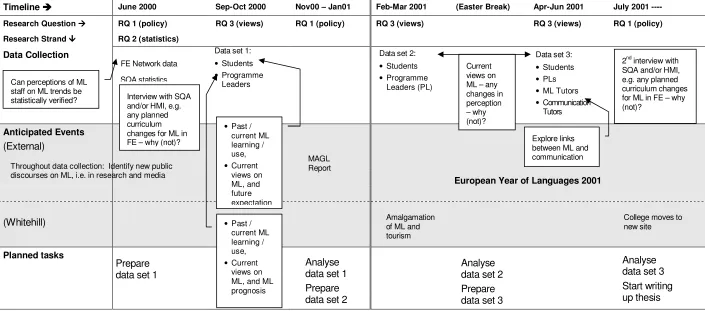
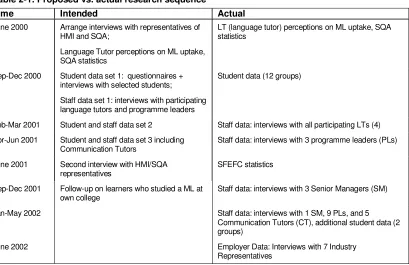
Having completed the requisite preparatory essays in June 2000 the main data collection period was set for June 2000 – June 2001. During this time, a number of significant pro-ML papers and initiatives were expected. In May 2000, the Nuffield Foundation had already published the findings of its inquiry into Britain’s future language needs over the next 20 years. The Ministerial Action Group for Languages (MAGL), set up by the Scottish Minister for Education in October 1998, was due to publish its findings and recommendations by the end of 2000. Finally, the European Commission and the Council of Europe had jointly declared 2001 as the European Year of Languages.
In the initial design of the investigation, I considered it important to explore the
motivational and attitudinal factors amongst a range of college students and college staff with regard to ML study in the light of these potentially powerful pro-language
initiatives. At the same time I wanted to find out what kind of statistical information was being collected regarding ML study within Scottish FE and to what uses, if any, the data were put.
In the selection of the research strategy and data collection methods, the limited time to negotiate access to potential research participants and to conduct the investigation itself whilst still fulfilling my professional commitments was an important consideration. Nevertheless, I was keen to gather evidence beyond my own institution. As steering group member of the Scottish FE Network Modern Languages (henceforth FE
Network)3 I was fortunate to have immediate access to four colleagues in similar college
3
posts to mine (i.e. in charge of ML provision), and whose colleges represented an even spread from east to west within the so-called central belt of Scotland. All of them agreed to participate in the research and to identify further potential research participants, i.e. student groups and relevant programme leaders, within their respective colleges.
In June 2000, I obtained some preliminary data from lecturers attending the annual FE Network conference as well as statistical data on ML uptake from the Scottish
Qualifications Authority (SQA)4. I then proceeded with the first set of student data collection in the autumn 2000.
My four language colleagues agreed to act as research collaborators for this initial phase by helping me to collect student data in their own colleges thus reducing the time commitment by myself. Although the student evidence was to be qualitative in nature it was recognised that staff might encounter difficulties negotiating or obtaining access to some student groups. We therefore agreed to ask students to complete a semi-open questionnaire, which would entail a minimum of disruption, and which could be followed by a more in-depth qualitative probe in the form of a group discussion where possible.
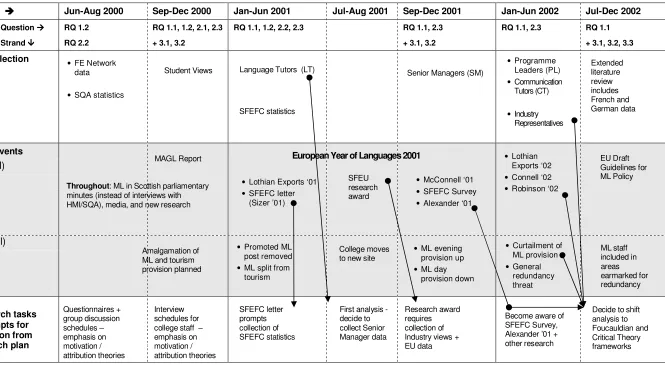
I was initially quite hopeful that I would be able to complete my data collection by the June 2001 deadline. However, ‘turbulence’ in the external context proved to present greater barriers than envisaged. My own college was going through an unsettled (and unsettling!) phase. A new chief executive took office in March 2001, just months before
4
the college was due to move to a completely new site. The staff restructure negotiated by the old principal a few months earlier was put on hold and a new restructure implemented in June 2001. At the same time, I was preparing a major promotional language event for September 2001, as part of the European Year of Languages. In the end, I only completed a fraction of the staff interviews by June 2001 and had to abandon the collection of a further student data set.
A timely grant of research funding enabled me to continue my research during the subsequent academic session (September 2001 – June 2002) albeit with the inclusion of additional data sources. These additions were included partly by obligation, to fulfil research-funding requirements, and partly by my own choice, in response to changes in the external context. These contextual factors also caused me to re-examine my data and to shift the emphasis of my analysis from the motivational perspectives of the
stakeholders per se to the ways in which knowledge claims with respect to ML learning might be constructed. Thus, by taking account of the socio-cultural and socio-historical context the research aims of the study have been more fully addressed. However, in order to keep to the allocated word limit of the Doctorate in Education5 most of these additional data analysis sets have been attached as appendices.
Another important feature of this study is the research diary where I kept track of significant events as they occurred and recorded my reactions to them. By detailing the various factors, their impact on the research process and my evolving understanding of the data, the research diary became an increasingly important and integral part of my
5
investigation. In order to help clarify to the reader my own differing perspectives within the research process, i.e. not just as ‘detached’ researcher but also as ‘engaged’
practitioner I wanted to (and felt I had to!) make these different voices visible in the thesis. I have done this by including footnotes of a personal nature at relevant points in the data analysis.
Finally, because of the complexity of the research process, and the nature in which I came to construct the analysis of the data I decided to present the findings in
chronological format, almost as a narrative, thereby demonstrating the evolutionary process of my understanding. For this reason, the main literature review chapter is restricted to publications up to 2000, with later publications referred to in the appropriate chronological research phases. This is also why the study is written throughout using the first person.
1
ARCHAEOLOGICAL
RECORDS UP TO 2000
Archaeology: the scientific study of material remains of past human life and activities; here: the subjective investigation of public and private discourses on modern languages in order to reveal some of the assumptions, expectations, values and beliefs underlying them.
Genealogy: an account of the descent of a person, family or group from
an ancestor or from older forms; here: an account of the origin of a given
belief regarding the place of modern languages in Scottish further education.
1.1
The Researcher as Archaeologist
When an archaeologist starts an excavation, s/he does not know what exactly s/he is going to find. The reasons for starting the search, how s/he conducts it, and where s/he looks for clues are influenced by her/his prior beliefs. Some finds may be as expected, others may surprise her/him, cause her/him to look for additional finds, and potentially alter her/his original beliefs. Time and other material resources are likely to limit the scope of the excavation and therefore any conclusions drawn include an element of faith that assumes that additional discoveries would not substantially alter the final
interpretation of the findings.
and journal articles or ‘archaeological records’ I decided to consult. As the data collection got underway, unexpected findings arising from the literature resulted in additional ‘digging’ for data as well as additional readings, and ultimately a change in my own understanding of the research topic. In order to allow the reader to follow the path of my ‘knowledge excavation’ the discourses examined in this chapter have been restricted to those published by the start of my data collection. They do NOT represent
all the texts I read from that period, nor do they embody all discourses that might be considered relevant on the matter. I am satisfied, however, that the selection presented here are sufficient to illustrate the points I wish to make. Discourses published
subsequently have been included in the respective data collection phase.
1.1.1
‘Language Skills Matter’: A Personal Genealogy
It is important to state from the outset that I approached this investigation with a positive inclination towards modern languages (ML) and its current relevance for the further education (FE) sector. How have I to come to take this position? I am a native German speaker and was taught English from age 12 and French from age 14. Although at school I had found language learning both easy and enjoyable, when faced with a choice between a language or science-based curriculum at age fifteen, I had chosen the latter because I was interested in using the language in ‘live’ situations, not in studying its ‘dead’ literature. The science-based curriculum appeared more geared towards ‘practical’ application, even when it involved mathematical theory.
languages other than English. Whilst I could understand their position – I had after all, been taught English precisely because it was so widely spoken – it occurred to me that in such a society people with language skills would be in high demand (even though I had no empirical evidence of this). Therefore, I went on to study languages at university (despite having to concentrate on literature) and after gaining my Bachelor degree I took up the university’s offer to study for a further qualification at a French university. During my four-year stay in France, I worked in the hospitality industry, using both English and my native German frequently.
Table 1-1: Summary of preparatory research phases
Time Autumn 1998 Spring 1999 Autumn 1999 Spring 2000
Assignments #1: Managing
Institutional Change A first attempt at formulating some research questions and exploring the substantive and methodological assumptions underlying these questions
# 2: Analysis, Criticism and Interpretation of Research Compared and contrasted 2 different research projects, in positivist and interpretative
paradigms respectively
# 3: Impact of policy on professional practice
A more in-depth look at how recent policy developments have affected the professional practice of modern language tutors in Scottish FE colleges.
# 4: Research Planning and Design
Research Proposal (involves revisiting Assignments 1-3 and expanding my literature review).
I am drawn to texts by Foucault and critical theorists but am unsure how to translate their ideas into research questions / set methodology. Decide to put emphasis of analysis on motivation constructs as developed by Dörnyei.
Contextual Events
Start of Nuffield Language Inquiry announced and preliminary report published. In Scotland, the Ministerial Action Group on Languages is established.
Conduct a preliminary study in my own college (‘Student Views and Staff Perceptions on MLs at Whitehill College’), the findings of which are presented at the College Board of Studies in June 1999. At my instigation, the FE Network (ML) prepares a response to the SEED consultation document ‘Skills for Scotland’.
Hold a promotional event for languages in September
(‘European Connections’). It results in lots of publicity in the media but the increase in ML uptake is minimal. Evening class budget is cut in preparation for planned college move to new site at an as yet unspecified date, resulting in reduced ML provision and loss of ML staff.
Publication of final report of Nuffield Languages Inquiry and Hall (2000). The latter is a literature review regarding the contribution of foreign languages to Scottish industry.
College principal announces planned move of college to new site for mid-2001. I decide to hold another ML promotional event in autumn 2001 as part of European Year of Languages in order to take full advantage of the college’s new location.
1.1.2
Policy and Professional Practice(s)
Findings from investigations leading to the Doctorate in Education should inform policy and academic professionals’ practice. Thus I started by examining the literature
concerned with policy, paying particular attention to the tensions between language and further education policies, at EU and UK levels. Other publications reported on the ways in which recent education policies had impacted on professional practice6. Many of these argued that policy implementation is modified through stakeholders’ underlying attitudes, beliefs, and motivation. This in turn led me to numerous studies on the
6
motivation of language learners. Although the aim of my investigation – to gain a deeper understanding as to why despite the close economic links to Europe and the governmental promotion of language learning the dominant view amongst Scottish people appeared to be that ‘English is enough’7 – has not altered, the way I tried to gain ‘enlightenment’ changed.
As stated at the beginning of this chapter, in the pages that follow I present a selection of the discourses published by June 2000 I read before, during and after the actual data collection phase that I consider relevant within my current epistemological and theoretical frameworks.
1.2
An Archaeology of EU Policies
1.2.1
EU Education Policies
The Treaty on European Union (The Maastricht Treaty) shifted the agenda of education and training policy in the European Community. Whereas the earlier Treaty of Rome (1957) had referred only to training, in the Maastricht Treaty (1992; in force from 1 November 1993) 'education' was included for the first time:
The Community shall contribute to the development of quality education by encouraging cooperation between Member States and, if necessary, by supporting and supplementing their action, while fully respecting the responsibility of the Member States for the content of teaching and the organization of education systems and their cultural and linguistic diversity (European Commission, 1992, Article 126)
7
The article also refers to the encouragement of the “European dimension in education, particularly through the teaching and dissemination of the languages of the Member States”' via a number of “incentive measures”. Although the rights embedded in the principle of 'subsidiarity' prevent any EU-wide legislative or other regulatory
harmonisation, there have been increasing efforts to support the development for
multilingual competence amongst all EU citizens through a number of so-called Action
Programmes. The White Paper on Education and Training (European Commission,
1995) set out the objective, amongst others, to enable all EU citizens to be proficient in
three European languages by the time they leave school. The proclaimed aims are the
respect for cultural and linguistic diversity of each member state and the enabling of EU
citizens to take full advantage of their rights to live and work in any one of the member
states. However, a closer look at the implementation strategies across EU member states
points to different purposes.
1.2.2
Implementation of Language Policies
According to official figures (Wright, 1999: 94), the first foreign language taught in most
member states is English. Clearly, this is not consistent with a respect for cultural and
linguistic diversity within the EU. France, for example, shares borders with German,
Italian, and Spanish speaking citizens, yet nearly 90% of French pupils learn English as
their first foreign language (Goullier, 1997:1). It rather implies a strong vocational
rationale that implicitly, if not explicitly, recognizes English as the dominant language of
Although Scotland has only recently regained parliamentary powers, it had always retained control over its own education and training system within the United Kingdom, and the teaching of a foreign language has effectively been compulsory throughout the Scottish secondary school curriculum since the proclamation of the ‘Languages for All’ policy (Scottish Office, 1989). The most frequently taught first foreign language in Scottish schools is French, followed by German and there have been efforts to diversify language provision to include Spanish and Italian. In this sense, Scottish ML provision represents a closer approximation of the European ‘ideal’.
Whilst here too the vocational rationale has been a consistent feature of policy statements with respect to ML study (e.g. Scottish Office, 1972, 1989, 1995) actual language learning practice within the EU has arguably weakened its credibility. Thus, for example, during the consultation phase for reforms to the curriculum framework of education for 16-19 year olds (subtitled ‘Higher Still’), the government decided not to heed the call by the Confederation of British Industry (CBI) to include ML study as a core skill (McMillan, 1994: 6).
However, the arguments regarding the place of ML in post-compulsory education have not been settled. Just before the start of my data collection phase in June 2000, the Nuffield Language Inquiry (2000) published its final report, and in December 2000, the Scottish Ministerial Action Group on Languages (henceforth MAGL) published its recommendations. Both made powerful arguments on the need for native English speakers to learn other languages. I will return to both publications later but for now it is worth emphasising that the Nuffield Inquiry, although with a UK-wide remit and
although it only had a Scotland-wide remit and was only concerned with the compulsory education sectors, required a ministerial response, and was therefore potentially more significant for my research.
1.2.3
Implementation of Lifelong Learning Policies
The aforementioned European White Paper on Lifelong Learning (European Commission, 1995) is not restricted to language learning and includes all education sectors. Again, countries diverge in their interpretation of lifelong learning, but it is fair to say that in the UK and Scotland it is usually associated informally with learning in post-compulsory education settings.
The broad Government aims concerning lifelong learning have been spelt out in their policy document Opportunities for Everyone (Scottish Office, 1999a). The common theme running through the statements is the idea of linking economic success to an educated workforce whose members are willing to update their knowledge and skills throughout their lives.
According to recent figures, (SFEFC, 2000a) there were over 410,000 student
within the Scottish education framework interfacing with both schools and universities, and the state and status of ML study in Scottish FE has powerful implications for higher education (HE) as well.
There is increasing interest in the sector and a growing body of research exploring issues such as the distribution of provision, and patterns of participation within Scottish further education (e.g. Raab & Davidson, 1999; Gallacher et al,2000). However, no published study to date has specifically investigated the state and status of modern languages within this sector.
According to Edwards & Usher (2000: 4) there are various traits apparent in other recent education policy statements, not just in Scotland, the UK or Europe, but in all Western, capitalist societies, such as:
• the need for change is largely cast in economic terms
• there is increasing criticism of schools & their failure to deliver what is required
• changes in schooling are being required without a significant increase in resourcing from
governments
• educational reform is promoted through changes in forms of governance
• schools are being required to work in more commercial and market-like ways
• there is an emphasis on standards, accountability and testing.
With respect to the post-compulsory scene in Scotland, Osborne et al (2000) point to the tension between economist elements and the contradicting commitment to social
pursue different markets or the same markets in different ways. The introduction of such quasi-market relations in the sector has increased inter-institutional competition and weakened the relationship between institutions and local communities. This new modus operandi inevitably pushes colleges to de-prioritise social justice concerns in favour of economic survival in the market place […]
The challenge for both HE and FE is to meet both individual needs in such a fashion,
and to develop an education and training environment that can aid the economic
development of the nation. (Osborne et al, 2000: 248-9)
Space does not permit a full discussion of the above issues at this time. For the purposes of this study, I wish to draw attention to two points: the need to produce curricula
relevant to the world of work and the requirement to be accountable.
With regard to point (1), Haskel & Holt (1999) highlight some problems for economists when trying to ‘predict’ future skill needs. They contend that most measures of skill shortages fail to pick up the extent to which employers adapt to skill shortages by opting for product strategies that do not require high skills – thereby eliminating the skill shortage, but at the expense of a poorer performance for the economy at large. Similarly,
[F]orecasts of skills are likely simply to extrapolate such low skill traps into the future - so that if individuals use the forecasts they will merely replicate the existing problem. (Haskel & Holt, 1999: 40)
The question therefore arises in what ways employers’ views on the need, or otherwise, for language skills, feed into economic surveys and forecasts because, according to a recent government paper,
The primary responsibility for addressing shortages and gaps lie with employers, individuals, and providers (Scottish Office, 1999b, online, §5.5)
there is a responsibility on Government to ensure that clear and helpful information is
available on which people can base their decisions (ibid)
Taking Haskel & Holt’s cautions into consideration, it is not evident how such ‘clear and helpful information’ can be obtained through skill forecasts as outlined above.
GAPS IN STATISTICAL EVIDENCE ON ML UPTAKE
Although there is a perception of overall decline in ML uptake in Scottish FE
programmes, the increase at my own college in ML uptake in evening classes generally and in Spanish specifically, warrants the search for verifiable statistical information on trends of ML study within Scottish FE by language, mode of study and/or college. This brings us to point (2) and the potential difficulties associated with the requirement for accountability. Cloonan & Canning (2000) found that flaws with some of the statistical data collection methods used by SQA on uptake of Scottish Vocational Qualifications (SVQs) provide unreliable indicators of uptake and completion rates. The authors outline weaknesses in the evidence that is being presented as ‘expert’ and whose ‘authority’ is blindly accepted. Whilst I did not expect to encounter such difficulties with respect to SQA data for ML uptake it was nevertheless important to note the significance of assumptions underlying statistical data collection, as will be seen later.
1.2.4
Colebatch’s Analytic Framework
specific, coherent objectives. The authority accorded to the person (or group of people) who endorses and legitimises the policy also implies an assumption that this person (or group of people) holds specialised knowledge (expertise) about the policy area so that implementation will follow in an orderly fashion. Colebatch, however, argues that policies frequently contain inconsistencies or conflict with other policies; that claims of expertise may be overstated and that the authority invested in certain knowledge claims may therefore also be misplaced (ibid: 7-8).
Colebatch also highlights that resources allocated to past initiatives restrict the formulation of new policies. Thus, the sheer amount of resources assigned to the learning of English in the past by the UK and by other EU states would make it difficult to bring about more truly multilingual language policies as envisaged by EU policy makers. At the same time, it would superficially justify the current dominant belief amongst UK citizens that there is little need for foreign language learning for their continued prosperity, despite the comprehensive challenges to it by Moys (1998) and the resultant Nuffield Languages Inquiry (2000).
POLICY INCOHERENCE
Since the White Paper of 1996 recommended the continued development of language skills, beyond compulsory schooling, this would, by definition, include both further and higher education sectors. However, in the Government Green Paper ‘Skills for
(Scottish Office, 1991b). Is this simply an oversight, or have policy makers’ views on the relevance of this skill for further education students changed over this period? This is an important question when one considers that currently a number of funding and curriculum policies within the Scottish FE sector are also undermining the position of ML study within the FE fulltime programmes.
For example, when Scottish FE colleges moved out of local authority control into direct government funding in 1993 students were no longer able to choose additional ‘elective’ credits on top of their main vocational programme at no extra cost to them, yet
previously programme leaders had frequently offered ML study to their students in this way (Doughty, 1994: 11). Now ML units could now only be studied as an additional elective subject if college managers decide to offer funding for this type of ML study. In addition, ML units were removed from a number of award frameworks.
POLICY INCONSISTENCY THROUGH ALLOCATION OF FINANCIAL RESOURCES
Other factors working against ML are the low subject weighting and the notional funding allocations within colleges. The ‘weighting’ of a curriculum subject is
calculated from estimated resource implications, which are considered to be negligible for ML. The low weighting means that higher numbers of students are required before a class becomes ‘viable’ for delivery in financial terms. New curriculum design rules for non-advanced (NC) provision mean that it is no longer possible to include a ML
This denies students the opportunity to add a further language to the one studied at school and disadvantages students who do not have previous ML skills (e.g. older students).
At the start of the data collection phase, similar design rules were about to be introduced to Higher National qualifications (advanced provision), i.e. Higher National Certificates and Higher National Diplomas (HNCs/HNDs). These awards are considered equivalent to first and second year undergraduate study respectively. Full implementation of the rules would effectively remove the possibility of the common practice to include up to three credits of a ML at beginners’ level in a number of HN qualifications such as in tourism, hospitality or business. This decision seems doubly curious if one considers that a ML can be studied ab initio in virtually all higher education (HE) programmes, a practice that is indeed encouraged as part of institution-wide language programmes at many British universities.
IMPLICATIONS FOR RESEARCH QUESTIONS
The discussion on policy-related discourses has raised two areas for further exploration:
1. how policy-related discourses published during the course of the investigative phase
would portray the role of modern languages in Scottish (further) education
2. what kind(s) of statistical information might be available, what kinds of assumptions are
(and can be) made about its collection procedures, and about the implications of the conclusions arrived at
1.3
An Archaeology of Stakeholders’ Practices
I have already indicated that the policy process involves the interaction between groups who construct their own meanings and practices during the implementation phases. It may not be possible to identify all the players in this cyclical and iterative process occurring in different contexts but they will certainly include students, college staff, college managers, and industry. Each one of them will somehow reformulate education policies into their own common-sense way of thinking, thereby altering the meanings originally intended8. What then what was ‘known’ about stakeholder views on ML skills by the start of the data collection phase in June 2000?
1.3.1
The Uncertain FE Learner
LANGUAGE LEARNERS IN FRENCH AND GERMAN FE
According to SFEFC (2000a), the percentage of FE students aged 25+ increased from 47% in 1992/3 to 55% in 1997/8. This means that while there is a significant younger cohort, much FE is actually undertaken on a part-time basis by adult students. This distinguishes its character from the equivalent provision in other EU member states, such as France and Germany. Policy makers in these two states appear concerned about the extent of ML study in the vocational education sector. In Germany for example, only about 15% of students on vocational training programmes are estimated to be learning a foreign language (Fels, 1999: 6). In France, students in the academic stream of the baccalaureate are more likely to study a second ML than students in the vocational
8
stream, and the learning of a subsequent language appears to have no purpose beyond that for academic achievement or advancement:
A large proportion of the French population seem to attach importance only to the first modern language as a key to access to the international community. By contrast, the learning of a second modern language appears to be seen merely as one subject among others, the usefulness of which is only assessed in terms of examination results and access to further education9 (Goullier, 1997: 6)
Thus, in both France and Germany, any ML learning that does take place in vocational education appears to be because of compulsion, and this raises interesting questions as to those students’ levels of motivation to learn English – an issue that could not be
addressed in this study, however.
RELEVANT UK STUDIES INVESTIGATING LANGUAGE LEARNER PERSPECTIVES
The ambiguity of the vocational rationale
Within Scotland, the studies by Wallace (1993), Hall & Bankowska (1994), Coleman (1996), and McPake et al (1999) are of significance because they highlight the ambiguity of employers with respect to language skills. Wallace found that graduates who had obtained various joint degrees with languages, i.e. students who had been convinced of the vocational rationale for ML study, were often unable to use their ML skills to the extent they had envisaged, if at all. The FE and HE student participants in Hall & Bankowska’s investigation were also studying the languages for predominantly vocational reasons. Both studies were small-scale and only investigated the views of
9
language learners themselves. By contrast the investigations by Coleman and McPake et al were large scale, with the latter also seeking the views of non-language learners.
Coleman’s comparative study of HE language learners
Coleman’s study (1996) investigated the views amongst 25,000 HE students in Britain and six other European countries with respect to ML and their relevance to the world of work. Although the study was conducted with HE students, it may be possible to compare certain of his findings with those of FE students. Nearly all students in Coleman’s sample had spent time abroad, in the country whose language they were studying and that attitude to people in these countries was a crucial factor in the success for language learning. According to Coleman’s data, ‘anxiety’, which has been
identified as a major barrier to successful ML learning (e.g. Arnold, 1999), was more common in women, and in young people, but was reduced as a result of stays abroad. Coleman’s findings are important because it raises the question of FE students’ strength of desire to travel and experience other cultures.
McPake et al’s study of ML uptake in Scottish secondary schools
GALLACHER ET AL’S INVESTIGATION OF SCOTTISH FE LEARNERS
We can juxtapose the above findings with those by Gallacher et al (2000) whose research explored factors that influence participation and non-participation in a range of FE provision in Scotland, and also obliquely raised the issue of ‘anxiety’. According to the researchers, many of the research participants were ‘uncertain learners’ “with initially ambivalent attitudes towards learning and considerable doubts about the relevance and value of college, and their own ability to succeed” (ibid: 70). Whilst practical support through finance and childcare helped them overcome some of the barriers, the main factor in turning an uncertain learner into an ‘engaged’ learner was a “supportive learning environment and college staff” for the mature student whereas for younger students peer influences were important. There seemed to be a split between some who had clear vocational motives and the more reluctant participants, who were “often coerced by financial incentives, or lack of alternatives” (ibid: 71). Whilst Bottery advocates a true ‘empowerment of [learner] clients’ (Bottery, 1998: 173), Gallacher et al
highlight the difficulties in the first steps of such an endeavour.
1.3.2
‘Technical Rationalism’ or ‘Ideological Commitment’?
member states concluded that cost-benefit considerations were also underpinned by “some ideological commitments” (Cloonan et al,1999: 502).
The role of senior managers also comes under the spotlight with regard to ML provision in selected Scottish FE and HE institutions (Scottish Office, 1991b) where the
Inspectorate recommended increased senior management support. Yet, in the follow-up study by Hall & Bankowska (1994) lack of such support was still a concern for ML staff. This was consistent with the conclusion by Doughty (1997, 1999a) that senior managers in one FE College considered European funding for exchanges or trips abroad an ‘expense’ and therefore explicitly discouraged such initiatives.
The disparity of findings in these studies highlights the importance of the research participant perspective and the difficulty in obtaining ‘objective’ qualitative data.
1.3.3
‘Strategic Compliance’ or Lack of ‘Ecological’
Awareness?
FE TEACHING PROFESSIONALS
One which ensures that they as individuals and as a profession are aware of
developments within their society and are able to locate their practice within a wider picture of social and political issues (ibid: 170)
The case study of 5 colleges, Shain & Gleeson (1999), which explored the practices of teaching practitioners to marketised relations in education, is therefore of interest. Shain & Gleeson concluded that lecturers were responding in different ways to the managerial directives. They found that a minority of lecturers either resisting any change or
unquestioningly accepting the new values. However, a larger constituency of staff were attempting to reconstruct a new kind of professionalism through ‘strategic compliance’ (ibid: 456). This was illustrated by a commitment to new thinking about learning and IT, for example, but at the same defying the system by continuing to collaborate with staff in other colleges despite an official policy of competition between colleges.
Whilst the authors were not optimistic about the rebirth of professionalism in FE in general, they saw ‘strategic compliance’ as a possible basis for rethinking
professionalism in the FE sector. In their interpretation of ‘strategic compliance’, the researchers suggest that staff following this maxim seek to minimise negative effects of managerial directives in order to maximise benefit for the student. However, I will argue that programme leaders do not necessarily have “an acute understanding of the political, social and ethical implications of the impact of their practice …” (Bottery, 1998: 171). Indeed, staff may at times employ ‘strategic compliance’ to protect subjective
1. For each unit it delivers, a vocational department (e.g. business or information technology) receives a ‘SUM,’0∀
which equals a notional ‘sum’ of money. Subjects located outwith the main vocational area have to be 'bought in' as if they belong to an outside body although they are of course part of the same college. ML study frequently falls into this ‘ex-departmental’ category. There certainly is a danger that this kind of artificial monetary allocation encourages programme leaders00 to make choices that benefit their own subject area irrespective of long-term consequences to students.
2. There is evidence to suggest that the monetary incentive connected with the ‘European dimension’, designed to encourage the inclusion of a ML component in FE programmes has not been implemented in the way that policy-makers intended:
The recognition in [Scotland] that the ability to cope with a modern European language is a necessary competence for the new citizen of Europe is entirely laudable. It is doubtful, however, if a module 1 level performance, which seemed to be all that was envisaged in many cases, would be sufficient to enable a student to cope with the language to the degree anticipated by some programme planners (Scottish Office, 1991b: 1).
According to the Inspectorate, the decision to include a 1-credit beginners’ language
option was a simple pedagogical misjudgement. However, ML staff interviewed by Hall
& Bankowska (1994) claimed that in many cases the inclusion of their subject was a
calculated choice by programme leaders to attract European funding:
[Programme leaders] are not really interested in languages; they’re just paying lip service to Europe. They may want to tart up their courses to get students in the door…(ibid: 49)
Unfortunately, Hall & Bankowska did not investigate the views of programme leaders to
verify these claims, an omission the present study aims to address.
10
Student Unit of Measurement: A SUM equates to a notional 40 hours of student study time and relates directly to a 1 credit Scottish Qualifications Authority (SQA) unit. The majority of activity delivered by Scottish FE colleges is based on units approved by SQA.
11
LANGUAGE SPECIALIST TEACHING STAFF
Counter-productive forms of strategic compliance can also be found amongst ML specialists themselves. McPake et al (1999), for example, concluded that a number of ML teachers in secondary schools were deliberately discouraging lower ability students from continuing with ML study post-16. This can be interpreted as a ‘negative’ act of strategic compliance with respect to the ‘Languages for All’ policy, whereby certain students are excluded from ML study ostensibly ‘for their own good’. Again, Hall & Bankowska (1994) did not investigate this particular aspect in their research although they concluded that the students’ “modest aspirations matched the expectations which the teaching staff had of these students” (ibid: 3). This statement suggests that ML teaching staff had pre-conceived ideas about the kind of language skills required for work, and the type of employment FE students would be going into. The quote by one of the staff certainly lends weight to this interpretation:
A University linguist expects a reasonably good salary, whereas business want to pay people who can operate a telephone, which is basically a clerical grade … the employers like them to be functional and operational (ibid.) original italics
The respondent has clear expectations regarding the type of jobs for which FE students should be preparing themselves, and the kind of ML competence for which FE students should be striving. Similarly, the finding by McPake et al – that ML teachers in
secondary schools had discouraged less able pupils from taking the subject – would have direct implications for the FE sector, as its intake is largely from students who do not hold sufficient qualifications, if any, to enter directly into university.
EMPOWERING UNCERTAIN LANGUAGE LEARNERS
Byram & Risager (1999) see the potential role of language teaching to fulfil a key function in European integration. However, it is not clear to what extent such an ‘idealist’ vision can be implemented in a vocational education sector which is severely restricted. However, if we consider the number of non-native speakers learning vocational subjects through the medium of English, the teaching of the subject, or at least some part of it, through the medium of the target language other than English, commonly referred to as ‘CLIL’ (content and language integrated learning) seems a potential area worthy of exploration. Coyle (2000) writes of some of the successes achieved with lower ability pupils, and I was therefore interested to explore to what degree FE staff would be prepared to ‘comply strategically’ with ML staff in order to ‘empower’ ‘uncertain learners’ by means of a methodology which represents a radical departure from established practices.
1.3.4
Ambiguity in Employer Feedback
According to policy makers, “the primary responsibility for addressing shortages and gaps lie with employers” (Scottish Office, 1999b, online, §8.1). However, we have already shown that feedback from employers is problematic, and a number of Scottish-based studies investigating the need for ML skills in industry have similarly come to contradictory conclusions as to the messages from employers in this respect12.
In the period leading up to the introduction of the ‘Languages for All’ policy in Scottish secondary schools, Duncan & Johnstone (1988) had predicted a rising need amongst
12
Scottish-based companies to recruit employees with ML skills. Eleven years later, the ELISE study (University of Dundee 1999) into language use and practice in Scottish companies concluded that lack of ML skills was still hindering business
communications. However, the sample of companies responding in both studies was low.
More recently, Hall (2000) affirmed that the research evidence for the benefits of ML in Scottish industry was inconclusive. Nevertheless, Hall’s other conclusion, that graduates of pure modern language degrees were less likely to find employment than those of other disciplines is directly contradicted by government statistics which show that graduates of ‘pure’ ML degrees have consistently low unemployment rates (Marshall, 1998; 1999; 2000). On the other hand, MLs did not necessarily feature in those same graduates’ jobs and employers may simply appreciate the transferable skills that language graduates acquire as part of their studies.
With the direct vocational requirement for language skills in business remaining ‘not proven’, it seems ‘rational’ that current Government are not pursuing a strong
implementation strategy for a potentially ‘irrelevant’ skill. However, taking on board the cautionary remarks by Haskel & Holt cited earlier (viz. p. 16), it may well be that
Interestingly, UK labour market researchers concluded that
In the period '94-5 and '96-7, the foreign workforce increased at a faster rate than those
of the UK (Salt & Clarke, 1998: 371).
Whilst this increase does not necessarily imply a corresponding rise in demand for, or
use of, language skills the findings are nevertheless consistent with Graddol’s claim that
Paradoxically, the more English becomes used as the world language, the more the British will need skills in other languages’ (Graddol, 1998: 24).
If one accepts Graddol’s argument, the marginalisation of the multilingual argument
within Scottish FE would serve to exclude FE students from the international labour
market. Thus, there is a need to examine the ways in which employers arrive at
decisions about the desirability of ML skills whilst further statistics on foreign workforce
trends would also be of interest.
1.3.5
Analytical Frameworks for Stakeholder Views
ATTRIBUTION THEORY
Attribution theory has its origins in two seminal works, Psychology of Interpersonal
Relations (Heider, 1958) and Social Learning and Clinical Psychology (Rotter, 1954).
In his study of the way ‘everyday’ people made sense of their world Heider came to the
conclusion that when people look for meaning in their experiences, they seek to explain
them in terms of simple cause and effect. They may perceive these causes (rightly or
specific to one instance or valid in a more general sense but in any case, the meanings they have taken from these experiences influence their subsequent thoughts, feelings, and actions.
Rotter’s (1954) was also concerned with internal and external attributions but also paid attention to the perceived locus of control. Both locus of control and causal attributions refer to the relationship between actions and outcomes. Locus of control is a belief about the nature of reinforcement (i.e. rewards and punishments); causal attributions are
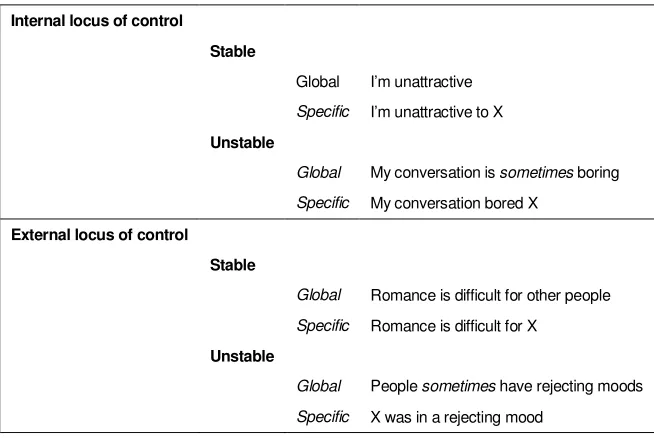
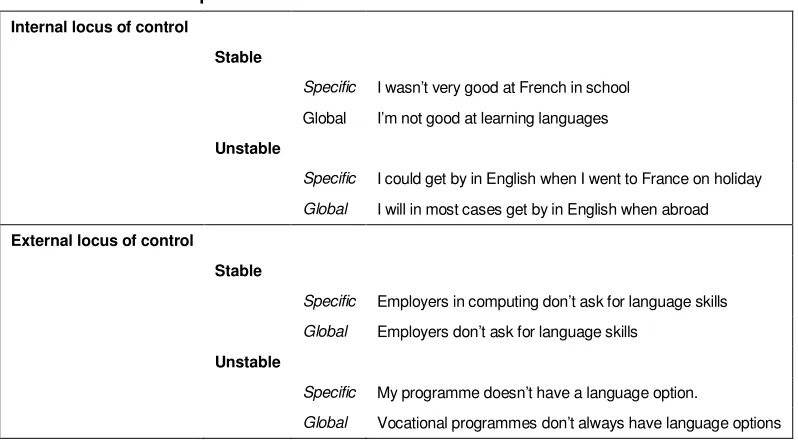
[image:41.595.94.421.536.755.2]judgements about the causes of events. Thus, an internally focused individual might still give external causal explanations (e.g. “If I learn French it will look good on my CV but whether I learn French or not depends on whether the jobs I’m going for are likely to require skills in French”). There are parallels between causal attributions and Rotter’s notion of expectation. Because expectation is a belief about whether responses lead to (or cause) reinforcement locus of control is one determinant of expectation. Peterson et al (1993) have summarised the relationships between these different concepts, as shown in Table 1-2.
Table 1-2: Examples of causal explanations for romantic rejection
Internal locus of control
Stable
Global I’m unattractive
Specific I’m unattractive to X
Unstable
Global My conversation is sometimes boring
Specific My conversation bored X
External locus of control
Stable
Global Romance is difficult for other people
Specific Romance is difficult for X
Unstable
Global People sometimes have rejecting moods
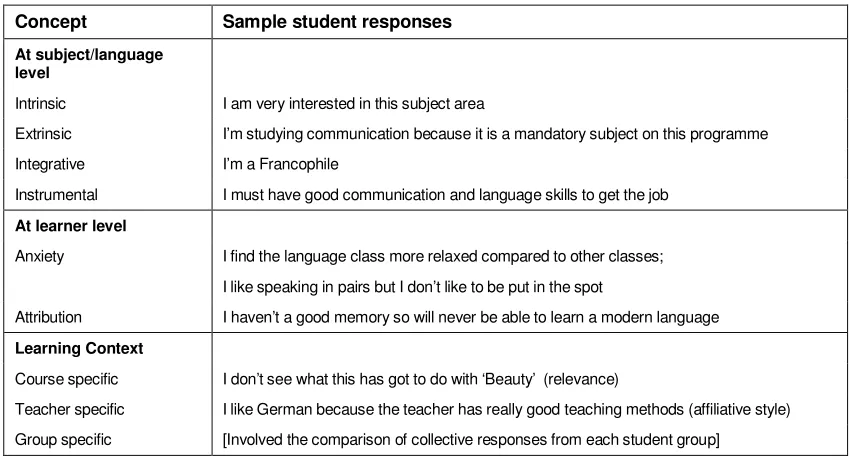
By categorising participant responses into the categories above it is possible to identify whether the causal explanations they give for (not) learning a language tend to be located in the internal or external loci of control, whether these loci are seen as stable or instable, and whether global or specific conclusions are drawn from these allocations. The concepts outlined have in turn informed the so-called self-determination theory.
1.3.6
Self-Determination Theory
The discussion on stakeholders’ practices has pointed to ‘instinctual’ action under certain ‘environmental’ circumstances, as well as the potential of the individual to dissent from current ‘common-sense’ assumptions and to act with ‘ecological’ awareness. With regard to these two notions of the human psyche, i.e. instinct and will, the concept of ‘self determination’ has recently become of interest again to motivational theorists in Western societies, where individuality and personal control dominate (Beck, 2000). ‘Self-determination’ can be defined as the conscious act of choosing from available options in order to satisfy one’s perceived needs. It is thus not simply an act of pure volition; it implies that one has accepted or integrated certain boundaries and limitations.
THE MOTIVATION SPECTRUM
Sociological psychologists have traditionally juxtaposed intrinsic and extrinsic
was a belief that any kind of compulsion would act as a demotivating influence. However, recent research suggests that when extrinsic rewards are sufficiently self-determined and internalised they can be combined with or lead to, intrinsic motivation. Building on their earlier theory (Deci & Ryan, 1985), Ryan & Deci (2000) have
developed a framework for the various degrees of motivation along the ‘self-determination’ spectrum that runs from complete apathy or ‘amotivation’ through a range of extrinsically motivated behaviour to truly ‘self-determined’ or intrinsically motivated action.
According to Ryan & Deci’s conceptualisation, an amotivated person lacks
intentionality and a sense of personal causation (or locus of control), resulting from either not valuing an activity or not feeling competent to do it. There are several forms of extrinsic motivation, which depend on the degree of acceptance of external influences.
External regulation refers to the least determined form of extrinsic motivation.
Introjected regulationinvolves externally imposed rules that the students may dislike but accepts as normative behaviour (e.g. ‘I should be in class on time’). Identified regulationmeans that the individual accepts the usefulness of the regulatory process (e.g. ‘I have to pass these courses if I want to go to university’). Integrated regulation
signifies that the individual has fully assimilated the external requirement with his/her own value system. In other words, the more the individual feels able to identify with these influences, the more autonomous his actions become. Thus, the intrinsically
Table 1-3: A taxonomy of human motivation
Regulatory Styles
Amotivation Extrinsic Motivation Intrinsic
Motivation
External regulation Introjection Identification Integration
Associated
Processes Perceived
non-contingency
Low perceived competence
Non-relevance
Non-intentionality
Salience of extrinsic rewards or punishments
Compliance or reactance
Ego involvement
Focus on approval from self or others
Conscious valuing of activity
Self-endorsement of goals
Hierarchical synthesis of goals
Congruence
Interest / enjoyment
Inherent satisfaction
Perceived Locus Of Causality
Impersonal External Somewhat external Somewhat internal Internal Internal
Source: Ryan & Deci (2000: 61)