Rochester Institute of Technology
RIT Scholar Works
Theses
Thesis/Dissertation Collections
5-1-1998
Darkness within
Virginia Gibson
Follow this and additional works at:
http://scholarworks.rit.edu/theses
This Thesis is brought to you for free and open access by the Thesis/Dissertation Collections at RIT Scholar Works. It has been accepted for inclusion
in Theses by an authorized administrator of RIT Scholar Works. For more information, please contact
Recommended Citation
ROCHESTER
INSTITUTE OF TECHNOLOGY
A Thesis
submittedto the
Faculty
ofthe
College
ofImaging
Arts
andSciences
in candidacy for
the
degree
ofMASTER OF FINE
ARTS
DARKNESS WITHIN
By
Virginia
L. Gibson
APPROVALS
Chief Adviser: Phillip Bonarth
Date:
Associate Adviser: Edward Miller
Associate Adviser: Judd Williams
Chairperson: Thomas Lightfoot
Date:
Date:
Date:
,r-.
/3 .
'1Y
I, Virginia
L.
Gibson, hereby grant permission to the Wallace Memorial Library of RIT to
reproduce my thesis in whole or in part. Any reproduction will not be for commercial use
or profit.
Signature:
IN A DARK TIME
In
adark
time,
the
eyebegins
to see,
I
meetmy
shadowin
the
deepening
shade;
I
hear my
echoin
the
echoing
wood-A lord
ofnatureweeping
to
atree.
I
live between
the
heron
andthe wren,
Beasts
ofthe
hill
and serpents ofthe
den.
What's
madnessbut nobility
ofthe
soulAt
odds with circumstance?The
day's
onfire!
I know
the
purity
of puredespair,
My
shadow pinned againstthe
sweating
wall.That
placeamong
the
rocks-is
it
a
cave,
Or winding
path?The
edgeis
whatI
have.
A steady
storm of correspondences!A
nightflowing
withbirds,
a raggedmoon,
And in broad
day
themidnight comeagain!A
man goesfar
to
find
out whathe is
-Death
oftheselfin
along,
tearless night,
All
naturalshapesblazing
an unnaturallight.
Dark,
dark my light
anddarker my desire.
My
soul,
like
someheat-maddened
summerfly,
Keeps
buzzing
atthe
sill.Which
I
is
/
?
A fallen
man,
I
climb out ofmy
fear.
The
mind entersitself,
andGod
the mind,And
oneis
One,
free in
the
tearing
wind.ACKNOWLEDGEMENT
A
number of peoplehave
servedasinspiration,
teacher
and/orfriend
during
the
course ofmy development
as a painter.First,
of coursemy
parents andbrothers.
My
first
images
ofpainting
areofmy
parentsworking in
theirdiverse
ways.My
brothers,
Richard
andWalter
also painted.To my
friends
Janet
Feigelson,
Eric Loeb
andKate Burch I
owe adebt
ofthanks
for
helping
meto
develop
my
voice as anindividual
,Jean Koehler
wasmy first
realpainting instructor
atthe
Dayton Art
Institute,
her
encouragementhelped
strengthenmy
resolveto take the
big
plunge.Among
the
faculty
atWright
State
University,
Diane
Fitch,
Kim Kaiser
andErnie Koerlin
wereparticularly
helpful.
I
had
atruly
transforming
experience atthe
Vermont
Studio
Center
(VSC)
in
the
summer of1995. The
encouragement and guidance ofBarbara Grossman
andBernie
Chaet helped
methroughadifficult
transition.
As
I
did
this
body
of workI constantly
heard Barbara's
voicetelling
meto, "Paint
like
ademon!"
and
Bernie's
admonitionto,
"Get in
there
andcompete."
I
tried toobey.The opportunity
to
workwiththese two
world class artists as well asthe
visiting
faculty
atVSC,
helped
propel meto
strike outin
a newdirection.
During
my
graduatecareer,
my
advisorPhillip
Bornarth
wasa constant source of challenges and guidance.His
patient manner andinterest
wereconstant andhis
encyclopedic
knowledge
of arthistory
provided anunending
stream of resources.For
his
rolein
my
artisticdevelopment,
I
thankhim
deeply.
Similarly
my
committee membersJudd
Williams
andEdward Miller have
givenhours
oftheir time to
consideration ofmy
work.I
have benefited from
theireyes and experience andI
thankthem.
DEDICATION
LIST OF
FIGURES
1.
Sonja,
Virginia L.
Gibson,
1994
2.
The Last of
theSnow,
Virginia L.
Gibson,
1994
3.Darkness
Within,
Virginia
L.Gibson,
19934.
Self
Portrait,
Virginia L.
Gibson,
1996
5.
Self
Portrait
enface,
Kathe
Kollwitz,
1911
6.
Self
Portrait
II,
Virginia L.
Gibson,
1995-6
7.
Self
Portrait
asAlien,
Virginia L.
Gibson,
1996
8.
Portrait of
Annette,
Alberto
Giacometti,
1964
9.
Self
Portrait
IV,
Virginia L.
Gibson,
1996
10. Reflection
withTwo
Children
(self
portrait),Lucian
Freud,
1965
11. Public
Property,
Virginia L.
Gibson,
1995
12. Public
Property,
Virginia L.
Gibson,
1995
13.
la
Cage,
Virginia L.
Gibson,
1996
14. Tom
II,
Virginia
L.
Gibson,
1996
15.
Poverty,
Kathe
Kollwitz,
1895
16.
David
II,
Virginia L.
Gibson,
1996
TABLE OF CONTENTS
1.
Introduction
3.
Philosophical
andHistorical
Underpinnings
8.
The Experience
ofmy
Training
15.
The Work
andIts
Context
34.
The Process
37.
Epilogue
Introduction
This
thesis
presentsan analysisof abody
of workthat
I
completedbetween
September
1995
andApril 1996. I
willdiscuss
the
raisondetre
for
the
work andthe
historical
touchstones that
have influenced
my
thinking
andmy
style.Aspects
ofthe
body
of work
that
showits
maintechnical
andthematic
currents willbe discussed.
Finally
I
willpresent some
details
ofmy
methodofworking
andhow
that
method worksin
consonancewith
the thematic
content ofthe
work.My
workis
at onetime
intensely
personaland,
if
executedproperly,
personalto
the
viewer as well.This
duality
forms
the
paradoxthat
is
the
heart
ofmy
work.Paradox,
a
fundamental
aspect ofliving
(eg.
kill for
peace),
canonly
be dealt
withcomprehensively
in
art.When I
talkaboutmy
intent
for
awork,
my
attemptto
stagemanage
the
experiencethat the
viewer willhave,
I
do
so withthe
knowledge
that
my
intent is only
one ofthe
validtranslations
ofthat
piece.If viewing
these
paintings causesyou
to
encounteryourself,
they
have
succeeded.Much
art,
ofcourse,
is
about other art.I
have
learned
a greatdeal pouring
overbooks
of reproductions andtramping
throughmuseums.Lucian
Freud,
in
aninterview
shown at
the
1995
retrospective ofhis
workheld
atthe
Metropolitan Museum
ofArt,
said,
"To
me,
going
to the
museumis
like going
to the
doctor."
He
usedthe
experienceto
"cure"
some problem
he
wasfacing. For
methe
museumshave
been
morelike
school.I
have,
therefore, in
the
course ofthis
thesis,
mentioned some ofthe
showsthat
I
have
seenA
central experiencehas directed my
workfrom
quiteearly
in
my
artisticdevelopment.
This
experienceis isolation.
It
appearedfirst
in
aseriesofsmall,
interiors
that
I
producedatWright State University.
During
my
graduate studiesI
have
begun
to
workon a
larger
scale andmy
stylehas
become less
cool and precise and moreexpressive.
The
scale,
subject and style combineto
provide a moreforthright
expressionPhilosophical.
Personal
andHistorical Underpinnings
I
have
executed a series ofpaintings,
largely
in
oil onlinen,
that
stimulatereflection on
the
isolation
of peoplein
ourmobilesociety.Physical,
personal andphilosophical
distance from
ourfamilies,
ourtraditional
source offeelings
ofcommunity,
has left
us alone and rootless.In
a widersense, the
experienceof our solitudetranscends
this time
and culture.The
experience of ourisolation
has
been
one ofthe
most pervasivethemes
in
all ofhuman
thought.That
isolation,
moreover,is
notjust isolation from
friends
orfamily
but
is
a reflection ofthe
fundamental
sensein
which each of us standsalone
in
the
universe- alonebefore God
or alonein
the
void.In
the
Judeo-Christian
traditionisolation
begins
withthe
loss
of paradise.God
holds
allinvolved in
the
acquisitionofknowledge
individually
responsible,
and eachsuffers a customized punishment.
In
the
endGod
abandonshis
creationsto
fend for
themselves.
"...
and you shall eatbread
tillyou return
to the
ground,for
out ofit
were youtaken:you are
dust,
and
to
dust
you shall return."
No
promise ofsalvation,
noheaven,
nohell
-for
Adam,
930
years oftoilfollowed
by
nothingness.
From
the
beginning
ofbarely
recordedhuman
thoughtwehave
looked
outside andus
has
notfelt
the
lash
offickle
fate.
Our
lives
hang
from
athread
andin
onemoment,
disease
oraccidentorflood
orfire (or
any
one of amillionother"acts
ofGod")
canbring
our
life
and evencivilization-as-we-know-it,
to
anend.One
schoolof
thought
holds2that
monotheismwas
the
first
expressionofhumankind's
terror
uponobserving
the
complexandoften malevolent world around
them.
This
God,
holding
sole andabsolutepower,
became
remoteandunapproachable."When
I
wasaway
atseminary
schoolthere
was a man who said you could petitionthe
Lord
withprayer,
petition
the
Lord
with prayer:YOU
CANNOT PETITION
THE LORD WITH
PRAYER!3"Faced
with suchpower, people,it is
suggested,
filled
theheavens
andearthwithgods oflesser
powers,
moreapproachablegodsboth
asintercessors
and as wholesalereplacements
for
this
one god.We
find
the
earliest artis
madeto
personify
these
deities.
Fertility
figurines
like
"Venus
ofWillendorf
'are
found
dating
from
nearly 25,000
yearsago.
Caves in Monte Pellegrino
show scenesof ritualdancing dating
from 12,000
yearsago.
The
history
of artis
inextricably
intertwined
withthe
history
of ourdiverse
andchanging
belief
systems.The
artifacts ofthese
systemsform
some ofthe
mostwidely
recognized
icons
ofthe
creativity
of our species.From
personaldevotional
totems to the
pyramids,
wehave
soughtto
offerthe
fruits
ofourcreativity
to
winthe
favor
ofthe
forces
we
believed
controlled ourdestiny.
The
Greeks
invented
a wholebestiary
of gods: godsthat
were grand and godsthat
were
petty,
godsthat
were envious of each other andfought;
godsin
the
likeness
ofuniverseand
primary
cause of allthings.
Of
the
myriadthreads
ofreligiosity let
usturn to
that
whichhas
shaped much of westernthought,
the
Judeo-Christian
tradition.
First
we recognizethat this tradition
is
not monolithicbut,
in
fact,
branches
widely in
both
time
and space.Adam's God
was of quitedifferent
characterthan the
God
wemeetin
the
New
Testament. This
latter
view ofGod,
whichhas
done
much
to
shape westernart,
is
of aGod
oflove.
Through
good works andby
the
intercession
ofthe saints,
salvation couldbe
achieved4.The Roman Church
spreadthis
word
in
many
ways.Certainly,
asthe
chiefpatron, the
Papacy
controlledthe
message arttransmitted
for hundreds
of years.The
emphasis was onuniformity
of message.The
Church,
deriving
its authority from
Peter,
knew
the
Truth.
Behave according
to thedicta
and salvation
is
assured.About
those
pesky
misfortunesthat
befall
you,
don't
worry,yourlife
may be brutish
andshort,
but
you will get your rewardin heaven. Do
youfeel
painbecause
aloved
onedied?
Don't
worry,
youjust don't
understandGod's
plan.Trust
authority,
you willbe
allright.But
evenin
the
face
ofthis message,
institutional
salvation, the
terrorevokedby
each person'scontemplationoftheir
individual
judgment
by
God,
survives.We
seeit,
for
example,in
the
flayed
skin ofMichelangelo
hanging
limp
in "The Last Judgment". The
pointis
subtly
made sincethe
churchdid
not cottonto
heresy.
A
third
sort ofGod
emergesduring
the
reformation.This
time the
individual
nature of
the
person'saccountability
was made explicit.The
pathto
salvation wasto
be
found between
you andGod
-do
not ask"authority,"
askyourconscience.
Salvation is
achievable notthroughsacrifice and good work
but
by
grace,
as a giftfrom
God.
The
attention
to
that,
this
life
is
notimportant,
yourrewardwillcomein heaven.
With
the
reformation
the
individual
experience wasvalidated.This
seachangein
theology
is
powerfully
reflectedby
the
contemporaneousart.Protestant
zealots4destroyedaltarpieces,
religious
statuary
anddesecrated
gravesites, citing
Calvin's
assertionthat
religious artwas
indistinguishable
from
idols.
Both
positive andnegativeforces
arising from
the
reformation pushed artists
into
concentrationonreligiously
neutral subjectsincluding
stilllife,
portraiture,
landscape
and genre.Among
these subjects, the
genre paintings arethe
most profound.
The
celebration of commonlife
echoesthe
best
strainsofthespirit ofthereformation,
individualism
anddemocratization.
We
seeJean-Baptiste Simeon Chardin
and
Johannes
Vermeer5,
whose works are saidto present,
"Domestic life
raisedto the
level
ofpoetry.6"
Calvin's
viewdoes
not win outhowever,
and aProtestant
religious artdoes
arise.Albrecht
Durer,
adevoted follower
ofMartin Luther
develops
an artthat
becomes
increasingly
austere7
in its
treatmentofreligiousthemes
(see for
exampleThe Four
Apostles
(1523-6)). Another
voicestruggling
to
develop
an art consistent withProtestant
religious
sensibility
wasRembrandt.
We
see such powerful works as"The
Raising
ofThe
Cross"(1634)7
where
Rembrandt himself
appearsas asinner,
helping
to
raisethe
crosson which
Christ
dies
for
his
sins.Left
to
strugglewithourconsciences, adiversity
of viewpointsarises.All
aspectsof
life began
to
reflectthis
diversity.
Facing
"La
Forza del
Destino,"dark
questionsbegan
to
surface.We hear Christ from
thecrosscry,
"My
God,
my
God,
why hast
thou
forsaken
me8?"
If
his
faith
is
notunshakablehow
can oursbe.
Our
ownexperiences prod usto
callmisfortunes that
are a piece ofevery life.
Largely,
however,
werefuseto
giveup
ourfaith
in
the
divine.
The
scariestthought
we as aspeciesseemto
be
ableto
conjureis
the
void.CNN
has greatly
increased
ourknowledge
ofthe
suffering
that
is
the
commonlot
ofmostofthe
planet's
inhabitants.
For
some, the
cognitivedissonance
causedby
the
contrastbetween
the
brutality
ofthe
world andthe
image
of aloving
God
becomes
too
much."I
amin high
school,
maybeyounger,
whenI
realizeGod is
abad joke
9"The lapse
offaith
ofChrist
presagesthe
existential conflictthat
sets man not onthe
threshold
ofparadise,
but back in
the
position ofAdam. In
this view,
gods are viewed asdelusions
and a sign offailure
of courage."Diffuse
the
outpourings ofthe
spiritualcoward,
The
rambling
lies
invented
for
the
sick.O
seethe
fate
ofhim
whoseguard waslowered
!-A
singlemisstep
and weleave
the
quick10."It
seemsthatnomaterwhatour philosophicalconvictions are we confrontthis
same
issue:
weare each alonein
our skin.Paradoxically,
this
widespread experience ofisolation
canbe uniting
as we recognize ourfeelings in
the
reaction of othersto
solitude.This community
of solitude extends acrosstime
and place.Images
ofsolitary
personsandplaces evoke
this
experiencewhichis
at onceindividual
and communal.This
recognitionand
the
searchfor community
that
does
notdeny
the
experience ofmy
solitudedrive
my
The Experience
ofMv
Training
There
have
been
four
formative
experiencesin
my
artisticcareerto
date:
the
painting
that
my
mother, father
andbrother did
asI
wasgrowing
up,
my
undergraduatetraining
atWright State
University,
my study
atthe
Vermont Studio Center
andmy
graduatework at
R.I.T.
Throughout
the
latter
three
ofthese
my
workhas had
aconsistentcentral
theme,
isolation.
My
mother wasprimarily
acolorist.Her
bright
palette and cheerfullandscapes
served as a starkcontrast
to the
workmy
father
and elderbrother.
The
men ofthe
household
painteddark,
moody
landscapes
(although my
youngerbrother,
Walter,
liked
to say,
"I
paintthe
house
-that
countsdoesn't it?"). I'm
not surethatI
recognizedthe
darkness
ofthose
works atthe time
but
asI
look
atthem
today
I
seemy
rootsin
those
paintings.
I
wasprimarily
aperforming
artist atthat
time, playing
piano andorgan,
indeed
I
startedmy
undergraduatetraining
as a piano major(organ minor)
atWest
Virginia
Wesleyan
College.
Reviewing
my
repertoire,
heavily
stacked withBach,
Beethoven,
Rachmaninov
andProkofieff,
I
now noticethe
dark
turn
of mind.After
nearly
tenyears ofadebilitating
illness,
I
began
my
undergraduate studiesagain.
This
time,
swayedby
more practicalconcerns,
I
finished
aB.S.
in Applied Social
Science
atthe
State
University
ofNew York
atBinghamton
(now known
asBinghamton
University). After graduating I
workedfor
several yearsas a social workerfor
Catholic
Social Services.
Wanting
moredepth,
I
began study for
my
M.S.W.
atMarywood
College.
During
this
period ofmy
life,
I became
increasingly
in
tune with,
andinterested
art
therapy.
While
doing
a practicum as atherapist
in
acounty
mentalhealth
clinic,
it
became
clearto
methat
I
was moreinterested
in
the
artthan
in
the therapy.
I
left
Marywood
4
creditsshort ofmy
mastersdegree
andbegan my
searchfor
artisticidentity.
During
this
sametime
I
wasmarriedandmy
husband
andI
movedfour
times
in
three years,
ashis
employmentdemanded.
Finally
arriving for
along
stay
in
Dayton,
Ohio
I
startedmy
training
as an artistby
studying painting
atthe
Dayton
Art
Institute. There I
had
ateacher
who was anewly
graduatedM.F.A. from
Parson's
School
ofDesign. She
encouraged me
to
begin
seriousstudy
atWright State
University
where shehad done her
B.F.A.
At Wright
State
I
enrolledin
the
Painting
Department
and studiedthe
traditionalundergraduatecurriculum.
I
attended parttime which, taken together
withthe
otherdifferences
between
me andthe
largely
fresh-from-high-school
studentbody,
heightened
my
sense ofisolation. Wright State
has
avery
rigorouscurriculum,
heavily
weightedin
art
history
and withvery
structuredstudioinstruction.
While
the
painting department
is
extremely strong technically, it
is
dominated
by
strong individuals
who generate adistinct
painting
style.Throughout
the
areaat galleries and showsit is
easy
to
spotthe
Wright
State Style. Although it
was awonderful placeto
study
fundamentals,
withits
strong
emphasis on
drawing,
colortheory
and arthistory,
it did
notfoster
diversity. It
washere,
however
that
the
beginning
ofmy
thematicworkemerged.In
apainting
course givenby
Professor
Ernie Koerlin (a
student ofBernard Chaet
atYale)
we weretold to
do
40,
3"x
5"
paintings
in
additionto the
larger
studioworks.What
emerged was a series ofquietinteriors have become
a pervasivefeature
ofmy
iconography.
I
completedallthe
artcourses
for
aB.F.A. just
before
wemoved again.When
I
cameto
RIT
my initial
reaction was-1
amalone
here.
The
diversity
ofstyle and
lack
of uniforminstructional
perspective allowed meto
begin my
struggleto
become
myself.I
have
notalwayshad
confidenceasI
took
steps(some
ofthem
sideways)
down
this
road.I
began,
feeling
I
wasthe
lone
realisttrapped
in Dante's Abstract
Inferno.
My
first
works atR.I.T.
were a continuation ofthe
silentinteriors.
They
weremodest
in
scale andmy
palette remained cool.These
workscontinued,
whilegrowing in
scale
to
ca. 30"x40"culminating
withPublic
Property
which containsmy first
self-portrait.
I
have
always paintedfirst from direct
observation.While I
abstractthe
forms
andwork withthelight
and colortosomeextentin
ordertocreatetheeffectthatI
want, the
paintings are all of real people and places.This
has
led
to
afascination
withlight
and spacein
my
surroundings(or
perhapsit is
the
otherway
around).It
was atthis
juncture
in
my
studiesthat
I
found
a spacethat
wasto
be
influential
in
my
experience ofR.I.T.
as well asinfluential
in
the
development
ofmy
work.There
is
alarge empty
roomadjoining
the
studioin
the
RIT
City
Center,
whichhas
large,
uncoveredwindows.The
lighting
makes cavernousthe
properdescriptor. I
instantly
became
intrigued
by
the
possibilitiesthat
the
roompresentedas asetting
for my
work.
There
were,
however,
problems.I
have had
atwo-yearfight
withthe
facilities
managementstaff
to
obtainand maintainaccess.In many
waysthis struggle,
for
accessto
an unused room
has become
one ofthe
defining
experiences ofmy
study.It
has forced
meto
fight for
the
work andhas led
to
an embattledquality
ofthose
two
years.While
the
room was
completely
unusedand,
whilemy
use ofit did
nodamage,
created nomess,
caused noone
inconvenience,
I
constantly
had
to
fight for
continuing
access.On
severalFigure
1.
Sonja,
Virginia
L.
Gibson,
1994,
Oil
onLinen,
42"by
36"occasions
I
cameto the
studioto
find
that
I
had
been
locked
out ofthe
room andmy
setups
destroyed. This
personalstruggleseems,
in
someways, to
be
the
current campaignto
eviscerate
the
fine
artsprograms atR.I.T. in
microcosm. [image:20.540.20.523.118.548.2]The last
two
paintingsthat
I
did
in
the
1994-5
academic
year are of andin
that
large
empty
space.They
aretransitional
piecesleading
from
the
cooler more objectivetreatments
ofSonja (see Figure
1.)
andThe Last
of
the
Snow
(see
Figure
2.)
to the
Figure
2.
The
Last of
theSnow,
Virginia L.
Gibson, 1994,
Oil
onLinen,
40"x30"more
emotionally
charged and expressivethesis
work. [image:21.540.105.436.124.560.2]Darkness
Within (see Figure
3.),
which seemsasthough
it
shouldbe
the title
workof
this
thesis,
wasactually
completedthe
yearbefore.
In
this
workI begin
to
use scraffittoto
define line
and addlight
to
alarge
area ofclosely
related values.Here I begin
to
see [image:22.540.7.523.156.550.2]with
my
third
eye aswell,
andI
paint whatI
see.Figure 3.
Darkness
Within,
Virginia L.
Gibson, 1995,
Oil
onLinen,
30"by
40"Before
the
school year endedI
wentto
the
Vermont
Studio
Center
for
a month.The
programat
VSC
wasvery
intense.
We
rose at6:00 AM
for
breakfast
at7:00 AM
andpainted
'till
noon when webroke for
ahalf-hour lunch.
Then
it
wasback
to the
studiountil supper at
6:00
PM. After
supperthe
programcontinued.There
was either alecture
by
oneofthe
residentorvisiting artists,
aslide showandlecture
by
astudent,
or adrawing
session.These
endedsomewhereafter1
1:30 P.M.
and often continuedinto
the
wee
hours. Bernard Chaet
andBarbara Grossman
critiquedmy
work almostdaily. In
addition
the
visiting
artists,
including
Bill Jensen
andArchie
Rand,
critiquedmy
work.The
pace was grueling.In
some waysI
felt
asif I had
been
sentto
a concentrationcamp
for
reeducation.Eventually
I
got sotired that
I
became
more suggestible andwilling
to
take the
risksthat the
staff wasurging
meto.
When I
returnedtoR.I.T.
in
the
fall
of1995,
alarge
numberofdiverse influences
were
swirling
in my
head.
My
originalthesis proposal,
which anticipated a voice andtreatment
like
that
ofThe Last of
theSnow,
seemedinappropriate for
the
workI
wasfeeling. But just
what wasit
that
I
wasfeeling? Where
wouldthis
alltake
me?My
centraltheme
remained unchangedbut
the
number oftools
that
I
had
to
expressthat
theme,
andmy ability
to
look
directly
atthe
issue
withouta reserve ofreason,
had clearly increased.
The story
ofthis thesis
is
the
story
ofhow
these tools
became
moreeasily
accessibleto
me and of
how
my
confidencein
their
use grew.The Work
andIts
Context
The
heart
ofisolation
is
the self; accordingly,
a number of worksin
this
thesis
portfolio are self-portraits.
The
progression withinthese
self-portraitsis,
in
someways,
ametaphor
for
my
progression as an artist andcertainly
amap
ofthose
artists whohave
Figure
4.
Self
Portrait,
Virginia L.
Gibson,
1996,
Gouache
andgraphite on canvasboard,
14"xl7"
[image:24.540.117.446.183.618.2]most
influenced
me.Part
ofmy
experienceofcommunity has been
(and
continuesto
be)
the
study
ofthe
work of otherartists.Much
of whatI
paint,
print anddraw is best
understood
in
the
context ofthe
work ofthe
artistthat
I
waslooking
at most atthe time
the
work was created.I
begin
with"Self Portrait I"(See Figure
4.)
astudy
in
gouache and graphite oncanvas
board.
This
is
in many
waysthe
darkest
workin
the group,
it
wasalsothe
first.
Being
first it
mostclearly
reflectsthe
sensibility
ofmy
study
atWright
State
wherethework of
Kathe
Kollwitz,
Alberto
Giacometti
andRichard Diebenkorn
was emphasized.This
self-portraitdepicts
adisembodied
head,
floating
in,
and at some placesbarely
distinguishable
from,
its
surroundings.Disembodied
heads
create adisturbing
effect ascan
be
seenin
the
later Rembrandt
self-portraits(for
instance
Self
Portrait,
(1657)
). This
moving
workis
abust,
whenclosely
examined,
however
the
dark
palletnearly
hides
the
connection
between head
andbody. While
the expression,
palette andsetting
I
use seemsufficient
to
convey
the
isolation
ofthe subject,
several otherdevices
are employedto
heighten
the
effect.The
tensionis
heightened
by
the
interplay
ofcontrasting
elements:light
anddark,
painterliness andthe
searching
graphitelines.
Contrast
is
acommondevice in my
work.I
useit
to
heighten
tensionandto
help
the
workembody
paradox.Light
anddark,
painterlinessanddrawing
elements,
curvilinearandrectilinear
elements,
as well asvarying degrees
of completionform
contrasts
that
shakeusloose from
ourusualframe
of reference.The lines in
this
first
self-portraitarethe
beginning
ofmy
incorporation
of aspectsof
Giacometti's11'121314
technique
into my
work.The
introduction
of adrawing
device in
the
painting is
a commontheme
in my
work.I
feel
astrong
connectionbetween
drawing
and
painting
and usethe
interplay
ofpainting
anddrawing
elementsto
help
createfeelings
of unrestanddiscomfort.
fflMumaaa
HHHBBBBBHBHMBBB^J
Figure
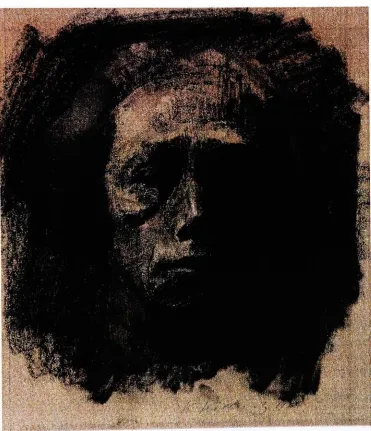
5.
Self
Portrait
enface,
Kathe
Kollwitz,
1911
[image:26.540.75.446.152.583.2]Although
I
was notlooking
atit contemporaneously,
this
first
self portraithas
aneerie resonancewith
Kollwitz's,
"Self-Portrait
enface,"(see Figure
5)
of1911.
The
melting
away
characterofthe
workalso reflectsmy internal
stateatthe
beginning
ofmy
thesis
work.The
indecision
andtimidity
that
I
felt
atthis
jumping
off pointin my
artisticdevelopment
are reflectedin
this
first
painting.The
secondofthese
selfportraits(Self
Portrait
II,
seeFigure
6),
a workin
oil onprepared
paper,
has been
three
distinct
paintings.First
to
appear was avery
dark
valuestudy
in
shades ofblack
and gray.The
drawing
was notanatomically
correct, the
face
being
noticeably
elongated,
but
it
wasthe
most expressive andheld
emotionaltruth.
Lucian Freud
nicely
encapsulatesthis
interplay
ofexpressionism andverisimilitudein
astatement.
"I
would wishmy
portraitsto
be
ofthe people,
notlike
them.
Not
having
the
look
ofthe sitter,
being
them.16"Most
noticeably influenced
by
Giacometti,
the
visagewas
dominated
by
the
searching lines
that
form
the
face
and corona.While
far from
aperfect work
it
wasaself-consistentportrayal of grimdetermination.
The
figure
was,
however,
disconnected
from her
environment.The
head
and shoulders confront somechallenge
but
the
painting
presents no clue aboutthe
nature ofthat
challenge.In
the
next phase ofthe
workI
addedcolor,
cadmiumred medium andNaples
yellowlightened
withwhite, to the
background
andt-shirt.
This
madethe
distinction
between
figure
and surroundings more explicit andthe
apronbecomes
apparent.While
astrugglewith
painting
wasnotexplicitly identified
asthe problem, the
reaction clear onthe
face
becomes
attributableto
some workin
whichthe
subjectis involved.
Butcher
and painterarenot
distinguished,
but
the
grimdetermination
and sense offrustration
evidentin
the
face
seemsclearly
relatedto
sometask
athand.
. ,
-Figure 6.
Self
Portrait
II,
Virginia L.
Gibson, 1996,
Oil
on preparedpaper,
22.5"
x 30.5"
In
the
final
stateI
added white andMars black
to the
face
andcorrectedits
proportions.
I
begin
to
causethe
searching
lines
to
coalescethus
giving
real volume.Now
the
personis distinct
in her
environment.While
the
sense of grimdetermination is
mostevident, the
determination
becomes
more emphasized.These
states arereflectiveofthe
time
in
whichthey
werecreated; the
first
andmost expressivebeing
the
second work of [image:28.540.121.429.11.438.2]the
thesis,
the
second state about30 days later
andthe
final
state completedasthe
last
work
in
this
series. [image:29.540.118.431.161.589.2]"Self Portrait
asAlien"(see Figure
7.)
showsthe
mostdirect influence
ofFigure 7.
Self
Portrait
asAlien,
Virginia
L.
Gibson,
1996
Oil
on preparedpaper,
22.5"x30.5"Giacometti
ofany
ofthe thesis
works.Clear
references
aremadeto
"Portrait
ofAnnette'(1964)
(see Figure
8.)
in
mattersofstyle and content.Alien
meetsour
gaze,
wide-eyedandconfident.
If
the
eyes areindeed
the
gateway
to the soul, then
[image:30.540.165.401.160.451.2]staring
atAlien
weFigure 8. Portrait of
Annette,
Alberto
Giacometti,
1964
stare
into
the
soul asRorschach
test
-deep
black
poolsthat
could containanything.These
eyes present an element of
danger,
youmustbe
careful notto
fall
into
them.
The
grimnessof
the
earlier worksis
replaced with more self-possession.The
intensity
ofthe
figure is
heightened
by
the
acidic pallet andby
the
interplay
ofdrawing
andpainterly
elements.My
paletteis
informed,
to
someextent,
by
that
ofWalter
Sickert17(see
for
example,
La
Hollandaise,
1906
andMornington Crescent
Nude,
Contre-Jour,
1907). His
palletA.
Figure 9.
Self
Portrait
IV,
Virginia
L.
Gibson, 1996,
Oil
onlinen,
32.75"x46.75"intensified
the
drama
ofhis
Camden
town works,
portraying light
at once natural andunnatural.
The final
self-portraitin
the thesis
workis
alsothe
largest
(see
Figure
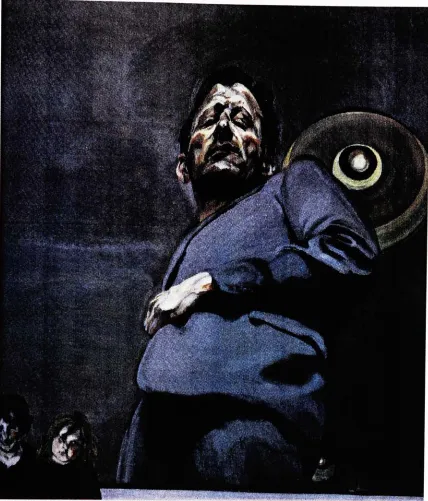
9).
While
the
face is
againseento
be
heavily
influenced
by
Giacometti,
the
compositionis
influenced
by
Lucian Freud.
In
his
"Reflection With Two
Children
(Self
(1965)
Figure
10. Reflection
withTwo Children
(self
portrait),
Lucian
Freud,
1965
Freud
is
shownlooking
down
athis
reflection.In
afilmed interview
which wasshownatthe
1994
retrospectiveatthe
Metropolitan
Museum
ofArt,
Freud
saidthat the
"trick"ofselfportraiture was
to
make oneself neither more grand nor moreterrible
than
you [image:32.540.58.486.33.534.2]actually
are.Accordingly,
my
self-portraithas
amatter-of-factquality.The figure is
rooted
in its
spaceby
the
use ofsearching
lines piercing
the
figure
andalluding
to the
surrounding
architecture.This
interplay
ofarchitecturaland organic elementsis
commonin
my
work.Here it
conveysboth
asenseofgroundednessand a sense oftension.
The
semi-transparency
ofthe
figure,
suggesting
lack
ofpermanenceandsubstance,
contrastswith
the
strength ofthe
arms andthe
confrontational gaze.She is
the
captain ofher
soul,
a creator
goddess,
stern and powerful notlost
anddespairing.
Another important
source oftension
in
my
workis
the
contrastbetween
areas ofdiffering
degree
of completion.I
first became
aware ofthis
device
in
the
work ofDegas.
(Indeed
an article which appearedin Art
News18
in
1993
featuring
his "Woman
ataWindow"
bears
the
sametitle
asthisthesis.) Found
andlost
edges andappearing
anddisappearing
masshave
the
powerto
create mystery.This mystery
invites
the
viewerto
supply
the
missing
details
heightening
the
individuality
ofhis/her
experience ofthe
work.An important step in
the
development
ofmy
workis
seenin
an examination ofmy
use ofarchitectural
detail. The intaglio
printshownbelow (see
Figure
11.),
"Public
Approval
processed requiredefinition
andtime
cycles shouldbe
revisitedProperty"
depicts
an area nearmy
studio.The
contrast oflight
anddark
valueand apparenttransparency
ofsubstantial objects combineto
createafeeling
ofdisconcerting
stillness.Translated
into
apainting
thesame subjectmattertakes
on several newdimensions (see
figure 12.). The
coolpalette, the
interplay
offinished
and unfinishedFigure 1 1. Public
Property,
Virginia L.
Gibson, 1995,
Etching
andaquatint,
23"
x 16"
areas and
the
voyeur-like self portraithelp
to
increase
tension
in
the
painting.There is
much about
this
treatment,
however,
that
is
familiar
and reassuring.The
stacked planesreveal an
inventory
ofthe
contents ofthe
space.Within
the
painting
the
presenceofdomestic
detail
reassures usthat
weknow
whatthis
spaceis.
In
the
more recent"la
Cage"(see Figure
13)
adistinct
changein
portrayalis
observed.Here,
in
anotheretching
of a [image:35.540.110.434.106.538.2]space near
my
studio much ofthe
detail is
strippedaway.The
placeis
notfilled
withFigure 12. Public
Property,
Virginia L.
Gibson,
1995,
Oil
onlinen,
30"
x
40"
clues
that
encourageabenign
and evenintimate interpretation
ofthe
scene.Instead
the
stripping
ofdetail
leads
to
ambiguity.Neither the
purpose ofthis
space norwhy
we arehere is
obvious.Scribbling
lines
areused,
in
additionto aquatint, to
create middle values.This
resultsin
a noisierimage
which generatesthe
sense of motion where noneis
possible
(e.g.
on a wall).These
features
combineto
allow a greater range ofFigure
13.
la
Cage,
Virginia
L.
Gibson, 1996,
Etching
andaquatint,23" x
16"
interpretations.
Dark
narratives are now suggestedandthe
senseofdisquiet is increased.
Disquiet,
the
feeling
ofbeing
slightly
offbase,
is
very helpful
in
experiencing
primalemotions.
We
canhide
withinfamiliarity
but,
strippedof ourfamiliar
context,
wehave
agreater chanceof
encountering
mystery.Figure
14.
Tom
II,
Virginia L.
Gibson,
1996
Oil
onlinen,
45"
x
60"
Illustrated
by
"la
Cage",
my
art canbe
seenas narrative.Not,
perhaps narrativein
the
traditionalsense,
wherethe
cluesto the
story
areto
be found in
the work,
but
ratheramystery story
wherethe information
essentialto
complete yourunderstanding
is
[image:37.540.111.433.93.524.2]deliberately
omitted.Like Lucian
Freud's
grandfather's view ofdreams,
the
paintingspresent us with raw
images
that
wemustsupply
withcontextin
orderto
derive
meaning.A lone
figure,
seatedin
the
samespace,
forms
the
compositionof"Tom
H"
(see
Figure 14.).
Compositionally,
the
work recallsKathe
Kollwitz's"Poverty"
(see Figure
Figure
15.
Poverty,
Kathe
Kollwitz,
1895
15.).
The
table
and mirror of"la
Cage"
aretransformed
into
asimplebed
and aliving
space
is
created.This
space which enclosesthe
figure
alsodraws
the
viewerin. The
[image:38.540.111.449.171.605.2]portrayalof a
large figure
in
aconstricted
space
which,
nonethe
less
encompassesthe
figure
andthe
viewer,
recallsBacon1920(see for
exampleStudy
After Innocent
X
andStudy
After
Velazquez's
Portrait
ofPope
Innocent
X
(1953)
whichI
had
the
goodfortune
Figure
16.
David
II,
Virginia L.
Gibson,
1996
Oil
onlinen,
50"
x
60"
to
viewatthe
Hirshhorn
Museum).
Tension
is
createdby
the
luminous
but
acidicpalette,
the
interplay
among
the
linear
elementsandbetween
line
andplane,
the
senseof [image:39.540.91.451.123.551.2]resignation
arising
from
the
figure
andthe
apparentdissonance in
scale.Is
this
placeaprison or amonastic cell?
Why
is
aplacewithsuch potentialfor
odious portent sobright
and what
is
implied
by
the
palette?The
narrativeis
incomplete. Viewers
mustimpose
their
owninterpretation
onthe
gestalt.The
samedevice,
dissonance
in scale,
is
usedin David II (see Figure 16.).
A
large figure is
cagedin
an areabetween
two
doors.
What
the
model and we aredoing
here
and whatis
the
purpose ofthis
space are questionsleft
for
the
viewerto
divine.
Visually,
wefind
the
figure imposed
on adark
pool of color reminiscent ofGoya's
use ofchiaroscuro21
(see for
example,
The Third of
May
1808
andPrison Interior).
Strong
verticals
formed
by
the
doors
aretruncated
asthe
doors'diagonals
funnel
the
figure
andthe
viewerinto
thespacebeyond. Though in
aresting
pose,
nothing
aboutthefigure
conveys rest.
The
strength ofthe
figure
contrastswiththe
docile
pose.Strong
anddark,
the
acidicpalette uses rose madderto
contrast withthe
Courbet
green,
ceruleanblue,
Prussian
blue
and cadmium yellowlight
whichform
the
dominant hues. The
interplay
ofthe
flesh
tones
withthe
greens andblues
ofthe
background
recallsthe
pallet ofSoutine's,
Portrait of
aYoung
Man22
.
A
nervousenergy is
seenin
the
markmaking,
especially
those
markscomposing
the
figure resulting in layer
afterlayer
of overpainting.The
lighting
is
eerie,
withthe
figure
seatedin front
of ablack
hole,
surroundedby
ahalo
oflight. The
source ofthatlight
andespecially
ofthe
light in
theupper right ofthe
pictureis
notclear.
What is
this
manwaiting for?
The final
workthat
I
willspecifically
addressis
"Sonja"
(see Figure
17.).
In
this
painting
alone
nudewomanstandsin
abarren
room.The
consonancebetween
the
Figure
17.
Sonja,
Virginia L.
Gibson, 1996,
Oil
linen,
50" x60"
woman's
nudity
andthat
ofthe
room unifiesher
withher
environment.In
anearly
state,
the
painting
showed a skeleton constructedwithGiacometti-like searching
lines,
standing
in
the
room.This x-ray like
quality
alsorecallsBacon,
whose use of medicalimagery
to
structure
painting is
welldocumented.19
The
figure
wasbuilt
uponthat
skeleton withlayers
ofcolor.The
central verticalformed
by
the
figure
andreinforcedby
the
column [image:41.540.95.453.37.472.2]behind
her
is disturbed
by
the
model's curved spine.That
verticalcontrasts withthe
sweeping diagonal formed
by
the
floor
plain.These
elementscombineto
define
trapezoidal
spaceslike
those
commonin
Hopper's23scenes of
isolation
anddespair.
Again
the
dark,
Sickert
like,
acidicpalette andthe
contrastbetween
finished
andunfinished areas serve
to
heighten
the tension.
What
is
this
place?What
is
this
womandoing
here? Is
sheawaiting judgment?
What
are wedoing
here? Are
we mere voyeurs ordoes
the
opencomposition24
include
ustoo.
After
Caravaggio,
the
picturehas
nodefined
edges25.
Are
wedrawn
into
this
space asBacon
has drawn
usin,
to
sharethe
figure's
space and predicament?
These
areamong
the
questionsthat
arise when we confront"Sonja."
I
bring
no answersto
thesequestionsto the
worksavemy
own.The
questions arethe
important
part,
theanswers are personal.The Process
As
I
saidearlier,
part ofmy
aimin
making
artis
to
find community
withthose that
confront
the
fundamental
question oftheir
isolation.
I have
mentioned some ofthose
whose work gave me
the
mostguidanceoverthe
last few
years:Rembrandt,
Degas,
Freud,
Goya, Sickert, Giacometti, Kollwitz, Hopper,
Diebenkorn
andBacon,
but how do I
experience
community
withthem.
Some
ofthis
sense ofcommunity
comesfrom
the
rather
traditional
process with whichI
work.I
hand
build
my
frames
and stretchthe
linen.
Rather
than
buying
pre-primedlinen,
I
preferto
apply
the
rabbit skin glue and primermyself.
As
a primerI
preferlead
white,
ostensibly
for
the
working
propertiesit imparts
to
the
overpainting
but
in
partbecause
ofits
long
history. The
process ofpreparing
the
linen
for
usegives metime to
consider whatI
willpaint.It
helps
to
keep
mefrom
taking
apainting
lightly
(if
I'm going
throughthis
muchtrouble
it better
be
important). The
craftlike
aspect ofthis
ritualhelps
mefeel
part of anunbrokenchainof artists all of whomhave,
at onetime
oranother,
been
involved in just
these tasks.
When
I
work,in
spite ofmy desire for
a sense ofcommunity,I
am asolitary
worker.
I
do
nothave
music on andI
preferto
workalone.I
do
not conversewiththe
models after work
has begun
andI
resentthe
intrusion
ofothers.Writing
aboutGiacometti,
David Sylvester
says:"Giacometti
was anextremely
inner-directed
manbut he
was not a solitary.He
enjoyed
talking
andlistening,
above allin
aone-to-onesituation,
andhis
models werepeople
he loved
or peoplehe
liked
to
be
with,sothat
working
withthe
model was apretext
for
conversation.And
whentalkhad
to
stop for
the
real workto take over, this
involved
a still moreabsorbing
interaction.
Giacometti
was not one ofthose
artists whowanted
the
modelto
be
anapple;
he
demanded
the
'attentive
presence'of whichAnnette
spoke
to
me12"
I
wantthe
modelto
be
an apple.The
paintingshave
oftenbeen
proceededby
several studies.Ink
wash,
graphiteandgouache are
my favorite
mediafor
these
exercises.Sometimes
months of studies willprecede a
full-scale
painting.During
the
preparation ofthe thesis
seriesI
did
not usestudies
in
the
traditional sense.Rather
thanpainting fragments
ofthe
final
work,I
usedothermedia or sometimes oil on prepared
paper,
todo
warmup
orpedagogic exercises.Several
oftheworksin
thethesis seriesstartedassuchprojects.In approaching
the
preparedlinen I
sometimesuse atransfergridand sometimesdo
not,
but
onething
remainsconstant,
I
createadrawing
in
paintbefore
hanging
onthe
painterly
edifice.This helps
to
reinforcemy
intertwining
ofdrawing
and painting.I
makecorrections
directly
onthe
canvas anddo
not alwaystry
to
hide
the
fact.
A painting is
notaphotographand should make nosuch pretense.
In
painting,the
markoftheartistis
asignificantpart ofthe
aesthetic.In making
my
marksI
useboth brushes
andknives.
Scraping
ofthe
workdown
to
the
ground or atleast down
to the
drawing
is
adevice
thatI commonly
use.In
several ofthe
worksin
the
thesis
seriesI have
madeextensiveuse ofsgraffito,a nervouslike scratching
andscribbling done
withthe
palletknife,
to
draw in form
andlight. In
marked contrastto
my
earlierwork,
I have
transitionedto
broad
brushes,
concentrating
onthe
creation ofatmospherics and
the
eliminationofdistracting
detail. Smaller brushes
are employedin
building
the
underdrawings andfigures.
In
fact
oftenthe
painting
proceeds as aconversation
between
searching
line (fine
brushes)
andlight
andvolume(broad brushes).
The
museum,
gallery
andbookstore
are essential parts ofmy
working
process asI
continue
my
attemptto
broaden
my community
ofpractice,
learning
from,
andelaborating
on, the
workof other artists.The
applicationofthis
researchto the
evocationof our primal experience
is
the
essence ofmy
workprocess.Epilogue
The
question of whether or not artshouldhave
apurposehas
been
a subject ofdebate.
Understanding
my
position onthis
is
pivotalto
understanding
my
work.As
I
saidearlier,
my
goalis
to
find
asenseofcommunity
that
does
notdeny
the
experienceofmy
solitude.
I
seekto
achievethis
by
creating
art whichtouches
on one ofthe transcendental
issues
whichhas faced
ourspecies since webecame
cognizant;
whatis
our placein
the
universe?
I
have
attemptedto
awakenthis
questionin
viewers ofmy
workby
my
choice ofsubject and
by
my
method ofrepresentation.While
not narrativein
the
classicalsense, the
tableaus
I have
createdinvite
the
viewerto
makeup
storiesthat
explainthem.
In
sodoing,
the
paintings serve as a sortofRohrshak test,
an uninterpretedimage in
whichthe
viewerencounters
him
orherself. Unlike
the
inkblot
test,
which attemptsto
presentneutral
images,
I
intentionally
load
my
paintings withcuesto
help
guidethe
viewers'
experience.
I have
chosento
presentpictures ofsolitary
people andsolitary
places.Often
I
have joined
the
person andthe
placeto
underlinethe
mood.I
have
garnered elements of composition andtechnique
from
masters whohave
also confrontedisolation
andincorporated
that
experiencein
theiroeuvre.The
workof
Degas,
Kollwitz, Giacometti, Hopper, Sickert,
Goya,
Freud, Bacon,
andSoutine have
been particularly influential in
the
development
ofmy
work.These
mastershave
effectedmy
choice ofpalette,
compositionand method of execution.They
have
taught
me muchand
I
have incorporated
elements oftheirindividual
stylesinto
mine.This
stylistic andtechnical
sharing helps
mefeel
myself as a part of acommunity
ofpracticethat
pre-datesthe
drawings in
the
caves atLascaux.
Across
time
and culturethe
many
issues
that
define
ourhumanity
provoke ourfinest
thought
and our most profound emotions.While I
resonate most aroundthemes
ofsolitude others
find
the
searchfor
significanceor, the
existence oftruth
or ofobjectivereality
compelling.Always
these
questions move usto
eloquence."Vincent
vanGogh
cut offhis
ear andsent
it
to
Marilyn Monroe.
The
severed ear remindedMarilyn
Monroe
ofa crescentmoon,
andfor
hours
shecontemplated
it
by
moonlight.She
telephonedVincent
vanGogh,
'Does
the
moonhave
apurpose?'
she asked.
Vincent
vanGogh
consideredher
question.
He decided it
was silly.Albert Camus
wrotethatthe
only
seriousquestion
is
whetherto
kill
yourselfor not.Tom
Robbins
wrotethat theonly
serious question
is
whethertimehas
abeginning
and an end
There is only
oneserious question.And
thatis:
Who knows
how
to
makelove
stay?Answer
methat
andI
willtell
youwhetherornotto
kill
yourself.Answer
methat
andI
will ease your mind aboutthe
beginning
and
ending
oftime.
Answer
methat
andI
willrevealto
youthe
purpose ofthe
moon.References
1.
Genesis 3:19
2.
Schmidt,
Williamcitedin,
"AHistory
ofGod:
The4,000
Year QuestOf
Judaism,
Christianity
andIslam,"KarenArmstrong,
Ballantine
Books,
New York(1993)
3.
Morrison, Jim,
Elecktra Entertainment
(1967)
4.
Halewood,
WilliamH.,
"SixSubjects
ofReformation Art: A PrefacetoRembrandt,"University
ofToronto
Press,
Toronto(1982)
5. Anexcellent compilationofhisworkistobe found inthe
catalog
oftheshow whichappeared attheNational
Gallery
ofArt
in1996
see,Arthur K.Wheelock,
"Johannes"Vermeer,
YaleUniversity
Press(1995)
6.
Read, Herbert,
ed.,"ArtandArtists,"ThamesandHudson,
London(1966)
7.
Bonafoux, Pascal,
"Rembrandt:
SelfPortrait,"Sklra-Rizzoli,
New York(1985)
8.
Janson, H.W.,
"History
ofArt",
PrenticeHall,
New York(1986)
9. Mark 15:34
10.
Underwood, Jane,
The ZuluWarrior,
in "YellowSilk,"Harmony
Books,
New York(1990)
1 1.
Roethke, Theodor,
"TheCollected PoemsofTheodoreRoethke,"
Doubleday
AnchorBooks,
NewYork
(1975)
12.
Lord, James,
"a Giacomettiportrait"(sic),Doubleday,
New York(1965)
13.
Sylvester, David,
"Looking
atGiacometti,"Henry
Holt&Company,
New York(1994)
14.
Bonnefoy, Yves,
AlbertoGiacometti,
Flammarion,
Paris(1991)
15.
Schneider,
Angela,
ed.,Prestel,
"AlbertoGiacometti,"
New York
(1994)
16.
Lampert,
Catherine,
LucianFreud: RecentWork, Whitechapel,
London(1993)
17.
Baron,
Wendy
andRichardShone,
ed.s,"SickertPaintings,"
Yale
University
Press,
New Haven(1992)
18.
Harbison, Robert,
DarknessWithin,
ArtNews,
92 (Dec.1993),
6519.
Faerna,
Jose'Maria,
"Bacon,"Abrams,
New York(1995)
20.
Davies,
HughandSally
Yard,
"FrancisBacon,"Abbeville
Press,
NewYork(1986)
21.
Tomlinson, Janis,
"Francesco Goya yLucientes,
1746-1828,"
Phaidon,
London(1994)
21.
Tomlinson, Janis,
"Francesco Goya
yLucientes,
1746
-1828,"Phaidon,
London(1994)
22.
Dunow, Esti,
Guy
Loudmer,
Klaus PerlsandMaurice
Tuchman,
ed.s, ChaimSoutine
(1893-1943)
Catalogue Raisonne Werkverzeichnis
II, Verlag,
Cologne(1993)
23.
Lyons, Debora,
Adam D.Weinberg
andJulieGrau,
ed.s,"Edward
HopperandtheAmericanImagination,"
Nortonand
Company,
New York(1995)
24.
Foran excellentdiscussionof closed and open composition see:Wolfflin,
Heinrich,
"PrinciplesofArtHistory: The ProblemoftheDevelopmentof
Style
in LaterArt,"DoverPublications,
New York(1929)
25.
Stella, Frank,
"Working
Space,"HarvardUniversity
Press,
Cambridge Massachusetts(1986)
26.
Robbins, Tom,
The Purposeof
the<