Int. J. Electrochem. Sci., 10 (2015) 10587 - 10596
International Journal of
ELECTROCHEMICAL
SCIENCE
www.electrochemsci.orgRapid-rate Capability of Micro-/Nano-Structured CoO Anodes
with Different Morphologies for Lithium-ion Batteries
Guoyong Huang1,2,*, Shengming Xu2,3,* , Yue Yang2, Yongbin Chen2,4 , Zongbei, Li2
1
School of Metallurgy and Environment, Central South University, Changsha 410083, China 2
Institute of Nuclear and New Energy Technology, Tsinghua University, Beijing 100084, China 3
Beijing Key Lab of Fine Ceramics, Tsinghua University, Beijing 100084, China 4
School of Science, Beijing Jiaotong University, Beijing 100044, China *
E-mail: [email protected], [email protected]
Received: 14 August 2015 / Accepted: 30 September 2015 / Published: 4 November 2015
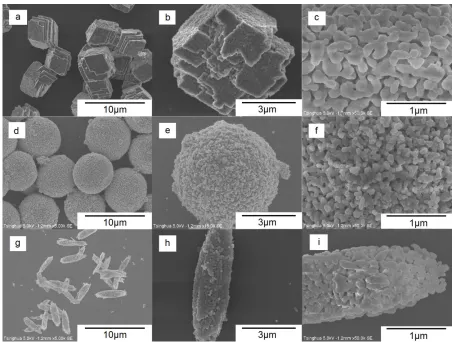
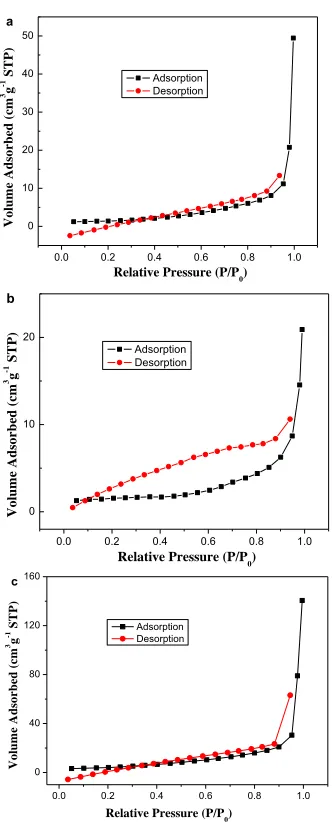
In this study, special micro-/nano-structured CoO powders with different morphologies (cube, sphere and spindle) have been synthesized successfully. All of micro-scale particles (cube, 1.0-4.0 µm in edge length; sphere, 3.0-7.0 µm in diameter; spindle, 2.0-5.0 µm in length and 1.0-3.0 µm in width) are built up by irregular nano-scale components (10-200 nm) attached to each other. Their specific surface areas are about 4.99 m2g-1, 5.01 m2g-1 and 15.74 m2g-1, and their average pore sizes are about 1.89 nm, 1.63 nm and 1.88 nm, respectively. By evaluation with electrochemical measurements, all of them possess high initial discharge capacities (1194.4 mAhg-1, 1208.5 mAhg-1 and 1248.7 mAhg-1 at 0.8 Ag-1), among which the spindle CoO electrode exhibits the best rapid-rate capability (the discharge capacity retention ratios at 0.8 Ag-1 after 50 cycles and at 1.6 Ag-1 after 30 cycles are 87.3% and 77.7%).
Keywords: Cobalt oxide, Morphologies, Micro-/nano-structure, Rapid-rate capability, Lithium-ion batteries
1. INTRODUCTION
and discharge, serious voltage polarization and poor electrical conductivity, its application for storage energy system is limited [9-12].
As we all know, the morphology of electronic material is one of the crucial factors to impact its property [19,20]. For example, ultrathin and highly-ordered CoO nanosheet arrays exhibit excellent cycling capability (1000 mAhg-1 after 100 cycles at 1 Ag-1) [21]. Self-assembled mesoporous CoO nanodisks (10 nm in thickness, 3-5 µm in diameter) possess good cycling performance (~ 630 mAhg-1 after 400 cycles at 0.8 Ag-1) [22], and CoO/CNTs nanoflowers show high energy density (~ 3.5 mWhcm-3 at a current density of 0.25 Acm-3) [9]. Porous CoO/C polyhedron (5-8 µm in length, 4-6 µm in width) retains a reversible capacity of 510 mAhg-1 after 50 cycles at 0.1 Ag-1 [19]. Therefore, it is meaningful to study the relationship between morphologies of CoO powders and their electrochemical performance. On the other hand, the microstructure of electronic material is another factor to affect its performance. And lots of papers about CoO with nanostructure have been reported. For instance, CoO/RGO nanocomposites deliver a high reversible capacity (960 mAhg-1) after 80 cycles at 0.2 Ag-1 [11]. CoO/C nanofiber networks (~ 8 nm) exhibit a good discharge capacity (630 mAhg-1) after 50 cycles at 0.1 Ag-1 [18]. As a contrast, the manipulation of micro-/nano-structure is an approach recently developed to improve the electronic performance of materials [23]. For example, micro-/nano-structured cubic Co3O4 powders (with side length ~ 2.4 μm in average) consisting of nanosheets (30-40 nm in thickness, 20-200 nm in diameter) show excellent capacity retention property at high rates (89.9% after 60 cycles at 1 C) [24]. Spherical micro-/nano-structured Co3O4 powders (~ 2.0 μm in diameter) assembled by nanoparticles (~ 100 nm) exhibit superior cycling performance (~ 970 mAhg-1 after 140 cycles at 0.4 Ag-1 and ~ 500 mAhg-1 after 500 cycles at 1 Ag-1 ) [25]. However, very few reports have been published regarding CoO powders with micro-/nano-structures.
Herein, in order to investigate the relationship between the shapes of CoO particles and the electrochemical performance, especially rapid-rate capability, micro-/nano-structured CoO powders with different morphologies were synthesized, and their distinct electrochemical performance as anode materials for LIBs was tested and compared.
2. EXPERIMENTAL SECTION
Preparation of samples. CoO powders with different morphologies:the CoCO3 precursors with different morphologies (cube, sphere and spindle) have been prepared with the methods mentioned in our previous reports [24,26,27]. The precursors were transferred into a muffle electric furnace, thermal treatment was carried out at 600 °C in N2 for 10 h with a heating ramp of 5 °C·min-1. After the reaction was over and the furnace was cooled naturally, black products were collected.
Electrochemical measurements. The electrochemical performance of CoO powders as electrodes was investigated through coin cells, while the lithium metal was used as the reference electrode. The working electrode was prepared by mixing CoO, polytetrafluoroethylene (PTFE) and acetylene black (ATB) with a weight ratio of CoO/ PTFE/ATB = 7:1:2, and the weight of every electrode is about 5 mg. The electrolyte solution prepared by dissolving LiPF6 (1 mol·L-1) in the mixture of diethyl carbonate (DEC), propylene carbonate (PC) and ethylene carbonate (EC) with a volume ratio of DEC/PC/EC = 1:1:3. The electrode capacity was tested by the battery testing system (Land, CT2001A) with the galvanostatic discharge-charge method at 25 °C. And the cyclic voltammogram (CV) was analyzed in the range of 0.01-3.00 V (vs. Li+/Li) at a scan rate of 0.2 mV·s-1 by electrochemical workstation (Princeton, Parstat2273).
3. RESULTS AND DISCUSSION
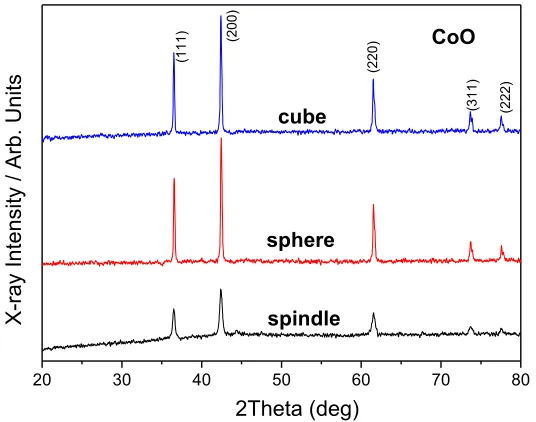
20 30 40 50 60 70 80
(2
22
)
(3
11
)
(2
20
)
(2
00
)
(1
11
)
spindle sphere
cube
CoO
X-ray Intensit
y / Arb. Unit
s
2Theta (deg)
Figure 1. XRD patterns of CoO powders with different morphologies.
[image:3.596.162.430.318.529.2]
each other. All of them exhibit highly-porous structures among nanoparticles, which are obtained by the heating treatment [28-30].
Figure 2. SEM images of CoO powders with different morphologies: (a), (b) and (c) cube; (d), (e) and (f) sphere; (g), (h) and (i) spindle.
0.05 0.10 0.15 0.20 0.25 0.30
1 2 3 4 5 a
BET Surface Area: 4.99 m2
g-1
BET Surface Area: 5.01 m2 g-1
BET Surface Area: 15.74 m2
g-1
V
o
lu
m
e
A
d
s
o
rb
e
d
(
cm
3 g -1 )
Relative Pressure (P/P0)
cube sphere spindle
0 5 10 15
0.000 0.004 0.008 0.012 0.016 0.020
b a
Average Pore Size: 1.89 nm (cube) 1.63 nm (sphere) 1.88 nm (spindle)
d
V
/d
r
(
cm
3 g -1 nm -1 )
Pore Size (nm)
cube sphere spindle
[image:4.596.71.526.128.470.2] [image:4.596.105.492.545.689.2]
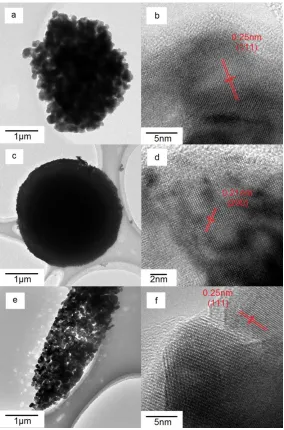
Figure 4. TEM and HRTEM images of CoO powders with different morphologies: (a), and (b) cube; (c) and (d) sphere; (e) and (f) spindle.
of cubic phase CoO, while sphere with the lattice spacing of 0.21 nm corresponds to (200) d-spacing, which indicates that some nanoparticles are single-crystal possibly [31,32].
0.0 0.5 1.0 1.5 2.0 2.5 3.0 -0.003 -0.002 -0.001 0.000 0.001 0.002 ~2.30 V 2.15 V ~1.20 V 0.15 V C u rr e n t d e n s it y ( A c m -2 )
Potential (V) (vs. Li+/Li)
1st 2nd 3rd 4th
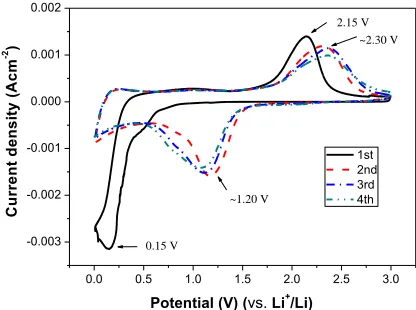
Figure 5. First four cyclic voltammogram curves of cubic CoO electrode at a scan rate of 0.2 mV·s-1 in the range of 0.01-3.00 V (vs. Li+/Li).
Since the morphologies of electronic materials affect the CV property little [11,15,19], cubic CoO powders are selected as a representative. The first four CV curves were recorded at a scanning rate of 0.2 mV·s-1 with the potential range of 0.01-3.00 V (vs. Li+/Li) (Fig. 5). At the first cycle, an obvious reduction peak is observed at ~ 0.15 V, which arises from the reduction of CoO to Co [Eqs. (1)]; and a well-defined anodic peak is found at ~ 2.15 V, which is caused by the oxidation of Co to CoO [Eqs. (2)] [12,22,33]. In the next cycles, all of reduction peaks shift to ~ 1.20 V, corresponding to the same reduction reaction [Eqs. (1)], while all of oxidation peaks are found at ~ 2.30 V with a slight change matching well with the same oxidation reaction [Eqs. (2)]. Therefore, the electrochemical reaction is excellently reversible from the second cycle. Remarkably, due to the formation of irreversible solid electrolyte interface (SEI) film, the intensity of reduction peaks decreases and the value of reduction peak shifts after the initial cycle [12,22,33].
CoO + 2Li+ + 2e-→Co + Li2O (1) Co + Li2O → CoO + 2Li+ + 2e- (2)
0 400 800 1200
0 1 2 3 a a
0.8 Ag-1
Specific Capacity (mAhg-1)
V o lt a g e ( V ) ( vs . L i + /L i) cube sphere spindle Charge Discharge
0 10 20 30 40 50
0 400 800 1200 1600 2000
0.8 Ag-1
[image:6.596.194.402.136.291.2]
0 10 20 30 40 50
0 400 800 1200 1600 2000
c
Cycle Number
S
p
e
c
if
ic
C
a
p
a
c
it
y
(
m
A
h
g
-1 )
0.4 Ag-1
1.6 Ag-1
cube sphere spindle
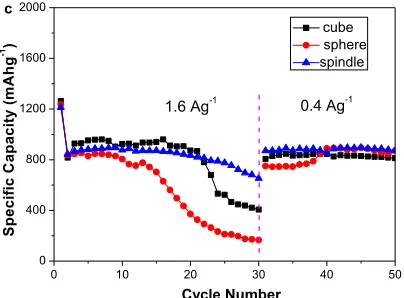
Figure 6. (a) First discharge and charge profiles of CoO electrodes with different morphologies in the range of 0.01-3.00 V (vs. Li+/Li) at 0.8 Ag-1; Capacity retention properties of CoO electrodes with different morphologies at different current densities: (b) 0.8 Ag-1, (c) 1.6 Ag-1 and 0.4 Ag -1
.
[image:7.596.199.401.75.224.2]
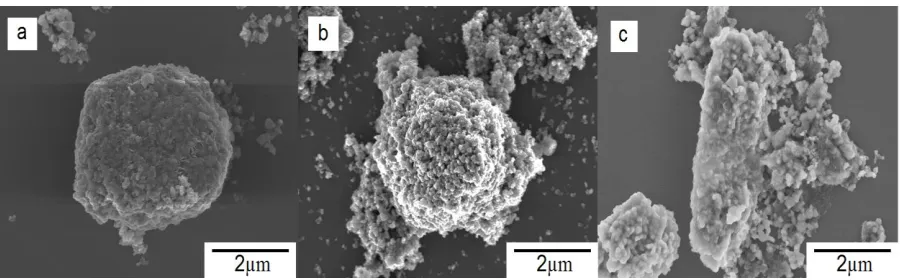
The SEM images of the CoO electrodes (mixtures of CoO/ATB/PVDF) with different morphologies after 50 cycles at 0.8 mAg-1 are shown in Fig. 7 (cube, Fig.7a; sphere, Fig.7b and spindle, Fig.7c). It indicates that the basic microstructures and shapes have not changed during the charge/discharge, which can be one of reasons for the good cycling performance of these materials.
Figure 7. SEM images of CoO electrodes (mixtures of CoO/ATB/PVDF) with different morphologies after 50 cycles at 0.8 Ag-1.
4. CONCLUSIONS
In summary, CoO powders with different morphologies (cube, sphere and spindle) have been synthesized successfully, and the electrochemical performance have been evaluated and compared. Because all of them possess the special micro-/nano-structure, which can enhance their electrochemical property obviously, all of the initial discharge capacities are very high (1194.4 mAhg-1, 1208.5 mAhg-1, and 1248.7 mAhg-1 at 0.8 Ag-1, respectively). More remarkable, it is proved that the morphologies of CoO particles may affect the rate capability. Therefore, among them, the spindle CoO electrode, which possesses the most reaction sites and the best electrolyte diffusion, exhibits the best rapid-rate capability (the discharge capacity retention ratios at 0.8 Ag-1 after 50 cycles and at 1.6 Ag-1 after 30 cycles are 87.3% and 77.7%).
ACKNOWLEDGMENT
This work was supported by the National Natural Science Foundation of China (Grant Nos. 51274130 and 51074096) and the program for Changjiang Scholars and Innovative Research Team in University (IRT13026).
SUPPORTING INFORMATION
[image:8.596.74.524.163.303.2]
0.0 0.2 0.4 0.6 0.8 1.0
0 10 20 30 40 50 a V o lu m e A d so r b e d ( cm 3 g -1 S
T
P
)
Relative Pressure (P/P0) Adsorption Desorption
0.0 0.2 0.4 0.6 0.8 1.0
0 10 20 b V o lu m e A d so r b e d ( cm 3 g -1 S
T
P
)
Relative Pressure (P/P0)
Adsorption Desorption
0.0 0.2 0.4 0.6 0.8 1.0
0 40 80 120 160 c Adsorption Desorption V o lu m e A d so r b e d ( cm 3g -1 S
T
P
)
Relative Pressure (P/P0)
Figure S. N2 adsorption/desorption isotherms of CoO powders with different morphologies: (a) cube, (b) sphere and (c) spindle.
References
1. H.Y. Sun, Y.G. Liu, Y.L. Yu, M. Ahmad, D. Nan, and J. Zhu, Electrochim. Acta, 118 (2014) 1. 2. P. Poizot, S. Laruelle, S. Grugeon, L. Dupont, and J.M. Tarascon, Nature, 407 (2000) 496.
3. G.Y. Huang, S.M. Xu, Y.B. Cheng, W.J. Zhang, J. Li, and X.H. Kang, Int. J. Electrochem. Sci., 10 (2015) 2594.
4. S.R. Li, Y. Sun, S.Y. Ge, Y. Qiao, Y.M. Chen, I. Lieberwirth, Y. Yu, and C.H. Chen, Chem. Eng. J.,192 (2012) 226.
5. J.I. Lee, S. Choi, and S. Park, Chem. Asian J., 8 (2013) 1377.
6. A.D.C. Permana, A. Nugroho, K.Y. Chung, W. Chang, and J. Kim, Chem. Eng. J., 241 (2014) 216. 7. Y.J. Hu, K.X. Xu, L.Y. Kong, H. Jiang, L. Zhang, and C.Z. Li, Chem. Eng. J., 242 (2014) 220. 8. H. Qiao, L.F. Xiao, Z. Zheng, H.W. Liu, F.L. Jia, and L.Z. Zhang, J. Power Sources, 185 (2008)
486.
[image:9.596.216.382.67.478.2]
12. L.J. Zhang, P. Hu, X.Y. Zhao, R.L. Tian, R.Q. Zou, and D.G. Xia, J. Mater. Chem., 21 (2011) 18279.
13. J. Jiang, J.P. Liu, R.M. Ding, X.X. Ji, Y.Y. Hu, X. Li, A.Z. Hu, F. Wu, Z.H. Zhu, and X.T. Huang, J. Phys. Chem. C, 114 (2010) 929.
14. J. Xu, J. Jin, K. Kim, Y.J. Shin, H.J. Kim, and S.U. Son, Chem. Commun., 49 (2013) 5981. 15. Y.F. Wang, and L.J. Zhang, J. Power Sources, 209 (2012) 20.
16. M.X. Li, Y.X. Yin, C.J. Li, F.Z. Zhang, L.J. Wan, S.L. Xu, and D.G. Evans, Chem. Commun., 48 (2012) 410.
17. J.G. Kim, Y. Kim, Y. Noh, and W.B. Kim, ChemSusChem, 8 (2015) 1752.
18. X.L. Huang, R.Z. Wang, D. Xu, Z.L. Wang, H.G. Wang, J.J. Xu, Z. Wu, Q.C. Liu, Y. Zhang, and X.B. Zhang, Adv. Funct. Mater., 23 (2013) 4345.
19. W.W. Yuan, J. Zhang, D. Xie, Z.M. Dong, Q.M. Su, and G.H. Du, Electrochim. Acta, 108 (2013) 506.
20. G.Y. Huang, S.M. Xu, J.L. Wang, L.Y. Li, and X.J. Wang, Acta Chim. Sinica, 71 (2013) 1589. 21. D.D. Li, L.X. Ding, S.Q. Wang, D.D. Cai, and H.H. Wang, J. Mater. Chem. A, 2 (2014) 5625. 22. Y.M. Sun, X.L. Hu, W. Luo, and Y.H. Huang, J. Mater. Chem., 22 (2012) 13826.
23. M. Zhang, E. Uchaker, S. Hu, Q.F. Zhang, T.H. Wang, G.Z. Cao, and J.Y. Li, Nanoscale, 5 (2013) 12342.
24. G.Y. Huang, S.M. Xu, S.S. Lu, L.Y. Li, and H.Y. Sun, ACS Appl. Mater. Interfaces, 6 (2014) 7236. 25. B. Zhang, Y.B. Zhang, Z.Z. Miao, T.X. Wu, Z.D. Zhang, and X.G. Yang, J. Power Sources, 248
(2014) 289.
26. G.Y. Huang, S.M. Xu, S.S. Lu, L.Y. Li, and H.Y. Sun, Electrochim. Acta, 135 (2014) 420.
27. G.Y. Huang, S.M. Xu, Y. Yang, H.Y. Sun, Z.B. Li, Q. Chen, and S.S. Lu, Mater. Lett., 131 (2014) 236.
28. W. Du, R.M. Liu, Y.W. Jiang, Q.Y. Lu, Y.Z. Fan, and F. Gao, J. Power Sources, 227 (2013) 101. 29. H. Guan, X. Wang, H.Q. Li, C.Y. Zhi, T.Y. Zhai, Y. Bando, and D. Golberg, Chem. Commun., 48
(2012) 4878.
30. X.F. Zheng, G.F. Shen, Y. Li, H.N. Duan, X.Y. Yang, S.Z. Huang, H.E. Wang, C. Wang, Z. Deng, and B.L. Su, J. Mater. Chem. A, 1 (2013) 1394.
31. M. Zhang, F.L. Yan, X. Tang, Q.H. Li, T.H. Wang, and G.Z. Cao, J. Mater. Chem. A, 2 (2014) 5890.
32. Y.M. Sun, X.L. Hu, W. Luo, and Y.H. Huang, J. Phys. Chem. C, 116 (2012) 20794.
33. J.C. Liu, Y.Y. Xu, X.J. Ma, J.K. Feng, Y.T. Qian, and S.L. Xiong, Nano Energy, 7 (2014) 52. 34. G.Y. Huang, S.M. Xu, L.Y. Li, X.J. Wang, and S.S. Lu, Acta Phys. -Chim. Sin., 30 (2014) 1121. 35. Q. Hao, D.Y. Zhao, H.M. Duan, and C.X. Xu, ChemSusChem, 8 (2015) 1435.