Int. J. Electrochem. Sci., 9 (2014) 5454 - 5466
International Journal of
ELECTROCHEMICAL
SCIENCE
www.electrochemsci.org
Effect of Fluoride Ions on Oxygen Reduction and Evolution
Reaction at α-MnO
2Cathode
Imgon Hwang, Eunsaem Ahn, Yongsug Tak*
Department of Chemical Engineering, Inha University,253 Yonghyun-dong, Nam-ku, Incheon 402-751,Republic of Korea.
*
E-mail: [email protected]
Received: 8 May 2014 / Accepted: 22 June 2014 / Published: 16 July 2014
Development of electrode materials and electrolytes with low overpotentials during oxygen reduction reaction (discharging) and oxygen evolution reaction (charging) is essential for achieving high efficiency in aqueous Li-air batteries. α-MnO2 was hydrothermally synthesized and used as an
electrode to investigate its possible application in an aqueous Li-air battery. The electrolyte was modified by the addition of trace amounts of halide anions and alkali metal cations. Fluoride anions and potassium cations are most effective in reducing the overpotential of oxygen reduction and evolution reactions. Electrochemical studies and XPS analysis support the fact that the specific adsorption of F- inside the double layer changes the oxidation state from Mn(IV) to Mn(III), resulting in an increase in catalytic activity for oxygen reduction/evolution reactions.
Keywords: Li-air battery, fluoride ion, oxygen reduction reaction, oxygen evolution reaction, aqueous electrolyte
1. INTRODUCTION
Rechargeable Li-air batteries have been investigated as energy storage and conversion systems because their theoretical energy storage capacity is much greater than that of Li-ion batteries [1-4]. Based on the type of electrolyte used, Li-airbatteries are classified into aqueous and non-aqueous systems [5-8]. A non-aqueous system has limited cyclability because the discharge products on air cathodes are solid materials (Li2O and Li2O2) that cannot be completely dissociated during the
(ORR) (O2 + 2H2O + 4e → 4OH-) during discharging and an oxygen evolution reaction (OER) (4OH-
→ O2 + 2H2O + 4e) during the charging process [10-14].
In an aqueous Li-air battery, the ORR during discharging is the same as the cathode reaction of the alkaline fuel cell, while the OER during the charging process corresponds to the anode reaction during alkaline water electrolysis.An air electrode for an aqueous Li-air battery requires high catalytic activities for both ORR and OER. Although manganese-oxide-based cathodes for ORR have been extensively studied for alkaline fuel cell and non-aqueous metal-air battery applications [15-20], their application in both ORR and OER has not yet been investigated for aqueous Li-air batteries. In addition, battery performance is not only significantly affected by the high efficiency of the air electrodes but also by electrolyte compositions.
With respect to electrolyte compositions, it has been reported that trace amounts of ions in the electrolyte expedite the rate of electrode reactions by either electrostatic effects or ligand-bridged electron-transfer pathways [21]. In the Cu-deposition process, the Cu2+/Cu+ reaction is catalyzed by chloride ions through a chloride-ion-bridged inner sphere reaction [21]. More recently, the effect of solution additives on electrode activity has been reported for the hydrogen evolution reaction (HER), 2H2O + 2e → H2 + 2OH-, in alkaline water electrolysis. Either Li+ or Ba2+ reduces the HER
overpotential by forming an adsorbed state that suppresses the access of gas molecules, such as O2 and
H2, to the electrode surface [22]. These cations play a role in increasing the effective surface area, and
ultimately, improving cathode efficiency. Therefore, it can be suggested that specifically adsorbed ions inside the inner Helmholtz layer of an electrode/electrolyte interface may catalyze the ORR and OER in aqueous Li-air batteries.
In this study, we investigated the effect of trace amounts of different ionic species on the ORR and OER for a hydrothermally prepared α-MnO2 electrode in KOH solution. Reaction pathway and the
catalytic activity of α-MnO2 were investigated with linear sweep voltammetry (LSV) and
Koutecky-Levich analysis.
2. EXPERIMENTAL
An α-MnO2 electrode was prepared by the hydrothermal method. 2 mmol KMnO4 and 1 mL
H2SO4 were dissolved in 20 mL of deionized water and maintained at 150℃ for 12 h in an autoclave
[23]. 1M KOH was used as the main electrolyte for the aqueous Li- O2 batteries and trace amounts of
anions in the form of KF, KCl, and KI were added to the 1 M KOH solution to investigate the effect of anions on the ORR and OER. The electrochemical behavior of ORR on α-MnO2 was investigated with
a potentiostat (Autolab PGSTAT302N) and a rotating disc electrode system (RDE, Autolab). The working electrode, α-MnO2, on the RDE system was prepared using the following procedure: a
mixture of water, α-MnO2, and nafion solution were homogeneously stirred for 1 h in an ultrasonic
from 0.3 to - 0.5 V vs. Hg/HgO/1M NaOH at a scan rate of 20 mV/s and the rotating speed was fixed at 4000 rpm.
The structure of the α-MnO2 electrode was analyzed with an X-ray diffractometer (XRD)
(Rigaku, D/Max-2200) and its surface elemental composition was investigated with X-ray photoelectron spectroscopy (XPS, ULVAC-PHI) using monochromated Al Kα radiation (hν is 1486.6 eV).
[image:3.596.158.438.239.469.2]3. RESULTS AND DISCUSSION
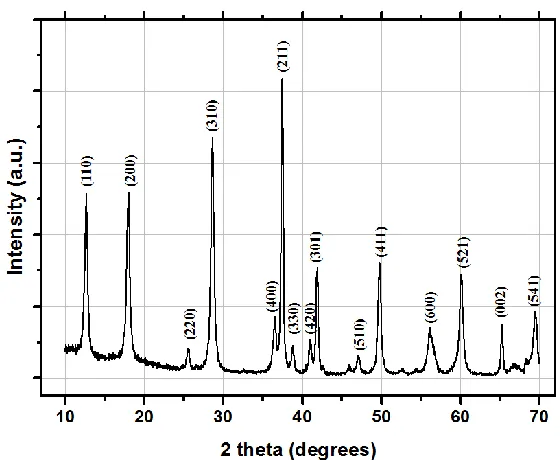
Figure 1. XRD of the α-MnO2 electrode synthesized using a hydrothermal method.
Fig. 1 shows the structure of the α-MnO2 electrode prepared by using a hydrothermal method; the
XRD peaks are indexed to a body-centered tetragonal α-MnO2 phase [24]. Fig. 2 shows that the
α-MnO2 electrode has a low catalytic activity for H2O + 2e → H2 + 2OH in the absence of dissolved O2,
but a high catalytic activity for O2 + 2H2O + 4e → 4OH- in an O2-saturated 1M KOH. To investigate
the effect of halide anions on the ORR in an O2-saturated solution, 0.001 M of KF, KCl, and KI were
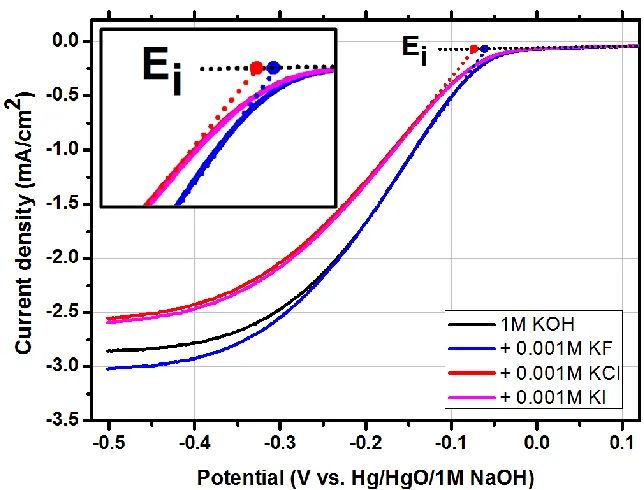
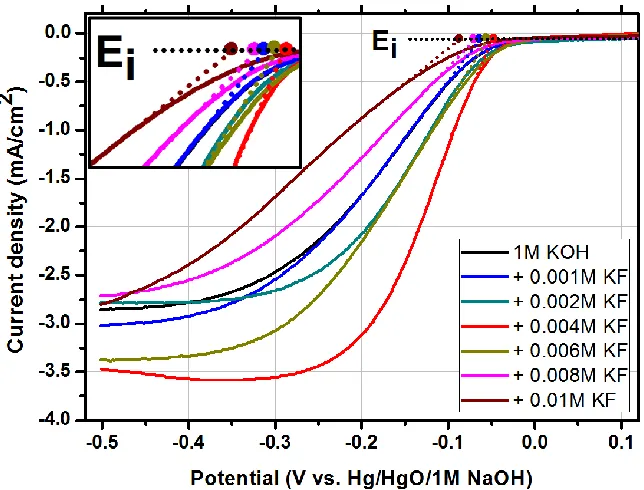
added to 1 M KOH to alleviate the cation effects on the ORR. The linear sweep voltammogram of Fig. 3 indicates that the addition of Cl- and I- ions suppressed the ORR but that the F- ions favored he rate of ORR. In order to elucidate the effect of F- on ORR, different concentrations of F- ions, from 0.001M to 0.01 M, were prepared and tested by LSV. Fig. 4 shows that the F- ion affected the ORR significantly. Catalytic activity of α-MnO2 increases at concentrations below 0.006M F-, but it
charge transfer rate and the lowest initial reduction potential, Ei, for the ORR were observed after the
addition of 0.004 M F- in 1M KOH.
Figure 2. Polarization curves for the oxygen reduction reaction at the α-MnO2 cathode in 1 M KOH
with a N2 purged and an O2 saturated environment. scan rate: 20 mV/s, rotation speed: 4000
rpm.
Figure 3. Polarization curves for the oxygen reduction reaction at the α-MnO2 cathode in pure 1 M
[image:4.596.139.459.140.383.2] [image:4.596.137.459.458.703.2]
Figure 4. Polarization curves for the oxygen reduction reaction at the α-MnO2 cathode in pure 1 M
KOH and 1 M KOH containing different amounts of KF. scan rate: 20 mV/s; rotation speed: 4000 rpm.
Polarization curves of ORR with oxygen saturated 1M KOH solution was rapidly decreased below -0.02 V (vs. Hg/HgO/1M NaOH), while 1M KOH with nitrogen purged solution cannot appeared ORR activity of α-MnO2 cathode. It can prove that oxygen within solution was reduced
rather than α-MnO2 catalyst. In order to investigate the effect of halide anions on the ORR at the
α-MnO2 cathode, a linear sweep voltammogram was measured with the addition of 0.001 M KF, KCl,
and KI in 1 M KOH. Fig. 3 indicates that the addition of a small amount of Cl- and I- ions generates the high overpotential for the initiation of the ORR and also increases the fast charge transfer rate below -0.25 V (vs. Hg/HgO/1M NaOH). Unlike the Cl- and I- ions, the presence of F- ions increased the rate of the ORR within the entire scan range of potentials by substantially increasing the catalytic activity of the α-MnO2 cathode. The NO3- ions show an effect similar to that of the ORR with Cl- and I- ions.
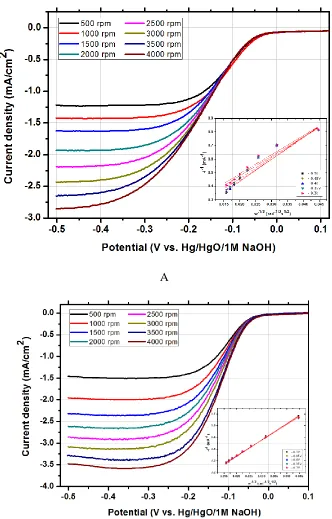
In order to elucidate the effect of F- ions on the ORR at the α-MnO2 cathode, polarization data at
different rotation speeds and electrode potentials were exploited to plot the Koutecky-Levich (K-L) equation. The number of electrons (n) participating in the ORR was obtained from the slopes of the K-L curves [25]:
i-1 = ik-1 + iL-1 = (nFkCo) -1 + (0.62nFD2/3Coν-1/6ω1/2) -1
where i is the measured current density, ik and iL are the kinetic- and diffusion-limiting current
densities, respectively, F is the Faraday constant (96,485 C/mol), A is the geometric area of the RDE, D is the diffusion coefficient of O2 in 1 M KOH (1.76 10-5 cm2/s), Co is the concentration of O2 in 1
[image:5.596.140.462.74.319.2]
respectively. The n value of the ORR was 2.50 in 1 M KOH and increased to 2.98 in the 0.004M KF- containing KOH solution.
A
B
Figure 5. Polarization curves and Koutecky-Levich plot for the oxygen reduction reaction at the cathode in (a) 1 M KOH only and (b) 1 M KOH containing 0.004 M KF. scan rate: 20 mV/s; rotation speed: 4000 rpm.
The exchange current density (io) was obtained from the Tafel plot using the following equation:
[image:6.596.134.466.113.632.2]
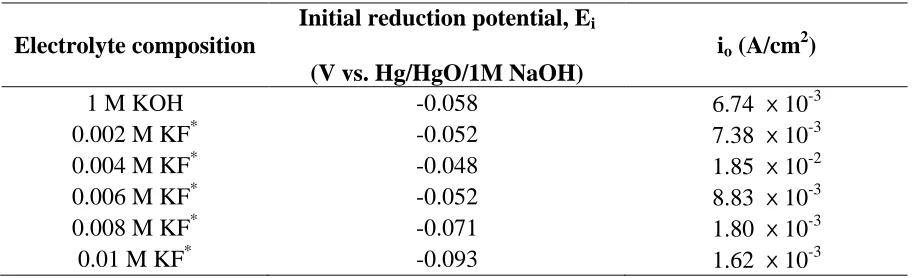
io was 6.74ⅹ10-3 A/cm2 in 1 M KOH and 1.85ⅹ10-2 A/cm2 in the 1 M KOH containing 0.004 M KF.
The exchange current density in the presence of 0.004M F- was three times higher than that in the pure 1 M KOH. Table 1 shows the initial reduction potential and exchange current density in different solution compositions.
A
B
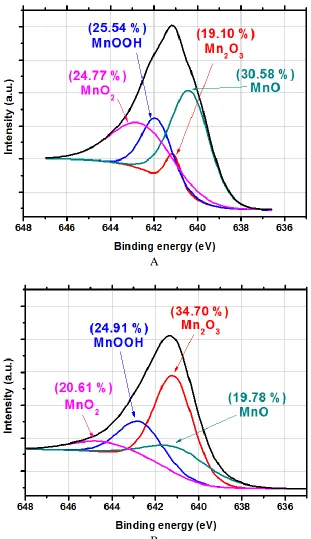
Figure 6. XPS Mn2p3/2 spectra of the α-MnO2 cathode after the oxygen reduction reaction in (a) 1M
[image:7.596.144.455.153.692.2]
Table 1. Initial reduction potential, Ei, and exchange current density for the oxygen reduction reaction
at the α-MnO2 cathode in different compositions of the electrolyte.
Electrolyte composition
Initial reduction potential, Ei
(V vs. Hg/HgO/1M NaOH)
io (A/cm2)
1 M KOH -0.058 6.74 ⅹ10-3
0.002 M KF* -0.052 7.38 ⅹ10-3
0.004 M KF* -0.048 1.85 ⅹ10-2
0.006 M KF* -0.052 8.83 ⅹ10-3
0.008 M KF* -0.071 1.80 ⅹ10-3
0.01 M KF* -0.093 1.62 ⅹ10-3
* Specific concentration of KF is added in 1 M KOH.
The ORR at α-MnO2 was assumed to proceed via a mixed two-electron and four-electron
pathway in the aforementioned electrolytes, pure KOH, and KOH containing KF. The reaction O2 +
H2O + 2e → HO2- + OH- involved a two-electron pathway, whereas the ORR entailed a four-electron
pathway when the following disproportionation reaction ended: 2HO2- → O2 + 2OH-. Lima et al.
asserted that the change in oxidation state from Mn(IV) to Mn(III) was responsible for the higher catalytic activity for ORR [26]. Mn(III) might have existed as Mn2O3, which was eventually converted
into MnOOH. However, the effect of a trace amount of F- ions on the oxidation state of Mn(IV) has never been investigated and still remains unclear. Since MnO2 is known to be a good adsorbent of
arsenic and fluoride ions in water [26,27], it can be supposed that F- ions are adsorbed onto the surface of α-MnO2. Assuming an electric double layer structure on a negatively charged electrode [28], F
-anions can be specifically adsorbed inside an inner Helmholtz layer. In order to investigate the existence of Mn(III) species during ORR in 1 M KOH containing 0.004 M F- solution, the Mn2p3/2
peak of the α-MnO2 cathode was analyzed with XPS after the ORR in the pure 1M KOH and 1 M
KOH with 0.004 M KF solutions. Fig. 6 shows that the proportion of Mn(III) components, such as MnOOH and Mn2O3, clearly increased in the 1 M KOH containing the 0.004 M KF electrolyte (Fig.
6(b), 59.61 %), as compared with the pure 1M KOH (Fig. 6(a), 44.64 %). This indicates that the adsorption of trace amounts of F- onto an α-MnO2 cathode may transfer electrons to α-MnO2 and
change the oxidation state of Mn(IV) to Mn(III), thereby increasing the catalytic activity for the ORR. However, the cause for the decrease in catalytic behavior of α-MnO2 above 0.008M F- is still unclear.
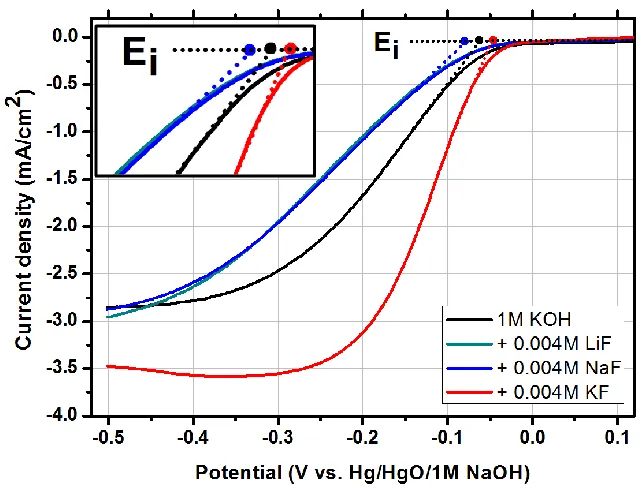
With fixed concentration of the fluoride anion (0.004 M), which had the highest catalytic effect on the ORR, different types of monovalent cations were tested in the form of LiF, NaF, and KF in 1 M KOH. The corresponding linear sweep voltammograms for each cation in separate solutions are shown in Fig. 7. Table 2 shows the initiation potential and exchange current density (io) for the ORR. With the
-2.13 mA/cm2 in 1 M KOH, but it can be verified -1.48 mA/cm2 at 0.004 M Li+, -1.50 mA/cm2 at 0.004 M Na+, and -3.48 mA/cm2 at 0.004 M K+ containing 1M KOH solutions, respectively.
Figure 7. Polarization curves for the oxygen reduction reaction at the α-MnO2 cathode in pure 1 M
KOH and 1 M KOH containing 0.004 M of LiF, NaF, and KF. scan rate: 20 mV/s; rotation speed: 4000 rpm.
The KF-containing electrolyte had the highest catalytic effect on the ORR, while the LiF and NaF-containing electrolyte had the lowest catalytic activity rather than 1M KOH solution. The radii of the hydrated cations decreased in the order, K+ < Na+ < Li+, because of ion-water solvent interactions [17]. Therefore, it can be inferred that the hydrated cations are adsorbed onto the outer Helmholtz layer inside the electric double layer structure and thereby inhibit the adsorption of dissolved O2 at the
[image:9.596.137.457.123.366.2]electrode surface, which can decrease the rate of the ORR. Therefore, the least hydrated alkali metal ion, K+, showed the highest catalytic activity for the ORR in the presence of 0.004 M fluoride ion. Table 2. Initial reduction potential, Ei, and exchange current density for the oxygen reduction reaction
at the α-MnO2 cathode in different compositions of the electrolyte.
Electrolyte composition
Initial reduction potential, Ei
(V vs. Hg/HgO/1M NaOH)
io (A/cm2)
1 M KOH -0.058 6.74 ⅹ10-3
0.004 M LiF* -0.072 4.78 ⅹ10-3
0.004 M NaF* -0.072 4.87 ⅹ10-3
0.004 M KF* -0.048 1.85 ⅹ10-2
[image:9.596.87.507.603.709.2]
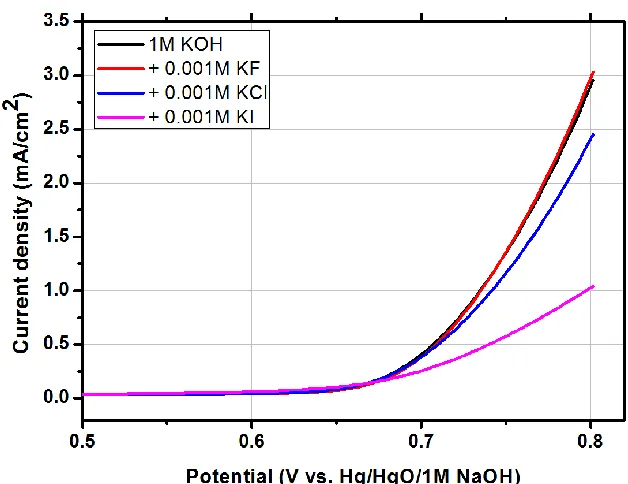
Figure 8. Polarization curves for the oxygen evolution reaction at the α-MnO2 anode in pure 1 M KOH
and 1 M KOH containing 0.001 M of KCl, KF, and KI. scan rate: 20 mV/s; rotation speed: 4000 rpm.
In order for α-MnO2 to be applied for aqueous Li-O2 battery, it should have a high catalytic
activity for oxygen evolution reaction, which is the reaction during battery charging. Effect of α-MnO2
electrode on oxygen evolution reaction was investigated in different compositions of electrolyte and linear sweep voltammetry was carried out by adding 0.001 M KF, KCl, KI in 1M KOH, following the same procedure for ORR.
Figure 9. Polarization curves for the oxygen evolution reaction at the α-MnO2 anode in pure 1 M KOH
[image:10.596.142.456.85.327.2] [image:10.596.164.438.501.713.2]
Table 3. Exchange current density for the oxygen evolution reaction at the α-MnO2 anode in different
compositions of the electrolyte.
Electrolyte composition io (A/cm2)
1 M KOH 2.60 ⅹ10-3
0.002 M KF 2.66 ⅹ10-3
0.004 M KF 2.85 ⅹ10-3
0.006 M KF 3.39 ⅹ10-3
0.008 M KF 4.17 ⅹ10-3
0.01 M KF 2.95 ⅹ10-3
* Specific concentration of KF is added in 1 M KOH.
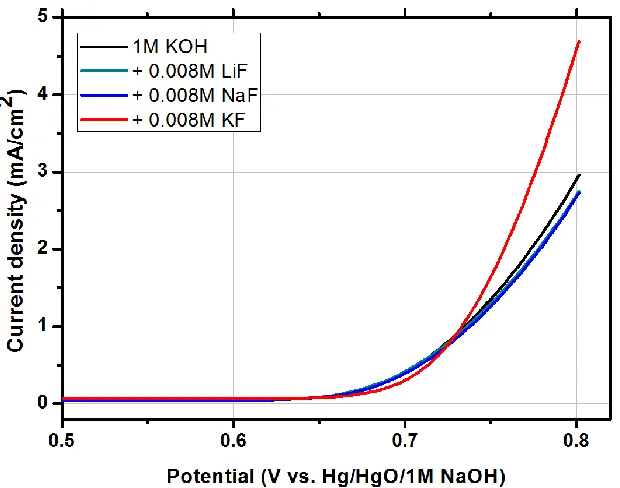
Figure 10. Polarization curves for the oxygen evolution reaction at the α-MnO2 anode in pure 1 M
KOH and 1 M KOH containing 0.008 M of LiF, NaF, and KF. scan rate: 20 mV/s; rotation speed 4000 rpm.
Fig. 8 indicates that addition of 0.001M of F- ion did not affect the OER catalytic activity of α-MnO2 but Cl-, I- suppressed OER. Linear sweep voltammogram of Fig. 9 shows that the activity of
α-MnO2 for OER was gradually increased up to 0.008M of F- as the concentration of F- increases. Table
3 shows that exchange current density, io, for OER was 2.60ⅹ10-3 A/cm2 in 1 M KOH and 4.17ⅹ 10-3
A/cm2 in the 1 M KOH containing 0.008 M F-. With the same reasoning for oxygen reduction reaction, it can be suggested that oxidation state change from Mn(IV) to Mn(III) of α-MnO2 by the adsorption of
[image:11.596.146.456.262.506.2]
explained by the adsorption of smallest hydrated cation of K+ on α-MnO2, as suggested in the
[image:12.596.82.502.174.254.2]discussion of oxygen reduction reaction.
Table 4. Exchange current density for the oxygen evolution reaction at the α-MnO2 anode in different
compositions of the electrolyte.
Electrolyte composition io (A/cm2)
1 M KOH 2.60 ⅹ10-3
0.008 M LiF 2.91ⅹ10-3
0.008 M NaF 3.05 ⅹ10-3
0.008 M KF 4.17 ⅹ10-3
* LiF, NaF, and KF are added in 1 M KOH.
4. CONCLUSION
Oxygen electrodes of aqueous Li- O2 batteries should have superior catalytic activities for ORR
during discharging and OER during the charging process. In this work, the effects of electrolyte compositions on the ORR and OER on a hydrothermally prepared α-MnO2 electrode were investigated
using an electrochemical method and XPS analysis. The presence of 1 M KOH containing 0.004M F -catalyzed the ORR significantly, resulting in an exchange current density 2.7 times higher than that observed with pure 1M KOH. Electrochemical analysis and XPS results suggest that specifically adsorbed F- is responsible for the fast charge transfer rate for ORR by changing the oxidation state of Mn(IV) to Mn(III) in α-MnO2. The observed higher activity of KF compared to that of NaF and LiF
with the same 0.004M F- can be explained by the difference in the size of hydrated cations. In addition, fluoride anions have a catalytic effect for the OER and 0.008M F- in 1M KOH has an exchange current density 1.6 times higher than that of pure 1M KOH. However, the other anions, Cl- and I-, have negative catalytic effects on both ORR and OER at α-MnO2 electrodes. These results suggest that F- in
the form of KF is a very effective additive in reducing the overpotential for the ORR and OER at α-MnO2 electrodes.
ACKNOWLEDGEMENT
This work was supported by the National Research Foundation of Korea Grant Funded by the Korean Government (MEST) (NRF-2012-M1A2A2671765) and the INHA UNIVERSITY Research Grant.
References
1. A. Debart, A. Paterson, M. Holzapfel, P. Bruce, Angew. Chem., Int. Ed,. 47 (2008) 4521.
2. R. Black, S. H. Oh, J. H. Lee, T. Yim, B. Adams, L. F. Nazar, J. Am. Chem. Soc., 134 (2012) 2902. 3. X. H. Yang, P. He, Y.-Y. Xia, Electrochem. Commum., 11 (2009) 1127.
5. C. Tran, X.-Q. Yang, D. Qu, J. Power Sources, 195 (2010) 2057.
6. T. Zhang, N. Imanishi, S. hasegawa, A. Hirano, J. Xie, Y. Takeda, O. Yamamoto, N. Sammes, J. Electrochem. Soc., 155 (2008) A965.
7. X. H. Yang, P. He, Y. Y. Xia, Electrochem. Commun., 11 (2009) 1127.
8. S. Hasegawa, N. Imanishi, T. Chang, J. Xie, A. Hirano, Y. Takeda, O. Yamamoto, J. Power Sources, 189 (2009) 371.
9. J. Read, J. Electrochem. Soc., 149 (2002) A1190.
10.Z. P. Zheng, R. Y. Liang, M. Hendrickson, E. J. Plichta, J. Electrochem. Soc., 155 (2008) A432. 11.G. Girishkumar, B. McCloskey, A. C. Luntz, S. Swanson, W. Wilcke, J. Phys. Chem. Lett., 1
(2010) 2193.
12.P. He, Y. Wang, H. Zhou, Electrochem. Commun., 12 (2010) 1686. 13.Y. Lu, J. B. Gddoenough, Y. Kim, J. Am. Chem. Soc., 133 (2011) 5756.
14.Christensen, R. Leidtke, J. Ahmed, A. Kojic, J. Electrochem. Soc., 159 (2012) R1. 15.F. H. B. Lima, M. L. Calegaro, E. A. Ticianelli, J. Electroanal. Chem., 590 (2006) 152. 16.I. Roche, E. Chaninet, M. Chatenet, J. Vondrak, J. Appl. Electrochem., 38 (2008) 1195.
17.J. Feng, Y. Liang, H. Wang, Y. Li, B. Zhang, J. Zhou, J. Wang, T. Regier, H. Dai, Nano Res., 5 (2012) 718.
18.Y. Gorlin, B. L. Kaiser, J. D. Benck, S. Gul, S. M. Webb, V. K. Yachandra, J. Yano, T. F. Jaramillo, J. Am. Chem. Soc., 135 (2013) 8525.
19.A. K. Thapa, T. Ishihara, J. Power sources, 196 (2011) 7016.
20.T. Ogasawara, A. Debart, M. Holfazel, P. Novak, P. G. Bruce, J. Am. Chem. Soc., 128 (2006) 1390. 21.Z. Nagy, J. P. Blaudeau, N. C. Hung, L. A. Curtiss, J. J. Zurawski, J. Electrochem. Soc., 142
(1995) L87.
22.D. Strmcnik, D. F. van der Vliet, K. C. Chang, V. Komanicky, K. Kodama, H. You, V. R. Stamenkovic, N. M. Markovic, J. Phys. Chem. Lett., 2 (2011) 2733.
23.X. Wang, Y. Li, J. Am. Chem. Soc., 124 (2002) 2880.
24.K. J. Babu, A. Zahoor, K. Nahm, R. Ramachandran, M. A. J. Rajan, G. G. Kumar, J. Nanopart. Res., 16 (2014) 2250.
25.F. H. B. Lima, M. L. Calegaro, E. A. Ticianelli, Electrochim. Acta, 52 (2007) 3732.
26.L. Batistella, L. Venquiaruto, M. D. Luccio, J. V. Dliveira, S. B. C. Pergher, M. A. Mazutti, D. D. Olivera, A. J. Mossi, H. Treichel, R. Dallgo, Ind. Eng. Chem. Res., 50 (2011) 6871.
27.H. S. Kong, W. Li, H. B. Lin, Z. Shi, Y. Y. Lu, Y. Y. Dan, W. M. Huang, Surf. Interface Anal., 45 (2013) 715.
28.D. C. Grahame, R. Parsons, J. Am. Chem. Soc., 83 (1961) 1291.