JouRNALoF VIROLOGY, Oct. 1976,P.96-106
Copyright0 1976 American Society for Microbiology
Vol.20, No.1
Printed in U.S.A.
Analysis
of Intracellular Feline Leukemia Virus Proteins
I.
Identification
of a 60,000-Dalton Precursor of Feline
Leukemia
Virus p301
GREGORY F. OKASINSKI AND LELAND F. VELICER*
Department of Microbiology and Public Health, Michigan State University, East Lansing, Michigan 48824
Receivedfor publication 16 March 1976
The synthesis and release of feline leukemia virus p30 was studied using a
permanentlyinfected feline thymus tumor cell line. Disrupted cells were divided into two subcellular fractions, a cytoplasmic extract (CE) representing cellular
materialsoluble in 0.5%NP-40 and a particulate fraction (PF) insoluble in 0.5%
NP-40, but soluble in 0.2% deoxycholate and 0.5% NP-40. Intracellular feline
leukemia virus p30 was isolated from infected cells by immune precipitation with antiserum to p30 and subsequent sodium dodecyl sulfate-polyacrylamide
gel electrophoresis of the precipitated proteins. Cells labeled for 3 h with
[15S]methionine containedequal amounts ofp30 in both the CEandthe PF.p30 synthesis was estimated to be 0.8% of the total host cell protein synthesis. Immune precipitates from cells pulselabeled for 2.5 min contained a labeled
60,000-dalton polypeptide (Pp6O) in the PF and a polypeptide in the CE that
comigratedwithfeline leukemia virusp30insodiumdodecyl sulfate-polyacryl-amidegel electrophoresis.Whencells werechasedafter a pulselabel,there was arapidloss of Pp60 inthe PFandanaccumulation ofp30inthe CE within 30 minfollowedbydistributionofp30 inboth the PF and the CE. Estimation of intracellular and extracellular p30 levels during a 0.5- to 24-h chase period suggestedthat most of the newly synthesizedp30wasincorporatedinto
extracel-lularvirus. Tryptic peptideanalysis oflabeled Pp6O and p30demonstrated the
presenceof 13 of 15 p30peptides within thePp6Omolecule. The trypticpeptide
analysisin concertwiththepulse-chase labeling dataprovidesstrong evidence thatPp6Ois aprecursor ofp30.
The polypeptide composition of both the avian and mammalian oncornaviruses has been thoroughly studied in the past several years (13, 14, 17, 18, 25). The oncornaviruses containfive to seven major structural proteins withmolecularweightsrangingfrom 10,000 to 85,000 (5). Although the polypeptide
composi-tionofthe oncornaviruses has been rigorously studied, information concerning the synthesis
and processing of these polypeptides has ap-peared only recently (1, 10, 23, 24, 31, 33, 34).
Evidence obtained from picornavirus-, par-amxovirus-, and reovirus-infected cells
indi-cates that nononcogenic RNA virus mRNA is
translated from asingle initiation site (4).The mRNA of theseviruses iswellcharacterized (3, 6, 36). All three types of nononcogenic RNA
virus mRNA are translated into polypeptides
thatcorrespondin size withtheviral mRNA (6, 21, 22). In poliovirus-infected cells, the initial
translation product is a large precursor
poly-'Articleno.7557from theMichiganAgricultural
Exper-imentStation.
peptide, which is subsequentlycleaved toyield mature virionpolypeptides(21).
Oncornaviruses contain a
high-molecular-weight genome composed of 28-358 subunits with a molecular weightofapproximately3 x 10 (2, 7, 9). These RNA subunits contain 3'
poly(A) sequences (7, 20, 27). The apparent
abilityofthesesubunitstoserveasmRNA in in vitroprotein-synthesizing systems(24, 30, 35), combined withthe presence on polyribosomes
ofviral-specific RNAwith amolecularweight
similartothat ofgenomicsubunits(12, 16, 32), suggests thatoncornavirus mRNA is very simi-lartogenomic subunits.Ifoncornavirus mRNA istranslated in a manner similarto nononco-genic RNAvirusmRNA,thenonewould expect aninitial translationproductof about 300,000
daltons.
Attempts to isolate the initial translation product ofoncornavirusproteinsynthesishave been directed to in vitro protein-synthesizing
systemsandimmunoprecipitationofviral
poly-peptides from infected cells. Various in vitro protein-synthesizing systems have been used
96
on November 10, 2019 by guest
http://jvi.asm.org/
FeLV p30 PRECURSOR POLYPEPTIDE 97
withlimited success (8, 30, 35). Recently, how-ever, polypeptides (molecular weights of 140,000 to 185,000 and 50,000 to 75,000) have been synthesized using Rauscher leukemia vi-rus (RLV) genomic RNA in a cell-free protein-synthesizing system (24), and 75,000-to 80,000-dalton polypeptides have been synthesized in
response toadded30-40S RNA of Roussarcoma
virus (35). Sodium dodecyl sulfate-polyacryl-amide gel electrophoresis (SDS-PAGE) of im-mune precipitates from avian myeloblastosis virus (AMV) (10, 33, 34)- and RLV (1, 31)-in-fected cells provides evidence fora 76,000-dal-ton precursor in the former and 200,000-, 80,000-, and 65,000-dalton precursor polypep-tides in thelatter. Although precursor
polypep-tideshavebeenisolated, evidencefor a 300,000-dalton precursor polypeptide is lacking.
The workreported herewasundertaken(i)to
determine whether a precursor polypeptide of feline leukemia virus (FeLV) p30 existed and (ii) tomonitortheincorporationof intracellular p30 intoextracellular virus. Data are presented thatdemonstratea60,000-daltonprecursor pol-ypeptide (Pp6O) of FeLV p30 and suggest that mostof thenewly synthesized intracellularp30 isincorporatedintoextracellularFeLV.
(Most ofthis work was submitted by G. F. Okasinski inpartialfulfillment of the require-ments for the Ph.D. degree, Michigan State Univ., EastLansing, 1976. Thiswaspresented in part at the 75th Annual Meeting of the American SocietyforMicrobiology, 27April-2 May 1975, New York, N.Y., and at the Cold
Spring Harbor meeting on RNA Tumor Vi-ruses, 28 May-1 June 1975, Cold Spring
Har-bor, N.Y.)
MATERIALS AND METHODS
Source of cells and virus. The permanently
in-fectedfeline thymustumorcellsuspension (F-422)
was used throughout these experiments. Thiscell
lineproducesthe Rickard strain of FeLV and was
propagatedaspreviously described(7).
Radioactive labelingofcellsand FeLV.Labeled
intracellular proteinand extracellular FeLV were
obtained from cells incubated for3 or 20h,
respec-tively, with either [35S]methionine, 3H-amino acid
mixture,or 14C-amino acidmixture (NewEngland
NuclearCorp.). All labelingwasdoneat astarting
celldensityof 2 x 10⁶ cell/mlwith 1,uCiofisotope
per 106 cells. Labeling with 3H- or 14C-amino acid mixtures wasdone in mediumcontaining10% of the normalsupplementof aminoacids. [35S]methionine
labelingwasdone in growth mediumcontaining5%
of the normalsupplementof methionine.
Pulse-chase labeling was done with cells
previ-ously incubated in methionine-deficient or amino
acid-deficientgrowth media for 45 min todepletethe
aminoacidpools.The cells were then labeled for 2.5 min with[35S]methionineor
"4C-amino
acidmixture(1,Ci/100 cells)at acelldensity of50x 106cells/ml.
The pulse was terminated by placing the labeled
cellsonfrozen mediacontaining 10 times thenormal
concentrationofmethionineor aminoacids (chase medium), adding 20 volumes of cold chase medium,
andcollectingthecellsbycentrifugation.
Cells to bechasedwerethen incubated in warm
chasemedium forvarioustimes at acelldensityof
106cells/ml.
Purification ofvirus. Cells were removed from
the growth mediumby centrifugation at 1,000 rpm
for5min inan International PR-6 centrifuge. The
growth mediumwasfurther clarifiedby
centrifuga-tionat10,000rpmfor 10 min in a SorvallGSArotor.
Clarified mediumwasthenoverlaid onto a
discon-tinuousgradient consisting of 5 ml of 40%sucrose (wt/wt) inTNEbuffer(0.01 MTris-0.1 MNaCl-0.001
MEDTA,pH 7.5)and 5 ml of 20% sucrose (wt/wt) in
TNE. The virus was banded on the 40% sucrose
layerbycentrifugation at 25,000 rpm for 1.5 h in an
SW27 rotor (Beckman). The bandedvirus was
col-lected, dilutedwith anequal volume of TNEbuffer,
andpelleted by centrifugationat25,000 rpm for 1.5h
inanSW27rotor.The viral pellet wasresuspended insamplebufferorlysisbuffer(see below and Fig. 1)
for SDS-PAGE and detergent disruption,
respec-tively.
Preparationof subcellular fractions. Cells were
collected by centrifugation, washed inHanks
bal-anced salt solution, resuspended in lysis buffer (0.5%NP-40-0.15MNaCI-0.01MTris,pH7.4), vor-texed for 20 s, andthenincubatedfor5min at4°C.
Thedisrupted cells were thencentrifuged at 2,400
rpmfor 5 min in anInternationalPR-6centrifuge.
The supernatant was removed and centrifuged at
100,000 xgfor 1 h in anSW50.1 rotor(Beckman).
The 100,000 x gsupernatant (cytoplasmicextract)
was carefully removed and the pellet was
resus-pendedinlysis buffer containing0.2%deoxycholate.
The cytoplasmic extract(CE) was also made 0.2%
deoxycholate in oneexperiment (seeFig. 6). Both
theresuspended pellet andCEwere rapidly
freeze-thawed eight times. The solubilizedpellet andthe
CE werethencentrifugedat 100,000 x gfor1h in an SW50.1 rotor. The supernatantfrom the solubilized
pellet wastermedthe particulate fraction (PF) or
NP-40-insoluble fraction, whereasthe CE was also
termed theNP-40-soluble fraction.
Preparation ofantisera. Antiserum to p30 was
prepared as previouslydescribed (17). Antisera to
bovineserum albumin(BSA)wasobtainedfromE.
Sanders(Michigan State Univ., East Lansing). Immunodiffusion analysis. Double diffusion was
performed, using 2%Noble agar (Difco), as
previ-ouslydescribed (17).
Immune precipitation. Antiserum used for
im-mune precipitation was clarified by centrifugation
at100,000 x g for 0.5 h in an SW50.1 rotor.Clarified antiserumwas added tosubcellular fractionsor
dis-rupted virusandincubatedfor 30minat37°C and
then overnight at4°C. Immune precipitates were
collectedbylayeringtheincubation mixtureover 1 ml of 5%sucrose (wt/wt)in lysisbuffer, followed by
centrifugationat2,000rpm for 20min.The immune
precipitates were resuspended in 0.5 ml of lysis
buffer, layeredover 5% sucrose, and centrifuged.
VOL. 20, 1976
on November 10, 2019 by guest
http://jvi.asm.org/
98 OKASINSKI AND VELICER
This was repeated one additional time. The final precipitate was solubilized for SDS-PAGE as
de-scribed below, or trichloroacetic acid-precipitable
radioactivity was assayed aspreviously described
(17).
SDS-PAGE.Electrophoresisinthepresence of 1% SDS wasdone using a 9%polyacrylamide gelsimilar
tothatdescribedbyFairbanksetal. (11). Samples
were solubilized in sample buffer (0.01 M Tris-hy-drochloride-5 mM EDTA-1% SDS-2% mercaptoeth-anol) and heated for 3 min at 100°C. Electrophoresis was performed at 70 V for 3 h. The gels were
frac-tionated and assayedforradioactivityaspreviously
described, (17), using 3a70B scintillation cocktail
(Research Products International Corp., Elk Grove Village, Ill.).
Tryptic peptide analysis. Immune precipitates fromcells pulse labeled with 3H-amino acidswere
electrophoresedinthe presence of 1% SDS.Thegels
were fractionated into 2-mm slices as described
above,andthepolypeptides, were eluted with 0.4 ml of 0.1% SDS at37°Cfor 24 h.Small portions of each fraction wereassayedforradioactivity to locate
la-beled polypeptides.3H-amino acid-labeledFeLV was
preparedandelectrophoresed,andp30waselutedin
asimilarmanner.
The eluted polypeptides plus 1 mg of BSA as carrier were precipitated with 15% trichloroacetic
acid and1 volumeofethanol. Theprecipitated
pro-teinwascentrifugedandthe pellet waswashedfour timeswithethanol andoncewithether. The final
pelletwasdriedunder a stream of nitrogen.
The precipitated protein was oxidized as
de-scribedbyHirs(19) with 1 ml ofperformicacid (4.5 ml of formicacidplus 0.5 mlof 30%hydrogen perox-ide kept at250Cfor 1.5h) for 1 h at40C.Atotal of 15 ml ofdistilledwater wasadded, followedby lyophili-zation.Thelyophilized proteinswereresuspendedin
15mlofdistilledwaterandlyophilizedagain.
Theoxidizedproteins wereresuspendedin 3ml of
0.15MNH4HCO3containing 300 ,ug oftolylsulfonyl
phenylalanyl chloromethyl ketone (TPCK)-treated
trypsin (WorthingtonBiochemicalCorp.)and 10,ul
oftoluene and thenincubatedfor 4 hat 370C. An
additional 300 ,ug of TPCK-treated trypsin was
added anddigestionwascontinuedfor 15 hat370C.
The digested polypeptides were lyophilized,
resus-pendedin 3 ml ofdistilled water, and lyophilized
again. Thedigestedpeptideswerestoredat -76°C.
Cation-exchange chromatography ofthe tryptic peptides was done by a modification of the technique ofSchroeder (28), using a high-pressure column of type P chromobeads (Technicon) maintained at 52.5°C. The tryptic peptides were suspendedin 1.5 mlofpH 3.1 buffer (16 ml ofpyridine and 278 ml of acetic acidperliter) and thencentrifuged at1,000 rpm for 5 min to remove insoluble cores.The pep-tides were loaded onto the column under pressure developed from a 30-mldisposablesyringeand tight-fitting tygon tubing. Thepeptideswereeluted with alineargradientof 300ml ofpH3.1bufferand300 mlof pH 5.0 buffer (161 ml ofpyridineand143ml of aceticacid perliter)ataflowrateof30ml/h. Frac-tions(3ml)werecollected,evaporatedat600C, and
radioactivelyassayedwith10ml of3a70B
scintilla-tioncocktail.
RESULTS
Immune precipitation of FeLV p30 from disrupted virus. [35S]methionine-labeled FeLV wasprepared and electrophoresed inthe pres-ence of1% SDS. The polypeptide profile (Fig.
10
A 35S labeled FeLV
p30 p15
8-
p70
6-
4-0
B Immune precipitated
p30
E 8N F p35
0.
~6-
4-0 20 40 60 80
FRACTION NUMBER
FIG. 1. SDS-PAGE ofimmune precipitated p30 fr-omNP-40-disrupted FeLV. -"S-labeled FeLVwas preparedfrom100x1O6cellsincubated with100uCi
of[3S]methioninefor 24 h in 50 ml of growth
me-dium. The virus was purified as described in Materi-alsand Methods.(A)FeLV(20,000 cpm) was resus-pended in sample buffer and electrophoresed; (B) FeLV(30,000 cpm) wasresuspended inlysisbuffer, incubatedfor0.5h at370C,and thenrapidly freeze-thawed 15 times. The disrupted virus was incubated with 200plofanti-p30,and an immune precipitate was collected, resuspended in sample buffer, and electrophoresed,asdescribedinMaterials and Meth-ods.
J. VIROL.
on November 10, 2019 by guest
http://jvi.asm.org/
[image:3.508.276.464.146.547.2]FeLV p30 PRECURSOR POLYPEPTIDE 99
1A) obtained was similartothat seenwith 3H-aminoacid-labeled FeLV (17; see Fig. 4). There was,however,little methionine label in the plO and pll position of the profile. A shoulderon thehigh-molecular-weightside of thep15peak wasroutinely seen and may correspondtothe previouslyreportedp21 of FeLV (17). The ma-jorityof labelwas distributed amongp15, p30, and p70.
To demonstrate the specificity of anti-p30,
[35S]methionine-labeled FeLV was disrupted with 0.5% NP-40 and 15 rapidfreeze-thaw
cy-cles and then immune precipitated. This dis-ruption procedure solubilizes all of the major
structural proteins, except p70 (Okasinskiand Velicer, manuscript in preparation). SDS-PAGE of the immune precipitate (Fig.1B)
dem-onstratedasingle polypeptide,whichmigrated atthe position of FeLVp30. Immune precipita-tion of '4C-amino acid-labeled FeLV yielded similar results(datanotshown). The data indi-cated that antiserum to p30 was monospecific
with respect to FeLVstructural proteins. Con-trol experiments using 5 ,ug of BSA and200 ,IA
of anti-BSA showed virtually no precipitation of labeled viral proteins, indicating little or no nonspecific trapping.
Immunodiffusion ofintracellular proteins. ACEanda PF wereprepared and examinedfor the presence ofp30 by immunodiffusion with
anti-p30.Boththe CE and thePFwerepositive forp30, asjudged bythe presence ofaline of identity with disrupted FeLV (Fig. 2A). This antiserum had previously been shown to be monospecific with respect to FeLV proteins in both immune precipitation (Fig. 1B)and
immu-nodiffusion(17). Antiserum to BSA wasusedin similarimmunodiffusion experiments, withno precipitin linesevident (datanotshown).
Estimation of the level ofintracellular p30 synthesis. To estimate the percentage of host
cellproteinsynthesisdirected toward synthesis
ofp30, aPF and aCE from long-term labeled cells (200 x 106) wereeach divided intoequal
portions (counts per minute per portion) and
incubated with increasing amounts of anti-p30.
Theimmuneprecipitable counts per minute in each portion of the CEandPF areexpressedas the percentage of total counts per minute (counts per minute in the CE portion and
countsperminute inthe PF portion). The CE
contained90%ofthe total counts perminute in this experiment (data notshown). Maximal im-muneprecipitation occurred with 50 ,ul of
anti-serum(Fig. 3), which wasequivalent to 400 ,ul
of anti-p30 to maximally immune precipitate intracellularp30from the CE or PF of 100x 106 cells.ThedatainFig. 3indicated that approxi-mately 0.8% ofthe total hostcell protein
syn-FIG. 2.Immunodiffusion oftheCE,PF,and
NP-40-disruptedFeLV with anti-p30. Wells A, B, and C
contained CE,NP-40-disrupted FeLV, and PF,
re-spectively. Well D contained anti-p30. The CE and
PF wereprepared from 100 x 106 cells disrupted with 0.6ml oflysisbuffer, asdescribedinMaterialsand
Methods. NP40-disruptedFeLV waspreparedfrom
unlabeled virus as described in the legend to Fig. 1.
.@ 0.5
0
-O.
' 0.4 . 0
a 0.3
E 0.2 0.
Ile0.1 I.
F~
F
Cytoplasmic Extract
YO,~~~
- ---%-, 0
//
Particulate
Fraction1,
50 100 150
anti-p30 (1l)
200
FIG. 3. Maximal immune precipitation of intra-cellularp30.Atotalof 250 x 106 cells were labeled for3h with 250,uCiof 3H-amino acid mixture in 125 ml of growth medium, and a CE and a PF were prepared as described in Materials and Methods. Each subcellular fraction was divided into six ali-quots (counts per minute per aliquot), and 5 pgof
unlabeled NP-40-disrupted virus (prepared as
de-scribed in the legend to Fig. 1) was added. The aliquots were incubated with either 5, 10, 25, 50, 100, or 200
pl
ofanti-p30,and immune precipitates werecollected as described in Materials and Meth-ods. The immune precipitates were resuspended in 1% SDS and the radioactivity was assayed. The countsper minuteof immune precipitates from eachaliquotareexpressedas the percentage oftotal counts
per minute (counts per minute of aCE aliquot plus countsper minuteof a PF aliquot).
thesis wasdirected toward production of FeLV
p30.Thedatafurther suggested that intracellu-larp30was equally distributed between the CE (anNP4O-solubleform) and the PF (an NP-40-insoluble form) and indicated a 10-fold enrich-ment ofintracellularp30 in the PF relative to thetotal counts per minute present in this
frac-tion. Nonspecific precipitation was determined
from a parallel experiment employing 5 ,ug of BSA per portion and increasing anti-BSA.
To-VOL. 20, 1976
on November 10, 2019 by guest
http://jvi.asm.org/
[image:4.508.315.388.78.152.2] [image:4.508.259.446.243.385.2]100 OKASINSKI AND VELICER
talnonspecific precipitation was less than 5% of the anti-p30 immune precipitable counts per minute. The total counts per minute (counts per minute in CEplus counts per minuteinPF) in this experiment represented greater than 95% ofthe total trichloroaceticacid-precipitable counts per minute incorporated during a 3-h labelingperiod (data not shown) and indicated that the cell fractionation procedure allowed
examination of greater than 95% of the total proteincontent of these cells.
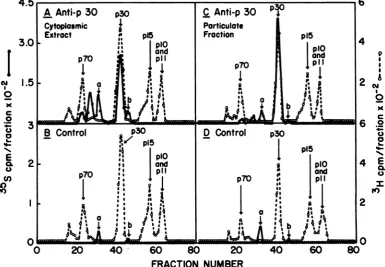
SDS-PAGE of intracellular p30 immune precipitates from long-term labeled cells. SDS-PAGE of immune precipitates from the CE andPFoflong-termlabeledcellsroutinely
yielded alabeled polypeptide that comigrated
with FeLVp30(Fig. 4AandC). Inaddition,two verysmallpeaks (a andb)areconsistentlyseen inbothexperimental andcontrol (Fig. 4Band D) profiles. Two polypeptides that migrate slower than polypeptide a were consistently
seen inp30 immuneprecipitates from the CE.
The nature of these polypeptides isunknown,
buttheymay represent hostpolypeptides
non-3.0
[
.5
[
A
Anti-p
30 p30 CytoplasmicI
Extroct i p15
I. and
p-A
p1Is 4: *.
b
covalently linked to intracellular viral p30. Noncovalent association of host polypeptides with intracellular oncornavirus polypeptides has been reported in Roussarcoma virus trans-formed hamster cells (15).
Immune precipitation and SDS-PAGE of intracellular p30 from pulse-chase-labeled cells. Pulse-chase labeling inconcert with SDS-PAGE of immune precipitates was done to de-termine whether a high-molecular-weight pre-cursor ofp30exists and tomonitor the release of intracellular labeled p30 into extracellular vi-rus. Cytoplasmic extracts andparticulate frac-tions were prepared from pulse-labeled and
pulse-chase-labeled cells followed by immune precipitation withanti-p30. Phenyl methyl sul-fonyl fluoride (Sigma Chemical Co.) was added tothe lysis buffer to prevent proteolytic cleav-ageduring preparation of subcellular fractions. When cells were pulse labeled for 2.5 min, the immune precipitate from the PF (Fig. 5A) contained a single polypeptide with a molecular weight of 60,000 (Pp6O), whereas the immune precipitate from the CE (Fig. 6A) contained a
C
Anti-p
30Particulote Froction
p30
I
p70
1
..0
I a
l*,
MOs"
A
pl5
plO
and
I
I
1
1:
4
2
~~~~~MM a
-3
6
2 p30 D
Control
P30B
Control
,
op15
.
p70:: p11 p70 ~~~~~0 and
I 11
p11~~~~~~70I
em0 r
0 20 40 60
I
I
CM
I
x
4-c
0
N.
E
0
to
FRACTION NUMBER
FIG. 4. SDS-PAGEofimmuneprecipitates fromthe CEand the PFof long-term-labeledcells.A CE and PFwereprepared from100 x 106cellslabeledfor3 h with100 pCiof[35S]methionine in50 mlof growth
medium, asdescribed in Materials and Methods. The CE and the PF were each divided into two equal portions (countsperminuteperportion)andincubatedwith either 200plofanti-p30orwith5pgofBSA and 200 of anti-BSA. The immuneprecipitates were collected and coelectrophoresed with 3H-amino acid-labeledFeLVasdescribedin Materials and Methods.(A)CEandanti-p30;(B)PF andanti-p30;(C)CE with
5pgofBSA andanti-BSA;(D)PF with 5pgofBSA andanti-BSA.
C-I
0
x
4-c 0
L..
N%..
E
U) In) I')
J.- VIROL.
I1,
I
20
4060
so
on November 10, 2019 by guest
http://jvi.asm.org/
[image:5.508.73.459.336.603.2]FeLV p30 PRECURSORPOLYPEPTIDE 101
20
4C)
6v a aFRACTION NUMBER
bU 0vu
FIG. 5. SDS-PAGEof immune precipitates fromPFsofpulse-chase-labeledcells.Atotalof700 x106cells
werepulselabeled for 2.5 min with1 mCiof[35S]methionineand then divided intosevenaliquots,oneof
whichwaslysedimmediately, whereas sixwerechasedfor periodsof0.5,1, 2, 3, 6,and24h(thecellsin each
chasealiquotwerecounted andadjustedtocontain 100 x100cells).A PFfractionwasprepared fromboth
pulse-labeled and pulse-chase-labeled cells, using lysis buffer containing300pgofphenyl methyl sulfonyl fluorideperml,asdescribed inMaterials and Methods.NP-40-disruptedFeLV(5pg)wasaddedtoeach PF
followed by 500p1ofanti-p30. Immune precipitateswerecollectedandcoelectrophoresedwith 3H-amino acid-labeled FeLVasdescribed in Materials and Methods. Arrows indicate positionsof nonglycosylated3H-amino
acid-labeled FeLVpolypeptides. (A) PF from cells pulse labeled for2.5min; (BtoF) PFs fromcells chasedfor 0.5to6 h.
singlepolypeptidethatcomigratedwith FeLV
p30. Control experiments employingBSA and
anti-BSAyieldedapolypeptideprofile (datanot
shown) identical to that seenwith
long-term-labeled subcellular fractions (Fig. 4B and D).
SDS-PAGE of immuneprecipitates from cells
chased for 0.5 hyielded quite different profiles.
The PFcontainedonlylow levels ofa
polypep-tide thatcomigratedwithFeLVp30 (Fig. 5B),
whereastheCE containeda30,000-dalton
poly-peptideinquantities much greater thanseenat
the end ofthepulse (Fig. 6B).
The PF and CE from cells chased for 1 h
contained immune precipitable p30 (Fig. 5C
and 6C).The lossof labeled p30seenintheCE
duringthe 0.5- to 1-h chase interval could be
accountedforbytheappearanceof labeledp30
present at 1 h in the PF (Fig. 5C) andbythe
labeled p30recoveredasextracellular FeLV at
1 h (Fig. 7).
Immune precipitatesofcellschased for 1, 2,
and 3 hcontainedp30inboththe PF(Fig.5C to
E) and the CE (Fig. 6C to E). The level of
immune precipitable p30 inthe PF decreased
duringthis 2-h chaseperiod, whereas the level
ofp30 in the CE remained relativelyconstant
(several experiments indicateda slight loss of immuneprecipitablep30inthe CE).The level
ofimmune precipitablep30 inthe PF andthe
CE at the 6-h interval (Fig. 5F and 6F) was
relativelyequal andbothwerereducedas
com-pared with the 3-h chase interval. No labeled
I
N C
6
0
E
Co
In
;R'
A 2.5 min D 2hchase
pulse Pp6o p70 p30 p1SplO
a-;"
a1I
Pl
St
!n
I
ndd4-
p70
p30p5
plIO
Krp2
lilT"~~~~~~~i
B Q5h chase E 3 h chase
p70 p30 p15 plO p70 p30 p15plO
o
I
I I
andC Ihchase p30 F 6h chase
p70 p15 plO p70 p30 p15 plO
4p
I°P
IF
1
ando-
A_
VOL. 20, 1976
on November 10, 2019 by guest
http://jvi.asm.org/
[image:6.508.111.401.68.397.2]102 OKASINSKI AND VELICER
A 2.5min pulse D 2h chase
p70 p30 p15 plO p70 p30 p15 plO
4 aond I and
l
I
II
B
C I h chase E 36h chase
p70 p3OpISpI p70 p30 p15plO
4 and ond
CL
0
N
C Ihcoef 6h chase
p70 p30 p15 plO p70 p30 p15plO
1
'If~~an
IaInI
4
plAi
20 40 60 80 20
FRACTION NUMBER
40 60 80
FIG. 6. SDS-PAGE of immune precipitatesfrom CEs ofpulse-chase-labeledcells. CEswereprepared from
thesame700 x106cells labeledasdescribed in the legendtoFig. 5, using lysis buffer containing300 Pgof phenyl methyl sulfonyl fluorideperml,asdescribed in Materialsand Methods.Deoxycholatewasaddedtoa
final concentration of 02%.NP40-disrupted FeLV (5pg)wasaddedtoeach CEfollowed by 500pi of anti-p30.Immune precipitates were collected andcoelectrophoresed with 3H-amino acid-labeledFeLV, as
de-scribed inMaterials and Methods. Arrows indicate positionsof nonglycosylated3H-amino acid-labeled FeLV polypeptides. (A) CE from cells pulse labeled for2.5min; (BtoF)CEsfromcells chasedfor0.5to0.6 h.
p30could be recovered at the 24-h chase time
(data not shown). Deoxycholate was added to
the cytoplasmic extracts (NP-40-soluble
frac-tion)inthisexperiment(Fig. 6)todemonstrate
thatPp6Ois foundonlyinthePFunder
identi-cal detergent conditions. Identical results to
thosepresented in Fig. 6wereobtained in the
absence ofdeoxycholate (datanotshown).
To determine whether labeled extracellular
FeLV p30 was contaminating the subcellular
fractions, a mixing experiment was done
em-ploying purified labeled FeLV and unlabeled
cells. When 50,000 cpm of purified
[35S]-methionine-labeled FeLV was incubated with
100 x 106 cells prior to fractionation, no 35S
label could be recovered in the subcellular
frac-tions (data not shown). The absence of
[35S]methionine-labeled intracellularp30inthe
subcellar fractions after a 24-h chase also
ar-gued against extracellular contaminationof the
CEand PF. The influence of labeledp30
associ-ated withnewlyassembled FeLVintheprocess
ofbuddingfrom the surfaceof these cells could
notbe determined.
Analysis of intracellular andextracellular
p30 levelsduring pulse-chase labelingof cells.
The levels of intracellular andextracellularp30
weremonitored duringa0.5- to 24-h chase
pe-riod aftera2.5-minpulse(Fig. 7)tofollow the
incorporationof intracellularp30into
extracel-lular FeLV. Extracellular p30 levelswere
de-termined by collecting FeLV from the chase
media in the previousexperiment (Fig. 5 and
6). Unlabeled carriervirus (100 ug)wasadded
toeach chaseportion (0.5,1, 2, 3, 6, and 24h),
and the viruswaspurifiedandelectrophoresed
in the presence of SDS. The amount of
[35S]-methionine-labeled p30 was determined from
J. VIROL.
on November 10, 2019 by guest
http://jvi.asm.org/
[image:7.508.96.404.70.394.2]FeLV p30 PRECURSOR POLYPEPTIDE 103
E
C)
0
c0 to
-5
0
2 4
[image:8.508.55.245.53.196.2]HOURS FIG. 7. Analysis of intracellular and p30 levels duringa0.5-to24-hchase 2.5-min pulse. The levels ofp30areexi
percentageof total intracellularorextri
Totalintracellular p30 is the level of both the CE and PF of cellschased for mined from Fig. 5 and 6). Totalextrac
the entireamountofvirion-associated leased duringa 0.5- to24-h chase afi
pulse (determined from SDS-PAGE beledFeLV released duringthisexper
bols: 0,percentageof totallabeledimi
table intracellularp30foundinbothti CE;0,percentageoftotal labeledextrac
p30.
the resultingelectropherograms (
gramsnotshown). The 24-h chase
vided the total extracellular FeLl whereasallremainingvalueswere
as apercentageofthetotalextrac
p30 (Fig. 7). All values for extrace
were corrected for virus released
first 0.5h ofeach chase period by
theamountoflabeledp30appearin
the 0.5-h time point. This analysi
examined theappearanceoflabele
lar FeLVp30, using the 0.5-h cha starting point and the 24-h chase total.
Intracellularp30levels during th chase period were obtained froi
shown inFig. 5B to F and 6B to
chasetimeprovided the total (1009
larlevel ofp30 inthis analysis. Th
minute comigrating with viral p3
theCEandPFwereusedtodeterm of intracellular p30 at each chas levelof p30ateach chase time isre
thepercentageof totalintracellull An analysis of the data present indicated thatat atime (approxin
when 50% of the total extracellul
appeared,approximately50%of th
cellular p30was nolonger detectab
suggested that the intracellularp34
these experiments was indeed a precursor of o / extracellular FeLV.
o.I Tryptic peptide analysis. High-pressure,
cation-exchange chromatography of tryptic
peptides was employed to determine whether
labeledpeptidesof FeLV p30 were also found in Pp60. 3H-amino acid-labeled Pp6O was used for thisanalysis to insure labeling of all peptides. The tryptic peptide map (Fig. 8) contained 25 3H-labeled peptides present in Pp60, whereas 6
224
3H-labeledp30
contained15peptides.
Of the15peptidespresentin3H-labeled p30, 13 are also extracellular present in
Pp60.
These chromatograms of la-periodaftera beledtryptic
peptides
indicated
thatp30
is pressed as the found within thePp6O
molecule.azcellularp30. DSUSO
p30found in DISCUSSION
r0.5 h (deter- Evidence from tryptic peptide analysis and
ellular
p30
Is pulse-chase labeling demonstratesthat Pp60 is FeLVp3O
re- a rapidly cleaved precursor ofFeLVp30.
Antera 2.5-mmn examination ofintracellular and extracellular
iment)
Sym-
p30 levels during pulse-chase labelingexperi-mune
precipi- ments suggests that newly synthesized p30 iswePFandthe subsequentlydistributed intoanNP-40-soluble cellularFeLV and -insoluble form and indicates that most of
the intracellularp30isassembled into extracel-lular virus.
Results of SDS-PAGE of immune precipitates
electrophero- from FeLV-infected cells demonstrated the !portionpro- presenceofintracellular p30 in both an NP-40-V p30 value, soluble (CE)and -insoluble (PF) form (Fig. 4).
represented Solubilization of p30 from the PFbytheuseof
ellularFeLV 0.2%deoxycholatesuggestsamembrane
associ-allularFeLV ation;however, furtherexperimentationwillbe I during the requiredtoconfirm this point. Asimilar distri-subtracting bution of intracellular oncornavirus proteins Lg in FeLV at between amembrane fraction anda
cytoplas-is, therefore, mic extracthas been reportedfor murine
sar-d extracellu- coma-leukemia virus-infected rat cells (29).
Lsetime asa Pp60appearstobelimitedtothe PFandisonly
time as the observable upon double-detergent treatment (0.5% NP-40 and 0.2% deoxycholate). This
in-ie0.5- to24-h ferred membrane associationof an
oncornavi-m the data rusprecursorpolypeptidehas beenobserved by
F. The 0.5-h other workers. AMV-infected primary chick
fi-9o)
intracellu- broblasts synthesize a 76,000-dalton precursorle countsper polypeptide, whose cleavage in vitro can be
30 from both inhibited by membrane-dissociating agents
mine
the level (34). Van Zaane etal. (31) have alsodescribede time. The two membrane-associated precursor polypep-,presented as tidesinJLS-V9cells infected with RLV.
ir
p30. The results of pulse-chase labeling experi-ted in Fig. 7 ments (Fig. 5 and 6) indicate that Pp60 is rap-nately2.0h) idly cleaved to form a large pool of NP-40-solu-lar viral p30 blep30 (CE), which subsequently becomes dis-etotalintra- tributed between the CEand thePF.The pres-)le. Thedata ence ofPp60 in the PF andp30inthe CE at the 0obtainedin end ofa 2.5-minpulse could also suggest that%of Total Intracellulor p30
Remaining---VOL. 20, 1976
on November 10, 2019 by guest
http://jvi.asm.org/
104 OKASINSKI AND VELICER
c~'lV~
VVVXI
L J L4
E viralp30
to
'Lli~~~~~~~'
2
0 P
2
5
ItiJ5
In'0
20 40 60 80 100 120 140 160 180
[image:9.508.67.461.60.359.2]FRACTION NUMBER
FIG. 8. Tryptic peptide analysis ofPp60and FeLVp30 eluted from SDS-polyacrylamide gels. Labeled Pp6Owasimmunoprecipitatedfromthe PF of 500 x 106 cells pulselabeled for 2.5minwith 500 XACiof 3H-labeled amino acid mixture. The immune precipitate was electrophoresed in parallel with 3H-amino
acid-labeled FeLV,asdescribedinMaterials and Methods. The labeled polypeptides were elutedfromthe gelsand
trypticpeptideswereprepared as described in Materials and Methods. The recovery for the entire procedure was 70 to 80%.Variouspeptide peaksareidentifiedby pH ofelutiondeterminedfromreading pH values with aPHM 26 expanded-scalepH meter(Radiometer, Copenhagen,Denmark). O, Elution pH values ofp30 trypticpeptides absentinPp6O.
p30 issynthesizedbothaspartofalarge
precur-sorandas amaturevirionpolypeptide.
Prelim-inary pulse-chase labeling experiments
em-ploying a general protease inhibitor (manu-scriptinpreparation)suggestthat inhibition of
Pp60 cleavage isassociated witha decrease of
labeledimmuneprecipitable p30attheendofa 2.5-minpulse, which wouldargue against syn-thesisofp30as a mature virionpolypeptide.
Therelativelyrapid loss of intracellular p30
from the PFduring the 1- to 3-hchase period,
combined with aslow loss ofp30from the CE during this interval, suggeststhat
extracellu-larFeLVp30may arise from an
NP-40-insolu-ble form of intracellularp30. The data (Fig. 5
and 6), however, donotruleoutthepossibility
that NP40-soluble p30 is directly assembled
intoextracellular FeLV. Thewell-documented
cell surface assembly of the oncornaviruses
seemstofavoramembraneassociationof viral
proteinsduringassembly and could be takenas
supportive ofour interpretation of these re-sults.
The existence of two intracellular pools of
p30,differinginsolubilityinNP-40and
appar-entlyinthekinetics ofincorporationinto
extra-cellular virus, raises several possibilities. For
example,theappearanceofaninitiallarge pool oflabeled p30 in the CE after pulse labeling
(Fig. 6) maysuggest furtherposttranslational
processingofintracellular p30 undetectablein
theseexperiments. The slow release ofp30from the CE into extracellular FeLV may suggest some fimctional role forp30 within these cells or mayreflect host regulation ofintracellular p30levels.
The analysisofintracellular and extracellu-larp30levelspresentedinFig. 7indicates that
most ofthe immune precipitable p30
synthe-sized andprocessed duringa2.5-minpulseand
30-min chase is subsequently assembled into
extracellularvirus. The30-minchasetimewas J. VIROL.
on November 10, 2019 by guest
http://jvi.asm.org/
FeLV p30 PRECURSOR POLYPEPTIDE 105
chosen asthe starting point for this analysis becauseitprovided thehighestlevel of labeled
intracellular p30 among the times examined. Anearlier starting time was notpossibledue to the simultaneouscleavage of Pp6O andthe ap-pearanceofp30.Approximately5%of the total
extracellularviralp30 is releasedduringa 30-min chase of pulse-labeled cells (data not
shown),whichindicatesthat theinitial levelof intracellularp30is atleast 5%higherthanwas
determinedinthisanalysis.
Trypticpeptide analysisofPp6Oandp30 dem-onstratesthatPp6Ocontainsp30(Fig. 8).Using a similar experimental approach,
AMV-in-fected cells have been shown to contain a
76,000-daltonprecursorpolypeptide(10,33, 34).
Precursorpolypeptideshave also beenreported inRLV-infected cellsbytwodifferentgroups of
workers (23, 31). One group (23) originally
re-ported the existence of 140,000-, 65,000-, and
50,000-daltonprecursorsofRLVp30inJLS-V16
cells. More recently the same group detected
the existence of anapproximately 200,000-, as
well as80,000-and65,000-, daltonprecursorof RLVp30inthe samecellsystem,usinga differ-ent SDS-PAGE system and the analysis ofa
limited number ofmethionine-labeled
tryptic
peptides (1). A second group, using JLS-V9
cells, couldonly detect 72,000- and
65,000-dal-ton precursors of RLV p30. Although a final
judgmentmust awaittrypticpeptide
analysis
of RLV precursorsidentifiedby bothgroups, pref-erably with larger numbers ofpeptides
than canbe labeled with methionine aspointed
outby Arcementetal. (1),their resultsmayreflect host cell influenceonprecursorprocessing.
Re-cently, Oskarsson et al. (26) have suggested
that a 60,000-dalton polypeptide at the FeLV
pseudotype
ofMaloney sarcoma virus may be anuncleaved precursor ofMaloneysarcoma vi-rus FeLV p30. Although the evidence from avian, murine, andfelineoncornavirusis con-sistent in demonstrating precursor polypep-tides within infected cells, the processing of these precursors ranges from the very rapidrate reported here to anaberrantcleavage
re-sultingintheincorporation oflargeamountsof a possible uncleavedprecursor into assembled
virions (26).Thesedifferencesinprocessing in-dicate that it may be essential to investigate notonly both avian andmammalian
oncornavi-rusprecursor polypeptides but also the effects of varioushostcells upon precursor processing. IfoncornavirusmRNA is equivalent to the 3 x 10⁶-dalton viral genome subunits (12, 16, 31) andtranslated from asingle initiation site,one would expect a precursor polypeptide with a molecular weight of approximately 300,000.
The failure to detect such a giant precursor
polypeptidein our experiments may be dueto several factors: (i) the p30 antigenic determi-nantof suchalarge polypeptide may be inac-cessibletoantibody;(ii) Pp6O may be acleavage productofanascentpolypeptide; (iii)
antibody
prepared against p30 purified by gel filtration in guanidine hydrochloride may not contain
antibody binding sites to all native p30
anti-genic determinants, thus lowering the effi-ciencyofimmuneprecipitation; (iv)the
hypoth-esized 300,000-dalton precursor may notexist.
ACKNOWLEDGMENTS
We thank Alice Swanson and Catherine Sekerke for
technical assistanceandDorisMunro fortyping.
Thisresearch was supportedby Public Health Service grantCA-12101from theNational Cancer Institute, grant
DRG-1230 from the Damon Runyon Memorial Fund for
Cancer Research, Inc., and a grant from the Elsa U. Pardee
Foundation.L. V. isarecipientofPublicHealth Service ResearchCareerDevelopment Award CA-70808 fromthe NationalCancer Institute.
LIMRATURE CITED
1. Arcement, L. J., W. L. Karshin, R. B. Naso, G.
Janjoom, and R. B. Arlinghaus. 1976.Biosynthesis
of Rauscher leukemia viralproteins: presence ofp30
and envelope p15 sequences in precursor polypep-tides. Virology 69:763-774.
2. Bader, J. P., and T. L. Steck. 1969. Analysis of the
ribonucleicacid of murineleukemiavirus. J. Virol. 4:454-459.
3. Baltimore, D. 1969. Thereplicationof picornaviruses, p. 101-176. In H. B. Levy (ed.), Thebiochemistryof viruses.Marcel Dekker Inc., NewYork.
4. Baltimore, D. 1971. Expression ofanimal virus ge-nomes.Bacteriol.Rev.36:235-241.
5. Bolognesi,D. P., G.Huper, R. W.Green,andT.Graf. 1974.Biochemicalproperties ofoncornavirus polypep-tides.Biochim. Biophys. Acta355:220-235. 6. Both, G. W., S.Lavi,and A. J. Shatkin. 1975.Synthesis
of allthegeneproductsofthereovirus genome in vivo and invitro.Cell 4:173-180.
7. Brian, D. A., A. R.Thomason,F.M.Rottman, and L. F.Velicer.1975.Propertiesoffelineleukemiavirus. III. Analysis of the RNA. J. Virol. 16:535-545. 8. Davies,J. W., and P. Kaesberg. 1974.Translation of
virus mRNA: protein synthesis directedby several virusRNAsinacell-freeextract from wheat germ. J. Gen.Virol.25:11-20.
9. Duesberg, P. H.,and P. K. Vogt. 1973. RNA species
obtained from clonallines ofaviansarcomaandfrom avianleukosisvirus. Virology54:207-219.
10. Eisenman,R., V. M. Vogt, and H.Diggelmann.1975.
Synthesis ofavian RNAtumor virus structural pro-teins. Cold Spring Harbor Symp. Quant. Biol. 39:1067-1075.
11. Fairbanks,G., T. L. Steck, and D. F. H. Wallach. 1971.
Electrophoreticanalysis of themajorpolypeptides of the human erythrocyte membrane. Biochemistry
10:2606-2617.
12. Fan, H., and D. Baltimore. 1973. RNAmetabolism of murine leukemia virus: detection of virus-specific RNA sequences in infected anduninfected cells and
identification ofvirus-specific messenger RNA. J. Mol. Biol. 80-.93-117.
13. Fleissner, E. 1971. Chromatographic separation and VOL. 20, 1976
on November 10, 2019 by guest
http://jvi.asm.org/
106 OKASINSKI AND VELICER
antigenic analysis of proteins of theoncornaviruses.
I. Avianleukemia-sarcomaviruses. J. Virol. 8:778-785.
14. Fleissner, E., H. Ikeda, J. S. Tang, E. S. Votetta, E.
Tress, W. Hardy,Jr., E. Stockert,E. A. Boyse,T. Pincus,and P. O'Donnell. 1975. Characterization of murineleukemia virus-specificproteins.Cold Spring Harbor Symp. Quant. Biol. 39:1057-1066.
15. Fleissner, E., and E. Tress. 1973. Chromatographicand electrophoretic analysisofviralproteins from ham-sterand chicken cellstransformed byRous sarcoma virus. J. Virol. 11:250-262.
16. Gielkens, A. L. J., M. H. L. Salden,andH.
Bloemen-dal.1974.Virus-specificmessenger RNA on free and
membrane-bound polyribosomesfrom cells infected withRauscherleukemiavirus. Proc.Natl.Acad.Sci. U.S.A. 71:1093-1097.
17. Graves, D. C., and L. F.Velicer. 1974. Properties of
feline leukemiavirus. I.Chromatographicseparation
andanalysisofthepolypeptides.J.Virol.14:349-365. 18. Green, R. W., D.P.Bolognesi,W.Schifer,L.Pister, G. Hunsmann, and F. de Noronha. 1973.
Polypep-tidesofmammalian oncornaviruses. I.Isolationand serological analysisofpolypeptidesfrom murine and
feline C-typeviruses.Virology 56:565-579. 19. Hirs, C. H.W. 1967. Performicacid oxidation. Methods
Enzymol. 11:197-199.
20. Ihle, J. N., K. L. Lee, and F. T.Kenney. 1974. Fraction-ationof 34Sribonucleicacid subunitsfrom oncorna-vcruses onpolyuridylate-sepharose columns.J. Biol.
Chem. 249:38-42.
21. Jacobson, M.F.,J.Asso, andD.Baltimore.1970.
Fur-therevidenceonthe formation ofpoliovirusproteins.
J.Mol. Biol. 49:657-669.
22. Kingsbury, D. W. 1973.Cell-free translation of para-myxovirus messengerRNA.J.Virol.12:1020-1027. 23. Naso, R. B., L.J. Arcement, and R. B.Arlinghaus.
1975. BiosynthesisofRauscher leukemiaviral pro-teins.Cell 4:31-36.
24.Naso,R.B.,L.J.Arcement,T.G.Wood,T. E.
Saun-ders, andR.13.Arlinghaus.1975.Thecell-free trans-lation ofRauscher leukemiavirus RNA into high molecular weight polypeptides. Biochim. Biophys. Acta383:195-206.
25. Nowinski, R.C., E. Fleissner, N. H. Sarkar, and T.
Aoki. 1972. Chromatographic separation and anti-genticanalysisofproteinsof theoncornaviruses.II.
Mammalian leukemia-sarcoma viruses. J. Virol. 9:359-366.
26. Oskarsson, M. K., W. G. Robey, C.L. Harris, P. J. Fischinger, D. K. Haapala, and G. F. Vande Woude. 1975. A p60 polypeptide in the feline leukemia virus pseudotype of Moloney sarcoma virus with murine leukemia virus p30 antigenic determinants. Proc. Natl. Acad. Sci. U.S.A.72:2380-2384.
27. Phillips, L. A., J. J. Park, and V. W. Hollis, Jr. 1974.
Polyriboadenylatesequences at the3'-terminiof ribo-nucleic acid obtained from mammalian leukemia and sarcoma viruses. Proc. Natl. Acad. Sci. U.S.A. 71:43664370.
28. Schroeder, W. A. 1967. Separation of peptides by chro-matography on columns of Dowex 50 with volatile developers. Methods Enzymol. 11:351-361.
29. Shanmugam, G.,NG. Vecchio, D. Attardi, and M.
Green.1972.Immunological studieson viral polypep-tide synthesis incellsreplicating murine
sarcoma-leukemiavirus. J. Virol. 10:447-455.
30. Siegert, W., R. N.H. Konings, H. Bauer, and P. H.
Hofschneider. 1972.Translationnofavian myeloblas-tosis virusRNA in acell-free lysate of Escherichia coli. Proc.Natl. Acad. Sci. U.S.A. 69:888-891. 31. Van Zaane, D., A. L. J. Gielkens, M. J. A.
Dekker-Michielsen, and H. P. J. Bloemers. 1975. Virus-spe-cific precursor polypeptides in cells infdcted with
Rauscher leukemiavirus.Virology 67:544-552. 32. Vecchio, G., N. Tsuchida, G. Shanmugam, and M.
Green. 1973. Virus-specific messenger RNA and nas-centpolypeptidesinpolyribosomesof cells replicating murinesarcoma-leukemia viruses. Proc. Natl. Acad.
Sci.U.S.A. 70:2064-2068.
33. Bogt, V., andR.Eisenman. 1973. Identification of a
large polypeptide precursor ofnavian oncornavirus proteins. Proc.Natl. Acad. Sci. U.S.A. 70:1734-1738. 34. Vogt, V., R. Eisenman, and H.Diggelmann.1975. Gen-erationofavianmyeloblastosisvirusstructural pro-teinsby proteolytic cleavageof aprecursor
polypep-tide.J. Mol.Biol.96:471-493.
35. Von DerHelm, K., andP. H.Duesberg.1975.
Transla-tionofRous sarcoma virus RNA in a cell-free system from Ascites Krebs IIcells. Proc. Natl. Acad. Sci.
U.S.A. 72:614-618.
36. Weiss, S. R., and M. A. Bratt. 1974. Polyadenylate
sequences onNewcastlediseasevirusmRNA
synthe-sizedinvivoand in vitro. J.Virol. 13:1220-1230.
J. VIROL.
on November 10, 2019 by guest
http://jvi.asm.org/
![FIG.1.preparedfr-ompendedFeLValsdium.ofincubatedelectrophoresed,thawedwithwas [3S]methionine SDS-PAGE of immune precipitated p30 NP-40-disrupted FeLV](https://thumb-us.123doks.com/thumbv2/123dok_us/1553303.107891/3.508.276.464.146.547/preparedfr-ompendedfelvalsdium-ofincubatedelectrophoresed-thawedwithwas-methionine-immune-precipitated-disrupted.webp)