City, University of London Institutional Repository
Citation
:
Fahad, L. G. and Rajarajan, M. (2015). Integration of discriminative and
generative models for activity recognition in smart homes. Applied Soft Computing Journal,
37, pp. 992-1001. doi: 10.1016/j.asoc.2015.03.045
This is the accepted version of the paper.
This version of the publication may differ from the final published
version.
Permanent repository link:
http://openaccess.city.ac.uk/13056/
Link to published version
:
http://dx.doi.org/10.1016/j.asoc.2015.03.045
Copyright and reuse:
City Research Online aims to make research
outputs of City, University of London available to a wider audience.
Copyright and Moral Rights remain with the author(s) and/or copyright
holders. URLs from City Research Online may be freely distributed and
linked to.
City Research Online:
http://openaccess.city.ac.uk/
[email protected]
Integration of discriminative and generative models for
activity recognition in smart homes
Labiba Gillani Fahad∗, Muttukrishnan Rajarajan
School of Engineering and Mathematical Sciences, City University London, UK
Abstract
Activity recognition in smart homes enables the remote monitoring of elderly and patients. In healthcare systems, reliability of a recognition model is of high importance. Limited amount of training data and imbalanced number of activity instances result in over-fitting thus making recognition models inconsistent. In this paper, we propose an activity recognition approach that integrates the Distance Minimization (DM) and Probability Estimation (PE) ap-proaches to improve the reliability of recognitions. DM uses distances of instances from the mean representation of each activity class for label assignment. DM is useful in avoiding decision biasing towards the activity class with majority instances; however, DM can result in over-fitting. PE on the other hand has good generalization abilities. PE measures the probability of correct assignments from the obtained distances, while it requires a large amount of data for training. We apply data oversampling to improve the representation of classes with less number of instances. Support Vector Machine (SVM) is applied to combine the outputs of both DM and PE, since SVM performs better with imbalanced data and further improves the generalization ability of the approach. The proposed approach is eval-uated using five publicly available smart home datasets. The results demonstrate better performance of the proposed approach compared to the state-of-the-art activity recognition approaches.
Keywords: Activity recognition, Smart homes, Assisted living, Pervasive healthcare, Distance minimization,
Probability estimation, Support vector machine
1. Introduction
Recognition of activities performed by a smart home resident is a fundamental task in assisted living and requires a high accuracy due to its use in healthcare services, such as remote monitoring of patients and elderly, and to assess their functional abilities [1, 2, 3]. Activity recognition supports independent stay of elderly in their own homes and ensures immediate medical aid as required [4, 5]. Early identification of health deterioration can also be possible through the long term analysis of recognized activities [1, 5]. Smart homes are equipped with sensors to record the events, such as interaction of the resident with objects and the environment. The sequence of events together defines an activity, such as eating, sleeping, meal preparation, or appropriate usage of medicines [4]. Challenges in activity recognition arise due to high intra-class variations, where varying sequences of events lead to the same activity; high inter-subject variations, where same activity is performed differently by different users; and less inter-class variations, where different activities are performed at the same location, such as preparing breakfast, lunch or dinner, [3, 5]. In addition, limited amount of training data, variation in frequency of execution of activities and sensor errors may also affect the performance of recognition approaches.
Activity recognition can be performed either by discriminative approaches, such as K-nearest neighbor (KNN) [6, 7], Artificial Neural Networks (ANN) [8], Support Vector Machine (SVM) [9] Distance Learning (DL) [5] and Conditional Random Fields (CRF) [10]; or generative approaches, such as Naive Bayes (NB) [11], Hidden Markov
∗
Corresponding author:phone:+44 (0) 20 7040 4073
Model (HMM) [3, 10] and Dynamic Bayesian Networks (DBN) [12]. Discriminative approachesmap the feature space to activity labels by learning the data boundaries [13]. Discriminative models are computationally efficient, capture the fine details in the data and remain robust in prediction of class labels. Discriminative approaches have the capability of tuning the parameters for the task at hand, however, these approaches can suffer from over-fitting [14]. On the other hand,generative approachesimprove the generalization ability by modeling the underlying distribution of classes from the obtained feature space. Generative models are flexible, since they learn the structure and the relationship between the classes by exploiting the prior knowledge for the given task such as Markov assumptions, prior distributions and probabilistic reasoning, although the parameters are not optimized. Generative approaches perform well with uncertainty in the data; however, require a large amount of data for reasonable estimations [13, 14]. We provide a hybrid model for activity recognition, which minimizes the limitation of both discriminative and generative approaches.
In this paper, we propose an activity recognition approach for smart homes by integrating Distance Minimization (DM) and Probability Estimation (PE). The approach exploits the capabilities of both discriminative and generative models. We combine a discriminative model, obtained by measuring inter-class feature distances from the mean representations of each class, with a generative model that measures the actual distribution of the obtained distances by curve fitting. In the case of activities with fewer instances, we use an over-sampling technique to improve the data representation of minority classes. Outputs of both models, the obtained distances and their estimated probabilities, are fused using the learning method multi-class SVM (one-versus-one), which is computationally efficient in the case of multiple classes, and a better choice in the case of imbalance number of activity instances [9]. The validation of the proposed approach using five smart home datasets through a comprehensive evaluation metrics demonstrates an improved performance in correct recognition of activities compared to existing approaches.
The rest of the paper is organized as follows: Sec. 2 discusses the related work on activity recognition. In Sec. 3, we discuss the proposed activity recognition approach. The datasets and experimental analysis are presented in Sec. 4. Finally, Sec. 5 draws conclusions.
2. Related work
Data obtained from ambient or environment interactive sensors, such as reed switches, pressure, motion, ana-log and binary sensors, is used for recognition of general activities performed in a smart home, such as preparing meal, eating, sleeping. Activity recognition approaches are generally classified into data driven and knowledge driven approaches. Data driven approaches can be further categorized into discriminative and generative recognition ap-proaches. This paper is mainly focused on data driven apap-proaches.
In generative approaches, NB classifier is used for activity recognition, which assigns the label of activity class with the highest probability corresponding to the sequence of activated sensor values [11]. Hierarchical-HMM (HHMM) is applied for activity recognition, where the number of events corresponding to each activity in the top layer is fixed [15]. HHMM remains more effective than Hidden Semi Markov Model (HSMM) and HMM. An exten-sion to this approach applies HHMM using variable number of events for each activity to represent different levels of complexity (HHMM-VS) [16]. Incorporation of temporal reasoning with HMM can improve the recognition accu-racy [17]. Long range dependencies in sequential algorithms are obtained by pattern mining, which finds the patterns indicating time segments during the execution of an activity. A probabilistic model is learned to represent the distri-bution of pattern matches along sequences in an activity, which is integrated with HSMM for recognition of activities (AR-SPM) [18]. In an unsupervised approach, the discontinuous frequent patterns are extracted and similar patterns are grouped in the clusters, while the boosted HMM is applied to learn from the clusters [3]. An incremental learning approach using DBN is applied to recognize activities by reconfiguring the previously learned models to adapt the variations within the activities [19]. The recognition performance and effectiveness of Dempster Shafer Theory (DST) of evidence and DBN approaches are compared for activity classification [12], where DST is suitable for uncertainty in the data, while DBN performance depends upon the quality and reliability of the input data. The capabilities of both generative (HMM) and discriminative (CRF) models are also evaluated for activity recognition [10].
for classification of activities [21]. The representative patterns of activities can be selected by pattern mining and sequence alignment methods, the patterns are then matched with the observed sequences of events for activity recog-nition [22]. Activity patterns can be identified in each location using frequent item set mining, while density based clustering is applied to form activity clusters [23]. Pattern mining is applied to extract the frequent patterns and Latent Dirichlet Allocation (LDA) is used to cluster the co-occurring sequential patterns, (ADR-SPLDA) [4]. Two variants of LDA obtained by replacing the multinomial distribution, LDAGaussian and LDAPoissonvon-Mises, can be used for classification of activities [24]. In a clustering based classification approach, homogeneous activities are grouped into clusters, while learning is applied within each cluster independently to learn the fine-grained differences between the activities [7]. Information gain is used to select feature subsets, while data balancing is applied to improve the representation of minority classes and Evidence-theoretic K-Nearest Neighbor (ET-KNN) is used for recognition of activities [25]. The comparison of five learning classifiers is performed under different challenges in [26], where SVM demonstrates to be the most robust classifier in activity recognition. Activity recognition can also be improved by separating activities from anomalies, where Support Vectors Data Descriptors (a variant of SVM) has been used for the classification of normal and anomalous behavior patterns of the elderly [27]. In an activity recognition approach with self-verification of assignments (ARSH-SV), correct/incorrect assignments are learned for label assignment us-ing SVM, while the confidence of assigned label is estimated by measurus-ing the distribution of underlyus-ing data through sub-clustering within each activity class [5]. In an online activity recognition approach, evolving neuro-fuzzy classi-fiers have been used to reflect the changes in the execution of activities [28]. Activity recognition can also be used for the behavior analysis of the smart home resident. HMM is applied to identify the repetitive patterns for behavior modeling, while atypical trends in the behavior are recognized through deviations in the distribution of events in the activities [29]. In [8], Probabilistic Neural Network (PNN) is applied to recognize the activities, while clustering based on the frequency of executed activities per day is used to monitor the daily routine of a smart home occupant and to identify the anomalies. A behavior modeling approach is developed by using Recurrent Neural Network and temporal information of a smart home occupant [1]. In an activity recognition approach to identify changes in behav-ior, different machine learning and statistical methods have been used to identify anomalies in different contexts and the outputs of all models are combined using a fuzzy rule based model to get the final decision [30].
Knowledge driven, evidence based and other hybrid approaches have also been applied for recognition of activi-ties. In a knowledge driven approach, ontological modeling and semantic reasoning are applied for classification of activities [2]. A hybrid approach combines the ontological and temporal knowledge representation for activity model-ing [31]. Partially observable Markov decision process models are built usmodel-ing the user interaction information within the context for activity recognition [32]. Temporal reasoning can be incorporated in ontology to recognize the daily activities [33]. Clustering can be used to define initial incomplete models through knowledge engineering, which are then used to represent an activity and to aggregate new events, and variations in the activity pattern are learned to get the complete model for activities [34]. Recognition approaches based on belief theory are also applied, such as Ev-idence Decision Network (EDN) approach [35], where the temporal information of domain knowledge i.e start time and duration of the activity is incorporated in the DST. An extension of this work is discussed in [36], where a data fusion approach based on DST is developed to include the temporal evidence of the occurrence of events. An eviden-tial approach (EFA-AR) exploits the combination rule of DST to support conflict resolution by combining the sensor information with common-sense knowledge [37]. Experience Sampling for activity annotation and weakly supervised learning methods, multi-instance learning and graph structure, are also applied [38]. In multi-instance learning, the activity data is grouped into bags-of-activities and the labels are assigned to bags instead of activity instances, and the goal is to determine the labels of instances belonging to particular activity provided by the bag’s label. In graph structure, the labels are propagated to the unlabeled neighboring activity instances through feature similarity and time proximity [38].
In this work, we combine both discriminative and generative models to minimize their limitations. A learning model is used for the integration, thus reducing the uncertainty in their decisions while improving the recognition performance and the generalization ability.
3. Activity recognition
LetA={Ak}Kk=1be a set ofKactivity classes andIk={Ijk}Jj=1be a set ofJactivity instances ofAkperformed in
Distribution estimation
Data oversampling
Feature extraction Segmented activities
Mean feature extraction
Distance from mean Mean representations
PDFs of distances
Probability estimation
Learning
Label assignment Activity
Features
Learned model Distances
Labels s
s
1 1
1
[image:5.595.135.461.109.322.2]s
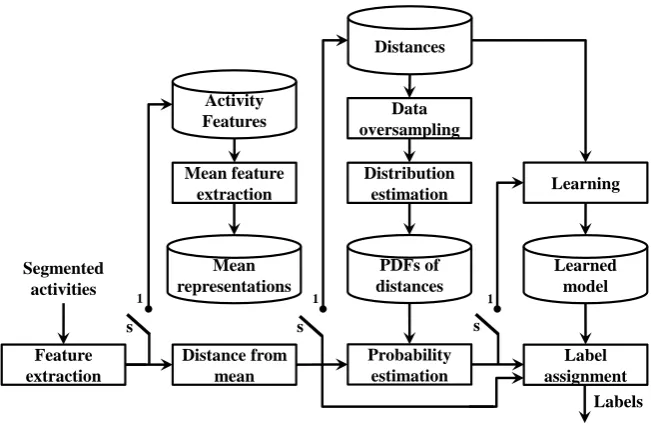
Figure 1: Block diagram of the proposed activity recognition approach. Switchs=1 is training.
instanceIjkis represented by a feature setFjk={fjkr} R
r=1ofRfeatures. Each feature f
r
jkrepresents the number of times
a sensor is activated during an activity. Fig. 1 shows the block diagram of the proposed learning approach to integrate DM and PE for activity recognition. DM, PE and their integration strategy are discussed in the next subsections.
3.1. Distance from means
We obtainKsets of mean feature representationMk={mrk} R
r=1, wherem
r
kis the mean of the same type of features
extracted from all instances{Ijk}Jj=1ofAkgiven as
mrk=1
J
J
X
j=1
frjk. (1)
Each activity classAkis represented by anMk[5]. For each activity instanceIjk, we obtain a distance vectorDjk =
{Dkˆjk}Kˆ
k=1containingKdistances each between its feature setFjkand mean setMkˆ, where ˆk=1. . . K, given as
Dˆkjk=||Fjk−Mkˆ||2. (2)
Label assignment at this stage can be performed using DM as
k∗ = argˆkmin D
ˆ
k
jk, (3)
wherek∗is the index of the activity class whose mean has the minimum distance fromIjk, the label of the selected
class is represented byLk∗. The obtainedMkfromAkhaving fewer number of activity instances may not be a good
representative of that class and results in overfitting of data. Furthermore, the sensor errors, such as missed activations or faulty readings in some activity instances can result in uncertainty in data [2].
For each activity classAk, we obtain aK×Jdistance matrix∆k, where each column of∆kisDjk, while thekth
row represented asχk={Dkjk} J
j=1has the distances ofJinstances ofAkfrom its meanMk. We exploitχkto estimate
the probability of assignment of correct label.
3.2. Probability estimation
We analyze the distances inχk to estimate their distribution. In order to obtain a better data representation in
technique SMOTE [39, 40]. SMOTE generates synthetic examples by adding to the sample under consideration, an obtained difference between the sample and its nearest neighbor. We obtain the setVkcontaining new samplesχˆk
along with the originalχkas
Vk={χk,χˆk}. (4)
The combined setVkis used for the analysis. We normalize the histogram ofVkto obtain its corresponding Probability
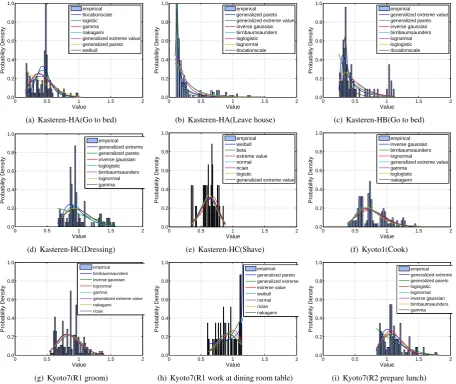
Density Function (PDF) (Fig. 2). The PDF obtained for each class is characterized by curve fitting the existing parametric distribution models [41]. We select the nearest model to the PDF by applying Bayesian Information Criterion [42]. The selected modelTkwith its parameters is stored, which approximates the PDF of distances between
the instances of the same class and its class mean. ForKactivity classes we haveT={Tk}Kk=1models.
We measure the probabilityP(Lkˆ|Dˆkjk) of instanceIjkbelonging toAkˆfor the given distanceDkˆjkand the distribution
modelTˆk(Eq. 2).
P(Lˆk|D
ˆ
k
jk)=G(D
ˆ
k
jk,Tkˆ), (5)
whereG(., .) takes as input the distance Dkˆ
jk and the selected modelTkˆ and returns the probability of the activity
instance belonging to the class Aˆk. Since for each activity instance we have a setDjk containing K distances, we
obtain the setPjk={P
ˆ
k jk}
K
ˆ
k=1containingKprobabilities, where eachP ˆ
k
jkis the probability ofIjkbelonging toAˆk.Djk
andPjkare combined by concatenation as a setΓjkto represent eachIjkas
Γjk={Djk,Pjk}. (6)
Γjkalong with its class labelLkare given as input to the multi-class SVM for learning.
3.3. Activity classification using SVM
We use the learning method SVM for the activity classification. SVM finds the most optimal hyperplane to discriminate the data points of two classes with maximum margin [43, 44].
ConsiderNtraining pairs (Γi,Li), where for simplicity jk=i,Γiis 2Rdimensional feature vector andLiis the class
label. The optimal hyperplane for non-separable patterns is obtained by solving the following optimization problem
ψ(w, ξ)=1 2w
Tw+C N
X
i=1
ξi, (7)
subject to the conditionLi(wTψ(Γi)+bias)≥1−ξi, ξi ≥0, where C is the penalty parameter of error termPNi=1ξi.
It represents the cost of constraint violation of data points on the wrong side of decision boundary, andψ(Γ) is the non-linear mapping. The weight vectorwminimizes the cost function termwTw. The non-linear input data is mapped
to higher dimension through a mapping functionψ(Γ) such thatψ : RN → FM,M >> N. Each point in the new
feature space is defined by a kernel functionK(Γi,Γj)=ψ(Γi).ψ(Γj). The non-linear decision surfaceS can now be
constructed by a new functionf(Γ) as:
f(Γ)=
Ns
X
i=1
αiLiK(Γi,Γ)+bias= Ns
X
i=1
αiLiψ(Γi).ψ(Γ)+bias, (8)
where the coefficientαi>0 is the Lagrange multiplier in an optimization problem. A pattern vectorΓicorresponding
toαi>0 is called a support vector. Nsis the number of support vectors. The f(Γ) is independent of the dimension of
the feature space. In this work, Radial Basis Function and Polynomial kernels are used, receptively, given as:
K(Γi,Γj)=exp(−
Γi−Γj
2
/(2σ)2)
and
K(Γi,Γj)=(ΓTiΓj+1)ρ,
(9)
0 0.5 1 1.5 2 0.0 0.2 0.4 0.6 0.8 1.0 Value Probability Density empirical tlocationscale logistic gamma nakagami
generalized extreme value generalized pareto weibull
(a) Kasteren-HA(Go to bed)
0 0.5 1 1.5 2
0.0 0.2 0.4 0.6 0.8 1.0 Value Probability Density empirical generalized pareto generalized extreme value inverse gaussian birnbaumsaunders loglogistic lognormal tlocationscale
(b) Kasteren-HA(Leave house)
0 0.5 1 1.5 2
0.0 0.2 0.4 0.6 0.8 1.0 Value Probability Density empirical
generalized extreme value generalized pareto inverse gaussian birnbaumsaunders lognormal loglogistic tlocationscale
(c) Kasteren-HB(Go to bed)
0 0.5 1 1.5 2
0.0 0.2 0.4 0.6 0.8 1.0 Value Probability Density empirical
generalized extreme value generalized pareto inverse gaussian loglogistic birnbaumsaunders lognormal gamma (d) Kasteren-HC(Dressing)
0 0.5 1 1.5 2
0.0 0.2 0.4 0.6 0.8 1.0 Value Probability Density empirical weibull beta extreme value normal rician logistic
generalized extreme value
(e) Kasteren-HC(Shave)
0 0.5 1 1.5 2
0.0 0.2 0.4 0.6 0.8 1.0 Value Probability Density empirical inverse gaussian birnbaumsaunders lognormal
generalized extreme value gamma
loglogistic nakagami
(f) Kyoto1(Cook)
0 0.5 1 1.5 2
0.0 0.2 0.4 0.6 0.8 1.0 Value Probability Density empirical birnbaumsaunders inverse gaussian lognormal gamma
generalized extreme value nakagami rician
(g) Kyoto7(R1 groom)
0 0.5 1 1.5 2
0.0 0.2 0.4 0.6 0.8 1.0 Value Probability Density empirical generalized pareto generalized extreme value extreme value weibull normal rician nakagami
(h) Kyoto7(R1 work at dining room table)
0 0.5 1 1.5 2
0.0 0.2 0.4 0.6 0.8 1.0 Value Probability Density empirical
generalized extreme value generalized pareto loglogistic lognormal inverse gaussian birnbaumsaunders gamma
[image:7.595.72.529.111.495.2](i) Kyoto7(R2 prepare lunch)
Figure 2: Examples of distributions of obtained distances of instances from the mean of their activity class. Legends are stored in the order of the nearest distribution to the data obtained using curve fitting. Curve fitting on distributions are generated using matlab library at link: http://uk.mathworks.com/matlabcentral/fileexchange/34943-fit-all-valid-parametric-probability-distributions-to-data (last accessed Feb. 2015).
In case of imbalanced dataset, multi-class SVM (one-versus-one) is a preferable choice, as fewer classifiers would be distorted. In addition, constructing the set of classifiers would be easy and less time-consuming [9].
Letφ be a newly detected activity instance. We extract the normalized feature setF(φ). FromF(φ), we obtain
the distance vectorD(φ) using Eq.2 and the probability vectorP(φ) using Eq.5. The two vectors are concatenated and
given as input to the obtained learned SVM model for label assignment. Using the distance and probability vectors, we generate an activity pattern with highest probability and minimum distance to be classified. The model returns the labelLk∗of the newly detected activity instance.
4. Evaluation and Discussion
Next, we compare the results with existing state-of-the-art recognition approaches ADR-SPLDA [4], AR-SPM [18], HHMM-VS [16], EFA-AR, Murphy rule and Dempster-Shafer rule [37], Temporal EDN, No time EDN [35, 47], CL-AR and J48-DT [48]. Furthermore, we present the activity level performance analysis though F1-scores and confusion matrices. Leave one day out cross validation is applied for the evaluation, where a single day data is used for testing and the remaining for training, and the process is repeated for all days.
4.1. Evaluation measures
Four measures for the evaluation using true positives (TP), false positives (FP) and false negatives (FN) are given as:
Precision= T P
T P+FP×100, (10)
Recall= T P
T P+FN ×100, (11)
F1score=2×Precision×Recall
Precision+Recall , (12)
Accuracy= T P
N , (13)
whereNis the total number of instances. F1score and accuracy return values between [0,1], where a value near to 1 shows the best performance, and near to 0 indicates the worst performance.
4.2. Datasets
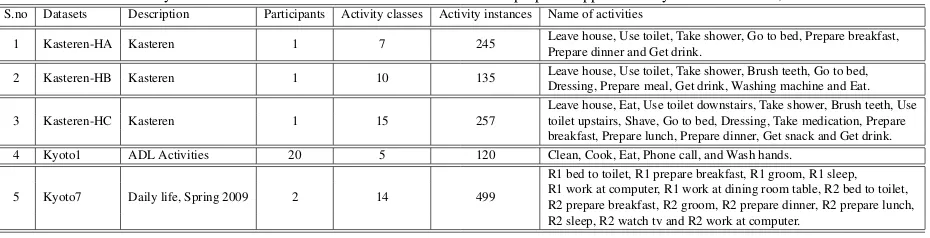
Table 1 shows the summary of five publicly available smart homes datasets, from Kasteren [49, 50] and CASAS [51] smart home projects, used in the evaluation. The selected datasets includes the challenges of overlapping of fea-tures among activity instances of different classes, availability of fewer instances for learning, number of participants in each home, and variations in the performance of the same activity by different users.
Kasteren smart home project includes three smart homes datasets; namely,Kasteren-HA,Kasteren-HBand Kasteren-HC. In each smart home, activities are performed by a single resident, where 7, 10 and 15 types of different activities are respectively, performed in three houses. Total number of activity instances are 245, 135 and 257, respectively. The information regarding three different houses is collected through several wireless sensor networks equipped with var-ious binary sensors; for example, reed switches, pressure mats, mercury contacts and passive infrared. The annotation of the activities is achieved by using either handwritten dairy or bluetooth handset.
We select two smart home datasets from CASAS project: Kyoto1andKyoto7. In comparison to Kasteren, the selected CASAS datasets comprise of multiple residents, which result in high inter-subject variations. Sensor network comprises of motion and other utility sensors, such as absent/present status of item and door open/close status of cabinet sensors. Moreover, analog sensors are used to measure the temperature and water usage. The annotation is achieved by using 3D visualization tool and residents diaries. InKyoto1dataset, 5 types of activities are performed by 20 participants. Each activity is performed once by each participant one after the other. The number of activity instances are 120. Kyoto7 contains activity instances performed by two residents living together and performing activities independently without cooperation.Kyoto7comprises of 14 types of activities with 499 instances.
4.3. Comparison with existing approaches
Table 2 shows the performance of proposed approach compared with DM, PE, ET-KNN and PNN, using defined performance evaluation metrics applied on the results obtained from five datasets.
In Kasteren datasets, some of the activities, such asPrepare breakfast,Prepare dinner,Get snackandGet drink,
orBrush teethandTake showerare performed in the same location and therefore share same sensors, which result in
Table 1: The summary of five smart home datasets used in the evaluation of proposed approach. Key: R1 - Resident 1, R2 - Resident 2.
S.no Datasets Description Participants Activity classes Activity instances Name of activities
1 Kasteren-HA Kasteren 1 7 245 Leave house, Use toilet, Take shower, Go to bed, Prepare breakfast,
Prepare dinner and Get drink.
2 Kasteren-HB Kasteren 1 10 135 Leave house, Use toilet, Take shower, Brush teeth, Go to bed,
Dressing, Prepare meal, Get drink, Washing machine and Eat.
3 Kasteren-HC Kasteren 1 15 257
Leave house, Eat, Use toilet downstairs, Take shower, Brush teeth, Use toilet upstairs, Shave, Go to bed, Dressing, Take medication, Prepare breakfast, Prepare lunch, Prepare dinner, Get snack and Get drink.
4 Kyoto1 ADL Activities 20 5 120 Clean, Cook, Eat, Phone call, and Wash hands.
5 Kyoto7 Daily life, Spring 2009 2 14 499
R1 bed to toilet, R1 prepare breakfast, R1 groom, R1 sleep, R1 work at computer, R1 work at dining room table, R2 bed to toilet, R2 prepare breakfast, R2 groom, R2 prepare dinner, R2 prepare lunch, R2 sleep, R2 watch tv and R2 work at computer.
and accuracy of proposed approach are 77.96%, 79.05% and 78.56%, respectively. Higher values of precision, recall and accuracy shows the effectiveness of proposed approach in correct assignment of activity instances to the target class in the case of less inter-class variations and limited number of instances, i.e, only 135, for ten activity class. Similarly, F1score (0.73) of proposed approach remains higher than that of DM (0.58), PE (0.50), ET-KNN (0.67) and PNN (0.67) classification approaches. InKasteren-HC, proposed approach obtains the highest accuracy of 64.93%. Precision and recall of proposed approach are 60.17% and 60.92%, respectively, which are 6.36% and 4.61% higher than DM, 9.78% and 11.22% higher than PE, 2.24%, 2.59% higher than ET-KNN, and 6.16% and 3.19% higher than PNN. The F1score also remains higher in comparison to other approaches.
In CASAS datasets, bothKyoto1andKyoto7datasets have high intra-class and inter-subject variations, however,
inKyoto1, each activity class is discriminative enough and well separated. InKyoto1, proposed approach shows better
performance with the F1score of 0.98 and accuracy of 98.21%. The performance of ET-KNN and PNN remains comparable to each other with an F1score of 0.93. InKyoto7, precision, recall and accuracy of proposed approach are 77.33%, 80.43% and 81.03%, respectively, and remain higher than other approaches. The F1score of proposed approach (0.78) also remains better than DM (0.73), PE (0.53), ET-KNN (0.68) and PNN (0.67). In both Kasteren and CASAS datasets, PE shows less performance due to less number of activity instances available for training.
Table 3 shows performance comparison of the proposed approach with existing activity recognition approaches: ADR-SPLDA [4], AR-SPM [18], HHMM-VS [16], EFA-AR, Murphy rule and Dempster-Shafer rule [37], Temporal EDN and No time EDN [35, 47] and CL-AR and J48-DT [48]. We measure accuracy and F1score, while applying the cross validations same as mentioned in the compared approaches. Proposed approach shows a better accuracy than ADR-SPLDA [4] in the two datasets. InKasteren-HA, it shows an improvement of 13% with an accuracy of 95.19%, while inKyoto1, it achieves an accuracy of 98.21% in comparison to 81.78% of ADR-SPLDA. In the case of imbal-anced class data, where some activities are executed more frequently than others, a high accuracy may represent the assignment of correct labels to the class with the majority of instances. However, F1score solves this limitation by in-corporating both precision and recall and thus is more reliable. The Kasteren-HA, Kasteren-HB and Kasteren-HC are imbalanced datasets including overlapping activities with less number of activity instances, particularly Kasteren-HB comprises of ten activities with 135 activity instances. The proposed approach has the highest F1score in, Kasteren-HA (0.93), Kasteren-HB(0.73), andKasteren-HC (0.59), compared to existing approaches. Similarly in Kyoto7, F1score of proposed approach is higher (0.78) than AR-SPM (0.73), which demonstrates that the approach remains least affected in the case of high intra-class and inter-subject variations, and less inter-class variations.
4.4. Activity level performance analysis
Fig. 3 presents the activity level performance comparison using F1score. Fig. 3(a) shows the comparison of proposed approach with AR-SPM [18], Temporal EDN, No time EDN, NB and J48-DT [47] onKasteren-HAdataset. The proposed approach attains high F1score in all seven activities compared to EDN, no time EDN, NB and J48-DT. In comparison with AR-SPM [18], for five activities F1score remain higher, while remain comparable the two activities,
Go to bedandLeave house. The proposed approach is further compared with AR-SPM in other three datasets. In
Kasteren-HB dataset [Fig. 3(b)], proposed approach obtains better F1score than AR-SPM in eight activities, and
Table 2: Performance evaluation metrics on five smart home datasets for proposed approach and the existing approaches: DM, PE, ET-KNN [7, 45] and PNN [8, 46] using leave one day out cross validation. Feature sets comprising of obtained distances and their estimated probabilities are given as input to the learning classifiers. Precision, Recall and Accuracy are in percentages (%), The range of F1score is between [0,1]. The highest values in the performance evaluation metrics are highlighted in bold.
S.no Datasets Classifiers Precision(%) Recall(%) F1score Accuracy(%)
1 Kasteren-HA
Proposed approach 93.94 94.23 0.93 95.19
DM 88.62 89.41 0.88 91.70
PE 66.37 66.40 0.64 69.66
ET-KNN 92.97 91.30 0.91 93.55
PNN 92.88 91.30 0.91 93.50
2 Kasteren-HB
Proposed approach 77.96 79.05 0.73 78.56
DM 63.17 60.19 0.58 58.92
PE 51.91 52.97 0.50 52.65
ET-KNN 67.37 70.07 0.67 69.89
PNN 67.94 70.88 0.67 69.42
3 Kasteren-HC
Proposed approach 60.17 60.92 0.59 64.93
DM 53.81 56.31 0.52 58.04
PE 50.39 49.70 0.48 52.33
ET-KNN 57.93 58.33 0.56 60.33
PNN 54.01 57.73 0.54 59.59
4 Kyoto1
Proposed approach 98.75 98.21 0.98 98.21
DM 96.06 96.15 0.95 96.15
PE 87.14 87.18 0.85 87.18
ET-KNN 93.21 94.62 0.93 94.62
PNN 92.64 93.85 0.93 93.85
5 Kyoto7
Proposed approach 77.33 80.43 0.78 81.03
DM 72.85 78.37 0.73 78.01
PE 52.08 57.06 0.53 57.36
ET-KNN 67.18 72.36 0.68 73.51
PNN 66.01 70.86 0.67 71.90
comparatively lesser in four activities ofLeave house,Go to bed,Take medicationandGet snack. InKyoto7[Fig. 3(d)], proposed approach achieves better F1score in eleven activities and comparable in two activities ofR2 prepare
breakfastandR2 groom, while show relatively less performance inR1 prepare breakfastthan AR-SPM.
Table 4(a) presents the confusion matrix of activities inKasteren-HAdataset. The proposed approach correctly recognizes most of the activity classes with an overall accuracy of more than 95%. ThePrepare breakfastandPrepare
dinneractivities share 10% of their instances among each other due to being performed at the same location. Table
4(b) shows the confusion matrix of activities inKasteren-HBdataset. The proposed approach has high recognition performance for activities other than kitchen activitiesGet drink,Wash dishesandEat. The reason for less recognition accuracy in kitchen activities is the usage of similar features and same location as well as less amount of activity instances. 28% ofGet drinkactivity instances are correctly recognized, while 57% goes intoEatand 14% are confused
withPrepare mealactivities. Similarly,Wash dishestransfers 33% of errors toBrush teethand 16% toEatactivities.
InEatactivity, only 12% of instances are accurately identified due to the least number of instances (8) are available for training. Table 4(c) shows the confusion matrix of activities inKasteren-HC dataset. The activities with few number of instances do not perform well, such as shave and Get snack each comprises of 7 instances, whilePrepare
lunchandPrepare dinnercontains 8 and 11 activity instances, respectively. Take medicationactivity could not be
recognized due to least number of activity instances i.e, only 3. Some of the activities transfer their errors to the other similar activities, such asShaveactivity, 28% of instances are identified correctly, while 57% and 14% instances are confused withBrush teethandTake showeractivities, respectively. Similarly, another example of overlapping activities isPrepare dinner, where 45% activity instances are accurately assigned labels, while its 36% instances are erroneously recognized asPrepare lunchand it transfer its 9% errors to both each of thePrepare breakfastandEat
activities. The other similar classes such asget drink,Eat,Prepare lunchandGet snackshows similar trend of sharing errors among each other.
Table 3: Comparison of existing approaches with proposed approach. Accuracy is in percentage(%) and the range of F1score is between [0,1]. The highest values are highlighted in bold.
Evaluation measure Cross validation Dataset Approach
Accuracy 1 day out
Kyoto1
Proposed approach 98.21
ADR-SPLDA(SPL=2) [4] 92.49 ADR-SPLDA(SPL=3) [4] 79.44 Kasteren-HA
Proposed approach 95.19
ADR-SPLDA(SPL=2) [4] 80.67 ADR-SPLDA(SPL=3) [4] 81.78
F1score
1 day out
Kyoto7 Proposed approach 0.78 AR-SPM(C+CP) [18] 0.73
Kasteren-HA
Proposed approach 0.93
AR-SPM(C+LP) [18] 0.81 HHMM-VS(AIC) [16] 0.70 EFA-AR [37] 0.77 Murphy rule [37] 0.68 Dempster-Shafer rule [37] 0.54 Temporal EDN [47] 0.70 No time EDN [47] 0.45 Kasteren-HB Proposed approach 0.73 AR-SPM(C+LP) [18] 0.52 HHMM-VS(AIC) [16] 0.55 Kasteren-HC Proposed approach 0.59 AR-SPM(C+LP) [18] 0.51 HHMM-VS(Intuitive) [18] 0.50 Ten-fold Kasteren-HA
Proposed approach 0.90
CL-AR [48] 0.87 J48-DT [48] 0.79
next in sequence toEat. Overall, the proposed approach achieves an accuracy of 95% or above in the recognition of all activities. Table 5(b) shows the confusion matrix of activities inKyoto7dataset. The meal preparation activities are sharing their errors among each other. An example of this isR1 prepare breakfast activity with 41% instances correctly identified, while 14% are incorrectly recognized as bothR2 prepare breakfastandR2 prepare dinner and 26% instances are erroneously identified as R2 prepare lunch activity. InR2 prepare breakfast activity, 55% of instances are correctly recognized, while it sends its 20% errors toR2 prepare dinnerand 13% errors toR2 prepare
lunchactivity class. For the remaining, the proposed approach recognized the activities with high accuracy.
From the detailed analysis of the results of proposed approach in comparison with existing methods, it can be concluded that proposed approach proves to be more effective and reliable in correct classification of activities in case of limited amount of training data, variations in the activity patterns and in the frequency of execution of activities, compared to other approaches. The PM approach shows the least results in all the datasets, since in order to obtain the actual distribution, a large amount of data is required. However, most of the activities in Kasteren and CASAS datasets have fewer instances, while increasing the instances of minority classes through oversampling does not always capture all the intra-class variations leading to a decreasing performance trend.
5. Conclusions
Lh Tlt Shwr Gbed Pbf Pdnr Gdrk 0
0.1 0.2 0.3 0.4 0.5 0.6 0.7 0.8 0.9 1
Activities
F1score
Proposed approach AR−SPM Temporal EDN No time EDN Naive Bayes J48 Decision Tree
(a) Kasteren-HA dataset
Lh Tlt Shwr Bt Gbed Drss Pml Gdrk Wd Eat 0
0.1 0.2 0.3 0.4 0.5 0.6 0.7 0.8 0.9 1
Activities
F1score
Proposed approach AR−SPM
(b) Kasteren-HB dataset
Lh Eat Tltdns Shwr Bt Tltups Shv Gbed Drss Med Pbf Plch Pdnr Gsnk Gdrk 0
0.1 0.2 0.3 0.4 0.5 0.6 0.7 0.8 0.9 1
Activities
F1score
Proposed approach AR−SPM
(c) Kasteren-HC dataset
R1btlt R1pbf R1grm R1slp R1wcmR1wdrt R2btlt R2pbf R2grmR2pdnrR2plch R2slp R2wtvR2wcm 0
0.1 0.2 0.3 0.4 0.5 0.6 0.7 0.8 0.9 1
Activities
F1score
Proposed approach AR−SPM
[image:12.595.72.528.103.483.2](d) Kyoto7 dataset
Figure 3: Activity level performance comparison of proposed approach with existing methods through F1score using ’leave one day’ out cross validation: (a) AR-SPM (C+LP) [18] Temporal EDN, No time EDN, NB and J48-DT [47] on Kasteren-HA (b) AR-SPM (C+LP) [18] on Kasteren-HB (c) AR-SPM (C+LP) [18] on Kasteren-HC (d) AR-SPM (C+CP) [18] on Kyoto7 datasets. Key (Kasteren): Lh - Leave House, Tlt - Use toilet, Shwr Take Shower, Gbed Go to bed, Pbf Prepare breakfast, Pdnr Prepare dinner, Gdrk Get drink, Bt Brush teeth, Drss Dressing, Pml -Prepare Meal, Eat - Eat, Wd - Wash dishes, Tltdns - Use toilet downstairs, Tltups - Use toilet upstairs, Shv - Shave, Med Take medication. Key (Kyoto7): R1btlt - R1 bed to toilet, R1pbf - R1 prepare breakfast, R1grm - R1 groom, R1slp - R1 sleep, R1wcmp - R1 work at computer, R1wdrt R1 work at dining room table, R2btlt R2 bed to toilet, R2pbf R2 prepare breakfast, R2grm R2 groom, R2pdnr R2 prepare dinner, R2plch -R2 prepare lunch, -R2slp - -R2 sleep, -R2wtv - -R2 watch tv, -R2wcmp - -R2 work at computer.
References
[1] S. Mahmoud, A. Lotfi, C. Langensiepen, Behavioural pattern identification and prediction in intelligent environments, Applied Soft Comput-ing 13 (4) (2013) 1813–1822.
[2] L. Chen, C. Nugent, H. Wang, A knowledge-driven approach to activity recognition in smart homes, IEEE Trans. on Knowledge and Data Engineering 24 (6) (2012) 961–974.
[3] P. Rashidi, D. J. Cook, L. B. Holder, M. Schmitter-Edgecombe, Discovering activities to recognize and track in a smart environment, IEEE Trans. on Knowledge and Data Engineering 23 (4) (2011) 527–539.
[4] B. Chikhaoui, S. Wang, H. Pigot, Activity discovery and recognition by combining sequential patterns and latent dirichlet allocation, Pervasive and Mobile Computing 8 (6) (2012) 845–862.
[5] L. G. Fahad, A. Khan, M. Rajarajan, Activity recognition in smart homes with self verification of assignments, Neurocomputing 149 (0) (2015) 1286–1298.
Table 4: Confusion matrices of activities in Kasteren datasets using leave one day out cross validation, (a) Kasteren-HA (b) Kasteren-HB (c) Kasteren-HC. Rows represent the actual and columns represent the predicted activities. Key: Lh - Leave House, Tlt - Use toilet, Shwr - Take Shower, Gbed - Go to bed, Pbf - Prepare breakfast, Pdnr - Prepare dinner, Gdrk - Get drink, Bt - Brush teeth, Drss - Dressing, Pml - Prepare Meal, Eat - Eat, Wd - Wash dishes, Tltdns - Use toilet downstairs, Tltups - Use toilet upstairs, Shv - Shave, Med - Take medication.
(a) Kasteren-HA
Activities Lh Tlt Shwr Gbed Pbf Pdnr Gdrk Lh 97.10 0 0 2.90 0 0 0 Tlt 0 97.30 1.80 0.90 0 0 0
Shwr 0 0 100 0 0 0 0
Gbed 0 4.30 0 95.70 0 0 0 Pbf 0 0 0 0 90.00 10.00 0 Pdnr 0 0 0 0 10.00 90.00 0 Gdrk 5.30 0 0 0 0 0 94.70
(b) Kasteren-HB
Activities Lh Tlt Shwr Bt Gbed Drss Pml Gdrk Wd Eat
Lh 95.70 0 0 4.30 0 0 0 0 0 0
Tlt 0 81.00 3.80 3.80 0 3.80 3.80 0 3.80 0
Shwr 0 0 100.00 0 0 0 0 0 0 0
Bt 7.70 0 0 69.20 0 0 0 0 15.40 7.70 Gbed 0 0 0 0 84.60 7.70 0 0 7.70 0 Drss 7.70 7.70 0 15.40 0 69.20 0 0 0 0 Pml 0 6.70 0 0 0 0 53.30 26.70 0 13.30 Gdrk 0 0 0 0 0 0 14.30 28.60 0 57.10 Wd 0 0 0 33.30 0 0 0 0 50.00 16.70 Eat 0 0 0 12.50 0 25 12.50 25.00 12.50 12.50
(c) Kasteren-HC
Activities Lh Eat Tltdns Shwr Bt Tltups Shv Gbed Drss Med Pbf Plch Pdnr Gsnk Gdrk Lh 84.80 6.50 6.50 0 0 0 0 0 2.20 0 0 0 0 0 0 Eat 7.70 57.70 3.90 0 0 0 0 0 0 0 7.70 0 11.50 11.50 0 Tltdns 8.00 4.00 76.00 0 0 0 0 4.00 0 0 4.00 0 0 0 4.00 Shwr 0 0 0 78.60 7.10 14.30 0 0 0 0 0 0 0 0 0 Bt 0 8.00 0 8.00 40.00 12.00 12.00 8.00 0 0 0 4.00 4.00 0 4.00 TltUps 0 11.10 0 3.70 3.70 66.70 3.70 0 3.70 3.70 3.70 0 0 0 0 Shv 0 0 0 14.30 57.10 0 28.60 0 0 0 0 0 0 0 0
Gbed 0 0 0 0 0 0 0 94.70 0 0 0 0 5.30 0 0
Drss 0 4.80 4.80 0 4.80 9.40 0 0 71.40 0 4.80 0 0 0 0
Med 0 0 0 0 66.70 33.30 0 0 0 0 0 0 0 0 0
Pbf 0 30.00 0 0 0 10.00 0 0 10.00 0 20.00 10.00 20.00 0 0 Plch 0 0 0 0 12.50 0 0 0 0 0 25.00 25.00 12.50 12.50 12.50 Pdnr 0 9.00 0 0 0 0 0 0 0 0 9.10 36.40 45.50 0 0 Gsnk 0 28.50 0 0 0 0 0 0 0 0 0 14.30 14.30 14.30 28.60
Gdrk 0 0 12.50 0 12.50 0 0 0 0 0 0 0 0 0 75.00
[7] L. G. Fahad, S. F. Tahir, M. Rajarajan, Activity recognition in smart homes using clustering based classification, in: Proc. of IEEE Int. Conf. on Pattern Recognition, Stockholm, Sweden, 2014, pp. 1348–1353.
[8] L. G. Fahad, A. Ali, M. Rajarajan, Long term analysis of daily activities in smart home, in: Proc. of the European Symp. on Artificial Neural Networks, Computational Intelligence and Machine Learning, Bruges, Belgium, 2013, pp. 419–424.
[9] A. Fleury, M. Vacher, N. Noury, Svm-based multimodal classification of activities of daily living in health smart homes: sensors, algorithms, and first experimental results, IEEE Trans. on Information Technology in Biomedicine 14 (2) (2010) 274–283.
[10] T. V. Kasteren, A. Noulas, G. Englebienne, B. Krose, Accurate activity recognition in a home setting, in: Proc. of Int. conf. on Ubiquitous computing, Seoul, Korea, 2008, pp. 1–9.
[11] E. M. Tapia, S. S. Intille, K. Larson, Activity recognition in the home using simple and ubiquitous sensors, Pervasive Computing 3001 (2004) 158–175.
[12] A. Tolstikov, X. Hong, J. Biswas, C. Nugent, L. Chen, G. Parente, Comparison of fusion methods based on dst and dbn in human activity recognition, Journal of Control Theory and Applications 9 (1) (2011) 18–27.
[13] L. Chen, J. Hoey, C. Nugent, D. Cook, Z. Yu, Sensor-based activity recognition, IEEE Trans. on Systems, Man, and Cybernetics, Part C: Applications and Reviews 42 (6) (2012) 790–808.
[14] T. Jebara, Discriminative, generative and imitative learning, Ph.D. thesis (2002).
Table 5: Confusion matrices of activities in CASAS datasets using leave one day out cross validation, (a) Kyoto1 (b) Kyoto7. Rows represent the actual and columns represent the predicted activities. Key: R1btlt - R1 bed to toilet, R1pbf - R1 prepare breakfast, R1grm - R1 groom, R1slp - R1 sleep, R1wcmp R1 work at computer, R1wdrt R1 work at dining room table, R2btlt R2 bed to toilet, R2pbf R2 prepare breakfast, R2grm -R2 groom, -R2pdnr - -R2 prepare dinner, -R2plch - -R2 prepare lunch, -R2slp - -R2 sleep, -R2wtv - -R2 watch tv, -R2wcmp - -R2 work at computer.
(a) kyoto1
Activities Clean Cook Eat Phone Call Wash Hands
Clean 95.80 0 4.20 0 0
Cook 0 100 0 0 0
Eat 0 0 95.80 0 4.20
Phone Call 0 0 0 100 0
Wash Hands 0 4.20 0 0 95.80
(b) Kyoto7
Activities R1btlt R1pbf R1grm R1slp R1wcmp R1wdrt R2btlt R2pbf R2grm R2pdnr R2plch R2slp R2wtv R2wcmp
R1btlt 82.40 2.90 11.80 0 0 0 2.90 0 0 0 0 0 0 0
R1pbf 0 41.20 0 0 0 0 2.90 14.70 0 14.70 26.50 0 0 0
R1grm 11.10 0 84.50 0 0 0 2.20 0 2.20 0 0 0 0 0
R1slp 0 0 0 100.00 0 0 0 0 0 0 0 0 0 0
R1wcmp 0 1.70 0 0 98.30 0 0 0 0 0 0 0 0 0
R1wdrt 0 0 0 0 0 77.80 0 0 0 0 0 0 11.1 11.1
R2btlt 2.60 0 0 0 0 0 87.20 0 7.70 0 0 0 0 2.50
R2pbf 0 10.30 0 0 0 0 0 55.20 0 20.70 13.80 0 0 0
R2grm 2.50 0 2.50 0 0 0 7.50 2.50 82.50 0 2.50 0 0 0
R2pdnr 0 16.70 0 0 0 0 0 13.90 0 58.30 11.10 0 0 0
R2plch 0 27.60 0 0 0 0 0 6.90 0 17.20 48.30 0 0 0
R2slp 0 0 0 2.90 0 0 0 0 0 0 0 97.10 0 0
R2wtv 0 0 0 0 0 6.50 0 0 0 0 0 0 93.50 0
R2wcmp 0 0 0 0 2.20 0 2.20 0 0 0 0 0 0 95.60
[16] H. Alemdar, T. V. Kasteren, M. Niessen, A. Merentitis, C. Ersoy, A unified model for human behavior modeling using a hierarchy with a variable number of states, in: Proc. of IEEE Int. Conf. on Pattern Recognition, Stockholm, Sweden, 2014, pp. 3804–3809.
[17] G. Singla, D. J. Cook, M. Schmitter-edgecombe, Incorporating temporal reasoning into activity recognition for smart home residents, in: Proc. of the AAAI Workshop on Spatial and Temporal Reasoning, Chicago, USA, 2008, pp. 53–61.
[18] U. Avci, A. Passerini, Improving activity recognitionby segmental pattern mining, IEEE Trans. on Knowledge and Data Engineering 26 (4) (2014) 889–902.
[19] C.-H. Lu, Y.-C. Ho, Y.-H. Chen, L.-C. Fu, Hybrid user-assisted incremental model adaptation for activity recognition in a dynamic smart-home environment, IEEE Trans. on Human-Machine Systems 43 (5) (2013) 421–436.
[20] H. Fang, L. He, H. Si, P. Liu, X. Xie, Human activity recognition based on feature selection in smart home using back-propagation algorithm, ISA Transactions 53 (5) (2014) 1629–1638.
[21] E. Nazerfard, B. Das, L. B. Holder, D. J. Cook, Conditional random fields for activity recognition in smart environments, in: Proc. of ACM Int. Health Informatics Symposium, Washington DC, USA, 2010, pp. 282–286.
[22] P.-C. Huang, S.-S. Lee, Y.-H. Kuo, K.-R. Lee, A flexible sequence alignment approach on pattern mining and matching for human activity recognition, Expert Systems with Applications 37 (1) (2010) 298–306.
[23] E. Hoque, J. Stankovic, Aalo: Activity recognition in smart homes using active learning in the presence of overlapped activities, in: Proc. of IEEE Int. Conf. on Pervasive Computing Technologies for Healthcare, San Diego, USA, 2012, pp. 139–146.
[24] K. Rieping, G. Englebienne, B. Krose, Behavior analysis of elderly using topic models, Pervasive and Mobile Computing 15 (0) (2014) 181–199.
[25] L. G. Fahad, S. F. Tahir, M. Rajarajan, Key features identification for activity recognition in smart homes, in: Proc. of IEEE Int. Conf. on Communications, London, United Kingdom, 2015.
[26] L. G. Fahad, A. Ali, M. Rajarajan, Learning models for activity recognition in smart homes, in: Proc. of Int. Conf. Information Science and Applications, Pattaya, Thailand, 2015.
[27] J. H. Shin, B. Lee, K. S. Park, Detection of abnormal living patterns for elderly living alone using support vector data description, IEEE Trans. on Information Technology in Biomedicine 15 (3) (2011) 438–448.
[28] F. J. Ordonez, J. A. Iglesias, P. de Toledo, A. Ledezma, A. Sanchis, Online activity recognition using evolving classifiers, Expert Systems with Applications 40 (4) (2013) 1248–1255.
[29] D. N. Monekosso, P. Remagnino, Behavior analysis for assisted living, IEEE Trans. on Automation Science and Engineering 7 (4) (2010) 879–886.
[30] A. R. M. Forkan, I. Khalil, Z. Tari, S. Foufou, A. Bouras, A context-aware approach for long-term behavioural change detection and abnor-mality prediction in ambient assisted living, Pattern Recognition 48 (3) (2015) 628–641.
[32] J. Hoey, T. Plotz, D. Jackson, A. Monk, C. Pham, P. Olivier, Rapid specification and automated generation of prompting systems to assist people with dementia, Pervasive and Mobile Computing 7 (3) (2011) 299–318.
[33] D. Riboni, L. Pareschi, L. Radaelli, C. Bettini, Is ontology-based activity recognition really effective?, in: IEEE Int. Workshops on Pervasive Computing and Communications, Seattle, USA, 2011, pp. 427–431.
[34] G. Azkune, A. Almeida, D. L. de Ipia, L. Chen, Extending knowledge-driven activity models through data-driven learning techniques, Expert Systems with Applications 42 (6) (2015) 3115–3128.
[35] S. Mckeever, J. Ye, L. Coyle, C. Bleakley, S. Dobson, Activity recognition using temporal evidence theory, Journal of Ambient Intelligence and Smart Environments 2 (3) (2010) 253–269.
[36] A. Kushwah, S. Kumar, R. M. Hegde, Multi-sensor data fusion methods for indoor activity recognition using temporal evidence theory, Pervasive and Mobile Computing accepted (0).
[37] F. Sebbak, A. Chibani, Y. Amirat, A. Mokhtari, F. Benhammadi, An evidential fusion approach for activity recognition in ambient intelligence environments, Robotics and Autonomous Systems 61 (11) (2013) 1235–1245.
[38] M. Stikic, D. Larlus, S. Ebert, B. Schiele, Weakly supervised recognition of daily life activities with wearable sensors, IEEE Trans. on Pattern Analysis and Machine Intelligence 33 (12) (2011) 2521–2537.
[39] N. V. Chawla, K. W. Bowyer, L. O. Hall, W. P. Kegelmeyer, Smote: Synthetic minority over-sampling technique, Journal of Artificial Intelligence Research 16 (1) (2002) 321–357.
[40] K.-J. Wang, B. Makond, K.-H. Chen, K.-M. Wang, A hybrid classifier combining smote with pso to estimate 5-year survivability of breast cancer patients, Applied Soft Computing 20 (0) (2014) 15–24.
[41] J. E. Gentle, Computational Statistics, Springer, 2009.
[42] G. Schwarz, Estimating the dimension of a model, The annals of statistics 6 (2) (1978) 461–464. [43] V. N. Vapnik, Statistical learning theory, John Wiley and Sons, New York, USA, 1998.
[44] M. Matsumoto, J. Hori, Classification of silent speech using support vector machine and relevance vector machine, Applied Soft Computing 20 (0) (2014) 95–102.
[45] T. Denoeux, A k-nearest neighbor classification rule based on dempster-shafer theory., IEEE Trans. on Systems, Man, and Cybernetics 25 (5) (1995) 804–813.
[46] D. F. Specht, Probabilistic neural networks, Neural Networks 3 (1) (1990) 109–118.
[47] S. McKeever, Recognising Situations Using Extended Dempster-Shafer Theory, Ph. D. Thesis, University College Dublin, 2011.
[48] S. D. Juan Ye, Exploring semantics in activity recognition using context lattices, Journal of Ambient Intelligence and Smart Environments 2 (4) (2010) 389–407.
[49] T. V. Kasteren, G. Englebienne, B. J. A. Krose, Activity recognition using semi-markov models on real world smart home datasets, Journal of Ambient Intelligence Smart Environment 2 (3) (2010) 311–325.
[50] T. V. Kasteren, G. Englebienne, B. Krose, Human activity recognition from wireless sensor network data: Benchmark and software, in: Activity Recognition in Pervasive Intelligent Environments, Atlantis Press, 2011, pp. 165–186.
![Table 2: Performance evaluation metrics on five smart home datasets for proposed approach and the existing approaches: DM, PE, ET-KNN [7, 45]and PNN [8, 46] using leave one day out cross validation](https://thumb-us.123doks.com/thumbv2/123dok_us/1476428.100272/10.595.138.461.157.421/performance-evaluation-datasets-proposed-approach-existing-approaches-validation.webp)
![Table 3: Comparison of existing approaches with proposed approach. Accuracy is in percentage(%) and the range of F1score is between [0, 1].The highest values are highlighted in bold.](https://thumb-us.123doks.com/thumbv2/123dok_us/1476428.100272/11.595.158.438.139.372/comparison-existing-approaches-proposed-approach-accuracy-percentage-highlighted.webp)