A. Camara, R. Kaiser, G. Labeyrie∗
SUPA and Department of Physics, University of Strathclyde, Glasgow G4 0NG, Scotland, UK
We present an experimental and theoretical investigation of spontaneous pattern formation in the transverse section of a single retro-reflected laser beam passing through a cloud of cold Rubidium atoms. In contrast to previously investigated systems, the nonlinearity at work here is that of a 2-level atom, which realizes the paradigmatic situation considered in many theoretical studies of optical pattern formation. In particular, we are able to observe the disappearance of the patterns at high intensity due to the intrinsic saturable character of 2-level atomic transitions.
PACS numbers: 05.65.+b, 42.65.Sf, 32.90.+a
Spontaneous pattern formation from a homogeneous state is a widespread phenomenon in nonlinear systems out of equilibrium1,2. Originating from fields such as chemistry3,4 and hydrodynamics1,5,6, the study of pat-tern formation has known a rapid development in optics starting from the 80’s7,8. Paradigmatic examples such as a Kerr medium9,10 or a collection of 2-level atoms at rest11 were considered in early theoretical studies. Var-ious nonlinear systems, either active such as lasers or photorefractive oscillators8,12,13, or passive such as liquid crystals14,15, were used to realize the first experiments. In some range of experimental conditions, these nonlinear materials mimic ideal systems such as the Kerr medium but one usually lacks a complete theoretical description of the light-matter interaction. Hot atomic vapors were also extensively employed to study various optical insta-bilities16–20. There, a theoretical description of the light-atom interaction is available, but the specific experimen-tal conditions (Doppler broadening, hyperfine structure, ballistic or diffusive motion of the atoms) considerably complicate the interpretation. Finally, cold atomic sam-ples started recently to be employed in optical pattern formation21–23.
We have identified in our single feedback mirror exper-iments three distinct mechanisms that lead to the spon-taneous formation of patterns. The first one, the op-tomechanical mechanism, is specific to cold atoms and relies on the spatial bunching of the atoms under the ac-tion of dipole forces. This mechanism is very efficient at ultracold temperature and leads to spectacular self-organization phenomena24. The presence of a Zeeman structure in the atomic ground state (spin degree of free-dom) allows for optical pumping, i.e. a redistribution between populations or creation of coherences between Zeeman substates, in particular within the ground-state. This mechanism is responsible for the polarization insta-bilities studied in hot atomic vapors17,19,20,25,26. Finally, under specific experimental conditions the atoms behave as 2-level systems and the optical nonlinearity is only due to the saturation of the electric dipole transition i.e
pop-∗To whom correspondence should be addressed.
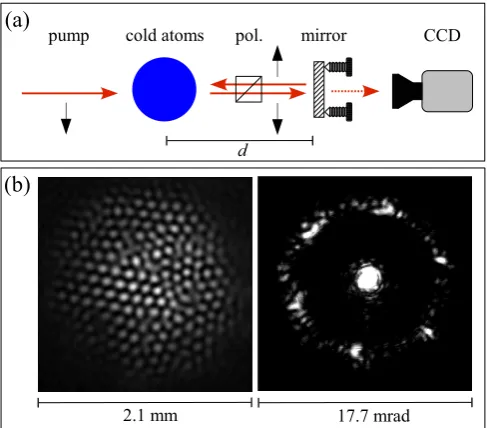
FIG. 1: (Color on line) Observation of patterns. (a) Experi-mental scheme. (b) Typical single-shot light distributions ob-served in the transverse instability regime, in the near (left) and far (right) field. The pump parameters are: I = 0.47 W/cm2 andδ= +6.5 Γ.
ulation transfer between ground and excited states. This is the situation studied in this paper, which realizes the paradigmatic theoretical description of a homogeneously-broadened 2-level atomic transition11. To our knowledge, the only previous experimental investigation of patterns due to a saturable nonlinearity was achieved in a hot sodium vapor16, and did not report the observation of the vanishing of the effect at large saturations. We present in this paper a detailed experimental investigation of this 2-level instability, and obtain a qualitative and quantita-tive agreement with a theoretical model based only on the microscopic description of the atom-light interaction.
[image:1.595.319.563.209.423.2]cloud of Rb87 atoms, released from a large magneto-optical trap (MOT). The cloud has a typical size of 9 mm FWHM along the pump propagation axis and con-tains 1011atoms. The resulting optical density (OD), for a weak beam on resonance with the F = 2 → F′ = 3 transition, is around 210. The linearly-polarized pump beam is retro-reflected by a mirror located at a distance dafter the cloud (the vertical arrows in Fig. 1(a) indicate the polarization of the beams). We use an imaging tele-scope (not represented in Fig. 1(a)) located between the MOT and the mirror to create a “virtual mirror”, which provides an access to negative values ofd27. The overall reflectivity of the feedback system is around 95% (cloud absorption not included).
By selecting a short (duration ≤ 1 µs) pump pulse, we can neglect the optomechanical nonlinearity which requires tens of µs since the atoms have to move over distances of the order of≈100µm23. Other mechanisms, relying on Zeeman internal degrees of freedom, also lead to a transverse instability and are currently under study in our groups. However, in the setup studied in the present paper a polarizer placed inside the feedback loop (Fig. 1(a)) guarantees that the feedback only occurs in the polarization channel parallel to the incident pump po-larization, and prevents the occurrence of a polarization instability linked to Zeeman degrees of freedom. This is confirmed by the fact that almost no light is detected in the polarization channel orthogonal to the pump polar-ization. Throughout this work we are thus left with the simplest, 2-level nonlinearity corresponding to the follow-ing expression for the refractive index of our cloud of cold atoms:
n= 1−3λ 3
4π2
δ/Γ 1 + (2δ/Γ)2
ρ
1 +s (1)
where δ = ωl−ω0 is the detuning between the laser and atomic frequencies, Γ = 2π×6.06 MHz is the natu-ral width andρdenotes the spatial atomic density. The nonlinearity arises from the presence in this expression of the saturation parameter s = I
Isat
1
1+4(δ/Γ)2, where
Isat = 1.67 mW/cm2 is the saturation intensity. For s≪1, the gas exhibits a Kerr-like behaviorn≃n0+n2I, wheren0is the linear refractive index andn2the nonlin-ear one. Importantly, fors≫1 the nonlinearity vanishes and the instability is expected to disappear. In the Kerr regime, the nonlinearity is “self-focusing” (n2 > 0) for δ > 0 and “self-defocusing” for δ <0. Note that Eq. 1 only describes the real part of the complex refractive in-dex, which is responsible for the instability. However, (nonlinear) absorption is also present and included in our theoretical analysis.
[image:2.595.318.562.49.312.2]Fig. 1(b) shows images of the transverse intensity dis-tribution of the transmitted pump beam, in the near field (left) and the far-field (right). We observe for these pa-rameters contrasted patterns with a clear hexagonal sym-metry. However, here the near-field patterns are always divided into several domains with different orientations of the hexagons, and we never observe the long-range
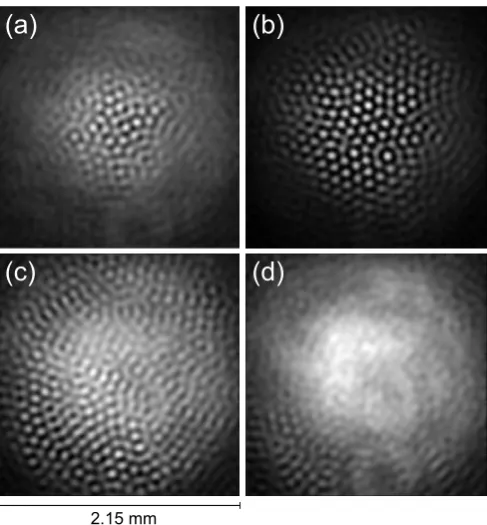
FIG. 2: Saturation of the instability. We show the evolution of the patterns as the pump intensity is increased : a)I= 0.24 W/cm2, (b)I = 0.47 W/cm2, (c) I = 1.41 W/cm2 and (d)
I= 4.24 W/cm2. The detuning isδ= +6.5 Γ.
order typically associated with the optomechanical non-linearity23. Using parameters different from the optimal set increases the number of such domains, rendering the hexagonal symmetry less obvious (see Fig. 2).
0 5 10 15 0.0
0.5 1.0
P
d
0 5 10 15 20
0.92 0.75
0.5 0.3
0.2 0.1
0.06
(c) (b) pum p intensity (W /cm
2
)
pum p intensity (W /cm
2
) 1
0.1 0.1
1
0.035
(a)
FIG. 3: (Color on line) (a) 2-level instability domain (δ >0). We measurePd (see text) as a function ofδandI, and plot the data as isolines. Note the logarithmic horizontal scale. The dots indicate the theoretical threshold for the instability (see text). (b) and (c) show cuts through the 2D chart of (a) as indicated by the dashed lines.
We then select an area around beam center (of diame-terw/2) and perform a 2D numerical Fourier Transform (FT). The FT images are then summed, and we extract from the resulting averaged FT image the power in the pattern mode. This quantity is normalized to the power inside the undiffracted beam (central peak in the FT im-age). We then perform the same operation on images of the pump beam, obtained without atoms. This yields the background power in the pattern mode, due to the resid-ual rugosity in the pump’s intensity profile, which is sub-tracted from the data obtained in the presence of atoms. In addition, in Fig. 3Pd values are scaled such that the maximal value (obtained for δ = 6.5 Γ and I = 0.47 W/cm2) is 1.
On the blue side of the transition, we observe the pat-terns between roughlyδ= 3.5 Γ and 17 Γ (Fig. 3(b)). For smaller values ofδ, the patterns vanish quite abruptly. In this small-δregime, the cloud is optically-thick with two important consequences: first, the strong absorption con-siderably reduces the magnitude of the feedback; second, there is a large amount of scattered light with a quite homogeneous spatial distribution, which is expected to blur the transverse field modulation responsible for the
instability. For large detunings the patterns also disap-pear but much more gradually, because of the decrease ∝1/δ of the refractive index. We observe a well-defined lower-intensity threshold for the instability, around 0.16 W/cm2 for δ= 6.5 Γ (Fig. 3(c)). This threshold is sub-stantially higher than observed for longer pump pulses, where the optomechanical mechanisms sets in23. Also, we found that a minimum OD of around 100 is required to observe the 2-level patterns, while this threshold can be considerably lower for optomechanical patterns23. The saturation of the nonlinearity results in a gradual van-ishing of the instability for large pump intensity (I >2 W/cm2 forδ= 6.5 Γ, which corresponds tos≈7).
We compare in Fig. 3(a) our experimental data with the theoretical instability threshold (dots) as obtained using a 2-level, thin-medium model. This model is based on the approach of29, extended to the case of the feed-back mirror configuration and with the inclusion of ab-sorption. We also included in our model the longitudinal intensity modulation due the interference of the incident and retro-reflected pumps, but without the approxima-tion used in29. As can be seen, the qualitative and quanti-tative agreement is rather satisfactory. We speculate that the discrepancy at small δmay come from the scattered light (not included in the model), as discussed above.
On the red side of the transition (δ < 0), we only observe poorly-contrasted structures without clear sym-metry. The characteristic spatial scale of these structures is roughly twice that on the blue side. Their domain of observation in (δ,I) space approximately mirrors that of the patterns on the blue side. A full theoretical expla-nation for this red-blue asymmetry is still lacking. We believe that its origin lies in nonlinear propagation effects taking place inside the cloud. This may not come as a surprise since such effects have been observed in the past in such large cold atom clouds30. In that work, we in-vestigated the self-trapping of a Gaussian beam of small waist (20µm) forδ >0, which resulted in a roughly con-stant transverse size of the beam as it propagated inside the cloud. It is thus reasonable to speculate that if an ar-ray of bright spots such as seen in the transverse intensity distribution of Fig. 1(b) forms inside the medium, it will be stabilized by self-focusing for δ >0. On the contrary, for δ < 0 self-defocusing will tend to blur these struc-tures. For these effects to play a role, one requires the Rayleigh length corresponding to the transverse size of the bright intensity spots to be smaller than the length of the medium. This condition imposes a size for the spots of a few tens of microns, which is what we typi-cally observe.
[image:3.595.57.300.54.349.2]100 150 200 250 20
40 60 80
-60 -40 -20 0 20 40
100 150 200 250 300 350 400
d
-p
e
r
i
o
d
(
m
m
)
pattern size ( m)
(
m
)
[image:4.595.58.308.55.224.2]feedback distance d (mm)
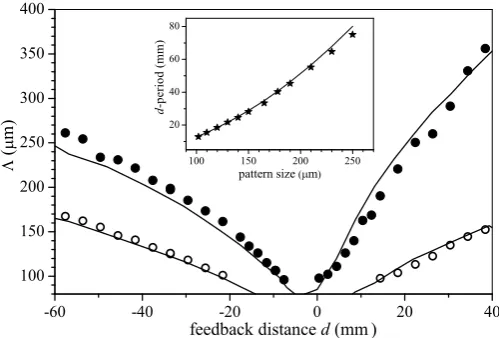
FIG. 4: Talbot effect and pattern size (δ > 0). We mea-sure Λ (see text) as the feedback mirror distanced is varied (dots: lowestq-mode, circles: higherq-mode). The line is the prediction of a thick-medium model. The insert shows the measured d-period as a function of the pattern size (stars), together with the Talbot effect prediction (line).
field, and so on. For a mirror distanced, the transverse pattern wavelength Λ for which this is optimum obeys Λ2=λd/(N+ 1/4) in the case of a thin medium and of a self-focusing nonlinearity10,27. In this expression, N is an integer of same sign as d. Furthermore, the Talbot effect implies that instability thresholds are periodic in mirror distancedwith period Λ2/λ.
This tunability andd-periodicity of the pattern scale, features specific to the single-mirror feedback scheme, are illustrated with Fig. 4 where we plot Λ (measured by far-field imaging of the transmitted pump, see Fig. 1(b)) ver-susd. The dots correspond to the lowest-q mode, where q = 2π/Λ. The circles correspond to the next higher-q mode, which is observed only for large |d|. The bold
lines are predictions of a thick-medium model, similar to that of Fig. 3(a) but including the propagation inside the cloud and neglecting absorption. The Talbot period-icity appears through the fact that the sameq, and hence Λ, is observed for periodically-spaced values ofd, the d-period being Λ2/λ. This is verified in the insert, where the experimentally observedd-period is plotted against Λ (dots) and compared to the expression above (line). The overall agreement between experiment and theory is very satisfactory, for all instability branches, confirming the validity of the Talbot picture in our situation.
We demonstrated in this paper the existence of a pattern-forming optical instability in a cloud of cold atoms, based only on the 2-level electronic nonlinearity. In this paradigmatic situation, we were able to observe the disappearance of the instability at high optical power, due to the saturation of the nonlinearity. This work demonstrates the interest of cold atomic samples for the field of nonlinear optics and pattern formation, motivated by the fact that several nonlinear mechanisms coexist and can be selected and studied independently. Understand-ing and controllUnderstand-ing these various mechanisms constitutes an important step in the future prospect of extending these experiments to degenerate quantum gases, where the simultaneous self-organization of light and matter can lead to a rich class of physical phenomena32.
Acknowledgments
The Strathclyde group is grateful for support by the Leverhulme Trust and EPSRC, the collaboration between the two groups is supported by the Royal Society (Lon-don). The Sophia Antipolis group is supported by CNRS, UNS, and R´egion PACA. We acknowledge fruitful discus-sions with Dan Gauthier. WJF also acknowledges shar-ing of unpublished work by M. Saffman.
[1] M.C. Cross and P.C. Hohenberg, Rev. Mod. Phys. 65, 851 (1993).
[2] M. Meinhardt, Rep. Prog. Phys.55, 797 (1992). [3] A.M. Turing, Philos. Trans. R. Soc. London Ser. B237,
37 (1952).
[4] Q. Ouyang and H.L. Swinney, Nature352, 610 (1991). [5] Lord Rayleigh, Proc. R. Soc. Lond. A93, 148 (1916). [6] H. B´enard, Ann. Chim. Phys.7, 62 (1900).
[7] L.A. Lugiato, M. Brambilla and A. Gatti, Adv. Atom. Mol. Opt. Phys.40, 229 (1999).
[8] F.T. Arecchi, S. Boccaletti and P.L. Ramazza, Phys. Rep. 318, 1 (1999).
[9] A. Yariv and D.M. Pepper, Opt. Lett.1, 16 (1977). [10] W.J. Firth, J. Mod. Opt.37, 151 (1990).
[11] G. Grynberg, Optics Comm.66, 321 (1988).
[12] F.T. Arecchi, G. Giacomelli, P.L. Ramazza and S. Resi-dori, Phys. Rev. Lett.65, 2531 (1990).
[13] Chr. Tamm, Phys. Rev. A38, R5960 (1988).
[14] R. Macdonald and H.J. Eicher, Opt. Commun.89, 289 (1992); M. Tamburrini, M. Bonavita, S. Wabnitz and E. Santamato, Opt. Lett.18, 855 (1993); E. Pampaloni, S. Residori and F.T. Arecchi, Europhys. Lett. 24, 647 (1993).
[15] R. Neubecker, G.-L. Oppo, B. Thuering and T. Tschudi, Phys. Rev. A52,791 (1995).
[16] G. Grynberg, E. Le Bihan, P. Verkerk, P. Simoneau, J.R.R. Leite, D. Bloch, S. Le Boiteux and M. Ducloy, Optics Comm.67, 363 (1988).
[17] G. Grynberg, A. Maˆıtre and A. Petrossian, Phys. Rev. Lett.72, 2379 (1994).
[18] T. Ackemann and W. Lange, Phys. Rev. A50, R4468 (1994).
[20] A.M.C. Dawes, L. Illing, S.M. Clark and D.J. Gauthier, Science308, 672 (2005).
[21] J.A. Greenberg, B.L. Schmittberger and D. Gauthier, Opt. Exp. 19, 22535 (2011).
[22] J.A. Greenberg and D.J. Gauthier, Phys. Rev. A 86, 013823 (2012); J.A. Greenberg and D.J. Gauthier, EPL 98, 24001 (2012).
[23] G. Labeyrie, E. Tesio, P.M. Gomes, G.-L. Oppo, W.J. Firth, G.R.M. Robb, A.S. Arnold, R. Kaiser and T. Ack-emann, Nature Photonics8, 321 (2014).
[24] K. Baumann, C. Guerlin, F. Brennecke and T. Esslinger, Nature464, 1301 2010.
[25] D.J. Gauthier, M.S. Malcuit and R.W. Boyd, Phys. Rev. Lett.61, 1827 (1988).
[26] A. Aumann, E. B¨uthe, Yu.A. Logvin, T. Ackemann and W. Lange, Phys. Rev. A56, R1709 (1997).
[27] E. Ciaramella, M. Tamburrini and E. Santamato, Appl. Phys. Lett.63, 1604 (1993).
[28] W. Lange, A. Aumann, T. Ackemann and E. B¨uthe, Quantum Semiclass. Opt.10, R23 (1998).
[29] G.A. Muradyan, Y. Wang, W. Williams and M. Saffman, Nonlinear Guided Waves topical meeting technical digest, paper ThB29 (2005).
[30] G. Labeyrie and U. Bortolozzo, Opt. Lett. 36, 2158 (2011).
[31] G. d’Alessandro and W.J. Firth, Phys. Rev. Lett. 66, 2597 (1991).