City, University of London Institutional Repository
Citation
:
Fletcher, Stephanie (2013). Exploring the Consequences of Psychological Trauma: The View From The Swamp. (Unpublished Doctoral thesis, City University London)This is the accepted version of the paper.
This version of the publication may differ from the final published
version.
Permanent repository link:
http://openaccess.city.ac.uk/5921/Link to published version
:
Copyright and reuse:
City Research Online aims to make research
outputs of City, University of London available to a wider audience.
Copyright and Moral Rights remain with the author(s) and/or copyright
holders. URLs from City Research Online may be freely distributed and
linked to.
1
Exploring the Consequences of Psychological
Trauma:
The View From The Swamp
Stephanie Fletcher
Portfolio for Professional Doctorate in Counselling
Psychology (DPsych)
City University, London
Department of Psychology
2
Contents
List of figures and tables………...7
Acknowledgements………...8
Declaration of Powers of Discretion ……….…….9
Section A: Preface...………...10
References………..………....14
Section B: Research……….15
Interacting with the Muggles: Experiences of relationships in individuals who define themselves as having Dissociative Identity Disorder. Abstract……….………16
Introduction……….……….……….….17
Dissociation………..………..17
Dissociative Identity Disorder………..………19
A controversial diagnosis……….…………..20
Overview of Literature……….……..24
Studies on professionals beliefs on DID………..24
Linking trauma and DID……….………..26
Neurological considerations………...……….………..27
Links between dissociation, DID and attachment………...28
The experience of DID………..………...34
Linking the perceived experience of DID, early attachment and relationships……….……….……….36
The importance of the present study………..39
Research aims ………..……….…42
Entering into the debate ………..……….………...42
Personal relationship with the research ………....45
Methodology………..….………47
Overview……….…….47
3
Rationale for qualitative perspective………...47
Epistemological framework………49
Interpretative Phenomenological Analysis………..51
Rationale behind choosing IPA…..………..….54
Research plan……….…………..57
Choice of data collection method……….57
Initial interview structure……….59
Pilot studies………..61
Sampling and participants……….……….62
Procedure……….….64
Recruitment and preparation……….64
Pre-interview discussion………..66
The interview schedule………...66
Post-interview debrief……….……….67
Analytic strategy……….……..67
Ethics………..………..……69
Evaluation of research………..……….72
Methodological reflexivity……….….…74
Analysis……..………..………..……….77
Overview of the analysis………77
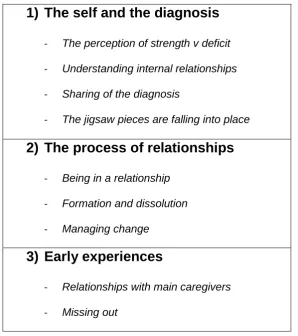
Master theme 1: The self and the diagnosis……….………78
Emergent theme: The perception of strength versus deficit……….79
DID as a strength……….………79
DID as a deficit……….…………82
Feeling lucky……….………83
Emergent theme: Understanding internal relationships………….…84
A balancing act……….……84
Managing alters………...85
Emergent theme: Sharing of the diagnosis……….87
How to explain DID……….……87
Who to share the diagnosis with………..……88
Not being real……..……….………89
Others reactions……….….90
Emergent theme: The jigsaw pieces are falling into place…….…..91
4
Emergent theme: Being in a relationship……….…..93
Being a partner……….……..93
Being a mother………96
Lack of understanding………..97
Meeting people’s needs……….………..…100
Emergent theme: Formation and dissolution……….101
Formation of new relationships…….………..101
Ending of relationships……….104
Emergent theme: Managing change………...109
Master theme 3: Early experiences………..111
Emergent theme: Relationships with main caregivers……….112
Emergent theme: Missing out……….………….115
Summary…..……….……117
Discussion…...……….………119
Discussion of findings……….119
Master theme 1: The self and the diagnosis…………..…………...119
Master theme 2: The process of relationships……….……….126
Master theme 3: Early experiences……….131
Implications for counselling psychology……….….132
Limitations and ideas for future research………...………..134
Conclusions………..……….136
Reflective statement……….…...137
References………..………..……140
Appendices….………..………159
Appendix 1: Interview schedule……….………159
Appendix 2: Example of the interview activity……….…161
Appendix 3: Initial correspondence to First Person Plural………....162
Appendix 4: Confirmation of recruitment through First Person Plural.……163
Appendix 5: Recruitment material……….…………164
Appendix 6: Telephone interview prompts………..……165
Appendix 7: Information sheet…..……….………166
Appendix 8: Consent form……….….168
5
Appendix 10: Sample of transcription identifying initial notation and
emergent themes……….………....170
Appendix 11: Theme list for Lauren….……….………174
Appendix 12: Table illustrating initial clustering of themes from Lauren’s interview………..……….……….178
Appendix 13: Initial clustering between cases……….……..181
Appendix 14: Ethical approval form…….……….………..187
Appendix 15: Presence of themes across participants…………..………..196
Appendix 16: Table demonstrating the breakdown of the emergent themes………...197
Section C: Publishable paper for the Journal of Trauma and
Dissociation………..…...…198
Talking to the Muggles: A Qualitative Investigation into the Concept of Self and the Experience of Relationships in those who Define Themselves as having Dissociative Identity Disorder. Acknowledgements………..………..200
Abstract………..………..201
Literature Review……….………201
DID, early attachment and adult relationships………..203
Method……….………..204
Participants……….……….204
Interview schedule……….……….204
Procedure……….………205
Analytic strategy……….….205
Analysis………..…………206
The perception of strength versus deficit………206
The self as strong and capable………207
6
Discussion……….……….212
Treatment implications……...……….………..216
Limitations……….………217
Future research……….…...218
Conclusions………..……….218
References……….………220
Appendices………225
Appendix 1: Submission instructions for authors to the Journal or Trauma and Dissociation………..……225
Section D: Professional case study………..………230
Using Trauma Focused Cognitive Behavioural Therapy: Working with Ehlers and Clark’s cognitive model of Posttraumatic Stress Disorder Introduction and start of therapy……….231
Introduction and rationale for choosing this case………..231
Summary of theoretical orientation………...231
The context for the work and the initial referral……….…..233
Client’s biographical details………..….233
Convening the first session……….………..234
The presenting problem……….……….234
Initial formulation……….……….235
Current threat………..……….236
Nature of trauma memory and negative appraisals….………….…236
Strategies to manage current threat……….………...236
Negotiating a contract and therapeutic aims……….……..237
Development of therapy………..……….……237
The pattern of therapy……….………237
The therapeutic plan and main techniques used………..………….238
Key content issues…….………..………238
The therapeutic process………..…………241
7
Making use of supervision……….…….242
Changes in the formulation, therapeutic plan and therapeutic process….243 The conclusion of therapy………...244
The therapeutic ending……….………..244
Evaluation of the work……….………244
Personal learning……….……245
References……….………248
Appendices……….………...…250
Appendix 1: Formulation diagram………..………..250
Appendix 2: Negative cognitions………..251
List of Tables and Figures Figure 1: The diagnostic criteria for Dissociative Identity Disorder……….…………20
8
Acknowledgements
This portfolio would not have been possible without the support and encouragement of my friends, family and research supervisor, Dr Jacqui Farrants.
I would like to thank my friends who have encouraged me to continue and push through but also to take breaks and get back to reality.
I thank my family who at times have struggled to understand this strange thing called counselling psychology but have remained positive throughout. These thanks also extend to my pets who have sat beside me, quite literally, throughout this endeavour.
To Jacqui, thank you for responding with such calm and patience to my regular questions and queries and in encouraging me to be critical. You have helped me so much.
To Jamie, thank you for the endless cups of tea, support and words of encouragement. I couldn’t have done it without you.
9
Declaration of powers of discretion
10
11
‘The world breaks everyone and afterwards some are strong at the broken places’ (Fosha, 2002, p. 7)
The preface will explore each component of this Doctoral Portfolio and consider the choices that were involved in selecting and creating each component. In addition it will discuss how the parts of the portfolio are related to each other through the theme of psychological trauma and through my own personal interest in working with clients who have experienced trauma.
The portfolio begins with a piece of original research into the experiences of relationships in those who define themselves as having Dissociative Identity Disorder (DID). This research used semi-structured interviews to gather data that were then analysed using interpretative phenomenological analysis (IPA). The aims of this study were to gain an insight into the subjective experiences of those who define themselves in this way; and to explore their perceptions of the impact of DID on their relationships. Researching the concept of DID has been an experience in itself; on disclosing the subject of my thesis, I have regularly been met with confusion from family and friends, (‘what on earth is DID?’) and pitying smiles from professionals, (‘why study something that doesn’t exist?’). I cannot criticise others for their responses; my own views have evolved significantly through the process of completing this project. Initially ready to campaign for the existence of a misrepresented and misunderstood diagnosis, I now take a step back from judging a concept I can never confirm or disprove. I now focus on the experience that is described by those who define themselves as having DID and consider how this can be understood and supported by professionals.
12
controversy of the diagnosis (Piper & Mersky, 2004) and the possible cause for the development of the diagnosis (Liotti, 2004) there has been little literature published on the subjective experience of those who define themselves as having DID. There seemed a gap in the research and, therefore, this seemed a worthy project to pursue.
The publishable paper, section C of the portfolio, offers a review of the research study discussed above. The paper condenses the study and is written to meet the requirements for publication in the Journal of Trauma and Dissociation. The movement from writing a thesis to achieve an academic award, to writing a paper for publication that could prove valuable to other professionals is significant: it feels as though it signals a point in my training where I begin to move from being a trainee counselling psychologist to a counselling psychologist.
Section D of the portfolio is dedicated to a professional case study, which explores the work between my client, Marie, and myself. Marie attended therapy to address her Posttraumatic Stress Disorder(PTSD) after being violently raped a year previously. My work with Marie was certainly one of the most rewarding pieces of therapeutic work I have completed over the three years of my training. Although successful, the work was challenging for both Marie and myself. I have included this piece as I believe it links to the other work in this portfolio and is another example of when I have been attracted to working with those who were in extreme distress and had experienced trauma.
13
a need to reduce, in others, the feelings of being different and unheard that I have experienced myself.
The journey to becoming a counselling psychologist has been long and challenging. Although I knew that I fitted into the philosophy behind the discipline, I have often wondered which therapeutic approach I best fitted with; am I a CBT therapist or do I prefer psychodynamic interventions? I have wanted to fit somewhere, to know what values drove me and to know how best I worked. However, I never discovered where I fitted and now I have reached a space where I feel comfortable in just being me. Perhaps this change in thinking is also reflective of the process throughout my research. I wanted to fit the concept of DID into a category; I wanted to believe something, to have a position.
Through my reading I discovered the following quote from Schön:
‘A high, hard ground overlooking a swamp. On the high ground, manageable problems lend themselves through the application of research based theory and technique. In the swampy lowland, messy, confusing problems defy technical solution. … [But] … in the swamp lie the problems of great human concern.’ (as cited by Strawbridge & Woolfe, 2010, p. 6)
14
References
Davis, J. D. (2011). Cultural dimensions of intersubjectivity: Negotiating ‘sameness’ and ‘otherness’ in the analytic relationship. Psychoanalytic Psychology, 28,
4, 549-559.
Fosha, D. (2002). Trauma reveals the roots of resilience. Constructivism in the Human Sciences, 6, 1&2, 7-15.
Liotti, G. (2004). Trauma, dissociation, and disorganised attachment: Three strands of a single braid. Psychotherapy: Theory, Research, Practice, Training, 41, 472-786.
Piper, A., & Mersky, H. (2004). The persistence of folly: Critical examination of Dissociative Identity Disorder. Part II. The defence and decline of multiple personality or Dissociative Identity Disorder. Canadian Journal of Psychiatry, 49, 10, 678-683.
Scroppo, J. C., Drob, S. L., Weinberger, J.L., & Eagle, P. (1998). Identifying Dissociative Identity Disorder: A self report and projective study. Journal of Abnormal Psychology, 107, 2, 272-284.
15
Section B: Research
Interacting with the muggles:
16
Abstract
This thesis seeks to explore the experience of relationships in individuals who define themselves as having Dissociative Identity Disorder (DID). The diagnosis of DID has been controversial for many years and the existence of the experience of multiple identities questioned. This study is interested in finding out more about the lived experience of those who define themselves as having DID.
The research takes a contextual constructionist epistemology and seeks to explore experience of relationships. Data were collected from seven women, between 30 and 50 years of age, who defined themselves as having DID. Data were collected using semi-structured interviews and analysed using interpretative phenomenological analysis (IPA).
Three master themes emerged from the data: ‘the self and the diagnosis’; ‘the process of relationships’ and ‘early experiences’. ‘The self and the diagnosis’ describes how the experience of DID appeared to impact on the way individuals perceived themselves and their diagnosis, as DID being a strength or a deficit. Also discussed within this master theme were difficulties in managing internal relationships; sharing the diagnosis with others; and improvement. ‘The process of relationships’ master theme described the experiences of being in different roles; good and bad interactions with others; and managing the beginning and the ending of relationships. The master theme of ‘early experiences’ explored the descriptions of interactions with early caregivers and the impact of these on the perceived development of DID.
17
Introduction
Dissociative Identity Disorder (DID), previously referred to as Multiple Personality Disorder, has been a controversial diagnosis for some time. It became more widely recognised following the publication of Sybil (Schreiber, 1973), a novel following the journey of one woman’s perceived experience and treatment of DID. The idea of experiencing multiple internal identities can appear somewhat surreal and this has led some professionals to suggest that the diagnosis is a socially created phenomenon (Spanos, 1994). However, others fiercely defend the diagnosis, describing it as a creative survival technique developed to cope with severe childhood trauma.
Through writing this thesis, I offer an insight into the subjective experience of individuals who define themselves as having DID and how these individuals make sense of their relationships in relation to their diagnosis. Although each individual’s experience is different, insight can be gained through careful examination of each case and can either build on previous literature, offer suggestions for professionals working with clients who define themselves in this way or lead to further research into Dissociative Disorders.
I begin this thesis with a discussion around the concepts of dissociation and Dissociative Identity Disorder (DID) and continue by considering the controversies behind the diagnosis of DID. I move forward to discuss previous research into the diagnosis of DID, focusing on the link between DID and attachment; and qualitative research exploring the subjective experience of DID. I will finish this chapter by considering the importance of the current thesis, its aims, and my own impact on the design and implementation of the research and how I may have shaped the analysis.
Dissociation
18
described as the experience resulting from alcohol or drug use (Van Den Bosch, Verheul, Langeland & Van Den Brink, 2003).
Although dissociation is the core feature of the Dissociative Disorders it is quite difficult to quantify. Spitzer, Barnow, Freyberger and Grabe (2006) discuss how dissociative experiences fall among the diagnostic criteria for a number of mental health disorders such as Posttraumatic Stress Disorder and Borderline Personality Disorder (APA, 2013) and Holmes et al (2005) acknowledge how the term ‘dissociation’ is open and can encompass a number of definitions. Dissociation can be viewed as a spectrum of experience; Livingston (2009) has suggested that most people have times when they feel disconnected from themselves or their environment, for example, driving a familiar route and arriving at a destination with little memory of the journey. However, others such as Janet (as cited in Spitzer et al, 2006, p. 82-83) suggested that dissociation was a discontinuous phenomenon which was limited to those individuals who were already experiencing mental disorder. Although more recent research has been undertaken on the experience of dissociation, there still seems debate concerning whether it is a dimensional or typological construct.
Evidence for dissociation as a dimensional process comes from studies using questionnaires and rating scales such as the Dissociative Experiences Scale (DES). Putnam (1989) describes the distribution of dissociative experiences recorded by those with no mental health difficulties and an inpatient sample with a variety of difficulties, both groups display a similar pattern of distribution of dissociative experience, suggesting that there may be a continuum from minor to major degrees of dissociative experience.
19
Dell and O’Neil (2009) assert that dissociation becomes pathological and might be labelled as a disorder when there is ‘a partial or complete disruption of the normal integration of a person’s psychological functioning’ (p. xxi). Korzekwa, Dell and Pain (2009) describe this disruption as being experienced in a number of different ways: feeling as if the world around you is unreal (derealisation); feeling detached from your own body (depersonalisation); forgetting personal information or past events which is too extensive to be classed as normal forgetfulness (dissociative amnesia); and finding evidence or receiving information about other alternative identities (identity alterations). The APA (2013) describes five categories of Dissociative Disorder: Dissociative Identity Disorder; dissociative amnesia; depersonalization/derealisation disorder; other specified Dissociative Disorder and unspecified Dissociative Disorder.
Dissociative Identity Disorder
The focus of this thesis is on the experience described as Dissociative Identity Disorder (DID), referred to by Livingston (2009) as the most complex of the Dissociative Disorders. The diagnosis of DID was previously referred to as Multiple Personality Disorder and perhaps the most well documented criterion of this diagnosis is described by the APA (2013) as a:
‘Disruption of identity characterized by two or more distinct personality states, which may be described in some cultures as an experience of possession. The disruption in identity involves marked discontinuity in sense of self and sense of agency, accompanied by related alterations in affect, behavior, consciousness, memory, perception, cognition, and/or sensory-motor functioning’ (p.155).
20
Sar (2011) reports the prevalence of DID at approximately 1% in the general population and Sinason (2011) describes a significant gender bias: women are being diagnosed with DID much more frequently than men. There is no recommendation for medication to treat DID unless there is a dual diagnosis, and then medication will be used to treat the accompanying disorder (Cohen, 2004).
Figure 1: The DSM-5 (APA, 2013, p. 292) Criteria for Dissociative identity Disorder.
A controversial diagnosis.
McIntee (2006) describes how, historically, perceived symptoms of DID were attributed to spirit possession, but more recently two conflicting theories about the development of these symptoms have emerged: the posttraumatic theory of DID and the socio-cognitive theory (Spanos, 1994). Professionals who support the A. Disruption of identity characterized by two or more distinct personality states or
an experience of possession. This involves marked discontinuity in sense of self and sense of agency, accompanied by related alterations in affect, behavior, consciousness, memory, perception, cognition, and/or sensory-motor functioning.
These signs and symptoms may be observed by others or reported by the individual.
B. Recurrent gaps in the recall of everyday events, important personal information, and/or traumatic events that are inconsistent with ordinary forgetting.
C. The symptoms cause clinically significant distress or impairment in social, occupational, or other important areas of functioning.
D. The disturbance is not a normal part of a broadly accepted cultural or religious practice. (Note: In children, the symptoms are not attributable to imaginary
playmates or other fantasy play.)
E. The symptoms are not attributable to the direct physiological effects of a substance (e.g., blackouts or chaotic behavior during alcohol intoxication) or
21
posttraumatic theory describe DID developing as a result of severe childhood trauma; such as abuse (Kluft, 1995; Gleaves, Hernandez & Warner, 1999). Within this mode of thought, DID develops as a survival technique, where a child dissociates to mentally avoid the abuse that they are victim to. Repeated trauma is believed to reinforce this coping strategy until dissociated states become more prominent and form separate identities (Trujillo, 2009). Other researchers such as Liotti (2004) and Barach (1991) still side with the posttraumatic theory but have described DID developing as a result of early attachment and communication difficulties between the child and main caregiver, this position will be explored further later in this chapter. The socio-cognitive theory of DID, which is also referred to as the iatrogenic model (Spanos, 1994) states that the disorder is socially constructed. This perspective describes DID as either self-created by individuals with the aim of avoiding responsibility or attracting attention and resources; or developed by therapists who through suggestion and encouragement lead individuals to believe they experience the symptoms that constitute the diagnosis (Gillig, 2009).
22
Disagreement about the existence of the diagnosis of DID continues and has been stimulated recently by the publication of the DSM-5. Paris (2012) describes DID as a ‘medical fad’ (p. 1076) that should not be included in the manual and has been fading out of significance over the last few years. Paris’s article prompted strong disagreement from researchers who study and work with individuals who identify themselves as having DID. They criticise Paris’s arguments about DID as opinion rather than based on scientific evidence (Martinez-Taboas, Dorahy, Sar, Middleton & Kruger, 2013). However, a recent article in the New Scientist calls for DID to be rejected as an official diagnosis, quoting a case where one client’s abuse memories were created through engagement in therapy (Waterhouse, 2013).
23
both ways of considering the phenomenon of DID. When I use the word ‘concept’ I refer to the ideas that are associated with the diagnosis of DID and the perceived experience of DID.
In March 2011, the first meeting of the Campaign for the Inclusion and Recognition of Multiplicity and Dissociation was held in London. This is a campaign group trying to increase awareness of DID and other Dissociative Disorders. Some of the aims of the group are: for DID to be defined as an aspect of Post-Traumatic Stress Disorder; to develop guidelines for the treatment of DID; for these guidelines to be recognised by the National Institute for Health and Clinical Excellence (NICE); for increased access to training for professionals to improve service provision for those identifying as having DID; and for funding to be provided for long term therapy for this client group (Spring, 2011). For those who support the diagnosis of DID or define themselves as having DID, it is very important that these should be met.
Interventions for working with those who experience DID appear to be in their infancy and are in themselves considered quite controversial. For example, Ringrose (2011) suggests that successful treatment includes increasing levels of communication between hosts and their alters1 and working through trauma memories. Brand et al’s (2012) survey of experts who work with clients defining themselves as experiencing DID, also recommended identifying and working directly with alters. This guidance assumes that individuals who define themselves as having DID are aware of the presence of their alters and have recollection of their traumatic memories, or perhaps it assumes that these may emerge through the process of therapy. The idea that DID could be created through engagement in therapy has been a criticism directed at the diagnosis (Spanos, 1994; Waterhouse, 2013). As mentioned previously, Loftus et al (2008) questioned the validity of recalled memories and therefore, as suggested by Piper and Mersky (2004), it is very difficult to identify whether alters and trauma memories emerge through therapy or are being created by therapy. If these experiences and memories are created by therapy, this raises a question about the ethics of therapy with this client
1
24
group, as creating these aspects of experience could cause an individual significant psychological distress. It is clear that the diagnosis of DID generates extreme opinions and some passionate responses, and there is little doubt that controversy concerning the diagnosis will continue for years to come.
Taking into account the controversy around the diagnosis of DID it is important to consider my own position within these debates. As a researcher and a counselling psychologist I use diagnostic labels, but try to avoid relying on them as I believe this leads to assumptions concerning experiences, instead I try and remain focused on the reported experience of the individual. However this group of individuals are defined, it is clear that they experience difficulties and distress, and their experience needs to be explored in order to understand how and what support should be provided. I have given thought to the language used to define DID and those who state they experience the disorder. Although I do refer to DID throughout, I am considering this as a perceived experience, this avoids making judgements about the existence of DID and reflects the position offered by my participants as I did not request an official medical diagnosis from them. I will be using the phrases ‘individual who defines themselves as having DID’ or ‘individual experiencing DID’ throughout this report to describe those who identify with the diagnosis.
Overview of Literature2
Studies on professional’s beliefs of DID.
Despite some professionals stating that the concept of DID is under-researched (Sinason, 2011) I did not find this to be the case and found a great deal of research in the area. I also found a lot of information and research in the field of dissociation, which appears a much more accepted experience than DID; I have considered this research as I believe it can offer insights into the concept of DID. A major theme of the research I came across was the controversy of the diagnosis, as discussed
2
25
above. Opinion remains divided and this has created debates between researchers such as those between Gleaves (1996) and Spanos (1994) and Paris (2012) and Martinez-Taboas et al (2013). Research has also been carried out into the beliefs and attitudes of professionals towards the diagnosis of DID. Hayes and Mitchell (1994) investigated mental health professionals’ scepticism towards the diagnosis, from their sample, 24% reported moderate to extreme scepticism. Dunn, Paolo, Ryan and Van Fleet (1994) found differences between professionals who did believe in the diagnosis compared to those who did not. Professionals who validated the diagnosis of DID were significantly younger and had been employed for less time than those who did not believe in its existence. Interestingly, Cormier and Thelen (1998), in their study of 425 participants, suggested that professionals’ beliefs about DID were impacted on by their therapeutic orientation: participants with a cognitive behavioural orientation were more sceptical and negative about the diagnosis that those from a psychodynamic orientation.
Disagreeing with the scepticism about DID, some researchers have spent time defending the diagnosis and creating evidence that they believe supports it. Kluft (1995) has written a number of articles about his experiences of working with clients who identify themselves as having DID. He defends the diagnosis by suggesting that literature that is sceptical of the validity of reported abuse believed to cause DID, has not considered available reports that confirm the abuse. Kluft (1995) surveyed a sample of his own clients diagnosed with DID and stated that 56% of these clients had instances which confirmed their memories of abuse. However, this percentage is still only just over half of his sample and these instances did include clients’ own accounts of confirmations of abuse. Gleaves et al (1999) carried out an investigation with 446 participants into the existence of symptoms of DID prior to the individual starting therapy, assuming perhaps that if the symptoms of DID were developed iatrogenically by the therapeutic relationship, symptoms would not be present before contact with therapy. Findings showed that in 67% of cases, clinicians received some form of corroboration of symptoms prior to starting therapy.
26
They describe how there is no real definition available for what is meant by ‘identity’ or ‘personality state’ (p. 679).
Linking trauma and DID.
Another theme of the research assumes the possibility of experiencing multiple selves and the existence of DID. This research takes a posttraumatic view of the disorder, linking it with traumatic early experiences. An early theory of the development of dissociative behaviour was provided by Pierre Janet. Janet (as cited in Scroppo, Drob, Weinberger & Eagle, 1998, p. 273) suggested that dissociation was a process that served to keep traumatic experience out of consciousness. The link between dissociation and trauma has led to a body of research exploring specific early experiences and their impact on levels of dissociation, which I have considered relevant to the understanding of DID.
Van Den Bosch et al (2003) assessed levels of trauma, dissociation and PTSD in individuals with a diagnosis of Borderline Personality Disorder and suggested that higher levels of dissociation are related to extremely abusive early experiences. Findings suggested that levels of dissociation were highest amongst those with a history of sexual and physical abuse before the age of 16; those who were abused by more than one perpetrator; and those who had experienced severe maternal dysfunction. Although this study did not specifically research DID, the findings do suggest a link between high levels of dissociation (a described symptom of DID) and trauma. Scroppo et al (1998) found similar results when they completed research comparing psychiatric patients diagnosed with DID and non-dissociative psychiatric patients. They found that participants with a diagnosis of DID reported more severe childhood trauma, often beginning at an early age. Lev-Wiesel (2008) suggests that early, specifically sexual, abuse is linked to the development of Dissociative Disorders in later life. Silberg (1998) explains that sexual abuse renders the body no longer safe, therefore the only way of escaping the experience is mentally, using mechanisms such as dissociation.
27
extremity of the abuse and trauma that is linked to the development of DID, and states that ritualistic abuse has been disclosed by some individuals diagnosed with DID. However, the existence of ritualistic abuse has been questioned by Bottom, Shaver and Goodman (1996) and little evidence has been found to support the concept (La Fontaine, 1998). Sachs (2007) draws on Kahr’s (2007) concept of infanticidal attachment, suggesting that this form of attachment can be subdivided into symbolic and concrete. She suggests that individuals who develop DID experience deliberate acts of violence from caregivers, intended to harm the child, which she refers to as concrete infanticidal attachment. She compares this to the violence that has been reported by those who develop schizophrenia, where danger is suggested to the child rather than acted out; Sachs calls this symbolic infanticidal attachment. Further research into the link between attachment and the diagnosis of DID will be discussed later in this chapter.
Neurological considerations.
Further research into the link between the diagnosis of DID and childhood abuse has implicated the hippocampus and the amygdala areas of the brain, which respond to stress and are involved in managing distress and regulating emotions. Vermetten, Schmahl, Lindner, Loewsenstein and Bremner (2006) found that individuals with a diagnosis of DID displayed smaller hippocampal volumes than control participants. Changes in hippocampal volume are thought to be due to prolonged exposure to glucocorticoids released during stressful experiences, suggesting that individuals diagnosed with DID may have smaller hippocampal volume due to exposure to prolonged stress caused by trauma. However, this link is correlational and does not confirm that the experience of DID is caused by early trauma.
28
structures such as the hippocampus and the amygdala occurs early in life, suggesting that changes found in these areas are a result of early experiences rather than later events in adulthood (Cole & Cole, 2001).
Links between dissociation, DID and attachment.
The link between DID and childhood trauma has led researchers to consider the specific early experiences that may lead to the development of DID. A great deal of literature now assumes that DID is a result of dysfunctional attachment styles (Liotti, 2004; Barach, 1991). The word attachment refers to the relationship between a child and their primary caregiver; forming this attachment is universal among humans and important for survival (Cole & Cole, 2001). Bowlby (1988) described attachment behaviour as:
‘Any form of behaviour that results in a person attaining or maintaining proximity to some other clearly identified individual who is conceived as better able to cope with the world’ (p. 29).
Attachment theory was developed by John Bowlby (1988) and suggests that infants are driven by an internal motivation to form an attachment with a caregiver, ensuring their survival. Barach (1991) appears to be one of the first researchers who drew the link between Bowlby’s concept of detachment, which is described as a form of defence in the child following a long separation from a caregiver (Bowlby, 1988, p. 37), and the diagnosis of DID. Barach noticed how individuals diagnosed with DID tended to express emotional unresponsiveness and indifference, similar to that seen in children whose attachment style Bowlby described as detached, and suggested that DID is a disorder of attachment and relational difficulties.
29
a disorganised/disorientated category of attachment. Infants with attachment styles within this category demonstrated disorganised behaviour, behaving in odd and conflicting ways towards their caregiver (Liotti, 1992). Fonagy (2011) suggested that children who were classified as having a disorganised/disoriented style of attachment behaved in this way due to experiencing their caregivers as very inconsistent, behaving abusively or neglectfully at certain times and loving at others. Due to these inconsistencies in caregiver behaviour, infants are unable to develop organised ways of responding.
A number of researchers (Ogawa, Sroufe, Weomfield, Carlson & Egeland, 1997; Carlson, 1998) have suggested that early disorganised/disorientated attachment could be related to the higher levels of dissociative behaviour and specifically to the diagnosis of DID (Fonagy, 2011). Ogawa et al (1997) investigated the first 19 years of the lives of 168 young adults scored as having a disorganised/disorientated attachment style at 12 and 18 months of age. The researchers explored variables such as experiences of trauma and levels of dissociation. Findings suggested that disorganised patterns of attachment were strong predictors of later high levels of dissociation (Ogawa et al, 1997). Similarly Carlson (1998) followed 157 participants from birth to 19 years of age. Findings suggested that disorganised attachment was correlated significantly with early relational experiences such as the mother-child relationship and the quality of caregiving received by the child. Early attachment disorganisation also correlated with variables relating to behavioural problems in school, psychopathology and increased levels of dissociation in adolescence. The studies mentioned above explore dissociative behaviour rather than Dissociative Disorders or specifically DID. However, they do identify that dissociative behaviour, a described symptom of DID, is linked to early attachment difficulties, suggesting that the development of DID may also be linked to early relational difficulties.
30
memories of traumas; whereas those who cannot be classified present incoherent states of mind about attachment. West, Adam, Spreng and Rose (2001) studied 69 adolescents who were scored as unresolved or unclassifiable by the AAI. These individuals were then compared to 64 adolescents who were classified under an organised style of attachment. The results suggest that unresolved or unclassifiable patterns of attachment are correlated with higher levels of dissociative behaviour.
Liotti (2006) has written a great deal on the subject of Dissociative Disorders, DID and disorganised attachment and takes the position that infant attachment disorganisation is a dissociative process. Liotti suggests that children who experience abuse from a caregiver are trapped in a difficult dilemma: the child is driven by a need to form an attachment bond, to create a relationship with a caregiver in order to survive, but, creating and maintaining that bond is also dangerous for the child. He states that the attachment becomes disorganised because the child never knows what to expect or how to behave as the caregiver’s behaviour is inconsistent. To manage this impossible situation the child may start to collude with the parent’s denial of the abuse, preserving the attachment and using dissociation to push the abuse out of awareness (Liotti, 2006).
Bowlby’s theory of internal working models has also been used to explain how dissociative behaviour leads to the development of multiple identities identified in the diagnosis of DID. Fonagy (2011) suggests that due to the inconsistency of parent’s behaviour, different self-representations may be created by the infant to cope with the different interactions with the primary caregiver. Bowlby (1973) had also suggested that unhappy care-seeking interactions could cause the infant to develop multiple internal representations of self instead of developing a unitary or cohesive self. Similarly Liotti (1992) has discussed multiple models of the self developing through attempts to push the abuse out of conscious awareness and suggests that each model created is strengthened by further abuse until these start to be perceived as different alters.
31
seem like separate people. Blizard (1997) also suggests that in some families, children may be treated as an extension of the parent, leaving the child with no unitary sense of self. This lack of a sense of self and a coherent representation of the caregiver may drive the child to form multiple identities, each of which may relate separately to one of different parent presentations.
Despite research suggesting the link between dissociative symptoms and disorganised attachment, Liotti (2006) noticed that some children experience disorganised/disoriented attachment and do not develop dissociative symptoms. This led him to consider that disorganised attachment may be a precursor to the development of Dissociative Disorders rather than having a direct causal link. He suggests that early disorganised attachment makes an individual more vulnerable to using pathological dissociation in response to later trauma or life difficulties, therefore dissociative behaviour is a result of disorganised attachment and later trauma. Liotti also suggests that instead of the self and personality fragmenting and separate internal identities being formed; trauma happens so early in a child’s development that the self and personality is never able to form and remains in a fragmented state which was present at birth. Liotti’s ideas challenge the theory that dissociative behaviour and DID are developed later in childhood, as defences against trauma, but also makes assumptions concerning when and how a child’s personality and sense of self forms.
32
predicted by the level of parental responsiveness experienced in childhood. Interestingly, the only type of trauma that they found to be linked to dissociation was verbal abuse. These findings suggest that it could be the early interactions between child and caregiver that result in disorganised attachment and later dissociative behaviour.
Schore and Schore’s (2008) discussion of regulation theory offers a way of understanding the impact parental responsiveness and interaction with the infant can have. They suggest that attachment is more than a way of maintaining physical safety but also provides a way of regulating internal states and external relationships. Schore (2009) suggests that a secure attachment depends on the mother’s ability to regulate the infant’s emotions, both positive and negative, through mutual gaze and response to the infant’s changes in arousal. Attachment communications can directly affect the development of the central nervous system, the autonomic nervous system and the limbic system, which are involved in processing and regulating emotional responses. Inappropriate responses to a child’s expressions of emotions can induce extreme levels of arousal as no interactive repair is offered. Schore (2009) refers to this as relational trauma, which can have a lasting impression on the right brain, the area concerned with the individual’s capacity to regulate and manage life stresses and to maintain a unified sense of self.
The idea that an inability to self-regulate emotions could be related to higher levels of dissociative behaviour is also supported by Briere, Weathers and Runtz (2005) who state that trauma exposure accounted for only 4% of the variance in dissociative symptoms. However, Briere (2006) suggested that difficulty in regulating negative emotional states, learned through early attachment, increased the likelihood that a trauma-exposed individual would experience dissociative symptoms, proposing that the ability to self-regulate emotions rather than early trauma per se, could be a vulnerability factor for later dissociative behaviour.
33
health difficulties) and that those infants with high rates of disorganisation were more likely to have experienced insensitive or intrusive caregiving. Carlson discusses the role of emotional regulation in attachment, suggesting that when an infant has a frightened or frightening caregiver, they are left to manage their own emotions when their capabilities are not fully developed. Carlson (1998) suggests that this reliance on the child’s underdeveloped abilities interferes with the development of emotional regulation and internal organisation, leaving the child unable to cope with expressions of emotion and perhaps leading to behaviour such as dissociation.
If dissociative behaviour is a result of poor early attachments, what creates these difficult relationships? Liotti (1992) suggests that parents of disorganised attached babies were more worried by traumatic memories or losses than parents of securely attached babies. Liotti suggests that if parents are traumatised, their own attachment system can be activated frequently, which can result in them seeking comfort from their child. The child is too young to offer the support required and therefore the parent may become angry, aggressive and frightening towards the child. Liotti suggests that this places the child in a difficult situation where they need to maintain the relationship with the parents to ensure survival but being close to the parent is also dangerous. Main and Hesse (1990) refer to this situation as ‘fright without solution’. They suggest that a parent can be frightened of the child or the child’s emotions and withdraw leaving the child unaware of why the parent is expressing fear, resulting in their own arousal levels increasing. Consistent with the idea that caregivers’ own difficulties impact on relationships with their own children are Lyons-Ruth and Jacobvitz’s (1999) findings that 80% of children whose parents are rated unresolved on the AAI develop disorganised attachment to their parents.
34
The experience of DID.
Although research into attachment, neurology and trauma are useful in considering factors that may lead to a diagnosis of DID, they don’t offer much information about what it is like to define yourself as experiencing DID. A search for more information about individual experience results in four main categories of information within this theme. There are the stories of people who have experienced childhood trauma, been diagnosed with DID and are now writing from a place of recovery. These stories include an article by Olga Trujillo (2009) who describes her experiences of childhood trauma and how she believes she mentally left her body during the abuse and ‘broke down’ the attacks by placing different elements of the abuse into separate imaginary drawers, which later developed as different identities (Trujillo, 2009). Another article offering access to experience and meaning-making around DID is written by Coyle and Thobaben (1995). In this article Rhonda Coyle describes how she was diagnosed, her experience of living with DID and how she believed her different identities were formed.
35
echoed by Saakvitne (2008) who states that ‘more than many diagnoses, the diagnosis of DID creates an identity in and of itself’ (p. 257).
Other sources of information about experience are poems and short stories written by individuals diagnosed with DID. First Person Plural is a survivor led charity for individuals diagnosed with DID and publishes a quarterly magazine called Rainbows End; another organisation called Positive Outcomes for Dissociative Survivors (PODS) publishes a magazine called Multiple Parts three times a year. Each edition of both magazines contains a number of poems and short stories written to express the difficulties of living with DID. A book edited by Cohen, Giller and W (1991) called Multiple Personality Disorder from the Inside Out also offers short stories, comments and poems from individuals who are diagnosed with DID about their experiences and difficulties.
One of the most common ways of exploring the experiences of individuals diagnosed with DID is through case studies written by professionals. For example Baker (2010) discusses the case of Jackie and how through therapy she was able to restore a sense of self. Rothschild (2009) discusses her work with Sarah and how together they helped Sarah restore a sense of herself as a continuous entity. Stickley and Nickeas (2006) take a narrative approach to discussing the experiences of Rachel offering a review of Rachel’s journey from early abuse, to a later diagnosis of DID. These case studies often demonstrate how a professional worked with a client with DID and how successful this was, although because they are written in the third person by researchers who have worked with the individual discussed in the case study, they offer limited insight into what the experience was like for the individual themselves.
36
emphasised the individuality of people’s experiences and acts as a reminder of the importance of considering the individual’s experience of living with any mental health problem. However, she does highlight some common themes between interviews: for example, participants believed that problems accessing appropriate services and treatment had exacerbated the difficulties of living with DID. They also reported a general lack of understanding about the disorder, not only from professionals but also from friends and family, which led to strong feelings of isolation. Support from therapists and support workers was described as very valuable. Another common thread was the difficulties participants experienced when relating to others. This finding could link with the research relating dissociative behaviour with disorganised attachment patterns in childhood and ability to self-regulate emotions. Cannon (2010) suggests that the experiences of relationships for those who define themselves as having DID require further investigation.
Linking the perceived experience of DID, early attachment and relationships.
Consideration of the literature around dissociative behaviour and DID suggests that early dysfunctional attachment has been implicated in the development of both experiences (Liotti, 2004) and that individuals who have been diagnosed with DID report difficulties in their adult relationships (Cannon, 2010), but there is a lack of information and knowledge about individuals’ specific experiences in their relationships.
If we are to assume that early attachment impacts on development, then it is possible that poor early attachment and the experience of dissociative behaviour would impact on the way an individual conducts their adult relationships. Blizard and Bluhm (1994) suggest that the child’s internal model of the environment and those in it will create a template for later relationships. Fonagy (2011) suggests that if the infant has negative experiences with their caregiver, they will develop negative representations of others.
37
interpersonal relationships by assessing 81 participants, using the Structured Interview for Disorders of Extreme Stress, receiving treatment from a trauma service. Results suggested that levels of lifetime shame and current dissociative behaviour made significant contributions to individuals’ relationships. Higher levels of dissociative behaviour were linked to feeling disconnected from others, and served to dissolve interpersonal relationships. Dorahy suggested that this was due to the degree to which dissociation was felt to be uncontrollable, and how this could create feelings of shame that impacted on the individual’s relationships.
In a later study, Dorahy and Clearwater (2012) investigated feelings of shame and guilt in adult men who had been sexually abused as children. Data were collected from a focus group of seven participants and analysed using IPA. Findings from this study suggested that childhood sexual abuse impacted on the way individuals viewed themselves which then impacted on how they interacted with others. For example, those viewing themselves as shameful believed others would also judge them in this way. Findings also suggested that feelings of shame and guilt impacted on individuals’ sense of worth and how worthy they felt of support from others. One participant described how his feelings about himself impacted on his ability to disclose his abuse history to others: he reported anxiety in sharing his history due to perceived stigma from others and feeling unsure how they would response to his disclosures. This anxiety led him to withdraw from others and avoid their questions, but this left him feeling isolated. Another participant reported feeling as if he never fully understood the internal perceptions of others, leading to feelings of uncertainty around how to react around people.
38
Other research considers how trauma can impact on the way a person positions themselves socially. Dorahy et al (2009) suggest that if an individual feels similar to those in their social group, they can be protected from distress by feeling a sense of connectedness and acceptability as a member of the group. However, in complex PTSD, the authors assert individuals feel disconnected from others and therefore they do not experience this protection. This could also be true of those defining themselves as experiencing DID; alternatively the diagnosis of DID itself may create a social identity for some, allowing them to experience connectedness with others who have the diagnosis.
A study by Barlow, Cromer, Prairie Caron and Freyd (2012) suggests that individuals who define themselves as having DID display higher levels of attachment to companion animals and stuffed animals than student groups who experienced high or low levels of dissociation measured by the Dissociative Experiences Scale (DES). Barlow et al suggest that a human-animal bond could serve as an attachment to compensate for lack of attachment from early caregivers; however, it also could be that due to difficulties in relationships with people, individuals who define themselves in this way seek attachment from other sources.
39
positions of authority within the family, may create difficulties with trust, intimacy and dependency later on in life.
Qualitative research has been carried out with those who report sexual abuse allowing access to the experience of relationships in this sample of individuals, however, no research has been carried out specifically to look at the relational experiences of those who define themselves as having DID. A few insights can be gathered through Cannon’s (2010) investigation of ‘what is it like living with DID?’ Her findings suggest that individuals who define themselves in this way experience difficulty making friends; one of the reasons for this was described as the struggle to balance the needs of friends with the needs of internal identities. Other difficulties included the feeling that others did not understand or believe their experience of DID and therefore participants reported feeling as if they were hiding their real selves from others. Participants also reported problems with mentalisation, feeling as if they were unable to hold another person in mind when they were out of their sight, this meant participants had the ability to leave friends and end relationships with ease. Missing out on developmental stages was also reported, leaving individuals feeling as if they did not have a secure attachment figure in childhood, which created difficulties in connecting to others in adulthood.
Trujillo (2009) offers a glimpse into the impact she believes developing DID has had on her relationships. She describes feeling and behaving differently depending on the person she was with and this only becoming apparent when talking to others and getting feedback from them. She stated that she found trusting others to be very difficult, due to her belief that others would never love her or be honest with her. She stated that she managed these difficulties by often hiding herself from others, building new relationships very slowly and carefully.
The importance of the present study
40
research exploring the experiences of relationships in individuals who define themselves as having DID. Counselling psychology, as a discipline, seeks the latest research and approaches to guide interventions; further research into the lived experience of DID would be useful to guide therapeutic interventions with this client group.
I believe finding out more information about the experiences of relationships in individuals who define themselves in this way can be beneficial to the individual themselves, the professionals working with that individual and the healthcare system.
DID continues to be considered as a rare diagnosis, and controversy still remains about its existence (Piper and Mersky, 2004; Paris, 2012). This can lead to confusion about diagnosis and how best to help individuals who perceive themselves as having DID. Individuals who are given this diagnosis describe spending on average six to seven years in the treatment system before receiving appropriate support (Gleaves, 1996). The link between the diagnosis of DID and childhood trauma suggests that individuals are vulnerable and therefore accessing appropriate treatment quickly would be very beneficial. Feeling abnormal can lead an individual to withdraw from others, feeling misunderstood and isolated. An increased understanding of their own and others’ experiences may reduce loneliness, isolation and distress in those who define themselves in this way.
41
Dell (1988) states that the common image of DID is inaccurate and that switching and amnesia, commonly assumed to be the main symptoms of DID, occur for less than a half of a percent of the time (as cited in Trauma and Abuse Group, 2002). Instead, Dell describes the main difficulties as regular intrusions that interrupt functioning, and the development of a sense of self. These comments suggest that very little is actually known about the experience of those who perceive themselves to have a diagnosis of DID and more knowledge on the subject would be helpful.
Gaining a greater understanding of the experience of relationships in this client group would also help to inform therapeutic work, especially in terms of building and maintaining the therapeutic relationship. Perhaps knowing the difficulties clients may face and which relationship dynamics may be enacted within the therapeutic relationship would be helpful for therapists. As a trainee counselling psychologist my work is very much centred on the therapeutic relationship and my interventions are based on empirical evidence. From the perspective of a counselling psychologist, more information concerning experiences of relationships in this group of individuals would give findings which can then be used to guide therapeutic interventions.
Receiving appropriate treatment is not only beneficial to the individual but also to the health service. Lloyd (2011) explored one client’s treatment journey before she had been diagnosed with DID. The client had been engaged with the health service for 13 years before receiving the diagnosis that enabled her to gain access to long-term therapy. Lloyd presented evidence that the clinical cost of the 13 years of crisis management was far higher than the long-term therapy which was proving to be much more helpful. Research by Brand et al (2009) has suggested that appropriate therapeutic treatment for individuals who define themselves as being diagnosed with DID can be very successful. By studying individuals who had engaged in long-term therapy she noticed that clients in the later stages engaged in fewer self-harming behaviours, had fewer hospital admissions and displayed increases in levels of functioning and decreases in levels of distress.
42
information about their experiences in relationships in order to provide appropriate support to reduce distress and work towards improving their quality of life.
Research aims
Research question:
What are the experiences of relationships in individuals who define themselves as having Dissociative Identity Disorder?
Research aims:
1. To gain an insight into experiences of relationships in individuals who define themselves as having DID.
2. To explore the meaning that these individuals make of their relationships, considering the perceived impact of experiencing DID on their relationships.
Entering into the debate
But how do we study a concept that is so questionable? In studying the concept, am I assuming that individuals can experience alternative identities and that DID does exist? Also by using the diagnostic label of DID, am I entering into the debate concerning the accuracy and value of diagnostic labelling?
Debates and controversies have always existed around the value of diagnostic labelling and the publication of manuals of mental disorder. Mayes and Horwitz (2005) explore the history and controversies behind previous versions of the American Psychiatric Association’s Diagnostic and Statistical Manuals and more recently the publication of DSM 5 (APA, 2013) has again provoked these debates. For six months letters were written into The Psychologist, the British Psychological Society’s monthly publication, regarding the positives and negatives of using diagnostic categories and certainly among psychologists there are passionate and divided opinions on the subject.
43
some stigma attached to certain diagnoses which may cause an already vulnerable individual further distress. In addition to this is the fact that medical theories of mental disorder are far from being proved and that due to overlaps of symptoms between diagnoses individuals can often be given a label which may not be accurate.
Applying these difficulties to DID, Warner and Wilkins (2003) suggest that making diagnostic constructs appear ‘real’ imposes formulations on certain disorders, which can then shape individual’s actions and the way they perceive themselves (p.170). This is supported by Hegeman (2009), who suggests that individuals experiencing DID may come to cherish their various parts rather than needing to escape the trauma that led to their development. This creation of an identity based on a diagnosis could be true of DID.
The opposite opinion on this topic is presented by Brewin, Lanius and Novac (2009) who suggest that diagnostic labels are descriptive and are helpful for professionals as they use a commonly understood language. Regier, Narrow, Kuhl and Kupfer (2009) also describe how diagnostic manuals do not ignore the individual and their experience taking into account cultural and societal influences.