City, University of London Institutional Repository
Citation
: Pratt, A.C. (2014). Cities: The cultural dimension. Government Office for
Science, Department of Business, Innovation and Skills.This is the published version of the paper.
This version of the publication may differ from the final published
version.
Permanent repository link:
http://openaccess.city.ac.uk/6280/Link to published version
:
Copyright and reuse:
City Research Online aims to make research
outputs of City, University of London available to a wider audience.
Copyright and Moral Rights remain with the author(s) and/or copyright
holders. URLs from City Research Online may be freely distributed and
linked to.
City Research Online: http://openaccess.city.ac.uk/ [email protected]
Cities: The cultural
dimension
Future of cities: working paper
Cities: The cultural dimension
Andy C Pratt
City University London
August 2014
Contents
Foreword ... 4
Introduction ... 5
Part 1 ... 6
The cultural field ... 6
The cultural and creative industries ... 6
Cities 1964-2014 ... 8
Inheritance (1960s-1970s) ... 9
De-industrialisation (mid 1970s-late 1990s)... 11
The Creative Industries and the Heritage Lottery Fund (late 1990s onward) ... 14
Part 2 ... 20
Drivers of change ... 20
Education and income ... 21
Migration ... 22
Technology ... 23
Governance ... 24
De-industrialisation and the growth of London ... 25
The next 50 years: six scenarios ... 26
Tourist-experience city ... 27
Homeland city ... 28
Campus city ... 29
Business Lounge City ... 30
The Omnivore City ... 31
Edge City ... 31
Conclusions ... 33
Foreword
The Future of Cities project is informed by working papers which are commissioned by the Lead Expert Group and written by authors from academia and industry.
These papers highlight the key challenges and opportunities facing cities in the UK out to 2065. The Expert Group will draw upon this evidence base to develop project outputs which will be published in 2014 and 2015.
These outputs will aim to inform near-term policy making in both local and central government, which achieves desirable long-term outcomes for UK cities.
Introduction
In the last 50 years culture has undergone a dramatic shift in meaning and practice. In the post-War period a narrow social elite set dominant cultural values. The notion became limited to heritage, its material forms, and its conservation; the cultural realm was separate from the economic. Today culture is all of this and more: it is about new ideas, social groups and products, as well as the transformation of existing ones; it is at once economic and social, as well as cultural. Cultural values generally reflect a more diverse and democratic social composition (Marwick 1991). In this period the key term – culture – has undergone repeated interrogation: what is culture, what is its value, and to whom? Moreover, the nature and degree of these terms, and their relationships to the city, have changed.
Culture is both embodied in social groups, and in places and spaces. Woven into this cultural transformation cities have also undergone an unprecedented phase of
redevelopment and change the world over; arguably, the last 50 years being their most tumultuous, particularly with regards to culture (Hall 1998). The built form of the city is the stage and actor in cultural change, the ‘City Beautiful’ movement of the early twentieth century being a notable example (Olsen 1986). Critically, the provision (and denial) of public spaces has been an important site of social and cultural demonstration that has challenged the regulated and enclosed prestige of buildings (Amin 2008). Such change does not only concern material infrastructure, but also its governance, and relationships with other cities and regions, nationally and internationally.
The aim of this paper - to sketch out the possible future cultural dimension of cities - is a challenging task; one where culture in both its old and new forms will have a greater impact than has been previously evident. We preface the review of the past 50 years, which is sub-divided into three temporal sections, with some definitional issues regarding culture, the creative industries in the UK; these two parts constitute the first half of the paper. In broad terms, four iterations of city-culture modalities can be identified: heritage, cultural and creative industries, regeneration, and the experience economy. In the
Part 1
The cultural field
The traditional concern of cultural policy has been with the fine arts and the conservation of physical artefacts of heritage. The urban fabric is, and has been since the start of the 20th century, marked by institutions charged with this task and the imposing landmark status of the buildings containing them. In practice this has represented the mainly public patronage of the arts: music and theatre, commissioning fine art work, and preserving, archiving and displaying artefacts.
Outside of these spaces, often the prime urban civic space, there lay a commercially orientated cultural presence, dominated by retail provision, but with a more commercial cultural presence: cinemas, restaurants, cafes, night clubs and bars; and beyond this sporting facilities are also a key aspect of urban culture; in traditional formulations this realm is not cultural, but commercial. Caught in between are two realms: one is public space, often the site of new emergent cultural expressions (Amin 2008); and the other is that of informal and ‘everyday’ leisure activities many of which have a strong cultural form. The last 50 years has been characterised by the dynamism and growth of production and consumption of commercial culture, and the creative industries have expanded through the means of music, television, and digital platforms. What marks out these forms is less their mark on the urban landscape, and more in the transformation of cultural practices in it. Creative industries now account for a significant component of economic output and employment in many cities, more than is generally appreciated, or accommodated in, urban plans. In London the creative industries represent the third largest sector of the workforce (Freeman 2010). Moreover, a significant indirect impact is also experienced by cities through the tourism and hospitality industries. Finally, the ‘cultural offer’ of cities is increasingly utilised as a tool of city branding, to attract not only tourists but also foreign direct investment (El Beyrouty and Tessler 2013). Thus culture has been repositioned. It now plays strategic and instrumental roles, in addition to its traditional ones; moreover it is not ‘one’, but many, cultures and sub-cultures which are increasingly markers of identity.
The cultural and creative industries
The cultural field extends considerably beyond the concern of the Department of Culture, Media and Sport (DCMS)1, or the Local Authority Department of Leisure Services. Not only do cultural practices stretch across the formal and informal spheres, but also across the commercial and the non-commercial/public boundaries. Moreover, they are not exclusively rooted in singular places, or institutions, which government agencies regard as ‘cultural or creative’. Culture is also embedded in ways of life, as well as in the economy and the state (Williams 1989). It could be argued that this ‘messiness’ is as much about the rate of change in the cultural field, as the inadequacies of the analytical lens through which we view it (state or commercial; formal or informal; economic or cultural).
1
The Department of National Heritage (subsequently DCMS) was created in 1992. Its functions were previously carried out by a variety of Departments.
It was in 1997 that the term ‘Creative Industries’ was coined, with the establishment of the eponymous Task Force; the product of which was a definition, and a statistical audit: The Creative Industries Mapping Document (DCMS 1998)2. Prior to this the term Cultural Industries had been current, usage was popularised by UNESCO (Girard 1982), and it was deployed as a key idea in the strategies of the Metropolitan County Councils (MCC), notably that of the Greater London Council (GLC) Industrial Strategy (Greater London Council 1985). Although the usages and concepts were different, in practice the
terminology merged and developed3. It was notable that it took until the second mapping document before any regional dimensions of the creative industries were registered; even then the role of cities was not differentiated (DCMS 2001)4.
The dynamism of culture is disclosed through the repeated trope of the ‘culture wars’ as a representation of a crisis of cultural values. Across the timespan under question, one can identify at least six dualisms that represent such a rupture (see Box A). The original usage of the term culture wars dates back to the early 1960s and the two cultures debate; a discussion about the tensions between science and the humanities as ways of seeing, and of governing, the world (Snow 1964). Although it took longer to mature and be articulated, the debate about high and low culture found plenty of challenges in the 1960s. Of course this was also the ground upon which the discipline of cultural studies was founded, directing its concerns at ordinary culture and sub-cultures (Hebdige 1979, Williams 1989). If the high-low culture divide had been initially one of class, cultural studies opened up a dialogue relating to the post-colonial movement and migration: namely the debate about an emerging multi-cultural society (Gilroy 1987, Parekh 2002).
Box A: 50 years of tension between culture and value
high -low aesthetic analogue - digital
art - science mono- multi-cultural cultural - economic value
elite - mass culture classical – modern
In the last 50 years the dominant cultural norm of society has shifted from the values on the left to the right of the dyadic pairs.
Culture in the early 1960s was identified with: the classical tradition in arts and music, opera, literature and theatre. Popular culture, let alone ‘pop’ or modern traditions were less likely to appear in the cultural cannon.
2
The definition of the Creative Industries can be seen in Box D below.
3
The current dominant interpretation is that adopted by UNESCO Institute for Statistics (2009). Framework for Cultural Statistics. Paris, UNESCO. This formulation used internationally (eg UNESCO (2013). Creative economy report 2013 special edition: widening local development pathways. Paris, UNESCO/UNDP.) extends the definition beyond consumption, and commercial culture to include the production system of cultural goods (tangible and intangible), as well as education, training, preservation and archiving.
4
But see Pratt1997,which showed that most creative industry jobs were urban, and within that, dominated by London.
More recently the reverberations of digitisation are expressive of a further divide with the analogue. To be sure, this is not a repeat of the same distinction; each iteration creates a new group of winners and losers. However, the on-going debate points to the dynamic and poly-inflected object that culture is: one that initially has been seen as one of idealism and consumption; and has expended to include materialism and cultural
production. This is not simply an academic debate about terminology and interpretation. The ever-changing means of cultural production and consumption, enabled through both social and technological means, represents the power of culture to enable people not only to be resilient, but also to grow and transform. The pace of change and the
embedding of culture at the heart of day-to-day national government have occurred quite recently. Culture has moved from an ‘arm’s length’ funding body and sponsored
agencies, its position until 1992, when the Department of National Heritage was created as a Ministry, and in 1997 when the Minister (now named DCMS) gained a place at Cabinet.
Cities 1964-2014
Cities have continued to follow a dynamic path of growth and change: suburbanisation, dispersal and new towns, and inner city industrial decline and regeneration. The urban population of the UK continues to grow. The urban system has become decidedly more focused on London since the 1980s. In parallel, the pattern of governance has been interwoven notably with the ‘re-discovery’ of the inner cities, a response to both economic decline and social unrest with a significant racial dimension: the inner-city riots of 1981, 1985, 2001, and 2011 are examples; each giving rise to considerable debate about culture and representation (Benyon and Solomos 1987, Solomos 2011). Overlain on this were the tensions between the governance powers and aspirations of the MCC5, their demise, and eventual re-articulation to Regional Development Agencies (RDA), and their eventual demise6. There are three moments when the culture and creative industries joined with cities to have significant impacts, all from the 1990s onwards: in the strategies of the MCCs, each had a cultural industries strategy; in the Regional Economic
Strategies of the RDAs, each devoted a chapter to the creative industries; the City of Culture competition, elevated the cultural as a key part of urban strategies7, albeit with no extra resources8.
Box B offers a conceptual map of the emergent modalities of culture, creativity and the city: the competing interpretations of a. the field of governance of cultural value, b. the city of culture, and c. the creative city. In this section we examine the historical record in order to review the shifting relationship of culture and the city in the last half-century (played out in the field represented by Box B) in order to understand its drivers. As will be noted, it is not simply the volume and breadth of culture that has changed in relation to cities, but also the location, balance of material and non-material practices, production and consumption, and the mix of commercial and non-commercial activities. For clarity of discussion, the timespan can be divided threefold: inheritance, de-industrialisation, and the creative industries.
5
1972 Local Government Act: Metropolitan County Councils: 1972-1986
6
1998- 2012: Regional Development Agencies Act
7
Established in 2009, first awarded in 2013, awarded every 4 years.
8
Local government funding shortfalls led one local authority, Newcastle, to cut its culture budget to zero in 2013. see
www.theguardian.com/culture/2013/jan/29/culture-cut-arts-funding-newcastle
Box B: Mapping the cultural dimensions of the city: City of Culture, the Creative City and the field of Culture Values
a. The governance field of cultural value
b. City of Culture c. Creative City
1. Tourism and Experience 2. Heritage and preservation 3. The arts
4. City beautiful, the designed and planned city of culture
5. The intercultural city, city of multiple cultural communities
1. Creative decision making and governance
2. Mobilisation of youth, cultural politics 3. Place marketing, attracting
investment
4. Industrial strategy a. cultural quarters b. cultural industry policy
Inheritance (1960s-1970s)
The buildings of the civic precinct contained cultural institutions, which performed the role of educating and informing citizens of what was, for most, an uncontested and shared cultural heritage that was founded on high culture. The exception to this norm was the presence of a significant number of cinemas located in the core retail area, as well as outer urban, and suburban centres. Beyond this lay a significant field of the ‘ordinary’ cultural activities carried out in self-organised groups in the community9.
Urban growth and redevelopment was initially concentrated in the continued post-war suburbanisation and second wave New Town developments. The traditional townscape began to change further as a result of the changing organisation of retailing exemplified by the supermarket10 and the chain store. Due to floor space requirements new building was required and with it a novel urban form emerged: the shopping centre and arcade11. A further iteration responded to increasing car ownership: namely the emergence of the out of town shopping centre, initially for DIY stores, and then later for weekly food shopping. The car and the out of town shopping centre impacted significantly on the traditional city core in terms of decreased footfall, and increased vacancy rates; the net result was a sharp decline of the high street and traditional shops; critically, the cultural life of the city was eroded. Mindful of this threat, there was much opposition in the form of planning regulations: in the end, to little effect.
There was concern that the domination of chain store retailers, and a small number of mall developers, was leading to a dramatic fall in diversity of retail offer even in new shopping centres, and of the urban experience12. Culturally, there was also concern with the changing character of the high street; an aspect of urban cultural conviviality and pride was lost from many city centres. As city centres suffered decline, public cultural facilities were, in effect, in the wrong location and in older and less suitable buildings that made it more difficult to adapt to patterns of visitor demand (a shopping demand which was becoming participatory and interactive, compared to the previous norm of passive and receptive customers): the result of an economic reconfiguration, but one with profound cultural impacts.
Culture in the early 1960s, as noted above, was generally characterised as a consensual focus on high culture; however, new and emergent forms increasingly challenged this, not just cinema, which was by then an accepted new form, but especially by popular music venues. Local and regional popular music cultures arose, notably in the larger cities, starting with Liverpool13. It was not just live music, but also dance too; Northern Soul, again rooted in the North West conurbation, being a particular case in point. With the emergence of popular television much entertainment became home-centred; this had a significant knock-on effect in the urban realm: cinema audiences collapsed (UK Film Council 2002), cinemas closed, and the number of urban pubs steadily declined14. Commentators pointed to the emergence of a more individualised and isolated cultural lifestyle where informal, community and voluntary aspects were undermined15.
9
This cultural inheritance is captured in texts such as Hoggart (1957) and Williams, R. (1989).
10
The first Supermarket in the UK opened in 1951; but significant growth occurred from 1960s onward.
11
Birmingham Bull Ring Shopping centre was the first indoor shopping centre in the UK, 1964
12
http://oxford-institute.sbsblogs.co.uk/2013/07/19/diversity-and-the-uks-high-streets/
13
In the 1970s and 1980s the music epicentre shifted to the West Midlands, for Heavy Metal, and subsequently Ska; returning to Sheffield, Manchester and Liverpool in the 1990s. Throughout this time London remained the focus of recording, marketing and management, as well as the biggest audiences.
14
The number of pubs declined by 28% between 1982-2012 www.beerandpub.com/statistics
15
A classic statement – written about the US – that sparked debate in the UK was Putnam, R. D. (2000). "Bowling alone : the collapse and revival of American community." 541 p.
UK cities were on a downward trajectory with respect to their traditional cultural offering; where (novel) cultural activity was growing, it was in re-purposed commercial cultural urban environments, such as pubs and nightclubs. The period of the 1970s saw the continuation of the post-war decline of cinema audiences; and another stalwart of the city centre, the cinema, moved to decay and decline. Smaller cinemas closed, or were
converted into bingo halls; larger ones were closed or sub-divided into multiscreen cinemas in order to compete with the edge-of-town cinemas (UK Film Council 2002). Migration to cities resulted in the emergence of ethnic restaurants in many of them16. The popularity of these signalled a change in (what had until then) been a very conservative national food culture, as well as a greater propensity to ‘eat out’ (or at least not to prepare food at home)17; a trend that has gathered pace ever since.
A sign of the times was that in the late 1960s the National Trust board was challenged for its exclusive focus on the preservation of grand houses and stately homes. Likewise, the Arts Council of Great Britain was under pressure to respond to a changing society and polity18. For example, the 1965 ‘Policy for the arts’ signalled both a tentative recognition of popular culture, and a decentralisation of its provision (Hewison 1995).
It is notable that the conception of protected and preserved buildings and sites also changed, admitting modern and industrial architecture. So much so, that by the early 1980’s commentators noted a strand of national, or policy, obsession with a
(romanticised) old country (Hewison 1987). The event of the 1970s and 1980s - the deindustrialisation of the Northern cities - provided one possible reason for people to take comfort in (an idealised) past, as had also happen at the dawn of the 20th century
(Weiner 2004).
De-industrialisation (mid 1970s-late 1990s)
The period from the mid-1970s and late-1980s was one of national economic decline, experienced particularly in the Northern regions, an exposure to internationalisation and competition for inward investment as manufacturing industry declined or was relocated abroad. This had a massive impact in terms of a transformation of the industrial base of most cities outside of London and the South East, whose employment had until then relied on manufacturing. That manufacturing which remained was transformed, a
condition of that transformation was invariably production reorganisation, that meant that the demand on industrial premises, which had been a main stay of the industrial
heartland of cities, was quickly vacated leaving behind physical and social dereliction. Governments began to realise that there was an ‘inner city problem’ which would not simply go away without direct action. London was rather an exception, it suffered
massive manufacturing loss, but in gross terms these jobs were replaced with the surge of growth in financial services (Pratt 1994). Whilst overall jobs were stable in London, unemployment still grew as those migrating from the regions, or outer London, added to the labour supply.
The cities of the North and their regions took longer to recover, and this had a significant impact and legacy on their urban landscapes (many dominated by manufacturing and
16
As an example the number of ‘Indian’ restaurants in 1960 was 500; by 2011 9400
www.fedrest.com/marketresearch.htm
17
Average spend per person per week on eating out, out of total food spend, was 26% in 2005 compared to less than 10% in 1955. see www.defra.gov.uk/statistics/files/ defra-stats-food-family-annual-2009/pdf
18
Driven by international in-migration, increased access to higher education, and higher standards of living (see below).
warehousing buildings now unused). For most cities the economic decline of the 1970s and 1980s compounded an already declining city centre, and one for which the cultural offering was either out of date, or not frequented by the population. Significant attempts were made to draw consumers back to the centre, with large-scale urban retail
remodelling, for example the Arndale Shopping centre in Manchester19. The scale of such developments both reconfigured public and private space, and was one
representation of cultural values in the city, just as the town halls and galleries of the previous century had been.
Many cities initiated physical regeneration schemes of once industrial land supported by European Regional Development Funds, which were available for many depressed regions at the time. A popular theme was to have waterfront development schemes for offices and residential uses, but driven by a cultural theme (Loftman and Nevin 1995). This drew on an emergent Northern European experience of culture-led urban
regeneration at the time (Bianchini and Parkinson 1993).
Public cultural institutions were often limited in their capacity to change, in one part by falling tax income and limited autonomy from the nation state, and in the other part by the burden of the upkeep of buildings unsuitable for the changes that were overtaking
cultural institutions such as museums and galleries: an active engagement with audiences, and an attempt to reach out from the gallery space, and to connect with community interests (Vergo 1989). One resolution of this tension was resolved by the rising popularity of industrial archaeology and museums. These provided a
counterbalance to the socially and physically remote stately home model that had previously dominated physical heritage sites.
Alongside this, cultural industries strategies were developed by the MCCs (until their abolition in 1986). The pioneer was Sheffield, rooting its cultural industries regeneration in a solution to youth unemployment and local economic development20. Thus, the
foundations were set for polices focused on the cultural industries, alongside the arts and heritage. These programmes were operated under planning and local economic
development budgets, in contrast to those of the arts and leisure which catered for heritage, libraries and museums.
The transformation of culture begun in the 1960s developed further with an upsurge in community arts practice and a growing recognition of the importance, and relative neglect of, culture for marginalised groups (representing ‘new’ migrants, and the poor). Central government attention shifted to the cities seeking to link culture and economic
revitalisation. ‘Garden Festivals’ were a pioneering example of urban regeneration supported by central government, beginning with the Liverpool Garden Festival in
198421. In 1988 the Arts Council produced its ‘Action for Cities’, which was indicative of a shift occurring toward instrumentalism: henceforth arts and culture would lead
regeneration.
19
When it was built in the 1970s it was the largest of its kind in Europe.
20
A definitive statement of such policies was Greater London Council. (1985).
21
Others were held in Stoke, Glasgow, Gateshead, and Ebbw Vale
Box C: Funding balance of projects of Heritage Lottery Fund 1994-2012
Source: Heritage Lottery Fund Strategic Framework 2013-18
In the same year Tate Liverpool opened, an example of the decentralisation of national cultural institutions, as part of a plan to regenerate the Liverpool dock area; a further satellite of the Tate opened in St Ives in 1993. This signalled a trend of provincial resurgence in gallery and museum building22, reaching its apogee after the millennium, and significantly aided by the 1993 National Lottery Act23; an indicative balance of funding on projects is shown in Box C. In this period there has been a significant investment in flagship developments of new cultural infrastructure, in the case of major libraries and concert halls funded by local authorities (see Box E below)24.
The notion of the temporary festival, such as the Garden Festival, also can be seen in the European City of Culture (ECOC) idea, which in its pioneering 1990 Glasgow incarnation became a significant vehicle for civic pride, marketing and industrial transformation. There have been many interpretations of the significance of this new approach to the ECOC scheme (Palmer-Rae Associates 2004) in places not previously noted as a high cultural destination. Whilst there is disagreement about the success for Glasgow, and whether the impact was solely due to ECOC, most agree that it opened the door to a new strategy of mixing of culture and regeneration (Booth and Boyle 1993).
As noted above, a significant shift in the physical form and changing function of the city centre has been the growth of the out-of-town shopping centre, and the inner city
enclosed mall. These developments have invariably removed a large proportion of retail
22
Bradford’s National Film and Television museum (1983), and the Royal Armouries Leeds (1996) were early examples.
23
It would be instructive to see the proportional balance of cultural funding in the UK over time. However, the fragmented nature of these funding streams, their shifting targets and sponsors makes such a task formidable. See Casey, B., et al (1996). , Selwood, S. and G. Brown (2001).
24
activity from the city centre25. Moreover, in-city malls have often effectively privatised what were once public streets; effectively extracting significant parts of the city from the common circulation space thereby changing the cultural experience. In part the ‘new enclosures’ were a response to a town centre management concern, to make the city centre safe and attractive. The almost universal presence of closed circuit television cameras has been one way to address the law and order issue26, however, it also raises issues of civil liberties. Another idea was what became in many cases an aggressive drinking culture of the city centre, could be diffused by a more relaxed ‘open all hours’ city centre (Bianchini 1995, Heath 1997). City centres have become a mecca for the larger pub, the coffee shop, and fast food outlet. Drinking and eating has become the object of a city visit in itself rather than shopping. Such changes represent a profound contrast with the heavily regulated retail and entertainment culture up until 1994, where rigid closing times, and Sunday trading restrictions were maintained.
A trend throughout the last half-century has been the increase of tourism, both inward and outward27. The latter has an impact on the expectations of the host-population to try a wider range of cultural experiences (adding to that already prompted by in-migration). The former is a significant market opportunity. London is always going to benefit the most as its national institutions attract the best audiences; however, it also puts a significant cost on the necessary regular upgrading to facilities. Perhaps the best example of a new trend has been Tate Modern: this captured a significant change in trend that was forward, and not backward, looking by showcasing modern art, in a consciously cosmopolitan and multicultural outlook, in an old industrial building (Leonard 1997).
The international pressure to maintain competitive advantage leads to a shorter turnover time between refurbishment, and this becomes an added challenge that opens up a gap between second and third tier cities The 1990s marked a significant change in the post-war architecture profession. The reputation and visibility of architecture, and British architects, became very successful globally in this period, key developments such as major new offices, high-rise buildings, and airports, galleries and concert halls provided the canvas upon which to advertise a new architectural confidence. However, it was only in the 2000s that these architects got to build their structures in the UK.
The Creative Industries and the Heritage Lottery Fund (late 1990s onward)
Following on from the emerging trends from the early 1990s central government turned to focus on the economic impact of the arts, and alternate funding sources (and less money from the state). The headline change was the focus on the Creative Industries, a new concept (see Box D) that had its focus on the exploitation of intellectual rights and economic earnings. Although they were only available at the national scale, the
accompanying ‘Mapping Document’ provided economic data that the creative industries could contribute directly to economic growth and jobs. Whilst it generated much publicity, little substantive policy flowed from it. It took until the second mapping document in 2001 to include an appendix on regional creative industries, but still nothing on the urban. Subsequent analyses have shown that 40% of all employment in the creative industries
25
See British Council of Shopping Centres (2006). In the early 1960s there were no ‘out of town’ developments, now 60% of floor space is located out of town. It will require a massive regulatory change to slow, let alone turn around, this trend.
26
The first town, Kings Lynn adopted the technology in 1987. There was a huge growth in the application of CCTV to town centres in the 1990s. By 1995 200 town centres had them fitted. See Graham, S., J. Brooks and D. Heery (1995), Visit Britain (2014).
27
National statistics (1999). Visit_Britain (2014).
is in the major conurbations, and 24% of UK employment in the creative industries in London alone (Pratt 1997).
Box D: The Creative Industries
The DCMS introduced the notion of the creative industries in 1998 defined as "Those industries which have their origin in individual creativity, skill and talent and which have a potential for wealth and job creation through the generation and exploitation of intellectual property"
The industries were identified as: 1. Advertising
2. Architecture
3. Arts and antique markets 4. Crafts
5. Design
6. Designer fashion 7. Film, video
8. Interactive leisure software 9. Music
10. Performing arts 11. Publishing 12. Television 13. Radio
Box E: A selection of New Galleries and Museums
Tate Liverpool, 1988 Tate St Ives 1993
Royal Armouries Leeds ,1996 The Lowry, Manchester 1999 Walsall Art Gallery, 2000 Tate Modern, London 2000
Imperial War Museum North, Manchester 2002 The Baltic, Gateshead 2002
The Sage, Gateshead 2004 The Public, West Bromwich 2010 Turner, Margate 2011
Hepworth Gallery, Wakefield 2011
A more visible appearance of (traditional) culture in the city emerged as a result of the availability of funds from the Lottery, the time-lag of investment planning and building, and the approaching millennium delivered many new galleries and museums (Box E); predominately outside London. The 2001 free admission policies and the new building programme boosted the popularity of museums, and crucially their visitor numbers. Tate Modern was perhaps the jewel in the crown given its success with visitors and cultural statement of a modern and cosmopolitan nation. The record of these new galleries and museums has been mostly good, and some excellent, but there have been some notable failures28. However, despite the increasingly ‘crowded market’ of new museums, visitor numbers have continued to rise29.
Thus, the huge boost in the creative industries (in profile, but also in terms of economic output), as well as the new cultural infrastructure boosted by the Lottery funds, marked a significant renaissance that has had an impact on cities in the form of new buildings, a renewed cultural confidence, and recognition of the part that culture and creativity may play in it. Connecting the existing infrastructure and melding it with these new
circumstances has been a challenge. The first steps were laid out by the Urban Task Force (1999) which strengthened an existing trend of brown-filed development, and critically, mixed use development. The latter was viewed as the key to resolving social, economic and environmental tension by reducing the travel to work distances. It also help to promote the re-population of cities based on the idea of the attraction of cultural
activities and ‘live-work’ paces. This, it hoped, would create the conditions for a
renaissance of urban living, especially for a younger population30 that was both culturally vibrant and environmentally sustainable.
28
Several galleries have struggled, but the most high profile failure has been The Public in West Bromwich (2010-2013)
29
Between 2000-2010 visitor numbers increased by 51%. National Museum Directors Council (2011).
www.nationalmuseums.org.uk/what-we-do/encouraging_investment/free-admission/
30
Indicative are the projects of developers such as Urban Splash that have focused on this type of project (eg New Islington, Manchester).
This concept was given a major boost by the writings of Richard Florida (2002) who argued that cities that invested in both a high quality environment and contemporary cultural facilities that appealed to the ‘creative class’ would attract this group of workers to them. The critical fact that Florida revealed was that the ‘creative class’ was in demand by high growth/high technology industry, and thus such a strategy would attract these industries and jobs to their cities (hence reversing the trend of workers following jobs), as well as investing in culture and the environment. Not surprisingly, the idea was very popular.
Florida’s ideas were taken up in the UK as well, but they underwent a transformation as they confronted the home-grown cultural industries model, and both rubbed up against a more traditional cultural heritage approach (Pratt 2010). The result was a rather
confusing mix of approaches and rationales, but the overriding point was that cities - aside from London – generally lacked the strategic capabilities or resources from the mid-2000’s onwards to offer a strong creative/cultural strategy.
Another challenge to the creative class thesis was the real contradiction between an idea of tolerance and diversity and the real life experience. The inner city riots of 2001 and 2011 gave pause to the notion that all groups were benefitting from the brave new world of the creative city. In parallel, those from the traditional arts and cultural establishment objected to the commercial nature of the culture provided in this new model of the city. From both, albeit different, perspectives there was a persistent question of just how inclusive the creative city vision was (Pratt 2011).
The investment in major cultural events such as the 2012 Olympics and the 2000 Millennium Dome give a distinctly urban focus. However, these were characterised by their temporary nature, as well as their ‘legacy’ regeneration function (similar to the Garden Festivals). The ECOC award to Liverpool was another example of a temporary festival. Following in Glasgow’s footsteps, Liverpool gained the title of the UK’s latest ECOC in 200831. The lesson learned this time was that the competitor cities (within the UK) were judged to have gained significantly from the bidding process, notably
Newcastle32. The celebration of identity and the local negotiation of a shared local
cultural heritage was perceived to be a significant (unintended) outcome. In part this was the stimulus for the UK to set up its own National City of Culture competition on a four-year cycle, the first was awarded to Derry/Londonderry (2013), and will be hosted by Hull in 2017.
The revolution of retailing associated with the growth of online shopping had dealt another blow to the traditional city core. It was clear that retailing alone would not retain customers; thus the emergence of two related themes. The first sought to capitalise on the ‘experience’ of the city (Pine II and Gilmore 1999, that is what face-to-face contact in the city offered as a premium beyond online shopping. Thus trends in urban animation, buskers and street theatre, are employed by town centre managers to attract people back to the centre, and to compete with other centres and out of town centres33. There
31
The ECOC has been subjected to extensive monitoring and evaluation; although conclusions are difficult to draw as the aims and objectives are different each time. In this sense Liverpool was significant in that it sought (for the first time) to create a pre- and post- event evaluation. See Garcia, B., R. Melville and T. Cox (2010). .
32
We can add to this the bidding process for sports events; Manchester’s bid for the 2000 Olympic games for example; the successful bid, but less successful outcome, of the Sheffield Student Games (1991), but the success of the Edinburgh Commonwealth Games (1986), and the Glasgow Commonwealth Games (2014)
33
Pioneered in Brent Cross in London 1976, the out of tradition city centre retail mall continued to grow, notable developments (above 140,000ft2) being London’s Bluewater and Lakeside, Sheffield’s, Meddowhall and Manchester’s, Trafford, and Merry Hill, Dudley. See www.retail-week.com/property/top-100-shopping-centres/
has also been recognition of the importance of public spaces, often graced with a major piece of specially commissioned public art.
City centres have struggled against on one hand the bland repetition of the same chain stores, and on the other hand, the infill of charity shops and banks. One growth area has been a general increase in restaurants and eating establishments in cities. Food culture, especially a diverse range of ethnically themed restaurants, in addition street food and farmers’ markets has been a major transformation of city life. Additionally the growth of specialist cultural quarters: these are physical clusters of boutique craft and specialist retail activities, with some small-scale cultural production on site located in ‘heritage’ areas of inner cities34. It is important to distinguish these from ‘creative clusters’ or cultural production quarters (see above). These are usually focused on the provision of incubator units for creative micro-enterprises35. A variant are the artist studio complexes that have emerged in London managed by Space, and in many cities elsewhere in England and Scotland operated by agencies such as Acme. The resurgence of artists’ studios and workplaces has become a significant entrant into many inner cities, their presence is often picked up as the first signs of gentrification and turnaround a process which invariably leads to the expulsion of the artists due to rising rents (Pratt 2009). Another effect of the transformation of the Creative Industries has been that associated with broadcasting, especially the BBC. Digitisation has given rise to re-organisation of broadcasting around functions (news, sport, drama) rather than technologies (radio, TV). The BBC has relocated a substantial part of its organisation in Salford, and Bristol, as well as other national hubs such as Glasgow and Cardiff. The whole nature of
broadcasting has changed; commissioning is now the main function, not broadcasting, today much programme making is competitively outsourced. Not surprisingly,
independent production companies still cluster close to the commissioning hubs.
Film has also undergone a significant change, whilst public support continues it has been the commercial aspects that have been drivers. London has developed as a world leader in film special effects; as film is mainly ‘enhanced’ today, this is big business. A micro-cluster, but of international significance exists in Soho. An important ‘offshoot’ is Bristol, home of an animation cluster linked to Aardman Animation, and the BBC Natural History Unit. A new industry, computer games, has also developed clusters; but for
organisational reasons peculiar to games production these clusters are predominately non-inner city36.
Other creative industries, such as music and publishing, have retreated to London, Manchester and Glasgow-Edinburgh. The newspaper industry has also suffered decline, its traditional location in London is now as much dictated by cheap office space, as they are no longer linked to printing presses which are now dispersed closer to customers. Theatre and opera, perhaps, because they offer a live experience, have survived.
However, regional theatre struggles and undoubtedly will continue to do so. Experiments such as NT live have demonstrated that digital representation is viable. However, whilst it provides access to audiences, the challenge of reversing decline in audiences (and particularly their narrow, aging, demographic) remains (Bakhshi, et al. 2010).
34
Nottingham’s Lace Market; Manchester’s Northern Quarter, Brighton’s Lanes.
35
Examples, amongst many are: the Chocolate Factory, Wood Green; The Custard Factory, Birmingham; The media centre, Huddersfield; the Lighthouse, Brighton (and Wolverhampton), the Watershed, Bristol.
36
Leamington Spa, Dundee, Warrington, Derby Guildford, and Teeside are examples.
The most significant marker of urban culture in recent years has been the austerity measures that have led to much reduced public funding, notably at the local scale (associated with libraries, and local museums)(Pratt and Hutton 2013). The smallest museums, which were mainly sustained through volunteering, have been able to survive; the largest museums and galleries have been in part protected, but are also in a good position to attract sponsorship. The middle-size museums and galleries, particularly those in the major cities outside London suffered most in this period. Volunteering cannot fill the gap; and sponsorship is much harder to attract.
Although it is not strictly urban in form, a notable growth of the cultural phenomenon of festivals has been significant in the last 20 years37. The festivals are part of the urban system, they comprise urban residents and resources; they are in effect ‘pop up’ cities: music festivals such as Glastonbury now attract 135,000 visitors. The occurrence is not confined to popular music, there has also been a significant growth in festivals for
literature, performance and science: the most successful in recent years38 being Hay-on-Wye, Edinburgh and Cheltenham , which all now attract considerable corporate and media sponsorship39.
37
For example, in the summer of 2013, there were over 160 popular music festivals in the UK see Leyshon, A. (2014).
38
All of these festivals have run for a long time, the oldest being Edinburgh, starting in 1947.
39
Sponsorship has become an increasingly significant source of cultural funding in recent years see Arts and Business (2009).
Part 2
Drivers of change
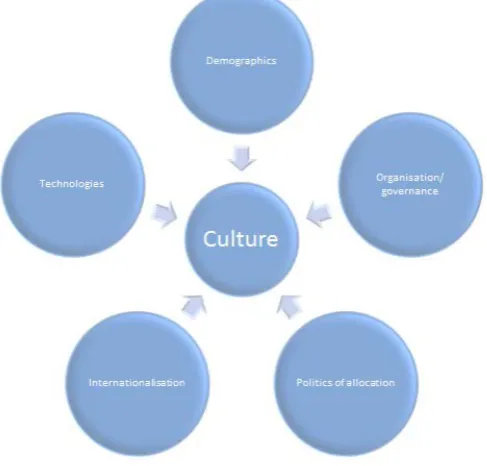
Reflecting upon the last 50 years we can identify five drivers of change in the cultural field, (see figure 1). They all interact with wider economic change and urban development not covered here. These drivers are mobilised by changing inputs: demographic
[image:21.595.106.350.278.511.2]changes, technological, and internationalisation; as well as the politics and governance of the cultural sector. The results of these drivers are a range of cultural forms and experiences.
Figure 1: the five drivers of cultural change
Figure 2: the three stressors of cultural change
[image:21.595.107.297.580.730.2]consumption, an experience increasingly delivered at least in part via a digital platform. Some commentators see a shift towards an ‘ominivore’ cultural consumption where the range of cultural participation expands, effacing the old divisions. Second, the abiding concern of cultural agencies is with conservation and preservation; however, two new aspects of culture have emerged as critical: cultural participation and access, and cultural production. Finally, contemporary culture is globalised in the sense of the mixing of many new cultural forms, but also the UK has gained a significant reputation for pioneering cultural innovation (Landry 2000, Landry 2006, Wood and Landry 2007). We now review the five major drivers of change that we expect to play a significant role in the next half century.
Education and income
A key component of cultural change is education. Obviously, knowledge of culture gained in education is important and extends the depth and breadth of cultural appreciation. Education is also significant because extended participation (as a result of the rising school leaving age which occurred in 1972 (14-16 years) and 2013 (16-18 years), as well as the increasing participation in higher education, from the 1960s, but especially in the 2000s) delays family formation and an extension of leisure time and the relative freedom to engage in cultural activities. Moreover, growth of the birth rate in the post war-period created a powerful force in the economy.
In the 1960s, this process was further boosted by rising wealth and disposable income for younger persons. These two trends created the foundation for a rise in consumption associated with teenage fashion, mainly mobilised around music and clothing; this trend has continued, despite intervening recessions40. The particularly short trend cycle of music and clothing feeds even more consumption (as the ‘turnover rate’ increases). This is one of the motors of the economic expansion of the creative industries. This process has been driven onward by the extension of cultural consumption by the ‘baby boomers’ beyond teenager-hood, into middle and increasingly older age (Young 2002).
A consequence is that the ‘popular culture’ consumption demographic is increasingly encompassing all age groups. Furthermore, the impact of higher educational
achievement, associated with increasingly discerning cultural consumption, will also work its way through the population. Participation in higher education was around 5% in the early 1960s, it is closer to 45% today41. Female participation in the labour market has now exceeded that of men, as has higher education participation. It is clear that the white male norms of the cultural field will be challenged in terms of gender, class and ethnicity, and that this trend will intensify rather than wane.
However, the inheritance of the expansion of higher education (or rather the mode of financing it) will result in the current cohort, and those that follow, carrying considerably more debt from that education, and the ever-increasing costs of housing, through to middle and older age. Inevitably, this will set limits on consumption. Furthermore, working ages are increasing and pension values declining. In the median term cultural
40
Spending on leisure goods and services now accounts for 18% of all household expenditure, up by 7% compared to household leisure spending in 1953. In the early-1950s, broadcasting was confined to three BBC radio stations and just one monochrome BBC television channel. Cinema attendance was 10 times higher in the early 1950s than it is today, although recently attendance levels have begun to improve. Young, R. (2002).
41
The number of students proceeding on to higher education has risen ten-fold over the last half century. In 2001, there were 2 million students in full- or part-time higher education, compared with just 220,000 in the mid-1950s. The UK had around 20 universities in 1950, compared with over 90 in 2002 .Ibid.
consumption will continue to rise; and as a consequence in 25 years or so it will be expected to plateau.
Migration
A second aspect of demographic change that began in the 1950s is immigration. The first post-war migration groups were encouraged to fill labour market gaps: they hailed
primarily from the Caribbean. Political refugees drove subsequent migration from East Africa and the Indian sub-continent. Later movements especially in the 2000s have been motivated by economic (push) factors; notably eastern European migrants. To this can be added a global flow of in-migrants attracted to the UK, many of them highly skilled, and in highly paid professions. Settlement of immigrants has been dominantly urban in character.
Immigration in the pre-millennium period was particularly significant in that it involved large numbers of families arriving in a relatively short period and settling permanently. Moreover, settlement was highly concentrated in a small number of cities; there has been a politically negative response by some portions of the population. Immigration has
challenged the dominant mono-culturalist and assimilationist modes of the past. After considerable social struggle, a period of multiculturalism was ushered in and cultural institutions were transformed to support cultural diversity. Those cities with significant immigrant populations, especially as they became second generation, native born, commonly questioned the failure to see their cultural traditions and histories reflected in public and municipal culture. The local public celebrations of various ethnic groups are a representation of this change (for example: Chinese New Year, Diwali and Eid). The subsequent transformation has added a further nuance to the balance between heritage and change in the field of culture, as well as for whom, and how, it represents that culture. It is this process that will continue to shape what we mean by culture and heritage in the future.
Although the political debate focuses on arrivals, and net migration, the overlooked fact is that there is a large through flow of population bringing knowledge and expertise, and culture to the UK, and vice versa, higher education can be particularly highlighted here as a gateway to cities outside the capital; although London remains most popular. It seems unlikely that this pattern will change, and even if new settlement were prohibited as more extreme political actors threaten, the current mix of population would remain with us. It is a demographic fact that Britain is, and will stay, multicultural. The next 50 years will see the consequences as they work themselves through culture, economy and society will only get more profound as time goes on. The notion of ‘plural cities’ where no one group has majority describes a handful of cities today; it will be most cities by the mid twenty-first century42.
Even the temporary mobility of people, for instance as tourists, has important cultural implications. The rise in foreign travel has changed the taste and cultural tolerance of the UK population (as evidenced by the acceptance of multi-culturalism, and the embrace of diverse media, fashions and cuisines)43. This will undoubtedly continue as travel costs
42
Joseph Rowntree Foundation (2013): The Dynamics of Diversity: evidence from the 2011 Census: Does Britain have plural cities? www.ethnicity.ac.uk/research/outputs/briefings/dynamics-of-diversity/
43
The average British household in the 1950s could afford, at most, only one family holiday per year, and the vast majority tended to be spent in the UK at holiday camps, hotels and small guesthouses. In 2000, UK residents made 37 million holiday trips to European or inter-continental destinations, spending over £15 billion. Office for National
Statistics International Passenger Survey (2000); Travel Trends (2001)
continue to fall, in spite of concerns about the environmental costs. In parallel, we see a rise in cultural tensions in cities expressed as racism, but also through a resistance to difference. A programme of engagement with such cultural differences underpins one strand of emergent cultural policy, seeking to achieve mutual understanding (Wood and Landry 2007). It has been argued that in so doing cultural diversity, rather than being a state of stress, can be transformed into an asset.
Incoming tourists are increasingly significant, not only adding to diversity, but economic growth. The spend-per-visit has increased dramatically in recent years, especially from Chinese visitors44. Much of the tourism is urban based, and often around shopping, as well as counter balanced by a continuing concern with heritage.
Technology
The most obvious changes, especially in the cultural industries, seem to have been wrought by technology: mass reproduction and digitisation to give two obvious examples. However, we need to be very cautious about ‘reading off’ cultural change from
technologies: technologies enable, societies transform cultures. Organisational and regulatory forces can shape, or sidestep, the potential impact of technologies.
The transformation of technology has had relatively little direct impact on the heritage sector, but a massive transformative effect for the creative industries. The fundamental transformation of music from live to recorded music and its popular consumption had manifest impacts. The business model of music, like that of any publishing, is based upon the ability to secure a growing rent from a single product, a record; the returns to scale are enormous. Furthermore, popular music forms that were international enabled even great profits to be made extending markets outside of the UK. In the 2000s the transformation of digitisation destabilised this particular model of distribution and business form in the creative industries. However, although the transformation was difficult for some, and led to a restructuring of the industries, overall creative industries consumption has continued to grow, indeed, it has proliferated, converged and hybridised into many new forms. The changes afforded by new technologies have affected the way we spend our leisure time. Mass TV arrived in the living room in the 1960s; TV has consistently taken on average 3 hours of our time each day; since the 1960s film
attendance has collapsed. The rise of mobile computing and social media now exceeds even the time investment of TV, although both activities are increasingly carried out at once. Moreover, newspaper reading has declined in the last 30 years, from 72% to 45%45. Clearly, with only 24 hours in a day, the impact of other leisure and cultural activities will become apparent.
The issues that are emergent with current technological-regulatory changes that will have lasting significance concerns the mass customisation of services based upon personal data characteristics. On one hand this is opening new markets, on the other hand it is causing considerable social and political concerns about privacy and surveillance. This applies to the tracking of individuals and their information shadow online and offline (with forms of electronic surveillance in the city). Clearly, there are massive challenges in negotiating security and freedom, which are likely to play out in terms of access to the public sphere of cities, and to cultural expression.
44
Visit Britain (2014): china market and trade profile, January; National Statistics (1999) Travel Trends, a report on the 1999 National Passenger survey; Visit Britain (2014) inbound tourism Trends Quarterly, 9.
45
Social Trends 40 (2014); The General Household Survey (2002) shows that just 12% of the population took part in arts activities in the last month.
A second theme that has been enabled by pervasive communications technologies has been coordination ‘on the go’ not linked to a building. The possibilities of temporary types of social gathering - the ‘festivalisation’ of temporary cultural events (from pop-up events to festivals) - is one example, another is the way that cities are becoming ‘stages’ for informal cultural activities that are ‘harvested’ by ‘trend spotters’ on city streets and fed back into the innovation process. Finally, the desire for experience, the qualities that the frequently atomised online life cannot provide, is likely to become an organising modality of cities as they respond to the online transformation.
Governance
There has been a significant shift in cultural values over the last half-century, represented by a turn away from the automatic acceptance of cultural values handed down by experts or those in authority. At the same time the breadth of what counts as culture has also widened; moreover, there has been a greater acceptance of what had been previously characterised as non-British and non-traditional cultural values and forms. Finally, the role of commercial culture has become far more pronounced; at the same time the
implicit assumption that commercial culture will be inferior has diminished. These shifts in the cultural landscape present problems for policy makers as the object of policy making, and their audiences have changed. The rise of commercial cultural forms is in principle outside the purview of cultural policy. Thus, cultural policy has played ‘catch up’.
As we have noted one of the biggest shifts in the balance has been to direct policy
concern to commercial culture (usually in terms of the creative industries), and away from more traditional cultural forms. A second shift has been to change the accountability of cultural funding, increasingly it is an investment that has to yield social and economic benefits as well as cultural; urban regeneration being a case in point. In the process the ‘arm’s length principle’, a buffer between political control of culture and its support, has become much weakened. Austerity has simply advanced these trends (Pratt and Hutton 2013).
In terms of the future, a key theme of cultural governance is instrumentalism, and ‘value for money’. It seems unlikely that ‘art for art’s sake’ will make a serious return in terms of state funding. A second theme is ‘who pays for culture?’; the advance of the ‘small state’ has not led to the disappearance of culture but to culture funded by a number of sources: corporate sponsorship, the state, individuals and volunteers46.
A third theme is the spatial basis of cultural policies. A complex pincer movement has led to a reduction of central state funding for culture. However this funding tended to benefit national treasures, more than often located in London. The lottery has leveraged capital funding for many new regional museums; future sources of sustainable revenue funding will be the challenge. Cities and regions at present are receiving less money and are disinclined to invest in culture. One possibility is that regional fragmentation advances and cities receive tax-raising powers, or much increased autonomy. Tax raising powers could increase the cultural budget; they could also draw upon culture to establish identity in an environment of stronger place-based competition.
One area that policy makers have begun to explore is the relationship of the cultural and creative economy to the rest of the economy, and to innovation. On one hand, this could
46
Despite the concerns of Putnam (2000) people in the UK are continuing to participate in community activities and to volunteer. Despite recession and government initiatives such as the ‘Big Society’, levels of volunteering have remained more or less stable over the last decade. Cabinet Office (2014).
be manifested as another form of instrumentalism; on the other hand it might lead to the exploration of different value systems that culture may offer, and thus be deemed worth of investment in its own right.
De-industrialisation and the growth of London
The final driver of change is that which relates to the UK urban system, this has a particular part to play in the understanding of the position of culture and cities. The de-industrialisation that impacted UK cities in the 1970s and 1980s resulted in localised unemployment, and related social problems, as well as devastation of the urban fabric in inner urban locations.
New employment growth eventually came from drawing in more women, and more part-time workers into the workforce. The new jobs were not traditional manufacturing jobs, but retail and office jobs. London went through this cycle first, and emerged from the other side with net job growth but a transformed sectoral composition: manufacturing being replaced by financial services. Moreover, previous restrictions on office growth in London were relaxed and a disproportionate growth was concentrated in London. In the regions physical decay, and attendant social problems of unemployment, especially amongst the youth, gave rise to a particular instrumental inflection of policy for the creative industries where the balance of concern was in favour of the social impacts rather than the cultural or economic ones. Despite significant investment and job growth in regional cities, London, and the decline of mining and manufacturing shape the UK space economy.
For the future even if new developments were evenly spread (per capita), the South East would enjoy significant advantages. The greater efficiencies due to past investment will continue this cumulative progress. In the cultural sector, which is structurally dominated by London, the process will be even more pronounced. This is going to be a profound challenge for cities outside London.
The prospect of high-speed rail links such as HS2 could re-integrate the non-London conurbations, bringing them closer. However, the cultural system is structured, and not simply changed by proximity. As a result there is a danger that faster links will reinforce the centrality of London. In order to avoid this trend radical governance changes would be required that actively spatially redistribute and restructure the economic, cultural and governance system.
The next 50 years: six scenarios
In this section we will take the inheritance of the last 50 years, the emergent drivers of change and what we will identify as the themes of urbanisation that we are likely to experience. We present this as a range of scenarios based upon six ideal-type cities. We do not expect any one of these cities to be the model for the future, but rather that this range will point to the potential parameters for the role of culture in cities. The objective here is not to second-guess policy but rather to lay out potential consequences of longer term drivers and established trends that will result in a number of stylised challenges to direct future policy making.
The underpinning factors are long-term, or slowly changing processes. For example, those of demography; here we know that the population will be increasingly aging, better educated, and multi-cultural. Leading on from this there will clearly continue to be an interest in culture, in fact all trends indicate that this will be more profound, and have a broader range. The precise manifestation of this demand will be contested.
On one hand we can see a continuation, or even a revival, of a monoculture restricted to place based politics (city, region or nation); on the other hand, there is the rise of a cosmopolitan culturally omnivorous perspective comprising a politics of identity (culture as a resource to assert political abstractions47), and a politics of allocation. A half-century long transition away from a large state toward a small state can be identified in which cultural funding (public or private) has been deeply impacted. Culture increasingly has to be justified by reasons other than cultural value per se: instrumentalism,
sponsorship, or the market.
Accompanying a proliferation of cultural values and identities, there is the spectre of social and economic polarisation, and urban polarisation. This is manifest as the structural division of life changes, and the securitisation of a cultural commons and a collective city space is a marked trend. On the horizon there are other markers of division; the one likely to have most impact on the cultural field is that of the shifting balance of control over digital and intellectual property rights. In this sense, the options are between the city as an innovative, and diverse cultural commons, or, the city a cultural fortress protecting its unique assets from the sight of others under (digital) lock and key.
The scenarios that follow have been generated from 2 x 5 matrix: the five themes already discussed, lying on a dualistic continuum. This is represented in Box F. Clearly there are many permutations possible; we have chosen six to highlight some potential challenging outcomes. The intention here is not to ‘predict’ a precise outcome(s), but to provide a range of possibilities and non-normative challenges which are, for presentational
simplicity, presented as vectors of the future cultural dimensions of the city as a heuristic for policy making.
47
The classic statement on the construction of cultural traditions and claims to political nationalisms is Hobsbawm, E. and T. Ranger, Eds. (1992). The Invention of Tradition. Cambridge, Cambridge University Press.
Box F: The matrix of future cities and culture: topics and range
a. Education/Training
Cultural spending, increasing debt
b. Migration/Movement
Restrict immigration, selection by wealth, open immigration c. Technology
Dominance by technologies, mediation, cultural shaping of technologies d. Governance
Centralised planned, market demand, democratic culture, control of movement by technologies
e. Space
Hierarchical urban system, fragmentation by city type, polarisation within cities
Tourist-experience city
The experience city will be organised for, and tailored to, an augmented reality of the city48. We can already see this in the practices of contemporary museum curation; if extended to a larger scale we might consider the city providing an immersive
experience, tailored to the visitor, complete with sensual feedback. It will not simply be a computer game, or a theme park, but a blending of the two with film special effects, and rooted in the unique physical environment and history of the city (Ashworth and
Tunbridge 2000). It will blend the physical presence and virtual worlds: the physical setting will merge the streets, museums and galleries; as well as the sensual ambiance. This option is only likely to be available to a small number of cities due to the resource intensive nature of the project.
The ‘back story’ is that such data rich environments will enable the more efficient
management of people and experiences. These characteristics provide a limit for current ‘tourist-historic’ and ‘cultural touristic' cities (Russo 2002, Russo and van der Borg 2002, Richards 2007). Thus the bottom line is to earn as much money through the total
management envelope of the customer. By extending and merging retail trends, and experience, that is for the most invisible and willingly entered into by the user (by
collecting uploading participants’ personal data). Cities will compete to provide a unique digital enhanced experience49. In this way cities may be able to square the circle of offering something unique and place specific, even when everything is reproducible, and reality is rendered banal.
Appropriate experiences will be selected, programmed and tailored to individual needs; and associated with previous visits to this, and to other similarly ‘enhanced’ cities50. The data rich environment will enable not simply personal itineraries to be arranged, but will
48
Pine II, J. P. and J. H. Gilmore (1999). The Experience Economy: Work Is Theatre & Every Business a Stage. Harvard, Harvard Business School.work, and the writings of William Gibson and Neal Stephenson, as well as the environment of role playing computer games such as Assassin’s Creed.
49
A digital extension of the notion of ‘creative tourism’ Richards, G. and L. Marques "Exploring Creative Tourism: Editors Introduction." Journal of Tourism Consumption and Practice 4(2): 1-11.
50
This is an extension of challenge that historic, heritage and tourist cities seek to achieve supply management: managing access to particular facilities and directing users to others where there could be overcrowding. Here this can be done in real time, and interpolated with demand management as well.