R E S E A R C H A R T I C L E
Open Access
Epoch length and the physical activity bout
analysis: An accelerometry research issue
Makoto Ayabe
1*, Hideaki Kumahara
1,2, Kazuhiro Morimura
1and Hiroaki Tanaka
1Abstract
Background:The purpose of the present investigation was to compare the bouts of daily physical activity (PA) determined by three different accelerometer epoch lengths under free-living conditions.
Methods:One hundred thirty-four adults (50 ± 7 years) wore an accelerometer (Lifecorder) for 7 consecutive days under free-living conditions in order to determine the time spent in physical activity of light intensity (LPA), moderate intensity (MPA), vigorous intensity (VPA), moderate to vigorous intensity (MVPA), and the total physical activity (TPA; sum of LPA, MPA and VPA). Additionally, all PA was divided according to the bout durations (sporadic, >3 min, >5 min, and > 10 min). These indices of PA were analyzed using three different epoch lengths (4 sec, 20 sec and 60 sec) derived from the accelerometer.
Results:The LPA significantly increased in association with increases in the epoch length (48.7 ± 15.9 to 178.7 ± 62.6 min/day, p < 0.05). The amount of sporadic VPA determined by the shortest epoch length (2.9 ± 5.2 min/day) was significantly longer than the two remaining epoch lengths (1.1 ± 2.4 to 0.9 ± 2.5 min/day, p < 0.05). The times of the MVPA bouts lasting longer than 3 minutes determined using the 4-second epoch length (2.6 ± 5.4 to 7.7 ± 10.0 min/day) were significantly shorter than those determined using the other two settings (6.5 ± 10.5 to 13.8 ± 13.8 min/day, p < 0.05). The frequencies of the MVPA bouts lasting longer than 10 minutes determined using the 4-second epoch length (0.2 ± 0.3 bouts/day) were significantly lower than those determined using the other two settings (0.3 ± 0.4 bouts/day, p < 0.05).
Conclusion:The epoch length setting of the accelerometer affects the estimation of the PA bouts under free-living conditions in middle-aged to older adults.
Keywords:Accelerometer, Pedometer, Pedometry, Methodology, Accuracy, Validity
Background
The American College of Sports Medicine and the American Heart Association recommend that all healthy adults 18 to 65 years of age engage in moderate-intensity aerobic (endurance) physical activity (MPA) or vigorous-intensity aerobic physical activity (VPA) in order to promote and maintain health [1]. Since several consensus statements also recommend engaging in moderate to vig-orous intensity physical activity (MVPA) [2,3], spending a longer time performing MVPA is widely accepted to be a goal for a healthy lifestyle. Additionally, moderate-intensity aerobic activity, which is generally equivalent to a brisk walk that noticeably accelerates the heart rate, can
count toward the 30 minute minimum by performing bouts of activity lasting 10 minutes or more [1].
Strath et al. [4] showed that bouts of PA lasting≥10 min-utes may constitute a more time-efficient strategy to decrease body mass index and waist circumference. In addition, accumulating MVPA in shorter bouts might be a beneficial starting point for individuals to increase their PA levels and decrease their body mass index and waist circumference. Furthermore, sustained volitional activity (i.e.,≥10 min in duration) might play an important role for the long-term maintenance of weight loss [5]. These find-ings indicate that participating in MVPA lasting > 10 min might be more beneficial than accumulating sporadic MVPA.
However, with regard to bouts of MVPA lasting > 10 min-utes, no consistent definition has been used to evaluate * Correspondence:[email protected]
1
Faculty of Health and Sports Science, Fukuoka University, 8-19-1 Nanakuma, Jonan-ku, Fukuoka 814-0180, Japan
Full list of author information is available at the end of the article
activity monitor data, and the traditional use of 1 minute recording intervals seems to be thede factobout definition [6]. Accelerometers function by integrating a filtered digi-tized acceleration signal over a user-specified time interval, commonly referred to as an epoch [7]. The usual acceler-ometer stored magnitude of accelerations at fixed record-ing intervals (1 sec, 4 sec, 15 sec, or 60 sec or longer) is called an“epoch”[8]. At the end of each epoch, the some index of physical activity is calculated; this process is repeated until data collection is completed [8,9]. Recent studies examined the appropriate epoch length to estimate the sporadic MVPA [7,8,10], and the use of a shorter time sampling interval might reduce the misclassification errors of PA estimates [8]. However, there have been no studies that have directly compared the bouts of PA determined using different epoch lengths under free-living conditions. Since most walking bouts last 30 sec or less [11,12], we hypothesized that a shorter epoch length may be more suitable to reflect the “real” bout duration under free-living conditions.
Therefore, the purpose of the present investigation was to examine the effects of the epoch length lasting from 4 seconds to 1 minute on the evaluation of bouts of PA lasting longer than 3, 5 and 10 minutes under free-living conditions in middle- to older-aged adults.
Methods Subjects
One hundred and thirty-four adults, aged from 32 to 72 yr., participated in the present investigation. All volunteers were recruited from Fukuoka city (Fukuoka, Japan) by the newspaper and web site. All volunteers liv-ing independently and were free of debilitatliv-ing chronic diseases. Furthermore, none of the participants habit-ually participated in any sports activities. The character-istics of the participants are shown in Table 1 (Table 1). After an explanation of the study requirements, each subject read and signed a consent form. The ethics com-mittee of Fukuoka University approved all procedures used in the present investigation. All procedures related
to the measurements were performed between March and April.
Physical activity assessments
During the course of the present investigation, all parti-cipants wore a pedometer with a uni-axial accelerometer (Lifecorder Ex 4-sec version, Kenz, Nagoya, Japan; LC) under free-living conditions. The LC is a small and light-weight (60 mm × 46 mm × 26 mm, 42 g) device that is equipped with a uni-axial piezo-electronic accelerometer that samples vertical acceleration ranging between 0.06 G and 1.94 G at 32 Hz. Based on the magnitude and frequency of accelerations, the LC determines the level of movement intensity every 4 seconds on a scale of 1 (minimal intensity of movement) to 9 (maximal in-tensity of movement). As shown in a previous investiga-tion [9], the intensity levels closely approximated the metabolic equivalents (METs) of the activities being per-formed. Previous investigations have demonstrated that the LC is suitable for research purposes [9,13,14]. The LC has the potential limitation, similar to other types of activity monitors, in that they too often remain vulner-able to problems from external vibrations and unmeas-ured sources of energy expenditure such as hill climbing and isometric activity in daily life [15]. After reading the instructions regarding the general care of these activity monitors, the participants wore the LC for 10 days con-tinuously, except while sleeping or bathing. We used seven continuous days (the 4th day to the 10th day, five weekdays and two weekend days) for data the analysis because the 1st to the 10th days included non-wearing time and the 2nd day was used to familiarize the sub-jects with the LC. All subsub-jects documented when they removed the LC die for personal reasons. The LC was placed on the left anterior mid-line of the thigh on the waist band of the participant’s clothing. The present in-vestigation placed the LC on the left side in order to prevent the LC from being dropped while the subjects inserted or removed their belts. The LC was sealed, so that the participants could not gain access to the PA measurements during the experimental period. After the data collection period was completed, the participants returned the LC by mail to the investigators so that the stored data could be uploaded to a personal computer for the analysis. To be included in the analysis, each par-ticipant had to have at least seven days of sufficiently wearing the device (>10 hours) [7].
Accelerometer’s data analysis
[image:2.595.57.291.617.716.2]All accelerometer’s out puts were averaged over 7 days, and weekly values were defined as individuals represented. Since the present investigation was focused on the acceler-ometer’s algorithms, the inter individual variability, such as the day-to-day variability or hourly variability, were not Table 1 Characteristics of participants
All Female Male
N 134 42 92
Age (years) 50 ± 7 50 ± 7 50 ± 8
Height (cm) 165.0 ± 8.1 156.2 ± 4.9 169.1 ± 5.8*
Body weight (kg) 66.7 ± 12.4 54.7 ± 8.4 72.3 ± 9.8*
Body mass index (kg/m2) 23.3 ± 6.9 28.5 ± 6.9 21.0 ± 5.5*
Waist circumference 88.2 ± 8.8 84.3 ± 9.7 90.0 ± 7.8*
evaluated according to the previous validation studies [8,14]. In the present investigation, the epoch length was also set at 20 sec and 60 sec, in addition to the usual 4 sec setting. The reasons why we chose these three epoch lengths are as follows: first, the 4 sec and 60 sec epoch lengths were used in previous studies [6,16,17]. Addition-ally, as the LC detects the intensity of PA every 4 sec, the epoch length had to be selected from a multiple of 4 sec, and the epoch length must be a common divisor of the bout duration (3 min, 5 min and 10 min). Therefore, we chose 20 sec as the third epoch length.
The time spent in light intensity PA (LPA), moderate in-tensity PA (MPA), vigorous inin-tensity PA (VPA), and mod-erate + vigorous intensity PA (MVPA) was determined. Furthermore, the sum of the time for LPA, MPA, and VPA was defined as the total PA (TPA). Thereafter, based on the time series data of the three epoch lengths, the TPA and MVPA were divided according to the bout dura-tions (Sporadic, < 3 min, < 5 min, and < 10 min,
respect-ively). We defined a “bout” as PA that was maintained
completely at an intensity level of 1 or higher for at least 3 minutes, 5 minutes or 10 minutes (TPA3, TPA5, TPA10, and TPA3, TPA5, TPA10, respectively). Similarly, the daily time spent for the MVPA lasting at least 3 minutes, 5 min-utes and 10 minmin-utes were assessed (MVPA3, MVPA5, and MVPA10, respectively). The reason for using these dura-tions was as follows: First, only the 3 min bouts of PA had a significant impact on the post-prandial blood lipids and
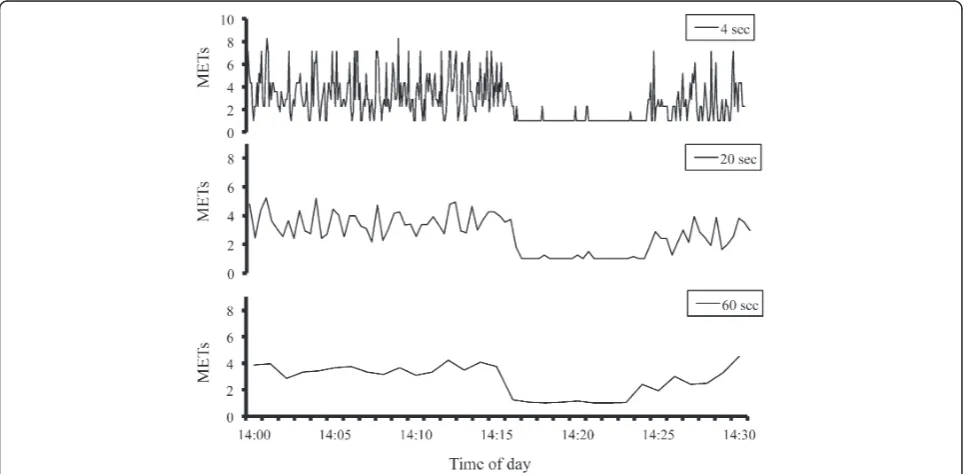
metabolic syndrome in previous studies [16,18,19]. Fur-thermore, the bouts of PA lasting longer than 5 min com-prised just 0.14 percent of all walking bouts under free-living conditions [11,12]. Finally, the PA bouts lasting longer than 10 min have been widely recommended by consensus statements [1] (Figure 1).
Statistics
The data were expressed as the means with standard deviations. The potential gender-related differences in the obtained data were analyzed by the unpaired t-test.
A one-way ANOVA and Scheffe’s test were used to
com-pare the PA levels for the 3 different epoch lengths. The magnitude of the differences between the time and fre-quency of PA for the 4 sec epoch length compared to those of the other two epoch lengths was analyzed by paired t-tests. Statistical significance was set at P < 0.05. All statistical analyses were performed using the Stat-View software program (version 5.0.1, SAS Institute, Cary, NC, USA) (Figure 2).
Results
[image:3.595.57.541.438.675.2]The height, body weight, body mass index, and waist cir-cumference were significantly different between males and females (p < 0.01, Table 1). As none of the acceler-ometer outputs significantly differed between genders, the PA data are shown as the combined results for males and females (Tables 2 and 3). Table 2 shows the time
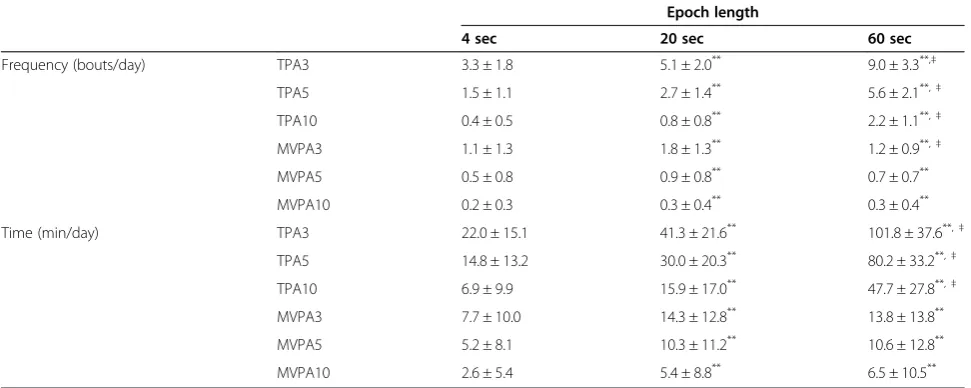
spent in sporadic PA as determined by the three differ-ent accelerometer epoch lengths. The LPA significantly increased with the increase in epoch length (p < 0.05). The amount of sporadic VPA determined by the shortest epoch length (4 sec) was significantly longer compared with the two remaining epoch lengths (p < 0.05). Table 3 shows the time and frequency for the PA bouts as deter-mined using the three different accelerometer epoch lengths. Regardless of the intensities and bout durations, the frequency and the time for the PA bouts determined using the 4 sec epoch length were significantly shorter compared with the other two settings (p < 0.05). Add-itionally, the frequency and the time for TPA determined using the 20 sec epoch length were significantly smaller compared with that determined using the 60 sec epoch length (p < 0.05).
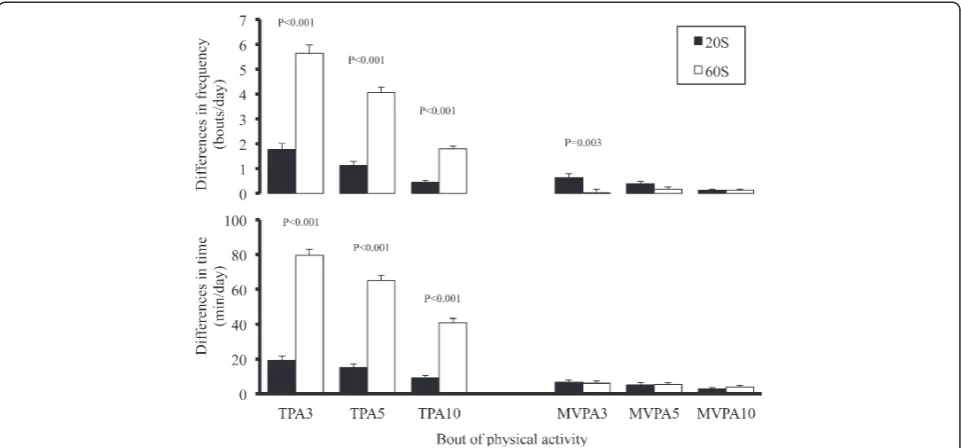
Figure 2 shows the differences in the times and fre-quencies of the bouts of TPA and MVPA between those determined using the 4-second epoch length and those determined using the 20- and 60-second epoch lengths. The magnitudes of the differences in the times and frequencies of the bouts of TPA determined using the 60-second epoch length were significantly larger than those determined using the 20-second epoch length (p <0.001). In contrast, the magnitudes of the differences in the times and frequencies of the bouts of MVPA did not differ significantly, except for the time of the MVPA3M.
Discussion
[image:4.595.58.539.89.313.2]The present investigation is, to the best of our knowledge, the first study to examine the role of an accelerometer’s epoch length (4 sec, 20 sec and 60 sec) in the evaluation of PA bouts with regard to accelerometer-based PA assess-ment in middle- to older-aged individuals. Main finding of the present investigation is that, regardless of the intensity and bout duration categories, the frequency and time for the PA bouts were significantly lower when the shortest epoch length (4 sec) was used compared with the longer epoch lengths (20 sec and 60 sec). Furthermore, when the analysis was limited to the TPA, the frequency and time for the PA bouts were significantly lower as the epoch length increased. Although previous investigation exam-ined the epoch length on the“sporadic MVPA estimation” [7,8,10], the present investigation firstly showed that the epoch length affects the“MVPA bouts estimation”. These
Figure 2Differences in the time and frequency of physical activity bouts compared with those determined using a 4 sec epoch length.
[image:4.595.58.291.601.683.2]The Y-axis shows the differences between the time or the frequency spent on the physical activity bout determined by the 4 sec epoch length and that by the 20 sec or 60 sec epoch length, respectively. TPA3, TPA5, TPA10; total physical activity lasting longer than 3 min, 5 min and 10 min. MVPA3, MVPA5, MVPA10; moderate to vigorous intensity physical activity lasting longer than 3 min, 5 min and 10 min.
Table 2 Accelerometer’s epoch length and the time spent in sporadic physical activity
Epoch length
4 sec 20 sec 60 sec
LPA (min/day) 48.7 ± 15.9 104.2 ± 36.1** 178.7 ± 62.6**,‡
MPA (min/day) 30.0 ± 14.9 33.2 ± 16.2 28.5 ± 15.9*,†
VPA (min/day) 2.9 ± 5.2 1.1 ± 2.4** 0.9 ± 2.5**
MVPA (min/day) 32.9 ± 16.5 34.3 ± 17.1 29.4 ± 16.9*,†
Data are expressed as the means with the standard deviation (mean ± SD). LPA; light intensity physical activity, MPA; moderate intensity physical activity, VPA; vigorous intensity physical activity, MVPA; moderate to vigorous intensity physical activity.
*, **
Significantly different compared with 4 sec (*
p < 0.05,**
results indicate that the accelerometer’s epoch length affects the estimation of the PA bouts under free-living conditions in middle-aged to older adults. The 20- and 60-second epoch lengths resulted in larger amounts of MVPA bouts compared with the 4-second epoch length. Thus, caution should be exercised regarding the accelerometer’s data setting when discussing the PA bouts reported in pre-vious publications. Furthermore, the best epoch length to estimate MVPA bouts remains unclear.
One of the original findings of the present investigation is that, with regard to the accelerometer-based PA assess-ment, a shorter epoch length results in smaller amounts of PA bouts compared with the longer epoch lengths under free-living conditions in middle aged to older adults. Although several previous investigations have examined the effects of an accelerometer’s epoch length on the estimation of sporadic MVPA [6,8,20], the present investigation provides the first demonstration that an accelerometer’s epoch length affects the estimation of the frequency and time of PA bouts. A previous study showed that a shorter epoch length was more suitable for estimat-ing the time spent in sporadic MVPA, where MVPA were significantly higher and light-intensity activity was signifi-cantly lower when presented as 10 sec epochs compared with that using a 60 sec epoch length [8]. Similar results are also found in adolescents and children where a signifi-cant epoch effect was seen for time spent in VPA, LPA, and rest in the child and adolescent samples and MVPA in the child sample [10]. These findings are consistent with the results of the present investigation, where the daily time spent in sporadic MPA and VPA based on the shortest epoch length (4 sec) were significantly longer than that based on the longer epoch lengths (Table 2). However,
with regard to the PA bouts, it is of interest that the rela-tionships between the accelerometer’s epoch length and the amount of PA were inverted (Table 3). The frequency and time for the PA bouts were significantly smaller for the shorter epoch length setting compared with the longer
epoch length settings. The mean daily time for MVPA10
under the shortest epoch length setting was less than half of that under the longer epoch length settings.
[image:5.595.56.542.101.295.2]The main explanation for the differences in the amount of PA among the three different epoch lengths is consid-ered to be due to two different factors. First, the bout dur-ation of daily PA is very short under free-living conditions [12,16,17]. Orendurff et al. previously indicated that 60% of all walking bouts lasted less than 30 seconds, and 81% of all walking bouts lasted 1 minute or less, and 2 minute walking bouts represented just 1% of all walking bouts [12]. Second, the shorter epoch has a higher sensitivity to detect the changes in the human PA, such as the transi-tion to PA from rest, and/or the switch from walking to jogging, etc., compared with the longer epoch length. Under the 1 min epoch length, for example, if people walk for five seconds then rest for 55 seconds, this 1 min would be categorized as LPA or MVPA rather than a resting period. Similarly, if people take a short break during con-tinuous jogging, this minute would be categorized as MPA rather than VPA, regardless of the presence or absence of the break. In other words, with regard to the 60 sec epoch length, the intensity of PA is less likely to result in a classi-fication of inactivity or VPA, because the various types of PA, including the inactivity, are averaged over 1 min peri-ods. As a result, the accelerometer might detect a larger number of PA bouts. In contrast, a shorter epoch length can more sensitively detect the changes in the type and Table 3 Frequency and time in bouts of physical activity by 3 different accelerometer’s epoch lengths
Epoch length
4 sec 20 sec 60 sec
Frequency (bouts/day) TPA3 3.3 ± 1.8 5.1 ± 2.0** 9.0 ± 3.3**,‡
TPA5 1.5 ± 1.1 2.7 ± 1.4** 5.6 ± 2.1**,‡
TPA10 0.4 ± 0.5 0.8 ± 0.8** 2.2 ± 1.1**,‡
MVPA3 1.1 ± 1.3 1.8 ± 1.3** 1.2 ± 0.9**,‡
MVPA5 0.5 ± 0.8 0.9 ± 0.8** 0.7 ± 0.7**
MVPA10 0.2 ± 0.3 0.3 ± 0.4** 0.3 ± 0.4**
Time (min/day) TPA3 22.0 ± 15.1 41.3 ± 21.6** 101.8 ± 37.6**,‡
TPA5 14.8 ± 13.2 30.0 ± 20.3** 80.2 ± 33.2**,‡
TPA10 6.9 ± 9.9 15.9 ± 17.0** 47.7 ± 27.8**,‡
MVPA3 7.7 ± 10.0 14.3 ± 12.8** 13.8 ± 13.8**
MVPA5 5.2 ± 8.1 10.3 ± 11.2** 10.6 ± 12.8**
MVPA10 2.6 ± 5.4 5.4 ± 8.8** 6.5 ± 10.5**
Data are expressed as the means with the standard deviation (mean ± SD). TPA3, TPA5, and TPA10; Bouts of physical activity lasting longer than 3 min, 5 min and 10 min. MVPA3, MVPA5, and MVPA10; Bouts of moderate to vigorous intensity physical activity lasting longer than 3 min, 5 min and 10 min.
**
intensity of PA, as well as the resting period (brief inter-ruptions, etc.). Thereafter, the PA bouts were significantly smaller for the shorter epoch length compared with the longer epoch length.
There is large variability in MVPA bouts lasting longer than 10 minutes. In the present investigation, the mean MVPA lasting > 10 minutes was 2.6 ± 5.4 min day-1under the 4-second epoch length. Similarly, the time for MVPA bouts was 2.0 min day in the US NHANES Study [21], 0.4 to 0.6 min day-1 in British, Italian and French volunteers [22] and 0.0 to 5.2 min day-1in a Japanese study [23]. In contrast, some investigators have reported much longer MVPA bouts of > 30 min day-1 in overweight and obese individuals [24], 19.2 ± 18.6 min day-1in overweight parti-cipants and 25.8 ± 23.4 min day-1in normal-weight indivi-duals [5]. The differences in the amounts of MVPA bouts seem to exceed the acceptable range and are caused not only by the epoch length, including human-behavioral ele-ments, but also by the data analysis process. In other words, the procedures used to assess and quantify the PA bouts must evolve in order to determine how to manage brief interruptions (i.e. breaks of < 1 minute) of PA. In the present investigation, all MVPA bouts satisfied the inclu-sion criteria, where the intensity of PA was above 3 METs for that lasting at least 10 minutes. In contrast, some investigators have attempted to improve the sensitivity of detecting MVPA bouts. For example, to allow for the brief periods of rest common during certain activities, i.e. paus-ing for a water break while playpaus-ing basketball, the criteria used to define a bout requires a running average of 70% of the counts to be above the cut-off point [21]. Similarly, interruptions of 1 or 2 minutes below 3 METs are allowed during consecutive MVPA lasting > 10 minutes to define bouts of MVPA [25]. We cannot conclusively define the best epoch length to estimate PA bouts because we were unable to compare the accelerometer’s outputs with the
“gold standard method for assessing PA bouts.”Because it is difficult to assess the bout duration of PA under free-living conditions, using video tape recordings and/or dir-ect observation is the gold standard method for assessing PA bouts in experimental studies.
However, the previous and present investigations appar-ently indicate that a shorter epoch length may be superior to estimate the PA bouts compared to a longer epoch length [8,26]. Furthermore, recent publications showed that, although PA bouts are relatively rare under free-living conditions, the MVPA lasting > 1 min was signifi-cantly associated with the blood lipid status and age in previous studies [16,17]. In contrast, with regard to the 1 min epoch length, it is doubtful whether it can evaluate
“real” PA bouts under free-living conditions, due to the lack of accurate treatment of the interruptions in activity. Further investigations will be required to determine how to divide the continuous PA with interruptions and the
intermittent PA, how to assess the activity level during these short interruptions, and what length of interruptions can be accepted, etc. However, a recent publication, which summarized accelerometer-based research, showed that the longer epoch duration (1 minute) is the most com-monly used epoch length [6]. In addition, the time for MVPA bouts lasting > 10 minutes based on the 60-second epoch length is also significantly associated with health outcomes using this length [4,5]. Additionally, using a longer epoch length can reduce the data to be saved, so the results using a longer epoch length would be superior with regard to data treatment, and would allow for a longer monitoring period by saving the data storage cap-acity. Therefore, each epoch length has both advantages and disadvantages. Future research should first develop a method to quantify the PA bouts on the basis of a detailed analysis, thereafter, the contribution of the different PA bouts to the health outcomes should be examined based on the quantitative assessment of the PA bouts based on the most valid epoch length.
There are several limitations to the present investigation that should be considered when interpreting the results. First, the type (uni-axial) and position (waist) of the accel-erometer used in the present investigation does not allow for the collection of upper body activity, and thus may underestimate the total PA. Additionally, as the LC has an original algorithm for PA intensity classification, the results of the present investigation should be confirmed using other activity monitors. Second, the participants evaluated in the present investigation were primarily middle-aged, non-active males and females. Furthermore, the partici-pants all lived in urban areas, and buses and trains were their primary means of transportation. Thus, it is limited to generalize the present investigation to the heterogeneous individuals, therefore, the results of the present investiga-tion should be confirmed in active individuals and hetero-geneous volunteers, including young children.
Conclusion
length in heterogeneous volunteers using several types of activity monitors.
Competing interests
None of the authors have any professional relationship with companies or manufactures that will benefit from the results of the present study.
Authors’contributions
Planning: MA, HT, Conducting: MA, HK, KM, Data treatment: MA, KM, Reporting: MA, HK, HT. All authors read and approved the final manuscript.
Acknowledgement
Part of this study was supported by Fukuoka University (Global FU program, and Fukuoka University Institute for Physical Activity).
Author details
1Faculty of Health and Sports Science, Fukuoka University, 8-19-1 Nanakuma,
Jonan-ku, Fukuoka 814-0180, Japan.2Faculty of Nutritional Sciences, Nakamura Gakuen University, Fukuoka, Japan.
Received: 5 October 2012 Accepted: 8 January 2013 Published: 18 January 2013
References
1. Haskell WL, Lee IM, Pate RR, Powell KE, Blair SN, Franklin BA, Macera CA, Heath GW, Thompson PD, Bauman A:Physical activity and public health: updated recommendation for adults from the American College of Sports Medicine and the American Heart Association.Med Sci Sports Exerc
2007,39(8):1423–1434.
2. Saris WH, Blair SN, van Baak MA, Eaton SB, Davies PS, Di Pietro L, Fogelholm M, Rissanen A, Schoeller D, Swinburn B,et al:How much physical activity is enough to prevent unhealthy weight gain? Outcome of the IASO 1st Stock Conference and consensus statement.Obes Rev2003,4(2):101–114. 3. Ishikawa-Takata K, Tabata I:Exercise and physical activity reference for
health promotion 2006 (EPAR2006).J Epidemiol2007,17(5):177. 4. Strath SJ, Holleman RG, Ronis DL, Swartz AM, Richardson CR:Objective
physical activity accumulation in bouts and nonbouts and relation to markers of obesity in US adults.Prev Chronic Dis2008,5(4):A131. 5. Catenacci VA, Grunwald GK, Ingebrigtsen JP, Jakicic JM, McDermott MD,
Phelan S, Wing RR, Hill JO, Wyatt HR:Physical Activity Patterns Using Accelerometry in the National Weight Control Registry.Obesity (Silver Spring)2011,6(19):1163–1170.
6. Heil DP, Brage S, Rothney MP:Modeling Physical Activity Outcomes from Wearable Monitors.Med Sci Sports Exerc2012,44(1S):S50–S60.
7. Trost SG, McIver KL, Pate RR:Conducting accelerometer-based activity assessments in field-based research.Med Sci Sports Exerc2005,
37(11 Suppl):S531–S543.
8. Gabriel KP, McClain JJ, Schmid KK, Storti KL, High RR, Underwood DA, Kuller LH, Kriska AM:Issues in accelerometer methodology: the role of epoch length on estimates of physical activity and relationships with health outcomes in overweight, post-menopausal women.Int J Behav Nutr Phys Act2010,7:53.
9. Kumahara H, Schutz Y, Ayabe M, Yoshioka M, Yoshitake Y, Shindo M, Ishii K, Tanaka H:The use of uniaxial accelerometry for the assessment of physical-activity-related energy expenditure: a validation study against whole-body indirect calorimetry.Br J Nutr2004,91(2):235–243. 10. Edwardson CL, Gorely T:Epoch length and its effect on physical activity
intensity.Med Sci Sports Exerc2010,42(5):928–934.
11. Ayabe M, Kumahara H, Aoki J, Tanaka H:Assessment of frequency and bouts duration of moderate intensity physical activity by an accelerometer in 4-sec interval under-free living condition.Journal of Japan Society for the Study of Obesity2007,13(2):197–200.
12. Orendurff MS, Schoen JA, Bernatz GC, Segal AD, Klute GK:How humans walk: bout duration, steps per bout, and rest duration.J Rehabil Res Dev
2008,45(7):1077–1089.
13. Ayabe M, Aoki J, Ishii K, Takayama K, Tanaka H:Pedometer accuracy during stair climbing and bench stepping exercises.J Sports Sci & Med2008,
7(2):249–254.
14. Ayabe M, Ishii K, Takayama K, Aoki J, Tanaka H:Comparison of interdevice measurement difference of pedometers in younger and older adults.
Br J Sports Med2010,44(2):95–99.
15. Shephard RJ, Aoyagi Y:Measurement of human energy expenditure, with particular reference to field studies: an historical perspective.Eur J Appl Physiol2011,112:2785–2815.
16. Ayabe M, Kumahara H, Morimura K, Ishii K, Sakane N, Tanaka H:Very short bouts of non-exercise physical activity associated with metabolic syndrome under free-living conditions in Japanese female adults.Eur J Appl Physiol2012,112(10):3525–3532.
17. Ayabe M, Aoki J, Kumahara H, Tanaka H:Age-related differences in daily physical activity divided by bout duration: Preliminary findings in female convenience samples.J Sports Sci2012,30(7):709–713.
18. Miyashita M, Burns SF, Stensel DJ:Accumulating short bouts of brisk walking reduces postprandial plasma triacylglycerol concentrations and resting blood pressure in healthy young men.Am J Clin Nutr2008,
88(5):1225–1231.
19. Ayabe M, Kumahara H, Morimura K, Ishii K, Sakane N, Tanaka H:
Accumulation of short bouts of non-exercise daily physical activity is associated with lower visceral fat in Japanese female adults.Int J Sports Med2013,34:62–67.
20. Heil DP, Bennett GG, Bond KS, Webster MD, Wolin KY:Influence of activity monitor location and bout duration on free-living physical activity.Res Q Exerc Sport2009,80(3):424–433.
21. Metzger JS, Catellier DJ, Evenson KR, Treuth MS, Rosamond WD, Siega-Riz AM:Patterns of objectively measured physical activity in the United States.Med Sci Sports Exerc2008,40(4):630–638.
22. Davis MG, Fox KR:Physical activity patterns assessed by accelerometry in older people.Eur J Appl Physiol2007,100(5):581–589.
23. Ayabe M, Aoki J, Kumahara H, Tanaka H:Duration and frequency of daily physical activity and achievement of exercise and physical activity reference for health promotion 2006.Jap J Phys Fitness and Sports Med
2008,57(5):577–586.
24. Young DR, Jerome GJ, Chen C, Laferriere D, Vollmer WM:Patterns of physical activity among overweight and obese adults.Prev Chronic Dis
2009,6(3):A90.
25. Hagstromer M, Troiano RP, Sjostrom M, Berrigan D:Levels and patterns of objectively assessed physical activity–a comparison between Sweden and the United States.Am J Epidemiol2010,171(10):1055–1064. 26. McClain JJ, Abraham TL, Brusseau TA Jr, Tudor-Locke C:Epoch length and
accelerometer outputs in children: comparison to direct observation.
Med Sci Sports Exerc2008,40(12):2080–2087.
doi:10.1186/1756-0500-6-20
Cite this article as:Ayabeet al.:Epoch length and the physical activity bout analysis: An accelerometry research issue.BMC Research Notes2013
6:20.
Submit your next manuscript to BioMed Central and take full advantage of:
• Convenient online submission
• Thorough peer review
• No space constraints or color figure charges
• Immediate publication on acceptance
• Inclusion in PubMed, CAS, Scopus and Google Scholar
• Research which is freely available for redistribution