MSc Thesis
(Afstudeerscriptie)
written by
Anthia Solaki
(born December 11, 1992 in Thessaloniki, Greece)
under the supervision ofProf. dr. Francesco BertoandProf. dr. Sonja Smets, and submitted to the Board of Examiners in partial fulfillment of the requirements for the degree of
MSc in Logic
at theUniversiteit van Amsterdam.
Date of the public defense: Members of the Thesis Committee:
June 28, 2017 Prof. dr. Francesco Berto
• Chapter 1: The standard epistemic and doxastic logics are introduced inSection 1.1. We explain how these emerged as spin-offs of Modal Logic and discuss some of their prop-erties. InSection 1.2, we present the various forms and manifestations of theproblem of logical omniscience. The problem plagues the mainstream treatment of knowledge and belief because this ascribes unlimited inferential power to the agents. We then empha-size why it is important to resolve it, arguing against claims that have been put forward to justify this sort of idealization. This discussion also hints at elements seen as desirable for a proposed solution.
• Chapter 2: This chapter serves as the background for what follows. It introduces ele-ments from the toolkit ofDynamic Epistemic Logic, that can help us draw a more realistic picture of reasoning. First, we presentpublic announcement logic(Section 2.1). Second, we describe the contribution of plausibility models in the study of (static) belief change (Section 2.2). Third, we briefly discuss dynamic belief change triggered by various kinds of incoming information (Section 2.3).
• Chapter 3: In this chapter, we provide a detailed exposition and discussion on selected proposals against the problem, as found in the literature. They are classified according to the rationale and method they adopt. Apart from explaining their workings, we also assess them according to specific criteria. This survey allows us to spot useful tools and underlying ideas, but also reveals the open challenges that await.
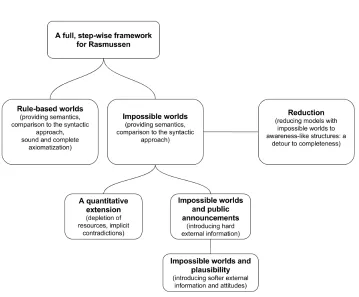
• Chapter 4: This chapter constitutes our own attempt to resolve the problem, in a way that improves existing approaches and accounts for the real, dynamic nature of rea-soning. More specifically, we design two settings, dubbedRule-based worlds(RW) and Impossible worlds (IW), that break reasoning processes intoreasoning steps. In Sec-tion 4.1.1, we present the main elements of RW, we compare it to a similar step-wise view and construct the complete logicΛRW. InSection 4.1.2, we similarly present IW.
This approach additionally allows for a more detailed analysis of reasoning, further pur-sued inSection 4.2andSection 4.3, mainly inspired byChapter 2. Next,Section 4.4 pro-vides a reduction of frameworks withimpossible worlds, that, combined with material fromChapter 3, facilitates the construction of complete axiomatic systems.
Abstract. . . i
Acknowledgements . . . ii
Outline of the thesis. . . iii
1 The problem of logical omniscience 2 1.1 Epistemic and doxastic logic . . . 2
1.2 The problem . . . 6
2 Dynamic Epistemic Logic 11 2.1 Public Announcement Logic . . . 11
2.2 Belief change and plausibility models. . . 12
2.3 Dynamic belief change due to hard and soft information . . . 14
3 Dealing with the problem: a critical survey 17 3.1 Syntactic approaches . . . 18
3.1.1 Syntactic structures . . . 18
3.1.2 Rasmussen . . . 19
3.2 Implicit versus explicit attitudes. . . 22
3.2.1 Awareness . . . 23
3.2.2 Algorithmic Knowledge . . . 25
3.2.3 Justification Logic . . . 26
3.2.4 Logics of Justified Belief and Knowledge . . . 31
3.3 Impossible worlds . . . 38
3.3.1 Elementary approaches. . . 38
3.3.2 Jago . . . 39
3.3.3 Rasmussen & Bjerring. . . 44
3.4 Other remarks . . . 49
4 Proposals for real-life agents 50 4.1 A full framework for Rasmussen’s dynamic epistemic logic . . . 51
4.1.1 Rule-based worlds (RW) . . . 52
4.1.2 Impossible worlds (IW) . . . 63
4.2 Impossible worlds and public announcements (IWPA). . . 72
4.3 Impossible worlds and plausibility(IWp) . . . 74
4.4 Reducing frameworks with impossible worlds . . . 79
The problem of logical omniscience
1.1 Epistemic and doxastic logic
Since Hintikka’s seminal work inHintikka(1962), Logic has been instrumental in the formal study of propositional attitudes such as knowledge and belief. Standard epistemic and dox-astic logics were developed as spin-offs ofModal Logicand made use of its main techniques, in particular of thepossible worlds semantics. The core of this conception is that in knowing or believing something, one obtains a way of determining which theactualworld is among a range of possibilities.Possible worldsarticulate precisely this conception: they embody these logical possibilities. Although there is a lively debate on their metaphysical status1, given our purposes, we content ourselves in considering possible worlds alternative scenarios, repre-sentations of the ways the world could be or could have been.
The standard approach accounts for knowledge by supplementing the language of propo-sitional logic with a unary operatorK such thatKφreads: “the agent knows thatφ”. Follow-ing the same fashion, we can add a unary operatorBsuch thatBφreads “the agent believes thatφ”. Next, the semantic interpretations are given in terms of possible worlds: an agent knows(/believes) thatφif and only if in all possible worlds compatible with what the agent knows(/believes), it is the case thatφ.
Of course, there can be more than one operator to accommodate settings with more than one agent. Then, by indexing the operators, we getKiφ, read as “agenti knows thatφ”, and likewise for belief. The content of this chapter can be accordingly generalized for multi-agent settings.
Departing from these initial remarks, we will give the concrete account of standard single-agent epistemic logic, starting off with the constructions of Modal Logic (Blackburn et al.
(2001),Bezhanishvili and van der Hoek(2014), Fagin et al.(1995a)). We will also comment on how this can be adapted for doxastic and combined epistemic-doxastic frameworks.
Definition 1.1.1(Syntax). The language of single-agent epistemic logic is defined inductively as follows:
φ ∶∶= p ∣ ¬φ ∣ φ∧φ ∣ Kφ
withp∈ΦandΦa set of propositional atoms.
The language of single-agent epistemic-doxastic logic is easily obtained by supplementing the previous definition withBφ. The common boolean connectives are defined in terms of¬ and∧as usual. It is also useful to consider thedualoperators ˆK, ˆBwhere ˆKφ∶= ¬K¬φand
ˆ
Bφ∶= ¬B¬φ.
Next, we elucidate the technical details that show how the relational structures of Modal Logic are utilized in our context. More specifically, the compatibility of worlds with the agent’s knowledge and belief is captured via primitive binary relations on possible worlds, reflecting epistemic and doxastic accessibility. We first present the standard modal account, followed by the discussion on the properties that furnish this fruitful adaptation.
Definition 1.1.2(Kripke frames and models).
1. AKripke frameis a pairF = ⟨W,R⟩, where:
• W is a non-empty set of possible worlds.
• Ris a binaryaccessibilityrelation onW.
2. AKripke modelis a frame supplemented with a valuationV ∶Φ→ P(W)assigning to eachp∈Φa subsetV(p)ofW. Intuitively,V(p)is the set of all worlds in the model wherepis true. A pair(M,w)consisting of a modelMand a designated worldwof the model is called apointed model.
As we will see, the accessibility relation can be used to denote epistemic or doxastic ac-cessibility. Of course, frames and models might be endowed with more than one accessibility relation, thereby allowing for combined epistemic-doxastic settings.
We now proceed with the truth clauses and other key-definitions:
Definition 1.1.3(Truth). For a worldwin a modelM= ⟨W,R,V⟩, we inductively define that a formulaφistrue in M at world w(notation:M,w⊧φ) as follows:
• M,w⊧pif and only ifw∈V(p), wherep∈Φ.
• M,w⊧ ¬φif and only ifM,w /⊧φ.
• M,w⊧φ∧ψif and only ifM,w⊧φandM,w⊧ψ
• M,w⊧Kφif and only if for all worldsu∈W such thatw Ruwe haveM,u⊧φ.
A setΣof formulas is true at a worldwof a modelM(notation:M,w⊧Σ) if all members ofΣ are true atw.
Regarding belief, and denoting the doxastic relation withRb, we simply define an extended frameF = ⟨W,R,Rb⟩and model M= ⟨W,R,Rb,V⟩as suggested above. Then the following clause can be added:
Definition 1.1.4(Truth in a model). A formula is(globally) true(orvalid)in a modelif it is true at all possible worlds of the model. A set of formulas is true in a model if all of its members are true in the model.
Definition 1.1.5(Validity). A formulaφisvalid at a world w in a frameF(notation:F,w⊧φ) if it is true atwin every model⟨F,V⟩based onF. It isvalid in a frameF(notation:F ⊧φ) if it is valid at every worldwinF. It isvalid on a class of framesif it is valid in every frame of the class. It isvalidif it is valid on the class of all frames. The set of all formulas that are valid on a class of framesFis called thelogicofF.
Definition 1.1.6(Logical Implication and Equivalence).
1. A set of formulasΨlogically impliesφwith respect to a class of framesF, if for allF ∈F and all worldsw∈ F: wheneverF,w⊧ψfor everyψ∈Ψ, thenF,w⊧φ. We will also say thatφis alogical consequenceofΨ.
2. Two formulas are logically equivalent if each logically implies the other. One is true pre-cisely when the other is true.
Note that the definition can be restated with respect to a class of models. From the fore-going it follows that a formula is valid if it is a logical consequence of the empty set of formulas.
The definitions above constitute the basis to illustrate the direct contribution of Modal Logic to the construction of epistemic and doxastic frameworks. Apart from these basic el-ements though, the contribution extends further: the use ofcharacterization resultsrenders many properties of knowledge and belief amenable to formal study. In particular, the validity of certain formulas is associated with certain properties of the accessibility relation(s). The following definition sets the background for the investigation of these effects.
Definition 1.1.7(Normal modal epistemic logic). Anormal modal epistemic logicΛis a set of formulas that contains all instances of propositional tautologies, all instances of theKripke schema(K):K(φ→ψ) → (Kφ→Kψ)and is closed underModus Ponensand theNecessitation Rule(N): fromφinferKφ.
By suitable modifications of the operators, the (normal) doxastic counterpart is easily ob-tained.
As a result, certain logics, built on the addition of special schemes of formulas as axioms, induce certain algebraic properties on the accessibility relations. The classes of frames that are determined by those properties reflect useful properties of knowledge and belief, often revealing connections to epistemological corollaries.
Veridicality
The axiom scheme that reflects theveridicality of knowledge, i.e. that ifφis known thenφ is true, is called (T):Kφ→φ. Its addition results in the logicT. One can easily check that (T) corresponds to the class of those frames where for every worldw,w R w, i.e. the class of all reflexiveframes. Likewise, if one accepts veridicality of belief, the belief-version of the scheme should be added, turningRbinto a reflexive relation too. It is worth noticing that most formal-izations do not assume veridicality for belief.
Consistency
The axiom scheme that reflects theconsistency of knowledgeis called (D):Kφ→ ¬K¬φ. It is equivalent to¬K(φ∧¬φ). Its addition results in the logicD. The axiom is valid precisely on those frames where for any worldw, there is some worldusuch thatw Ru, i.e. the class of all serialframes2. Accordingly, the belief-version of the axiom isBφ→ ¬B¬φand corresponds to seriality of the doxastic accessibility relation.
Positive Introspection
The instances of the axiom (4)Kφ→K Kφreflect thepositive introspection of knowledge. The addition of this axiom scheme yields the logicK4. It characterizes the class of those frames where for any worldsw,u,v, ifw RuanduR vthenw R v, i.e. the class of alltransitiveframes. Positive introspection of belief works along the same lines.
Negative Introspection
The instances of the axiom (5)¬Kφ→K¬Kφreflect thenegative introspection of knowl-edgeand result in the logicK5. This axiom scheme characterizes the class of those frames where for any worldsw,u,v, ifw Ruandw R vthenuR v, i.e. the class of alleuclideanframes. Negative introspection of belief again works along these lines.
While veridicality is often seen as an essential property for knowledge, this is not the case for belief; it is generally accepted that an agent might hold false beliefs. It has been argued that this is one of the properties that can be used to distinguish knowledge and belief. As a result, a belief-version of the axiom is not usually assumed and, in turn, doxastic accessibility need not be reflexive. On the other hand, the intuitive appeal of positive and negative introspec-tion is considered debatable for both knowledge and belief, as is consistency of belief, and no absolute consensus has been reached regarding the inclusion of the respective axioms (Danto
(1967),Hintikka(1962),Lemmon(1967),Stalnaker(2006)).
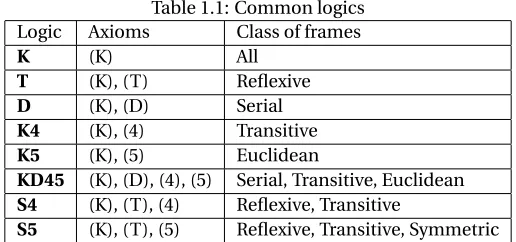
The aforementioned remarks are summarized inTable 1.1. Overall, combinations of these axioms result in logical systems of varying strength that are sound and complete with respect to those classes of frames complying with the analogous combinations of restrictions on the accessibility relation(s). Picking themostappropriate system depends on one’s dispositions and goals.
We only notice that according to the received view (e.g. as inFagin et al.(1995a)) (a) epis-temic models are S5-models, that is models in which the (episepis-temic) accessibility relation is
an equivalence relation (reflexive, transitive and symmetric or equivalently: reflexive and eu-clidean) and (b) doxastic models are KD45-models, that is models in which the (doxastic) ac-cessibility relation is serial, transitive and euclidean. These modelling choices give rise to cer-tain additional properties regarding the interaction between knowledge and belief operators under combined epistemic-doxastic frameworks. In other words, if we assign the proposed qualities to the epistemic and doxastic relations, the following validities easily follow:
• Strong positive introspection of beliefsBφ→K Bφ.
• Strong negative introspection of beliefs¬Bφ→K¬Bφ.
[image:10.612.177.435.279.400.2]• Knowledge implies beliefKφ→Bφ.
Table 1.1: Common logics Logic Axioms Class of frames
K (K) All
T (K), (T) Reflexive
D (K), (D) Serial
K4 (K), (4) Transitive K5 (K), (5) Euclidean
KD45 (K), (D), (4), (5) Serial, Transitive, Euclidean S4 (K), (T), (4) Reflexive, Transitive
S5 (K), (T), (5) Reflexive, Transitive, Symmetric
This is the mainstream logical landscape drawn by the hintikkian approach, heavily influ-enced by the machinery of normal modal logics. As we will see, the seemingly smooth integra-tion of knowledge and belief in this picture faces serious objecintegra-tions.
1.2 The problem
We have seen the main properties of epistemic and doxastic logics. Despite the benefits reaped by exploiting Modal Logic in the formal study of knowledge and belief, there is a certain cost. Theproblem of logical omniscience(identified inHalpern and Pucella(2011),Hintikka(1975),
Moses(1988),Parikh(2008), among others), is an inherent defect of this treatment. It mani-fests itself as follows:
Suppose that an agent at a worldw knows all formulas in a setΨand that Ψlogically impliesφ. Because of the former assumption, all formulas ofΨhold at every world epistemically accessible fromw. Due to the latter assumption,φ holds at these worlds as well. Therefore, the agent knowsφatw.
follow mathematically from a given state of the game and players are aware of the latter, it is not the case that they always play according to the winning strategy; otherwise, many games would be pointless and uninteresting. The performance of real-life agents is inhibited by their limited memory, computational capacity, biases, faulty reasoning etc. That is to say that real-life agents are fallible and resource-bounded, therefore not well accommodated within these settings.
Equally alarming considerations arise from special cases of the full form. In addition, even if certain modifications alter the kind of structures and the notion of truth in a manner that avoids the full problem, the divergence from reality is retained through weaker problematic closure principles. More specifically, all these special and weaker forms are given below, fol-lowing the work ofvan Ditmarsch et al.(2007) andFagin et al.(1995a).
1. Ifφis valid, then the agent knowsφ. (Knowledge of valid formulas)
2. If the agent knowsφandφlogically impliesψ, then the agent knowsψ. (Closure under Logical Implication)
3. If the agent knowsφandφis logically equivalent toψ, then the agent knowsψ. (Closure under Logical Equivalence)
4. If the agent knowsφand also knowsφ→ψ, then the agent knowsψ. (Closure under Material Implication)
5. If the agent knowsφandφ→ψis valid, then the agent knowsψ. (Closure under Valid Implication)
6. If the agent knowsφand also knowsψ, then the agent knowsφ∧ψ. (Closure under Conjunction)
7. If the agent knowsφ, then the agent knowsφ∨ψ. (Closure under Disjunction)
Again, the foregoing can be restated for belief.
Knowledge of all valid formulas is a special case of the full form as validity boils down to logical consequence from the empty set. The discrepancy between the standard treatment and real agents is once again apparent. For example, it is not realistic to expect that agents believe or know every propositional tautology irrespective of its complexity. In the same line of rea-soning, consider Goldbach’s Conjecture3; if it is true, then it is true at all possible worlds and if it is false, then it is false at all possible worlds. As a result, in any case, the correct response to the Conjecture is known by any agent, according to the possible worlds account. In contrast to these predictions, though, Goldbach’s Conjecture remains an unsolved mathematical prob-lem. Yet another illustration of the problem arises from the Closure under Logical Implication, that follows immediately from the full form, as well as from the Closure under Logical Equiv-alence, predicting that an agent knows any formula that is equivalent to a formula she knows. Closure under Material Implication is a weaker principle not necessarily following from the full form. However, it coincides with Closure under Logical Implication in standard modal logic. Closure under Valid Implication is equivalent to Closure under Logical Implication because in
standard modal logicφ→ψis valid precisely whenφlogically impliesψ. Closure under Con-junction and DisCon-junction are special cases of full logical omniscience, if the set{φ,ψ}logically impliesφ∧ψand ifφlogically impliesφ∨ψ– respectively.
Another counterintuitive quality that is nevertheless attributed to agents, at least under systems that contain the axiom (D), is that of Consistency: agents never know/believe bothφ and¬φ. However, in the real-world, cognitively limited reasoners often maintain inconsistent beliefs, whether they realize it or not. More specifically, it has been claimed that agents might even believe a contradictionexplicitlyand consider themselves justified in doing so, as di-aletheistsbelieve that a particular sentence, theliar sentence, is simultaneously true and false (Priest(2006)).
At this point, it is worth noticing that this kind of idealization, as indicated by the afore-mentioned list, is also observed in mainstream attempts of logical modelling on belief change. As also observed in the next chapter, the building block of the predominantAGMapproach (Alchourrón et al.(1985)), thebelief sets, also suffer from closure principles that lead to omni-scient agents. According to this approach, the beliefs of an agent are represented by a set of sentences in a formal language. This set is taken to be closed under logical consequence, i.e. if pis in a belief set andqlogically follows fromp, thenqis already in the set. But of course, this too entails that agents are expected to believe all consequences of their beliefs, thus leading to the undesired properties of the full form of logical omniscience. In addition, if the belief set contains bothpand¬p, i.e. the agent holds some inconsistent belief, then her belief state necessarily collapses to the trivial one, as she is expected to believeeverything. Moreover, fol-lowing the AGM postulates: if two sentencespandqare logically equivalent, then believing the one amounts to believing the other. However, we often revise our beliefs influenced by the mode of presentation and the frame under which the revision takes place. In these cases, we might end up believing the one without believing the other.
Despite the discrepancy between logical predictions and reality, there have been attempts to defend the standard paradigm and view its properties as inevitable or even desired tools. For instance,Stalnaker(1991) andYap(2014) examine reasons that could justify the extent of the idealization. First, this is sometimes defended as the means to reach the mechanisms under-lying the complex theory of knowledge and belief. Motivated by certain examples from other disciplines, e.g. the use of frictionless planes in physics, it has been argued that the isolated study of individual components of larger theories increases our understanding of them, even if we miss out on their interconnections. For example, external forces may be ignored and the realistic picture may be only partially drawn because the internal dynamics tend to move the system in question towards an equilibrium. In this line of reasoning, idealization can be justi-fied by viewing the fallibility of agents as a kind of “cognitive friction” that interferes with the reasoning process yet the latter eventually reaches an equilibrium where perfect rationality is attained. A second reason backing idealization lies in the need for simplification: the cost of distortion is assessed as unimportant when compared to the benefits of simplifying. Thirdly, another source of justification is presented by virtue of normativity: although the standard logics draw an ideal picture, far from the actual inner workings of knowledge and belief, they are still considered acceptable and valuable as they set the standard that rational agentsought tocomply with.
However, these arguments cannot completely alleviate the worries on logical omniscience. To begin with, the distortion induced by the closure principles is not negligible. Resorting to the idealized models of other disciplines seems more like a convenient analogy4. In particular,
there is no reason, theoretical or empirical, to assume that the reasoning process, constantly influenced by external information, ever reaches an equilibrium of spotless rationality. As a re-sult, one cannot do away with logical omniscience by merely suggesting that it poses no threat in the long run. Moreover, considering the descriptive use of epistemic and doxastic logics, the argument for simplicity is ineffective because the extent of the chasm between idealized and real agents is substantial enough to obscure many of the benefits. Apart from the fact that the closure principles are not aligned with ordinary intuitions, there is also concrete evidence that sheds light on actual cognitive states and highlights the extent of the defect. Cognitive science and psychology of reasoning import experimental evidence suggesting that subjects’ perfor-mance in reasoning tasks, e.g. in theWason selection taskor thesuppression task, is not always consonant with logical predictions (Stenning and van Lambalgen(2008)). Furthermore,Parikh
(2008), prompted by Daniel Kahneman’s work on behavioural economics, argues that human belief states are neither consistent nor usually closed under logical inference. In general, the shift from classical to behavioural economics (Kahneman(2003),Simon(1955)) endorses the revision of idealized models of perfect rationality so that limited resources and the framing of decision-making are taken into account. In addition, the experiments discussed inAlxatib and Pelletier(2011) andRipley(2011) show that in certain cases, agents hold – at leastprima facie– inconsistent beliefs. This does not mean that they are “absurd” nor willing to believe ev-erything, as the standard account predicts. Next, appealing to normativity to secure standard epistemic and doxastic logics from objections also faces counterarguments: there seem to be good reasons, for example, to account for the fact that agents do not knowallconsequences of their knowledge even while aiming for a normative model of how weought toreason. That is, acknowledging our own fallibility is often seen as a prerequisite to rationality.Stalnaker(1991) specifically reports on the view that rational agents should believe that some of their own be-liefs are false. Forcing one to commit to models that areeithernon-normativeorrepresenting omniscient agents might as well be a false dilemma. A normative model can still focus on a moderatelyrational agent, who is able to conduct finite chains of inferences avoiding blatant inconsistencies, despite being non-omniscient. Finally, Hintikka’s own understanding of the problem did not presuppose any kind of defense of his standard systems due to normativity:
Logical truths are not truths which logic forces on us; they are not necessary truths in the sense of being unavoidable. They are not truths we must know, but truths which we can know without making use of any factual information. [...] The fact that the so-called laws of logic are not “laws of thought” in the sense of natural laws seems to be generally admitted nowadays. Yet the laws of logic are not laws of thought in the sense of commands, either, except perhaps laws of the sharpest possible thought. Given a number of premises, logic does not tell us what conclusions we ought to draw from them; it merely tells us what conclusions we may draw from them – if we wish and we are clever enough.5
Consequently, there is not enough support to defend the modelling of agents with infinite inferential powers as a means to say how they ought to perform.
We have thus far presented the problem of logical omniscience and emphasized its impor-tance. However, the intuitive considerations and the experimental evidence that dictate the attack against logical omniscience also urge us to demarcate another feature of real agents’
general (see for exampleStokhof and van Lambalgen(2011), for similar considerations). The wider study, that touches upon philosophy of science, is beyond our scope.
epistemic/doxastic states. Although real agents are fallible and non-omniscient, they still are logically competent; their rationality might be bounded but it is not absent. In particular, we often fail in making complex inferences as we lack the necessary time, memory or computa-tional power. Even if these are sufficient, incomplete reasoning or biases interfere with our judgment. Yet, we do engage in bounded reasoning: noticing that it is (once again) raining in Amsterdam, we would normally take our raincoats before leaving home. This is because from our beliefs that (a) it is raining and that (b) whenever it is raining, we need a raincoat, we infer that we should wear the coat and act accordingly. Furthermore, people seemingly hold-ing inconsistent beliefs, are still considered (moderately) rational. We might hold false beliefs without this preventing us from reasoning and operating in the world withoutmuchtrouble. The interdisciplinary empirical data mentioned earlier also contributes to the case for logical competence. For instance, subjects’ performance in the Wason selection task was remarkably improved when it was stated as imitating a familiar social norm (Griggs and Cox(1982)). In
van Benthem et al.(2016), we also encounter a defense of logical competence on the grounds of these task-dependent fluctuations of performance.
Clearly, people are not irrational, and if they ignored logic all the time, extracting the wrong information from the data at their disposal, it is hard to see how our species could survive. What seems to be the case is rather an issue of representa-tion of reasoning tasks, and addirepresenta-tional principles that play a role there.6
In addition, the subjects ofAlxatib and Pelletier(2011) were able to provide good reasons for claiming that a certain suspect is both tall and not tall. Their responses triggered the re-evaluation of classical logic and the extended study of phenomena of vagueness rather than the re-evaluation of the subjects’ mental capacities. Along the same lines, the research on deci-sion theory and economics stresses the importance of the availability of resources, the pursuit of a satisfactory but not always optimal solution, the influence of fallacies in decision-making etc., without suggesting that agents’ activity collapses to irrationality. Therefore, a successful attempt to model actual epistemic/doxastic states presupposes that agents are logically com-petent and more specifically they do not miss out on trivial consequences of what they know or believe.
As a result, logical closure principles, either illustrated in the possible worlds semantics or the purely syntactic belief sets, give rise to the problem of logical omniscience. It is therefore essential to revise the current outlook on logical modelling of propositional attitudes, if we are to capture their realistic effect.
Dynamic Epistemic Logic
Chapter 1discussed the paradigmatic accounts on epistemic and doxastic logic as well as the major problem of logical omniscience. These accounts, however, are purely static; they model knowledge and belief, as held at a particular moment. As a result, they cast aside the con-stant changes of attitudes triggered by both our “internal” mental processes (e.g. performing inferences) and our “external” interactions (e.g. the information exchange that takes place during a discussion). It is therefore clear that merely focusing on a glimpse of an agent’s epis-temic/doxastic state yields a rather limited modelling, that omits real-life actions interfering with our reasoning. Such deficiencies can be treated by using tools fromDynamic Epistemic Logic (DEL), that putsmodel changeunder scrutiny. The vast variety of systems designed within this field allows for modelling of a plethora of attitudes and of multiple phenomena, especially concerning multi-agent settings. Given our purposes though, we only review a se-lection of these1– more specifically those that provide the background for the content of the next chapters – and restrict our attention to the changing states of a single agent.
The general idea is to enrich the standard language by modal operators that correspond to the actions capable of altering an agent’s epistemic or doxastic state. Their effect is then captured viamodel transformations. If a formula is of the form[]φwith[]such an operator, then it is evaluated at a particular world in a model by examining what the truth value ofφis at the transformed model. That is, formulas involving action operators are evaluated by utilizing transitions from the original model, activated by the action of the corresponding operator.
2.1 Public Announcement Logic
In what follows, we summarizePublic Announcement Logic(PAL) (Plaza(2007)), because it offers a clear illustration of the above and provides the foundations to better understand more complex actions as well as the details for some of the proposals ofChapter 3andChapter 4. To begin with, its language is the extension of the standard language with modal operators[ψ!] such that[ψ!]φreads “after the public announcement ofψ,φis true”. The announcement is
thought of as truthful and absolutely reliable; this is the motivation behind the definition of the transformed modelMψ!as a model in which all not-ψworlds are eliminated. Formally:
Definition 2.1.1(Model transformation by public announcement). Given a Kripke modelM= ⟨W,R,V⟩, its transformation by !ψis a modelMψ!= ⟨Wψ!,Rψ!,Vψ!⟩where:
• Wψ!= {w∈W∣M,w⊧ψ}
• Rψ!=R∩(Wψ!×Wψ!)
• Vψ!(p) =V(p)∩Wψ!
The truth clauses are then supplemented with the extra clause:M,w⊧ [ψ!]φif and only if M,w /⊧ψorMψ!,w⊧φ. The first part of the clause is such to obey the restriction totruthful announcements: if the announced sentence is false, then[ψ!]φis vacuously true.
It can be shown that the addition of the following axioms and rule to the axioms and rules ofS52results in a sound and complete axiomatic system. These axioms are often called re-duction axioms, for they reduce the complexity of formulas with announcements. Indeed, we can gradually end up with formulas that do not involve announcements at all, i.e. formulas of our basic language. Subsequently, the completeness of PAL follows immediately from the completeness ofS5.
• [ψ!]p↔ (ψ→p)
• [ψ!]¬φ↔ (ψ→ ¬[ψ!]φ)
• [ψ!](φ∧χ) ↔ ([ψ!]φ∧[ψ!]χ)
• [ψ!]Kφ↔ (ψ→K([ψ!]φ))
• Fromφinfer[ψ!]φ
The above can be easily adapted for frameworks involving belief.
A subtle point that is worth a remark is that announced sentences do not always preserve their truth valueafterthe announcement. The most prominent case in point isMoore formu-las, such asp∧¬B p: it is not hard to see why the very announcement of this defeats its truth. Moore formulas then indicate that PAL is not closed under substitution.
With this illustration in mind, we only emphasize that it is possible to generalize the in-tuition behind action-induced change and thus study more sophisticated real-life scenarios. This has been achieved due to the construction ofaction modelsandproduct updates, intro-duced inBaltag et al.(1998).
2.2 Belief change and plausibility models
Dynamic Epistemic Logic also incorporates ideas from Belief Revision. According to theAGM theory(Alchourrón et al.(1985)), an agent’s beliefs are given by a logically closed set of sen-tences, her belief set. This belief set might be expanded, contracted or revised, in the face of
2The same holds if we substituteS5with other appropriate systems – appropriate, in the sense of being sound
new information, represented by a sentenceφ. The corresponding operations,expansion, con-traction, andrevisionare ruled by theAGM postulates. However, their status is controversial, as they too suffer from concerns on their adequacy in capturing realistic belief change.
Until now we have elaborated on the effect of public announcements. It is natural to think of them as a kind of expansion, given that the elimination of worlds results in an enrichment of the agent’s factual knowledge, an idea investigated invan Ditmarsch et al.(2004). Yet one may come up with examples of incoming information such that the basic view of expansion does not suffice; in particular, if the announced sentence contradicts existing beliefs, then the agent ends up believingeverything. In order to deal withchangingbeliefs, DEL primarily relies onplausibility models(Baltag and Smets(2008)). These allow us to express various grades of knowledge and belief. Importantly,conditional beliefsexpress what is believed, depended on certain incoming pieces of information, and in this way, they manage to modelstatic belief change, that is, belief change in a non-changing situation.
Definition 2.2.1(Plausibility model). Aplausibility model Mis a structure⟨W,≥,V⟩where:
• W is a non-empty set of worlds.
• ≥is alocally well-preordered relationonW, such thatw≥ureads “wis considered no more plausible thanu”.
• V is a valuation such that each propositional atom from a given setΦis assigned to the set of worlds where it is true.
Abbreviations such as>,≤,<are defined as usual; for example, we will usew<uto say thatu≥w andw /≥u with the slash denoting a negated relation. In order to make precise the notion of alocally well-preordered relation, first consider the binary relation∼onWsuch that forw,u∈W:w∼uif and only ifw(≥ ∪ ≤)∗u. Thenlocal connectedness3amounts to: if w∼uthenw≥uoru≥w. Converse well-foundednessamounts to: for each non-empty set P⊆W, the set of its minimal elements (i.e.mi n(P) ∶= {w∈P∣ ∀u∈P∶u/<w}) is non-empty. Bringing together reflexivity, transitivity, local connectedness and converse well-foundedness, we obtain the definition of a locally well-preordered relation. The intuitive appeal of reflexivity and transitivity is obvious, given the reading of≥. Local connectedness is invoked to say that the agent should be able to assign a relative plausibility between any two worlds considered possible. Converse well-foundedness is imposed to avoid infinite chains of more and more plausible worlds; being able to retrieve the set of “the most plausible worlds” is instrumental for the definitions that follow.
In order to describe other attitudes, we supplement the standard epistemic language with a modal operator◻such that◻φstands for “φis defeasibly known by the agent”. Defeasible knowledge(orsafe belief) is a weaker notion distinguished from the ordinaryK reading, dis-cussed inLehrer and Paxson(1969),Lehrer(2000) and formalized inStalnaker(2006). While K denotes an infallible and irrevocable kind of knowledge, that persists even in the face of false incoming information, defeasible knowledge only persists in the face oftrueincoming information4. The semantics, in terms of plausibility models, is given by:
3In simplified settings, we could simply imposeconnectednesson≥, that would amount tow≥uoru≥w, for
everyw,u∈W, and thus obtain a definition of∼in terms of these two cases.
4Lehrer’sjustification game, as inLehrer(2000) andFiutek(2013) is illustrative for the study of defeasible
Definition 2.2.2(Semantics-plausibility models).
• M,w⊧pif and only ifw∈V(p).
• M,w⊧ ¬φif and only ifM,w /⊧φ.
• M,w⊧φ∧ψif and only ifM,w⊧φandM,w⊧ψ.
• M,w⊧Kφif and only ifM,u⊧φfor allu∈Wwithw∼u.
• M,w⊧ ◻φif and only ifM,u⊧φfor allu∈W withu≤w.
Furthermore, belief can be also accommodated within this setting. As promised earlier, we can talk about the agent’s conditional beliefs, denoted byBψφand interpreted as “the agent believesφ, conditional onψ”. Conditional belief can be given as an expression involving the dual ofK ( ˆKφ∶= ¬K¬φ) and◻as follows: ˆKψ→Kˆ(ψ∧ ◻(ψ→φ)). Its corresponding truth clause can be obtained in a simple way by:
M,w⊧Bψφif and only ifM,u⊧φfor allu∈mi n{u∈W∣w∼u∧u∈ [[ψ]]}
with[[ψ]]denoting the set of worlds whereψis true.
It is then easy to view plain belief as a special case of conditional belief, and more specifi-cally asB⊺φ; since⊺is always true,Bφamounts tounconditionalbelief ofφ. Then naturally:
M,w⊧Bφif and only ifM,u⊧φfor allu∈mi n{u∈W∣w∼u}
Given that conditional, and thus plain, belief is expressible in terms ofKand◻, it has been shown (Baltag and Smets(2008)) that a sound and complete axiomatization (with respect to the class of pointed plausibility models) for this variety of notions is obtained by:
• TheS5 axiom schemes and rules forK.
• TheS4 axiom schemes and rules for◻.
• Kφ→ ◻φ.
• K(◻φ→ψ)∨K(◻ψ→φ).
2.3 Dynamic belief change due to hard and soft information
Turning to the dynamics of plausibility models, the account of public announcements, as sources of hard information, can be adapted for plausibility models too.
Definition 2.3.1(Plausibility model transformation by public announcement). Given a plau-sibility modelM= ⟨W,≥,V⟩, its transformation byψ! is a modelMψ!= ⟨Wψ!,≥ψ!,Vψ!⟩where:
• Wψ!= {w∈W∣M,w⊧ψ}
• ≥ψ!=≥ ∩(Wψ!×Wψ!)
The truth clause for sentences of the form[ψ!]φis then given in the same spirit as above. A sound and complete axiomatization can be obtained by supplementing the axiom schemes and rules of any static logic corresponding to the model class we are interested in, and the PAL reduction axioms mentioned above, with a reduction axiom for defeasible knowledge5.
[ψ!]◻φ↔ (ψ→ ◻(ψ→ [ψ!]φ))
However, real-life interaction does not only involve truthful and absolutely reliable infor-mation. For example, cases in which the source is partially trusted are suggestive of actions bringing along “softer” information, that only changes our beliefs but not our knowledge. This is whyvan Benthem(2007) suggested other policies of belief change. Plausibility models, which offer a more detailed outlook to the states of the agent, enable us to study the effect of such actions. The main idea is that soft information cannot really eliminate a world. Rather, it changes the plausibility ordering so that the incoming information is somehow “prioritized”, without altogether discarding the other possibilities. For our purposes, we will focus on the revision operation ofradically upgradingwithψ(ψ⇑), that rearranges worlds in a way that renders allψ-worlds more plausible than all¬ψ-worlds, and leaves intact the ordering within these two zones6. Given that our language is suitably extended with operators[ψ⇑], the fol-lowing definition leads to the truth clause for[ψ⇑]φ:
Definition 2.3.2(Model transformation by radical upgrade). Given a plausibility modelM= ⟨W,≥,V⟩, its transformation byψ⇑is a modelMψ⇑= ⟨Wψ⇑,≥ψ⇑,Vψ⇑⟩where:
• Wψ⇑=W
• ≥ψ⇑= (≥ ∩(W×[[ψ]]))∪(≥ ∩([[¬ψ]]×W))∪(∼ ∩([[¬ψ]]×[[ψ]])
• Vψ!(p) =V(p)
Then,M,w⊧ [ψ⇑]φif and only ifM[ψ⇑],w⊧φ.
We can obtain a complete axiomatization (van Benthem(2007),van Ditmarsch et al.(2015)) for the dynamic logic of radical upgrade by augmenting any complete axiomatization on the static models by the following reduction axioms and rule:
• [ψ⇑]p↔p
• [ψ⇑]¬φ↔ ¬[ψ⇑]φ
• [ψ⇑](φ∧χ) ↔ [ψ⇑]φ∧[ψ⇑]χ
• [ψ⇑]Kφ↔K[ψ⇑]φ
• [ψ⇑]Bχφ↔ (Kˆ(ψ∧[ψ⇑]χ)∧Bψ∧[ψ⇑]χ[ψ⇑]φ)∨(¬Kˆ(ψ∧[ψ⇑]χ)∧B[ψ⇑]χ[ψ⇑]φ)
• Fromφ, infer[ψ⇑]φ
5Reduction axioms for conditional beliefs can be analogously obtained. We confined ourselves to◻, given the
way conditional beliefs were defined in terms ofKand◻. Consultvan Ditmarsch et al.(2015), Chapter 7, for logics built on conditional beliefs.
6Radical (or lexicographic) upgrade is widely discussed invan Benthem(2007), and it is also representable with
Dealing with the problem: a critical survey
In this chapter, we examine prominent attempts to cope with the problem of logical omni-science. The examination is structured according to the following classification:
• Syntactic approaches.
• Approaches that propose a distinction betweenimplicitandexplicitattitudes, invalidat-ing the problematic closure principles with respect to the latter. These comprise aware-ness structures,algorithmic structures,justification logicsandlogics of justified knowl-edge and belief.
• Impossible-worlds frameworks, that extend the usual set of worlds with impossibilities. Such approaches are divided into: elementary ones, involving worlds that are either not closed by any notion of logical consequence or (only) closed under some non-classical notion of logical consequence; Jago’s approach as described inJago(2014), imposing a suitable structure on the epistemic space; the attempt ofRasmussen and Bjerring(2015) who aim at a dynamic framework that traces the evolution of an agent’s reasoning pro-cess.
Apart from explaining each proposal’s contribution1towards the solution of the problem, we also comment on their adequacy according to both general criteria and proposal-specific objections. The major general criterion of our evaluation is testing whether the avoidance of logical omniscience is accompanied by an overall attractive modelling of agents’ bounded, but not absent, rationality. That is, merely escaping the forms of the problem does not suffice; an attractive approach should also reflect that agents are (moderately) logically competent. In fact, what we want to avoid is non-omniscience collapsing into total irrationality and igno-rance. We are hesitant to accept that one might fail in knowing even the most trivial conse-quences of what she knows. Of course, strictly determining what can count as “trivial” con-sequence is not an easy task, especially given thatanyinference can be unfolded as a chain
1In doing so, we will remain faithful to the descriptions as found in the literature. However, slight modifications
consisting of “easy”steps. Despite the vague nature of the notion of moderate logical compe-tence, we still value its integration into a proposed framework, at least from a normative point of view: it represents how agentsought toperform. Another criterion emerges if we further assess the explanatory power in capturing these subtle differences. In other words, we want to see whether the approaches are intuitively plausible and aligned with our understanding of what actually goes on whenever real agents reason. For example, a technically sufficient so-lution that nonetheless relies on ad-hoc and not independently motivated assumptions and modifications should not be considered entirely successful. Besides, resolving the problem per se would not have required extreme effort if we had just tweaked the semantics of the standard systems in accordance with the very goal of destroying the unwelcome closure prin-ciples. However, in that case, in the absence of any (other) concrete incentive to motivate the modification, it is doubtful whether the result would pertain to the propositional attitudes we examine, at least in a meaningful manner. Furthermore – and unsurprisingly – finding a way out of the problem often requires the introduction of additional machinery. The danger then lurks in obtaining new or weaker forms of logical omniscience with respect to these newly introduced elements. It is therefore worth checking whether logical omniscience is avoided without simultaneously generating further problems.
3.1 Syntactic approaches
3.1.1 Syntactic structures
The main idea behind this syntactic approach, described inEberle(1974),Fagin et al.(1995a),
Halpern and Pucella(2011), is to identify the agent’s epistemic state with the set of formulas that she knows, at each possible world2. Indeed, weexplicitlylist these formulas at a primitive level, without relying on the usual recursive definition and thus on the epistemic accessibility relation. More concretely:
Definition 3.1.1(Syntactic structure). Asyntactic structure⟨W,C⟩is a pair consisting of a set of worldsW and a valuation functionCthat assigns truth values toallformulas at all worlds.
The crucial difference from standard Kripke models is that the truth values of compound formulas are determined directly from the syntactic valuationC instead of being computed recursively, based on the valuation of atomic formulas. As a result, syntactic structures can be considered generalizations of standard Kripke models as accessibility relations are no longer relevant in obtaining the truth value of formulas such asKφ. In this case, we can view each Kripke model⟨W,R,V⟩as a syntactic structure⟨W,C⟩such thatC(w)(φ) =1 wheneverM,w⊧ φ.
It is not hard to see how the syntactic approach deals with all forms of the problem. First and regarding the full form, the value ofKφis not affected by the truth values of the formulas inΨnor by the Logical Implication fromΨtoφ. More specifically,Knowledge of valid formu-lasfails because the construction of the valuation function could be such that the truth values ofφandKφdiverge.Closure under Logical Implication,Closure under Material Implication, Closure under Valid Implicationlikewise fail because the value ofKψcan be suitably tailored.
2A doxastic counterpart of this approach can be easily obtained. Belief may just replace knowledge in what
The truth values ofKφandKψdo not have to agree, just becauseφandψare logically equiv-alent, thereforeClosure under Logical Equivalencemight fail. The values ofKφandKψdo not put any constraints on the values ofK(φ∧ψ)andK(φ∨ψ), thus avoidingClosure under ConjunctionandClosure under Disjunction. Finally, we can also invalidate the consistency of knowledge, i.e. ¬K(φ∧ ¬φ), by considering the independence of values betweenφ∧ ¬φand
¬K(φ∧¬φ).
Given that our prime interest lies in invalidating the closure principles, we might want to preserve the standard account as far as propositional connectives are concerned. It is therefore reasonable to impose constraints such as (a)C(w)(¬φ) =1 if and only ifC(w)(φ) =0, and (b) C(w)(φ∧ψ) =1 if and only ifC(w)(φ) =1 andC(w)(ψ) =1.
However, the syntactic response to the problem is not entirely satisfactory, despite avoid-ing all forms of it. Even by imposavoid-ing the constraints and given the connection to the standard epistemic models, it cannot describe any interesting property of knowledge and belief. The only formulas that are valid in such structures are propositional tautologies. By assigning ar-bitrary truth values we indeed avoid the problem but our understanding of propositional atti-tudes is not facilitated because no interesting philosophical benefits can be reaped from this kind of formalization. More importantly, since knowledge or belief assertions are assigned truth values arbitrarily, there is nothing to ensure that agents know or believe at leastsome consequences of what they know or believe, thus the desideratum on capturing logical com-petence is not fulfilled. Had we attempted to preserve the epistemologically interesting prop-erties or add desired elements of a realistic portrayal via suitable modifications of the syntactic valuation, we would have ended up with an ad-hoc, artificial and unnatural embedding of the standard modelling device in the syntactic structures. This obviously lacks independent mo-tivation and presupposes an acknowledgement of the superiority of the standard epistemic-doxastic systems, which goes against the very project of proposing a fuller and more attractive alternative.
3.1.2 Rasmussen
Another syntactic attempt, now constructing a dynamic logic whose axiomatization is such to escape the problem, is described inRasmussen(2015). The author emphasizes that the source of the problem lies in the difficulty to jointly satisfy the following two requirements:
(R1) The knowledge of resource-bounded agents is not closed under any non-trivial logical law (Non-Closure).
(R2) If a resource-bounded agent knows the premises of a valid inference and knows the rel-evant inference rule, then, given sufficient resources, the agent can infer the conclusion (Non-ignorance).
avoiding a form of omniscience, the rule “fromφinfer⟨Fi⟩Kiφ” is derivable, thereby show-ing that agents can indeedcome to knowvalidities butonlyif they think “hard enough”. Ras-mussen expands this idea, aiming at a full description of an agent’s reasoning process. This task boils down to accounting for (i) the specific applications of inferences rules involved in a reasoning process, (ii) the chronology of these applications of inference rules, (iii) the cog-nitive cost of each application of an inference rule. With this observation in mind, the logical languageLD(Φ), and the axiomatization of the proposed logicLDare defined as follows:
Definition 3.1.2(LanguageLD(Φ),Rasmussen(2015)). The languageLD(Φ)is defined in-ductively from a set of atomic sentencesΦ, a knowledge operatorK, and a set of dynamic operators⟨Ri⟩λifor 1≤i≤nas follows:
φ ∶∶= p ∣ ¬φ ∣ φ→φ ∣ Kφ ∣ ⟨Ri⟩λi
withp∈Φ.
The dual modality[Ri]λiφis defined as¬⟨Ri⟩λi¬φ. Then,⟨Ri⟩λiφintuitively reads “φis the case aftersomeapplication ofRi at cognitive costλi”, with “any” replacing “some” for the dual case. Cognitive costs can be thought of as natural numbers.
In order to present the axiomatization, the following abbreviations are used to denote ar-bitrary sequences of dynamic operators3:
⟨‡⟩i∶= ⟨Ri⟩λi. . .⟨Rj⟩λj [‡]i∶= [Ri]λi. . .[Rj]λj
whereRi, . . . ,Rj are arbitrary inference rules andi =λi+. . .+λj. The first abbreviation intuitively says that “after some application ofRi at cognitive costλi followed by . . . followed by some application ofRj at cognitive costλj,φis the case. For the intuitive reading of the second abbreviation, again replace “some” by “any”.
Definition 3.1.3(Axiomatization ofLD,Rasmussen(2015)). Letφ,ψ∈ LD(Φ),Γ⊆ LD(Φ), and ⟨‡⟩i,⟨†⟩j (also,[‡]i,[†]j) denote arbitrary sequences of dynamic operators. The logicLDhas the following axiom schemes:
• (PC) All substitution instances of propositional tautologies.
• (A1)⟨‡⟩iKφ→φ(Veridicality)
• (A2)⟨‡⟩iKφ→ ⟨‡⟩i[†]jKφ(Persistence)
• (A3)⟨‡⟩iφ∧⟨†⟩jψ→ ⟨‡⟩i⟨†⟩j(φ∧ψ)(Succession)
• (A4)⟨‡⟩i(φ∧ψ) → ⟨‡⟩iφ(Elimination)
LDhas the following inference rule:
• (MP) IfΓ⊢φandΓ⊢φ→ψthenΓ⊢ψ.
It is evident that for a doxastic framework, axiom (A1) might be dropped at it only imi-tates the veridicality axiom (T) usually adopted for standard epistemic systems. (A2) says that known sentences remain known as reasoning progresses. This still presupposes two idealizing assumptions (a) on agent’s infallible memory, and (b) on sentences preserving a truth value throughout the whole reasoning process. (A3) is imposed to express that a reasoning process can succeed another, and finally yield the conjunction of their outcomes. (A4) simply states thatφis the case after a reasoning process if bothφandψare the case after it.
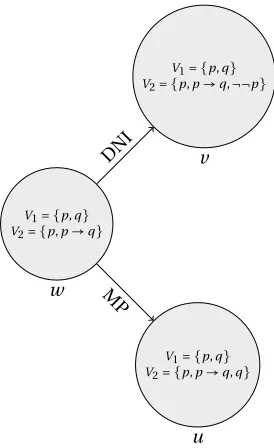
An extension ofLD, denoted byLΛD, comprises appropriate axioms for specific inference rules from a setΛ, with which the agent is equipped. For illustrative purposes, consider Modus Ponens (M P), Conjunction Introduction (C I) and Double Negation Elimination (D N E), as the inference rules inΛ. The main idea behind the axiomatization is that the agent can come to know certain formulas with the additional cognitive cost of applying an inference rule. For example, if the agent knowsφandφ→ψthen the agent can deriveψby applying Modus Ponens at a particular cognitive cost. Using the abbreviation∆∶=φ∧. . .∧ψto denote arbitrary conjunctions in the language,LΛDis axiomatized as follows:
Definition 3.1.4(Axiomatization ofLΛD,Rasmussen(2015)). LetΛ= {M P,C I,D N E}and let∆ be an arbitrary conjunction of sentences inLD(Φ). Furthermore, letµ,κ,νdenote the cogni-tive costs ofM P,C I,D N Erespectively.LΛDextendsLDwith the following axiom schemes:
• (M PD)⟨‡⟩i(∆∧Kφ∧K(φ→ψ)) → ⟨‡⟩i⟨M P⟩µ(∆∧Kφ∧K(φ→ψ)∧Kψ)(M P -success)
• (C ID)⟨‡⟩i(∆∧Kφ∧Kψ) → ⟨‡⟩i⟨C I⟩κ(∆∧Kψ∧Kφ∧K(φ∧ψ))(C I -success)
• (D N ED)⟨‡⟩i(∆∧K¬¬φ) → ⟨‡⟩i⟨D N E⟩ν(∆∧K¬¬φ∧Kφ)(D N E -success)
Of course, the same pattern can be generalized for any inference ruleR with premises φ1, . . . ,φnand conclusionψ, and a cognitive costλ:
(RD) ⟨‡⟩i(∆∧Kφ1. . .∧Kφn) → ⟨‡⟩i⟨R⟩λ(∆∧Kφ1. . .∧Kφn∧Kψ)
The following theorem of the extended logic essentially distinguishes Duc’s logic fromLΛD and manifests the accuracy of this framework in describing reasoning processes:
Theorem 3.1.1(Application,Rasmussen(2015)).
K¬¬φ∧K(φ→ψ) → ⟨D N E⟩ν⟨M P⟩µ⟨C I⟩κK(φ∧ψ)
is a theorem ofLΛD.
The theorem illustrates the dynamic nature of reasoning by keeping track of the applica-tions of the inference rules, their chronology and their cognitive costs. Additionally, it does so by taking into account the complexity of an agent’s deduction. That is, unlike Duc’s system, we can account for the fact that not all deductions are equally hard and the evolution of reasoning is thus described in a more elaborate way.
consider thatΛ≠ ∅; taking an arbitrary inference ruleRwith premisesφ1, . . . ,φnand conclu-sionψ, theR-closureKφ1∧. . .Kφn→Kψis not a theorem of our logic because ifR∈Λ, then its corresponding axiom is of the form:
⟨‡⟩i(∆∧Kφ1∧. . .Kφn) → ⟨‡⟩i⟨R⟩λ(∆∧Kφ1. . .Kφn∧Kψ)
which says that the agent needs toreasonto attain knowledge ofψ, unlikeR-closure which dictates that whenever the agent knowsφ1, . . . ,φn, she automatically knowsψ, too. IfR/∈Λ then the result trivially holds. On the other hand,Non-ignoranceis satisfied because the axiom does predict how, given sufficient resources, the agent can derive the relevant conclusion.
Interestingly, this approach captures both non-omniscience and non-ignorance. Of course, syntactic manipulations, and in particular the introduction of cognitive costs, allow us to mod-ify the system as we please. Yet the problem is usually semantically retained because it is pre-cisely the commitment to a notion of truth that poses the challenge. By merely modifying the axioms, without providing semantics, it seems that Rasmussen bites the bullet. In particular, it is easy to see that no trivial possible-worlds framework could work. That is, how a model would change as the outcome of an application of sequences of inference rules is not a trivial matter. What can make it even more challenging is capturing what the effect of different – quantitative – cognitive costs would be on such a model. Obtaining the validity of the proposed axioms and theorems then remains an open issue. This renders the choice of axioms somewhat controver-sial: why aretheseformulas the most appropriate to capture the desired features of reasoning? What is more, and again in the absence of the useful properties of possible-worlds seman-tics, we miss out on interesting properties about knowledge and belief. Moreover, the way the desideratum on agents’ rationality is stated, i.e.Non-ignorance, raises suspicion about its ade-quacy. Although it is tailored in a way that matches the subsequent axiomatization4, there are reasons to assume that even when given sufficient resources, e.g. infinite time, agents will still be fallible. For example, they might just be biased or reluctant to reason according to the logi-cal rules. In this sense, it is worth emphasizing that Rasmussen sheds light merely on what an agentcando – what is in principle affordable when certain resources are available – and what the agent cannot do – when running out of those. The axiomatization, though, says little on what an agentought to do, in general. Despite the normative nature of the notion of compe-tence as suggested in the beginning of this chapter, Rasmussen’s characterization and solution remain largely descriptive. All in all, his approach only partially overcomes the problem.
3.2 Implicit versus explicit attitudes
It has been argued that the problem of logical omniscience is in fact an indication for a dis-tinction betweenimplicitandexplicitpropositional attitudes. For example,Levesque(1984) suggests that closure principles do not refer to what weactuallyknow or believe but rather to another kind of concept: what is implicit in what we know or believe, even without us realizing it.
[. . . ] if an agent imagines the world to be one whereαis true and ifαlogically impliesβ, then (whether or not he realizes it) he imagines the world to be one
4This might even exacerbate our worries on the explanatory power and motivation underlying the axioms; an
whereβalso happens to be true.5
In addition, the distinction between implicit and explicit attitudes is endorsed by results in psychology. For example, it has been documented (Schacter(1987),Schacter and Tulving
(1994)) thatimplicit memoryaffects our performance as we resort to our accumulated experi-ence without making a conscious recall, unlikeexplicit memorythat usually involves a delib-erate and conscious act of recall. One could therefore argue that there are different shades of knowledge, corresponding to different ways it can be acquired.
In any case, we need to tell apart what is explicitly, directly known/believed by an agent and what the world would be like if what she knows/believes was true, even if its consequences are not consciously accessible to her. The approaches below promise to model this difference and show that logical omniscience is overruled with respect to the former while remaining an unproblematic, and even desired, feature with respect to the latter.
3.2.1 Awareness
One of the ways that have been proposed to formally capture this distinction is based on the notion ofawareness. According to this view, as presented inFagin and Halpern(1987) and
Fagin et al.(1995a), agents are not logically omniscient because they cannot believe/know things they are not aware of. In order to account for the concepts that the agent is aware of, the standard single-agent language is supplemented with an operatorAsuch thatAφreads “the agent is aware ofφ” and, also, with an operatorKesuch thatKeφreads “the agent explicitly knowsφ”. Next, our familiar models are enriched by an additional component:
Definition 3.2.1(Awareness structure,Fagin et al.(1995a)). Anawareness structureis a Kripke modelMaugmented by an awareness functionA, i.e. a tuple⟨W,R,V,A⟩, such thatA asso-ciates a set of formulas from our extended language with each worldw∈W. Intuitively, this set is the set of all formulas that the agent is aware of atw.
The awareness function behaves arbitrarily; for instance, an agent might be aware of both φand¬φ, or aware ofφ∧ψbut unaware ofφ. Once we obtain these new structures, we can turn to the truth clauses ofAφandKeφ.
Definition 3.2.2(Semantics for awareness,Fagin et al.(1995a)). The definition and notation follow that ofDefinition 1.1.3, only now supplemented with:
• M,w⊧Aφif and only ifφ∈ A(w).
• M,w⊧Keφif and only ifM,w⊧KφandM,w⊧Aφ.
Unsurprisingly, for the case of beliefBeφ(once the operatorsBeandB are added to the language to denote explicit and implicit belief ) we substituteKφwithBφin the last clause, i.e. Beφboils down toBφandAφ.
Consequently, while implicit knowledge remains subject of the closure principles that yield logical omniscience, the problem can be avoided in its explicit form. For example, if an agent explicitly knowsφ, andφlogically impliesψ, then it need not be that she explicitly knowsψ; althoughKψstill holds, it might be thatψ/∈ A(w)for some world of the model. Likewise, not all valid formulas are explicitly known/believed as an agent might not be aware of them.