Volume 21(3), 8- 14, 2017
JOURNAL of Horticulture, Forestry and Biotechnology www.journal-hfb.usab-tm.ro
8
Extraction of phenolic compounds from organic dried apples:
comparison
between
conventional,
microwave-
and
ultrasound-assisted extraction methods
Stan
Andreea
1, Bujor Oana-Crina
1, Badulescu Liliana
2*1Research Center for Studies of Food Quality and Agricultural Products, Bucharest; 2University of Agronomic
Sciences and Veterinary Medicine Bucharest
Corresponding author: [email protected]
Abstract The aim of this study was to compare a conventional assay with microwave- (MAE) and ultrasound- (UAE) assisted extraction methods on the extraction of phenolic compounds from organic dried apples by evaluating the content in catechin, epicatechin, chlorogenic acid and quercitrin. Samples from two apple varieties (Golden Rush and Topaz) were analyzed. Methanol/water (70:30, v/v) was selected as the solvent mixture for the phenolic compounds extractions. The High Performance Liquid Chromatography coupled to diode array detection (HPLC-DAD) were used for the identification and quantification of the respective phenolic compounds.
Qualitative analysis revealed similar phenolic profiles in both apple varieties. Whatever extraction method is used, in both apple varieties chlorogenic acid and epicatechin were present in higher contents compared to catechin and quercitrin with chlorogenic acid being the major contributor. It was found a better extraction of chlorogenic acid, catechin and quercitrin (only for Topaz apple) using conventional process in comparison with MAE and UAE. A higher content of quercitrin was obtained with MAE and UAE compared to conventional method. The content of phenolic compounds in Golden Rush apple was higher than in Topaz apple.
Results from this study indicated that conventional extraction can be a more efficient process than MAE and UAE for the extraction of phenolic compounds from organic dried apples.
Key words
extraction, organic dried
apples, phenolic
compounds
Apples (Malus domestica) represent one of the
most widely cultivated variety [3]. Although the chemical composition of apples has been extensively investigated [10, 11]. The phenolic content of apples is influenced by variety, maturity, harvesting moment, processing, conditions of the culture, crop load, infection development, fruit position within and geographic origin [6-9].
Phenolics are involved in the defense mechanism in apple against fungal pathogens such as Venturia sp., Gloeosporium sp., Sclerotinia fructigena, and Botrytis cinerea. Infection of apple tissue brings about an increase in polyphenol oxidase activity leading to acceleration of polyphenol oxidation. Thus, the oxidation products of polyphenols play an important role in apple tissues’ resistance to pathogens [6, 7]. Polyphenols attract considerable interest because of their ubiquitous occurrence within the plant kingdom and their numerous important properties, related to their high structural diversity [13, 14]. The polyphenols found in apples in the majority of scientific papers are (+)-catechin, (‒)-epicatechin, chlorogenic acid, procyanidine B1 and B2, phloridzin,
rutin, p-coumaric acid, quercetin-3-O-rhamnoside [1,
12, 17, 18, 19, 20, 21, 22, 23, 2]. Owing the acidic character of their hydroxyl groups and the nucleophilic properties of the phenolic rings, these molecules are highly reactive and undergo various types of reactions in the course of food processing and storage [15, 16].
Due to
the structural diversity and complexity of phenolic
compound in plants, extraction is the first and the most important step in the separation and characterization of these compounds. The most common liquid/liquid and solid/liquid extractions are frequently employed to separate phenolic compounds. At present, regarding the overall environmental impact of an industrial extraction, the unconventional extraction methods such
as microwave- (MAE) and ultrasound- (UAE) assisted
extractions, supercritical fluid extraction (SFE), pressurized fluid extraction (PFE) or accelerated solvent extraction (ASE) are applied actually to separate phenolic compounds [5].
phenolic compounds from organic dried apples by evaluating the content in catechin, epicatechin, chlorogenic acid and quercitrin.
Materials and Methods
Two varieties of organic apples like Golden Rush and Topaz were harvested at the optimal harvest time stage from the experimental organic orchard of University of Agronomic Sciences and Veterinary Medicine (UASVM) from Bucharest in October 2017. Until their analysis, apples were stored in cold room at 3°C and 85% relative humidity in Laboratory of Postharvest Technologies form Research Center for Studies of Food Quality and Agricultural Products from UASVM Bucharest.
Sample preparation
Prior to drying, apples from each variety were washed and sliced into circular discs without stalks and seeds, using a hand-operated slicer. After that apple slices were immediately blanched in tap water at 95°C for 1.5 minutes and then dried for 6 hours at 40 °C until dry matter of the samples was 85% and moisture content 15%. Drying process was performed using an Excalibur household dryer.
Chemicals
All used solvents, standards and reagents were of analytical grade. Acetonitrile was obtained from Merk (KgaA, Darmstadt,Germany), methanol from Riedel-de-Haun (Muskegen, Germany), formic acid from Sigma-Aldrich (GmbH, Germany). The
(+)-catechin, (‒)-epicatechin and quercitrin (quercetin-3-O
-rhamnoside) standards were purchased from
Extrasynthese (Genay, France), chlorogenic acid from Sigma-Aldrich (GmbH, Germany). Water used in the study was produced with the Milli-Q Direct Water Purification System (Millipore SAS, France).
Extraction
To an amount of 0.25 g of dried apple was added 10 mL of 70% aqueous methanol ( v/v) [3], and extracted through conventional (C), microwave- (MAE) and ultrasound- (UAE) assisted methods. The conventional extraction method consist in maceration of the 0.25 g of dried apples chopped with 2 mL of 70% methanol for 24 hours in dark and room temperature (aprox. 21°C). After maceration the sample were homogenized in the presence of quartz sand, then were quantitatively passed into 15 ml centrifuge tubes using the remaining 8 mL and then
The microwave- (MAE) assisted extraction was performed using the same extraction conditions
described for UAE (0.25 g of dried apple and 10 mL
of 70% methanol ) in a Advanced Microwave Digestion System at 70°C,at a power of 700 watts, for 30 minutes.
All the obtained extract were filtered through a 0.2 µm PFTE Agilent filter before HPLC analysis.
Instrumentation and Chromatographic
Conditions
Phenolic compounds analysis was realized through High Performance Liquid Chromatography (HPLC) using the adapted method from Xie et. al., 2011 [4].
An Agilent Technologies 1200 chromatograph equipped with an UV-DAD detector was used for HPLC analysis. All the data were recorded and processed with the Agilent ChemStation B.04.03 software (Agilent, USA). Chromatographic separation of compounds were performed using an Agilent Zorbax Eclipse Plus C18 (4.6 x 150mm, 5 µm i.d.) column coupled with a XDB C18 (4.6 x 12.5mm, 5 µm i.d.) analytical guard column (Agilent, USA). The temperature of the column during analysis was kept at 20°C, the injection volume was 5 µl. A binary solvent system was used with solvent A (0.1% formic acid in water, v/v) and solvent B (acetonitrile) with the
following elution gradient: 0-4 minutes, 10% B; 4-10
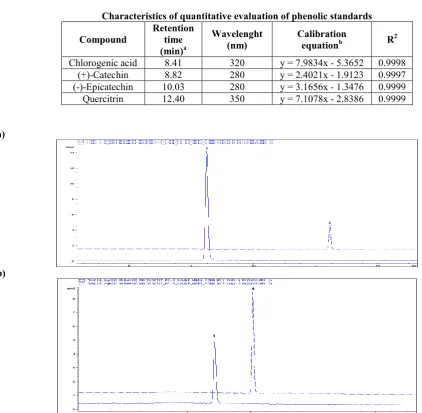
minutes, 10-30% B; 10-18 minutes, 30-10% B; and 18-20 minutes, 10% B, at a flow rate of 1 mL/min. The chromatographic peaks were identified by comparing the spectral caracteristics and retention times (190 - 400 nm) with those of standards. A calibration curve was obtained through injection of known and different concentration of standards, in order to perform the quantitative analsis of samples. Absorbance was measured at 280 nm, 320 nm and 350 nm.
All samples were analyzed in triplicate after independent sample extraction.and standard deviantion was calculated using incorporated function of Microsoft excel.
Results and Discussions
10
Table 1
Characteristics of quantitative evaluation of phenolic standards
Compound Retention time
(min)a
Wavelenght
(nm) Calibration equationb R2
Chlorogenic acid 8.41 320 y = 7.9834x - 5.3652 0.9998
(+)-Catechin 8.82 280 y = 2.4021x - 1.9123 0.9997
(-)-Epicatechin 10.03 280 y = 3.1656x - 1.3476 0.9999
Quercitrin 12.40 350 y = 7.1078x - 2.8386 0.9999
a)
b)
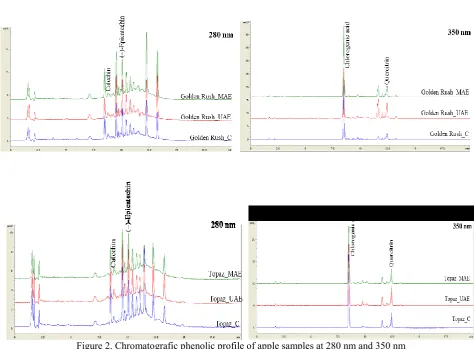
Figure 2. Chromatografic phenolic profile of apple samples at 280 nm and 350 nm
To perform the selective extraction of the phenolic compounds from organic dried apples, three techniques of extraction were selected for comparison of their effectiveness: conventional, microwave- and ultrasound-assisted extraction methods. In Figure 2, the chromatografic profile of phenolic compounds from apple samples at 280 nm and 350 nm are presented.
To evaluate the extraction effectiveness of conventional method, the dried apples were macerated in 70% methanol for 24 hours in dark and room temperature. For both, Golden Rush and Topaz apple samples, the obtained results showed that the greatest amount of (+)-catechin from dried apples was extracted through conventional extraction method (Figure 3). In the case of (‒)-epicatechin, the microwave- and
ultrasound-assisted extraction methods presented better results than conventional one (Figure 4).
12
Figure 3. Graphic representation of catechin in Golden Rush and Topaz apples
[image:5.595.159.436.557.680.2]Figure 4. Graphic representation of epicatechin in Golden Rush and Topaz apples
Figure 5. Graphic representation of chlorogenic acid in Golden Rush and Topaz apples
Figure 6. Graphic representation of quercitrin in Golden Rush and Topaz apples
Conclusions
Qualitative analysis revealed similar phenolic profiles in both apple varieties. Whatever extraction method is used, in both apple varieties chlorogenic acid
comparison with MAE and UAE. A higher content of quercitrin was obtained with MAE and UAE compared to conventional method. The content of phenolic compounds in Golden Rush apple was higher than in Topaz apple.
Results from this study indicated that conventional extraction can be a more efficient process than MAE and UAE for the extraction of phenolic compounds from organic dried apples.
Acknowledgements
The work on this research was carried out with the support of UEFISCDI grant ERANET 2/2015 SusOrganic, contract no. PN3-P3-55/2015.
Bibliography
1.Carbone K., Giannini B., Picchi V., Lo Scalzo R., Cecchini F. - 2011 - Phenolic composition and free radical scavenging activity of different apple varieties in relation with the cultivar, tissue type and storage. Food Chemistry, 127, 493-500. [1]
2.Cerkovic G., Canadanovic-Brunet J., Djilas S., Savatovic S., Mandic A., Tumbas V. - 2008 - Assesment of polyphenolic content and in vito antiradical characteristics of apple pomance. Food Chemistry, 109, 340-347. [19]
3.Ceymann M., Arrigoni E., Scharer H., Bozzi Nising A., Hurrell R. F. - 2012 - Identification of apples rich in health-promoting flavan-3-ols and phenolic acids by measuring the polyphenol profile. Journal of Food Composition and Analysis, vol. 26, no. 1-2, 128–135, 2012. [11]
4.Dai, J., Mumper, J.R. - 2010 - Plant Phenolics: Extraction, analysis and their antioxidant and
anticancer properties.Molecules, 15, 7313-7352. [5]
5.Du W.X, Olsen C.W., Avena-Bustillos R. J., Friedman M., McHugh T.H. - 2011 - Physical and atibacterial properties of edible fikms formulated with
apple skin polyphenols. Journal of Food Science, 76,
149-155. [17]
6.Fratianni F., Sada A., Cipriano L., Masucci A., Nazzaro F. - 2007 - Biochemical characteristics, antimicrobial and mutagenic activity in organically and conventionally produced Mallus domestica, Annurca. The Open Food Science Journal, 1, 10-16. [23]
7.Kalinowska Monika, Bielawska Aleksandra,
Lewandowska-Siwkiewicz Hanna, Priebed W.,
9.Liaudanskas M., Viškelis P., Jakštas V.,Raudonis R., Kviklys D., Milašius A., Janulis V. - 2014 - Application of an Optimized HPLC Method for the Detection of Various Phenolic Compounds in Apples from Lithuanian Cultivars. Journal of Chemistry, Vol. 2014, 1-10. [3]
10.McCann M.J., Gill C. I., R., O’Brien G., Rao J. R., McRoberts W.C., Hughers P., McEntee R., Rowland I. R. - 2007 - Anti-cancer properties of phenolics from
apple waste on colon carcinogenesis in vitro. Food
Chemistry & Technology, 45, 1224-1230. [18] 11.Naczk M., Shahidi F. - 2004 - Phenolics in food and nutraceuticals. Chapter 4. Phenolic compounds in fruit and vegetables, 132-236 [6]
12.Quideau S., Deffieux D., Douat-Casassus C., Pouysegu L. - 2011 - Angewandte Chemie, 50, 586– 621; [13]
13.Quideau S., Deffieux D., Douat-Casassus C., Pouysegu L. - 2011 - Angewandte Chemie 123, 610– 646. [14]
14.Rop O., Jurikova T., Sochor J., Mlcek J., Kramarova D. - 2011 – Antioxidant capacity, scaveging radical activity and selected chemical composition of native apple cultivars from Central Europe. Journal of Food Quality, 34, 187-194. [22] 15.Savatovic S., Cetkovic G. S., Dilas S. M., Tumbas V. T., Canadanovic-Brunet J. M.,Cetojevik-Simin D.D., Mandic A.I. - 2008 - Antioxidant and antiproliferative activity of Granny Smith apple pomance, Acta periodica technologica, 39, 201-212. [20]
16.Schieber A., Hilt P., Streker P., Endreß H.-U., Rentschler C., Carle R. - 2003 - A new process for the combined recovery of pectin and phenolic compounds from apple pomace. Innovative Food Science and Emerging Technologies, 4, 99-107. [21]
17.Serra A.T., matias A.A, Frade R. F. M., Duarter R.O., Feliciano R.P., Bronze M. R., Figueira M. E., de Carvalho A., Duarte C.M.M. - 2010 – Characterization of traditional and exotic apple varieties from Portugal. Part 2 – antioxidant and antiproliferative activities. Journal of Functional Foods, 2, 46-53. [12]
18.Stopar, M., Bolcina, U., Vanzo, A., and Vrhovsek,
U. 2002. Lower crop load for cv. Jonagold (Malus x
domestica Borkh.) increases polyphenol content and fruit quality. Journal of Agricultural and Food
Chemistry, 50:1643–1646. [8]
14
polyphenolic antioxidants in apple: effect of cultivar, harvest year, and storage conditions. Journal of
Agricultural and Food Chemistry, 49:3606–3613. [9]
22.Wu J., Gao H., Zhao L., - 2007 - Chemical compositional characterization of some apple cultivars. Food Chemistry, vol. 103, no. 1, 88–93. [10]
23.Xie F., Yu A., Hou D., Liu H., Ding l., Zhang S. - 2011 - Rapid and sensitive analysis of eight polyphenols in tobacco by rapid resolution liquid chromatography. American Journal of Analytical