
This is a repository copy of
Polar Spinel-Perovskite Interfaces : an atomistic study of
Fe3O4(111)/SrTiO3(111) structure and functionality
.
White Rose Research Online URL for this paper:
http://eprints.whiterose.ac.uk/102934/
Version: Published Version
Article:
Gilks, D., McKenna, K.P. orcid.org/0000-0003-0975-3626, Nedelkoski, Z. et al. (8 more
authors) (2016) Polar Spinel-Perovskite Interfaces : an atomistic study of
Fe3O4(111)/SrTiO3(111) structure and functionality. Scientific Reports. 29724. pp. 1-7.
ISSN 2045-2322
https://doi.org/10.1038/srep29724
[email protected]
https://eprints.whiterose.ac.uk/
Reuse
This article is distributed under the terms of the Creative Commons Attribution (CC BY) licence. This licence
allows you to distribute, remix, tweak, and build upon the work, even commercially, as long as you credit the
authors for the original work. More information and the full terms of the licence here:
https://creativecommons.org/licenses/
Takedown
If you consider content in White Rose Research Online to be in breach of UK law, please notify us by
www nature com scientificreports
Origin of reduced magnetization
and domain formation in small
magnetite nanoparticles
Zlatko Nedelkoski , Demie Kepaptsoglou , Leonardo Lari , Tianlong Wen
,, Ryan A. Booth ,
Samuel D. Oberdick , Pedro L. Galindo , Quentin M. Ramasse , Richard F. L. Evans ,
Sara Majetich & Vlado K. Lazarov
The structural, chemical, and magnetic properties of magnetite nanoparticles are compared. Aberration corrected scanning transmission electron microscopy reveals the prevalence of antiphase boundaries in
nanoparticles that have signi cantly reduced magnetization relative to the bulk Atomistic magnetic
modelling of nanoparticles with and without these defects reveals the origin of the reduced moment. Strong antiferromagnetic interactions across antiphase boundaries support multiple magnetic domains
even in particles as small as nm
Magnetic nanoparticles (NPs) are expected to be single magnetic domain below a critical size, typically on the order of the domain wall width for the corresponding bulk material. Single domain particles should have the maximum magnetic moment per volume, which is desirable for their use in ferroluids1,2, magnetic separation3, contrast agents4,5 for magnetic resonance imaging and magnetic hyperthermia6,7, all of which use iron oxide NPs. However, many researchers observe reduced magnetization, relative to that of the bulk. he reduction has been attributed to surface spin disorder8,9 or to variations in crystallinity, as in the case of low temperature aqueous preparation methods10. However, increasing crystallinity and reducing surface roughness does not necessarily solve this problem11,12. Indeed, in this work we demonstrate that even high quality magnetite NPs can have dra-matic diferences in their magnetic properties. High resolution electron microscopy is used to identify subtle diferences in three kinds of NPs, and atomistic spin calculations are used to reveal the origin of the reduced magnetization and its anomalous temperature dependence.
By a combination of measurements and modelling we demonstrate that antiphase domain boundaries in NPs can greatly reduce their magnetic moment. APB defects are seen in substrate supported thin ilm growth of mag-netite13–15, and also in core-shell NPs16. Here we demonstrate that the strong antiferromagnetic super-exchange interactions across the APBs signiicantly decrease the magnetisation of the NPs due to formation of multiple magnetic domains even in NPs below 15 nanometres.
While the detection of APBs requires sophisticated atomic resolution electron microscopy, we show that besides the reduced Ms, zero ield cooled magnetization measurements can be used to easily identify types of NPs with a high density of these defects, and therefore lower magnetization compared with that of single crystal NPs.
Results and Discussion
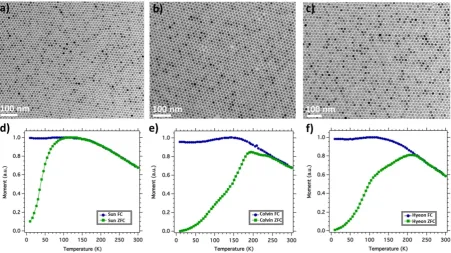
he experiments compared 12–14 nm diameter iron oxide nanoparticles synthesized by three well-established methods that were pioneered by the groups of Sun17, Colvin18 and Hyeon19. Hereater, they will be referred to as Sun, Colvin and Hyeon NPs. All three synthesis methods involve high temperature inert atmosphere decom-position in organic solvents, leading to monodisperse, highly crystalline, spherical particles coated with sur-factants. Large ield of view electron microscopy images for all three sets of NPs are presented in Fig. 1a–c and Supplementary Fig. S1. he size distribution of the three samples is similar: Sun 12.3 ± 2.9 nm, Colvin 13.7 ± 1.6 nm and Hyeon 14.2 ± 2.0 nm.
Department of Physics University of York Heslington York YO DD UK SuperSTEM, Sci-Tech Daresbury
Campus Daresbury WA AD UK Physics Department, Carnegie Mellon University, Pittsburgh, Pennsylvania
USA State Key Laboratory of Electronic Thin Films and Integrated Devices University of Electronic Science and Technology of China Chengdu China Department of Computer Science and Engineering Universidad de Cádiz
Puerto Real Spain Correspondence and requests for materials should be addressed to S M email sara cmu edu or V K L email vlado lazarov york ac uk
Received January
Accepted March
www.nature.com/scientificreports/
he structural and chemical composition of the particles was characterized by a combination of selected area electron difraction (SAED) and electron energy loss spectroscopy (EELS). In some syntheses of magnet-ite (Fe3O4) other phases are formed initially, then transformed through oxidation16. In contrast, as shown in Supplementary Fig. S2, all sets of the studied NPs in this work are single phase magnetite NPs. For more detailed chemical information, EELS measurements were performed in an aberration corrected scanning transmission electron microscope (STEM). he small size of the aberration corrected electron probe (< 1 Å in the conditions used for this experiment) reveals the local chemical composition within the nanoparticles. Furthermore, compar-ison of O K and Fe L2,3 edge ine structures averaged over selected NPs with those acquired from a known ‘bulk’ Fe3O4 sample, acquired under identical optical conditions (Supplementary Fig. S3) conirms that the chemistry of all three sets nanoparticles is Fe3O4 like (Supplementary EELS discussion). In addition, atomically-resolved 2D EELS measurements for all three sets NPs (Supplementary Figs S4, S5 and S6) consistently showed no change in the Fe L2,3 white-line intensity ratios across the observed NPs. his conirms the chemical uniformity of the
particles and the absence of a core-shell structure.
In contrast to the apparent structural and chemical uniformity of the three sets of nanoparticles, as deter-mined by TEM, SAED and EELS, the magnetic properties are strikingly diferent. he Sun particles have a speciic saturation magnetization of 81 ± 12 emu/g at 10 K (71 ± 1 emu/g at 300 K), values that are roughly 10% below that of the bulk. In comparison, the values for the Colvin particles were 37 ± 1 emu/g at 10 K (36 ± 1 emu/g at 300 K), and for the Hyeon particles 39 ± 4 emu/g at 10 K (40 ± 4 emu/g at 300 K). hese Colvin and Hyeon particles have approximately half the magnetization of the Sun particles of comparable size. When hysteresis loops were meas-ured ater cooling in a large magnetic ield, no exchange bias was observed.
Further details about the magnetic behaviour of the NPs are revealed by the zero ield cooled (ZFC) and ield cooled (FC) magnetization curves (Fig. 1d–f). he ZFC curve of the Sun particles shows a peak at 110–120 K, and a gradual decay at higher temperature. he Colvin particles also show a shoulder at ~ 110–120 K, plus a peak at 180 K and another feature near 200 K. he Hyeon particles have a shoulder near 110 K and a peak slightly above 200 K. he peak in the ZFC magnetization curve is associated with the blocking temperature TB of the nanopar-ticles, which is proportional to the anisotropy: KV ~ 25 kBTB, where K is the anisotropy energy density, V is the particle volume and kB is the Boltzmann constant. With this interpretation, the Colvin and Hyeon particles would have higher K than the Sun particles, yet they have lower magnetization. ZFC curves with anomalous features like those in Fig. 1e,f have been reported for NPs made by many other methods including aqueous co-precipitation20. ZFC curves like that of Fig. 1d have been reported for larger aqueous method particles21.
he puzzling magnetic behaviour in the ZFC curves cannot be explained by the conventional TEM and SAED observations alone, but requires deeper structural analysis. STEM imaging was used to determine the atomic structure and chemistry of selected nanoparticles, and to identify structural characteristics typical to each prepa-ration method. he contrast dependence of high angle annular dark ield (HAADF) imaging on the atomic num-ber Z as ~Z1.7 enables direct identiication of both iron tetrahedral (Fe
[image:3.595.102.554.46.299.2]A) and octahedral (FeB) atomic columns in the NPs. Figure 2 shows atomically-resolved HAADF images of representative Sun, Colvin and Hyeon NPs. In all three cases the bulk-like magnetite structural ordering extends to the particle surfaces, and no core-shell structure is observed.
Figure 1. Conventional TEM images of (a) Sun, (b) Colvin, (c) Hyeon nanoparticles. Zero Field Cooled (ZFC)
www.nature.com/scientificreports/
However, upon closer inspection, the HAADF images reveal certain structural characteristics that may be related to the observed diferences in magnetic behavior. he Sun nanoparticles, such as that shown in Fig. 2a are predominantly spherical with no strain (Supplementary Fig. S7) or disorder across the entire particle, as in metal-lic NPs22. In contrast to the Sun NPs, structural defects are observed in both Colvin and Hyeon NPs. he preva-lence of structural defects in Colvin and Hyeon NPs and absence of defects in Sun NPs is demonstrated by dark-ield TEM images covering hundreds of NPs (Supplementary Figs S8, S9 and S10). In addition, the presence/ absence of structural defects is illustrated in the atomic resolution HAADF STEM images for the three sets, pre-sented in Supplementary Figs S11, S12 and S13. Figure 2b,c shows that the translational symmetry is broken and structural domains are formed. Most of the observed structural defects are antiphase domain boundaries (APBs), which can be described by fractional unit cells shit of ¼a0[110]. In Fig. 2c the selected region shows the atomic arrangement of an APB with ¼a0< 110> viewed along the [11-2] zone axis. he mismatch across the boundary (e.g. between octahedral planes across the boundary) is outlined. Figure 2d shows the break in the structural symmetry of the cationic (111) plane by a crystallographic shit of the octahedral atomic planes by a0 121 , imaged along the [11-2] viewing direction.
APBs, extensively studied in magnetite thin ilms13,23–27, are correlated with anomalous properties such as very high magnetic saturation ields23 and negative magnetoresistance15,28. However, no direct evidence of APBs in single crystal magnetite NPs has been demonstrated. Recent work on the formation energy of highly stable APB defects29 could explain why APBs are stable even in NPs. A lattice vector shit of ¼ a
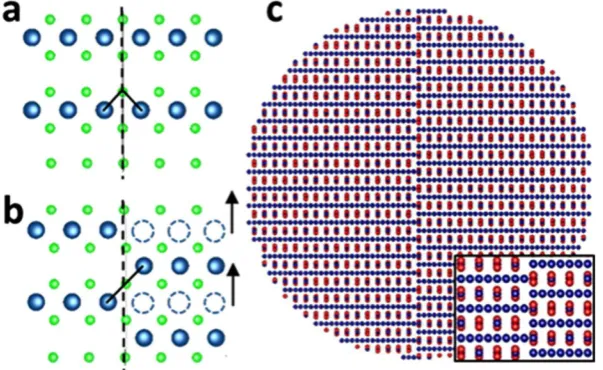
0< 110> creates an APB (Fig. 3a,b) with a very low formation energy (0.1 J/m2). Figure 3b illustrates how the 90° (Fig. 3a) Fe
[image:4.595.157.553.46.429.2]B-O-FeB bulk-like ferromagnetic super-exchange interaction is changed to 180° antiferromagnetic interaction due to the lattice shit caused by the APB. APBs with diferent lattice shit vectors result in similarly increased AFM
Figure 2. Atomically resolved HAADF STEM images of representative (a) Sun NP viewed along the [111] zone
www.nature.com/scientificreports/
interactions. Here we consider only the APBs with ¼ a0< 110> shit for two reasons: a) these APBs are experi-mentally observed in the studied NPs, and b) the formation energies of other type APBs are an order of magni-tude larger, and are therefore much less likely to form in NPs.
hese experimental indings provide a basis for an atomic level understanding of the diferent magnetic behavior, based on the strong correlation between the macroscopically measured magnetic properties of NPs and the presence of the APB defects observed by atomic level imaging. he magnetic properties of magnetite are determined by the short-range Fe-O-Fe super-exchange interactions. he dominant super-exchange interaction in Fe3O4 between tetrahedral FeA and octahedral FeB sublattices results in their antiferromagnetic alignment30,31. Since there are twice as many Fe atoms on B sites as on A sites, this gives an overall net magnetisation of 4 µB per formula unit of Fe3O4. he super-exchange interactions depend strongly on the angle and the length of the Fe-O-Fe bonds32. When the angle is 90° (the case of Fe
B-O-FeB bonds) the super-exchange interaction is ferro-magnetic. As the bond angle increases the super-exchange becomes antiferromagnetic (AFM), as in the case of 125° FeA-O-FeB bond that is the dominant super-exchange interaction in magnetite. Any further increase in angle, increases the strength of AFM interaction, which reaches a maximum value for 180° bonds33. Across the APB the Fe-O-Fe bond angles are distorted which signiicantly impacts the magnetic properties.
Atomistic spin calculations on model particles (with and without APBs) provide insight into the efect of APBs on NP magnetic moment. Using VAMPIRE sotware34 we calculated the spin conigurations at magnetic satura-tion for various model NPs and compared the results to same size NP without APBs (Fig. 4a). Figure 3c shows the atomic geometry of the simplest model, a spherical nanoparticle 10 nm in diameter, with a ¼a0< 110> APB at the center of the NP. he calculations for this model NP show that there is a reduction in the saturation magnetiza-tion by 26% compared to the same size NP without the structural defect (i.e. magnetizamagnetiza-tion value of ~66 emu/g). Furthermore, looking at the spin coniguration snapshots (Fig. 4a,b) one can see the formation of two magnetic domains due to the presence of the strong 180°antiferromagnetic bonds across the boundary (Fig. 4c). Within a domain, the FeA and FeB spins are antiparallel, as expected in bulk magnetite. However, across the APB, the FeB spins are canted because of the change in FeB-O-FeB superexchange coupling. In Fig. 4b, where the NP has an APB across its center, the magnetization of the let (ML) and right (MR) sides of the particle are not parallel, even at 5T. he APB reduces the magnetic moment, relative to a defect-free NP.
[image:5.595.156.458.48.233.2]his simple model demonstrates the efect of the APBs on the NP magnetic moment, but more complex NPs with multiple APBs, faceting, and surface anisotropy were also studied. When the number of coplanar APBs and their relative positions were varied, the magnetization reduction in all modeled NPs is determined by the number of 180° FeB-O-FeB bonds per unit volume. In Fig. 4d we consider two non-coplanar APBs with boundaries on < 11-2> type planes, a model inspired by the APBs geometry observed in the Hyeon NP shown in Fig. 2c,d. he predicted decrease in the saturation magnetization for this model NP is ~34% (i.e. the model nanoparticle has magnetization of ~59 emu/g), a result quantitatively closer to the experimental data. Given the small nanoparticle size, surface efects can afect the magnetic properties. Nominally spherical particles can develop faceted surfaces either directly during synthesis or over time via Ostwald ripening. Supplementary Fig. S14 shows that this has little impact on the spin coniguration and therefore the particle moment. Surface anisotropy can have important efects in NPs30,35. However, the NPs here are coated with organic surfactants with weak spin-orbit coupling, hence the surface anisotropy contributions are negligible compared to the strong exchange interaction across the
Figure 3. (a) [001] view of a (001) FeB–O lattice plane in bulk magnetite. (b) he presence of a ¼a0< 110>
www.nature.com/scientificreports/
APB defects. Even when large surface anisotropy was assumed, as shown in Supplementary Fig. S15 there was minimal distortion of the spin coniguration and the magnetic moment was reduced by only 1%.
Conclusions
[image:6.595.156.551.48.434.2]Nanoparticles prepared by the Sun, Colvin and Hyeon methods have similar structure and chemical composition, as conirmed by conventional TEM imaging, SAED, and EELS. However, their magnetic properties are very dif-ferent. Sun NPs had close to bulk like speciic magnetization while Hyeon and Colvin NPs showed less than half of the speciic magnetization of bulk Fe3O4. his anomalous magnetic behavior was correlated with the absence or presence of antiphase domain boundary structural defects. Atomic resolution STEM-HAADF imaging clearly shows the presence of abundant APB defects in the Colvin and Hyeon but not the Sun NPs. he dominant APB occurring in Colvin and Hyeon NPs is due to a ¼ a0 < 110> lattice vector shit. Due to the very low energy formation of this type boundary they can form under the growth conditions of the Colvin and Hyeon methods. he density of APBs is directly correlated to the number of antiferromagnetic bonds that ultimately lead to the reduced magnetization. Atomistic spin calculations show that the magnetization reduction is greater when more antiferromagnetic bonds are created across the boundary planes. he strong character of the super-exchange interactions is responsible for the multi-domain magnetic behaviour of the Fe3O4 NPs, a unique property not expected in metallic magnetic-NPs.
Figure 4. Spin conigurations at 5T. (a) [001] zone axis of a 10 nm nanoparticle without APBs, which has a
www.nature.com/scientificreports/
In summary, the antiphase boundary structural defects create high angle antiferromagnetic bonds that reduce the magnetization in crystalline magnetite nanoparticles. Magnetic nanoparticles predicted to be mono-domain based on their size alone may in fact contain multiple magnetic domains. Because of their stability, APBs reduce the particle magnetic moment unless extremely large ields are applied. For applications where the magnitude of the particle magnetization is critical and the applied ields are modest, NPs with a low density of APBs are desir-able. ZFC magnetization measurements are a convenient way to screen nanoparticles and optimize preparation methods in order to minimize these magnetization-reducing defects.
Methods
All samples were prepared using Schlenk line techniques, with inert atmosphere decomposition in high boiling point organic solvents. here were slightly diferent precursors, surfactants, and solvents. In all cases a single growth stage was used to obtain the inal particle size. he Sun method17 uses Fe acetyl acetonate as a precursor and a combination of oleic acid and oleyl amine surfactants, in benzyl ether. he Colvin method18 uses an Fe oxyhydroxide precursor and oleic acid, in 1-octadecene. he Hyeon method19 uses an Fe oleate precursor and oleic acid, also in 1-octadecene. Transmission electron microscopy (TEM) was used to assess the size distribu-tion of the particles and selected area electron difracdistribu-tion (SAED) was used for preliminary phase identiicadistribu-tion. Dense assemblies of the particles were characterized by superconducting quantum interference device (SQUID) magnetometry to determine the saturation magnetization at 10 K and 300 K, at ields up to 5 T. Zero ield cooled (ZFC) magnetization curves were measured ater cooling to 10 K, turning on a small ield (0.01 T), and measuring the magnetization as the temperature was increased up to 300 K. For ield cooled (FC) magnetization curves, the magnetization was recorded as the samples were cooled from 300 K to 10 K in 0.01 T ield.
To quantify the speciic saturation magnetization, elemental analysis was used to determine the amount of iron. Here the magnetic moment at 5 T of a ixed volume of nanoparticle dispersion in toluene was measured. Atomic absorption measurements were made on the same samples over a series of dilutions, and comparison with a Fe calibration standard was used to determine the molar concentration of iron in the undiluted sample. he numerical values assumed that the iron was in the form of Fe3O4 and that the particles had the same density as that of bulk magnetite.
Structural characterisation has been performed by transmission electron microscopy (TEM) and Selected Area Difraction (SAED) using a JEOL 2000 EX and a double aberration corrected JEOL JEM-2200FS, both operated at 200 kV.
Scanning transmission electron microscopy imaging and electron energy loss spectroscopy were performed in a Nion UltraSTEM100TM equipped with a Gatan Enina spectrometer. he microscope was operated at 100 kV, with a convergence angle of 30 mrad; at these optical conditions the electron probe size is determined to be 0.9 Å; the inner detector angle for HAADF STEM imaging was 76 mrad. he native energy spread of the electron beam for EELS measurements was 0.3 eV; with the spectrometer dispersion set at 0.2 eV/channel, this yielded an efective energy resolution of 0.6 eV. he EELS collection angle was 31 mrad. For reading clarity the atomically resolved spectra presented in Supplementary Figs S4, S5 and S6 were de-noised by principal component analysis using the CiMe− plugin36 for Gatan’s Digital Micrograph 2.3 sotware suite.
he spin dynamics of the magnetite nanoparticles containing APBs were simulated using VAMPIRE sotware package34. he energetics of the system is described by a Heisenberg spin Hamiltonian of the form:
= −
∑
⋅ −∑
+ + −∑
µ ⋅≠
(
)
J S S k S S S S H
2 ,
i j ij i j
i
x y z
i i i
c 4 4 4
app
where Jij is the Heisenberg exchange interaction between neighbouring spins i and j, Si and Sj are the local spin
unit vectors on sites i and j respectively, kc is the local cubic anisotropy constant, µi is the local atomic spin
moment on each site i and Happ is the external applied ield vector. he demagnetizing ield is included in the simulations using the macrocell method34 where the atomic spin coniguration is spatially averaged over the macrocell. A macrocell size of 2 nm was used in the calculations. A cubic magnetocrystalline anisotropy constant of 3.2·10−25 J/atom is included in the simulations. We note that although local cubic anisotropy is included in the simulation, this is relatively weak and has no appreciable efect on the total magnetization of the particle, which is dominated by the exchange interactions. Between FeA and FeB sites of magnetite there are correspond-ing exchange interactions: JAA = − 0.11 meV, JBB = + 0.63 meV and JAB = − 2.92 meV determined from ab-initio calculations37. At the APB, the 180° super exchange bonds lead to an enhanced antiferromagnetic exchange inter-actions with J180 = − 8.9 meV, which was extrapolated from the known bulk exchange interactions using ~cos2(θ) relationship38. All the calculations were performed at temperature set to 0 K in order to show the ground state spin coniguration. At higher temperature, spin luctuations are present within domains and at the surface, but the domain structures remain the same. he simulations focused on spin conigurations for NPs at saturation ields (5 T). Details of lower ield hysteresis require a full treatment of the local anisotropy introduced by the APB, and are the subject of future work.
Data Availability.
All data created during this research are available by request from the University of York Data Catalogue https://dx.doi.org/10.15124/249cbf0c-8e88-426b-b3ba-53d490e027ed.References
1. Berger, P. et al. Preparation and Properties of an Aqueous Ferroluid. Journal of Chemical Education76, 943 (1999).
www.nature.com/scientificreports/
3. Gupta, A. K. & Gupta, M. Synthesis and surface engineering of iron oxide nanoparticles for biomedical applications. Biomaterials
26, 3995 (2005).
4. Laurent, S. et al. Magnetic iron oxide nanoparticles: synthesis, stabilization, vectorization, physicochemical characterizations, and biological applications. Chem Rev108, 2064 (2008).
5. Pereira, C., Pereira, A. M., Rocha, M., Freire, C. & Geraldes, C. F. G. C. Architectured design of superparamagnetic Fe3O4 nanoparticles for application as MRI contrast agents: mastering size and magnetism for enhanced relaxivity. Journal of Materials Chemistry B (2015).
6. hiesen, B. & Jordan, A. Clinical applications of magnetic nanoparticles for hyperthermia. International journal of hyperthermia: the oicial journal of European Society for Hyperthermic Oncology, North American Hyperthermia Group24, 467 (2008).
7. Pankhurst, Q. A., hanh, N. T. K., Jones, S. K. & Dobson, J. Progress in applications of magnetic nanoparticles in biomedicine. Journal of Physics D: Applied Physics42, 224001 (2009).
8. Pratt, A. et al. Enhanced oxidation of nanoparticles through strain-mediated ionic transport. Nat Mater13, 26 (2014).
9. Kodama, R. H., Berkowitz, A. E., McNif, J. E. J. & Foner, S. Surface Spin Disorder in NiFe2O4 Nanoparticles. Phys Rev Lett77, 394 (1996).
10. Massart, R. Preparation of aqueous magnetic liquids in alkaline and acidic media. Magnetics, IEEE Transactions on17, 1247 (1981). 11. Krycka, K. L. et al. Origin of Surface Canting within Fe3O4 Nanoparticles. Phys Rev Lett113, 147203 (2014).
12. Salafranca, J. et al. Surfactant Organic Molecules Restore Magnetism in Metal-Oxide Nanoparticle Surfaces. Nano Letters12, 2499 (2012).
13. Gilks, D. et al. Origin of anomalous magnetite properties in crystallographic matched heterostructures: Fe3O4(111)/MgAl2O4 (111). Journal of Physics: Condensed Matter25, 485004 (2013).
14. Eerenstein, W., Palstra, T. T. M., Hibma, T. & Celotto, S. Origin of the increased resistivity in epitaxial Fe3O4 ilms. Physical Review B
66, 201101 (2002).
15. Margulies, D. T. et al. Origin of the Anomalous Magnetic Behavior in Single Crystal Fe3O4 Films. Phys Rev Lett79, 5162 (1997). 16. Wetterskog, E., Tai, C.-W., Grins, J., Bergström, L. & Salazar-Alvarez, G. Anomalous Magnetic Properties of Nanoparticles Arising
from Defect Structures: Topotaxial Oxidation of Fe1–xO|Fe3−δO4 Core|Shell Nanocubes to Single-Phase Particles. ACS Nano7, 7132 (2013).
17. Sun, S. et al. Monodisperse MFe2O4 (M = Fe, Co, Mn) Nanoparticles. J Am Chem Soc126, 273 (2004).
18. Yu, W. W., Falkner, J. C., Yavuz, C. T. & Colvin, V. L. Synthesis of monodisperse iron oxide nanocrystals by thermal decomposition of iron carboxylate salts. Chemical Communications2306 (2004).
19. Park, J. et al. Ultra-large-scale syntheses of monodisperse nanocrystals. Nat Mater3, 891 (2004).
20. Daou, T. J. et al. Hydrothermal Synthesis of Monodisperse Magnetite Nanoparticles. Chemistry of Materials18, 4399 (2006). 21. Batlle, X. et al. Magnetic nanoparticles with bulklike properties (invited). J Appl Phys109, 07B524 (2011).
22. Kovács, A. et al. Direct Observation of a Surface Induced Disordering Process in Magnetic Nanoparticles. Phys Rev Lett103, 115703 (2009).
23. Margulies, D. T. et al. Anomalous moment and anisotropy behavior in Fe3O4 ilms. Phys. Rev. B53, 9175 (1996). 24. Hibma, T. et al. Anti-phase domains and magnetism in epitaxial magnetite layers. J Appl Phys85, 5291 (1999).
25. Luysberg, M., Soin, R. G. S., Arora, S. K. & Shvets, I. V. Strain relaxation in Fe3O4/MgAl2O4 heterostructures: Mechanism for formation of antiphase boundaries in an epitaxial system with identical symmetries of ilm and substrate. Physical Review B80,
024111 (2009).
26. Eerenstein, W., Palstra, T. T. M., Saxena, S. S. & Hibma, T. Spin-Polarized Transport across Sharp Antiferromagnetic Boundaries. Phys Rev Lett88, 247204 (2002).
27. Eerenstein, W., Palstra, T. T. M. & Hibma, T. Spin-valve behaviour of anti-ferromagnetic boundaries in ultrathin magnetite ilms. hin Solid Films400, 90 (2001).
28. Eerenstein, W., Kalev, L., Niesen, L., Palstra, T. T. M. & Hibma, T. Magneto-resistance and superparamagnetism in magnetite ilms on MgO and MgAl2O4. Journal of Magnetism and Magnetic Materials258–259, 73 (2003).
29. McKenna, K. P. et al. Atomic-scale structure and properties of highly stable antiphase boundary defects in Fe3O4. Nat Commun5, (2014).
30. Mazo-Zuluaga, J., Restrepo, J. & Mejía-López, J. Surface anisotropy of a Fe3O4 nanoparticle: A simulation approach. Physica B: Condensed Matter398, 187 (2007).
31. De Grave, E., Persoons, R. M., Vandenberghe, R. E. & de Bakker, P. M. Mossbauer study of the high-temperature phase of Co-substituted magnetites, CoxFe3-xO4. I. x < = 0.04. Physical review B, Condensed matter47, 5881 (1993).
32. Goodenough, J. B. & Loeb, A. L. heory of Ionic Ordering, Crystal Distortion, and Magnetic Exchange Due to Covalent Forces in Spinels. Phys Rev98, 391 (1955).
33. Robinson, D. W. Magnetism and the Chemical Bond. John B. Goodenough. Interscience (Wiley), New York, 1963. xvi + 394 pp. Illus. $12.50. Science143, 33 (1964).
34. Evans, R. F. L. et al. Atomistic spin model simulations of magnetic nanomaterials. Journal of Physics: Condensed Matter26, 103202 (2014).
35. Yanes, R. et al. Efective anisotropies and energy barriers of magnetic nanoparticles with N\‘eel surface anisotropy. Physical Review B76, 064416 (2007).
36. Lucas, G., Burdet, P., Cantoni, M. & Hébert, C. Multivariate statistical analysis as a tool for the segmentation of 3D spectral data. Micron52–53, 49 (2013).
37. Uhl, M. & Siberchicot, B. A irst-principles study of exchange integrals in magnetite. Journal of Physics: Condensed Matter7, 4227 (1995).
38. Sawatzky, G. A., Geertsma, W. & Haas, C. Magnetic interactions and covalency efects in mainly ionic compounds. Journal of Magnetism and Magnetic Materials3, 37 (1976).
39. Momma, K. & Izumi, F. VESTA 3 for three-dimensional visualization of crystal, volumetric and morphology data. J Appl Crystallogr
44, 1272 (2011).
Acknowledgements
S. A. M. acknowledges support from US DOE grant #DE-FG02-08ER46481. SuperSTEM is the U.K. National Facility for Aberration Corrected STEM, supported by the Engineering and Physical Sciences Research Council (EPSRC). V.K.L. acknowledges support from EPSRC (through grants EP/K03278X and EP/K013114/1). his work made use of the facilities of N8 HPC provided and funded by the N8 consortium and EPSRC (Grant No. EP/ K000225/1). he Centre is co-ordinated by the Universities of Leeds and Manchester.
Author Contributions
www.nature.com/scientificreports/
Z.N., L.L. and V.K.L. Strain maps were produced by Z.N., V.K.L. and P.L.G. All authors contributed to the analysis and interpretation of the data. V.K.L and S.M. wrote the paper.
Additional Information
Supplementary information accompanies this paper at http://www.nature.com/srep
Competing Interests: he authors declare no competing inancial interests.
How to cite this article: Nedelkoski, Z. et al. Origin of reduced magnetization and domain formation in small
magnetite nanoparticles. Sci. Rep.7, 45997; doi: 10.1038/srep45997 (2017).
Publisher's note: Springer Nature remains neutral with regard to jurisdictional claims in published maps and
institutional ailiations.
his work is licensed under a Creative Commons Attribution 4.0 International License. he images or other third party material in this article are included in the article’s Creative Commons license, unless indicated otherwise in the credit line; if the material is not included under the Creative Commons license, users will need to obtain permission from the license holder to reproduce the material. To view a copy of this license, visit http://creativecommons.org/licenses/by/4.0/
![Figure 2. Atomically resolved HAADF STEM images of representative (a) Sun NP viewed along the [111] zone axis, (b) Colvin NP viewed along the [114] zone axis](https://thumb-us.123doks.com/thumbv2/123dok_us/7839499.176364/4.595.157.553.46.429/figure-atomically-resolved-haadf-representative-viewed-colvin-viewed.webp)

![catena Poly[[[diaqua(tetramethylethylenediamine κ2N,N′)nickel(II)] μ sulfato κ2O:O′] monohydrate]](data:image/gif;base64,R0lGODlhAQABAIAAAP///wAAACH5BAEAAAAALAAAAAABAAEAAAICRAEAOw==)