Copyright © 2000, American Society for Microbiology. All Rights Reserved.
Essential and Dispensable Virus-Encoded Replication Elements
Revealed by Efforts To Develop Hypoviruses as Gene
Expression Vectors
NOBUHIRO SUZUKI, LYNN M. GELETKA,ANDDONALD L. NUSS*
Center for Agricultural Biotechnology, University of Maryland Biotechnology Institute, University of Maryland, College Park, Maryland 20742
Received 18 February 2000/Accepted 15 May 2000
We have investigated whether hypoviruses, viral agents responsible for virulence attenuation
(hypoviru-lence) of the chestnut blight fungusCryphonectria parasitica, could serve as gene expression vectors. The
infectious cDNA clone of the prototypic hypovirus CHV1-EP713 was modified to generate 20 different vector candidates. Although transient expression was achieved for a subset of vectors that contained the green
fluorescent protein gene fromAequorea victoria, long-term expression (past day 8) was not observed for any
vector construct. Analysis of viral RNAs recovered from transfected fungal colonies revealed that the foreign genes were readily deleted from the replicating virus, although small portions of foreign sequences were retained by some vectors after months of replication. However, the results of vector viability and progeny characterization provided unexpected new insights into essential and dispensable elements of hypovirus
replication. The N-terminal portion (codons 1 to 24) of the 5ⴕ-proximal open reading frame (ORF), ORF A, was
found to be required for virus replication, while the remaining 598 codons of this ORF were completely dispensable. Substantial alterations were tolerated in the pentanucleotide UAAUG that contains the ORF A termination codon and the overlapping putative initiation codon of the second of the two hypovirus ORFs, ORF B. Replication competence was maintained following either a frameshift mutation that caused a two-codon extension of ORF A or a modification that produced a single-ORF genomic organization. These results are discussed in terms of determinants of hypovirus replication, the potential utility of hypoviruses as gene expression vectors, and possible mechanisms by which hypoviruses recognize and delete foreign sequences.
Fungi representing all major taxons have been reported to harbor viruses and related virus-like double-stranded (ds) RNA genetic elements (1, 17, 29). Similar to viruses of animals and plants, mycoviruses have potential utility for elucidating host functions and manipulating host phenotype (see reference 41). Evidence of progress in developing this potential is pro-vided by recent studies with members of the familyHypoviridae that cause an attenuation of virulence (hypovirulence) and alter dependent developmental process, e.g., asexual and sex-ual sporulation, of their host, the chestnut blight fungus Cry-phonectria parasitica. For example, efforts to understand the molecular basis for hypovirulence revealed a crucial role for G-protein signal transduction in a wide range of vital fungal physiological processes that included pathogenesis (4, 9, 15, 16, 23, 24, 40). In related studies, Chen and Nuss (5) used full-length infectious cDNA clones of genomic RNAs derived from severe and mild hypovirus strains to differentially influence the fungal phenotype and the interaction betweenC. parasiticaand its plant host.
The availability of a reverse genetics system for hypoviruses (3, 7) also provides opportunities to examine the consequences of specific mutations of the viral genome and explore the potential for development of hypoviruses as fungal gene ex-pression vectors. In this regard, deletion of 88% of the coding region for the papain-like protease p29 from the infectious cDNA clone of the prototypic hypovirus CHV1-EP713 dem-onstrated that this viral protein was dispensable for viral
rep-lication and revealed the extent of its contribution to virus-mediated reduction in fungal pigmentation and asexual sporulation (10). This observation also implied that one could replace the deleted portion of the viral genome with heterol-ogous sequences, thus generating a hypovirus RNA cytoplas-mically replicating gene expression vector system. Addition-ally, since CHV1-EP713 RNA is not encapsidated, constraints on the size of heterologous inserts, as are often encountered with many other virus vector systems, were expected to be minimal.
Several potential applications can be envisioned for a cyto-plasmically transmissible RNA-based hypovirus gene expres-sion vector. The incorporation of a visual reporter gene could provide a convenient means for monitoring hypovirus move-ment from cell to cell during anastomosis or long distance through a fungal colony or even a fungal population. It might be possible to enhance ecological fitness of hypovirulent C. parasiticastrains by expressing nuclear genes that are normally downregulated by hypovirus infection, e.g., viral expression of the mating pheromone gene Mat-2 (43) might relieve virus-mediated female infertility. Hypovirus host range might be extended to a number of pathogenic fungi by incorporatingC. parasiticahost range determinants, once identified, within re-combinant viral constructs. It is also conceivable that the phe-notypic changes caused by hypovirus infection could be further modified by the incorporation of foreign genes that might alter specific host metabolic or signaling pathways. Hypoviruses may even be exploited to deliver secretable gene products from infected fungal cells to difficult to transform chestnut plant cells, e.g., to enhance plant defense responses.
This study describes extensive efforts to modify the infec-tious CHV1-EP713 cDNA clone to express foreign genes.
Al-* Corresponding author. Mailing address: Center for Agricultural Biotechnology, University of Maryland Biotechnology Institute, Plant Sciences Bldg., Rm. 5115, College Park, MD 20742-4450. Phone: (301) 405-0334. Fax: (301) 314-9075. E-mail: [email protected].
7568
on November 9, 2019 by guest
http://jvi.asm.org/
colihygromycin B phosphotransferase gene (HYG) (11). The coding regions of these reporters were amplified from plasmids pEGFP (Clontech Laboratories, Inc., Palo Alto, Calif.) and pCPXHY1 (10), respectively, by PCR using primers that also introduced specific terminal restriction sites and cloned into pPCR-Script SK(⫹) (Stratagene, La Jolla, Calif.). Two nonreporter genes that included the foot-and-mouth disease virus 2A protease gene (2A) (32) and the Mat-2 mating type pheromone gene (PH) of C. parasitica(43) were generated as synthetic oligonucleotides. The codon usage for the 2A gene, which encodes the 17-residue peptide NFDLLKLAGDVESNPGP, was modified to match that of C. parasitica nuclear genes (AAA-TTT-GAC-TTG-CTC-AAG-TTG-GCC-GGT-GAC-GTC-GAG-TCC-AAC-CCG-GGT-CCC).
Construction of virus expression vectors.Modification of and gene insertion into the full-length hypovirus cDNA was facilitated by the development of a mutation/modification cassette system. The foundation plasmid pTRN was gen-erated by PCR-mediated replacement (21) of the original multiple cloning site of the commercially available plasmid pTZ19R (U.S. Biochemicals, Cleveland, Ohio) with oligonucleotides specifying a multiple cloning site (NotI,SacII,AscI, XbaI,NheI,KpnI,RsrII, andSpeI) that contained combinations of the unique restriction sites found in the plasmid harboring the full-length CHV1-EP713 viral cDNA, pLDST. Construction of the pTRN-based cassette used in this study, pTNR4, involved insertion of the 5⬘-terminal 3.7-kbXbaI-NheI CHV1-EP713 cDNA fragment derived from pLDST (7), followed by modifications of the multiple cloning site for applications not described in this study that included destruction of theXbaI site and introduction of an additionalNotI site following theSpeI site. Following appropriate alterations of, or insertion of foreign gene sequences into, the viral cDNA fragment in pTRN4, modified full-length CHV1-EP713 viral cDNAs were reconstituted by insertion of the 3⬘-terminal 8.9-kb NheI-SpeI CHV1-EP713 cDNA fragment, also derived from pLDST. The result-ing plasmids were linearized at theSpeI site and used as a template for in vitro synthesis of viral vector transcripts from the T7 polymerase promoter present in the pLDST-derivedXbaI-NheI fragment. All synthetic viral-vector transcripts contained the wild-type CHV1-EP713 5⬘- and 3⬘-noncoding terminal sequences with the exception of the group II vectors, which contained a two-nucleotide change immediately upstream of the open reading frame (ORF) A initiator codon from taATGg to ccATGg. Transfection ofC. parasiticaspheroplasts and recovery of infected fungal colonies was performed as described by Suzuki et al. (38). The integrity of each vector construct was verified by sequence analysis at insert junctions and modification sites. Detailed descriptions of cloning steps are available from the authors upon request.
GFP visualization.Sterile glass coverslips (22 by 22 mm) were placed on cellophane overlaying potato dextrose agar (PDA) and hyphae of transfected fungal colonies were allowed to grow as a thin layer between the cellophane and coverslip from a small agar inoculation plug placed at the edge of the coverslip. Coverslips with attached hyphae were transferred to a glass slide, mounted with distilled water, and observed with a Leica fluorescence stereomicroscope model MZ FLIII (Leica Microscopy Systems, Heerbrugg, Switzerland). Emission of green fluorescence was observed with a GFP plant fluorescent filter set (GFP3; Leica Microscopy Systems) and photographed with a Spot 1.3.0 charge-coupled device digital camera (Diagnostic Instruments, Inc., Sterling Heights, Mich.). A C. parasiticatransformant (strain EGFP-CP) in which EGFP gene expression was driven by the C. parasitica glyceraldehyde-3-phosphate dehydrogenase (GPD) gene promoter (Pgpd) was used as a positive control.
dsRNA isolation and ClampR analysis. dsRNA was isolated from fungal colonies transfected with transcripts of each of the vector constructs and sub-jected to agarose gel electrophoretic analysis as described by Suzuki et al. (38). A single-tube, reverse transcriptase PCR protocol, ClampR (25), was performed on isolated dsRNA preparations as described previously (38). The 25-l reaction mixture contained 10 mM Tris-HCl (pH 8.3), 50 mM KCl, 1.5 mM MgCl2, appropriate primer sets (10 pmol each) annealed to dsRNA (100 ng) after a previous denaturation and annealing step, 1 U of avian myeloblastosis virus reverse transcriptase (Life Technologies, Gaithersburg, Md.), and 1 U of Am-pliTaq DNA polymerase (Perkin-Elmer, Branchburg, N.J.). The reaction mix-tures were incubated at 42°C for 30 min, followed by 30 PCR cycles of 94°C for 1 min, 45°C for 1.5 min, and 72°C for 2 min. Amplified PCR products were subcloned into pPCRScript and subjected to sequence analysis.
tion serves as the termination codon of ORF A and the AUG portion is the 5⬘-proximal translation initiation codon of ORF B.
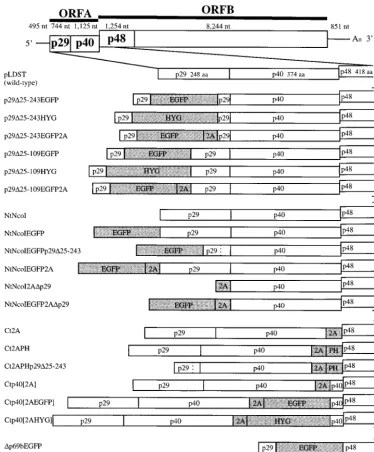
Four basic strategies were explored to construct a total of 20 hypovirus expression vector candidates. The observation that 88% of the p29 papain-like protease coding domain of ORF A was dispensable for viral replication (10) provided the basis for the first group of vectors, targeting the p29 coding region as a candidate for insertion of foreign gene sequences. Two foreign genes previously demonstrated to express efficiently in trans-formedC. parasiticawere utilized for these initial studies. The E. colihygromycin phosphotransferase gene (HYG) is the ba-sic selection marker used in a large number of C. parasitica transformation vectors (2, 8, 10, 16). The enhanced mutant form of the GFP (EGFP) gene fromAequorea victoria(30) is expressed efficiently under the control of theC. parasiticaGPD promoter after ectopic chromosomal integration (see Fig. 3).
For group I vectors, the reporter genes were inserted in frame into previously characterized p29 deletion mutant infec-tious cDNAs. The first of these mutants, originally described by Craven et al. (10) and designated⌬p29 (referred to here as p29⌬25-243), contained a deletion of the BamHI fragment spanning map positions 562 to 1218, thereby fusing codon Pro24 with codon Leu244 (see reference 34 for the CHV1-EP713 sequence map coordinates). The second mutant, desig-nated p29⌬25-109, contained a smaller deletion extending from map position 562 to 822, fusing Pro24 with Glu110 (38). Since the active p29 protease domain (amino acid [aa] residues 135 to 248) and cleavage site (Gly248-Gly249) remained intact in the latter mutant (6), the p29-reporter fusion protein en-coded in vectors p29⌬25-109EGFP and p29⌬25-109HYG was predicted to be cleaved from the polyprotein at the normal p29 cleavage site. In contrast, the p29-reporter fusion protein pro-duced by the ⌬p29-based constructs p29⌬25-243EGFP and p29⌬25-243HYG, which lacked the p29 protease domain, was predicted to be further fused to p40. Two additional group I vectors (p29⌬25-109EGFP2A and p29⌬25-243EGFP2A) were engineered to incorporate the foot-and-mouth disease virus 2A protease (2A) (32) with the intention of liberating an N-ter-minal p29-reporter fusion protein.
Vectors in group II contained modifications or gene insertions at the precise N terminus (designated Nt in vector constructs) of ORF A. This was accomplished by first using PCR mutagenesis to modify the ORF A translation initiation codon from TAATGG (map positions 494 to 499) to CCATGG, thus creating anNcoI restriction site in the foundation vector construct NtNcoI. Other constructs in this group were then generated by insertions of reporter genes into theNcoI site. Vector NtNcoIEGFP was pre-dicted to produce EGFP fused to p29, while deletion of the p29 BamHI fragment (map positions 562 to 1218) in vector NtNcoI-EGFPp29⌬25-243 was predicted to produce EGFP flanked by p29 aa residues 1 to 24 at the N terminus and by p29 aa residues 244 to 248 at the C terminus all fused to p40. The 2A protease domain was introduced into the 3⬘-flanking region of the EGFP in
on November 9, 2019 by guest
http://jvi.asm.org/
vector NtNcoIEGFP2A⌬p29 with the intention of liberating the EGFP-2A fusion protein from p29. AnNcoI-modified translation initiation codon was also engineered at the N terminus of a vector in which the entire p29 coding domain was deleted and a 2A gene was fused to the p40 coding domain. TheNcoI site in this vector, NtNcoI2A⌬p29, was then used to introduce the EGFP sequence to form vector NtNcoIEGFP2A⌬p29.
[image:3.612.116.491.78.531.2]Vectors in group III contained gene inserts in the 3⬘-termi-nal portion of the p40 coding domain near or adjacent to the pentanucleotide UAAUG that separates ORF A from ORF B, i.e., in the C terminus (designated Ct in vector constructs) of the ORF A-encoded polyprotein. Vectors Ct2A and Ct2APH contained, respectively, the 2A domain and the 2A domain fused to theC. parasiticaMat-2 pheromone gene (PH) inserted FIG. 1. Schematic representation of vector constructs. The genetic organization of the infectious cDNA clone of wild-type hypovirus CHV1-EP713 in plasmid pLDST (7) is shown at the top. The coding strand is 12,712 nucleotides in length, excluding the poly(A) tract, and contains two ORFs, A and B (34). ORF A encodes two polypeptides, p29 and p40, that are released from polyprotein p69 by an autocatalytic event mediated by the papain-like protease domain within p29 (6). Expression of ORF B also involves an autoproteolytic event in which p48, also a papain-like protease, is released from the N-terminal portion of the encoded polyprotein. The junction between ORFs A and B consists of the sequence 5⬘-UAAUG-3⬘(map positions 2362 to 2366) where the UAA portion serves as the termination codon of ORF A and the AUG portion is the 5⬘-proximal translation initiation codon of ORF B. Diagrams of 20 CHV1-EP713-based gene expression vector candidates, organized within four groups (I to IV) on the basis of four design strategies, are shown below the wild-type CHV1-EP713 cDNA. Four foreign genes (indicated by shaded boxes) were incorporated into the vectors: the enhancedA. victoriagreen fluorescent protein gene (EGFP), theE. colihygromycin B phosphotransferase gene (HYG), the foot-and-mouth disease virus 2A protease gene (2A), and the Mat-2 mating type pheromone gene (PH) ofC. parasitica. The dashed lines shown in vector constructs NtNcoIEGFPp29⌬25-243 and Ct2APHp29⌬25-243 indicate the deletion of theBamHI fragment (bases 562 to 1218) of the p29 coding domain leading to the fusion of p29 proline residue 24 with p29 leucine residue 244. The cloning operations used to construct individual expression vector candidates are described in detail in Methods and Materials and in Results.
on November 9, 2019 by guest
http://jvi.asm.org/
The final group of vectors, group IV, consisted of two con-structs in which the EGFP gene was inserted in place of most of ORF A (the p69 polyprotein coding domain). Vectors
⌬p69bEGFP and ⌬p69bEGFP2A contained the EGFP and
EGFP–C-terminal 2A fusion genes inserted between the BamHI site at position 562 and a newBamHI site engineered precisely at the pentanucleotide in such a way that the stop codon was destroyed (UAAUG to CCAUG) while retaining the AUG initiator codon in frame with the upstream region. That is, these vectors have a single large ORF that is predicted to produce the EGFP fused at the N terminus with p29 aa 1 to 24 and at the C terminus with p48 of ORF B or unfused at the C terminus due to 2A protease activity, respectively.
Replication competence of expression vector constructs.
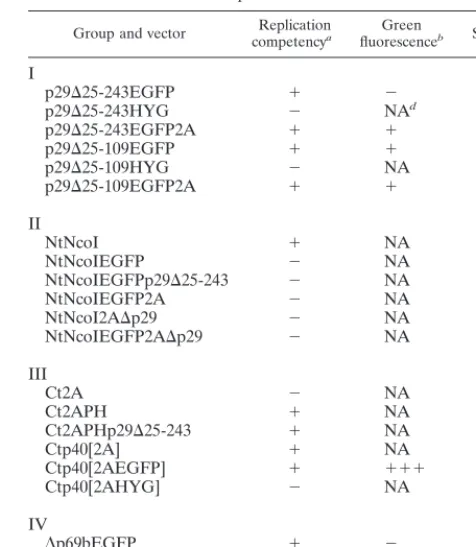
The replication competence of each vector construct was ex-amined by transfecting spheroplasts prepared from virus-free C. parasitica EP155 and scoring for the recovery of viral dsRNA from regenerated mycelial cultures (results are sum-marized in Table 1). Although the HYG gene is efficiently expressed inC. parasiticafrom integrated plasmid vectors (7, 8), neither of the group I vectors that contained HYG as the foreign gene (p29⌬25-243HYG and p29⌬25-109HYG) were found to be replication competent (Fig. 2, lanes 2 and 5). In contrast, transcripts derived from all EGFP-containing vectors were able to readily establish productive infections (Fig. 2, lanes 1, 3, 4, and 6).
The group II foundation vector, NtNcoI, readily established an infection upon transfection (Fig. 2, lane 7) and stably re-tained the altered sequence (TAATGG to CCATGG) adja-cent to the ORF A initiation codon (data not shown), indicat-ing that the mutation required to introduce theNcoI site had no gross negative effect on virus replication. Interestingly, the introduction of foreign gene sequences into thisNcoI site re-sulted in loss of replication competency (Fig. 2, lanes 8 to 12). Moreover, transcripts derived from vectors NtNcoI2A⌬p29 and NtNcoIEGFP2A⌬p29, both of which lacked any of the p29 coding domain, also failed to initiate productive infections. The potential role for the 5⬘proximal portion of the p29 coding domain in CHV1-EP713 replication will be addressed in a subsequent section.
Insertion of foreign sequences adjacent to the UAAUG pentanucleotide separating ORFs A and B in the group III vectors had mixed consequences for virus replication. Vector Ct2A, in which the 2A protease gene was inserted immediately upstream of the UAAUG pentanucleotide, was replication incompetent (Fig. 2, lane 13). However, insertion of the C. parasitica Mat-2 pheromone gene (43) preceded by the 2A gene into the same position, either in the context of the
full-length CHV1-EP713 sequence (Ct2APH) or the ⌬p29
background (Ct2APHp29⌬25-243), was tolerated and yielded infectious transcripts (Fig. 2, lanes 14 and 15). Similarly, tran-scripts derived from vectors Ctp40[2A] and Ctp40[2AEGFP], in which the 3⬘-terminal sequence of the p40 coding domain (nucleotides 2,318 to 2,361) was duplicated to form anSbfI site
for insertion of foreign genes, were infectious (Fig. 2, lanes 16 and 17). Finally, as was observed for group I vectors containing the HYG gene, vector Ctp40[2AHYG] was not replication competent.
Group IV expression vectors were constructed with the antic-ipation that they might be replication incompetent. Although it was clearly established that 88% of the p29 coding domain could be deleted without abolishing CHV1-EP713 replication (10), there was no evidence to suggest that the p40 coding domain would also be dispensable. Additionally, the pentanucleotide sep-arating ORFs A and B was mutated to remove the ORF A translation stop codon, creating an in-frame single ORF genome organization. Surprisingly, transcripts derived from both vectors, ⌬p69bEGFP and ⌬p69bEGFP2A, readily initiated infections (Fig. 2, lanes 19 and 20). Thus, p40, like most of p29, is dispens-able for CHV1-EP713 replication. The role of the UAAUG pen-tanucleotide will be considered in more detail in a later section.
EGFP expression in fungal cells infected with expression
vector constructs. Replication-competent EGFP constructs
p29⌬25-243EGFP, p29⌬25-243EGFP2A, p29⌬25-109EGFP,
p29⌬25-109EGFP2A, Ctp40[2AEGFP], ⌬p69bEGFP, and
⌬p69bEGFP2A were examined for green fluorescence on day 6 posttransfection (results are summarized in Table 1). The highest level of fluorescence was observed for mycelia infected with vector Ctp40[2AEGFP] (Fig. 3). However, the level of fluorescence was considerably lower than that exhibited by mycelia stably transformed with the EGFP gene under the control of theC. parasiticaGPD promoter, pEGFP-CP (Fig.
NtNcoI ⫹ NA ⫹⫹
NtNcoIEGFP ⫺ NA NA
NtNcoIEGFPp29⌬25-243 ⫺ NA NA
NtNcoIEGFP2A ⫺ NA NA
NtNcoI2A⌬p29 ⫺ NA NA
NtNcoIEGFP2A⌬p29 ⫺ NA NA
III
Ct2A ⫺ NA NA
Ct2APH ⫹ NA ⫹
Ct2APHp29⌬25-243 ⫹ NA ⫹
Ctp40[2A] ⫹ NA ⫹
Ctp40[2AEGFP] ⫹ ⫹⫹⫹ ⫺
Ctp40[2AHYG] ⫺ NA NA
IV
⌬p69bEGFP ⫹ ⫺ ⫹
⌬p69bEGFP2A ⫹ ⫺ ⫹
aVector viability was examined based on virus-specific dsRNA recovery as shown in Fig. 2.
bThe ability of a vector virus to fluoresce is indicated as⫹⫹⫹(moderately highly fluorescent),⫹(faintly fluorescent), and⫺(negative).
cThe stability of vectors was analyzed by ClampR:⫹⫹, stable as long as 9 weeks posttransfection;⫹, stable as long as 3 weeks posttransfection;⫺, under-went deletion before 3 weeks posttransfection.
dNA, not applicable.
on November 9, 2019 by guest
http://jvi.asm.org/
[image:4.612.311.549.82.356.2]3). Fluorescence was also detected at very low levels in mycelia transfected with vectors 243EGFP2A, p29⌬25-109EGFP, and p29⌬25-109EGFP2A (Fig. 3). Importantly, green fluorescence was lost for each of the EGFP-positive
transfectants within several weeks of culturing following trans-fer of a portion of the mature colony to new PDA plates. No fluorescence was observed at any time posttransfection for mycelia infected with transcripts derived from vectors
[image:5.612.114.490.71.199.2]p29⌬25-FIG. 2. Agarose gel electrophoretic analysis of viral dsRNAs recovered from transfectedC. parasiticacolonies 3 weeks posttransfection. Transfected fungal colonies were transferred from regeneration media to PDA plates 7 days posttransfection, cultured for 1 week, transferred to liquid growth media for an additional week of culturing, harvested, and processed to recover dsRNA according to the protocol of Hillman et al. (19). Partially purified viral dsRNA preparations were treated with S1 nuclease (5 U) to digest single-stranded RNA (3) and examined by agarose (0.7%) gel electrophoresis. Full-length viral dsRNAs are the slowest-migrating bands in each lane. The faster-migrating species observed in lanes 7, 15, 17, and 21 correspond to internally deleted defective viral dsRNAs previously identified in hypovirus-infected isolates (2, 35). Lanes marked with an M contain 200 ng of 1-kb DNA ladder (Life Technologies) as relative size markers, with arrows indicating the positions of the 5.1-, 2.0-, and 1.0-kb bands. Lane 1, p29⌬25-243EGFP; lane 2, p29⌬25-243HYG; lane 3, p29⌬25-243EGFP2A; lane 4, p29⌬25-109EGFP; lane 5, p29⌬25-109HYG; lane 6, p29⌬25-109EGFP2A; lane 7, NtNcoI; lane 8, NtNcoIEGFP; lane 9, NtNcoIEGFPp29⌬25-243; lane 10, NtNcoIEGFP2A; lane 11, NtNcoI2A⌬p29; lane 12, NtNcoIEGFP2A⌬p29; lane 13, Ct2A; lane 14, Ct2APH; lane 15, Ct2APHp29⌬25-243; lane 16, Ctp40[2A]; lane 17, Ctp40[2AEGFP]; lane 18, Ctp40[2AHYG]; lane 19,⌬p69bEGFP; lane 20,⌬p69bEGFP2A; lane 21, wild-type virus cDNA pLDST.
FIG. 3. Micrographs of EGFP-expressingC. parasiticastrains. Agar plugs containing transfected fungal mycelia were transferred from regeneration plates to cellophane-overlaid PDA plates on day 4 posttransfection and placed at the edge of a glass coverslip. The mycelia were allowed to grow between the coverslip and the cellophane for 2 days and then transferred to a glass slide for observation (see Materials and Methods). Mycelia attached to the coverglass were observed under a fluorescent microscope at
⫻100 magnification. Vector constructs used for transfection are indicated at the bottom of each panel and include p29⌬25-243EGFP, p29⌬25-243EGFP2A, p29⌬25-109EGFP, p29⌬25-109EGFP2A, Ctp40[2AEGFP],⌬p69bEGFP, and⌬p69bEGFP2A. A colony transfected with synthetic transcripts derived from wild-type virus cDNA, pLDST, served as a negative control, while a transformant in which the EGFP gene (pEGFP-CP) is expressed from theC. parasiticaGPD gene promoter (Pgpd) was used as a positive control.
on November 9, 2019 by guest
http://jvi.asm.org/
[image:5.612.111.494.369.675.2]243EGFP,⌬p69bEGFP, and⌬p69bEGFP2A or for colonies transfected with wild-type CHV1-713 transcripts (pLDST) (Fig. 3).
Stability of expression vectors after transfection.The
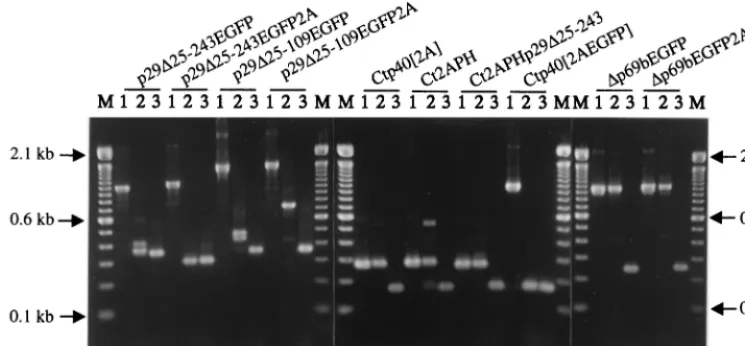
tran-sient nature of GFP fluorescence expression suggested either a significant reduction in vector replication or in the stability of the foreign gene within the replicating vector RNA. Since dsRNA was found to be present in infected mycelia even months after transfection (data not shown), a single-tube re-verse transcription PCR analysis, ClampR (25), was performed on dsRNAs recovered from infected mycelium at 3 and 9 weeks posttransfection in an effort to examine foreign gene stability. As indicated in Fig. 4, the foreign gene sequences were partially or completely deleted from all group I vector RNAs by 3 weeks posttransfection. In contrast, foreign genes were retained in three of the four infectious group III vectors, Ct2A40, Ct2APH, and Ct2APHp29⌬25-243, at week 3. Similar results were observed for the two infectious group IV vectors. However, foreign genes appeared to be deleted from replicat-ing vector RNAs in all groups by week 9.
To gain further insight into the deletion process, ClampR fragments generated from 9-week-old colonies (Fig. 4) were cloned and sequenced. With the exception of p29⌬25-109EGFP2A, a single deletion breakpoint was observed for five individual subcloned ClampR fragments generated from the progeny RNA of each vector, suggesting that a population consisting of a major deletion species was stabilized by 9 weeks posttransfection. As indicated in Fig. 5, progeny of all replica-tion-competent vector constructs in group I retained the 5⬘-proximal p29 coding region upstream of theBamHI site at position 562 used for foreign gene insertion and a short se-quence encoding from 1 109EGFP2A) to 19 (p29⌬25-243EGFP2A) aa residues of the foreign EGFP sequence. The position of the 3⬘-terminal deletion breakpoints varied consid-erably for the different vectors. For example, the deletion prog-eny generated from vector p29⌬25-243EGFP retained 10 codons from the C terminus of the EGFP protein, while
the 3⬘-deletion breakpoints for progeny derived from vec-tors 243EGFP2A, 109EGFP, and p29⌬25-109EGFP2A extended to different regions of the p29 or p40 coding domains. In the case of progeny of vector p29⌬25-109EGFP2A, three of the five ClampR clones retained a por-tion of the FMDV 2A protease sequence, whereas the other two did not. Thus, although entire foreign genes were unstable, portions of foreign sequences were retained in some hypovirus vector progeny for long periods of culturing.
Foreign gene sequences were completely deleted from each of the group III replication-competent vector genomes, as di-agrammed in Fig. 5. Vectors Ctp40[2A] and Ctp40[2AEGFP] reverted precisely to their parental virus, CHV1-EP713, sug-gesting a homologous recombination mediated by the dupli-cated p40 coding sequence of the vector constructs. The dele-tion events that led to removal of foreign sequences from vector Ct2APH included the additional deletion of a viral U residue immediately 5⬘of the ORF A translation stop codon, causing a frameshift and a resulting two-codon extension of ORF A relative to that present in CHV1-EP713 (Fig. 5 and 6)
(AUUUUAAUGUAUAA to AUUUAAUGUAUAA, the
pen-tanucleotide within bases 2358 to 2371 is shown in boldface). A similar frameshifted deletion product was generated for Ct2APHp29⌬25-243. However, the events leading to the for-mation of this progeny must have involved deletion of two viral U residues since the G residue present at the third position of the C-terminal Met codon of the PH gene was retained (Fig. 5 and 6).
[image:6.612.116.489.76.249.2]Different deletion patterns were observed for the two group IV vectors that were distinguished by the presence of a single ORF rather than the prototypical two-ORF organization. Vec-tor⌬p69bEGFP underwent complete deletion of the EGFP gene to revert to its progenitor, ⌬p69b, indicating that the progeny of this vector were able to replicate with the UAAUG pentanucleotide modified so as to fuse p29 codons 1 to 24 with the N terminus of ORF B in a single-ORF configuration. In contrast, the single-ORF vector⌬p69bEGFP2A was converted
FIG. 4. ClampR analysis of dsRNA recovered from fungal colonies transfected with candidate expression vectors. For each replication-competent vector (shown at the top) ClampR was performed on the full-length cDNA clone (lane 1 in each set) and on dsRNA isolated 3 weeks (lane 2 of each set) and 9 weeks (lane 3 of each set) posttransfection. Transfected hyphae were transferred from regeneration plates to PDA plates at 7 days posttransfection. After incubation for 7 days, the cultures were transferred to liquid medium for an additional week of culturing and then harvested for recovery of dsRNA (3-week samples) or transferred weekly to new PDA plates for 6 weeks (9-week samples) before transfer to liquid medium. Primer sets were chosen to amplify fragments spanning the foreign gene insert as follows: NS7 and BR54 (nucleotide map positions 476 to 493 and 1386 to 1402, respectively) for vectors p29⌬25-243EGFP, p29⌬25-243EGFP2A, p29⌬25-109EGFP, and p29⌬25-109EGFP2A; NS21 and NS22 (nucleotide map positions 2240 to 2259 and 2382 to 2401, respectively) for Ctp40[2A], Ct2APH, Ct2APHp29⌬25-243, and Ctp40[2AEGFP]; and BR16 and NS22 (nucleotide map positions 364 to 382 and 2382 to 2401, respectively) for⌬p69bEGFP and⌬p69bEGFP2A. Amplified fragments were electrophoresed in a 2.0% agarose gel in 1⫻Tris-borate-EDTA. M refers to the 100-bp DNA ladder size markers (Life Technologies). Arrows indicate the migration positions of the 2.1-, 0.6-, and 0.1-kbp size standards.
on November 9, 2019 by guest
http://jvi.asm.org/
to a deletion product containing two ORFs with a junction similar to that seen for the deletion products of group II vectors Ct2APH and Ct2APHp29⌬25-243, i.e., the equivalent of deleting a U residue just prior to the ORF A stop codon causing a two-codon extension into the p48 coding region and reconstruction of the ORF B coding domain.
The recovery of multiple independent viable deletion prog-eny that contained a two-codon extension of the 5⬘-proximal ORF was surprising (Fig. 6), given the prediction (34) that the UAAUG pentanucleotide junction separating ORFs A and B is likely to regulate the termination of ORF A translation and reinitiation of ribosomes for subsequent translation of ORF B. To reduce the possibility that the viability of these deletion
mutants is dependent on compensatory mutations, a mutated virus cDNA, designated FS1, was constructed in which the first residue of the pentanucleotide, U 2362, was deleted within the context of the infectious virus cDNA. FS1 transcript derived from the reconstituted virus cDNA was able to replicate and to induce the same set of phenotypic changes caused by wild-type CHV1-EP713 (data not shown). The sequence integrity of the mutated region was confirmed by ClampR and sequence anal-yses, indicating that the mutant virus is viable and stable. We conclude that the single frameshift deletion of U 2362 and the resulting two codon extension of ORF A is tolerated without observable changes in virus replication or virus-mediated al-terations of fungal phenotype.
FIG. 5. Illustration of deletion breakpoints in progeny RNA recovered from mycelia transfected with hypovirus vector constructs. DNA fragments amplified by ClampR for genomic dsRNA templates recovered from infected mycelia at 9 weeks posttransfection (Fig. 4) were cloned into theSrfI site of pPCRScript (Stratagene Systems), and five independent clones were subsequently sequenced. The breakpoints for each deletion progeny are indicated by arrowheads. Nucleotide and amino acid sequences are shown below the schematic representations for some of the more informative deletion breakpoints. Map positions are indicated at each end of the sequence information. Arrows show the amino acid sequence for viral proteins p29, p40, and p48. The symbols⫽,⫺, and -//- are used to indicate sequences not shown due to space limitations, the same sequence as found in the original parental vector shown in the top row, and deleted sequences, respectively.
on November 9, 2019 by guest
http://jvi.asm.org/
Deletion mutation of the 5ⴕ portion of the p29 coding
do-main abolishes replication competency.With the exception of
the foundation vector NtNcoI, all group II vectors were repli-cation incompetent. Comparison of these vectors with those that could initiate an infection revealed one obvious distin-guishing feature: all replication-competent vectors contained at least 66 nucleotides (map positions 496 to 561, Met1 through Pro24) of the 5⬘ portion of the p29 coding domain. The possibility that the 5⬘-proximal portion of the p29 coding domain plays a role in virus replication was investigated by further deletion from the Pro24 codon toward the N terminus of the p29 coding region within the context of the replication-competent, foreign-gene-free p29⌬25-243 and⌬p69b mutants. In one set of deletion mutants, p29 codon Val12 was fused with Asp242 of p29 (⌬p29-based mutant NS36a) or with Met1 of p48 (⌬p69b-based mutant NS36b). In the second set of mu-tants, the deletion was extended to p29 translation initiation codon Met1, completely eliminating the p29 N-terminal coding domain. Both sets of deletions resulted in loss of replication competency when tested repeatedly under transfection condi-tions in which transcripts from the original p29⌬25-243 and ⌬p69b vectors consistently initiated productive infections.
DISCUSSION
Animal viruses have been modified for delivery of foreign genes of potential therapeutic value, while plant viruses are being harnessed for large scale in planta production of protein products. The availability of infectious full-length hypovirus cDNA clones (3, 5, 7), the only viral reverse genetics system currently available for the kingdomFungi, provides the plat-form for manipulating a fungal virus for analogous applica-tions. A potential for engineering hypoviruses as gene expres-sion vectors was suggested by the observation that 88% of the p29 coding domain was dispensable for virus replication (10) and by the absence of a virus-encoded coat protein (34) that might place packaging constraints on insert size. Moreover, transcripts generated from chimeric cDNA clones derived from a severe and a mild strain were recently shown to be fully infectious and genetically stable (5). However, the perfor-mance of the 20 independent hypovirus vector candidates de-scribed in this report has failed to meet initial expectations.
It was possible to demonstrate that the CHV1-EP713 infec-tious transcript could maintain replication competence while accommodating the insertion of foreign genes at several dif-ferent sites within ORF A. Moreover, transient expression of the inserted foreign gene was achieved for several of the vector
candidates. However, long-term expression was compromised by the ability of the viral replication machinery to recognize and delete all or most of the foreign sequences within a few weeks posttransfection. In this regard, it is noteworthy that some vector progeny did retain as many as 60 nucleotides of foreign sequence for an extended time period. Efforts to find a correlation between sequence instability and differences in codon usage between viral ORFs and foreign gene sequences were not successful. The ill-defined and generally unpredict-able nature of foreign gene instability in RNA virus vectors has been reviewed in detail by Scholthof et al. (33). As noted by these authors, several RNA virus vectors have found consid-erable utility in spite of the problem of long-term foreign gene instability.
In related studies, functionally conserved coding domains derived from hypovirus CHV1-Euro7 that differed as much as 13% at the nucleotide level from that of the corresponding EP713 domain were stably maintained in CHV1-EP713/CHV1-Euro7 chimeric viruses (reference 5 and data not shown). Now that hypoviruses belonging to three distinct species have been sequenced in full (5, 20, 34, 36), it will be of considerable interest to determine whether genes derived from more distantly related hypoviruses will be stably retained in CHV1-EP713 chimeric viruses or recognized as foreign and deleted.
Although only transient expression of foreign genes was achieved in this study, the possibility that hypoviruses can be developed as vectors for stable gene expression is not excluded. Insertions were restricted in this study to ORF A. It is quite conceivable that regions within ORF B are more tolerant of gene insertion. An alternative vector strategy was also sug-gested by the observation that the 5⬘-terminal portion of the p29 coding domain was required for vector RNA replication. Shapira et al. (35) previously characterized internally deleted dsRNAs recovered from CHV1-EP713 infected colonies that retained only the terminal noncoding regions:⬃150 bp from the terminus corresponding to the 5⬘end of the coding strand and⬃450 bp from the other terminus. Although these small dsRNAs replicated in the presence of the full-length viral RNA, efforts to use these terminal sequences to construct a helper virus-dependent replicon as a gene expression vector were unsuccessful (B. Chen and D. L. Nuss, unpublished re-sults). The absence of a N-terminal p29 coding domain in those constructs may have been responsible for the failure to observe expression of inserted genes, a possibility currently under in-vestigation.
The fact that defective RNAs lacking the N-terminal portion FIG. 6. Sequences in the pentanucleotide region of vector construct progeny. ClampR fragments were obtained with primer set NS21 and NS22 (map positions 2240 to 2259 and 2382 to 2401, respectively) for progeny dsRNAs of vectors Ct2APH, Ct2APHp29⌬25-243, and⌬p69bEGFP2A 9 weeks after transfection and sequenced. Nucleotide sequences and deduced amino acid sequences for the ORF A-ORF B junction of CHV1-EP713 are shown for reference. Asterisks indicate termination codons of ORF A, and the underlined sequence refers to the pentanucleotide. Nonviral nucleotides are shown in lowercase letters.
on November 9, 2019 by guest
http://jvi.asm.org/
of p29 can replicate in the presence of the full-length hypovirus RNA suggests that this element does not play a direct role in the replication process. Could the N-terminal portion of p29 play a role in facilitating translation of the CHV1-EP713 cod-ing domains? In this context, it is intrigucod-ing to consider that the long CHV1-EP713 5⬘-noncoding region contains seven mini-ORFs and has been shown to inhibit in vitro translation (31), properties often associated with internal ribosome entry sites (IRES) (28, 42). This raises the possibility that the 5⬘-terminal noncoding region and the N-terminal portion of p29 might function coordinately to facilitate an IRES-guided translation mechanism. Certainly, precedents exist for the involvement of coding domain elements in facilitating both viral RNA ampli-fication (e.g., references 18 and 27) and cap-dependent or cap-independent translation (14, 26, 39). The role of the N-terminal portion of p29 in hypovirus replication and gene ex-pression clearly warrants further detailed investigation.
Analyses of viable vectors and recovered progeny also pro-vided unexpected revelations concerning the UAAUG pen-tanucleotide that separates ORFs A and B. As indicated by Hillman et al. (20), this pentanucleotide is conserved in the prototype members of two of the three recognized species within the genusHypovirus, CHV1-EP713 and CHV2-NB58, that share only 60% overall nucleotide sequence identity. These authors further reported the presence of an A/U string immediately preceding the pentanucleotide for both hypovirus species: the sequences 5⬘-AAAAUAAAAUUUUAAUG-3⬘for CHV1-EP713 (pentanucleotide in boldface) and 5⬘-AAAAU UUUAAUUAAUUAAUG-3⬘ for CHV2-NB58. Interestingly, insertion of the 2A domain immediately preceding the pen-tanucleotide resulted in a replication-incompetent vector, Ct2A, even though this domain was tolerated at several other sites within ORF A. In contrast, insertion of theC. parasitica pheromone gene at this site resulted in viable vectors, Ct2APH and Ct2APHp29⌬25-243. The potential secondary structure for the two sequences 5⬘-UCCAACCCGGGUUAAUG-3⬘ for
the 2A gene and 5⬘-UGCGUUGUCAUGUAAUG-3⬘ for the
pheromone gene, may provide a clue for the observed differ-ences; the 2A sequence has the potential for forming a 10-residue hairpin structure that involves the first U of the pen-tanucleotide, U 2362.
Nucleotides immediately upstream of position 2362 are also notable in a second interesting observation regarding the pen-tanucleotide. Viral uracil residues were deleted in the progeny RNA recovered from mycelia transfected with two indepen-dent vector constructs (vectors Ct2APH and Ct2APHp29⌬25-243), resulting in a two-codon extension of ORF A. Addition-ally, a similar dicistronic genome structure was generated in the progeny of virus⌬p69bEGFP2A that was engineered to have a monocistronic genome. Based on evidence from muta-tional analysis of an identical pentanucleotide in the dicistronic influenza virus RNA7 (22), it was suggested that the hypovirus pentanucleotide facilitated a ribosome termination and reini-tiation mechanism that might, in turn, regulate the relative translation of the two ORFs (34). This would be functionally analogous to the⫺1 ribosomal frameshift in the yeast killer virus that regulates the relative production of the Gag and Gag-Pol fusion proteins (12) or the⫺1 termination-reinitia-tion proposed for the productermination-reinitia-tion of coat protein and RDRP protein by theHelminthsporium victoriae190S totivirus (37). Even a twofold change in the efficiency of frameshifting from the normal 1.9% can have a significant effect on killer virus RNA replication (13). Thus, it was surprising that specific alteration of the pentanucleotide in mutant FS1 that extended ORF A by two codons did not cause any detectable change in viral RNA accumulation or infected host symptom expression.
An even more surprising result regarding the UAAUG pen-tanucleotide was the stable replication of the progeny derived from expression vector⌬p69bEGFP2A, in which the two-ORF genetic configuration was abolished by a modification of the ORF A termination codon that fused Pro24 of p29 directly in frame with Met1 of p48. This result suggests that the UAAUG pentanucleotide is altogether dispensable for virus replication. In this regard, Smart et al. (36) recently reported a single-ORF configuration for hypovirus GH2, a proposed member of a third hypovirus species very distantly related to CHV1-EP713. An additional unexpected revelation from this study was that p40 is not required for CHV1-EP713 replication. Although no function has previously been assigned to p40, computer-as-sisted analysis of the deduced p40 amino acid sequence indi-cated a very high pKa value, suggesting a possible role as a basic RNA binding protein. However, the ability to retain replication competence in the absence of any portion of the p40 coding domain (vectors⌬p69bEGFP and⌬p69bEGFP2A) eliminates this virus-encoded protein as playing an essential role in either viral transcription or replication.
The apparent dispensability of the pentanucleotide, most of p29 and all of p40 for virus replication, raises the question of why they are retained in the wild-type virus. The most obvious explanation is that these elements in some way contribute to viral fitness under natural field conditions. p29 has been shown to contribute to virus-mediated reductions in host pigment production, asexual sporulation, and laccase production (8, 10), and the symptom determinant has been mapped to a region extending from Phe25 through Gln73 (38). However, it is unclear just how these traits benefit virus reproduction. In this regard, preliminary studies suggest that portions of ORF A do influence the efficiency of virus transmission to asexual progeny (N. Suzuki et al., unpublished results). Fortunately, theC. parasitica-hypovirus experimental system lends itself to detailed studies of molecular host-pathogen interactions. The vector progeny recovered in this study provide the basis for future mutagenesis studies to determine the contribution of p40 to virus-mediated alteration of fungal phenotype, includ-ing hypovirulence, and the role of the pentanucleotide in reg-ulating the relative expression of viral gene products and the role of the N terminus of p29 in translation initiation. It is anticipated that continued efforts to develop hypovirus expres-sion vectors by gene insertions in ORF B or the use of defec-tive RNA platforms will lead to additional revelations about hypovirus molecular biology.
ACKNOWLEDGMENTS
This work was supported in part by National Institutes of Health grant GM55981 to D.L.N.
We are grateful to Todd Parsley, Angus Dawe, and Gert Segers for helpful discussions.
REFERENCES
1.Buck, K. W.1986. Fungal virology—an overview, p. 2–84.InK. W. Buck (ed.), Fungal virology. CRC Press, Boca Raton, Fla.
2.Chen, B., G. H. Choi, and D. L. Nuss.1993. Mitotic stability and nuclear inheritance of integrated viral cDNA in engineered hypovirulent strains of the chestnut blight fungus. EMBO J.12:2991–2998.
3.Chen, B., G. H. Choi, and D. L. Nuss.1994. Attenuation of fungal virulence by synthetic infectious hypovirus transcripts. Science264:1762–1764. 4.Chen, B., S. Gao, G. H. Choi, and D. L. Nuss.1996. Extensive alteration of
fungal gene transcript accumulation and elevation of G-protein-regulated cAMP levels by a virulence-attenuating hypovirus. Proc. Natl. Acad. Sci. USA93:7996–8000.
5.Chen, B., and D. L. Nuss.1999. Infectious cDNA clone of hypovirus CHV1-Euro7: a comparative virology approach to investigate virus-mediated hypo-virulence of the chestnut blight fungusCryphonectria parasitica. J. Virol. 73:985–992.
6.Choi, G. H., R. Shapira, and D. L. Nuss.1991. Cotranslational
on November 9, 2019 by guest
http://jvi.asm.org/
21–26.
12. Dinman, J. D., T. Icho, and R. B. Wickner.1991. A⫺1 ribosomal frameshift in a double-stranded RNA virus of yeast forms a gag-pol fusion protein. Proc. Natl. Acad. Sci. USA88:174–178.
13. Dinman, J. D., and R. B. Wickner.1992. Ribosomal frameshifting efficiency and Gag/Gag-Pol ratio are critical for yeast M1 double stranded RNA virus propagation. J. Virol.66:3669–3676.
14. Frolov, I., and S. Schlesinger.1996. Translation of Sindbis virus mRNA: analysis of sequences downstream of the initiating AUG codon that enhance translation. J. Virol.70:1182–1190.
15. Gao, S., and D. L. Nuss.1996. Distinct roles for two G-protein␣subunits in fungal virulence, morphology and reproduction revealed by targeted gene disruption. Proc. Natl. Acad. Sci. USA93:14122–14127.
16. Gao, S., and D. L. Nuss.1998. Mutagenesis of putative acylation sites alters function, localization and accumulation of a Gi␣subunit of the chestnut blight fungusCryphonectria parasitica. Mol. Plant-Microbe Interact.11:1130– 1135.
17. Ghabrial, S. A.1998. Origin, adaption and evolutionary pathways of fungal viruses. Virus Genes16:119–131.
18. Goodfellow, I., Y. Chaudhry, A. Richardson, J. Meredith, J. W. Almond, W. Barclay, and D. J. Evans.2000. Identification of acis-acting replication element within the poliovirus coding region. J. Virol.74:4590–4600. 19. Hillman, B. I., R. Shapira, and D. L. Nuss.1990. Hypovirulence-associated
suppression of host functions inCryphonectria parasiticacan be partially relieved by high light intensity. Phytopathology80:950–956.
20. Hillman, B. I., B. T. Halpern, and M. P. Brown.1994. A viral dsRNA element of the chestnut blight fungus with a distinct genetic organization. Virology201:241–250.
21. Horton, R. M., Z. Cai, S. Ho, and L. R. Pease.1990. Gene splicing by overlap extension: tailor made genes using the polymerase chain reaction. BioTech-niques8:528–535.
22. Horvath, C. M., M. A. Williams, and R. A. Lamb.1990. Eukaryotic coupled translation of tandem cistrons: identification of the influenza B virus BM2 polypeptide. EMBO J.9:2639–2647.
23. Kasahara, S., and D. L. Nuss.1997. Targeted disruption of a fungal G-proteinsubunit gene results in increased growth but reduced virulence. Mol. Plant-Microbe Interact.10:984–993.
24. Kasahara, S., and D. L. Nuss.2000. Identification ofbdm-1, a gene involved in G protein-subunit function and␣-subunit accumulation. Proc. Natl. Acad. Sci. USA97:412–417.
25. Kowalik, T. F., Y.-Y. Yang, and J. K.-K. Li.1990. Molecular cloning and comparative sequence analysis of bluetongue virus S1 by selective synthesis
protein. Gene15:229–233.
31. Rae, B. P., B. I. Hillman, J. Tartaglia, and D. L. Nuss.1989. Characterization of double-stranded RNA genetic elements associated with biological control of chestnut blight: organization of terminal domains and identification of gene products. EMBO J.8:657–663.
32. Ryan, M. D., A. M. King, and G. P. Thomas.1991. Cleavage of foot-and-mouth disease virus polyprotein is mediated by residues located within a 19 amino acid sequence. J. Gen. Virol.72:2727–2732.
33. Scholthof, H. B., K.-B. G. Scholthof, and A. O. Jackson.1996. Plant virus gene vectors for transient expression of foreign proteins in plants. Annu. Rev. Phytopathol.34:299–323.
34. Shapira, R., G. H. Choi, and D. L. Nuss.1991. Virus-like genetic organiza-tion and expression strategy for a double-stranded RNA genetic element associated with biological control of chestnut blight. EMBO J.10:731–739. 35. Shapira, R., G. H. Choi, B. I. Hillman, and D. L. Nuss.1991. The contribu-tion of defective RNAs to complexity of viral-encoded double-stranded RNA populations present in hypovirulent strains of the chestnut blight fungus, Cryphonectria parasitica. EMBO J.10:741–746.
36. Smart, C. D., W. Yuan, R. Foglia, D. L. Nuss, D. W. Fulbright, and B. I. Hillman.2000.Cryphonectria hypovirus3, a virus species in the family Hy-poviridaewith a single open reading frame. Virology265:66–73.
37. Soldevila, A., and S. Ghabrial.2000. Expression inS. pombeof the HV 190S mycovirus RNA-dependent RNA polymerase gene from dicistronic con-structs. J. Virol.74:997–1003.
38. Suzuki, N., B. Chen, and D. L. Nuss.1999. Mapping of a hypovirus p29 protease symptom determinant domain with sequence similarity to potyvirus HC-Pro protease. J. Virol.73:9478–9484.
39. Verver, J., O. Le Gall, A. van Kammen, and J. Wellink.1991. The sequence between nucleotides 161 and 512 of cowpea mosaic virus M RNA is able to support internal initiation of translation in vitro. J. Gen. Virol.72:2339–2345. 40. Wang, P., and D. L. Nuss.1995. Induction of cellobiohydrolase I gene from C. parasiticais suppressed by hypovirus infection and regulated by a G-protein mediated signaling pathway involved in fungal pathogenesis. Proc. Natl. Acad. Sci. USA92:11529–11533.
41. Wickner, R. B.1996. Viruses of yeast, fungi and parasitic microorganisms, p. 557–585.InB. N. Fields, D. M. Knipe, and P. M. Howley (ed.), Fields virology, 3rd ed. Lippincott-Raven, Philadelphia, Pa.
42. Wimmer, E., C. U. T. Hellen, and X. M. Cao.1993. Genetics of poliovirus. Annu. Rev. Genet.27:353–436.
43. Zhang, L., R. A. Baasiri, and N. K. Van Alfen.1998. Viral repression of fungal pheromone precursor gene expression. Mol. Cell. Biol.18:953–959.