This is a repository copy of TMS interferes with lexical-semantic retrieval in left inferior
frontal gyrus and posterior middle temporal gyrus : Evidence from cyclical picture naming
.
White Rose Research Online URL for this paper:
http://eprints.whiterose.ac.uk/81367/
Version: Submitted Version
Article:
Krieger-Redwood, Katya and Jefferies, Elizabeth orcid.org/0000-0002-3826-4330 (2014)
TMS interferes with lexical-semantic retrieval in left inferior frontal gyrus and posterior
middle temporal gyrus : Evidence from cyclical picture naming. Neuropsychologia. pp.
24-32. ISSN 0028-3932
https://doi.org/10.1016/j.neuropsychologia.2014.09.014
[email protected] https://eprints.whiterose.ac.uk/ Reuse
Items deposited in White Rose Research Online are protected by copyright, with all rights reserved unless indicated otherwise. They may be downloaded and/or printed for private study, or other acts as permitted by national copyright laws. The publisher or other rights holders may allow further reproduction and re-use of the full text version. This is indicated by the licence information on the White Rose Research Online record for the item.
Takedown
If you consider content in White Rose Research Online to be in breach of UK law, please notify us by
1
TMS interferes with lexical-semantic retrieval in left inferior frontal gyrus and posterior middle temporal gyrus: Evidence from cyclical picture naming
Department of Psychology and York Neuroimaging Centre, University of York
Authors: Katya Krieger-Redwood, Elizabeth Jefferies
Department of Psychology, University of York, Heslington, York, YO10 5DD, UK
2 Abstract
We used TMS to investigate the contribution of left inferior frontal gyrus (LIFG) and
posterior middle temporal gyrus (pMTG) to lexical/semantic selection and retrieval processes using a cyclical naming paradigm. Participants named pictures that were presented repeatedly across six cycles, either in semantically related or unrelated sets. Previous research has suggested that selection demands are higher for related sets, especially after repetition, since participants
experience competition from the activation of semantic neighbours. In contrast, retrieval demands are greater for unrelated sets in the absence of semantic priming, particularly on the first cycle when the target names have not been previously activated. Therefore, this paradigm can reveal
independent effects of (i) retrieval demands (i.e., the ease of accessing picture names from visual input) and (ii) selection/competition. We found that rTMS to LIFG and pMTG produced similar behavioural effects: stimulation of both sites disrupted picture naming performance on early cycles (when participants were less practised at producing the picture names) and for semantically-related sets (when there was the potential for increased competition and yet also facilitation from semantic neighbours). There were no effects of TMS when either retrieval or selection requirements were maximal on their own. The data therefore support the view that both LIFG and pMTG contribute to picture name retrieval, with both sites playing a critical role in mediating the semantic facilitation of naming when retrieval demands are high.
3
Introduction
The mechanisms that underpin the production of appropriate lexical and semantic information have been long been a focus of research within cognitive neuroscience and
psycholinguistics. There is a consensus that activation spreads between semantically-related words and concepts (e.g., Chen & Mirman, 2012; Collins & Loftus, 1975; Foygel & Dell, 2000; Levelt et al., 1999), and this phenomenon is thought to underpin semantic priming effects in tasks such as picture naming. However, unchecked spreading activation could cause competition, since items that are semantically related to the target are also activated, raising the question of how words and concepts are selected for output. Researchers have proposed that lexical selection can be driven by processes intrinsic to the lexical/semantic system i.e., when a potential output reaches a critical threshold for production, or via lateral inhibition of related representations (e.g., Foygel & Dell, 2000; Levelt et al., 1999). Additionally, when the system experiences strong competition and/or weak activation of any potential target, top-down cognitive control mechanisms may be triggered (Bedny et al., 2008; Jefferies et al., 2007; Schnur et al., 2009; Thompson-Schill et al., 1999). These processes could bias interactive-activation processes within the lexical-semantic system to dampen competition and promote the target response, and/or constrain ongoing processing so that it is appropriate to the current goal or task context.
The neurobiological underpinnings of these processes are not well-understood.
Neuroimaging studies have reported stronger activity within left inferior frontal gyrus (LIFG) when competing lexical and semantic representations vie for selection (Badre et al., 2005; Moss et al., 2005; Thompson-Schill et al., 1997) and when top-down control processes guide lexical/semantic retrieval (Buckner et al., 1996; Demb et al., 1995; Fiez, 1997; Gabrieli et al., 1998; Kapur et al., 1994; Peterson et al., 1988; Wagner et al., 2000; 2001). These findings support the view that, at least under some circumstances, top-down control mediated by LIFG makes an important contribution to retrieving relevant aspects of lexical/semantic information and resolving competition (Bedny et al., 2008; Schnur et al., 2009; Thompson-Schill et al., 1997; 1999). Specifically, recent work suggests that LIFG is involved in both selection and retrieval (Badre et al., 2005; Bedny et al., 2008; Gold et al., 2006; Snyder et al., 2011; Wagner et al., 2001; Whitney et al., 2009) and these elements might interact since the lateral excitation of related concepts during retrieval would intensify selection demands (Martin & Cheng, 2006; Snyder et al., 2011).
4
unclear. Numerous studies have specifically implicated pMTG in lexical/semantic retrieval, as opposed to selection (Badre et al., 2005; Bedny et al., 2008; Gold et al., 2006; Hickok & Poeppel, 2007; Noppeney et al., 2004). Nevertheless, like LIFG, pMTG is reliably recruited across lexical and semantic tasks that maximise executive demands in multiple ways (for review, see the activaton liklihood estimation meta-analysis of Noonan et al., 2013). pMTG can show co-activation with LIFG across diverse aspects of semantic control, including understanding ambiguous vs. non-ambiguous words, semantic retrieval in the presence of strong distracters and the retrieval of relatively weak semantic relationships (Bedny et al., 2008; Eviatar & Just, 2006; Gennari et al., 2007; Thompson-Schill et al., 1997; Whitney et al., 2011a; Zempleni et al., 2007). Furthermore, inhibitory TMS delivered to pMTG as well as LIFG disrupts tasks with high selection as well as retrieval demands (Whitney et al., 2011b, 2012). Since pMTG shows functional coupling with LIFG, one possibility is that controlled retrieval and selection depends on the interaction of these brain regions, with both sites showing increased recruitment when retrieval is relatively unconstrained by the context (i.e., retrieval demands are high), when competitors are highly active and/or when task requirements demand that unusual aspects of knowledge are brought to the fore.
Tasks that can at least partially separate retrieval and selection processes are crucial to understanding the role of LIFG and pMTG in semantic/linguistic control. The cyclical naming task in which small sets of semantically related or unrelated items are presented repeatedly across several cycles is one task which permits this type of separation, and can also reveal how these processes interact. On the first cycle in this task, when participants are producing the picture names for the first time, retrieval demands are relatively high because naming does not benefit from repetition priming. This explains why naming latencies fall sharply between cycles 1 and 2 (Belke et al., 2005; Navarrete et al., 2012; Schnur et al., 2009). Retrieval demands are also initially lower for
semantically-related sets, since related items benefit from semantic priming, explaining why naming latencies are longer for unrelated than related sets on the first cycle in some studies (Navarrete et al., 2012). However, on later cycles, the initially beneficial effects of semantic priming are overtaken by negative effects thought to result from increased competition. Previously-produced semantically-related items become strong competitors that interfere with the retrieval/production of target names, and therefore selection demands are increased on later cycles. This effect is thought to explain why naming latencies are higher for related than unrelated sets on later cycles (Belke et al., 2005; Gardner et al., 2012; Jefferies et al., 2007; Schnur et al., 2006; 2009). In summary, retrieval demands are highest for semantically-unrelated sets and on early cycles, while selection
5
Refractory effects in cyclical picture naming tasks have been suggested to reflect a build-up of competition at the lemma level in models of speech production (Schnur et al., 2006; 2009). However, similar effects can be found in comprehension tasks (Campanella & Shallice, 2011; Forde & Humphreys, 1997; Gardner et al., 2012; Jefferies et al., 2007), suggesting that this pattern is not specific to speech production. Instead, studies have linked the decline in performance across cycles (in both picture naming and comprehension) to failures of top-down executive control of
competition across multiple tasks, mediated by LIFG (Gardner et al., 2012; Schnur et al., 2009). Both
LIFG MTG M‘I examining the cyclical naming
paradigm, with greater activation for semantically-related than unrelated sets (Schnur et al., 2009, see also Heim et al., 2009, for similar semantic blocking effects in LIFG). This stronger BOLD response might reflect the spread of activation to semantically-related concepts, and/or selection mechanisms that help to focus this increased activity on the target. Both of these sites also show increased activation when semantic competitors of target picture names are primed using a definitions task (De Zubicaray et al., 2006). However, neuroimaging studies of semantic blocking effects have not directly examined the influence of repetition across multiple cycles; moreover, since neuroimaging methods are correlational, such studies cannot confirm whether the increased activation at both sites has a causal role in controlling lexical/semantic activation.
Neuropsychological studies support the view that both LIFG and pMTG make a necessary contribution to the executive control of semantic activation (Jefferies & Lambon Ralph, 2006; Noonan et al., 2010). Deficits of semantic control in patients with semantic aphasia (SA) result from lesions that have a peak overlap in either left IFG or pMTG. Moreover, on a wide variety of semantic tasks, cases with damage restricted to left temporoparietal cortex show a similar pattern of deficits to those with lesions in LIFG (although patients with frontal lesions can have less fluent speech production; Corbett et al., 2009a; Corbett et al., 2011; Jefferies & Lambon Ralph, 2006; Noonan et al., 2010): both sets of patients show poorer semantic retrieval in the absence of external
constraints designed to reduce the need for internally-generated control over semantic activation (i.e., cueing effects; Corbett et al., 2011; Jefferies et al., 2008) and more impaired comprehension when there are strong distracters, a weak relationship between the probe and target, or when the subordinate meanings of ambiguous words must be retrieved (Noonan et al., 2010). Patients with SA demonstrate increasingly impaired performance for both naming and word-picture matching
6
have damage to pMTG) show much weaker or non-existent effects of cycle on all versions of these tasks (Gardner et al., 2012; Jefferies et al., 2007; Schnur et al., 2009), despite being similar to the left frontal SA patients on other assessments of semantic and non-semantic control. Posterior SA patients do show poorer naming and comprehension for semantically-related sets , like those with LIFG lesions, but they tend to only show subtle effects of speed and cycle in response latencies (Jefferies et al., 2007), if at all. However, due to variable size and location of damage in patients with stroke aphasia, it is hard to make strong inferences about the contribution of specific parts of left frontal and temporoparietal cortex to different aspects of semantic control from such studies.
Finally, there is a growing literature on the effects of non-invasive brain stimulation on lexical-semantic retrieval and selection, which is broadly consistent with the dissociation between left prefrontal and temporoparietal cortex found in neuropsychological investigations. Anodal transcranial direct current stimulation (tDCS) to left prefrontal cortex has been shown to decrease effects of semantic interference in semantically-blocked picture naming, including dampening down increases in naming latencies that characterise the effects of repeating semantically-related sets of pictures (Pisoni et al., 2012; Wirth et al., 2011, although null results for LIFG were reported by Henseler et al., 2014). These effects might reflect a strengthening of top-down control following LIFG stimulation, since anodal tDCS is thought to enhance cortical excitability and thus facilitate processes within stimulated brain sites. In contrast, tDCS to the posterior superior temporal lobe was found to increase semantic interference effects (Pisoni et al., 2012), perhaps because greater excitability of
this region led to more spreading activation between semantically-related items, and thus more competition. However, interpretation of these findings is not straightforward as tDCS is not a focal method, and not well-suited to drawing conclusions about the functions of specific brain regions. Neuroimaging studies have revealed multiple regions in both posterior temporal and prefrontal cortex with different roles (Badre et al., 2005; Bedny et al., 2008; Gold et al., 2006): for example, Bedny et al. (2008) found that while left posterior STG showed effects of semantic similarity, pMTG showed effects of ambiguity like LIFG. However, tDCS to the posterior temporal lobe would
modulate the excitability of both pSTG and pMTG simultaneously.
The current study used a brain stimulation method with much higher spatial resolution, namely transcranial magnetic stimulation (TMS), to modify performance on semantically-related and unrelated sets in a cyclical picture naming task. We used an inhibitory offline repetitive TMS
7
retrieval demands within a single task. For each site, we tested whether TMS-induced disruption was greatest (1) when selection demands were maximal (for related sets on later cycles), (2) when initial retrieval demands were maximal due to the absence of repetition or semantic priming (for early cycles and unrelated sets), or (3) when the spread of activity to semantically-related items could successfully overcome high retrieval demands in the absence of TMS (i.e., on early cycles for
semantically-related sets). Given the previous neuroimaging literature indicating a role for LIFG (and potentially also pMTG) in both selection and retrieval, we might expect that TMS would interfere with naming of related sets on early cycles, since these trials are characterised by high retrieval demands which can be ameliorated by semantic priming, but only when spreading activation from semantic neighbours is at an optimal level. Secondly, we examined whether LIFG and pMTG showed a functional dissociation or parallel effects of TMS. Since LIFG and pMTG appear to form a
distributed functional network for the executive control of lexical-semantic processing, with co-activation across a wide range of executive-semantic manipulations (e.g., Noonan et al., 2013), stimulation of these regions might elicit equivalent effects. However, other researchers have suggested that mid-LIFG (pars triangularis) contributes to both selection and controlled retrieval, while in contrast, pMTG is involved in lexical/semantic retrieval only (Badre et al., 2005). This functional dissociation would predict TMS effects for LIFG on late cycles/related sets (characterised by strong competition) and effects of pMTG stimulation on early cycles/unrelated sets (characterised by high retrieval demands).
Method
Design: A within subjects 2 x 2 x 2 x 6 factorial design was used, with TMS (no stimulation vs.
stimulation), site (LIFG, pMTG), relatedness (related, unrelated), and cycle (1, 2, 3, 4, 5, 6) as factors. We used an offline TMS procedure: participants performed the task immediately after stimulation, allowing us to rule out the possibility that the loud clicks, jaw contractions, or eye blinks associated with each pulse disrupted performance on the behavioural task.
Participants: Eighteen participants were examined in the study (11 females; mean age = 20.78, SD = 2.37). All participants were right-handed, native British-English speakers recruited from the
8
Stimuli: These were colour pictures, which appeared on a white screen in succession, in either related blocks or unrelated blocks. The categories for the related sets were as follows: types of balls (x2), baked goods, birds, boats, cars, cartoon characters (x2), cereals, clothing, computer goods, dogs, drinks, evening wear, flowers, fruits, garden tools, hats, herbs/spices, musical instruments (x2), jewellery, kitchen goods (x3), pastries, pets, puddings, sea creatures, transport, tools, vegetables (x2), winter gear, zoo animals (x2). Items were named at the specific level and were highly semantically related, making the task more challenging than basic level naming.
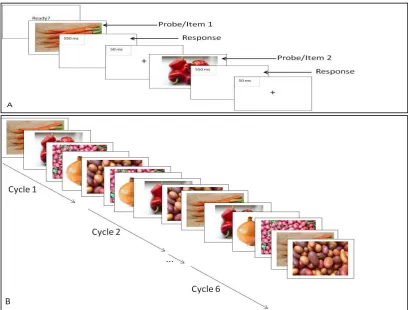
Tasks: Picture probes were presented individually on a computer screen and participants named each picture as it appeared. The task alternated between related and unrelated sets. In each set, there were five items to be named in each cycle, and these were repeated across six cycles. The order of the items within blocks was random, with no item occurring twice in a row (i.e., radish, carrot, potato, onion, pepper, onion). No trials were repeated within or across sessions. Following six cycles of one set, the first cycle of a new set was presented. Therefore, this method eliminated the potential confound between cycle and time since stimulation. There were 72 cycles per condition.
A number naming control task was included to assess any non-specific effects of TMS. Participants produced the English names for strings of Arabic numerals presented on the screen. These numbers contained no commas (to increase difficulty), varied in length from tens of thousands to millions (e.g., 56395, 614592, 7246856), and shifted position slightly on the screen (reducing the availability of visual cues to number length/syntax).
Procedure: A PC running E-Prime software controlled stimulus presentation and recording of response times. Responses were given verbally into a microphone which was connected to a Serial Response (SR) Box (Psychology Software Tools). Each trial started with a fixation cross for 50ms followed by the presentation of the picture or number to be named. In picture naming blocks, the onset of the participant response triggered a blank screen (550ms) after which the next trial began. In number naming blocks, once the participant initiated their response, the text colour changed to grey but the number remained on screen to minimise working memory demands. Each block was
Figure 1).
Participants were familiarized with the stimuli and their correct names before the
9
complete 12 related and 12 unrelated blocks of picture naming and 80 number trials prior to each TMS session. No practice items were used in the TMS experiment.
The TMS sessions began with further practice trials (6 related and 6 unrelated blocks, plus 80 number trials), followed by familiarisation of stimuli for the experiment. In the experiment, there were then 6 blocks per condition for picture naming (related/unrelated), and 20 number trials, assessed at three time points: before stimulation (baseline 1), immediately after stimulation (i.e., to capture performance under the influence of TMS), and 30 minutes after the end of the stimulation period (by which point, effects of TMS should have washed out; baseline 2). The two baseline measures were combined (as one baseline) for data analysis (an average of the two baselines was used for each participant). The related and unrelated sets alternated (e.g., related-unrelated-related etc.), and the number naming (one block) either preceded or followed semantic naming. The
[image:10.595.93.502.372.682.2]following variables were counterbalanced within and across participants: the order of sets (across both LIFG/pMTG sessions, and TMS/baseline periods), task order (whether the control task, related sets or unrelated sets were presented first), and order of LIFG/pMTG sessions.
10
Selection of TMS Site: Structural T1-weighted MRI scans were used to identify sites for stimulation in . Sites were identified from a recent neuroimaging meta-analysis examining manipulations of semantic control demands, in which the two strongest clusters were within LIFG (pars triangularis; -45, 19, 18; MNI coordinates), and pMTG (-54, -49, -2; Noonan et al., 2013). Brainsight 2 (Rogue Research, Montreal Canada, www.rogue-research.com/) was used to co-register participant scalps to their MRI structural image and to identify these sites, which were transformed from standard to individual brain space. Four landmarks were used for co-registering each
participant s head to their brain image (tip of the nose, bridge of the nose, left/right tragus).
Stimulation Parameters: Before TMS testing began (each session), individual motor threshold was determined by the lowest stimulation intensity required to elicit contraction of the first dorsal interosseous (FDI) muscle in the contralateral hand. Motor thresholds ranged between 39% and 65% (average: 51%) of maximum stimulator output. A 70 mm figure of eight coil, attached to a MagStim Rapid2 stimulator was used for repetitive magnetic pulses. Repetitive trains of TMS were delivered at 1Hz for 10 minutes, at 120% of motor threshold.
Data Analysis: TMS disruption was expected to manifest itself in slower response times (RT), rather than a decline in accuracy (Walsh & Cowey, 2000). Incorrect productions, missed trials and
responses faster than 250ms were removed prior to analysis (5.2% of trials). We report an analysis based on median RT, since medians are not strongly influenced by outlying values which can be problematic in analyses of response latency. For completeness, the supplementary materials provide summary statistics (Table S1) and ANOVA results (Table S2) for response accuracy, although
performance was close to ceiling (perhaps because of our familiarisation procedure which acquainted participants with the correct name for each picture before the experiment started). There were no significant effects of TMS or site on response accuracy. The majority of errors were response omissions: there were insufficient errors of commission to permit an analysis of different error types.
Results
11
< .001), which reflected (i) greater retrieval demands for unrelated sets particularly on early cycles and (ii) greater selection demands for related sets particularly on later cycles. This interaction was explored using Bonferroni t-tests, corrected for 6 comparisons (examining the effect of relatedness at each cycle). On cycle 1, there were faster responses for related than unrelated sets (t(13) = -7.1, p < .001), since semantic priming between related items helped to ameliorate the high retrieval demands during naming on cycle 1. The effect of semantic facilitation at cycle 1 was larger than that reported in several previous studies (e.g., Belke et al., 2005), perhaps because our familiarisation procedure ensured that participants knew the items within each set before the experiment commenced. Moreover, we used sets of highly related items that could be named at the specific level (i.e., types of shoes clogs, trainers etc.), and previous work has shown stronger facilitation of picture naming by close semantic neighbours of the target (Mahon et al., 2007). In contrast, on cycles 2-6 following repetition of the related and unrelated sets, there were faster responses to unrelated items (Bonferroni t(13) > 5.9, p < .001). This advantage for unrelated over related sets
became stronger across cycles, as competition between related items strengthened as they were repeated (t = 5.9 on cycle 2; t = 15.0 on cycle 6).
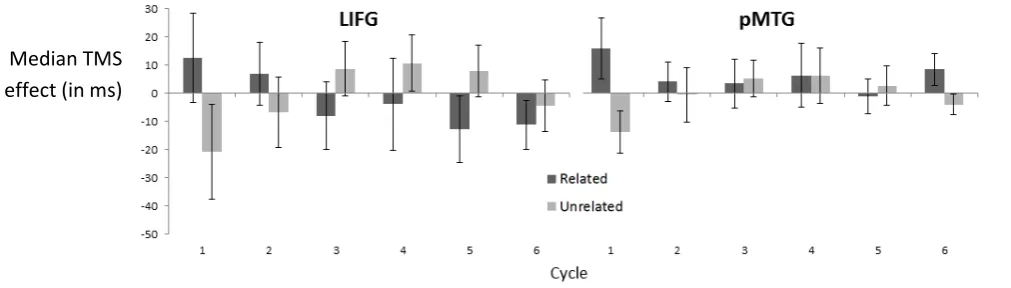
TMS effects on cyclical naming: Figure 2 shows naming latencies for each site, cycle and related/unrelated sets, with and without an influence of TMS, while Figure 3 shows the TMS effect (i.e., a difference score) for each condition. Omnibus ANOVA examining the effects of site by TMS by relatedness by cycle (2 x 2 x 2 x 6) revealed a significant 3-way interaction between TMS, relatedness and cycle, indicating that TMS had a differential effect for the related/unrelated sets across the six cycles (see Table 1). There was also a site by relatedness interaction: the relatedness effect (i.e., slower naming of related than unrelated sets, which characterised cycles 2-6) was somewhat larger for pMTG (Bonferroni t(15) = 8.38, p < .001) than for LIFG (Bonferroni t(15) = 6.09, p < .001). We focus the remainder of the analysis on the way in which TMS effects varied as a function of
12
Df F p
Site 1, 15 <1 0.34
TMS 1, 15 <1 0.93
Site x TMS 1, 15 <1 0.56
Site x Relatedness 1, 15 5.72 0.03 TMS x Relatedness 1, 15 <1 0.57 Site x TMS x Relatedness 1, 15 1.49 0.24
Site x Cycle 5, 75 <1 0.78
TMS x Cycle 5, 75 <1 0.84
[image:13.595.154.443.70.268.2]Site x TMS x Cycle 5, 75 <1 0.98 Site x Relatedness x Cycle 5, 75 1.58 0.18 TMS x Relatedness x Cycle 5, 75 3.44 0.01 Site x TMS x Relatedness x Cycle 5, 75 <1 0.67
Table 1. Omnibus ANOVA investigating interactions of TMS with site and task. Site = LIFG vs. pMTG. TMS = baseline performance vs. post-TMS session. Relatedness = related vs. unrelated picture naming sets. Cycle = Cycle 1, 2, 3, 4, 5, 6.
To unpack the complex three-way interaction between TMS, relatedness and cycle, we computed ANOVAs at each site for each cycle to establish when and where TMS was having a differential effect on the naming of related and unrelated sets (see Table 2). For LIFG, there was a TMS by relatedness interaction at cycle 1. There were no main effects or interactions involving TMS for any other cycle at this site. The TMS by relatedness interaction on the first cycle was further examined using two-tailed Bonferroni-corrected t tests that computed the difference between related and unrelated sets in the presence or absence of TMS to LIFG. The p values were corrected across 2 comparisons (examining the effect of relatedness at baseline and following TMS). These t tests confirmed that there was a highly significant advantage for related over unrelated sets in the baseline data (Bonferroni t(15) = 7.98, p < .001). Following TMS to LIFG, semantic facilitation was weaker but still reached significance (Bonferroni t(15) = 3.05, p = .016).
There was also an interaction (TMS by relatedness) at cycle one for the pMTG site (Table 2). Again, Bonferroni-corrected t-tests were used to investigate this interaction, as above. There was a strong advantage for related over unrelated sets at baseline (Bonferroni t(15) = 6.18, p < .001) and a smaller yet still significant effect of relatedness following the application of TMS (Bonferroni t(15) = 2.11, p = .03). Thus, TMS to both sites reduced the semantic facilitation effect.
13
14
LIFG pMTG
TMS
TMS x
Relatedness TMS
TMS x Relatedness
Cycle df 1, 15 1, 15 1, 15 1, 15
1 F <1 4.64 <1 5.27
p 0.78 0.04 .88 0.04
2 F <1 1.82 <1 <1
p 0.99 0.20 0.67 0.76
3 F <1 2.16 <1 <1
p 0.97 0.16 0.45 0.86
4 F <1 1.07 <1 <1
p 0.77 0.32 0.43 0.99
5 F <1 3.45 <1 <1
p 0.80 0.08 0.88 0.64
6 F 1.08 <1 <1 2.42
[image:15.842.238.616.68.306.2]p 0.31 0.48 0.41 0.14
15
Figure 2. Median picture naming latencies for semantically related and unrelated sets, with and without an influence of TMS (baseline = no TMS) at each site (LIFG, pMTG). Error bars indicate standard error of the mean.
16
Figure 3. TMS effects (TMS baseline) at each cycle (1-6). Error bars indicate standard error of the mean.
Discussion
This study investigated the contributions of LIFG and pMTG to retrieval and selection processes within a cyclical naming task, using inhibitory offline TMS. The findings revealed a highly similar involvement of these two sites, converging with recent neuroimaging and TMS studies suggesting that LIFG and pMTG work together to support lexical and semantic retrieval, particularly in executively-demanding contexts (e.g., Noonan et al., 2013; Noppeney et al., 2004; Whitney et al., 2011a; 2011b; Wright et al., 2011). TMS to both sites produced selective slowing for semantically related items on the first cycle i.e., when high retrieval demands could be overcome by drawing on
the activation of neighbouring concepts. Specifically, the size of the semantic facilitation effect was reduced by the application of TMS to both LIFG and pMTG.
Behaviourally, we observed both semantic facilitation and interference effects in this study. (i) Facilitation occurred on the first cycle, when retrieval demands were maximal (i.e., naming was faster for related than unrelated items). Our use of specific-level picture naming and highly related sets of concepts (i.e., different types of shoe, with largely-overlapping features) may have increased levels of facilitation in our paradigm, given that in previous studies, strong semantic neighbours elicited improved performance (Mahon et al., 2007; Navarrete et al., 2012). (ii) On later cycles, we saw semantic interference instead of facilitation (better performance for unrelated than related sets). Computational models based on interactive-activation and competitive settling show that weak activation of non-target neighbours produces facilitation, while strong activation elicits interference (Chen & Mirman, 2012): this provides a parsimonious account of why semantic effects Median TMS
17
switched from facilitation to interference in this experiment (see also Rahman & Melinger, 2009 for a related account).
TMS to both LIFG and pMTG selectively interfered with semantic facilitation effects on cycle 1 and did not modulate the magnitude of semantic interference effects on later cycles. This pattern of results might reflect TMS-induced disturbance to the ability to maintain weak activation within a set of semantically-related items and/or a failure to benefit normally from this semantic set, due to
when levels of activation were low. There was no disruptive effect of TMS at either site when retrieval demands were maximal yet semantic processing and selection demands were minimised (i.e., on the first cycle for unrelated sets) instead, these trials tended to show facilitation following TMS. There was also no clear disruptive TMS effect when competition between highly activated semantically-related items was maximal (i.e., on later cycles for related sets), even though the behavioural effects of competition were apparent (namely, there was a strong advantage for unrelated over related sets from cycle 2). Finally, there were no inhibitory TMS effects on a demanding number naming control task that tapped language production yet minimised lexical/semantic selection and retrieval if anything, TMS again facilitated performance on this task. The TMS results therefore show that both LIFG and pMTG make a
necessary contribution to semantically-driven word production, especially when retrieval demands are maximal, yet the role of these sites cannot be characterised simply in terms of lexical/semantic
We propose that TMS to LIFG and pMTG modulates spreading activation within the conceptual system, as opposed to effects within the speech production system per se. Although
some researchers have proposed a special role for LIFG in resolving competition within the speech production architecture, and have characterised the semantic blocking effects seen in cyclical picture
(Belke et al., 2005; Maess
18
components of semantic cognition interact and are supported by the same control mechanisms (e.g., Snyder et al., 2011). This viewpoint is compatible with our finding of maximal TMS disruption when there were high retrieval demands, plus semantically-related sets (i.e., when the spread of activity through the semantic system was relevant to naming performance).
A key question motivating this study concerned the relative contribution of pMTG and LIFG to the selection and retrieval of lexical/semantic representations. Some researchers have argued that although pMTG and LIFG show coupled activation, they nevertheless have functionally dissociable roles, with pMTG supporting semantic retrieval and LIFG playing a more unique role in selection (Badre et al., 2005; Bedny et al., 2008; Gold et al., 2006). This framework might predict a double dissociation, such that TMS to pMTG should slow naming on the first cycle of unrelated sets (when retrieval demands are high), while stimulation of LIFG should leave the first cycle of naming unaffected, with disruption at later cycles (i.e., when selection peaks). We found no such
dissociation: both sites showed the same pattern on a task designed to separate selection and retrieval requirements. This fits well with the idea that these two sites become functionally coupled in tasks in which lexical/semantic activation must be controlled (Jefferies, 2013; Noonan et al., 2013; Turken & Dronkers, 2011) and with TMS studies showing that stimulation of both pMTG and LIFG produces equivalent disruption of tasks designed to maximise either semantic selection
requirements or controlled retrieval demands (Whitney et al., 2011b, 2012).
19
on cycle 1, and the process of efficiently
demands would be impaired. However, competition within the semantically related sets might also be reduced on later cycles by this failure to maintain currently-relevant aspects of knowledge, and this might explain the absence of a TMS effect at either site when selection demands were maximal.
Our data are compatible with the findings of many neuropsychological studies, as noted above; however, on the cyclical naming paradigm specifically, patients with lesions encompassing our two stimulation sites show important differences: cases who have damage to LIFG show
increasing errors across cycles for semantically-related sets, while patients with damage restricted to temporoparietal regions show only very subtle or no effect of cycle (Campanella et al., 2009;
Gardner et al., 2012; Jefferies et al., 2007; Schnur et al., 2009). Some researchers have suggested that this difference reflects a greater involvement of LIFG in the resolution of competition (Schnur et al., 2006; Schnur et al., 2009) and, at first glance, these data do not relate very easily to the TMS findings we report here. However, it is difficult to draw direct comparisons between patients and healthy individuals on the cyclical naming task because the behavioural effects, even without any effect of TMS, show a different profile. In healthy individuals, the blocking profile (i.e., faster naming of unrelated sets) starts on cycle 2 and is stable across subsequent cycles whereas in patients with LIFG lesions, the blocking effect builds-up cumulatively across cycles (Belke & Stielow, 2013). One possibility, suggested by the current TMS data and other tasks in the neuropsychological literature, is that LIFG and pMTG do jointly support semantic control, and their engagement is maximised in situations in which both selection and retrieval demands are high (since these processes interact), but that patients with LIFG lesions show more dramatic effects of cycle, and a growth of
perseverations across cycles, because they have additional deficits (following their more extensive lesions or white matter damage) for example, in resetting top-down goals for semantic retrieval as the target shifts, or in overcoming interference from previously-selected responses and re-activating representations which were previously inhibited.
20
demands than the related items: in other words, this near-significant interaction between TMS and relatedness might once again reflect TMS-induced disruption when both retrieval and selection demands were relatively high. Further empirical work is need to confirm whether these possible effects are genuine. However, if TMS to LIFG does prove to increase naming latencies for unrelated sets at later cycles more than stimulation of pMTG, LIFG might play a greater role in establishing and maintaining an ad-hoc category of possible responses when this is not based on semantic
relationships.
In conclusion, the cyclical naming task provides a unique opportunity to separate retrieval processes (which are maximal on cycle one for unrelated sets) and selection demands (which are high on later cycles for related sets). We show that TMS to pMTG and LIFG disrupted performance on the first cycle for related sets, i.e., when high retrieval demands could be ameliorated through the activation of semantically-related items from the set. This corroborates previous TMS studies demonstrating a similar involvement of the two sites in the control of lexical/semantic retrieval (Whitney et al., 2011b, 2012). This pattern could reflect disturbance to the ability to identify and
target response in the face of high retrieval demands.
Acknowledgements: This work was supported by a BBSRC studentship to the first author. The work was also partly supported grants from the BBSRC (BB/J006963/1) and the European
Research Council (283530 SEMBIND). We would like to thank Shane Ford for collecting the pictures
21 References
Badre, D., Poldrack, R. A., Pare-Blagoev, E. J., Insler, R. Z., & Wagner, A. D. (2005). Dissociable Controlled Retrieval and Generalized Selection Mechanisms in Ventrolateral Prefrontal Cortex. Neuron, 47(6), 907-918.
Barsalou, L. W. (1991). Deriving categories to achieve goals. In G. H. Bower (Ed.), The psychology of learning and motivation: Advances in research and theory (Vol. 27, pp. 1-64). San Diego, CA Academic Press.
Bedny, M., McGill, M., & Thompson-Schill, S. L. (2008). Semantic adaptation and competition during word comprehension. Cerebral Cortex, 18(11), 2574-2585.
Belke, E., Meyer, A. S., & Damian, M. (2005). Refractory effects in picture naming as assessed in a semantic blocking paradigm. Quarterly Journal of Experimental Psychology Section A: Human Experimental Psychology, 58(4), 667-692.
Belke, E., & Stielow, A. (2013). Cumulative and non-cumulative semantic interference in object naming: Evidence from blocked and continuous manipulations of semantic context. Quarterly Journal of Experimental Psychology, 66, 2135-2160.
Buckner, R. L., Raichle, M. E., Miezin, F. M., & Petersen, S. E. (1996). Functional Anatomic Studies of Memory Retrieval for Auditory Words and Visual Pictures. The Journal of Neuroscience, 16(19), 6219-6235.
Campanella, F., Mondani, M., Skrap, M., & Shallice, T. (2009). Semantic access dysphasia resulting from left temporal lobe tumours. . Brain, 132, 87-102.
Campanella, F., & Shallice, T. (2011). Refractoriness and the healthy brain: A behavioural study on semantic access. Cognition, 118, 417 - 431.
Chen, Q., & Mirman, D. (2012). Competition and Cooperation Among Similar Representations: Toward a Unified Account of Facilitative and Inhibitory Effects of Lexical Neighbors. Psychological Review, 119, 417-430.
Collins, A. M., & Loftus, E. F. (1975). Spreading activation theory of semantic processing. Psychological Review, 82, 407-428.
Corbett, F., Jefferies, E., Ehsan, S., & Lambon Ralph, M. A. (2009a). Different impairments of semantic cognition in semantic dementia and semantic aphasia: evidence from the non-verbal domain. Brain, 132(9), 2593-2608.
Corbett, F., Jefferies, E., & Lambon Ralph, M. A. (2009b). Exploring multimodal semantic control impairments in semantic aphasia: Evidence from naturalistic object use. Neuropsychologia, 47(13), 2721-2731.
Corbett, F., Jefferies, E., & Lambon Ralph, M. A. (2011). Deregulated Semantic Cognition Follows Prefrontal and Temporo-parietal Damage: Evidence from the Impact of Task Constraint on Nonverbal Object Use. Journal of Cognitive Neuroscience, 23(5), 1125-1135.
De Zubicaray, G., McMahon, K., Eastburn, M., & Pringle, A. (2006). Top-down influences on lexical selection during spoken word production: A 4T fMRI investigation of refractory effects in picture naming. Human Brain Mapping, 27, 864-873.
Demb, J. B., Desmond, J. E., Wagner, A. D., Vaidya, C. J., Glover, G. H., & Gabrieli, J. D. (1995). Semantic encoding and retrieval in the left inferior prefrontal cortex: a functional MRI study of task difficulty and process specificity. The Journal of Neuroscience, 15(9), 5870-5878. Eviatar, Z., & Just, M. A. (2006). Brain correlates of discourse processing: An fMRI investigation of
irony and conventional metaphor comprehension. Neuropsychologia, 44(12), 2348-2359. Fiez, J. A. (1997). Phonology, Semantics, and the Role of Left Inferior Prefrontal Cortex. Human Brain
Mapping, 5, 79-83.
Forde, E. M. E., & Humphreys, G. W. (1997). A Semantic Locus for Refractory Behaviour: Implications for Access Storage Distinctions and the Nature of Semantic Memory. Cognitive
22
Foygel, D., & Dell, G. S. (2000). Models of impaired lexical access in speech production. Journal of Memory and Language, 43, 182 216.
Gabrieli, J. D. E., Poldrack, R. A., & Desmond, J. E. (1998). The role of the prefrontal cortex in language and memory. Proceedings of the National Academy of Sciences, 95, 906-913. Gardner, H. E., Lambon Ralph, M. A., Dodds, N., Jones, T., Eshan, S., & Jefferies, E. (2012). The
differential contributions of prefrontal and temporoparietal cortices to multimodal semantic control: Exploring refractory effects in semantic aphasia. Journal of Cognitive Neuroscience, 24, 778-793.
Gennari, S. P., MacDonald, M. C., Postle, B. R., & Seidenberg, M. S. (2007). Context-dependent interpretation of words: evidence for interactive neural processes. Neuroimage, 35(3), 1278-1286.
Gold, B. T., Balota, D. A., Jones, S. J., Powell, D. K., Smith, C. D., & Andersen, A. H. (2006). Dissociation of Automatic and Strategic Lexical-Semantics: Functional Magnetic Resonance Imaging Evidence for Differing Roles of Multiple Frontotemporal Regions. Journal of Neuroscience, 26(24), 6523-6532.
Heim, S., Eickhoff, S., Friederici, A., & Amunts, K. (2009). Left cytoarchitectonic area 44 supports selection in the mental lexicon during language production. Brain Structure and Function, 213(4-5), 441-456.
Henseler, I., Mädebach, A., Kotz, S. A., & Jescheniak, J. D. (2014). Modulating Brain Mechanisms Resolving Lexico-semantic Interference during Word Production: A Transcranial Direct Current Stimulation Study. Journal of Cognitive Neuroscience, 26(7), 1403-1417.
Hickok, G., & Poeppel, D. (2007). The cortical organization of speech processing. [10.1038/nrn2113]. Nature Reviews Neuroscience, 8(5), 393-402.
Hoffman, P., Pobric, G., Drakesmith, M., & Lambon Ralph, M. A. (2011). Posterior middle temporal gyrus is involved in verbal and non-verbal semantic cognition: Evidence from rTMS. Aphasiology, 1-12.
Jefferies, E. (2013). The neural basis of semantic cognition: converging evidence from neuropsychology, neuroimaging and TMS. Cortex, 49(3), 611-625.
Jefferies, E., Baker, S. S., Doran, M., & Lambon Ralph, M. A. (2007). Refractory effects in stroke aphasia: a consequence of poor semantic control. Neuropsychologia, 45(5), 1065-1079. Jefferies, E., & Lambon Ralph, M. A. (2006). Semantic impairment in stroke aphasia versus semantic
dementia: a case-series comparison. Brain, 129, 2132-2147.
Jefferies, E., Patterson, K., & Lambon Ralph, M. A. (2008). Deficits of knowledge versus executive control in semantic cognition: Insights from cued naming. Neuropsychologia, 46, 649-658. Kapur, S., Craik, F. I. M., Tulving, E., Wilson, A. A., Houle, S., & Brown, G. M. (1994). Neuroanatomical
correlates of encoding in episodic memory: Levels of processing effect. Proceedings of the National Academy of Sciences, 91, 2008-2011.
Levelt, W. J. M., Roelofs, A., & Meyer, A. S. (1999). A theory of lexical access in speech production. Behavioural and Brain Sciences, 22, 1-38.
Maess, B., Friederici, A. D., Damian, M., Meyer, A. S., & Levelt, W. J. M. (2002). Semantic category interference in overt picture naming: Sharpening current density localization by PCA. Journal of Cognitive Neuroscience, 14(3), 455-462.
Mahon, B. Z., Costa, A., Peterson, R., Vargas, K. A., & Caramazza, A. (2007). Lexical selection is not by competition: A reinterpretation of semantic interference and facilitation effects in the word-picture interference paradigm. Journal of Experimental Psychology: Learning, Memory and Cognition, 33, 503-535.
Martin, R., & Cheng, Y. (2006). Selection demands versus association strength in the verb generation task. Psychonomic Bulletin & Review, 13(3), 396-401.
23
Navarrete, E., Del Prato, P., & Mahon, B. Z. (2012). Factors determining semantic facilitation and interference in the cyclic naming paradigm. Frontiers in Psychology, 3, 1-15.
Noonan, K. A., Jefferies, E., Corbett, F., & Lambon Ralph, M. A. (2010). Elucidating the nature of deregulated semantic cognition in semantic aphasia: evidence for the roles of prefrontal and temporo-parietal cortices. Journal of Cognitive Neuroscience, 22(7), 1597-1613.
Noonan, K. A., Jefferies, E., Visser, M., & Lambon Ralph, M. A. (2013). Going beyond Inferior Prefrontal Involvement in Semantic Control: Evidence for the Additional Contribution of Dorsal Angular Gyrus and Posterior Middle Temporal Cortex. Journal of Cognitive Neuroscience, 1-26.
Noppeney, U., Phillips, J., & Price, C. (2004). The neural areas that control the retrieval and selection of semantics. Neuropsychologia, 42(9), 1269-1280.
Peterson, S. E., Fox, P. T., Posner, M., Mintum, M., & Raichle, M. E. (1988). Positron emission tomographic studies of the cortical anatomy of single-word processing. Nature, 331, 585-589.
Pisoni, A., Papagno, C., & Cattaneo, Z. (2012). Neural correlates of the semantic interference effect: New evidence from transcranial direct current stimulation. Neuroscience, 223(0), 56-67. Rahman, R. A., & Melinger, A. (2009). Semantic context effects in language production: A swinging
lexical network proposal and a review. Language and Cognitive Processes, 24, 713-734. Schnur, T. T., Schwartz, M. F., Brecher, A., & Hodgson, C. (2006). Semantic interference during
blocked-cyclic naming: Evidence from aphasia. Journal of Memory and Language, 54(2), 199-227.
Schnur, T. T., Schwartz, M. F., Kimberg, D. Y., Hirshorn, E., Coslett, H. B., & Thompson-Schill, S. L. (2009). Localizing interference during naming: Convergent neuroimaging and
neuropsychological evidence for the function of Broca's area. Proceedings of the National Academy of Sciences of the United States of America, 106(1), 322-327.
Snyder, H. R., Banich, M. T., & Munakata, Y. (2011). Choosing our words: retrieval and selection processes recruit shared neural substrates in left ventrolateral prefrontal cortex. Journal of Cognitive Neuroscience, 23(11), 3470-3482.
Thompson-Schill, S. L., D'Esposito, M., Aguirre, G. K., & Farah, M. J. (1997). Role of left inferior prefrontal cortex in retrieval of semantic knowledge: a reevaluation. Proc Natl Acad Sci U S A, 94(26), 14792-14797.
Thompson-Schill, S. L., D'Esposito, M., & Kan, I. P. (1999). Effects of Repetition and Competition on Activity in Left Prefrontal Cortex during Word Generation. Neuron, 23(3), 513-522.
Turken, A. U., & Dronkers, N. F. (2011). The neural architecture of the language comprehension network: converging evidence from lesion and connectivity analyses. Frontiers in Systems Neuroscience, 5, 1-20.
Wagner, A. D., Koutstaal, W., Maril, A., Schacter, D. L., & Buckner, R. L. (2000). Task-specific Repetition Priming in Left Inferior Prefrontal Cortex. Cerebral Cortex, 10(12), 1176-1184. Wagner, A. D., Pare-Blagoev, E. J., Clark, J., & Poldrack, R. A. (2001). Recovering Meaning: Left
Prefrontal Cortex Guides Controlled Semantic Retrieval. Neuron, 31(2), 329-338.
Walsh, V., & Cowey, A. (2000). Transcranial magnetic stimulation and cognitive neuroscience. Nature Reviews Neuroscience, 1(1), 73-80.
Whitney, C., Grossman, M., & Kircher, T. (2009). The Influence of Multiple Primes on Bottom-Up and Top-Down Regulation during Meaning Retrieval: Evidence for 2 Distinct Neural Networks. Cerebral Cortex, 19(11), 2548-2560.
Whitney, C., Jefferies, E., & Kircher, T. (2011a). Heterogeneity of the Left Temporal Lobe in Semantic Representation and Control: Priming Multiple versus Single Meanings of Ambiguous Words. Cerebral Cortex, 21(4), 831-844.
24
Whitney, C., Kirk, M., O'Sullivan, J., Lambon Ralph, M. A., & Jefferies, E. (2012). Executive Semantic Processing Is Underpinned by a Large-scale Neural Network: Revealing the Contribution of Left Prefrontal, Posterior Temporal, and Parietal Cortex to Controlled Retrieval and Selection Using TMS. Journal of Cognitive Neuroscience, 24(1), 133-147.
Wirth, M., Rahman, R. A., Kuenecke, J., Koenig, T., Horn, H., Sommer, W., et al. (2011). Effects of transcranial direct current stimulation (tDCS) on behaviour and electrophysiology of language production. Neuropsychologia, 49(14), 3989-3998.
Wright, P., Randall, B., Marslen-Wilson, W. D., & Tyler, L. K. (2011). Dissociating Linguistic and Task-related Activity in the Left Inferior Frontal Gyrus. Journal of Cognitive Neuroscience, 23(2), 404-413.
Zempleni, M. Z., Renken, R., Hoeks, J. C. J., Hoogduin, J. M., & Stowe, L. A. (2007). Semantic
25
Supplementary materials
LIFG pMTG Mean SD Mean SD
Baseline, related
Cycle 1 0.94 .065 0.94 .045 Cycle 2 0.94 .043 0.96 .031 Cycle 3 0.94 .054 0.95 .035 Cycle 4 0.93 .066 0.94 .065 Cycle 5 0.94 .058 0.95 .048 Cycle 6 0.94 .063 0.95 .059
Post-TMS, related
Cycle 1 0.93 .070 0.94 .061 Cycle 2 0.95 .082 0.94 .064 Cycle 3 0.92 .092 0.94 .063 Cycle 4 0.95 .069 0.94 .068 Cycle 5 0.93 .074 0.94 .060 Cycle 6 0.94 .064 0.93 .069
Baseline, unrelated
Cycle 1 0.94 .055 0.94 .031 Cycle 2 0.95 .054 0.97 .037 Cycle 3 0.96 .070 0.97 .028 Cycle 4 0.95 .060 0.98 .017 Cycle 5 0.95 .076 0.96 .050 Cycle 6 0.95 .104 0.97 .031
Post-TMS, unrelated
Cycle 1 0.91 .115 0.94 .055 Cycle 2 0.93 .138 0.94 .042 Cycle 3 0.94 .107 0.96 .050 Cycle 4 0.95 .087 0.98 .021 Cycle 5 0.95 .075 0.97 .034 Cycle 6 0.97 .058 0.96 .037
26
df F p
Relatedness 1, 15 5.97 .03
Cycle 1, 15 3.42 .01
Relatedness x Cycle 5, 75 2.83 .02
Site 1, 15 <1 .46
TMS 1, 15 1.69 .21
Site x TMS 1, 15 <1 .79
Site x Relatedness 1, 15 2.67 .12 TMS x Relatedness 1, 15 <1 .98 Site x TMS x Relatedness 1, 15 <1 .42
Site x Cycle 5, 75 <1 .78
TMS x Cycle 5, 75 <1 .54
Site x TMS x Cycle 5, 75 <1 .59 Site x Relatedness x Cycle 5, 75 <1 .45 TMS x Relatedness x Cycle 5, 75 <1 .73 Site x TMS x Relatedness x Cycle 5, 75 <1 .66