STUDIES OF MENEIDIC SYSTEMS
Hamish McNab
A Thesis Submitted for the Degree of PhD
at the
University of St Andrews
1974
Full metadata for this item is available in
St Andrews Research Repository
at:
http://research-repository.st-andrews.ac.uk/
Please use this identifier to cite or link to this item:
http://hdl.handle.net/10023/15492
being a Thesis
presented by
HA^IGH McNAB. B.Sc.
to the
UNIVERSITY OP ST. ANDREWS
St. Andrews July 1974
' (
STUDIES OF MENEIDIC SYSTEMS
in application for j
ProQuest Number: 10167400
All rights reserved INFORMATION TO ALL USERS
The quality of this reproduction is dependent upon the quality of the copy submitted. In the unlikely event that the author did not send a com plete manuscript and there are missing pages, these will be noted. Also, if material had to be removed,
a note will indicate the deletion.
uest
ProQuest 10167400
Published by ProQuest LLC (2017). Copyright of the Dissertation is held by the Author.
All rights reserved.
This work is protected against unauthorized copying under Title 17, United States C ode Microform Edition © ProQuest LLC.
ProQuest LLC.
789 East Eisenhower Parkway P.O. Box 1346
I
(i)
DECLARATION
I declare that this thesis is based on the results of
experiments carried out by me, that it is my own composition, | and has not previously been presented for a Higher Degree,
The work was carried out in the Department of Chemistry of the University of St, Andrews, under the direction of
D,M,G. Lloyd,
(ii)
c e r t i f i c a t e
I hereby certify that Mr. Haraish McNab, B.Sc., has spent 11 terms at research work under my supervision, has fulfilled the conditions of the Resolution of the University Court 1967, No, 1, and is qualified to submit the accompanying thesis in
application for the degree of Ph.D.
I
S ri Ï
I
(ill)
UNIVERSITY c a r e e r
I entered the University of St. Andrews in October 1967 as the William J. Matheson Scholar, and graduated B.Sc. with First Class Honours in Chemistry in July 1971.
(iv)
a c k n o W l e d g e m e n t s
I am most grateful to Dr. D. Lloyd for his advice, interest and encouragement over the past three years.
Parts of this thesis could not have been written without the help of Dr. A.R. Butler (kinetics) and Dr. R.K. Mackie (spectra).
I am indebted to my friends and colleagues in the lab. for many interesting and valuable discussions, some pertaining to chemistry,
My thanks are also due to the technical staff of the Department, especially Miss M. Poowiardowska (nmr spectra), Mr, C, Millar (mass spectra) and Mr. J.R, Hews (microanalyses).
13
The C nmr spectra were recorded by Dr, A. Boyd at the University of Edinburgh.
I am indebted to Mrs. W. Pogorzelec, Mr, T, McQueen, and Mr. J, Gray for their help in the production of this thesis.
(v:)
s u m m a r y
The nmr spectra of 2,3-dihydro~l,4“*diazepinium salts are
'I discussed. Prom the magnitude of the coupling constants around 4
5 the conjugated part of the molecules, a planar partial structure '
with complete electron delocalisation is indicated, The molecule as a whole adopts a half-chair configuration which rapidly inverts at room temperature. The effect of ring substitution on this exchange process is correlated with the size of the substituents.
The mass spectra of a variety of 2,3-dihydro-l,4-diazepinium salts are reported. The molecular ion of the cation is only
rarely observable due to thermal dissociation of the salt. The
1 2
major breakdown process involves the loss of the (N -C ) fragment but other pathways are also considered. The factors governing some anomalous fragmentation patterns are discussed.
The rates of bromination in methanol of a number of 2,3“ dihydro-1,4“diazepinium salts were measured under first-order conditions, normally by stopped flow methods. Differences in
rate of factors of up to 10000 between dihydrodiazepines with only * alkyl or aryl substituents, are correlated with steric effects in
the region of the reaction site,
5,6,7~Unsubstituted 2,3-dihydro-l,4-diazepinium salts are tedious to make by standard methods. Their facile preparation from 1,5“diaryl-1,5“diazapentadienium salts under high dilution conditions, is disfcussed, and the scope of the synthesis was explored. The mechanism of the reaction was investigated using mono-amine model compounds. Attempts to prepare 5,7-dimethyl- dihydrodiazepinium salts by this method generally resulted in the formation of 2-methylimidazolines.
The parent 2,3-dihydro-l,4-diazepinium perchlorate was | obtainable by this high dilution synthesis in sufficient
quantities for a study of its properties to be made. It is active towards electrophiles, giving 6-substitution products, and reacts
‘1?
(vi) j
1
with-nucleophiles at the 5(7) position. In contrast to 5,7“ substituted dihydrodiazepines, the 6“halogeno derivatives are inert towards nucleophiles at the 6“position,
A series of 1,2“dihydropyrimidines was prepared, and the chemical and spectroscopic properties of these heterocycles are compared with those of the isoelectronic 2,3“dihydro-1,4“diazeplnes. Dihydropyrimidines show meneidic reactions with electrophiles at the 5“position, but only G-unsubstituted derivatives react with
nucleophiles at the 6“position, A convenient synthetic route from -s| 4-methyldihydropyrimidines to 5-methyldihydrodiazepinium salts is
described,
The effect of electronic perturbation on the 1,5-diazapenta-dienium system was investigated using series of 1,3-dimethyl-I,2-dihydro“2“0X0“ and 2-thiopyrimidinium salts. Substitution reactions
of 4,6“unsubstituted derivatives with electrophiles have been shown to proceed by alternative mechanisms; those pyrimidines with 4(6)-methyl substituents also show substitution reactions in the 4(6)-methyl groups. Stable adducts are formed by reaction of the
4,6-unsutastituted compounds with bases. The structure and chemical properties of these pseudobases are discussed.
The electronic structure of 2,3-dihydro-1,4-diazepinium perchlorates and the other 1,5-diazapentadienium salts considered
13
Declaration Certificate University Career Acknowledgement s Summary CONTENTS Page (i) (ii) (iii) (iv) (v) INTRODUCTION Nomenclature
Quasi“aromaticity and Meneidic Character 'U'“vinamidines
’W ’“vinamidines 'Sickle'"vinamidines Polyazapentadienes Diazapolymethines
Miscellaneous Diazapolymethine Systems Other Quasi“aromatic Compounds
1 1 2 8 10 11 11 14 19 DISCUSSION PART 1 DIHYDRODIAZEPINES
1. Nuclear Magnetic Resonance Spectra of Dihydrodiazepinium
Salts 21
2. Mass Spectra of Dihydrodiazepinium Salts 34 3. Steric Effects in the Bromination of Dihydrodiazepinium
Salts 43
4. The Preparation of Cyclic Products by Reaction of
1,5-Diaryl -I , 5-diazapentadienium Salts with Diamines 50
5. 2,3“Dihydro“l,4“diazepinium salts 61
PART 2 DIHYDROPYRIMIDINES 1,2-Dihydropyrimidines
1,2“Dihydro“2“oxo“ and 1,2“Dihydro“-2~thiopyrimidines
66
PART 3
CARBON-13 NUCLEAR MAGNETIC RESONANCE SPECTRA 95
EXPERIMENTAL Materials and Apparatus
Abbreviations
PART 1
N “Methyldihydrodiazepinium Salts 2 j,2“”Dimothyldihydrodiazepinium Salts Variable Temperature Nmr Spectra Dihydrodiazepinium iodides
Dihydrodiazepinium Salts for Bromination Rate Studies Kinetic Studies
N;N’ “D i i m i n o e ^
Reactions with Diamines Reactions with Monoamines Kinetic Studies
Dihydrodiazepines from Oxo-enamines
Reactions of 2,3™Dihydro-TH-T,4-diazepinium Perchlorate
103 103 104 104 108 109 111 113 114 115 120 122 122 124
1
PART 2 1.2 “•Dihydropyrimidines Reactions with Electrophiles Reactions with Nucleophilesâ=Ezrimidinones_and_2:P3rr^^
Reactions with Halogens Reactions with Bases
Nomenclature
The terms 'dlhydrodiazepine' and 'dihydropyrimidine’ as used
in this thesis, refer to 2,3"dihydro~l,4~diazepines and
1,2-dihydro-pyrimidines unless otherwise stated. The numbering in a,(<5“diaza“
polymethines, which includes the nitrogen atoms, follows the
precedent of Dreiding^. The 6-position in dihydrodiazepines, which, is electronically equivalent to the 5-position in dihydropyrimidines and the 3-position in open-chain 1,5-diazapentadienes, is also
referred to as the *meso’ position by analogy with porphyrin and
cyanine nomenclature. The name ’vinamidine' has been suggested for
2 the 1,5“diazapentadiene system ,
Quasi-aromaticity and Meneidic Character
The term 'quasi-aromatic’ was defined in 1964 as follows: "Molecules should be called quasi-aromatic ônly if they contain an acyclic conjugated TV-electron system and show chemical properties typical of aromatic compounds, especially reaction by substitution with retention of type. A significant mesomeric stability is
3
implied" . Nevertheless, the meaning of quasi-aromaticity has become almost as hackneyed as that of aromaticity itself. Although it was originally used to describe the structure of osazones^, it
3
was latter defined as above in terms of reactivity. More recently, the hydrogenated ring of tetralin has been dubiously described as
'quasiaromatic’ on the basis of the results of a variety of physical 5
measurements , and to add to the confusion, the term was redefined in 1972, this time on a structural basis®.
substitution rather than addition". Meneidic behaviour may be
'f 10
concisely summarised by Robinson’s phrase' "The tendency to retain the type". ’Aromatic Reactivity’ is one example of meneidic
behaviour, but the concept is clearly a more general,one. Carboxylic | acid derivatives, for example, show retention of type in the
9
interconversions of esters, amides, acid halides etc . Tropolone may be considered meneidic, both in its substitution reactions with electrophiles and in its conversion to 2-substituted tropones, in
11
which reactions it behaves as an extended acid . Even alkenes
undergo substitution reactions with Friedel-Crafts reagents and may be 12
designated 'meneidic’ in this context
2 Compounds containing the 1,5-diazapentadienium or vinamidinium system (1) form perhaps the best examples of quasi-aromaticity or
+ +
HgN=CH-CH=CH-NHg < --- > H N-CH=CH-CH=NHg
(
1)
meneidic behaviour, and so their chemistry is discussed in some detail. The system has a high resonance stability despite the absence of closed conjugation, and it is this stability which
explains the importance of substitution reactions in the chemistry j of such compounds. Three geometrical isomers are possible:
all-cis ('U'), all-trans ('W’) and cis-trans (’sickle'). The second is the most stable form in isolation, but the others may be important when constrained in ring systems.
’U ' —vinamidines
The simplest cyclic 1,5-diazapentadiene is pyrazole, but since it is also fully conjugated, it cannot be described as quasi
aromatic.
Perhaps the most extensively studied vinamidine system is the
j
2,3-dihydro-l,4“”diazepine (2). Such compounds have recently been |.
.
I
13
the subject of a comprehensive review , and so only a summary of the salient features of their chemistry is presented here.
The first authentic dihydrodiazepine was isolated by
Schwarzenbach and Lütz^^, who obtained the 5,7-dimethyl derivative (3), from the reaction of ethylenediamine with acetylacetone under acidic conditions. The course of the reaction is markedly pH dependent, however, and the bisoxo-enamine (4) is obtained as the major product in mildly alkaline or neutral media^®'^®. Condensation
Me Me
Ctrr: \
NH \
Me
Me' (4 ) ''Me
reactions of dicarbonyl compounds with diamines remain the principal synthetic route to dihydrodiazepines, although modified conditions may be necessary^^'^®, especially in the preparation of
aryl-19 20 21
substituted compounds ’ ' , Some isolated examples of the preparation of dihydrodiazepines by other methods have recently
22 “27 appeared in the literature
Dihydrodiazepine bases share with amidines the distinction of
29
1
I 'i
NH
r
.-‘i. being perhaps the strongest organic bases known, with pK^ values in 4
28
the region 13-14 , This is due principally to the resonance stability of the monocation (5), estimated to be about 20 kcalmol”^ which is further exemplified by the large pH range over which the monocation is the predominant species. The dication (6) is formed
significantly only in acids of comparable strength to 70% sulphuric acid^®. Dihydrodiazepinium salts are also resistant to oxidation, dehydrogenation, and hydrolysis^®, although the latter may occur
under strongly alkaline conditions. One example of a catalytic -| 22
reduction of a dihydrodiazepine has been reported , | Surprisingly, in view of their positive charge, dihydro
diazepinium salts are active towards electrophiles, and reaction '4 characteristically occurs by substitution at the 6-position rather 4 than by addition. A less naive analysis indicates that this
reactivity is not unexpected. As modified enamines, dihydro diazepinium cations are paradoxically electron-rich, despite their charge. These compounds, therefore, are readily deuteriated by
24 30-32 33 34
acids ’ , brominated with bromine in methanol ’ , halogenated
34 with N-halogenosuccinimides in chloroform or acetic acid , and
35 “38
nitrated by nitric acid-sulphuric acid mixtures . The reaction
proceeds via an intermediate cT-complex (7), analogous to the Wheland intermediate in the electrophilic substitution of benzenoid
13
compounds' . This intermediate loses a proton to give the 6-substituted product (8). Kinetic s t u d i e s ® ^ ' h a v e shown that
H ■+
/ N-— ^
ST' N"-'"
H IT'" R
-H+
(8) (^ ~D, Br, Cl, I, NOg) (7)
these reactions bear more than a superficial similarity to reactions of active benzenoid compounds, and it was for this
3 reason that the term ’quasi-aromatic' was defined to describe them . Further similarities are evident; the 6-nitro compounds may be
3 5 4 X 3 ^
reduced to amines " which yield stable anils and diazonium salts , while the 6-unsubstituted compounds are themselves sufficiently
active to couple with diazonium salts, although the dihydrodiazepines 42
so produced are hydrolytically unstable and are not isolable
As might Tbe expected since no stable intermediate structure
can be drawn, dihydrodiazepines are inert to electrophiles at the 5(7) positions^^'^^. Even 6™substituted dihydrodiazepines react preferentially at the 6-position despite the loss of resonance
stabilisation in the process^^'^^. Surprisingly, 5,7-disubstituted dihydrodiazepines are also inert to nucleophiles at the 5(7)
positions although attack at these sites is electronically
favourable. Totally unexpected is the facile reaction of 6-halogeno-dihydrodiazepines with nucleophiles at the 6-position to give
substitution products^^'^^'^^, A variety of oxygen, nitrogen, iodide and sulphur nucleophiles have been used. This reaction is unlikely to involve the conjugated tautomer of the dihydrodiazepine, which is electron-rich at the 6-position, but rather the bis-imine tautomer (9), where that position is adjacent to three electron-withdrawing groups and is therefore prone to nucleophilic attack
(scheme 1). In agreement with this, N-substituted-6-halogeno-dihydrodiazepines,which cannot exist as a bis-imine tautomer, do
34
not react with nucleophiles . There is no spectroscopic evidence for the presence under any conditions of the bis-imine tautomer, although energetic considerations suggest it may be present to the
40
extent of about 10% . Such concentrations may not be observable spectroscopically because of rapid exchange.
R R
X
.N--+N
*N (9)
\ n"' H
Y
Scheme 1
N — R - : A
N R
N ^nucleophile
or N7 and the 6-unsubstituted compound is isolated (see Scheme
Attack of the nucleophile on the 6"“substituent in the bis -imine tautomeric form is thought to yield an anion which abstracts a proton from the medium to give the product. This 'abnormal
34
substitution' is a competitive reaction with the conventional 34
nucleophilic substitution
The 1,5“diazapentadiene system also exists potentially in
45 ' 46
benzo“”l , 5'~diazepines (10) which have been known since 1907 , but
J...
H(10a)
in these compounds the biS“imine tautomer (10b) is the predominant form^^'^^. The monocations, however [eg. (11)] do contain the
47
vinamidinium system , but this species is stable over only a 48
moderate pH range . The lack of meneidic character of these compounds is further exemplified by their unpredictable behaviour
48
with electrophiles . The system is complicated by conjugation with the benzene ring.
2,3-Dihydrobenzo“l,4-diazepines (12) have been extensively 49
studied on account of the pharmacological importance of certain 50
derivatives, such as the tranquiliser 'valium' (13) , These (10b)
N—""'Me
H
Me
0 N'«
(13) Ph ►Cl ■"*r
■ N "
(
12)
compounds are formally 1,9“diazanonatetraenes and so mj-ght be active towards electrophiles at positions 7 and 9. Indeed, the 7-nitration
51 of one such, diazepine has been reported' ,
There have been very few reports on 1,5-diazapentadienes constrained in rings other than seven-membered. The
1,2-dihydro-52 53
properties are reported in this thesis. The eight-membered ring
N = . I
%
"0
(
20)
(
21)
(
22)
3
N___
" (14T (15)
analogueJ 1,2,3,4-tetrahydrodiazocine (15), is unknown, and molecular models indicate that the structure is rather strained.
Although not specifically studied in this thesis, the
possibility of replacing the nitrogen atoms of 1,5-diazapentadienes
with other electron-donating heteroatoms is clearly an attractive '% one. Such compounds, whether of six or seven-membered rings, in
general remain to be investigated. The 2,3-dihydrooxazepine system (16) has never been prepared, and no simple derivatives of
) o
N - z / \ N = / \ N ___
(16) (17) (18) (19)
2H-1,3-thiazines (19) have been isolated. The 2,S-dihydro-l,4-thiazepine ring (17) has excited more interest because of its similarity to penicillin derivatives, and three rather specialised syntheses have been reported^^*^^'^^, including one of a thiazepinium salt^^, 6-Substituted derivatives were prepared in each case; the reactions of the compounds were not studied. The only known
derivatives of the 2I£”1,3~oxazine system (18) contain a 2 -ethoxy
substituent, and were formed by reaction of oxoenamines with triethyl- 57
orthoformate' . The 2,3-dihydro-T,4-dithiepinium cation (20) is unknown, while the only 1,4-dioxepin derivatives which have been
58 prepared contain the 5,6,7-trihydrodioxepin nucleus (21)
y 0 —
-g
'W '~vi namldines
The most extensive class' of vinamidines with the all-trans configuration is that of open-chain 1,5-diazapentadienium salts (22). Although the corresponding bases are predominantly all-
cis^^^^^p^^p stabilised by hydrogen“bonding as are p-diketone enols, the large vie coupling constants (J ca.l3Hz) of protons 1-5 in the nmr spectra of the cations unambiguously establish their structure as all-trans^^*^^. The possibility^^ of the bases having a non- classical 6 TC-electron structure by conjugation through the hydrogen bond , has been ruled out ,
A variety of methods of preparation of these compounds has been reported. In certain cases, they may be made directly from the
62 47
corresponding dicarbonyl compound or its mono™ or di-acetal 64
derivatives, but two steps may be necessary . The normal route to N,N*-dialkyl-^,3,4mnsubstituted derivatives, however, is by a sequence involving successively Micheal addition, and condensation of the alkylamine on propargylaldehyde^^; they can also be prepared
66
from the more readily available diaryl derivatives . The preparation of 2 -aryl and 2,4-diaryl-l,5-diazapentadienes from
67
dithiolium salts , and the isolation of the 3-methyl™1,5“diphenyl 68
compound via a six-stage synthesis from iso“butyraldéhyde are examples of alternative synthetic routes. 2,4-Dichlorovinamidinium salts have been made from phosgenimmonium salts^^'^^.
The literature on these open chain diazapentadienes and their higher vinylogues is diverse. In some cases they have been studied
71
as model compounds for cyanine dyes , but spectroscopic comparison 60 63 72
with dihydrodiazepines has also excited interest ' ' , They have been used as synthetic intermediates, for example in the
73 74 75
preparation of phenanthrenes , quinolines , cyanines and dihydro-26 27
diazepines ' . The use of the 2,4-dichloro derivatives in the
76
-* 9
The majority of these cyclisations involve the electrophilicity f of the 2(4) positions, a property not normally associated with the
corresponding positions in the dihydrodiazepine system. In contrast, • 3 comparatively little work has been done on the nucleophilicity of
77 the 3’“■position, Arnold and co-workers have studied the formylation ^
78 78,79
bromination and nitration of the 1,1,5,5“tetramethyl
compound (22, R = Me, X = H) which in each case gave the 3-substituted product (22, R = Me, X = CHO, Br, NO^). Deuteriation at the
3-position has also been r e p o r t e d T h e bromination and nitration
work was later repeated on the 2-aryl derivatives, and similar results were obtained^ , It is nevertheless noticeable that the conditions used were necessarily milder than for the corresponding
reactions in the dihydrodiazepine series. For example, bromination # of these open-chain compounds with molecular bromine (the reagent of 4 choice in dihydrodiazepine chemistry) is unsatisfactory due to the
formation of unstable addition products. The rigidity of the transition state in the reactions of the cyclic compounds would therefore appear to have some influence on their meneidic properties
The bis”imide derivative of dimedone (23) is an example of ^
a rigid all-trans vinamidinium salt, and, neglecting steric effects
due to the dimethylamino group, it seems to show similar properties ft
to dihydrodiazepines. The ’U ’ and ’W systems have similar
y y X ■
t
(26)
+ + +
(23) (24) (25)
resonance energies, and their rates of deuteriation are almost
identical . In contrast, the dimedone ON and SN derivatives (24) 83
and (25) show a reduction in rate of deuteriation by a factor of about 10^ over the bis-imide^^. This is to be expected since the
:
"Sickle* vinamidines
Very little work has been published on vinamidines of this configuration, although they have been prepared photochemically from those of the all“trans structure^^'^^. On steric grounds, it seems
74 79 87
likely that the dianil derivatives (29) ' ' of p-chlorovinyl~ aldehydes^^ [eg. (28)] should be èickle-shaped. NH Pn
O
CHGCl
NHPh
NR
R (3GB)
% IG
-electron"donating ability of nitrogen (ie, its Lewis basicity) is
greater than for the other two heteroatoms. Unfortunately, no
such quantitative results are available for the CIN system i 84
(26) or for the 2-aryl open-chain SN systems which have been
86
recently prepared , Gn the basis of the above data, it has been predicted that the 2,3“dihydro"l,4"dithiepinium cation may be too unreactive to show meneidic properties. The closest analogue to this system which has been prepared is the 1,5-diethyl-1,5"dithia“ pentadienium cation (27)^^, but only its uv spectrum was recorded.
"SEt (27)
1
(28)
The 4-aminopyridinium system (3G) is an example of an electronically perturbed cis-trans vinamidine, and its resonance
forms show competition between the 1,5"diazapentadiene (3GA) and the ■ pyridine (30B) structures. A detailed analysis of vibrational spectra
+NR NR , nr , NR2
X" I" / i \
R ; (31)
of (3G) (R = H) has shown that the vinamidine is indeed the favoured canonical form^^. Nitration of (3G) (R = Me) and of the free base (31) (R =r;Me) at the 3-position show similar rates over a wide pH
- 11 - g
I
90 '
range . This suggests that the reaction of (31) proceeds via ’ | the cation, presumably by a typical vinamidine mechanism.
Polyazapentadienes— —W r I ~^ii 11 mill ra I ii it >i ttii nimii» i ~ in mm 11
An interesting series of 1,2,4,5-tetra-azapentadienes, the formazans (32)^^ has been studied in some detail. These compounds
92 are readily prepared by the action of diazonium salts on hydrazones
93
or on compounds containing active methylene groups . Formazan
I
94
bases rigidly adopt an all-cis structure , and there has been some discussion concerning the nature of the hydrogen bond in these
94 95 96
systems ’ '' . Surprisingly, they are rather weak bases, and no Ar
^N=N\
Ar-^ (32)
salt has ever been isolated, probably due to ready hydrolysis. In some cases, an acid-catalysed rearrangement may take place to give
97
benzO“l,2,4“triazine derivatives . The mechanism of this reaction
presumably parallels that of quinoline formation from 1,5-diaryl-1,5-diazapentadienes^^. Formazans nevertheless show meneidic
character in their activity towards electrophiles at the 3-position. They couple with diazonium salts^^ and undergo the Mannich reaction^^, Bromination of (32) (Ar = Ph, X = H) takes place not only at the
3-99
position, but also in the N^-phenyl substituents , Such behaviour
34
is also found with some N,N*-diaryldihydrodiazepines . The 3-bromo derivatives are active towards nucleophiles, and the corresponding
99 iodo-compound and thiol have been made in this way
A number of 1,3,5-triazapentadienes have been prepared^^'^^*^^.
Diazapolymethines
12
possibilities of geometrical isomerism are manifold.
R_N-(CH)^=NR_ < — -> /j n ^ R N=(CH)„“NR_6 Ti A
(33)
The syntheses of (33), (R = Me, n = 1-13) have been described 65
by Malhotra and Whiting , The compounds.most readily available are those where n = 5, the dianils of glutacondialdehyde, which are
prepared in two steps by the action of amines on pyridinium salts 65 The reverse process has also been reported100 Glutacondialdehyde dianils are imporant synthetic intermediates, and are used in the classic Ziegler“Hafner synthesis of azulenes (Scheme
I
4-I
.1
heat ^ Me
Scheme 2
Like the vinamidines, the conjugated system in these hepta-methinium salts is essentially electron-rich, and so the compounds may be expected to be active towards electrophiles. There is only one report of such reactions in the literature, Kucera and Arnold
78
prepared the 3-substituted compounds (34) (X = Br, NO^) by the 78
same methods as they used for pentamethines , although the yields
‘NMe, Me^N'
(34) R' (35)
in this case were slightly lower. The structures of the products were established by cyclisation to pyridine derivatives. No
attempts were made to observe disubstitution; a comparison with
benzene derivatives of the activating effects of substituents already present would be of interest.
13
-No chemical studies have been carried out on the next member of the series J, an all-trans diazanonamethine, but the isoelectronic
Ij
. i
cycloheptatriene derivatives (35) have been investigated. These -1 are most readily prepared by the action of the appropriate amine on
102
the 1,2“diethoxytropylium ion , although other methods have been i reported^^^'^^^'^^^. Structural work has shown that the may
be symmetrically located between the nitrogens^^^, possibly giving 107
a 10 “-electron system , and so some ambiguity exists as to the exact mechanism of electrophilic substitution in these compounds. The bases may be brominated or chlorinated, and coupled with
diazonium salts, the reaction taking place at the 4“position of the 103
cycloheptatriene ring ' . No work of this kind has been carried
N^
Ar
(36)
Tropolone itself readily undergoes substitution reactions at the 4-position with electrophiles, and it has been suggested^^^ that the mechanism of these reactions is parallel to that of vinamidines, via a stable cation (37) analogous to the Wheland intermediate. A wide variety of 1,2-disubstituted tropylium salts (38) are known^^^, and a comparison of their behaviour with
(388) (38C)
out on the salts. The 4-halogeno substituents are active towards | nucleophiles, but do not necessarily yield simple products. For
example, both hydrogen sulphide and thiourea react with the 4-bromo 103
compound to give the sulphide (36)
Y'
(38A)
electrophiles would be of interest. When X and Y are poor Lewis bases (eg. 0,8,01), form (38A) would be important and reaction with
14
NR
(39)
NR,
c
R
^OH V _ J +
(42) Miscellaneous
From the foregoing account, it is clear that the unique properties of a ,w~diazapolymethines depend substantially on two physical consequences of their structure. First, the high stability
.liii ■•; ■ ■ ■ ■■ ^ — :---1- - . ^. - — . A. .
■«
1
electrophiles slow. Forms (38B) and (38C), which give a higher a electron density at the 4-position should be of increased importance l|
13 ?
when X and/or Y is nitrogen. C nmr studies could also indicate
1
this trend. Æ
1soelectronic with these cycloheptatrienes, are the cyclopenta- diene derivatives (39)^'^^ and (40)^^^. A detailed analysis of the
% (40)
spectra of the base (40) was interpreted in terms of an intramolecular
111
hydrogen bond, which undergoes rapid exchange . These
conclusions have been confirmed recently by an X-ray crystal structure determination and by ESCA results on compound [(40), R = Ph]^^’^^, Some doubt was cast^^^ ’ ^^^^on the 'non-classical aromatic' concept which had been proposed earlier for related
systems^^'^^^'^^^. These cyclopentadienes have been used in the
112 113
synthesis of hydrocarbons ' ' , using methods related to the
Ziegler-Hafner azulene preparation, Meneidic reactions in these A systems have not been studied, although they can proceed only at the t 3-position of the ring because of the position of the bridge.
î
15
-of the monocation, especially notable in the dihydrodiazepine series, is related to its symmetrical 'push-pull' mesomeric system.
Second, the alternation in charge along this system causes selected positions to be active towards electrophiles and others towards nucleophiles. That these reactions tend to be substitution
rather than addition is a further consequence of the stability of the t structure,
This thesis is concerned primarily with the effect of the
geometric and electronic environment on the properties of vinamidines, y It is appropriate at this stage to consider a selection of other
recent examples where these characteristic properties are evident, despite electronic perturbation of the system. The chemistry of one such species, the 4-aminopyridinium cation (30) has already been discussed,
Perhaps the most important modified vinamidines are the corrin and porphyrin systems^^^'^^^^ which occur in a diverse
117 118
variety of natural products ” , Electrophilic substitution has been shown to take place at the meso (m) positions in porphyrins
(43) and their metal complexes, although the p-position is said to
119 120 121122
be more active ^ . Metal-free porphyrins may be deuteriated ' ,
123 120 124
halogenated and nitrated ' , and the nitro“compound reduced to
120
an amine . The corresponding complexes are deuteriated more
121
rapidly than the bases , and can be formylated under Vilsmeyer
121
conditions . A meso-thiocyanato derivative has also been
,125 prepared
The resemblance of the tetradehydrocorrin system (44) to that 126
of dihydrodiazepines has been remarked upon by Johnson , Complex salts of the former may be halogenated, deuteriated, or
126 127
nitrated ' , reaction occurring at the 5, 10 or 15 positions. The immediate substitution products, however are unstable to
126 127
oxidation”' ' . Reaction of the 5 ,15~dibromo“derivati ve with 126
nucleophiles gave the 5,15-unsubstituted compound. , a mode of ,_| 34
16
tetradehydrocorrin complex salts may be reduced specifically to 5
NH
HN
(43)
HN
10
15
(44) (45)
128
corrins (45) reflects once again the stability of the
vinamidine system. Little work appears to have been done on the reactions of corrins themselves with electrophiles. Similarly, the reactions of simpler macrocyoles^^^*^^^ [eg. (46)] prepared as routes to possible model compounds for corrins and porphyrins, have not been studied.
Me, ,Me
HN ,N
Me
I'Et CH
(47) (46)
Some other natural products containing the a,LO“‘diazapoly-1 a,LO“‘diazapoly-13a,LO“‘diazapoly-1
methine nucleus have been reported '
Commercially, the most important diazapolymethines are without doubt the oyanines, which, as photographic sensitisers "have made
132
colour photography and high-speed photography possible" . Many variations in the structure of cyanine (47) have been reported: other heterocycles may replace either or both of the quinoline nuclei for example, while polymethine or azapolymethine chains may separate the, two rings, Clearly the permutations are endless and
Some impression of this may be gained by the 790 page review by 132
’>t
- 17 - ^
furthermore the literature of the subject is complicated by much of the work being reported as patents. Because of the photographic interestp the spectroscopic properties of cyanines are well documented, but little work has been done on their chemistry. Activity towards electrophiles, however, has been demonstrated by
X33 X 34 their ability to couple with diazonium salts ' ^
A variety of normally reactive systems may be stabilised by
the vinamidine group. Whereas cyclopropenium salts react additively t 135 136
in the cold with weak nucleophiles (eg. alcohols) " , the 1,2,3“tris(diraethylamino) derivative (48) is unaffected by hot
IVle^N Me K r '^ M e MejM iMMe ^
(48) (48A) (48B)
137 {
water. The contribution of the imine canonical forms (48A) is ] evident from the X-ray crystal structure of the compound, which ; shows short C-N bonds^^^. It is tempting to consider these
compounds as bridged 3-aminovinamidines (48B). If this argument J is valid, the scarcely studied 1,2“diaminocyclopropenium system
should exhibit comparable stability and might undergo electrophilic -I; substitution (unlike other cyclopropenium salts), at the 3-position. {
139 '
As may be predicted, the corresponding trialkoxy- and tris(alkyl- | thio)cyclopropenium^^^ salts are markedly less stable. ;
Cyclopropenium salts, although reactive, are inherently stable
species. In contrast, cyclobutadienes are thermodynamically -unstable and simple derivatives may be isolated only with great ] difficulty^^^'^^^'^^^. Push-pull cyclobutadienes^^^ eg. (49),
145 I
which can be obtained comparatively readily ', can be drawn in % a vinamidinium canonical form (49A). In this case, however, -structural data show that the ester-ring bond is of 'normal' length, i and not shortened as would be expected if the form (49A) were % prevalent . These cyclobutadienes have strong basic and
18
EtOgC NBt.
CO Et EtO
Et_N
-NEt. “ 2'^ÎNEt,
COgEt Et N CO Et
(49) (49A) (50)
144
nucleophilic properties^*', and some of the driving force in their reactions (eg. with acids, bromine, or methyl iodide) may be the resultant formation of the stable 1,5~diazapentadienium system (50)
NMe
NMe
NMe
NMe,2
(51) (51A)
(X - H, Br, CHo). The cyclobutadiene itself may be generated by the action of sodium hydride on the salt (50) (X = H) 145
Simple pentalene derivatives have only recently been prepared, 147
and were shown to be highly reactive . l,3-5is(dimethylamino)-pentalene (51), however, is stable towards atmospheric oxygen for several hours at room temperature, possibly due to the contribution
148 of the vinamidinium/cyclopentadienide canonical form (51A) . A
149 2-aza derivative has also been prepared '
In the chemistry of benzenoid compounds, the importance of the Wheland intermediate in the course of electrophilic substitution reactions has long been recognised. Recently, the benzenium ion
150 itself has been observed spectroscopically in super-acid media , but the first Wheland intermediates to be isolated and to be stable
151
at ambient temperatures, eg.(52) , employed vinamidines to délocalisé the positive charge. It is of interest that
halogeno-NR, NR,
R,
R^N 2
Br (52)
benzenes are produced by the action of bases on the cation (52),
1
1
.152
whereas strong nucleophiles cause debromination' in a manner reminiscent of dihydrodiazepines^^ and tetradehydrocorrins^^®.
Other Quasi-aromatic Compounds
A few other systems are known which display quasi-aromatic or meneidic properties, chief among these being the metal chelates
of acetylacetone (53). After much discussion^^^*^^^'^^^ it is now r
Me\
M/3 (53)
- 6 / Me
156
agreed from nmr evidence that the conjugation in these systems does not include the metal, and so is truly acyclic. Electrophilic substitution reactions on these compounds have been known for nearly
157
fifty years and a considerable selection of syntheses has been carried out^^^. As well as undergoing halogenation^^^'^^^ and nitration^^^'^^^ at the methine position, these chelates may be
161
formylated under Vilsmeyer conditions and acylated by the Friedel“Crafts method^^^. The nitro-compound may be reduced
catalytically to an amine, which gives a diazonium salt with nitrous 163
acid . This salt couples with p-naphthol, is reduced by ethanol, 163
and yields a fluoro derivative under Schiemann conditions' . As with benzenoid compounds, groups other than hydrogen may be replaced
158
by electrophiles '' , but the 3-halogeno compounds are inert towards 159
nucleophiles . This is not unexpected in view of the high charge density of the methine position; indeed the chemical shift of this position in the nmr spectra of these chelates (c^. t 4.5)^^^
is comparable to that of the equivalent (6“) position in dihydro diazepines (ca_, T 4.9).
20
prepared167 Me
M/3
Me Me
I I <
» '
Me " Me
(55) (54)
DISCUSSION
PART I
21
SECTION 1
NUCLEAR m a g n e t i c RESONANCE SPECTRA OF DIHYDRODIAZEPINIUM -f
SALTS” ^
Nmr spectroscopy has found extensive use in the study of dihydrodiazepines, but the technique has in general been applied only as an empirical tool in structure determination. For
example, the position of substitution in reactions with electrophiles | has been confirmed by the absence of the 6-proton signal in the i
34 35 ^
spectra of the products ' . On a more sophisticated level, the
nmr spectra of dihydrodiazepines have been quoted as models in the ■; resolution of the * non-classical aromaticity' controversy concerning ü
open"Chain 1,5-diazapentadienes , and attempts have been made to :
173 '■>
correlate the chemical shifts with theoretical charge densities . V The technique has also been used kinetically in studies of
30
deuterlation reactions . However, the spectral parameters have % never been related to the structure and conformation of the dihydro - ' i
diazepine ring itself, although work has been reported for 1,5- '■ 174
benzodiazepines'
The majority of early determinations of dihydrodiazepine °; spectra employed trifluoroacetic acid (TEA) as solvent, but ■( acetone or Jdimethylsulphoxide (DM80) were found to be more / convenient. Under these conditions, the signals occur as broad
peaks at low field, whose position may be clarified by the addition of a little TEA, This solvent mixture also resolved NH^"CH
coupling, which otherwise is not observable because of proton exchange.
As has been noted for other 1,5-diazapolymethinium salts'^, the chemical shifts of the protons in the vinamidinium portion of the dihydrodiazepinium cation (56),reflect the charge distribution
m
22
(56)
The vicinal coupling constants (J . ) due to the interactionvie
'.j: field (ca. t 2,5), while those at the 6 -position are more shielded, >t,
I the peaks occurring at ca, t 5,0, Simple first-order spectra are |
therefore generally obtained, î
between the protons of this conjugated part of the molecule, are of /C interest because of empirical correlations with IT-bond order |
175 176 177 ^
(p) " ' ' , Equations relating and p have been derived for five- and six-membered rings, but no extension to seven-membered rings has been reported. However, the inspection of molecular models has suggested that the geometry of the conjugated portion of the dihydrodiazepine may approximate to that of a six-membered ring, with bond angles little perturbed from 120°. Table 1 lists the vicinal coupling constants of the majority of known
5,6(7)-unsubstituted dihydrodiazepinium salts and the bond orders derived 176 177
from them ' assuming a six-membered ring geometry. Considering the naivety of the approach, and the total neglect of any effect due
178
to the electronegativity of nitrogen , it is remarkable that these empirical bond orders are so close to the 'theoretical' value of 0,75, which may be obtained assuming the complete delocalisation of 6 electrons through 4 bonds. This total delocalisation is also
172 implied by the similarity in magnitude of and
The effect of vicinal coupling is also evident in the resonances due to the methylene protons, although in this case the complexity of the spin system may give rise to peculiar signals (eg. Figures 1 and 2), A similar peak has also been recorded in
179
the spectrum of the bisoxo-enamine (4) ; it is possible that these
■ I
23
\ n
(56)
a, R'' = H = R^ = Me 1
b, R^ = Me g, R^ R^ = CH Ph Ph
c, r2 = Me h, R^ = r"^ ■I..Y d, r5 Me i, R^ = R® = Me .. 1 1
% 1 e, R® = Me j, R^ r”r" = R = Me
(where unspecified, R = H)
Table 1 Coupling Constants and Bond Orders for the Dihydrodiazepinium Salts (56)
! I I I
T 1 1 '7'7 * T
Compound Solvent 45(17)| 56(67)
I
/Hz 'P'- P56a
I 56b
[ Hg]acetone; ,.2,
(/TPA)
■^1 (/TPA)
45 45 /Hz
176! 177
P56 P56 Z : Ref.
0.64;0,63; 7.8 |0.71 0.69 CIO x
[ H^]acetone; 0.7 0.7 ^ 7.9 0,72 0.69 CIO, x
56c [‘^Hg'Jacetone' 7.9 0.72 0.69 7.9 0.72 0.69 CIO x
56d 560 56f [\g]DMSO (/TPA) :[^HglDMSO
7.8 0.71 0.69 8.2 0.76 0.72 rate x,22
8.0 0.73 0.70 /TPA
■"h ] ace tone !
^ I
CIO^ 18,y
56g j[ Hgjacetonei
56h :[^Hg]DMSD
56i j[ Hg Jd mSO
56j '[ Hgjacetone
i 7.8
8.0
i
! 8.2
0.711 0.69 CIO 17,y
0.73 0.70 CIO^ X4 0.76
8.4 10.78
0.72IC10, 19
;.8 0.83 0.77 X
Reference x ; this work
y ; I am grateful to Dr. D.R Marshall for samples of these compounds
[image:37.614.76.482.228.738.2]24
Figure 1
The Methylene Signal in the Nmr Spectrum of 2, 3“Dihydro“6“-methyl 1H_“1,4“diazepinium Perchlorate (5&e); Showing the Effect of NH Coupling (Sweep Width 100 H z )
S
Figure 2 [image:38.612.48.475.34.744.2]25 /
coupling constant between each methylene and the NH^
Long-range coupling between the 6-proton and the NH has also || been observed, which causes the 6 -proton signal to appear as a small
triplet (J ca^o 1.8 Hz), not always fully resolved, in the spectra of N,N*-unsubstituted dihydrodiazepinium salts. The corresponding signal in ^-substituted compounds is a doublet (J c^. 1,8 Hz); the assignment has been further confirmed by double resonance
experiments. There is much evidence that such coupling through four bonds normally requires a planar ’W ’-shaped configuration^^^^, Hence the effective planarity of the complete vinamidinium system in
18 these compounds is confirmed. Similarly, the earlier supposition that the dihydrodiazepinium system adopts a half-chair (57) rather
*
than a half-boat (58) conformation is substantiated, since only in the former case are the NH^ and 6-CH^bonds coplanar. In the spectrum of the 2-methyl derivative (56c), 'meta*-coupling between the non-equivalent 5- and 7-protons is observed (J ca. 1,1 Hz), The assignment was confirmed by an INDOR experiment,
W V
N < ■■■/\ I TV// "' \ 'H
(57) (58)
At normal temperatures and in the absence of N.H_ coupling, the signal due to the methylene protons occurs as a singlet. At lower temperatures, however, the resonance becomes broad and flattens, and when the temperature is reduced still further the signal reappears as a complex multiplet. Such behaviour is typical of a conform- ationally mobile system. Thus at comparatively high temperatures the ring rapidly inverts between forms (57A) and (57B), whilst at lower
26
-N
A l .+
V
(57A
.N*
\ y
(57B)
temperatures this process Is slowed down so that the system becomes effectively 'frozen* In one conformation.
The strongly coupled signals due to the methylene protons at low temperature render such compounds unsuitable for a kinetic analysis of the ring inversion, and so a series of 2,2"dimethyl- dihydrodiazepinium salts (59) and (60) were synthesised for this purpose. At -50^, the spectra of these salts are fully resolved,
a, X=H d, X=C1 b, X=NO e, X=Br c, X=OMe f, X=I
g , X=Me CIO,
(59)
N Ph
Ph N
H
CIO (60)
.Me H X'
H "Me
(59a)
and that of the 6~unsubstituted compound (59a) was examined in detail,
The methylene protons occur as an AB system (J 13.6 Hz,
A 'T 0.62 ppm) the downfield half of which is further split into two doublets, (J 7,2 Hz), due to coupling with the 4"“NH group. Spin decoupling the downfield of the two NH_ signals causes the multiplet to collapse to an unperturbed AB system. From the relation between
4
I
I
127
dihedral angle and coupling constant, therefore, the downfield part of the AB system represents the 'equatorial' proton This observation could be consistent with a ' homo “homo “*aromat ic ' ring current. However, the equatorial proton in [ Jcyclohexane is also reported to resonate at lower field than the axial (A T 0,48 ppm)^^^, and so the effect of l,4“orbital overlap in dihydrodiazepines can probably be neglected.
The two signals for the 2“methyl groups are separated by 38.3 Hz, The upfield resonance is broad, but may be sharpened by decoupling the upfield (axial) methylene proton. Hence the axial methyl“Substituent may be assigned to the upfield signal.
The 6 -proton signal occurs as a triplet due to long-range coupling with the NH^„ Spin decoupling each NH in turn causes the signal to collapse to a doublet, the coupling constants being slightly different (J-,g 1.9 Hz, 1.5 Hz).
Due to the dissymmetry of the system, the protons in the 5-and 7 methyl groups give rise to two peaks (separation 2,1 Hz at “50°) „ Decoupling the upfield (1““) NH^ sharpens the upfield signal and hence this must be due to the 7methyl group. Conversely, the downfield signal is sharpened by decoupling the upfield methylene resonance. The separation of these methyl peaks is apparently temperature dependent, and is reduced to 0,4 Hz at 30°. A similar effect is found in the spectrum of the 6methoxy compound (59c), where the separation varies from ca. 4 Hz at -90°, through O Hz
(30°) to ca. 2 Hz at +60°, The explanation of this phenomenon, and of the concomitant variation in line-“shape, is obscure.
The NH^ signals in the low temperature spectrum of (59a) are separated by ca 30 Hz, The downfield resonance, due to the 4-proton, is the broader of the two, because of coupling with the adjacent
methylene group.
28
-due to the 2methyl group occurred as doublets of equal intensity. Hence there is no preference for bulky groups in dihydrodiazepines to adopt the equatorial position. This is not unexpected in view of the absence of any axial interactions.
The kinetic analysis of the ring inversion process is
particularly simple for the 2,2-dimethyldihydrodiazepines (59) and h (60), The 2,2-dimethyl groups give rise to one sharp singlet at
high temperature, which becomes broad and eventually disappears as the temperature is lowered. Below this 'coalescence temperature' (T ), the inversion rate is slow on the nmr time scale and two singlets are observed (Figure 3). Equations have been derived relating the rate constant for the exchange process to spectral parameters such as line width^^^'^^^, and from an Arrhenius plot,
an estimate of the activation energy (E^) and hence enthalpy (AH^^) | for the inversion may be calculated. Temperatures in the range T
to T^ + 25° were experimentally convenient; a typical Arrhenius plot is shown in Figure 4. Furthermore, application of transition- state theory to the situation at the coalescence temperature gives an expression for the free energy of activation (AG^) for the inversion, from which may be calculated the entropy of activation (AS^)^"^^. These quantities are compiled for the dihydrodiazepinium cations (59) and (60) in table 2, AG^* is an estimate of AG"^ based on an empirical relation^^^, A G ^ * 57.3 +■ 0.21 T^ ± 1.9 kJ mol ^ ; the agreement between this and the rigorous thermodynamic AG^ is remarkable.
It is apparent from the table that the electronic nature of the 6“substituent has little effect on the ease of inversion, the free energies of activation for the 6-nitro and 6-methoxy compounds
““X
differing by less than 0.2 kJ mol . Unexpectedly, however, large
■ J
29
-T :r +60
(Intensity x
A \
II' T = -1 7'
V
kK ,
11 /W''
*vy
y.
N
S u „ > =
ï z; -61
,4^L'i, M\.h&
Figure 3 Temperature Dependence of the 2,2-Methyl signal in the Nmr spectrum of 2,3-Dihydro-2,2,5,7-tetramethy1-6-nitro-lH-diazepinium Perchlorate (59b) (Sweep Width 50 Hz)
4
30
Figure 4 Arrhenius Plot for the Ring Inversion Process of the 6“Nitrodihydrodiazepinium Perchlorate (59b)
A
/
/
<y>O«5
CVJ
/
(N (M o6rH
iH j f n
CO
O
rH
00
CO o
CO o
CD rH
31
Table 2 Activation parameters for ring-inversion in
2,2“dimethyldihydrodiazepinium salts (59) and (60)
mpound j T ( ) :
!
i
a d+/
kJ mol AH'^/kJ mol kJ mol J
^
mol k7
-
1
.
-1
. kJ molA d * * /
-159a 4±1 j 58.7+0.6 57,2+1.3' 59.5+1.3 - 5.3+1.9 58.1+1.9 59 b -27+1 ; 51,8+0.51 46.0+0.7', 48.1+0.7 -23.5+1.2 51.6+1.9 59c '~25tl j 52.0+0.51 51.0+2.5 53.1+2.5 - 3.8+3.0 52.0+1.9 59d -23+1 1 52.6+0.5 46.2+1.5j 50.2+1.5 -17.6+2.0 52.5+1.9 59e -25+1 I
!
52.2+0.51
50.5+2.11 52.5+2.1 - 7.0+2.6 52.0+1,9 59f ;-32+1 ; 50.8+0.5 ' 46.7+0.1, 48.7+0.1, -16.8+0.6 50.6+1.9 69g -49+1 1 47.1+0.5 40.5+1.0 42.4+1.0 -29.1+1.5 47.0+1.9 60 - 2+1 56.9+0.6 54.5+2.1 56.7+2.1 - 9.3+2.7 56.9+1.9
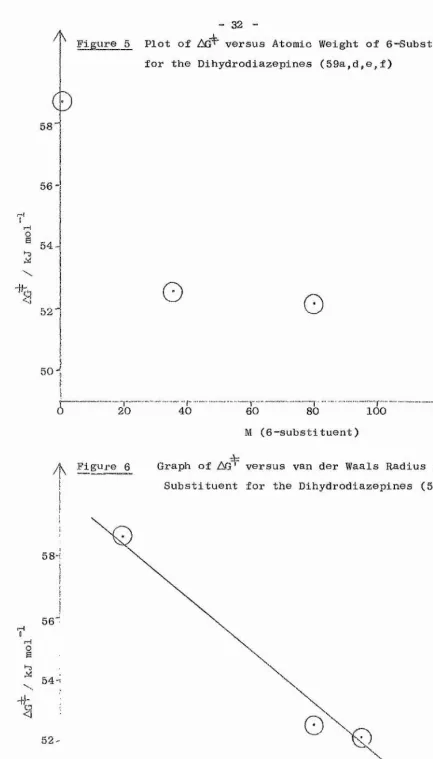
groups at the 6-position facilitate the exchange. This phenomenon could have its origins either in a pondéral or a size effect. A graph of formula weight of substituent versus gave an irregular curve (Figure 5), while a plot of van der Waals radius^^^ of monatomic substituents against AO gave a straight line, with standard deviation in gradient of about 10% (Figure 6). It is likely, therefore, that the large substituents must influence the geometry of the ring. The vicinal repulsions between the groups on the 5,6 and 7 positions may cause a slight lengthening of the ring bonds*, or may perhaps distort the planarity of the vinamidinium system. In either case, the rigidity of the molecule would be affected.
The case of the 6-methyldihydrodiazepinium salt is anomalous. It is known^^^ that the van der Waals radius of a methyl group is roughly comparable to that of a bromine atom, yet the inversion process in the 6-methyl compound is much more facile than would be predicted from the graph (Figure 6). A related anomaly has been found
*
32
-Figure 5 Plot of versus Atomic Weight of 6“Substituents for the Dihydrodiazepines (59a,d,e,f)
58"
56 J
r4 rH
5
4-60
20 40 80 100 120
M (6-substituent)
Graph of AO' versus van der Waals Radius of 6- Substituent for the Dihydrodiazepines (59a,d,e,f) Figure 6
58-:
56"
54
50
I
0.10 0.12 0.14 0.16 0.'l80.18 0.20 0.22f
van der Waals radius (6-substituent) / nm
[image:46.612.57.490.6.765.2]33
-in the study of cyclohexane derivatives, where methyl groups show a greater tendency to take up equatorial positions than do bromine
atoms . Both effects may be explained by the shorter bonding
distance of the methyl group which will cause greater interaction
with vicinal substituents.
Replacement of the 5- and 7-methyl groups with phenyl
substituents causes a slight decrease in . Although not studied
quantitatively, increasing the size of substituents at the 1,4- and f: especially the 2,3-positions appears to increase AG , as might foe
expected from simple pondéral arguments.
34
-SECTION 2
MASS SPECTRA OF DIHYDRODIAZEPINIUM SALTS
In contrast to the importance of nmr spectroscopy in the
investigation of dihydrodiazepines, their mass spectra have been < f but little studied. Staab and Wiinsche^^^ reported the breakdown
À
2
Scheme 3
(61) resulted in the formation of ethylene, hydrogen cyanide and
2
tropylium ion (R = Ph), Other breakdown processes such as the
direct loss of C^H^ from the molecular ion gave rise to peaks of lesser intensity, and in any event are applicable only to the special case of 2(3)-aryldihydrodiazepines.
Because of the problem of involatility, there have been comparatively few reports in the literature of mass spectral work
190
on organic salts , However, in this study, satisfactory spectra of dihydrodiazepinium salts were obtained, although the molecular
ions were rarely observable. The perchlorate salts were in general thermally unstable, and for this reason a series of dihydro
diazepinium iodides (62) was prepared. These are readily available from the perchlorates by metathetic reaction with potassium iodide
patterns of a selection of 2,3-diaryl derivatives, obtained both | by standard condensation methods^^^, and by the Cope rearrangement
23 24
of double anils formed from 1,2-diaminocyclopropane^ , Intense
% molecular ions were present for all the compounds studied; the
chief fragmentation process, confirmed by the presence of metastable 4
peaks, was the elimination of the fragment,leaving a positively charged linear compound (61) (Scheme 3). Further decomposition of
2 7
R c=N.— ^t;R
^
Jj ^ +N=CHR^35
in methanol2
5 7
a, R =R -Me
b , R^=R^=R^=M e
5 7
c J R =R =Ph
d, R^=Me,R5=R?=ph 5 6 7 *
e, R =R =R =Me f, Rl=R°=R?=Me
(where unspecified, R=H)
5 7
g, R‘=Me,R =Ph h, R-^=R^=Ph,
5 7 R =R =Me
i, 2,3“cyclohexano, 5 7
R —R =Me
j, 2,3 -eye1ohexano,
5 7
R"=R =Ph 1 4 6 * k , R —R —R —Me
1 4 * 1, R =R =Me
The mass spectrum of the 5,7-diphenyl compound (62c) (Figure
7) was studied in detail, and the peak assignments checked by high
resolution mass measurement. These results are summarised in table
3.
All the dihydrodiazepinium iodides investigated showed low intensity peaks at the m/e value corresponding to the molecular ion
13
of the salt, but this is most likely to be the C-isotope peak of the free base. Thermal dissociation of the salt, where possible,
would therefore appear to precede electron bombardment. For
alkyl-substituted dihydrodiazepinium salts, the most intense peak
in the molecular ion cluster is indeed characteristically that of the base. For aryl-substituted derivatives, however, the
peak is the most abundant, probably due to the loss of the second
hydrogen atom to give a resonance stabilised cation eg, (63), isoelectronic with the Wheland intermediate. This explanation
(63)
(64)
cannot hold for the intense (M ,. -2) peak in the mass spectrumcation
of the 1,4-diphenyl compound (62h), however, in which case the
36
CM
rH
CD
pH
rH
fH
CQ
<T) CD lO ^
QAXr^BTOH. CO
37
-formation of the 1,4-diazepinium nucleus (64), possibly by a
retro [8+2] cycloaddition, would appear to be most likely.
For compounds in which the 1,4*” and positions are blocked by alkyl groups, the molecular ion of the cation may be observable
Table 3 Summary of high resolution results for
2,3-dihydro-5,7-diphenyl“lH“l,4~diazepinium iodide (62c)
m/e Structure Formula Found Required
249
" /HN ”— ^Ph
.--"TPh H
249.132774 249,139167 249.134697
247 xN-— ^Ph
\ N r--^Ph
247.122506 247.123517
220 H C=N— -^Ph
} "
CH Ph
Cie"l4K 220.112552
: 220.112619 1
191
H
191.085824 191.086071
144 II ^ ÜH H4^+)pPh
H
Cio"io% 144.081782 144.081320
117 ^Ph C g H ^ 117.057833 117.057846
104 PhC SN+H W 104.050051 104.050022
102 PhC=CH
+ ” 102.047179 102.046948
(eg. Compound (6.2k), Found, 139.123601; requires 139.123517). Explanations for the apparent vaporisation of an organic salt have included the postulation of an unstable cation-anion adduot which
[image:51.613.73.474.200.675.2]” 38
complex^GO.
For the alkyl“(but not aryl) substituted dihydrodiazepintum
iodidesy the simple cleavage of the substituent is an important breakdown path in the mass spectrum. (eg. Compound (62a), Found
* *
m 96; 1:24— >109 requires m 95.8). The relative intensity of this
(M Ü&SG-15) peak, referred to the standard (M ), is affected by the number of methyl groups in the molecule, but is almost
independent of the position of substitution.
As was found previously^^^, the most intense breakdown peak 1 2
in each spectrum is due to the loss of the (N — C ) fragment. This
is unexpected, since the ejected radical is not resonance stabilised
as it is in the case of 2~aryldihydrodiazepines. An alternative 191
pathway , involving thermal loss of ethylene to give a pyrazole, was rejected on the basis of the high-resolution results. The
2,2-dimethyl compounds (62b) and (62d) almost exclusively lose the radical Me^C^N* in preference to HgC=N', while for the N-methyl dihydrodiazepinium salt (62f), it is the loss of H^C=N» which has preference over H^C=]SIMe.
The linear cation (61) may itself decompose; metastable peaks
have been found for the direct loss of a methyl group (eg. Compound (62a), perchlorate salt, Found m^ 68.5*, 96— ->81 requires m* 68.4).
A second, less favourable, breakdown of the dihydrodiazepine 1 7
is the ejection of the (N ”C ) fragment; the loss of cyanides is
known to be a favourable process in the mass spectra of many I 92
nitrogen heterocycles ' . The residue of the molecule may be
written as a cyclic species [eg. (65)],
Ph
Ph
(65)
(
66)
(67)39
-The peak at m/e 117 In the mass spectrum of the 5,7“diphenyl
derivative (62c) may be assigned the azirine structure (66).
This forms an example of another general decomposition route, the
driving force of which is probably the concomitant production of an ethylene and a cyanide, two small, stable, neutral fragments. That
the azirine formation is not the major driving force is clear from the spectrum of the 5"methyl“7“phenyl compound (62g), in which peaks
due to methyl and phenyl substituted azirines occur with similar
Intensities. The steric requirements of the reaction are met by
the planarity of the 1,5-diazapentadiene system, which allows facile
overlap between the p-orbitals of the I- and 6-positions.
A further breakdown mechanism may lead to a three-Tiiembered
ring, in this case a cyclopropenium ion [eg. (67)]. This
decomposition may be regarded as an offshoot of the major pathway
leading to the linear cation (61), probably due to the rearrangement
of an intermediate cation radical. Once again, the concomitant formation of neutral species is probably the driving force. The simplest identifiable decomposition fragments which give rise to peaks in the mass spectra are generally protonated or unprotonated
cyanides and acetylenes (table 3).
Because the primary decomposition process involves the breaking 2 3
of the C “C bond, this mechanism cannot lead to products in the
case of the 2,3-cyclohexanodihydrodia.zepinium salts (621) and (62j).
Instead, the dimethyl derivative (621) shows an intense peak at m/e 109 (Found, 109.076615; C H N requires 109.076569), which
probably corresponds to the formation of the pyrimidinium cation
(68). This assignment is confirmed by the occurrence of a
O
u Me(
3 MeH
40
corresponding cluster of peaks centred at m/e 233 in the mass
spectrum of the diphenyl derivative (62j). The 1,3“interaction necessary for this breakdown is probably enhanced by the rigidity
of these dihydrodiazepines. A small peak at m/e 122 (relative intensity 27%) in the spectrum of the dimethyl compound may be due to the 1,4-diazepine (69) (Found,122,084205 ; ^^^10^2 f^^uires
122.084394).
Atypical spectra are also shown by the 1,4(6)"-methylated
salts (62k) and (621) (Figure 8). The parent peak is
characteristically at m/e 142 due to iodomethane (62k, Found,
141.928757; CH I requires 141.927946) or at 128 due to HI (62 1, Found, 127.912838; HI requires 127.912296), probably formed by thermal decomposition induced by the iodide counter "“ion. The
further decomposition of the heterocycles is also anomalous.
Methylamlne is eliminated, resulting in strong peaks at m/e 93 and m/e 79 in the spectra of (62k) and (62 1) respectively, which may be represented as pyridine derivatives (Scheme 4). (62k, Found,
93,057982, C^H^N requires 93.057846). Further evidence for this assignment is given by the direct loss of m/e 27 (HCN) from these
* * .192
species (62k, Found m 46.7; 93— > 66 requires m 46.8)
Me ^ N (i)heat ^ +
(11)"^
Me H
H \
MeN —
Scheme 4
^ Me “MeNI^
m/e 93
The mass spectra of a selection of dihydrodiazepinium salts
bearing electronegative substituents at the exposition (70) were
:
41
Figure 8 Mass Spectrum of the 1,4,6-Trimethyldihydrodiazepinium Iodide (62k)
100 n
142
90-
80-
70-93
M Q
166
127
20
-139
10
Ljiiii
20 40 60 80 100 120 140
m/e
X-J