Co-presence Communities:
Using pervasive computing to support weak social networks
Jamie Lawrence
Terry R. Payne
David De Roure
Intelligence, Agents and Multimedia Group
School of Electronics and Computer Science
University of Southampton, UK
E-mail:
{
jel03r, trp, dder
}
@ecs.soton.ac.uk
Abstract
Although the strongest social relationships feature most prominently in our lives, we also maintain a mul-titude of much weaker connections: the distant col-leagues that we share a coffee with in the afternoon; the waitress at a our regular sandwich bar; or the ‘famil-iar stranger’ we meet each morning on the way to work. These are all examples of weak relationships which have a strong spatial-temporal component but with few sup-port systems available. This paper explores the idea of ‘Co-presence Communities’ - a probabilistic definition of groups that are regularly collocated together -and how they might be used to support weak social net-works. An algorithm is presented for mining the Co-presence Community definitions from data collected by Bluetooth-enabled mobile phones. Finally, an example application is introduced which utilises these communi-ties for disseminating information.
1
Introduction
Despite their chaotic appearance, our lives are full of temporal patterns: the morning commute, the nor-malised work hours, the weekly project meeting, the ‘lunch hour’, and the Friday after-work drinks are just some of the commonly-held patterns. Another at-tribute of modern life is the ubiquity of weak, inciden-tal, relationships and ‘familiar faces’ we see each day. Where these informal relationships and temporal pat-terns collide, there exists regular social groupings which are typically unnoticed, unsupported, unexplored and undervalued. For example, in the early 1970’s, Stan-ley Milgram performed a small study to investigate a phenomenon he calledFamiliar Strangers. Milgram de-fined a familiar stranger as someone who is observed,
repeatedly for a certain time period and without any interaction [15]. Milgram’s study of a railway station (frequented by commuters) revealed that 89.5% of the participants could identify at least one person which they recognised but had never spoken to. These seem-ingly trivial relationships are not terribly valuable dur-ing the normal course of life but they become essential during a crisis.
The corporate setting can be thought of as a minia-ture version of the urban environment. Many of the informal relationships that are seen in the city (such as friends, neighbours, and familiar strangers) can also be found within the boundaries of an organisation. There are also informal knowledge-sharing networks called ‘Communities of Practice’, which can be thought of as people bound together by their “common sense of purpose and a real need to know what each other knows” [2]. These communities of practice provide an invaluable source of knowledge sharing that cuts across the strict boundaries of a hierarchical company struc-ture. An essential ingredient which allows these com-munities to thrive is the actual physical interaction of its participants. Whether it is technicians swapping stories over lunch or hanging around the coffee pot, the social interaction is a critical component of knowledge generation and dissemination within an organisation.
each other automatically and unobtrusively. In our in-vestigation, we use Bluetooth-enabled devices (such as phones, PDA’s, etc.) to detect ‘encounters’ between people. A data mining algorithm can then reveal the underlying co-presence communities by extracting in-stances of repeated co-presence. This automated dis-covery of co-presence communities is particularly valu-able because they provide a computational representa-tion of the fundamental social networks which would otherwise be hidden. The co-presence communities would then prove to be a useful means of providing informal social networks with a mechanism for sharing knowledge (in a similar way to a group mailing list).
Our ongoing research effort aims to show how co-presence encounters, detected by wireless devices such as Bluetooth-enabled phones, can be analysed and clus-tered to identify (and subsequently augment) the sort of informal social networks discussed above. This paper introduces the concept of a Co-presence Community, in Section 2, and illustrates how these communities could be used to provide an knowledge sharing infrastruc-ture for informal social networks (Section 3). A data mining algorithm is presented in Section 4, which can extract the co-presence communities from individual co-presence events. Finally, a brief example from a simulated data source is presented (Section 5) and the paper concludes with a discussion of the future work in Section 6.
2
Co-presence
In its most general form, co-presence refers to the spatio-temporal conditions under which humans can interact with each other. In 1966, Goffman referred to co-presence as the condition when people “sense that they are close enough to be perceived in whatever they are doing, including their experiencing of others, and close enough to be perceived in this sensing of being perceived” [11]. In the telecommunications domain, co-presence typically involves one or more parties collabo-rating with each other through a virtual representation (e.g. teleconferencing) or within a virtual environment (e.g. a massively multiplayer online role playing game, MMORPG). Zhao [17] attempts to reconcile these dif-fering views by structuring co-presence along two pri-mary axis: proximity (physical or electronic) and cor-poreal presence (where one, both or neither parties may be present at the physical location). Whilst much of this paper may be applicable to other modes of co-presence, we shall typically be referring to “corporeal copresence” from Zhao’s taxonomy — the most nat-ural state of co-presence, where all parties are physi-cally proximate and present at the same site. In our
use of co-presence, we do not require that the parties actually engage in any direct interaction — they may just be walking past each other or sitting on a bus to-gether. The key point is that the spatial and temporal conditions must exist such that it is possible for the participants to interact.
2.1
Definitions
When two parties are co-present, aco-presence re-lationship can be said to exist between them. This relationship is symmetric but not transitive, and may exist with multiple parties simultaneously:
• ifa−−−−−−→copresent bthenb−−−−−−→copresent a.
• ifa−−−−−−→copresent bandb−−−−−−→copresent cit does not imply that c−−−−−−→copresent a
• ifa−−−−−−→copresent bit is also possible thata−−−−−−→copresent c
Aco-presence eventis simply the instantaneous rep-resentation of a presence relationship, i.e., the co-presence relationship at an instant of time.
2.2
Co-presence Detection
(a) ego-centric (b) omniscient
Figure 1. An ego-centric and omniscient views of the co-presence relationships be-tween participants in the Haggle dataset.
everyday, mundane experience... [embodiment] is the property of our engagement with the world that allows us to make it meaningful”.
The sensing technology will usually influence how the co-presence data is scoped. In anego-centric view (Figure 1(a)), only the co-presence data from a single person is available, whereas an omniscient view (Fig-ure 1(b)) implies a total knowledge of all co-presence events within the population. Wireless sensors (ra-dio or infra-red) will generally produce ego-centric co-presence data whereas a centralised location correla-tion service is capable of producing both ego-centric or omniscient data.
One of the limitations of computational co-presence detection is that it requires each person to make them-selves visible to the sensors — either by carrying a particular device, activating a software application on their mobile phone or connecting to a centralised ser-vice. In most non-trivial experiments, only a very small proportion of the real-world co-presence events can be captured computationally because one or more of the parties are not visible to the sensors. These unde-tectable people are the ‘dark matter’ of the co-presence network. This dark matter is not a critical flaw in the use of co-presence but obviously the higher the den-sity of people carrying sensors, the more accurate and useful a co-presence system will be.
ACo-presence Communityis a group of individ-uals that are regularly co-present at approximately the same time. These communities are purely derived from co-presence data and explicitly lack any social context, but it is expected that this contextual information can be added more accurately by the user. However, our hypothesis is that repeated collocations of individu-als indicates a valuable underlying social relationship. Even if the underlying cause of the co-presence is just that the participants take the same route to work, they share, if nothing else, a common interest in the func-tioning of the local area (safety, cleanliness,
punctual-ity) [13]. These co-presence communities can be rep-resented as the set of community members, and the start and end times of the period when the commu-nity is active. The stability of a commucommu-nity refers to how predictable the community’s characteristics are. For example, the co-presence community formed by weekly project meetings would have stable membership and temporal dimensions. In contrast, the community formed on a commuter bus might have a stable tempo-ral dimension (because you always catch the same bus) but an unstable membership (because it’s not always the same people on that bus). By obtaining these com-munity memberships via wireless sensors, it should be possible to build a dynamic, self-updating model of the people that a user is typically near.
3
AIDE: Ambient Information
Dissem-ination Environment
The Ambient Information Dissemination Environ-ment (AIDE) is an application that demonstrates the utility of co-presence communities, by allowing users to share content with their Bluetooth-enabled mobile phones. The user can specify different rules for shar-ing content, dependshar-ing on the current social context (i.e., the co-presence community). The content could range from recently-read online articles, cartoons and jokes, photos of the local area, new journal publica-tions, or the details of upcoming events. Naturally, not everyone is interested in the same content and, just like human conversations, there is time and place for sharing everything: confidential work discussions aren’t appropriate in the bar and movie reviews aren’t an accepted part of most meetings. Co-presence com-munities would be utilised to direct and filter the con-tent and bring this into a socially-meaningful context. A similar concept was used in the “Serendipity” ap-plication [6], which used co-presence to facilitate inter-est match-making and introductions1. The advantage of co-presence communities for this application is that they would allow dissemination in different contexts: sharing jokes with strangers on the commute home (i.e., a time-stable community) or disseminating the latest call-for-proposals to a research group (a fully stable community formed by weekly meetings). AIDE would ambiently determine which community a detected de-vice belongs to and transfer the selected content in the background, based on the source user’s specified pref-erences. It seems likely that a filtering and ranking mechanism would be required to reduce the
informa-1However, Serendipity used single incidents of co-presence,
tion overload caused by collecting content during each period of co-presence.
The primary goal behind AIDE is to facilitate knowledge sharing within weakly-connected groups that otherwise would not have any means of dissem-inating information. In essence, it would function like an automatic mailing list where the subscriptions are based on the co-presence relationships rather than an explicitly-defined membership list. It is certainly not designed to replace the social interactions that exist within a community but, instead, augment and en-courage them. Other potential co-presence community applications might include: building an online social network using real-world co-presence data [4]; deter-mining the interruptibility of someone based on who they’re co-present with (similar to Begole et al’s work on rhythm modelling [1]); creating an awareness of the user’s social surroundings through introspective vi-sualisations of the communities (like Encounter Bub-bles2); or even routing messages between devices us-ing the temporal and membership characteristics of co-presence communities (similar to [14]).
4
Co-presence Community Miner
The core problem when discovering co-presence communities is one of clustering together historical co-presence events. A relatively simple approach has been taken which combines a feature detection algorithm and COBWEB [8], a well-known incremental clusterer. Essentially, the algorithm creates discrete intervals of co-presence, uses an edge detection technique to find continuous periods when a similar set of devices were co-present, and then clusters these periods across all historic data (outlined in Algorithm 1). The resulting clusters are the definitions of co-presence communities.
Algorithm 1The Co-presence Community Mining al-gorithm
loop
batch←daily batch of co-presence data intervals←discretisation ofbatch{see 4.1}
periods←extract features inintervals{see 4.2}
for allperiodsdo
update clusterer withperiod{see 4.3}
end for end loop
2http://www.seansavage.com/encounter-bubbles/
−2 −1 0 1 2 3
0
1
(a)
−2 −1 0 1 2 3
0
1
(b)
−2 −1 0 1 2 3
−1
0
1
[image:4.612.321.531.84.143.2](c)
Figure 2. This figure illustrates how the Laplacian operator transforms a signal so that the major transitions (edges) are repre-sented by zero-crossings
4.1
Discretisation
The first process is to segment the daily batches of co-presence data into equally-sized intervals, thereby assigning each co-presence event to a discrete time in-terval. The purpose of this stage is to normalise the data and provide initial groupings of devices. It is particularly important if the co-presence events were captured on a continuous basis, or from different data sources. Iis the sequence of intervals,ix, ix+1, . . . , ix+n
where nis the number of intervals in the batch. Each interval, ix, consists of the set of devices co-present
during the time [x∗interval,(x+ 1)∗interval] where interval≥to the sampling resolution of the data.
4.2
Feature Extraction
The next stage extracts periods of similar device membership using a combined smoothing and edge de-tection technique. Essentially, the algorithm needs to smooth the interval’s membership (to provide some re-sistance against measurement errors) and then deter-mine significant changes in membership. This can be succinctly calculated using the Laplacian of Gaussian
(LoG) operator:
LoG(x) = 1 σ2
x2
σ2 −1
e−2(σx22 )
130 140 150 160 170
Device ID
130 140 150 160 170
−0.4
0.0
Interval
[image:5.612.69.254.84.210.2]Response
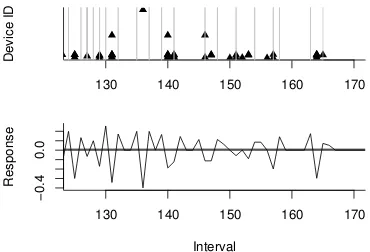
Figure 3. The co-present devices, the period boundaries (in grey) and the corresponding response signal
A ‘response’ for each interval,i, is calculated by av-eraging the LoGof each co-present device,d, across a smoothing window ofw:
response(ix) =
P|ix| d
Pw
j=1−w−1 2
(
LoG(j), ifd∈ix+j
0, otherwise
|ix|
where (|ix| is the number of devices co-present during
intervalix).
The zero-crossings ofresponseare detected by scan-ning across the signal and checking for changes in sign. The actual position of the zero-crossing may fall be-tween interval boundaries so, to account for this, the value which is closest to zero is chosen as the zero-crossing. For example, if response(x) = 0.3 and response(x+ 1) = −0.2, the zero-crossing will occur at x+ 1. The locations of these zero-crossings are used as the start and end boundaries for periods, where each period collects together a sequence of similar inter-vals. Figure 3 shows a small portion of the co-presence events from the Reality Mining dataset [7], the result of theLoGtransformation and the corresponding period boundaries. As can be seen in this figure, the period boundaries correctly delineate the major changes in co-presence membership.
4.3
Clustering
The previous step has constructed a set of periods, each of which collects together contiguous intervals of similar co-presence events. The aim of this step is to cluster together those periods with a similar start time, end time and membership — thereby construct-ing the definitions of co-presence communities. The
periods may be clustered on numerical (start and end times), nominal (day of the week) and set (the mem-bership of a period) attribute types. These attribute types, and our requirement for incremental learning, effectively rule out many of the popular clustering al-gorithms such as K-means, Finite Mixture Models or
Expectation-Maximisation approaches. Instead, a class of clustering algorithms known as Concept Formation
algorithms are more appropriate because of their incre-mental nature and support for several attribute types. COBWEB is a well-known conceptual learning algo-rithm that has been applied in numerous domains and has formed the basis for several other clustering algo-rithms [8, 16]. It incrementally constructs a hierarchy of concepts using four functions (incorporation, cre-ation, merge, split) which are controlled by the Cat-egory Utility (CU) metric [10]. In practice, maximis-ing the category utility will maximise the similarity of instances within a cluster and the dissimilarity be-tween clusters. As originally proposed, the COBWEB clusterer only operates on nominal attributes but an extension, called CLASSIT, provides support for nu-merical attributes by calculating the CU of nunu-merical attributes using a normal distribution and standard de-viation [9]. A simple modification of the original CU formula is proposed to account for sets of nominal val-ues (i.e., the devices co-present during a period). For a set attribute,Si, with membersm1, m2, . . . , mn, the
category utility can be defined as:
CUset(C`) =
X
i
X
n
(P r[mn∈Si|C`]2−P r[mn]2)
which is simply the nominal category utility summed across all members of a set attribute.
From the input periods, COBWEB will produce a hierarchical tree of clusters. Each cluster provides a probabilistic representation of the co-presence periods and therefore describe the user’s co-presence commu-nities.
5
Validation
0 50 100 150 200 250
Device ID
(a)
[image:6.612.70.267.75.202.2](b)
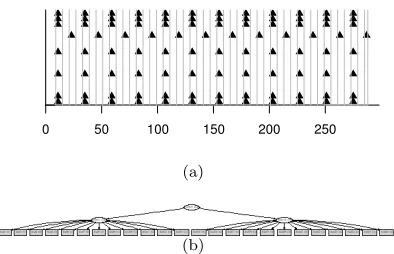
Figure 4. The output from a perfectly regular simulated dataset: (a) The input co-presence data and period boundaries; (b) The clus-ter hierarchy produced by the algorithm, with the nodes representing the discovered co-presence communities.
a pattern whereby each agent encounters the same two sets of other agents (whilst travelling to ‘work’ and back), 12 times a day. Furthermore, once a full home-work cycle has been completed, no new communities should be found (since each day is exactly the same). The resulting COBWEB hierarchy (Figure 4(b)) shows the 24 identified communities directly corresponding to those expected from movement pattern.
6
Conclusions and Future Work
This paper has introducedCo-presence Commu-nities — a novel concept of regular collocation occur-rences between a group of individuals. These com-munities can be discovered my mining a set of raw co-presence events captured by Bluetooth-enabled mo-bile phones, and an algorithm for achieving this has been outlined. The generated community definitions are expected to be useful in identifying informal social networks within corporate or urban environments, and providing a means of supporting information dissemi-nation within these groups. The AIDE application is one such service which will utilise the co-presence com-munity definitions to provide an ambient knowledge dissemination channel within regular, but informal, so-cial networks.
Currently, only the most preliminary analysis of the algorithm’s performance has been performed. The next phase will evaluate the algorithm’s performance by us-ing more complicated stochastic simulations and real-world co-presence data. Furthermore, an application trial is scheduled to start in Summer 2006 that will
evaluate the utility and performance of co-presence communities in a real-world scenario.
References
[1] J. B. Begole, J. C. Tang, and R. Hill. Rhythm mod-eling, visualizations and applications. In UIST ’03: Proceedings of the 16th annual ACM symposium on User interface software and technology, pages 11–20, New York, NY, USA, 2003. ACM Press.
[2] J. S. Brown and E. S. Gray. The people are the com-pany. Fast Company, 1:78, November 1995.
[3] T. Choudhury and A. Pentland. The sociometer: A wearable device for understanding human networks. In
Computer Supported Cooperative Work - Workshop on Ad hoc Communications and Collaboration in Ubiqui-tous Computing Environments, 2002.
[4] S. Counts and J. Geraci. Incorporating physical co-presence at events into digital social networking. In
CHI, Late Breaking Results, 2005.
[5] P. Dourish. Where the Action Is. MIT Press, 2001. [6] N. Eagle. Can serendipity be planned? MIT Sloan
Management Review, 46(1):10–14, Fall 2004.
[7] N. Eagle and A. Pentland. Reality mining: Sensing complex social systems.Journal of Personal and Ubiq-uitous Computing, pages 1–14, February 2006. [8] D. Fisher. Knowledge acquisition via incremental
conceptual clustering. Machine Learning, 2:139–172, 1987.
[9] J. H. Gennari, P. Langley, and D. Fisher. Models of incremental concept formation.Artificial Intelligence, 40:11–61, 1989.
[10] M. A. Gluck and J. E. Corter. Information, uncer-tainty, and the utility of categories. InProceedings of the Seventh Annual Conference of the Cognitive Sci-ence Society, pages 283–287. Lawrence Erlbaum Asso-ciates, 1985.
[11] E. Goffman. Behaviour in Public Places. The Free Press, 1966.
[12] E. T. Hall. The Hidden Dimension. Anchor Books, 1969.
[13] J. Jacobs. The Death and Life of Great American Cities. Jonathan Cape, 1962.
[14] S. Merugu, M. Ammar, and E. Zegura. Routing in space and time in networks with predictable mobility. Technical Report GIT-CC-04-07, College of Comput-ing, Georgia Institute of Technology, 2004.
[15] S. Milgram. The Individual in a Social World, chap-ter The Familiar Stranger: An Aspect of Urban Anonymity, pages 51–53. Addison-Wesley, 1977. [16] K. Thompson and P. Langley. Concept formation in
structured domains. In D. H. Fisher, M. J. Pazzani, and P. Langley, editors, Concept Formation: Knowl-edge and Experience in Unsupervised Learning. Mor-gan Kaufmann, 1991.