Applying mSpace interfaces to the Semantic
Web
Nicholas Gibbins1, Stephen Harris1, Alan Dix2, and m.c. schraefel1
1 School of Electronics and Computer Science,
University of Southampton, Southampton, United Kingdom
2 Computing Department,
University of Lancaster, Lancaster, United Kingdom
Abstract. Ontologies can represent large, multidimensional spaces: clas-sical music, research in computer science in the UK, health care for breast cancer are examples of rich domains. There have been no easy ways to represent meaningful slices through these multidimensional spaces to privilege the parts of the domain that are of interest to a given user. mSpace, an interaction model we describe here, is particularly suited to ontology-based interaction because it is designed to expose and support exploration of relations in a domain. In this paper we propose the for-malism for this interaction model to support mapping this kind of user-determined interaction onto a high dimensional space represented by an ontology. The model provides semantic web designers with a means for rapidly prototyping and interrogating the data represented by an ontol-ogy. It also and provides a fast, effective UI alternative to keyword search and browsing for users to explore the domain space while maintaining domain context.
1
Introduction
searches is that they usually rely on fixed hierarchies of categories. That is, both the order and the number of subcategories in the tree is fixed. This means that a user cannot reorient the space to support their focus. They must approach the domain from the organizational bias of the designers.
The Semantic Web’s use of ontologies to structure domains presents new op-portunities to represent domains to users for their interaction with the domain space. This means that users can have greater options in how they engage with Web-based information, thus affording more diverse approaches than keyword or category search for building knowledge from the information they discover. The semantics of ontologies, for instance, privilege relationships; ontologies also afford multiple paths to view the same data instance from multiple perspec-tives. Exposing these relationships and paths provides knowledge seekers with additional information to inform their knowledge building tasks. Within the Se-mantic Web community, however, there has been little research to date on how to exploit ontologies to formalize and automate such interaction design oppor-tunities. The closest work in this space has been in information visualization. Understandably, in that case, most work has emphasized how extant visualiza-tion techniques can be applied to the Semantic Web [2]; interacvisualiza-tion issues have been, again understandably, secondary. Our interest, however, is specifically how interaction affordances can be enhanced by leveraging the properties of the Se-mantic Web. To that end, we present a formal representation of an interaction model informed by the Semantic Web. Though we present one visualization to describe the model’s interaction characteristics, the model itself is visualization agnostic. Designers can use whichever visualization they choose - tree maps [3], self-organizing maps [4], polyarchies [5], lists. Our interest here is to formalize the behaviours of the data given the set of interactions defined.
There are two key advantages to this interaction model for domain interac-tion. First, mSpace provides system designers with a way to support fast visual data inspection in the domain from numerous perspectives. It also gives design-ers an automatic way to leverage their ontologies to present the domain to a user such that users first, can readily perceive the scope and relations within the domain from the available attributes, and second can then explore the domain from an orientation of the information that suits their interests.
In the following section, we describe the mSpace interaction model in terms of the interaction design itself. We situate the related work within this discus-sion. Next we describe the formal model for the behaviours associated with each interaction. We follow this with a service-level characterization of the model. We conclude with our plans for future work, including a brief sketch of an API instantiating the mSpace model.
2
Interaction Design of
the mSpace model
The goal of an mSpace is to support users’ exploration of a domain. By ex-ploration, we mean something other than the Web sense of browsing or surfing. Surfing or browsing Web pages suggests moving among discrete Web pages which potentially have only very loose associations between them. The only association several pages may have in common, for instance, is that a user has visited each page within the past thirty seconds. By exploration, we mean that the user is making information selections within a structured information domain, based on ontological associations among its parts. The interaction design for exploration would provide mechanisms for the user to take advantage of these associations in exploring the domain. In exploration, context and the availability of contextual information to support users’ exploration is a critical component of the inter-action design. An mSpace, designed to support exploration, therefore privileges associations and contexts in the domain interaction and representation.
to leverage such semantic affordances. The remainder of this section describes the specific interaction affordances of an mSpace.
2.1 mSpace Representation and Interaction
An ontology can represent a vast, multidimensional domain that can support many ways of focusing on its data. an mSpace facilitates both the representation of the space and the interaction with this representation in a variety of ways. These are:
slices: projections through the n-dimensional space,
context: spatial rather than temporal layout of a slice
dimensional sorting: the organization of attributes within a slice, and how the organization constrains the data associated with each attribute.
substitution: the revision of a slice by changing one attribute in a slice with another not previously in the slice
expansion/contraction: the addition of a new attribute to a slice; the removal of a previous attribute from a slice.
In the following sections we use the example of the Classical Music domain to ground our description of these features.
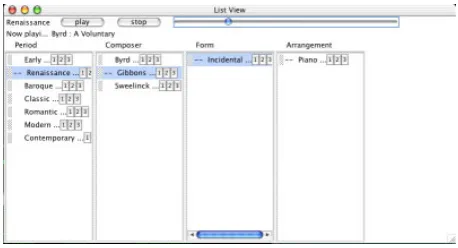
Slices, Columns and Context As described above, slices represent projec-tions through an n-dimensional space that are flattened. The flattened projection results in a hierarchical ordering of the attributes in slice. Slices mean that cer-tain views of the domain are privileged over others. For example, the classical music domain may be sliced to privilege information about compositions in a variety of ways. One approach is to foreground information about compositions through the attributes Period (Romantic or Baroque) — Composer ( Mozart or Bach) — Form (symphony or serenade) — Arrangement (solo instrument, orchestra) — Composition. Likewise the domain might be sliced to privilege in-formation on compositions through recordings: Record Company — Orchestra — Conductor — Artist — Year Recorded — Composition. We refer to each of these attributes as Columns, in which the label of the column is the attribute name and the body of the column is the list of instances which are associated with the column - depending on its hierarchical location within the slice
views of information clusters of hierarchies or 3D representations of these clus-ters. Other research has also challenged claims about the value of 2.5 or greater dimensional views for information organization and access [10]. Therefore 1-2D representations of slices through n-dimensional spaces provide both accessibility and performance benefits over more complex dimensional simulations.
[image:5.612.193.422.182.306.2]While hierarchies can be represented in a variety of visualizations, our default visualization is a spatial, multipane or multicolumn view. An example of a spatial multicolumn view for the first Classical Music slice is shown in Figure 1.
Fig. 1.Spatial multicolumn view for classical music slice
A spatial view in general means that the associated context of the informa-tion is persistently maintained in the interface. The complement of spatial views are temporal views where context is maintained in memory. For instance, the standard Web representation of information is temporal: a click on a link gener-ally replaces the originating page with a new page in the browser window, eras-ing the previously visible information. While mSpaces are visualization-neutral, we strongly recommend that mSpace visualizations support spatial context: in previous work we have shown that supporting spatial rather than temporal con-text results in better navigation performance by users [11]. Indeed, in the same study, we found that temporal interfaces had a significant negative correlation with age. With our simple default multipane view, we get a variety of benefits for low implementation cost: there is little overhead in rendering what are effectively contiguous list views of a data space.
composer. This arrangement of the slice turns out to be an interesting oppor-tunity for learning more than a single association of a period with a composer, since in certain cases, the composer is associated with multiple periods (Bach with Classic and Baroque, for instance). Thus, this one selection retrieves both the requested information, and potentially reveals meta-information about the construction of the classical music domain.
Hierarchical rearrangement is not to be confused with sorting order within a fixed hierarchy. That is, in a fixed hierarchy such as Period — Composer — Form — Arrangement — Composition, one might choose to sort the composer column alphabetically or by date of birth. This sorting has no effect on the current instances associated with each attribute. Reordering the attributes in a hierarchy, as we explain in more detail in the formal model description below, causes instances associated with each attribute to be reassessed, both in terms of the data associated with that attribute, as well as how that rearrangement effects it neighbours on either side of it, since a dimensional sort - a rearrangement of attributes in the hierarchy - effectively creates a new query within the slice.
Rationale:Dimensional sorting lets the user organize the domain in a manner that suits their current interests/knowledge. Providing multiple perspectives on an information space has long been valued by hypertext researchers not only for access for but the value of learning more about a domain [12, 13] of building knowledge by seeing associations that would not otherwise be apparent. It also lets the explorer move into the domain from a locus of familiarity. For someone less familiar with a domain (a domain-naive user), dimensional sorting may pro-vide an approach into a domain that would not otherwise be available. Someone who knows little about classical music, but who once took piano lessons may find it easier to access the domain by privileging Instrument as the first attribute in the hierarchical slice. By supporting dimensional sorting to improve access from multiple perspectives, we are not explicitly modelling users for a particular ver-sion of a domain, but are letting users determine the domain verver-sion for their needs/tasks.
Domain Substitution, Expansion and Contraction Substitution, Expan-sion and Contraction are variations on DimenExpan-sional Sorting. The key differ-ence conceptually is that unlike Dimensional Sorting, these other techniques alter the slice through the space. Substitution can fundamentally alter the slice by potentially replacing each attribute with another in the domain. Expan-sion/Contraction can also have a considerable effect on the slice by increasing or decreasing the scope of the slice.
representation, the piano. Similarly, by substituting dimensional values one can gradually reformulate the slice to support new perspectives on an attribute. By translating an Historical slice gradually into a Recordings slice, one might also see that some very familiar works by Bach, like the solo cello sonatas, have been rearranged for a variety of instruments repeatedly over the centuries, into one of the latest for five string electric bass but have not been frequently recorded, whereas the same arrangement of Beethoven’s Fifth symphony has been rere-corded by countless orchestras. In other words, by facilitating manipulation of the slices through substitution, expansion and contraction, we facilitate more ways to explore and therefore provide more ways to understand the domain and its inter-relations - and perhaps the biases informing its organization.
3
Related Work
mSpaces are largely informed by work in Human Computer Interaction in di-rect manipulation interfaces [14] and query previews [15]. Didi-rect Manipulation interfaces support immediate feedback of manipulations in an interface. Thus, moving a slider up in an onscreen volume control and hearing the volume level increase is an example of direct manipulation. Changing the attribute in an mSpace column and immediately seeing the change and its effect is an example of direct manipulation. This style of interaction design is in contrast to user interfaces which change based on inferences about user interactions. Adaptive Interfaces [16], for instance, might adjust the ordering of elements in a menu based on frequency of use. Evaluations of such adaptive models have rarely been positive [17].
Query previews are a branch of direct manipulation user interfaces specifically designed for query formulation. They allow users to construct queries visually rather than textually. An interface on recipes, for instance, may present a variety of sliders with values associated with each so that one can select the degree of spiciness in a dish, whether the dish is fish, meat, or vegetarian; how long it takes to prepare and so on. Based on these constraints, the search engine returns a list of appropriate recipes. The design of available query attributes values eliminates the possibility of returning an empty set. In this way, users gain an easy method to quickly construct potentially more complex queries than a keyword search would allow, and equally can evaluate the results, tweak the parameters of the query, and run the revised query again just as quickly
Like query previews, mSpaces are direct manipulation, visual queries. Unlike most instantiations of such queries, mSpaces extent the preview query space, foreground domain manipulation affordances. Not only can users determine the attributes in the domain to query, they can organize them to privilege their evolving explorations of the domain.
Our goal in doing so is to provide Semantic Web designers with an interaction model they can first formally evaluate, and next instantiate to rapidly provide the described interaction affordances.
Our description of mSpace using Semantic Web technologies bears some sim-ilarity to work in the Formal Concept Analysis community, particularly in the area of ontology-aware browser interfaces for information retrieval and discov-ery [18, 19]. These systems construct a concept lattice which is used to provide support for navigation through an information space; this concept lattice repre-sents the different hierarchies that would result from ordering entities according to their attributes. mSpace also provides such a hierarchical view of the entities in the system, but in a more structured manner that affords the user greater control over their exploration of the information space.
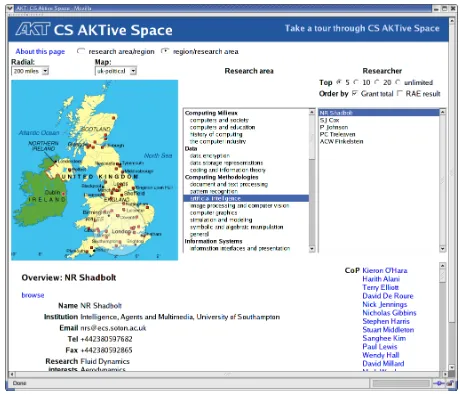
The CS AKTiveSpace (CAS) Semantic Web application [20] which recently won the Semantic Web Challenge for best Semantic Web Application3was very much informed by the interaction design expressed above. The goal of the ap-plication was to support user-determined exploration of the domain Computer Science Research in the UK. Underneath the UI, the application exploits a wide range of semantically heterogeneous and distributed content. The content cur-rently comprises around ten million RDF triples, with information constantly being harvested and updated. The content in the application is mediated through an ontology constructed for the application domain, the AKT Reference Ontol-ogy [21], and incorporates components from other published ontologies as well. The challenge for the UI which an mSpace approach addressed, was to make the space managable enough to support meaningful interrogation by users. The UI would afford users the ability to explore the domain such that they could read-ily compare, for instance, what areas of the domain are researched in different areas of the country, who the top rated researchers are in a given domain; who do these researchers work with the most, what have they published. These are each results of queries that would be complex and potentially too cumbersome to construct to facilitate real-time shifting between one formation of a query and another. By modeling the CAS UI on the mSpace model, we were able to hide the complexity of the queries from the user, and support real-time query manipulation and ontology exploration, where data instances are revealed in context.
A large goal of the mSpace work has been to formalize the interaction model in order to create a generalizeable model for semantically informed information spaces. CAS is the first application of the mSpace model mapped into a Seman-tic Web back end. Through the development process of implementing mSpace affordances, such as slices and dimensional sorting, against the AKT ontology, we have been better able to determine where the issues would be in formalizing the model for general application deployment. Indeed, the effort to deploy the mSpace interaction design has reinforced the value of formalizing the model. It will make building mSpace-informed applications like CAS more principled. This is important on a practical level, since based on the demonstrations we have
Fig. 2.CS AKTiveSpace: an example of an mSpace interface
given of CAS, we have been approached to design other CAS-inspired applica-tions for granting councils, engine manufacturers and a space agency to name a few. Below, we touch on two of the ways that the formal mSpace model will improve mSpace-informed application development.
Query generation: The query generation performed by the CAS application is based on programmatic query constructions performed in the application logic of the program. This can make extracting and debugging the queries un-necessarily complex, whereas the constraint matrix suggested by this model, described below, will provide a cleaner and more general abstraction for the query generation algorithm.
Inter-column constraints: The current version of the CAS application is based on adjacent constraints, which has the consequence that as columns are rear-ranged (one of the more common interactions) the semantics of the column positions changes, causing undesirable and confusing changes in the contents of the columns. With the benefit of the model we see that privileged column constraints would have been more appropriate for this application (the user is attempting to narrow down selections, approaching a target group of in-dividuals). This approach would have the advantage that re-arranging the columns would not affect the semantics of column selection.
4
Modelling mSpace interfaces
As described in the previous section and in [6], an mSpace interface consists of a series of user interface controls, which we callcolumns, each of which presents a selection of objects for the user to choose from. A user’s interaction with these column progresses from the left to the right. The selection that they make in a column affects the selections which are offered in the subsequent columns that lie to its right. The selection offered by each column is a collection of objects of the same conceptual type; a list of people, or of institutions, or of publications, for example. Each of the columns represents some facet of the objects being searched, and a selection within a column can be thought of as specifying some dimension in the sparse multidimensional space of a knowledge base (where each class is treated as a dimension).
In this respect, the interface resembles the menu-based interfaces used for ex-ploring databases; a user chooses from lists of options that lead the user through the formulation of a query. The mSpace method differs in that a context (or column layout) may be dynamically reconfigured so as to place one dimension at a higher importance than others.
Our basic approach in constructing this model is to consider each column as representing some class of objects. For each columni, we have three sets.Ti is the complete set of instances of the class associated with that column, Di is the set of instances which are displayed at a given moment, andSi is the set of instances which have been selected by the user.
Ti⊆Di⊆Si (1)
The setTiis the extension of the class associated with the columni. This class could be specified by a class expression in a description logic-based language such as OWL [22] or DAML+OIL [23], and might vary from a simple named class to a more complex class expression (for example, ’all higher education institutions within the UK that were rated 5* in the 2001 Research Assessment Exercise’).
The relationships between columns are described in terms of constraints which determine the displayed instances in each column and the effect that a selection has on other columns. For example, the constraintCij, which relates column ito columnj would be:
Cij⊂Ti×Tj (2)
The set of constraints for a layout must provide a means to relate each column to every other column, either directly, or indirectly by chaining more than one constraint together. For a layout with n columns, the basis set of constraints contains n−1 constraints. It is possible to construct systems with more than this minimum number of basic constraints, but this raises the possibility of inconsistency when there is more than one way to relate one column to another, possibly by chaining constraints, and those relations are incompatible or have different meanings. If we restrict ourselves to basis sets of constraints, there are two common approaches to forming constraints which we can use in mSpace systems, each with its advantages and disadvantages.
4.1 Distinguished column constraints
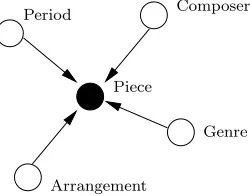
In this approach, the layout contains a distinguished results column to which all other columns are constrained. As shown in Figure 4.1, the constraints in such an approach are ‘star-like’.
Arrangement Period
Piece
Composer
[image:11.612.258.383.281.379.2]Genre
Fig. 3.Distinguished column constraints
The instances displayed in the results column,Dres, will be those that satisfy the constraints from the selections on other columns:
Dres= i
SiCires (3)
wherei ranges over the columns
The notationSiCij is used to mean the set of values in Tj that correspond to values inSi, according to the constraintCij:
For example, if we have a column containing a list of countries that includes the Vatican City, and our final column contains a list of computer science researchers, but we have no information about the state of computer science research in the Vatican, then we remove Vatican City as a choice in the country column. In effect, we are limiting the system in such a way as to only let the user answer questions that it can answer. The instances displayed in columni(the members of the set Di) will be those instances that satisfy the constraint Cires for some value ofDres:
Di=CiresDres (5)
4.2 Adjacent column constraints
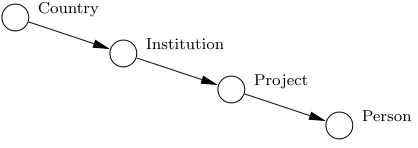
In the second approach, each column provides a constraint, which we call an adjacent column constraint, to its immediate successor in the layout.
Country
Institution
Project
[image:12.612.217.426.269.343.2]Person
Fig. 4.Adjacent column constraints
Si+1⊆Di+1=SiCii+1∩Cii+1+2Cii+2+3. . . Cn−n 1Tn (6) wheren is the number of columns
In Figure 4.2, this type of constraint is denoted byCnAwherenis the column from whose selection the constraint is derived (the constraint is applied to column n+ 1). Since this constraint set is a basis, we can determine the pairwise effect of a selection on any other column by composing the basis constraints. For example, in Figure 4.2 the constraint on column three from column one isC1A◦C2A.
In practice, these composed constraints are not used in implementations (where the constraints are evaluated column by column from left to right); we describe them in order to illustrate the parallels between the two approaches to building a basis set.
CT
1 C2T C3T C4T C5T
CA
1 C2A
CD 1
CD 2
CD 3
[image:13.612.190.426.61.176.2]CD 4
Fig. 5.mSpace column constraints
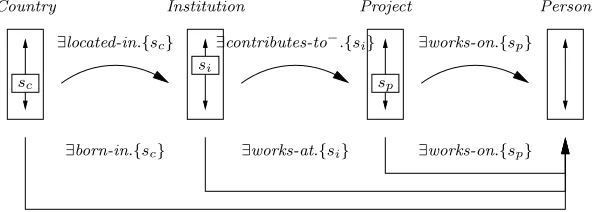
work on the projects. We choose an initial layout that consists of a column of institutions, then of projects, and finally of people, as shown in Figure 4.2. The ontology on which the interface is based defines the four named classesCountry, Institution,Projectand Person, each of which is used as the type constraint on the relevant column. Institutions are related to projects by the contributes-to property, people to projects by theworks-onproperty, people to institutions by the works-at property, institutions to countries by thelocated-in property and people to countries by theborn-inproperty.
Institution Project Person
Country
∃works-on.{sp} ∃born-in.{sc}
∃located-in.{sc} ∃contributes-to−.{si} ∃works-on.{sp}
∃works-at.{si}
sc
si
sp
Fig. 6.mSpace example
The adjacent selection basis constraint from countries to institutions is of the
form∃located-in.Country, while that from institutions to projects is∃contributes-to−.Institution, and that from projects to people is ∃ works-on.Project Initially, the only
[image:13.612.160.457.346.452.2]The distinguished column selection constraint basis set consists of∃works-at.Institution, which runs from institution to person,∃works-on.Project, which runs from from
project to person, and∃born-in.Country, which runs from country to person. As in the adjacent case, these constraints are modified as selections are made. The concrete selection constraint between the institution and project columns, which takes into account the existence of people which satisfy the selections made in these columns, is:
∃ works-on−.(∃works-at.{s1, s2, . . .})
wheres1,s2and so on are the individuals which have been selected in theProject column.
In this example, where the selection constraints are straightforwardowl:hasValue restrictions on single properties, the pairwise selection constraint is anowl:hasValue restriction on the composition of one of the properties with the inverse of the other (eg.∃ (works-on−◦works-at).{sinst}).
So far, we have described layouts which use owl:hasValuerestrictions as selection constraint class expressions, but these are not the only possibility. We can also form constraints of the form ∀R.{s1, s2. . .} (in OWL terms, an owl:allValuesFromrestriction to an enumerated class defined usingowl:oneOf), and can incorporate other restrictions which are not parameterised by selections.
4.3 Layout operations
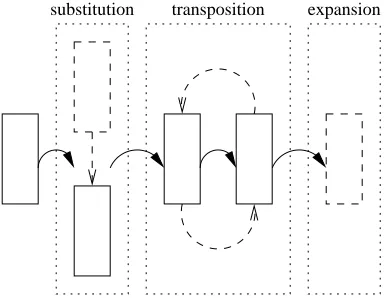
The description of intra- and inter-column constraints above assumes a fixed layout of columns, whereas an mSpace interface allows the user to modify the layout at will. We define two primitive operations on a layout: theadditionof a column within the layout, and theremovalof a column from the layout. As they are, these primitive operations are unlikely to be supported in a given mSpace interface because they are at too low a level to fit well within the paradigm of dimensional exploration introduced by mSpace. Instead, we define three dis-tinct types of higher-level operation which can be expressed as a composition of the primitive operations, and which an mSpace interface would be expected to support (illustrated in Figure 7):
Expansion: A new column may be added to the right of the existing columns
Substitution: A column within the layout may be switched with a column of a different type
Transposition: The positions of two columns within a layout may be ex-changed. This is a specific example of a dimensional sorting operation – there are others.
transposition expansion substitution
Fig. 7.mSpace operations
set of options from which they made the selection), which in turn may change more instantiated constraints, and so on.
We describe operations which cause the invalidation of selections as disrup-tive. For example, if a selection has been made in a column, and the column is substituted for one of a different kind, the selection is lost, which affects any presented options or selections in subsequent columns. Similar behaviour is to be expected in the event that two columns are transposed, although it may be possible to retain the selections in the columns provided they do not violate the new selection constraints.
In the general case, we cannot easily characterise this disruptive propagation of changes, but we can determine what the change to the constraint set will be in response to the initial operation for the two selection constraint schemes. We describe the changes brought about by an operation in an abstract fashion, by counting the number of selection constraints which must be changed. These are listed in Table 1; +nindicates thatnconstraints are added to the set, −nthat nare removed and ±nthat nare changed.
Adjacent Distinguished column first/last other distinguished other add +1 −1,+2 ±(n−1) +1 remove −1 −2,+1 ±(n−1) −1 expand +1 — ±(n−1) +1 transpose ±3 ±4 ±(n−1) 0 substitute ±1 ±2 ±(n−1) ±1
[image:15.612.207.413.505.585.2]Since the observed flow of information in an mSpace interface runs from left to right, an operation which changes a column in a layout using adjacent selection constraints is likely to change those columns which lie to its right. For example, the expansion of an existing layout under the adjacent scheme by the addition of a new final column is a non-disruptive operation which does not involve the removal or replacement of existing constraints (shown as +1 in Table 1).
Conversely, under a distinguished column scheme (where the final column is the distinguished column), all the selection constraints are replaced with ones suitable for use with the new final column. In this case, the change in the type of the final column leads to the introduction of a new set of selection constraints, which may be violated by the existing selections. Since constraints are applied in a pairwise manner under this scheme (going from one column of a pair to the distinguished column, and then back to the other column in the pair), a change in the type of the distinguished column affects all selection constraints, which raises the prospect that the selections in all existing columns may be invalidated (shown as±(n−1) in Table 1).
Similar behaviours exist for the operations of transposition and substitution under either of the constraint schemes described above. In general, adjacent selection constraints yield more disruptive operations for small layouts with less than five columns (there are no distinguished columns, so the cost is mostly constant across the columns in a layout, the first or last columns being an obvious exception).
In contrast, distinguished column selection constraints designate one column as special and express all selection constraints in terms of that column. Opera-tions on columns other than the distinguished column are less disruptive than their counterparts under adjacent selection constraints (note the values for trans-position in Table 1). However, operations on the distinguished column become significantly more expensive because they change the entire constraint set.
Thus, a rule of thumb which informs a designer’s choice of selection constraint scheme is this. For interfaces where dead end suppression is considered essential, or where layouts have fewer than five columns, or where the expansion operation is not to be supported, distinguished column selection constraints are the appro-priate approach, otherwise adjacent selection constraints should be chosen. One proviso to this is that expansion under distinguished column constraints, where the final column is not the distinguished column, are no more expensive than expansion under adjacent constraints.
4.4 Permitted layouts
We express this behaviour in a successor matrix which relates each column type to the column types after which it may appear; the column types used in this matrix are the type constraint class expressions described in the previous section. When a user is presented with a layout, the set of permissible operations which they may use to rearrange the layout is constructed by consulting this matrix. For example, the user is presented with a list of column types which may be used to expand the current layout that is generated by taking the set of all possible column types and removing those which are prohibited by the columns already in the layout.
Similarly, the transposition of two columns is a two part operation. The user selects the first of the columns to be transposed, then the columns with which that column may be swapped (which would yield a permissible layout when swapped) are indicated. The user then selects the second column from those indicated, and the layout is rearranged.
4.5 Column presentation
The model of mSpace outlined above concerns itself primarily with the genera-tion of the abstract choices offered to the user in each column and the propaga-tion of the effects of making a selecpropaga-tion through the system, but this is not the only concern. If each column represents an set of objects from which the user must make some choice, the manner in which that set is rendered for presentation to the user is also of importance.
In our prototype mSpace system, CS AKTiveSpace, we have implemented a column view for selecting UK higher education institutions which is rendered as a map of the UK showing the geographical distribution of HEIs. This column need not have been rendered in this fashion; it could have been shown as a simple multipick widget containing the names of the institutions.
In each case, the information required to render the column is obtained from the knowledge base (human-readable labels and latitude/longitude coordinates for the HEIs). The design of an mSpace interface must therefore not only include the set of column types, their permitted combinations and the constraints which relate them, but also the alternate rendering styles for each column.
Our CS AKTiveSpace system also illustrates the use of ordering and limiting constraints on columns. The final column contains a list of people (filtered by the preceding columns) which may be ordered according to various criteria (we allow ordering by total grant income and by the research rating of their institu-tion). Similarly, the number of people shown in this column may be limited to the first five, ten, etc. This behaviour is separate from the selection-based be-haviour described earlier in this section and is largely a presentational issue; we implement it as a set of filters which apply to the column after the application of inter-column constraints.
effectively decoupled from the view/controller pairs through the adoption of a clean API by which the view interacts with the model.
4.6 Detail view presentation
As with column presentation above, we consider the generation of the detail view provides the user with contextual information as they interact with the system to be a purely presentational issue that has little to no impact on the interactions between the columns described in our formal model. The detail view provides information (at a fairly coarse granularity) about the entity that was most recently the focus of the user’s attention, namely the most recent selection that they made in a column.
5
Implementation
The characterisation of an mSpace user interface in terms of description logic expressions given above should be considered to be an abstract description of such a user interface, and not a detailed specification of an implementation itself. In our prototype Semantic Web application, CS AKTiveSpace, we chose to limit the class expressions used as selection constraints to be owl:hasValue restrictions. We further chose to implement these constraints in a na¨ıve man-ner which does not require recourse to a DL reasoman-ner; constraints were repre-sented as triple patterns containing variables which were bound as selections are made. For example, the constraint∃works-at.Institution(used as a distinguished column selection constraint in the example) would be replaced with the triple patterns (?person,works-at,?institution) and (?institution,rdf:type,Institution). These triple patterns were expressed in the RDQL language, and used as queries to generate the values with which panels were populated.
This approach has the advantage of simplicity, because a constraint and its inverse have exactly the same form. The triple patterns do not assume that the constraint will be read in the direction of a relation or of its reverse; the reading of the constraint depends on which variable is bound (by a selection), and which is free (and generates potential selection with which a column is populated). In addition, the RDQL query language is supported by a number of RDF stores and inference engines, including 3store [24] (on which we have built our CS AKTive-Space application), Sesame [25] and Jena [26], so providing some flexibility in our choice of infrastructure.
The disadvantage of this approach is that it permits only one particular type of constraint, and that the construction and composition of disjunctive query patterns (as would be the case when multiple selections are made in a column), is clumsy in RDQL.
6
Conclusion and Further Work
possibilities for more strongly correlating the interaction behaviours with the semantics inherent in the information represented by the system.
Our plans for future work include the development of a framework to facil-itate the construction of mSpace-based systems (drawing on our experiences of implementing our prototype CS AKTiveSpace system), and the investigation of techniques for automating the development of mSpace systems from ontologies. From this, we intend to develop an API and toolset to make deploying mSpace in OWL-based Semantic Web applications a plug and play operation. To this end, part of our goal with this paper is to generate discussion about and feedback for our model, to better inform the development of an API.
7
Acknowledgements
This work was supported by the Advanced Knowledge Technologies (AKT) In-terdisciplinary Research Collaboration (IRC). The AKT IRC is sponsored by the UK Engineering and Physical Sciences Research Council under grant num-ber GR/N15764/01 and comprises the Universities of Anum-berdeen, Edinburgh, Sheffield,
Southampton and the Open University.
The authors would like to thank Nigel Shadbolt and Srinandan Dasmahap-atra for their comments on this work.
References
1. Vivisimo: Vivisimo document clustering engine. http://www.vivisimo.com/
(1970)
2. Geroimenko, V., Chen, C., eds.: Visualizing the Semantic Web. Springer (2002) 3. Bederson, B.B., Shneiderman, B., Wattenberg, M.: Ordered and quantum
treemaps: Making effective use of 2d space to display hierarchies. ACM Trans. Graph.21(2002) 833–854
4. Chen, H., Dumais, S.: Bringing order to the web: Automatically categorizing search results. In: Proceedings of the ACM SIGCHI Conference on Human Factors in Computing Systems (CHI’00). (2000) 145–152
5. Robertson, G., Cameron, K., Czerwinski, M., Robbins, D.: Polyarchy visualiza-tion: visualizing multiple intersecting hierarchies. In: Proceedings of the SIGCHI conference on Human factors in computing systems, ACM Press (2002) 423–430 6. m.c. schraefel, Karam, M., Zhao, S.: mspace: interaction design for
user-determined, adaptable domain exploration in hypermedia. In: Proceedings of the AH2003 Workshop on Adaptive Hypermedia and Adaptive Web-Based Systems, Nottingham, UK (2003) 217–235
7. Risden, K., Czerwinski, M., Munzner, T., Cook, D.: An initial examination of ease of use for 2d and 3d information visualizations of web content. IJHCS53(2000) 8. Schaffer, D., Zuo, Z., Greenberg, S., Bartram, L., Dill, J., Dubs, S., Roseman,
9. Modjeska, D., Waterworth, J.: Effects of desktop 3d world design on user navigation and search performance. In: Proceedings of Information Visualization 2000, IEEE (2000) 215–220
10. Cockburn, A., McKenzie, B.: Evaluating the effectiveness of spatial memory in 2d and 3d physical and virtual environments. In: Proceedings of the SIGCHI conference on Human factors in computing systems, ACM Press (2002) 203–210 11. m.c. schraefel, Karam, M., Zhao, S.: Preview cues for exploring domain hierarchies.
In: Proceedings of Interact 2003, Switzerland (2003)
12. Neuwirth, C., Chimera, D.K.R., Gillespie, T.: The notes program: A hypertext application for writing from source texts. In: Proceeding of the ACM Conference on Hypertext. (1987) 121–141
13. Shipman, F., Moore, J., Maloor, P., Hsieh, H., Akkapeddi, R.: Spatial hypertext: Semantics happen: Knowledge building in spatial hypertext. In: Proceedings of the Thirteenth Conference on Hypertext and Hypermedia. (2002) 25–34
14. Chimera, R., Shneiderman, B.: An exploratory evaluation of three interfaces for browsing large hierarchical tables of contents. ACM Transactions on Information Systems (TOIS)12(1994)
15. Plaisant, C., Shneiderman, B., Doan, K., Bruns, T.: Interface and data architec-ture for query preview in networked information systems. ACM Transactions on Information Systems (TOIS)17(1999) 320–341
16. Sukaviriya, P.N., Foley, J.D.: Supporting adaptive interfaces in a knowledge-based user interface environment. In: Proceedings of the 1st international conference on Intelligent user interfaces, ACM Press (1993) 107–113
17. McGrenere, J., Baecker, R.M., Booth, K.S.: An evaluation of a multiple interface design solution for bloated software. In: Proceedings of the SIGCHI conference on Human factors in computing systems, ACM Press (2002) 164–170
18. Kim, M., Compton, P.: A web-based browsing mechamism based on concep-tual structures. In: Concepconcep-tual Structures: Extracting and Representing Seman-tics: Contributions to the 9th International Conference on Conceptual Structures (ICCS2001). (2001) 47–60
19. Eklund, P., Cole, R.: Structured ontology and information retrieval for email search and discovery. In: Foundations of Intelligent Systems, 13th International Symposium (ISMIS 2002). (2001) 75–84
20. Shadbolt, N., monica schraefel, Gibbins, N., Glaser, H., Harris, S.: CS AKTiveS-pace: Representing Computer Science in the Semantic Web.http://triplestore. aktors.org/tmp/www2004-cas.pdf (2003)
21. : The AKT Reference Ontology. http://www.aktors.org/publications/ ontology/(2002)
22. McGuinness, D.L., van Harmelen, F.: OWL Web Ontology Language Overview. Candidate recommendation, World Wide Web Consortium (2003)http://www.w3. org/TR/owl-features/.
23. Connolly, D., van Harmelen, F., Horrocks, I., McGuinness, D.L., Patel-Schneider, P.F., Stein, L.A.: DAML+OIL (March 2001) Reference Description. W3C Note, World Wide Web Consortium (2001)
24. Harris, S., Gibbins, N.: 3store: Efficient Bulk RDF Storage. In: Proceedings of the First International Workshop on Practical and Scalable Semantic Systems (PSSS2003), Sanibel Island, Florida, USA (2003) 3–17