0022-538X/92/074003-10$02.00/0
CopyrightC)1992, AmericanSocietyforMicrobiology
Expression and Characterization of
Genetically Engineered
Human
Immunodeficiency Virus-Like Particles Containing
Modified
Envelope Glycoproteins: Implications for Development
of
a
Cross-Protective AIDS Vaccine
BENJAMINROVINSKI,1* JOEL R. HAYNES,'t SHI XIAN CAO,1 OLIVE JAMES,' CHARLES SIA,2 SUSAN ZOLLA-PAZNER,3 THOMAS J. MATTHEWS,4 ANDMICHEL H. KLEIN" 2
Departments ofMolecularGenetics' and Immunobiology,2Connaught Centre forBiotechnology Research, Willowdale, Ontario, Canada M2R3T4;Department of Pathology, New York UniversityMedicalCenter, New
York,
New York100163;
and Department of Surgery, Duke University Medical Center, Durham, North Carolina2771JOReceived 15 November1991/Accepted 24 March 1992
Noninfectious humanimmunodeficiencyvirustype1(HIV-1)viruslikeparticlescontainingchimericenvelope
glycoproteinswereexpressedinmammalian cellsby usinginducible promoters. Weengineeredfourexpression vectors in which a synthetic oligomer encoding gpl20 residues 306 to 328 (amino acids YNKRKRIHIGP GRAFYTTKNIIG) from the V3 loop of the MN viral isolate was inserted at various positions within the endogenous
HIV-1m
envgene. Expression studies revealed that insertion of the heterologous V3(MN) loopsegmentat twodifferent locations within the conservedregion2(C2)ofgpl20,either 173or242residuesaway
from the N terminus ofthe mature subunit, resulted in the secretion offullyassembled HIV-like particles containingchimeric LAI/MN envelope glycoproteins.Both V3 loop epitopeswererecognized by loop-specific neutralizing antibodies. However, insertion oftheV3(MN)loopsegmentinto otherregionsofgpl20 ledtothe productionofenvelope-deficientviruslike particles. Immunization with HIV-likeparticlescontainingchimeric envelope proteins induced specific antibodyresponsesagainst both theautologousand heterologousV3loop epitopes, including cross-neutralizing antibodies against the
HIV-1LAI
and HIV-lMN isolates. This study, therefore, demonstrates the feasibility of genetically engineering optimized HIV-like particles capable of eliciting cross-neutralizing antibodies.The human immunodeficiencyvirustype 1 (HIV-1)isthe causative agent ofAIDS and related disorders (5, 17). The envelope (env) glycoprotein is the major surface antigen expressed bythe virus and HIV-1-infected cells. It is
syn-thesized as a glycosylated precursor protein (gp160) that subsequently undergoes endoproteolytic cleavage to yield thelarge external glycoprotein, gpl20, and asmaller
trans-membrane protein, gp4l (2, 12, 55), which contains the gpl60fusion domain. These two subunits form a
noncova-lentglycoprotein complex which is anchored to the virion capsid and infected cell membranes through gp4l (2, 13). The envglycoprotein complex is directly implicated in the infectivity, cellulartropism, cytopathology, and pathogenic-ityof HIV-1(9, 10, 35, 36, 40, 43, 44, 52).
Thecurrentvaccine strategies designedtodevelop asafe
and efficacious AIDS vaccine include whole, inactivated viruses(11, 18, 20, 21,45, 46,61),recombinantantigensand viruses (3, 4, 6, 16, 21, 27, 31, 48, 53, 54, 65, 68, 69), genetically engineeredviruslikeparticles (19, 25, 26, 28, 33, 58, 60, 66), synthetic peptides (7,8, 21, 24, 28, 30, 50, 51, 57), and anti-idiotypic antibodies (34). Vaccines composed of whole, inactivated simian immunodeficiency virus (SIV) were shown either to prevent the establishment ofvirus infection(11, 45)ortodelaytheappearanceof disease(61)in
macaqueschallengedwith infectiousvirus. These encourag-ing results suggest that perhaps a protective immune
re-sponse against HIV-1 can effectivelybe obtained by incor-poratingmost of the viralantigensintoacandidate vaccine.
*Correspondingauthor.
tPresent address:Agracetus Inc., Middleton, WI53562.
We (28) and others (19, 25, 33, 58, 60, 66) have previously reported that noninfectious HIV-like particles can be
re-leased from mammalian and insect cells transfected with a varietyofexpressionvectors. Since theseparticles contain eithermostor all of the HIV-1 structuralantigens, theyare potential candidate immunogens for the development of improved cross-protective AIDSvaccines.
Several studies have shown that theprincipal neutralizing determinant of HIV-1 lies within the tipof theloop forming the third variable region (V3) ofgpl20 (23, 40, 42, 50, 56). Since neutralizing antibodies essentially recognize the hy-pervariable epitope(s)of theloop,it is conceivabletodesign cross-protectivechimeric vaccinesby insertingtheV3 loop epitopesof themostpredominant anddivergentviralisolates intoasingle envelope.
In the present study, we investigated the possibility of producing HIV-like particles with chimeric envelopes. To thisend,weengineeredasetofexpressionvectorsinwhich the env gene from the HIV-1LAI strain was modified to
produceviruslikeparticles containing aV3(MN)
neutraliza-tion epitope inserted in different regions of gpl20(LAI). Immunogenicity studies have shown that these optimized particlesinduceantibodyresponsesagainstbothautologous andheterologous V3 loop epitopesand elicit cross-neutral-izingantibodiesagainsttheHIV-1LAIandHIV-lMNisolates.
MATERIALS AND METHODS
Cell lines and cell culture. MonkeyCOS-7 and Vero cells weregrown andpassaged biweekly inDulbecco's modified Eagle'smedium (Flow Laboratories, McLean, Va.) supple-mented with 10% heat-inactivatedfetal bovineserum
(Bock-4003
on November 9, 2019 by guest
http://jvi.asm.org/
neck), glutamine (2 mM), penicillin (50 IU/ml), and strepto-mycin (50,ug/ml). A CD4+ HeLa cell line (41) was obtained through the AIDS Research and Reference Reagent Program (Division of AIDS, National Institute of Allergy and Infec-tious Diseases; HeLa T4+) from Richard Axel. This cell line was maintained in the presence of 0.5 mg of Geneticin (GIBCO Laboratories, Long Island, N.Y.) per ml.
Antibodies. The following mouse monoclonal antibodies were obtained from Dupont Canada, Inc., Markham, On-tario: anti-HIV-1 reverse transcriptase (RT), NEA-9304; neutralizing anti-HIV-1gpi20 monoclonal antibody 5023 (14) raised against a synthetic peptide containing 15 amino acids presentwithin the V3 loop ofHIV-1(IIIB), NEA-9305; and anti-HIV-1 gp4l, NEA-9303. The anti-CD4 monoclonal an-tibody OKT4 was obtained from Ortho Diagnostic Systems, Inc.,Raritan, N.J. The neutralizing anti-gp120 human mono-clonal antibody 268-liD (22) recognizes a core epitope consisting of the HIGPGR sequence in the third variable domain of the env glycoprotein of the viral MN strain.
Construction of recombinant expression plasmid vectors. The nucleotide and amino acid numbering used throughout for HIV wasdesignated by Myers et al. (47). The expression plasmid vector pMTHIVd25 (Fig. 1A) was constructed from pMTHIV (28) by deleting a 25-bp DNA fragment (nucleo-tides 753 to 777; LAI sequence) containing viral RNA packaging sequences (1, 39). In this vector, transcription of the HIV-1 coding sequences is regulated by the inducible humanmetallothionein IIa (MT) promoter and a simian virus 40polyadenylation sequence. A collection of pMTHIVd25-based expression vectors containing modifications in the env gene coding sequence was generated (Fig. 1B). Vectors pMTHIVST, pMTHIVBG, and pMTHIVKP were con-structed by inserting synthetic oligonucleotide cassettes encoding amino acid residues 306 to 328 from the V3(MN) loop sequence (47) into the indicated StuI,BglII, and
KpnI
restriction sites, respectively (Fig. 1B). To construct plasmid pMTHIVSB, theStuI-BglII DNAfragment depicted in Fig. 1Bwasreplaced byasynthetic oligonucleotide encoding the same V3 loop residues. For all constructs, the synthetic DNA cassettes were designed to encode additional amino acid residues to maintain the reading frame and create unique restriction sites flanking the heterologous V3(MN)loop DNA segment. The nucleotide sequences of all con-structs wereconfirmed byDNAsequencing.
DNA-mediated celltransfections. COS-7, Vero, and HeLa T4+ cells were grown to 80% confluence and transfected with 20 ,ug ofplasmidDNAeither by Lipofectin (Bethesda Research Laboratories [BRL], Gaithersburg, Md.)orby the Transfinity (BRL) calcium phosphate procedure. Cells trans-fected with plasmids containing the human MT promoter wereinduced 24 to 36 h after transfection with 5 ,uM CdCl2 for 12 to 16 h. Unless otherwise indicated, most cells and culture supernatantswereanalyzed for protein expression at 48 hposttransfection.
Isolation of HIV-1 viruslike particles from cell culture supernatants. Culture media (10 ml) from cells transfected with individual expression constructs were collected and clarified by centrifugation at 2,000 x g (Sorvall RT6000B;
Dupont Company, Wilmington, Del.) for 15 min at 4°C. Viruslike particles were isolated by ultracentrifugation as previously described (28).
Sucrose gradient fractionation and RT assay. To purify HIV-like particles for immunogenicity studies, pelleted par-ticles obtained by ultracentrifugation of cell culture super-natants were resuspended in 200 ,ul of TNE buffer (10 mM
Tris-HCl [pH 8.0], 100 mM NaCl, and 1 mM EDTA),
A.
Sacl 678
SD ATG
I I I
Y
-l
Xhol8944
ENV
pMTHIVd25
B.
signal peptide
pMTHIVST pMTHIVBG pMTHIVKP
cleavage site
gpl20 # gp4l
t
t
tt
t
CD4 binding KpnI Stul BgIll domain
YNKRKRIHIGPGRAFYTTKNIIG DV
SRTAYNKRKRIHIGPGRAFYTTKNIIGTR
RTAYNKRKRIHIGPGRAFYTTKNIIGTRAV
pMTHIVSB
YNKRKRIHIGPGRAFYTTKNIIGDPV
FIG. 1. Diagrammatic representation of constructs and vectors used toexpressHIV-likeparticles withnormal and modified enve-lope proteins. (A) A25-bp DNA fragment(nucleotides 753 to777 from HIV-1LAI) which contains known viral RNA packaging
se-quences(1, 39) was deleted fromplasmidpMTHIV(28)togenerate theexpression vectorpMTHIVd25. In this vector, transcription is driven by the human MTIa promoter. (B) Vectors pMTHIVST, pMTHIVBG, and pMTHIVKP were constructed by inserting syn-theticoligonucleotidecassettesencoding the 23gpl20amino acids YNKRKRIHIGPGRAFYTTKNIIG (residues 306 to 328) from the V3 loop of the MN isolate (47)into the depictedStuI, BglII, and
KpnI
restriction sites, respectively. To construct plasmid pMTHIVSB, theStuI-BglIlDNA fragment wassimply replaced byasynthetic DNA cassette encoding the same V3(MN) loop residues. Thepredictedamino acid sequence of insertedepitopes is indicated for eachindividualconstruct.SD,splicedonor; pA,simianvirus 40 polyadenylationsite; MT, MTpromoter.
overlaid onto a continuous sucrose gradient (20 to 60% wt/vol), andsedimentedat100,000 xginaBeckman SW40 rotorfor1.5 h at4°C. The gradient fractionswerecollected from the bottom in 500-,ul aliquots. RT activity was mea-suredin each fractionaspreviously described (28).
Immunoprecipitations. Two days after transfection, cells were washed in phosphate-buffered saline (PBS) and dis-rupted in 0.5 ml oflysis buffer (50 mM Tris-HCl [pH 8.0] containing 0.5% Nonidet P-40, 5mMEDTA, 150mMNaCl, and1 mMphenylmethylsulfonyl fluoride) for 15 to30 minat
on November 9, 2019 by guest
http://jvi.asm.org/
[image:2.612.335.550.72.439.2]4°C.The lysateswere adsorbed for 1 h at room temperature with 30
RI
of a50% suspension of protein G-agarose (BRL) and clarified by centrifugation. Immunoprecipitation analy-seswereperformed by adding 1 jig of antibody and 30RI
of a 50% suspension of recombinant protein G-agarose toclarified extracts. After 16 h of incubation at 4°C,
immuno-precipitates were collected by centrifugation at 14,000 x g, washed three times in lysis buffer, resuspended in Laemmli sample buffer (37), boiled for 2 min, and fractionated by sodium dodecyl sulfate-polyacrylamide gel electrophoresis
(SDS-PAGE). To detect the presence of proteins in the culture medium of cells transfected with recombinant vec-tors encoding chimeric gp120(LAI/MN) proteins, the cell supernatants werefiltered through a 0.45-,um-pore-size filter, and 1 jig of the human 268-liD monoclonal antibody (22) was added to the medium as described above.
Immunopre-cipitateswere thenwashed, pelleted, resuspended in Laem-mli sample buffer, fractionated by SDS-PAGE, and analyzed
by immunoblotting with the neutralizing mouse
anti-gpl2O(IIIB) monoclonal antibody 5023 (14).
Western immunoblot
analysis.
Pelleted particles weresus-pended in 40 jil of TNE, mixed with 10 ,ul of 5 x Laemmli
samplebuffer(37), andboiled for 3 min. Viral proteins were thenseparated by SDS-PAGE and transferred to Immobilon membranes (Millipore, Bedford, Mass.) (63). Membranes were blocked with BLOTTO buffer (PBS containing 5% Carnation instant nonfat dry milk, 0.0001% wt/vol
thimero-sal, and 0.01%vol/volantifoam A emulsion) for 2 h at 25°C and then incubated with appropriate dilutions of antibodies
overnight at 4°C. Filters were then incubated with a goat anti-mouse immunoglobulin G antibody conjugated to alka-linephosphatase (Promega, Madison, Wis.) and reacted with the alkaline phosphatase chromogenic substrates nitroblue tetrazolium chloride and 5-bromo-4-chloro-3-indolyphos-phatep-toluidine salt(BRL).
CD4-binding assays. CD4+ HeLa cells (41) were trans-fected with the recombinant expression plasmid vectors as described above. Cells were induced with 5 jiMCdCl2 24 h after transfection, and cell lysateswere prepared 24 h after induction. Alllysateswereadsorbed for1h at room temper-aturewith 30 jilofa50% suspension of recombinant protein
G-agarose and clarified by centrifugation. The precleared cell lysates were then immunoprecipitated with the mono-clonal antibody OKT4. Immunoprecipitated material
con-taining env protein-CD4 complexes was then resolved by
SDS-PAGEandanalyzedby immunoblotting with the mouse
anti-gpl20(III.)
monoclonal antibody 5023. This assay only detects envelope-CD4 protein complexes and is not quanti-tative.Immunogenicity studies and measurement of antibody re-sponses.Fullyassembledenvelope-containing particles were isolated from the supematants of stably engineered Vero cells transfected with plasmids pMTHIVd25, pMTHIVST, and pMTHIVBG, respectively, by ultracentrifugation
throughaglycerolcushion and purified by sucrose gradient fractionation (28). The p24 content of the various particle
specieswasdeterminedbyap24-specificenzyme immunoas-say(CoulterImmunology, Hialeah, Fla.). All stable cell lines secretedapproximately500
jig
of p24 per liter.Female SJL/J mice (Charles River, Montreal, Quebec,
Canada) between 6 and 8 weeks of age were immunized
subcutaneouslywithdoses of purified particles
correspond-ingto 10
jig
of p24antigen emulsified in Freund's completeadjuvant. A booster injection equivalent to 5 jig of p24
antigen was given 3 weeks later in Freund's incomplete
adjuvant. Mice were sacrificed 9 days after the second
immunization, and sera were collected and heat inactivated at 56°C for 30 min. The presence of antibodies to HIV-1 antigens was determined by antigen-specific enzyme-linked immunosorbent assay (ELISA). ELISA plates (LKELKAY plates; Lab Systems, Shrewsbury, Mass.) were coated at
20°C
for 18 h with 100 jil of a solution containing either recombinant proteins at 1 jig/jil or peptides at 10 jig/ml in 50 mM carbonate buffer, pH 9.6. The recombinant gpl20 was obtained from American Bio-Technologies, Inc., Cam-bridge, Mass., and p24 was obtained from Dupont Canada, Inc., Markham, Ontario, Canada. Synthetic peptides corre-sponding to the neutralizing determinant found in the V3 loops of gpl20 from HIV-1 strains HXB2, MN, and ELI (Table 1) were purchased from American Bio-Technologies, Inc., Cambridge, Mass. Plates were blocked at room tem-perature for1 h with 200 jil of 2% gelatin in PBS and washed three times with PBS containing 0.05% Tween 20. Serum samples were serially diluted in PBS-Tween 20 and added to individual wells for 1.5 h at room temperature. The plates were then washed three times with PBS-Tween 20, and a goat anti-mouse immunoglobulin G-horseradish peroxidase enzyme conjugate (Amersham Canada Ltd, Oakville, On-tario, Canada) diluted 1:5,000 in PBS-Tween 20 was added for 30 min at 37°C. After an additional washing step, the color was developed by using 0.1% tetramethylbenzidine-0.004% hydrogen peroxide (ADI Diagnostics, Willowdale, Ontario, Canada). Optical density was read at 450 nm by using a Titertek Multiskan MCC/340 plate reader (Flow Laboratories, McLean, Va.). Endpoint titers were defined as the highest serum dilution which resulted in optical density readings at least twofold greater than the baseline absorb-ance established for normal mouse serum controls.Determination of cross-neutralizing antibodies in immu-nized guinea pigs by a cell fusion blockade assay. Guinea pigs were immunized subcutaneously with purifiedHIV-like par-ticles corresponding to 10 jig of p24 antigen emulsified in Freund's complete adjuvant. Booster immunizations with doses corresponding to 5 jg of p24 were given intramuscu-larly every 2 weeks in Freund's incomplete adjuvant. Blood wascollected 14 days after each booster immunization, and the serum fraction was isolated. The ability of immune guinea pig antisera to neutralize the HIV-1LAIandHIV-1MN strains was assessed after four booster immunizations by determining the presence of cell fusion-blocking antibodies in the sera as previously described (59). Prior to the assay, all antisera were adsorbed with monkey Vero cells to re-move cross-reactive anti-primate antibodies.
RESULTS
Recombinant plasmid vectors used to study the expression ofHIV-like particles with modified envelope glycoproteins. A set of plasmid vectors was constructed to study the expres-sion of noninfectious viruslike particles with structurally modified env proteins. We previously used the inducible human MT promoter to produce immunogenic HIV-like
particles in stably engineered primate cell lines (28). The original expression vector (pMTHIV) was further modified toconstruct pMTHIVd25 by deleting the 25-bp DNA frag-mentknown to contain viral RNA packaging sequences (1, 39) from
HIV-1l_AI
proviral DNA (Fig.1A). This deletion did not significantly affect particle assembly. In addition, a collection of pMTHIVd25-based expression vectors with genetic modifications in the env coding sequence was con-structed (Fig. 1B). These vectors were engineered to pro-duceHIV-lL_4-like
particles with chimeric envelopeon November 9, 2019 by guest
http://jvi.asm.org/
proteins containing the same heterologous V3(MN) loop epitope inserted at different positions.
Expression of HIV-like particles with chimeric MN/LAI envelope proteins. To broaden and enhance the immunoge-nicity of the HIV-lLAI-like particles, we engineered chimeric envelopes and investigated whether alterations in the env gene would affect particle assembly. To this end, we con-structed four pMTHIVd25-based expression vectors in which a synthetic oligomer encoding gp120residues 306 to 328 (aminoacids YNKRKRIHIGPGRAFYTTKNIIG) from
the V3 loop of the MN viral isolate (47) was inserted at various positions within the HIV-lLAI env gene (Fig. 1B). These mutations should result in insertion of the V3(MN)
neutralization epitope(s) either into the first conserved re-gion(Cl)ofgp120 approximately 12 residues away from the Nterminus ofthe mature glycoprotein (pMTHIVKP) or into the second conserved region (C2) of the env protein 173 (pMTHIVST) and 242 (pMTHIVBG) residues away from the Ntprminus, respectively. In plasmid pMTHIVSB, the
mu-tation was designed to replace 69 amino acids in the C2 region with theV3(MN) segment.
To characterize and compare the products of both native and mutated envgenes, COS-7 cells weretransfected with the various recombinant expression vectors. The transfec-tantsproducedbetween 400 to500 ,ugofparticle-associated p24 per liter, upon inquition with heavy metals. Particles
pelletedfromthe culture supernatants ofinduced cells were
analyzed by
immunoblottiug
48 h after transfection. envproteins were vispalized t
u$ing
the mouse anti-gp120monoclonal antibody 5023, 'which ecognizes the env
pro-teinsofthe LAI and, to alesser
eXt@nt,
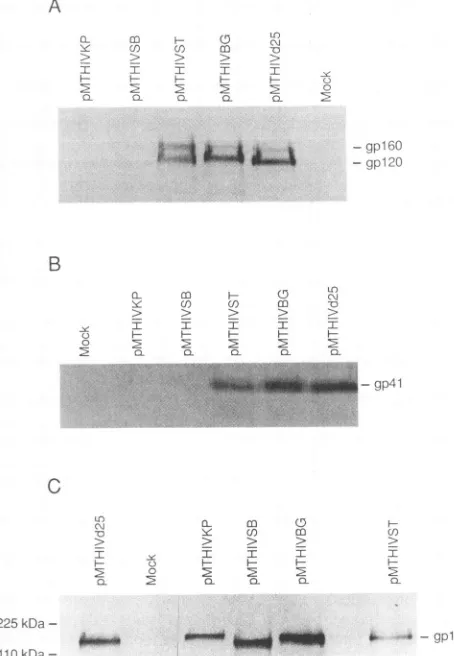
of the MNstrains in Western blots (14). Protein bands with apparent molecular weights consistent with those of native gp120 and gp160 wereobserved in pelleted material derived from the super-natants of cells transfected with plasmids pMTHIVd25, pMTHIVST,and pMTHIVBG, respectively (Fig. 2A). How-ever, env glycoproteins were not expressed from vectorspMTIJHVKP
andpMTtIIVSB.
Immunoblotanalysisof thesesampl,s
with a mouse anti-gp41 monoclonal antibodycon-firmej
that the transmembraneproteinwasonly detected inthe
three
samples in which gpl20 was present (Fig. 2B).Taksn together, these data demonstrate that, of the four
chipieric
env gene constructs, only the pMTHIVST andpMTHIVBGvectorswereabletoproduceviruslikeparticles containingsurface- and membrane-associatedenvelope sub-units when transfected into COS-7 cells.Therefore,insertion of the heterologous V3(MN) loop segment at twodifferent
positions within the C2 region of gpl20, either 173
(pMTHIVST) or 242 (pMTHIVBG) residues from the N terminus,resulted inexpressionofstructurally modifiedenv proteins. However, insertion of the V3(MN) loop segment into theCl regionofgp120 approximately 12residues away from the N terminus of the mature glycoprotein (pMTHIVKP) or replacement of69 amino acids in the C2
regionwith the heterologous segment(pMTHIVSB) resulted in structural modifications that affected theexpression of the envproteins.
Todetermine whether the lack of env protein expression in the supernatants of cells transfected with constructs
pMTHIVSBandpMTHIVKPwasdueto adefect inparticle assembly and production or to'the inability of transfected
cellstosynthesizegpl60precursorprotein, we first assessed the presence of RT in pelleted material by immunoblot
analysis, usingamousemonoclonal anti-RT antibody. Sim-ilar steady-state levels of both forms of the RT enzyme (51 and 66 kDa, respectively) were observed in all particle
A
\1 U) U) m CM
> _ > > > I I I I I H F- F F-
F-CL CL CL C
-Y
c-:E
-gpi60
-gp120
B
al m F- ( 5 C'
y~ U) U) CD -o
> > > > >
~L CL_LL
I I I I I~~~~~~~~p.
c
Cn
I
CL
cL m (
-) cU mCU
I I I I
.x F F- F
o E > > 2
2 CL CLa
225kDa
-_ a -gpl60
110
kDa-FIG. 2. Immunoblot analysisofenvelopeglycoproteins present in celllysatesor associatedwith HIV-like particles expressed by transfectedCOS-7cells. Cellsweretransfectedwitheithercontrol (pMTHIVd25)ormutated(pMTHIVST,pMTHIVBG, pMTHIVSB, and pMTHIVKP) plasmidvectors. (A and B) Viruslike particles
werepelletedfrom the supernatants(10ml) of COS-7 cells induced with 5 pMCdCl2at48 h after transfection. Thepelletwasanalyzed by SDS-PAGEand immunoblotting, using either the mouse anti-gpl20monoclonalantibody 5023(Dupont)
(A)
or a mouseanti-gp4l monoclonalantibody (B). (C) Lysatesprepared by treating 5 x 10⁵ transfected and CdCl2-induced COS-7 cellswith lysis bufferwereresolvedbySDS-PAGE andanalyzed forthepresenceofprecursor gpl60protein by immunoblottingwiththemouseanti-gp120
mono-clonalantibody5023(Dupont). Electrophoretic mobilitiesofnative gpl20, gpl60,andgp4lglycoproteinsareindicated. Mock, pelleted material obtainedfrommock-transfectedCOS-7cells.
species analyzed(datanotshown). Sincethe presenceofRT in pelletedmaterial is indicative of viralassemblyand virus release intp the culture medium, these results demonstrate that allconstructs expressed comparable amounts of virus-likeparticlesin responsetoCdCl2induction. Inaddition,the
ability of nonsecreting transfectants to synthesize the env glycoprotein precursorintracellularlywas demonstratedby
immunoblot analysis of cell lysates probed with the
anti-gpl20 monoclonal antibody 5023. The gpl60 glycoprotein wasdetected in all celllysates (Fig. 2C). The truncatedenv glycoprotein precursor expressed from pMTHIVSB which lacks 69 amino acids had, as expected, a lower apparent molecularmassrelativetothe other precursorproteins.The variations in steady-state levels of the various precursor
proteinsafterCdCl2inductionprobablyreflect differences in
on November 9, 2019 by guest
http://jvi.asm.org/
[image:4.612.324.551.75.403.2]their intracellular stability. However, these results con-firmed the ability of all constructs to express gpl60. The
absence of detectable gpl20 in cell lysates may be due to rapid intracellular degradation or transport to and release from the cell surface. Furthermore, only a small fraction of gpl60 is processed into thegpl20 subunit (67).
To establish that the gpl20 subunits produced by pMTHIVST and pMTHIVBG contained the heterologous
V3(MN)loopepitope(s),theenvelope proteinswere immu-noprecipitated in the absence of any detergents or denatur-ing agents with the human monoclonal antibody 268-liD
directedagainstaneutralizationepitope oftheV3(MN)loop (22). Immunoprecipitates were then resolved by SDS-PAGE and analyzed by immunoblotting with the mouse anti-gpl2O(IIIB) monoclonal antibody 5023 (14). Immunoblot analysis (Fig. 3) revealed that antibody 5023 specifically
recognized a single band corresponding to gpl20 only in
immunoprecipitates from the supernatants of cells trans-fected with the pMTHIVST and pMTHIVBG constructs. Theseresults clearly indicate that the processed env glyco-proteins expressed from thesevectorscontain the heterolo-gousV3(MN) loop segment.
Influence of structural modifications of theenv
glycoprotein
on CD4 binding. Insertion of the V3(MN) loop-coding se-quenceinto the env gene didnotaffect the DNA sequences encoding a region critical for interaction with the CD4 receptorinanyof the four mutated constructs(38)(Fig.1B). However, we investigatedwhether these structural
modifi-cations had any effect on the ability of the altered env proteins to interact with CD4. Since all the mutated con-structs express a precursor env glycoprotein, CD4+ HeLa cells (41)weretransfected with the mutatedvectorsorwith the control plasmid pMTHIVd25 and CD4 binding was assayedon celllysates at48 hposttransfection. Thelysates werefirstimmunoprecipitatedwith the monoclonalantibody
OKT4which bindsto aportionof CD4notmaskedbygpl60 binding and therefore recognizes complexes between CD4 and theHIV-1glycoprotein (10, 35, 41).The immunoprecip-itated material was then resolved by SDS-PAGE and
ana-lyzed byimmunoblotting with the mouse anti-gpl20 mono-clonal antibody 5023. The precursor env glycoprotein
presentin thelysates of cells transfected with pMTHIVd25, pMTHIVST, and pMTHIVKP wasprecipitated with OKT4 andisthus capable ofbinding to CD4(Fig. 4). In contrast, precursor env proteins expressed by the constructs pMTHIVBG andpMTHIVSBwerenotimmunoprecipitated byOKT4, suggestingthattheydidnotinteract with CD4.
Immunogenicity ofHIV-like particles with chimeric enve-lopeglycoproteins. Fully assembled viruslike particleswere purified by ultracentrifugation through a glycerol cushion and then bysucrose gradient fractionation from the super-natants of stably engineered Vero cells transfected with
plasmids pMTHIVd25, pMTHIVST, and pMTHIVBG, re-spectively (see Materials and Methods). Groups oftwo to four mice received two injections (10 and 5 ,ug of p24
equivalent per dose,respectively) of particles with modified envproteins to evaluate their respective immunogenicities.
The antibody response to envelope and core antigens was analyzed by antigen-specific ELISA, and the results ob-tainedarepresentedinTable 1.Envelope-andcore-specific antibody titers were similar in the three groups of mice immunized with particles isolated from stably engineered Vero cells transfected with constructs pMTHIVd25,
pMTHIVST, and pMTHIVBG, respectively. These
anti-body responses were of the same order of magnitude as
Cm CO
m
> > >
I I I
} H
a c: c
SC)
CL C\j
> >
I I
H H
Qo Q C
[image:5.612.361.515.81.172.2]gpl20- N I
FIG. 3. Immunoblot analysis of material immunoprecipitated from supernatants of cells transfected with control(pMTHIVd25) and mutated (pMTHIVST, pMTHIVBG, pMTHIVSB, and pMTHIBKP) expression vectors. Culture supernatants of cells transfected with the various recombinant plasmid constructs were first immunoprecipitated in the absenceofanydetergent or dena-turing agents with the human monoclonalantibody 268-llD which specifically recognizesaneutralizationepitope within the V3loop of anHIV-lMN envelope (22). Immunoprecipitateswerethen resolved by SDS-PAGE and analyzed by immunoblotting with the mouse anti-gp120(III) monoclonal antibody 5023 (Dupont). Mock, immu-noprecipitate ofmock-transfected cellsupernatant.
thosepreviouslyreported for HIV-likeparticles secreted by
stably engineered primatecelllines (28).
The antisera werefurther tested for their reactivities with synthetic epitopes from the V3loops of three different HIV-1 isolates. Thesepeptidesconsist of aminoacid residues 302to 322,307 to 325, and 303 to 323 ofgpl20 from theHXB2, MN,
and ELI viral strains, respectively (47). Since the three expression constructs used to produce the immunogens
contain the env coding sequences of the
HIV-1l_AX
isolate,
'C-0
kDa 225
- 110-72
-
46-LO
C\ H ( m a_
0 u) co CO \C
> > > > >_
IiI I I
a a a a Qa
- _gp160
-gpl20
-"""
wf
28-
-FIG. 4. Immunoblotanalysis ofCD4-envelope complexes immu-noprecipitated withmonoclonal antibody OKT4. CD4+ HeLa cells (41) were transfected with control (pMTHIVd25) and mutated (pMTHIVST,pMTHIVBG,pMTHIVSB, andpMTHIVKP) expres-sionplasmidvectors. Cells were irlducedwith 5 ,uMCdCl2. Forty-eighthours aftertransfection,cellsweretreated withlysis bufferand lysates (1 ml) were immunoprecipitated with the mouse anti-CD4 monoclonal antibody OKT4 (Ortho). Immunoprecipitates contain-ing env protein-CD4complexes werethen resolvedbySDS-PAGE and analyzed byimmunoblottingWith the mouse anti-gpl20
mono-clonal antibody 5023 (Dupont). Mock, immunoprecipitate from mock-transfected CD4+ cells. Sbme of the bands with electropho-retic mobilities with apparent molecularmasseslower than 110kDia correspond to the heavy and light chains of the murine OKT4 antibody.
on November 9, 2019 by guest
http://jvi.asm.org/
[image:5.612.346.528.423.586.2]TABLE 1. Antibody responses after immunization with HIV-1 viruslike particles containing modified envelopeglycoproteins
ELISAtiter (reciprocal dilution) Immunoreactivity to: Amino acid sequencea
pMTHIVd25 pMTHIVST pMTHIVBG
Peptides
HXB2 C-302NTRKRIRIQRGPGRAFVTIGK-322 2,500 2,500 2,500
MN C-307NKRKRIHIGPGRAFYTTKN-325 2,500 12,500 12,500
ELI C-303NTRQRTPIGLGQSLYTTRSRS-323 <100 <100 <100
Proteins
rgpl2O >62,500 >62,500 >62,500
rp24 >62,500 >62,500 >62,500
The second and lastaminoacid of eachpeptideis numbered as toits positionin the V3loop, accordingtothe system ofMyersetal.(47).
we first tested the reactivity of the antisera with apeptide containingmostof the V3(HXB2) loopresidues butdiffering from the corresponding V3(LAI) sequence by only one
amino acidatposition 306 (Table 1). HXB2peptide-specific titersweresimilar in all threegroupsof mice, suggesting that
the introduction ofthe heterologous V3(MN) loop segment didnotaffect the humoralresponse against the endogenous V3(LAI) loop. Interestingly, the particles produced by cells transfected with pMTHIVd25 that lacked the V3(MN) do-main also elicited cross-reacting anti-V3(MN) antibodies (1/2,500), suggesting that these antibodies recognize an epitope shared by thetwoV3 loop peptidesequenceswhich are 65% similar. However, the expression vectors pMTHIVST and pMTHIVBG which contained the V3(MN) loop coding sequences produced viruslike particles which induced a markedly enhanced (1/12,500) and specific anti-bodyresponse against the V3(MN) loop peptide (Table 1). The lack of antibodyresponsetothe divergent V3(ELI) loop peptideservedas acontrol for thespecificityof theantibody response.
Generation of cross-neutralizing antibodies in guinea pigs immunized with particles containing chimeric envelope glyco-proteins. In an effort to determine whether immunization with HIV-like particles containing envelope proteins with the immunodominant V3 loop domains of HIV-1LAI and HIV-1MN can induce cross-neutralizing antibodies against
both viralstrains, threetofourguinea pigswereimmunized with each of the recombinant antigens. The immune sera were assayed fortheabilityto prevent fusion of uninfected CD4-expressing cells with cells chronically infected with either HIV-1LAI or HIV-1MN (59). Shown are the results
with serum samples obtained 2 weeks after the fourth
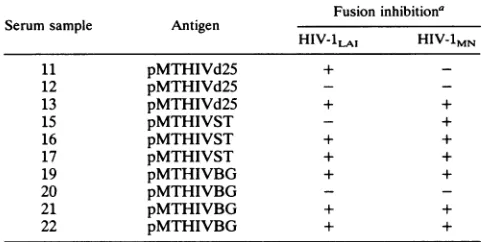
booster immunization (Table 2). Two of three animals im-munized with viruslikeparticles containing onlytheV3(LAI) domain (pMTHIVd25) responded with antibodies thatwere
effective inblocking syncytiainducedbyHIV-1LAI.Immune
serafrom five ofsevenguinea pigsimmunized withparticles containing the V3 loop domains ofHIV-1LAI andHIV-1MN (pMTHIVSTandpMTHIVBG)alsoblocked fusion of CD4-expressing cells with cells chronically infected with
HIV-1LAI*
Inaddition,
immunization with HIV-likeparticles
containingchimericenvelopeswasveryeffectiveininducing cross-neutralizing antibody responses since six of seven serumsamplesfromimmunized animalswereable toblock syncytia induced by either HIV-1LAI or HIV-lMN. Cross-neutralizing activitywasalso observed intheserumofoneof
threeguinea pigsimmunizedwith viruslikeparticles contain-ing only the V3(LAI) loop domain. Some of the serum samples were also checked for the ability to blockade HIV-1RF or HIV-2Z, and none of the tested samples
pre-vented syncytia induced by these viral strains (data not
shown).
DISCUSSION
We have previously established mammalian cell lines which produce noninfectious and immunogenic HIV-like
particles (28). The main objective of this study was to genetically engineerviruslikeparticleswith additional
mod-ifications to optimize their safety and develop a cross-protective AIDS vaccine candidate. Recent experiments
suggest that candidate AIDS vaccines should include the HIV-1 env glycoprotein, since neutralizing antibodies and protective immune responses were observed in animals immunizedwith variousenvantigen species (6, 21, 23, 48,
50, 51, 54). Therefore, an essential feature that must be incorporated into the design ofa safe andefficacious
parti-cle-based AIDS vaccine candidate is the insertion of immu-nogenic determinants that promote neutralizing and cross-protective immune responses.
Inthisstudywetested thefeasibilityof thisapproach by
engineering chimeric envelope proteins which contain the V3 neutralization epitopes oftwo of themostpredominant
HIV-1 isolates in North America. To establish whether HIV-like particles can expressenvproteinswith additional heterologous epitopes, weengineeredfour HIV-1LAI-based
expressionconstructsinwhich theenvgenewasmodifiedby
inserting heterologous DNA sequences coding for the neu-tralization epitope (YNKRKRIHIGPGRAFYTTKNIIG) of theV3(MN) loop (47).Insertion of theheterologousV3(MN)
loop segment into the conserved C2region of theenvprotein
either 173 (pMTHIVST) or 242 (pMTHIVBG) amino acid residues away from the N terminus ofmaturegpl20
(HIV-'LAI)
didnotaffect theprocessing
of chimericenvglycopro-TABLE 2. Cell fusion blockade
Fusion inhibitiona
Serumsample Antigen
HIV-1LAI HIV-1MN
11 pMTHIVd25 +
12 pMTHIVd25
-13 pMTHIVd25 + +
15 pMTHIVST - +
16 pMTHIVST + +
17 pMTHIVST + +
19 pMTHIVBG + +
20 pMTHIVBG
-21 pMTHIVBG + +
22 pMTHIVBG + +
aAdsorbedserumsamplesweretestedat afinal dilution of1/10toblock
syncytiumformation inducedbyCEM cellschronically infectedwitheither
HIV-lLAIorHIV-1MN(59).Numbers ofsyncytiain uninhibited wells
(pre-immuneornormalsera)weregreater than 50 for eachvirus. Anegative (-)
score indicates no inhibition and a positive score (+) indicates fusion inhibitionbythetestserum,with fiveorlesssyncytiaperwell.
on November 9, 2019 by guest
http://jvi.asm.org/
[image:6.612.316.557.553.674.2]teins or their association with HIV-like particles. In con-trast,insertion of the V3(MN) epitope into the conservedCl
region of gpl20 (HIV-1LAI) near the N terminus of the mature glycoprotein (pMTHIVKP) or replacement of 69 amino acids in the C2 region with this epitope (pMTHIVSB) resulted in the expression of viruslike particles devoid of env
glycoproteins. These modifications, however, did not affect thesynthesis of precursor glycoproteins. These observations suggest that the mutations likely resulted in an incorrect
folding of the chimeric gpl60, hindering its proteolytic
cleavage site. Previous studies have also demonstrated that mutations in these two regions ofgpl20 either abolished or
significantly reduced the processing ofgpl60 (29, 49). The site of insertion of the heterologous V3(MN) epitope
determined the ability of the four chimeric env glycoprotein precursors to bind to CD4. It has been shown that gpl20 residues located in the fourth conserved region (C4) are critical for CD4 binding (38), although other gpl20 amino acid residues have also been implicated in gpl20-CD4 inter-actions (36,49, 62). None of the V3(MN) insertions affected the critical gp120C4 region. However, only two of the four chimericenvelope precursors were able to bind to CD4. The fact that these unprocessed env glycoproteins were shown to associate with CD4 is consistent with the recent observation that cleavage ofgp160is not required for CD4 binding (15). Our results also confirm that mutations outside the critical
region required for CD4 binding may indirectly affect the conformationortheaccessibility of the CD4 binding site (9, 13, 36, 49, 62, 64).
Thetwoprocessed chimeric env proteins produced by the
pMTHIVSTand pMTHIVBG expression vectors expressed theheterologous V3(MN) loop epitope, and the env proteins were immunoprecipitated with an anti-gpl20 monoclonal
antibodywhich specifically recognizes a neutralization de-terminant of theV3(MN)loop (22). This finding suggests that additional neutralization epitopes can be inserted into the
envelopeof chimeric viruslike particles and remain antigenic regardless of significant conformational changes in gpl20 tertiary structure as exemplified by the loss of CD4 binding
activity observed for one of the antigenic constructs
(pMTHIVBG).
Forimmunogenicity studies, viruslike particles containing chimeric env proteins were expressed in Vero cell lines
stably transfected with expression plasmids pMTHIVd25,
pMTHIVST, and pMTHIVBG, respectively. All secreted HIV-likeparticleselicited strong envelope- andcore-specific humoral responses in mice immunized with these particles. Nonchimericparticles induced cross-reacting antibodies
rec-ognizing the V3(MN) segment. This observation may be
explained by the fact that the sequences of V3(LAI) and
V3(MN) epitopes are 65% similar and that both peptides share the highly conserved GPGRAF motif. However, chi-mericparticles induced a markedly enhanced
anti-V3(MN)-specific antibodyresponse as judged by a sixfoldincrease in
antibody titer. We have therefore identified two specific
endogenous restriction sites in the HIV-1LAIenv gene that can be utilized to insertDNA sequences coding for
immu-nogenicheterologous V3 loop epitopes without affecting env
protein processing and assembly into viruslike particles. Structural modifications of this nature could beincorporated into candidate HIV vaccines to broaden the specificity of cross-neutralizing antibodies.
Indeed, our results demonstrated that cross-neutralizing antibodies couldbe elicited inguinea pigs by immunization with chimeric HIV-like particles containing the immuno-dominantV3 loop epitopes ofHIV-1LAI andHIV-1MN. The
ability of chimeric particles to induce HIV-lMN
neutraliza-tion islikelyduetothe presenceof theheterologousV3(MN)
epitope, because six of seven animals immunized with these particles responded with antibodies that blocked HIV-lMN-specific cell fusion. Although the V3 region of gp120 gener-ates predominantly isolate-specific neutralizing antibodies, the highly conserved GPGRAF motif within the core of the V3 loop can generate broadly neutralizing antibodies (32). Since this motif is shared by theV3(LAI) and V3(MN) loops, this could partially explain the cross-neutralization observed with the serum from one of three guinea pigs immunized with nonchimeric
HIV-1LAI-like
particles. However, other fac-tors such as proper presentation of conserved conforma-tional epitopes could contribute to the induction of cross-neutralizing antibodies (27).In conclusion, we have shown that env genes can be manipulated to design structurally modified viruslike parti-cles capable of inducing cross-neutralizing antibodies. We suggest that a major advantage in using genetically engi-neered HIV-likeparticles as candidate AIDS vaccines isthe degree of flexibility conferred on the rational design of these particles. The safety and immunogenicity of particle-based vaccines can be optimized by introducing structural modifi-cations in selected viral antigens. Although the clinical efficacy of HIV-like particles with chimeric env proteins remains to be determined, vaccination with theseengineered immunogens may provide an alternative strategy for the prevention of disease and prove to be ofimmunotherapeutic value for the treatment of HIV-infected patients.
ACKNOWLEDGMENTS
We thank Lauren Rodrigues for excellent technical assistance. We also wish to acknowledge Lisa Liang for isolation and quanti-tation of viruslike particles, Dathao Nguyen and Danielle Power for contributions to the construction of some of the expression plasmid vectors, and Charlene B. McDanal for expert assistance with the syncytium blockade assays.
Thiswork was funded in part by the Ontario Technology Fund. S.Z.-P. was supported in part by research funds from the National Institutes of Health (AI72658) and the Department of Veterans Affairs. T.J.M. was supported in part by National Institutes of Health RO1 grant5-ROl-AI 30411.
REFERENCES
1. Aldovini, A., and R. Young. 1990. Mutations of RNA and protein sequences involved in human immunodeficiency virus type1packaging result in production of noninfectious virus. J. Virol. 64:1920-1926.
2. Allan, J. S., J. E. Coligan, F. Barin, M. F. McLane, J. G. Sodroski,C.A.Rosen, W. A. Haseltine, T. H.Lee, and M. Essex. 1985. Major glycoprotein antigens that induce antibodies in AIDS patients are encoded by HTLV-III. Science 228:1091-1094.
3. Arthur, L. O., J. W. Bess, Jr., D. J. Waters, S. W. Pyle, J. C. Kelliher, P. L. Nara, K. Krohn, W. G. Robey, A. J. Langlois, R. C. Gallo, and P. J. Fischinger. 1989. Challenge of chimpan-zees (Pan troglodytes) immunized with human immunodefi-ciency virus envelope glycoprotein gpl20. J. Virol. 63:5046-5053.
4. Arthur, L. O., S. W. Pyle, P. L. Nara, J. W. Bess, Jr., M. A. Gonda, J. C. Kelliher, R. V. Gilden, W. G. Robey, D. P. Bolognesi, R. C. Gallo, and P. J. Fishinger. 1987. Serological responses in chimpanzees inoculated with human immunodefi-ciency virus glycoprotein (gpl20)subunit vaccine. Proc. Natl. Acad. Sci. USA 84:8583-8587.
5. Barre-Sinoussi, F., J. C. Chermann, F. Rey, M. T. Nugeyre, S. Chamaret, J. Gruest, C. Dauguet, C. Axler-Blinn, F. Vezinet-Brun, C. Rouzioux, W. Rozenbaum, and L. Montagnier. 1983.
on November 9, 2019 by guest
http://jvi.asm.org/
Isolation of aT-lymphocyteretrovirus fromapatient atriskfor acquired immune deficiency syndrome (AIDS). Science 230: 868-871.
6. Berman, P. W., T. J. Gregory, L. Riddle, G. R. Nakamura, M. A. Champe,J. P.Porter, F. M. Wurm, R. D. Herschberg, E. K. Cobb,andJ. W.Eichberg. 1990. Protection of
chimpan-zeesfrom infection byHIV-1 aftervaccination with
recombi-nant glycoprotein gpl20but notgpl60. Nature (London) 345: 622-625.
7. Bolognesi,D. P.1989.HIVantibodiesand vaccinedesign.AIDS 3(Suppl. 1):S111-S118.
8. Chanh,T.C.,G. R.Dreesman,P. Kanda, G. P.Linette, J.T. Sparrow, D. D. Ho, and R. C. Kennedy. 1986. Induction of anti-HIVneutralizing antibodies by synthetic peptides. EMBO J.5:3065-3071.
9. Cordonnier, A.,Y. Riviere, L. Montagnier,and M. Emerman. 1989. Effects of mutations in hyperconserved regions of the extracellular glycoprotein of human immunodeficiency virus type 1onreceptorbinding.J. Virol. 63:4464-4468.
10. Dalgleish, A. G., P. C. L. Beverly, P. R. Clapham, D. H. Crawford,M. F.Greaves,and R.A. Weiss.1984. The CD4(T4) antigenisanessential component of the receptor for the AIDS retrovirus.Nature(London)312:763-766.
11. Desrosiers,R.C.,M.S.Wyand, T. Kodama, D. J. Ringler, L. 0. Arthur, P. K. Sehgal, N. L. Letvin, N. W. King, and M. D. Daniel. 1989. Vaccine protection against simian immunodefi-ciency virus infection. Proc. Natl. Acad. Sci. USA 86:6353-6357.
12. DiMarzo-Veronese, F.,A. L.deVico,T. D.Copeland, S. Orosz-Ian,R.C.Gallo,and M.G.Sarngadharam.1985. Characteriza-tionofgp4lasthetransmembraneproteincodedbythe HTLV-III/LAVenvelopegene.Science 229:1402-1405.
13. Dowbenko, D., G. Nakamura, C. Fennie, C. Chimasaki, L. Riddle, R. Harris, T. Gregory, and L. Lasky. 1988. Epitope mapping of the human immunodeficiency virus type 1 gpl20 withmonoclonal antibodies.J. Virol.62:4703-4711.
14. Durda,P.J., L.Bacheler,P.Klapham,A.M.Jenoski,B.Leece, T. J.Matthews, A. McKnight,R. Pomerantz,M. Rayner, and
K.J. Weinhold. 1990. HIV-1neutralizingmonoclonalantibodies inducedbyasynthetic peptide.AIDS Res. Hum. Retroviruses 6:1115-1123.
15. Earl, P. L., S. Koenig, and B. Moss. 1991. Biological and immunological properties of human immunodeficiency virus type 1envelopeglycoprotein: analysisofproteinswith
trunca-tions and deletrunca-tionsexpressed byrecombinant vaccinia viruses. J.Virol. 65:31-41.
16. Earl,P.L.,M.Robert-Guroff,T.J.Matthews,K.Krohn,W. T.
London,and B.Moss.1989. Isolate- andgroup-specificimmune responsestotheenvelopeproteinofhumanimmunodeficiency virusinducedbyalive recombinant vaccinia virus in macaques. AIDS Res. Hum. Retroviruses 5:23-32.
17. Gallo,R.C., S.Z. Salahuddin,M.Popovic,G.-M.Shearer,M. Kaplan,B. F.Haynes,T.Palker,R.Redfield, J.Oleske,B.Safai, G. White, P. Foster, and P. D. Markham. 1984. Frequent detection andisolationofcytopathic(HTVL-III)frompatients with AIDS and atrisk for AIDS. Science 224:500-503. 18. Gardner, M. B. 1990. Vaccination against SIV infection and
disease. AIDS Res. Hum. Retroviruses 6:835-846.
19. Gheysen,D.,E.Jacobs,F. deForesta,C.Thiriart,M.Francotte, D. Thines, and M. De Wilde. 1989. Assembly and release of HIV-1 precursorpr559agvirus-like particles fromrecombinant baculovirus-infectedcells. Cell 59:103-112.
20. Gibbs, C.J., Jr., R. Peters, M.Gravell, B.K. Johnson, F. C. Jensen,D.J.Carlo,andJ. Salk. 1991. Observations after human immunodeficiencyvirus immunization and challenge of human immunodeficiencyvirusseropositive and seronegative
chimpan-zees.Proc. Natl. Acad. Sci. USA 88:3348-3352.
21. Girard,M., M. P. Kieny,A.Pinter,F.Barre-Sinoussi,P.Nara, H.Kolbe,K.Kusumi,A.Chaput, T. Reinhart, E. Muchmore, J. Ronco,M. Kaczoreck,E.Gomard, J. C.Gluckman,and P. N. Fultz. 1991. Immunization of chimpanzeesconfers protection against challenge with human immunodeficiency virus. Proc. Natl. Acad. Sci. USA 88:542-546.
22. Gorny, M. K., J.-Y. Xu, V. Gianakakos, S. Karkowska, C. Williams,H.W.Sheppard, C. V.Hanson,and S.Zolla-Pazner. 1991. Production of site-selectedneutralizinghuman monoclo-nal antibodiesagainst the third variable domain of the human immunodeficiency virus type 1 envelope glycoprotein. Proc. Natl.Acad. Sci. USA88:3238-3242.
23. Goudsmit, J., C. Debouck, R. H. Meloen, L. Smit, M.Bakker, D. M.Asher, A. V. Wolff, C.J. Gibbs, Jr., and D. Carleton Gajdusek.1988.Humanimmunodeficiencyvirus type 1 neutral-izationepitope with conserved architecture elicits early type-specific antibodies in experimentally infected chimpanzees. Proc. Natl. Acad. Sci.USA 85:4478-4482.
24. Goudsmit, J.,C. L. Kuiken, and P. L. Nara. 1989. Linearversus
conformational variation of V3 neutralization domains of HIV-1 during experimental and natural infection. AIDS 3(Suppl. 1): S119-S123.
25. Haffar, O.,J.Garrigues, B. Travis, P. Moran, J. Zarling, and S. L. Hu. 1990.Humanimmunodeficiency virus-like, nonrepli-cating, gag-env particles assemble in a recombinant vaccinia virusexpressionsystem.J.Virol.64:2653-2659.
26. Haffar,0.K., M. D.Smithgall,P. A.Moran, B. M.Travis,J.M. Zarling, and S. L. Hu. 1991. HIV-specific humoral and cellular immunityin rabbitsvaccinated with recombinant human immu-nodeficiencyvirus-like gag-envparticles. Virology183:487-495. 27. Haigwood,N.L.,P. Nara,E.Brooks,G. A. VanNest, G.Ott, K.W.Higgins,N.Dunlop,C.J. Scandella,J.W.Eichberg, and K. S. Steimer. 1992. Native but not denatured recombinant human immunodeficiencyvirus type 1 gpl20generates broad-spectrum neutralizing antibodies in baboons. J. Virol. 66:172-182.
28. Haynes,J. R.,S. X.Cao,B.Rovinski, C.Sia,0.James,G. A. Dekaban, and M. Klein. 1991. Production of immunogenic HIV-1 virus-like particles in stably engineered monkey cell lines.AIDS Res. Hum. Retroviruses 7:17-27.
29. Helseth, E., U. Olshevsky, C. Furman,andJ. Sodroski. 1991. Human immunodeficiencyvirus type 1gpl20 envelope glyco-protein regions important forassociation with thegp4l
trans-membraneglycoprotein.J. Virol.65:2119-2123.
30. Ho, D. D., J. C. Kaplan, I. E. Rackauskas, and M. E.Gurney. 1988. Second conserved domain ofgpl20is important for HIV infectivity and antibody neutralization. Science 239:1021-1023. 31. Hu, S.L., J. Klaniecki, T. Dykers, P. Sridhar, and B. M. Travis. 1991. Neutralizing antibodies against HIV-1 BRU and SF2 isolates generated in mice immunized with recombinant
vac-cinia virus expressing HIV-1 (BRU) envelopeglycoproteins and boosted withhomologousgpl60.AIDS Res. Hum.Retroviruses 7:615-620.
32. Jahaverian, K., A.J. Langlois, G. J. LaRosa, A. T. Profy, D. Bolognesi, W. C. Herlihy, S. D. Putney, and T. J. Matthews. 1990. Broadly neutralizing antibodies elicited by the hypervari-able neutralizing determinant of HIV-1. Science250:1590-1593. 33. Karacostas, V., K. Nagashima, M. A. Gonda, and B. Moss. 1989. Human immunodeficiency virus-like particles produced by a
vaccinia virus expression vector. Proc. Natl. Acad. Sci. USA 86:8964-8967.
34. Kennedy, R. C., and T. C. Chanh. 1988. Perspectives on developing anti-idiotype-based vaccines for controlling HIV infection. AIDS 2(Suppl. 1):S119-S127.
35. Klatzman, D., E. Champagne, S. Chamaret, J. Gruest, D. Guetard, T. Hercend, J.-C. Gluckman, and L. Montagnier. 1984. T-lymphocyte T4 molecule behaves as the receptor for human retrovirusLAV. Nature(London) 312:767-768.
36. Kowalski, M., J. Potz, L.Basiripour, T. Dorman,W.C.Gou,S. Terwilliger, A. Daxton, C. Rosen, W. Haseltine, and J. Sodroski. 1987.Functional regions of theenvelopeglycoproteinof human immunodeficiencyvirus type 1. Science 237:1351-1355. 37. Laemmli, U. K. 1970.Cleavageofstructuralproteinsduringthe
assembly of the head ofbacteriophage T4. Nature (London) 227:680-685.
38. Lasky, L. A., G. Nakamura, D. H. Smith, C. Fennie, C. Shimasaki, E. Patzer, P. Berman, T. Gregory, and D.Capon. 1987. Delineation ofa regionofthe human immunodeficiency virustype 1gpl20glycoprotein critical forinteractionwith the
on November 9, 2019 by guest
http://jvi.asm.org/
CD4receptor. Cell 50:975-985.
39. Lever, A., H. Gottlinger, W. Haseltine, and J. Sodroski. 1989. Identification of a sequence required for efficient packaging of human immunodeficiency virus type 1 RNA into virions. J. Virol.63:4085-4087.
40. Lifson, J. D., M. B. Feinberg, G. R. Reyes, L. Rabin, B. Banapour, S. Chakrabarti, B. Moss, F. Wong-Staal, K. S. Steimer, and E. G. Engleman. 1986. Induction of CD4-depen-dent cell fusionby the HTLV-III/LAV envelope glycoprotein. Nature (London) 323:725-728.
41. Maddon, P. J., A. G. Dalgleish, J. S. McDougal,P. R.Clapham, R. A.Weiss, and R. Axel. 1986.TheT4geneencodesthe AIDS virus receptor andisexpressed inthe immune system and the brain. Cell 47:333-348.
42. Matsushita, S., M. Robert-Guroff, J. Rusche, A. Koito, T. Hattori, H. Hoshino, K. Javaherian, K. Takatsuki, and S. Putney. 1988. Characterization of a human immunodeficiency virus neutralizing monoclonal antibody and mapping of the neutralizing epitope. J. Virol. 62:2107-2114.
43. McCune, J. M., L. B. Rabin, M. B. Feinberg, M. Lieberman, J. C. Kosek, G. R. Reyes, and I. L. Weissman. 1988. Endopro-teolytic cleavage of gpl60 is required for the activation of humanimmunodeficiency virus. Cell 53:55-67.
44. Montagnier, L., J. C. Chermann, F. Barre-Sinoussi, S. Chama-ret, J. Gruest, M. T. Nugeyre, F. Rey, D. Dauget, E.Axler-Blin, F.Vezinet-Brun, L. Rouzioux, A. G. Salmot, W. Rozenbaum, J. C. Gluckman, D. Glutzman, E. Vilmer, C. Griscelli, C. Foyer-Gazagel, and J. C. Brunet. 1984. A new human T-lym-photropic retrovirus: characterization and possible role in lymphadenopathy and acquired immune deficiency syndromes, p. 363-379. In R. C. Gallo, M. E. Essex, and L. Gross (ed.), Human T-cell leukemia/lymphoma virus. Cold Spring Harbor Laboratory, Cold Spring Harbor, N.Y.
45. Murphey-Corb, M., L. N. Martin, B. Davison-Fairburn, R. C. Montelaro, M. Miller, M. West, S. Ohkawa, G. B.Baskin, J. Y. Zhang, S. D. Putney, A. C. Allison, and D. A.Eppstein. 1989. A formalin-inactivated whole SIV vaccine confers protection in macaques. Science 246:1293-1297.
46. Murphey-Corb, M., R. C. Montelaro, M. A. Miller, M. West, L. N. Martin, B. Davison-Fairburn, S. Ohkawa, G. B. Baskin, J. Y. Zhang, G. B. Miller, S. D. Putney, A. C. Allison, and D. A. Eppstein. 1991. Efficacy of SIV/DeltaB670 glycoprotein-en-riched and glycoprotein-depleted subunit vaccines in protecting against infection and disease in rhesus monkeys. AIDS 5:655-662.
47. Myers, G., J. A. Berzofsky, A. B. Rabson, T. F. Smith, and F. Wong-Staal (ed.). 1990. Human retroviruses and AIDS. Theo-retical Biology and Biophysics, Group T-10. Los Alamos Na-tional Laboratory, Los Alamos, N.Mex.
48. Nara, P. L., W. G. Robey, S. W. Pyle, W. C. Hatch, N. M. Dunlop, J. W. Bess, Jr., J. C. Kelliher, L. 0. Arthur, and P. J. Fischinger. 1988. Purified envelope glycoproteins from human immunodeficiencyvirus type1variants induce individual, type-specific neutralizingantibodies. J. Virol. 62:2622-2628. 49. Olshevsky,U., E. Helseth, C. Furman, J. Li, W. Haseltine, and
J. Sodroski. 1990. Identification of individual human immuno-deficiency virus type 1 gpl20 amino acids important for CD4 receptorbinding. J. Virol. 64:5701-5707.
50. Palker, T. J., M.E.Clark, A. J. Langlois, T. J. Matthews, K. J. Weinhold, R. R. Randall, D. P. Bolognesi, and B. F. Haynes. 1988. Type-specific neutralization of the human immunodefi-ciencyvirus with antibodies to env-encoded synthetic peptides. Proc. Natl. Acad. Sci. USA85:1932-1936.
51. Palker, T. J., T. J.Matthews,A.Langlois, M. E. Tanner, M. E. Martin, R. M. Scearce, J. E. Kim, J. A. Berzofsky, D. P. Bolognesi, and B. F. Haynes. 1989. Polyvalent human immuno-deficiency virus synthetic immunogen comprised of envelope gpl20Thelpercell sites and B cell neutralization epitopes. J. Immunol. 142:3612-3619.
52. Popovic, M., M. G. Sarngadharan, E. Read, and R. C. Gallo. 1984. Detection, isolation, and continuous production of cyto-pathic retroviruses (HTLV-III) from patients with AIDS and pre-AIDS. Science224:497-500.
53. Redfield, R. R., D. L. Birx, N. Ketter, E. Tramont, V. Polonis, C. Davis, J. F. Brundage, G. Smith, S. Johnson, A. Fowler, T. Wierzba, A. Shafferman, F. Volvovitz, C. Oster, D. S. Burke, and the Military Medical Consortium for Applied Retroviral Research. 1991. A phase I evaluation of the safety and immu-nogenicity of vaccination with recombinant gpl60 in patients with early humanimmunodeficiency virus infection. N. Engl. J. Med. 324:1677-1684.
54. Robey, W. G., L.0. Arthur, T. J. Matthews, A. Langlois, T. D. Copeland, N. W. Lerche, S. Oroszlan, D. P. Bolognesi, R. V. Gilden, and P. J. Fischinger. 1986. Prospect for prevention of human immunodeficiency virus infection: purified 120-kDa en-velope glycoprotein induces neutralizing antibody. Proc. Natl. Acad. Sci. USA 83:7023-7027.
55. Robey, W. G., B. Satai, S. Oroszlan, L.0. Arthur, M. A. Gonda, R. C. Gallo, and P. J. Fischinger. 1985. Characterization of envelope and core structural gene products ofHTLV-III with sera from AIDS patients. Science228:583-595.
56. Rusche, J. R., K. Javaherian, C. McDanal, J. Petro, D. L. Lynn, R. Grimaila, A. Langlois, R. C. Gallo, L. 0. Arthur, P. J. Fischinger, D. P. Bolognesi, S. D. Putney, and T. J. Matthews. 1988. Antibodies that inhibit fusion of humanimmunodeficiency virus-infected cells bind a 24-amino acid sequence of the viral envelope, gpl20. Proc. Natl. Acad. Sci. USA85:3198-3202. 57. Shafferman,A., P. B. Jahrling, R. E. Benveniste, M. G.Lewis,
T. J. Phipps, F. Eden-McCutchan, J. Sadoff, G. A. Eddy, and D. S. Burke. 1991. Protection of macaques with a simian immunodeficiency virus envelope peptide vaccine based on conserved human immunodeficiency virus type 1 sequences. Proc. Natl. Acad. Sci. USA 88:7126-7130.
58. Shioda, T., and H. Shibuta. 1990. Production of human immu-nodeficiency virus (HIV)-like particles from cells infected with recombinant vaccinia viruses carrying the gag gene of HIV. Virology 175:139-148.
59. Skinner, M. A., A. J. Langlois, C. B. McDanal, J. S. McDougal, D. P. Bolognesi, and T. J. Matthews. 1988. Neutralizing antibod-ies to an immunodominant envelope sequence do not prevent gpl20binding to CD4. J. Virol. 62:4195-4200.
60. Smith, A. J., M.-I. Cho, M. L. Hammarskjold,and D. Rekosh. 1990. Human immunodeficiency virus type 1 Pr55gag and Prlfflg'"° expressed from a simian virus 40 late replacement vector are efficiently processed and assembled into virus-like particles. J. Virol. 64:2743-2750.
61. Sutjipto, S., N. C. Pedersen, C. J. Miller, M. B. Gardner, C. V. Hanson, A. Gettie, M. Jennings, J. Higgins, and P. A. Marx. 1990. Inactivated simian immunodeficiency virus vaccine failed toprotect rhesusmacaques from intravenous or genital mucosal infection but delayed disease in intravenously exposed animals. J. Virol. 64:2290-2297.
62. Syu, W., Jr., J.-H. Huang, M. Essex, and T.-H. Lee. 1990. The N-terminal region of the human immunodeficiency virus enve-lope glycoprotein gpl20 contains potential binding sites for CD4. Proc. Natl. Acad. Sci. USA 87:3695-3699.
63. Towbin, H., T. Staehelin, and Gordon, J. 1979. Electrophoretic transfer of proteins from polyacrylamide gels to nitrocellulose sheets: procedure and some applications. Proc. Natl. Acad. Sci. USA76:4350-4354.
64. Tschachler, E., H. Buchow, R. C. Gallo, and M. S. Reitz, Jr. 1990.Functional contribution of cysteine residues to the human immunodeficiency virus type 1 envelope. J. Virol. 64:2250-2259.
65. Van Eendenburg, J. P., M. Yagello, M. Girard, M. P. Kieny, J. P. Lecocq, E. Muchmore, P. N. Fultz, Y. Riviere, L. Montag-nier, and J. C.Gluckman. 1989. Cell-mediated immune prolif-erative responses to HIV-1 of chimpanzees vaccinated with different vacciniarecombinant viruses. AIDS Res. Hum. Ret-roviruses 5:41-50.
66. Vzorov, A.N., M.I. Bukrinsky, V. B. Grigoriev, Y. Y. Tentsov, and A. G. Bukrinskaya. 1991. Highly immunogenic human immunodeficiency virus-like particles are produced by recom-binant vacciniavirus-infected cells. AIDS Res. Hum. Retrovi-ruses 7:29-36.
67. Willey, R. L., J. S. Bonifacino, B. J. Potts, M. A. Martin, and
on November 9, 2019 by guest
http://jvi.asm.org/
R. D. Klausner. 1988. Biosynthesis, cleavage, and degradation of the human immunodeficiency virus 1 envelope glycoprotein gpl60. Proc. Natl. Acad. Sci. USA 85:9580-9584.
68. Zagury,D., J. Bernard, R. Cheynier,I.Leonard, M. Fouchard,
B. Receil, D. Ittele, Z. Lurhuma, K. Mbayo, J. Wane, J. J.
Salaun, B. Goussard, L. Dechazal, A. Burny, P. Nara, and R. C. Gallo. 1988. A group-specific anamnestic immune reaction
against HIV-1 induced by acandidate vaccine against AIDS.
Nature (London) 332:728-731.
69. Zarling, J. M., J. W. Eichberg, P. A. Moran, J. McClure,P.
Sridhar, and S. L. Hu. 1987. Proliferative and cytotoxicT cells
toAIDS virusglycoproteinsinchimpanzeesimmunized witha
recombinant vaccinia virus expressing AIDS virus envelope glycoproteins. J. Immunol. 139:988-990.